







Abstract
In this paper, we bring to the fore the role of relationships in serial acquirers. Through an in-depth, qualitative, longitudinal study, we explore how engaging in sequential and overlapping processes of postacquisition integration impairs the integration capabilities of serial acquirers. We identify how the relational dynamics that follow each individual integration initiative impede the ability of acquiring firms to operate business as usual, as well as to integrate new targets. Our study offers deep insight into the complexities of serial acquisitions, by conceptualizing the nature and composition of integration capabilities, and the role of relationships in organizations undergoing frequent changes. Based on our findings, we assert that relationships deserve more attention in serial acquisitions; they serve as mechanisms that provide the social fabric of coordination and capability development.
Serial acquirers are firms that engage in a stream of acquisitions to expand, increase their resource base, and internationalize (Chatterjee, 2009; Smit & Moraitis, 2010; Vermeulen & Barkema, 2001). To achieve strategic benefits and create value from the deals, effective postacquisition integration is necessary (Haspeslagh & Jemison, 1991b). Postacquisition integration includes the combination, alignment, and coordination of structures, resources, and processes across the target and acquiring firms (Graebner, Heimeriks, Quy Nguyen, & Vaara, 2017). However, scholars have extensively documented the difficulties firms face in achieving the desired level and mode of integration (Brueller, Carmeli, & Markman, 2018). Postacquisition integration is a complex and unpredictable process that strains managerial capabilities and requires extensive efforts and resource dedication (Graebner, 2004; Larsson & Finkelstein, 1999; Zorn, Sexton, Bhussar, & Lamont, 2019). For serial acquirers, the challenges of integration extend beyond the single acquisition, as their string of sequential and potentially overlapping integration processes puts additional strains on their organization (Barkema & Schijven, 2008b; Kusewitt, 1985; Klarner & Raisch, 2013).
Serial acquirers may offset the challenges and costs associated with implementing a stream of acquisitions by developing integration capabilities (Laamanen & Keil, 2008; Mitchell & Shaver, 2003). Integration capabilities consist of the ability and capacity to manage the process through which the target and acquirer's structures, processes, and resources are aligned (Zollo & Singh, 2004). Although recent studies have provided important insights into serial acquirers and the key role of integration capabilities (Barkema & Schijven, 2008b; Laamanen & Keil, 2008; Zollo, 2009; Zollo, Leshchinskii, & De, 2013), they are rather silent on the constituent elements of integration capabilities and the processes through which they evolve. Moreover, there is a lack of studies that empirically examines the mechanisms through which outcomes are produced in serial acquirers (Graebner et al., 2017). We thus argue that there is a need to open the “black box” to explore the processes through which integration capabilities and organizational inefficiencies accumulate in serial acquirers (Barkema & Schijven, 2008a, 2008b). This knowledge is key to understanding (a) how managers can mitigate the costs and challenges of engaging in a sequence of challenging, time-consuming, and resource-demanding integration processes, and (b) the implications for their organizations.
We began with the general question of how the consequences of carrying out a series of acquisitions accumulate in serial acquirers. To investigate these concerns, we conducted a qualitative, longitudinal case study of a Scandinavian IT company, SerialFirm, as it carried out a series of acquisitions. We initially observed how relational dynamics played an important role in each integration process. This discovery prompted us to focus on the dynamics of relationships in the serial acquirer. It is well established in the literature that relationships are central vehicles for coordination, knowledge sharing, and problem solving in organizations (Huang, Luo, Liu, & Yang, 2016) and thus constitute an important integration mechanism (Uzzi, 1997). Moreover, we argue that postacquisition integration, at its core, involves relational dynamics. On the one hand, to achieve coordination benefits, postacquisition integration involves the establishment of new relationships across previous firm boundaries (Puranam, Singh, & Chaudhuri, 2009; Ranft & Lord, 2002). On the other hand, structural integration leads to organizational changes that displace organizational members and disrupt existing relationships, thus potentially destroying socially embedded strategic capabilities (Briscoe & Tsai, 2011; Colman & Rouzies, 2019; Spedale, Van Den Bosch, & Volberda, 2007). A rich understanding of how relationships play out in serial acquirers may shed important light on the organizational consequences of carrying out continual and overlapping integration processes. This insight may enhance current conceptualizations of integration capabilities. In this paper we therefore ask the following: How do relational dynamics influence integration capabilities over time in serial acquirers?
Our findings make important contributions to the literature. First, our study builds on and extends the literature on integration capabilities (Laamanen & Keil, 2008; Mitchell & Shaver, 2003; Zollo, 2009; Zollo et al., 2013). We shed new light on how integration capabilities evolve by identifying and conceptualizing their constituent elements, as well as their dynamic and embedded nature. Our study shows that integration capabilities reside broadly in the organization and informs its ability to coordinate actions and learn. In doing so, we identify the paradox of integration capabilities: the very elements that allow firms to successfully integrate are the very ones that are challenged during integration efforts.
Second, we empirically document and theorize the process through which relational disruptions over time deplete the integration capabilities of serial acquirers. Importantly, we show how relational disruptions accumulate in serial acquirers’ organizations and compromise the context for nurturing integration capabilities. The continuous deterioration of the relational fabric will leave the firm increasingly less able to operate its normal business as well as integrate new targets. This finding illuminates the organizational contingencies for learning from acquisitions by emphasizing relationships as key conduits of knowledge transfer and coordination in organizations.
Third, we pave the way for new insights into the organizational consequences of integrating a string of acquisitions by conceptualizing the role of relationships. Our fine-grained data and detailed exploration allow us to shift the conversation from emphasizing variance-based explanation models toward a deeper understanding of the organizational processes of serial acquirers. In doing so, we augment studies that have highlighted the implications of suboptimal integration and organizational inefficiencies in serial acquirers (Barkema & Schijven, 2008b; Kusewitt, 1985) by empirically identifying and theorizing relational dynamics as the mechanism through which organizational inefficiencies accumulate. In addition, we show that relationships are disrupted by events intended for organizational restructuring, which suggests that these events should be managed with caution, even though they have been shown to generate efficient results in the long run (Barkema & Schijven, 2008b). The novelty of our contribution lies in unraveling the role of relationships in organizations exposed to continual structural changes. We find that while serial acquirers are under constant pressure to “pull together” and integrate individual acquisitions, their organizations are increasingly “falling apart.”
A Relational Perspective on Integration Capabilities
Serial Acquirers and Integration Capabilities
The challenges of integrating single deals have been documented extensively. Prior research has shown that postacquisition integration requires substantial managerial attention, effort, and resource dedication (Larsson & Finkelstein, 1999), which may divert attention from ongoing operations and destroy the strategic capabilities that motivated the deal (Puranam, Singh, & Zollo, 2006). The structural combination of the target and acquirer's organizations is an important means of integration to realize intended synergies, whereas the development of a common social community is a particularly important means of integration for the transfer of socially complex knowledge (Bresman, Birkinshaw, & Nobel, 1999; Puranam et al., 2009). Both structural and social integration are needed to ensure the coordination of target and acquiring firm's resources and activities for successful postacquisition implementation (Birkinshaw, Bresman, & Håkanson, 2000).
Research findings differ regarding the performance impact of a serial acquirer's past acquisition experiences. Some studies document positive effects, explained by the ability of serial acquirers to benefit from accumulated learning grounded in past acquisition experiences (Laamanen & Keil, 2008). Other studies show declining performance as more acquisitions are added (Rahahleh & Wei, 2012). Studies have shown that serial acquirers struggle to assimilate frequent deals, “biting off more than they can chew,” which leads to organizational “indigestion” (Kusewitt, 1985). This indigestion causes impeded managerial decision-making and suboptimal integration of the target's resources and activities (Barkema & Schijven, 2008b). Thus, negative effects result from the added costs and complexities facing the acquirer's increasingly strained management resources, leading to a decreasing organizational fit for each new acquisition (Barkema & Schijven, 2008b).
To offset the negative implications of carrying out a series of acquisitions, firms may develop integration capabilities (Bingham, Heimeriks, Schijven, & Gates, 2015). Scholars have documented that firms can become more efficient acquirers by drawing on their acquisition experience (Barkema & Schijven, 2008a). Integration capabilities can be defined as “the ability to absorb and manage business resources on a continuing basis” (Mitchell & Shaver, 2003, p. 171). They are the firm-level capabilities that facilitate the implementation of the integration process (Zollo et al., 2013) and comprise the knowledge and skills serial acquirers can draw on when engaging in a series of acquisitions (Laamanen & Keil, 2008). Successful integration rests on the ability to develop a context and mindset that guides integrations—the former to ensure that the strategic agenda is followed and to manage interfaces between the target and acquirer, the latter to create a joint vision, transfer capabilities, and encourage continual learning (Haspeslagh & Jemison, 1991a). Moreover, firms with integration capabilities are more likely to acquire (Mitchell & Shaver, 2003); they are also better at breaking inertia and changing their organizational structure to accommodate new acquisitions (Hitt, Harrison, Ireland, & Best, 1998).
Building integration capabilities hinges on the acquirer's ability to learn from past acquisition experiences (Hayward, 2002). Integration capabilities are developed through deliberate learning and documentation processes (Bingham et al., 2015; Zollo, 2009; Zollo & Singh, 2004), which themselves are fostered by retaining top managers (Zollo et al., 2013) and establishing dedicated organizational units (Trichterborn, Zu Knyphausen-Aufseß, & Schweizer, 2016). However, learning from acquisition experience is challenging for acquiring firms because acquisition decisions are diverse and complex, occur relatively infrequently (Zollo, 2009), and are characterized by causal ambiguity (Cording, Christmann, & King, 2008). Notably, while the literature provides valuable insights into integration capabilities, few empirical studies have explored in depth the processes through which integration capabilities evolve in the organization. Thus, our knowledge is limited regarding how integration capabilities emerge or deteriorate over time in serial acquirers.
A Relational Perspective on Serial Acquirers
Embedded relationships are core mechanisms of integration (Uzzi, 1997) that complement formal organizational structures (Puranam et al., 2009; Tsai, 2002). While the notion of relationships refers to bonds between two or more actors, the notion of embedded relationships captures that they do not exist in isolation, rather they are nested within a network of other relationships (Granovetter, 1985; Uzzi, 1997). Embedded relationships are characterized by patterns of reciprocity, positive sentiments, and shared norms and goals. They foster predictable action, lower monitoring costs, improve joint problem solving, and facilitate knowledge transfer (Huang et al., 2016). Further, embedded relationships provide conduits for boundary-spanning behavior that constitute the building blocks for cooperation and coordination between the acquirer and target (Colman & Rouzies, 2019); thus, they foster postacquisition integration and facilitate knowledge sharing (Bresman et al., 1999).
Structural integration is an important means by which managers design a joint formal organization that represents the desired patterns of interaction between the acquirer and target (Puranam et al., 2009; Zaheer, Castañer, & Souder, 2013). Formal structures support the formation of embedded relationships (Kleinbaum & Stuart, 2014), providing physical proximity that increases the probability of interaction and thus the likely formation of new relationships (Clement & Puranam, 2018; Reagans, 2011). Relationships develop through recurrent interaction and repeated exchanges (Trapido, 2007), a process that requires time (Gargiulo & Benassi, 2000; Jansen, Tempelaar, van den Bosch, & Volberda, 2009) but is largely beyond managerial control (Lamont, Williams, & Hoffman, 1994). Thus, while formal structures that stimulate the formation of new relationships and intended patterns of interaction may be readily designed, the actual patterns of social interaction may lag, resulting in inconsistencies between the formal and informal organization (Gulati & Puranam, 2009).
Relational inertia is the tendency for people to routinely repeat past actions and interactions with people they already know. It follows that existing interactions become cemented and remain unexamined, based on familiarity and reciprocal commitments over time, so that pursuing new relationships becomes less compelling or meaningful (Gargiulo & Benassi, 2000). In other words, organizational members often prefer interaction through existing relationships and are cautious about forming new relationships across preacquisition boundaries (Briscoe & Tsai, 2011; Kim, Oh, & Swaminathan, 2006). As a result, interaction in the merged unit may suffer from two inertia-related errors (Clement & Puranam, 2018). First, organizational members may fail to interact with new actors they now depend on according to a new postacquisition formal structure; second, they may engage with another actor they do not depend on in the new structure but are familiar with from the preintegration structure. The first error prevents the discovery and management of interdependencies between actors, whereas the second error undermines performance as individuals continue to nurture relationships that, within the new organization's formal structure, are less important (Clement & Puranam, 2018). However, on the positive side, inert embedded relationships and lagging informal structures may facilitate speed and quality of decision-making (Uzzi, 1997) and provide conduits for advice, information, and gossip that compensate for inefficiencies in the new formal structure (Gulati & Puranam, 2009). Thus, these prior relationships may provide important informal postacquisition integration mechanisms that mitigate for inefficiencies as the organization establishes a new structure.
As target and acquirer organizations are joined, existing embedded relationships may be severed and dissolved (Spedale et al., 2007). Briscoe and Tsai's (2011) study shows that post acquisition, although new ties form, they do so at the expense of embedded relationships in the preacquisition unit. The changes involved in structural integration, such as the displacement of employees, introduction of new colleagues, and establishment of new reporting lines, may disrupt the social context and the existing relationships in the organization (Paruchuri, Nerkar, & Hambrick, 2006), thereby destroying tacit and socially complex knowledge that resides in fragile relationships (Paruchuri & Eisenman, 2012; Ranft & Lord, 2002).
There is no question that the current literature acknowledges the importance of embedded relationships as conduits of coordination and socially complex knowledge, including affirming the need to preserve these relationships, post acquisition. Indeed, a relatively recent stream of research has emphasized this relational approach, focusing on single acquisitions (Rogan & Sorenson, 2014). However, it offers little insight into how relational dynamics unfold over time and shape the integration capabilities of serial acquirers. For serial acquirers, relational dynamics extend beyond the single integration process as the focal integration process is nested within, and overlaps with, prior integration processes (Barkema & Schijven, 2008b; Zorn et al., 2019). We argue that examining relationships at the nexus of postacquisition integration has the potential to further our knowledge of integration capabilities in serial acquirers.
Methods
This paper reports the findings of a longitudinal, qualitative case study of a serial acquirer. Our case firm is a public, Scandinavian, multinational enterprise that delivers IT operations and solutions, hereafter referred to as SerialFirm. We gained access to SerialFirm as the firm embarked on a growth strategy, engaging in a stream of acquisitions. Throughout our observation period, SerialFirm carried out more than 20 acquisitions, divested noncore businesses, and reorganized. At the outset of the study, the firm employed about 2500 people; at the last data gathering, the firm had grown to approximately 5200 employees.
In this study, we aim to build theory on how relational dynamics influence integration capabilities in serial acquirers by exploring the unfolding complexities and dynamics involved in postacquisition integrations. Thus, a longitudinal, qualitative case study that draws on several sources of evidence is appropriate. Qualitative research designs are well suited for the development of rigorous and context-sensitive theory (Gioia, Corley, & Hamilton, 2013); further, they work well for the study of processes that involve temporal dynamics that are also embedded in nuanced social interactions (Graebner, Martin, & Roundy, 2012). Our research design allowed us to trace the unfolding of events in real time over a period in which SerialFirm embarked on a growth strategy, carrying out a stream of acquisitions, as noted above. This allowed for unique data gathered in real time.
In qualitative research, sampling is purposeful and not random—a logic implying the selection of information-rich cases allowing for in-depth study of the dynamics of interest (Patton, 1990). SerialFirm represents a particularly revealing case, providing rich data through access to transparent observations of the mechanisms and processes in serial acquisitions (Pettigrew, 1990). First, SerialFirm had an explicit “growth through acquisition strategy,” providing us the opportunity to examine a serial acquirer in real time. Second, in the field of IT operations, the process of achieving synergies from acquisitions requires structural integration and the careful management of target technologies to avoid disruptions to daily operations. Such complex integration makes SerialFirm a particularly fruitful setting for our study.
Data Gathering
The data were collected over a three-year period and include several sources. First, we conducted 102 in-depth interviews with the top management team, union representatives, middle managers, and employees. Second, we observed various meetings and work groups, including attending the corporate management team summit, integration planning and transformation project meetings, company presentations, and information meetings for the employees held by the CEO and vice presidents over the study period. Third, the first author was provided an office space at SerialFirm headquarters, allowing for continual informal observations and conversations with managers and employees. Finally, archival data were made available to the researchers, covering the study period, which encompassed published and unpublished material and documents of various kinds (annual reports, business cases, strategy documents, newspaper articles, intranet articles, and other internal documents). Table 1 shows the various sources of data, and their use in the analysis.
Data Sources and Uses
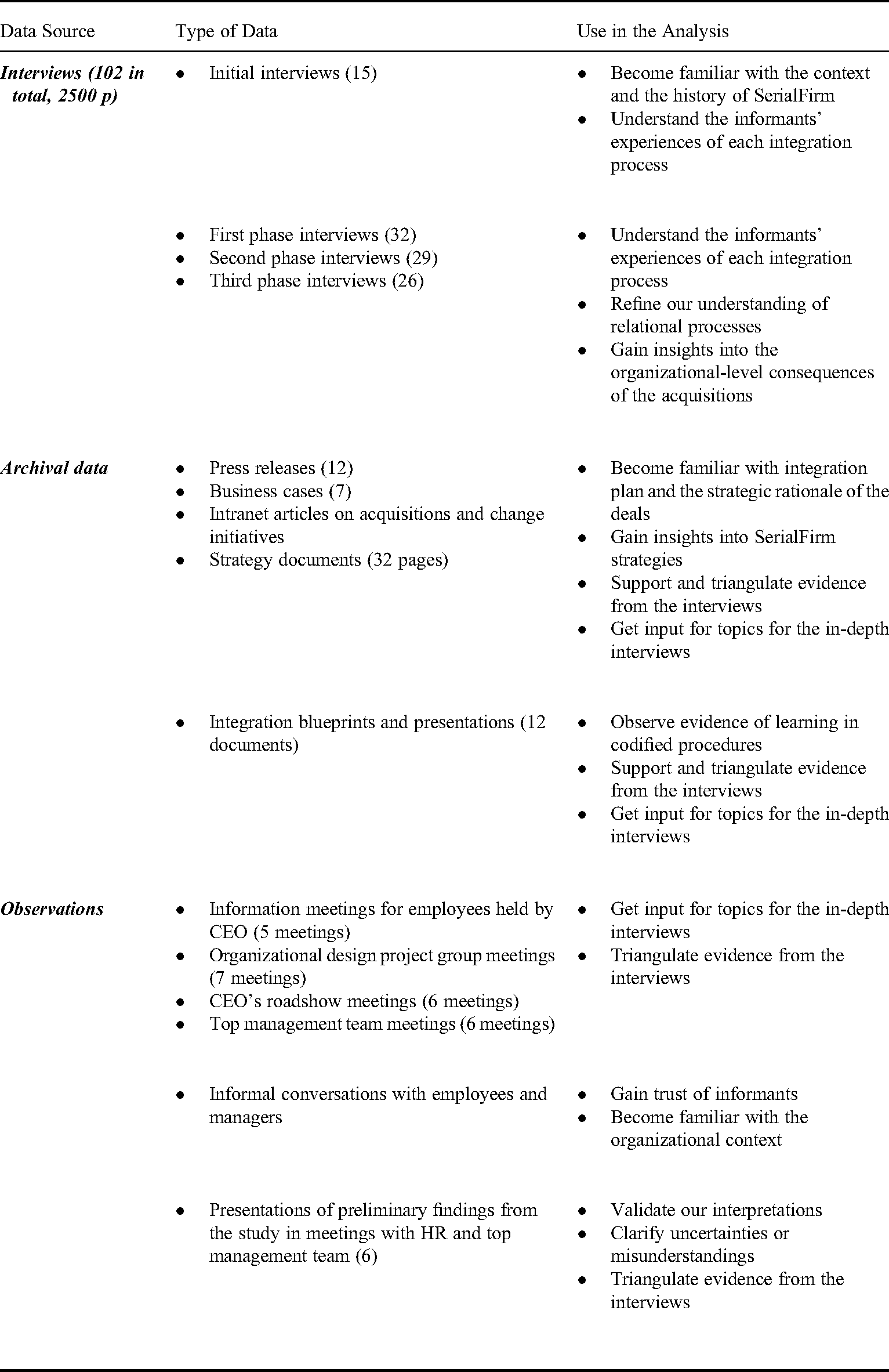
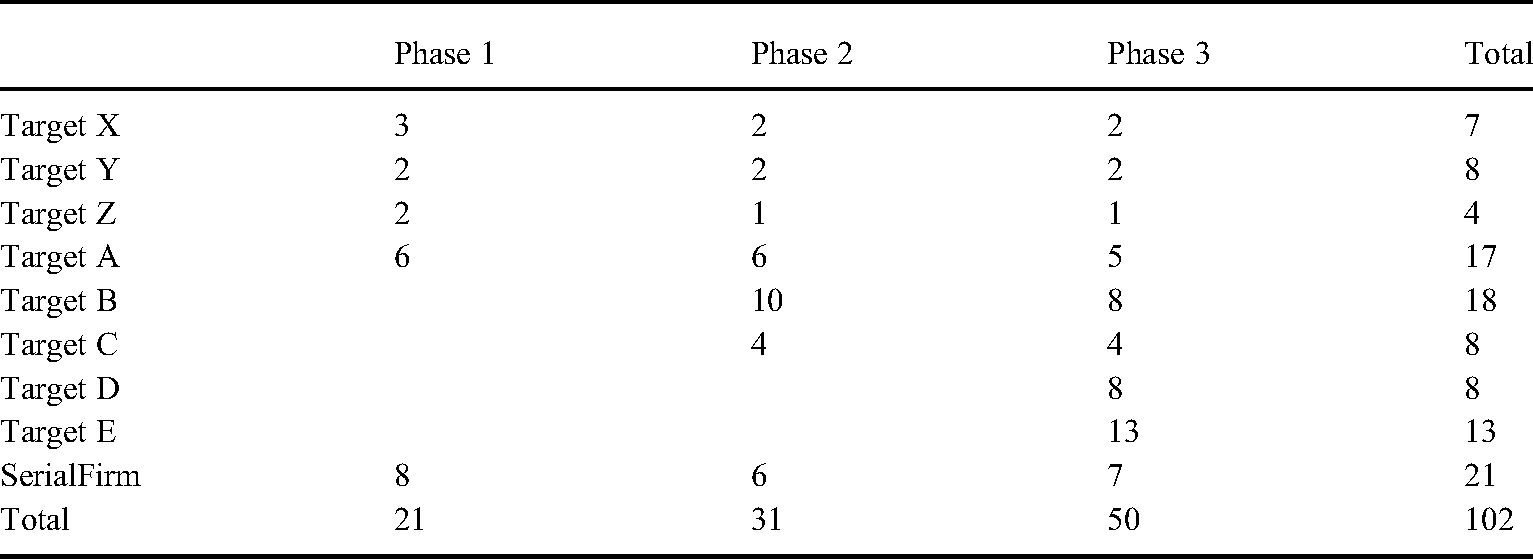
Our main data source was the in-depth interviews. Qualitative interviews are fitting to tap into organizational members’ accounts and interpretations of unfolding integration processes and the organizational outcomes they entailed. Snowball sampling led us to informants; specifically, we received suggestions from our contact person in the company of initial key respondents who, in turn, suggested additional respondents. We selected informants from different parts of the organizations. First, we picked informants by tracing each acquisition, interviewing both target and acquiring firm managers and key employees that were exposed to the integration process. This included integration managers, operational managers, and functional managers. Second, we selected informants involved in the organizational restructuring initiative (“one firm” initiative): the project managers, the team members, and operational managers, and employees particularly involved in the process. Third, we interviewed the top management team and union representatives (see Table 2). Because a varied sample of informants is less likely to represent the same biases, this process limits biases that could arise from retrospective sense making and impression management (Eisenhardt & Graebner, 2007). We interviewed until saturation—that is, until each new interview provided little new knowledge (Charmaz, 2006).
Number of Interviews per Firm and Phase
We developed an interview guide focused on relevant topics, while allowing for the exploration of new areas (Charmaz, 2006). We wanted each respondent to talk about the unfolding integration processes and their role and experience with the new organization. As our study is concerned with understanding how and why the integration processes and the organization of a serial acquirer evolve as they do over time, we encouraged our informants to tell their stories about what happened, including who did what and when (Langley, 1999). In the interviews we probed into (a) the events of each postacquisition integration phase, (b) the consequences of these events, (c) the challenges involved in carrying out business as usual, and (d) the characteristics of the various organizations. The interviews lasted from one to two hours. With the permission of the informants, we recorded and transcribed the interviews verbatim and organized our data (interview transcripts, field notes, and archival data) in Atlas.ti.
Data Analysis
We focused our data analysis on three targets acquired two years prior to the initiation of our study (targets X, Y, and Z) and five targets acquired during our study period (targets A, B, C, D, and E) (see Figure 1). Importantly, these were large acquisitions with substantial ramifications for many managers and employees, which thus had significant impacts on SerialFirm's organization.
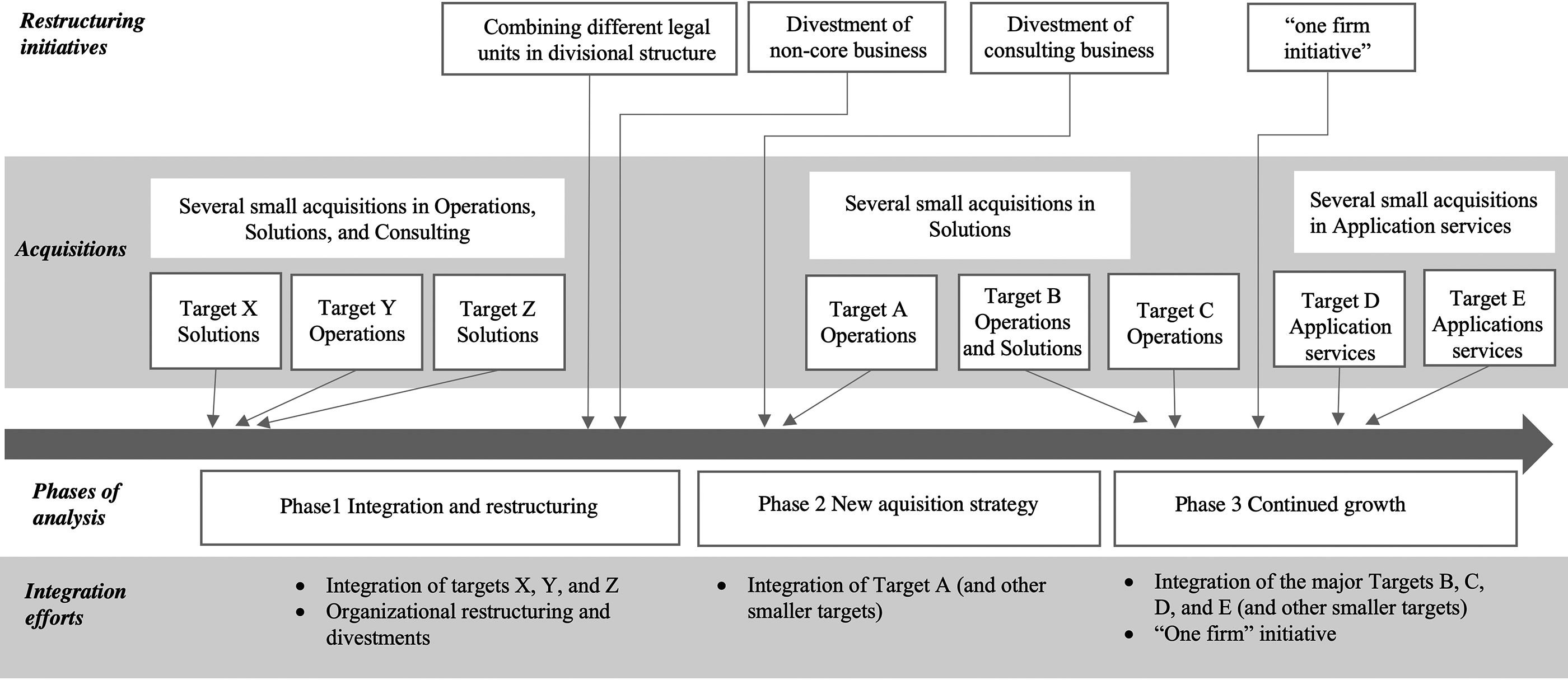
Timeline of Events, Integration Efforts, and Organizational-level Outcomes.
We initially developed a case history based on a chronology of key events (Miles, Huberman, & Saldana, 2020; see Figure 1). This chronology included the various acquisitions, the integration efforts, and the structural changes SerialFirm carried out during the study period. In line with strategies for temporal bracketing, we deconstructed our data into three successive adjacent phases, reflecting the reality of unfolding events (Langley, 1999). The first phase comprised the structural integration processes of acquisitions carried out two years prior. Previous acquisitions—specifically targets X, Y, and Z—had been granted substantial autonomy; they had either been “grafted onto” the SerialFirm organization as separate units or been established as independent business units. Nevertheless, they were still salient and distinguishable units in the SerialFirm organization, both in terms of deliveries and resources. In this phase, SerialFirm managers described how their main challenge going forward, in pursuit of their strategic agenda, was integrating activities and resources to achieve scale advantages across these previously acquired units. This prompted the top management team to initiate a consolidation strategy, which included divesting noncore businesses and combining all business units into one legal structure.
In the second phase, SerialFirm pursued additional growth, acquiring target A. Target A was a relatively large acquisition that received significant attention in the organization. SerialFirm planned to fully integrate it into one of its business units. In addition, they acquired smaller targets and divested their consulting business. In phase three, targets B, C, D, and E were acquired. As well, SerialFirm carried out a large organizational restructuring initiative, labeled “The One Firm Initiative.” It included redesigning their organization toward better coordination and a shared culture and identity.
Our analysis followed established procedures for grounded theory to analyze qualitative data (Charmaz, 2006). We first engaged in open coding, identifying key themes in our informants’ stories (Coffey & Atkinson, 1996; Van Maanen, 1998). These first-order categories consisted of the core and recurrent expressions in our informants’ narratives. Next, we engaged in axial coding, searching for relationships between the emergent categories (Strauss & Corbin, 1998). These second-order concepts captured our understanding of the elements involved in the integration processes in the serial acquirer, such as relational inertia, insufficient relationship formation, and suboptimal integration.
As is common in qualitative inductive studies, data gathering and data analysis are closely related (Langley, 1999). We did not employ predetermined categories of analysis but allowed the empirical reality to define these. Categories and dimensions of analysis emerged by juxtaposing the themes in the interview transcripts with existing theory. In this manner, the constructs that emerged in the early interviews were refined and challenged as we continued interviewing. As our data analysis progressed, emergent themes and constructs continued to evolve, which contributes to the depth, openness, and detail that are among the benefits of qualitative inquiry (Patton, 1990). Figure 2 shows the structure of our data.
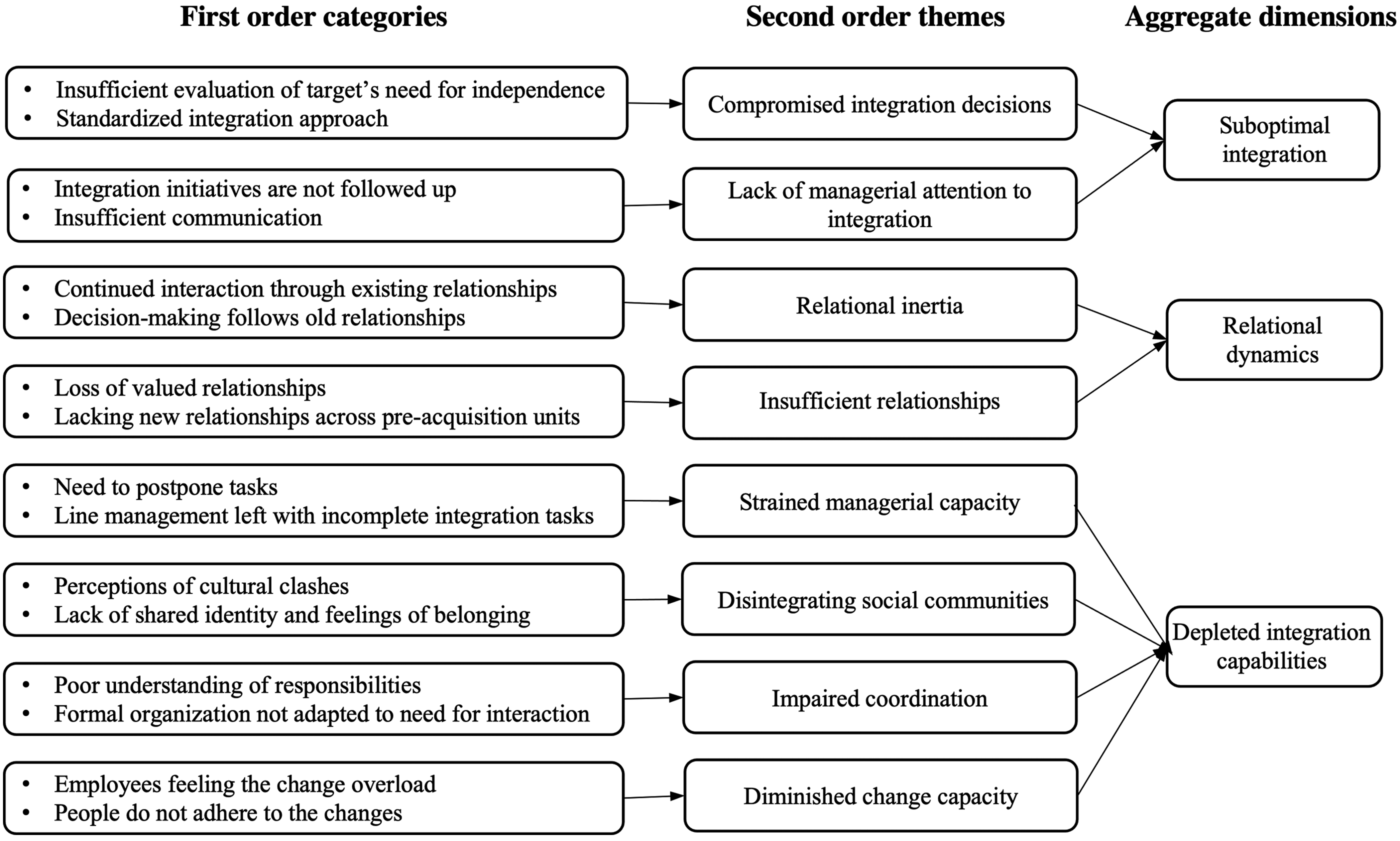
Data Structure.
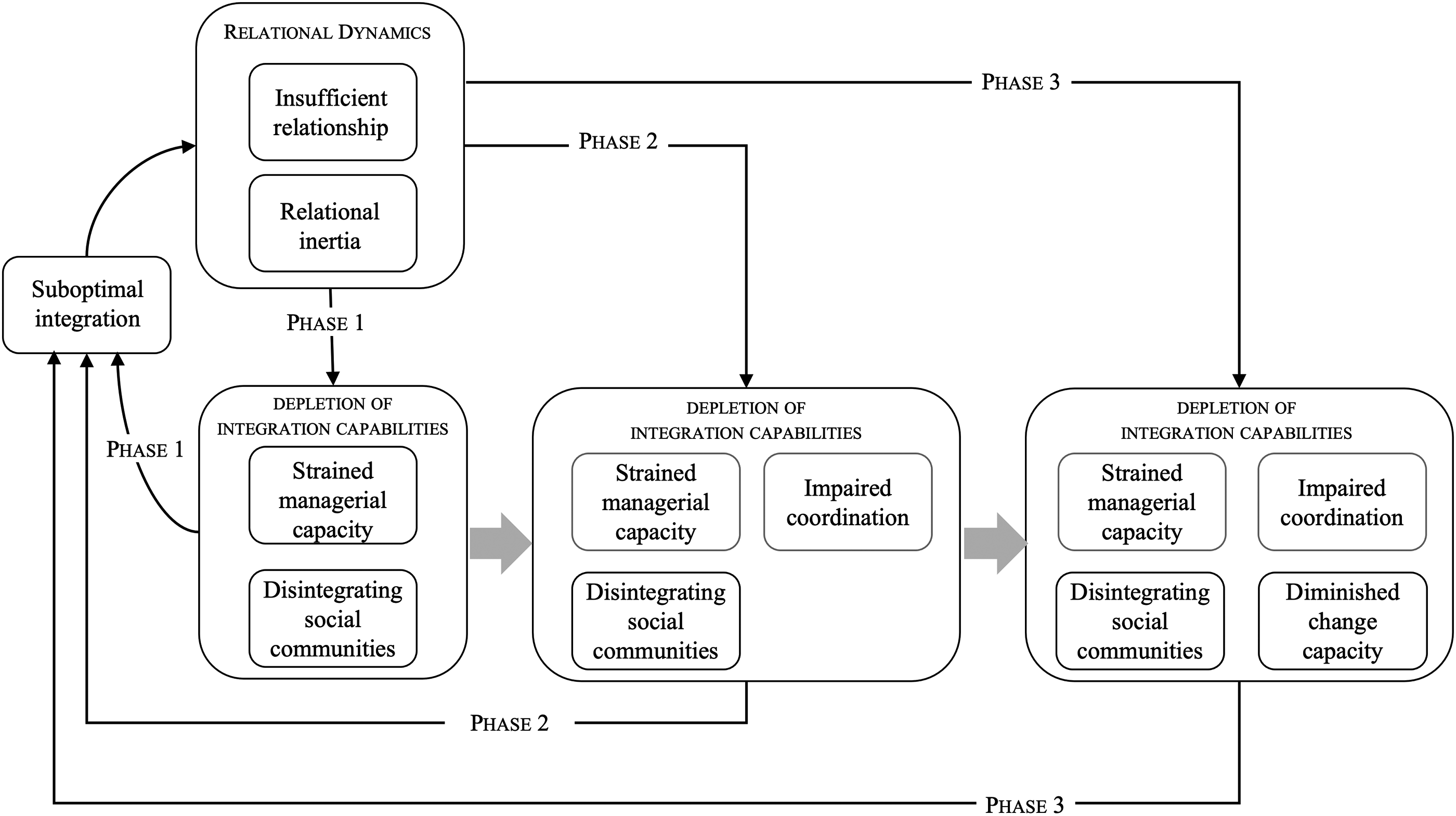
The temporal bracketing strategy allowed us to map the integration processes over time and elaborate on the relationships between various integration initiatives, relational dynamics, and the accumulated outcomes. Eventually, our analysis led us to our emergent model, theorizing the relational dynamics involved in the depletion of integration capabilities. Thus, while Figure 2 shows our data structure that grounds our constructs, the relations between these constructs are depicted in Figure 3 (inserted below).
Emergent Model.
Findings
Our data reveal a compelling story of the role of relationships in a serial acquirer. During our study period, we observed how suboptimal integration triggered relational inertia and insufficient relationships, which subsequently led to strains on managerial capacity, disintegration of social communities, impaired coordination, and diminished change capacity in the serial acquirer's organization.
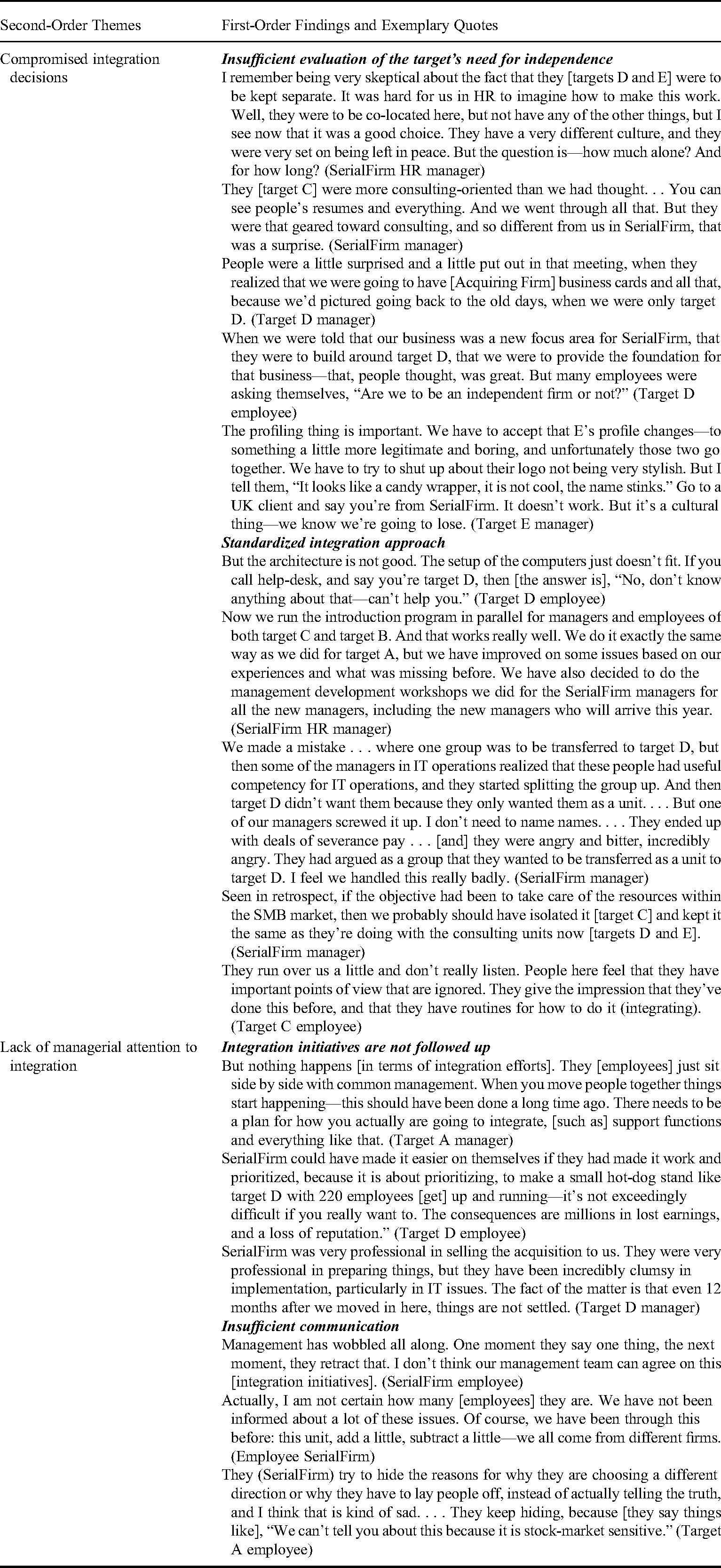
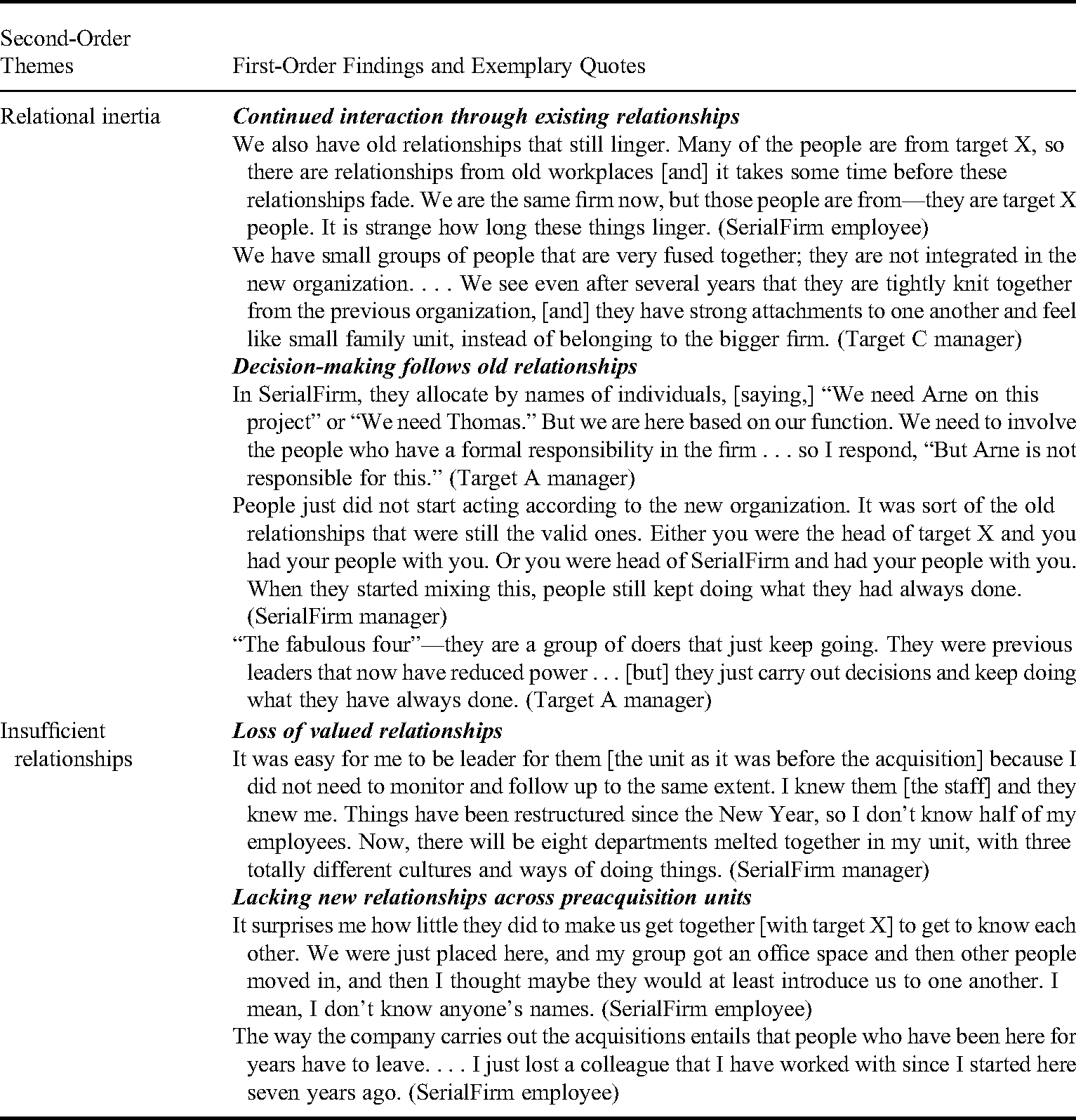
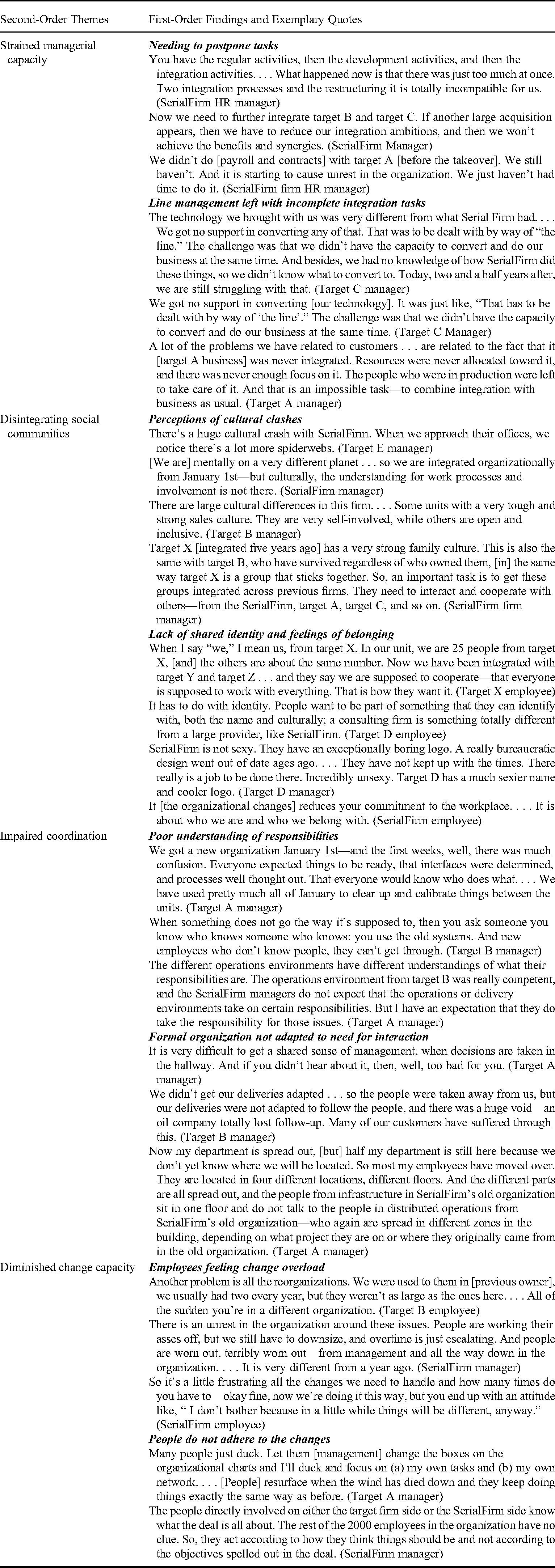
In this section, we present a detailed account of our findings by first unpacking each emergent theme, supported by our informants’ narratives. To add to the robustness of our findings, Tables 3 to 5 provide additional data. Below we present our process model (see Figure 3), which theorizes the relationship between our emergent concepts.
Representative Quotes for the Overarching Dimension of Suboptimal Integration
Representative Quotes for the Overarching Dimension of Relational Dynamics
Representative Quotes for the Overarching Dimension of Depletion of Integration Capabilities
Suboptimal Integration: Compromised Integration Decisions and Lack of Managerial Attention to Integration
A dominant theme that emerged in our informants’ narratives throughout the three phases was the suboptimal integration following each acquisition. Grounded in our data, we identified suboptimal integration as compromised integration decisions and insufficient managerial attention to integration issues. Compromised integration decisions were voiced as our informants explained how the acquiring firm had insufficiently evaluated the characteristics of each target and thus miscalculated the target's need for independence. Rather than addressing each acquisition as a unique instance that required adapted integration approaches, SerialFirm had, based on their past acquisition experiences, developed a standardized integration approach that did not sufficiently cater to the target's needs. For example, a SerialFirm manager explained how SerialFirm was destroying the knowledge-based capabilities of target A by not allowing them decision-making authority: At the end of the day, it is the large and slow SerialFirm that decides. At the end of the day, we control the resources. . . . There is a power struggle between the target A environments, who are creative and fast-paced, and the old, slow. And it's the old and slow that is obstructing the creative in the end. (SerialFirm manager) So when we [in target E] think that we are in control, and that if we don’t want to move to their offices we don’t have to, that if we don’t want target D merged with us, then they won’t, that target E will be the flagship, our clients won’t have to deal with SerialFirm but that they’ll just be the financial investor backing us. That definitely isn’t the case. And I honestly think that is what they thought here. . . . I think they [SerialFirm] are smarter than us like that, and it's taken some time before they [managers of target E] have understood that here. (target E manager)
Likewise, in phase 2, former target A managers and employees expressed frustration about the poor integration of their firm into SerialFirm. Top management appeared to have solely “sketched the organization on paper” while failing to operationalize the integration and to anticipate how the changes would affect both target A and SerialFirm employees. As noted by this target A manager: But nothing happens [in terms of integration efforts]. They [employees] just sit side by side with common management. When you move people together things start happening—this should have been done a long time ago. There needs to be a plan for how you actually are going to integrate, [such as] support functions and everything like that. (target A manager)
Relational Dynamics: Relational Inertia and Insufficient Relationships
We identified two relational mechanisms: relational inertia and insufficient relationships. Relational inertia was evident in our data through our informants’ stories of how, despite structural integration efforts, interaction between organizational members and decision-making in SerialFirm still took place in the context of preacquisition relationships. Managers and employees observed how people preferred cooperating and communicating with colleagues in their legacy firms, rather than interacting with individuals in their new formal units in SerialFirm, with whom they did not have established relationships. These legacy affiliations, fostered over years, were characterized as close—in fact, they resembled family relationships. A target X employee explains this: I know most people here. At least the ones from target X. I have worked with them for a long time, practically since childhood. I used to come to work with my dad. I have a lot of contact with (target X) people outside of work, as well. (target X employee) I have had problems with access in SerialFirm. I didn’t know how to get help in the SerialFirm system, but we have our own IT person here. He knows me, so for me there was no problem. (target E employee) It was like, “Hey, buddy—you’ll take that [position], right? You’re in?” Then I was like, “Yeah, I’m in.” (target A manager)
Our informants also described that insufficient relationships were established across previous firm boundaries, while valued relationships were dissolved. A central theme in our informants’ accounts was the challenges of cooperation across the various units and the difficulties involved in establishing new relationships across previous organizational boundaries. While employees were allocated to organizational units, together with employees from the other targets, limited cooperation and interaction took place between employees from the different targets and SerialFirm: We were just sitting here side by side in meetings we talked about implementing and starting to answer each other's customer calls, but in practice nothing happened. We kept on working like we always had. And we barely knew our colleagues’ names. (target Y employee)
Depleting Integration Capabilities
Throughout our study period, we observed gradual depletion of the organization's ability to operate and change—what we label integration capabilities, consistent with prior literature. Depleting integration capabilities emerged through our informants’ accounts of strained managerial capacity, disintegrating social communities, impaired coordination, and diminished change capacity among employees. In phase 1 we found accounts of strained managerial capacity and disintegrated social communities, and these two elements became more severe throughout the next two phases. In phase 2 we found accounts of impaired coordination that worsened in phase 3, whereas in phase 3, we observed diminished change capacity. Consequently, the four elements of integration capabilities accumulated over the three phases and manifested in the organization of the serial acquirer. Refer to Figure 3.
When you go in and change—there has been downsizing, change in agreement structures, change in operational routines. There are many actors with new roles and responsibilities, as the corporate structure is changing to a strong, more powerful corporate structure. . . . This is going to take a toll on management. (SerialFirm manager) There are large cultural clashes between the different firms. There are different ways of working. (target X employee)
Frank [head of unit] initiates something, Lucy [CHR] initiates something, Peter [COO] initiates something . . . and it seems like nothing is connected, or that they have discussed what to prioritize . . . and the initiatives are not connected. (SerialFirm manager)
The third element of depleted integration capabilities emerged in this phase—namely, impaired coordination. Our respondents lamented what they perceived to be the absence of coherent understanding of responsibilities in SerialFirm. This perception was evident in their accounts of how there was little shared understanding of allocations of roles, routines, and procedures. As voiced by a SerialFirm manager, “[After all the changes] there is a lack of understanding about what is actually done by whom.” This was evident in poor cooperation and coherence across the legacy units, as well as in organizational failures and severe problems in deliveries to customers. A target A manager described this in these terms: The different operations environments have different understandings of what their responsibilities are. The operations environment in target A was really competent [people], but SerialFirm managers do not expect that the operations or delivery environments take on certain responsibilities. But I have an expectation that they do take the responsibility for those issues. (target A manager)
Additionally, managers had to maintain daily operations in an organization that was increasingly struggling with challenges related to new and unfamiliar resources and technologies. As such, our informants expressed concerns about the inadequate managerial capacity, both to carry out integration initiatives, to deal with employees growing concerns, and also to focus on day-to-day operations.
We also learned that further deterioration in the social communities of SerialFirm was underway in this phase. SerialFirm employees described an organization with a destroyed “social fabric” and no shared culture and identity. This absence of cohesion and shared understanding manifested itself as “translation issues” in the SerialFirm organization. For example, different definitions and ideas about technology and processes created confusion and misunderstandings in the daily operations of the firm, as this target A manager explained: For example, what is a platform and what is not a platform? They give different meanings to the terms. For some, the platform is a configuration on the PC. For me, the platform is everything from networks to servers; from a to z is the platform. So, when someone says we need to get a new platform up and running I get really depressed, because that implies a lot of work. For others, it implies just small adaptations. (target A manager)
On the other hand, informants also told stories of how their existing target cultures were under threat by the integration efforts. For example, a target C manager described how the split up of their unit “shattered” their culture. In target E, a previous stand-alone organization, employees and managers described how the integration process involved breaking up their “family” so that they lost the “family relationships” that had characterized their preacquisition firm. Target E managers cited the loss of family relationships as the reason why 15 senior employees left the firm as a group to establish a competitor. In summary, both existing target cultures were split up, whereas a new coherent SerialFirm culture was not perceived to emerge. As such, social communities increasingly disintegrated.
Evidence of impaired coordination also was a key concern in this phase. The complexities involved in coordinating across an expanding number of insufficiently integrated legacy groups became obvious. Managers expressed frustrations that the increasing number of acquired firms were not sufficiently integrated within SerialFirm, which led to ever more confusion in the organization about the distribution of roles and responsibilities. This is illustrated by this SerialFirm manager's comments, explaining the lack of allocated responsibilities for customer support: We are supposed to be the third line of support when they get problems they can’t deal with . . . and we have staffed according to that—assuming that someone else has staffed the first and second lines of support. But then it turns out that there is no operational first line support for some technologies that we have a lot of issues and problems with. So there is a struggle between the managers: “No, I have not staffed for second line support; that is your responsibility.” Stupid fights like that [happen]. (SerialFirm manager)
The final element of depleted integration capabilities emerged in this phase through employees’ descriptions of employees feeling change overload. The continued changes were taking a toll on their motivation, leading to frustration. They perceived the ongoing changes to be more substantial and more frequent, while also carrying more significant consequences than previous changes to which they had been exposed. The continual reorganizations that followed each integration process were described as altering their organization in an ongoing way. Moreover, our informants described how people did not adhere to the changes. For example, they described coping strategies that involved focusing on their daily tasks and hoping that the changes “would go away.” Some also characterized their experience of this endless sea of change as, “Bend over; here it comes again” (target A employee). They sought to dodge the planned changes, aiming to just “keep doing what they had always done” (SerialFirm manager). Table 5 displays additional quotes from our respondents on depleted integration capabilities.
Emergent Model: The Influence of Relational Dynamics on Integration Capabilities
Building on our analysis, we develop a process model (see Figure 3) that conceptualizes the consequences of recurrent suboptimal integration in serial acquirers. Our study shows that each suboptimally integrated acquisition triggered two core relational dynamics. First, suboptimally integrated acquisitions opened up for relational inertia, as employees preferred interacting through trusted relationships when integration and operational issues became challenging post acquisition. Second, suboptimal integration did not provide the conditions conducive to new relationship formation. Our study shows that these two relational dynamics led to the gradual and accumulated depletion of four organizational elements. We conceptualize these elements as the depletion of the organization's integration capability, as these elements impeded the ability of the organization to integrate new targets and run daily operations (Laamanen & Keil, 2008; Mitchell & Shaver, 2003; Zollo et al., 2013).
First, insufficient relationship formation and relational inertia strained managerial capacity. As relationships are important coordination mechanisms (Uzzi, 1997) and conduits for updated information and deep knowledge (Ranft & Lord, 2002), they facilitate decision-making. Thus, when these conduits fail, managerial resources are burdened by efforts to mitigate these losses. In our study, we noted that as the complexities of additional, dissolved, and inert relationships emerged through each subsequent acquisition, demands on managers’ time and attention increased as they tried to support the formation of new relationships and meet employee demands for information and coordination. The relational inertia took a toll on managerial capacity because, as employees reverted to existing relationships, managerial resources were necessary to mitigate the misalignment between formal decision-making structures and informal interaction.
Second, the lack of relationship formation and relational inertia led to disintegation of the social community; this was a process that accentuated over time as more suboptimal integration efforts led to the deterioration of existing relationships. When relationships are dissolved, the coherence of social communities suffer (Bresman et al., 1999; Ranft & Lord, 2002). Meanwhile, relational inertia will maintain relationships that undermine building a shared, integrated social community at the postacquisition stage; furthermore, they uphold the existing demarcation along the divides of the preacquisition organizational units. Our data show how an organization characterized by both insufficient formation of relationships and relational inertia increasingly fails to offer settings conducive to the development of new social communities.
Third, our data demonstrate that coordination started to suffer in SerialFirm over our second observation period. Coordination implies the process of organizing people or groups to accomplish a collective set of tasks (Briscoe & Rogan, 2016). The ability to coordinate activities was impaired as existing relationships that provided relational coordination were dissolved, and new relationships that were intended to provide coordination failed to form. Moreover, while inert relationships initially compensate for disturbed coordination (Gulati & Puranam, 2009), we observed that these became less efficient with each additional suboptimal integration.
Fourth, our data reveal how, over time, as these relational dynamics accumulated, employees were increasingly incapacitated and demotivated due to their recurrent loss of valuable relationships and the slow development of new relationships that foster trust and affinity. The loss of valued relationships also left employees feeling increasingly alienated, with their former colleagues having left the firm or put in other firm units. This insight derives from individuals’ need to belong and make sense of their role in the organization. We argue that this essential element of integration capability is threatened by the recurrent disruptions of relationships.
In addition, we observed a dynamic between the constituent elements of depleted integration capabilities—specifically, insufficient managerial capacity and disintegrating social communities—that contributed to impaired coordination. Managers had limited time and ability to resolve organizational inefficiencies, and the informal organization failed to compensate for missing formal coordination (Puranam et al., 2009). As well, the capacity of employees to cope with change diminished as their concerns were neglected by strained managers and disintegrating social communities, which no longer provided a supportive environment. The impaired coordination also led to disruptions in employees’ task environment. In a reciprocal fashion, the diminished employee change capacity, the disintegration of social communities, and the impairment of coordination all further strained managerial resources; managers were tasked with mitigating employees’ concerns and coordinating actions across previous firm boundaries while avoiding disruptions to ongoing business. As such, the deterioration of each element contributed to a vicious cycle with the other elements of integration capabilities.
Our observations show that the deterioration of relationships in the organization leave the firm with gradually reduced ability and capacity to carry out subsequent integration efforts. Serial acquirers may thus be victims of a downward spiral, due to relational dynamics gradually depleting their integration capabilities, as well as the constituent elements of their integration capabilities dynamically, but negatively, reinforcing one another.
Discussion
Our study makes clear that when relationships are exposed to frequent changes, they become inefficient or insufficient, depleting organizational resources and communities as time goes on. For serial acquirers, this insight is crucial, shedding light on their ability to run daily operations and carry out new acquisitions. This finding also answers our initial research question on how relational dynamics influence the development of integration capabilities over time in serial acquirers. By unpacking the relational dynamics taking place in a serial acquirer, we provide novel insights into the nature and development of integration capabilities and offer three important contributions to the literature.
Our first contribution is to offer a conceptualization of the constituent elements and dynamic nature of integration capabilities. While a growing literature has provided important insights into integration capabilities (Laamanen & Keil, 2008; Lamont, King, Maslach, Schwerdtfeger, & Tienari, 2019; Mitchell & Shaver, 2003), it has remained silent on their constituent elements. Our qualitative inductive approach allowed for in-depth insights into an organization that increasingly took on more frequent acquisition integrations; this opportunity allowed us to empirically identify organizational changes and mechanisms (Anderson et al., 2006) that have been alluded to in the literature. We provide empirical evidence of the deterioration of the four elements—managerial capacity, cohesive social community, coordination, and employee change capacity—and suggest that these are essential to the serial acquirer's ability to balance challenging integration efforts and daily operations. These elements relate to sufficient resources, coordination, knowledge accumulation, and motivation, making them core elements in the organization's ability to change (Birkinshaw, Zimmermann, & Raisch, 2016; Judge et al., 2015).
Managerial resources are instrumental in mobilizing and mitigating to facilitate postacquisition integration (Graebner, 2004). Significantly, learning from past acquisitions also depends on the ability and capacity of managers to articulate, reflect, and collectively evaluate ongoing and past experiences (Bingham et al., 2015; Zollo et al., 2013). Thus, when managerial capacity is strained, integration is compromised (Barkema & Schijven, 2008b) and learning from experience is impeded. Other factors that affect integration are social communities, which provide conduits for the transfer of socially embedded knowledge and shared understanding (Bresman et al., 1999; Ranft & Lord, 2002). As well, coordination of tasks must occur to avoid disruptions to ongoing operations, while carrying out integration efforts (Haspeslagh & Jemison, 1991b; Puranam et al., 2006). Moreover, integration requires the efforts and ability to change at the employee level (Buono, Bowditch, & Lewis III, 1985).
We thus show the paradox of integration capabilities: the very elements that allow firms to successfully integrate are the very ones that are challenged during integration efforts. While the strengthening of these constituent elements will enable the firm to effectively carry out integration processes and avoid disruptions to ongoing business, their continuous deterioration through relational dynamics will leave the firm increasingly less able to operate its normal business as well as integrate new targets.
Although the literature has emphasized deliberate learning mechanisms in serial acquirers as key to understanding integration capabilities (Bingham et al., 2015; Zollo, 2009; Zollo & Singh, 2004), current knowledge is limited regarding the organizational processes through which integration capabilities are developed or depleted. Our fine-grained qualitative data enable insights into socially embedded, ongoing processes in serial acquirers. Extant research has situated integration capabilities in dedicated teams and top management (Heimeriks, Schijven, & Gates, 2012; Trichterborn et al., 2016); our study conceptualizes integration capabilities as part of ongoing organizational endeavors. By exposing the process dynamics that shape the evolving features of the integration process (Graebner et al., 2017), we recast the development of integration capabilities as a broad-level, socially complex, and emergent process. We argue that this insight has important implications for how we address integration capability. Generating experiences and learning from past acquisitions must involve a broad set of actors, including managers on lower levels and employees. These actors’ experiences, their collective reflections, and their capacity and ability to coordinate activities and resources become crucial elements of an acquirer's integration capability.
Our second contribution is having empirically documented and conceptualized relational processes as precursors to depleted integration capabilities. Previous studies have documented how relationships play an important role in postacquisition integration (Briscoe & Tsai, 2011; Colman & Rouzies, 2019; Spedale et al., 2007). Our study extends this insight by showing how relational disruptions accumulate in serial acquirers’ organizations and compromise the context for nurturing integration capabilities. Moving beyond a dyadic view of integration to that of a series of integration processes, we provide unique insights into how generations of relational processes impair the organization of serial acquirers. These findings provide insights into the role of relationships as integration mechanisms in organizations that undergo frequent changes.
Our findings show how continual disruptions to the relational fabric of an organization accumulate and ultimately contribute to the disintegration of the social community, which in turn impedes organizational learning processes that preserve and transfer socially complex and valuable organizational knowledge (Bresman et al., 1999; Zollo & Winter, 2002). This is because this knowledge resides in interaction patterns and existing relationships in the organization (Ranft & Lord, 2002). The fractured relationships destroy the conduits for “who knows what, and how should things be done,” which subsequently diminishes the stable system for remembering, retrieving, and distributing information (Brandon & Hollingshead, 2004). With time, this impedes developing both the necessary experiential learning from each acquisition and the intended knowledge transfer that motivated the deal (Heimeriks et al., 2012; Vermeulen & Barkema, 2001). This gradual distortion of relationships leads to disintegration of the social communities within which individuals reflect, share experiences, and learn from past acquisitions, thereby reducing the serial acquirer's abilities to integrate new acquisitions.
Our third contribution is that we empirically show and conceptualize the role relationships play in the accumulation of organizational inefficiencies. Consistent with prior research (Gulati & Puranam, 2009), our study shows that relational inertia initially may be productive, as it upholds patterns of interaction that are conducive to carrying out important tasks in times of ambiguity. Certainly then, relational inertia following each acquisition may be very efficient in a period of transition, as the informal organization supplements and compensates for inadequacies in the formal organization (Gulati & Puranam, 2009). However, in serial acquirers, the continuous flow of new acquisitions implies recurrent structural changes, resulting in accumulated generations of inert legacy relations. In such scenarios, the informal structure becomes so complex that it no longer offsets the lack of formal structure. Hence, we find that as new target firms are added, existing relationships become increasingly outdated, distant, and irrelevant. The complexity of the ongoing and repeated severing of relationships therefore strips relational inertia of its integrative potential, including the ability to mitigate faulty formal coordination.
Prior research has shown that restructuring mitigates accumulated inefficiencies arising from a series of acquisitions. By allowing for a short period of “liability of newness” (Amburgey, Kelly, & Barnett, 1993), the organization unlocks the synergistic potential of restructuring (Barkema & Schijven, 2008b; Maksimovic, Phillips, & Prabhala, 2011). A relational perspective on serial acquisitions informs this view. Our findings reveal how both acquisition integration and organizational restructuring trigger inertia and insufficient formation of new relationships across previous firm boundaries. In serial acquirers, rather than alleviating inefficiencies, organizational restructuring triggers relational dynamics that amplify deteriorating organizational processes.
An organizational restructuring initiative is a large, complex organizational change that requires substantial managerial efforts and resources. We assert that organizational restructuring and integration efforts strain managerial capacity in similar ways. These findings are supported by the well-established notion that formal structural changes can be quickly initiated; however, actual patterns of interactions in the organization adjust quite slowly to the new context and may be unresponsive to managerial command (Lamont et al., 1994). Hence, in organizations that undergo frequent changes, a restructuring event may trigger additional relational disruptions, adding fuel to the fire.
Naturally, we concur that organizational restructuring may be necessary to mitigate long-term organizational inefficiencies; further, organizations that allow the new structure to settle enjoy performance benefits (Barkema & Schijven, 2008b). From a relational perspective, however, we observe that structural changes should be undertaken with caution in serial acquirers, which are already exposed to excessive change. The most advantageous timing of organizational restructuring in serial acquirers, and its impact on relationships, is an interesting topic for future studies when considered through a relational lens.
Prior studies have inferred the dynamics of the integration processes of a serial acquirer through terms such as “indigestion” (Kusewitt, 1985) and “accumulated inefficiencies” (Barkema & Schijven, 2008b). This research has proposed that serial acquirers will eventually suffer from organizational inefficiencies, which may explain organizational outcomes. Our study empirically documents relational dynamics that allow us to elaborate theory identifying the relational factors that ultimately shape the performance of serial acquirers (Laamanen & Keil, 2008; Rahahleh & Wei, 2012). Thus, through unraveling the role of relationships, we illuminate the contingencies and consequences of suboptimal integration for organizational coordination and cohesion in serial acquirers. Our study finds that serial acquirers are under the constant pressures to “pull together” and coordinate through integration efforts, even while their organizations are in the process of “falling apart.”
Managerial Implications, Boundary Conditions, and Future Studies
Our study offers clear managerial guidance. Managers in firms that engage in a series of acquisitions would be wise to pay particular attention to relationships; this will entail providing a context conducive to the preservation of valuable embedded relationships, while allowing time and opportunity to foster new relationships. When evaluating organizational fit in the predeal phase, managers can pay close attention to the existing relational fabric and evaluate how integration initiatives will affect these. To offset the “vicious cycle” of spiraling and depleted integration capabilities, it will be important to reduce suboptimal integration by paying careful attention to each integration process. Unquestionably, the relational dynamics triggered by integration must be carefully monitored as well. While managers need to secure integration (by establishing new relationships across target and acquiring firms), they also need to preserve existing relationships to avoid disruptions. This points to the managerial dilemma between integration and autonomy, one that in serial acquirers goes beyond the single integration process. Our research shows that integration capabilities rest broadly in the organization; therefore, managers need to take extra care to ensure that employees can develop relationships necessary for carrying out daily operations and accumulate and apply experiences that are relevant to the new acquisitions.
Our study has revealed the deterioration of integration capabilities through relational dynamics that unfold over time in an accumulated process, where new organizational elements are gradually affected. In light of this, an interesting question is whether our findings can inform the process of building integration capabilities in a positive, rather than negative, direction—that is, switching the process so that we might offer insights to serial acquirers on how to build integration capabilities. It seems intuitive that when building integration capabilities, managerial resources and social communities in the serial acquirers’ organization are important elements to foster, and that coordination and motivation will follow. Whether these processes follow similar or different logics are important areas for future studies.
When considering the implications of our research, the transferability to other contexts becomes critical (Lincoln & Guba, 1985; Miles et al., 2020). We explored our research question in a firm that carried out a significant number of acquisitions with a high degree of integration during the study period. This presents ample opportunities for uncovering the relational dynamics unfolding in a serial acquirer, as a transparently observable phenomenon (Pettigrew, 1990). However, it also carries the inherent risk that our findings are idiosyncratic. While our revelatory case has unique features, we maintain that the patterns we identified in SerialFirm are transferable to other serial acquirers. Fast growth through acquisitions is not unusual, and we therefore expect other serial acquirers to experience similar challenges in terms of disintegrating social communities, impaired coordination, strained managerial capacity, and diminished employee capacity for change. Given the disruptions and pressures on managerial capacity in any acquisition, as well as the time to build efficient relationships that align with the formal structure, we would expect depleting integration capabilities in any acquirer that undertakes a string of acquisitions. However, the extent and type of implications from frequent changes need to be studied further. For example, both the acquisition strategy (Laamanen & Keil, 2008) and the pacing, sequencing, and timing of new acquisitions (Klarner & Raisch, 2013) can inform relational dynamics and how integration capabilities are subsequently depleted or built. The long-term relational implications of periods of acquisition and periods of restructuring are interesting to study further (Barkema & Schijven, 2008b). We encourage future studies to include firms in different industries, with diverse pacing, sequencing, restructuring, and timing patterns that follow various integration strategies (Brueller et al., 2018; Zaheer et al., 2013).
Moreover, our findings have implications beyond the context of serial acquirers. We feel confident that our theorizing is transferable to other contexts, as firms engage in many types of corporate change efforts that trigger relational processes. These efforts may be divestitures, expansions, or new collaborative ventures. Our findings reveal the relationship implications of frequent and cumulative changes, which affect the organization's ability to coordinate and learn. With increased pressures on firms to change and adapt, structural changes that challenge the relational make-up of the firm is ever more important to understand.
Footnotes
Acknowledgments
We thank Øystein Fjeldstad for insightful feedback on a previous version of this manuscript. We also thank the case company for granting us access to their organization and for funding the data gathering. Randi Lunnan acknowledges the contribution of the Tom Wilhelmsen Foundation.
Declaration of Conflicting Interests
The author(s) declared no potential conflicts of interest with respect to the research, authorship, and/or publication of this article.
Funding
The author(s) received no financial support for the research, authorship, and/or publication of this article.
