







Abstract
Few studies have focused on how power influences an idea receiver's endorsement of creative ideas. By integrating associative evaluation theory with insights from the power literature, we identify power as an important receivers’ factor that accentuates the relation between an idea's creativity level and receivers’ endorsement. We contend that the idea generator's status is a boundary condition and, together with creativity level, the idea generator's status jointly influences the degree to which idea receivers’ power affects idea endorsement. We conducted four studies to test our hypotheses. Study 1 was a laboratory experiment. It found a two-way interaction of receiver power and creativity level, showing that compared to low-power receivers, high-power receivers expressed stronger endorsement of ideas with high levels of creativity. Study 2 was a field study in a manufacturing company. It replicated Study 1's findings and further found a three-way interaction showing that the moderating effect of receiver power was strengthened when the generator had higher rather than lower status. Studies 3 and 4 respectively replicated the two-way and three-way interactions using experiments and demonstrated positive associations as the theorized mediator, providing empirical support for the positive association account. We discuss implications of these studies and call for future research to deepen our understanding of how creative ideas are endorsed in the workplace.
Organizations have invested enormous resources to encourage creative idea generation in the hopes of improving work processes, introducing new products, and retaining and attracting customers. Anecdotes suggest that rather than a dearth of creative ideas, it is often the lack of endorsement of new ideas that results in organizations’ not capitalizing on their employees’ creativity to gain a competitive advantage. For example, after a Kodak employee invented the first digital camera in 1975, others in the company did not endorse it, leading Kodak to miss the opportunity to take a commanding lead in the digital photography marketplace (Estrin, 2015). What factors facilitate idea endorsement expressed by the receivers of creative ideas? We set out to address this question.
Providing suggestive evidence, the power literature shows the promise of power in facilitating favorable reactions to new ideas or suggestions (DiBenigno, 2020; Satterstrom, Kerrissey, & DiBenigno, 2021). Social psychology research suggests that power has important implications for decision-making such that power increases optimism in perceiving risks (Anderson & Galinsky, 2006), reduces loss aversion (Inesi, 2010) and attention to constraints (Whitson et al., 2013), and increases propensity toward action (Galinsky, Gruenfeld, & Magee, 2003) and agentic reactions (Landis, Kilduff, Menges, & Kilduff, 2018). Surprisingly, there has been sparse research into the role of power in reactions to creative ideas. We integrate the two disparate literatures—the power literature and the idea endorsement literature—for an understanding of how idea receivers’ power affects their idea endorsement. Power is traditionally defined as a person's capacity to influence other people who are in a state of dependence (Emerson, 1962; French & Raven, 1959). Not being limited to only those who occupy formal managerial positions, social psychological research shows that power can be characterized by a psychological state that occurs when an individual perceives they can influence another person or other people (Anderson, John, & Keltner, 2012; Galinsky et al., 2003). Power is ubiquitous in organizations (Blader & Chen, 2014; Tost, 2015). It “is experienced by most individuals at one time or another and that when it is experienced, it has metamorphic effects” (Galinsky et al., 2003: 454). We examine how the power of idea receivers influences their endorsement of ideas with varying degrees of creativity, and how the status of the idea generator moderates the relation among power, creativity level, and idea endorsement.
We aim to make several contributions. Prior research has looked at idea receivers’ perception or recognition of creative ideas (Lu, Bartol, Venkataramani, Zheng, & Liu, 2019; Mueller, Melwani, Loewenstein, & Deal, 2018; Zhou, Wang, Song, & Wu, 2017). Taking a step further, we put idea endorsement center stage, contributing to answering the critical question of how to increase idea receivers’ endorsement of creative ideas.
We make theoretical contributions by integrating the power and idea endorsement literatures to extend the associative evaluation account on idea receivers’ reactions to creative ideas (Zhou et al., 2017). We theorize that receivers’ endorsement of an idea is grounded in the associative evaluation process. Whether receivers endorse the idea depends on whether largely positive associations are activated in their memory; the idea's creativity level and the receivers’ personal factors jointly influence this activation. If the idea has a high level of creativity, and the receivers score high on certain personal factors linked to creativity-favoring elements in the receivers’ memory, this feature similarity would activate positive associations, resulting in endorsement. The power literature suggests that power is such a factor, as it is linked to creativity-favoring elements such as adventure, approach, self-expression, and expansion (Galinsky, Rucker, & Magee, 2015; Keltner, Gruenfeld, & Anderson, 2003; Tost, 2015). We hypothesize and find that higher power led to idea receivers’ stronger endorsement of ideas with high levels of creativity. We contribute to the associative evaluation account by identifying idea endorsement as an essential reaction to creative ideas, revealing the positive role that power plays in endorsing ideas, and directly measuring and testing positive associations—the theorized mediating mechanism.
In addition, we show that idea generators’ status influences powerful individuals’ endorsement of creative ideas. This further extends the associative evaluation account by suggesting that, together with an idea's level of creativity, idea generators’ status jointly influences the degree to which idea receivers’ power affects idea endorsement, a phenomenon that has not been well understood. We also directly test positive association as the mediator for the joint effects of power, creativity level, and generator status on endorsement.
Finally, we investigate idea endorsement by various idea receivers, including intended beneficiaries, coworkers, prospective customers, and managers. New ideas carry uncertainty (Mueller, Melwani, & Goncalo, 2012). Whether creative ideas can be accepted and put to use depends on how strongly these receivers endorse them. If the intended beneficiaries or prospective customers of the new idea or product endorse it, such uncertainty is reduced. Moreover, implementing new ideas is seldom within the full control of the idea generator. New ideas pose challenges and require changes to existing ways of doing things. This creates tension and resistance because the new elements do not fit with existing systems or the ideas compete with alternative goals and priorities. For a new idea regarding work methods and processes, implementing it requires support from coworkers and managers as their buy-in can make or break the new initiative in the implementation process. If they endorse the idea, they help overcome roadblocks during idea implementation. If they do not endorse it, they resist or derail the new initiative. Examining endorsement by various kinds of receivers thus contributes to the understanding of this vital issue in the workplace.
Background and Hypotheses
In this section, we first describe the conceptual background and provide an overview of our theoretical framework. We then develop hypotheses to be tested in our studies.
Endorsement of Creative Ideas
We define idea endorsement as the degree to which an idea receiver expresses his or her support for, desire, and readiness to realize the idea that he or she has encountered. In the emergent stream of research into the receiving side of creativity, a conceptual distinction has been made between evaluative vs. adoptive reactions to creative ideas (Zhou, Wang, Bavato, Tasselli, & Wu, 2019). When a receiver responds to an idea generated by other people, the receiver may make an evaluative reaction, which refers to his or her perceiving the degree to which the idea is creative. On the other hand, the receiver may have an adoptive reaction, which refers to his or her expressing the desire to support, approve, and implement the idea. Earlier studies on the receiving side of creativity have largely focused on evaluative reactions such as creative idea perception (Mueller et al., 2018; Zhou et al., 2017), and more recent work has examined adoptive reactions such as willingness to implement or invest in a new idea (Lu et al., 2019). For the reasons previously elaborated, we seek to complement earlier studies and deepen our understanding of the receiving side of creativity by focusing on idea endorsement.
The Associative Evaluation Account: Background and Overview
Psychological research has established an associative evaluation perspective, which maintains that when encountering a target (e.g., an idea), a receiver forms his or her impression of the idea spontaneously; whether the impression is positive or negative depends on the particular associations that are activated when the receiver encounters the target (Gawronski & Bodenhausen, 2006, 2011). The congruity between the target and relevant information stored in the receiver's memory determines the particular associations spontaneously activated (Bassili & Brown, 2005; Gawronski & Bodenhausen, 2011). When the associations activated are primarily positive, the receiver experiences positive affective reactions as well as corresponding attitudes and behavioral intentions toward the target (Gawronski & Bodenhausen, 2006, 2011).
Building on this perspective, the associative evaluation account of reactions to creativity specifically addresses how individuals react to a creative idea upon encountering it. 1 This account suggests that when being presented with a new idea and faced with the question of whether he or she endorses it, a receiver's response is shaped by the associative evaluation process (Zhou et al., 2017). The associative evaluation process is affected by the nature of the stimuli (e.g., whether the idea has a high or low level of creativity; whether the idea generator has high or low status), and factors associated with the idea receiver (e.g., whether the receiver has high or low power). More specifically, in the receiver's memory system, creativity may be associated with positive notions, such as “competitively advantageous,” “successful,” and “profitable,” or negative notions, such as “difficult,” “dangerous,” and “uncertain.” When presented with an idea, whether the receiver endorses it depends on what kinds of associations are primarily activated. If high levels of positive associations with the idea are activated, the receiver tends to feel good about the idea and endorse it. If scant positive associations are activated, the receiver may not feel good about the idea and not endorse it. Usually, ideas have high or low levels of creativity according to certain normative standards. Because factors associated with the receiver influence what kinds of associations are stored in his or her memory, for the same idea that has a high level of creativity, individuals who have high vs. low levels of a given factor react to the idea differently. Power is a key factor in this regard.
Influences of Receiver Power on Idea Endorsement
Integrating evidence accumulated in the power literature with the associative evaluation account leads to the insight that idea receivers with high levels of power accumulate more positive associations with creativity. Compared to those with low power, individuals with high-power process information more flexibly, have a more global attention focus (Smith & Trope, 2006), are less likely to be influenced by situational cues or constraints (Galinsky, Magee, Gruenfeld, Whitson, & Liljenquist, 2008), and are more likely to take actions and risks (Anderson & Galinsky, 2006; Keltner et al., 2003). These tendencies enable them to either engage in more creative activities and experience success from such endeavors or mobilize resources to better capitalize on others’ creative ideas than individuals with low power (Galinsky et al., 2008; Smith & Trope, 2006). This is because creativity is inherently risky, uncertain, and difficult to obtain. It requires individuals to have a strong drive to act toward a desired outcome, to be willing to take risks, to be unconcerned about what others say, and to use resources and influences to capitalize on creative ideas (Anderson & Galinsky, 2006; Keltner et al., 2003). It also requires individuals to have a global attention focus so as to capture a broad set of information and material and process information flexibly so that they combine and recombine the array of information and material into something new and useful (Forster, Friedman, Özelsel, & Denzler, 2006; Keltner et al., 2003). Thus, compared to people with low power, those with high power possess more creativity-conducive tendencies, which lead them to experience greater success in creativity and build more positive associations with creativity in their mind. When individuals encounter an idea that has high creativity, if they also have a high level of power, the idea will trigger the positive associations with creativity and lead them to endorse the idea (Zhou et al., 2017).
In contrast, individuals with low power are more likely to place emphasis on potential losses, be more inclined to think and act to protect against possible threats, and have a narrower attention focus (Forster et al., 2006; Keltner et al., 2003). Compared to those with high power, individuals with low power are less likely to process information flexibly (Smith & Trope, 2006), more likely to be influenced by situational cues and constraints (Galinsky et al., 2008), and less likely to take actions and risks (Anderson & Galinsky, 2006). As a result, low-power people tend to engage in fewer creative activities. Even if they engage in creative activities, they experience less success than people with high power. Low levels of power make them less able to mobilize resources to generate and implement creative ideas successfully. Over time, the lack of engagement in creative activities or lack of success in generating and implementing creative ideas means that they have a fewer number of positive elements associated with creativity stored in their memories. Thus, when they encounter an idea that has a high level of creativity, it will trigger fewer positive associations in them than in those with higher power. The fewer positive associations activated make it less likely for these individuals to endorse the idea. When they encounter an idea that has a low level of creativity, the lack of creativity in the idea itself renders it unable to trigger positive associations with creativity (Zhou et al., 2017).
In total, the above analysis indicates that when individuals encounter ideas that range from low to high levels of creativity according to certain normative standards, people with higher power will express stronger endorsement of the ideas that have higher levels of creativity than will people with lower power, because ideas that have higher levels of creativity activate more positive associations in the memories of those with higher power. For ideas that have relatively low levels of creativity, the difference in endorsement between individuals with high or low levels of power diminishes.
Hypothesis 1 (H1): Receivers’ power interacts with an idea's creativity level to affect receivers’ endorsement of the idea, such that there is a stronger positive relation between creativity level and idea endorsement for receivers with higher levels of power than lower levels of power.
The Role of Idea Generator Status
The associative evaluation account suggests that while receivers’ power and ideas’ creativity level interact to affect the receivers’ endorsement, factors associated with idea generators can attune this interactive effect. More specifically, the associations activated in response to a stimulus depend on the total configuration of the input stimulus and, as part of the configuration, the source of the stimulus adjusts the activation of concepts in response to the stimulus (Gawronski & Bodenhausen, 2011; Zhou et al., 2017). For ideas with high levels of creativity, one concept that is an integral part of the associative representation of the target stimulus is the idea generator's status, which refers to the prestige, respect, and esteem that the generator has from others’ perspective (Blader & Chen, 2012; Fiske, 2010). In the workplace, a generator's status can be earned from the generator's expertise, knowledge, or being the primary source of advice and knowledge for others in the workplace (Howell, Harrison, Burris, & Detert, 2015; Phillips, Rothbard, & Dumas, 2009). Fundamentally, a generator's status reflects the social worth and social esteem publicly acknowledged by others (Chen, Peterson, Phillips, Podolny, & Ridgeway, 2012), and people pay close attention to status dynamics in the environment (Anderson, Hildreth, & Howland, 2015). This is particularly evident in situations that involve recognizing and utilizing expertise (Bunderson, 2003). As such, a generator's status should serve as an important cue that adjusts how receivers react to creativity.
If ideas with high levels of creativity are generated by persons with high status, such as those who are primary sources of advice and knowledge for others in a work unit (i.e., being at the center of an advice network), the concepts activated are likely to be “respected,” “cutting-edge,” “admirable,” “influential,” and “well-supported.” These positive concepts support and strengthen the positive elements, such as “advantageous,” “exciting,” “successful,” that ideas with high levels of creativity activate in the memories of receivers who have more power, solidifying and sustaining these receivers’ positive associations activated by the creative idea and further activating even more positive associations. According to the associative evaluation account, such strengthened and broadened positive associations further enhance these receivers’ endorsement of the creative ideas (Zhou et al., 2017).
Conversely, if ideas with high levels of creativity are generated by persons with low status, the concepts activated in the memories of the receivers are likely to be “untested,” “unreliable,” and “unqualified.” These negative concepts undermine the positive elements, such as “advantageous,” “exciting,” and “successful,” that ideas with high levels of creativity activate in powerful individuals’ memories, reducing the positive associations. According to our theory, the reduced positive associations result in diminished endorsement.
When ideas have low levels of creativity, and/or when receivers have low levels of power, far fewer positive associations are activated from these receivers’ memories than when the ideas are highly creative and the receivers have high levels of power. Under various combinations of low creativity and low power, if the ideas are generated by low-status persons, few positive associations are activated. Even if the ideas are generated by high-status persons, the lack of creativity in the ideas or the lack of power of the receivers renders that there are fewer positive associations activated, because either the low-creativity ideas cannot trigger many positive associations with creativity in the idea receivers’ memories, or there are fewer positive elements stored in the idea receivers’ memories to begin with. Thus, the idea generator's status attunes the interactive effects between ideas’ creativity level and idea receivers’ power.
Hypothesis 2 (H2): There is a three-way interaction among an idea's creativity level, idea receivers’ power, and the idea generator's status on idea receivers’ endorsement of the idea, such that the interactive effect predicted in H1 occurs when the idea generator has higher rather than lower status.
Positive Associations as Mediating Mechanism
In this section, we hypothesize that positive associations are the mediating mechanism that transmits the hypothesized two-way (H1) and three-way interaction effects (H2), respectively. The power literature has posited that individuals experience power at one point or another in their lives (Galinsky et al., 2015; Tost, 2015). Those with higher levels of power feel less constrained, approach new opportunities, and take risks; these tendencies lead them to further engage in activities related to new ways of doing things (e.g., Galinsky et al., 2003; Keltner et al., 2003). When people have power, they have more resources and influence, which allow them to better capitalize on creative ideas.
Over time, such experiences result in a large number of positive terms (e.g., “advantageous,” “exciting,” “successful”) associating the experience of power with creativity in their memory (Gawronski & Bodenhausen, 2011; Zhou et al., 2017). When making judgments, individuals with high power tend to rely on their own subjective experiences (Weick & Guinote, 2008). When they encounter an idea that has a high level of creativity, the idea is likely to trigger the positive associations with creativity that they have experienced, which lead them to feel good about and endorse the idea. However, when they encounter an idea that has a low level of creativity, and/or if they have a lower level of power, the idea will trigger fewer positive associations with creativity, which, in turn, reduce idea endorsement (Zhou et al., 2017).
Hypothesis 3 (H3): The relation between the two-way interaction predicted in H1 and receivers’ endorsement is mediated by positive associations.
Previously, we have hypothesized that idea creativity and receiver power interact to affect the level of positive associations activated. When receivers with higher levels of power encounter highly creative ideas, more positive associations are activated in their memories than the other combinations of receiver power and idea creativity—that is, when receivers have lower levels of power or ideas that are less creative, or both. Moreover, our theory suggests that if an idea's generator is a high-status individual, the aforementioned interactive effect on positive associations will be even stronger because the positive associations activated in response to the idea are influenced by the totality of the idea as a stimulus, and the generator's status is closely linked to the idea as a stimulus (Gawronski & Bodenhausen, 2011; Zhou et al., 2017).
When a high-power receiver is aware that the generator of a highly creative idea has high status, the concepts associated with high status (e.g., “respected,” “admirable,” “influential,” and “well-supported”) are activated. The positive elements sustain and strengthen the positive associations activated by the combination of a high-creativity idea being perceived by the high-power receiver, thereby activating even more positive associations. However, if the generator of an idea with a high level of creativity has low status, the concepts activated in the memories of the receivers are likely to be “not influential,” “not respected,” and “not well-supported.” These negative concepts undermine the positive elements that the combination of high receiver power and the highly creative idea could activate, reducing positive associations.
When an idea has low creativity, and/or when the receiver has a low level of power, far fewer positive associations will be activated in the receiver's memory than when the idea is highly creative and the receiver has a high level of power. Under various combinations of low creativity and low power, if the ideas are generated by a low-status person, there will be fewer positive associations activated. Even if the idea generator has high status, the lack of creativity in the idea or the limited receiver power results in fewer positive associations activated.
Thus, among various combinations of receiver power, idea creativity, and generator status, when a high-power receiver sees a highly creative idea generated by a high-status person, more positive associations will be activated in the receiver than any other combinations. According to the associative evaluation theory, these broadened and increased positive associations in turn lead to stronger endorsement of the creative idea (Zhou et al., 2017).
Hypothesis 4 (H4): The relationship between the three-way interaction predicted in H2 and receivers’ endorsement is mediated by positive associations.
Overview of Studies
Using different operationalizations of power and status, we conducted four studies across different contexts and with receivers in different roles to test and triangulate the hypotheses. Study 1 experimentally manipulated power and found that power interacted with an idea's creativity level to influence idea endorsement. Study 2 replicated and extended Study 1 at a manufacturing company. Employees submitted creative ideas to improve products, processes, and safety. Study 2 yielded convergent findings with those obtained in Study 1 by using a peer-rating approach to measuring power. It showed Study 1's findings based on the psychological property approach to power generalized to the power in the eyes of others—a sociorelational approach to measuring power. Study 2 also tested the moderating role of an idea generator's status.
To further triangulate the operationalizations of power in Studies 1 and 2, Studies 3 and 4 used a self-report measure of power. Study 3 replicated Study 1 results. Of greater importance, Study 3 measured and found that positive associations served as the mediating mechanism. Study 4 triangulated Study 2's operationalization of idea generator status by using a vignette to manipulate status. Study 4 replicated Study 2's results. Importantly, Study 4 measured and found that positive associations mediated the effects of the three-way interaction.
Study 1: Experimental Manipulation of Power and Its Interaction With Creativity Level on Endorsement
Study 1 Method
Please recall a particular incident in which you had power over another individual or individuals. By power, we mean a situation in which you controlled the ability of another person or persons to get something that they wanted or were in a position to evaluate those individuals. Please describe this situation in which you had power—what happened, how you felt, etc.
Participants in the low-power condition were instructed to: Please recall a particular incident in which someone else had power over you. By power, we mean a situation in which someone had control over your ability to get something that you wanted or was in a position to evaluate you. Please describe this situation in which you did not have power—what happened, how you felt, etc.
In the control condition, participants were instructed to: Please recall what you did yesterday. Please describe what happened, how you felt, etc.
After the power manipulation, participants were presented with 19 ideas about how to improve teaching quality. We followed prior studies to use these ideas, because these ideas ranged from low to high levels of creativity and have been documented in the literature (e.g., Zhou et al., 2017). Participants were instructed to answer, one idea at a time, their endorsement of the idea (“To what extent are you willing to endorse having the idea implemented in the school?”) on a scale that ranged from 1 (extremely low) to 7 (extremely high). Participants also reported their demographic information and were debriefed after they completed the experiment.
Study 1 Results
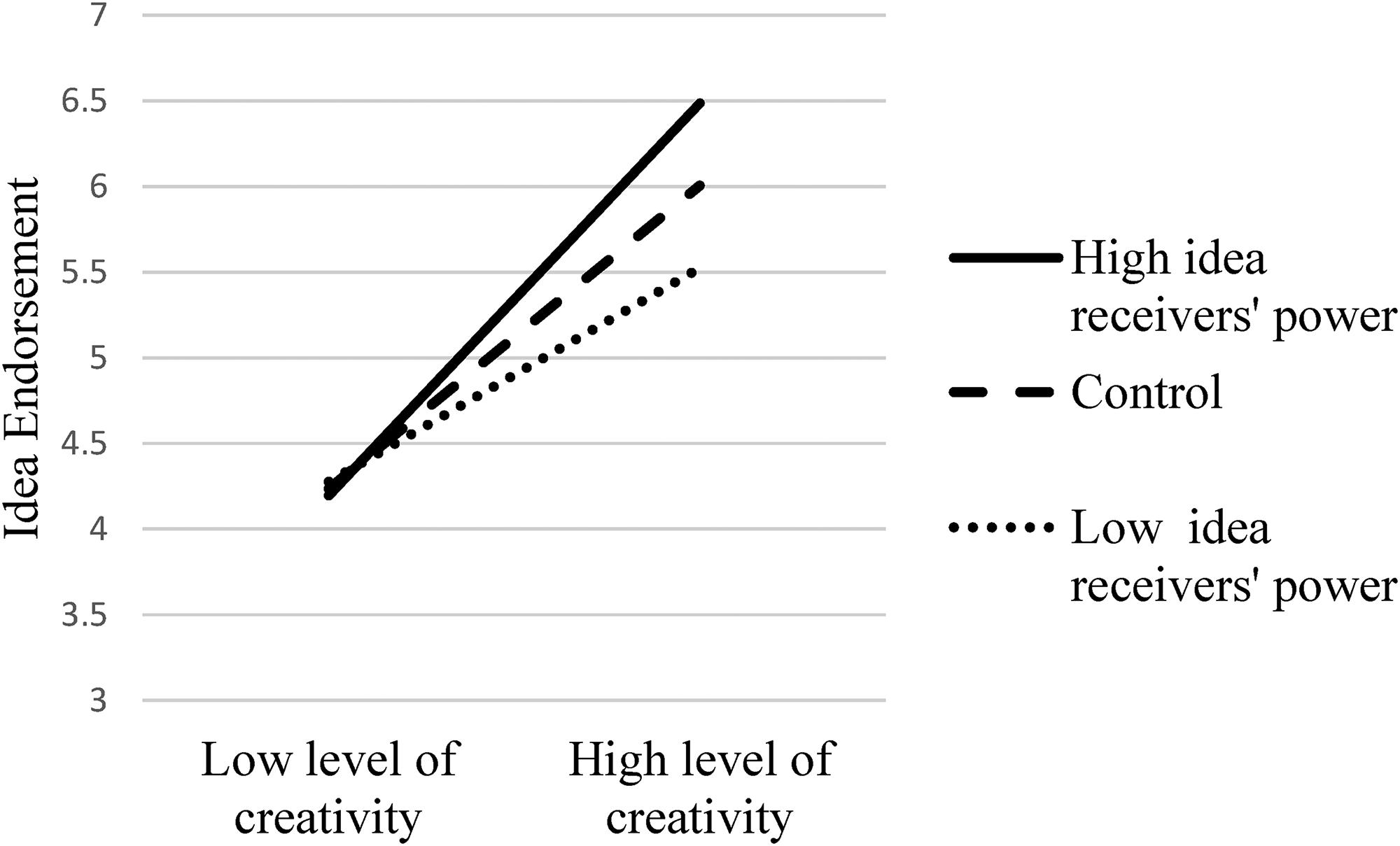
Study 1: Interactive Effect of Idea Receivers’ Power and Creativity Level on Idea Endorsement
Multilevel Modeling Results for Study 1
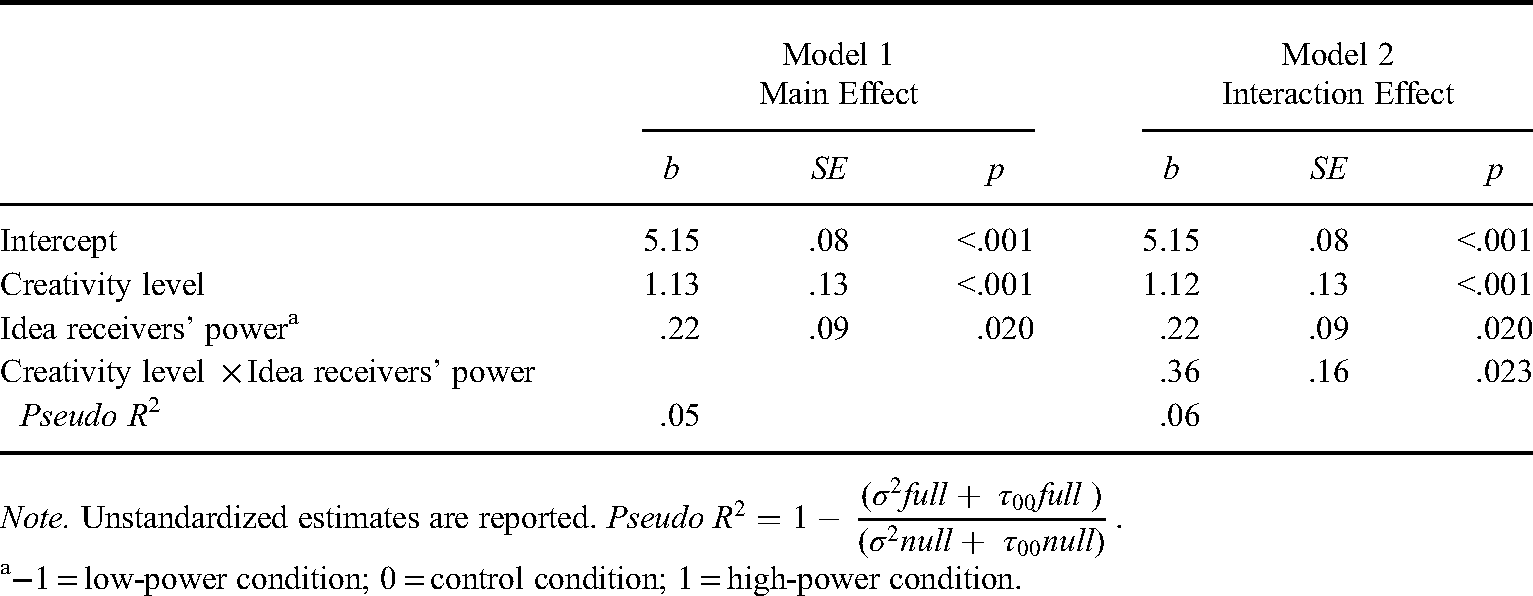
Note. Unstandardized estimates are reported.
−1 = low-power condition; 0 = control condition; 1 = high-power condition.
Study 1 Discussion
Study 2: Influence of Receiver Power, Idea Creativity Level, and Generator Status on Endorsement
Study 2 Method
Separately, to assess each idea's level of creativity, we invited five managers who had been tasked with evaluating employees’ ideas in the department to serve as the expert panel of judges (e.g., Amabile, 1996; Shalley & Perry-Smith, 2001; Thrash, Maruskin, Cassidy, Fryer, & Ryan, 2010). The panelists were blind to the names of the idea generators when they read the content of the ideas. The judges independently rated the creativity levels of these 16 suggestions.
Measures
Study 2 Results
Means, Standard Deviations, and Correlations for Study 2
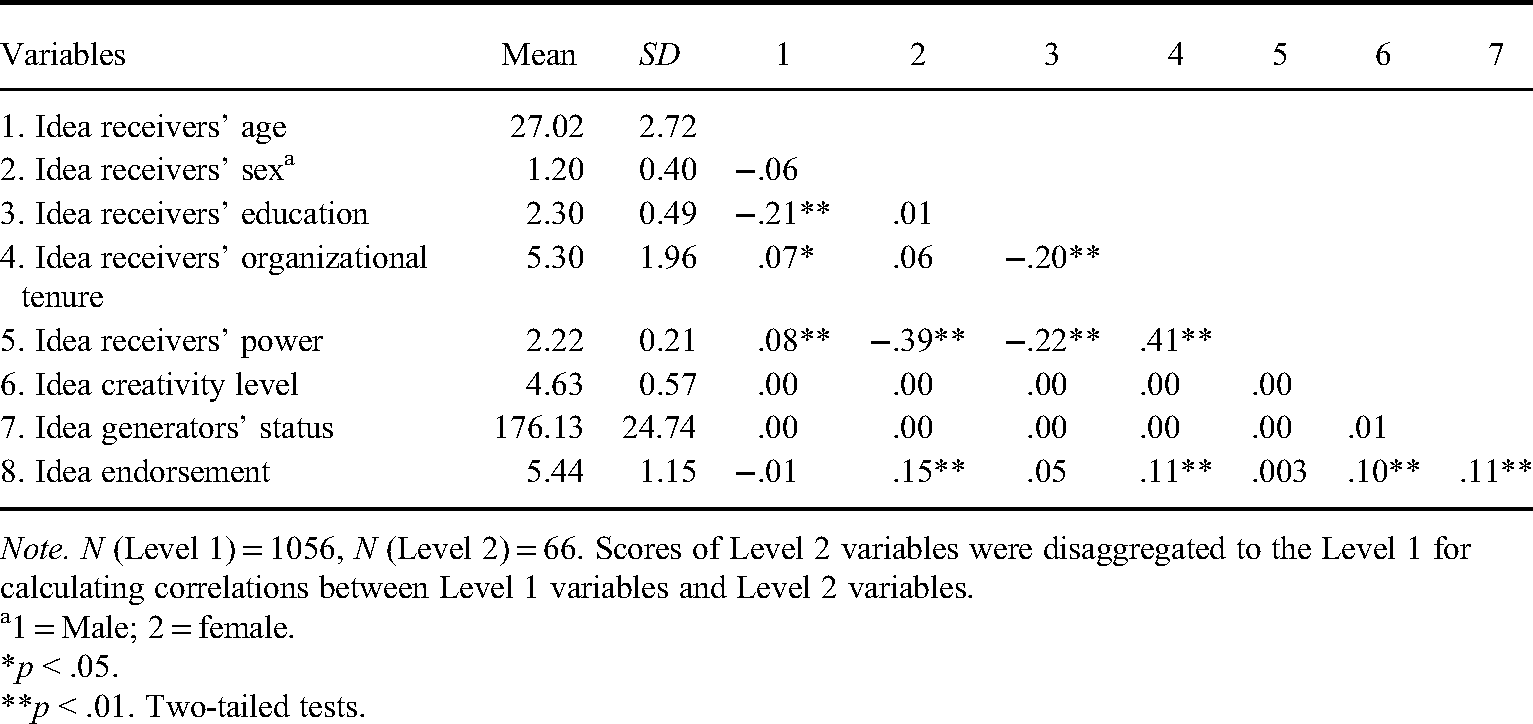
Note. N (Level 1) = 1056, N (Level 2) = 66. Scores of Level 2 variables were disaggregated to the Level 1 for calculating correlations between Level 1 variables and Level 2 variables.
1 = Male; 2 = female.
*p < .05.
**p < .01. Two-tailed tests.
Multilevel Modeling Results for Study 2
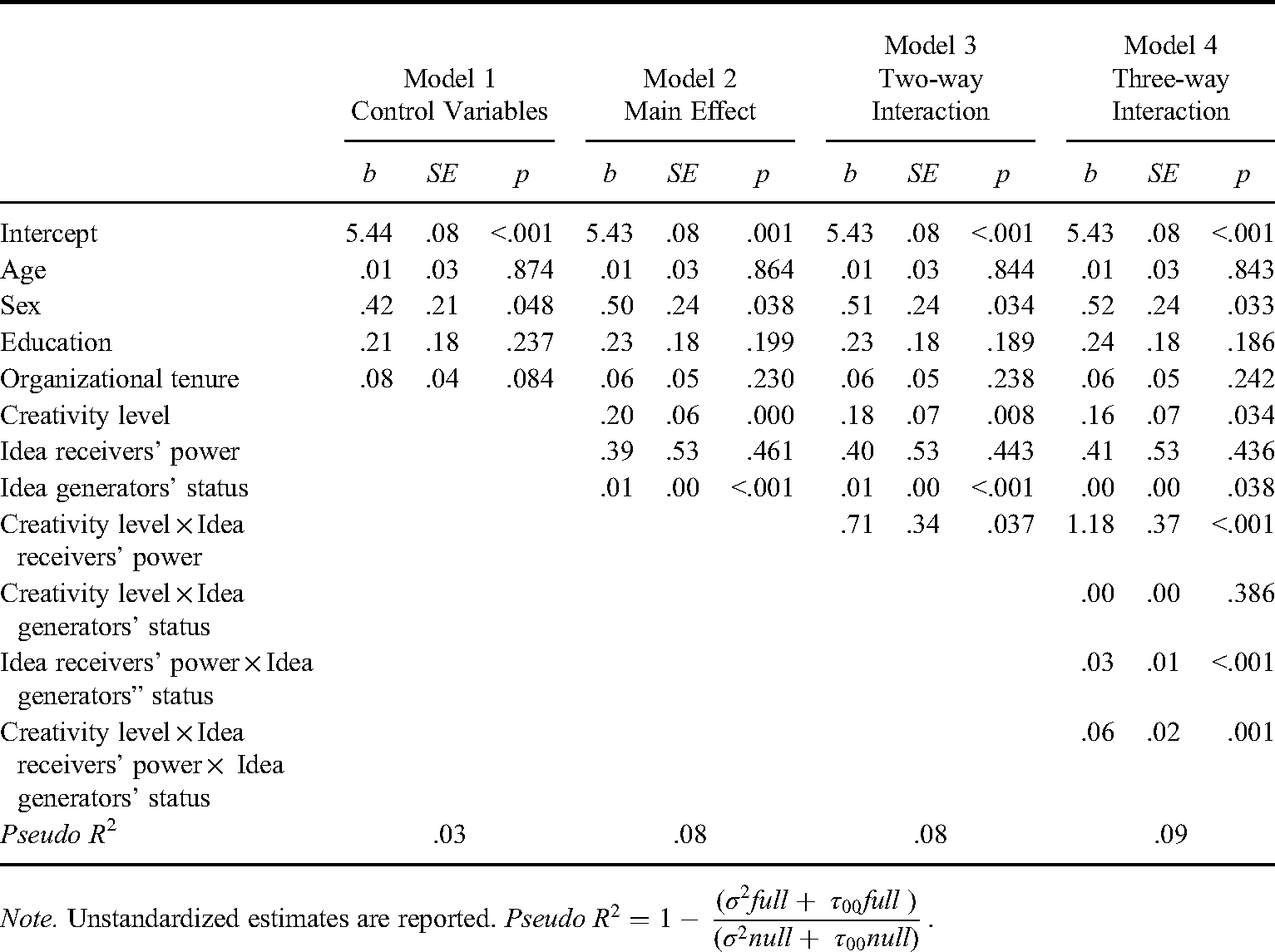
Note. Unstandardized estimates are reported.
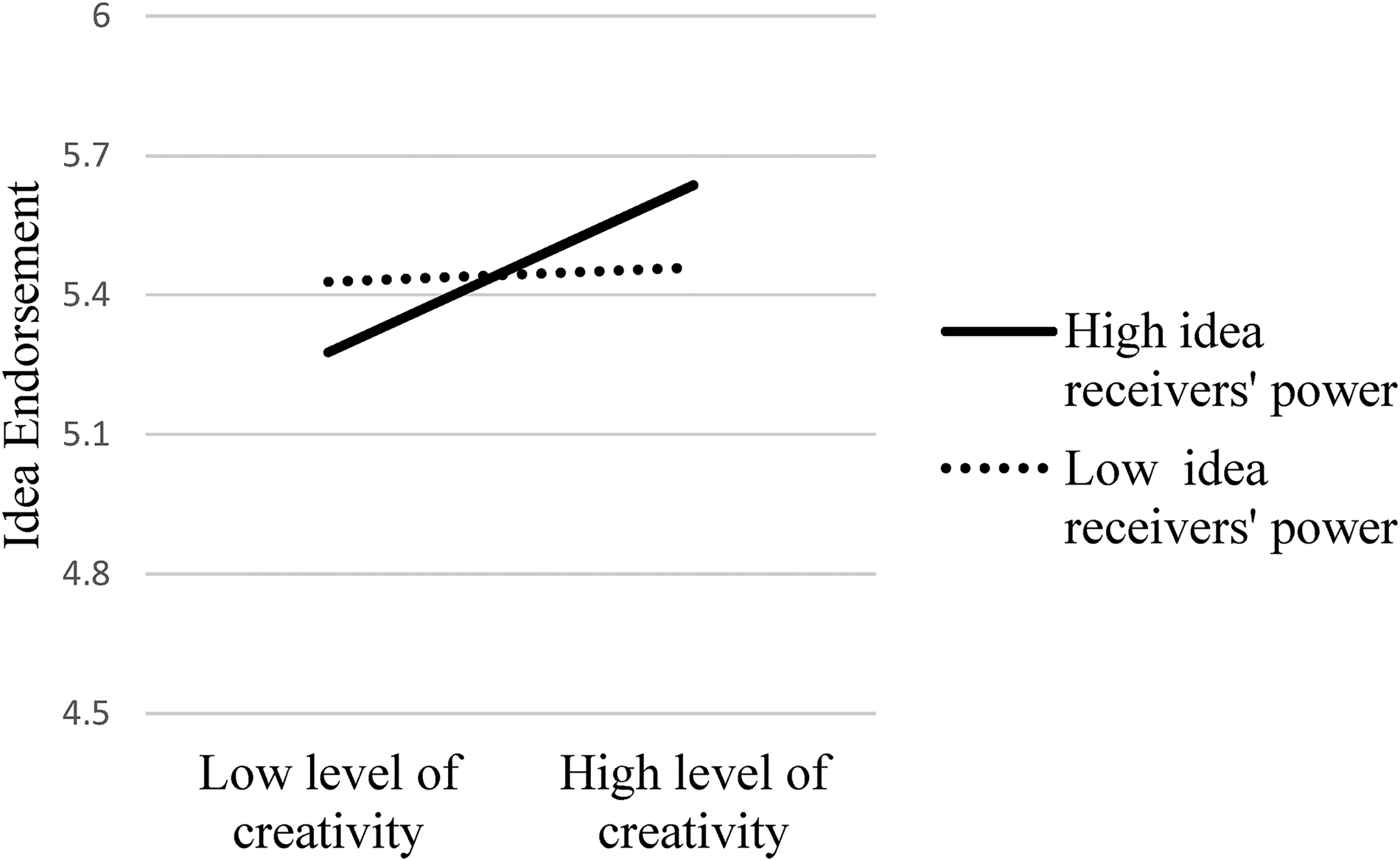
Study 2: Interactive Effect of Idea Receivers’ Power and Creativity Level on Idea Endorsement
Model 4 in Table 3 shows that the three-way interaction involving creativity level, receiver power, and generator status was statistically significant (b = .06, p = .001). The simple slope analyses showed that when the ideas were generated by high-status employees (1 SD above the mean), creativity was positively related to endorsement when power was higher (1 SD above the mean) (b = .65, p = .001), whereas when power was lower (1 SD below the mean), the relation was negative (b = −.51, p = .023). The slope difference test indicated that creativity had a stronger relation when power was higher (difference = 1.16 p < .001). However, when the ideas were generated by employees with lower status (1 SD below the mean), creativity had a positive relation at lower levels of power (b = .33, p = .031), and the relation was nonsignificant at higher levels of power (b = .16, p = .219). The difference between the two lines was not statistically significant (difference = .16, p = .416). Figure 3 depicts the interaction for higher or lower levels of generator status, respectively. Overall, when idea generators had higher levels of status, there was a stronger and positive relation between creativity and endorsement when power was higher. The relation became weaker and negative when power was lower. When idea generators had lower levels of status, the relation between creativity and endorsement did not significantly differ between receivers with higher and lower levels of power. In all, the results supported H2. We discuss the three-way interaction results in more detail in the discussion.
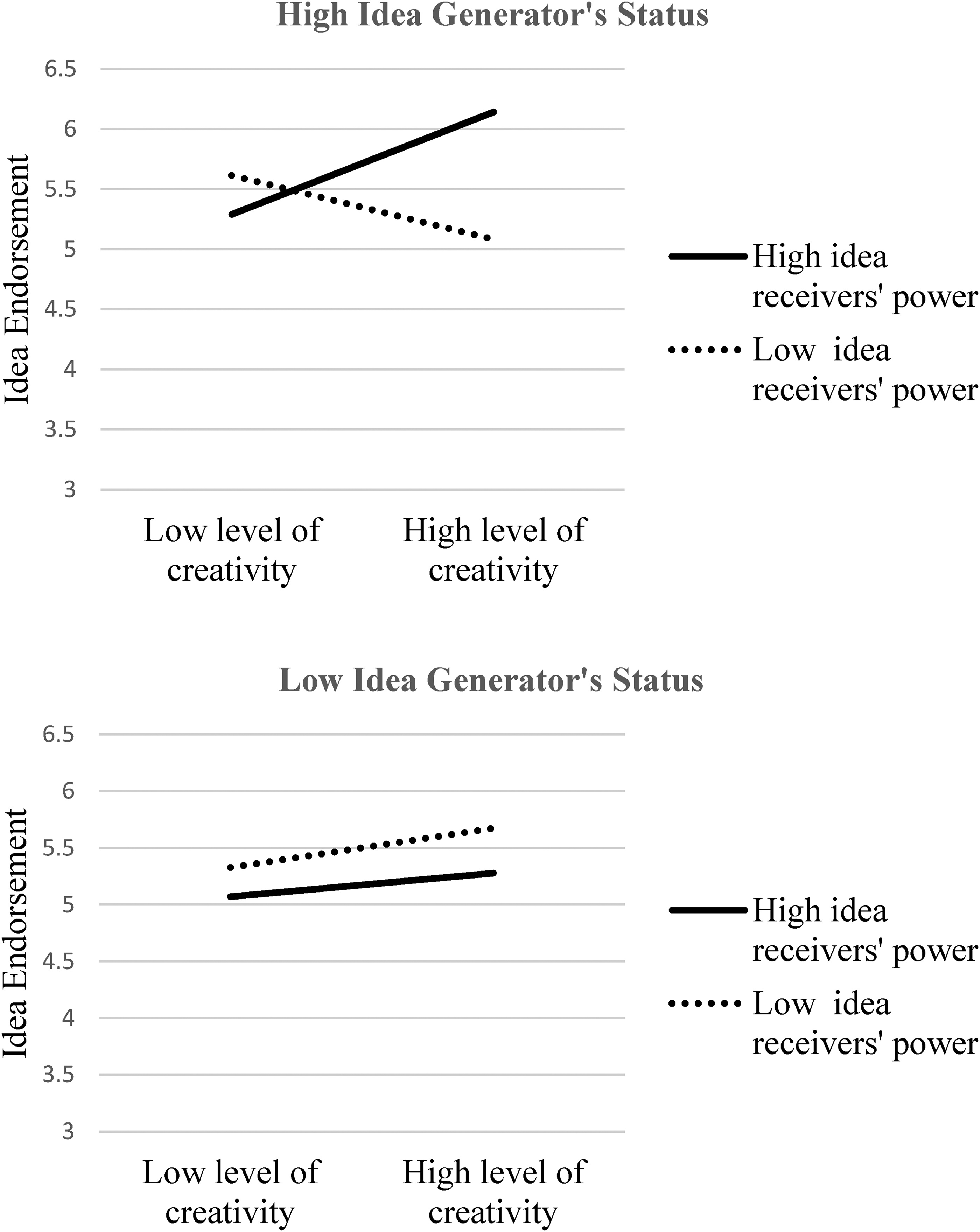
Study 2: Interactive Effect of Idea Receivers’ Power, Idea Generators’ Status, and Creativity Level on Idea Endorsement
Study 2 Discussion
Study 2 tested H1 and H2 in a work context with ideas generated by working employees. Replicating Study 1 results, Study 2 found support for H1 that receiver power interacted with idea creativity level to relate to idea endorsement. Further, extending Study 1, in the work context where an employee's status is a salient contextual factor, Study 2 demonstrated generator status as a boundary condition such that the interaction predicted in H1 occurs when the idea generator has higher rather than lower status. Though findings from Studies 1 and 2 are in line with our theory, the theorized underlying mechanism was unfortunately not measured or tested. To programmatically examine the mediating mechanism, Study 3 tested whether positive associations mediated the interaction effects found in Study 1.
Study 3: Positive Associations as a Mediator for Joint Effects of Power and Creativity Level on Endorsement
Study 3 Method
Study 3 Results
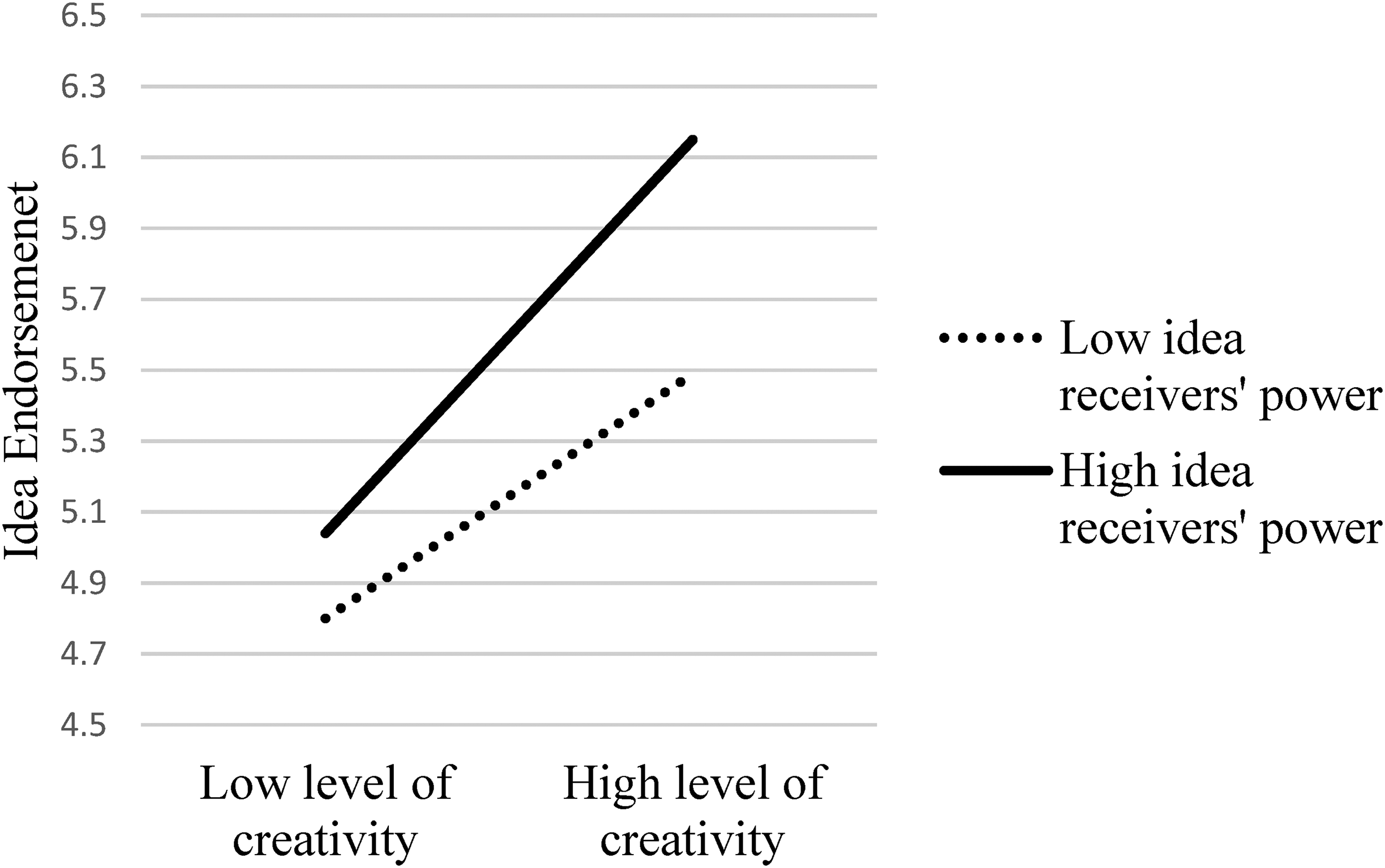
Study 3: Interactive Effect of Idea Receivers’ Power and Creativity Level on Idea Endorsement
Multilevel Modeling Results for Study 3
Note. Unstandardized estimates are reported.
0 = low creativity level condition; 1 = high-creativity level condition.
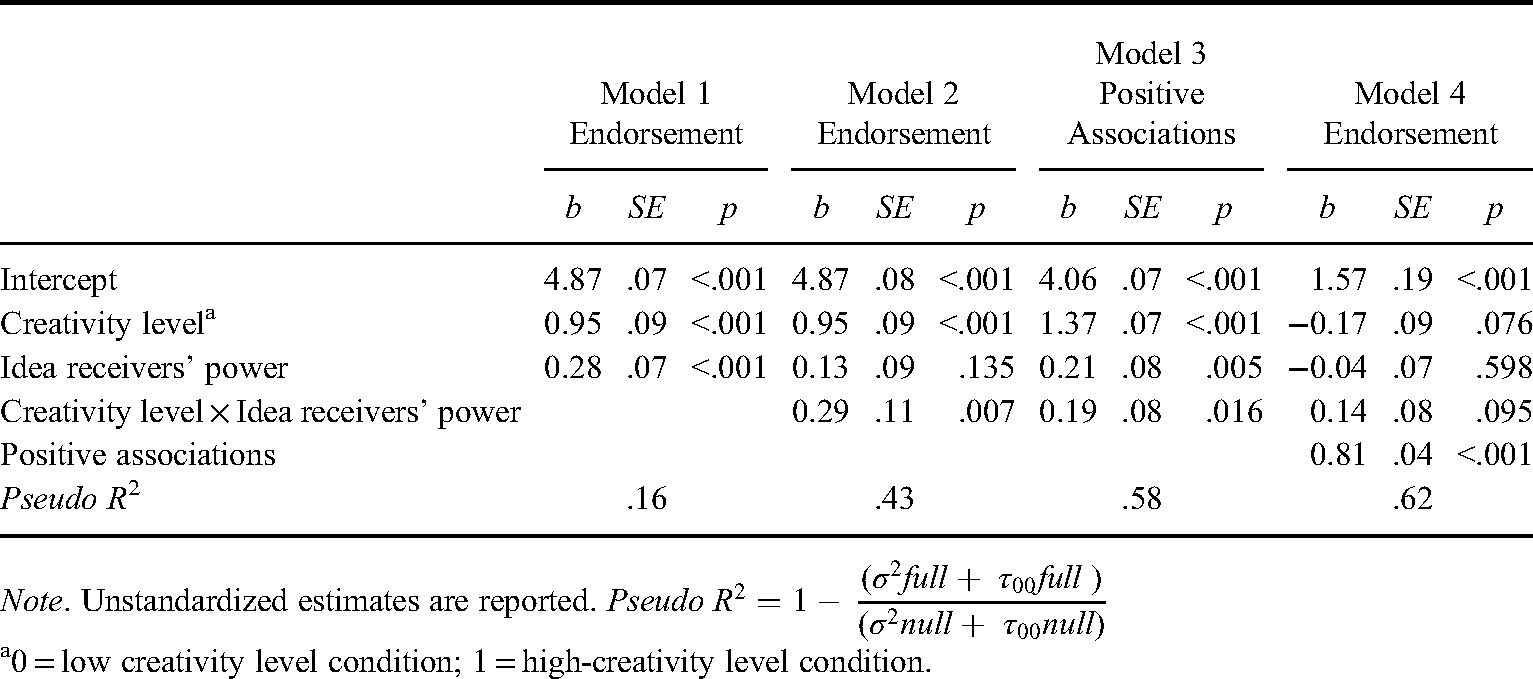
H3 suggested a mediated moderation effect. According to Model 3 in Table 4, the interaction term between power and creativity level was significant in predicting positive associations (b = .19, p = .016). As presented in Table 4, after entering positive associations, the significant interaction between power and creativity on endorsement became nonsignificant (b = .14, p = .095), and positive associations were positively related to endorsement (b = .81, p < .001). These results supported the mediated moderation effect. To gather further evidence, we calculated the 95% confidence intervals (CIs) of the indirect effects using Monte Carlo bootstrapping (with 20,000 replications; Liu, Zhang, & Wang, 2012; Preacher, Rucker, & Hayes, 2007; Preacher & Selig, 2012). We found a significant positive indirect effect of the interaction between power and creativity on endorsement via positive associations (estimate = .15, CI95% = [0.02, 0.28]). Taken together, these results supported H3.
Study 3 Discussion
Study 3 used new products to manipulate creativity level and measured idea receivers’ power. Supporting H1, we again found that idea receivers’ power interacted with creativity level to affect idea endorsement. Notably, we found that positive associations mediated the interactive effect of creativity and power on idea endorsement, thereby providing empirical evidence for the associative evaluation theory. Building on and extending Study 3, Study 4 added generator status to test H4, thereby programmatically examining the mediating mechanism.
Study 4: Positive Associations as a Mediator for Joint Effects of Power, Creativity Level, and Generator Status on Endorsement
Study 4 Method
You know that after many years of working at Fun Kitchen Company, Pat has attained a great deal of (/very little) status and (/or) prestige within the company. People at the organization seem to genuinely respect (/have little respect for) Pat and seem to hold Pat in high (/low) regard.
Study 4 Results
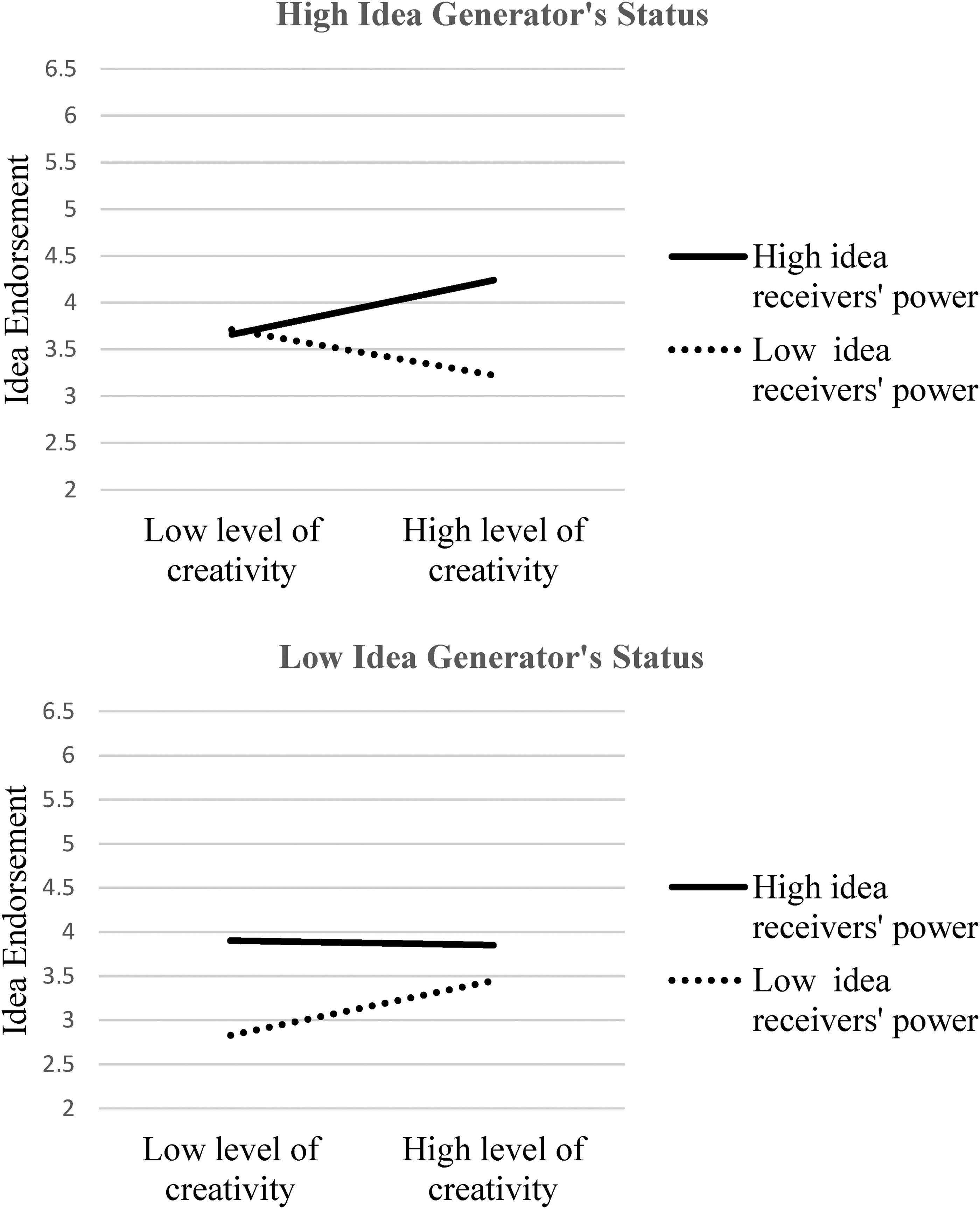
Study 4: Interactive Effect of Idea Receivers’ Power, Idea Generators’ Status, and Creativity Level on Idea Endorsement
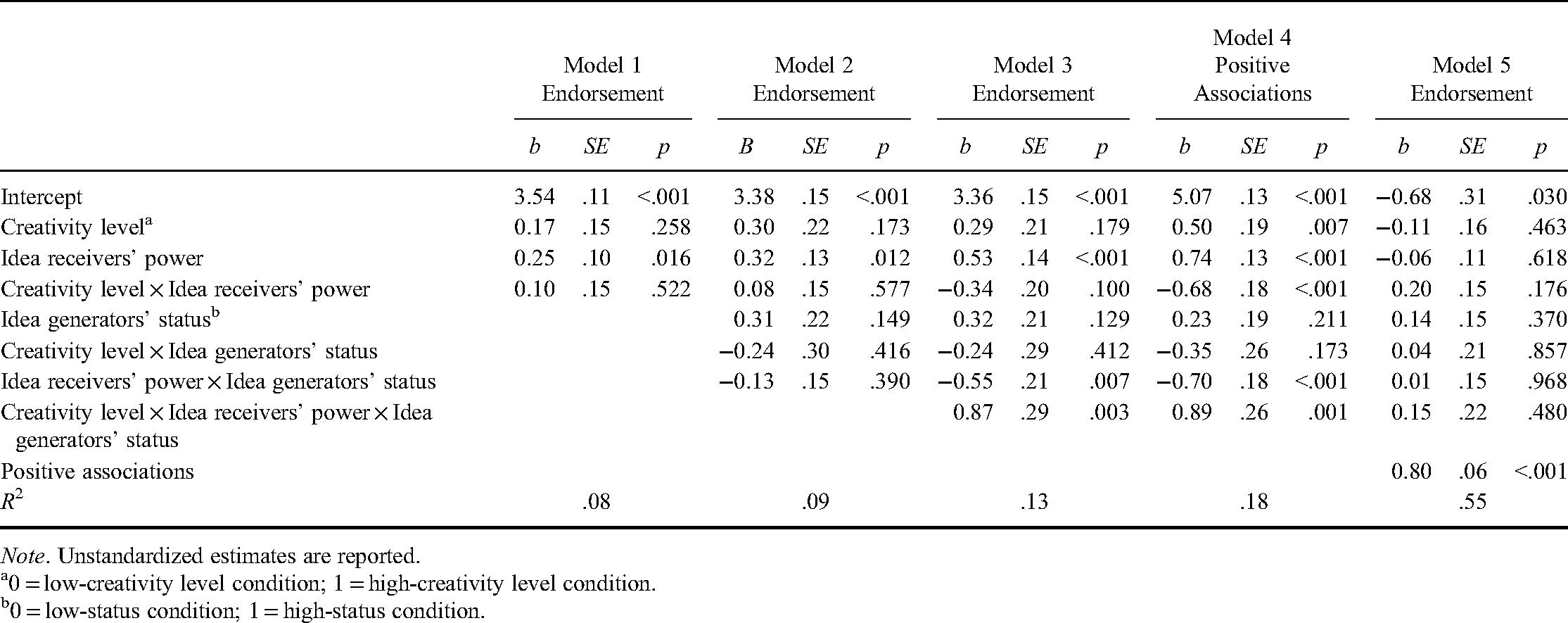
Regression Results for Study 4
Note. Unstandardized estimates are reported.
0 = low-creativity level condition; 1 = high-creativity level condition.
0 = low-status condition; 1 = high-status condition.
As we found a significant three-way interaction effect on endorsement, we proceeded to test H4 that involves a mediated moderation effect of the three-way interaction on endorsement via positive associations. According to Model 4 in Table 5, the interaction term between receivers’ power, creativity level, and the generator's status was significant in predicting positive associations (b = .89, p = .001). As shown in Model 5 in Table 5, after entering positive associations, the significant three-way interaction on endorsement became nonsignificant (b = .15, p = .480), and positive associations were positively related to endorsement (b = .80, p < .001). Overall, these results supported a mediated moderation effect. To provide further evidence for the mediated moderation effect, we calculated the 95% confidence intervals (CIs) of the indirect effects by using Monte Carlo bootstrapping (with 20,000 replications). It showed a significant positive indirect effect of the interaction involving receivers’ power, creativity level, and the generator's status on endorsement via positive associations (estimate = .71, CI95% = [0.29, 1.15]). Taken together, these results supported H4.
General Discussion
Building on and extending the associative evaluation account, we conducted four studies and largely found support for our hypotheses. We studied four types of idea receivers: students who were the intended beneficiaries of ideas on improving teaching effectiveness at a university (Study 1); employees who would be involved in and affected by the implementation of ideas submitted by other employees at their company (Study 2); adults who were prospective customers of new consumer products (Study 3); and managers who evaluated new products ostensibly designed by their employees (Study 4). The ideas these receivers evaluated were relevant to their respective research settings. Building on prior work in the power literature, we used three different operationalizations of power. Mostly consistent results emerged across these four studies. Results from Studies 1, 2, and 3 demonstrated that, as hypothesized, when idea receivers had more power, the greater the creativity of the ideas being evaluated, the higher the receivers’ endorsement of the ideas. In addition, Study 2 showed a boundary condition of our theoretical analysis of the interaction between receiver power and the creativity level of ideas: the influence of power on receivers’ endorsement of highly creative ideas was stronger when the ideas were generated by employees who had higher status than those who had lower status. Studies 3 and 4 directly tested and found support for the theorized mediator.
Theoretical Implications
Creativity and its implementation often lead to a less-traveled path with an uncertain outcome, dealing with existing work processes, structures, and systems, and competing with alternative ideas and approaches (Amabile, Barsade, Mueller, & Staw, 2005; Klein & Knight, 2005). Thus, it is not surprising that creative ideas frequently encounter skepticism and resistance (Mueller et al., 2012; Mueller et al., 2018). To move forward and harness the benefits of creative ideas, such ideas must be endorsed by key stakeholders. Their endorsement is crucial for putting the ideas into action (Perry-Smith & Mannucci, 2017; Staw, 1990), because resources such as money, time, support, and approval need to be obtained for implementation. Their endorsement opens the door for the idea to obtain approval for implementation or pave the way for the idea to gain buy-in during the implementation process (Satterstrom et al., 2021).
Identifying idea endorsement as a key reaction from idea receivers and building on the associative evaluation account that posits how one receives creativity is a function of both personal and contextual factors (Zhou & Woodman, 2003; Zhou et al., 2017), we examined how power influences receivers’ endorsement of creative ideas. In doing so, we deepen our understanding of how creativity is received by focusing on a new outcome that has a closer linkage with implementation than outcomes examined in prior studies. Management scholars have examined evaluative types of responses such as creativity recognition or assessment—that is, the extent to which a receiver perceives a normatively creative idea to be creative (Elsbach & Kramer, 2003; Mueller et al., 2018; Zhou et al., 2017). Our focus on idea endorsement, which is an adoptive type of response (cf. Zhou et al., 2019), complements prior studies’ focus on evaluative responses. Together, they advance our understanding of creativity receiving.
Drawing on the associative evaluation account, we observed receivers’ power interacting with creativity level to affect idea endorsement. Individuals with higher power are more action oriented, confident, and optimistic when faced with uncertainties, challenges, and resistance than those with lower power (Anderson & Galinsky, 2006; Fast, Sivanathan, Mayer, & Galinsky, 2012). These tendencies result in storing more positive experiences with creative stimuli in their memories. Consistent with our theory, we found that when encountering creative ideas, the activated positive experiences with creativity led the receivers with higher power to express stronger endorsement of the ideas than those with lower power.
Contextual factors also influence how receivers react to creativity (Zhou & Woodman, 2003; Zhou et al., 2017). Consistent with the associative evaluation account, we showed how one essential feature associated with creative ideas—idea generators’ status—shapes the influence of power on receivers’ endorsement of creative ideas. Partly owing to their expertise or achievements (Anderson & Kilduff, 2009), idea generators with higher status are respected and admired by others (Ridgeway & Walker, 1995). We found that generators’ status adjusted the effect of power on idea endorsement. That is, although Study 2 found the two-way interaction effect involving receiver power and idea creativity level such that for receivers with high levels of power, there was a positive relation between creativity level and idea endorsement, it did not find a significant relation between creativity level and idea endorsement for receivers with low levels of power. According to our theory, this nonsignificant relation was likely caused by the moderating role of idea generator status. In fact, the three-way interaction results revealed that if taking generator status into consideration, when it was high, there was a stronger and positive relation between creativity level and idea endorsement for high-power receivers than for low-power receivers. The relation between creativity level and endorsement was negative for low-power receivers. When a low-power person received an idea generated by a high-status person, the low-power person had fewer positive associations with creativity to be activated than a high-power person. In addition, the power and status literatures suggest that low-status employees are disadvantaged relative to high-status employees, and a high-status idea generator may pose interpersonal threats to an individual with low power (Arnett & Sidanius, 2018; Magee & Galinsky, 2008). These experiences resulted in fewer positive associations related to high-status persons stored in low-power persons’ memories. Moreover, with their lack of control of resources, low-power persons had fewer positive experiences with creative endeavors, which also resulted in fewer positive associations with creativity. All in all, low-power receivers endorsed creative ideas generated by high-status persons to a lesser extent.
When idea generator status was low, the relation between creativity level and idea endorsement did not differ between high- and low-power receivers. It became nonsignificant for high-power receivers and positive for low-power receivers. It is possible that high-power receivers did not see the ideas from a low-status generator as relevant to them or useful for satisfying their goals (Gruenfeld, Inesi, Magee, & Galinsky, 2008; Magee & Smith, 2013) and thus had limited positive associations. Hence, when the generator had low status, high-power receivers might not pay close attention to their ideas in the first place (Overbeck & Park, 2006), and as a result, even a creative idea failed to activate sufficient positive associations for them to render an endorsement. In contrast, low-power receivers probably experienced greater self-other overlap and became attuned to the experiences of a low-status generator (Galinsky, Magee, Inesi, & Gruenfeld, 2006; Hogeveen, Inzlicht, & Obhi, 2014), which led to positive associations. These positive associations allowed them to take the low-status generator's perspective, gain a better understanding of the creative ideas, and be more willing to endorse them.
Study 4 replicated the three-way interaction in Study 2. The simple slope analyses showed some slight differences across the two studies. Interestingly, in Study 4, when idea generator status was high, the relation between creativity level and endorsement became nonsignificant (rather than a negative relation as in Study 2) for low-power receivers. This is likely because the high-status generators’ interpersonal threats were less salient in the Study 4 fictional context than in the Study 2 real work context, and thus fewer unfavorable associations were activated (Arnett & Sidanius, 2018; Magee & Galinsky, 2008). We again found that when idea generator status was low, the relation between creativity level and idea endorsement was nonsignificant for high-power receivers but positive for low-power receivers. This finding suggests that when perceiving ideas from low-status generators, low-power individuals can be discerning and show greater endorsement for highly creative ideas. Overall, Studies 2 and 4 suggest that above and beyond an idea's creativity level, the generators’ factors influence how the idea is received. This phenomenon has not received much attention in the literature.
Lastly, supporting the associative evaluation account, results of Studies 3 and 4 explicated the mediating mechanism of positive associations. Study 3 found that positive associations mediated the joint effect of creativity level and receiver power, and Study 4 found that positive associations mediated the joint effect of creativity level, receiver power, and generator status on idea endorsement. Our studies contribute to the associative evaluation account on the receiving side of creativity by providing a test of the theorized mechanism, which has not been examined in prior research (Zhou et al., 2017; Zhou et al., 2019). To illuminate the experiences of positive associations, we conducted interviews. For example, the CEO of an Internet information service company shared with us: “We help companies to improve the quality of their services by conducting AI-aided text analysis of big data on customer experiences. . . . We successfully helped a company . . . to improve their service quality by using new algorithms to analyze their customers’ reviews. Such reviews are crucial and the company spends a lot of money to identify fake reviews. When my employees told me a new idea for identifying fake reviews, I was so excited. The idea is smart, unprecedented, and cost-effective. . . . I felt fascinated and energized by it; it allowed us to provide so much value to our client companies! . . .So I endorsed the idea.”
Methodological Strengths, Limitations, and Future Research Directions
The present investigation has methodological strengths. It included a mix of experimental and field studies to enhance internal and external validity. Study 1 was a lab study, helping us to establish the causal sequence of the interactive effect that we had predicted. Study 2 replicated Study 1 results by using a different sample at a different setting and boosted ecological validity because employees were asked to express the degree to which they endorse the ideas that arose naturally from their unit and were being considered for possible implementation.
In Studies 1, 2, and 3, the receivers rated multiple ideas that ranged from low to high-creativity levels (e.g., 19 ideas in Study 1 and 16 ideas in Study 2). This multiple-ratings-per-rater design is advantageous as it enabled us to test how the within-person relation (i.e., how receivers endorsed ideas with varying degrees of creativity levels) varies as a function of a between-person factor (i.e., power; Silvia, 2007, 2008; Zhou et al., 2019). Had we only run studies in which each receiver rated a single idea, the thesis that higher power receivers express a greater willingness to endorse ideas with higher levels of creativity than receivers with lower power would not have been rigorously tested, because the level of creativity of the target idea would have been assumed rather than directly examined (cf. Zhou et al., 2019).
We also strengthened our findings by using different operationalizations of power and conducted our studies in different contexts with meaningful rating materials to the receivers. The power literature has accumulated various approaches to empirically capture power (for reviews, see Galinsky et al., 2015; Tost, 2015). In light of the strengths and weaknesses associated with each of these approaches and with the goal of enhancing internal and external validity, we adopted three ways to operationalize power. Study 1 used the episodic recall of experiences with power to activate the experience of power, which is a widely used approach for manipulating power in experiments (Galinsky et al., 2003). Study 2 asked coworkers to assess the power of a focal individual, a measure used in field studies (Brass & Burkhardt, 1993). Studies 3 and 4 adopted a questionnaire measure of power (Anderson et al., 2012). Converging results from the studies that used different ways to operationalize power show the robustness of our conclusions.
These strengths notwithstanding, our studies have weaknesses, which should be addressed in future research. First, our ratings materials were teaching improvement suggestions at a university, process improvement suggestions at a company, and photos showing new product prototypes. Future research may use alternative forms of rating materials, such as actual product prototypes, and examine whether receivers’ endorsement of creative targets is similar.
Second, we focus on an understanding of the endorsement of ideas with varying levels of creativity, instead of its subcomponents—novelty and usefulness. Future research may take a fine-tuned look at how receivers endorse ideas with varying degrees of novelty and/or usefulness. One interesting idea is concerned with usefulness. It is possible that a creative idea has a positive impact on a company's business operations (e.g., making the work process more efficient) but a negative impact on coworkers (e.g., having a more efficient process means fewer people are needed to work in the unit, and thus the loss of some jobs). Our studies cannot directly speak to how coworkers may or may not endorse an idea when it is good for the organization but bad for coworkers. We call for future research to address this issue.
Third, though we tested the mediating role of positive associations, we did not open the black box fully and explain why creative ideas triggered positive associations in receivers with high levels of power. Future research is needed to open this black box. For example, we theorized that people with higher power tend to engage in creative activities more or are able to mobilize resources to capitalize on others’ creative ideas, and these successes result in their building more positive associations with creativity in their mind. Future research is needed to directly test these possibilities.
Finally, consistent with the interactionist lens, Studies 2 and 4 showed that receivers did not evaluate an idea in isolation from the idea generator when this information was available—idea generators’ status colored how high-power individuals responded to creative ideas. Yet our understanding is far from complete. For example, whereas Studies 1 through 3 found the power by creativity level two-way interaction, Study 4 did not detect it. Interestingly, Studies 1 through 3 were conducted in China, whereas Study 4 was conducted in the United States. It is possible that because the US culture tends to be individualistic, when the status of the idea generator was known, idea receivers reacted to this generator characteristic to a great extent, resulting in a strong power by creativity level by generator status three-way interaction and rendering the power by creativity level two-way interaction not as meaningful. Future research is needed to investigate this interesting possibility. To understand the full range of idea generators’ factors and their effects on idea endorsement by others, future research might continue to use the interactionist lens to examine how idea generators’ factors, factors related to receivers, and creativity levels of ideas interact to affect receivers’ endorsement.
Practical Implications
Our findings provide implications for idea generators who attempt to sell their creative ideas to gain endorsement as well as organizations aiming to capture the benefits of creative ideas. First, to champion their ideas and obtain endorsement from key stakeholders, idea generators should go to the individuals with high power or are seen by their coworkers as powerful. Other things being equal, such idea receivers are likely to find new ideas attractive and endorse them, and their support and endorsement can ultimately serve to mobilize resources and facilitate the process through which creative ideas are implemented and their intended benefits are realized. Our results suggest that as an idea's level of creativity increases, the strategy of going to powerful individuals to seek their endorsement of the idea is especially necessary.
Second, the experience of power is ubiquitous in organizations. Regardless of one's rank or role, one can have high levels of power in certain situations. Importantly, as a psychological state, the feeling of being powerful is malleable. For example, merely spending a few minutes to recall and write about past experiences involving high levels of power can provoke a feeling of power. Because experiencing power leads one to endorse creative ideas, organizations in need of capturing creative ideas should assign individuals experiencing more power to receive and assess creative ideas. In addition, Study 1 results suggest that prior to assessing creative ideas, managers could spend a few minutes recalling past experiences in which they controlled resources and experienced power. Such a practice may meaningfully elevate their feelings of power and lead them to be more open to endorsing highly creative ideas.
In conclusion, because the implementation of a creative idea involves addressing existing work processes and systems, receivers’ endorsement of the idea is essential. Despite its importance, few studies have investigated the factors that facilitate idea receivers’ endorsement of creative ideas. We set out to address this critical research need. With a program of four studies, we found that an idea's creativity level, a receiver's power, and a generator's status jointly impact idea endorsement. Supporting the associative evaluation account, we demonstrated the role of positive associations in mediating the aforementioned effects on idea endorsement. We encourage future research to deepen our understanding of how a creative idea is endorsed by considering factors associated with the receiver, the context, and the idea generator.
