







Abstract
We formulate and test a theory explaining how local labor markets moderate the effects of pay comparisons on turnover among non-CEO top management team (TMT) members. Sampling S&P 1500 TMT members, we find that dense local labor markets for executives weaken the effects of social comparisons and CEO tournaments on TMT member turnover by providing more job alternatives and decreasing switching costs. We also find that pay comparisons with other TMT members in the local area are most salient in dense labor markets, increasing higher-paid TMT members’ labor market visibility (signaling their worth externally) and their subsequent turnover. Our theory and findings thus identify local labor markets as a highly relevant boundary condition for TMT turnover decisions, as TMT members more readily quit when residing in communities where jobs are plentiful and offer higher pay than their current employment.
Corporations worldwide rely on compensation programs to motivate top management team (TMT) members not only to perform but also to remain (Gao, Luo, & Tang, 2015; Gopalan, Huang, & Maharjan, 2021). TMT member retention is critical as the turnover is costly (amounting to 40 times their pay; Downey, March, & Berkman, 2001) and jeopardizes corporate performance (e.g., disrupting strategic plans or transferring human capital to competitors; Agarwal, Ganco, & Ziedonis, 2009; Barron, Chulkov, & Waddell, 2011; Boeker, 1997). Given pay's central role in forestalling turnover (Andrus, Withers, Courtright, & Boivie, 2019; Bloom & Michel, 2002; Gao et al., 2015), strategic management scholars further explore how varied forms of executive pay comparisons—that consider relative pay besides the absolute level—affect TMT departures. Applying social comparison theory (Festinger, 1954), scholars explain how sizable pay differences among TMT members increase turnover by invoking pay inequity (i.e., pay dispersion; Messersmith, Guthrie, Ji, & Lee, 2011). Apart from making within-TMT comparisons, social comparison proponents contend that TMT members compare their pay with that earned by industry peers to assess external pay inequity (i.e., pay level; Ridge, Hill, & Aime, 2017). By contrast, tournament theorists focus on pay gaps between CEOs and TMT members (i.e., pay disparity; Ridge et al., 2017), positing that ample tournament prizes induce TMT members to continue participating in the competition for CEO status (Bloom & Michel, 2002; Kale, Reis, & Venkateswaran, 2014; Lazear & Rosen, 1981).
Although illuminating how pay underlies TMT members’ decision to stay or leave, this research overlooks how executive pay comparison effects may hinge on local executive labor markets. Rather, executive turnover researchers have long presumed that executive labor markets are national (or international; Southam & Sapp, 2010) or industry-wide (Ridge et al., 2017). Yet, recent scholarship reports that the labor market for CEOs and TMT members can be geographically segmented (Yonker, 2017; Zhao, 2018). Such findings suggest that dense local labor markets allow TMT members to leave for organizations paying more equitably (Aime, Hill, & Ridge, 2020) or offering more winnable or attractive tournaments (Shaw, 2014). The idea that TMT turnover is best understood when considering pay and labor markets is supported by long-standing turnover theories (for a discussion, see Hom, Lee, Shaw, & Hausknecht, 2017). These theories are derived—wholly or in part—from March and Simon's (1958) seminal view that turnover hinges not just on executives’ desire to leave (perceived desirability of movement [PDM]) but also on whether executives can leave (perceived ease of movement [PEM]; Holtom, Mitchell, Lee, & Eberly, 2008). TMT members who want to leave may not be able to leave unless desirable jobs are available to them1 (or they are notified by search firms about available positions; Hamori, 2010), and there are few “switching costs”2 associated with taking a new position (Hom & Kinicki, 2001; Mitchell, Holtom, Lee, Sablynski, & Erez, 2001; Mobley, Griffeth, Hand, & Meglino, 1979).
Extending prevailing views of how pay comparisons influence TMT turnover, we investigate how local executive labor markets—acting as a market-level PEM influence (Trevor, 2001)—can moderate PDM effects. Dense labor markets boost employment options (increasing the number of local tournaments and the size of tournament prizes; Zhao, 2018) while limiting the personal and family switching costs incurred by moving (Feldman, Ng, & Vogel, 2012; Kiazad, Holtom, Hom, & Newman, 2015). Since March and Simon (1958), subsequent perspectives on turnover (Muchinsky & Morrow, 1980; Price, 1977; Trevor, 2001), job embeddedness (Lee, Burch, & Mitchell, 2014), and organizational commitment (Meyer, Stanley, & Parfyonova, 2012; Meyer, Stanley, & Vandenberg, 2013) envision a broader array of PEM factors besides job opportunities that can moderate PDM effects, such as the job benefits and community amenities (cherished by incumbents or families) relinquished upon leaving. Because pay is “first and foremost a measure of comparative success” (Fredrickson, Davis-Blake, & Sanders, 2010: 1033), we similarly contend that local labor market density, which reflects available job opportunity and switching costs, moderates how pay dispersion, pay level, and pay disparity influence non-CEO TMT member turnover. Given Zhao's (2018) demonstration that local job availability facilitates TMT member mobility, we argue that the presence of numerous attractive local alternatives whose attainment carries minimal switching costs can weaken the effects of various pay comparisons. That is, such options mute the distress otherwise felt by pay inequity or deficient tournament conditions.
To our knowledge, despite ample inquiries into how pay comparisons affect TMT member behavior (Fredrickson et al., 2010; Messersmith et al., 2011; Ridge et al., 2017), strategic management scholars have yet to consider how labor markets influence these relationships. Following microlevel turnover research attesting to how labor markets moderate PDM influences (Carsten & Spector, 1987; Hom, Caranikas-Walker, Prussia, & Griffeth, 1992; Meyer et al., 2013), we furnish a more thorough understanding of TMT member turnover by considering the joint effects of TMT members’ desire to leave and their ability to do so. While underpaid executives may seek new opportunities that enhance their self-evaluations (Aime et al., 2020), dense labor markets make it easier for TMT members to find such opportunities without incurring significant switching costs. Analysis of longitudinal data on 16,770 non-CEO TMT members from more than 2,500 US-based firms yields broad support for our predictions that local labor markets moderate the impact of different pay comparisons on TMT member turnover.
Before embarking on our theoretical rationale for labor market effects on TMT turnover, we note that we focus on non-CEO TMT members, as CEOs have already won the tournament, which makes it unlikely that they will engage in social comparisons with lower-level TMT members (Fredrickson et al., 2010; Lazear & Rosen, 1981). We note that although information on CEO departures is readily available (Gentry, Harrison, Quigley, & Boivie, 2021), it is extremely difficult to determine if non-CEO TMT members exit voluntarily (Zhao, 2018). In general, firms do not release information about the reasons why such TMT members depart. As a result, despite our theoretical explanations for voluntary turnover, we acknowledge that our measures cannot distinguish between voluntary and involuntary departures. Yet, we contend that our hypothesized relationships are consistent for voluntary and involuntary turnover. After all, dense labor markets also increase TMT member dismissals because firms can more easily find suitable replacements for terminated members (Zhao, 2018). That said, our arguments center on voluntary turnover, as TMT members are seven times more likely to depart voluntarily than be forced out (Gentry et al., 2021). Even among lower-level employees, voluntary departures are far more common than involuntary turnover (Trevor & Piyanontalee, 2020).
Theory and Hypotheses
Because of the deleterious effects of TMT member departures, a substantial body of scholarly work has identified numerous antecedents across multiple levels of analyses (for a review, see Finkelstein, Hambrick, & Cannella, 2009). At the firm level of analysis, scholars examined how factors such as CEO turnover (Shen & Cannella, 2002), firm performance (Boeker, 1992; Hilger, Mankel, & Richter, 2013; Shen & Lin, 2009), industry environment (Wiersema & Bantel, 1993), scandals (Andrus et al., 2019; Arthaud-Day, Certo, Dalton, & Dalton, 2006), and acquisitions (Bilgili, Calderon, Allen, & Kedia, 2017; Cappelli & Hamori, 2014; Walsh, 1988) underlie TMT member turnover. At the individual level, however, much of this work has centered on pay as a key PDM proxy because of its inordinate influence on TMT members’ desire to stay or leave. Executives’ compensation underlies their wealth, status, and organizational commitment and thus their decision to remain at a firm (Hom et al., 2017). Such is the salience of TMT member pay that multiple components of TMT members’ pay contracts have been shown to underlie their decisions to look elsewhere (e.g., pay raises, stock ownership, underwater stock options; Dunford, Boudreau, & Boswell, 2005; Gao et al., 2015).
Due to the public availability of compensation for CEOs and other highly paid TMT members, compensation comparisons are especially salient for top TMT members as well as the prospective employers who recruit them. Long-standing literature suggests that TMT members compare their pay relative to the CEO or TMT members and that pay differences influence TMT member and firm outcomes (Carpenter & Sanders, 2002; Ridge, Aime, & White, 2015; Siegel & Hambrick, 2005). When TMT members make less than those at the same level, they feel lower job satisfaction (Kale et al., 2014; Ridge et al., 2017), while pay differentials among TMT members decrease team collaboration, effectiveness, and loyalty (Henderson & Fredrickson, 2001; Ridge et al., 2015; Siegel & Hambrick, 2005). For example, Aime et al. (2020) evaluated whether social comparisons influenced subsequent jobs held by all members of the TMT, finding that TMT members sought jobs that enhance their comparative standing with their (new) peers. Yet, when vertical pay differentials exist (aka, CEO–TMT pay disparity), turnover often declines because such differentials enhance “tournament” competitions wherein the winner receives an outsized reward. Large tournament prizes not only retain TMT members but also induce greater effort and performance (Main, O'Reilly , & Wade, 1993; Messersmith et al., 2011; Wade, Porac, Pollock, & Graffin, 2006). According to Graham, Harvey, and Rajgopal (2005), more than 75% of TMT members are strongly motivated to compete in tournaments because they believe success provides upward mobility in the labor market.
Given the pivotal role that TMT member pay differences have on turnover decisions, scholarly preoccupation with this essential PDM proxy is not surprising. Yet, long-standing turnover formulations have espoused the need to consider whether TMT members can leave because no matter how much TMT members may want to exit, they may not be able to (for a discussion, see Hom et al., 2017). In the parlance of March and Simon (1958), such TMTs would have low PEM. Because they further promulgated the number of perceived job alternatives as underlying PEM, derivative models later enshrined employment alternatives as the prime PEM force (Mobley, 1977; Price, 1977). Since then, turnover and commitment theorists conceived “switching costs”—or what incumbents would lose by vacating jobs—as also contributing to PEM (e.g., loss of seniority or vested benefits; Meyer & Allen, 1997; Mobley et al., 1979). For TMT members, prospective leavers also risk losing restricted or unvested stock options (Boyer & Ortiz-Molina, 2008; Gao et al., 2015).
Subsequent turnover scholars broadened switching costs to include spousal and community ties (Rusbult & Farrell, 1983) and loss of community amenities that employees personally value (Mitchell et al., 2001). Most recently, job embeddedness proponents envision how employees changing residency for new employment can cause their families to lose access to valued firm benefits (e.g., health care coverage) or community amenities (e.g., excellent schools; Feldman et al., 2012; Kiazad et al., 2015). These varied switching costs have been upheld by meta-analyses in turnover (i.e., expected utility of quitting; Hom, Allen, & Griffeth, 2020), organizational commitment (i.e., continuance commitment; Meyer, Stanley, Herscovitch, & Topolnytsky, 2002), and job embeddedness (i.e., off-the-job embeddedness; Jiang, Liu, McKay, Lee, & Mitchell, 2012).
Local Labor Markets as a PEM Moderator
Owing to theoretical and empirical prominence accorded to job availability and switching costs in the burgeoning compensation, embeddedness, and turnover literatures (Allen & Meyer, 1990; Mitchell et al., 2001; Steel, 2002), TMT turnover research is beginning to assess how local labor markets represent PEM influences (Peng & Yin, 2021; Southam & Sapp, 2010). Extending March and Simon's (1958) proposition that the number of visible firms underpins perceived alternatives, we expect that dense local labor markets furnish TMT members with more local job options (including more desirable options; Francis, Hasan, John, & Waisman, 2016; Zhao, 2018). Besides this, dense local labor markets diminish switching costs by enabling TMT members to change jobs without incurring significant personal and family switching costs. These costs include jeopardizing spousal careers, disrupting children's schooling (Feldman et al., 2012), or giving up superior lifestyles (e.g., coastal homes and pleasant weather; Deng & Gao, 2013). Indeed, Deng and Gao's (2013: 197) evidence suggests that community sacrifices (aka, “nonmonetary benefits”) matter even to wealthy senior TMT members who demand pay premiums for being headquartered in polluted, crime-ridden, or expensive locations. We suggest then that TMT members living in areas with plentiful firms attain greater PEM as they believe that they can more readily change firms without uprooting themselves or their families (Allen, 2006). Dense local labor markets not only increase TMT members’ optimism about securing good jobs without relocating but also objectively translate into concrete job offers (Cappelli & Hamori, 2014).
Building on these central ideas, the economics literature further suggests that compensation levels are inflated when more firms within a local area compete for labor (e.g., Audretsch & Feldman, 1996; Bacolod, Blum, & Strange, 2009; Christoffersen & Sarkissian, 2009). This is especially true for highly skilled candidates such as senior TMT members, whose hiring can determine firms’ course of action (Francis et al., 2016; Zhang & Chung, 2018). In strong labor markets, more employers compete intensely for executive talent by offering more attractive tournaments where candidates have better chances of winning or capturing larger prizes (Zhao, 2018). Furthermore, strong local labor markets allow TMT members to pursue jobs in locations where they grew up, as firms are “five times more likely to hire a local CEO than would be expected if geography were irrelevant to the matching process” (Yonker, 2017: 609). Indeed, a recent inquiry into thousands of TMT member job changes determined that employers are seven times more likely to hire TMT members from within a 60-mile radius of firm headquarters (Zhao, 2018). Such effects combine to bolster not only the actual pay that TMT members can earn elsewhere but also their optimism about attaining higher-paid jobs.
Given that labor market density can increase the number and attractiveness of alternatives (Zhao, 2018), we suggest that local labor markets will moderate relationships between pay differences and turnover. Such interactions hold “more promise than do main effects for understanding complex voluntary turnover” (Trevor, 2001: 621). Sustaining classic tenets of interactive effects between PEM and PDM (Muchinsky & Morrow, 1980; Price, 1977), empirical studies conclude that PEM—variously operationalized as perceived alternatives, low unemployment rates, or more movement capital—can moderate PDM effects on turnover (Carsten & Spector, 1987; Hom et al., 1992; Trevor, 2001). Similarly, the commitment profile literature implies that affective commitment influences the impact of continuance commitment (reflecting job scarcity) on turnover (for a review, see Meyer et al., 2012). Given scant inquiry into how PEM might offset the effects of TMT member pay differences, we examine how local labor market density (as a PEM proxy) can weaken the impact of effects of pay comparisons (aka, PDM proxies) on TMT member turnover.
Local Labor Markets and Social Comparisons
We first consider how two forms of horizontal pay differences are weakened in dense labor markets: pay dispersion, which reflects the average variation in pay among TMT members within the same firm, and pay level, which is the average difference in pay between the focal TMT member and TMT members at other firms (Messersmith et al., 2011; Ridge et al., 2015). While pay dispersion represents status within a firm, pay level provides insights into a TMT member's standing relative to others in the same industry (Brown, Sturman, & Simmering, 2003). We theorize about both horizontal pay differences because dense labor markets will weaken a TMT member's reliance on these forms of social comparisons. Furthermore, both forms of comparison have been shown to have compounding effects on turnover (Ridge et al., 2017).
Pay comparisons among TMT members
When TMT members are confronted with potential social comparisons, they first engage in cognitive processes that decide their similarity to referent others (Mussweiler, 2003). While these judgments can be based on any information, the most relevant information for social comparisons is those in which the information is consistent with TMT members’ self-evaluations (for a discussion, see Gerber, Wheeler, & Suls, 2018). Social comparisons between top TMT members are most salient when TMT members are similar across a “variety of attributes like age, tenure, status, power, performance, and pay” (Ridge et al., 2015: 620). Large differences in pay among TMT members of the same firm (i.e., pay dispersion) indicate substantial variations in these attributes. Pay differences among horizontal peers are “virtually always presumed to be counterproductive when work is interdependent” (Trevor, Reilly, & Gerhart, 2012: 585) because such differences increase perceived inequity and conflict while eroding job satisfaction and commitment (Akerlof & Yellen, 1988; Bloom, 1999; Pfeffer & Langton, 1993). Turnover among TMT members subsequently tends to be higher when pay dispersion is large (for a review, see Shaw, 2014).
Although the responsibilities of TMT members within the same firm are highly interdependent, that does not mean that their skill set or their compensation is the same as another top TMT member within the same firm (Carpenter, Geletkanycz, & Sanders, 2004). Dense labor markets make comparisons among TMT members less impactful because they can find more suitable referents (for evaluating worth) when they are locally employed in ample numbers. TMT members are less likely to rely on other TMT members inside the firm for pay comparisons because dense labor markets furnish more relevant referents living in the local vicinity who are more similar in job responsibilities, status, and power. For example, a CFO likely believes that comparing oneself with other CFOs within the area is more representative of one’s worth than comparing oneself against other TMT members with different responsibilities, such as the COO. Greater similarity increases the salience of social comparisons (Festinger, 1954; Wheeler & Miyake, 1992), implying that TMT members will rely less on other TMT members within the firm for social comparisons. In summary, additional firms in the local area provide TMT members with more relevant referents for pay comparisons. When pay dispersion is large, however, TMT members may downplay social comparisons with other TMT members when more relevant compensation peers are available outside the firm. To be clear, we are not saying that these comparison groups are no longer relevant but simply that their impact weakens because other TMT members who live in the same area become increasingly salient for pay comparisons. Thus, we hypothesize the following:
Hypothesis 1: The relationship between pay dispersion and turnover will be moderated by local labor market density such that the positive relationship between pay dispersion and turnover is weaker as labor market density increases.
Pay comparisons within the industry
Another commonly studied attribute of TMT member compensation is social comparisons within the same industry (or “market”; Messersmith et al., 2011; Wade et al., 2006). This literature suggests in general that firms and TMT members pay close attention to the pay level of other TMT members within the same industry, in part because firms can thus set pay enabling them to compete against industry rivals for the same TMT member talent (Laschever, 2013; Porac, Wade, & Pollock, 1999; Ridge et al., 2017). Because proximity is a central premise of social comparison theory (Festinger, 1954), we suggest that while industry peers are an important referent group, dense local labor markets weaken the relationship between these industry comparisons and TMT member turnover because other TMT members in the local area are more proximal for comparisons. For example, even when TMT members work in different industries, TMT members residing in the same community are often connected socially through professional and community networks (e.g., schools that their children attend, church congregations, trade associations, nonprofit service, board memberships; Francis et al., 2016). Moreover, TMT members in dense labor markets likely believe that comparing their pay against that of other local TMT members represents a more meaningful apples-to-apples comparison given similar housing and living costs as compared with TMT members in other geographical regions. In general, TMT members may downplay geographically remote pay referents when making pay comparisons.
Dense labor markets offer more than just a larger pool of top management team (TMT) members for cross-comparison; they also provide comparable groups of other TMT members who share similar values and lifestyle experiences. Living costs, culture, and community amenities vary widely among geographic areas (Deng & Gao, 2013), making TMT members within the same area more relevant for purposes of social comparison. Even if they can earn higher pay in other localities, TMT members may incur switching costs that are not sufficiently offset even by attractive relocation packages. That is, they may endure various nonpecuniary losses incurred by moving, such as surrendering community amenities that they or their families value (e.g., safer or unpolluted environs; Deng & Gao, 2013). If TMT members have more job alternatives (and higher-paid jobs; Francis et al., 2016) in dense local labor markets, they can avoid relocation costs (Allen, 2006) while advancing their careers and pay at another firm (Kale et al., 2014). Additionally, many TMT members prefer to stay within an area for family reasons (Feldman et al., 2012; Yonker, 2017), decreasing the likelihood that TMT members will compare their pay levels with those earned by TMT members in the same industry. Because “higher paid executives may have more value in the labor market” (Ridge et al., 2017: 682), we conclude that dense labor markets will erode the positive relationship between industry pay level and TMT member turnover:
Hypothesis 2: The relationship between pay level and turnover will be moderated by local labor market density such that the positive relationship between pay level and turnover is weaker as labor market density increases.
Local Labor Markets and Tournaments
We now consider the effect that labor markets have on tournaments, which occur when there are large disparities between the compensation of the CEO and that of the TMT. Tournament theory asserts that large vertical pay disparities promote rather than decrease retention because TMT members who earn much less than the CEO are incentivized to compete for larger prizes (Fredrickson et al., 2010; Lazear & Rosen, 1981). These pay disparities increase competition within the TMT as members seek to become the next CEO because TMT members are motivated to increase their effort (Becker & Huselid, 1992). In summary, significant pay disparity between the CEO and TMT decreases TMT turnover because tournaments represent a “meritocracy in which reward for effort increases substantially as individuals win successive rounds of the occupational tournament” (Ridge et al., 2017: 675).
Dense labor markets reduce the negative effect of tournaments on turnover because there is only one TMT member who can win the tournament when a CEO succession event occurs. Because tournaments are larger and more numerous in dense labor markets (Zhao, 2018), TMT members can easily shift to another winnable tournament should they believe that they will lose in the current competition (Shaw, 2014). Dense labor markets increase turnover in the presence of a tournament because not all TMT members are interested in or are able to win the tournament at their firms (Lazear & Rosen, 1981). Some TMT members may prefer to seek another tournament where they have a greater chance of winning, while others losing the tournament are “likely to drop out of the competition to pursue other opportunities” (Messersmith et al., 2011: 459). For example, Aime et al. (2020) observed that TMT members likely seek out other firms where they have a better standing in comparison with other TMT members (Aime et al., 2020). In summary, dense labor markets diminish the loyalty-sustaining impact of tournaments by increasing the number of other tournaments or attractive tournament prizes while decreasing switching costs:
Hypothesis 3: The relationship between CEO–TMT pay disparity and turnover will be moderated by local labor market density such that the negative relationship between pay disparity and turnover is weaker as labor market density increases.
Local Labor Markets and Within-Area Pay Comparisons
Given that dense local labor markets influence social comparisons and tournaments, a relevant question is whether TMT members compare themselves with their local TMT counterparts? Long-standing research has shown that TMT members often compare themselves with TMT members outside the firm (Aime et al., 2020; Kale et al., 2014; Messersmith et al., 2011; Ridge et al., 2017; Wade et al., 2006). We argue that plentiful local firms increase the likelihood that TMT members will engage in social comparison with other TMT members within the immediate community because it is easier to compare oneself with those who are physically proximal. After all, that executives participate in local social comparisons is well supported: executives have long been shown to pay attention to other local executives and firms because information about referent others is more readily obtained, thus making such comparisons easier. The ease of such comparisons has significant labor market implications, as firms hiring an outside CEO are much more likely to select someone from the local area because information about such candidates is more readily available (Ma, Pan, & Stubben, 2020; Yonker, 2017). Another implication is that firms in dense labor markets must offer CEOs larger incentives for attaining higher firm performance because executives can more easily compare their pay with that of similar executives (Francis et al., 2016). Dense labor markets affect firms in numerous other ways, as the proximity to larger pools of directors influences board independence (Knyazeva, Knyazeva, & Masulis, 2013) and firms more often select board members who are geographically close (Fahlenbrach, Low, & Stulz, 2010). Other studies reveal that geographic proximity plays a key role in executive strategic decision making, including merger and acquisition activity (Chakrabarti & Mitchell, 2013; Ragozzino & Reuer, 2011), innovation (McCann, Reuer, & Lahiri, 2016), and networking (Funk, 2014).
Specifically, we suggest that higher relative pay within the local community (which is publicly known or accessible to search firms; Cappelli & Hamori, 2014) bolsters TMT members’ external status and perceived competence (Ridge et al., 2017), enhancing their ability to find work elsewhere (Trevor, 2001). Although turnover theory largely regards higher pay as an embedding mechanism that diminishes PDM, higher pay may simultaneously boost a TMT member's PEM by enhancing one’s marketability. High-paid TMT members in the region are also likely viewed as “stars” in their field as greater pay signals greater competency (Sturman, Shao, & Katz, 2012) or status (for employment in higher-paying elite firms; Ridge et al., 2017), making it easier for them to leave. In line with this paradoxical pay effect, other investigations have similarly shown how promotions, which generally reduce PDM (especially if substantial pay raises accompany promotions), can increase turnover by endowing employees with more movement capital (Salamin & Hom, 2005; Trevor, Gerhart, & Boudreau, 1997). As Holmstrom (1982) noted, outside firms often struggle to gather complete information about TMT member talent because the performance of a TMT member's employing organization hinges on internal managerial decisions as well as systematic risk factors operating at industry and firm levels. Outside firms instead rely on a TMT member's pay to deduce a TMT member's reputation and status (Milbourn, 2003), which increases PEM for higher-paid TMT members. Within-area relative pay thus constitutes an individual-level PEM proxy representing a labor market signal of ability that bolsters a TMT member's local job prospects (Waldman, 1990).
To understand the extent to which within-area compensation influences turnover, we suggest that the density of the local labor market must be considered. Following Trevor's (2001) pioneering demonstration of an individual-level × labor market PEM interaction, we deduce that local labor market density accentuates, rather than buffers, the impact of within-area relative pay on TMT member turnover. That is, when more firms populate a local area, greater compensation of top TMT members relative to others in the area qualifies or entitles them to more attractive employment opportunities (aka, local tournaments; Zhao, 2018) where they can secure posts that are higher paying (e.g., golden hellos; Xu & Yang, 2016) or more prestigious and powerful (Gao et al., 2015). Given the difficulty of finding highly qualified candidates, firms in dense labor markets might try to outbid one another for higher-paid TMT members (Francis et al., 2016; Ridge et al., 2017). This enables higher-paid TMT members to capitalize on intense competition for their services as more suitors can afford to match or improve on their already sizable compensation (cf. Zhao, 2018). According to Cialdini's (2001) scarcity principle, higher-paid TMT members are scarce commodities and thus earn higher pay or enticements when pursued by more employers. Furthermore, TMT members paid less than community peers are less quit-prone, for they receive fewer job offers than reputably more capable higher-paid TMT members. In summary, more dense local labor markets should strengthen the positive relationship between within-area relative pay and voluntary turnover:
Hypothesis 4: The relationship between within-area relative pay and turnover will be moderated by local labor market density such that the positive relationship between within-area relative pay and turnover is stronger as labor market density increases.
Methods
Sample
We gathered data on non-CEO TMT member departures in S&P 1500 firms from 2000 to 2019. While we analyzed executive departures until only 2017, we tracked each departure for 3 years (time t, t + 1, and t + 2) to ensure that the TMT member left the firm, which is why our data extend to 2019. We collected data from varied sources, such as Compustat, Execucomp, BoardEx, Audit Analytics, and the US Department of Labor Statistics. We matched Core-Based Statistical Areas (CBSAs) to firms’ zip codes using CBSA assignments provided by the US Department of Housing and Urban Development to define the local area in which firms are located. As we utilized an event history approach, we first gathered all TMT members appearing in Execucomp between 1995 and 2019. We then kept only those TMT members who first appeared in Execucomp after 2000 to ensure that we observed the first instance where they appeared in the data set to reduce left censoring. This exclusion allowed us to better see the entire period in which TMT members were at risk of leaving once they entered the data set. After accounting for missing values, we were left with a sample of 16,770 TMT members from 2,539 firms that provided an unbalanced data set of 69,457 TMT member–firm-year observations. We captured 8,620 turnover events in this sample, including some TMT members who moved multiple times.3 The average number of turnover events by TMT members in each year was 621 (about 12.7% of TMT members in each year). Notably, among the TMT members who left their firms, only 479 moved to another area (5.7% of total TMT members),4 indicating that exiting TMT members tend to remain in their current areas. We report additional details of sample TMT members in Appendix A.
Measures
Dependent variable
TMT member turnover is a binary variable with a value of 1 if a TMT member departs from one’s current firm in that year. The date left company (leftco) variable from the Execucomp database provided the date when a TMT member leaves the firm. Because some values were missing, we inspected BoardEx TMT member profiles to fill in any missing turnover dates. Since the US Securities and Exchange Commission requires only that firms reveal the compensation for the five highest-paid TMT members, a TMT member can drop out of the database without having left the company (i.e., one is not listed in the five highest paid). As a result, for any TMT members omitted from the Execucomp database and for which Boardex does not have a departure date, we examined the subsequent 3 years to see if the TMT member reappeared within the same firm in the Execucomp database (Andrus et al., 2019). Inspecting the following 3 years ensured that the TMT member had truly left the firm. The dependent variable is then set to 1 (aka, “turnover”) in a given year if the TMT member is not listed in the following 3-year period. For any TMT member who does not have a turnover date (i.e., one is still employed at the end of the panel), that person was treated as right censored and coded as 0.
Independent variables
Pay dispersion is calculated by the standard deviation of the non-CEO TMT member compensation divided by the mean compensation of the non-CEO TMT members of the firm (Ridge et al., 2017; Yanadori & Cui, 2013). This measure captures pay variation among non-CEO TMT members in a firm. Pay level within the industry is calculated as the difference between a TMT member's total compensation and other non-CEO TMT members’ average total compensation in the two-digit Standard Industrial Classification (SIC). This indicates a TMT member's payment level as compared with all non-CEO TMT members in the industry. Values are positive if a TMT member's pay level is above the industry average and negative if it is below it. The value is then divided by 1,000 to convert it to millions of dollars. CEO–TMT pay disparity is measured as the log of the difference between the CEO's total pay and the average total pay of non-CEO TMT members in a firm (Ridge et al., 2017). This measure represents a tournament prize, a pay gap between the CEO and TMT members. Finally, within-area relative pay is measured as the ratio of the focal individual's total compensation to the average total compensation of the rest of the non-CEO TMT members located in the same CBSA (Ridge et al., 2015). As a result, TMT members with a value of relative pay >1 make more on average than other non-CEO TMT members in the local area.
Our moderating variable, local labor market density, is operationalized as the number of firms listed in the S&P 1500 firms located within a CBSA. Given our focus on the effects of the local labor market, our measurement of local labor market density uses the zip code to identify the area of the company headquarters, as the majority of these top TMT members live near firm headquarters. We used Housing and Urban Development data to link the zip code of the firm's headquarters to the five-digit CBSA code for micropolitan and metropolitan areas defined by the US Office of Management and Budget (Wilson & Din, 2018). Unlike zip codes provided by the US Postal Service, CBSAs are administrative boundaries generated to capture and analyze census data. Because some metropolitan areas have multiple zip codes, using the CBSA allows us to determine the number of publicly listed firms headquartered in a given metropolitan area. That way, we can capture the actual number of firms in a local area, even if they reside in different zip codes. While some scholars have operationalized local labor market density by the number of firms within a certain radius (e.g., a 60-mile radius; Zhao, 2018), this type of measure can omit relevant labor market competitors. In other words, if a firm was located on the edge of a large metropolitan area, the radius-based measure would possibly exclude firm concentrations on the other side of the city. As a result, we counted the number of firms in a given CBSA and divided this sum by 10 to compute local labor market density.
Control variables
Our analyses controlled for various individual-, firm-, and industry-level antecedents of TMT member turnover. For individual-level control variables, TMT member age and TMT member tenure are included. We included female TMT member, set at a value of 1 if the TMT member is female and 0 if male. We further controlled for a TMT member's number of titles using the total count of the number of titles that each TMT member holds in a given year (Ridge et al., 2015). Heir apparent reflects whether a TMT member is likely to be promoted to the CEO position (Busenbark, Krause, Boivie, & Graffin, 2016). It is measured as a binary variable, taking a value of 1 if a TMT member holds the title of COO, president, or both and is at least 4 years younger than the CEO (Ridge et al., 2015). The number of board seats outside is a count variable, a sum of the board seats held by a TMT member outside the firm. Total compensation uses a logged version of the tdc1 variable in the Execucomp database. The variable unexercisable options is also generated from Execucomp. Within-firm pay rank is a count variable reflecting a TMT member's compensation rank order among non-CEO TMT members within a firm. A value of 1 indicates the highest rank, and the value increases when the rank is lower.
At the firm level, firm size is operationalized as the natural logarithm of the total number of employees at the firm. Industry-adjusted firm performance is measured by the return-on-assets ratio, divided by the average return-on-assets ratios in the SIC two-digit industry.5 To control for CEO and governance characteristics, we included current CEO age, whether an outside CEO is appointed, CEO involuntary turnover, CEO involuntary turnover, CEO retirement, and total TMT turnover. Outside CEO appointed is coded 1 if the current CEO is an outsider. CEO involuntary turnover, CEO involuntary turnover, and CEO retirement are binary variables generated by Gentry et al. (2021), coded 1 for each type of departure and 0 otherwise. Total TMT turnover captures the number of non-CEO TMT members who left the firm in the prior year, excluding the focal TMT member. Board size is the number of board members in the firm, while board independence is the number of independent board members divided by the total number of board members. Finally, the variable material restatements is measured as a count of material restatements during each year. Shareholder concerns is a count of shareholder activism filings to the management, while litigation represents the number of legal cases against the firm (Andrus et al., 2019).
At the industry level, we included industry pay dispersion and industry CEO–TMT disparity to control for industry pay norms (Finkelstein & Hambrick, 1989; Ridge et al., 2017). Industry pay dispersion is calculated by the standard deviation of TMT member pay divided by the mean of TMT member pay in the two-digit SIC industry. Industry CEO–TMT disparity is measured by the log of the difference between the CEOs’ pay and the average pay of all non-CEO TMT members in the two-digit SIC industry. We also include each firm's average industry relatedness in the CBSA and the average industry total compensation for non-CEO TMT members. The average industry relatedness is operationalized as the occupational profile similarity among industries following occupation classifications by the US Department of Labor Statistics (Farjoun, 1998). The extent to which similar firms exist in the local area in terms of occupational skills and functional background may influence scouting for TMT members since their related experience and knowledge add value to the firm (Bermiss & Murmann, 2015).
Analysis
Given that TMT member turnover has not occurred at time t, we examine the likelihood of turnover using a Cox proportional hazards regression model (Cox, 1972):

Cox proportional hazards models are semiparametric and consider censored survival time. Although our data collection strategy substantially reduces the potential for left censoring, our selection of the period between 2000 and 2017 has the potential for right censoring (Morita, Lee, & Mowday, 1993). For instance, given that TMT members A and B entered the firm in the same year if TMT member A left between 2000 and 2017 but TMT member B left after 2017, data on the turnover of TMT member B would be unavailable, meaning that this subject is right censored. In this case, a logit model may result in biased estimates (Jiang et al., 2017). Thus, a Cox proportional hazards model allows us to evaluate the hazard of TMT member turnover while accounting for right-censored data. Another advantage of employing a Cox proportional hazards model is that it considers the exact time when each subject enters and leaves the data set, allowing us to account for time-varying effects from different survival periods (Cleves, Gould, Gutierrez, & Marchenko, 2010). For example, being at risk of exiting the firm from 2002 to 2006 may affect the risk of turnover differently than being at risk from 2009 to 2015. In constructing the time panel for each TMT member, we utilized the stsplit command in Stata (Hiatt, Carlos, & Sine, 2018; Jann, 2004).
Results
Table 1 provides descriptive statistics and correlations for our variables. All analyses utilize two-tailed tests. To check multicollinearity, we conducted a variance inflation factor (VIF) analysis, and the average VIF was 1.62. We note that pay level and within-area relative pay were highly correlated at >.89, which was highly concerning. To determine if this high correlation was a problem, we first looked at the VIF for each variable. The VIF for pay level was 6.15, and the VIF for within-area relative pay was 6.55, which was reasonable. Furthermore, we looked at how the two variables were influencing each other in the models. We ran fully specified models while leaving out one of the aforementioned variables, and the results were consistent, suggesting that the variables were not having an undue influence on each other. Last, we note that even though the two variables have a positive correlation, the results of each interaction are opposite. When interacted with labor market density, the effect of pay level is weakened while the effect of within-area relative pay is strengthened, suggesting that including both variables provides distinct insights. We conclude then that multicollinearity is not likely to be a substantial concern in our analyses.
Descriptive Statistics and Correlations
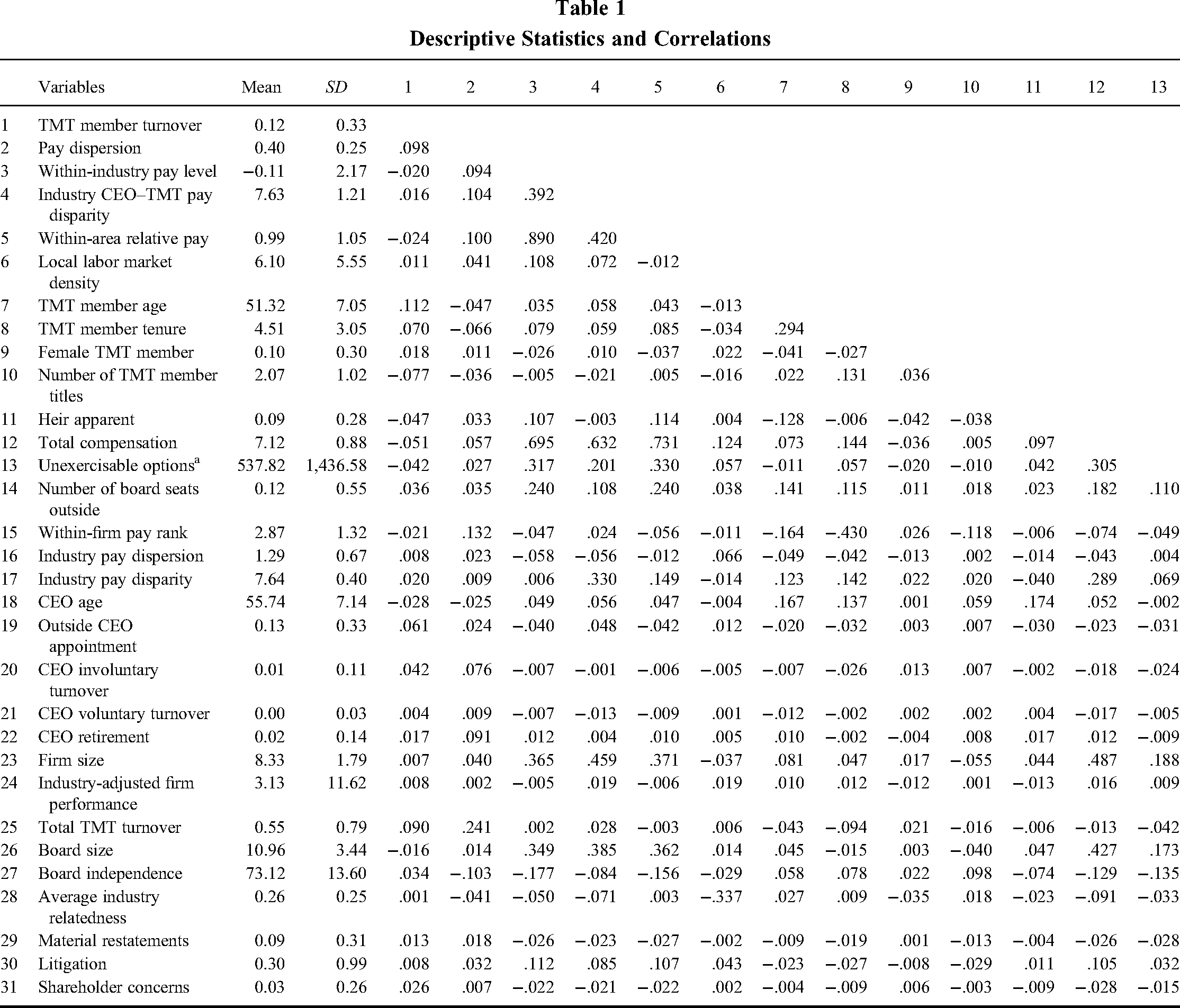
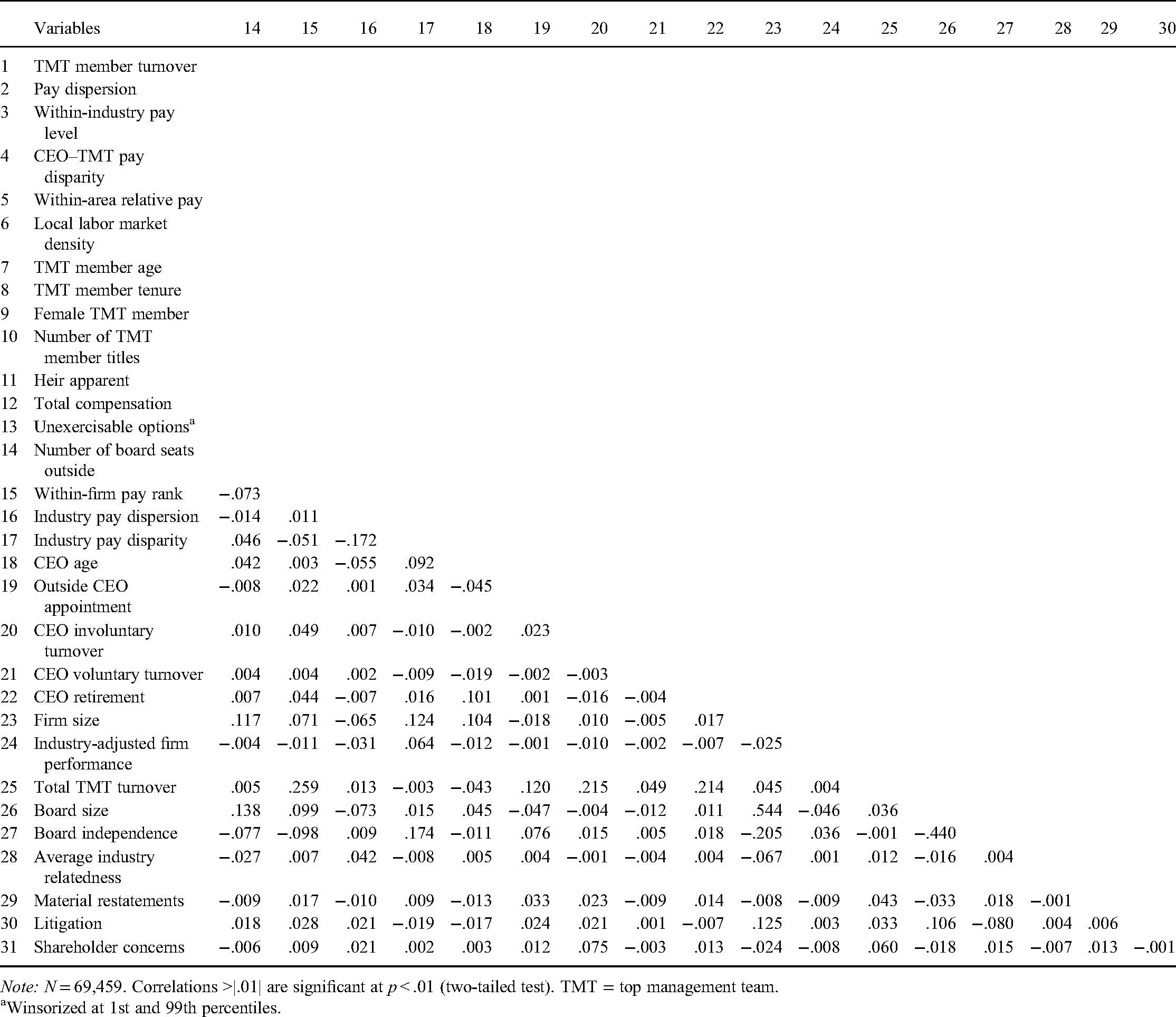
Note: N = 69,459. Correlations >|.01| are significant at p < .01 (two-tailed test). TMT = top management team.
Winsorized at 1st and 99th percentiles.
Table 2 provides results of survival analyses analyzing the effect of local labor market density on the likelihood of TMT member turnover. In the Cox proportional hazards model, the HR represents the proportional change in which a 1-unit predictor increase boosts the probability of event occurrence (i.e., turnover risk). Thus, an HR >1 indicates that the predictor variable increases the likelihood of TMT member turnover, while HRs <1 indicate that the predictor variable decreases this likelihood. Model 1 in Table 2 includes only control variables. In Model 2, we introduce the independent variables with all controls, and Model 3 is the fully specified model that includes the four interactions.
Cox Survival Analysis of TMT Member Turnover
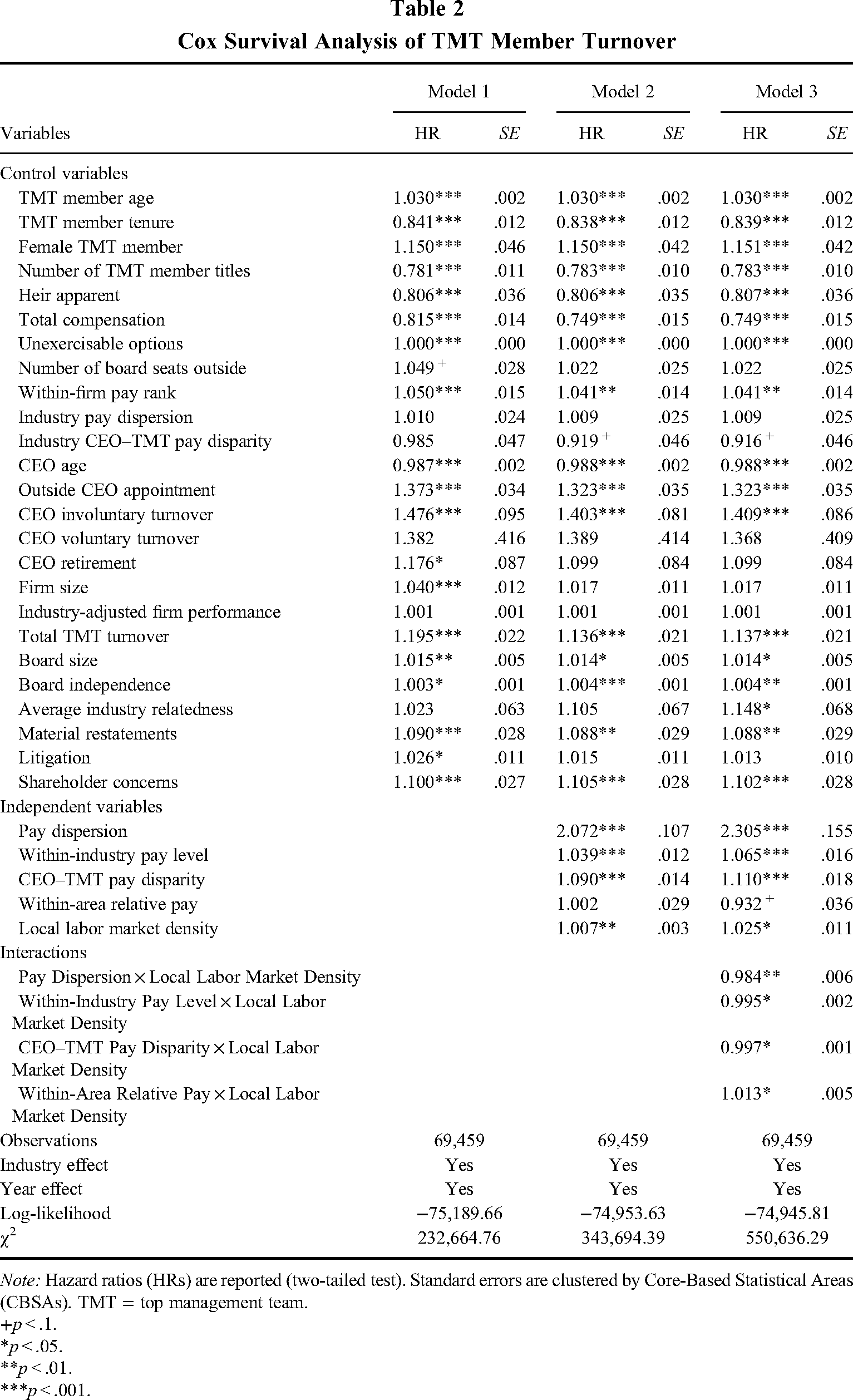
Note: Hazard ratios (HRs) are reported (two-tailed test). Standard errors are clustered by Core-Based Statistical Areas (CBSAs). TMT = top management team.
+p < .1.
*p < .05.
**p < .01.
***p < .001.
Hypothesis 1 posits that increased local labor market density would weaken the positive impact of pay dispersion on a TMT member's likelihood of turnover. In support of this hypothesis, Model 3 in Table 2 shows that the HR for the interactive effect of pay dispersion and local labor market density is <1 and significant (HR = 0.984, p = .006). Thus, Hypothesis 1 is strongly supported. Figure 1 depicts the marginal effect (according to mean-centered variables) of the interaction term between pay dispersion and local labor market density. We find that when local labor market density at 1 SD above the mean decreases, the impact of a 1-unit increase in pay dispersion on the likelihood of TMT member turnover decreases by 12 percentage points versus 1 SD below the mean (from 106% to 94%).
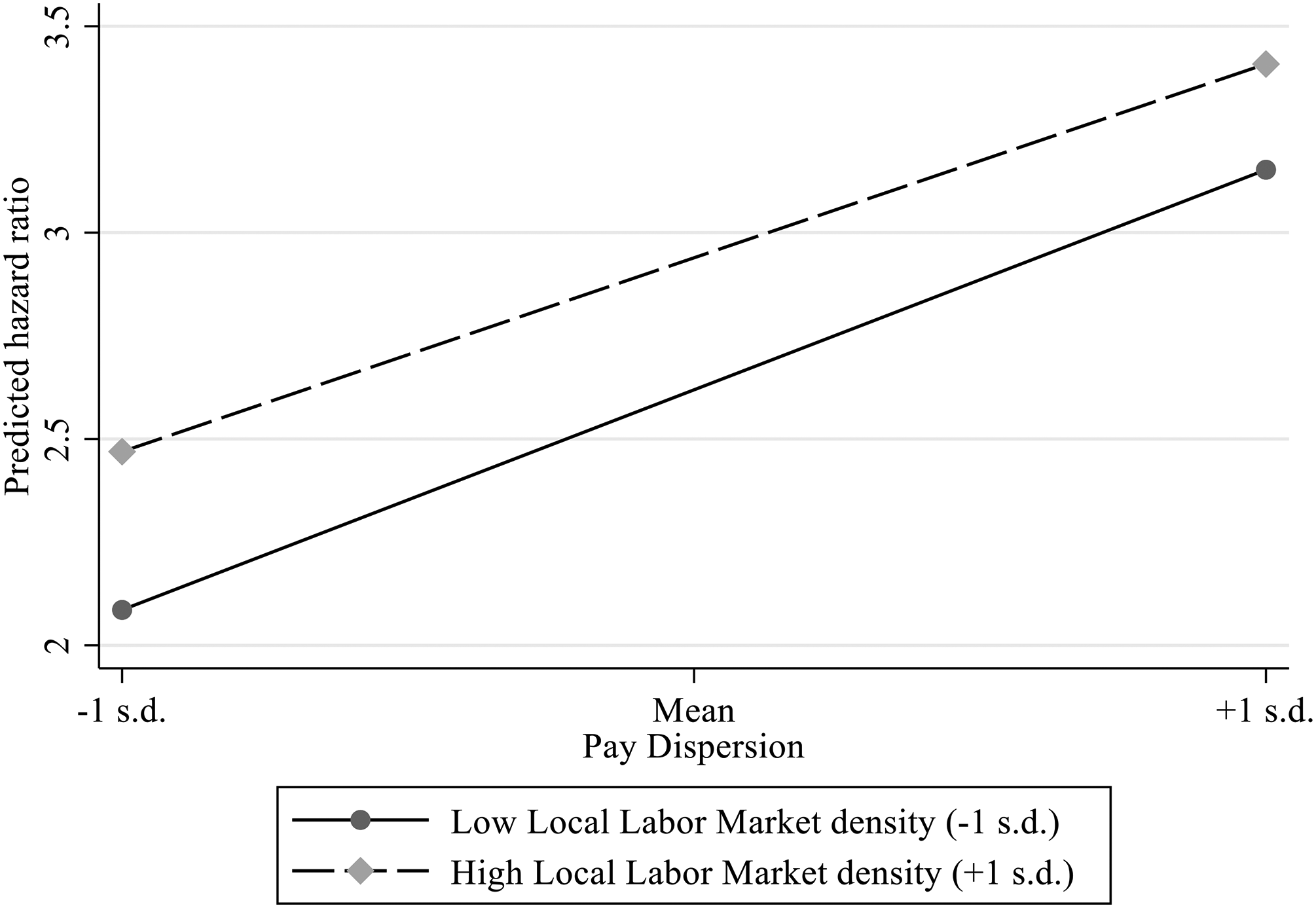
Interaction Plot Showing How Labor Market Density Moderates the Relationship Between Firm Pay Dispersion and Top Management Team Member Turnover
Hypothesis 2 suggests that an increase in local labor market density will weaken the positive impact of pay level in the industry on a TMT member's likelihood of turnover. The HR for the interaction impact of pay level and local labor market density is significant and <1 (HR = 0.995, p = .017), confirming Hypothesis 2. Figure 2 plots the marginal effect (according to mean-centered variables). When local labor market density increases by 1 SD above the mean versus 1 SD below the mean, the impact of a 1-unit increase in pay level on the likelihood of TMT member turnover decreases by 55 percentage points (from 59% to 4%).
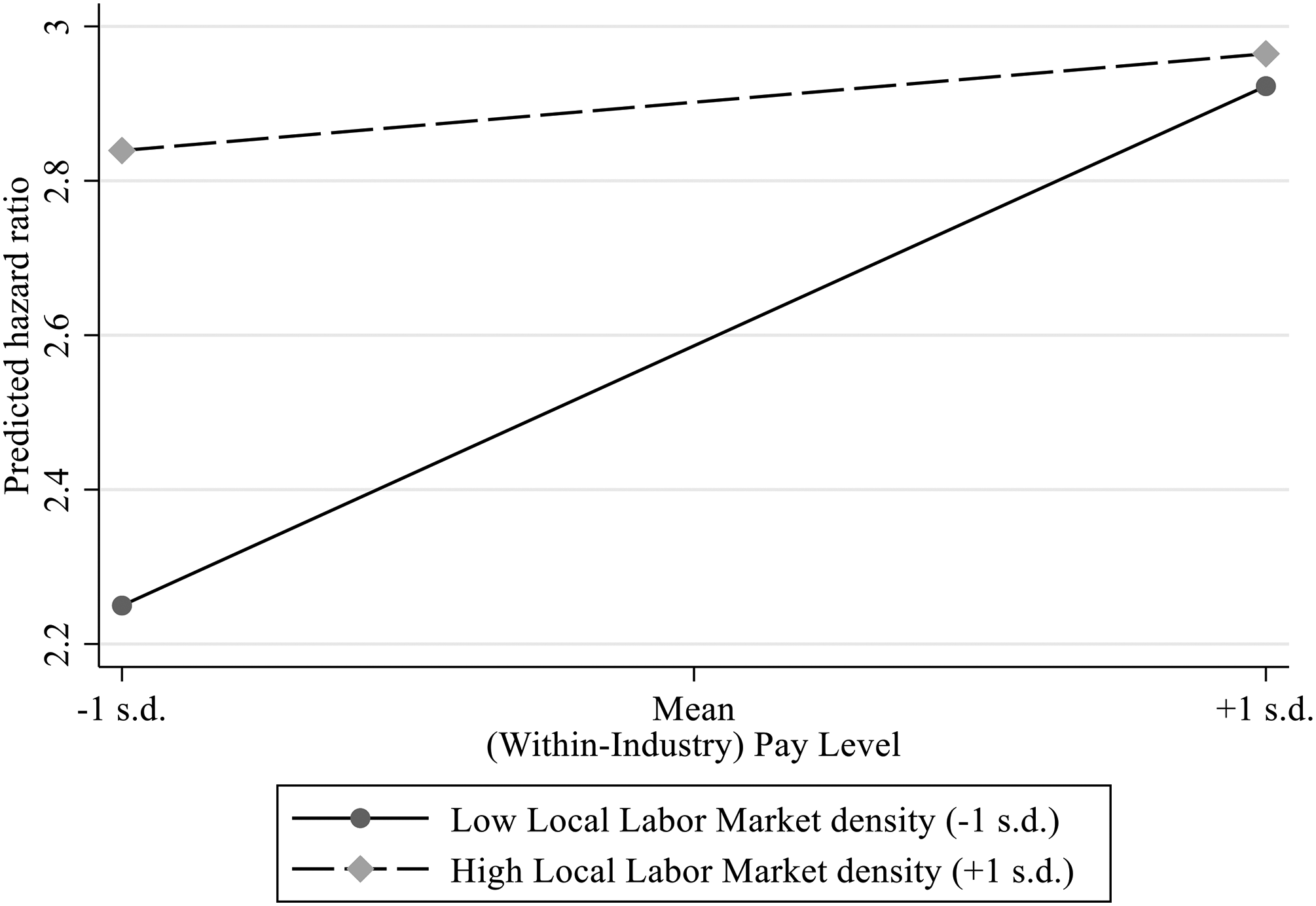
Interaction Plot Showing How Labor Market Density Moderates the Relationship Between Within-Industry Pay Level and Top Management Team Member Turnover
Hypothesis 3 posits that local labor market density will weaken the relationship between CEO–TMT pay disparity at a firm and a TMT member's likelihood of turnover. The HR for the interaction impact of pay level and local labor market density is significant and <1 (HR = 0.997, p = .038), confirming Hypothesis 3. Figure 3 plots the marginal effect (according to mean-centered variables). We find that when local labor market density increases by 1 SD above the mean versus 1 SD below the mean, the impact of a 1-unit increase in CEO–TMT pay disparity on the likelihood of TMT member turnover decreases by 12 percentage points (from 39% to 27%). Of note is our finding that the direct effect of higher CEO–TMT pay disparity increases the likelihood of TMT member turnover, which is different from prior studies. We elaborate on the implications of this finding in the Discussion section.
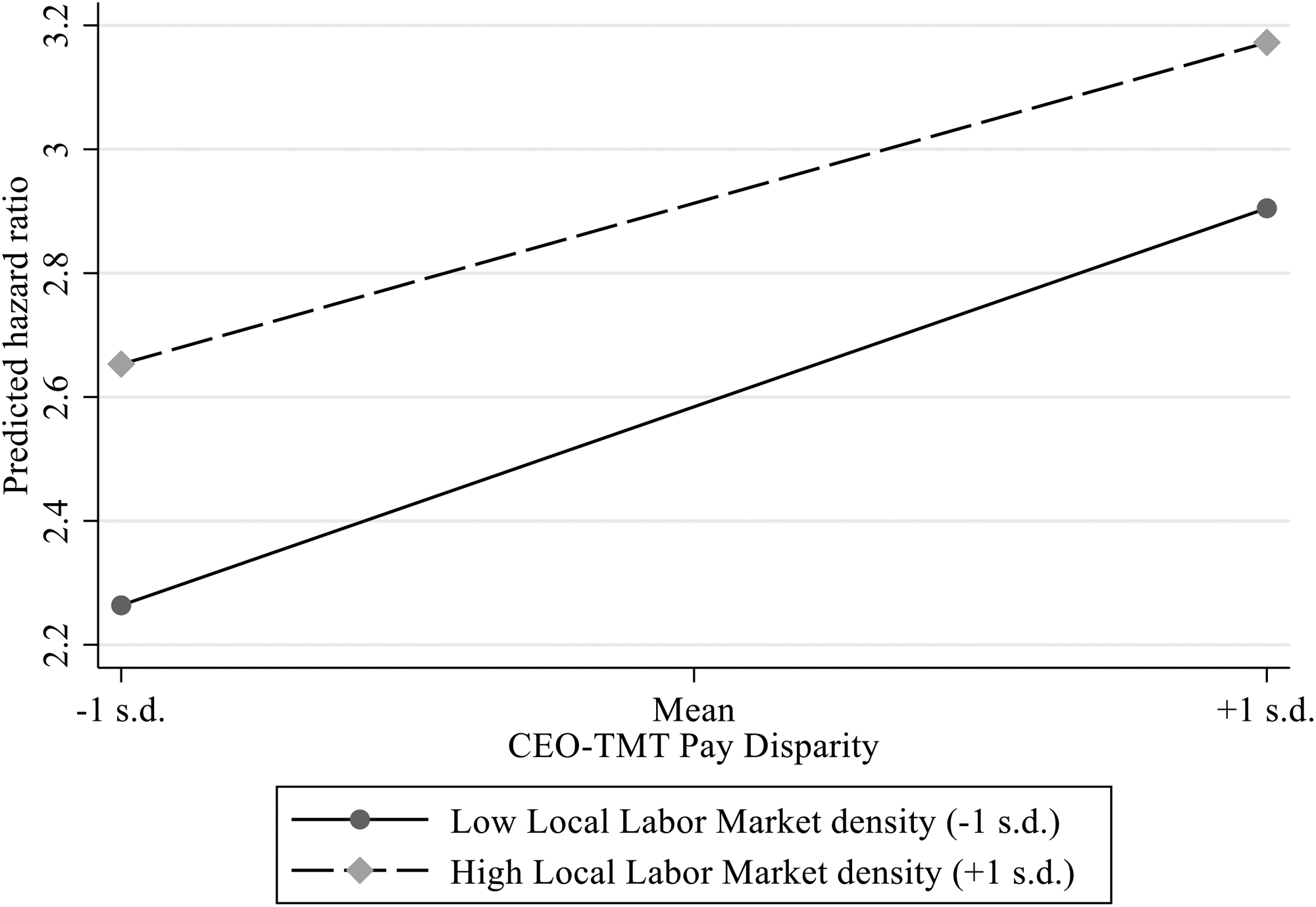
Interaction Plot Showing How Labor Market Density Moderates the Relationship Between Firm Pay Disparity and Top Management Team Member Turnover
Finally, Hypothesis 4 posits that local labor market density will positively moderate the relationship between within-area relative pay and a TMT member's likelihood of turnover. The HR for the interaction effect of within-area relative pay and local labor market density is significant and >1 (HR = 1.013, p = .013), supporting Hypothesis 4. The positive interaction indicates that as local labor market density increases, TMT members who are paid higher relative to others within their local area are more likely to leave. Figure 4 plots the marginal effect (according to mean-centered variables). When local labor market density increases by 1 SD above the mean versus 1 SD below the mean, the impact of a 1-unit increase in within-area relative pay on the likelihood of TMT member turnover rises by 80 percentage points (from −6% to 74%).
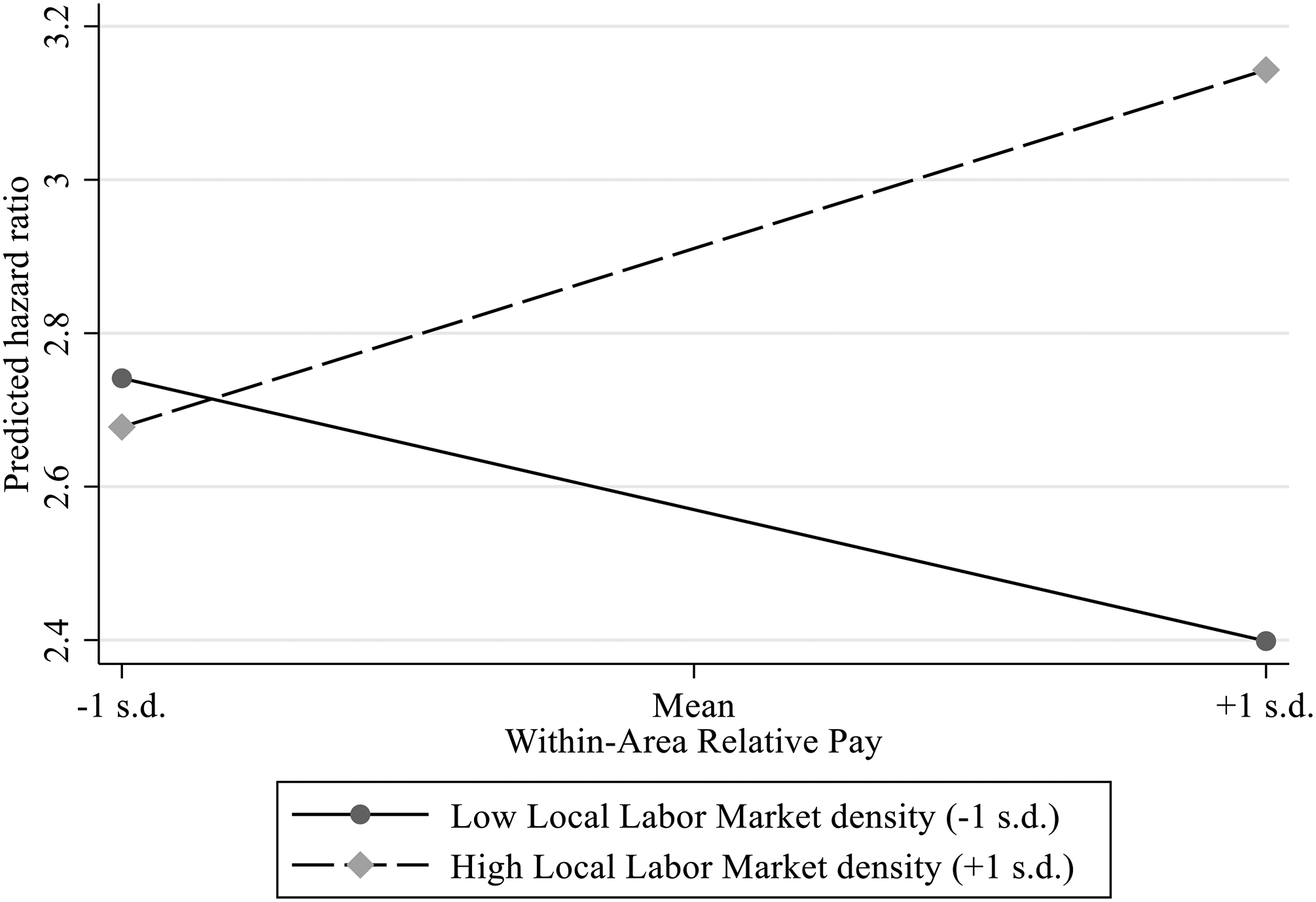
Interaction Plot Showing How Labor Market Density Moderates the Relationship Between Within-Area Pay Disparity and Top Management Team Member Turnover
Additional Analyses
We conducted numerous robustness checks. First, while the Cox proportional hazards model is appropriate for analyzing right-censored data, a competing risk regression model (Fine et al., 1999) estimates risks when a subject can experience multiple types of failure events. The competing risk model estimates the subdistribution HRs of two or more exclusive competing events (Fine et al., 1999). In this study, the competing events are whether TMT members leave the firm (i.e., TMT member turnover) or if they are promoted to CEO at the current firm (i.e., competing risk). The results of this analysis were consistent with our primary analysis.
Second, within-area relative pay is measured as a ratio, which could be problematic (Certo, Busenbark, Kalm, & LePine, 2020). To understand how measuring within-area relative pay as a ratio affects our results, we measured within-area relative pay as the difference between the focal TMT member's total compensation and the average total compensation of other non-CEO TMT members within the local area. The results are consistent with our primary results for Hypothesis 4. We note, however, that the standard errors of the interaction term are relatively higher as compared with other variables and interaction terms, which can lead to imprecise or insignificant estimations (Jonsson, Greve, & Fujiwara-Greve, 2009; Lyngsie & Foss, 2017). As a result, we continue to measure within-area relative pay as a ratio within our primary analysis. Separately, we considered following the approach used by Essman, Schepker, Nyberg, and Ray (2021), who used unscaled control variables for total compensation and the average TMT member total compensation within the local area. Including these should improve the robustness of our findings. Yet, when including these two control variables, we observed that the VIF values for TMT member total compensation and within-industry pay level were 33.02 and 21.87, respectively, indicating potential multicollinearity issues. Additionally, an unscaled measure of TMT total compensation was highly correlated with CEO–TMT pay disparity (ρ = 0.95) and within-area relative pay (ρ = 0.92). Because of these concerns, we do not use these variables in any analyses. Instead, we use a logged version of total compensation in our primary analyses.
Third, our sample is multilevel such that TMT members are nested within companies. As a result, we conducted a two-level analysis with a multilevel mixed-effects logistic regression model using the melogit command in Stata 17. This approach allows us to account for the nonindependent nature of our data by accounting for random effects in a higher level of our data (Ferrão, Curto, & Gama, 2016; Liu, Finkelstein, Kruk, & Rosenthal, 2018). With random intercepts for the second-level variable (company), the multilevel mixed-effects model results also largely confirm our primary analysis, although Hypothesis 3 was not supported.
Fourth, we compared several measures of local labor market density, by (a) using all public firms included in the Compustat database (our reported sample includes only S&P 1500 firms) and (b) computing the number of TMT members within the CBSA, which is expected to be highly correlated with the number of firms in the CBSA. Results for each of these models were similar to our reported results for all four hypotheses. We further checked the robustness of our results to alternative ways of calculating local labor market density, such as using a distance from the focal firm. We calculated the number of firms within a 20-, 60-, and 100-mile radius from the focal firm (Zhao, 2018) and found general support for all four hypotheses. Results for the impact of the interaction between within-industry pay level and local labor market density within a 100-mile radius area were not significant, implying that pay level has a stronger effect over smaller areas.
Fifth, we conducted analyses while controlling for several measures of a TMT member's profile, which can influence one’s turnover decisions. The profile measures include education level, senior TMT member experience, and broader industry experience. While including education level and senior TMT member experience showed significant results for Hypotheses 3 and 4, Hypotheses 1 and 2 were not supported. This shows the strong impacts of firm pay disparity and within-area relative pay on TMT member turnover in dense areas, but the results are likely to be biased, as 48% of observations were missing data on the TMT member's profile. When controlling for TMT members’ multiple industry experiences, all results were consistent with our primary results. The results controlling for multiple industry experiences confirm the strong impact of the local labor market on their turnover regardless of their experience across different industries. Detailed descriptions of TMT members’ profiles and the regression results are shown in Appendix B.
Finally, we considered how industry effects might influence TMT members’ turnover. We first controlled for the turnover rates of specific industries that might affect our results, as industries with higher turnover are likely located in more dense labor markets. Following Belenzon and Tsolmon (2016), we collected data on specific industry turnover rates from the US Bureau of Labor Statistics. This allowed us to create two variables: the industry turnover rate in each two-digit SIC industry and the industry turnover rate by CBSA. Models that controlled for the turnover rate in each two-digit SIC industry and CBSA confirmed our primary findings. Our second approach was to examine whether the industry similarity in each CBSA influences our results because more firms in a similar industry may have a greater impact on TMT members’ PEM. To address the similar industry effect, we ran analyses using a subsample that (a) includes only observations where industry similarity is high (high market-level PEM), (b) excludes observations where industry similarity is high (without high market-level PEM), and (c) excludes areas that have only one firm or one industry (low market-level PEM). Overall, the findings were generally consistent, although somewhat weaker when compared with our primary analysis results. We provide more detailed descriptions of the industries in our sample in Appendix C.
Endogeneity Considerations
As omitted variable bias is a potential concern for any study, we have included numerous control variables at the individual, firm, and industry levels to reduce the risk of omitted variable bias. To check whether omitted bias is a substantial risk, we utilized tests considering the impact threshold for a confounding variable (ITCV; Frank, 2000). We conducted this analysis using the konfound package in Stata. As our dependent variable is dichotomous, we used the ITCV test with a nonlinear logit model, which allows us to understand how much of an impact a confounding variable would need to have to invalidate our findings (Busenbark, Lange, & Certo, 2017; Harrison, Boivie, Sharp, & Gentry, 2018; Westphal & Zhu, 2019). Because the ITCV is currently inappropriate for interaction terms (Busenbark et al., 2017), we applied it to our main variables (Model 2 in Table 2). The ITCV for pay dispersion is 0.272, showing that an omitted variable would have to be correlated at .272 with pay dispersion and TMT member turnover to overturn our results. Between these two variables and other control variables, all of the correlations are <.13 (Table 1).
Robustness of inference to replacement (RIR) suggests that 92.19% of observations (n = 63,962) would need to be replaced with cases that have zero impact to invalidate the effect of pay dispersion on TMT member turnover. To invalidate the effect of pay level on TMT member turnover, the ITCV is 0.084, suggesting that an omitted variable would need to be correlated at .084 with pay level and TMT member outcome. Pay level is correlated with total compensation, unexercisable options, the number of board seats outside, firm size, board size, board independence, and litigation variables above the ITCV of 0.084, but none of these variables are correlated >.084 with turnover. The RIR suggests that 52.78% of observations (n = 36,619) would need to be replaced with cases that have zero impact to invalidate the effect of pay level on TMT member turnover. The ITCV for CEO–TMT pay disparity suggests that the partial correlation needs to be .208, and the RIR results state that 87.30% of cases (n = 60,570) would need to be replaced to overturn pay disparity's impact on TMT member turnover. CEO–TMT pay disparity is correlated with total compensation, industry CEO–TMT pay disparity, firm size, and board size at levels above the ITCV of 0.208, but none of these variables are correlated with turnover above that threshold. Last, the ITCV suggests that the partial correlation threshold for local labor market density is 0.127, and the RIR suggests that 71.99% of observations (n = 49,947) would have to be replaced with a null effect to invalidate our findings. Local labor market density is correlated with average industry relatedness at |.337|, which is above the ITCV of 0.127 but correlated with turnover at .001. These results suggest that the risk of omitted variable bias in our results is low.
Discussion
Despite March and Simon's (1958) assertion that turnover depends on job incumbents’ PDM and PEM, the TMT literature construes compensation as having a direct PDM influence on TMT members’ turnover, irrespective of their ability to leave. For example, recent investigations of non-CEO TMT member turnover have chosen to “focus primarily on . . . the desirability of an individual's situation in terms of pay” (Messersmith et al., 2011: 458) by assessing the impact of pay dispersion and pay disparity. While social comparison and tournament theories illuminate their effects, our understanding of TMT member turnover is incomplete given pervasive evidence that PEM forces moderate how PDM forces (e.g., job attitudes, job embeddedness) affect turnover among lower-echelon employees (Carsten & Spector, 1987; Meyer et al., 2012; Sender, Rutishauser, & Staffelbach, 2018). By considering the moderating role of local labor market density (a PEM proxy), our study provides a more nuanced understanding of how pay differences drive TMT member turnover. We find that dense local labor markets attenuated the direct effects of social comparison and tournaments. This confirms our assertion that existing models based on social comparisons (Bloom & Michel, 2002; Ridge et al., 2017; Siegel & Hambrick, 2005) and tournaments (Lazear & Rosen, 1981; Messersmith et al., 2011) need to incorporate TMT member PEM to better comprehend when TMT members will depart. In other words, scholars must simultaneously consider PEM and PDM forces to better explain the effects of pay comparisons on TMT member turnover.
Our study first considers how local labor market density buffers the effects of pay dispersion, pay level, and pay disparity. We find that dense labor markets temper the pay dispersion effect on TMT member turnover because TMT members can find proximal TMT members outside their TMT who are more similar in terms of job roles, reducing their reliance on comparisons with other TMT members within the firm. Relatedly, we find that pay level, which reflects comparisons with other TMT members within the industry, has a diminished effect on turnover when there are more firms locally. Even though TMT referents in the same industry are similar to focal TMT members in job knowledge and job responsibilities, their saliency as pay referents declines because they reside in remote—if not different—geographic locations that vary in amenities and cost of living (Deng & Gao, 2013), making apples-to-apples pay comparisons difficult.
Additionally, prevailing views of tournaments suggest that TMT member turnover declines when tournaments exist because TMT members are incentivized to reach the CEO role. Refining this view, we demonstrated that the loyalty-inducing effect of tournaments weakens in dense labor markets because TMT members can readily join more rewarding tournaments (offering larger tournament prizes) or more winnable tournaments elsewhere (cf. Zhao, 2018). A primary contribution of our study then is that prominent forms of pay comparisons have diminished effects on TMT member turnover when local labor markets are strong, establishing PDM × PEM interactions that have long preoccupied microlevel turnover research (Hom & Kinicki, 2001; Hom et al., 2017; Trevor, 2001).
Given that the salience of these internal pay comparisons is attenuated in the presence of dense labor markets, we find that when TMT members live in dense labor markets and earn more pay than their local counterparts, they end up leaving more often. That is, firms in dense labor markets paying top TMT members above market compensation increase rather than decrease their turnover. Above-market pay in dense labor markets thus represents a visible (or verifiable) signal of TMT member ability that increases executives’ ease of movement (Allen & Griffeth, 2001) more than it reduces their desire to leave (cf. Salamin & Hom, 2005; Trevor et al., 1997). In tight labor markets, higher-paid TMT members become more frequent targets for poaching by recruiting or competing firms (Gardner, Munyon, Hom, & Griffeth, 2018; Lee, Mitchell, Holtom, McDaniel, & Hill, 1999). As a result, higher TMT pay within the local area accelerates turnover when executives live in communities where they can readily and appreciably advance their careers (including promotions to CEO; Kale et al., 2014) without incurring undue switching costs (Zhao, 2018). Conversely, TMT members who are paid less than others in the local area find it more difficult to move because outside firms do not regard them as highly (Ridge et al., 2017).
Overall, our findings strongly suggest that incorporating PEM forces into extant research on TMT member pay comparisons clarifies their influence on TMT member turnover. Since March and Simon (1958), wide-ranging theoretical perspectives on turnover, job embeddedness, and organizational commitment (Hom, Mitchell, Lee, & Griffeth, 2012; Lee & Mitchell, 1994; Meyer et al., 2012) positioned PEM influences as central underpinnings of why incumbents stay or leave. Sustaining those views, we rigorously demonstrated that local labor market density diminishes comparisons with referent groups who are dissimilar and/or nonproximal because dense labor markets offer abundant and more attractive employment alternatives in the community (aka, more tournaments and larger tournament prizes; Zhao, 2018) as well as reduced switching costs (Allen, 2006). When more firms populate a geographical area, TMT members can more readily change jobs for higher-paid, more prestigious jobs without incurring relocation costs (Zhao, 2018), such as relinquishing community amenities cherished by them or their families (e.g., leaving reputable schools for children, disrupting spousal careers; Feldman et al., 2012; Mitchell et al., 2001). Additionally, our finding that local labor market density underpins TMT member turnover corroborates emerging research disputing conventional academic wisdom that TMT member labor markets are strictly nationally (or internationally) integrated (Francis et al., 2016; Gao et al., 2015; Zhao, 2018).
Our investigation further yields practical implications for managing TMT member turnover. When TMT members live in a region with abundant local job alternatives, compensation committees and CEOs should consider a TMT member's relative pay with other TMT members in the local community, as these TMT members serve as a relevant comparison group for turnover decisions (Aime et al., 2020; Gao et al., 2015). Our research suggests that boards of directors who recruit high-status TMT members should consider not just tangible rewards (e.g., compensation or perks) but also intangible rewards (e.g., social support or internal status) or nonpecuniary incentives (Zhao, 2018). After all, furnishing monetary incentives may inadequately diminish PDM levels and may even increase PEM when TMT member pay surpasses local market rates. Along these lines, firms should clarify top TMT members’ career paths to identify when—if not how—they can move upward, including attaining CEO status either internally or externally in the future (Essman et al., 2021). In summary, monitoring prime competitors in the local labor markets (especially in the same industry or size) and the enticements that they offer (e.g., potential CEO vacancies, and compensation packages) may help firms proactively retain valued senior TMT members.
Study Limitations and Future Research
Despite theoretical and practical contributions of our findings, there are multiple opportunities to expand and improve on what has been done in this study. Perhaps most important, our measure of TMT member turnover does not allow us to fully rule out that these turnover events were involuntary. Our theory assumes that turnover was voluntary, yet it is not possible to determine if TMT members left their position involuntarily (especially for non-CEO TMT members) as firms face significant legal liabilities if they disclose that departing TMT members were fired. Although our approach is consistent with other TMT member turnover studies (Andrus et al., 2019; Arthaud-Day et al., 2006; Boivie, Graffin, & Pollock, 2012), we believe that our theoretical model also applies to involuntary turnover. From the firm's perspective, dense local labor markets make it easier to terminate ineffective or undesirable TMT members as firms can more readily replace them with local recruits (which lessens turnover dysfunctionality; Nyberg & Ployhart, 2013). Typically, firms must not only find capable replacements but also must convince them to leave their position. Recruiting TMT members outside the local area is difficult (as candidates may themselves be deeply rooted in their current communities; Mitchell et al., 2001), resulting in firms having to offer expensive relocation packages to entice candidates and their families (e.g., quality-of-life premiums; Deng & Gao, 2013).
Another potential study limitation is that the effect size of labor market density seems relatively small when compared with some other turnover predictors (e.g., gender, firm performance, outside CEO succession). However, marginal effects illustrate how significant the impact of labor market density is on these relationships. As illustrated in Figure 1, dense labor markets limit the effect of higher pay dispersion by 12 percentage points. The effect of dense labor markets on the relationship is even stronger for pay level, as turnover is decreased by 55 percentage points in dense labor markets (Figure 2). The effect on tournaments is substantial, as dense labor markets decrease the effect of CEO–TMT pay disparity on turnover by 12 percentage points (Figure 3). Most impactful, though, is the effect of labor market density on within-area pay comparisons. As shown in Figure 4, the turnover likelihood increased by 80 percentage points when higher-paid TMT members (relative to local counterparts) reside in dense rather than sparse labor markets. Thus, the marginal effects of local labor market characteristics can have a substantial impact on the relationship between pay differences and turnover, as the effects of local labor market density are more pronounced when combined with other PEM and PDM factors.
Another implication of our research is our finding that tournaments have a positive effect on turnover, which is contrary to most prior research that generally concludes that tournaments reduce turnover (Becker & Huselid, 1992; Coles, Li, & Wang, 2018; Gibbons, 1998; Kale et al., 2014). This contradiction speaks to the importance of considering PEM forces such as labor markets in combination with pay differences because tournaments held in sparse labor markets would likely be more motivating to TMT members. However, dense labor markets increase the number and size of outside tournaments, allowing TMT members who are seeking the “prize” to more easily find external opportunities that provide the most rewards (Zhao, 2018). As our findings suggest, tournaments held in these conditions likely spur, rather than diminish, TMT member departures. For example, in the presence of a large tournament, a TMT member who earns much less than other TMT members in the local area likely cannot move given that their movement capital is diminished when compared with area peers (Trevor, 2001). An important avenue for future research then is to explore other ways in which labor markets influence tournaments. For example, do tournaments best incentivize retention when TMT members have greater human capital, status, or power? TMT members with such attributes have more job alternatives and can better find more desirable tournaments nearby.
We note that the effect of local labor markets is more substantial when considering how an individual's pay compares with referent others. This supports the idea that pay comparisons are most relevant when they are specific to an individual (e.g., such as pay level or within-area relative pay) rather than a group (e.g., pay dispersion or pay disparity). Empirical tests of relationships between TMT member pay and turnover generally examine group-level pay differences, such as pay dispersion within the TMT and industry or the disparity between CEO and TMT pay (e.g., Messersmith et al., 2011; Ridge et al., 2017). Our findings that within-area relative pay—an individual-level comparison of a TMT member's pay standing among one’s peers in the local area—provides greater movement capital suggest that future researchers might consider individual- and group-level pay comparisons together. Take, for example, a TMT member who works at a firm where TMT pay dispersion and CEO–TMT pay disparity are high. Considering a TMT member's individual-level pay would likely provide very different conclusions when a TMT member is highly paid as compared with lower-compensated TMT members. This TMT member likely has a better chance of winning the tournament and thus will be less inclined to leave, whereas the underpaid TMT member versus other TMT members within the firm would more likely leave. Thus, we believe that research on interactions between social comparisons and tournaments would be well served to consider individual- and group-level pay differences concurrently. Furthermore, future research should assess other individual-level PEM proxies besides relative pay, such as TMT members’ job transferability or relative status (e.g., occupational mobility or positional rank; Frydman, 2019; Gayle, Golan, & Miller, 2015; Hamori, 2010).
Another novel way to expand on this study is to consider how other community characteristics besides labor market density affect TMT member turnover. This may include factors such as cost of living, political contexts, family ties, school systems, crime, transportation, and other community features that embed TMT members or their families (Feldman et al., 2012; Mitchell et al., 2001)—or even impel them to relocate to more attractive destinations (e.g., relocate closer to relatives, greater career opportunities for partners or spouse; Tharenou & Caulfield, 2010). For example, recent work considers whether a leader's political ideology “fits” with the ideology of the firm (Bermiss & McDonald, 2018). Similarly, TMT members located in an area that does not fit with their ideology may likely leave. Future research should also examine how local labor market attributes influence other outcomes, such as firm strategic actions, TMT member compensation, board and director antecedents, and outcomes, as well as nonmarket outcomes, such as stakeholder management and activism.
Although inspired by microlevel turnover research on PDM × PEM interactions, our demonstration of a rare individual-level PEM × market-level interaction warrants replication. As noted earlier, microlevel theories increasingly promulgate environmental PEM factors (e.g., unemployment rates and community amenities). Excepting Trevor (2001), microlevel turnover studies have nonetheless narrowly construed individual-level PEM factors (mostly human capital attributes such as education) while overlooking their potential interaction with community PEM attributes. We thus recommend that microlevel turnover researchers identify additional ability signals, which likely vary across occupations. For example, IT professionals signal expertise by frequently contributing to internet-enabled open knowledge communities by addressing members’ software questions (Huang & Zhang, 2016). Besides testing their interactive effects with unemployment statistics, we prescribe testing their interactive effects with community switching costs (which are borne by incumbents or families) that impede ease of movement. Finally, we note that greater availability of hybrid or remote working arrangements can lessen switching costs, as employees can work for distant employers without having to relocate. For such employees, local labor market density and community embeddedness likely matter less (Allen, 2006).
In conclusion, our research calls attention to the long-standing oversight of how PEM forces influence the relationship between TMT member pay and turnover (a few exceptions include Frydman, 2019; Gayle et al., 2015; Hamori, 2010). This is problematic because market-level PEM (i.e., local labor markets; Trevor, 2001) reduces the impact of pay dispersion, pay level, and pay disparity, ultimately influencing turnover in more nuanced ways than has previously been conceived by TMT member turnover scholars. Although the broader turnover literature has long deemed that PEM (notably, labor market characteristics) is a central turnover driver (Hulin, Roznowski, & Hachiya, 1985; Lee & Mitchell, 1994; Mobley et al., 1979; Price & Mueller, 1981; Steel, 2002), extant models that purport to elucidate why TMT members vacate jobs are devoid of market-level PEM factors. Using the PDM and PEM framework that much of turnover theory sustains, we theorize and find that local labor market density attenuates the effects of proxies reflecting social comparisons and tournaments.
Footnotes
Acknowledgments
We thank Action Editor Aaron Hill and two anonymous reviewers for their insightful feedback and support in developing this article. We also thank Bert Cannella, Dan Turban, Valerie Sy and participants at University of Missouri's Research Development Series for their help with earlier versions of this manuscript.
Appendix A: Additional Details About the Sample TMT Members
Among the 16,770 TMT members in our sample, the most common titles are vice president (70.98%), chief finance officer (CFO; 24.67%), chief operating officer (COO; 9.10%), president (8.77%), and chief accounting officer (CAO; 1.62%). Table A1 provides more information about TMT members in our sample. Note that these percentages add up to >100% because 33.9% of vice presidents also hold a CFO, COO, or CAO title and 35.5% of TMT members who are president also hold a CFO, COO, or CAO title.
Appendix B: Measures of TMT Members’ Profiles and Robustness Test Results
Because the profile of the TMT member may influence the likelihood of TMT member turnover, we considered several measures of a TMT member's profile, including education level, senior TMT member experience, and broader industry experience.
First, to identify if biographical profiles have similar effects for non-CEO TMT members, we measure TMT member human capital as represented by a TMT member's education level and the experience that one has as a senior TMT member (e.g., Acharya & Pollock, 2013; Khanna, Jones, & Boivie, 2014). Education level has a minimum value of 12, representing the achievement of high school education. TMT members with a bachelor, master, or doctoral degree had 16, 18, and 23 years of education, respectively. Education level reflects an individual's cognitive abilities (Khanna et al., 2014). A TMT member's experience as a senior TMT member is represented by the number of years that a TMT member has served as a CFO, COO, or president. Including these as control variables results in Hypotheses 1 and 2 no longer being supported, although Hypotheses 3 and 4 are still supported (Table B1). We note that because TMT member education is available to use only for TMT members listed on Boardex, we lose approximately 48% of our sample (we retain 8,073 TMT members, 1,969 firms, and 35,944 TMT member–firm-year observations). This result is thus likely to be highly biased (weakening statistical power).
The second way in which we try to account for a TMT member's profile is by controlling for whether one has experience working in multiple industries. To do so, we generated a dummy variable that is 1 if a TMT member has worked in multiple industries during the time that one is listed on Execucomp. Of 16,662 TMT members, 607 have worked in multiple industries, and results are consistent with our primary analysis (see Table B2).
Appendix C: Additional Details About Sample Industries
Considering job options in a similar industry in the local area allows us to better address concerns of industry bias where similar industries in the area may influence PEM. We first deeply looked at our sample industries in the CBSAs. Table C1 provides summary statistics of the industries in our sample. Our sample shows that the average industry similarity (i.e., level of industry relatedness) is about 0.26, within the same CBSA as well as nationwide. On average, there are 17 industries in each local area out of 65 unique industries nationwide. Regarding the number of CBSAs, there is an average of 179 CBSAs each year in our sample, while 45 CBSAs (25%) have at least 7 industries each year. This suggests that within-industry hiring bias has the potential to influence a significant portion of TMT members in our sample.
