







Abstract
In this study, we develop the argument that geographic distance between the state and local governments undermines the state's capacity to influence the implementation of state policies by local organizations. Drawing from information economics and the attention-based view, we propose that physical distance reduces the state's monitoring effectiveness through two interrelated mechanisms: information asymmetry and state leaders’ inattention to distant issues. Using data of Chinese public firms’ implementation of environmental activities between 2008 and 2016, we find that firms conduct fewer environmental activities required by the state when they are regulated by local governments that are more geographically distant to Beijing. This distance effect is, however, attenuated in regions with higher levels of gross domestic product growth and Internet activism. Furthermore, firm characteristics that draw the direct attention of state leaders and provide alternative information channels—namely, firm visibility and government subsidy received—negatively moderate the effect of geographic distance. This study contributes to the literatures by identifying a geography-based view of state capacity in shaping organizational behaviors and its underlying mechanisms.
Introduction
That the state has a role in shaping organizational behaviors is hardly controversial. Scholars have used the concept of state capacity to describe the top-down administrative ability of the state government to implement policies and influence organizations (Besley & Persson, 2010; Guillén & Capron, 2016). While past studies have demonstrated the power of the state in intervening into private organizations (Evans, 1995; Guler, Guillén, & Macpherson, 2002; Roy, 1999), state policy implementation is not always successful, and there is a high level of heterogeneity in organizational responsiveness (Weiss, 1998; Xie, Shen, & Zajac, 2021). Primarily based on agency theory, extant studies have attributed this heterogeneity to the different incentives of state leaders and local government officials (Luo, Wang, & Zhang, 2017; Yue, Wang, & Yang, 2019), the regulatory discretion of local bureaucrats (Grandy & Hiatt, 2020), or the hierarchical distance between state government and lower-level governments (Wang, Wijen, & Heugens, 2018). Few studies, however, have examined how a nation's geographic scope—in particular, the physical distance between the state and local governments—might affect the state's capacity in influencing firm behaviors. Nevertheless, the political science literature has long considered geography a key determinant of state capacity (Boone, 2003; Kasara, 2007; Rotberg, 2010). Yet, due to differences in research focus, this literature has not examined the effect of geographic distance from the firm's perspective.
This article therefore fills the gap in the literature by explicitly investigating how geographic distance enables firms to reduce their responsiveness to a nationwide state environmental policy in China. Drawing from information economics (Coval & Moskowitz, 2001; Giroud, 2013) and the attention-based view (Hoffman & Ocasio, 2001; Ocasio, 1997), we propose that the physical distance between the state and local governments creates opportunities for local firms to reduce their policy implementation through two interrelated mechanisms: information asymmetry and state leaders’ inattention to distant issues. First, geographic distance makes it difficult for state leaders to have close oversight of the process through which local governments gather and report information or to personally visit distant regions to gather more accurate information, thus increasing the information asymmetry regarding local environmental performance. The second and also largely overlooked mechanism is state leaders’ inattention. We argue that farther distance decreases state leaders’ attention to regional policy performance, given their lack of embeddedness in the issue-related context and a lower level of perceived impact of issues in remote regions. Both mechanisms imply that geographic distance reduces the state's monitoring effectiveness, thereby creating opportunities for firms to reduce their compliance with the state's environmental policy by colluding with local governments who have other agendas, such as promoting local economic growth. Note that the two mechanisms often reenforce each other in influencing the effectiveness of state policy implementations. While a high level of information asymmetry tends to weaken the saliency of issues and thereby reduce attention, a high level of attention may facilitate the flow of information, reducing information asymmetry.
We further examine some contingency factors, at the region and firm levels, that may affect the distance effect. The two regional variables chosen have effects on either local governments’ incentive to deviate or the state's information gathering and attention allocation. First, while a focus on economic goals gives local governments incentive to deviate from the state's environmental policy, for regions that have already achieved relatively high gross domestic product (GDP) growth, their local governments would have more leeway and thus are expected to comply more with state policy to pursue environmental protection. Second, regional Internet activism on environmental protection is expected to ease the state's monitoring problem, given that it serves as an additional information channel and directly draws the attention of state leaders to local environmental issues. Hence, the negative effect of geographic distance on firms’ environmental policy implementation is likely mitigated in regions with higher levels of GDP growth and Internet activism on the environment. Furthermore, we examine two firm-level factors—firm visibility and subsidy received from the government—that motivate the state to bypass local governments to directly collect information on firms and place attention to them. This will exert pressure on firms for improving environmental performance, and we therefore expect that the negative effect of geographic distance on firms’ environmental responsiveness is mitigated for those with higher visibility and those receiving more government subsidy.
Empirically, we analyzed Chinese public firms’ implementation of environmental activities from 2008 to 2016, during which the state government issued specific environmental requirements in China's national Five-Year Plans. We constructed a unique data set that integrates firm-level data on their environmental activities and geographic locations and region-level data on Internet activism and GDP growth rate. Our results support our hypotheses and suggest that geographic distance between the state and regional (provincial) governments creates strategic opportunities for local firms to reduce their responsiveness to the state's environmental policy requirements. Furthermore, this distance effect is attenuated in regions with higher levels of GDP growth and more Internet postings of environmental issues. Firm visibility and subsidy received from the government also negatively moderate the effect of geographic distance.
This study makes several contributions to the literatures. First, it contributes to the research on firms’ institutional strategies in emerging markets (Dorobantu, Kaul, & Zelner, 2017; Marquis & Raynard, 2015) by identifying a geography-based view of state capacity in shaping corporate strategy. To date, scant scholarly attention has been paid to the role of geographic distance in determining firm responsiveness to state intervention. Our study fills this gap by integrating political science insights on geography with organizational theory and proposing that firms’ implementations of state policy have substantial geographic variations. Second, we draw on information economics and the attention-based view of the organization to identify two underlying mechanisms in explaining the geographic variations of firms’ policy responsiveness. By doing so, our study extends the Weberian state literature by uncovering how the bureaucratic system can be ineffective, not only because of the hierarchical distance between the state and local governments and other general monitoring challenges that have been emphasized by existing studies (e.g., Luo et al., 2017; Wang et al., 2018; Yue et al., 2019), but also due to the distance effect associated with information gathering and attention allocation by state leaders. Finally, this study extends the literature on antecedents of corporate environmental actions (e.g., Delmas & Toffel, 2008; Sharfman, Shaft, & Tihanyi, 2004; Walls, Berrone, & Phan, 2012) by uncovering the role of geographic factors, in addition to institutional or firm-level factors emphasized by existing studies, in affecting firm environmental performance.
Theoretical Background
The most widely used conceptualizations of state capacity build implicitly or explicitly on Max Weber's portrayal of the state as an organization with the ability to make and implement policies (Besley & Persson, 2010; Geddes, 1994; Migdal, 1988). By providing predictable career paths for lower-level officials, state leaders can rely on the latter to intervene in private organizations and implement nation-level agendas (Evans & Rauch, 1999; Skocpol, 1979). Given this Weberian tradition that emphasizes principal-agent (state leaders–local officials) interactions, the agency problem between the state and local governments has formed the foundation for subsequent research on this subject (North, 1990). Specifically, in the case of China, although the country is led by a powerful state government, due to its gigantic size and regional diversity, local governments have the overall responsibilities for coordinating economic activities, providing public services, and enforcing laws within their jurisdictions (Landry, 2008). The state government controls local governments through a centralized personnel control system that determines the promotion or demotion of local officials based on their performance evaluation and competition outcomes with other regions (Edin, 2003; Li & Zhou, 2005).
This decentralized governance system has been proven successful in contributing to China's spectacular economic growth since the reforms in 1978 (Lin & Liu, 2000). Meanwhile, with China's rapid economic development there arose various social problems, which prompted the state government to develop other agendas, such as protecting the environment, managing inequality, and maintaining social harmony. Accordingly, the duties of local government officials are expanded to include goals aligned with these agendas. When these alternative goals are in conflict with economic development, local officials have the tendency to prioritize the latter, for at least two reasons. First, economic goals and performances are more quantifiable, allowing easier performance evaluation and comparison across regions (Qi & Zhang, 2014; van der Kamp, Lorentzen, & Mattingly, 2017). Second, economic performance often receives more weight in the state's overall evaluation of local governments and is tied closely to the subsequent promotion of local officials (Chen, Li, & Zhou, 2005; Li & Zhou, 2005). Therefore, local government officials may prioritize GDP growth at the expense of other regional tasks, which however may deviate from the state government's agendas (Xu, 2011). Indeed, some studies have shown that local governments in China are motivated to not tightly enforce social and environmental regulations set by the state to attract more foreign direct investment (Wang, Wei, Deng, & Yu, 2017; Wu, 2007).
Accordingly, recent studies have examined various factors that affect the conflicts of interests among different levels of government in China, which in turn influence firm responsiveness to state policies. For example, Luo et al. (2017) suggested that the extent to which local governments focus on economic growth, which creates tension with the state's expectations on corporate social responsibility (CSR), affects the likelihood of firm decoupling in CSR reporting. In analyzing Buddhist temples’ commercialization in China, Yue et al. (2019) showed that the incentive to promote GDP growth prompted local governments to commercialize Buddhist temples, which is in conflict with the state logic that emphasizes social justice. In addition, some recent studies examined the role of hierarchical distance within the state hierarchy in affecting the capacity of the state government to monitor local government and influence firm compliance. In a study of corporate environmentalism in China, Wang et al. (2018) found an inverted U-shape relationship between firm environmental actions and the number of governmental levels separating the state government and local government with which the firm is affiliated. While these studies have powerfully demonstrated the importance of agency conflicts in affecting state policy implementation by firms, the role that geographic distance between the state and local governments plays in influencing such a conflict and subsequent firm behavior has not been explored.
Yet, existing economics and political science studies have long considered geographic distance a key determinant of state capacity in enforcing policies (Bates, 1983; Boone, 2003; Herbst, 2000). In this line of literature, the general finding is that state capacity declines with an increase in distance from the capital or large cities (Brinkerhoff, Wetterberg, & Wibbels, 2018). In addition to the challenges associated with the transportation structure of remote regions, another key explanation for the distance effect is that a lack of political resources leads to decay in the state's reach with an increase in physical distance. For instance, Bates (1983) and Herbst (2000) argued that African national leaders do not even try to extend the state's power to the countryside, focusing instead on consolidating power in the capital and the few large urban centers. These explanations for the distance effect appear to be context specific and do not apply to other situations, such as the context of our study, where transportation is not a major challenge and where the state has strong incentives to extend its power to distant regions. Moreover, due to differences in research focus, this literature has not examined the effect of geographic distance from the firm's perspective, not to mention the mechanisms through which distance affects firm compliance with state policies.
In the following, we turn to the state's influence on firm implementation of a nationwide environmental policy in China. To cope with increasing environmental challenges, the state government in China since 2006 has introduced a series of national policies in the national Five-Year Plans to induce firms to implement ecofriendly activities. The state government specifies the types of environmental activities that firms should implement, including conversion to energy-efficient appliances, reducing various emissions, recycling, and investing in research and development. The enforcement of the national environmental policy is delegated to regional governments that directly regulate local firms. The launch of such a state-level environmental policy creates a social laboratory for observing variations in firms’ implementation of environmental activities required by the state and for examining the impact of geographic distance between the state and local governments on this variation and its mechanisms.
Hypothesis Development
Effect of Geographic Distance on Firm Environmental Policy Implementation
In this study, we are interested in how geographic distance between the state and local governments creates leeway for firms to mitigate the state's environmental regulatory influence. There are at least two potential mechanisms leading to the distance effect: increased information asymmetry with physical distance and state leaders’ lack of attention to distant issues.
Information asymmetry mechanism
In the first mechanism, geographic distance increases the level of information asymmetry between state leaders and local governments, which heightens the difficulty of state monitoring and control of a region's environmental performance. This argument is in line with the stream of information economics literature, which has primarily focused on the relationship between headquarters and its divisions or that among organizations in a value chain or a network. The key arguments are based on the premise that geographic proximity facilitates access to information and monitoring. For instance, proximity makes it significantly easier for headquarters to acquire information regarding plant performance (Giroud, 2013). Furthermore, mutual fund managers are more likely to hold shares of local firms, and they earn substantial abnormal returns from these investments, suggesting “improved monitoring capabilities or access to private information of geographically proximate firms” (Coval & Moskowitz, 2001: 812). This literature provides implications for a better understanding of how geographic distance may create information-based disadvantages for the state's monitoring of its policy implementation.
In the case of China's environmental policy implementation, at the state government level, the Ministry of Ecology and Environment and other ministries, such as the Ministry of Natural Resources, are the organizations responsible for formulating national environmental goals and requirements in the national Five-Year Plans. The actual enforcement of the policy is, however, delegated to each provincial government, particularly the provincial Department of Ecology and Environment (Zhang, Chen, & Guo, 2018). The state government periodically evaluates regional environmental performance mainly based on reports prepared by provincial governments and occasional site visits (Xu, 2011).
However, because geographic distance makes it difficult for the state government to have a close oversight of the process through which local governments gather and report information, there could be a significant loss of useful and truthful information (Chen, Jin, Kumar, & Shi, 2012; Ghanem & Zhang, 2014). The state government may also directly acquire a region's environmental performance information through site visits. Geographic distance again makes it difficult for time-constrained state leaders to personally visit distant regions. In contrast, for geographically proximate regions, state leaders, through direct interactions and denser social networks, are more likely to access firsthand information or hear about how the local government or firms in these regions have implemented environmental activities. Realizing this, local government officials are also more likely to file accurate reports, further improving the quality of the information that state leaders receive and enhancing their monitoring effectiveness (Alonso, Dessein, & Matouschek, 2008). In this case, a farther geographic distance between the state and local governments will result in a higher level of information asymmetry between the two, which leaves room for less environmental compliance by firms directly regulated by local governments.
Attention mechanism
In addition to its effect on information asymmetry, geographic distance may affect the saliency of local environmental issues to state leaders and their attention to such issues. Organizational attention is defined as organizational decision makers’ noticing, encoding, interpreting, and focusing of time and effort on issues and answers (Ocasio, 1997). The core argument of the attention-based view is that due to bounded rationality and limited cognitive resources (March & Simon, 1958; Simon, 1957), decision makers cannot pay equal attention to all events and issues but have to focus their attention on a narrow set of selected issues and answers (Hoffman & Ocasio, 2001). In explaining how decision makers selectively attend to some issues while ignoring others, prior studies have identified two critical factors. The first is related to decision makers’ embeddedness in the issue-related context (Whiteman & Cooper, 2011). If decision makers are highly embedded in the context in which an issue occurs, they have formal and informal interactions with the issue's signals and cues. Such intensive concrete interactions increase the saliency of the issue to decision makers and thus their attentional level. The second factor involves decision makers’ perceived impact of an issue. For instance, research shows that people are more responsive to issues that present a considerable threat (Hoffman & Ocasio, 2001) or those for which they sense that their actions will be more effective or impactful (Cryder, Loewenstein, & Scheines, 2013).
One key determinant of the embeddedness or perceived impact is the physical distance between decision makers and issues (Ocasio, 1997; Tversky & Kahneman, 1974). A larger physical distance limits the embeddedness of decision makers in the environment where the issue occurs. It also makes it more difficult for decision makers to have concrete interactions with the stimuli of issues, and their attentional processing of remote issues thus often lacks fine-grained structure (Liberman & Trope, 2008; Liberman, Trope, & Stephan, 2007). Moreover, increased physical distance reduces decision makers’ perceived importance of an issue. Since proximity increases people's inner experience of an issue, other things being equal, a closer threat is perceived to be more dangerous (Shin et al., 2019). In contrast, an issue that occurs at a distance is often perceived to be of less significance. Previous research has further shown that physical distance decreases the perceived impact of actions taken to address the issues (Touré-Tillery & Fishbach, 2017). Decision makers are therefore less willing to address faraway issues but may instead focus more on proximate issues if they intend to make a significant impact on society.
In the context of state monitoring of local environmental performance, the influence of physical distance on the state's (in)attention can be quite pronounced. First, state leaders are more environmentally embedded in nearby regions than in distant ones, and they therefore have more firsthand interactions with the cues and signals of ecological systems in nearby regions. In contrast, their understanding of environmental conditions in distant regions is often superficial and limited, resulting in a reduced attention level. Second, as noted, an increased physical distance may lower state leaders’ perceived importance of environmental issues in distant regions, as well as the impact of their actions on the environmental sustainability of those regions, leading to reduced attention-level and monitoring intensity.
It is important to note that the information asymmetry and attention-based mechanisms are not independent of each other. Instead, they often interact and reenforce each other in influencing the effectiveness of the state's monitoring of regional implementation of state policies. For example, a high level of information asymmetry might reduce the attention of state leaders by weakening the saliency of the issues. Yet, a high level of attention often facilitates the flow of information, which is likely to reduce the extent of information asymmetry.
In sum, the mechanisms of information asymmetry and inattention predict a negative relationship between geographic distance and the state's monitoring effectiveness of local environmental performance, which would give a distant local government more leeway to deviate from state policy requirements. This would further have direct impacts on firms' environmental strategies, given that, as argued earlier, local governments often place less emphasis on environmental performance than GDP growth, which heavily relies on the financial performance of local business activities. Meanwhile, considering their own economic interests, local firms are generally unwilling to engage in environmental protection, which is often rather costly and therefore negatively affects their financial returns (Aravind & Christmann, 2011; Marquis, Toffel, & Zhou, 2016; Wang et al., 2018). Consequently, individual firms may take advantage of geographic distance by colluding with local governments to escape from a full implementation of the state's environmental policy. Thus, as a baseline hypothesis, we propose the following:
Hypothesis 1: Geographic distance between the state and local government of a region where a firm is located is negatively associated with the firm's responsiveness to the state's environmental policy.
Moderating Effects of Regional Characteristics: GDP Growth and Internet Activism
As argued earlier, the multitasking nature of local governments gives them incentives to deviate from the state's environmental requirements. However, the degree of misalignment in objectives between the state and local government may not be the same across different local governments. First, although economic growth remains the most critical factor in evaluating local officials’ performances, the state government has increasingly emphasized the importance of environmental sustainability, stressing that local officials’ performance appraisal should go beyond GDP to include environmental protection and ecological civilization construction (Tang, Jiang, & Mi, 2021). As a result, there is an increasingly significant impact of environmental performance on local officials’ political promotion, especially for regions that already achieved high economic growth (Feng, Wang, & Hu, 2021; Pu & Fu, 2018; Wang & Lei, 2021). Second, a stream of research in environmental sociology has found that residents of more economically developed countries, as well as relatively wealthier people within countries, are more concerned about the state of the natural environment (Franzen, 2003; Inglehart, 1995; Kemmelmeier, Król, & Kim, 2002). As a result, local governments of regions with higher economic growth may face greater pressure from the residents to engage more in environmental protection.
Therefore, in regions that have already achieved relatively high economic growth, local government officials may have more incentive to comply with the state's environmental policy to enhance their chance of getting political promotion and to satisfy the demands of local residents. For these regions, there is a more aligned goal between the state and local governments in achieving high environmental performance. In this case, even though geographic distance reduces the state's capacity to closely monitor local environmental performance, firms are unlikely to take advantage of the distance, given that the enforcement of the state's environmental policy is carried out by local governments. Thus, we hypothesize the following:
Hypothesis 2a: The negative effect of geographic distance on firms’ environmental responsiveness weakens for firms operating in regions with a higher level of GDP growth.
Another regional factor that may affect the distance effect is the level of Internet activism on environmental protection in a region, which is expected to affect state leaders’ attention to local environment and serve as an alternative channel for information gathering. The rise of online media provides an alternative channel for state leaders to learn about regional issues and gather social feedback (Egorov, Guriev, & Sonin, 2009; Esarey & Xiao, 2011). For example, in 2010 when a vaccine scandal broke out in China, thousands of parents called for joint action through the Internet, refusing to have their children vaccinated at the official disease control centers. This quickly caught the attention of the state government, which had not noticed this issue from regular reports of local governments until the social dissatisfaction broke out online. As a response, the state government quickly punished the vaccine producers and local officials involved (Qin, 2013).
In the context of environmental protection, online media (particularly social media) has been the primary platform where people actively post, forward, and comment about local environmental problems (DeLuca, Brunner, & Sun, 2016). For instance, Sukosd and Fu (2013) explored how China's indigenous social media Sina Weibo was used in the discussion of seven major cases of environmental pollution between 2010 and 2012, finding that Weibo created a public sphere for citizens to express critical opinions about environmental incidents. Therefore, Internet activism on environmental protection not only draws the attention of state leaders to local environmental performance but also serves as a bottom-up information channel through which state leaders can acquire local information. Furthermore, increased attention of state leaders to local environmental issues may trigger more information-gathering efforts from the state government's side, which further reduces the information asymmetry faced by state leaders. As a result, even though geographic distance between the state and local governments in general reduces firms’ responsiveness to the state's environmental policy, for firms operating in regions with a high level of Internet activism on environmental protection, we expect the information asymmetry and state leaders’ inattention due to geographic distance to be mitigated and, hence, the negative effect of geographic distance on firms’ environmental responsiveness to be reduced.
Hypothesis 2b: The negative effect of geographic distance on firms’ environmental responsiveness weakens for firms operating in regions with a higher level of Internet activism on environmental protection.
Moderating Effects of Firm Characteristics: Firm Visibility and Government Subsidy
In addition to regional features, certain firm characteristics can affect the impact of geographic distance on firms’ environmental responsiveness by allowing the state government to bypass local governments to directly collect firm information and place greater attention to them.
The first is firm visibility. Past studies showed that firms with high visibility are likely to draw greater attention from their stakeholders, including the state government (Wang & Qian, 2011; Zhang, Wang, & Zhou, 2020). Research in political sociology further demonstrated that in countries such as China, highly visible social entities with resources to mobilize popular actions are often watched closely by the state government (Li & O’Brien, 2008; Spires, 2011). The state's closer attention to highly visible firms serves two political purposes. First, it ensures that the practices of highly visible firms do not present challenges to the state's ruling (Perry, 2010). Second, policy compliance by highly visible firms offers a critical exemplar for others to follow, which can enhance state policy outcomes without the need to directly intervene with firm behaviors.
Firms with high visibility are also more likely to be scrutinized by other stakeholders, including the general public (Fiss & Zajac, 2006). The compliance of highly visible firms, as compared with less visible ones, to institutional requirements is subject to higher standards, particularly in areas such as environmental protection (Jiang & Bansal, 2003; Marquis & Toffel, 2012; Short & Toffel, 2008). As such, highly visible firms’ noncompliance with the state's environmental requirements may trigger greater public discontent and negative media coverage (Marquis & Bird, 2018), in turn increasing state leaders’ attention to these firms and potentially leading to more information-gathering efforts from the state government as a consequence.
In sum, while geographic distance in general reduces the state's monitoring effectiveness, firm visibility can draw greater state attention, which further reduces the information asymmetry and inattention associated with the state's monitoring of firms in faraway regions, leading to a reduced effect of geographic distance on the environmental responsiveness of such firms.
Hypothesis 3a: The negative effect of geographic distance on firms’ environmental responsiveness weakens for firms with a higher level of visibility.
The second firm characteristic that we examined is the amount of government subsidy that a firm receives. Government subsidy is an important fiscal tool for the state government to allocate resources, with the aim of achieving specific social objectives through subsidized firms (Rodrik, 2004). To ensure desired performance outcomes from the subsidies, the state government has incentives to monitor subsidized firms more closely. First, there is a need for the state government to gather information on subsidized firms’ activities and performance to evaluate the effectiveness of subsidy programs, make necessary adjustments to the programs, and inform future policy making. Second, government subsidies are ultimately funded by the general public as taxpayers. Thus, firms receiving subsidies essentially have the general public as their stakeholders, who demand that their money be properly utilized (Huang, 2022). Indeed, firms or industries that receive large amounts of government subsidy often attract greater attention from the general public and media coverage (DiPippo, Mazzocco, Kennedy, & Goodman, 2022; Glaeser & Lee, 2023). The public's interest and demand for such firms would also necessitate greater attention and information-gathering efforts from the state government to ensure that the subsidized firms deliver desired outcomes to the public (Evans & Patton, 1987; Huang, 2022).
While such subsidy-driven monitoring may not be directly about firms’ environmental performance, it will likely exert pressure on the subsidized firms for improving compliance with all relevant state policies, including the environmental policy. Consequently, we expect that the amount of government subsidy that a firm receives will mitigate the negative effect of geographic distance on its environmental policy implementation by reducing the information asymmetry and state inattention associated with physical distance.
Hypothesis 3b: The negative effect of geographic distance on firms’ environmental responsiveness weakens for firms receiving more government subsidy.
Methods
Data and Sample
To test our hypotheses, we built a unique longitudinal data set of Chinese public firms’ environmental responsiveness from 2008 to 2016. We collected information on corporate environmental activities from the China Public Firm Corporate Social Responsibility Database. Since the Chinese stock exchanges began requiring public firms to issue CSR reports in December 2007, 2008 is the first year in which systematic data on corporate environmental performance are available in China. The CSR reports are required to follow certain standards, and the reporting firms need to specify the code of standard at the end of the CSR reports. According to Ideacarbon (2020), an independent research agent of environmental sustainability in China, there are 11 types of standards used in public firms’ CSR reports. About 42.79% of public firms follow global standards, such as the Global Reporting Initiative Standards and the ISO Standard 26000, and 65.59% follow stock exchanges’ guides to prepare their CSR reports.
Our initial research sample therefore includes all Chinese public firms between 2008 and 2016. We obtained other firm information required for constructing key firm-level variables from the China Stock Market and Accounting Research database. We then supplemented the firm-level data with region-level data from multiple sources. Information on Internet activism regarding the environment was extracted from Sina Weibo, the most popular microblog in China. Data on provincial GDP growth and other regional characteristics were obtained from the China Socio-Economic Development Statistical Database. After the exclusion of firms with missing information on key variables, our final sample was an unbalanced panel data with 2,220 firms and 10,648 observations.
Key Variables
Environmental responsiveness
Given that the state government had specified various required environmental actions in the national 11th and 12th Five-Year Plans for the period from 2006 to 2015, we constructed our dependent variable, environmental responsiveness, by measuring the extent to which a firm's environmental activities followed the requirements of the state government's policy guidance. We took a three-step approach to compute this variable. First, we collected the official documents of the 11th and 12th Five-Year Plans from the State Council website; then, we identified four aspects as proposed by the state that contributed to environmental sustainability: energy saving, emission reduction, recycling, and technology development. The procedures that led to the classification of the four aspects are summarized in Appendix A. We then hired two research assistants to extract keywords related to the four aspects of the Five-Year Plans. The keywords and their synonyms are summarized in Table A1.
Second, we used a Python program to run a content analysis for each environmental project that a firm conducted in a given year to see whether the content of the activity contained any of the identified keywords or their synonyms. Python is a general purpose programming language that supports multiple programming paradigms, including structured (particularly procedural), object-oriented, and functional programming. The specific Python functions that we used in the content analysis were in and string match, which helped to identify keywords or synonyms from firms’ reports of their environmental projects. We assigned a score of 1 to a firm's environmental project if it mentioned at least once a keyword or its synonym identified from the state's Five-Year Plans. Note that repeated mentioning of a keyword within a project was not counted additionally, but if a keyword appeared in multiple environmental projects, we interpreted it as the firm conducting multiple projects in a specific environmental area and hence assigned multiple points to the firm (1 point for each project). We then aggregated the score to the firm-year level to obtain the final score of a firm's environmental responsiveness. In the analysis, we took a logarithm of the score to account for the skewness of this variable.
Geographic distance
Our main explanatory variable, geographic distance, was calculated as the logarithm of the geographic distance between the provincial government of a region where firm i is located and the state government in Zhongnanhai, Beijing, in year t. We chose Zhongnanhai as a proxy for the location of the state government since it is the headquarters of the Communist Party and the State Council of China. To compute the distance, we first converted each provincial government's address into GPS coordinates. Using the GPS coordinates of Zhongnanhai (39°54′41″N 116°22′50″E), we ran an R program to generate the physical distance (in kilometers) between the state government and corresponding provincial government.
High GDP growth
We constructed a dummy variable that equaled 1 for the provinces that ranked in the top 25th percentile in terms of GDP growth rate in each year and 0 otherwise. This corresponds to about eight provinces being categorized as having high GDP growth in each year.
Internet activism
To measure Internet activism regarding the environment, we utilized data of online postings on Sina Weibo. Given that our concerned policy is environmental protection, we used a Python program to identify postings on Weibo that contained the keywords “environmental protection” and “pollution” and their synonyms. The program was also able to identify the geographic location from which a post was submitted. We thus constructed Internet activism: the logarithm of the total number of postings on Weibo regarding the environment in each city during 2010 to 2016.
Firm visibility
Following the literature (Wang & Qian, 2011), we measured firm visibility using its advertising intensity calculated as the ratio of selling, general, and administrative expenses to sales.1
Government subsidy
Government subsidy was calculated as the total amount of government subsidy that each firm received in each year.
A series of variables was included as controls that captured firm and regional characteristics that could affect firm engagement in environmental protection. Firm-level variables included standard controls such as firm age and firm size, measured by the number of years that a firm had been listed and the logarithm of a firm's sales revenue. We controlled for firm diversification by including an entropy-style index that measured firms' revenue diversification across industries. We controlled for the availability of slack resources by including a firm's return on assets and financial leverage. Since corporate executives can also influence a firm's socially responsible activities, we included CEO duality as a proxy for their managing power in a firm's environmental strategy. In addition, as compared with private firms, firms with state ownership may have different incentives to conduct socially responsible practices. We therefore controlled for state share: the ratio of firm shares owned by the state to a firm's total shares. Furthermore, one may be concerned that since the CSR report that we used is at the corporate level, the presence of subsidiaries, especially those in different regions from the headquarters, may influence our results. To address this concern, we controlled for the number of nonlocal subsidiaries in other provinces for each firm. Finally, to differentiate the effect of geographic distance from that of political hierarchical distance, following Wang et al. (2018) we included the political status of a firm's affiliated local government, firm political affiliation, as an additional control variable.
To further take into consideration the incentive complexities of local government officials, following prior studies (Wang & Luo, 2019; Wang, Zhu, Chen, & Luo, 2021) we controlled for local official age, the logarithm of the age of the party secretary in the city, and local official tenure, the number of years that the party secretary had worked in the city in our analyses. Following Wang, Zhang, and Zhou (2020), we also collected data on the work experience of provincial party secretaries to control for those who had work experience in the state government and hence were more likely to follow state government requirements.
At the region level, we controlled for regional economic development level, measured by regional per capita GDP at the city level. Similarly, firms in more polluted regions were expected to conduct more environmental activities. We therefore controlled for regional pollution level, as measured by the logarithm of the total number of firms in high-pollution industries outlined in the state's Five-Year Plans in each city. To control for the effect of transportation infrastructure that can affect information gathering and attention of the state, which in turn affect a firm's environmental actions, we included regional airport, a dummy variable that equaled 1 if there was any airport operating in the city where a firm was located in a given year. We also controlled for regional natural reserve: the logarithm of the number of natural reserves in a province in each year, which might correlate with local environmental performance. Furthermore, in regions where there are more natural reserves, nongovernment organizations (NGOs) may disseminate information related to firm environmental performance, which could reduce the information asymmetry faced by the state government. To mitigate the potential influence of NGOs, we collected data on NGOs in China based on regions and included regional NGO, the number of NGOs in each city, in our regressions. Moreover, since 2013 the state government in China has launched a program to build monitoring stations across cities to collect and report local air quality data in real time. We therefore controlled for monitoring technology, a dummy variable that equaled 1 if the city where a firm was located had installed the automated air quality monitors in a given year. Moreover, industries tend to differ in terms of their environmental impact; thus, we controlled for a dummy variable that equaled 1 for industries with more environmental concerns, including manufacturing, mining, power, construction, and transportation. Finally, we included year fixed effects to control for temporal heterogeneities in firms’ engagement in environmental protection. Table 1 presents the statistics and correlations among all the variables.
Descriptive Statistics and Correlations
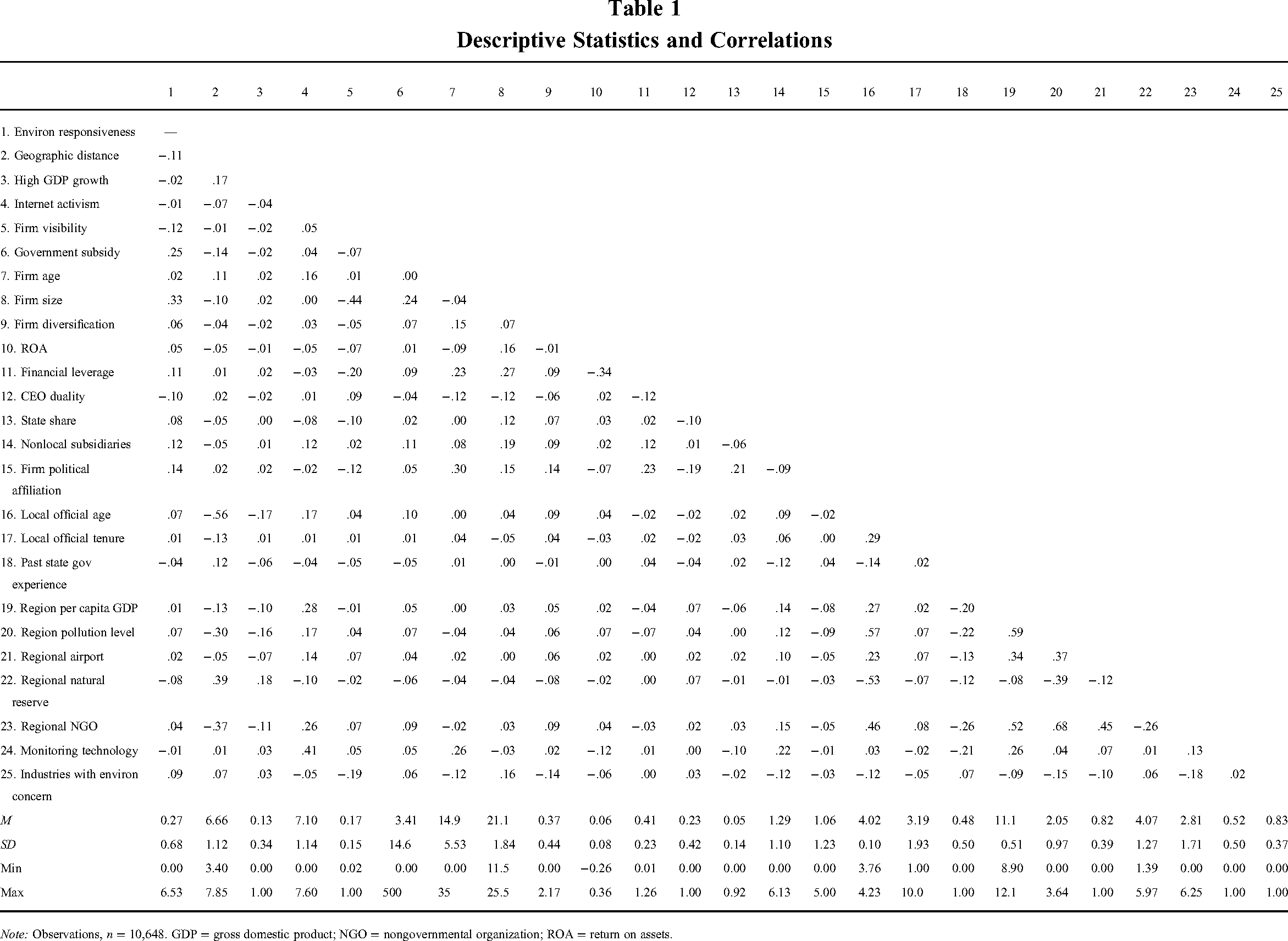
Note: Observations, n = 10,648. GDP = gross domestic product; NGO = nongovernmental organization; ROA = return on assets.
Model Specification
We employed random effect panel regressions to test our hypotheses. We selected this model because our key explanatory variable, geographic distance, does not vary much with time. In this case, a firm fixed effect model cannot effectively estimate the main effect of geographic distance because it eliminates all time-invariant effects (Wooldridge, 2010). Furthermore, all independent variables are lagged by 1 year, taking into consideration the latency of their effects.
Results
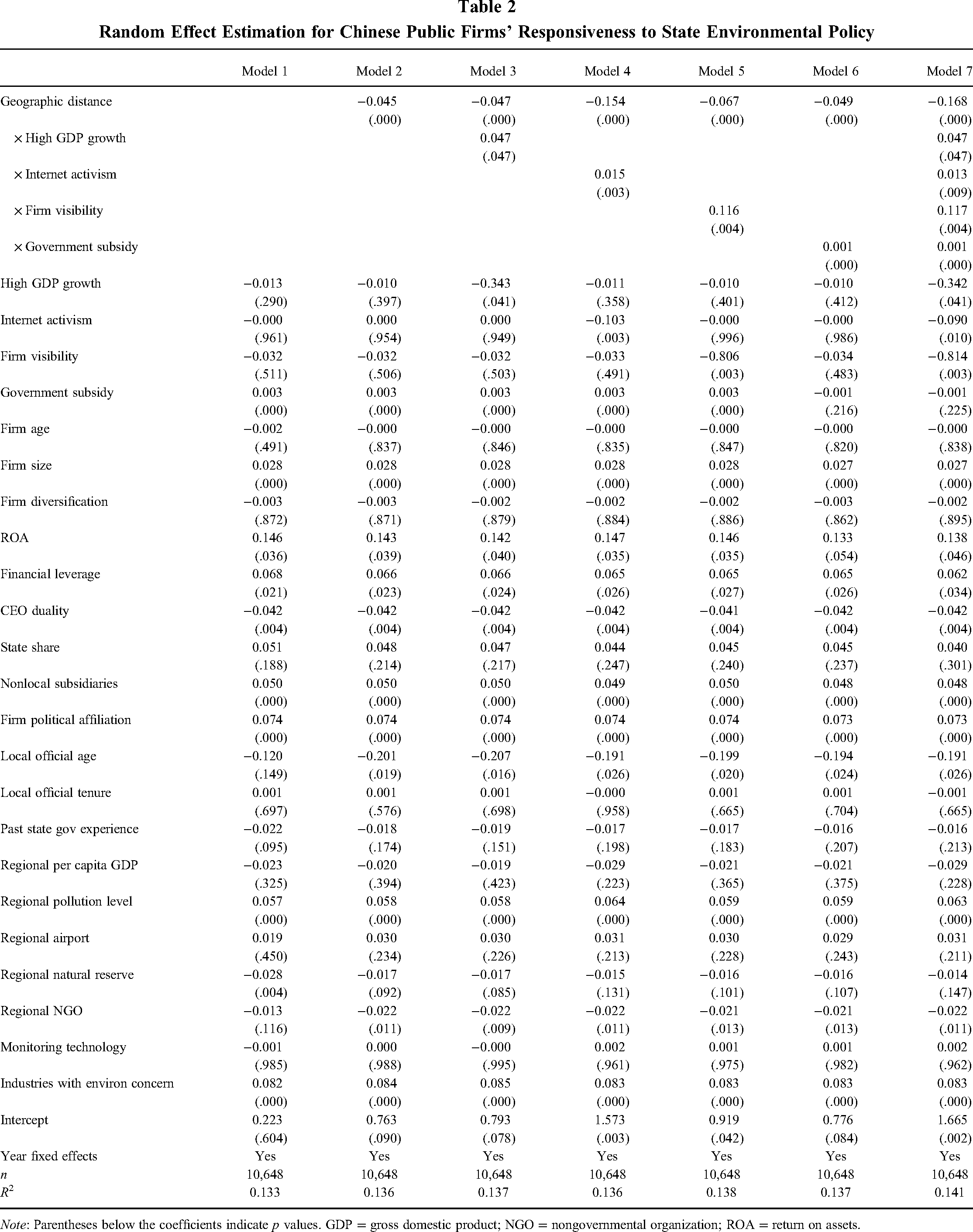
Table 2 reports the results of random effect estimations for Chinese public firms’ implementation of the state's environmental policy. Model 1 shows that firms with more government subsidy, a larger size, and a higher return on assets or leverage ratio conduct more environmental activities in response to the state's requirements. The power of a CEO, as measured by whether she or he also chairs the board of directors, appears to be negatively correlated with a firm's environmental responsiveness. Furthermore, firms with more subsidiaries outside the province of the headquarters and those with a higher level of political affiliation are more responsive to the state's environmental policy. Local official's age or tenure and regional per capita GDP level do not seem to significantly affect a firm's environmental responsiveness. However, whether the provincial party secretary had work experience in the state government is negatively correlated with a firm's environmental responsiveness. The effect of the number of high-pollution firms in the region is positive, while that of the number of natural reserves in the region is negative. Finally, firms from industries with more environmental concerns seem to conduct more environmental activities required by the state government. These results are largely consistent with our expectations.
Random Effect Estimation for Chinese Public Firms’ Responsiveness to State Environmental Policy
Note: Parentheses below the coefficients indicate p values. GDP = gross domestic product; NGO = nongovernmental organization; ROA = return on assets.
Model 2 tests the main effect of geographic distance between the state and local government and reveals that, as expected, this variable has a significantly negative effect on a firm's environmental responsiveness (geographic distance, β = −0.045, p = .000). A 1% increase in the logarithm of geographic distance between the state government and the provincial government that directly regulates a firm is associated with a 4.5% reduction of the firm's measured environmental responsiveness, thereby supporting H1. Model 3 tests the moderating effect of regional GDP growth. As predicted, the interaction term is significantly positive (Geographic Distance × High GDP Growth, β = 0.047, p = .047). This suggests that in regions where local governments have achieved relatively high GDP growth and therefore are more willing to protect the environment, firms are less likely to get away from the state's environmental policy, thus mitigating the negative impact of geographic distance on local firms’ environmental responsiveness. This result lends support to H2a. Model 4 tests the moderating effect of Internet activism and shows that the coefficient of the interaction term between geographic distance and the number of Weibo environmental postings is positive and significant (Geographic Distance × Internet Activism, β = 0.015, p = .003). This supports our conjecture in H2b that in regions with a higher level of Internet activism regarding the environment, the effect of geographic distance on a firm's environmental responsiveness becomes smaller.
We tested the moderating effect of firm characteristics that drew the attention from state leaders or reduced their information asymmetry in Models 5 and 6. In Model 5, we included the interaction term between geographic distance and firm visibility; the result was positive and significant (Geographic Distance × Firm Visibility, β = 0.116, p = .004). Hence, H3a is supported: firm visibility negatively moderates the effect of geographic distance between the state and local government on a firm's environmental responsiveness. Model 6 includes the interaction between geographic distance and the amount of government subsidy that a firm receives; the result was significant and positive (Geographic Distance × Government Subsidy, β = 0.001, p = .000). This supports our conjecture in H3b that the amount of government subsidy that a firm receives negatively moderates the effect of geographic distance on its environmental responsiveness. Finally, Model 7 is a full model that contains all the interaction terms. The results show that the effect of geographic distance remains robust and significant. Furthermore, similar to what we found in Models 3 to 6, all the interaction terms remained positive and statistically significant, lending extra support to our hypotheses.
Robustness Tests
Ensuring robustness of the dependent variable
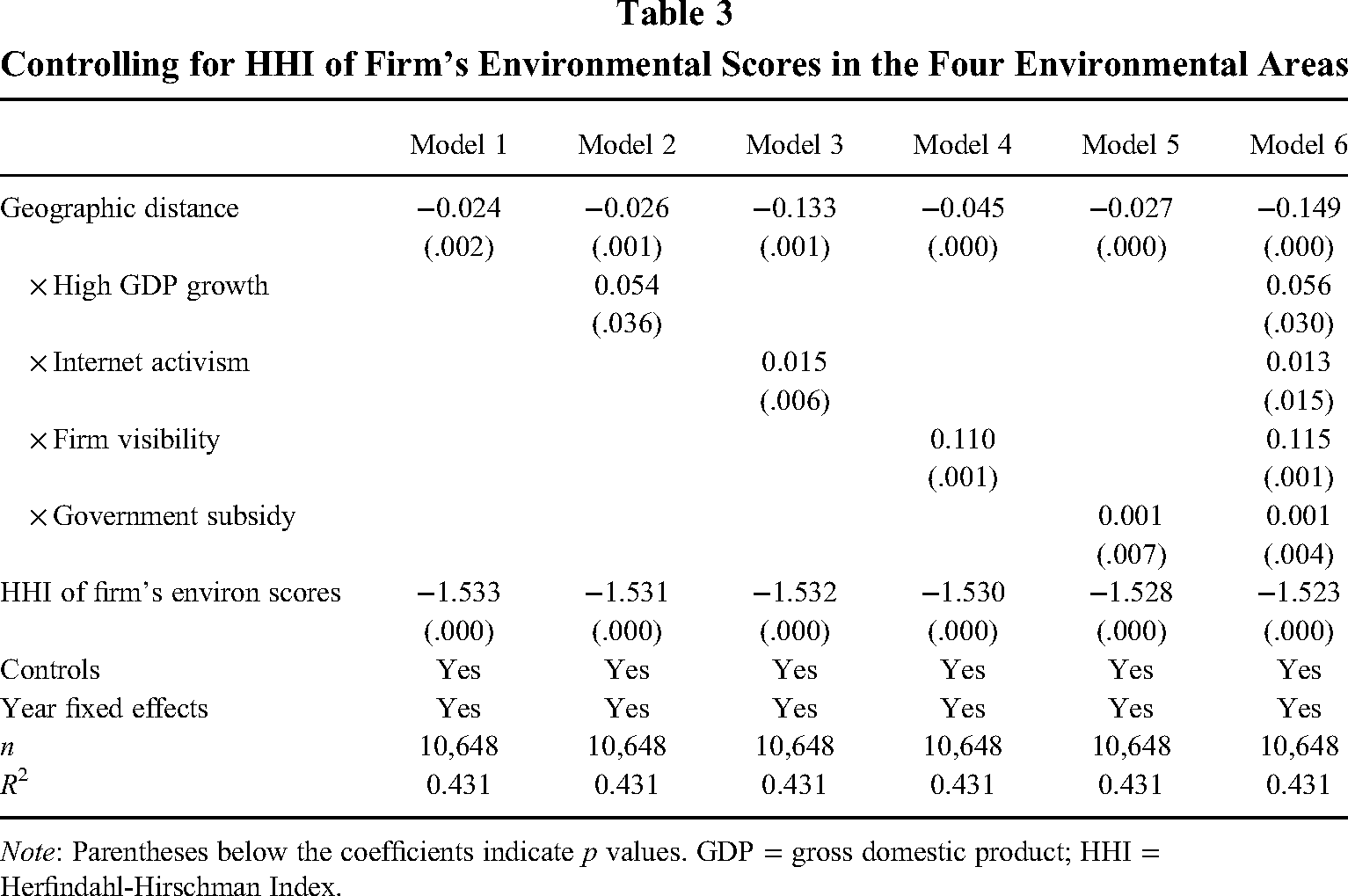
To ensure that our main results were not sensitive to the specific approach that we used to construct our dependent variable, we conducted two robustness tests. First, when computing our dependent variable, environmental responsiveness, we relied on keywords identified in the four environmental areas outlined in the state's Five-Year Plans: energy saving, emission reduction, recycling, and technology development. Specifically, a score was assigned to a firm if one of its environmental projects contained any of the keywords. The four areas, however, had varying numbers of keywords. Thus, a firm's specialization in areas with more identified keywords may have led to a higher score received by the firm. As a robustness check, we calculated the Herfindahl-Hirschman Index based on each firm's environmental scores in the four areas and included it as a control variable. Therefore, a firm’s degree of specialization in certain environmental areas was accounted for. We report the estimation results in Table 3, which shows that our main findings on the relationship between geographic distance and a firm's environmental responsiveness and the interaction effects remain highly robust.
Controlling for HHI of Firm's Environmental Scores in the Four Environmental Areas
Note: Parentheses below the coefficients indicate p values. GDP = gross domestic product; HHI = Herfindahl-Hirschman Index.
Our second robustness test measured firm responsiveness to the state's environmental policy in a different way from the content analysis approach used in the main analysis.
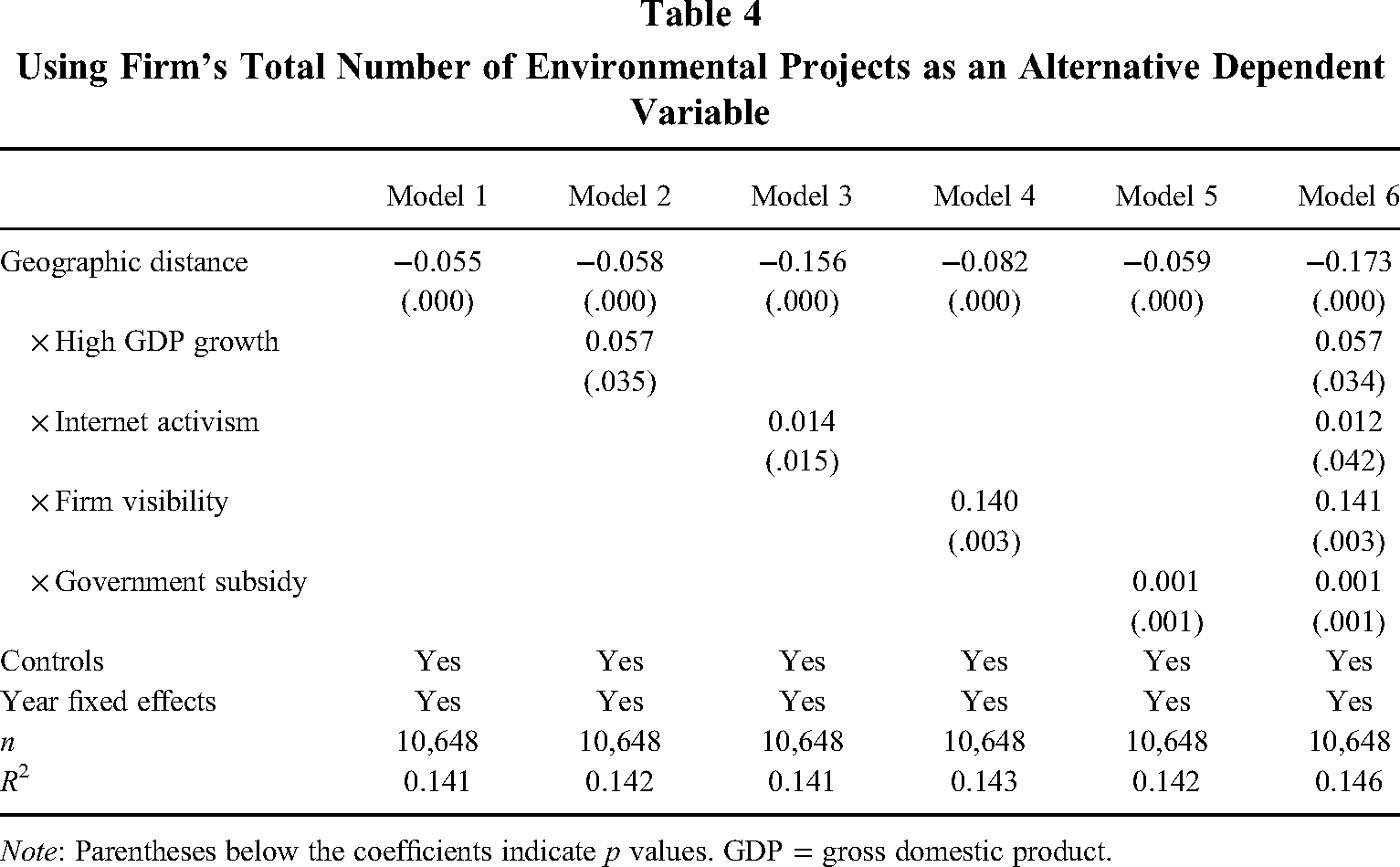
In this measure, we simply counted a firm's annual environmental projects, as directly extracted from the CSR section of the China Stock Market and Accounting Research database. We accordingly constructed the variable environmental activities to capture the intensity of a firm's environmental responsiveness, calculated as the logarithm of the number of environmental projects firm i conducted in year t. The estimation results based on this alternative dependent variable are reported in Table 4. We found a consistently negative effect of geographic distance on a firm's total number of environmental activities. Furthermore, all the interaction effects remained robust in this analysis, lending additional support to our hypotheses.
Using Firm's Total Number of Environmental Projects as an Alternative Dependent Variable
Note: Parentheses below the coefficients indicate p values. GDP = gross domestic product.
Addressing the potential endogeneity of geographic distance
In this study, reverse causality does not appear to be a major concern given that most firms’ geographic locations were determined historically and often driven by founders’ familiarity with the markets and therefore were unlikely to be significantly affected by China's environmental regulations in our sample period (2008–2016). Nevertheless, the significant relationship between geographic distance and firm responsiveness to the state's environmental policy may still be inflated by the presence of some unobserved variables that simultaneously correlate with a firm's geographic location and its environmental performance.
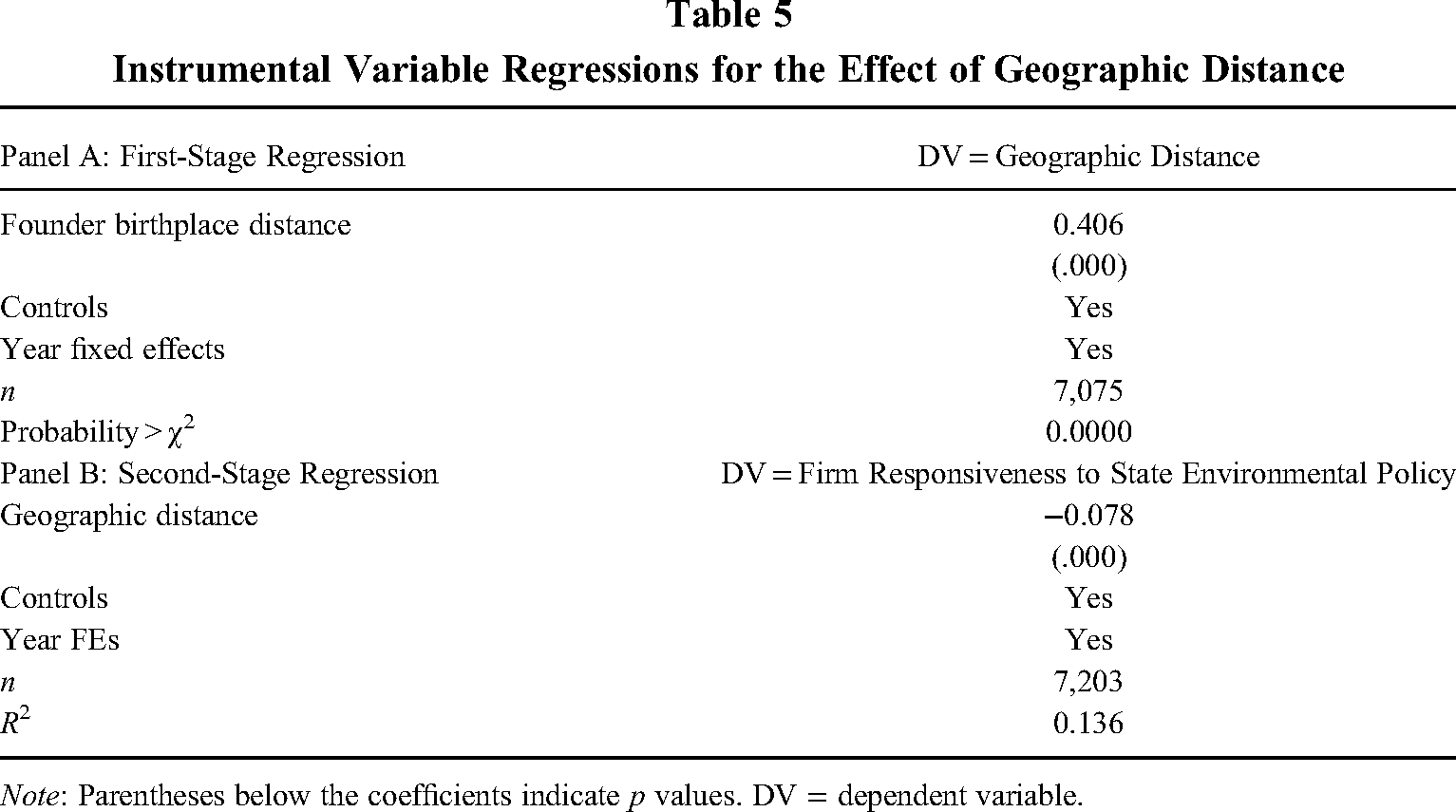
We again adopted two approaches to address such a potential endogeneity issue: an instrumental variable approach and a propensity score matching (PSM) method. In the first approach, we selected an instrumental variable that was expected to have an effect on the endogenous explanatory variable (geographic distance) but unlikely to affect the dependent variable (firm environmental performance). Specifically, we manually collected information on the birthplaces of firms’ founders, based on the anticipation that founders’ birthplaces were likely to affect the current locations of firms and hence their local governments' geographic distances to the state government. Furthermore, the founders’ birthplaces were historically determined and thus should be unrelated to firms’ environmental responsiveness in our sample period, other than through its influence on geographic distance. We then constructed founder birthplace distance, which is the logarithm of geographic distance between a founder's birthplace (at the city or province level, depending on the availability of data) and the state government in Beijing. We expected this variable to be positively correlated with our main explanatory variable in the main model, which is geographic distance between the firm's current region (and hence the local government) and the state government. Meanwhile, this instrument should not directly affect a firm's environmental policy responsiveness other than through the mechanism of geographic distance.
The estimation results are reported in Table 5. Panel A reports the first-stage regression result. As expected, founder birthplace distance is positively and significantly (p < .01) associated with geographic distance between the state government and local government of the region where the firm is located, suggesting that this instrument is indeed relevant. Panel B reports the second-stage regression result. The instrumented geographic distance variable remained negatively and significantly associated with firm responsiveness to the state's environmental policy, which provides support to our argument that geographic distance between the state and local government can indeed reduce local firms’ compliance with the state's environmental policy.
Instrumental Variable Regressions for the Effect of Geographic Distance
Note: Parentheses below the coefficients indicate p values. DV = dependent variable.
In addition to the instrumental variable approach, we performed a PSM analysis to further mitigate the concern that some firm characteristics, such as capability and resource, may simultaneously determine a firm's geographic location and its responsiveness to the state's environmental policy. In implementing the PSM analysis, we first categorized our sample into two groups. Those with a higher value of geographic distance (>75th percentile) were regarded as the treatment group, indicating that they were located in regions relatively distant to the state government. We then used the PSM method to identify observations from the rest of the sample, which had the most similar propensity score to those in the treatment group (based on a 1:1 match). When estimating the propensity score, we not only included all firm-level variables in the main model but also added firms’ market share and number of political connections to capture their capabilities and political resources, which might affect firm location decisions. Finally, given the matched sample, we reestimated all the regressions. As shown in Table B1, our main findings remained robust, particularly the negative effect of geographic distance on firms’ environmental responsiveness.
Discussion
In this article, we examine how the state's regulatory influence on organizations declines with geographic remoteness due to increasing information asymmetry and state leaders’ inattention. In a study of Chinese public firms’ implementation of the state's environmental policy from 2008 to 2016, we found broad support for the geography-based view of state capacity. As the distance between the state and local government increases, firms in the region conduct significantly fewer environmental activities outlined in the national Five-Year Plans. The distance effect is, however, mitigated in regions that rank relatively high in GDP growth rate, where local government officials tend to have more incentives to promote environmental protection. Internet activism on environmental issues, which are expected to draw the attention of state leaders and serve as an additional information channel, also mitigates the effect of geographic distance on firms’ environmental responsiveness. Finally, firm visibility and amount of government subsidy received are negatively moderate the effect of geographic distance, consistent with the argument that these firm-level factors motivate the state government to monitor such firms more closely.
This study offers several theoretical contributions. First, we contribute to the literature on corporate institutional strategies in emerging markets (Dorobantu et al., 2017; Marquis & Raynard, 2015) by identifying a geography-based view of state capacity in shaping organizational behaviors. In explaining the agency conflict between state leaders and local officials and firms’ responses to the state's policy interventions, previous studies have primarily focused on factors such as regulatory discretion of local bureaucrats and hierarchical distance between the state and local governments (e.g., Grandy & Hiatt, 2020; Wang et al., 2018). However, the literature has overlooked the role of geography, in particular the physical distance between the state and local governments, in influencing the state's capacity to implement policies. This omission is striking since the economics and political science literature has shown substantial geographic variations in state policy outcomes (Brinkerhoff et al., 2018; Herbst, 2000; Michalopoulos & Papaioannou, 2014). Our study therefore fills an important gap in the literature.
Second, our argued mechanisms of information asymmetry and state leaders’ inattention underlying the distance effect, as well as empirical findings consistent with the proposed mechanisms, allow us to make new contributions to the literature. In his seminal book Economy and Society, Weber (1978) stresses that the reason why local bureaucrats can get away with acting against the interests of the state is that there is information asymmetry concerning the quality of their performance. Complementing this view, we find that Internet activism and firm characteristics that resolve the information asymmetry faced by the state government can enhance the state's monitoring effectiveness and thereby reduce the negative effect of geographic distance on firms’ policy compliance. Furthermore, drawing on the attention-based view of organizations (Ocasio, 1997), we posit that geographic distance plays an influential role in determining the level of attention that state leaders pay to issues. Just like any decision makers in organizations, state leaders at the top of the state hierarchy cannot pay equal attention to all issues across the country due to bounded rationality and limited cognitive resources. This perspective, however, has been largely overlooked in existing studies on state capacity.
Finally, this study speaks to the literature on corporate environmental performance, especially in terms of its antecedents. Prior works in this area has focused on how institutional structures and logics (Lee & Lounsbury, 2015; Sharfman et al., 2004; Yan, Almandoz, & Ferraro, 2021), social movements (Delmas & Toffel, 2008; Marquis & Bird, 2018), and various firm-level factors (Marquis & Qian, 2014; Walls et al., 2012) may affect firms’ engagement in environmental activities. Extending this literature, our study uncovers that a new geographic-based factor, particularly geographic distance between different levels of governments, may have an impact on corporate environmental performance.
In addition to theoretical contributions, this study has practical implications for firms and policy makers. It offers firms a nuanced understanding of the state's influence across different geographic locations and, more important, how they might navigate the dynamics of policy influence to achieve desired outcomes. For example, while some firms may consider moving to capital cities to obtain resources and political favors (e.g., Chen, Yan, & Yang, 2020), they should be cautious given the unintended consequences of geographic proximity, such as increased monitoring of their policy implementation. For policy makers, our findings suggest that geographic distance may hinder their capacity to regulate local organizations due to information problems and limited attention. They further imply that if the state government aims to deal with these challenges effectively, it may consider approaches that help reduce the distance effect. For example, it could strategically monitor distant local governments and firms more closely or send state officials to distant regions more frequently to directly inspect local policy implementation.
Several limitations of our study provide opportunities for future research. The first is related to data on some of the key variables and their measures. Ideally, our dependent variable should capture the extent to which a firm closely implements the state's environmental policy. Although our content analysis helps quantify corporate policy compliance and we used alternative measures of dependent variable in our analyses, we still face a major challenge in assessing a firm's fidelity to policy implementation due to data limitations. That is, CSR reports are a set of self-reported information. It is noted that Chinese public firms’ CSR reports are issued under certain legal regulations and global standards. Still, in practice, there might be opportunities for firms to misreport or selectively disclose their environmental activities. We acknowledge this data limitation and encourage future research to collect other firm-level information (e.g., amount of pollutant discharges) to more adequately address this limitation. In addition, in the context of this study, some government actions, such as local visits by state officials, should help directly resolve the information asymmetry and inattention problems associated with geographic distance and thus have a direct effect on environmental policy implementation. However, we are not able to control this variable in our model due to the unavailability of information on state government visits to or inspections of local regions. Future research may explore additional data sources or find ways of manually collecting such critical information.
Second, the generalization of our findings based on China's unique context should be dealt with caution and can be considered a limitation of our study. For instance, the arguments and findings here would not apply to countries or regions with a limited size, where geographic distances between the state and local governments are small and do not exhibit sufficient variations. Yet, we believe that our geography-based theoretical argument of policy implementation is not necessarily specific to the Chinese regime. In other countries or regions, such as the United States or European Union (EU), the federal government or EU officials may still face policy implementation problems, and the effectiveness of policy might depend on the geographic distance between federal and state governments or EU headquarters and locations of EU countries. That said, whether similar arguments would indeed hold in these other contexts is subject to further empirical verifications.
Finally, the interpretation of our results may also be constrained by our focus on environmental policy. While we expect that the distance effects identified in this study would largely hold for other state policies, differences may exist in terms of the level of incentive alignments between the state and local governments, as well as that between the local government and firms. Future research may modify the arguments developed here and verify their validity by extending the investigations into other policy contexts.
Conclusion
This study investigated firm responsiveness to state policy from a geography-based perspective that has been underexplored in existing literature. It revealed that the geographic distance between the state and local governments significantly reduces the state's monitoring effectiveness, which gives a distant local government and firms within its jurisdiction more leeway to deviate from the state's policy requirements. This effect is, however, contingent on the degree of misalignment in objectives between the state and local government. Furthermore, region- or firm-level characteristics that draw the direct attention of state leaders and provide alternative information channels effectively mitigate the effect of geographic distance. We hope that this study serves as an important step toward an advancement of our understanding on the roles of geography in creating institutional complexities and their effects on firm behaviors.
Footnotes
Acknowledgments
We gratefully acknowledge the helpful guidance of the action editor, Professor Sali Li, and two anonymous reviewers. We thank Yang Lu and Ruoxin Li for their excellent research assistant work and the seminar participants at the University of Melbourne, Northwestern Polytechnical University, Peking University, Tsinghua University, and IACMR Research Seminar Series Session 3 for their valuable comments. This research is supported by the National Natural Science Foundation of China (grant 72102145).
Notes

Appendix A: Procedures to Measure Firms’ Responsiveness to the State Government's Environmental Policy
To construct firms’ responsiveness to the environmental policy of the state government, we took the following steps.
We read through all the chapters of the state government's 11th and 12th Five-Year Plans and categorized them into general, firm related, and government related. We focused on the general and firm-related chapters to identify requirements on firms’ environmental engagement. The chapter on general targets and requirements sets out general requirements related to energy saving and emission reduction, and the chapter on priority project outlines specific projects that firms need to carry out. Two additional chapters on building a recycling economy and developing technology are also firm related. Given the related chapters, we classified state government's environmental requirements into four categories: energy saving, emission reduction, recycling, and technology development. Two research assistants and one instructor then extracted keywords related to the four aspects from the chapters identified in step 1 and saved this as an initial dictionary. We hired a professional content analysis service provider to decompose the descriptions of environmental projects in firms’ CSR reports into words. Two research assistants and one instructor identified the synonyms of the keywords from the initial dictionary. These newly identified synonyms were added to the dictionary. A content analysis was then performed by comparing firms’ environmental activities in the CSR reports and the dictionary. For each environmental activity, a score of 1 was assigned to the firm if any keyword or its synonyms appeared. Note that the assigned score was 1 regardless of how many times the keyword was mentioned in a specific environmental activity. If a keyword appeared in multiple environmental activities, we interpreted it as the firm conducting multiple activities in a specific environmental area and hence assigned multiple points to the firm (1 point for each activity). We iterated this process for each of the four categories, and our final output was four scores for each firm in each year. We also used the logarithm of the sum of the four scores to measure a firm's environmental responsiveness to the state's environmental regulation.
Appendix B: Propensity Score Matching Analysis
We performed a propensity score matching analysis to address the concern that some firm characteristics, such as capability and resource, may simultaneously determine a firm's geographic location and its responsiveness to the state's environmental policy. We first categorized our sample into two groups. Those with a higher value of geographic distance (>75th percentile) were regarded as a treatment group. We then used the propensity score matching method to identify observations from the rest of the sample, which had the most similar propensity score to that in the treatment group (based on a 1:1 match). In estimating the propensity score, all the firm-level variables in the main model were included. Firms’ market share and number of political connections were further included to capture their capabilities and political resources, which might affect firm location decisions. According to the matched sample, we reestimated all the regressions, and Table A2 summarizes the results. Our main findings, particularly the negative effect of geographic distance on firms’ environmental responsiveness, remained robust.