







Abstract
Building and deploying a minimum viable product (MVP) is often considered a necessary step in the venture development process. Although MVPs are ubiquitous in practice, foundational scholarly work on MVPs is virtually nonexistent. We leverage and build upon the lean start-up literature and the scientific approach to entrepreneurship to develop theory related to the dimensionality, forms, risks, and trade-offs of MVPs. We first define and identify the conceptual boundaries of MVPs and explain the relationship between MVP dimensionality and MVP development decisions. We then specify how MVP risks emerge and how these risks relate to the trade-off decisions that entrepreneurs must grapple with when building and deploying MVPs. We conclude by presenting future research opportunities on this important but previously overlooked phenomenological artifact.
Keywords
The “lean start-up” framework is a theory of entrepreneurial management that encourages innovators to focus on experimentation during new venture development (Shepherd & Gruber, 2021). It is an opportunity-centric actionable theory that might be best viewed as “an application of the scientific method to entrepreneurship” (Blank & Eckhardt, 2024: 2). The lean start-up framework consists of several practical tools that work together to facilitate meaningful start-up progress. These tools include the Business Model Canvas (Osterwalder & Pigneur, 2010), the Market Opportunity Navigator (Gruber & Tal, 2017), iterative customer development procedures (Blank, 2010), and the minimum viable product (MVP ; Blank, 2003, 2010; Ries, 2011), the last of which is the focus of this article. We define the MVP as a tangible product or service representation with a limited number of features deployed for the purpose of learning about the value of a potential solution via experimentation.
The practical application of lean start-up tools has been widespread, yet these tools have received varying attention in the academic literature. In particular, academic research on MVPs has been scarce, prompting Shepherd and Gruber (2021) to call for research on MVPs to bridge the divide between entrepreneurship practice and theory. These scholars assert that research on MVPs is likely to reveal insights about the development and best use of MVPs for hypothesis testing and advancing the start-up process (Shepherd & Gruber, 2021). Blank and Eckhardt (2024) suggest research should explore the important trade-offs associated with lean start-up tools and experimentation. To enhance lean start-up theory, they also call for integration of the lean start-up framework with scholarly research rooted in entrepreneurship and innovation literatures.
In this research, we draw directly from the literature on the lean start-up framework (Contigiani & Levinthal, 2019; Felin, Gambardella, Stern, & Zenger, 2020; Shepherd & Gruber, 2021) and supplement it with recent insights pertaining to the scientific perspective of entrepreneurship (e.g., Camuffo, Cordova, Gambardella, & Spina, 2020; Koning, Hasan, & Chatterji, 2022; Zellweger & Zenger, 2023) to develop theory related to the dimensionality, forms, risks, and trade-offs of MVPs. In so doing, we contribute to the scholarly conversation related to the lean start-up by presenting an integrative definition of MVPs, specifying MVP dimensionality, identifying MVP forms, and explaining how their complex interconnections influence development and deployment decisions for entrepreneurs. Additionally, we put forth propositions that explain when and why MVPs might generate intrinsic risks for new ventures. Drawing upon the literature focused on scientific experimentation, we theorize how entrepreneurs can mitigate MVP risks using experimental best-practice strategies. Overall, our work is aligned with—and extends—the prior scholarly work on the lean start-up. We conclude our article by encouraging future research to build upon and test the conceptual model of MVPs that we present herein.
Unpacking the MVP: Initial Conceptual Foundations
The MVP is one of the core foundational tools of the lean start-up framework. The term “MVP” was originally coined by Frank Robinson of SyncDev (Blank & Eckhardt, 2024), and practical instruction on its applicability was initiated two decades ago (Blank, 2003). In some ways, the MVP serves as a cornerstone to the lean start-up framework given its history and interconnections with the broader suite of lean start-up tools. Yet, it has been underexplored by scholars. There are still ambiguities related to its boundaries, dimensions, scope, deployment tactics, risks, and connections with the other lean start-up tools. Shepherd and Gruber (2021) note that if the scholarly understanding of MVPs is to advance, foundational research is needed to clarify the dimensions, contingencies, and domain of this important entrepreneurial artifact.
Our first aim in this article is to define and distinguish the MVP from other related artifacts. Consistent with best-practice recommendations for phenomenon-based theorizing (Fisher, Mayer, & Morris, 2021; Ployhart & Bartunek, 2019), we unpack the key elements of the MVP, including its dimensionality, forms, and boundaries.
Defining MVPs
Over the past decade, several definitions, each with varying degrees of specificity, have been offered for MVPs. In The Lean Startup, Ries (2011: 77) defines the MVP as “a version of a new product, which allows a team to collect the maximum amount of validated learning about customers with the least effort.” Blank (2013) also emphasizes minimal effort as a quality of MVPs by noting that MVPs ideally are composed of just those features (and no more) that allow the artifact to be deployed for testing. York and Danes (2014) built on these definitions by specifying the importance of user involvement in the MVP. They define the MVP as a “set of minimal requirements which meet the needs of the core group of early adopters or users” (York & Danes, 2014: 25). Camuffo et al. (2020: 566) describe the MVP as “a preliminary basic version of the offering with just enough features to let customers experience it and assess their willingness to pay for it.” Martins Pacheco, Vazhapilli Sureshbabu, Nürnberger, Durán Noy, and Zimmermann (2021) identify the MVP as a tool that enables testing of an idea with limited resources early in the venture development process. The definitions presented here are varied but share a common thread around “minimum features,” “efficient learning,” “external deployment,” and “experimenting with users.” Building upon these initial attempts to define the MVP, we propose a definition that synthesizes each of these aspects. Taken together, we define the MVP as a tangible product or service representation with a limited number of features deployed for the purpose of learning about the value of a potential solution via experimentation.
By “tangible,” we assert that an MVP exists as a concrete instantiation of a concept (cf. Berglund, Bousfiha, & Mansoori, 2020) that can be perceived by at least one of the senses (i.e., the MVP can be seen, heard, or felt, etc.). Merriam-Webster (2021) defines tangible as “easily seen, recognized, or capable of being perceived.” Tangibility thus constitutes an object’s existence beyond one’s imagination and its perceptibility by the senses. MVPs have only a limited number of features and by design are minimally developed to include only essential elements to test a potential solution. This implies that entrepreneurs must make trade-off decisions about what features to include and exclude in their MVPs. MVPs become useful only when they are deployed externally to test aspects of a concept. MVPs thus exist at the interface between the venture and the external market environment (cf. Simon, 1996). They are deployed for learning via experimentation at this interface (cf. Burnell, Stevenson, & Fisher, 2023; Zellweger & Zenger, 2022). MVPs are future oriented—they are used to test potential market opportunities, in accordance with the understanding that there is a high degree of uncertainty related to the value of a potential solution (cf. Dimov, 2016; Knight, 1921). By “value of a potential solution,” we assert that entrepreneurs are concerned with measuring a potential product or service’s worth for a set of potential use cases (Rindova & Petkova, 2007), including the discovery of whether potential customers might be willing to pay for a potential solution (Camuffo et al., 2020).
The Conceptual Distinction Between MVPs and Prototypes
MVPs and prototypes share conceptual overlap, yet there are also several important distinctions. We focus on MVPs (rather than reintroduce the prototype construct into the literature) because the MVP is a core tool within the lean start-up framework (Shepherd & Gruber, 2021) and because the MVP is used extensively by entrepreneurs (Blank, 2013) and entrepreneurship educators (Blank & Eckhardt, 2024). In line with recent work (cf. Camuffo et al., 2020; Shepherd & Gruber, 2021), we position MVPs as a distinct entrepreneurial artifact.
Prototypes have largely been studied outside of the entrepreneurship literature (e.g., Houde & Hill, 1997; Thomke, 1998; Wall, Ulrich, & Flowers, 1992). Much of this prior scholarly work on prototypes does not reference the critical external elements of the lean start-up framework. Prototypes instead are often presented as internal testing tools. That is, they are mainly used for internal evaluations of product manufacturability or engineering concept development, what Song and Montoya-Weiss (2001: 77) refer to as “in house sample product testing.” Rothaermel and Deeds (2004) contend that the ideal outcome of prototype exploration is the development of a patent. Davila (2000: 389) notes prototypes are used “to assure manufacturability” within an organization and that prototypes often require meaningful capital outlays.
In contrast, MVPs are ideally deployed with relatively little capital outlay (Blank, 2013) and with a precise purpose in mind: to learn about the market potential of a solution (i.e., product or service offering) via experimentation (Blank & Dorf, 2012; Contigiani & Levinthal, 2019). A key distinction between prototypes and MVPs relates to how these objects are positioned relative to stakeholders. MVPs are externally facing and used for market validation, testing, and learning about product-market fit (Blank, 2013; Blank & Eckhardt, 2024). Prototypes are internally positioned and used mainly to assess manufacturability or patentability. Overall, the key conceptual and pragmatic differences between MVPs and prototypes lie in their inherent purposes, internal versus externally facing positions in relation to stakeholders, and their integration within the lean start-up framework.
Dimensionality: MVP Realism Along Three Dimensions
Building from the innovation literature (Eisenman, 2013), we propose that MVPs vary in their realism, which is the degree to which the MVP is comprehensive relative to the anticipated final form of a product or service. MVP realism consists of three interconnected dimensions: aesthetics, functionality, and symbolism.
Aesthetic realism
Aesthetic realism accounts for representations of the final product as perceived by one of the five physical senses (i.e., vision, touch, smell, hearing, or taste). It is intrinsically linked with ontological objectivity, that is, the manifestation of what something is as it relates to one of the five physical senses, independent of its function or subjective meaning (see McBride & Wuebker, 2022). MVPs are simply a representation of a concept used for testing, and the final product or service will likely be quite different from the MVP in terms of its aesthetic qualities.
Although aesthetic aspects of an MVP might be perceived by a user through any one of the five physical senses, aesthetic realism of an MVP in practice often comes from visual representations (i.e., “looks like”). This includes aspects such as the color, size, shape, and symmetry that manifest objectively in the physical or digital world (cf. Creusen & Schoormans, 2005; Koning et al., 2022; Rindova & Petkova, 2007). For example, in 2013, founders of the fitness company Peloton deployed an MVP online with high aesthetic realism through visual image representations of their exercise bike concept. Even though the final product had not yet been built, the visual representations presented by the venture exhibited aesthetic design features, such as a large flat-screen monitor, a micro-adjustable seat, fitness data wireframes, and the novel connected interface with the virtual instructor for which Peloton later became famous (see the appendix). 1 Examples of MVPs with aesthetic attributes beyond visual senses could include a podcasting start-up testing audio content or a vitamin water start-up testing different flavor profiles.
Functional realism
Functional realism relates to features that enable potential users to experience functional aspects of a potential product or service. Functional realism is tangible only in instrumental form (Creusen & Schoormans, 2005; Eisenman, 2013). For example, functional features can include the particular aspects of a chair that enable sitting, characteristics of a doorknob for opening, or the prongs on a fork for eating (Norman, 2013). Functional realism is the degree to which a feature allows a customer to accomplish a pragmatic goal or aim. If a person wants to sit, a chair allows for the accomplishment of this aim. Functional realism is prioritized when the entrepreneur wants to demonstrate to external stakeholders that the MVP has some level of pragmatic usefulness.
An example of an MVP with high functional realism comes from Vesta Stoudt, the inventor of duct tape. Stoudt was a package worker in a plant that had a contract with the U.S. Navy. During her time working for the plant, she conceived of an idea for a new cloth-based waterproof tape. Because she envisioned her first customer as the U.S. Navy, a pragmatic organization, Stoudt focused on creating an MVP that showcased functionality over aesthetics or symbolism. When she struggled to get her supervisors to take her seriously, she sent a sample of her MVP and wrote directly to President Roosevelt. Roosevelt was so impressed with how the tape could be used to seal ammunition crates for shipping, he forwarded her letter to the war production board so it could support her to further develop her MVP and eventually begin procurement of the product.
Symbolic realism
Symbolic realism relates to epistemological rather than ontological features of the MVP. Whereas ontology is concerned with what something is, epistemology is concerned with what one thinks or believes figuratively or metaphorically about that thing (McBride & Wuebker, 2022). Entrepreneurs rely on symbolic realism to evoke cognitive representations, shared beliefs, cultural routines, or allegories in the minds of those who interact with the MVP (i.e., “feels like” or “reminds me of”). This includes cultural or procedural meanings associated with the potential product beyond its functional or aesthetic features (Lounsbury & Glynn, 2001) including its conformity to institutionalized categories and designs (Hargadon & Douglas, 2001). Symbolic features can also evoke meanings associated with the personal identities of potential users (Rafaeli & Vilnai-Yavetz, 2004). Symbolic realism triggers users’ awareness of hierarchical standing and one’s identity within a socially constructed system of values, rituals, beliefs, and practices.
We posit that due to their power in eliciting cultural resonance, MVPs that have a high degree of symbolic realism can be powerful tools when it comes to evaluating how users respond to representations experientially, procedurally, or socially. For example, the founders of the unsuccessful Fyre Festival deployed a short video MVP and mysterious orange tile on Instagram to symbolize exclusivity and an enigmatic social experience (Hess, 2022). They orchestrated the simultaneous posting of their MVP by some of the world’s most well-known social media influencers, symbolizing high status and social standing. Increasing symbolism further, the founders suggested the festival was to be held at Pablo Escobar’s former private island and labeled the festival as “the greatest party of all time.” The short video MVP focused heavily on symbolic representations of exclusivity, implying that the event would be a once-in-a-lifetime opportunity, leading some to pay up to $250,000 to secure tickets sight unseen (Kreps, 2017). MVPs with a high level of symbolic realism can induce a strong fear of missing out on a culturally significant event (see Przybylski, Murayama, Dehaan, & Gladwell, 2013). The deployment of this MVP revealed a strong demand for the potential product, but the festival ultimately failed because there was a major disconnect between symbolic user perceptions generated by the MVP and the reality of what the company was able to eventually deliver (see Kreps, 2017). While this is an extreme example used to illustrate the symbolic dimension, another example of an MVP with high symbolic realism comes from Oculus Rift, creators of one of the first virtual reality headsets. The Oculus Rift MVP was not fully assembled (launched as a developer kit). Using crowdfunding, the Oculus Rift founder touted the MVP as the “closest we’ve come to Star Trek’s Holodeck” to resonate with its target (techy) users and emphasize symbolic value (Kickstarter, 2012).
Scope: Boundaries of the MVP Construct and MVP Forms in Practice
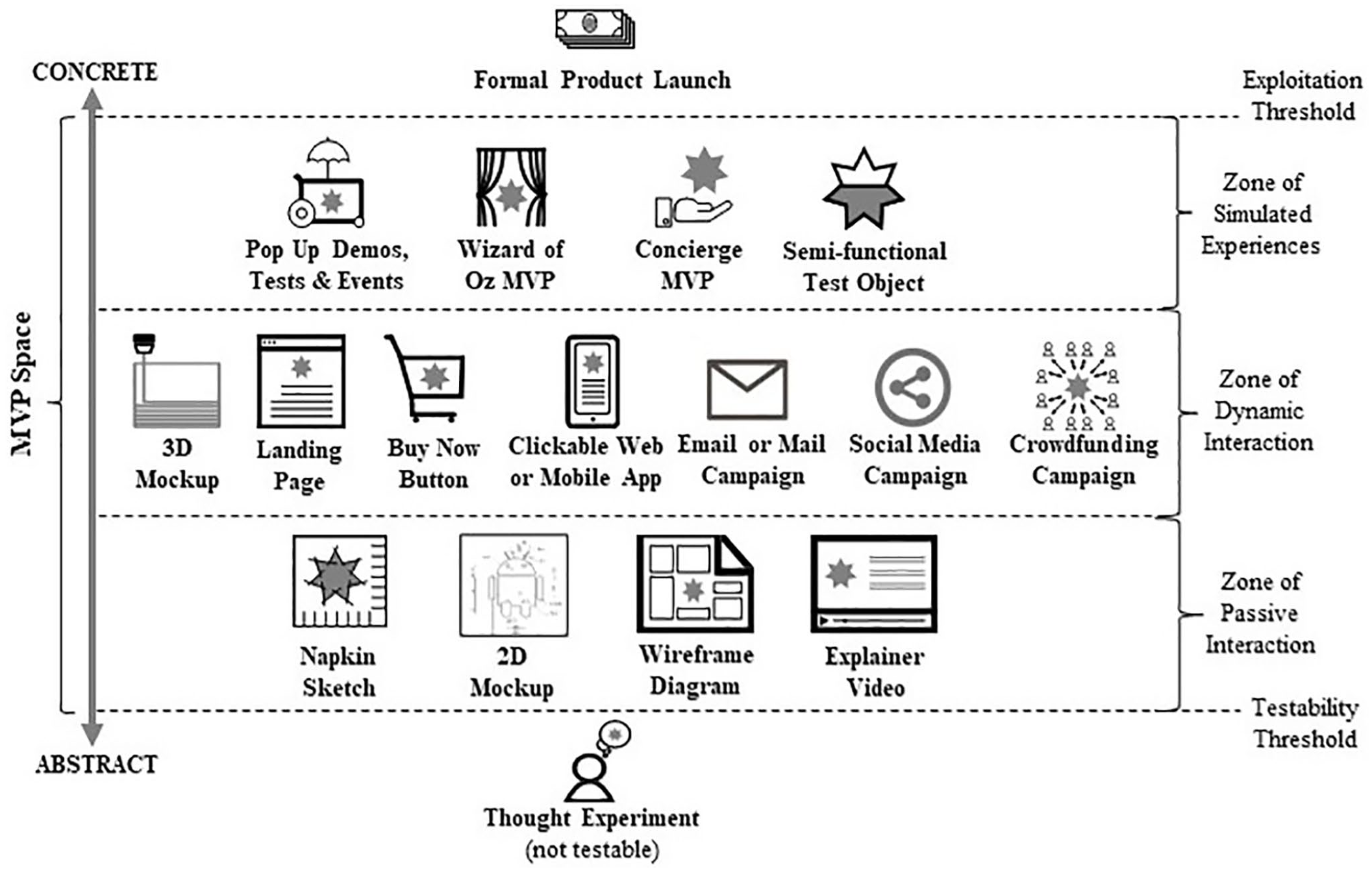
We propose that MVPs fit between two conceptual thresholds: above the testability threshold and below the exploitation threshold. Passing the testability threshold requires that an entrepreneur construct a tangible manifestation of a concept for the purposes of external testing, thereby going beyond mere “thought experiments” (e.g., Folger & Turillo, 1999) or “disciplined imagination” (e.g., Shepherd & Sutcliffe, 2011). While thought experiments represent a useful cognitive exercise for entrepreneurs (Kier & McMullen, 2018; Shepherd & Gruber, 2021), they fall below the MVP testability threshold because they are neither concrete nor tangible. This testability threshold is the point at which an MVP becomes a tangible representation that is realistic enough to be shared with potential stakeholders so that they might provide feedback.
The exploitation threshold is the point at which an entrepreneur’s project shifts from experimental and exploratory to a formalized commercial endeavor focused on execution, routines, and operational efficiency (March, 1991). 2 In other words, the exploitation threshold represents the point at which the artifact is considered to be a commerical product or service ready for scale rather than just a mechanism for testing the value of a proposed solution. The gap above the testability threshold and below the exploitation threshold gives rise to different MVP forms.
MVP forms
Within the boundaries we have specified, MVPs can take on several different forms. MVP forms are the physical or virtual manifestations that entrepreneurs use in practice (e.g., a landing page, a 3D mock-up, a pop-up demo), and they can be classified at different theoretical levels based on how potential users interact with the MVP (passively, dynamically, or via simulated experiences). Figure 1 illustrates MVP forms at each level.
Minimum Viable Product (MVP) Forms Used in Practice
Just above the testability threshold lies the zone of passive interaction. The most basic MVP form in this zone is the “napkin sketch.” The founders of Southwest Airlines famously developed a napkin sketch of their airline concept that would transit between Dallas, Houston, and San Antonio. The sketch allowed the founders to describe and communicate the potential value of the concept in simple terms. However, napkin sketches are limited in their testability as they are essentially a rudimentary illustration of a potential solution. It is possible that an entrepreneur could still conduct relatively weak testing with a napkin sketch, although such actions might negatively impact the venture’s legitimacy. Yet, the MVP in sketch form is still tangible as it can be shared and understood by others even though it is not a three-dimensional object.
In addition to the simple napkin sketch, there are several MVP forms that fall into the zone of passive interaction—where user testing is feasible but still largely a passive experience. The “explainer video” is an MVP form that is used to visually display a potential solution. An example comes from Dropbox cofounder Drew Houston. Houston developed an explainer-video MVP to test market interest in a potential product that could allow for seamless file syncing across devices. Rather than first build the full product, which would require multifaceted integration across operating systems, management of large files over slow internet connections, and handling of file conflicts, Houston simply created a video that demonstrated the value of the potential software to gauge interest. The MVP, although nonfunctional, helped Houston ensure that people were interested in the product and resulted in a waiting list of 75,000 people for the beta product within days. Nonetheless, while viewing the explainer video, potential users could not actually interact with the MVP itself. Other MVP forms in the zone of passive interaction include the “wireframe diagram” and the “2D mock-up.”
The next level up is the zone of dynamic interaction. In this zone, the “landing page” is a commonly used MVP form in practice. The landing page MVP is a basic webpage that displays a visual representation of a potential product or service. In some cases, the landing page is used to gather initial customer acquisition estimates or contact information from potential customers. A slightly more dynamic form of the landing page presents customers with a Buy Now button, which is used to compile preorders. Other forms in the zone of dynamic interaction include the “3D mock-up,” the “clickable web/mobile app,” the “email campaign,” the “social media campaign,” and the “crowdfunding campaign” (see Table 1 for examples).
Examples of MVP Theoretical Dimensions, Forms, and Deployment Tactics
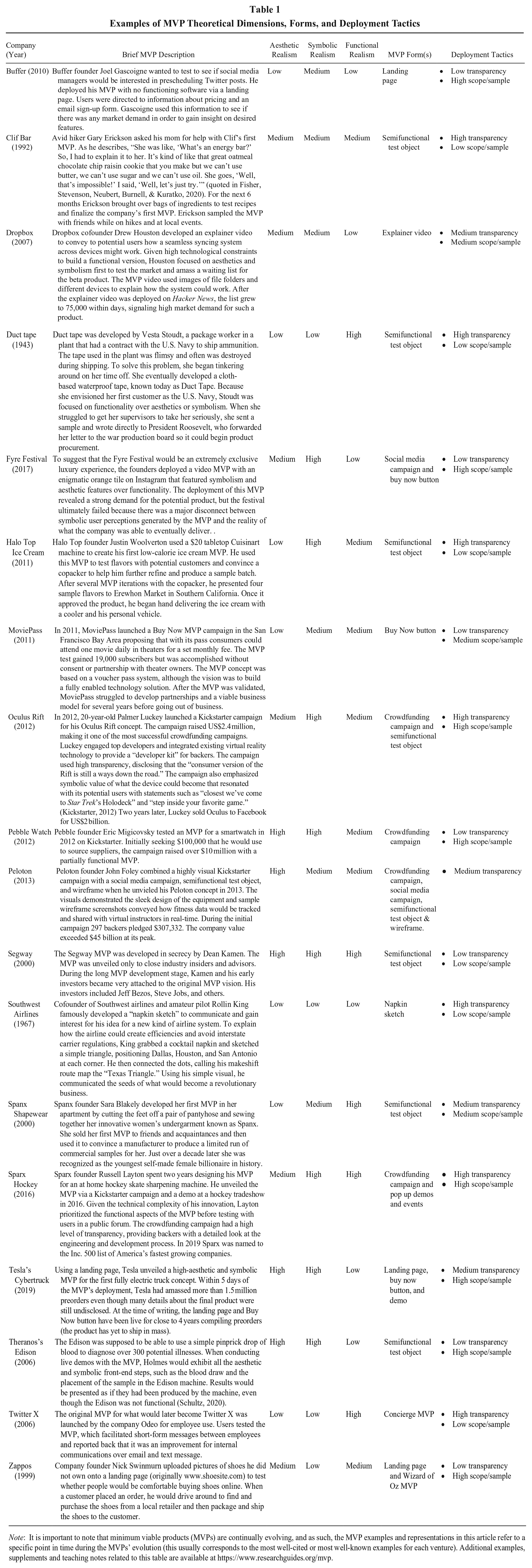
Note: It is important to note that minimum viable products (MVPs) are continually evolving, and as such, the MVP examples and representations in this article refer to a specific point in time during the MVPs’ evolution (this usually corresponds to the most well-cited or most well-known examples for each venture). Additional examples, supplements and teaching notes related to this table are available at https://www.researchguides.org/mvp.
Finally, the zone of simulated experiences includes additional MVP forms that are conceptually just below the exploitation threshold and focus on measuring user behavior. For example, the “Wizard of Oz” MVP is used to create a simulated customer experience using a combination of technology and manual workarounds. In a recent New York Times article, Eric Ries, the founder of the lean start-up movement, described a Wizard of Oz MVP used to test the potential for a new food-tracking app. Using this app, users “could take a photo of food and it would tell you how many calories were in it. [The entrepreneurs] said it was driven by proprietary technology. But they were really just using people hired to look at the images” and manually estimate the calories (Kessler, 2021: 2). Entrepreneurs who use the Wizard of Oz MVP attempt to put users in an immersive front-end experience without their comprehension of what is happening “behind the curtain,” hence the name Wizard of Oz. If well designed, users might imagine that the technology that supports the product is fully functional, while it is simply a low functioning MVP mock up used to test the value of the potential solution. The “concierge” MVP is similar to the Wizard of Oz MVP. Continuing the preceding analogy, users have a view of what takes place “behind the curtain.” With the concierge MVP, the back end, which often involves individuals providing manual services, remains visible and transparent to the user (Bland & Osterwalder, 2019). Entrepreneurs often rely on these two MVP forms when the full solution at scale requires extensive technical development. As such, an overreliance on manual processes that do not require an initial investment might be a necessary first step to test user experiences. Other MVP forms in the zone of simulated experiences include pop-up demos, tests and events (e.g., a food entrepreneur who uses a farmers market to test flavors and get feedback or an entrepreneur who sets up a pop up booth outside an event to display and get feedback on an MVP) and “semifunctional test objects” (e.g., Vesta Stoudt’s duct tape MVP described previously).
In practice, it is common for entrepreneurs to combine MVP forms. For example, explainer videos can be displayed directly on landing pages, crowdfunding campaigns might display 2D mock-ups, the Wizard of Oz MVP might rely on a clickable app to facilitate interactions with users, and so on. Nonetheless, the identification and labeling of discrete MVP forms distinguishes between various MVPs used in practice at different levels, and this categorization also provides a conceptual foundation upon which the rest of our work (and future MVP research) can be built. Table 1 provides examples of various MVPs with details on their forms and dimensionality.
Extending Theory on MVPS: Risks and Mitigation
A baseline assumption of MVPs in prior literature is that they are constructive for early-stage entrepreneurial ventures (e.g., Camuffo et al., 2020). Practitioners often consider using MVPs as an essential and necessary part of entrepreneurship (Blank, 2012; Ries, 2011). Yet building and deploying an MVP is not without risks. Because entrepreneurs design MVPs with minimum features to facilitate efficient testing, they face risks and trade-off decisions when doing so. Next, we develop propositions highlighting specific types of risks related to MVPs and draw upon principles from the scientific experimentation literature to propose ways in which entrepreneurs could offset each risk. Figure 2 provides a visual representation of the conceptual scope of our entire model, including the MVP dimensions, forms, MVP risks/trade-offs, and theorized MVP risk mitigation tactics.
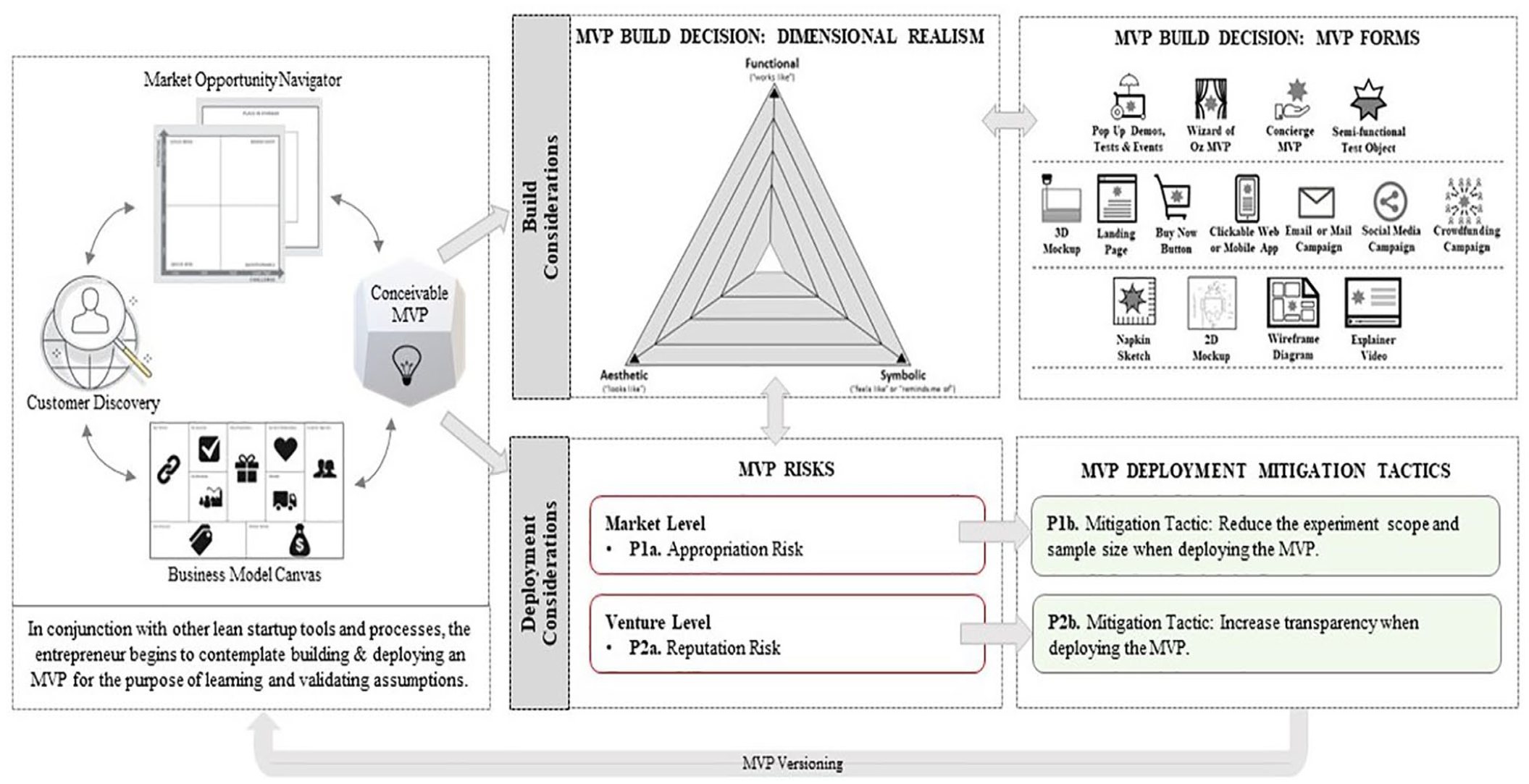
Conceptual Model of Minimum Viable Product (MVP) Build and Deployment Considerations
Market Level: Appropriation Risk
MVP realism decisions and appropriation risk
The competitive business landscape is a complex system (Simon, 1991) made up of many intricate parts that interact in nonsimple ways (Fleming & Sorenson, 2004; Nickerson & Zenger, 2004). Functioning and succeeding in these complex systems presents immense challenges for entrepreneurs. To enter such systems, entrepreneurs attempt to introduce novel, often unrecognizable products into the purview of an often unknown set of stakeholders (Fisher, Stevenson, Neubert, Burnell, & Kuratko, 2020). Public displays of new products or services by early movers can result in both opportunities and potential disadvantages (Dobrev & Gotsopoulos, 2010). Teece (1986) noted that initial innovators may not be in a position to capture the most value from their own technological innovations due to resource constraints and marketplace externalities. In particular, when product imitation is easy, the largest share of marketplace profits accrue after the introduction of a new innovation to incumbents that control complementary assets (Teece, 1986).
Given such threats, economic actors may closely guard the rare knowledge they possess about a market opportunity within the boundaries of the firm. Indeed, if economic actors are able to shield knowledge about certain rent-generating opportunities associated with a competitive imperfection, such actors are more likely to amass outsized economic rents (Alvarez & Barney, 2004; Barney, 1991). However, because entrepreneurial firms do not possess perfect information about their market opportunities (Knight, 1921), the lean start-up approach suggests that they can gain knowledge by interacting with stakeholders beyond the boundary of the venture (Burnell et al., 2023; Venkataraman, Sarasvathy, Dew, & Forster, 2012). Doing so means that entrepreneurs must unveil at least some aspects of their potential offering’s feature set externally. This external disclosure could expose the venture to competitive information problems (Alvarez & Barney, 2004), including appropriation risk.
Given the desire for low-cost opportunity exploration, it is not uncommon for entrepreneurs to initially build and deploy MVPs that prioritize aesthetics over other dimensions. High-aesthetic MVPs help external stakeholders quickly sense what the final product or service could “look like.” When such MVPs enter the public domain, other competitive firms or those that might be considering entering the product space may take notice. If the opportunity appears to have value, the simple act of deploying an MVP could expose a venture to appropriation risk. It is not certain that other firms will steal an MVP in its current form, but rather, they may be able to leverage their own resources to appropriate value from the market that the entrepreneur intends to service over the long term (Alvarez & Barney, 2004).
Prior research has documented that novice entrepreneurs commonly worry that their concepts might be stolen in the early stages of development (Drencheva, Stephan, Patterson, & Topakas, 2021). One way in which the entrepreneur can attempt to insulate their innovations from duplication is via patenting (i.e., establishing intellectual property [IP]). However, for patent protection to be effective, the entrepreneur would need to exhibit a version of the product that will be stable into the future. The ambiguous nature of an MVP means that establishing enforceable IP is likely to be infeasible at this stage. Moreover, given the cost-efficiency and iterative aims of MVPs and the broader lean start-up approach, which relies on rapid experimentation, establishing IP at the exploration stage directly conflicts with the lean goals of deploying an MVP.
Since establishing IP may be infeasible and incompatible with the purposes of an MVP, entrepreneurs who want to protect their solutions from potential imitators may need to signal to other firms that they have a superior advantage in terms of product functionality (often referred to as a first-mover advantage). When an entrepreneur increases the functional realism of an MVP, the immediate threat of product appropriation by a rival may be attenuated due to a decreased short-term economic incentive for that rival. However, increasing functional realism in the first versions of the MVP means that an entrepreneur would need to deviate from the core ethos of MVP testing, which is to minimize effort and cost by deploying low-realism MVPs as quickly as possible (Blank & Dorf, 2012). Therefore, the entrepreneur faces a trade-off decision: Should they deploy a “cheap and lean” low-functional-realism MVP to learn as fast as possible from the external market yet risk rapid imitation from competitors, or should they build a more comprehensive, higher-functioning version that would be more difficult to imitate before unveiling it beyond the boundary of the firm?
For a salient example, consider Tesla’s unveiling of a high-aesthetic MVP in 2019 for the first fully electric truck concept, named Cybertruck. Within 5 days of the release of the MVP, Tesla had amassed more than 250,000 preorders (Rueters, 2019). During the MVP release, Tesla prioritized aesthetic features, such as its unique design, its steel structural skin, its vault utility bed, and images of its armored-glass windshield. Yet, during the live demonstration, one of the windows, which were supposed to be bulletproof, shattered, indicating that the MVP lacked functional aspects. However, Tesla’s high-aesthetic MVP made a splash in the automotive world (Rueters, 2019), garnering major interest from consumers, and in the process signaled to incumbent firms that the electric truck market was ripe for entry. Within 18 months of demonstrating this high-aesthetic but low-functional-realism MVP, other firms, including Ford and GM, announced plans to develop electric trucks after years of reluctance to do so. Ford’s competitive electric truck has since come to market, while Tesla’s Cybertruck had not yet shipped commercially at the time of writing.
All else equal, one way to resolve this dilemma is to increase the functional aspects of the MVP through investments of time and capital (reducing the functional distance between the MVP and the anticipated final product). Such an approach would likely reduce the time lag between initial MVP deployment and commercial launch. However, from the lean start-up perspective, increasing functional realism of an MVP is not always feasible (or advisable) given the goals of testing ideas with minimal investment. New venture resource constraints also often limit how much investment can go into MVP development. In addition, precisely which resources to leverage or combine to reduce the functional distance between the MVP and the eventual commercial product cannot always be predicted ex ante. Given the pervasive resource constraints and knowledge problems facing new ventures, we contend that a nontrivial appropriation risk manifests whenever MVPs are deployed into the public sphere. Moreover, when the functional realism of the MVP is low and barriers to entry are also low, the deployment of this artifact can result in rapid imitation from others. Prior research shows that incumbents routinely scan the entrepreneurial landscape to appropriate technology from underresourced firms (Dushnitsky, 2017; Dushnitsky & Lenox, 2005). Thus, while at odds with the efficiency aims of the MVP, we reason, as functional realism increases, the immediate threat of appropriation by rival firms declines. We formally express this with the following proposition:
Proposition 1a: At the time of deployment, appropriation risk is inversely related to MVP functional realism and positively related to MVP aesthetic realism.
Mitigating appropriation risk through deployment sample and scope decisions
In the prior section, we explained why appropriation risk manifests when entrepreneurs deploy MVPs in the public domain. In this section, we draw on well-known principles from the literature on scientific experiments to theoretically account for partially mitigating appropriation risk. The success and generalizability of experiments, whether in the entrepreneurial or the scientific realm, depends on design elements of the experiment being conducted. The entrepreneur, much like a scientific experimentalist, must determine where and with whom to conduct experimental tests. Fundamentally, these are decisions related to the sample size (number of participants) and the scope (breadth of sample sources) that will be used in the experiment. Sample size is simply the total number of cases that the entrepreneur (or experimentalist) plans to assess in their experiment. Scope refers to the demographic, geographic, or psychographic dispersion of individuals involved in the experiment. For example, an entrepreneur could choose between experimenting via a public open call on the internet (wide scope) versus testing with a handful of family members (narrow scope). The entrepreneur might also consider using a convenience sample consisting of a cross-section of community members who visit a local coffee shop versus active sampling of potential early adopters at a specialty trade show. These illustrations demonstrate that the act of experimenting with an MVP requires a series of important ex ante choices by the entrepreneur.
In scientific terms, such decisions have implications for both statistical conclusion validity (Shadish, Cook, & Campbell, 2002) and generalizability (Highhouse, 2009). Sample size decisions impact statistical conclusion validity, such that with larger samples, the chances of uncovering a causal effect increases (decreasing the possibility of type II error; see Shadish et al., 2002). Increasing the scope has the potential to imply increased generalizability (Henrich, Heine, & Norenzayan, 2010). As Wilson, Aronson, and Carlsmith (2010: 50) explain, Most social psychologists would agree that the perfect study would be one that was conducted in a naturalistic setting, with a diverse sample of participants that revealed the nature and causes of an important social psychological phenomenon. Unfortunately, such a study is like a Platonic ideal that can rarely be achieved. Experimentation almost always involves a trade-off between competing goals: the desire to study a real problem in its natural context, on the one hand, and the desire to have enough control over the setting to be able to learn something about that problem.
As with scientific experiments, we assume that a larger scope in an MVP experiment would allow an entrepreneur to acquire increased generalizable evidence that there is a market need for the concept. For example, testing with a large sample and wide scope on a crowdfunding portal could achieve these ends given the typically large and dispersed nature of crowdsourced groups on such platforms (Afuah & Tucci, 2012; Stevenson, Allen, & Wang, 2022). As an example, Pebble founder Eric Migicovsky tested an MVP for a smartwatch on the popular crowdfunding website Kickstarter in 2012. Initially seeking $100,000, the campaign ended up raising over $10 million without a built-out functional MVP. Migicovsky had conducted a large-sample (worldwide) experiment using a high-aesthetic and symbolic MVP. With this large sample, Migicovsky was able to learn rapidly, with a high degree of confidence, that the market was favorable to his novel smartwatch concept before building the product or even sourcing suppliers. However, deploying an MVP with this large scope and sample carries certain risks. The success of the campaign signaled to incumbent technology firms (e.g., Apple, Garmin) that users were keenly interested in smartwatch options, potentially increasing the interest of other technology companies in the product space. Despite the massive success of its initial testing with a high-aesthetic-realism MVP and its first-mover rollout, the Pebble watch has since been discontinued. Adding to this complication, some entrepreneurs might argue (as some experimentalists do; see Mook, 1983) that the goal of the MVP experiment ought not be to obtain fully generalizable knowledge, but rather the goal should be to obtain specific knowledge that pertains to a specific small set of individuals (referred to as the “population of interest” in the experimental literature and “early adopters” or “lead users” in the organizational and innovation literature).
Taken together, the logic just outlined suggests that entrepreneurs confront a trade-off associated with (a) where (the scope) and (b) how many individuals (the sample size) to test their MVPs. On one hand, entrepreneurs can gather robust and generalizable knowledge from testing with many potential users. On the other hand, entrepreneurs may also be increasing appropriation risk when they open their MVP up to a large audience. Hence, entrepreneurs must confront this experimental design trade-off when deciding how to best deploy their MVP. We propose the following:
Proposition 1b: Reducing experimental scope and sample size when deploying MVPs will decrease appropriation risk; however, testing with a narrow scope or sample also reduces the depth of learning for entrepreneurs related to the validity and generalizability of their experimental results.
Venture Level: Reputation Risks
MVP realism decisions and reputation risk
When new firms gain access to novel and valuable information from users and other stakeholders, they put themselves in a much stronger position to develop innovative new products and enter new markets (Fisher, 2019). Focusing on aesthetic or symbolic features of an MVP before building out functional aspects can be beneficial as it allows for more rapid learning about customer preferences and their willingness to pay. Moreover, this approach is also quite cost-effective as building functional features typically requires more extensive investments of both time and capital, relative to aesthetic aspects. Indeed, such practices are quite common in entrepreneurial accelerators and other high-tech start-up communities (Cohen, Bingham, & Hallen, 2019). For example, an informant in a recent study of entrepreneurs in accelerators articulated, “Building the fancy product would have taken a really long time, but fortunately, we learned it’s not necessary” (Cohen et al., 2019: 17). This approach of early MVP deployment before attending to functionality concerns is common among entrepreneurs. However, this can also be hazardous.
While high-realism MVPs are effective for learning from markets, they also create expectations from those who interact with them. One primary goal of the MVP is to determine if potential users might be compelled to buy (Blank, 2013). Thus, an ideal MVP validation outcome occurs when the MVP elicits a strong visceral response. Blank (2009) refers to this idealized outcome as one in which the entrepreneur can observe the user’s “pupils dilate” or a change in the user’s voice. Such a response is especially likely when individuals interact with MVPs that have high symbolic and cultural resonance (Soublière & Lockwood, 2022). MVP symbolic realism relates to expectations and beliefs that users develop about the potential product’s value. When users interact with MVPs that evoke strong cognitive representations of personal significance, user expectations and emotional connection toward eventual product releases may strengthen. Observing an elevated emotional connection is a desirable outcome for entrepreneurs when testing their MVPs. However, when MVP user expectations increase, there is increased potential for reputational fallout if the venture is unable to deliver a final product that meets the user’s expectations. Therefore, the higher the symbolic realism, the greater the emotional and cultural resonance associated with the potential product and the greater the reputation risk if the final product falls short of the user’s expectations.
A notable example related to the risks of deploying a low-functional but highly symbolic MVP comes from the defunct company Theranos. Its MVP, the Edison, was supposed to be able to use a simple pinprick drop of blood to diagnose over 300 potential illnesses. Theranos built the MVP with high aesthetic and symbolic realism but low functional realism. Even though the functional aspects were lacking, Theranos’s founder, Elizabeth Holmes, would present the MVP to high-profile investors and potential users as though it were functional. When conducting live demonstrations using the MVP, Holmes would emphasize its symbolic value, explaining how a tiny blood draw could reduce the frictions of diagnostic testing with the potential to save lives. Holmes would take the person experiencing the MVP demonstration out of the room while they waited for the Edison to generate the results (Carreyrou, 2019). The blood sample would then be transferred to an off-the-shelf commercial diagnostic machine to generate the test results, which were later placed next to the Edison so they were viewable upon return to the room (Carreyrou, 2019). Tyler Schultz, a Theranos whistleblower, describes the situation: “We had no assets validated on the product on the Theranos system . . . so if we collected a sample from [users], as far as I know, zero tests would be run on the Theranos platform, [but users were] definitely under the impression that all of these tests were being run on the Theranos platform” (Schultz, 2020: chap. 2). This is an extreme example of a low-functional and high-symbolic Wizard of Oz MVP being used to deceive potential users. When it was later revealed the Edison was not functional, Holmes was charged with fraud.
When entrepreneurs deploy MVPs with low functional realism and high symbolic realism, there is an increased risk of reputational damage if the eventual product does not perform as depicted. Although prior literature suggests that initially testing with low-realism MVPs is a common and often necessary step for early-stage entrepreneurs (Shankar & Shepherd, 2019), we argue that when entrepreneurs showcase such MVPs, their reputational risks are amplified, especially when audiences strongly resonate with the symbolic features of the MVP. As a result, while symbolic realism can increase reputation risk, focusing on the functional aspects of the MVP during initial deployment may offset this risk. When users interact with MVPs that are functionally closer to the final product form, the venture reduces the gap between the representative artifacts used for testing and the final product. We thus propose the following:
Proposition 2a: At the time of deployment, reputation risk is inversely related to MVP functional realism and positively related to MVP symbolic realism.
Mitigating reputation risk through transparency
One way in which entrepreneurs can reduce reputation risk is via increased transparency. By transparency, we mean open and free sharing of product-related information about the MVP at the time of deployment. Indeed, prior research shows that transparency has the potential to benefit an organization’s employees, customers, and other stakeholders via trust as a mechanism (Parris, Dapko, Arnold, & Arnold, 2016). According to Mayer, Davis, and Schoorman (1995), trust, in part, is based on the perception that the entity to be trusted adheres to a set of principles that the trustor finds acceptable. Other research shows that when established firms take an active transparent stance, they can develop a competitive advantage as potential customers exhibit increased brand favorability and have greater purchase intentions (Eggert & Helm, 2003). Likewise, similar transparency benefits emerge for entrepreneurial ventures when deploying MVPs. Open disclosures related to the true status of an MVP will reduce the potential reputational or legal risks that an entrepreneur could face in the short or long term because users will have more insight into and understanding of the status of the product or service. Eric Reis recently discussed how a lack of transparency in the context of MVPs can create moral and legal hazards for entrepreneurs: You see how people get confused really easily, because it is important to be able to do a landing page test where you ask people to pre-order a product that doesn’t exist. But . . . you have to come clean about what you’re doing and why. Otherwise, your customers might come to rely on something you said or a promise that you can’t deliver that would harm them. And that’s not only morally wrong, it’s bad business to build that reputation. (quoted in Kessler, 2021: 2)
Entrepreneurial funding and support platforms advocate for increasing transparency when testing with MVPs. In 2019, Kickstarter issued new transparency guidelines directing entrepreneurs to increase honesty, openness, and candor related the status of the MVPs they present on the portal (Kickstarter, 2019). Kickstarter claims this benefits both funders and entrepreneurs. Meg Heim, Kickstarter’s head of systems integrity, stated the disclosures “help guide creators into setting expectations that [will] help them [and the campaign] in the long run” (Heater, 2019: 2).
Although these arguments and examples indicate increasing transparency during MVP testing could alleviate reputational risk, it is also possible that it might reduce learning efficacy during experimentation. Some scientific experimentation literature implies that when full details about an experiment being conducted are known by the participants, there is an increased risk of demand characteristics biasing the experimental results (cf. Hertwig & Ortmann, 2008; Nichols & Maner, 2008). Demand characteristics refers to “cues that make participants aware of what the experimenter expects to find or how participants are expected to behave” (Nichols & Maner, 2008: 151). Demand characteristics introduce bias into scientific experiments as participants tend to act in ways that support an experimenter’s hypotheses (Orne, 1962). Hence, while transparency may reduce reputational risk for an entrepreneur, it could also interfere with valid inferences derived from MVP experiments.
Indeed, it is possible for firms to conduct experiments with MVPs with added transparency, yet just as is the case with scientific experimentation, some level of opaqueness may increase the practicality of the design and the quality of the data obtained (Hertwig & Ortmann, 2008; Kelman, 1967). Thus, when experimenting with MVPs, entrepreneurs face a trade-off wherein increasing transparency has the potential to decrease reputation and legal risks but doing so might reduce experimental realism. This, in essence, is an internal validity problem (Patel & Fiet, 2010) that may reduce entrepreneurs’ ability to rapidly learn from MVP deployment. Hence, we propose the following:
Proposition 2b: Increased transparency when deploying MVPs can decrease reputation risk; however, increased transparency might diminish the authenticity of feedback received during experimentation from participants.
Discussion
By drawing from the literature on the lean start-up, we develop a definition and conceptual model for one of the primary lean start-up tools: the MVP. Our conceptual model unpacks the dimensionality of MVPs, identifies MVP forms, and explains when and why using MVPs might involve inherent risks. We present propositions based on scientific experimentation principles to account for how such risks could be mitigated.
Implications and Future Research Opportunities
MVP dimensionality and configurational approaches
We conceptualized MVPs as consisting of three interconnected realism dimensions: aesthetic, functional, and symbolic. We discussed the dimensions of MVP realism separately when laying out our conceptual foundations, yet we recognize that these dimensions are not orthogonal to one another. The dimensions of MVP realism are likely correlated with each other, at least to some degree. For example, one could imagine that aesthetic features of an MVP could also include elements of symbolic realism. The design choices made by Thomas Edison in commercializing the electric light, for instance, included aesthetic features that fit within institutional norms for existing light sources (cf. Hargadon & Douglas, 2001), and hence one could argue that aesthetic and symbolic realism were related to one another in this case. Likewise, aesthetic features could serve the “functional” purpose of providing the user an aesthetic experience, or symbolic features could provide some utility to users, thereby also offering some functionality. This assumed nonorthogonality could have implications for substitution or complementarity among the dimensions. For example, entrepreneurs could use high-aesthetic realism as a substitute for functionality if these two dimensions are expected to be related in the final product form. Assuming certain features take less time and resources to construct than others, one dimension of realism might serve as a lower-cost substitute for other dimensions when experimenting.
We encourage future research to build upon the three-dimensional conceptualization of MVPs that we present herein. Researchers could directly apply this three-dimensional framework to empirical questions related to design attributes and adoption (cf. Rindova & Petkova, 2007). Future studies could also take a three-dimensional scaling view of MVPs and explore how the correlations between each of the dimensions impact different venture stakeholders. For example, are certain three-dimensional configurations especially harmful (or helpful) to social judgments in certain contexts or for certain types of venture audiences (cf. Fisher, Kuratko, Bloodgood, & Hornsby, 2017)? This future research opportunity is particularly applicable when considering the social constructivist (e.g., Baker & Nelson, 2005) or entrepreneurial narratives (e.g., Fisher, Neubert, & Burnell, 2021; Uparna & Bingham, 2022) perspectives. The social construction of ideas requires entrepreneurs to communicate meaning to audiences who may have no prior familiarity with the product or domain. Thus, researchers could explore how entrepreneurs might focus on certain MVP dimensions when testing with discrete stakeholder groups with different expectations and preferences. Alternatively, researchers might explore how entrepreneurs alter their emphasis on MVP dimensions with different stakeholder groups, perhaps as an another way to mitigate appropriation or reputation risk.
MVP design trade-offs and risk outcomes
Our theorizing highlights that a core trade-off for entrepreneurs related to whether to increase functionality to mitigate risks that are connected to aesthetic and symbolic realism. An implication of this trade-off is that entrepreneurs who emphasize a fast and frugal approach to experimenting with MVPs with limited functionality may increase exposure to appropriation and reputational risks. This implication highlights a risk associated with applying the lean start-up framework. Our theorizing suggests entrepreneurs may sometimes need to build more functionality into their MVPs to reduce such risks. Thus, our conceptual insights provide more nuance and some caution to the lean start-up framework.
Another trade-off relates to the sample size, scope, and transparency of MVP experiments. Borrowing from the literature on scientific experiments, we theorized that these factors present trade-offs for entrepreneurs as they consider with whom to experiment and how much information should be provided about the MVP. Our propositions suggest that entrepreneurs attempt to optimize learning when they test MVPs with a large and diverse sample of potential customers with MVP transparency set based on the scope of the MVP test. However, such decisions may also be associated with increased reputational costs, leading to a trade-off. An implication of this trade-off is that entrepreneurs following strict scientific methods of experimentation may sometimes put themselves in jeopardy of appropriation and reputational risks. This implication questions whether “entrepreneurs as scientists” is always an appropriate analogy. Perhaps scientific methodologies, while useful in evaluating opportunities (cf. Camuffo et al., 2020), may sometimes lead to unforeseen hazards. Thus, what we propose here adds to the emerging literature on entrepreneurs as scientists by shifting the focus from evaluating opportunities to considering long-term risks of using scientific methods when testing the value of potential solutions within markets.
Beyond market- and venture-level factors impacting MVP usage, future research might consider individual-level factors that could influence MVP design and deployment decisions. For example, future research could explore what happens when an entrepreneur becomes personally attached to their MVP. Indeed, we know that when individuals actively spend time developing ideas into tangible artifacts, a sense of psychological ownership over those artifacts can develop (Grimes, 2018; Norton, Mochon, & Ariely, 2012; Ranganathan, 2018; Zhu, Hsu, Burmeister-Lamp, & Fan, 2018). Researchers might therefore consider whether and how entrepreneurs prioritize realism features based on their own sense of attachment to their ideas. For example, do highly attached entrepreneurs prioritize realism features across all dimensions, or do they tend to fixate on one area of realism? Do highly attached entrepreneurs hold back certain features of their MVPs in secrecy to avoid negative feedback? Researchers might also explore how an entrepreneur with high psychological ownership over certain features may shift (or not shift) the MVP dimensions that are emphasized and the implications of such shifts in terms of appropriation, reputational risks, and learning.
Beyond psychological attachment, there are several other individual-level factors that could influence MVP build and deployment decisions. These include personality (Zhao, Seibert, & Lumpkin, 2010), vision (Venus, Johnson, Zhang, Wang, & Lanaj, 2019), entrepreneurial identity (Stevenson, Guarana, Lee, Conder, Arvate, & Bonani, 2024), learning differences (Wiklund, Yu, Tucker, & Marino, 2017), regulatory focus (Wallace, Little, Hill, & Ridge, 2010), coachability (Ciuchta, Letwin, Stevenson, McMahon, & Huvaj, 2018), or differences in personal wealth (Bruton, Pryor, & Cerecedo Lopez, 2024). Researchers might consider how such individual-level factors influence MVP trade-off decisions related to appropriation or reputation risks discussed herein.
Finally, additional research opportunities related to MVP design trade-offs exist at the team level. For example, a venture team might disagree on which features to include in their MVP. Understanding how teams come to consensus on MVP forms, features, and dimensions presents an interesting research opportunity. Team conflict related to MVP features could reduce the team’s willingness to engage in experimentation, or it could increase team willingness to experiment.
Implications for lean start-up tool alignment research
The MVP is only one tool within the suite of lean start-up tools. While each lean start-up tool is valuable, aligning tools together in practice is likely to provide synergistic learning. For example, consider how the Market Opportunity Navigator (Gruber & Tal, 2017) and the MVP can be used synergistically. High environmental uncertainty and unpredictability as it relates to what to do first during initial stages of start-up progression can deter entrepreneurial entry. Focusing on an MVP and aligning it with the Market Opportunity Navigator might lessen this initial hurdle. The Market Opportunity Navigator first guides entrepreneurs through a generative process, resulting in a portfolio of market options. When these options are illuminated, the next step of testing ideas within a specific market can be systematically determined. Once entrepreneurs generate market options, an MVP can help navigate customer discovery activities within opportunity sets. During the opportunity navigation process, trying to understand unmet market needs and the reasons that might compel customers to buy proposed solutions is critical (Gruber & Tal, 2017). Entrepreneurs can benefit from combining the Market Opportunity Navigator with quickly developed low-realism MVPs at this early stage of validation. This synergistic combination could reveal initial insights into how valuable opportunities within a particular market might be by uncovering the reasons or concerns that underlie hypothetical purchasing decisions. Aligning and synergistically utilizing lean start-up tools can thereby enhance and expand entrepreneurs’ search and validation efforts.
Moreover, failure to align an initial MVP with a workable market opportunity could result in unproductive or unusable testing data. Inferior data acquired as a result of poor tool alignment might hinder decisions related to subsequent MVP development (e.g., relying on MVP forms or realism levels that do not align with the market). Inferior data derived during the MVP testing stage might also hinder critical go-to-market decisions (Wilden, Chirico, & Detienne, 2022). Future research could consider how testing with aligned versus misaligned lean start-up tools can influence important start-up decisions, such as the go versus no-go decision (e.g., Bakker & Shepherd, 2017). Moreover, researchers might consider how these decisions influence the venture over time. For example, researchers could investigate if subsequent pivots (or venture failure) are more likely to occur over time if lean start-up tool misalignment occurred during the exploration stage. Future research might also consider which of the lean start-up tools carry the most weight when it comes to pivot-or-persistence decisions. Overall, there are rich future research opportunities to explore the connection between lean start-up tools as well as the impact of contingency factors.
Practical Implications
Herein, we bridge the divide between science and practice by critically evaluating MVP development and deployment. Specifically, we provide cautions to entrepreneurs who seek to use MVPs. Although MVPs can result in efficient learning, they might also lead to negative social judgments if the trade-offs inherent in MVP deployment decisions are overlooked. In practice, entrepreneurs may mitigate potential risks of MVPs by reducing experimental scope and sample size, increasing transparency, aligning MVPs with other lean start-up tools, or reconfiguring the dimensions of aesthetic, functional, or symbolic realism. Experimenting entrepreneurs looking to successfully navigate MVP deployment trade-offs might learn from the body of work that documents effective scientific experimentation practices (e.g., Chen, Elfenbein, Posen, & Wang, 2024; Grégoire, Binder, & Rauch, 2019; Shadish et al., 2002; Stevenson, Josefy, McMullen, & Shepherd, 2020). Although learning via experimentation is the central purpose behind using an MVP, entrepreneurs can also leverage MVPs to achieve additional outcomes, such as collecting preorders (e.g., Tesla’s Cybertruck) or amassing users for a two-sided marketplace. Finally, entrepreneurs should consider their learning needs when determining how to configure an MVP most effectively in terms of form combinations and along the realism dimensions presented herein. 3
Conclusion
Scholarly interest in MVPs is emerging as researchers look to keep pace with entrepreneurship practice. Yet, the theoretical foundations for MVPs, including their inherent risks, were notably absent from the literature. We address this gap by presenting an integrative definition of MVPs and distinguishing the theoretical dimensions underpinning MVP realism. We also delineate the boundaries of the MVP and classify discrete forms of MVPs used in practice. We then develop propositions that explore intrinsic risks of MVP deployment and mitigation tactics to avoid such risks. Overall, we build a theoretical grounding for the MVP as it relates to features, trade-offs, risks, and risk mitigation. Given the emerging scholarly interest in MVPs, we also propose future research opportunities. We hope our conceptual presentation of MVPs will inspire additional theory building and empirical testing around this important tool used by entrepreneurs.
Footnotes
Appendix
Acknowledgements
We would like to thank Jeff McMullen, Matt Josefy, Salem Alsanousi, Parker Busick, Bill Dawson, the dedicated team of JOM editors and reviewers, and the many entrepreneurs and students of entrepreneurship at Indiana University that shared valuable feedback on earlier versions of the concepts presented in this article.
