







Abstract
The effective socialization of newcomers into organizations is critical for employee and organizational success. As such, ensuring successful onboarding has become even more pivotal for newcomer adjustment, performance, and retention. The literature has seen significant growth and incorporated new theoretical perspectives, such as resource-based approaches since the most recent comprehensive meta-analytic review of the literature. Therefore, we extended earlier reviews by presenting an updated model of the socialization process, reviewing the literature, and examining this updated model via meta-analysis. In all, we identified 256 studies that met our meta-analytic inclusion criteria, and 183 with sufficient k across construct categories were included in our meta-analysis. At the correlational level, we analyzed antecedents to proximal adjustment indicators and proximal adjustment to distal outcomes. We examined a potential moderator, whether the study took place in a horizontal-individualistic (HI) versus vertical-collectivistic (VC) culture. Last, we analyzed a path model to identify unique relationships between specific antecedents (age, full-time work experience, organizational tenure, proactive personality, information seeking, organizational tactics, insider mentoring/supporting), proximal adjustment indicators (social acceptance, role clarity, task mastery, perceived fit), and distal outcomes (job satisfaction, organizational commitment, turnover intentions, other-rated performance, and well-being). Our analyses uncover the role of proactive personality and proactive newcomer behaviors in newcomer adjustment and the importance of social acceptance for newcomers. They also identify perceptions of fit as an important but relatively under-examined adjustment indicator and newcomer well-being as an additional socialization outcome. We develop future directions for socialization theory and research methods.
Organizations spend significant resources recruiting and selecting new employees. However, once “on board,” the successful adjustment of newcomers to their new environment is not guaranteed. According to one estimate, even before the dramatic shifts in turnover due to the pandemic, over one-third of new hires left their organizations within the first year (Work Institute, 2020). Ensuring successful onboarding has become even more pivotal for newcomer adjustment (Gallup, 2022), with the practitioner press hailing onboarding as key to newcomer retention and effectiveness (Everett, 2022). Organizational socialization research examines the onboarding process through which newcomers learn the skills and acquire the information needed to adapt to new roles and successfully transition from organizational “outsiders” into organizational “insiders.” Socialization experiences are critical to newcomer performance and attitudes toward the organization, including job satisfaction, organizational commitment, and turnover intentions (Bauer, Bodner, Erdogan, Truxillo, & Tucker, 2007; Wanberg, 2012).
Scholarly interest in organizational socialization has flourished since its introduction to the literature. However, the most recent comprehensive quantitative review of this literature was published by Bauer et al. (2007), who reviewed 70 studies in their summary meta-analytic path model. That meta-analysis demonstrated the key role played by organizational socialization tactics and newcomer information seeking in relation to newcomer adjustment. While subsequent reviews have enhanced our knowledge of the organizational socialization process, they have targeted specific issues or been relatively narrow in focus. For example, Saks, Uggerslev, and Fassina (2007) published a meta-analysis of 30 articles focusing on socialization tactics. Fang, Duffy, and Shaw (2011) wrote a narrative review focused on the development of newcomer capital. Ellis, Bauer, Mansfield, Erdogan, Truxillo, and Simon (2015) conducted a targeted narrative review through the lens of stress theory. Allen, Eby, Chao, and Bauer (2017) authored a joint narrative review of the socialization and mentoring literatures. Zhao, Liu, Zawacki, Michel, and Li (2023) examined newcomer proactive behaviors in their meta-analysis. And, Liu, Watts, Feng, Wu, and Yin (2024) conducted a meta-analysis on the effects of socialization programs on retention. Although each of these adds to our understanding of the socialization landscape, there has been no recent comprehensive meta-analytic review of the socialization literature. This is a significant omission because the past two decades have seen a proliferation of original studies and an expansion of the theoretical frameworks applied to the newcomer socialization process, but which frameworks matter most and under what conditions remains unclear.
Thus, our current review is timely as it contributes to the literature in the following ways. First, we contribute to socialization theory by summarizing the literature and presenting an updated model of the socialization process based on foundational and emerging theoretical perspectives central to the socialization process. Bauer et al. (2007) developed a comprehensive model of socialization based on an uncertainty reduction perspective, and their findings reinforced an interactionist perspective. Since then, resource-based perspectives have gained ground, inspiring the question of whether these new theoretical perspectives have meaningfully advanced our understanding of the socialization process. Together, these perspectives provide a framework for organizing our review while summarizing these disparate socialization research streams. Second, by reviewing 256 studies and synthesizing findings from 183 samples, we contribute a critical review and update beyond the last comprehensive review of the literature. In doing so, we reevaluate the importance of various socialization experiences for newcomers. We examine additional newcomer behaviors such as feedback seeking, job crafting, and relationship building that have emerged in the literature since the last review. We also uncover antecedents that were not examined in the last review (e.g., personality, especially proactive personality), reflect on the relative importance of different adjustment indicators (e.g., the key role of social acceptance), and examine additional distal outcomes of the socialization process, such as well-being, that were not included in previous reviews. Finally, since the last review, research has been increasingly conducted outside of Western contexts characterized by high individualism and low power distance. Factors associated with newcomer adjustment can vary across cultures, offering us an opportunity to examine the role of cultural context in the socialization process. As a result, a key contribution of this research is that we are able to provide a more nuanced, theoretically and empirically grounded understanding of newcomer adjustment.
Theoretical Background
Bauer et al.’s (2007) meta-analysis of the socialization literature primarily drew from uncertainty reduction theory (Berger, 1979), which was dominant in the literature at the time. The foundational assumption of uncertainty reduction theory is that newcomers face uncertainty when starting a new job, including uncertainty about tasks and role expectations, colleagues, and the organization itself. Consistent with Bauer et al.’s (2007) findings, organizational approaches that mitigate uncertainty through the provision of structured and formalized practices are thought to reduce uncertainty and positively influence adjustment outcomes (Van Maanen & Schein, 1979). Moreover, the uncertainty experienced by newcomers is presumed to be uncomfortable and anxiety-producing, which motivates newcomer proactivity such as information seeking (Bauer et al., 2007; Zhao et al., 2023). Uncertainty reduction has explained newcomer impressions formed by realistic job previews prior to organizational entry (Earnest, Allen, & Landis, 2011) and psychological contracts (Woodrow & Guest, 2020).
The uncertainty reduction perspective has been useful for explaining how organizational practices and newcomer behaviors relate to adjustment indicators such as role clarity. However, one critique is that the provision of information and subsequent reduction of ambiguity is not sufficient to explain other aspects of socialization, such as social acceptance, self-efficacy, perceived fit, or work engagement (Bauer et al., 2007; Saks & Gruman, 2018; Saks et al., 2007). As such, subsequent research has adopted a variety of theoretical perspectives to predict newcomer outcomes.
For example, contemporary
Finally, the
Overview of the Organizational Socialization Process
The organizational socialization process reflects a period of transition for newcomers, characterized by learning, adaptation, and adjustment. Previous research has shown that effective newcomer adjustment is influenced by factors that can be grouped broadly into two categories: (1) characteristics and behaviors of newcomers and (2) actions by the organization or its members. Based on this, we identified many newcomer-focused antecedents, which we further organized into the subcategories of newcomer individual characteristics, newcomer impressions of the organization, and newcomer behaviors. We identified organizationally focused antecedents that we grouped into the subcategories of organizational socialization tactics and organizational insiders. 1 See Figure 1 for our summary model.
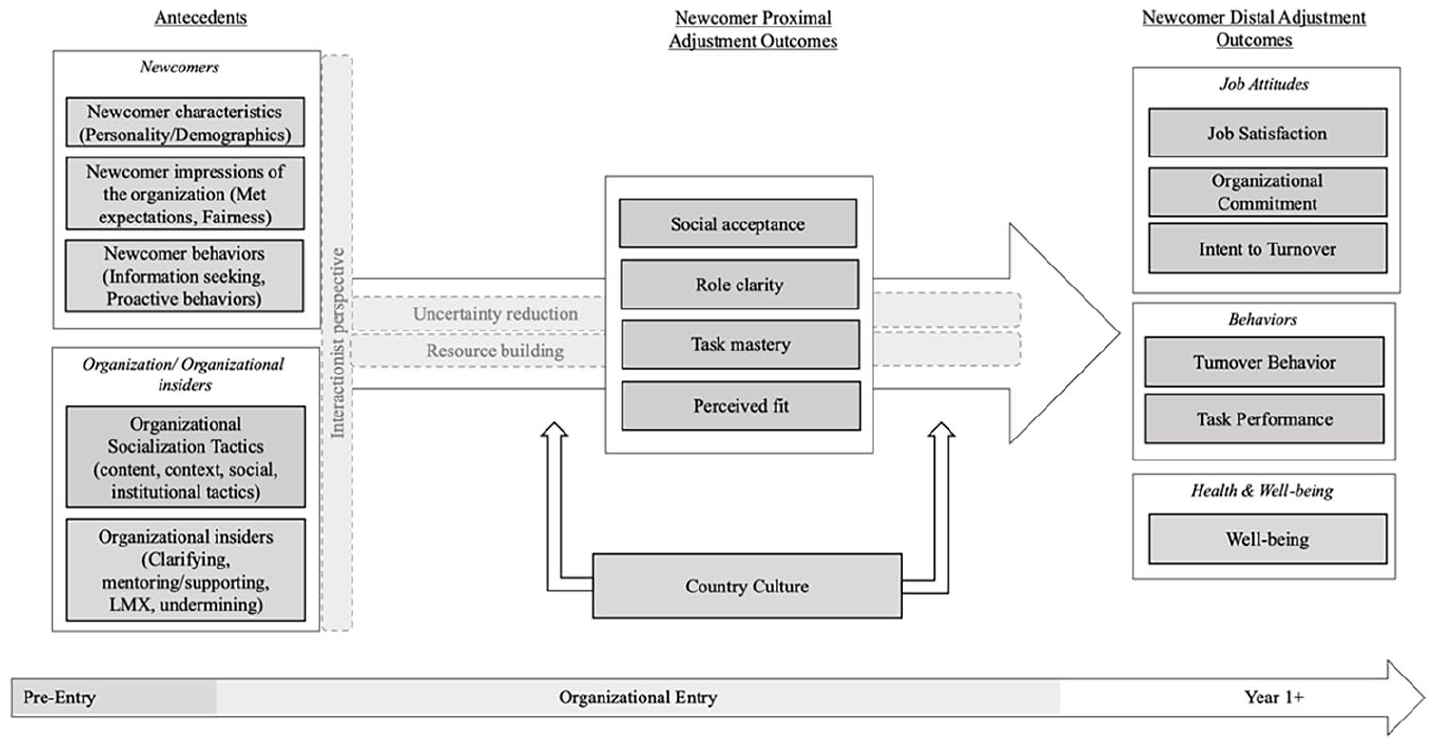
Updated Summary Model of Newcomer Organizational Socialization Constructs
Outcomes of the socialization process have been organized into “proximal” and “distal” outcomes (Bauer et al., 2007; Kammeyer-Mueller & Wanberg, 2003). Bauer et al. included three proximal outcomes of the socialization process: social acceptance, role clarity, and task mastery. In our current review, we also include newcomer-perceived fit as a proximal outcome. Distal outcomes emerge from successful early adjustment and include job satisfaction, organizational commitment, and turnover intentions, as well as newcomer behaviors of turnover behavior, task performance and newcomer well-being. Next, we will go into more detail about our summary model.
Antecedents to Effective Socialization
A number of factors have been empirically identified as important for effective socialization. As discussed previously, these factors can stem from the individual, such as newcomer personality, demographics, and behaviors or characteristics of the environment, including the existence of formal organizational socialization tactics and interactions with organizational insiders. We briefly review each in turn.
Newcomer characteristics
Newcomer characteristics matter because they serve as personal resources that can shape interpretations of the new environment, influence how one might respond to uncertainty or challenges early in the socialization process, and predict how newcomers might engage with their new environment (Bauer & Erdogan, 2014). Newcomer characteristics include personality, such as the big five personality traits, core-self evaluations, and proactive personality, as well as demographic factors, such as age and work experience. Interestingly, prior meta-analyses (e.g., Bauer et al., 2007; Saks et al., 2007; Zhao et al., 2023) did not include many newcomer characteristics. However, recent empirical studies suggest that newcomer characteristics play a role in the socialization process. For example, Simon, Bauer, Erdogan, and Shepherd (2019) found that a proactive personality can act as a support, reducing the effects of negative factors such as perceived overqualification on adjustment. This may be because proactive newcomers are more likely to engage in socialization-related behaviors such as information seeking and feedback seeking that help reduce uncertainty and build other important job and social resources.
Newcomer impressions of the organization
Another group of antecedents to the socialization process are newcomer impressions of the organization, which play a role in other organizational contexts (e.g., job applications, groups, and teams). Although early research on impressions in socialization centered on newcomer expectations and realistic job previews (RJPs) that function through the reduction of uncertainty (Phillips, 1998), more recent research has focused on whether newcomers trust the organization and its members (e.g., supervisor, coworkers) and on psychological contract fulfillment (e.g., Woodrow & Guest, 2020; Zhu, Tatachari, & Chattopadhyay, 2017). Such research demonstrates how interactions between newcomers and organizational insiders help newcomers make sense of their fit with the environment and signal resource availability. For instance, van der Werff and Buckley (2017) focused on elements of trust and found that, over time, reliance (e.g., depending on one’s group members) and disclosure (e.g., willingness to discuss one’s feelings honestly) increased; these increases occurred in bursts followed by plateaus, as opposed to a consistent linear trend. Nasr, El Akremi, and Coyle-Shapiro (2019) found that the perceived fairness of supervisors and coworkers was positively related to newcomer perceptions of support and positively related to subsequent role clarity and social integration. Overall, newcomer impressions are a potential antecedent to effective socialization indicators like role clarity—because they reduce uncertainty for newcomers—and potentially to indicators like social integration when they signal the availability of social resources. However, newcomer impressions have not been directly examined in most prior reviews.
Newcomer behaviors
Newcomer behaviors, which focus on what newcomers do during the socialization process, are key to the socialization process. Reichers (1987) noted that socialization rates would be accelerated when both newcomers and insiders “proact on each other” (p. 280), pointing to the importance of newcomers being active players in their own socialization (e.g., Wanberg & Kammeyer-Mueller, 2000). Early focus was placed on information-seeking behavior, given newcomers’ need for clarity early in the socialization process (Bauer et al., 2007). However, subsequent reviews (Zhao et al., 2023) have underscored the importance of a range of proactive newcomer behaviors, including relationship building, positive framing, and feedback seeking, which are thought to build important personal and social resources. For example, Nifadkar, Tsui, and Ashforth (2012) found that feedback seeking was related to social acceptance among IT workers. Perceived information sharing was also related to newcomer role clarity in a sample of newly hired technology workers in China (Zheng, Zheng, Wu, Yao, & Wang, 2021). In their meta-analysis, Zhao et al. (2023) showed that seeking information and feedback (which they referred to as sensemaking behaviors) were more strongly related to task mastery and role clarity, while relationship building related more strongly to social integration. This area has emphasized the active steps newcomers take to facilitate successful integration into the social and task-related fabric of the organization.
Organizational socialization tactics
Just as individuals differ, organizations differ in how they facilitate newcomer adjustment. Through the lens of uncertainty reduction, Van Maanen and Schein (1979) observed that organizational approaches to information dissemination differ in at least six dimensions that exist on a bipolar continuum. Specifically, collective (versus individual) tactics involve grouping newcomers together for cohort-style socialization. Formal (versus informal) tactics represent arrangements where newcomers are separated from the actual work environment while being socialized. Sequential (versus random) tactics include newcomers following a set progression of steps, and fixed (versus variable) tactics involve having new hires follow a set timeline before they assume their new roles. Serial (versus disjunctive) tactics are comprised of being socialized by experienced organizational members who serve as role models, and investiture (versus divestiture) tactics affirm the newcomer’s identity during socialization.
These six tactics represent one end of the spectrum (collective, formal, sequential, fixed, serial, and investiture), referred to as institutionalized socialization tactics. They represent more formal, structured, deliberate, and intentional ways of bringing newcomers into the fold where newcomers are grouped together, separated from other employees, follow a strict timeline with a predictable sequence of events, and receive role modeling and support (Jones, 1986). In contrast, tactics at the other end of the spectrum (individual, informal, random, variable, disjunctive, and divestiture) are labeled as individualized socialization tactics. These represent newcomer socialization that is less deliberate, in which the organization largely leaves newcomers to their own devices upon entry.
Yet another way of classifying these tactics is to conceptualize the six dimensions under three higher-level factors: context tactics (collective, formal), content tactics (fixed, sequential), and social tactics (serial, investiture; Cable & Parsons, 2001; Saks et al., 2007). Notably, our review indicates little consensus on how tactics are conceptualized. There are studies using six- (e.g., Cooper-Thomas & Anderson, 2002), three- (Saks & Gruman, 2011), and one-dimensional conceptualizations (e.g., Peltokorpi, Feng, Pustovit, Allen, & Rubenstein, 2022). Earlier meta-analytic evidence revealed that institutionalized tactics were more positively related to adjustment and outcomes, suggesting that newcomers benefit from structured experiences that help them adjust to their roles (Bauer et al., 2007; Saks et al., 2007). These experiences have been shown to relate to all indicators as they provide key opportunities and information important for building task mastery, social integration, and role clarity.
Organizational insiders
The interactionist paradigm underscores the importance of insiders in helping newcomers make sense of their new environment. Insiders not only provide key information and feedback to newcomers that help them reduce uncertainty but serve as a critical source of social resources important for engagement and well-being (e.g., Rubenstein, Kammeyer-Mueller, & Thundiyil, 2020; Saks & Gruman, 2012, 2018). Most recent research concerning organizational insiders has focused on the provision of informal support. Consistent with the interactionist framework, this research considers insiders as “socialization agents” who play a key role in helping newcomers understand their role and make sense of the broader organizational environment (e.g., Nifadkar, 2020; Nifadkar & Bauer, 2016). Research finds feedback and clarifying information early in the socialization process from mentors and supervisors as important to the development of a sense of mastery and role clarity. Kammeyer-Mueller, Wanberg, Rubenstein, and Song (2013) showed that insider support related to social integration, supporting a resource-based perspective. Despite evidence suggesting the importance of insiders, previous quantitative summaries have not directly examined the role of insiders on proximal adjustment outcomes.
Proximal Outcomes: Socialization Adjustment Indicators
At the center of most socialization models are the proximal outcomes that mediate the socialization process, often referred to as newcomer adjustment. In their review, Bauer et al. (2007) identified three types of adjustment: building relationships with organizational insiders (social acceptance), understanding one’s role in the organization (role clarity), and learning the skills and knowledge necessary to have job-specific self-efficacy (task mastery). While the tripartite framework has been widely accepted (e.g., Zhao et al., 2023), Saks et al. (2007) investigated perceived fit as an additional proximal outcome, and fit has been incorporated to some degree in other subsequent socialization models (e.g., Ellis et al., 2015; Saks & Gruman, 2012). Therefore, we have included perceived fit in our updated model.
Distal Socialization Outcomes
The purpose of socialization is to positively affect distal outcomes, the most commonly investigated being newcomer job attitudes/intentions (e.g., job satisfaction, organizational commitment) and behaviors (e.g., job performance, turnover). Indeed, some combination of these distal outcomes has been incorporated into nearly every review of the socialization process, finding consistent links between proximal adjustment indicators and distal outcomes (Bauer et al., 2007; Saks et al., 2007; Zhao et al., 2023). In addition, and consistent with the incorporation of resource-based theory, researchers have begun incorporating employee well-being as an additional distal socialization outcome (Ellis et al., 2015), and it is included in our updated model as well.
National Culture as a Moderator
We examined national culture as a potential moderator in our model. National culture represents values that distinguish one society from another (Hofstede, 2001). Recognizing that the most commonly studied cultural differences of collectivism and power distance tend to be highly correlated, Rockstuhl et al. (2020) proposed a typology classifying countries as horizontal-individualistic (HI; e.g., Australia, France, US) or vertical-collectivistic (VC; e.g., China, Greece, Japan). HI cultures are primarily Western cultures with high individualism and low power distance, whereas VC cultures are mostly Eastern cultures high in collectivism and power distance. Consistent with Rockstuhl, Wu, Dulebohn, Liao, and Hoch’s (2022) classification of culture’s role as one of compensation versus congruence, some antecedents of socialization may emerge as stronger correlates of adjustment indicators to compensate for what is missing in the cultural context, whereas others may emerge as dominant correlates of distal outcomes because they are more congruent with cultural expectations (Rockstuhl et al., 2022).
Review Methods
Socialization Literature Review
We took several steps to identify a comprehensive set of articles for review (Figure 2). 2 Once identified, each article was read by a member of the author team. If included, sample demographic characteristics and the constructs included in the correlation matrix were recorded. After initial determinations were made regarding which constructs were available to code, one member of the team coded each article. We created a codebook to help ensure consistency and held weekly meetings to discuss and come to a consensus on any ambiguities or disagreements. Because organizational socialization is a process, we anchored our meta-analysis on the relationships between antecedents and proximal outcomes (adjustment) and between proximal outcomes and distal outcomes. As Ashforth (2012) notes, proximal adjustment variables both logically precede distal outcomes such as job satisfaction and performance and serve to mediate the relationship between newcomer and organizational antecedents and those distal outcomes.
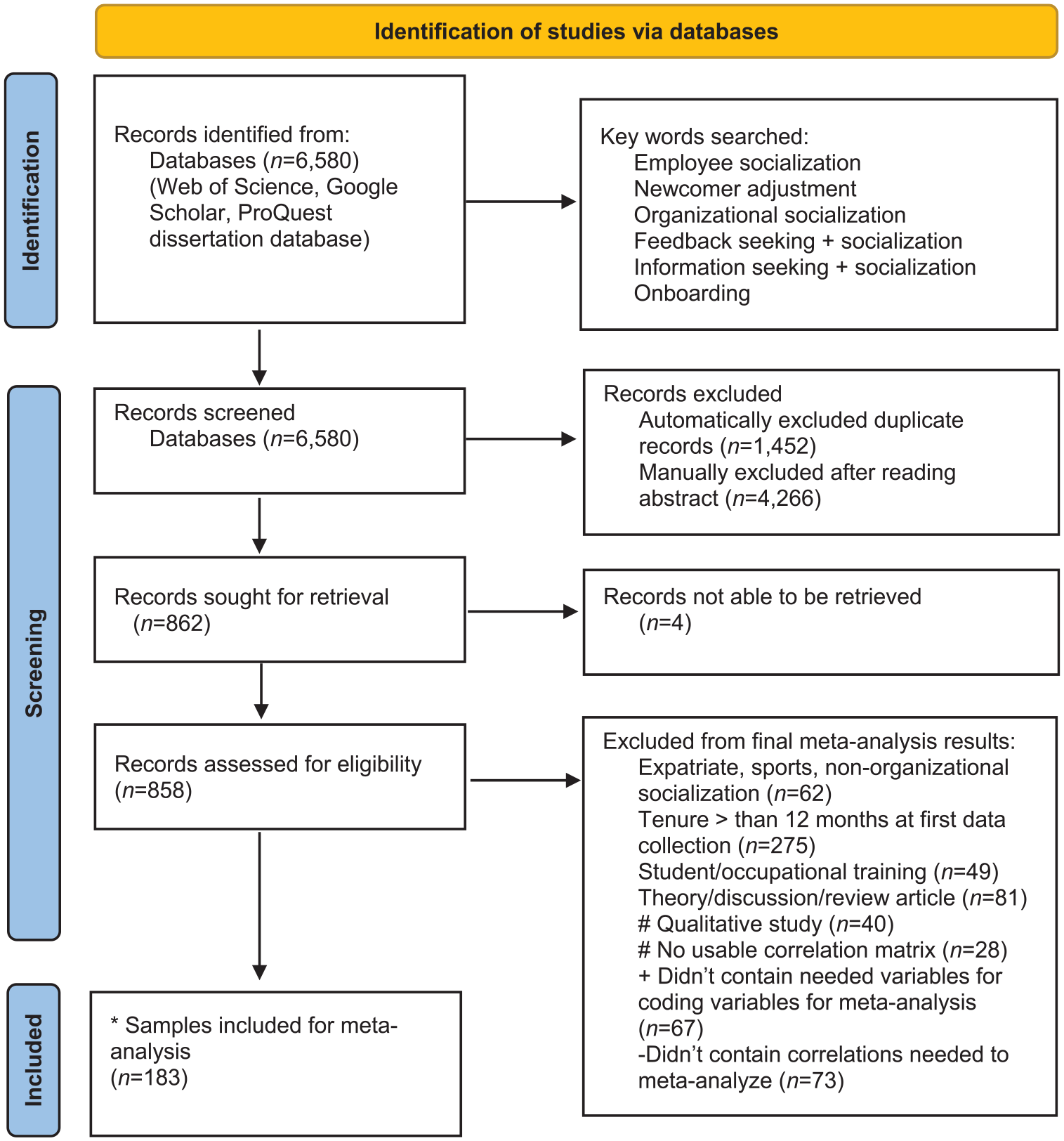
Literature Review and Study Identification
Analytic Methods
We conducted the current meta-analysis using effect sizes in the correlation matrix for each available sample. For our meta-analytic approach, we used random-effects models (Hedges & Olkin, 1985) to analyze the effect size distributions provided there were three or more correlations available; fixed-effect models were used when only two correlations were available. We Fisher-transformed all correlations prior to analyses, testing effect size centrality and heterogeneity. Our presented results are back-transformed into the Pearson correlation metric. In interpreting our correlational findings, we followed Bosco, Aguinis, Singh, Field, and Pierce (2015) in defining small effect sizes as those at or under .09, medium effect sizes as those at or under .26, and large effect sizes above .26. To capture the sensitivity of our results to publication bias, we report Orwin’s (1983) fail-safe k, which indicates the number of studies with an average correlation of zero needed to bring the obtained mean correlation to less than a criterion level using this definition of a small effect.
First, we present the overall meta-analytic weighted average correlations for all variables included in our summary model, including antecedents to proximal adjustment indicators and proximal and distal outcomes. 3 Second, to assess a potentially important boundary condition, we used the Rockstuhl et al. (2020) typology (based on Hofstede’s 2001 country-level scores) to code for whether the study took place in a horizontal-individualistic (HI; e.g., Australia, US) or in a vertical-collectivistic (VC; e.g., China, Greece) culture. Third, we created a path model to examine constructs that have been robustly studied (i.e., k’s of 10 or more) in a multivariate analysis. Sample information from each study was gathered from the method section.
Sample characteristics
The average age of newcomers in the reported samples was 28.42 years (SD = 4.84). Averages were taken at the sample level and were not weighted by sample size. Samples reported that 53% of participants identified as male. Samples tended to be highly educated, with a majority including those with an undergraduate or graduate degree as their highest obtained education level. A total of 40% of studies included multisource data from newcomers and other sources. For occupation and industries, 18% of studies included a variety of jobs within one study, and 40% were located in business settings, including finance, banking, and human resources. A total of 12% studied engineering/IT/high-tech workers. Manufacturing/blue collar jobs, the hospitality industry, and jobs in the healthcare industry each represented 7% of studies reviewed. Few studies of interns (4%), police (2%), and educators (2%) were conducted.
Historically, a substantial gap in the newcomer literature was a focus on North American samples to the exclusion of other populations. In the most recent research, we found there has been a shift toward more geographic diversity in terms of sampling. For example, while many samples studied still came from North America (39%), a growing percentage of samples came from Asia (36%) and Europe (21%). To date, only a small fraction of samples are from Australia/Oceania (1%) or South America (1%). A total of 33 countries were represented in samples in our review. And, in our HI-VC coding, we classified 60% of the studies into HI and 40% into VC categories.
Meta-Analytic Results
Meta-Analytic Correlations
We start by providing a quantitative summary of how the socialization variables were related, presenting the weighted average correlation coefficients of the relationships between antecedents and proximal outcomes (Tables 1a–d) and between proximal outcomes and distal outcomes (Table 2). Next, we discuss findings from our meta-analytic path model. We then discuss moderation results.
Meta-Analytic Results for Antecedents of Social Acceptance
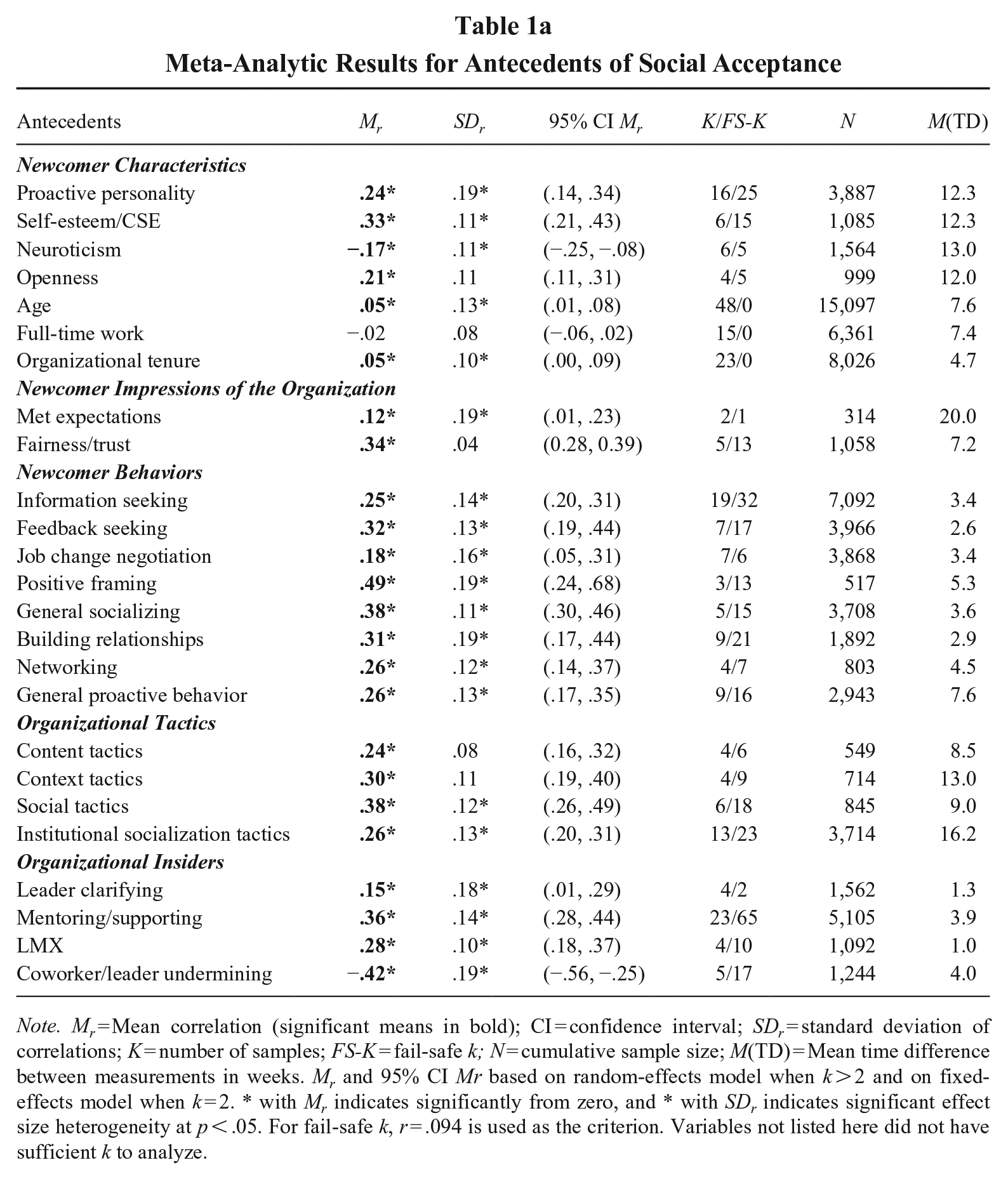
Note. Mr = Mean correlation (significant means in bold); CI = confidence interval; SDr = standard deviation of correlations; K = number of samples; FS-K = fail-safe k; N = cumulative sample size; M(TD) = Mean time difference between measurements in weeks. Mr and 95% CI Mr based on random-effects model when k > 2 and on fixed-effects model when k = 2. * with Mr indicates significantly from zero, and * with SDr indicates significant effect size heterogeneity at p < .05. For fail-safe k, r = .094 is used as the criterion. Variables not listed here did not have sufficient k to analyze.
Meta-Analytic Results for Antecedents of Role Clarity
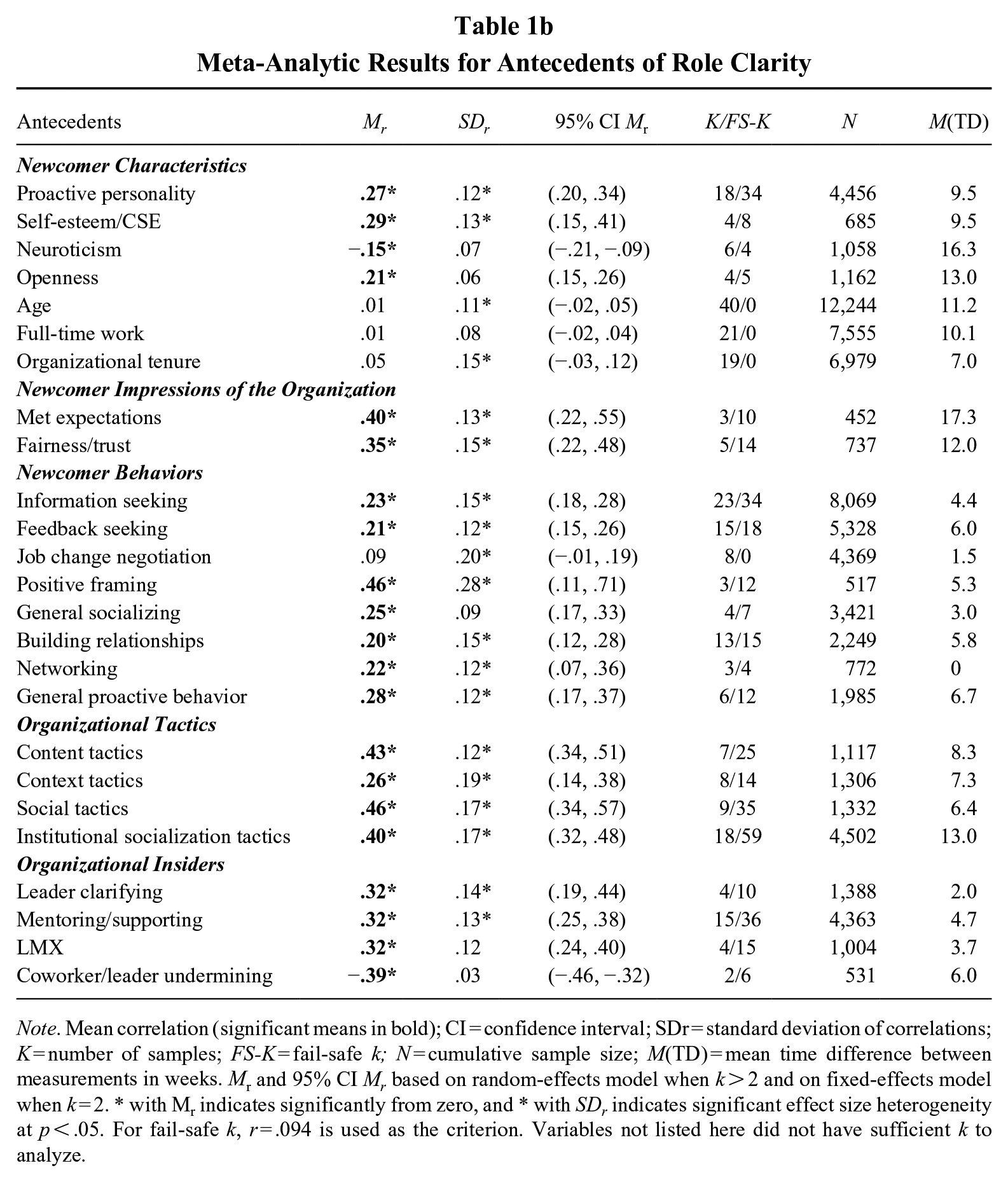
Note. Mean correlation (significant means in bold); CI = confidence interval; SDr = standard deviation of correlations; K = number of samples; FS-K = fail-safe k; N = cumulative sample size; M(TD) = mean time difference between measurements in weeks. Mr and 95% CI Mr based on random-effects model when k > 2 and on fixed-effects model when k = 2. * with Mr indicates significantly from zero, and * with SDr indicates significant effect size heterogeneity at p < .05. For fail-safe k, r = .094 is used as the criterion. Variables not listed here did not have sufficient k to analyze.
Meta-Analytic Results for Antecedents of Task Mastery
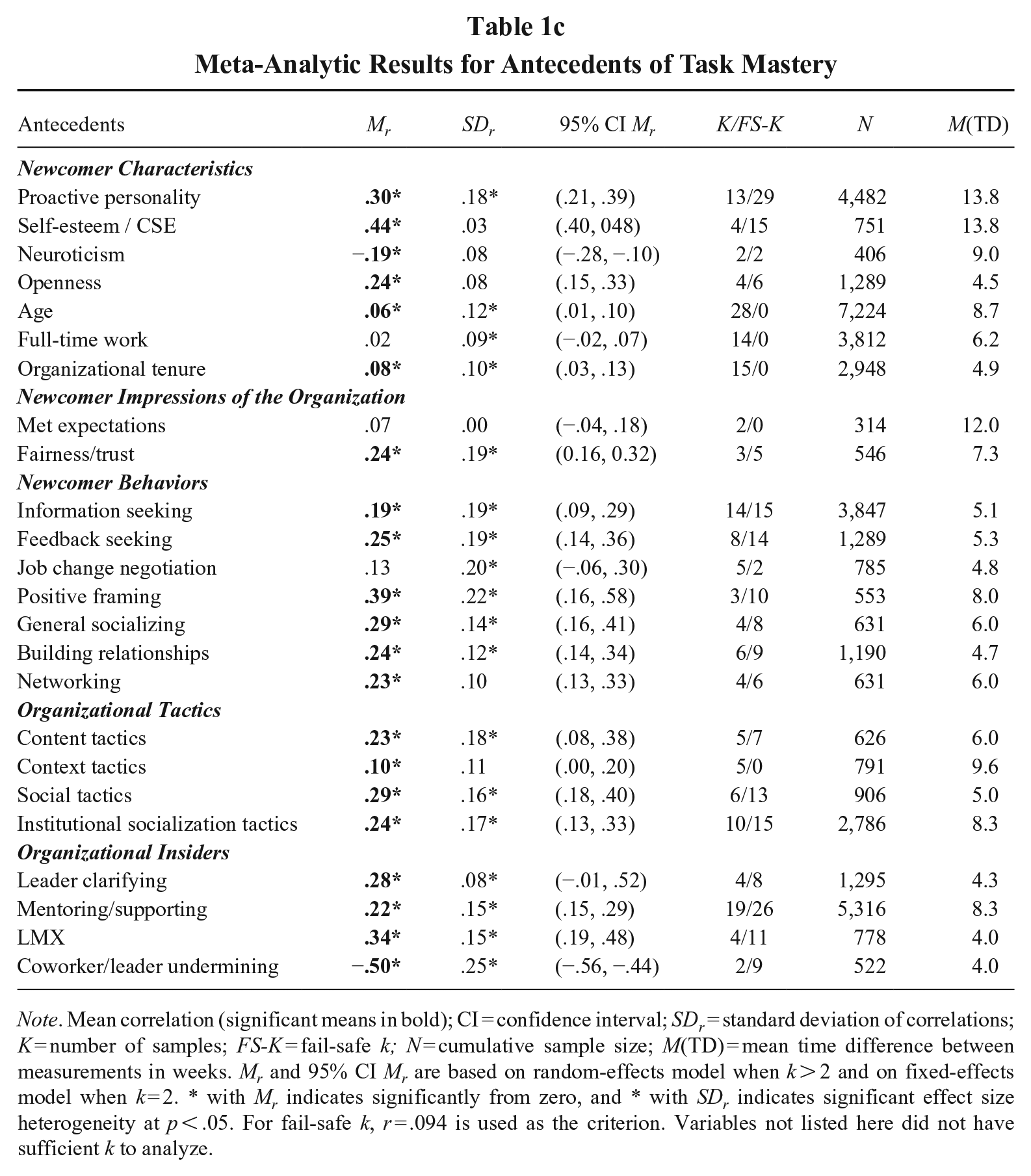
Note. Mean correlation (significant means in bold); CI = confidence interval; SDr = standard deviation of correlations; K = number of samples; FS-K = fail-safe k; N = cumulative sample size; M(TD) = mean time difference between measurements in weeks. Mr and 95% CI Mr are based on random-effects model when k > 2 and on fixed-effects model when k = 2. * with Mr indicates significantly from zero, and * with SDr indicates significant effect size heterogeneity at p < .05. For fail-safe k, r = .094 is used as the criterion. Variables not listed here did not have sufficient k to analyze.
Meta-Analytic Results for Antecedents of Perceived Fit
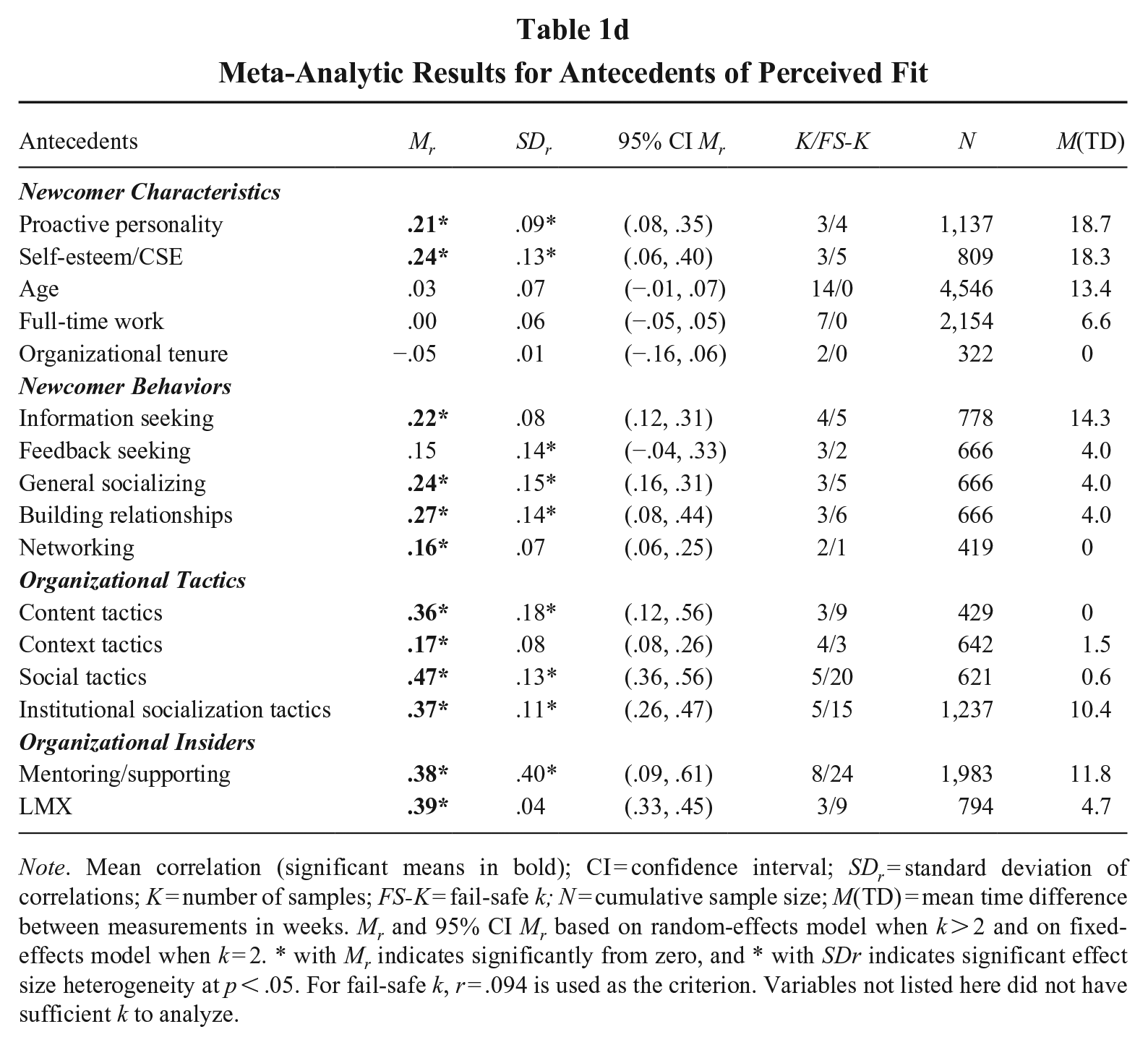
Note. Mean correlation (significant means in bold); CI = confidence interval; SDr = standard deviation of correlations; K = number of samples; FS-K = fail-safe k; N = cumulative sample size; M(TD) = mean time difference between measurements in weeks. Mr and 95% CI Mr based on random-effects model when k > 2 and on fixed-effects model when k = 2. * with Mr indicates significantly from zero, and * with SDr indicates significant effect size heterogeneity at p < .05. For fail-safe k, r = .094 is used as the criterion. Variables not listed here did not have sufficient k to analyze.
Meta-Analytic Results for Proximal Outcomes to Distal Outcomes
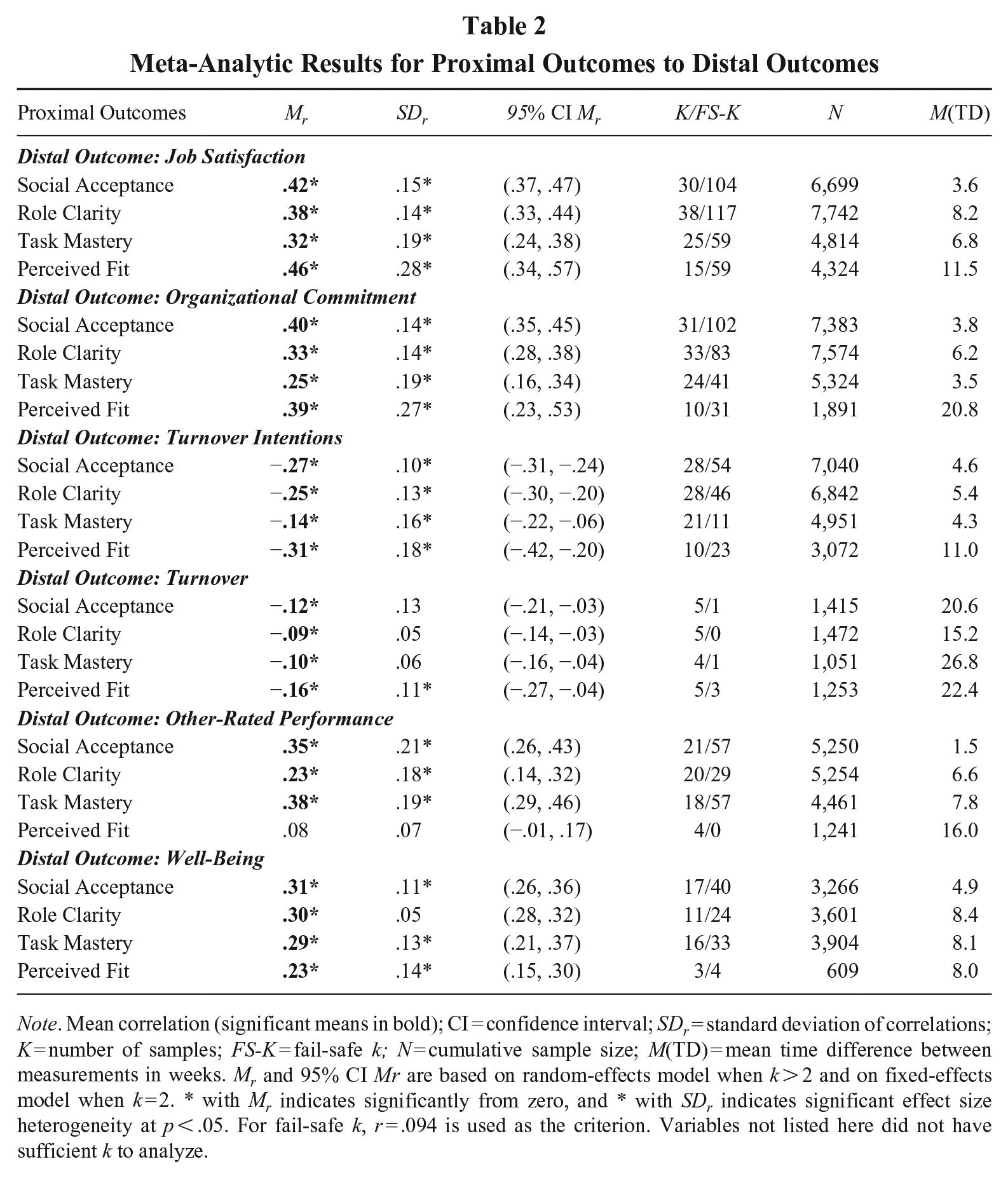
Note. Mean correlation (significant means in bold); CI = confidence interval; SDr = standard deviation of correlations; K = number of samples; FS-K = fail-safe k; N = cumulative sample size; M(TD) = mean time difference between measurements in weeks. Mr and 95% CI Mr are based on random-effects model when k > 2 and on fixed-effects model when k = 2. * with Mr indicates significantly from zero, and * with SDr indicates significant effect size heterogeneity at p < .05. For fail-safe k, r = .094 is used as the criterion. Variables not listed here did not have sufficient k to analyze.
Newcomer Characteristics and Proximal Adjustment Outcomes
Newcomers bring with them a host of individual attributes, many of which play a role in the socialization process. In line with our summary model (Figure 1), we identified four categories of newcomer antecedents: newcomer personality, newcomer demographics, newcomer impressions of the organization, and newcomer behaviors, resulting in a total of 17 newcomer-focused antecedents. We linked each antecedent to the four proximal outcomes when there were sufficient studies to do so.
Newcomer personality
The study of personality has added a deeper understanding of how the socialization process unfolds. We examined proactive personality, self-esteem/core self-evaluations (CSE), neuroticism, and openness. Proactive personality has received the most research attention, and it was positively related to all four proximal outcomes, rs = .21 to .30. CSE was positively related to the proximal outcomes, rs = .24 to .44. Similarly, openness was positively related to social acceptance, role clarity, and task mastery, rs = .21 to .24, but there were insufficient studies to examine its relationship with fit. Conversely, neuroticism was negatively related to social acceptance, role clarity, and task mastery, rs = −.15 to −.19, but there were insufficient studies to examine fit.
Taken together, these results indicate three new findings. First, personality was not included in earlier socialization models (e.g., Bauer et al., 2007), but consistent with an interactionist perspective and resource-based theories, we found strong evidence for personality’s relevance to socialization. Second, even though the literature typically focuses on proactive personality in socialization, CSE may actually be more important. And third, our analysis uncovered a gap in that more research is needed linking personality to fit.
Newcomer demographics
Demographics are often used as control variables in the literature but could be influential in the socialization process. We found that age, full-time work experience, and organizational tenure had nonsignificant or modest relationships with proximal outcomes. Although demographics were not considered in prior socialization models (e.g., Bauer et al., 2007), their omission appears reasonable. Despite this pattern, it is important to recognize that only a limited set of demographics were evaluated, and we were unable to capture issues such as newcomer and work group diversity or similarity, which may play a role in socialization.
Newcomer impressions of the organization
We conceptualized newcomer impressions as whether the newcomer’s expectations were met and promises kept, calling this met expectations, and the extent to which a newcomer perceives the organization as fair and trusts the organization, calling this trust/fairness. For met expectations, there was a significant and large effect size with role clarity (r = .40), a small effect on social acceptance (r = .12), and no relationship with task mastery. Fairness/trust positively related to social acceptance, role clarity, and task mastery, rs = .24 to .35. These are new findings regarding the role of met expectations and trust/fairness in socialization indicators and were not included in Bauer et al.’s (2007) meta-analysis. We posit that early perceptions of trust and fairness may serve as cues to newcomers about resource availability, allowing them to feel more comfortable and confident. In particular, newcomer perceptions aligned with establishing role clarity and social acceptance but less so with task mastery. Notably, a limited number of studies investigated how newcomer impressions relate to proximal socialization outcomes (k = 5 maximum), and no studies examined how newcomer perceptions related to fit.
Newcomer behaviors
We focused on eight aspects of newcomer behaviors. Information seeking was related to all four proximal outcomes, rs = .19 to .25. Feedback seeking was related to social acceptance, role clarity, and task mastery, rs = .21 to .32 but not related to fit. Job change negotiation was positively related to social acceptance (r = .18) and not related to task mastery or role clarity; there were insufficient studies to analyze its relation with fit. Positive framing showed strong consistent relationships with social acceptance, role clarity, and task mastery, rs = .39 to .49, but there were insufficient studies linking it to fit. General socializing behaviors (rs = .24 to .38), building relationships (rs = .20 to .31), and networking (rs = .16 to .26) were positively related to all proximal outcomes. Although it was not linked to task mastery or fit in enough studies, general proactive behavior had a positive relationship with social acceptance (r = .26) and role clarity (r = .28). This examination of eight newcomer behaviors (as opposed to one in Bauer et al.) and their demonstrated effects on several of the proximal outcomes is an important and promising new finding, with implications for future research. Further, in Bauer et al. (2007) only information seeking was included as a newcomer behavior, and the relation between information seeking and fit was not evaluated. Descriptively, the current findings indicate larger effects for information seeking on social acceptance (Bauer et al., 2007: r = .16 vs. current: r = .25), role clarity (Bauer et al., 2007: r = .17 vs. current: r = .23), and task mastery (Bauer et al., 2007: r = .14 vs. current: r = .19). Further, our findings uncovered the role of proactive behaviors (such as feedback seeking, positive framing, and general socializing). These were not included in past comprehensive reviews, and their potential effects on proximal socialization rival or exceed the role played by information seeking.
Since the last major review, research has cemented the importance of a range of newcomer proactive behaviors on the socialization process. Studies are beginning to examine the role of fit as an adjustment variable, with feedback seeking, general socializing, building relationships, and networking appearing to explain fit. This trend aligns with the interactionist perspective of employees playing an active role in shaping their socialization experience.
Organizational Variables and Proximal Adjustment
Organizational socialization tactics
Results for socialization tactics are reported using a unidimensional approach and a three-dimensional approach. The unidimensional approach aggregates all tactics onto one dimension (institutional socialization tactics). The three-dimensional approach includes tactics categorized by content tactics, context tactics, and social tactics. 4
Using the unidimensional approach, all correlations with proximal adjustment indicators were significant and medium to large in magnitude (rs = .24 to .40). When using a three-dimensional approach, social tactics had the largest correlations with all indicators (rs = .29 to .47). Content tactics had the second-largest correlations in most cases, ranging from r = .43 for role clarity to r = .23 for task mastery. Finally, context tactics had the weakest correlations, its largest with social acceptance (r = .30), and smallest with task mastery (r = .10).
In short, consistent with prior reviews (e.g., Bauer et al., 2007; Saks et al., 2007), socialization tactics play an important role in the socialization process. In addition, by taking a three-dimensional approach to tactics, the present study provides greater clarity around how different types of socialization tactics related to the proximal adjustment indicators with there being substantial differences (e.g., r = .10 for context to task mastery and r = .29 for social tactics to task mastery). The current study found social tactics play an important role in developing higher levels of proximal adjustment indicators. Notably, correlations tended to be large, particularly for role clarity and fit.
Organizational insiders: Clarifying, supporting, and undermining
Although there were insufficient studies to examine the relationship between leader clarifying and fit, we found that leader clarifying was related to social acceptance, role clarity, and task mastery, rs = .15 to .32. Our review uncovered a number of studies examining mentoring and supportive behavior by organizational insiders. Specifically, our results showed medium to large relationships with the four proximal outcomes, rs = .22 to .38. Conversely, our findings for undermining by organizational insiders included fewer studies, but we found large, significant negative relationships with social acceptance, role clarity, and task mastery, rs = −.39 to −.50, and no studies including undermining and fit. Although this area of research is still emerging, studies examining LMX and the proximal outcomes revealed consistently large effect sizes, rs = .28 to .39.
Like most antecedents in our model, the role of insiders was not considered in prior reviews (e.g., Bauer et al., 2007). Our updated meta-analysis demonstrated that behaviors by organizational insiders play a large role in the specific proximal indicators of fit and social acceptance. Scholarly interest in the role of insiders clearly has grown to include the development of relationships between newcomers and insiders consistent with a focus on the building of resources and social capital. However, more studies are needed on the role of negative insider behaviors (e.g., undermining), as the limited studies available did show very large effects (e.g., r = −.39 to −.50). Taken together, it is clear that organizational insiders, and especially leaders, are important to the socialization process.
Newcomer Proximal Adjustment to Distal Outcomes
In line with our updated summary model (Figure 1), we report on the proximal adjustment indicators as they relate to distal socialization outcomes consisting of newcomer job attitudes, behaviors, and well-being (see Table 2).
Social acceptance
Social acceptance had large effects on job satisfaction (r = .42) and organizational commitment (r = .40). These were robust findings with failsafe k over 100 in both cases. Social acceptance was strongly related to performance (r = .35) and negatively related to turnover intentions (r = −.27) and turnover (r = −.12). Social acceptance had a strong relationship with well-being (r = .31). Descriptively comparing our results to those of Bauer et al., the largest differences were that social acceptance had stronger relations with job satisfaction (current: r = .42 vs. Bauer et al.: r = .33) and performance (current: r = .35 vs. Bauer et al.: r = .21), with other relations being more similar. Social acceptance was also related to well-being, which was not evaluated by Bauer et al. (2007). Overall, our updated meta-analysis shows that of the proximal socialization indicators, social acceptance has consistent and relatively large effects on distal outcomes. This new finding demonstrates the importance of helping employees become embedded into the social fabric of the organization, and it appears to be the cornerstone for developing many distal outcomes.
Role clarity
Role clarity was positively related to job satisfaction (r = .38) and organizational commitment (r = .33), both demonstrating large effects, and to performance (r = .23) at a medium level. Role clarity was negatively related to turnover intentions with a medium effect (r = −.25) and actual turnover with a small effect (r = −.09). Finally, the relationship between role clarity and well-being was positive and large (r = .30). In comparison with Bauer et al. (2007), most direct effects of role clarity were fairly similar. However, we now link role clarity with well-being. In short, role clarity (or its negative counterpart, role ambiguity) was related to a number of important outcomes. Additionally, role clarity as it related to distal outcomes has received a reasonably large degree of attention with several specific relationships having over 30 samples included in this analysis.
Task mastery
Task mastery was found to have medium to large effects for the most frequently studied distal outcomes of job satisfaction (r = .32) and organizational commitment (r = .25). Task mastery was related to performance with a large effect (r = .38), and medium effects on turnover intentions (r = −.14) and actual turnover (r = −.10). Task mastery was also found to have a large effect with newcomer well-being (r = .29). In comparison to Bauer et al. (2007), the magnitude of the effects of task mastery are similar. However, we have now added well-being as an outcome and increased the robustness of each estimate by having more studies on each relationship. Conceptually, task mastery is the most performance-oriented proximal adjustment indicator, and we see that conceptual link come to light in our results. For instance, task mastery had a strong relationship with performance. However, it was less strongly related to attitudinal variables compared to social acceptance and role clarity, pointing to the importance of considering specific proximal adjustment pathways through which distal socialization outcomes occur.
Perceived fit
Since the last comprehensive review (Bauer et al., 2007), perceived fit has emerged as a key proximal socialization indicator with robust effects. For example, the relationships between fit and job satisfaction (r = .46) and fit and organizational commitment (r = .39) were significant and large. There was a large negative relationship with turnover intentions (r = −.31) and a medium effect (r = −.16) with actual turnover. For fit and performance, the effect was not significant, although some individual studies (Wang Zhan, McCune, & Truxillo, 2011) have found such a relationship. Finally, there was a medium effect for fit and well-being (r = .23). Our addition of fit in this meta-analysis highlights its importance as an outcome. In fact, fit had larger correlations with job attitudes and turnover compared to other proximal adjustment indicators. In short, the paucity of research on fit and distal socialization outcomes is a gap, given its consistent associations with a range of outcomes uncovered in this meta-analysis. Fortunately, the role of fit appears to be a growing area of research.
Culture Moderation Results: Antecedents to Proximal Outcomes
As a follow-up to our previous analyses, we were interested in the role of culture as a boundary condition to the relationships examined. We evaluated culture as a moderator of the relation between 25 antecedents and 4 adjustment indicators, leading to 100 possible relationships. However, we were unable to test 29 of these because all the studies were in the same group (all HI or all VC), or no studies existed reporting a relationship. Of the 71 relations tested, 12 showed significant cultural effects. 5 The results indicate that in HI countries, mentoring was more strongly related to role clarity than in VC countries (HI: r = .38 vs. VC: r = .17). Similarly, neuroticism (HI: r = −.27 vs. VC: r = −.12), context tactics (HI: r = .35 vs. VC: r = .13), and leader-clarifying behaviors (HI: r = .26 vs. VC: r = .03) had stronger relations with social acceptance in HI countries compared to VC countries. In contrast, in VC countries, job change negotiation (VC: r = .38 vs. HI: r = .08) was more strongly related to social acceptance than in HI countries. Similarly, information seeking (VC: r = .32 vs. HI: r = .18), positive framing (VC: r = .60 vs. HI: r = .13), general socializing (VC: r = .39 vs. HI: r = .21), and networking (VC: r = .34 vs. HI: r = .14) were more strongly related to role clarity in HI versus VC countries. Fairness/trust (VC: r = .47 vs. HI: r = .11) and information seeking (VC: r = .28 vs. HI: r = .06) were more strongly related to task mastery in VC countries. Finally, age (VC: r = .07 vs. HI: r = −.01) was more strongly related to perceived fit in VC countries.
These results suggest that in more individualistic HI cultures, organizational factors, such as structured approaches to socialization and organizational support, are more influential. In more collectivistic, VC cultures, newcomer information seeking and other proactive behaviors seem to make a bigger difference. However, there were a number of relationships that we were unable to test because they were studied in only one culture.
Culture Moderation Results: Proximal to Distal Outcomes
Of the 24 relations tested between proximal and distal outcomes (4 proximal indicators × 6 outcomes), culture was a significant moderator in 5 (21%). In each case, VC cultures showed a larger correlation compared to HI cultures. These relations were social acceptance to organizational commitment (VC: r = .52 vs. HI: r = .36), role clarity to performance (VC: r = .30 vs. HI: r = .13), task mastery to organizational commitment (VC: r = .39 vs. HI: r = .21) and performance (VC: r = .46 vs. HI: r = .21), and perceived fit to well-being (VC: r = .37 vs. HI: r = .12).
In summary, in the collectivistic and highly power-distant societies of Eastern cultures, feeling like an insider and having a sense of clarity were more strongly related to job attitudes and performance. These had weaker relations in the individualistic and egalitarian Western cultures. Notably, some of these differences were quite large in magnitude between the two groups, which speaks to the importance of cultural context in the socialization process, an issue that was not analyzed in prior meta-analytic efforts (e.g., Bauer et al., 2007).
Meta-Analytic Path-Model: Direct Effects
Because socialization is a complex process unfolding among multiple variables, we analyzed the relationships among socialization variables via a meta-analytic path model. This allowed us to examine the effect of individual antecedents on the proximal outcomes when simultaneously considering the effect of other antecedents, as well as the effect of each proximal outcome on the distal outcomes after accounting for the effect of other proximal outcomes. It also allowed us to examine which variables mediate the relationships between antecedents and outcomes.
In the sections that follow, we present the results of our path model, which depict a streamlined version of our updated conceptual model. Our path model contains 7 antecedents, 3 proximal adjustment indicators, and 5 distal outcomes representing the most frequently examined variables (i.e., those consistently based on 10 or more studies) because these are the most robust estimates, and path modeling requires sufficient observations among all included constructs. Table 3 summarizes the direct effect parameter estimates in our meta-analytic path model (see Figure 3).
Direct Effect Parameter Estimates in Meta-Analytic Path Model
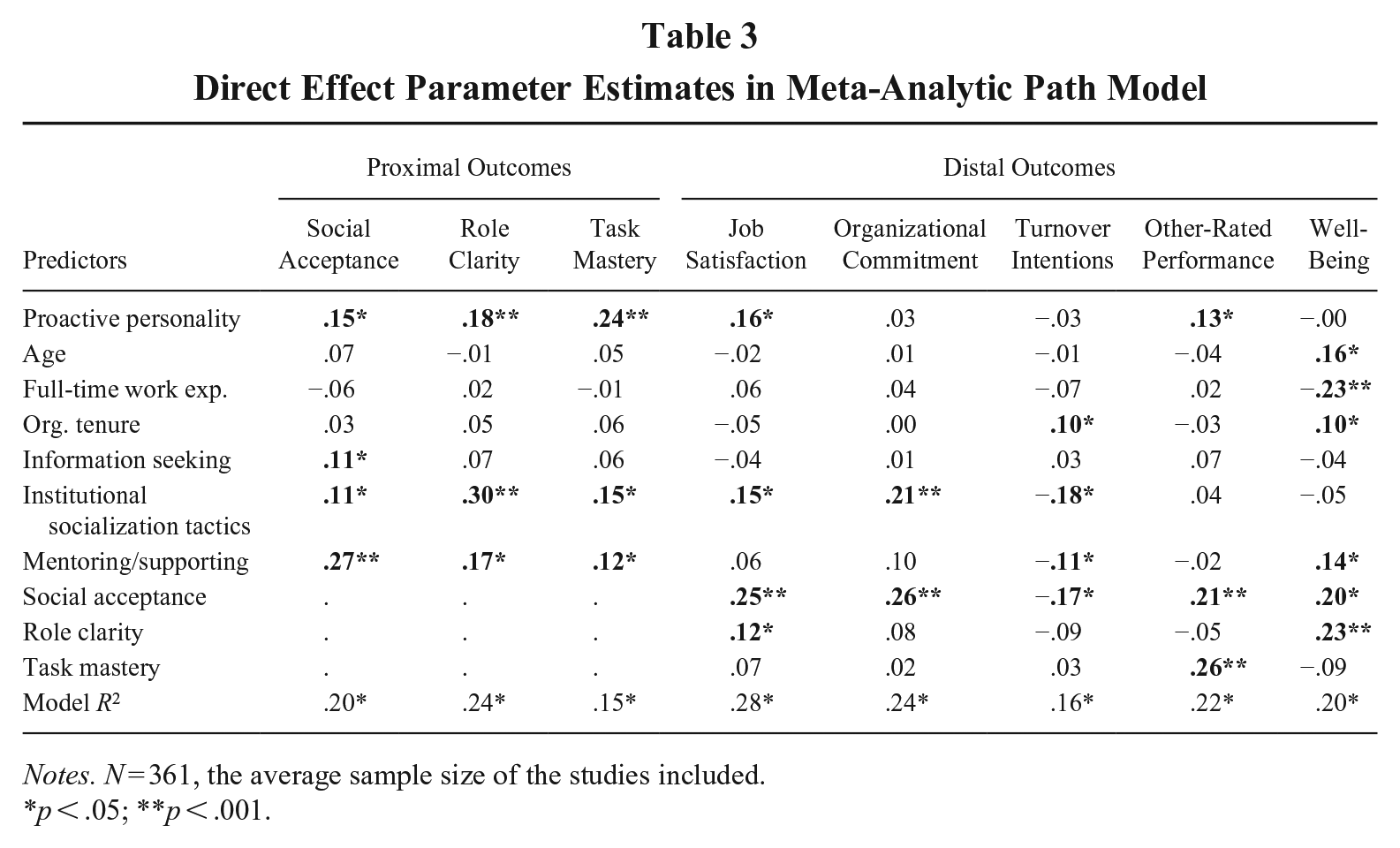
Notes. N = 361, the average sample size of the studies included.
p < .05; **p < .001.
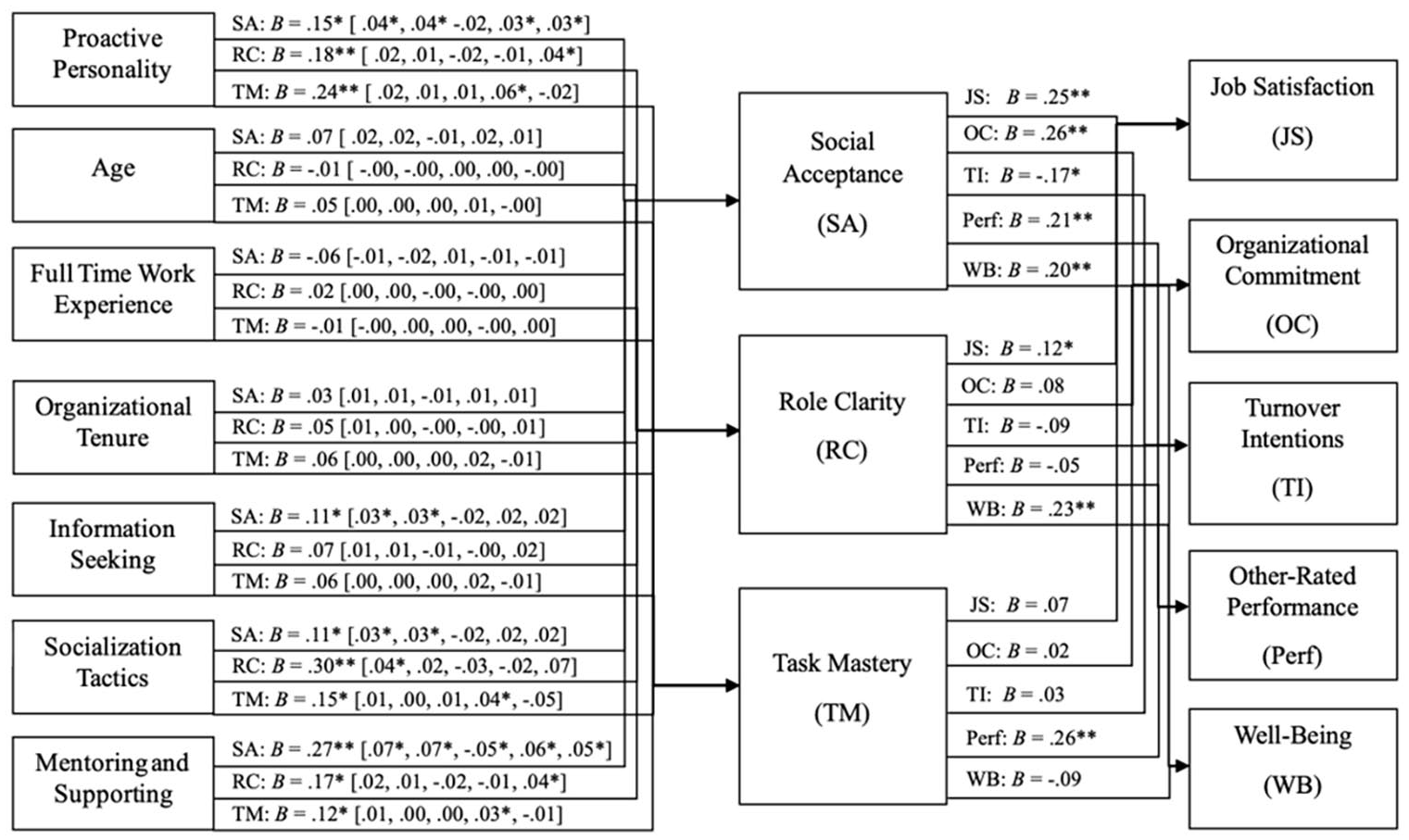
Results of Path Model
Antecedents to proximal outcomes
Examining the standardized estimates associated with our path model, proactive personality, socialization tactics, and mentoring/supporting were consistently and significantly related to newcomer social acceptance, role clarity, and task mastery. Specifically, proactive personality (Bs = .15 to .24), organizational socialization tactics (Bs = .11 to .30), and mentoring/supporting (Bs = .12 to .27) were related to the three proximal outcomes. In addition, information seeking was significantly related to newcomer feelings of social acceptance (B = .11).
In the present meta-analysis, we considered seven socialization antecedents versus two in Bauer et al. (2007), utilizing the same three proximal outcomes. Several notable differences were found. Only proactive personality, socialization tactics, and mentoring/supporting related to all three proximal outcomes. Of those, only socialization tactics were included in Bauer et al. (2007); thus, our model represents substantial changes particularly in understanding the antecedents to effective socialization. Specifically, proactive personality had the strongest association with task mastery, whereas mentoring/supporting was the most strongly related to social acceptance. Socialization tactics were most strongly related to role clarity. Notably, the effect of socialization tactics on task mastery appeared muted in our results compared to those from Bauer et al., likely due to the effects of proactive personality and mentoring/supporting on task mastery. Information seeking, which was related to social acceptance and role clarity in Bauer et al., was only related to social acceptance in our results. The demographic variables of age, full-time work experience, and organizational tenure were not related to the proximal outcomes after accounting for other, more robust covariates.
Proximal outcomes to distal outcomes
The proximal outcome most consistently related to distal outcomes was social acceptance, which was related to all five distal outcomes of job satisfaction (B = .25), organizational commitment (B = .26), turnover intentions (B = −.17), performance (B = .21), and well-being (B = .20). Role clarity was significantly related to job satisfaction and newcomer well-being (B = .12 and B = .23, respectively). Task mastery was significantly related to job performance (B = .26), but no other distal outcomes. Comparing our findings with those from Bauer et al. (2007), we found two notable differences. First, Bauer et al. did not include well-being as an outcome. We found that well-being has come into play as an important indicator of effective socialization, receiving a fair amount of research attention and being significantly related to both social acceptance and role clarity. Second, social acceptance was the only proximal indicator that was related to more than two distal outcomes. In fact, social acceptance was related to all five distal outcomes, often with relatively strong effects. Again, this highlights the importance of ensuring newcomers feel accepted into the social fabric of the organization.
Meta-Analytic Path-Model: Indirect Effects of Antecedents on Distal Outcomes
In addition to the direct effects, the indirect effects were evaluated (see Table 4 and Figure 3). On the individual side, proactive personality had indirect effects on job satisfaction, organizational commitment, performance, and well-being through the mechanism of social acceptance. Additionally, proactive personality had indirect effects on performance through task mastery and on well-being through role clarity. Information seeking also had significant indirect effects on job satisfaction and organizational commitment through social acceptance.
Indirect Effect Parameter Estimates in Meta-Analytic Path Model
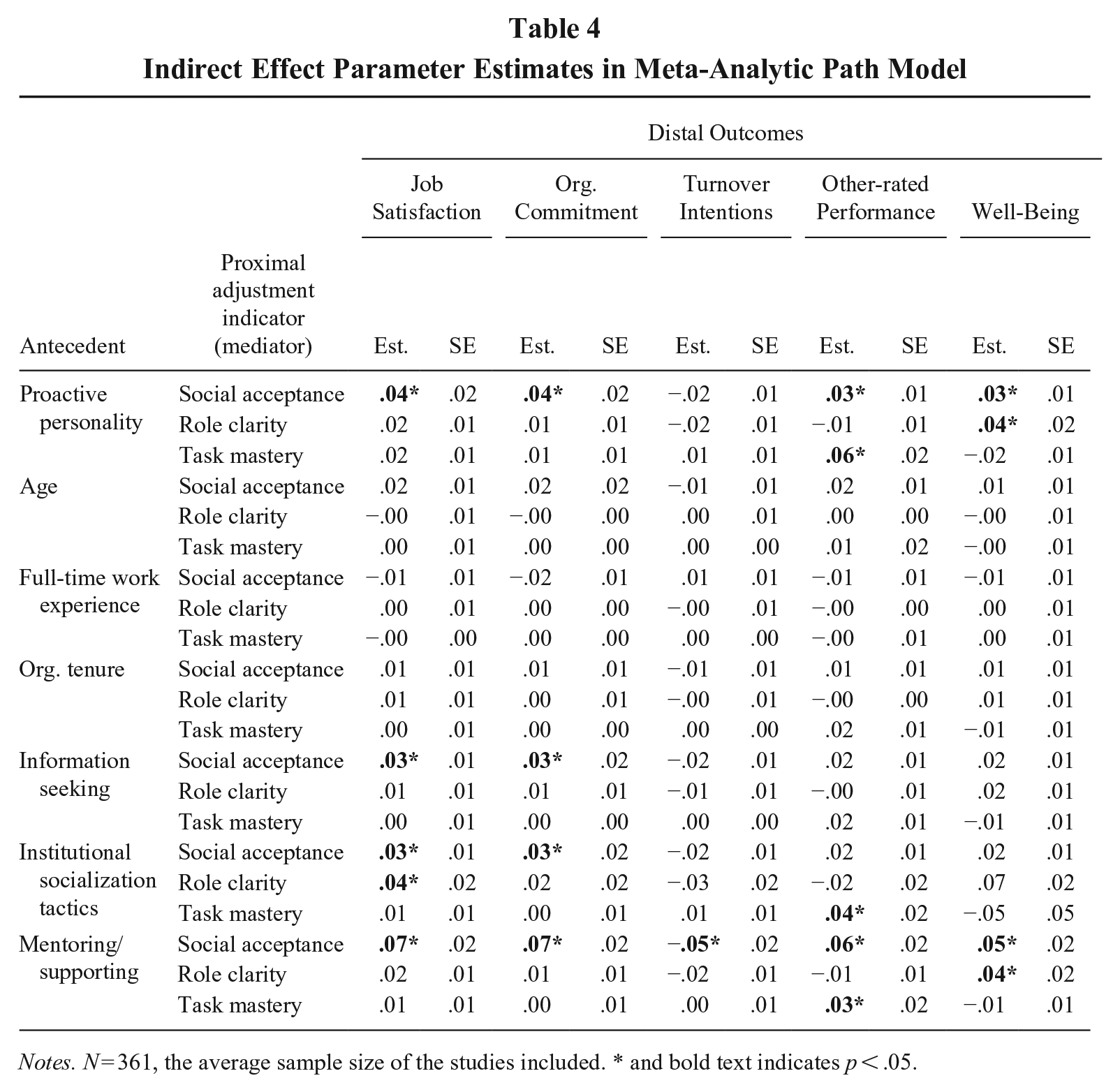
Notes. N = 361, the average sample size of the studies included. * and bold text indicates p < .05.
On the organization side, socialization tactics had significant indirect effects on job satisfaction and organizational commitment through social acceptance, on job satisfaction through role clarity, and on performance through task mastery. Mentoring/supporting had indirect effects on job satisfaction, organizational commitment, turnover intentions, performance, and well-being. Notably, all operated through social acceptance. Mentoring/supporting also had an indirect effect on performance through task mastery and an indirect effect on well-being through role clarity.
Taken together, multiple newcomer antecedents, including proactive personality as well as organizational factors including socialization tactics and mentorship, had significant indirect effects on a range of outcomes. The proximal adjustment indicator of social acceptance was clearly the most consistent mechanism through which indirect effects occur. However, task mastery does appear to be an important mechanism through which indirect effects occur on performance.
Discussion of Meta-Analytic Results
In summary, our review suggests that the organizational socialization literature has evolved in terms of both quantity and quality since the most recent comprehensive review (Bauer et al., 2007). Our comprehensive review provides greater understanding regarding which antecedents are related to newcomer adjustment and the relationships between adjustment and newcomer socialization success. Although some of the findings observed in earlier reviews were confirmed, many new relationships and constructs were examined. We briefly summarize these here.
Newcomers play a critical role in the organizational socialization process, and research has increasingly identified newcomer characteristics and behaviors contributing to newcomer success. Although Bauer et al. (2007) considered only one newcomer behavior as an antecedent, we found robust evidence for the importance of a range of newcomer characteristics and behaviors. We found emerging evidence for the role of newcomer personality in the socialization process, with newcomer proactivity being particularly important. We also found growing interest in perceptions of fairness among newcomers and continued interest in the role of newcomer proactive behaviors. We see these as important additions to understanding effective socialization and opportunities for future inquiry.
Research shows that the roles of organizational tactics and insiders in the socialization process are important. Tactics ranged from institutionalized approaches, where newcomers go through a series of common learning experiences, to individualized approaches where newcomers go through informal and sporadic learning experiences (Chong, Beenen, Gagné, & Dunlop, 2021; Peltokorpi et al., 2022). These studies suggest that institutionalized approaches to socializing newcomers are associated with more favorable proximal and distal outcomes such as role clarity, and these effects seem to be driven by the amount of social support available to employees. Our review points especially to the role of the social context, highlighting the importance of both formal structures that provide social connection and support, as well as informal supports offered by organizational insiders. However, there remains much to learn about the role of organizational insiders, when and why they give or withhold support, and how their support is solicited and utilized in the socialization process.
What Matters Most for Newcomer Organizational Socialization?
Based on our path model, it is clear that proactive personality, organizational socialization tactics, and insider mentoring/supporting all mattered for the adjustment indicators. They were related to feelings of social acceptance, having a sense of clarity in one’s role, and feeling confident in one’s ability to do their job. Conversely, information seeking appeared to be related only to social acceptance but not role clarity (counter to previous comprehensive reviews; Bauer et al., 2007) or task mastery when examining the relationships in a multivariate model. In this multivariate context, age, work experience, and tenure were unrelated to the adjustment indicators. This stands in contrast to the correlational findings that showed some small but significant relationships.
Our findings showed that proactive personality was related to each category of distal outcomes (job attitudes, behaviors, and well-being), identifying who is most likely to be successful in the onboarding process, but core self-evaluations also had bivariate relationships comparable to and exceeding the effects of proactive personality. Moreover, it suggests that although information seeking, a factor identified as important in previous meta-analyses, is important, proactive individuals engage in a wide range of proactive efforts that seem even more important for newcomer adjustment, including positive framing, general socializing, and feedback seeking. Mentoring/supporting also stands out as arguably the single most important antecedent to successful onboarding, being related to each outcome of interest including performance and well-being, through multiple mechanisms. Its consistent and strong effects should shift the prevailing thinking to consider mentoring/support as a cornerstone of any effective socialization program. Although we were unable to include undermining in our path model, it is worth noting that, at the correlational level, the relationships were quite high. So, while we are unable to make statements regarding its associations in the multivariate model, the role of undermining should be pursued in future research.
Regarding outcomes of the socialization process, the most consistently related proximal adjustment indicator was social acceptance, which was related to all outcomes in the path model. This finding lends credence to the concept of “the people make the place,” indicating the importance of social ties not only for job satisfaction, which is perhaps to be expected, but also for well-being and job performance. Notably, not only is social acceptance consistently the mechanism through which antecedents affected distal outcomes, but the magnitude of effects on distal outcomes is also consistently strong. Although social acceptance was identified as an important mediating mechanism in previous reviews, those reviews pointed to it having a level of importance similar to the other mediating mechanisms. Our updated findings highlight social acceptance as the most important mechanism for successful onboarding, with role clarity playing a more limited role—albeit still an important one for well-being and job attitudes—and task mastery mattering for performance.
Role clarity was only significantly related to job satisfaction and well-being. However, while role clarity and task mastery were related to fewer distal outcomes than social acceptance, the relationships found are still important for successful organizational socialization. As expected, the three proximal adjustment indicators mediated the relationship between socialization antecedents and distal outcomes. This supports the view of proximal adjustment indicators as a key aspect of the organizational socialization process. Thus, we recommend that researchers continue to examine all three indicators. In addition, while not in our final path model due to insufficient samples, perceived fit looks promising given correlational relationships to all outcomes studied except for performance.
We have two takeaways for the nature of the effects of culture on the newcomer socialization process. First, our results indicated that for the majority of the relationships, factors that affected successful adjustment were similar across cultures. This finding is important to consider and offers reassurance that findings are generalizable across cultures. Second, the significant relationships that emerged indicate an interesting pattern: in HI cultures where socialization typically occurs in nonstructured and individualized ways, having a structured approach to socialization and providing support through relationships such as mentoring were more influential for socialization outcomes, relative to VC cultures. This may be because structural and relational support are more widely available in VC cultures and, therefore, are less of a differentiator. In contrast, proactive approaches to socialization—such as information seeking, networking, and positive framing—were more strongly related to outcomes in VC cultures, again potentially indicating that because these behaviors may be less prevalent, they could be more influential in VC cultures. These findings are consistent with Rockstuhl et al.’s (2022) conceptualization of cultural compensation argument, where socialization antecedents providing what is missing in the broader context emerged as more influential. In other words, organizations and individuals can facilitate newcomer socialization by offering or seeking sources of support less typical of that context. With respect to outcomes, the majority of the relations tested suggested that newcomer adjustment was equally beneficial across cultures. Where differences emerged, the results were consistent with the cultural congruence argument, supporting the role of feelings of being an insider in VC cultures where insider/outsider distinctions are greater.
Finally, we note that a common limitation of meta-analysis is that we are only able to examine relationships where sufficient primary research has already been conducted. For this reason, we could not test the moderating effects of different working or employment arrangements. We did, however, see evidence of recent studies examining contemporary topics such as virtual and remote onboarding (Ahuja & Galvin, 2003; Good & Cavanagh, 2017; Woo, Endacott, & Myers, 2023), temporary workers (Dufour, Escribano, & Maoret, 2021; Lapalme, Doucet, Gill, & Simard, 2017; Lo Presti, Costantini, Akkermans, Sartori, & De Rosa, 2023; Manuti, Spinelli, & Giancaspro, 2016; Smith, Matthews, Mills, Hong, & Sim, 2022), and internships (Beenen & Pichler, 2014; Cao, Lee, & Waung, 2023). For example, Woo et al. (2023) found that remote newcomers engage in specific behaviors such as organizing virtual small talks, leveraging digital repositories, and unintentional limit testing. More work is needed on the role of socialization context variables in the socialization process.
New Horizons: Agenda for Future Research
Our review illustrates the significant progress made in our understanding of newcomer socialization. Further advancement is possible by taking a cohesive yet fine-grained look at the socialization process, making connections to other relevant literature. As an organizing framework, we proposed an updated summary model of the socialization process that builds upon Bauer et al.’s (2007) focus on uncertainty reduction theory and reflects the evolution of this field toward theoretical perspectives that explain how newcomers build resources and leverage the new work environment to facilitate adjustment. In doing so, we identified several opportunities to enrich our understanding of the socialization process that extend existing theory and guide future research in a more systematic and coherent way. In the following sections, we elaborate on future research opportunities for theory and research methodology.
Future Research Opportunities for Socialization Theory
We identified several opportunities to enrich our understanding of the socialization process that extend existing theory and guide future research in a more systematic and coherent way. (See Table 5 for a summary of future research suggestions and example research questions.)
Summary of Future Research Suggestions and Example Research Questions
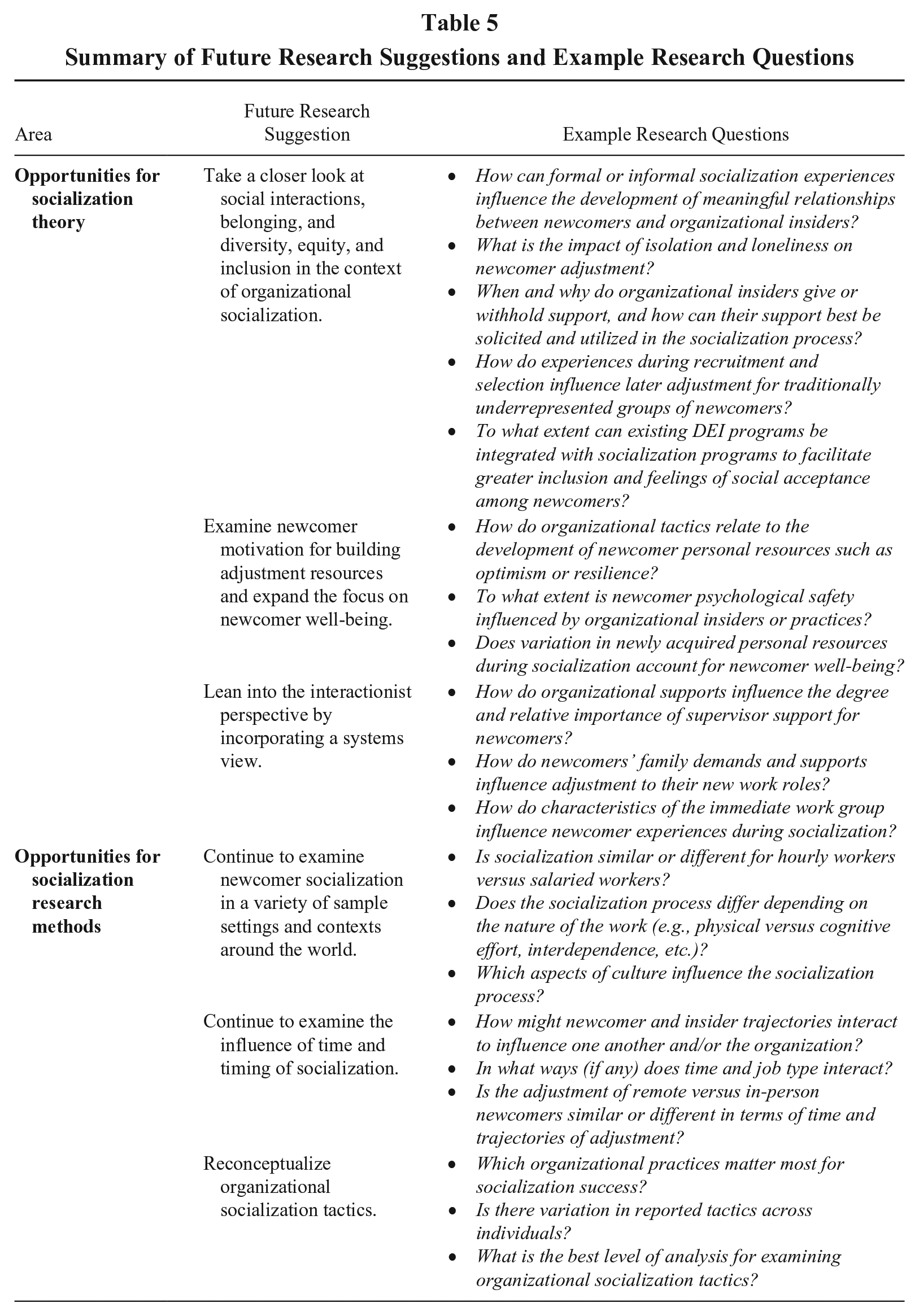
A closer look at social interactions, belonging, and DEI
Perhaps one of the most compelling findings from our review is the importance of organizational insiders in not only providing newcomers with critical information and helping them to make sense of their new environment but in helping newcomers feel socially accepted. As such, we encourage future research that explores how newcomers develop a sense of social acceptance and belonging within their new work context. In examining this literature, we found that theoretical perspectives used to understand and predict socially related experiences of newcomers are varied, ranging from sensemaking, network theory, social cognition theory, and social exchange theory. Harris, Li, Boswell, Zhang, and Xie (2014) found in a sample of newcomers in a shipbuilding company that trust in the leader was related to perceived insider status; Cable, Gino, and Staats (2013) found that newcomers celebrated for what they brought to the organization were more successful than those who were told how great the organization was; and Sluss and Thompson (2012) found that LMX related to PO fit among newcomers in telemarketing. While we have learned a great deal from research based on these perspectives, the focus of this research has often been from the newcomer’s point of view: transactional in nature and focused on the content of information provided by others (e.g., task-related information, social support) rather than on the development of critical relationships themselves. That is, the application of these theoretical perspectives may be more useful for understanding how newcomers achieve a sense of role clarity and self-efficacy rather than for how they develop a sense of true social acceptance and belonging with the group.
The call to take a more relationship-oriented view of the socialization process is not new (Korte & Lin, 2013; Reichers, 1987). However, we contend that this perspective has not been sufficiently utilized to understand newcomer belongingness, despite an increasing number of studies that have included the role of insiders. A relational approach would put newcomers’ sense of belonging and identification with the group at the heart of the socialization process and would require the incorporation of theories from social psychology (e.g., social identity theory: Tajfel & Turner, 2004; belongingness theory: Leary & Baumeister, 1995). Integration of theorizing related to the availability of social resources that relate to a sense of belonging among newcomers over time would be helpful. Understanding the development of a sense of belonging among newcomers is especially critical in today’s world of work, where employees often conduct work remotely, isolated from their peers, and where the impact of loneliness in society is increasingly recognized (Murthy, 2023).
This relationship-oriented approach would also recognize the dyadic, bidirectional processes at play when one enters a new organization. While we were unable to examine the actual interactions between insiders and newcomers in our present meta-analysis, consistent with the interactionist perspective (Reichers, 1987), we observed the recent development of a more agentic view of insiders that acknowledges their autonomy in providing and withholding support and views the interaction as a dynamic exchange (Kammeyer-Mueller et al., 2013). Viewing newcomer-insider interactions as a dynamic exchange expands upon prevailing theoretical perspectives that have centered on the newcomer experience but have largely overlooked the perspective of others in the interaction. An example of recent research taking this relational view is Liu et al. (2023), who examined how seasoned team members respond to newcomers and pointed to the impact of such reactions on team functioning. Sauer (2011) also examined leadership and teams in the socialization context. Taking a relational approach would enable deeper consideration of insiders’ experiences, perspectives, and motivations.
A relationship-focused approach would not be complete without a strong integration of network perspectives. The quality of the dyadic relationships newcomers develop certainly matters, as evidenced by our finding that a sense of belonging that arises from relations with organizational insiders is a powerful indicator of newcomer adjustment. However, there is also reason to believe that the structure and pattern of the relationships newcomers develop also matters, and despite the introduction of a network perspective, such studies remain rare. For example, Zhou, Li, and Chi (2022) showed that having a core position as opposed to a peripheral position in the network was related to receiving greater help from peers, ultimately affecting likelihood of turnover. Similarly, Allen (2006) found that how embedded newcomers became within their new organizations was related to their turnover. One’s network position conveys information and allows access to resources that go beyond resources provided through having high-quality relations.
Finally, an interesting but underdeveloped focus for socialization research is the extent to which the process of adjustment is similar or different for different people that may be particularly relevant to the area of diversity, equity, and inclusion. Regarding demographics in our review, although age, work experience, and organizational tenure appeared to play a limited role in most outcomes, they were directly related to well-being. We note that the weak-to-null relationships for demographics present a potentially positive finding. Specifically, this suggests that workers across the lifespan, as well as with varying levels of work experience and organization tenure, have comparable levels of adjustment. Despite this finding, we observed very little systematic research attending to diversity and inclusion issues, such as how race, gender, sexual identity, or disability status could influence the adjustment process (an exception is age, which we discussed previously). This is a missed opportunity given the increasing diversity of the workforce, combined with our findings suggesting the critical role of social acceptance during organizational entry and the potential importance of perceptions of fit. Indeed, Kammeyer-Mueller, Livingston, and Liao (2011) pointed out that “individuals who are different from their co-workers may receive less support from others and may continue to be viewed as outsiders” (p. 234). Not only is there an opportunity to better understand the experiences of newcomers with different identities, but there is also a practical opportunity for organizations to integrate this information with existing DEI programs to better support the process of all newcomers becoming insiders. For example, research is needed that addresses the experiences of women or traditionally underrepresented minority newcomers in predominantly male or majority-dominated organizations. Or, for instance, we may ask which organizational tactics lead to the greater adjustment and belongingness of newcomers who are sexual minorities, have a disability, or are from a neurodiverse group (e.g., Beatty, Baldridge, Boehm, Kulkarni, & Colella, 2019; Follmer, Sabat, & Siuta, 2020; Martinez, Sawyer, Thoroughgood, Ruggs, & Smith, 2017) by facilitating greater inclusion and feelings of acceptance among newcomers.
Newcomer motivation for building adjustment resources
Findings from our review point to the importance of motivated, growth-oriented behaviors that build critical resources and influence adjustment outcomes. Although uncertainty reduction has often been cited as an explanatory mechanism, some scholars (Ellis et al., 2015; Saks & Gruman, 2018) have pointed out that this perspective may be limited as it solely accounts for behavior that is avoidant in nature—that is, actions that mitigate anxiety or ambiguity while neglecting approach-oriented behaviors. Within the socialization literature, scholars have noted this imbalance and proposed models that incorporate aspects of building and growth. For example, Saks and Gruman (2012) proposed the socialization resources theory and argued that work engagement could be facilitated by providing newcomers with relevant resources. Similarly, Bauer and Erdogan (2014) discussed the role of newcomer capital in the socialization context, and Ellis et al. (2015) discussed how COR theory and JD-R theory could be used to describe a path of individual engagement within the socialization context. Empirical research also attests to the value of this dual focus as findings surrounding anxiety alone are mixed. Further, individual resources like optimism and hope have been found to be important to socialization but are not well accounted for by uncertainty reduction theory (Bauer, Erdogan, Caughlin, Ellis, & Kurkoski, 2021). As such, our updated model of organizational socialization adopts an integrated view of these motivational dynamics by incorporating resource-based perspectives. We encourage researchers to focus on positive stimuli and newcomer motivation for growth and development.
Our results suggest that personality variables are a fruitful avenue for future research on the newcomer experience and may explain newcomer behavior and outcomes. At the correlational level, each relationship between personality variables and proximal socialization outcomes was of a medium or large magnitude, highlighting their importance in the adjustment process. These findings also imply that some other “likely suspect” personality traits, such as conscientiousness, extraversion, honesty-humility, and adaptability (cf. Wang et al., 2011), that have often been included in research on selection deserve greater research attention, as do specific facets of broader “big five” traits, which we found were studied but not consistently. For example, openness (and related constructs) is another promising individual difference to help newcomers learn their new roles (cf., Vandenberghe, Landry, Bentein, Anseel, Mignonac, & Roussel, 2021), as we saw in the limited studies examined to date. We also note plausible roles for other socially oriented individual differences such as emotional intelligence (e.g., Joseph, Jin, Newman, & O’Boyle, 2015) and for cognitive variables (e.g., general cognitive ability) in newcomer adjustment; these remain relatively unexamined but reflect key personal resources that may inform newcomer engagement, behavior, and success during socialization. For example, Fang, McAllister, and Duffy (2017) found that CSE served as a resource for newcomers along with social capital resources (strong networks). Another potential avenue is that of perceived similarity during the socialization process (Kammeyer-Mueller et al., 2011). Other individual differences, such as curiosity, are potentially promising but have not been studied consistently enough to be included in our meta-analysis as a standalone construct (it was included in openness for our analyses) as there simply were not enough studies to date to do so. We encourage additional research that focuses on how individual characteristics may relate to motivational states and predict critical newcomer outcomes such as innovation and performance (e.g., Harris et al., 2014; Harrison, Sluss, & Ashforth, 2011).
Expanded focus on newcomer well-being
Early socialization research acknowledged the stressful nature of the organizational entry process, describing it as an “anxiety-producing experience” noting the inherent difficulty in coping with unmet expectations, surprises, and uncertainty related to one’s new job (Fisher, 1985). Indeed, uncertainty reduction theory posits that ambiguity is associated with anxiety in the socialization process. In our review, we note the rise in research that includes measures of newcomer anxiety, exhaustion, stress, and well-being. Studies examining well-being among newcomers have been quite varied, at times positioning newcomer experiences as antecedents to the socialization process, mediators, or outcomes of it. Another challenge is the variety of measures used, which have ranged from psychological distress (e.g., inability to concentrate, irritability; e.g., Nelson & Quick, 1991) to physical symptoms of stress (e.g., trouble getting to sleep; Saks & Ashforth, 1997) to general mental health (i.e., GHQ; Oyet & Chika-James, 2022), adaptive and maladaptive coping strategies used by newcomers (Smith, Amiot, Smith, Callan, & Terry, 2013), work-related well-being (Vandenberghe, Panaccio, Bentein, Mignonac, & Roussel, 2011), and emotional exhaustion (Lapointe, Vandenberghe, & Boudrias, 2013). For the purposes of our review, we combined these measures as indicators of well-being. Despite this broad group of measures, research suggests that socialization experiences can explain stress-related and well-being outcomes (e.g., Dunford, Shipp, Boss, Angermeier, & Boss, 2012). Frögéli, Annell, Rudman, Inzunza, and Gustavsson (2022) examined data collected weekly from new professionals and found that on weeks when participants experienced higher social acceptance, role clarity, and task mastery, they reported less stress, and in general those with greater levels of these adjustment variables reported less burnout 12 months post-hire. Certain socialization experiences may reduce socialization demands (i.e., reduce uncertainty), while others will help newcomers cultivate new task and social resources critical for adjustment. To the extent newcomers reduce demands and build resources during socialization, they should experience greater well-being over time (Ellis et al., 2015; Saks & Gruman, 2012).
Leaning into the interactionist perspective
What is clear from our review is that the organizational socialization process is complex and influenced by a range of antecedents that influence and presumably interact with one another. Despite the fact that socialization scholars have long assumed the bidirectional and interactive nature of adjustment (Li, Harris, Boswell, & Xie, 2011; Reichers, 1987), this interaction has been largely conceptual, or when studied empirically often narrowly confined to the newcomer (e.g., proactive job crafting) and their interaction with organizational socialization activities (e.g., tactics) or individual insiders (e.g., a supervisor; Ellis, Nifadkar, Bauer, & Erdogan, 2017; Gross, Debus, Liu, Wang, & Kleinmann, 2021; Liu et al., 2023). Thus, standard approaches to testing the interactionist perspective have not reflected the complexity of this paradigm. We suggest that integrating a networks perspective or systems view may be fruitful avenues for exploring and testing the interactionist framework in a way that appropriately reflects the complexity of the socialization process and incorporates its many antecedents and outcomes in a systematic way.
A more recent focus on networks and network theory (Burt, 2005) has been a natural evolution of both resource theory, with the idea that social capital is a resource (e.g., Bauer & Erdogan, 2014; Saks & Gruman, 2012), and uncertainty reduction theory while simultaneously highlighting the key function of newcomer-insider interactions (proposed by the interactionist perspective). Morrison (2002) introduced this topic to the socialization literature with their work examining the effects of friendship and network ties on new employee adjustment. It was further enhanced by a review article by Fang et al. (2011) who conceptualized social capital as network structure (as evidenced by ties and structural holes) and network resources (as evidenced by network range and status). They argued that communication networks connect newcomers with insiders and help them understand new environments reflecting the integral nature of social interactions to the adjustment process. Understanding how interactions with one’s environment influence access to critical socialization resources is an important area of continued research.
Another means by which socialization researchers may further explore and test the interactionist perspective is to consider newcomers at the center of multiple, sometimes interrelated systems that they must learn to navigate successfully for adjustment to occur. For example, these systems could include work teams, organizational systems, broader industry networks, nonwork systems, and community systems, which we found to date have only been narrowly considered or not in depth. Borrowing from developmental theories in other areas of psychology and sociology (e.g., ecological systems theory) and adopting the perspective of the newcomer at the center of multiple systems may prove useful in understanding the subprocesses in which socialization outcomes develop and is a natural extension of the notion of socialization as an interactive process.
As an example, research, and indeed our own findings, have highlighted the role of the social system in newcomer adjustment (e.g., mentoring/support, social acceptance). A systems view could enable us to examine how the newcomer-supervisor relationship itself, as well as how the supervisor’s position in the system, both influence the supervisor’s behavior toward a newcomer and newcomer outcomes. Similarly, organizational culture may influence expectations of supervisors or coworkers and subsequent behaviors aimed at supporting newcomers, and conversely, supervisor or coworker behavior toward a newcomer may influence a newcomer’s view of the organizational culture. Some research has already taken this approach, providing insights into the dynamics of the socialization process. For example, Nifadkar and Bauer (2016) examined conflict among newcomers and coworkers and found that supervisors buffered the negative effect of early conflict with coworkers thus playing a protective role. Further, if we assume that newcomers exist at the nexus of both work and nonwork systems, we can consider questions related to how their family or nonwork networks influence their adjustment to the new work environment and vice versa.
A systems orientation such as the one proposed here would necessarily require a multilevel lens in which constructs are conceptualized and measured at the appropriate levels. This approach would allow the systematic integration of research from other areas of management (e.g., team formation and dynamics, the work-nonwork interface, human resources management systems). It would also allow the field to more clearly map the influence of factors like organizational tactics or organizational culture, which have long been of interest to socialization researchers, and, as we discuss later, may benefit from a thoughtful consideration of levels of analysis.
Future Opportunities for Socialization Research Methodology
Our review resulted in several observations related to how the literature has evolved methodologically since the last comprehensive review and ideas for future research methodology.
Sample characteristics
As noted earlier in our review, much of the research on organizational socialization has focused on college graduates and knowledge workers. Notable exceptions include the study of the organizational socialization of blue-collar workers such as the apprentices in France examined by Perrot, Bauer, Abonneau, Campoy, Erdogan, and Liden (2014); hands-on occupations such as law enforcement (e.g., Liu et al., 2023) or health and animal care workers (e.g., Lopina et al., 2012); and studies of manufacturing (e.g., Cai, Liu, Zhao, & Li, 2020; Lu & Tjosvold, 2013). Other sample characteristics include nonwork contexts. It is surprising how little research has been conducted examining the family context of newcomers as partners, elder-care obligations, and child-care obligations may impact the socialization process (see Ellis, Bauer, & Crain, 2023; Jiang, Wang, & Ma, 2023, for recent work in this area). We encourage the ongoing study of diverse settings and samples in terms of locations, job types, personal situations, and different occupational sectors. Further, although more countries are now represented in this literature, and we were able to do some analysis of moderating effects, given the importance of interpersonal interactions in the socialization process and increased globalization, it would be fruitful to intentionally study socialization in different cultures. For example, while the more individualized societal expectations in the United States may encourage greater proactive behaviors, collectivistic cultures may promote relatively more support from coworkers. Notably, a small number of studies have investigated specific groups (e.g., socialization of recent immigrants and refugees: Malik & Manroop, 2017; Ortlieb & Ressi, 2022), which has implications for culture and socialization. The field needs continued research and more explicit consideration of culture.
Time and research methods
Because organizational socialization is a process, by definition it involves change over time, and time is implicit in socialization research. However, the empirical research has not always addressed time as a factor. Historically, reviews lamented that the organizational socialization research literature was dominated by cross-sectional designs. Bauer, Morrison, and Callister (1998) noted that 70% of the research they reviewed involved data collected over time albeit not necessarily using longitudinal designs. Bauer et al. (2007) noted an increase in longitudinal studies. Indeed, much of the research has adopted a general pattern (pre-entry, 1, 3, 6, 9, and 12 months of data collection or some variation). In our review, we found that the number of data collections ranged from 1 to 14 with an average of over two data collections and an average span between the first and last data collections of almost 6 months. The average tenure of newcomers in our review was nearly 3 months at the time of the first data collection, although this number does not represent the socialization literature as a whole because (consistent with our conceptualization of newcomer) we only included studies where newcomers had 12 or fewer months of tenure at the first data collection. Thus, while some research continues to employ cross-sectional designs and retrospective reports, the broader emphasis on time and the use of longitudinal designs has been a positive trend.
Of course, this common approach of 12 months being considered the timeframe for newcomer socialization is only descriptive. Some jobs entail a great deal of turnover, and tenure is often measured in months rather than years (e.g., retail sales associate), while other jobs are incredibly complex (e.g., an astronaut) requiring several years to obtain mastery. In this vein, Capitano, Mishra, Selvarathinam, Collins, and Crossett (2022) asked subject matter experts (SMEs) from 35 occupations how long it takes for them to achieve social acceptance, role clarity, and task mastery. The SMEs reported a range of time across occupations, and task mastery was seen as taking the longest to achieve. Occupational complexity increased the time it took to adjust, and unstructured work and greater autonomy were related to a longer time to achieve role clarity. Thus, we recommend that researchers use the timeframes that make the most sense for their research questions and research participants.
Capitalizing on longitudinal research designs, another trend in the socialization literature has been examining trajectories of change over time (e.g., Song, Liu, Shi, & Wang, 2017). Ashforth (2012) argues that “learning and adjustment are ‘lumpy’ in the sense that they are typically driven by episodes that precipitate experiences, reflection, and perhaps reinterpretation of previous events” (p. 162). That is, the transition to organizational insider may not happen overnight but takes place in fits and starts over the newcomer’s first year. This finding is consistent with the work of Boswell et al. on the honeymoon-hangover effect who showed evidence of a curvilinear trend in job satisfaction that peaked at 3 months (Boswell, Boudreau, & Tichy, 2005; Boswell, Shipp, Payne, & Culbertson, 2009). Other research has examined trajectories as well (e.g., Bauer et al., 2021; Liu, Lee, Li, & Li, 2021; Song et al., 2017; Zhou, Park, Kammeyer-Mueller, Shah, & Campbell, 2022). By conducting trajectory analyses, Bauer et al. (2021) found that meeting one’s manager on the first day and having one’s workstation ready on the first day were important. Taken together, these studies, along with other longitudinal socialization research, have shown that focusing on trajectories and change over time is important for understanding the newcomer socialization process. Thus, examining changes over time with a focus on the change itself is an important advancement in organizational socialization research and a further opportunity for future research.
Reconceptualizing socialization tactics
Finally, although socialization tactics have traditionally been a cornerstone of organizational socialization research, their operationalization needs attention. Tactics are typically defined as if they operate at the organizational level and represent actual differences in how organizations socialize employees. However, the dominant scale of organizational tactics (Jones, 1986) does not measure actual socialization practices but rather newcomer perceptions. For example, the item “Other newcomers have been instrumental in helping me to understand my job requirements” does not say much regarding what the organization actually does to socialize newcomers. This concern exists for the bulk of the questionnaire. Studies typically measure socialization tactics based on reports of newcomers acclimating into their first jobs (e.g., Ashforth, Sluss, & Saks, 2007; Cable & Parsons, 2001). Because one person per organization is surveyed, it is not possible to test whether the variation in reported tactics represents individual or organizational variation in responses. In short, researchers should explicitly consider levels of analysis in their studies when considering socialization tactics. As it stands, tactics may measure individuals’ feelings about how helpful the organization has been in supporting employees instead of what the organization actually does to socialize newcomers (see Klein, Polin, & Leigh Sutton, 2015, for a notable exception).
Conclusion
A major aim of this review article was to take stock of the research on organizational socialization to date in order to help advance future work on the topic. Our review uncovered several themes, advances such as new variables and socialization pathways, and some critical topical and methodological gaps—with numerous implications for organizational practice and for research on socialization and the wider management literature. This review of existing theory and research enables us to advance an updated summary model of socialization to serve as a strong foundation for future theory and research in this important research area for organizations and newcomers.
