







Abstract
Research on subnational institutions is largely motivated by the observation that formal and informal institutions within countries are unevenly configured over geographical space. Although diverse, this relatively nascent body of work has yet to explicate firm activity across subnational locales that exhibit institutional dissimilarity and isomorphism with both proximate and distant centers of political-economic power. To characterize firm activity over such spatially continuous institutional landscapes within countries, we synthesize insights from the subnational institutions literature by introducing a topography framework with its characteristic dimensions comprised of (1) polycentricity, (2) elevation, and (3) slope. We discuss theoretical contributions from using this framework to review 92 articles in the period 1999 to 2024 from 24 journals before concluding with directions for future research. This work integrates knowledge on subnational institutions across management sub-fields, including, but not limited to, international business, strategic management, and entrepreneurship.
Keywords
Introduction
As rules and norms that govern political, legal, economic, and cultural realms, institutions have been used to explain how firms attain legitimacy, reconcile isomorphic pressures, handle environmental complexity, and select and enter countries. The uniformity of institutions within countries is often assumed, even as institutional rules at political center(s) unevenly replicate over space in response to local opportunities and challenges (Ostrom, 2010). For instance, in Côte d’Ivoire, peasant societies in the northern Senoufo zones are more cohesive and hierarchical than those in the forested south (Boone, 2003). Despite the notion that assuming subnational homogeneity is unrealistic (Beugelsdijk & Mudambi, 2013), “within-country diversity is still rarely even acknowledged in most empirical studies, let alone investigated” (Dow, Cuypers, & Ertug, 2016: 320). A review of subnational institutions is equally lacking (Sun, Doh, Rajwani, & Siegel, 2021), even as localized realities make a “synthesis of established theory and an intra-country variation typology imperative” (Chabowski, Hult, Kiyak, & Mena, 2010: 929).
In this review of work on subnational institutions, we build on prior research to propose an “institutional topography” 1 lens in which subnational institutions are depicted as polycentric, or multi-centered yet mutually adjusting (Batjargal, Hitt, Tsui, Arregle, Webb, & Miller, 2013), across geographical space. A topographical perspective captures gradients in governance that underlie highly variable competitive landscapes within a country when locally coalesced ways of doing things diverge from central mandates. Given “illusions of spatial homogeneity” (Shenkar, 2001: 525), a country’s institutional topography is theorized to vary across formal and informal institutions at polycentric peaks and troughs, with elevations in institutional quality and slopes reflecting changing governance across space. The effects of such institutional unevenness, including non-uniform constraints and provisions (Orr & Scott, 2008), have been established as critical parameters to the strategy and performance of firms (Chan, Makino, & Isobe, 2010).
As an example of topographical realities in a given locality, an electric vehicle (EV) maker in China, NIO Inc., increased its production by 81% and market capitalization from $4 billion to $100 billion within a year of receiving land, financing, and supply chain support from the government of Hefei, the capital of Anhui province, in exchange for a 17% stake that was sold, also within a year, at a return of 5.5 times initial investment (Hancock, 2022). While cases like NIO account for much of the economic growth in China and other countries—five of the six largest EV makers in China have local government investors with the power to approve factories, licenses, and financing—the enabling and impeding functions of subnational institutions at a country’s center(s) of power and across geographical space remain little understood.
As a study in (lower) elevation, landlocked Anhui has a per capita GDP less than 40% of that of neighboring Jiangsu province, and a considerably lower per capita rural income than the national average, due to lagging agricultural and service sectors (World Bank, 2021). Tianchang, a remote county in Anhui, deficient in resources, infrastructure, and foreign direct investment (FDI), exhibits diminishing governance across geographical space, that is, slope. Bordered on three sides by Jiangsu and 90 km to its capital, Nanjing, 2 a polycentric point in China’s institutional landscape, Tianchang hosts firms escaping strict environmental regulations in Jiangsu, while its own firms derive capital and best practices from managers’ trips to Jiangsu. In the 1970s, rural Tianchang supported fast-growing sectors by promoting clusters and harnessing social ties from out- and in-migration for skills, despite unsupportive national policies. Due to foreign buyers’ complaints, the county government set up institutions to oversee product quality for exporting firms, eventually devolving regulatory power to the township government (Kostka, 2012).
Our problem statement, given such institutional unevenness, is: How do institutions influence firm activity in subnational regions that exhibit both dissimilarity (e.g., environmental regulations) and isomorphism (e.g., best practices) with physically proximate (e.g., Nanjing) and distant (e.g., Beijing) power centers? According to Hutzschenreuter, Matt, and Kleindienst (2020: 5), the “subnational region must be defined as a coherent part of a country within which differences along a specific characteristic, e.g., language, wealth, education, infrastructure, are smaller than across regions.” Subnational institutions, in turn, can be defined as topographically delineated sets of formal and informal rules that influence principles for competition beyond institutional arrangements enacted at the national level. These institutions are often characterized in disparate terms, for example, as ethnic associations that facilitate exchange among actors including but not limited to customers, suppliers, and distributors (Karreman, Burger, & van Oort, 2017); tribal, social, and religious norms; and grassroots political networks (Mbalyohere & Lawton, 2022), or attitudinal indicators such as the need for trust and reciprocity (Chan et al., 2010).
The main contributions of our review consist of introducing a novel topography lens that (1) provides a fine-grained means of accounting for myriad subnational institutions, whereby different “cross-sectional” views of the institutional landscape may emerge by adjusting the foci for center(s) of power by institution type; (2) integrates the geographically-derived concept of topography to more accurately portray the quality of subnational institutions as uneven (via elevation), and changes therein as continuous (via slope); and (3) identifies the ways in which institutional topography may vary over formal and informal subnational institutions. By merging the idea of topography from a different domain (i.e., geography) with the polycentricity concept from management (Batjargal et al., 2013; Ostrom, 2010)—which accommodates context-specific notions of institutional quality—we are able to use explanatory mechanisms, that is, elevation of governance quality in institutions and slope of change across space, that have generalizability across phenomena due to their broad explanatory power (Post, Sarala, Gatrell, & Prescott, 2020).
Theory Development
Although North (1990) indicated that the rules of the game in society affect both formal and informal institutions, most research to date has focused on formal institutions. Whereas formal institutions are quantifiable, informal institutions are arguably challenging to theorize about and examine empirically (Orr & Scott, 2008), being only therefore qualitatively valid. The expanse of related items subsumed under the umbrella term of informal institutions further renders it difficult to quantify the subnational variations therein. While it may be possible to create a numerical index of the variable importance of guanxi across a country (Peng, Sun, & Markóczy, 2015), or generate an institutional capacity score of places based on quality of governance factors (Montiel, Husted, & Christmann, 2012), it is veritably impossible to assign values to informal institutions that, in their multidimensionality, evade such summary notions.
Although “spikes” and “drops” in formal institutional rule at points of institutional polycentricity may be mapped using quantitative values, variations in informal institutions along institutional topographies are less amenable to such objective modeling, as they are arguably a function of a firm’s subnational location. We thus conceptualize informal institutions at any given point in space as idiosyncratically experienced by the firm in that location, that is, with respect to their varied effect on firms and formal institutions in terms of their governance strength, as prescribed by law. As an example of subnational idiosyncrasies in political rule, the central regime in Senegal routinely faces pressures to find intermediaries at the village level in order to achieve a modicum of administrative effectiveness across the country (Boone, 2003).
Where localities constitute metaphorical “slices” of the institutional landscape (Andrews, Fainshmidt, Schotter, & Gaur, 2022), there may be more similarity between regions in different countries than in the same country (Lenartowicz, Johnson, & White, 2003). Even Hofstede (1983: 77), who views the nation-state as the most “legitimate unit of analysis,” concedes that studying national cultures “smell[s] of superficiality and false generalization.” Indeed, Steel and Taras (2010) show that as much as 90% of the variance in culture rests within countries, while Shenkar (2001: 525) notes that “intra-cultural variation explains as much if not more than inter-cultural variation.” As Andersson, Beugelsdijk, Mudambi, and Zaheer (2011) note, the cultural distance between two Scandinavians from Denmark and Sweden may be smaller than that between two Indians from the Hindi-speaking north and the Tamil-speaking south.
The metaphorical value of a topography lens thus lies in its depiction of spatially continuous proliferations of ethnic culture (Dheer, Lenartowicz, & Peterson, 2015), which, due to being rooted in local realities, not only defies human-specified geographic boundaries but also accounts for polycentric peaks and troughs in institutional quality across space. Given its integration of important geographical concepts, our topographical conceptualization represents the closest operationalizable approximation of institutions for theorizing on the interplay between formal and informal institutions across space and time (Holmes, Miller, Hitt, & Salmador, 2013). This perspective allows for theorizing on, for instance, the continuous milieu in the Ivoirian west as “a constellation of small sovereign communities” (Dian, 1985: 84) and a “scattering of stateless societies” (Chappell, 1989: 676). Given institutional landscapes that resist spatial (e.g., provincial) or social (e.g., ethnic clans) boundaries, topography represents a valuable lens in characterizing uneven yet steady-across-distance patterns of state building.
Method for the Systematic Review
We apply our topography framework to survey 92 management articles on subnational institutions from 24 peer-reviewed journals between 1999 and 2024, before outlining an agenda for future research. Table 1 summarizes the distinguishing features of the topography lens along which the articles are cataloged. Following previous reviews (Hitt, Tihanyi, Miller, & Connelly, 2006; Hutzschenreuter et al., 2020), Figure 1 presents our framework of subnational institutions consisting of three dimensions (polycentricity, elevation, and slope) and management outcomes. Figure 2 offers a classification of countries using a matrix comprised of all three dimensions.
Topography Framework Versus Previous Work Related to Subnational Institutions
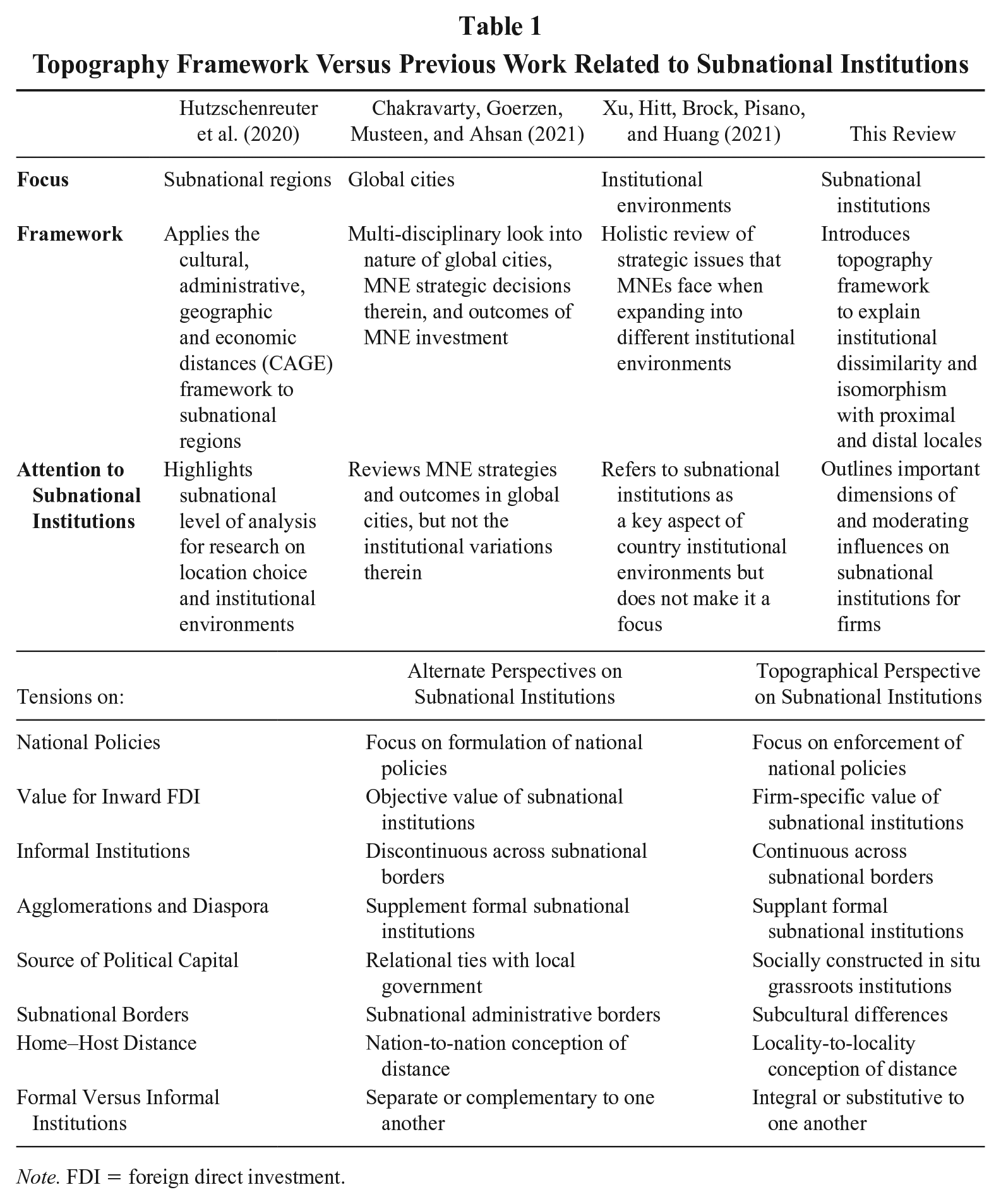
Note. FDI = foreign direct investment.
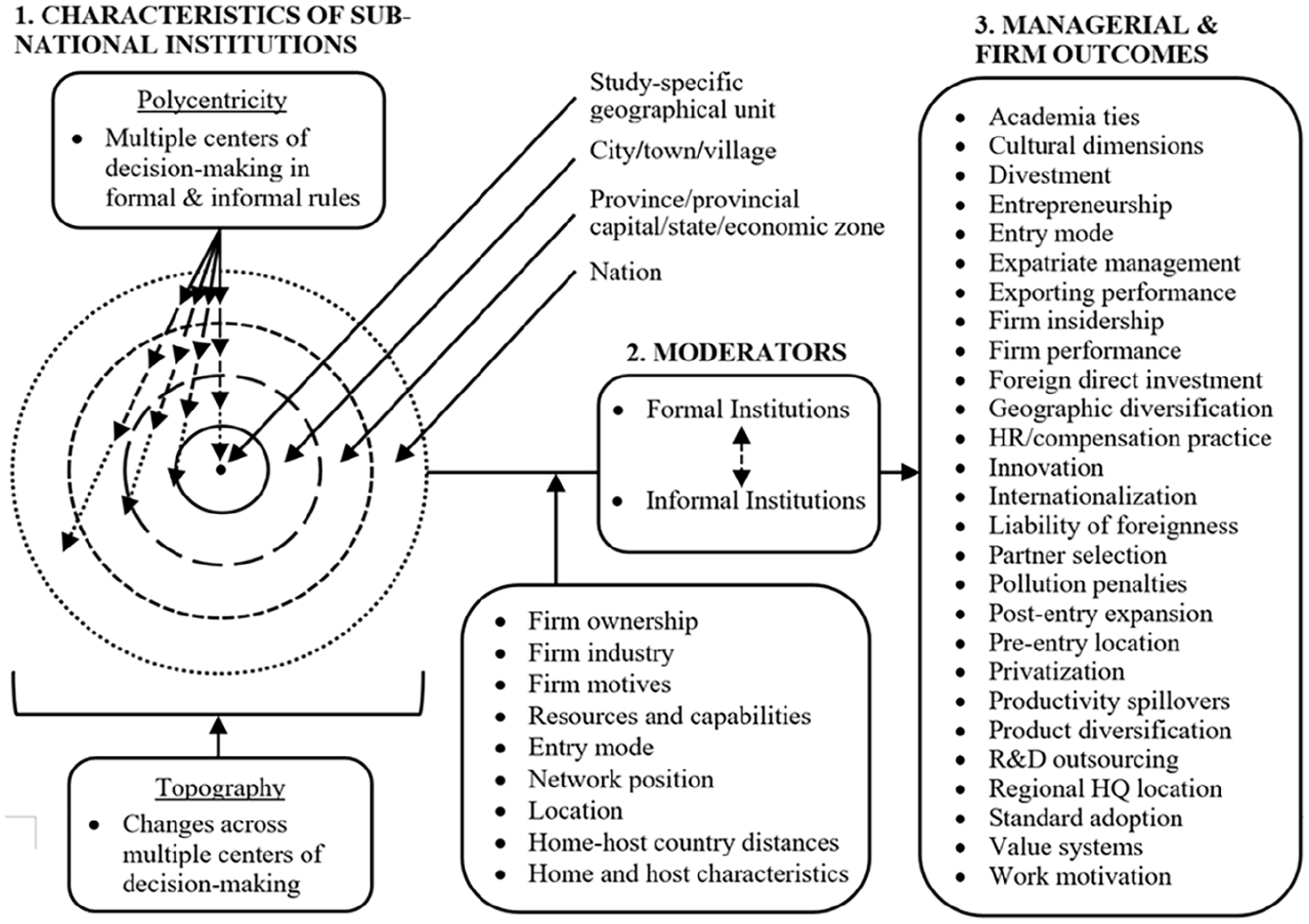
Topographical View of Subnational Institutions
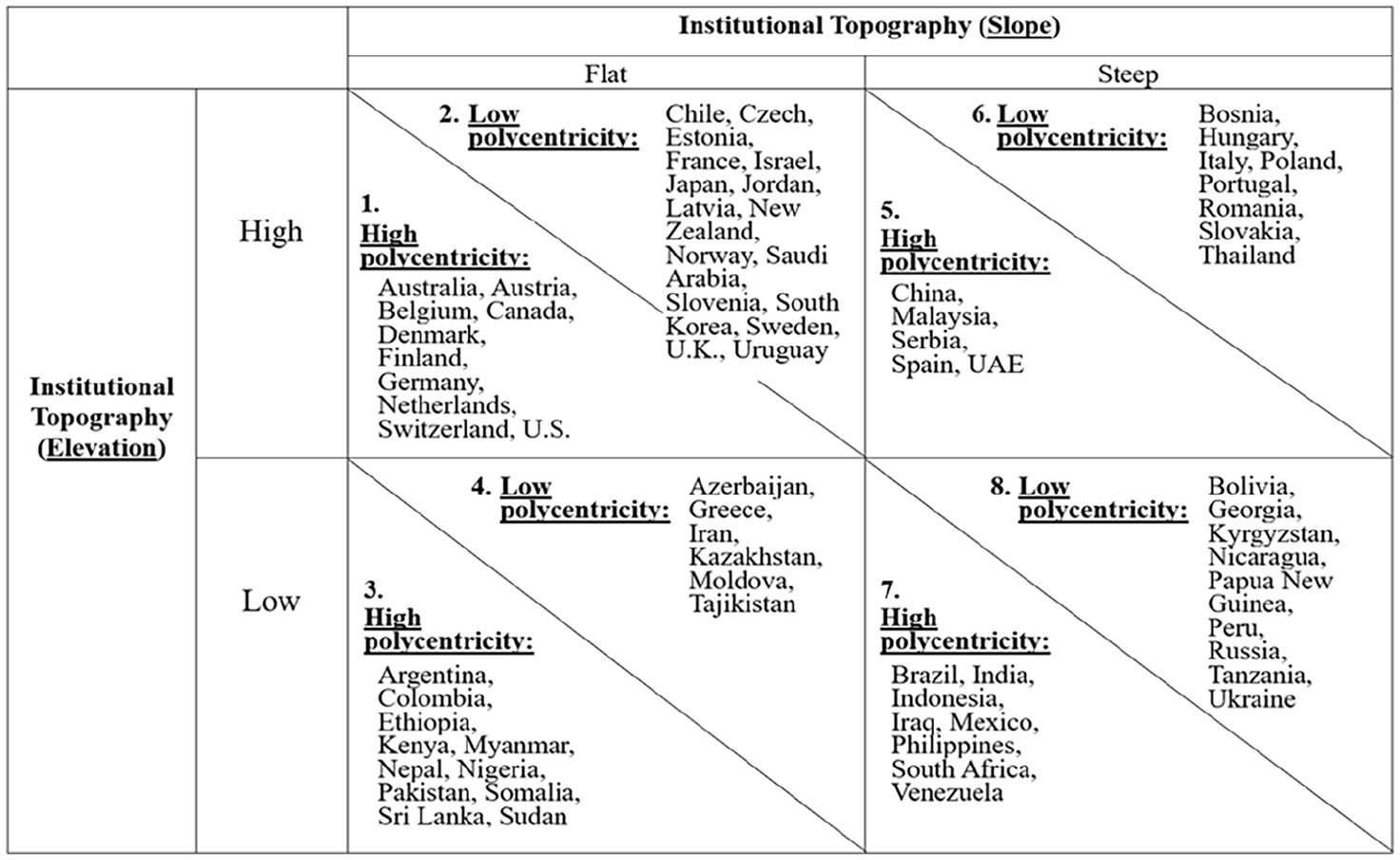
Matrix of Institutional Topography Containing Polycentricity, Elevation, and Slope
We considered an article relevant if it had a focus on subnational institutions, to which the primary theoretical contribution was made, to the exclusion of papers solely concerned with within-country location, and so forth. Importantly, distinct from reviews on global cities (Chakravarty et al., 2021) and subnational regions (Hutzschenreuter et al., 2020), we excluded papers not focused on institutions. Consistent with other reviews (Shepherd, Souitaris, & Gruber, 2021), we excluded commentaries, special issue introductions, meta-analyses, and theoretical and research method papers. In keeping with our goal to synthesize findings, we included only papers that provided empirical evidence using longitudinal data, surveys, or case studies. In line with our focus on firm and entrepreneur-level outcomes, we excluded papers at the region level of analysis. Additional procedures were adopted to finalize our review scope.
First, to identify literature, we entered the terms “subnational institutions OR sub-national institutions” in the abstract and full-text fields of peer-reviewed journals in Business Source Complete over the period 1999 to 2024. This initial search returned 502 articles. To ensure that the identified studies focused on the management context, we limited the scope to management journals—that is, Asia Pacific Journal of Management, Global Strategy Journal, International Business Review, Journal of Business Ethics, Journal of Business Research, Journal of Economic Geography, Journal of International Business Studies, Journal of International Management, Journal of World Business, and Management International Review—which reduced the article count to 67. We chose 1999 for the start year given the increased interest in and recognition of subnational institutions in the management domain at this time (cf. Porter, 1998). As an additional check, we ran a search in Business Source Complete with the same terms for the years 1967 to 1999, which generated 76 papers, all of which were published in economics and sociology journals.
Second, to ensure the comprehensiveness of our review, we used Google Scholar to search the same terms in peer-reviewed articles of reputable journals not included in Business Source Complete. We chose relevant articles from the following journals, regarded as top-tier research outlets in management based on their 5-year impact factor: Entrepreneurship Theory & Practice, Journal of Management, Journal of Management Studies, Organization Science, and Strategic Management Journal. This measure led to the inclusion of 12 additional articles.
Third, to identify additional research that may warrant inclusion (i.e., studies that may not contain our search terms in the abstract or body text but that nonetheless focus on subnational institutions), we examined the reference lists of our selected articles, as well as articles citing them. To ensure relevance, we examined only papers that were cited by at least five of the articles in our existing sample (L. Chen, Tong, Tang, & Han, 2022), manually reviewing their title, keywords, abstract, and full text. This process yielded an additional 13 articles from Business History, Economic Geography, International Journal of Human Resource Management, International Studies of Management & Organization, Journal of East Asian Studies, Journal of International Business Policy, Multinational Business Review, Research Policy, and Strategy Science.
As our last step, we coded the 92 articles into the three topography dimensions of institutions. Of the 92 articles, 42, or 46%, focused on polycentricity, 25, or 27%, focused on elevation, and 25, or 27%, focused on slope. Two coders independently checked the relevance of every article. Based on Krippendorff’s alpha (α = 0.92), the level of agreement between the coders was high and well above the threshold of 0.70 (Hayes & Krippendorff, 2007).
Findings
Our analysis using the institutional topography framework reveals the role of subnational institutions in shaping firm activity, and establishes polycentricity, elevation, and slope as critical dimensions that capture the unevenness in institutional quality and governance within countries.
Polycentricity
Subnational regions exhibit polycentricity where formal and informal institutions coalesce at multiple centers of power. The non-uniform development of varied governance landscapes with nationwide markets in credit, talent, and strategic factors give rise to subnational institutions that firms—domestic and foreign alike—rely on for political and financial resources.
While subnational institutions have hitherto largely been considered only in terms of their formal versus informal counterparts (Peng, Wang, & Jiang, 2008), the sedimentation of formal institutions atop layers of mental, religious, ethnic, and linguistic—that is, informal—institutions (Andrews et al., 2022), merits a topographical depiction. Because it is hard for (formal) government at any subnational level to influence culture (Rodríguez-Pose & Storper, 2006), we treat informal values and norms as the continuously coalesced bases for formal rules, the strength of which peaks and troughs at certain points on this “foundational” layer of institutions (Holmes et al., 2013). As “a substratum of institutional arrangements” (Hofstede, Van Deusen, Mueller, & Charles, 2002: 800), culture can be viewed as a part of informal institutions that “underpin formal institutions” (Redding, 2005: 123). With gradients of governance emanating from rules set at the center(s) that are gradually altered by formal and informal institutions across space (North, 1990), the heterogenous impact of polycentric institutions on firms engenders a topography characterized by varying degrees of ruggedness—that is, polycentricity—which captures the extent to which institutional landscapes are uneven within national confines.
The extent of ruggedness can be characterized along geographic and industry dimensions, although both are anchored in economic considerations. The ability of subnational regions to exercise their own institutions increases to the extent that they do not depend on political center(s) for resources such as land, financial capital, and licenses (Boone, 2003). As a case in point for high levels of ruggedness, local communities in Indonesia harbor a deep-seated mistrust of the central government, given strong traditions of land ownership and a conviction that they have a stake in what happens in their environment, irrespective of land titles or contractual rights awarded to corporate interests. With myriad Indonesian islands also viewed by the citizenry as separate countries, each with its own language, culture, religion, and ideology (Röell, Osabutey, Rodgers, Arndt, Khan, & Tarba, 2022), the attendant regulatory flexibility further contributes to high levels of ruggedness. In terms of industry, extractive industry firms—with irreversibility of investments and lower bargaining power (Maggioni, Santangelo, & Koymen-Ozer, 2019)—are particularly exposed to localized policies and must negotiate separately with local authorities regarding issues such as business permits, real estate, and access to public utilities.
Formulation versus enforcement of national policies
Within the broader scope of political and economic conditions, we review four articles that address the local implementation of national policies. Whereas alternate conceptions of subnational institutions may focus on the formulation of national policies, our topographical lens treats the non-uniform enforcement of national policies as the bedrock of polycentric governance. For instance, while working conditions are traditionally determined by institutional frameworks enacted at the national level, the enforcement of labor laws is usually delegated to local authorities responsible for conducting administrative and safety inspections. Whereas local authorities traditionally ensure a more uniform compliance with national regulations in developed countries, developing countries are often characterized by weak local enforcement of labor laws due to poorly functioning subnational institutions as well as a large informal sector (Boeri, Helppie, & Macis, 2008).
It is within a context of “humanness” that informal institutions exert their polycentric effects. For instance, Crescenzi, Pietrobelli, and Rabellotti (2014) found the importance of “socio-institutional factors” for innovation—measured as educational achievements and productive resource use—to depend on value chain stage and the degree to which human capital is involved, arguing that regions without a labor market capable of assimilating talent will experience out-migration and brain drain. According to Sleuwaegen and Boiardi (2014), however, innovation depends not so much on the availability of a highly educated workforce, but, rather, on the specific activities of creative individuals. They found that subnational institutions that encourage creative entrepreneurship and protect intellectual property rights (IPR) score highly on innovation, wherein “inspiration”—the share of workers in creative occupations—exerts a greater impact than intelligence, measured as the availability of highly educated people.
The polycentric economic, social, and cultural conditions within countries are further reflected in the different propensities of workers to unionize. In Turkey, uneven institutional and economic development across subnational regions yields heterogeneity across labor standards, such that firms from industries with more hazardous work conditions tend to invest in locales with higher health and safety standards in order to economize on reputational costs, and firms with more irreversible investments tend to invest in regions with less unionization, due to lower bargaining power (Maggioni et al., 2019). Our framework shows that different firms are attracted to different subnational institutions, which represent subjective value to firms with idiosyncratic objectives, capabilities, and sunk costs, as opposed to harboring static impact across firms.
Objective versus firm-specific value for inward foreign direct investment
We review nine articles on the nuanced relationship between within-country religious, linguistic, ethnic, and climate (political and natural environment) variation and inward FDI. Given the non-uniform implementation of national policies across subnational regions, institutional polycentricity captures the extent to which local institutions converge with or diverge from national institutions, often a function of how subnational regions compete against or propel one another (Blanc-Brude, Cookson, Piesse, & Strange, 2014) within a national agenda. FDI thus defies the notion of a “country” institutional environment, as firms are embedded in multiple, different subnational contexts (Xu et al., 2021). For instance, policies on tariffs, land usage, and financing can vary significantly by region (Nee & Opper, 2010), with certain ones designated as open areas, where foreign firms receive favorable treatment (Zhou, Delios, & Yang, 2002) and international new ventures exhibit greater performance (Park, Li, & Tse, 2006), while others are less open.
Yet, the strength of home–host affinity along ethnic and contextual dimensions could supersede institutional openness in attracting FDI. For instance, Strange, Filatotchev, Lien and Piesse (2009) found that family firms from Taiwan invest in inland—that is, less open—provinces in China, and non-family firms in South and Middle Coast provinces. The findings suggest that the entry mode and subnational location decisions are interrelated, with the parent’s equity stake in the subsidiary depending on the location within China, and the chosen location depending on the equity stake. Importantly, the efficacy of firms’ external relational linkages varies according to the strength of the cultural and historic ties between the location of the foreign affiliate and Taiwan. With regard to institutional opaqueness—the opposite of openness—Ramos and Ashby (2013) show that organized crime does not deter FDI inflows unilaterally in Mexico, but rather that FDI from countries with high levels of organized crime tends to flow into high-crime states.
Polycentricity gives rise to heterogeneity, in inward FDI, as a function of the institutional value specific to different areas within countries, affecting employee expectations in job security, career advancement, and personal support (King & Bu, 2005). In India, Buckley, Cross, and Horn (2012) identify the importance of education attainment, infrastructure quality, and proximity to government offices and special economic zones for FDI. Mudambi and Navarra's (2003) work on FDI in Italy suggests that similar factors, such as infrastructure for utilities and transportation—and the size of the industrial workforce—are just as important in developed countries. Further, subnational political tradition—that is, leftist and statist versus pro-business and centrist—has a marginal as opposed to direct effect on FDI, after accounting for firm and location factors. Sethi, Judge, and Sun (2011) corroborate the importance for attracting FDI into Chinese provinces of industry-weighted location advantages (i.e., infrastructure, natural resources, and labor skills, government incentives), although only for manufacturing and extractive, rather than high-tech, industries.
Continuity in informal institutions across subnational borders
We review four papers on within-country proliferations of shared norms and expectations. In contrast to extant notions, a polycentric view conceives of institutions at the intersection of provincial lines as exhibiting continuity in ethnic composition and resource endowments, treating borders as largely the arbitrary product of history. Work on the continuity of firms’ sustainability strategy across country borders finds that, for instance, Mexican firms headquartered in northern states bordering the United States. are more likely to comply with Mexico’s Clean Industry Program guidelines (Perez-Batres, Miller, Pisani, Henriques, & Renau-Sepulveda, 2012). Due to war and migration, the same Dai ethnic group in China’s Yunnan province is dispersed across present-day borders in neighboring Thailand, Laos, Cambodia, and Burma. Their localized traditions, belief systems, dialects, and cuisines continue to be shaped by institutions consisting of observable elements, such as rituals, 3 and tacit ones, such as power structures. For example, Theravāda Buddhism dictating everyday experiences 4 was first adopted by the Dai due to compatible social structures with the indigenous tusi political system, 5 where native chieftains were appointed as hereditary officials.
More recently, in overseas Chinese communities where Chinese firms locate their FDI, collective identities are preserved even as new immigrants become assimilated via education, labor market participation, and social and cultural incorporation, reflecting the persistent nature of social norms and values (Kelley, Coner, & Lyles, 2013), as well as the salience of historic and cultural links (Strange et al., 2009). In China, while provinces retain distinct identities, with their own cuisines, customs, and dialects, these distinctions are not punctuated by physical borders but rather spill over into neighboring provinces. While coastal regions have developed institutions (Sethi et al., 2011), inland regions harbor varying trajectories of institutional development along a spatial continuum. Instead of treating socially delimited (e.g., provincial) boundaries and their role in demarcating subnational institutions as a given, polycentricity advances the premise that institutions specific to subnational regions arise from the ongoing renegotiation of their borders.
Subcultural differences rather than administrative boundaries
We review eight works on subcultures as purveyors of polycentricity. Appreciation for institutional unevenness in subcultures is not new, even as subnational regions are largely delimited by administrative—that is, provincial—boundaries. Since “institutions incorporate historical experiences into their rules and organizing structures” (DiMaggio & Powell, 1991: 33), countries are in essence uneven repositories of shared histories. Extant research has set forth a variety of historical (Ralston, Nguyen, & Napier, 1999), linguistic (Tung, 2008), ethnic (Zaheer, Lamin, & Subramani, 2009), and generational (Egri & Ralston, 2004) explanations for within-country cultural heterogeneity.
Lenartowicz et al. (2003) found greater cultural similarity between Cartagena in Colombia and Caracas in Venezuela than within Colombia. In their study of core values in four Brazilian subcultures, Lenartowicz and Roth (2001) found that every subculture places a high importance on security (i.e., safety, harmony, and stability of family and societal groups), followed by life enjoyment; least valued are self-direction and conformity (i.e., restraint of actions and impulses likely to harm others or violate norms). They unveil strong subculture effects on entrepreneurs’ motivation, showing that while emphases on self-direction and life enjoyment raise performance, a focus on security reduces it. In a study on acquisitions in China, Wang, Zeng, and Shenkar (2021) use a subnational cultural proxy of the rice–wheat farmland ratio to show that, compared to growing wheat, which fosters an analytical subculture, rice farming produces a collectivistic subculture, which facilitates synergies in post-acquisition integration when both acquirer and target are from rice-growing regions. Negative learning given rice acquirers and rice targets suggests that knowledge transfers may be difficult even in the presence of cultural similarity.
In a study of work values in India, a country with over 300 scheduled tribes, 6 Dheer et al. (2015) found that regions in North-Central display less institutional compliance, while those in the Far-East, West, and South-West exhibit more male dominance, and those in North-Central and West more traditional values. In addition, North-West and North-Central put greater emphasis on work, while South-West and South value luxury and satisfaction, and North-West, West, and South-West pursue greater goal orientation. Ralston et al. (1999) compare work values in Vietnam with those in China and the United States, finding that the United States scores highest on individualism and significantly higher than both North and South Vietnam and Southwestern China. The reason for North Vietnam being, surprisingly, higher than South Vietnam on individualism is identified as the South’s harsh re-education program in the 1970s, which made people less aggressive in business for fear of losing their livelihoods, and thus more likely to conform to the North’s (Hanoi’s) government policy. Managers in Southwestern China are more open to change than managers in South Vietnam, but are not significantly different to those in North Vietnam, who are said to covet the financial gains and economic freedom observed across the border in China.
Within China, Kwon (2012) found individualism and uncertainty avoidance to be higher in Shenzhen than in Taiyuan, but long-term orientation to be lower. In Iran, Ancient, Islamic, and Western subcultures exert separate effects on Hofstede’s workplace dimensions (Latifi, 2006), just as Western, Heartland, and Muslim subcultures of Russia differentially influence employees’ preferred incentive systems of monetary, status, and social rewards (Elenkov, Manev, & Kuntz, 2022). For instance, employees in Western Russia favor monetary rewards, while those in Muslim Russia prefer social and status rewards, and those in Heartland Russia value status rewards. In addition, Western Russia rates highest on mastery and intellectual autonomy, Muslim Russia on hierarchy, harmony, egalitarianism, and embeddedness, and Heartland Russia on egalitarianism. While traditional conceptions of subnational institutions are relegated to formal and informal dimensions within administrative boundaries, our topography lens recognizes the role of subcultures in shaping the polycentric materialization of core and work values.
Agglomeration and diaspora supplant formal institutions
Nine papers deal with agglomeration across artificial subnational borders. The continuous nature of institutions is nowhere more salient than for natural disasters (Oh, Oetzel, Rivera, & Lien, 2020) and wars (Dai, Eden, & Beamish, 2013), where being co-located with firms from the same industry or home country may provide access to life-saving information. As such, this body of research on the polycentric aspects of subnational institutions yields insights for their direct (i.e., exposure to natural disasters or violence) and moderating (i.e., agglomeration with peers, or positive externalities that stem from the geographic co-location of firms; cf. Porter, 1998) effects on firm entry into or exit from provinces within a country. Agglomeration with home-country firms has been further found to outweigh even financial subsidies and institutional openness as a location determinant for Japanese MNEs deciding where to invest in the United Kingdom (Buckley, Horn, Cross, & Stillwell, 2013), as well as for Taiwanese firms seeking to invest in China (Strange et al., 2009).
In work on agglomeration, Stallkamp, Pinkham, Schotter, and Buchel (2018) demonstrate that co-ethnic cores—with ongoing relationships between firms (and individuals) from the same country, trust based on home-country norms, and support infrastructure such as home-country banks, schools, and social services—affect FDI expansion speed, which has also been shown to depend on proximity to a country’s capital city (Hutzschenreuter & Harhoff, 2020). As such, the informal institutions of co-ethnic cores—which are polycentric in nature—supplant formal institutions in facilitating the expansionary behavior of firms with respect to location and speed, although the foreign entry decision may initially be predicated on formal institutions propagated from polycentric loci. For instance, in Mexico, it takes 2 days to register a property transfer in Colima, but 74 days in Mexico City (World Bank, 2016). Even in the topographically “flat” United States, where the legal system requires the House, Senate, and President to agree to enact legislation, each state has its own governing body and laws, with stark differences in corporate tax rates, ranging from 0% in South Dakota to 11.5% in New Jersey (Tax Foundation, 2023).
In addition to formal institutions in the locality, polycentricity emanates in large part from the co-location of people that share human-to-human connections as these impinge on informal institutions of importance to firm decisions. For instance, the attributes of the local migrant community, availability of ethnic ties, and density of the local institutional context all serve to determine where Chinese firms locate within European countries, with the probability of investment being higher the greater the size of new generations of immigrants and the higher their level of education (Karreman et al., 2017). Similarly, Kelley et al. (2013: 450) show that Chinese diaspora size is among the strongest predictors of Chinese firms’ location in the United States, pointing to contact frequency and “sheer enthusiasm exhibited by residents” in city-to-city ties as key determinants. In their research on the services offshoring industry in India, Zaheer et al. (2009) found that ethnic ties influence the location of new industry entrants beyond location attributes and affect foreign firms less than domestic firms, with the latter being more influenced by the ethnic ties of their Chief Executive Officers (CEOs) relative to cluster capabilities and their own strategy.
Grassroots institutions as socially constructed in situ capabilities
The polycentric expression of social trust and goodwill is explored in five papers. Subnational variation reflects differences found not only in government policy and enforcement but also in local culture and business norms, particularly the goodwill of communities and religious authorities (Röell et al., 2022). The polycentric nature of specific informal institutions—for example, tribal norms and traditional practices—in emerging market countries may furthermore warrant a customized approach to achieving subnational embeddedness. Mbalyohere and Lawton’s (2022) work in Uganda sheds light on “cultural property management” in the realm of, for example, local beliefs in spirits, the strategic engagement with which is deemed imperative to building relationships in communities. The role of bridging agents and grassroots networks comprised of local managers, consultants, community leaders, and non-governmental organization (NGO) members that facilitate such corporate political activity (CPA) as the relocation of centuries-old traditional religious assets—for example, the home of a local god that would otherwise be permanently submerged with the construction of a new dam reservoir—is especially salient in settings where CPA is not readily transferrable to other subnational contexts.
As enduring systems of shared meanings and collective understandings, informal institutions reflect a socially constructed reality that shapes cohesion and coordination in a society that, although not codified into documented standards and rules, “play a larger role in driving firm strategies and performance” in contexts with weak formal institutions (Peng et al., 2008: 927), with nuanced effects across levels. According to Onuklu, Hill, Darendeli, and Genc (2021), informal institutions are locally structured political arenas that underpin variations in formal subnational institutions, often modeled as the degree of hierarchy, social cohesion, capacity for collective action, mode of labor control and land allocation, nature and intensity of internal divisions, and autonomy in a region. The authors catalog the impact of informal institutions on small-and-medium-sized enterprises in three of Turkey’s mid-tier cities, finding that lack of collaboration among firms and between firms and government authorities in Samsun exacerbates voids in national formal institutions, whereas Kayseri and Gaziantep exhibit strong export-supporting business networks that help to bridge any voids in national formal institutions.
Similar substitution effects are identified by X. Chen and Wu (2023), who found that firms affiliated with business groups—imparted with economies of scale and scope, investment opportunities, as well as preferential information and resource access—are less sensitive to the effects of informal institutions than independent firms. They examine outward FDI as a function of social trust, which at low levels prompts firms to eschew weak institutions at home, and at high levels serves to enable foreign operations, such that firms in regions with moderate levels of social trust are most likely to conduct FDI, given both the motivation to escape and the ability to internationalize. Firm internationalization thus increases with social trust up to a point but decreases past this point. Higher levels of subnational social trust further exert a positive effect on the performance of foreign firms, which is contingent on their local embeddedness, wherein the positive effect is weakened as their export intensity increases (Lu, Song, & Shan, 2018).
Home–host distance as a locality-to-locality rather than nation-to-nation concept
We review the fine-grained, polycentric treatment of national institutional distance in eight papers. A notable implication of polycentric logic is the tempering of home–host distance by locality-to-locality distance, as a consequence of accounting for local idiosyncrasies. In research on tacit knowledge via networking, Monaghan, Gunnigle, and Lavelle (2014) show how coalitions of subnational institutions can be tailored to the FDI needs of MNEs to initiate, negotiate, and accelerate insidership both prior to and during entry. In a study on wine exports, Hejazi (2022) measures the context-specific distance between home countries and individual catchment areas of retailers in Canada, showing domestic country bias to be weaker in catchment areas that have a stronger affinity with the home country, the strength of which may even reverse country biases so that foreign wines are favored over domestic wines. As shown by Miller, Thomas, Eden, and Hitt (2008), MNEs from emerging economies tend to locate in subnational regions with firms of similar ethnic identities to establish relationships with stakeholders (e.g., customers, potential employees, etc.). Similarly, while the linguistic distance between Japan and the United States is large, it is smaller for Japanese firms seeking to enter Japanese-speaking communities in California (Dow et al., 2016). Equity ownership is moderated by linguistic variation within and distance between acquirers’ and targets’ respective countries, giving rise to behavioral uncertainty and information asymmetry in global mergers and acquisitions (M&A), over and above the effects arising from cross-national differences.
According to Slangen’s (2016) work on subnational cultural variation, MNEs prefer setting up joint ventures (JVs) over wholly owned subsidiaries when dealing with cultural complexity in a target subnational region than that of a target country, but only for initially large, acquired subsidiaries rather than initially small, greenfield subsidiaries. In the context of China’s World Trade Organization (WTO) accession, Ma, Tong, and Fitza (2013) found subnational effects to be stronger in preceding periods—when there would have been less foreign competition—and less developed regions. In work on regional headquarters, Ma, Delios, and Lau (2013) show that, given greater China–home country administrative or cultural distance, Beijing is less likely to be chosen than Shanghai. Indeed, Shanghai information technology (IT) recruits share more beliefs on employee–employer psychological contracts with counterparts in the United States than in Beijing, although only for females; Beijing women are less expectant of employers to provide training than women in the United States and Shanghai (King & Bu, 2005).
Elevation
Elevations of institutional quality vary significantly across subnational regions. Higher elevation areas, such as economically developed coastal regions, offer robust institutional frameworks that support firm activities, while lower elevation areas provide weaker support. We illustrate how firms adapt their strategies to disparities in elevations of institutional quality.
Political-economic transitions throughout the world have rendered institutional landscapes polycentric, where central governments delegate more power in investment approval, land use, and banking to local governments that coordinate economic activities by enforcing regulations (Gao, Wang, & Che, 2018). As central governments devolve powers to subnational regions, the predictive power of national institutions diminishes as subnational constituents amass power from the political center(s) (Buckley & Ghauri, 2004). For instance, in southern Côte d’Ivoire, subnational institutions in farming societies emerging from historical processes of precolonial settlement, colonial conquest, and peasantization have worked against the concentration of power over the people and land (Boone, 2003). The ensuing polycentricity is reflected in varied elevations of subnational institutions—that is, the degree to which these institutions are upheld and valued, within the governance topography of countries.
The development and interpretation of formal institutions is thus affected by culture, such that even when institutions are designed and interpreted to apply nationally, enforcement diverges as local administrators confront different geographic assets, for example, proximity to raw materials and seaports, human capital, and climates (North, 1990). The extent to which institutions are enforced in turn determines their elevation versus demotion at any given point in space. For instance, the interpretation and enforcement of IPR law, while commonly defined at a national level, has been shown to depend critically on local cultural norms (Santangelo, Meyer, & Jindra, 2016), the court level at which trials take place, as well as monetary damages sought by foreign plaintiffs (Sun, Choi, Guo, Guo, Zou, & Cui, 2023). The limited utility of political capital with central governments, moreover, applies to internationalization by entrepreneurial firms from emerging markets, as knowledge search and transfer may depend more on political capital acquired at lower levels of subnational government (Ma et al., 2016).
Uneven enforcement of legal and financial frameworks
We review five papers on differential access to quality institutions. For instance, substantial variation in governance exists in the protection of labor rights (Maggioni et al., 2019). While working conditions are largely determined by institutional frameworks enacted at the national level, the enforcement of labor laws is usually delegated to local authorities responsible for conducting administrative and safety inspections. The uneven economic, social, and cultural conditions are further reflected in the different propensities of workers to rely on unions. Furthermore, whereas local authorities traditionally ensure more uniform compliance with national regulations in developed countries, developing countries are often characterized by weak local enforcement of working conditions due to poorly functioning subnational institutions. As such, even as firms may consider a region for investment due to favorable institutions (Ma, Ding, & Yuan, 2016), local realities will depend on policies for privatization, deregulation, or decentralization (Hutzschenreuter et al., 2020).
Greater access to legal and financial institutions in subnational regions indicates higher elevation. Firms in these regions are theorized to be more likely to internationalize, as Chang, Torres de Oliveira, Chung, and Zheng (2022) found in the context of China’s Belt-and-Road Initiative. In contrast to this “support” view, which treats home-country subnational institutions as a facilitator of internationalization (Yang, 2018), the “escapism” view suggests that home-country constraints underlie internationalization. As Shi, Sun, Yan, and Zhu (2017) show, firms seek to escape institutional fragility, defined as internal friction due to differential progression of institutions across regions, whose effect on outward FDI is weaker when firms have high productivity or high state ownership, and stronger when firms have a robust export network.
Economic development and political intervention
Stronger institutions, as reflected in higher marketization and economic development, translate into greater elevation, and constitute the focus of 10 papers. In regions with strong economic development, MNE subsidiaries will be more able to contribute to economic development than in less developed regions (Dimitratos, Liouka, & Young, 2009). Provincial intervention, however, reduces the positive effects of institutional development, especially for small firms. For instance, Nguyen, Le, and Bryant (2013) show that provincial transparency strengthens the strategy-performance link, but that preferential policies for state-owned enterprises weaken this positive relationship for private exporters. In a study on the speed of pro-market reforms, Banalieva, Eddleston, and Zellweger (2015) identified boundary conditions for the impact of marketization on family firms. The authors show that while the scope of pro-market reforms benefits performance, the speed of reforms detracts from performance, whereby family firms perform better in provinces undergoing slower reforms, and non-family firms perform better in provinces experiencing rapid reforms.
CEO pay dispersion in less developed regions is larger in cross-listed firms and smaller in state-owned enterprises and in voluntary compensation disclosure periods, but in more developed regions it is positively related to firm performance (He & Fang, 2016). In a study on entrepreneurs, Malesky and Taussig (2009) found their decision to enter the formal sector in Vietnam to correlate with better institutions, more telephones per capita, and connections to the state in a subnational region. Surprisingly, higher per capita GDP reduces formalization, which relies more on property rights than on other institutions. Furthermore, the relationship between IPR protection and regional R&D investment has been demonstrated to be U-shaped, where MNEs as plaintiffs in IPR lawsuits can strategically adjust upward the amount of monetary damage sought, and choose a lower court level to increase their probability of winning (Sun et al., 2023).
In work on government power, Xu, Tihanyi, and Hitt (2017) found that fiscal power at the provincial level—theorized as provincial government dominance in resource allocation and measured as provincial government revenue—poses barriers for high-performing firms seeking to privatize. Provincial enforcement stringency of environmental regulations further reinforces the negative relationship between foreign ownership and pollution penalties paid (Ding, Jia, Wu, & Yuan, 2016). As another pervasive form of provincial intervention, general corruption levels in Mexican states reduce the signaling credibility of private ISO 14001 certification for firm environmental conduct, while policy-specific corruption—in which customers cannot discern firm compliance with policy-related regulations—leads firms to signal desirable conduct via certification (Montiel et al., 2012). Subnational corruption lowers foreign firms’ performance, a relationship ameliorated by a greater export ratio and local experience (Yang, Ma, & Cui, 2021).
Liability of foreignness versus FDI legitimacy
Elevation may also relate to the existence of entities in the locality that help to reduce the liability of foreignness for firms seeking to invest therein, a topic that we review in 12 papers. The large psychic distance between Canada and China, for instance, may be reduced for Chinese firms investing in Canadian provinces with established investment promotion agencies in China (Anderson & Sutherland, 2015). In a study on console video games sold in the United Kingdom, Benischke, Rietveld, and Slangen (2023) found that sourcing video game inputs from product developers based in the same subnational region as consumers increased the latter’s willingness to pay, with these positive effects on sales being greater for foreign than for domestic developers and in culturally diverse regions, which tend to harbor variety-seeking consumers. As Filatotchev, Strange, Piesse, and Lien (2007) found for Taiwanese firms investing in China, an MNE’s equity stake in its foreign subsidiary is positively associated with its extent of economic and cultural links with the subsidiary’s location in China.
Institutions have been further shown to modify the existing elevation in a locale upward or downward—“turning a bad thing into a good thing and vice versa”—depending on the stakeholders and outcomes involved. In Chinese provinces with lower FDI legitimacy—operationalized by Schotter and Beamish (2011) as the number of foreign firms in a province over its total number of firms multiplied by a factor of 1,000—MNEs tend to employ more local nationals as managers and thereby perform better. This effect is stronger for greenfields, as compared with JVs, applies to all but the most developed coastal provinces, and is reversed in provinces with higher FDI legitimacy. Gao and colleagues’ (2018) work on the deterrent effect of historical conflict on Japanese firms’ location in China shows that by generating tax revenues and employment, Japanese firms are able to reduce the negative effect of past civilian casualties on firm performance. Efforts to achieve local embeddedness can thus serve to ameliorate liability of foreignness, although their value may be offset by stunted firm performance in regions more receptive to foreign firms, where institutions offering access to political and economic resources are known to enhance spillovers from foreign firms to the locality (Dimitratos et al., 2009).
By co-locating with country peers, large MNEs can leverage a more localized identity—via reduced expatriate staffing and ownership levels—and agglomeration externalities to out-compete MNEs from other countries with lower levels of such agglomeration (Peng & Beamish, 2019). Notwithstanding their ability to attract FDI based on proximity to core cities (McDonald, Buckley, Voss, Cross, & Chen, 2018) and agglomeration (Stallkamp et al., 2018), regions may harbor informal institutions—for example, employees’ willingness to work for lower wages and show greater commitment—that moderate the impact of formal institutions on inward FDI. Although agglomeration factors such as the employability of locals serve to attract inward FDI into Poland, Chidlow, Salciuviene, and Young (2009) demonstrate that people in regions outside of the Polish capital, with natural resources, but high unemployment rates, incidentally place a higher value on their job. Thus, agglomeration and infrastructure tend to override subnational location factors (Chidlow, Holmström-Lind, Holm, & Tallman, 2015), but in counterintuitive ways.
Elevation is thus largely a function of the formal (e.g., legal and financial frameworks) and informal (e.g., embeddedness, agglomeration, and political ties) institutions at a given point in space. As the enforcement of formal rules is often subject to the personal interpretations of key administrative officials (Luo & Park, 2001), firms benefit from such political ties. However, because political successors may not honor their predecessors’ commitments to preferential policies for firms (e.g., tax breaks, policy preferences, and resource support), turnover in the local government may cause information asymmetry that harms firms’ performance (Zhong, Lin, Gao, & Yang, 2019). Indeed, longer tenures for regional government leaders, according to work by Zhang, Zhan, Xu, and Kumar (2020), reinforce the positive relationship between subnational governments’ involvement in international friendship cities and their ability to foster greater scale in outward FDI. Drawing on an “institutional fostering” view, the authors show the FDI-facilitating role of friendship cities when regional leaders are stable in their positions.
Slope
Slopes in institutional change across geographical space affect the consistency of institutional support and constraints. Areas with steep slopes experience rapid changes in governance quality, necessitating that firms be agile in their strategic planning, whereas areas with flat slopes face less variable enforcement of regulations and fewer subcultural differences.
Regulatory inconsistencies give rise to institutional unevenness, where governance in a country’s political and economic center(s) weakens with greater distance from formal institutions to ethnically diverse populations in more remote regions (Meyer & Nguyen, 2005). In addition to the spatially delimited implementation of polycentric institutions, which produces elevations in governance, the rate at which governance strength changes—the slope of subnational institutions—at the margin (i.e., in a particular locale) may be attributable to the relative salience of informal institutions to their formal counterparts. The role of informal institutions in engendering formal institutions underlies their lock-step co-evolution. Formal governance mechanisms are not only imperfectly adopted from center(s), but heterogeneously distributed across space given deep-rooted geographical, ethnic, and historical differences (Holmes et al., 2013), providing less than adequate facilitation of networks with peasant constituencies in countries with agrarian heritages. Social cohesion within the towns and villages of Senegal, for example, relies not on the official chieftaincy or municipal head as mandated by the central government, but rather on the chef de l’ékafa, the head of small voluntary associations in rural communities. Africa is thus noted for varying capacities of subnational regions to self-govern (Boone, 2003), where legacies of top-down control from colonial rule cannot but give way to variations in state penetration of rural society.
Especially in emerging markets, colonial rule underlies patterns of governance often weakly but continuously reproduced from political center(s). As depicted by gradients along polycentric peaks and troughs, the rate at which institutions change across space is a function of uneven rule implementation by local authorities, often the sole political vehicle for addressing local problems. For instance, Senegal’s fragmented ethno-linguistic terrain led colonists to turn to local leaders for guidance, designing governance modes with the latter in ruling positions to enforce formal rules (Firmin-Sellers, 1996). Authority allotted to localities for support of projects orchestrated at centers means that the persistence of institutions is also predicated on people’s perception that institutional solutions can solve their problems (Tolbert & Zucker, 1996). Gradients in institutional rule between centers and peripheries reflect the former’s dependence on the latter for votes and civic support, which reinforces “the blunt, authoritarian character of local rule” (Boone, 2003: 123) over non-uniform and sloping institutional terrain (Ostrom, 2010).
Substitutive effects of informal for formal institutions
A consequence of such indirect rule is the moderation of local rulers’ power (Sun, Peng, Lee, & Tan, 2015), that is, the basis for slopes in institutional topography. To gauge the ways in which informal institutions supplant formal institutions along institutional gradients, we review six papers. National implementation of market reform policies is often accompanied by variability in governance quality (Li & Yao, 2010), such that subnational differences in economic freedom and development are pronounced (Li & Qian, 2013; Shi, Sun, & Peng, 2012), resulting in “steep” slopes. The rule of law, for instance, relies heavily on the capacity of local authorities to govern using informal rules. Wu, Li, and Li (2013) found that, although CEOs’ political connections to the central government can serve as a substitute for formal institutions, the positive effect of these connections on initial public offering (IPO) performance is stronger in regulated industries but diminished in regions with restrictions on markets. Informal institutions in the locality can also weaken the negative relationship between deficiencies in subnational formal institutions and firm ownership, with this substitutive effect more important for firms with less slack and state-owned enterprise ties (Chan & Du, 2022).
Research points to the role of formal institutions in moderating the relationship between slopes in resource availability and knowledge acquisition outcomes. Similarly, the substitutive effect of informal institutions—that is, networking to share resources or co-develop a technological product—for formal IPR regulations is moderated by both formal and informal rules (Huang, Geng, & Wang, 2017). Specifically, Western as opposed to Chinese firms exhibit a greater tendency to take advantage of IPR protection, that is, by adopting utility model patents in China, given greater IPR protection in a region and less embeddedness in informal institutions. Informal institutions governing IPR protection, for example, attitudes towards non-locals, IP expertise, market preferences, and professionalism, vary widely at the subnational level (Li & Sun, 2017), with smaller variations in regions with high, as opposed to low, R&D levels (Peng, Ahlstrom, Carraher, & Shi, 2017).
Marketization: Economic freedom and openness
Economic freedom often appears as a moderator of institutional elevation that, in turn, determines slopes for focal elevations, and we review seven papers in this tradition. In economically free, or high marketization, 7 regions, market-based capabilities such as CEO international experience are accorded greater value, given increased bids for CEO talent by foreign MNEs, competition from imports, and firms’ interest in going abroad (Peng et al., 2015). Specifically, well-developed subnational institutions increase outward FDI and strengthen the impact of executive equity ownership, but not executive pay, on outward FDI (Liu, Lu, & Chizema, 2014). However, both greater executive pay and executive equity ownership increase the extent of firms’ outward FDI, as well-compensated managers may be more motivated to pursue internationalization as a growth strategy than they otherwise might.
Value flows to subnational regions where it will be protected, whether institutional slopes reflect greater marketization or regulation. In one paper, where economic freedom is the outcome rather than moderating variable, firms with capabilities in innovation, pollution prevention, and environmental management were found to invest in more strictly regulated regions, while firms without such capabilities are less likely to do so (Bu & Wagner, 2016). Where regulations for curbing the power of controlling shareholders are well established, the expropriation of minority shareholders decreases in principal–principal conflicts, mitigating the resistance of large owners toward potential takeovers (Li & Qian, 2013). High levels of openness and marketization—signs of curtailed government power—are noted for shaping the networking of emerging market firms engaged in innovation with local academia (Kafouros, Wang, Piperopoulos, & Zhang, 2015) and MNEs considering local firms as JV partners (Shi et al., 2012). Changing gradients in marketization further incentivize foreign firms with local experience to choose JV partners based on brokering capacity rather than network centrality (Shi, Sun, Pinkham, & Peng, 2014).
Relational ties and legitimacy
We review six papers that focus on the moderation of governance quality by legitimacy achieved through various means. For instance, the differential value of relational ties is explored by Sun, Peng, and Tan (2017), who found that state control during institutional transitions leads CEOs with political ties to engage in product diversification, while CEOs with international experience leverage economic freedom during institutional transitions to conduct international expansion. The value of such ties may come with boundary conditions that make firms less likely to internationalize, given host country stakeholders’ concerns with unfair competition from state-backed firms. In addition, where politicians are considered unreliable by the local citizenry, having good relationships with the local government may exert a negative effect on a firm’s perceived legitimacy (Shapiro, Hobdari, & Oh, 2018).
In a study of Chinese state-owned enterprises, Li, Xia, Shapiro, and Lin (2018) found that firms with institutional compatibility—that is, legitimacy, at home, or institutional incompatibility abroad—are less likely to conduct outward FDI, but that these negative effects may be offset by coercive and mimetic forces such as the development of strong market institutions and peers’ investment behavior. All in all, firms are more likely to internationalize in the presence of greater access to legal and financial institutions (Sun et al., 2015), which has been shown to reinforce any positive performance from exporting to more open markets, or alternatively to exacerbate the negative performance from exporting to less open markets (Deng, Jean, & Sinkovics, 2018).
In less open institutional environments, where local governments maintain sole control over resource allocation, provincial intervention increases product and geographic diversification in firms with headquarters in the host country (Ma & Delios, 2010). Subnational policies thus serve as an important determinant of slope in less marketized regions, with the capacity to thwart abrupt drops in elevation. The incentive policies of subnational governments are, however, of less importance to MNEs from resource-advantaged home countries than from resource-disadvantaged ones (Yao, Xie, Li, & Xu, 2023). Su, Zahra, and Fan (2022) present a similar finding at the individual level of analysis in the context of rural China, showing that while upper-class individuals are less likely to become entrepreneurs in highly marketized regions—possibly due to the ability to engage in other wealth-creating activities as venture capitalists, consultants, or board members—they attain higher income growth once they do become entrepreneurs in these regions.
Economic development and spillover effects
We review three papers on economic development as “slope” for gradient changes in institutional rule. Sofka and Zimmermann (2008) found less liability of foreignness for foreign firms in economically depressed regions (i.e., East as opposed to West Germany), as customers therein tend to evaluate products more objectively and rely less on country-of-origin stereotypes, such that foreign firms may be able to achieve local embeddedness at rates equal to domestic firms. Similar boundary conditions for spillover and competition effects are explored by Xiao and Park (2018). Firms in regions with greater strength in formal institutions (i.e., legal environment, factor markets, government-market relationships) are less likely to achieve productivity via FDI spillovers than those in less developed regions, even as such talent, political resources, and financial backing arguably enhance spillovers from foreign to domestic firms. Indeed, in highly corrupt regions with less transparent institutions, firms are less motivated to innovate and more likely to engage in non-market activities, which weakens their absorptive capacity and any spillover effects (J. Chen, Zhan, Tong, & Kumar, 2020).
Subcultures as slopes in topography
Subcultures not only engender polycentricity by being ethnically distinct and indigenous to certain parts of a country, but also curate pixelations of informal and formal institutions across geographical space that moderate governance quality. We review four papers that explore this latter function. Subcultures are especially salient in large emerging market countries like China, with its 56 ethnic minorities, and provinces as large as entire countries (Kwon, 2012; Yi, Chen, Wang, & Kafouros, 2015), such as Iran with its historic subcultures (Latifi, 2006) and Brazil with the Gauchos and Paulista subcultures. Substantial cultural variations exist also in developed countries, as with Flemish- and French-speaking parts of Belgium (Zaheer, Schomaker, & Nachum, 2012), along with French- and English-speaking parts of Canada, and in smaller emerging markets, such as Vietnam (Meyer & Nguyen, 2005) and Mexico (Li et al., 2018).
Given the presence of within-country subcultures, national averages of institutional differences may overstate “effective” or “real” distances between two countries (Beugelsdijk, Slangen, Maseland, & Onrust, 2014). A country may thus be “unattractive” based on national averages, notwithstanding highly attractive subcultures therein. For example, while the average education level of the labor force in China is lower than that in Australia, the level is similar when comparing their most highly educated populace. A reliance on country-level data would thus mask opportunities to appeal to educated demographics and misrepresent the country-of-origin effect as uniform across foreign countries (Hejazi, 2022). As a result, predicating strategies pertaining to location choice and hiring on national averages, that is, on the assumption of spatial homogeneity, will systematically result in biased outcomes (Hutzschenreuter et al., 2020).
Discussion
The research on subnational institutions suggests that countries are characterized by spatial unevenness in the depth of state-society linkages, which we have attempted to capture using a novel topography framework. Our topographical view of subnational institutions brings to light issues that may otherwise be overlooked in deliberations on countries as investment locations, but are in fact critical to the long-term interests of entities including, but not limited to, foreign and domestic firms, governments and NGOs, and local citizenry. For instance, due to uneven institutions, the capital gains taxes and royalties that foreign firms pay to national governments often fail to reach the local communities that need them the most and that bear the highest health and safety costs associated with the exploitation of human and natural resources (World Bank, 2010). Notwithstanding any value provided, locally is where firms create damage.
As a case in point, the Bujagali Dam, a JV between a U.S. energy giant and Uganda’s main industrial conglomerate, claimed to lift Uganda out of poverty via hydropower generation, but in reality increased the nation’s debt, produced electricity that few could afford, stifled the development of viable alternatives such as geothermal energy, and jeopardized traditional African religious rituals at the site (Mbalyohere & Lawton, 2022). As historically engendered “landforms” that precede the formation of formal institutions, informal institutions at the local level in the form of ancient rituals enjoy more legitimacy than nationally prescribed forms of governance, given their sedimentation over centuries of socially reinforced values and practices. Indeed, central authorities installed in rural areas occupy positions much less robust than locally dominant lineages and aristocracies, whose staying power has been remarkable in places such as central and northern Senegal, Ghana’s Asante region, and southern Cote d’Ivoire (Boone, 2003).
Theoretical Contributions
Our framework provides an understanding of how firms navigate the complexities of institutional landscapes within countries. Leveraging metaphorically derived constructs such as elevation and slope, the notion of topography captures the uneven yet spatially continuous development of institutions. Akin to a magnifying glass, elevation and slope capture subnational variations in governance quality, and thus more closely reflect the variance across countries’ institutional landscapes than do extant frameworks concerned with the mean institutional distance between countries. Especially in emerging markets, where incomplete institutional development has left rural areas with “thinner” institutions, the institutional distance as measured from a firm’s home country to rural localities in the host country may be greater than to polycentric urban points. Extant conceptions of institutions may thus produce grossly inaccurate calculations of the institutional distance faced by foreign firms, to the extent that rural and urban institutional extremities are misrepresented by countries’ average value of institutions.
Using a topography metaphor, we draw attention to subcultures rather than subnational administrative borders in demarcating polycentric differences. Given the myriad ways in which informal institutions can affect firms—that is, driving policy enforcement—subnational institutions traditionally viewed as holding objective value are imbued instead with firm-specific value, as a function of a focal firm’s objectives and resources. With its fine-grained scrutiny of informal institutions, our topography framework further identifies grassroots institutions rather than ties with the local government as a viable source of social capital, especially in emerging market economies with large informal economies. In terms of formal and informal institutions, our review finds substitutive in addition to complementary dynamics, indicating a more integrated relationship between the two sets of rules than previously noted. As an instance of this dynamic, informal institutions in the form of political ties and agglomerations often supersede formal institutions in the localized enforcement of national policies. Where previous theories focus on the formulation of policies, our topography lens sheds light on their local enforcement.
Limitations
While our review provides valuable insights, it also has some limitations. First, there is not enough “data” to explore how formal institutions shape topographies in concert with informal institutions, a critical consideration to gauging tradeoffs between performing fine-grained analyses and excessive disaggregation. While informal institutions are challenging to examine empirically (Orr & Scott, 2008), recent qualitative efforts (Lu et al., 2018; Onuklu et al., 2021; Röell et al., 2022) demonstrate the utility of case studies, which we advocate for work seeking to understand the informal institutional bases for formal institutions (Holmes et al., 2013). Second, because the papers reviewed often address more than one dimension of polycentricity, elevation, and slope, we classify them according to themes that could apply to multiple dimensions. To streamline our review, however, we exclude studies utilizing FDI data (Chung & Alcácer, 2002) and concerned with region-level (Acs, Anselin, & Varga, 2002) or university-level (Yuan, Li, Vlas, & Peng, 2018) outcomes. Finally, as our topography framework cannot account for rich topographies that traverse country borders, we exclude studies of subnational regions covering parts of more than one country (e.g., Belderbos, Du, & Slangen, 2020) or those that focus on only one subnational region in a country (e.g., Xiao, Jeong, Moon, Chung, & Chung, 2013).
Suggestions for Future Research
Our review demonstrates that previous ideas about institutional complexity (e.g., Hitt, 2016) may have understated realities on the ground. We need theory that links not only formal and informal institutions but also different levels (national/subnational) and across levels, gauging how firms in different sectors adapt to institutional topographies. For instance, research is needed on the Bujagali Dam and countless other cases around the world of natural and human “resources” being treated as expendable, often in concert with so-called legitimized supra-national bodies; in the Bujagali case, an energy minister on the World Bank’s board was bribed and resigned as a face-saving option (Mbalyohere & Lawton, 2022). In 2008, India’s Tata Group, developer of the cheapest car in the world at $2,500—the Tata Nano—abandoned plans to manufacture the Nano in West Bengal, having failed to consider the hostile state government and farmers who resented the potential loss of farmland (Peng, Sun, Pinkham, & Chen, 2009). While polycentric institutions serve to anchor seemingly innocuous decisions on political and economic conditions, as well as on subcultures and grassroots entities, institutional arrangements at multiple levels need to be recognized and examined for their capacity to generate not only productive and innovative outcomes, but also destructive and perverse ones (North, 1990; Ostrom, 2010).
We need a new theory of institutional quality that accounts for institutional topography. As depicted in Figure 3, future research should consider the nature of institutional distance between countries as a function of subnational elevations. Because formal institutions constitute top-down prescribed “rules of the game” (North, 1990), localities are more likely to devise their own rules as they experience greater autonomy from the state. In effect, unevenness in core-periphery relations stems from regionalist ideologies, constituencies, and forms of local authority that provide the basis for localities to ignore rules propagated from the center. As social conflicts and alignments pierce the internal structures of government, institutions are often infused with an intense localism that overrides national politics and makes the state seem “irrelevant.” For example, when the United States withdrew from the United Nations Paris Climate Agreement, over 400 U.S. mayors involved with Climate Mayors—a mayor-to-mayor network created in 2014 to combat climate change led by Mayor Garcetti of Los Angeles—worked to uphold the treaty. More research is needed on the extent to which supranational institutions such as the United Nations encroach on national sovereignty to influence subnational institutions, and vice-versa, given center–locality divides.
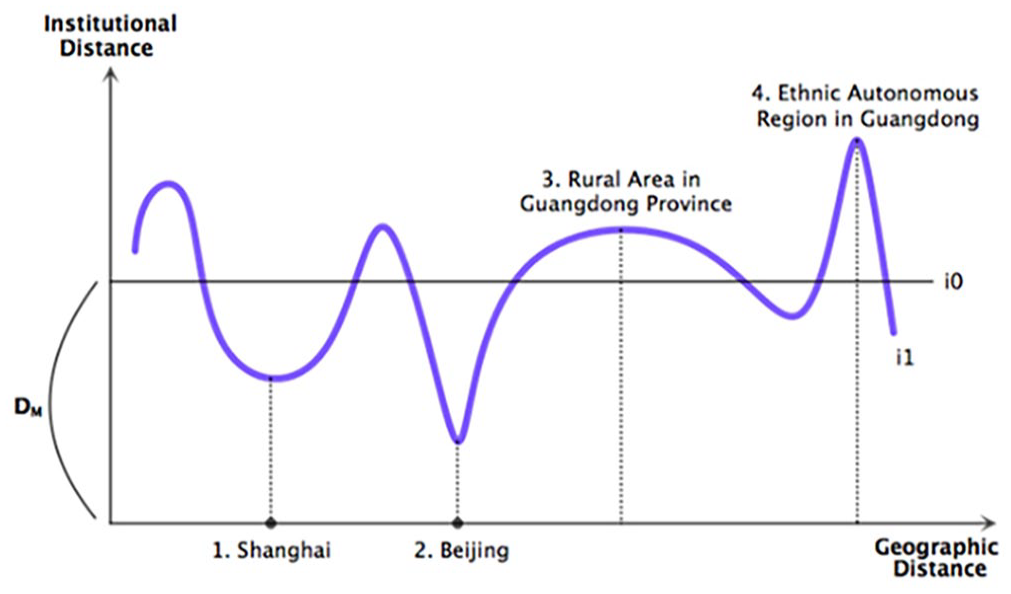
Schematic Representation of Nation-to-Nation Institutional Distance Accounting for Locality-to-Locality Institutional Topography
A more nuanced and intricate theory of how institutional legitimacy is established, given the interplay between national and subnational formal and informal institutions, may be useful for a variety of scenarios, including post-entry expansion. While firms typically originally enter first- and second-tier cities in going abroad, it is key to discern governance patterns within countries in expanding beyond these traditional competitive foci. Our framework identifies beneficial expansion paths along flatter—rather than steeper—topographies from a first city entered, given rapidly falling governance quality in the latter scenario. Expanding in a “smooth” geographical progression outward from the initial starting point of a first-tier city towards its proximal satellite cities and suburbs may be preferable—in terms of fit and speed—to entering geographically distant cities of similar size to the focal city, especially if such geographically continuous expansion targets cities with diaspora from the home country (Karreman et al., 2017; Kelley et al., 2013) or co-ethnic cores (Hutzschenreuter & Harhoff, 2020; Stallkamp et al., 2018).
Our review provides implications for theory development on institutional configurations, which recognizes that firm behavior is shaped jointly by the constraints, incentives, and resources provided by formal and informal institutions. We allude to proportions of institutionally “thick” regions accounted for by formal versus informal institutions, as well as that of more remote and rural areas with “thinner” institutions, or “a low density of industry and organization” (McDonald et al., 2018: 805). Given that the proactive development of institutions generates returns over time (Zhou et al., 2002) and space (Stallkamp et al., 2018), further research is needed to identify the drivers of local progress in “flattening” institutional topographies at home and abroad. Firms from largely flat—that is, unchanging—countries, or flat on a certain institutional dimension, for example, religion in Iran, could be less aware of the difficulties in dealing with disparate institutions in other countries (at least for the relevant dimension; Dow et al., 2016). In confronting such liability of foreignness, taking a topographical view may provide alternative “routes” in within-country expansion. It would further be instructive for research on location choice, among other firm outcomes, to examine the differential ease by which firms can move from institutionally thinner to thicker areas, and vice versa, along rising and waning topographies within countries.
Conclusion
Drawing on concepts from geography and management, our review highlights the critical role of subnational institutions in shaping firm activity and offers a comprehensive lens to assess the complexities of governance within countries. By considering polycentricity, elevation, and slope, firms can optimize their decisions in ways not possible with non-topographical thinking. Future research should continue to explore the intricate dynamics present across institutional topographies to enhance our understanding of their impact on firm behavior and performance.
