






Abstract
Organizations must simultaneously ensure “appropriateness” through adherence to rules and norms while promoting novelty through risk-taking. Ethical leadership, characterized by an emphasis on normatively appropriate conduct and the encouragement of ethical behavior through communication, reinforcement, and decision-making, is increasingly viewed as a way to navigate this tension and enhance creativity—the generation of novel and useful ideas. We modify this positive view by investigating two distinct but not mutually exclusive mechanisms underlying the effects of ethical leadership from a certainty perspective. Specifically, we propose that ethical leadership provides employees with relational certainty, which fosters psychological safety and thereby boosts creativity, and with normative certainty, which promotes conformity and hence constrains creativity. We also identify intolerance of uncertainty as a boundary condition for these countervailing explanations. Across three complementary studies, including a meta-analysis (Study 1) and two field studies with multi-source and multi-wave data (Study 2 and Study 3), the results largely supported our hypotheses. Our research contributes to the literature by introducing a certainty perspective that clarifies both the positive and negative relationships between ethical leadership and employee creativity, as well as by identifying a key boundary condition.
Keywords
Ethical leadership focuses on normatively appropriate behavior and encourages employees to act ethically through communication, reinforcement, and decision-making (Brown, Treviño, & Harrison, 2005). Research has demonstrated the positive role of ethical leadership in promoting prosocial behavior and other beneficial outcomes (e.g., the reduction of unethical behaviors). This line of work has adopted social learning and social exchange theories, which highlight how leaders can serve as moral role models and build reciprocal relationships that promote prosocial behavior and reduce unethical behaviors (Brown et al., 2005; Peng & Kim, 2020).
By contrast, ethical leadership’s implications for creativity, defined as the production of novel and appropriate ideas (Anderson, Potočnik, & Zhou, 2014), appear less straightforward. Ethical leadership is relevant to creativity because it directly speaks to a central tension that organizations face: the need to uphold “appropriateness” by adhering to established norms and rules while also promoting novelty to remain competitive. Managing this tension requires leaders who can support both rule-following and risk-taking behavior. Ethical leadership is well-suited to manage this tension as it not only emphasizes rules and norms, thereby reinforcing appropriateness, but also fosters trust and care, which enable risk-taking and, consequently, novelty. Ethical leadership has been advocated as a key predictor for fostering creativity (Chen & Hou, 2016; Gu, Tang, & Jiang, 2015), and numerous organizations have embraced this perspective in practice (Shafique, Ahmad, & Kalyar, 2020). As such, a prevailing view has emerged that ethical leadership is positively related to employee creativity (Chen & Hou, 2016; Zhu-Ireland & Shalley, 2023).
However, this positive view may be premature, for several reasons. First, most research relies on social learning and exchange theories (Peng & Kim, 2020), which focus on the positive, promotive aspects of ethical leadership (Banks, Fischer, Gooty, & Stock, 2021). This focus risks circular reasoning by defining ethical leadership in terms of its positive outcomes and then using those outcomes to justify its value (Moore, Mayer, Chiang, Crossley, Karlesky, & Birtch, 2019). Thus, there is an urgent need to move beyond extant theories and develop a balanced perspective that, consistent with ethical leadership’s dual emphasis on support and rule adherence, captures both its enabling and constraining functions in shaping employee behavior. Second, both creativity and unethical behavior involve deviation from norms, with creativity representing constructive deviation and unethical behavior representing destructive deviation (Zhou, Wang, Bavato, Tasselli, & Wu, 2019). Given ethical leadership’s well-established role in reducing unethical behavior, an important yet underexplored question arises: might it also suppress creativity, a form of positive deviance? As such, the relationship between ethical leadership and creativity may not be consistently positive. Third, recent meta-analysis has revealed a non-significant relationship between ethical leadership and creativity (Winchester & Medeiros, 2023), suggesting the existence of potentially offsetting mechanisms (Zhao, Lynch, & Chen, 2010). Indeed, ethical leadership may simultaneously promote and inhibit creativity, making its role in shaping creativity less straightforward than previously theorized. On the one hand, ethical leadership fosters trust, care, and open communication, promoting psychological safety and hence encouraging employees to embrace the uncertainties and risks involved in creative work. On the other hand, ethical leadership emphasizes adherence to rules and norms, fostering conformity that may inhibit the exploration necessary for creativity.
To address these theoretical omissions and tensions, we draw on previous literature (Berger & Bradac, 1982; Griffin & Grote, 2020; Lind & van den Bos, 2002) to develop a certainty perspective on ethical leadership. We argue that ethical leadership provides employees with two distinct forms of certainty: relational certainty, which promotes psychological safety through signals of care and principled behavior, and normative certainty, which promotes conformity through clear behavioral expectations. While relational certainty supports employees to engage in interpersonal risk-taking and creative work, normative certainty constrains creativity by reinforcing rule adherence. We further propose intolerance of uncertainty (i.e., an individual’s tendency to find it unacceptable that an adverse event might occur; Carleton, Norton, & Asmundson, 2007) as a boundary condition. Specifically, employees with high intolerance of uncertainty are particularly attuned to leadership cues that provide situational clarity. As a result, ethical leadership’s dual effects on creativity via psychological safety and conformity are more pronounced among these employees. Overall, our theorizing leads to a moderated dual-pathway model, in which ethical leadership exerts competing effects on creativity that are amplified by employees’ intolerance of uncertainty (see Figure 1).
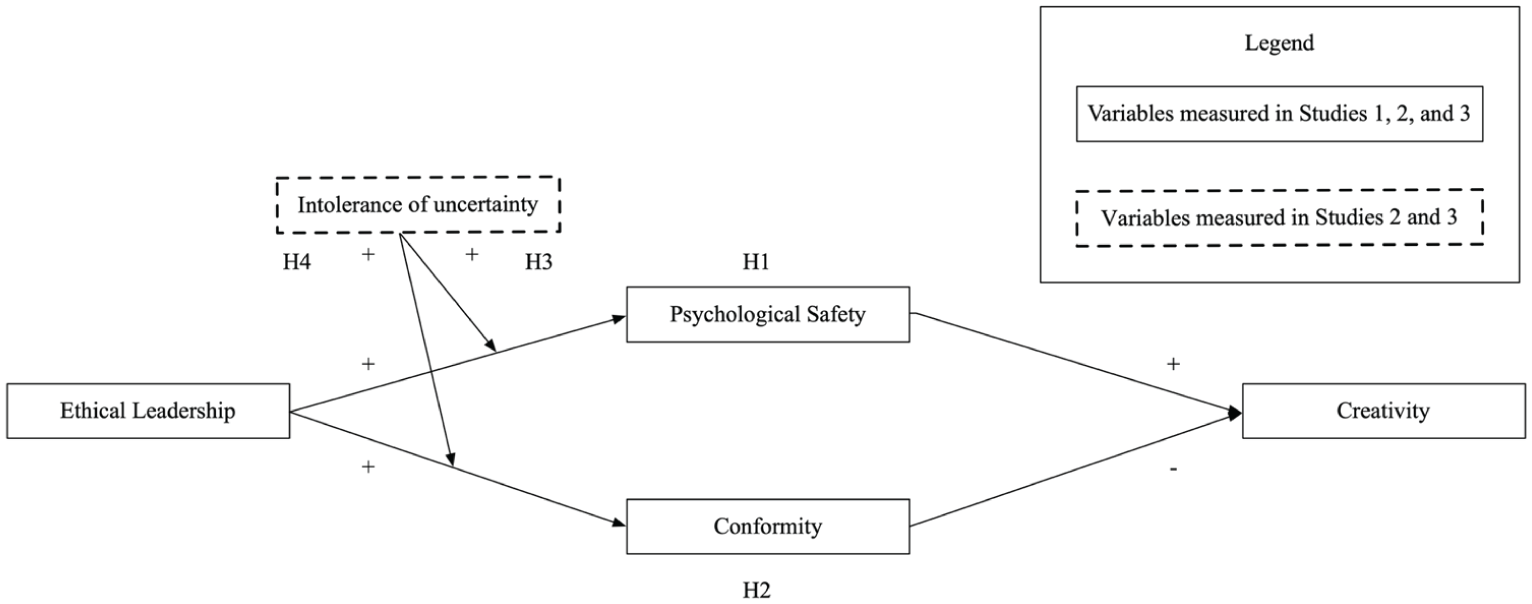
Conceptual Model
Our contributions involve three interrelated theoretical insights that advance research on ethical leadership and its impact on creativity. First, we reconceptualize ethical leadership from a certainty perspective. While dominant theoretical accounts, rooted in social learning and social exchange, have primarily cast ethical leaders as moral models or exchange partners (Brown et al., 2005; Peng & Kim, 2020), we reframe ethical leadership as a dual source of situational certainty: ethical leaders function as certainty-enhancing signals that boost relational certainty (predictability of treatment) and normative certainty (clarity of norms). This conceptual shift identifies certainty signaling as a core, but previously overlooked, function of ethical leadership, serving as a stabilizing force for employees in risky and uncertain creative work.
Second, we resolve theoretical tensions in the creativity literature by specifying the counteracting mechanisms through which ethical leadership operates. Prior research has often assumed a positive relationship between ethical leadership and creativity, yet empirical findings have been inconsistent (Winchester & Medeiros, 2023). We address this paradox by developing a dual-pathway model in which ethical leadership simultaneously activates an enabling pathway via psychological safety and a constraining pathway via conformity. This dual-pathway model challenges the prevailing positive view and provides a certainty-perspective-based explanation for why ethical leadership has mixed consequences for creativity.
Third, we enhance theoretical precision by identifying intolerance of uncertainty as a boundary condition of our theorizing. This insight is based on the understanding that the impact of ethical leadership on creativity can depend on individual characteristics (Trevino, 1986; Zhou & Hoever, 2014). Employees differ in their tendency to seek structure, and therefore respond differently to identical leadership signals. For employees high in intolerance of uncertainty, the certainty cues from ethical leaders are more influential, amplifying both the enabling relational pathway and the constraining normative pathway. This distinction clarifies for whom ethical leadership matters more, serving as a boundary condition for the certainty perspective.
Theoretical Background and Hypotheses
Ethical Leadership and Employee Creativity: A Certainty Perspective
Creative work is inherently uncertain, as employees often face the risk of failure and potential disapproval or punishment from supervisors or peers (Breidenthal, Liu, Bai, & Mao, 2020; George & Zhou, 2007; Gong, Cheung, Wang, & Huang, 2012; Gong, Kim, Lee, & Zhu, 2013). To engage in creativity successfully, employees must evaluate and cope with these uncertainties. Accordingly, we propose a certainty perspective to understand how ethical leadership shapes this process. Drawing on uncertainty literature (Berger & Bradac, 1982; Griffin & Grote, 2020; Lind & van den Bos, 2002), we argue that employees are motivated to seek certainty and situational cues—particularly in high uncertainty contexts such as creative work—to guide behavior, reduce interpersonal risk, and identify appropriate courses of action. We propose that ethical leadership serves as a primary source of situational clarity, helping employees regulate risk during creative processes. Ethical leadership—characterized by principled behavior, care, and open communication (Brown et al., 2005)—alters the uncertainty landscape by replacing ambiguity with structure. Converging evidence confirms that ethical leadership acts as a certainty-enhancing signal that reduces employee uncertainty across diverse contexts, including organizational change, over-qualification, and innovation (Ma, Shang, Zhao, Zhong, & Chan, 2023; Rahaman, Camps, Decoster, & Stouten, 2020; Rasheed, Hameed, Kaur, & Dhir, 2024). By consistently modeling moral conduct and clarifying expectations, ethical leaders help employees to make sense of uncertain situations by signaling both interpersonal reliability and normative clarity.
A central tenet of our certainty perspective is that ethical leadership provides relational certainty, defined as the confidence individuals have in their interpersonal standing and predictable treatment (Knobloch, 2005; Knobloch & Solomon, 1999; Walker, Bauer, Cole, Bernerth, Feild, & Short, 2013). In creative work, employees need assurance that taking risks will not result in mistreatment or marginalization. Ethical leaders generate this certainty through their demonstrated integrity, trustworthiness, and genuine care for followers (Brown et al., 2005; Kalshoven, Den Hartog, & De Hoogh, 2011). By consistently treating employees with dignity and fairness, ethical leaders reduce the interpersonal uncertainty often associated with creative endeavors (Rasheed et al., 2024; Tu, Lu, Choi, & Guo, 2019). This stable relational foundation assures employees that their standing with the leader is secure, fostering the psychological safety necessary for creative engagement (Ahmad, Gao, Su, & Khan, 2023; Tu et al., 2019).
Simultaneously, ethical leadership provides normative certainty, which reflects clarity regarding behavioral expectations, evaluative standards, and the boundaries of appropriate conduct (Theisen & Germar, 2024; Zhang, George, & Chattopadhyay, 2020). Creative processes are often hampered by ambiguity regarding what constitutes acceptable deviation versus punishable error (Zhou, 2022). Ethical leaders resolve this ambiguity by explicitly articulating ethical standards, enforcing rules, and utilizing rewards and punishments to align behavior with organizational norms (Brown & Treviño, 2006; Brown et al., 2005). This consistent reinforcement signals exactly what is right and how things should be done, thereby reducing evaluative uncertainty (Kim, Lee, Yun, & Spicer, 2026; Mayer, Kuenzi, Greenbaum, Bardes, & Salvador, 2009). However, while it reduces ambiguity, strong normative signaling also delineates rigid boundaries (Goncalo, Chatman, Duguid, & Kennedy, 2015; Madjar, Greenberg, & Chen, 2011). Consequently, normative certainty may paradoxically constrain creativity by increasing pressure to conform to established rules and norms and discouraging the deviance required for novelty (Miron, Erez, & Naveh, 2004; Miron-Spektor, Erez, & Naveh, 2011).
Moreover, our certainty perspective highlights that employees’ responses to uncertainty are not uniform but are shaped by their uncertainty-related dispositions (Griffin & Grote, 2020). One such disposition is intolerance of uncertainty, which reflects the tendency to find potential negative events unacceptable, regardless of their likelihood (Carleton et al., 2007; Dugas, Gosselin, & Ladouceur, 2001), and is associated with a greater tendency to seek and rely on external sources of structure and clarity (Smit & Montag-Smit, 2019). Because ethical leadership functions as a source of relational and normative certainty cues, employees with higher intolerance of uncertainty attend to and rely on these cues more heavily than employees with lower intolerance (Dugas et al., 2001; Grenier, Barrette, & Ladouceur, 2005). In this way, intolerance of uncertainty functions as a critical boundary condition, conditioning the extent to which employees depend on ethical leadership’s certainty-enhancing cues, and thereby amplifying both the enabling and constraining pathways to creativity.
The Mediating Role of Psychological Safety
Guided by our certainty perspective, we posit that ethical leadership functions as a salient source of relational certainty, which refers to the confidence individuals have regarding their interpersonal standing and predictable treatment (Knobloch & Solomon, 1999; Walker et al., 2013). In the workplace, this relational certainty is operationally manifested as psychological safety, defined as the belief that one can take interpersonal and creative risks without fear of negative consequences (Edmondson, 1999; Kahn, 1990; Liang, Farh, & Farh, 2012). By reducing interpersonal unpredictability and signaling reliable support, ethical leaders assure employees that they can act without fear of mistreatment or unjustified punishment (Sun, Park, & Yun, 2024), thereby fostering the sense of safety required for creativity.
Further building on the certainty perspective, we contend that ethical leaders communicate critical information about support (Kahn, 1990), which underpins psychological safety for two reasons (Frazier, Fainshmidt, Klinger, Pezeshkan, & Vracheva, 2017). First, ethical leaders are open-minded, trustworthy, caring, and principled (Kalshoven et al., 2011), which means they acknowledge that creativity entails uncertainty (Tu et al., 2019). By doing so, they provide relational certainty, alleviating employees’ concerns about potential mistreatment (Xu, Loi, & Ngo, 2016) and instilling a sense of safety (Xu, Hannah, Wang, Moss, Sumanth, & Song, 2025). Second, ethical leaders communicate openly and promote positive interpersonal relationships (Brown & Treviño, 2006). They emphasize the acceptance and encouragement of creativity, even when it entails mistakes and relational challenges during the creative process (Rasheed et al., 2024). This approach effectively provides relational certainty in the idea that generating novel ideas is acceptable and therefore also fosters safety.
In addition, research suggests that psychological safety enhances creativity because it gives employees space and permission to question conventional thoughts and behaviors and propose novel solutions to work-related challenges (for reviews, see Frazier et al., 2017; A. Newman, Donohue, & Eva, 2017). For instance, Li, Wu, Brown, and Dong (2022) and Wadei, Chen, Frempong, and Appienti (2021) find that ethical leadership encourages creativity by sending social cues that employees are supported and valued. Thus, we offer our first hypothesis:
Hypothesis 1: Ethical leadership has a positive indirect relationship with employee creativity via increasing psychological safety.
The Mediating Role of Conformity
Ethical leadership is also a key source of normative certainty stemming from clarity about behavioral expectations and evaluative standards (Theisen & Germar, 2024; Zitek & Hebl, 2007); this is because ethical leaders model moral conduct while articulating and enforcing clear rules (Brown & Treviño, 2006; Feldman, 1984). By articulating expectations and utilizing rewards and punishments, ethical leaders reduce ambiguity about what is considered right and how things should be done, and provide moral guidance that helps employees navigate uncertain situations (Ma et al., 2023; Rahaman et al., 2020; Rasheed et al., 2024). Through this process, ethical leadership provides the predictability that employees need to understand the social and evaluative context of their work (Kim et al., 2026). However, this clarity can also generate normative pressure. Although clear standards reduce anxiety, strict norms can narrow the perceived range of acceptable behavior (Goncalo et al., 2015). Therefore, we argue that this normative certainty might also be expressed through conformity (i.e., an adherence to norms and a reluctance toward distinctiveness; Madjar et al., 2011; Miron et al., 2004). From a certainty perspective, conformity serves as a strategy to reduce normative uncertainty in social interactions (Berger & Calabrese, 1975; Hogg & Terry, 2000).
Specifically, according to our certainty perspective, ethical leadership increases conformity in two ways. First, the ethical principles exhibited by leaders encourage employees to adhere to existing norms and standards (Brown & Treviño, 2006), offering clear behavioral guidance that fosters normative certainty. As a result, employees may prioritize accepted behaviors and view unconventional thinking and behaviors as inappropriate (Kundro, 2023; Liu, Liao, Derfler-Rozin, Zheng, Wee, & Qiu, 2020). Second, ethical leaders influence employee behaviors through rewards and punishments (Brown & Treviño, 2006; Brown et al., 2005; Mai, Zhang, & Wang, 2019; Song & Gu, 2020). In this context, uncertainty often arises from a history of punishment for behaviors that deviate from existing norms and rules. Thus, ethical leadership reinforces normative certainty regarding behavioral outcomes, ultimately promoting conformity.
Research has shown that conformity hampers employee creativity by emphasizing adherence to established norms and rules, which restricts divergent thinking and discourages the exploration of unconventional or novel ideas (Magni, Gong, Li, Pan, & Zhou, 2024; Zhou, Shin, Brass, Choi, & Zhang, 2009). Additionally, studies indicate that conformity to established norms and standards limits diverse interpretations and hinders participation in creativity (Madjar et al., 2011). Building on these points, we suggest that employees experiencing conformity induced by ethical leadership face challenges in searching for and integrating the diverse information necessary to generate ideas that deviate from established norms and rules.
Hypothesis 2: Ethical leadership has a negative indirect relationship with employee creativity via increasing conformity.
The Moderating Role of Intolerance of Uncertainty
Building again on the foundation of a certainty perspective, we suggest that individual differences shape how employees respond to uncertainty-related cues. One such difference is intolerance of uncertainty, a tendency which creates a heightened motivation to seek external structure and clarity to regulate this aversion to ambiguity (Griffin & Grote, 2020). Because ethical leadership functions as a certainty-enhancing signal, employees with higher intolerance of uncertainty are more likely to attend to and rely more heavily on the leader’s relational and normative cues (Smit & Montag-Smit, 2019; Sun et al., 2024). Consequently, ethical leadership should exert stronger downstream effects for these employees, amplifying both the enabling and constraining pathways to creativity.
Focusing on the enabling pathway, we expect intolerance of uncertainty to strengthen the positive indirect effect of ethical leadership on creativity via psychological safety. For employees with high intolerance of uncertainty, the interpersonal uncertainty inherent in creative processes, such as the risk of mistakes or rejection, is particularly threatening (Carleton et al., 2007; Tu et al., 2019). These employees respond more positively to and rely more heavily on the relational certainty provided by ethical leaders for two specific reasons. First, as they perceive the potential for mistreatment as highly threatening, they are more attuned to the leader’s trustworthiness and principled nature as essential guarantees of security (Dugas et al., 2001; Sun et al., 2024). Second, anxiety about the unpredictability of creative processes and outcomes leads them to place greater value on the leader’s open communication and relationship-building efforts, as these signals provide the reassurance they need to feel safe despite the risks inherent in creative work (Griffin & Grote, 2020; Rasheed et al., 2024). By contrast, employees low in intolerance of uncertainty are more comfortable with relational risk and ambiguity. They derive less incremental reassurance from the leader’s trustworthiness or open communication, as they do not require such external signals to feel secure, rendering the indirect effect via psychological safety weaker for them than for their less tolerant counterparts (Grenier et al., 2005; Neves, Almeida, & Velez, 2018).
Hypothesis 3: The positive indirect relationship between ethical leadership and employee creativity through psychological safety is stronger (weaker) when employees have higher (lower) intolerance of uncertainty.
Moreover, we expect intolerance of uncertainty to strengthen the constraining pathway through which ethical leadership undermines creativity via conformity. Creative work involves ambiguity not only about outcomes but also about evaluative standards (Zhou, 2022). Employees with high intolerance of uncertainty find this lack of clarity stressful and actively seek definitive guidelines to ensure their behavior is correct (Freeston, Rhéaume, Letarte, Dugas, & Ladouceur, 1994). These individuals rely more heavily on the normative certainty provided by ethical leaders for two reasons. First, as they crave behavioral clarity to manage their anxiety, they adopt the ethical principles modeled by leaders as scripts for appropriate behaviors, leading to stricter adherence (Gerlach & Pfrombeck, 2025). Second, their motivation to avoid the uncertainty of negative evaluation makes the leader’s use of rewards and punishments a salient signal of what to avoid, driving strict conformity in order to ensure predictability (Goncalo et al., 2015; Ma et al., 2023). Conversely, employees low in intolerance of uncertainty accept evaluative ambiguity more readily. They feel less pressure to align their behavior with explicit standards or avoid deviation to feel secure, thereby weakening ethical leadership’s normative influence on conformity for these employees (Dugas et al., 2001; Kim et al., 2026).
Hypothesis 4: The negative indirect relationship between ethical leadership and employee creativity through conformity is stronger (weaker) when employees have higher (lower) intolerance of uncertainty.
Overview of the Studies
We conducted three studies with complementary methods—a meta-analysis and two multi-source, multi-wave field studies—to test our hypotheses. In Study 1, we examined the mediating role of psychological safety (Hypothesis 1) and conformity (Hypothesis 2) using meta-analytic structural equation modeling (MASEM). We did not test the moderating effects due to a lack of information on our moderator in previous studies. In Studies 2 and 3, which employed a multi-wave and multi-source design, we tested all hypotheses, including the moderating effects in field settings. Our multi-method approach follows that of Sherf, Parke, and Isaakyan (2021) and is intended to address the limitations associated with a singular method (Wellman, Tröster, Grimes, Roberson, Rink, & Gruber, 2023), thereby enhancing the overall validity of our research.
Study 1: Method
Literature Search, Inclusion Criteria, and Coding
We conducted a comprehensive literature search, utilizing keywords related to our focal constructs and relationships (e.g., “ethical leadership,” “moral leadership,” “psychological safety,” “conformity,” “rule conformity,” “rule compliance,” “norm conformity,” “norm compliance,” “creativity,” “divergent thinking,” “creative*,” and “innovation”). We searched Web of Science, PsycINFO, Scopus, and ProQuest Dissertations and Theses Global databases, supplemented by backward searches of prior meta-analyses (Bedi, Alpaslan, & Green, 2016; Ng & Feldman, 2015; Peng & Kim, 2020) and narrative reviews (Brown & Treviño, 2006; Ko, Ma, Bartnik, Haney, & Kang, 2018), as well as manual searches of relevant management and applied psychology journals.
Moreover, we utilized six inclusion criteria (see Figure A1, the PRISMA Chart in Appendix A on the online supplemental material, at https://osf.io/mt9jr/?view_only=86d7f04a995d4878854eba69f0c3f821). Studies were included when they reported at least one of the hypothesized relationships, provided sufficient statistics to calculate effect sizes (e.g., correlation coefficient and sample sizes), sampled working individuals, reported independent samples (multiple studies coded separately and each sample used once), and used individual-level data. Construct operationalization followed both construct labels and scale content. “Ethical leadership” encompassed both ethical (Brown et al., 2005) and moral leadership (Cheng, Chou, Wu, Huang, & Farh, 2004). Creativity was mainly measured using established scales (Farmer, Tierney, & Kung-McIntyre, 2003; George & Zhou, 2001; Tierney, Farmer, & Graen, 1999; Zhou & George, 2001). We excluded studies primarily measuring innovation, but considered them in our supplementary analyses.
The first author reviewed all papers to determine eligibility given these inclusion criteria. A research assistant outside the research team reviewed papers excluded by the first author (98.48% agreement; disagreements resolved to 100%). These inclusion criteria yielded 112 primary studies (total sample size = 32,712) found in 103 articles. The first three authors participated in the coding process. After piloting and refining the coding scheme, the first author coded all variables, and a research assistant double-checked all correlation coefficients, sample sizes, and reliabilities (97.80% agreement; discrepancies resolved). Following standard meta-analytic practice (Carpenter, Whitman, & Amrhein, 2021; Koh, Lee, & Joshi, 2019), we used an Excel spreadsheet to record effect sizes, reliabilities, sample sizes, measures, sample characteristics (i.e., industry), study designs (e.g., multi-wave design), and publication status. More coding procedure details for Study 1 are available in Appendix A (see the online supplemental material).
Analytic Strategies
Following Hunter and Schmidt (2004), we applied a random-effects meta-analysis approach. We calculated corrected effect sizes, as well as the variability of relationships. When reliability data were not reported in the studies, the average reliability coefficient derived from the studies reporting data for the same variable was utilized (Combs, Liu, Hall, & Ketchen, 2006; Peng & Kim, 2020). Moreover, we imputed the reliability of objective measures as 1 (e.g., creativity; Sumanth, Černe, Hannah, & Škerlavaj, 2023). We analyzed data with MASEM and full information meta-analytic structural equation modeling (FIMASEM) analyses utilizing the “Shiny App”—https://mgmt.shinyapps.io/masem—from Yu, Downes, Carter, and O’Boyle (2016).
Study 1: Results
Bivariate Relationships From Meta-Analysis
Table 1 shows the results of bivariate relationships. Ethical leadership was positively related to psychological safety (ρ = .46, SDρ = .18, 95% CI [.39, .53]) and conformity (ρ = .31, SDρ = .13, 95% CI [.19, .43]). Psychological safety was positively related to creativity (ρ = .37, SDρ = .20, 95% CI [.30, .45]), while conformity was not significantly related to creativity (ρ = −.13, SDρ = .24, 95% CI [−.32, .06]).
Results of Bivariate Relationships From Meta-analysis in Study 1
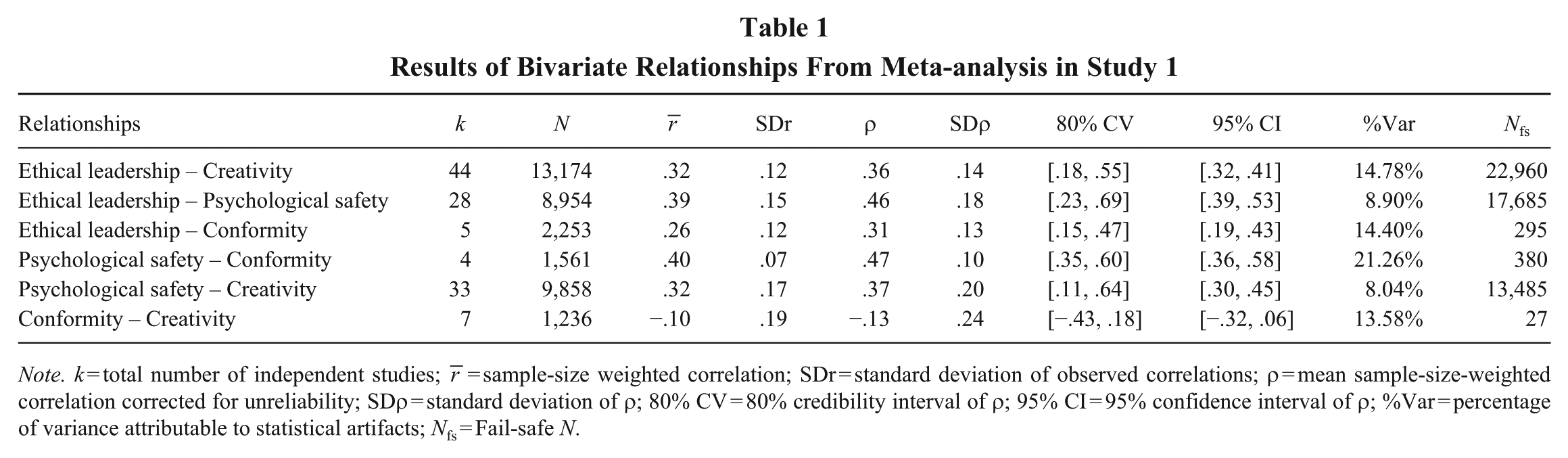
Note. k = total number of independent studies;
Hypotheses Testing
We computed the correlation matrix necessary for the MASEM analysis (for more details, see Table A1 in Appendix A). The harmonic mean of the sample size was 2,749. We specified a saturated path model where all potential relationships and covariances among the variables are estimated (Peng & Kim, 2020). As shown in Figure 2, ethical leadership was positively related to psychological safety (β = 0.46, p < .001), which in turn was positively associated with creativity (β = 0.44, p < .001). Further, the 10,000 iterations of bootstrapping indicated that the indirect relationship between ethical leadership and creativity through psychological safety was positive (indirect effect = 0.200, 95% CI [0.177, 0.224]), supporting Hypothesis 1. At the same time, ethical leadership was positively related to conformity (β = 0.31, p < .001), which in turn was negatively associated with creativity (β = −0.43, p < .001). The indirect relationship between ethical leadership and creativity through conformity was negative (indirect effect = −0.132, 95% CI [−0.151, −0.113]). Thus, Hypothesis 2 was also supported.
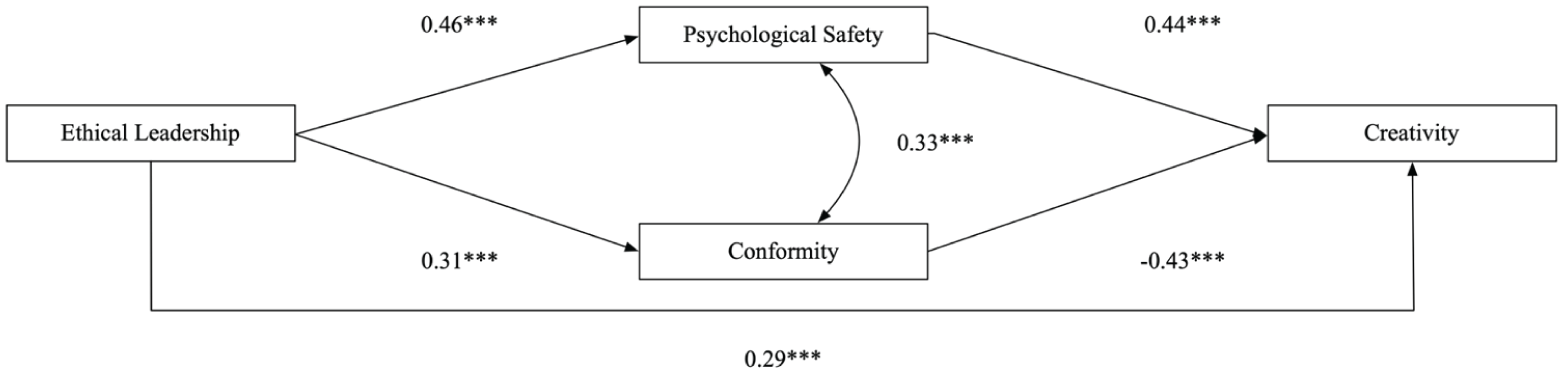
Results from MASEM Analysis in Study 1
Robustness Check and Supplementary Analyses
We conducted a set of robustness checks on potential biases due to methodological factors or publication status (see detailed results in Appendix A). The results revealed that the relationship between ethical leadership and employee creativity did not differ significantly across ethical leadership measures, creativity measures, creativity rating sources, research designs, and sampling industries. Regarding publication bias, results of fail-safe N and funnel plots suggested the findings were robust.
In addition, we conducted a set of supplementary analyses (see detailed results in Appendix A). First, we controlled for transformational leadership and obtained consistent findings from our primary analysis, revealing an incremental explanatory power of ethical leadership beyond transformational leadership. Second, previous evidence at the team level indicates that the relationship between ethical leadership and creativity might be curvilinear (Feng, Zhang, Liu, Zhang, & Han, 2018; Mo, Ling, & Xie, 2019). Although this evidence might not generalize to the individual level, we examined the potential curvilinear relationship between ethical leadership and employee creativity, and the relationship was not significant. Third, we added studies on innovation in a supplementary analysis. Findings were consistent with and without these studies. Finally, to examine the generalizability of these findings, we followed the procedures of Yu et al. (2016) and re-analyzed our model using FIMASEM analysis across 10,000 iterations. The results were comparable to the path coefficients from MASEM.
While Study 1 revealed the counteracting mechanisms, it lacked the information required to test Hypotheses 3 and 4. Hence, we designed Studies 2 and 3 to examine the moderating role of intolerance of uncertainty.
Study 2: Method
Sample and Procedure
For Study 2, we collected data from a biotechnology company in China. With the company’s permission and support, we obtained a roster of 597 employees from the Human Resources (HR) department and extended invitations for their participation in our study. Emphasizing strict confidentiality and research-focused utilization, we incentivized involvement by offering 10 RMB (approximately US$1.5) compensation for each completed survey. Our Study 2 received ethical approval from the Institutional Review Board (IRB) at the university with which the first author is affiliated.
Initially, 597 employees from 63 teams were invited to respond to questions about ethical leadership, intolerance of uncertainty, and demographic details at Time 1. Among them, 471 employees from 63 teams completed the questionnaires, yielding a response rate of 79%. Two months later, at Time 2, the same participants rated psychological safety and conformity, and 63 leaders rated the creativity of each employee they supervised. A total of 397 employees (response rate = 66%) and 58 leaders (response rate = 92%) completed Time 2 questionnaires. According to D. A. Newman (2014), listwise deletion leads to biased estimates. As such, we made use of all available data in our analyses with full information maximum likelihood estimation, which led to a matched final sample of 471 leader–member dyads from 63 teams. Employees’ average age was 30.37 years (SD = 6.98), and the average leader–member dyadic tenure was 2.83 years (SD = 7.37); 56% of participants were female, and 84% held a college diploma or above.
Measures
All measures were translated and back-translated (Brislin, 1986) and rated on a 7-point Likert scale (1 = strongly disagree, 7 = strongly agree). We measured ethical leadership with the 10-item scale (e.g., “Conducts his/her personal life in an ethical manner”; α = .96) from Brown et al. (2005), intolerance of uncertainty with the 12-item scale (e.g., “Unforeseen events upset me greatly”; α = .91) from Carleton et al. (2007), psychological safety with the five-item scale (e.g., “In my work unit, I can express my true feelings regarding my job”; α = .93) from Liang et al. (2012), conformity with the four-item scale (e.g., “It is considered extremely important here to follow the rules”; α = .79) from Patterson et al. (2005), and creativity with Baer and Oldham’s (2006) four-item scale (e.g., “This employee is a good source of creative ideas”; α = .94), which is a shortened version of the scale developed by Zhou and George (2001). We controlled for the age, gender, and education level of employees, as well as leader–member dyadic tenure, as several studies have found that individual differences in these demographic variables influence creativity (Gong, Huang, & Farh, 2009; Hora, Badura, Lemoine, & Grijalva, 2022; Scott & Bruce, 1994). The results were consistent with and without control variables (see detailed results in Appendix B).
Analytic Strategies
Because individual employees were nested within teams, we assessed clustering by calculating the intraclass correlation coefficient (ICC) for the dependent variable, creativity (Bliese, Maltarich, & Hendricks, 2018). The ICC was 0.20, below the commonly used threshold of 0.30 (McNeish, Stapleton, & Silverman, 2017), suggesting notable but controllable between-team variance. Based on recent methodological guidance (McNeish et al., 2017), we used clustered robust standard errors (CR-SEs) to address the non-independence of observations within teams. CR-SEs offer several benefits in this context: they adjust standard errors to account for clustering without requiring multilevel models, preserve the interpretability of single-level regression results, and serve as a reliable option when the number of clusters (63 teams in this study) is not sufficient for more complex hierarchical modeling (McNeish et al., 2017; Rabe-Hesketh & Skrondal, 2006). We applied the CR-SEs approach using the “type = complex” specification in Mplus (Version 8.3; Muthén & Muthén, 2017).
Next, we conducted confirmatory factor analyses (CFAs). Given the relatively large number of estimated parameters compared to our sample size (Bentler & Chou, 1987) and model complexity concerns (Williams, Hanna, & Smith, 2026), we followed Landis, Beal, and Tesluk’s (2000) recommendation to create three-item parcels for each latent construct by combining items in sequential order (also see Carnevale, Huang, Yam, & Wang, 2022; Fehr, Yam, He, Chiang, & Wei, 2017; Wang, Law, Zhang, Li, & Liang, 2019), which can improve model trustworthiness (Kline, 2018; Yoon et al., 2023). For constructs with an odd number of items, the final parcel included one more or one fewer item as necessary (e.g., ethical leadership: 10 items; Items 1–3, 4–6, 7–10).
We tested the hypotheses by estimating a path model that included both mediators simultaneously, the direct effect of ethical leadership on creativity, and the interaction between ethical leadership and intolerance of uncertainty predicting creativity. This specification accounts for covariance between mediators to isolate their unique effects (Bauer, Preacher, & Gil, 2006; Preacher, Rucker, & Hayes, 2007) and prevents bias in unconditional and conditional indirect effect estimates by controlling for potential moderation of the direct path (Edwards & Lambert, 2007). To enhance interpretability, we grand mean-centered ethical leadership and intolerance of uncertainty when creating the interaction term for the path analyses. We analyzed the data using Mplus. In addition, we used a Monte Carlo simulation approach with 10,000 iterations to estimate the 95% confidence intervals for the indirect effects using R (Preacher & Selig, 2012).
Study 2: Results
Descriptive Statistics and CFAs
Table 2 shows the descriptive statistics. The CFAs results indicated that the hypothesized 5-factor model fitted the data well (χ2[80] = 126.65, p < .05; CFI = .99; TLI = .98; RMSEA = .04; SRMR = .04) and exhibited a better fit than the alternative models (for more details, see Table C1 in Appendix C). To enhance transparency and assess the robustness of our parceling strategy, we conducted a series of supplemental analyses (see detailed results in Appendix C) following the recommendations by Williams et al. (2026). Together, these supplemental analyses support the validity of our parceling strategy.
Descriptive Statistics and Correlations Among Variables in Study 2
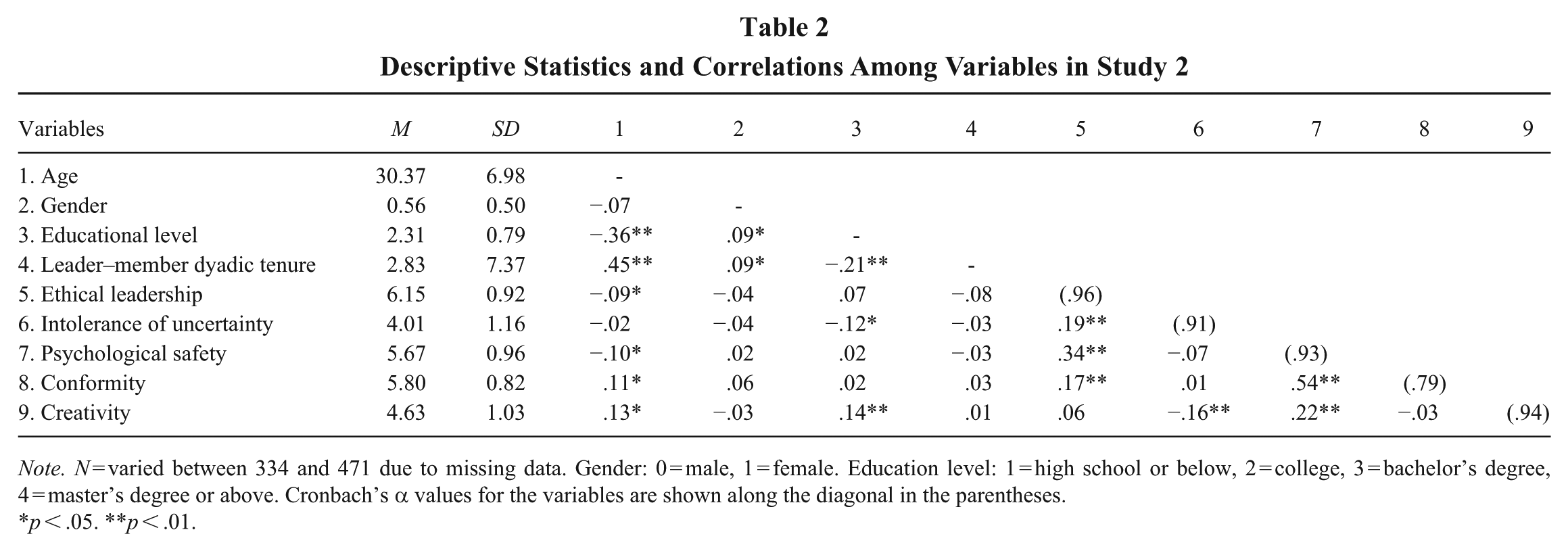
Note. N = varied between 334 and 471 due to missing data. Gender: 0 = male, 1 = female. Education level: 1 = high school or below, 2 = college, 3 = bachelor’s degree, 4 = master’s degree or above. Cronbach’s α values for the variables are shown along the diagonal in the parentheses.
p < .05. **p < .01.
Hypotheses Testing
As shown in Table 3, the results of path analyses suggested that ethical leadership was positively related to psychological safety (b = 0.50, SE = 0.09, p < .001), which in turn was positively related to creativity (b = 0.35, SE = 0.12, p = .003). Additionally, the Monte Carlo simulation with 10,000 iterations indicated that the indirect relationship between ethical leadership and creativity via psychological safety was positive (indirect effect = 0.175; 95% CI [0.057, 0.319]). Hence, the results of Study 2 supported Hypothesis 1, as did the results of Study 1. Moreover, ethical leadership was positively related to conformity (b = 0.21, SE = 0.06, p < .001), which in turn was negatively related to creativity (b = −0.20, SE = 0.10, p = .03). The indirect relationship between ethical leadership and creativity via conformity was negative (indirect effect = −0.043; 95% CI [−0.098, −0.003]). Thus, the results of Study 2 supported Hypothesis 2, again consistent with Study 1.
Results From Path Analyses in Study 2
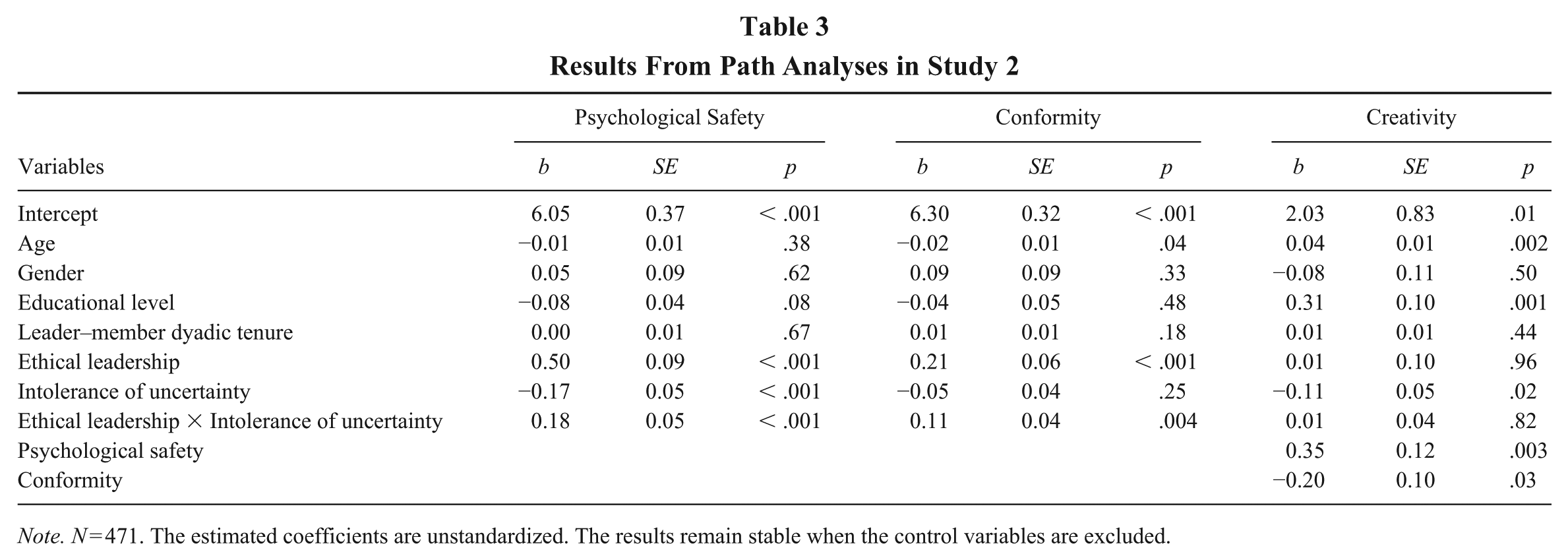
Note. N = 471. The estimated coefficients are unstandardized. The results remain stable when the control variables are excluded.
Table 3 also reveals a positive interactive effect of ethical leadership and intolerance of uncertainty on psychological safety (b = 0.18, SE = 0.05, p < .001). Simple slope analyses showed that this relationship was stronger among employees high in intolerance of uncertainty (b = 0.71, SE = 0.14, p < .001); than for those low in intolerance of uncertainty (b = 0.30, SE = 0.06, p < .001), the difference is significant (b = 0.41, SE = 0.11, p < .001). Figure 3 presents this interaction effect. Further, the conditional indirect relationship between ethical leadership and creativity through psychological safety was positive when intolerance of uncertainty was high (conditional indirect effect = 0.246; 95% CI [0.074, 0.462]), but weaker, albeit still significant, when intolerance of uncertainty was low (conditional indirect effect = 0.103, 95% CI [0.031, 0.191]). Thus, Hypothesis 3 was supported.
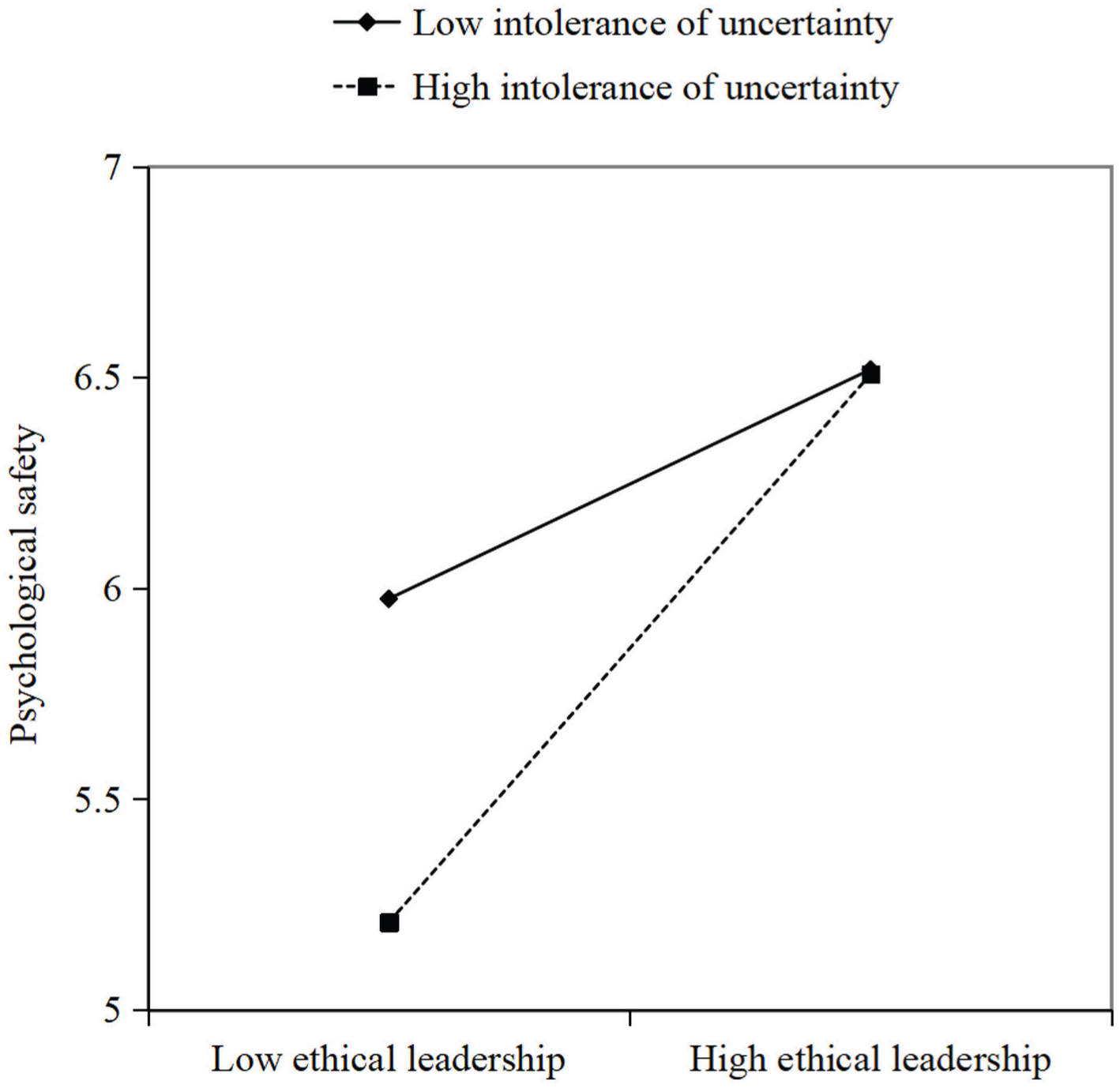
Moderation Effects Between Ethical Leadership and Intolerance of Uncertainty on Psychological Safety in Study 2
As shown in Table 3, the interaction effect of ethical leadership and intolerance of uncertainty on conformity was positive (b = 0.11, SE = 0.04, p = .004). Simple slope analyses showed that this relationship was stronger among employees high in intolerance of uncertainty (b = 0.34, SE = 0.09, p < .001), than for those low in intolerance of uncertainty (b = 0.08, SE = 0.05, p = .07); the difference was significant (b = 0.26, SE = 0.09, p = .003). Figure 4 presents this interaction effect. Additionally, the conditional indirect relationship between ethical leadership and creativity via conformity was negative at high levels of intolerance of uncertainty (conditional indirect effect = −0.070, 95% CI [−0.154, −0.004]), but not significant at low levels (conditional indirect effect = −0.017, 95% CI [−0.047, 0.002]), providing support for Hypothesis 4.
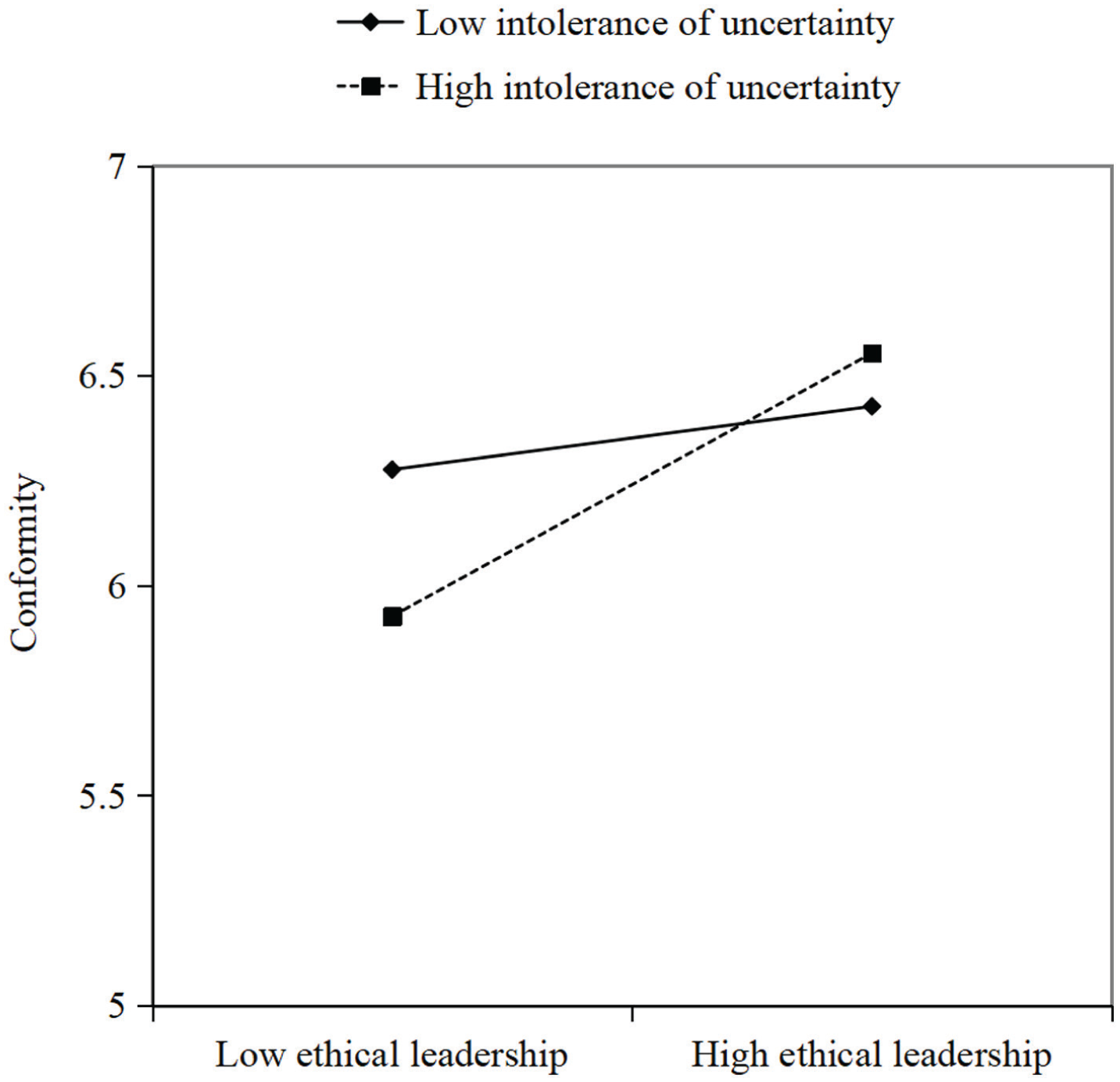
Moderation Effects Between Ethical Leadership and Intolerance of Uncertainty on Conformity in Study 2
Supplementary Analyses and Discussion
We conducted a set of supplementary analyses for Study 2 that revealed similar outcomes to the analyses conducted in Study 1 (see detailed results in Appendix B). For example, the results did not show an inverted U-shaped relationship between ethical leadership and creativity (Mo et al., 2019). Next, we present Study 3, a three-wave, multi-source design that improves upon Study 2 by better separating our model variables and further replicating the moderating role of intolerance of uncertainty.
Study 3: Method
Sample and Procedure
We collected data from three technology companies in China for Study 3. With the companies’ permission and cooperation, we obtained a roster of 430 employees from the HR departments and invited them to participate. Participants were assured of strict confidentiality, informed that the data would be used solely for research purposes, and compensated with 5 RMB (approximately US$0.75) for each completed survey. Study 3 also received ethical approval from the IRB at the first author’s affiliated university.
At Time 1, 412 employees from 108 teams completed a survey assessing ethical leadership, intolerance of uncertainty, and demographic details, yielding a response rate of 96%. Approximately 1 month later (Time 2), the same employees were invited to rate psychological safety and conformity, with 388 employees responding (response rate = 90%). One month thereafter (Time 3), team leaders were invited to rate employee creativity; 107 leaders (99% response rate) evaluated 381 employees (89% response rate). Consistent with D. A. Newman (2014), we avoided potential bias from listwise deletion by utilizing all available data through full information maximum likelihood estimation, resulting in a matched final sample of 412 leader–member dyads from 108 teams. Participants’ average age was 27.98 years (SD = 4.44), and average leader–member dyadic tenure was 2.56 years (SD = 1.23); 72% of participants were male, and 99% held a college diploma or above.
Measures
We followed the same translation-back-translation procedure used in Study 2 to ensure the appropriateness of all our measures. A 7-point Likert scale (1 = strongly disagree, 7 = strongly agree) was used for all variables in this study. For ethical leadership (α = .96), intolerance of uncertainty (α = .87), and psychological safety (α = .92), we again used the same measures as in Study 2. We measured conformity with Miron and colleagues’ (2004) four-item scale (e.g., “I adhere to accepted rules in my area of work”; α = .78), which is a more widely used scale for measuring conformity in previous field studies. We measured creativity with the 13-item scale (e.g., “This employee suggests new ways to achieve goals or objectives.”; α = .98) from Zhou and George (2001). By using different scales to measure key constructs in our model, we aim to increase the robustness and generalizability of our conclusions. As in Study 2, we controlled for employees’ age, gender, education level, and leader–member dyadic tenure. Results were consistent with and without control variables (detailed results are available in Appendix D).
Analytic Strategies
Similar to Study 2, individual employees were nested within teams. We assessed clustering by calculating the ICC for the dependent variable, creativity (Bliese et al., 2018). The ICC was 0.53, which exceeds the commonly used threshold of 0.30 (McNeish et al., 2017), indicating that the CR-SEs approach used in Study 2 was not suitable for addressing the non-independence of observations. Therefore, we conducted multilevel path analyses using Mplus (Version 8.3; Muthén & Muthén, 2017) to test all hypotheses simultaneously while accounting for covariance.
Consistent with Study 2, we included the direct effect of ethical leadership on creativity as well as the interaction between ethical leadership and intolerance of uncertainty predicting creativity to control for potential moderation of the direct path (Edwards & Lambert, 2007). Moreover, following Enders and Tofighi (2007), Zhang, Zyphur, and Preacher (2009), and Preacher, Zyphur, and Zhang (2010), we group-mean centered the independent variable, moderator, and mediators to isolate within-group variance. To ensure model parsimony, we modeled all paths with fixed slopes (Shi, Johnson, Liu, & Wang, 2013). Multilevel mediation and conditional multilevel mediation effects were tested using a Monte Carlo simulation with 10,000 iterations in R to estimate 95% confidence intervals for indirect effects (Preacher & Selig, 2012).
Study 3: Results
Descriptive Statistics and CFAs
Table 4 shows the descriptive statistics. We conducted multilevel CFAs, following the parceling procedures used in Study 2. The results indicated that the hypothesized 5-factor model fitted the data well (χ2[83] = 190.64, p < .05; CFI = .97; TLI = .96; RMSEA = .06; SRMRwithin = .05; SRMRbetween = .04) and exhibited a better fit than the alternative models (for more details, see Table E1 in Appendix E). As in Study 2, we conducted a series of supplemental analyses to enhance transparency and assess the robustness of our parceling strategy (see detailed results in Appendix E) following the recommendations of Williams et al. (2026).
Descriptive Statistics and Correlations Among Variables in Study 3
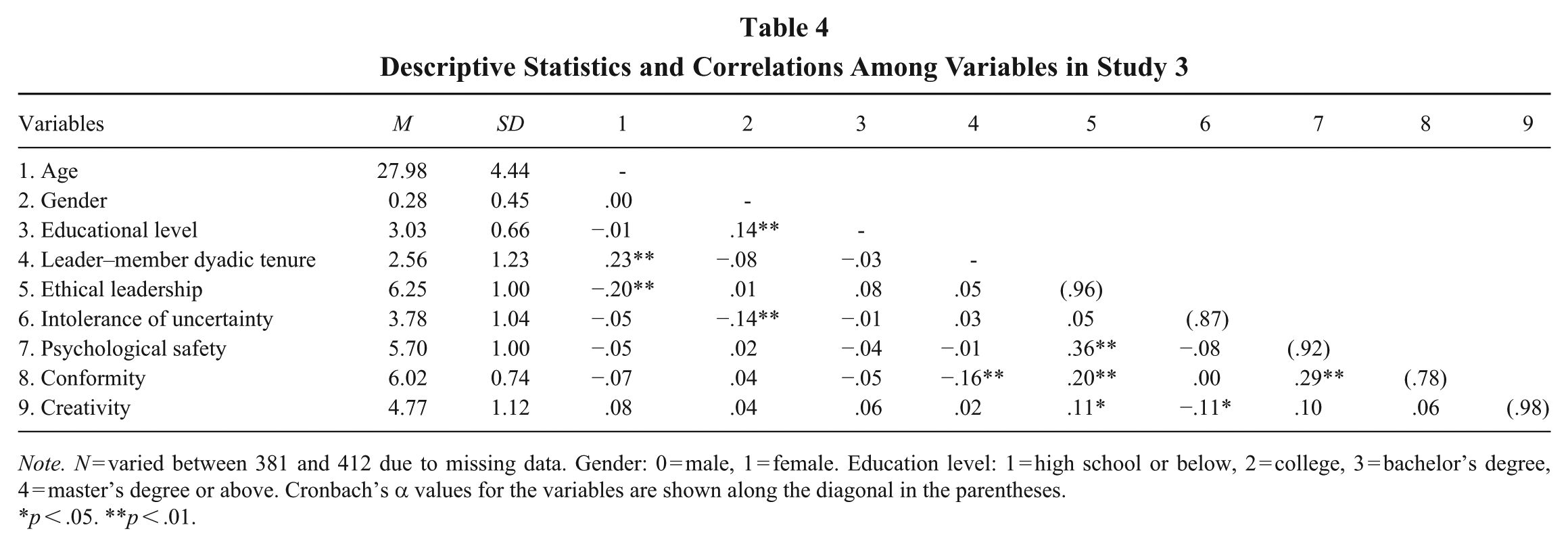
Note. N = varied between 381 and 412 due to missing data. Gender: 0 = male, 1 = female. Education level: 1 = high school or below, 2 = college, 3 = bachelor’s degree, 4 = master’s degree or above. Cronbach’s α values for the variables are shown along the diagonal in the parentheses.
p < .05. **p < .01.
Hypotheses Testing
As shown in Table 5, results of path analyses suggested that ethical leadership was positively related to psychological safety (b = 0.37, SE = 0.09, p < .001), which in turn was positively related to creativity (b = 0.10, SE = 0.04, p = .02). Additionally, the Monte Carlo simulation with 10,000 iterations indicated that the indirect relationship between ethical leadership and creativity via psychological safety was positive (indirect effect = 0.037; 95% CI [0.006, 0.076]). Moreover, ethical leadership was positively related to conformity (b = 0.19, SE = 0.06, p = .001), which in turn was negatively related to creativity (b = −0.09, SE = 0.05, p = .04). The indirect relationship between ethical leadership and creativity via conformity was negative (indirect effect = −0.018; 95% CI [−0.042, −0.001]). To summarize, in line with Studies 1 and 2, Study 3 supported Hypothesis 1 and Hypothesis 2.
Results From Path Analyses in Study 3
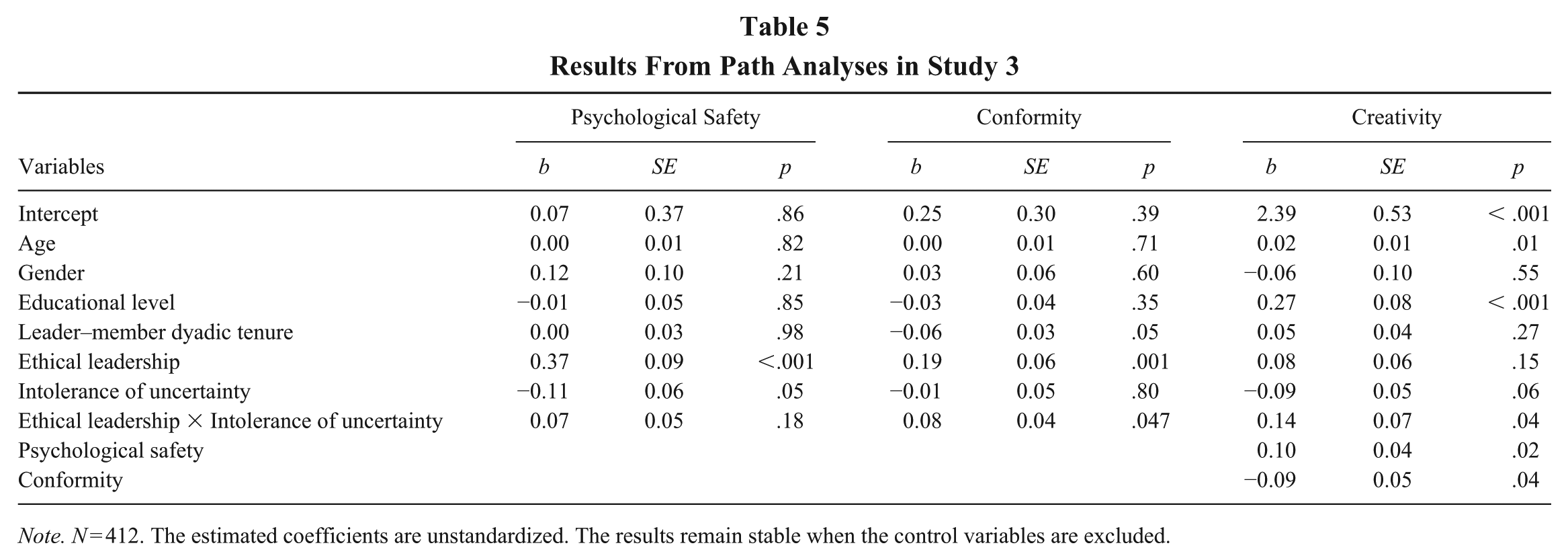
Note. N = 412. The estimated coefficients are unstandardized. The results remain stable when the control variables are excluded.
As Table 5 also illustrates, the interaction effect of ethical leadership and intolerance of uncertainty on psychological safety was not significant (b = 0.07, SE = 0.05, p = .18). Given that a significant moderation effect is a prerequisite for a moderated mediation relationship, we did not further test this hypothesis. Thus, Hypothesis 3 was not supported. However, the interaction effect of ethical leadership and intolerance of uncertainty on conformity was positive (b = 0.08, SE = 0.04, p = .047). Simple slope analyses further showed that the relationship between ethical leadership and conformity was stronger among employees high in intolerance of uncertainty (b = 0.26, SE = 0.08, p = .001), than for those low in intolerance of uncertainty (b = 0.12, SE = 0.06, p = .06); the difference was significant (b = 0.14, SE = 0.07, p = .047). We plotted the interaction effect in Figure 5. Additionally, the conditional indirect relationship between ethical leadership and creativity via conformity was negative at high levels of intolerance of uncertainty (conditional indirect effect = −0.024, 95% CI [−0.055, −0.001]), but not significant at low levels (conditional indirect effect = −0.011, 95% CI [−0.031, 0.001]), providing support for Hypothesis 4.
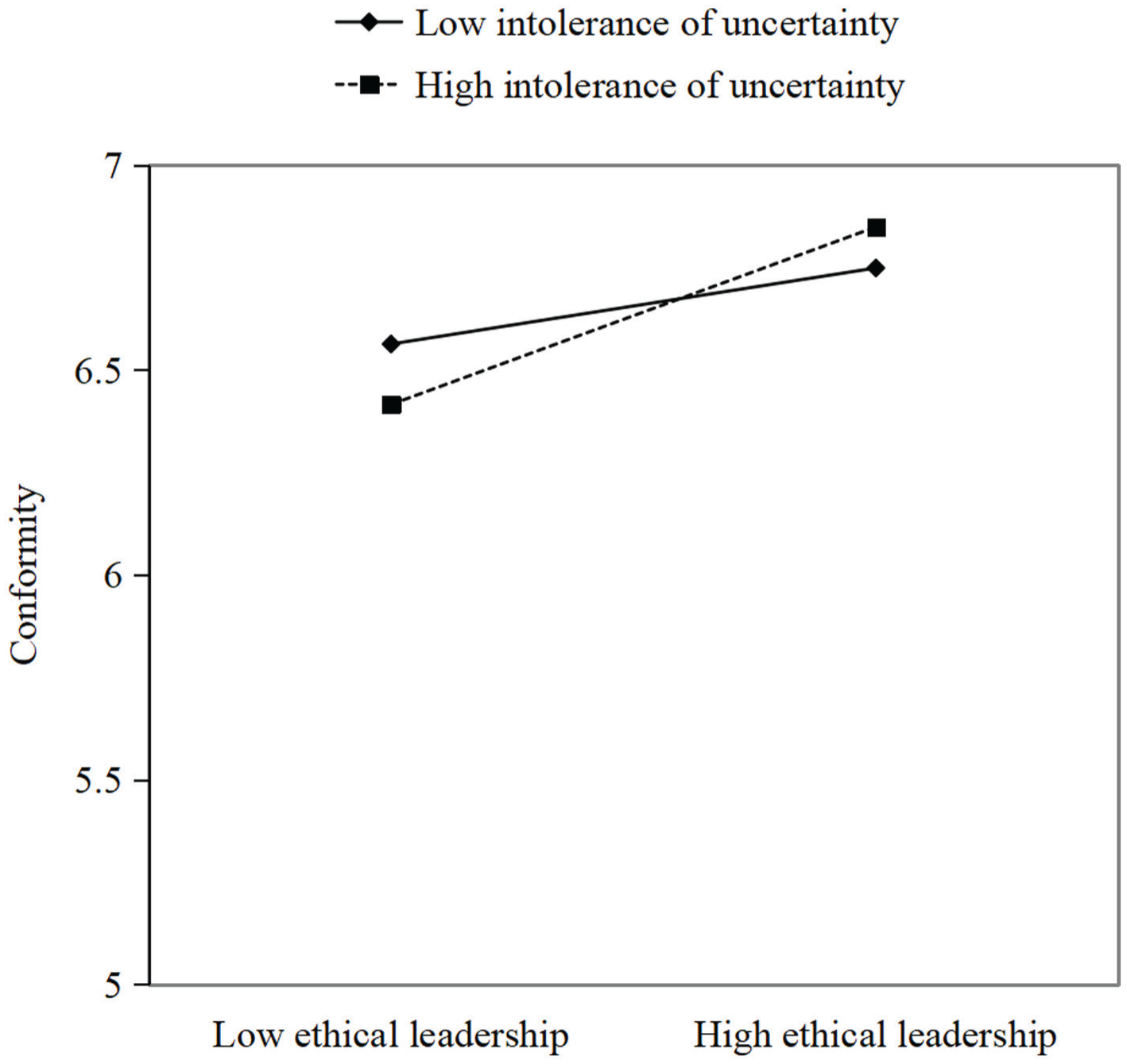
Moderation Effects Between Ethical Leadership and Intolerance of Uncertainty on Conformity in Study 3
Supplementary Analyses
Similar to Studies 1 and 2, in Study 3 we examined the potential curvilinear relationship between ethical leadership and employee creativity (Feng et al., 2018). Results did not support an inverted U-shaped relationship between ethical leadership and creativity (see detailed results in Appendix D).
General Discussion
Our objective was to conceptualize ethical leadership from a certainty perspective, theorize the two countervailing pathways through which it influences creativity, and demonstrate a boundary condition that shapes the two pathways. Across our meta-analysis and two field studies, we found that psychological safety consistently mediated a positive effect, whereas conformity mediated a negative effect of ethical leadership on creativity. Furthermore, intolerance of uncertainty amplified the positive indirect effect via psychological safety in Study 2. Across Studies 2 and 3, the negative indirect effect via conformity was also contingent on employees’ intolerance of uncertainty.
A key nuance in our findings concerns the relationship between conformity and creativity. Initially, the conformity–creativity association was non-significant in the bivariate meta-analytic evidence in Study 1 and in the zero-order correlations in Studies 2 and 3; however, the MASEM and path analyses revealed a significant negative effect, consistent with our hypotheses. This discrepancy likely reflects methodological differences, in three respects. First, bivariate estimates test associations in isolation, whereas multivariate models estimate focal paths while accounting for covariances among variables (Aguinis, Pierce, Bosco, Dalton, & Dalton, 2011; Bergh et al., 2016). Because piecemeal models sacrifice information by ignoring dependencies across equations (Bauer et al., 2006), simultaneous estimation is necessary to eliminate spurious correlations and yield accurate unique pathways (Preacher et al., 2007; Shi et al., 2013). Second, in nested data, raw correlations conflate within-team and between-team effects (Preacher et al., 2010; Zhang et al., 2009), whereas our analyses in Studies 2 and 3 explicitly model this nested structure, thereby yielding unbiased estimates (McNeish et al., 2017). Finally, correlated mechanisms can produce suppression, such that a focal relationship appears weak in bivariate analyses but strengthens once a relevant third variable is included (Friedman & Wall, 2005). Documenting such suppression can help recover unique effects masked by competing pathways (Mackinnon, Krull, & Lockwood, 2000; Mackinnon, Lockwood, & Williams, 2004; Salgado, Blanco, & Moscoso, 2019).
Implications for Research
Our findings offer several valuable implications for theory and research on ethical leadership and creativity. First, we advance the ethical leadership literature by developing a certainty perspective that reframes ethical leadership as a dual source of situational certainty. Prevailing frameworks rooted in social learning and social exchange (Brown et al., 2005; Peng & Kim, 2020) primarily emphasize prosocial role modeling and reciprocity; yet these perspectives provide limited leverage for explaining how ethical leaders shape employee reality beyond moral emulation. By integrating insights from the uncertainty literature (Berger & Bradac, 1982; Griffin & Grote, 2020; Lind & van den Bos, 2002), we theorize that ethical leaders supply critical certainty signals through consistent moral conduct and norm reinforcement (Brown et al., 2005). This position reframes ethical leadership not merely as a source of moral influence but as a dual source of situational certainty: relational certainty regarding interpersonal standing and predictable treatment and normative certainty regarding behavioral standards. Consequently, our work integrates the supportive and norm-enforcing elements of ethical leadership into a unified theoretical account (Kalshoven et al., 2011), offering a parsimonious explanation for how ethical leadership reduces ambiguity and acts as a stabilizing force for employees in uncertainty-laden work.
Second, we contribute to creativity research by identifying specific mechanisms that explain the tension regarding ethical leadership’s impact on creativity. Because creativity is inherently uncertain and requires norm deviation (George & Zhou, 2007; Gong et al., 2013), it is sensitive to leadership that simultaneously reduces interpersonal risk and enforces norms and standards. While prior research has often assumed a positive link between ethical leadership and creativity (Chen & Hou, 2016; Gu et al., 2015), recent meta-analytic evidence suggests inconsistent or offsetting effects (Winchester & Medeiros, 2023). Moving beyond these conflicting findings, we explicate the counteracting psychological processes at play: ethical leadership promotes creativity by increasing psychological safety (managing relational certainty) while simultaneously inhibiting it by fostering conformity (managing normative certainty). 1 By mapping these opposing pathways, we not only challenge the assumption that positive leadership styles yield exclusively positive creative outcomes, but also illustrate how ethical leadership can act as a double-edged sword in the creative process.
Third, we reveal intolerance of uncertainty as a boundary condition for the effects of ethical leadership, aligning with the person-by-situation interaction framework (Trevino, 1986; Zhou & Hoever, 2014). This insight not only strengthens our certainty perspective by specifying a boundary condition but also extends research on intolerance of uncertainty. Specifically, most research has treated intolerance of uncertainty primarily as a vulnerability factor in clinical or individual decision-making contexts (Birrell, Meares, Wilkinson, & Freeston, 2011; Carleton, 2012; Jensen, Kind, Morrison, & Heimberg, 2014). By contrast, we redirect this focus to the organizational domain, positing that this trait significantly influences the utility of leadership signals. Because employees differ in their desire for structure and tendency to regulate aversion to ambiguity (Griffin & Grote, 2020), the certainty-enhancing function of ethical leadership is not equally valuable across all individuals. Our key insight is that for employees with higher intolerance of uncertainty, their leaders’ relational and normative cues become more salient and influential. This heightened sensitivity amplifies both the enabling pathway through psychological safety and the constraining pathway through conformity. This finding also refines the boundary of the certainty perspective, demonstrating that the impact of ethical leadership depends on followers’ desire for structure. Together, our findings address the questions of why and when ethical leadership influences creativity, thereby offering a robust certainty perspective on ethical leadership and creativity.
Implications for Practice
In addition to their theoretical benefits, our findings offer actionable implications for promoting creativity without sacrificing ethical standards. First, to leverage the enabling pathway via psychological safety, leaders are encouraged to translate ethical intent into concrete behaviors that reduce interpersonal risk; this involves explicitly framing experimentation as legitimate, treating mistakes as learning opportunities rather than moral failures, and demonstrating procedural fairness in idea evaluation. By signaling that their support is reliable, leaders can empower employees to voice novel suggestions without fear of unjustified treatment.
Second, leaders could also mitigate the constraining pathway that we identify by clarifying that ethical standards are rooted in high-level principles related to moral conduct, rather than specific operational methods. Since ethical leadership can unintentionally discourage deviation from the status quo, organizations should establish structural safeguards for constructive deviance. Implementing practices such as separating idea generation from moral evaluation, using structured brainstorming, and assigning devil’s advocate roles can help employees differentiate between unethical behaviors (which are prohibited) and challenging the status quo (which is encouraged). This approach ensures that the ethical leader supports, rather than suppresses, creativity.
Third, leaders should tailor their approach according to employees’ intolerance of uncertainty. For employees high in intolerance of uncertainty, who crave structure, leaders can provide certainty through clear goals, timelines, and decision criteria, thereby creating a psychologically safe framework that enables employees to tolerate the uncertainty inherent in generating novel ideas. Instead of vague autonomy, leaders should offer specific guardrails and reassure these employees that well-intentioned deviations in methods or processes remain within ethical boundaries. Diagnosing uncertainty sensitivity allows leaders to provide necessary structure without over-controlling the creative process.
Limitations and Future Directions
Despite these contributions, our research has certain limitations that suggest compelling avenues for future study. First, several bivariate relationships in our meta-analysis (Study 1) were based on a limited number of independent studies. To address statistical power concerns (Valentine, Pigott, & Rothstein, 2010), we restricted our analyses to relationships with a minimum of four independent studies, consistent with prior meta-analyses (Ng & Feldman, 2015; Peng & Kim, 2020). Nevertheless, we recommend interpreting these specific bivariate estimates with caution, and encourage scholars to revisit these relationships with meta-analytical techniques as more primary studies accumulate. Second, our research primarily focused on the generation of creative ideas rather than their subsequent implementation. Future research could examine whether ethical leadership exerts different effects across the creation and implementation phases. For instance, creation involves greater ambiguity and risk, making relational certainty especially critical. By contrast, implementation requires clear guidelines, shared norms, and concerted action, making normative certainty more salient. Finally, while we identified intolerance of uncertainty as a key individual boundary condition, we encourage future research to examine situational moderators. One promising direction is the study of an error-avoidance climate (Gronewold, Gold, & Salterio, 2013), which heightens attention to mistakes and risk prevention. In such contexts, ethical leadership’s norm-reinforcing signals may become more salient, strengthening the conformity-based pathway while discouraging experimentation.
Conclusion
We sought to identify why and for whom ethical leadership helps or hinders employee creativity by testing two counteracting mechanisms and a boundary condition based on a certainty perspective of ethical leadership. Our meta-analysis and field surveys show that ethical leadership has both positive and negative relationships with employee creativity, and that these relationships occur through two opposing pathways: psychological safety and conformity. Further, the positive indirect effect via psychological safety and the negative indirect effect via conformity were contingent on employees’ intolerance of uncertainty. It is our hope that these findings can inform research and practice alike about the perils and benefits of using ethical leadership to foster creativity.
Footnotes
Acknowledgements
We thank Action Editor Orlando C. Richard, as well as the anonymous reviewers, for their help and guidance throughout the revision process of this article. We also thank Dr. Jia (Joya) Yu for her generous guidance and helpful suggestions on our meta-analytic structural equation modeling. This project was supported by the National Natural Science Foundation of China (72572164, 72172153, 72232009, and 72102226).
