







Abstract
In this paper, we seek to clarify competing perspectives on the relationship between workplace staffing conditions and organizational citizenship behaviors (OCBs). On one hand, workers may engage in more OCBs in the face of understaffing, reflecting a greater inclination to help during their organizations’ time of need. On the other hand, workers may engage in fewer OCBs due to understaffing, reflecting a withdrawal of effort under stressful circumstances to protect and conserve resources. Integrating social exchange principles with research on human resource (HR) attributions, we examine these two possibilities and their underlying mechanisms and boundary conditions across three multi-wave survey studies. We find some support for both perspectives. That is, manpower understaffing can prompt OCBs via greater felt challenge, whereas expertise understaffing can subvert OCBs via lower felt obligation to the organization but can also promote OCBs via greater felt obligation to one’s coworkers. Additionally, expertise understaffing can either enhance or diminish feelings of challenge, leading to downstream effects on OCBs, depending upon circumstances. Finally, relations between understaffing and proposed mediators varied based on perceived chronicity of staffing conditions and attributions regarding the degree to which staffing conditions were due to factors external to the organization (e.g., the COVID-19 pandemic), respectively. Implications of our results for theory and practice are discussed.
Keywords
Understaffing, when there are insufficient personnel resources to complete the essential tasks and functions of a work unit, is a common and consequential work stressor that has historically plagued certain industries (Hudson & Shen, 2015). For instance, staffing shortages in healthcare have long been rampant (e.g., Andel, Tedone, Shen, & Arvan, 2022), and turnover rates have customarily been high in retail and hospitality sectors (e.g., Mani, Kesavan, & Swaminathan, 2015). However, even amongst industries that do not suffer from widespread understaffing, pressures to cut costs can lead certain organizations to engage in understaffing practices, often to the detriment of worker job performance and well-being (Hudson & Shen, 2018). Moreover, economic and societal trends can also induce widespread understaffing, as evidenced by the “Great Resignation” where large numbers of workers left their jobs in the wake of the COVID-19 pandemic (Xu, Dust, & Liu, 2023).
When faced with these difficulties, organizations may hope their employees will go “above and beyond” minimum job requirements to engage in organizational citizenship behaviors (OCBs)—discretionary behaviors that contribute to the goals of the organization by bettering its social and psychological environment (e.g., volunteering for extra work assignments, helping coworkers; Spector, Bauer, & Fox, 2010). This suggests a positive relationship between understaffing and OCBs, as employees may rally to help in response to their organizations’ hardships. Indeed, meta-analytic research has found that understaffing can lead to presenteeism, whereby employees still come to work while ill (Miraglia & Johns, 2016), which has been conceptualized as a form of OCB (Johns, 2010).
Yet, there are also indications in the literature that organizations may not necessarily get their wish. Namely, prior meta-analytic research uncovers that work stressors are often negatively related to OCBs (Eatough, Chang, Miloslavic, & Johnson, 2011), indicating that when dealing with demanding working conditions, workers may instead seek to conserve their resources and engage in fewer extra-role behaviors. This suggests a negative relationship between understaffing and OCBs, as understaffing typically increases work stressors (i.e., workload, role ambiguity; Hudson & Shen, 2018).
Given these competing perspectives, we draw upon social exchange principles (Cropanzano, Anthony, Daniels, & Hall, 2017) to test mechanisms that may underlie positive (i.e., greater feelings of obligation to coworkers, greater feelings of challenge) or negative (i.e., lesser feelings of obligation to the organization) associations between understaffing and OCBs. Integrating research on human resource (HR) attributions (Nishii, Lepak, & Schneider, 2008), we further theorize that workers’ willingness to help in the face of understaffing may depend upon contextual cues or their attributions regarding the “why” behind understaffing conditions (e.g., due to factors outside the organization’s control). Finally, based upon theory and research that indicates understaffing is more appropriately conceptualized as a multidimensional construct (Hudson & Shen, 2015, 2018), we also explore whether these relations differ for manpower understaffing (i.e., lack of necessary staff in the work unit) versus expertise understaffing (i.e., lack of required knowledge, skills, or abilities in the work unit).
We test various aspects of our model (see Figure 1) across three complementary studies. Study 1 focuses on mediating mechanisms, employing a multi-wave field study to test our model in a sample of temporary workers over a timeframe aligned with their work assignment. Studies 2 and 3 incorporate moderating effects. Specifically, Study 2 consists of a multi-wave field study with a sample of permanent workers and opportunistically explored employees’ attributions of staffing conditions to current events (i.e., the COVID-19 pandemic), and Study 3 involves examining employee attributions regarding staffing conditions more directly and comprehensively, as well as incorporated a multi-source (i.e., supervisor) perspective.
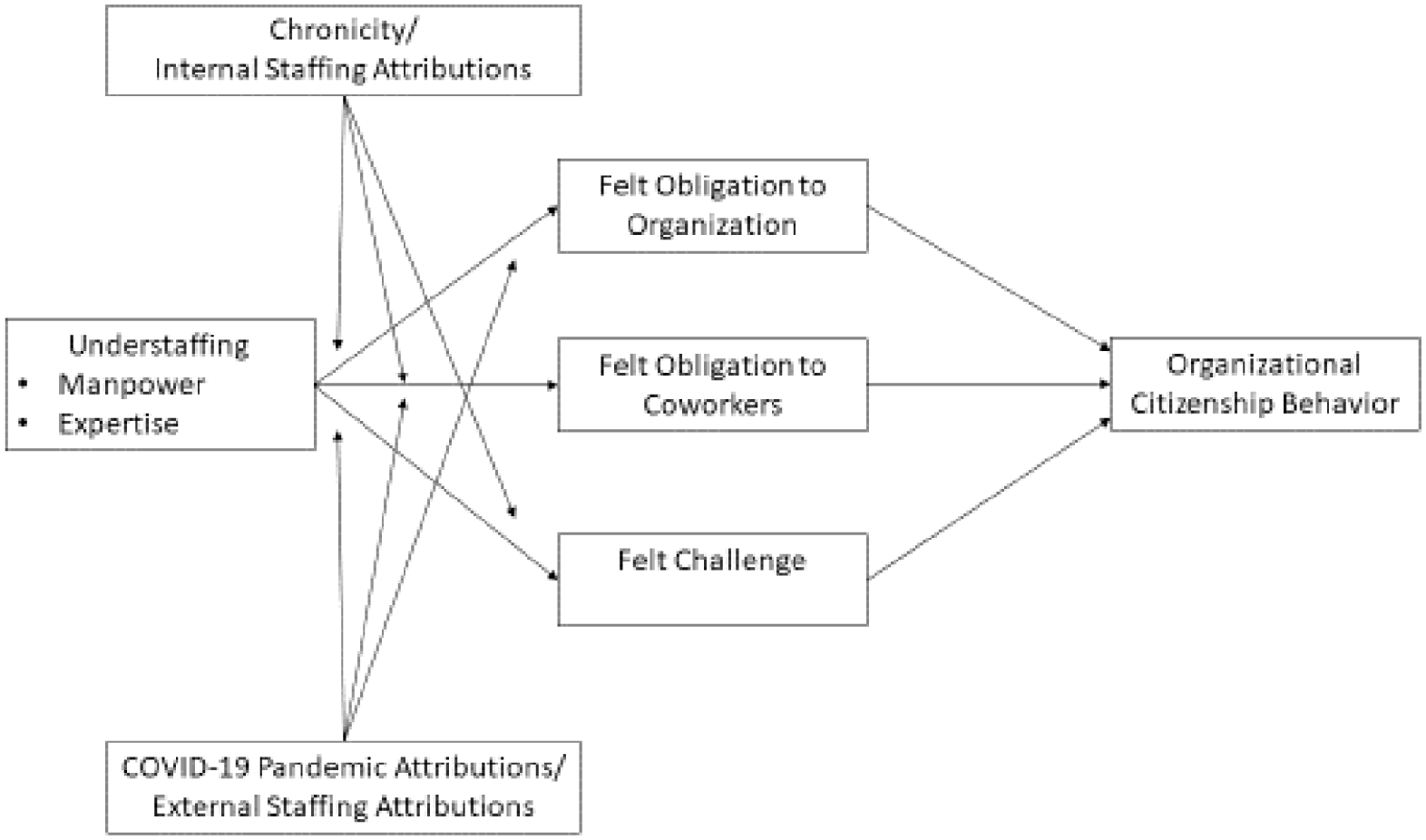
Conceptual Model
The current paper contributes to the human resource management and occupational health psychology literatures in a number of important ways. First, despite the ubiquity and impact of understaffing, limited research has been devoted to understanding this stressor from a psychological perspective (Hudson & Shen, 2015). In particular, we know little about how workers cope with or respond to understaffing conditions (cf. Shen, Chang, Cheng, & Kim, 2019). Consequently, we contribute to the literature by elucidating when workers are more or less apt to respond to understaffed work conditions in a more prosocial manner. Second, this work adds to a small, but growing, literature that highlights the value of conceptualizing understaffing as a multidimensional construct (e.g., Hudson & Shen, 2015, 2018), helping to fill out the unique nomological networks of manpower and expertise understaffing. Third, there remains significant ambiguity regarding relations between work stressors and OCBs broadly in the literature, such that positive, negative, and null effects have all been observed (e.g., Eatough et al., 2011; Mazzola & Disselhorst, 2019). By unpacking potential mediators and moderators, we contribute to the literature by providing insights as to how these different associations may arise.
Understaffing and OCBs: Hands off the Tiller?
Organizational scholars have long applied social exchange theory to explain reciprocity (or lack thereof) between workers and their organizations (Cropanzano et al., 2017). Specifically, social exchanges differ from traditional economic exchanges in that they reflect an ongoing and invested relationship whereby the two parties are expected to exchange unspecified favors and benefits over time, rather than engage in well-defined and quid pro quo transactions (Blau, 1964). Accordingly, Organ (1988) has argued that OCBs are a key way by which workers may choose to uphold their end of the social exchange relationship.
Workers view their employer as obligated to provide adequate staffing levels so that they can do their jobs (Ho, Rousseau, & Levesque, 2006; Woodrow & Guest, 2020). Therefore, understaffing is seen as a violation of the principles of social exchange by the organization. As a result, workers should experience lower felt obligation to their organization, defined as the “prescriptive belief regarding whether one should care about the organization’s well-being and should help the organization reach its goals” (Eisenberger, Armeli, Rexwinkel, Lynch, & Rhoades, 2001: 42). Subsequently, when felt obligation to the organization is low, workers should refrain from OCBs. This is because in this case the worker does not feel that they “owe” the organization anything. For example, Wu, Weisman, Sung, Erdogan, and Bauer (2022) argue that under such circumstances workers would neither feel a personal responsibility to help nor experience prosocial motivation given that the organization has lost their goodwill. Supporting these arguments, past empirical research indicates that felt obligation to the organization and OCBs are positively correlated (e.g., Eisenberger et al., 2001; Wu et al., 2022).
However, this past work has typically not distinguished between OCB directed toward the organization (OCB-O) versus directed toward individuals (OCB-I; Dalal, 2005). Although the link between felt obligation to the organization and OCB-O may be more obvious given the match in target, we contend that obligation to the organization likely predicts OCBs generally, including those directed toward coworkers. As workers are members of their work organizations, the obligation an employee feels to their company may trickle-down to encompass their coworkers. Alternatively, based on the concept of indirect reciprocity (Blau, 1964), workers may view helping their coworkers as a means to helping their organization, expecting coworkers to “pay it forward.” Thus, understaffing may ultimately undermine OCBs directed to the organization and individuals by eroding felt obligation to the organization.
Hypothesis 1: There is an indirect effect between understaffing and OCBs via felt obligation to the organization, such that understaffing is negatively related to felt obligation to the organization, which in turn is positively associated with OCBs.
Understaffing and OCBs: All Hands on Deck?
Although contemporary social exchange theorizing typically emphasizes principles of equity and reciprocity, alternative criteria for guiding decisions about whether and how to invest resources have long been recognized. Namely, one could decide to help based upon need (Deutsch, 1975). This would suggest that workers may be more prone to engaging in OCBs when understaffing is more dire.
Even though understaffing may decrease felt obligation to one’s organization, it could also increase felt obligation to one’s coworkers. In fact, qualitative research shows that understaffing makes the need to come together and help one another salient amongst coworkers (e.g., Boyd, Tuckey, & Winefield, 2014; Yanchus, Ohler, Crowe, Teclaw, & Osatuke, 2017). Thus, we expect that understaffing is associated with feeling obligated toward coworkers, which then promotes OCBs. Furthermore, obligations to coworkers may foster OCBs broadly, extending beyond those overtly directed at coworkers. There is evidence that when staffing is inadequate, employees often end up engaging in behaviors that are typically classified as OCB-O, such as forgoing time off (e.g., Allard & Whitfield, 2024). However, employees engage in these behaviors to avoid adding to coworkers’ already heavy workloads, rather than to benefit the organization.
Hypothesis 2: There is an indirect effect between understaffing and OCBs via felt obligation to coworkers, such that understaffing is positively related to felt obligation to coworkers, which in turn is positively associated with OCBs.
Additionally, we posit that understaffing may affect the nature of one’s work. Namely, when personnel resources are scarce, individuals may be more likely to be called upon to carry out unfamiliar or stretch tasks or responsibilities out of necessity (Hudson & Shen, 2015, 2018). In line with these arguments, Greenberg, Wang, and Dossett (1982) found that individuals predicted fewer workers handling a fixed set of tasks would result in greater job enrichment for each group member. Ganster and Dwyer (1995) observed that workers in more understaffed groups did in fact experience increased perceived task scope and skill utilization. Further, Hudson and Shen (2018) found that both manpower and expertise understaffing were related to higher quantitative workload—the number of tasks to be completed. Manpower understaffing also predicted higher qualitative workload—the mental effort needed to complete tasks. As workload is often held up as the “prototypical” challenge stressor (Podsakoff, Freiburger, Podsakoff, & Rosen, 2023), we predict that understaffing is positively related to felt challenge, feelings that the situation provides opportunities for growth or mastery (Folkman & Lazarus, 1985). In turn, felt challenge should fuel OCBs. This is because felt challenge motivates investment in and involvement with one’s organization (Boswell, Olson-Buchanan, & LePine, 2004), and OCBs represent a critical way in which workers contribute to their workplace.
Hypothesis 3: There is an indirect effect between understaffing and OCBs via felt challenge, such that understaffing is positively related to felt challenge, which in turn is positively associated with OCBs.
Contextual Cues and Staffing Attributions
We further theorize that employees do not respond uniformly to understaffing. That is, workers’ reactions to understaffing depend upon their attributions regarding its causes. One contextual factor that may shape employees’ staffing attributions is the chronicity of staffing levels. Namely, when understaffing is more chronic, workers may be more apt to perceive that this is a deliberate strategy adopted by their organization, leading to internal attributions. This then contributes to more unfavorable reactions to understaffing, and fewer OCBs downstream.
Indeed, the logic that consistency of actions promotes internal attributions has been robustly supported by classic attribution theory and research (e.g., Kelley, 1973; Kelley & Michela, 1980). Moreover, prior research indicates that HR strength—comprised of the consistency of HR practices across time and situations alongside their distinctiveness (i.e., the degree to which HR practices stand out and capture attention) and consensus (i.e., the degree to which HR practices are agreed upon by stakeholders, particularly in terms of fairness)—serves as a key antecedent of HR attributions (Hu & Oh, 2022). In other words, the how of HR practices informs employees’ understanding of why their organization is enacting these HR practices.
Research on employees’ HR attributions indicates that workers distinguish between two types of internal attributions: (a) positive or commitment-focused (i.e., the organization cares about the well-being of employees) and (b) negative or control-focused (i.e., the organization seeks cost-savings by exploiting employees; Hu, Oh, & Agolli, 2025; Nishii et al., 2008). More chronic (vs. acute) understaffing may be negatively associated with the former, and positively associated with the latter. Specifically, when organizations allow understaffing to persist for long periods, employees may interpret this as a lack of care for the well-being of its workers (Hudson & Shen, 2015) or a desire to take advantage of them. Therefore, we expect chronicity—or its associated internal staffing attributions—to moderate the relationship between understaffing and proposed mediators, such that more problematic effects are observed when inadequate staffing is more sustained. That is, the negative relationship between understaffing and felt obligation to the organization is stronger, whereas the positive relationships between understaffing and felt obligation to coworkers and felt challenge is weaker, when employees perceive staffing conditions as more chronic, view staffing practices as less motivated by care for employee well-being, or attribute them more to cost-savings motives.
Hypothesis 4: Chronicity or less favorable internal staffing attributions moderate the indirect effect between understaffing and OCBs via (a) felt obligation to the organization, (b) felt obligation to coworkers, or (c) felt challenge. This moderation occurs at the first stage of the mediation, such that greater chronicity strengthens the negative association between understaffing and felt obligation to the organization and attenuates positive associations between understaffing and felt obligation to coworkers and felt challenge.
There may also be situations where employees recognize that understaffing occurred due to circumstances outside the control of their employer. Case in point: the COVID-19 pandemic. This novel virus contributed to understaffing in certain industries due to increases in workload and absenteeism as well as the need to accommodate social distancing (e.g., healthcare, education; Andel et al., 2022). Additionally, the “Great Resignation,” when many workers quit their jobs in the midst and aftermath of the pandemic (Xu et al., 2023), led to widespread understaffing. Under these conditions, employees may be more understanding of—or even galvanized by—understaffing, leading to more favorable reactions and more OCBs downstream.
The COVID-19 pandemic serves as just one example of external circumstances that can influence workplace staffing levels. Seminal research on HR attributions acknowledges that workers can make external attributions for their organization’s HR practices (Nishii et al., 2008), but external attributions have rarely been examined in practice (Hu et al., 2025). Moreover, Nishii and colleagues’ (2008) measure of HR attributions equates external influences with labor unions, which is a very limited conceptualization. Thus, we propose that employees’ attribution that understaffing is due to factors beyond their organization’s control, regardless of what outside entity or event they see as the cause, will moderate the relationship between understaffing and proposed mediators. That is, the negative relationship between understaffing and felt obligation to the organization is weaker, whereas the positive relationships between understaffing and felt obligation to coworkers and felt challenge is stronger, when employees perceive staffing conditions are more strongly the result of factors external to their company.
Hypothesis 5: Attributions of staffing conditions to the COVID-19 pandemic specifically or external staffing attributions generally moderate the indirect effect between understaffing and OCBs via (a) felt obligation to the organization, (b) felt obligation to coworkers, or (c) felt challenge. This moderation occurs at the first stage of the mediation, such that greater external attributions attenuate the negative association between understaffing and felt obligation to the organization and strengthens positive associations between understaffing and felt obligation to coworkers and felt challenge.
Manpower Understaffing Versus Expertise Understaffing
Understaffing can take different forms, as a lack of sufficient personnel resources can encompass both missing needed staff (i.e., manpower understaffing) as well as absence of required knowledge, skills, and abilities within the group (i.e., expertise understaffing; Hudson & Shen, 2015). Although the two types tend to be positively correlated, they are conceptually and empirically distinct (Andel et al., 2022; Hudson & Shen, 2018; Pindek, Hayman, Howard, Arvan, & Spector, 2025; Shen et al., 2019). Thus, we explore whether the nature of the relationship and the processes linking manpower versus expertise understaffing to OCBs differ.
Hudson and Shen (2015) speculated that manpower understaffing may be viewed more positively, as the work group possesses the necessary “know how” and may perceive achieving group goals as still attainable with some extra effort. This, in turn, should engender more OCBs. By contrast, expertise understaffing may be viewed more negatively, as workers may perceive group objectives as unlikely to be attained given that the group lacks the requisite expertise, which may take time to develop. Furthermore, employees may view their organization as unreasonable in expecting them to perform adequately under these suboptimal circumstances, leading to lower felt obligation to the organization and a lower likelihood of OCBs downstream.
Alternatively, individuals may be more likely to be asked to stretch their knowledge and skills under conditions of expertise understaffing relative to manpower understaffing, leading to higher levels of felt challenge. This may occur because there is often no clear or natural fit in terms of who should take on unassigned tasks in these situations (Hudson & Shen, 2018). Subsequently, felt challenge then prompts greater OCBs. This suggests that expertise understaffing—rather than manpower understaffing—ultimately leads to higher levels of OCBs. As these are plausible alternatives, we pursue this as a research question rather than offering a hypothesis:
Research Question 1: Are the relations, mechanisms, and boundary conditions between understaffing and OCBs different for manpower versus expertise understaffing?
Self-Rated Versus Other-Rated OCBs
Rather than treating one rating source as inherently more valid than another, scholars have increasingly moved toward a more sophisticated and nuanced view of performance ratings, recognizing that different rater perspectives provide unique information (e.g., Berry, Carpenter, & Barratt, 2012; Carpenter, Berry, & Houston, 2014; Loignon, Fleenor, Jeong, & Woehr, 2025; Vergauwe, Hofmans, & Wille, 2022). In this vein, one of the major advantages to asking employees to report on their own OCBs is that the self has greater informational access (Allen, Barnard, Rush, & Russell, 2000). In contrast, others are only able to observe a focal individual’s actions at certain times or in a narrow range of contexts. For example, an item from Spector and colleagues’ (2010) OCB-Checklist is “lent a compassionate ear when someone had a work problem.” Supervisors may have limited opportunity to observe this type of behavior to the extent that it occurs primarily between peers or because employees are motivated to conceal work problems from supervisors. Supporting these arguments, convergence between self-ratings and other ratings tend to be lower for behaviors that are less observable (Carpenter, Rangel, Jeon, & Cottrell, 2017).
However, a major concern regarding self-ratings is that individuals are prone to self-perception biases. That is, individuals may be motivated to see or present themselves in a positive light. Reassuringly, meta-analytic research reveals that the mean difference between self-rated and supervisor-rated OCBs is small (Carpenter et al., 2014). Thus, existing evidence provides little support for the notion that workers tend to overclaim OCBs in self-reports. Another commonly raised concern is that relying on a single source (i.e., the employee) to rate all constructs—particularly at a single measurement occasion—may introduce common method variance and lead to spurious results (Podsakoff, MacKenzie, Lee, & Podsakoff, 2003; Rubenstein, Simon, Kammeyer-Mueller, Corwin, Morrison, & Whiting, 2025).
Conversely, research has also shown that individuals can have blind spots when it comes to their own performance. Therefore, one of the key benefits to asking leaders to rate their subordinates’ OCBs is that they may have a more appropriate frame-of-reference. Namely, supervisors generally have a strong understanding of subordinates’ roles and responsibilities and can also more directly compare employees’ behaviors to each other (Schröder, Ingold, Heimann, Roulin, & Kleinmann, 2025). Further, multi-source designs have been heralded as one of the most powerful ways to address common method variance in the literature (Podsakoff et al., 2003; Rubenstein et al., 2025).
However, leader ratings of OCBs also have significant drawbacks. Beyond issues of access and observability described above, observer ratings can be influenced by processes other than direct observation of behaviors (e.g., gossip; Connelly & McAbee, 2024). This could potentially result in (positive or negative) reputations that are unwarranted. Additionally, Carpenter et al. (2014) present evidence that supervisor-rated OCBs may be colored by halo error. Finally, leader-rated OCBs could be contaminated by systematic biases shared across observers, including those caused by gender, race, age, or attractiveness stereotypes (Vergauwe et al., 2022).
In summary, there are trade-offs to relying on self-rated versus leader-rated OCBs. We employ self-rated OCBs in Studies 1 and 2. However, given conceptual and empirical evidence that different rating sources have access to distinct information, we incorporate both self-rated and leader-rated OCBs in our final study and pose the following research question:
Research Question 2: Are the relations, mechanisms, and boundary conditions between understaffing and OCBs different for self-rated versus leader-rated OCBs?
Study 1
Method
Participants and procedures
Participants were temporary full-time employees recruited from a cooperative education program at a Canadian university. These placements often led to offers of full-time employment after graduation, and therefore were highly coveted. Although participants’ contracts were time limited, they were recruited, selected, evaluated, and compensated. Note that data from this sample has been used in prior research (Sample B in Pindek, Shen, Spector, & Gray, 2023); however, the present study addresses a distinct research question and examines non-overlapping variables.
Over their 4-month work contract, participants completed three surveys. We separated measurements to reduce common method variance (Podsakoff et al., 2003). The Time 1 survey occurred at the 6th week of the work term to give participants time to familiarize themselves with their new organization. In this first survey, participants reported on their workplace staffing conditions. The Time 2 survey was launched approximately 4 weeks after the first survey, and participants reported on the proposed mediators. Finally, the Time 3 survey took place approximately 4 weeks after the second survey, and participants self-reported OCBs. As a token of our appreciation, participants who completed all three surveys received $10 CAD.
After matching data across the three surveys, the final sample consisted of 503 participants. Participants had a mean age of 20.63 (SD = 1.45). In terms of gender, 54.5% of participants identified as female, 43.1% identified as male, 0.5% identified as other, and 2.0% did not report their gender. In terms of race, 54.3% of participants were Asian, 33.0% were White, 1.8% were Arab, 1.4% were Black, 0.8% were Latin American, 0.4% were Indigenous, 3.8% were Other, and 4.6% did not report their race. Participants were employed in a wide range of industries, the most common of which were technology (e.g., software, 15.2%), finance and insurance (13.0%), other industry (13.0%), healthcare (7.2%), and higher education (7.0%).
Measures
To establish temporal ordering, participants were asked to respond to each measure based on the conditions, their feelings, or their behaviors over the past month.
Understaffing
At Time 1, we used Hudson and Shen’s (2018) three-item measures of manpower understaffing (α = .90; sample item: “There are not enough employees in our work unit to complete all required job tasks”) and expertise understaffing (α = .80, sample item: “Our work unit needs employees with different skills from those the group currently possesses”), which use a 5-point Likert scale ranging from 1 (strongly disagree) to 5 (strongly agree).
Proposed mediators
At Time 2, we used Eisenberger and colleagues’ (2001) seven-item measure to capture felt obligation to the organization (α = .80; sample item: “I would feel guilty if I did not meet the organization’s performance standards”). We employed Mossholder, Settoon, and Henagan’s (2005) three-item measure to assess felt obligation to coworkers (α = .72; sample item: “I often feel like I owe my coworkers”). For felt challenge, we used an adapted version of Ohly and Fritz’s (2010) four-item measure (α = .84; sample item: “I view my work tasks as challenging”). Participants responded to each measure using a 5-point Likert scale from 1 (strongly disagree) to 5 (strongly agree).
OCB
At Time 3, participants reported how frequently they engaged in OCBs (α = .83) via the 10-item version of the OCB-Checklist (OCB-C, Spector et al., 2010; sample item: “Offered suggestions to improve how work is done”). Participants responded using a 5-point Likert scale from 1 (never) to 5 (everyday).
Data analyses
We first examined relationships between each of the two forms of understaffing and proposed mediators as well as proposed mediators and OCB using hierarchical regression analyses. To examine indirect effects, we employed Hayes’ (2018) PROCESS macro (Version 4.3; Model 4), including proposed mediators simultaneously in the models.
Results
We conducted confirmatory factor analyses (CFAs) to see whether our hypothesized factor structure was supported. In line with previous studies (e.g., Luksyte, Bauer, Debus, Erdogan, & Wu, 2022), we treated items for our constructs as ordinal and used the corresponding robust weighted least squares estimator (WLSMV). As reported in Table 1, our hypothesized six-factor structure fit the data well, χ2(390) = 1179.68, CFI = .96, TLI = .95, RMSEA = .06, SRMR = .06, and fit significantly better than alternative models. Descriptive statistics and correlations between study variables are presented in Table 2.
Confirmatory Factor Analyses for Studies 1 to 3
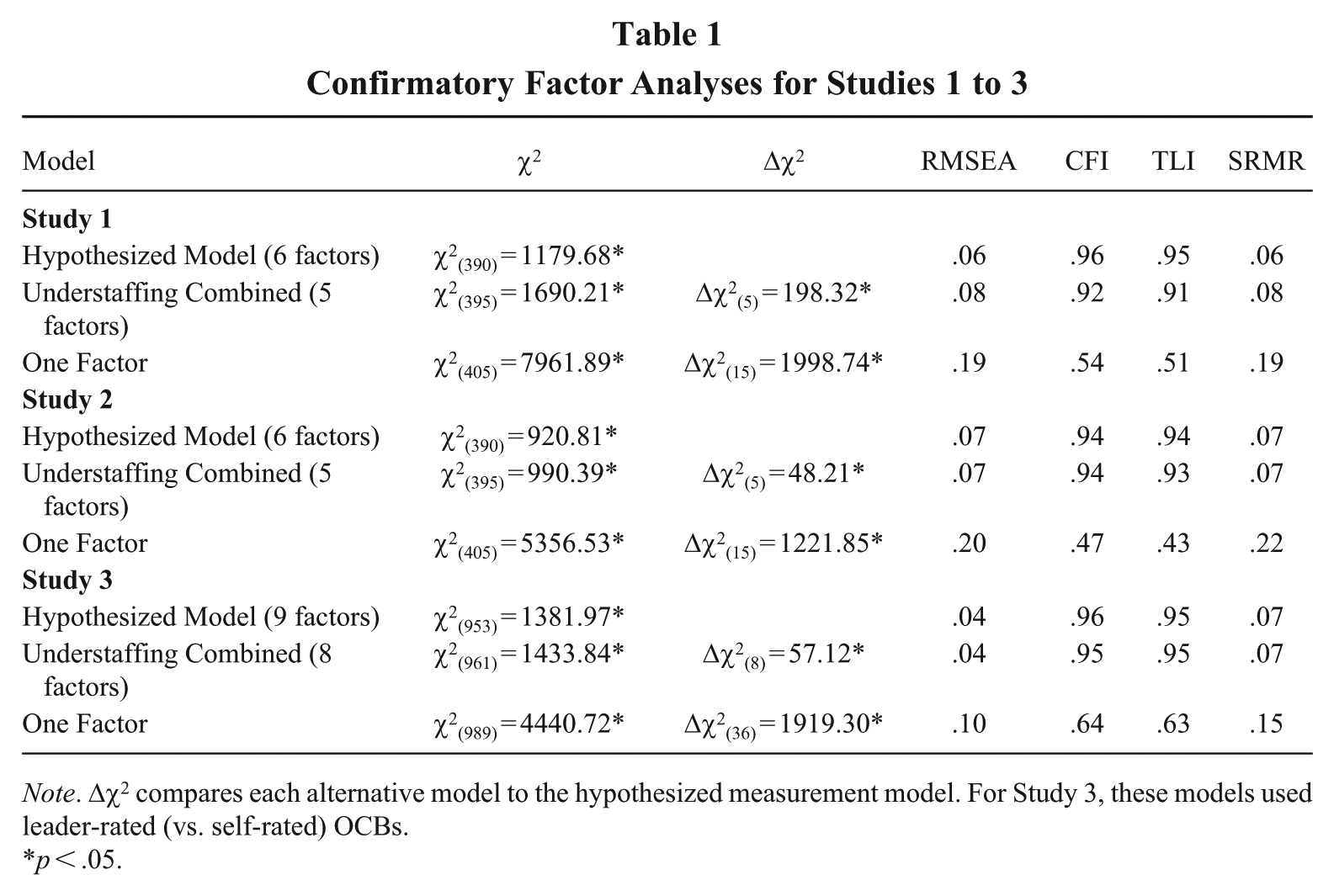
Note. Δχ2 compares each alternative model to the hypothesized measurement model. For Study 3, these models used leader-rated (vs. self-rated) OCBs.
p < .05.
Means, Standard Deviations, and Correlations in Studies 1 and 2
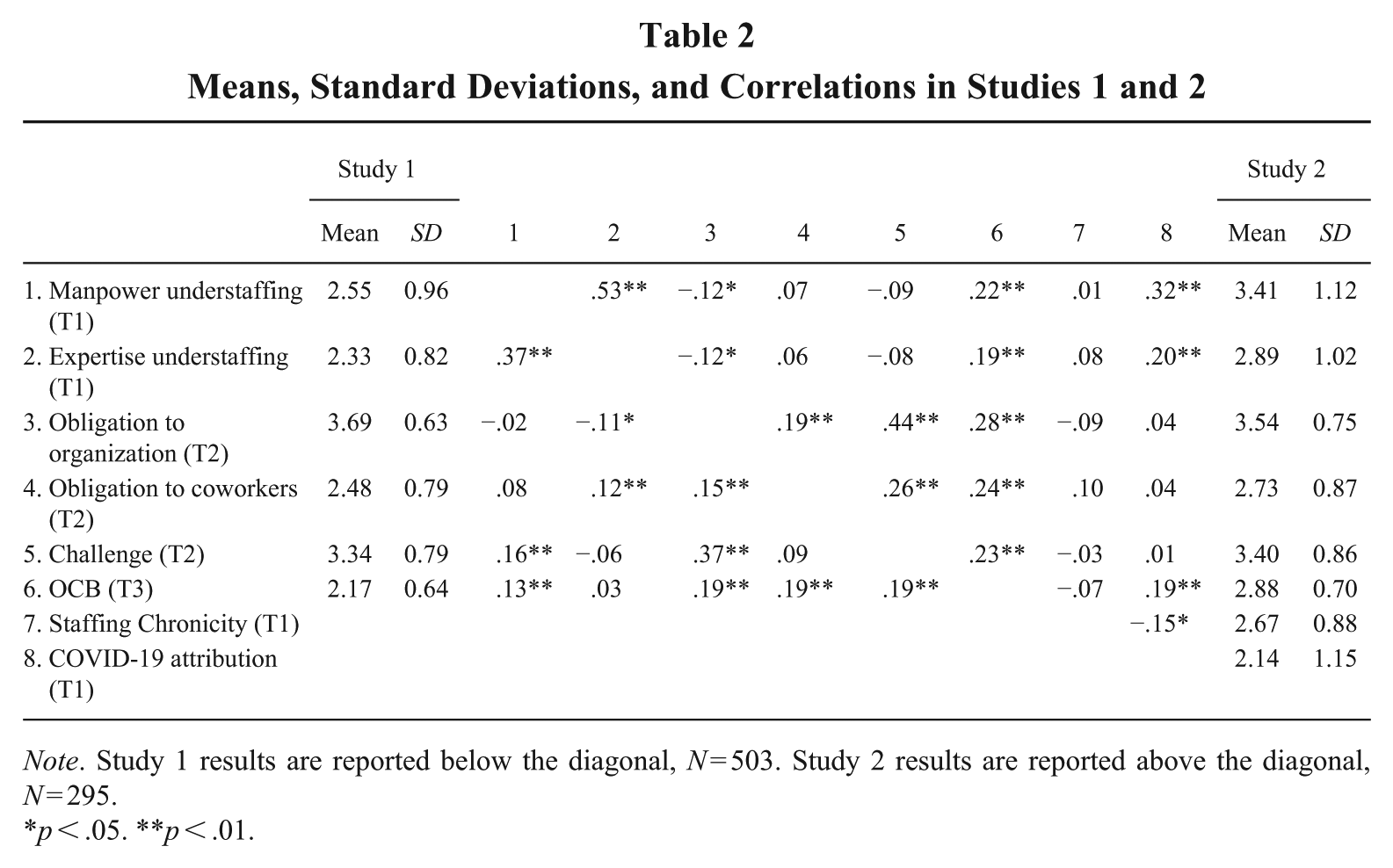
Note. Study 1 results are reported below the diagonal, N = 503. Study 2 results are reported above the diagonal, N = 295.
p < .05. **p < .01.
Tests of hypotheses
Manpower understaffing was positively related to felt challenge (b = .14, SE = .04, t = 3.69, p < .001), but was not associated with felt obligation to the organization (b = −.02, SE = .03, t = −.51, p = .613) or coworkers (b = .07, SE = .04, t = 1.82, p = .070; see Table 3). In contrast, expertise understaffing negatively predicted felt obligation to the organization (b = −.09, SE = .03, t = −2.50, p = .013) and positively predict felt obligation to coworkers (b = .12, SE = .04, t = 2.77, p = .006), but was not associated with felt challenge (b = −.06, SE = .04, t = −1.38, p = .168). Additionally, all three proposed mediators uniquely predicted OCBs.
Multiple Regression Analyses for Studies 1 and 2
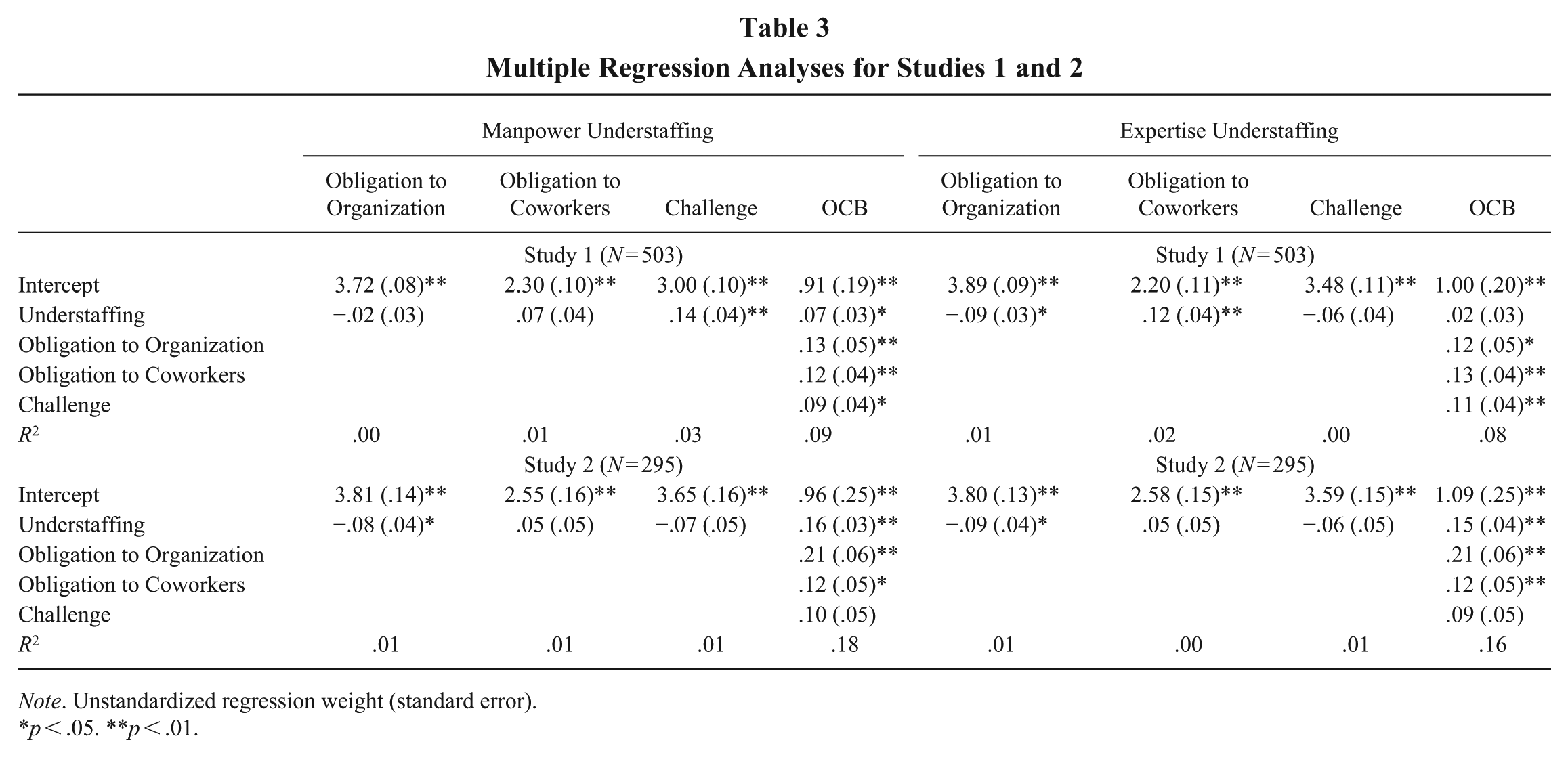
Note. Unstandardized regression weight (standard error).
p < .05. **p < .01.
In turn, when examining parallel mediation, there was a significant indirect effect of manpower understaffing on OCB via felt challenge (Indirect effect = .012, 95% CI [.002, .026]), but not via felt obligation to the organization (Indirect effect = −.002, 95% CI [−.011, .006]) or felt obligation to coworkers (Indirect effect = .008, 95% CI [−.001, .020]), supporting Hypothesis 3. In contrast, there was a significant indirect effect of expertise understaffing on OCB via felt obligation to the organization (Indirect effect = −.010, 95% CI [−.024, −.008]) and felt obligation to coworkers (Indirect effect = .015, 95% CI [.002, .032]), but not felt challenge (Indirect effect = −.006, 95% CI [−.019, .003]). This provides support for Hypotheses 1 and 2. 1
Discussion
This study substantiates that understaffing is indirectly related to OCB through all three posited mechanisms. Supporting a multidimensional conceptualization of understaffing (Hudson & Shen, 2015, 2018), the two types of understaffing exhibited distinct patterns of effects. Specifically, manpower understaffing was positively related to felt challenge, whereas expertise understaffing was negatively related to felt obligation toward the organization and positively related to felt obligation to coworkers. Downstream, each mediator positively predicted OCBs.
This study has several strengths, chief among them assessing constructs at meaningful points in time (i.e., at entry to a new organization and aligned with workers’ temporary contracts). However, there are also potential constraints on generalizability. Namely, temporary workers can differ substantively from permanent workers. Indeed, research on psychological contracts reveals that temporary (vs. permanent) employees generally perceive that their organization has made them fewer promises and see their relationship with their employer as more transactional (Scheel, Rigotti, & Mohr, 2013). This may make them less reactive to understaffing or less likely to enter into reciprocal exchanges in the form of OCBs with their organization. Thus, we sought to replicate our findings with a sample of permanent workers in the next study.
Study 2
Method
Participants and procedures
Participants were full-time workers based in the United States, recruited from Prolific. We chose Prolific for this study due to its functionality for supporting longitudinal designs (Palan & Schitter, 2018). The study consisted of three surveys, each completed about 1 week apart. At Time 1, participants reported staffing conditions. At Time 2, participants reported their standing on proposed mediators. At Time 3, participants self-reported OCB. Participants were remunerated 1 GBP for their participation in each survey, as Prolific is based in the United Kingdom so payment is processed in British sterling pounds.
We recruited 500 participants at Time 1. After combining data across the three surveys, the matched sample consisted of 368 indivduals. However, we removed 64 participants who failed any of the three attention checks embedded across the three surveys, in line with best practices for online panel data (Aguinis, Villamor, & Ramani, 2021; Porter, Outlaw, Gale, & Cho, 2019). Additionally, we removed nine participants who were not permanent employees. Thus, our final sample consisted of 295 participants. On average, participants were 36.14 years old (SD = 9.58). In terms of gender, 50.5% identified as men, 48.8% identified as women, and 0.7% identified as gender non-conforming. In terms of race, 80.3% identified as White, 8.5% identified as Asian, 5.4% identified as Hispanic/Latino, 4.4% identified as Black, and 1.4% identified as other. Participants held roles in a variety of industries, with greatest representation in education (15.6%), healthcare (11.2%), government (9.5%), other industry (9.5%), and information technology (8.8%).
This data collection took place during November 2021. At that time, the COVID-19 pandemic had significantly altered work arrangements, making remote work more common than before. On average, participants reported working in-person 66% of the time (SD = .42). However, 23% (n = 68) reported working in-person 0% of the time, meaning they were working fully remotely, and 45.1% (n = 133) reported working in-person 100% of the time. 2
Measures
Participants were asked to respond to these measures generally. We employed the same measures used in Study 1. Understaffing (manpower α = .90; expertise α = .80) was assessed at Time 1. Felt obligation to the organization (α = .86), felt obligation to coworkers (α = .74), and felt challenge (α = .84) were assessed at Time 2. OCB (α = .86) was assessed at Time 3.
To address Hypotheses 4 and 5, after completing Hudson and Shen’s (2018) understaffing measure at Time 1, participants were asked one question to capture the chronicity of their staffing condition (i.e., How long has your workplace staffing conditions been like this?). Participants responded on a 4-point Likert scale (1 = This is a recent and likely temporary shift; 2 = It has been like this for a short while; 3 = It has been like this for a long time; 4 = It has been like this for as long as I can remember). Additionally, one item was used to assess attributions regarding the extent which the COVID-19 pandemic shaped current staffing conditions (i.e., To what extent is your current workplace staffing conditions the result of the COVID-19 pandemic?), which employed a 5-point Likert scale ranging from 1 (not at all) to 5 (completely).
Data analyses
We followed the same data analysis plan as in Study 1. Additionally, to test moderated mediation, we employed Hayes’s (2018) PROCESS macro (Version 4.3; Model 7).
Results
We again conducted CFAs to determine whether our hypothesized factor structure was supported. Our hypothesized six-factor structure fit the data well, χ2(390) = 920.81, CFI = .94, TLI = .94, RMSEA = .07, SRMR = .07, and fit significantly better than alternative models (see Table 1). Descriptive statistics and correlations between study variables are presented in Table 2.
Tests of hypotheses
In contrast to the prior study, manpower understaffing did not predict felt challenge (b = −.07, SE = .05, t = −1.61, p = .108; see Table 3). Further, greater manpower understaffing was associated with lower felt obligation to the organization (b = −.08, SE = .04, t = −2.03, p = .044), but unrelated to felt obligation to coworkers (b = .05, SE = .05, t = 1.20, p = .230). In line with Study 1, expertise understaffing was not a significant predictor of felt challenge (b = −.06, SE = .05, t = −1.28, p = .20) but was a significant negative predictor of felt obligation to the organization (b = −.09, SE = .04, t = −2.07, p = .039). Diverging from Study 1, expertise understaffing did not predict felt obligation to coworkers (b = .05, SE = .05, t = −1.08, p = .283). 3
However, the indirect effects between manpower understaffing and OCB via felt obligation to the organization was not significant when either modeled as the sole mediator or when assessed in parallel with the other posited mediators (felt obligation to organization: Indirect effect = −.017, 95% CI [−.039, .001]; felt obligation to coworkers: Indirect effect = .006, 95% CI [−.004, .020]; felt challenge: Indirect effect = −.007, 95% CI [−.023, .004]). Similarly, felt obligation to the organization did not significantly mediate the relationship between expertise understaffing and OCB when modeled alone or alongside the other proposed mediators (felt obligation to organization: Indirect effect = −.019, 95% CI [−.045, .001]; felt obligation to coworkers: Indirect effect = .007, 95% CI [−.006, .023]; felt challenge: Indirect effect = −.006, 95% CI [−.023, .006]). Thus, Hypotheses 1, 2, and 3 were not supported in this study.
However, perhaps the lack of significant associations above were due to the presence of moderators. Therefore, we examined whether the chronicity of the staffing condition affected reactions to understaffing (see Table 4). We uncovered a significant interaction between manpower understaffing and chronicity on felt obligation to the organization (b = −.11, SE = .04, t = −2.53, p = .012; see Figure 2, left panel). Simple slope analyses indicate that manpower understaffing was unrelated to feelings of obligation to one’s company at lower degrees of chronicity (−1 SD; b = .03, t = .46, p = .646), but manpower understaffing was negatively related to obligation to one’s organization at higher degrees of chronicity (+1 SD; b = −.16, t = −2.32, p = .021). Additionally, the index of moderated mediation was significant (estimate = −.020, 95% CI [−.044, −.001]). Thus, manpower understaffing appears to primarily erode felt obligation to one’s company and, in turn, reduce helping toward the organization and its members when its occurrence is more long-term. This provides support for Hypothesis 4.
Moderation Analyses for Study 2
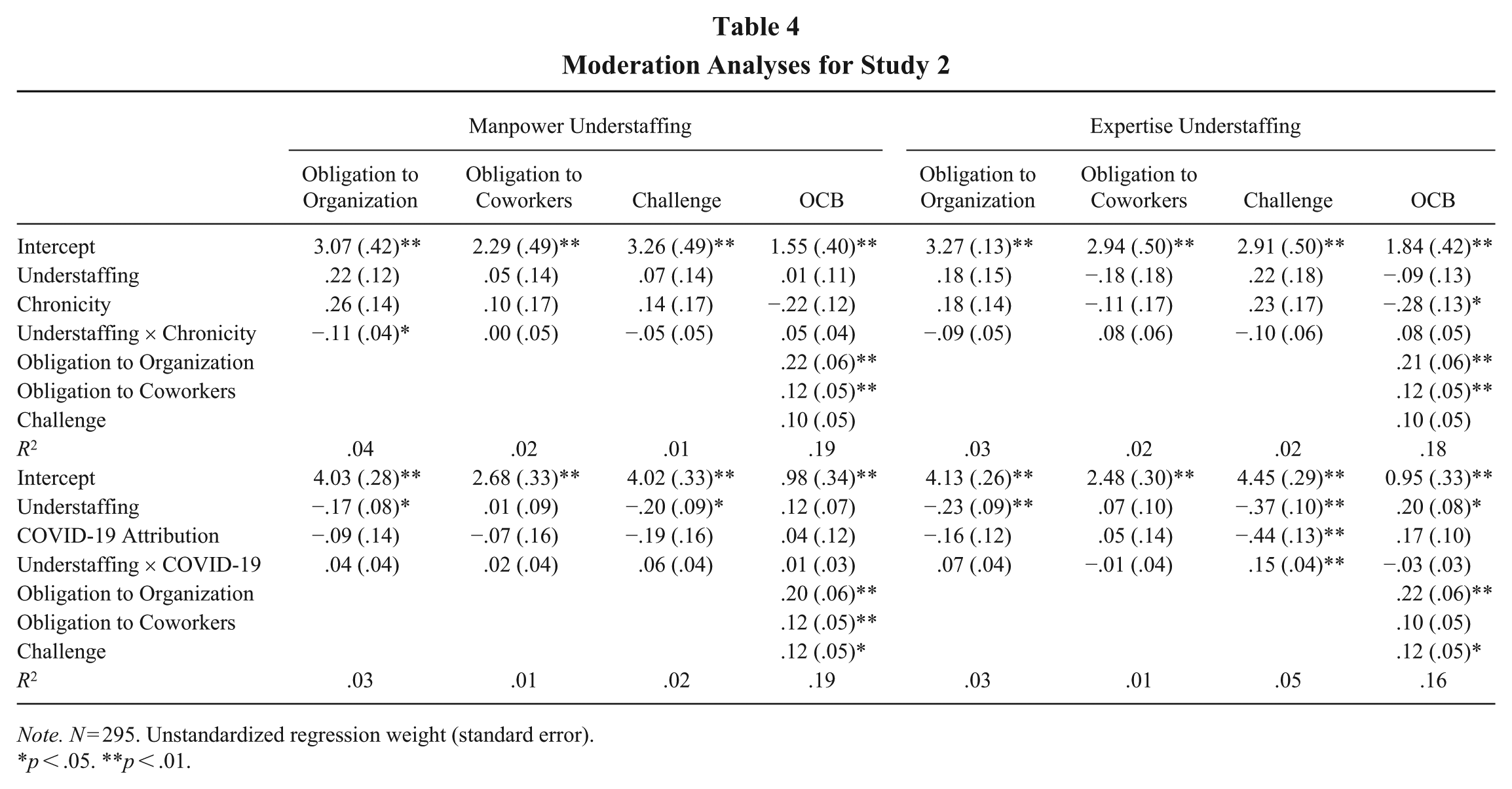
Note. N = 295. Unstandardized regression weight (standard error).
p < .05. **p < .01.
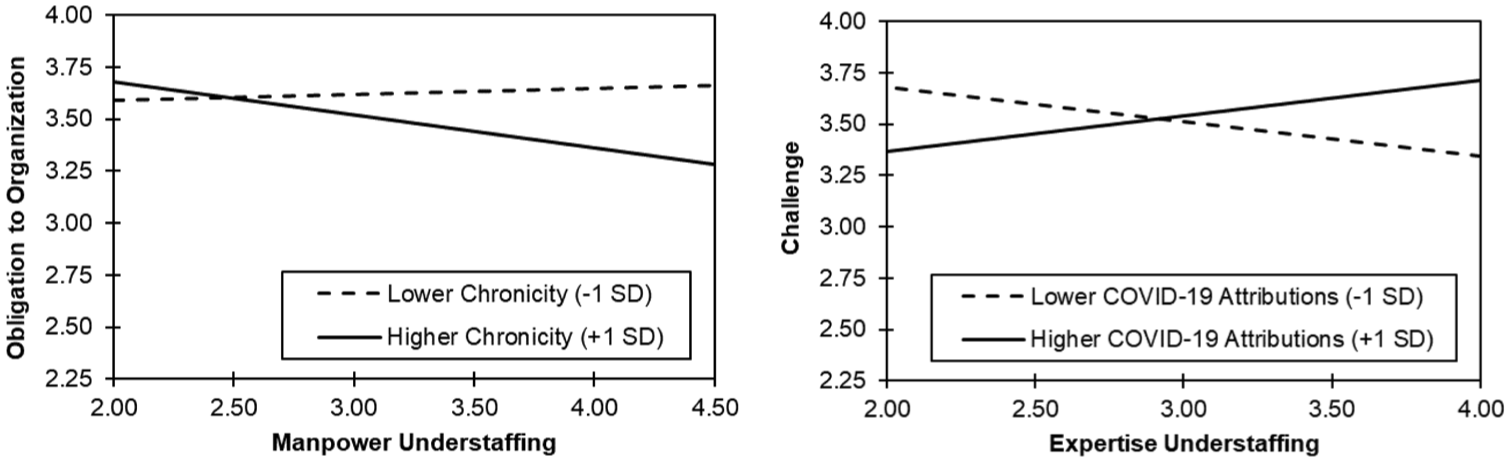
Moderating Effects of Chronicity and COVID-19 Attributions on Proposed Mediators in Study 2
We also found a significant interaction between expertise understaffing and COVID-19 attributions on felt challenge (b = .15, SE = .04, t = 3.65, p < .001; see Figure 2, right panel). Simple slope analyses reveal that the relationship between expertise understaffing and felt challenge was negative and significant when the staffing condition was viewed as less of the result of the COVID-19 pandemic (−1 SD; b = −.17, t = −2.18, p = .030). However, this relationship was non-significant when the staffing condition was viewed as more of the result of the COVID-19 pandemic (+1 SD; b = .17, t = 1.59, p = .113). Moreover, this relationship becomes positive and significant at +1.21 SD on the moderator variable, such that expertise understaffing actually enhances felt challenge when employees very strongly attribute current staffing conditions to the pandemic. Further, the index of moderated mediation linking these effects to OCB was significant (estimate = .030, 95% CI [.009, .055]), offering support for Hypothesis 5. 4
Discussion
We find some similarities in findings between the current sample of permanent employees and the sample of temporary workers in Study 1, supporting generalizability. In both studies, expertise understaffing was negatively related to feelings of obligation toward one’s company. However, in this study, we also observe that manpower understaffing was negatively related to felt obligation to the organization, although these harmful consequences appeared to emerge only when understaffing was a more sustained (vs. acute) issue. Thus, this effect may not have emerged in Study 1 since we were only able to examine short-term outcomes of understaffing.
Beyond the length of time a work group has been understaffed, the results of this study also indicate that worker attributions regarding the origins of staffing problems can play an important role in how they respond to understaffing. Namely, viewing the COVID-19 pandemic as a primary cause of understaffing led workers to experience expertise understaffing as a challenge and, ultimately, shaped the extent to which they helped the organization or its members. Consequently, we dive further into the moderating role of attributions by directly assessing different dimensions of staffing attributions in the next study (Nishii et al., 2008).
Additionally, unlike the prior study, we do not find a relationship between manpower understaffing and felt challenge in Study 2. One possibility is that this association failed to emerge because permanent workers have higher expectations of adequate staffing than their temporary counterparts, such that their reaction to higher levels of manpower understaffing is less favorable. Another possibility is that this could be due to the “Great Resignation” in the aftermath of the COVID-19 pandemic. Workers may have been more overwhelmed than usual, and therefore less likely to experience understaffing as challenging. Indeed, on average, workers in Study 2 reported higher levels of manpower understaffing than workers in Study 1.
Study 3
Method
Participants and procedures
Participants were employees and supervisors of a technology organization in China. Participants were recruited with the assistance of the organization’s HR department. The study consisted of three surveys, each administered approximately 3 weeks apart. At Time 1, employees reported on workplace staffing conditions (i.e., understaffing, chronicity, attributions). At Time 2, employees reported on proposed mediators (i.e., felt obligation to organization, felt obligation to coworkers, felt challenge). At Time 3, both employees and supervisors completed separate surveys rating employees’ OCBs.
After matching data across the three surveys, the final sample consisted of 344 employees nested within 85 supervisors. On average, supervisors provided ratings for four employees (SD = 3.37) and the average length of the supervisory relationship was 3.93 years (SD = 3.03). The average age of employees was 31.68 years old (SD = 6.09), and the average age of supervisors was 35.79 years old (SD = 6.18). The majority of employees (78.2%) and supervisors (83.5%) identified as men (21.8% of employees and 16.5% of supervisors identified as women). Although we did not collect job titles directly from participants, the HR department shared with us that their workforce consisted primarily of technical and research and development (R&D) roles (e.g., software engineers), along with some technology delivery and coordination roles (e.g., project managers, requirement analysts), quality assurance and implementation roles, and product management roles, as well as a small number of design roles (e.g., user interface).
Measures
All measures were translated to Mandarin Chinese and back-translated to English using standard procedures (Brislin, 1980) by three bilingual members of the research team. We employed the same measures used in Studies 1 and 2, with two exceptions. First, in the current study, we used a longer version of the OCB-C (i.e., 20- vs. 10-item; Fox, Spector, Goh, Bruursema, & Kessler, 2012). 5 Second, to assess staffing attributions, we employed Nishii and colleagues’ (2008) HR attributions measure. Participants responded using a 5-point Likert scale, ranging from 1 (not at all) to 5 (to a great extent). Positive and negative internal attributions were assessed using two items each (sample items: “My company makes the staffing and hiring choices that it does. . . (a) so that employees will be valued and respected—to promote employee well-being [positive internal]; (b) to try to keep costs down [negative internal]”). The original measure assessed external attributions using one item (i.e., “because they are required to by the union contract”); but, as argued above, this reflects an overly narrow conceptualization of external forces on staffing. Further, this item was not applicable in the current context, as technology firms in China are rarely unionized (Kirton, 2021). Thus, we self-developed two items to assess external staffing attributions (i.e., “due to factors outside of their control, such as employment rate or economic recession”; “because of unforeseeable events, such as natural disasters or pandemics”).
Data analysis
We followed the same data analysis plan as Study 2. However, as employees were nested within leaders in the current study, we conducted multilevel modeling to account for this clustering. Specifically, we group-mean centered predictors at Level 1 to remove the influence of between-group differences (Enders & Tofighi, 2007). Additionally, as the PROCESS macro is not designed to handle multilevel data, we calculated the significance of indirect effects and the index of moderated mediation using Monte Carlo simulations (e.g., Preacher & Selig, 2012).
Results
We conducted CFAs using the sandwich estimator to account for the clustered nature of our data. Our hypothesized nine-factor structure fit the data well, χ2(953) = 1381.97, CFI = .96, TLI = .95, RMSEA = .07, SRMR = .04, and fit significantly better than alternative models (see Table 1). Descriptive statistics and correlations between study variables are presented in Table 5.
Means, Standard Deviations, and Correlations in Study 3
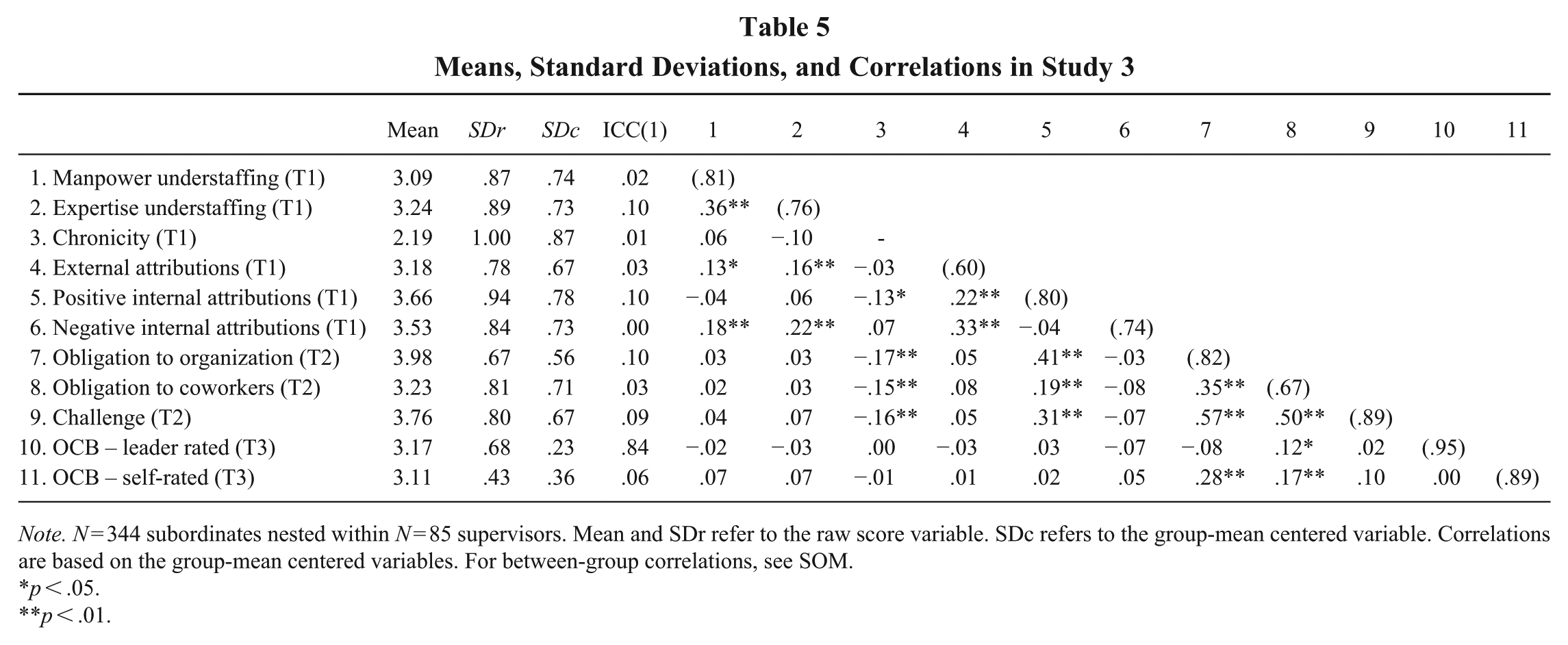
Note. N = 344 subordinates nested within N = 85 supervisors. Mean and SDr refer to the raw score variable. SDc refers to the group-mean centered variable. Correlations are based on the group-mean centered variables. For between-group correlations, see SOM.
p < .05.
p < .01.
In line with prior research, the means were comparable for leader-rated (M = 3.17) and self-rated (M = 3.11) OCBs. Leader-rated and self-rated OCBs were correlated at the between-group level (r = .27, p = .012), but not at the within-group level (r = .00, p > .999). This means that although supervisors and employees demonstrate some agreement about which work groups engage in more versus fewer OCBs, they diverge in their relative ordering of employee’s performance of OCBs within groups.
Tests of hypotheses
Within-group correlations indicate that neither manpower nor expertise understaffing was significantly related to the proposed mediators (see Table 5). Additionally, only obligation to coworkers positively predicted leader-rated OCBs, whereas obligation to the organization and coworkers both positively predicted self-rated OCBs. Thus, we did not move forward to test the indirect effects between manpower or expertise understaffing, respectively, on leader- or self-rated OCBs via the three proposed mediators. Hypotheses 1, 2, and 3 were not supported.
However, this may be because reactions to understaffing depend upon employees’ staffing attributions (see Table 6). We find a significant interaction between expertise understaffing and external staffing attributions on felt obligation to coworkers (γ = −.18, SE = .08, p = .018; see Figure 3, left panel). Yet the form of this interaction did not match our prediction that greater external staffing attributions would strengthen the positive relationship between expertise understaffing and obligation to coworkers, failing to support Hypothesis 5. Rather, the positive relationship between expertise understaffing and felt obligation to coworkers was only observed when external staffing attributions was lower (−1 SD; γ = .14, SE = .08, t = 1.04, p = .053, which becomes statistically significant at −1.03 SD on the moderator). Expertise understaffing was unrelated to felt obligation to coworkers when external staffing attributions were higher (+1 SD; γ = −.09, SE = .08, t = −1.19, p = .236). In turn, the index of moderated mediation linking these effects to leader-rated OCB was significant (estimate = −.010, 95% CI [−.024, −.0002]). However, this moderated mediation did not hold for self-rated OCB, as felt obligation to coworkers was no longer significant in predicting self-rated OCB (γ = .06, SE = .04, p = .113) when the other two posited mediators were simultaneously included in the model.
Multilevel Moderation Analyses by Staffing Attributions for Study 3
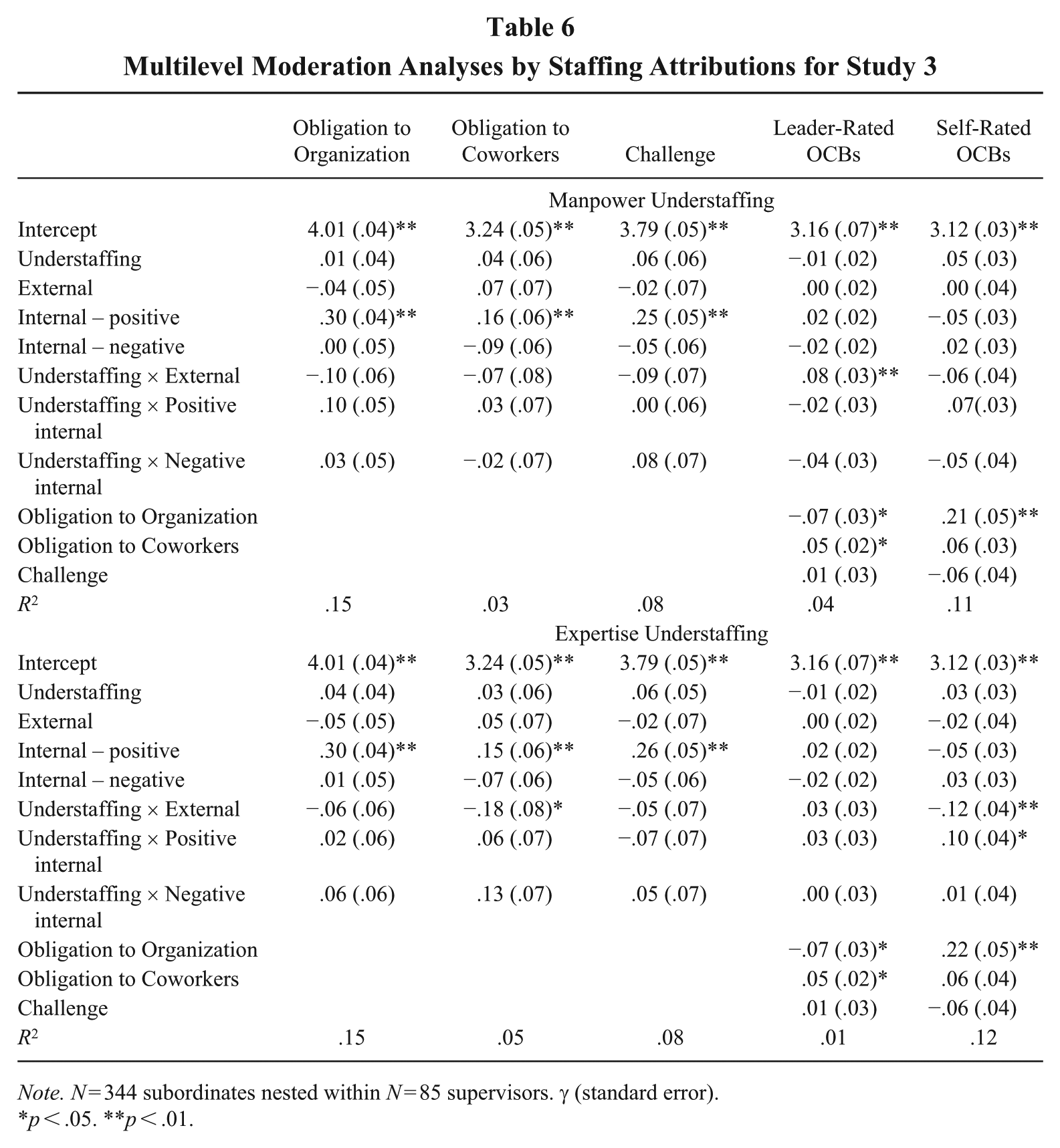
Note. N = 344 subordinates nested within N = 85 supervisors. γ (standard error).
p < .05. **p < .01.
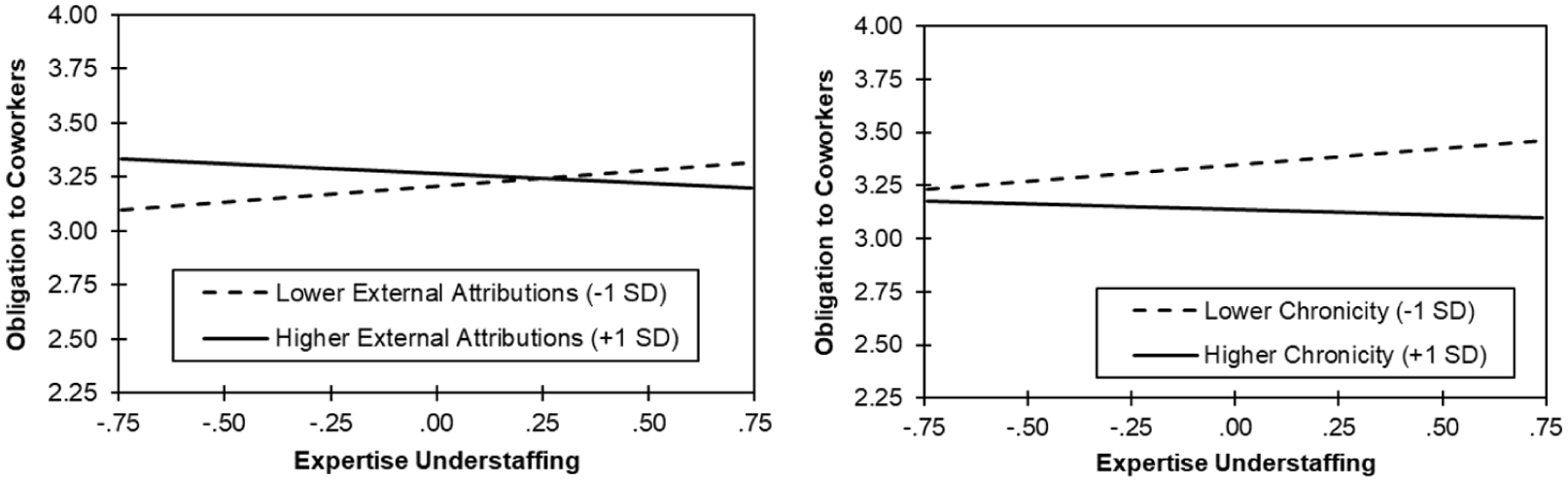
Moderating Effects of External Staffing Attributions and Chronicity on Felt Obligation to Coworkers in Study 3
In our introduction, we suggested that more chronic staffing conditions contribute to employees’ making stronger internal staffing attributions toward their organization, which then affects workers’ responses to understaffing. However, chronicity was only modestly negatively related to positive internal staffing attributions (r = −.13, p = .016), and was unrelated to negative internal staffing attributions (r = .07, p = .195). Further, neither moderated relationships between understaffing and proposed mediators. Thus, congruent with Study 2, we also explored whether chronicity directly moderated relationships between understaffing and posited mediators.
In Table 7, we observe a significant interaction between expertise understaffing and chronicity on felt obligation to coworkers (γ = −.12, SE = .06, p = .049; see Figure 3, right panel). Supporting Hypothesis 4, simple slope analyses reveal a positive relationship between expertise understaffing and feelings of obligation to coworkers when staffing conditions are less chronic (−1 SD; γ = .15, SE = .08, t = 1.81, p = .070, which becomes statistically significant at −1.57 SD on the moderator). However, this association disappears when staffing conditions are more chronic (+1 SD; γ = −.05, SE = .07, t = −0.73, p = .469). Although the index of moderated mediation to leader-rated OCB was not significant based upon the 95% CI (estimate = −.007, 95% CI [−.017, .0003]), it was significant when using the more liberal 90% CI. 6 However, this moderated mediation did not hold for self-rated OCB, as obligation to coworkers was only marginally significant in predicting self-rated OCB (γ = .06, SE = .04, p = .082) when the other two posited mediators were also included in the model.
Multilevel Moderation Analyses by Chronicity for Study 3
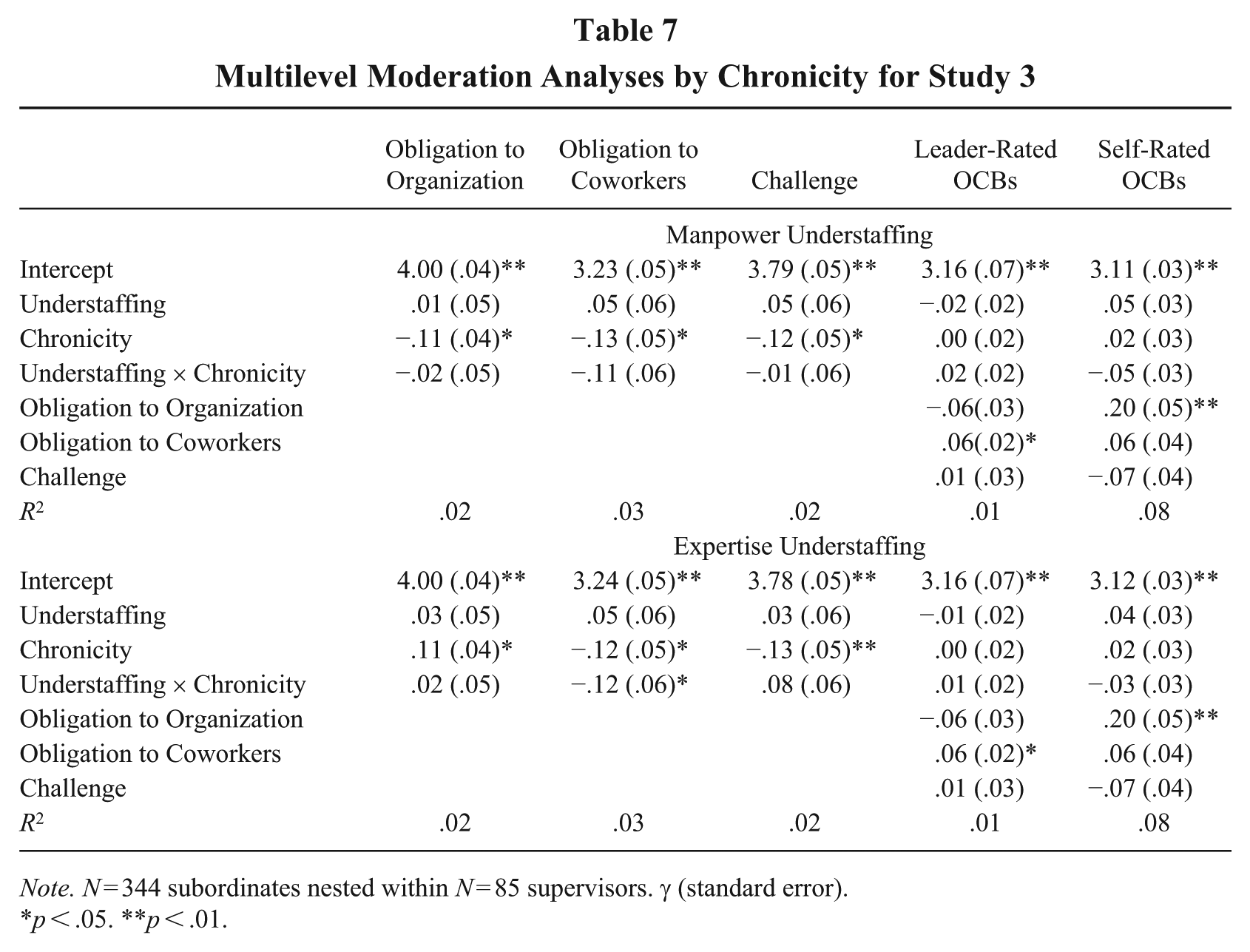
Note. N = 344 subordinates nested within N = 85 supervisors. γ (standard error).
p < .05. **p < .01.
Discussion
Aligning with results from Study 1, we find that expertise understaffing can contribute to more helping behaviors by employees (as rated by leaders) due to workers’ stronger feelings of obligation toward their coworkers. However, this process only unfolds under certain conditions; that is, when understaffing is less chronic or when employees’ make lower external staffing attributions. Moreover, findings based upon leader-rated versus self-rated OCBs demonstrated both convergence and divergence, in line with prior research that indicates different rating sources can offer distinct perspectives (e.g., Carpenter et al., 2014; Loignon et al., 2025; Vergauwe et al., 2022).
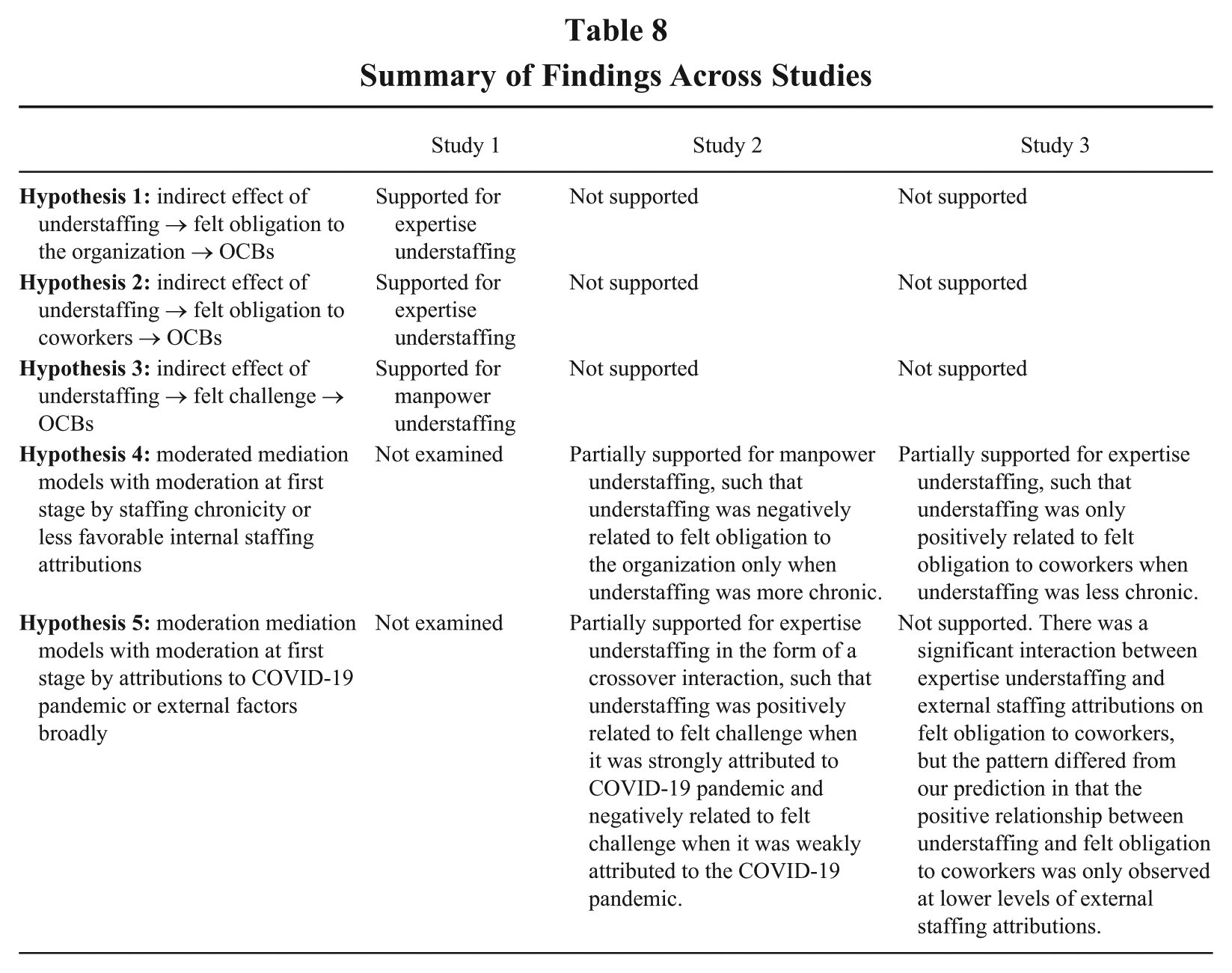
It is also important to acknowledge that the results of this study diverge from our prior studies in some important ways (see Table 8 for a summary of findings across studies). First, we primarily find effects of expertise, and not manpower, understaffing. Perhaps this is because our current sample consists of knowledge workers, such that a lack of needed knowledge, skills, or abilities within the work group is felt more acutely, whereas the samples in our prior studies were much more heterogeneous. Indeed, mean levels of expertise understaffing were higher in Study 3 compared to Studies 1 and 2.
Summary of Findings Across Studies
Second, in this study, self-rated OCBs was primarily driven by felt obligation to the organization. In contrast, leader-rated OCBs was associated with felt obligation to coworkers. We speculate that these findings likely reflect the specific contextual conditions characterizing Study 3. Namely, understaffing now, especially in the technology sector, is more likely due to downsizing and layoffs. This is juxtaposed against when Study 2 was conducted, during the “Great Resignation,” where understaffing may have largely been the result of voluntary exits by workers. Concerns regarding job loss and poor alternative employment prospects may lead workers to be more tolerant of adverse organizational conditions, including understaffing, and magnify the importance of their exchange relationship with their organization relative to other targets when determining their actions. Yet the same uncertain environment may make supervisors wary of subordinate cues or claims indicating their ongoing commitment to the organization. Consequently, supervisors may place more weight on cues they view as less susceptible to impression management or easier to directly observe, such as those involving coworkers, when forming judgments about employee behaviors.
Additionally, it appears that the moderating effect of making external staffing attributions generally, versus attributing staffing levels to COVID-19 specifically, differs. That is, in Study 2, when workers more strongly attributed staffing conditions to the COVID-19 pandemic, this resulted in more favorable reactions (i.e., expertise understaffing motivated workers via greater felt challenge). In contrast, in the current study, employees’ stronger attribution of staffing conditions to external factors appeared to erode benefits (i.e., there was no longer a positive association between expertise understaffing and felt obligation to coworkers).
One potential explanation is that other dimensions of attribution (Harvey, Madison, Martinko, Crook, & Crook, 2014), such as stability, intersect with locus of control (i.e., internal vs. external) to shape workers’ responses to understaffing. Many people may have viewed the COVID-19 pandemic as an event. Therefore, workers may have felt that they have sufficient resources to deal with the aftereffects of this temporary shock. In contrast, other external factors that negatively affect staffing may be viewed as more stable or enduring forces (e.g., economic recession, industry trends). Thus, the differences we observe across Studies 2 and 3 could be due to the particular types of external factors that employees’ see as to blame for inadequate staffing. Alternatively, even if employees in both studies identify an external event as the primary cause of their organization’s current staffing problems, the pandemic was a particularly strong event (i.e., novel, disruptive, critical; Morgeson, Mitchell, & Liu, 2015) and other, weaker events may not engender the same response.
Originally, we reasoned that chronicity exerts its moderating effects on relations between understaffing and employee responses by influencing internal staffing attributions. However, this does not appear to be the case. Chronicity moderated the relationship between expertise understaffing and felt obligation to coworkers, whereas positive and negative internal staffing attributions did not. This then begs the question: what underlies the negative consequences of more chronic understaffing? One possibility may be that even if employees do not attribute malicious motives to their organization for extended periods of poor staffing, chronic understaffing depletes and does not allow workers’ opportunities to replenish their resources (Hudson & Shen, 2015). By and by, depleted workers can no longer afford to be concerned about their exchange partners or muster energy to invest in work, ultimately leading to less helping.
General Discussion
Overall, our research offers a fuller picture of how workplace staffing conditions affect social exchanges and helping within organizations. On one hand, organizations’ desires that workers will rally to help in their time of need may be granted, as understaffing can be indirectly related to OCBs by promoting feelings of obligation to coworkers or feelings of challenge. On the other hand, organizations should be concerned by evidence that understaffing can also erode extra-role behaviors by lowering feelings of obligation toward the organization or feelings of challenge.
Inconsistent suppositions regarding the nature of the relationship between understaffing and OCBs can partially be explained by failure to consider different types of understaffing, highlighting the importance of assessing understaffing as a multidimensional construct (Hudson & Shen, 2015, 2018). We found some evidence that manpower understaffing, insufficient personnel resources in the form of lacking needed staff, can increase felt challenge. In turn, felt challenge predicts OCBs. However, it would be incorrect to simply conclude that manpower understaffing is beneficial for OCBs. We also uncovered some data that point to how more chronic levels of manpower understaffing can undermine OCBs by lowering felt obligation to the organization.
Prior research has tended to focus on manpower understaffing, overlooking expertise understaffing—when there are insufficient personnel resources in the form of lacking critical knowledge or skills in the work unit. Yet, expertise understaffing has unique and more complex linkages with OCBs. Specifically, expertise understaffing can exhibit contrasting effects on social relations, with offsetting influences on OCBs. That is, greater expertise understaffing can be negatively associated with feelings of obligation to one’s organization, which reduces enactment of OCBs. However, it can also prompt feelings of obligation to one’s coworkers, which enhances engagement in OCBs. The latter effect may primarily emerge when expertise understaffing is more acute or when employees do not view external factors as driving staffing.
Furthermore, expertise understaffing can also ignite and extinguish felt challenge among employees, depending on the circumstances. Felt challenge then influences OCBs downstream. Namely, expertise understaffing may excite and energize workers by stretching them to take on unfamiliar tasks or acquire new knowledge, skills, or abilities. However, expertise understaffing can also potentially demotivate employees by highlighting the lack of fit between their person and current circumstances, or serve to overwhelm them. Thus, the effective management of expertise understaffing may be particularly difficult given its capacity to both benefit and harm OCBs.
Practical Implications
Our work has important practical implications for organizations. First, this work supports the criticality of accurate strategic workforce planning to minimize understaffing. Although understaffing does not always negatively affect helping, this needs to be weighed against evidence that understaffing is often also associated with poor performance and worker well-being (e.g., Hudson & Shen, 2018). Additionally, organizations have generally moved toward leaner staffing to save costs. Yet this lack of slack in staffing can render them vulnerable to understaffing and may make it more difficult to take preventative measures (e.g., cross-training to prevent expertise understaffing). Second, to the extent that understaffing still occurs despite a company’s best laid plans, it is critical to diagnose what type of understaffing (i.e., manpower vs. expertise) a work unit is experiencing, as consequences and needed interventions may differ.
Our findings also indicate that some of the negative effects of understaffing emerge over time. This indicates that time is of the essence. However, time-to-hire is increasing across industries (Tilo, 2023). Consequently, organizations should consider how they can effectively streamline their personnel selection processes to reduce more chronic forms of understaffing. Finally, our work also demonstrates that workers form beliefs around their organization’s staffing strategies and these attributions can be consequential in shaping their responses to staffing conditions. As such, managers should be transparent and explain the logic behind staffing choices, rather than assuming that this is always apparent to employees. However, there appears to be risks to throwing one’s hands up and hiding behind external, macro-economic conditions to justify inadequate staffing unless employees are likely to agree that those conditions are indisputably difficult to foresee, such as in the case of the COVID-19 pandemic.
Limitations and Future Research Directions
We want to take the opportunity to acknowledge some limitations. First, we recognize that we rely on survey data to test mediation. Therefore, causal ordering cannot be assured. To address this concern, we conducted a supplemental experimental study where we manipulated staffing conditions using vignettes. Our results indicate that both types of understaffing, relative to an adequate staffing control condition, can indirectly contribute to OCB intentions via feelings of challenge. That said, there were no effects via felt obligation to the organization or coworkers, perhaps because participants had difficulty envisioning relationships with a hypothetical organization or coworkers (see the Supplemental Online Materials for details of this study).
Second, we rely primarily on self-rated OCBs across our studies, although we did incorporate leader-rated OCBs in Study 3. We attempted to minimize the potential effects of common method variance by employing a procedural remedy in the form of temporal separation, which has been found in both experimental studies (Rubenstein et al., 2025) and in meta-analytic research (Podsakoff, Podsakoff, Williams, Huang, & Yang, 2024) to significantly reduce the magnitude of observed correlations compared to same source, same occasion designs. However, this approach does not address all potential sources of common method variance (see Rubenstein et al., 2025 for a review). We do think it is important to point out that many of our central effects of interest were interactions, and prior simulation research reveals that these “cannot be artifacts of CMV” (Siemsen, Roth, & Oliveira, 2010: 456). Third, in Study 3, leader-rated OCB was assessed using a single rater. However, interrater reliability for supervisors’ ratings of performance is modest (e.g., Zhou, Sackett, Shen, & Beatty, 2024), such that reliability can be improved when multiple supervisor ratings are aggregated. Therefore, a design that includes multiple raters representing each rating source (e.g., peers, supervisors) would allow for a more sophisticated decomposition of consensus and dissensus across perspectives on OCBs (e.g., Loignon et al., 2025; Schröder et al., 2025; Vergauwe et al., 2022).
Although across our set of three studies we find some support for all our hypotheses—in that there is evidence substantiating all three mechanisms and both classes of moderators—we acknowledge that there are also inconsistencies. To address this limitation, we call for future research that investigates additional moderating factors that can help explain these discrepancies. For example, we only found associations between expertise understaffing and felt obligation to coworkers in Studies 1 and 3. Perhaps this relationship only arises when interdependence with coworkers is higher—either due to lack of experience (in the case of the temporary student workers in Study 1) or due to cultural values (in the case of the Chinese employees in Study 3).
We focus on the relationship between understaffing and OCBs. Yet it is interesting to contemplate whether these helping behaviors will ultimately affect unit performance. For manpower understaffing, this may be possible, as the work group possesses the knowledge and skills required, and workers’ willingness to invest extra effort may overcome performance slumps that would typically result from lack of staff. For expertise understaffing, OCBs are likely insufficient to compensate for performance decrements, since the work group ultimately lacks needed knowledge and skills for essential group tasks. However, even in the latter situation, we contend that organizations should still care about OCBs. For example, as OCBs better the social and psychological environment of the organization, this may facilitate employee retention—preventing the further escalation of understaffing. Thus, future research could seek to integrate the influence of understaffing on different aspects of individual and work group performance.
Our research substantiates prior theorizing that time is an important dimension of understaffing that shapes outcomes (Hudson & Shen, 2015). However, in our studies, we rely on participants’ subjective assessment of the chronicity of their workplace staffing conditions to capture this temporal dimension. This makes it difficult to answer the question: How long is too long? Therefore, to answer this question, we encourage future research to employ longitudinal designs with objective chronicity measures that could more clearly delineate when the negative consequences of understaffing begin to emerge, which could also differ by outcome.
Expertise understaffing remains underexplored in the literature relative to manpower understaffing (e.g., Pindek et al., 2025). Thus, we call for future research that expands our understanding of this construct. In particular, it is interesting to contemplate how the age of artificial intelligence (AI) may shape the occurrence and nature of expertise understaffing. On one hand, AI could serve as a great equalizer, helping employees to complete technically complex tasks that they could not have accomplished on their own, such that the incidence of expertise understaffing is greatly reduced. On the other hand, widespread adoption of AI tools could require new types of expertise that might be lacking amongst the current workforce (e.g., AI direction skills; AI troubleshooting skills), increasing the prevalence of expertise understaffing. Alternatively, some have argued that soft skills (e.g., empathy, communication) will become increasingly important, as humans may be most valuable in handling tasks for which AI is less suited. Thus, the types of expertise that might be difficult to come by in teams and organizations that engender expertise understaffing could also fundamentally change.
Lastly, our work also suggests new directions for the literature on HR attributions. Research in this domain tends to assume that HR attributions mediate the relationship between HR practices and employee outcomes (e.g., attitudes, performance; Hu et al., 2025). Our research reveals that HR attributions could also moderate relationships between HR practices and employee outcomes. Additionally, to date, external HR attributions are rarely assessed and have been narrowly conceptualized. We recommend that future research incorporate both internal and external HR attributions, and more thoroughly map out the full range of external factors that employees see as driving HR practices.
Conclusion
Returning to our motivating question, understaffing can contribute to workers taking their “hands off the tiller” and withholding help by eroding workers’ felt obligation toward the organization and subverting feelings of challenge. Yet, understaffing can also prompt an “all hands on deck” mentality whereby employees go above and beyond basic job requirements because it can induce felt obligation among coworkers and beget feelings of challenge. What unfolds depends in part upon the type(s) of understaffing experienced, the chronicity of staffing conditions, and the perceived circumstances that caused the staffing conditions. In sum, relations between workplace staffing levels and OCBs are complex and require careful attention and management.
Supplemental Material
sj-docx-1-jom-10.1177_01492063261453875 – Supplemental material for “All Hands on Deck” or “Hands off the Tiller”? Linking Understaffing and Organizational Citizenship Behaviors
Supplemental material, sj-docx-1-jom-10.1177_01492063261453875 for “All Hands on Deck” or “Hands off the Tiller”? Linking Understaffing and Organizational Citizenship Behaviors by Winny Shen, Shani Pindek, Jiawei Zheng, Jie Zhong and James W. Beck in Journal of Management
Footnotes
Acknowledgements
This work was supported by the Social Sciences and Humanities Research Council of Canada (SSHRC) under Grant #435-2016-0696, and the National Natural Science Foundation of China under Grant 72402112.
Supplemental material for this article is available with the manuscript on the JOM website.

Data Availability Statement
Data available on request from the authors.
Notes
References
Supplementary Material
Please find the following supplemental material available below.
For Open Access articles published under a Creative Commons License, all supplemental material carries the same license as the article it is associated with.
For non-Open Access articles published, all supplemental material carries a non-exclusive license, and permission requests for re-use of supplemental material or any part of supplemental material shall be sent directly to the copyright owner as specified in the copyright notice associated with the article.
