






Abstract
Across contemporary workplaces, organizations are increasingly deploying biometric technologies that capture, analyze, and act upon workers’ physiological and behavioral data, including heart rate variability, movement patterns, and keystroke dynamics. These technologies do not merely monitor workers; they introduce a qualitatively distinct form of managerial authority that is shaping perceptions of employees’ future organizational standing. We term this phenomenon bodily data control, defined as the organizational expectation that workers’ bodily data constitutes a legitimate input into evaluation, coordination, and intervention. We contend that bodily data control threatens a worker’s ability to think, plan, and act, which elicits job insecurity. Job insecurity refers to the perceived threat to the stability and continuity of one’s employment. We propose a theoretical model in which bodily data control threatens three dimensions of human agency: interpretive agency, moral agency, and instrumental agency. We theorize that these agency threats manifest experientially as perceived creepiness, affronts to inherent and meritocratic dignity, and reduced job autonomy, respectively, each of which elicits job insecurity through a distinct causal pathway. Our theoretical model and propositions contribute to job insecurity scholarship by reframing technology-induced job insecurity as a function of managerial authority over bodily data, rather than task displacement alone. We also contribute to broader management conversations regarding human agency, algorithmic governance, and the ethical treatment of workers in an era of pervasive surveillance.
Introduction
For much of its history, management scholarship has treated job insecurity as a response to external shocks and structural disruptions. Economic downturns, organizational restructuring, outsourcing, and technological automation have been theorized as forces that destabilize employment continuity by altering labor demand or redistributing tasks away from human workers (Aloisi & De Stefano, 2022; Greenhalgh & Rosenblatt, 1984; Yam, Tang, Jackson, Su, & Gray, 2023). Within this tradition, technology-induced job insecurity is typically understood as a consequence of displacement: machines replace tasks, discretion erodes, and workers anticipate job loss as human labor becomes less necessary (Desouza, 2005; Roskies & Louis-Guerin, 1990).
This framing, while powerful, rests on the implicit assumption that job insecurity arises primarily when technology threatens whether work will continue. Far less attention has been paid to how emerging technologies reshape job insecurity by altering how work is governed and who holds authority over its evaluation. In particular, management research has yet to fully theorize how new forms of managerial control over workers’ bodily data reshape employees’ perceptions of their future organizational standing. Recent advances in biometric technologies make this omission increasingly consequential. Facial recognition systems, fingerprint scanners, wearable sensors, gait (i.e., walking) analysis, keystroke dynamics, and emotion-recognition algorithms are now routinely deployed for security, safety, attendance tracking, productivity monitoring, and performance evaluation (Downie, Pachidi, Huysman, & Hafermalz, 2025; Lai & Rau, 2021). Biometric technologies allow organizations to capture, analyze, and act upon physiological and behavioral data that were previously inaccessible or treated as sensitive and private due to the direct link to workers’ bodies. While such systems promise efficiency gains and operational insight, they also introduce a qualitatively different form of managerial authority; one that extends beyond tasks and outputs to the bodily states of workers themselves (Park, Killoran, & Kietzmann, 2024).
Existing scholarship tends to approach developments in biometric technologies through the lens of surveillance, privacy, or bias. These perspectives highlight important risks of biometric technologies, yet they remain incomplete for explaining how job insecurity is elicited. Surveillance explains monitoring (Zuboff, 2022), but not why bodily data becomes authoritative in organizational decision-making. Privacy violations capture unwanted exposure (North-Samardzic, 2020), but not how bodily information comes to structure evaluation and intervention. Bias explains unequal outcomes (Matthews, Su, Yonish, McClean, Koopman, & Yam, 2025), but not why neutral systems may destabilize workers’ sense of job security. What is missing is a theory of control: specifically, how organizations come to claim legitimate authority over bodily data and how this reshapes a worker’s relationship to their job.
We introduce the concept of bodily data control to address this gap. Bodily data control refers to organizationally legitimated authority over the collection, interpretation, and use of employees’ physiological and behavioral data for managing work. Crucially, bodily data control does not hinge on whether bodily data is initially shared voluntarily or collected without employee awareness. Rather, it reflects an emerging organizational expectation that bodily states constitute legitimate managerial inputs; data that can be interpreted, combined with other metrics, and acted upon in ways that shape employment outcomes. Biometric technologies enable this shift by making bodily data persistently observable and interpretable (Downie et al., 2025), but the phenomenon itself lies in the control, not just surveillance, that such data affords.
We argue that bodily data control is consequential for job insecurity because it threatens a worker’s agency, which is their ability to think, plan, and act (Emirbayer & Mische, 1998; Gray, Gray, & Wegner, 2007). These three constituent elements of agency are threatened by bodily data control in analytically distinct ways. First, thinking is undermined through a reduction in interpretive agency by obscuring how bodily data is interpreted, weighted, and mobilized in evaluative processes, leaving workers uncertain about how they are being judged at work (Demetis & Lee, 2018; Smith, 2016; Weick, 1995). Second, planning is undermined through an erosion of moral agency by treating bodily signals as authoritative representations of the worker, which displaces person-centered evaluation and diminishes a worker’s confidence that their contributions will be fairly recognized and reciprocated by the organization (Choudhary, Marchetti, Shrestha, & Puranam, 2025; Edmondson & Lei, 2014; Gray, Young, & Waytz, 2012; Rogers & Ashforth, 2017). Third, acting is undermined through a decrease in instrumental agency by reducing a worker’s discretion over how bodily states affect task execution and performance management (Bandura, 2001; Zuboff, 2022). Together, these agency threats signal a shift in the basis of how workers perceive employment continuity, which we posit heightens perceptions that continued employment is contingent on bodily evaluations that are difficult to anticipate, contest, or negotiate.
In this conceptual paper, we theorize how bodily data control elicits job insecurity through threats to interpretive, moral, and instrumental agency, which manifest experientially as perceived creepiness, affronts to dignity, and reduced job autonomy, respectively. Our focus is on the diminishment of the three types of agency because the negative consequences of emerging technologies for worker wellbeing remain undertheorized relative to their potential benefits (Yam et al., 2023). By integrating research on job insecurity, managerial control, biometric technologies, and human agency, we offer a clarifying framework that explains why bodily data has become a particularly potent source of insecurity in contemporary organizations. Rather than merely expanding the list of technological antecedents to job insecurity, our contribution lies in reframing how scholars understand the relationship between emerging technologies, managerial authority over bodily data, and workers’ anticipations of their future at work.
Job Insecurity and its Technology-Induced Antecedents
Job insecurity scholarship investigates perceptions of threats to the stability or continuity of employment (Greenhalgh & Rosenblatt, 1984; Jiang & Lavaysse, 2018; Sirola, 2024). A critical assumption underlying job insecurity is that it is a perceived loss of influence over one’s organizational standing. Antecedents to job insecurity that have previously been explored include macroeconomic factors (Ellonen & Nätti, 2015), organizational influences (Roskies & Louis-Guerin, 1990), positional differences (Keim, Landis, Pierce, & Earnest, 2014), demographic considerations (Yang & Zheng, 2015), personality differences (Qu, Walter, Zhang, & Zhang, 2025), and technology-induced impacts (Wang, Liu, & Parker, 2020). While job insecurity has been studied across multiple levels of analysis, our focus aligns with a growing stream of research that examines how organizational technologies reshape workers’ perceptions over their employment futures (Dries, Luyckx, Stephan, & Collings, 2025).
Technology-induced antecedents to job insecurity refer to the roles that information and communication technologies play in the perception of threats to one’s job stability (Greenhalgh & Rosenblatt, 1984; Sirola, 2024; Wang et al., 2020). Four technology-induced antecedents have been identified in the prevailing literature that have a profound influence on job insecurity. A summary of the four antecedents is presented in Table 1.
Technology-Induced Antecedents to Job Insecurity
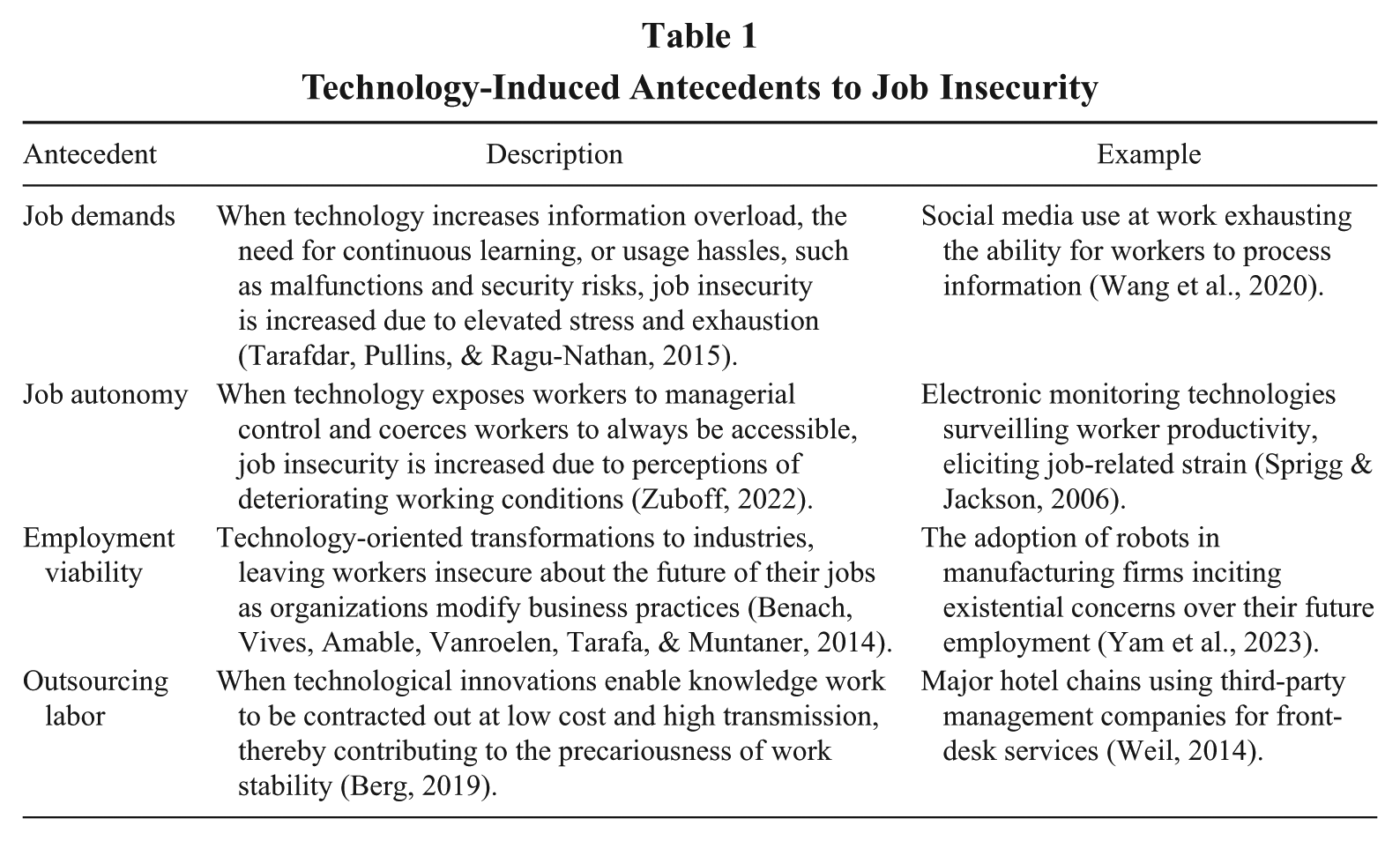
First, technology has been found to have a mixed role in relation to job demands (Wang et al., 2020). On the one hand, technology may reduce job demands through automating routine work and helping employees become more productive. For instance, Bautista, Rosenthal, Lin, and Theng (2018) found that the use of smartphones by nurses for work purposes was associated with enhanced care for patients and higher reported levels of productivity. On the other hand, many studies have found that technology can increase job demands, most notably by increasing the need for continuous learning, information overload, or managing technology malfunctions and security risks (Bala & Venkatesh, 2013; Day, Paquet, Scott, & Hambley, 2012; Farhoomand & Drury, 2002). The increase in job demands is associated with greater job insecurity because workers have elevated levels of stress and experience cognitive exhaustion, making it difficult to complete their daily work tasks (Ayyagari, Grover, & Purvis, 2011; Tarafdar et al., 2015).
Job autonomy may be defined as the degree to which the design and governance of work grants individuals discretion over how, when, and in what manner tasks are carried out (Parker, 2014). Technology has also been found to have competing effects on job autonomy. Videoconferencing technologies offer more flexible job scheduling, which was evident during the COVID-19 pandemic (Brammer, Branicki, & Linnenluecke, 2020), while smartphones enable workers to handle multiple demands simultaneously (König & de la Guardia, 2014). However, the flexibility of technology enabling working from home is counterbalanced by managers setting expectations that workers are always accessible, thus reducing their scheduling autonomy (Bader & Kaiser, 2017). Moreover, electronic monitoring technologies that are constantly watching employees induce job insecurity through perceptions of excessive surveillance (Sprigg & Jackson, 2006). Surveillance technologies reduce autonomy not merely by monitoring behavior, but by redefining what constitutes legitimate work activity.
The third technology-induced antecedent to job insecurity is a threat to employment viability. When workers perceive their long-term job prospects to be endangered as organizational fields change, they often perceive to have a declining influence over how their skills are interpreted and valued (Shoss, 2017). A common theme with research on emerging technologies in the workplace is that they engender existential concerns over the future of employment (Shoss, 2017; Yam et al., 2023). Firms increasingly adopt algorithmic tools for evaluating performance and transforming business practices, which often requires an updating of human skills and knowledge (Benach et al., 2014). The rapid adoption of algorithmic labor alongside the digital transformation of entire industries has led many workers to question their own skillsets in a rapidly changing environment.
Finally, technology has enabled firms to easily contract out work at low cost, known as outsourcing labor (Berg, 2019). Typical labor functions that are outsourced are those that are not central to a firm’s core operations, such as production, distribution, and transportation activities (Quinn & Hilmer, 1994). The diffusion of digital labor platforms over the past few decades has expanded the efficiency with which people can be contracted to perform work, as well as the range of tasks that may be outsourced, such as web development, IT programming, graphic design, copyright, or clerical tasks (Berg, 2019). For existing workers, however, the availability of outsourcing options weakens their bargaining power and heightens their perception that they may be replaced (Bajwa, Gastaldo, Di Ruggiero, & Knorr, 2018). Moreover, the stability of work for those in standard employment contracts benefitting from labor protections, such as call center employees and technology support workers, is becoming threatened as options for lower cost labor proliferate in other nations (Corporaal & Lehdonvirta, 2017). As such, while digital labor platforms afford low-cost outsourcing to organizations and global access to contracted work opportunities, they also contribute to job insecurity by increasing the volume of alternative, lower cost access to freelance workers.
Taken together, technology-induced antecedents to job insecurity reveal a common underlying dynamic: workers experience insecurity when technologies reduce their ability to shape how their work is planned, performed, interpreted, and evaluated. This research finds that technology implicitly assumes control over tasks, roles, or contracts. While prior research has examined these dynamics across distinct antecedents, it has not explicitly theorized them as manifestations of managerial control, particularly control enacted through workers’ physiological and behavioral data rather than through tasks, roles, or employment contracts. These dynamics point toward the importance of examining emerging forms of managerial control that operate not only through tasks or outputs, but through the bodily data of workers themselves.
Bodily Data Control as Enabled by Biometric Technologies
Organizations increasingly rely on data-driven systems to manage, evaluate, and coordinate work (Leidner & Tona, 2021). Within this broader shift toward analytics of people and processes, firms have begun to assert legitimate authority over the collection and use of workers’ physiological and behavioral data as a basis for managerial decision making (Downie et al., 2025; Killoran, Manseau, Park, & Kietzmann, 2025; North-Samardzic, 2020). These practices extend beyond traditional performance metrics by rendering aspects of workers’ bodies as decipherable by organizational systems. We refer to this as bodily data control, defined as organizationally legitimated authority over the collection, interpretation, and use of employees’ physiological and behavioral data for managing work. Bodily data refers to the physiological and behavioral characteristics of human bodies, such as retinal configurations, fingerprint patterns, typing strokes, and voice fluctuations (Lai & Rau, 2021; North-Samardzic, 2020). Bodily data can be managerially controlled, which reflects a growing expectation within contemporary organizations that bodily data constitutes a legitimate input into managerial analysis, evaluation, and coordination (Park et al., 2024). Bodily data control is not inherently coercive or exceptional, but it is ubiquitous; it has become increasingly available for organizational scrutiny.
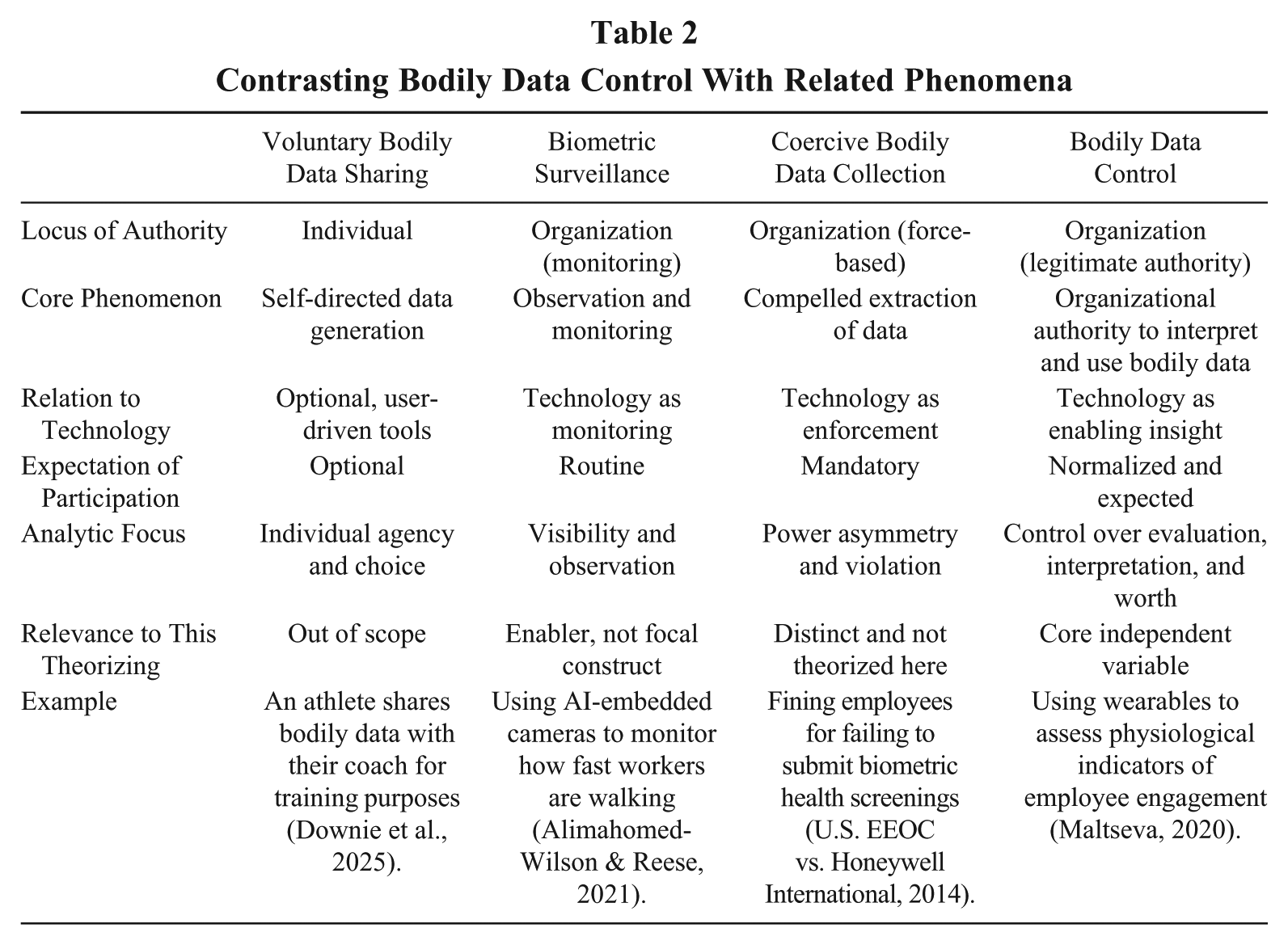
It is important to distinguish bodily data control from related but conceptually distinct phenomena, summarized in Table 2. First, bodily data control differs from voluntary bodily data sharing (Downie et al., 2025), such as self-tracking or wellness initiatives in which individuals retain discretion over whether and how their bodily data is generated and used. In contrast, bodily data control reflects an organizational expectation that it may be collected and analyzed as part of routine work governance. Second, bodily data control should not be conflated with surveillance practices per se (Zuboff, 2022). While surveillance technologies are pervasive and may enable the collection of bodily data, bodily data control refers to the broader organizational authority to interpret and act upon such data, rather than the act of monitoring itself. Finally, bodily data control does not depend on explicit coercion or a violation of rights (Greenwood & Wolfram Cox, 2023). The significance of bodily data control lies in the normalization of bodily data as a managerial resource, such that workers increasingly anticipate that their bodily data, alongside their tasks and outputs, are subject to organizational scrutiny and evaluation.
Contrasting Bodily Data Control With Related Phenomena
Recent innovations in biometric technologies have expanded the organizational capacity to exert bodily data control by making bodily attributes observable and interpretable. Contemporary biometric technologies capture a wide range of physiological data, including fingerprints, facial geometry, retinal configurations, heart rates, body temperature, and fatigue indicators, as well as behavioral data, such as gait patterns, keystroke dynamics, voice modulation, eye movements, and emotional expressions inferred through computer vision and affective computing (De Keyser, Bart, Gu, Liu, Robinson, & Kannan, 2021; Ferguson, Littlefield, & Purdon, 2021; Killoran et al., 2025). Unlike traditional performance metrics, biometric data is characterized by a high degree of permanence; many physiological and behavioral markers are stable over time because they are attributes that either cannot be changed or remain consistent throughout a person’s lifetime (De Keyser et al., 2021; Leidner & Tona, 2021). An individual’s facial structure and retinal configurations cannot be easily modified, whereas a social media profile can be easily changed or deleted. Moreover, biometric technologies often collect bodily data passively through sensors embedded in workplaces, devices, and access systems, making it difficult for humans to opt out of having their bodily data collected (De Keyser et al., 2021).
Finally, advances in machine learning further enhance the inferential power of biometric technologies, allowing organizations to draw conclusions about attention, engagement, reliability, or risk from bodily signals that were previously unobservable or uninterpretable. For instance, wearable devices, such as Fitbit, capture biomarkers such as heart rates and body temperatures. These biomarkers can be of use to managers because they offer an approximate measure of employee interest or disinterest at work (Maltseva, 2020). As a result, managers have begun providing employees with wearable devices to track real-time engagement levels in the workplace. Collectively, innovations in biometric technologies not only increase the volume of data available to organizations, but, more importantly, they enable bodily data to function as an authoritative basis for managerial control.
As bodily data becomes an accepted input into managerial systems, bodily data control reshapes organizational expectations about what can be known about workers. Rather than functioning as supplementary information, bodily data increasingly establishes a baseline for evaluation, against which human performance, engagement, risk, and suitability are assessed (Downie et al., 2025). When measurements of bodily data are found by managers to deviate from traditional norms, managers may require employees to explain the deviation. For instance, an assessment of low engagement by a wearable device may prompt a manager to ask the employee to explain why they have a low engagement score (Maltseva, 2020). Relatedly, an emerging trend in organizations is that the absence of bodily data can be grounds for suspicion (Ball, Di Domenico, & Nunan, 2016; U.S. EEOC v Consol Energy, Inc, 2017). Refusing to allow an organization to collect one’s own bodily data may be interpreted as noncompliance or concealment. As a result, workers may experience pressure not only to perform effectively, but to render their bodies to be continuously observed and/or scrutinized by biometric technologies. Bodily data control thus operates by normalizing the visibility into bodily data, advancing a new form of managerial control through the expectation that organizations can use bodily data as organizational inputs into evaluation. While biometric technologies offer potential organizational benefits (Killoran et al., 2025; Lai & Rau, 2021), our theoretical focus is on the negative consequences that arise specifically from managerial authority over bodily data, which is deeply tied to individual identity, difficult to alter, and ambiguous in how it will be interpreted and used.
By extending managerial authority into the domain of workers’ bodily data, bodily data control introduces a qualitatively different mode of organizational influence. When bodily data becomes a baseline for evaluation, an individual’s ability to decide how work is performed, how performance is interpreted, and how they are morally regarded within the organization may be subtly but systematically altered. In this way, bodily data control has implications that extend beyond privacy or surveillance concerns, and into human agency at work. In the sections that follow, we theorize how bodily data control threatens three types of human agency—interpretive, moral, and instrumental—and how these threats elicit job insecurity.
Bodily Data Control and Job Insecurity: Three Agency Pathways
Our contention is that bodily data control elicits job insecurity because it threatens workers’ capacity to exercise agency at work. With respect to humans, agency refers to the ability to exercise choice and discretion over one’s actions, specifically to think, plan, and act (Bandura, 2006; Emirbayer & Mische, 1998; Gray et al., 2007; Vanneste & Puranam, 2025). As discussed earlier, job insecurity reflects a perceived loss of influence over one’s future organizational standing. Such perceptions arise not simply from environmental uncertainty or technological change, but from conditions in which individuals experience a diminished ability to shape how work is carried out, understood, or evaluated (Nazareno & Schiff, 2021; Shoss, 2017). Bodily data control constitutes one such condition. Specifically, bodily data control transforms the provisions under which workers can interpret the circumstances of their organizational standing, anticipate and plan how they will be treated within the organization, and consequently to perform their job functions. To explain how these transformations translate into job insecurity, we foreground human agency as the theoretical mechanism linking bodily data control to workers’ perceptions of job insecurity.
Drawing on existing scholarship on human–technology collaborations, we distinguish three types of human agency that are especially salient in the context of bodily data control and are directly related to thinking, planning, and acting: interpretive agency, moral agency, and instrumental agency. The three types of agency are summarized in Table 3 and are linked to how they manifest experientially in practice, which will be delineated below.
Human Agency Types Threatened by Bodily Data Control
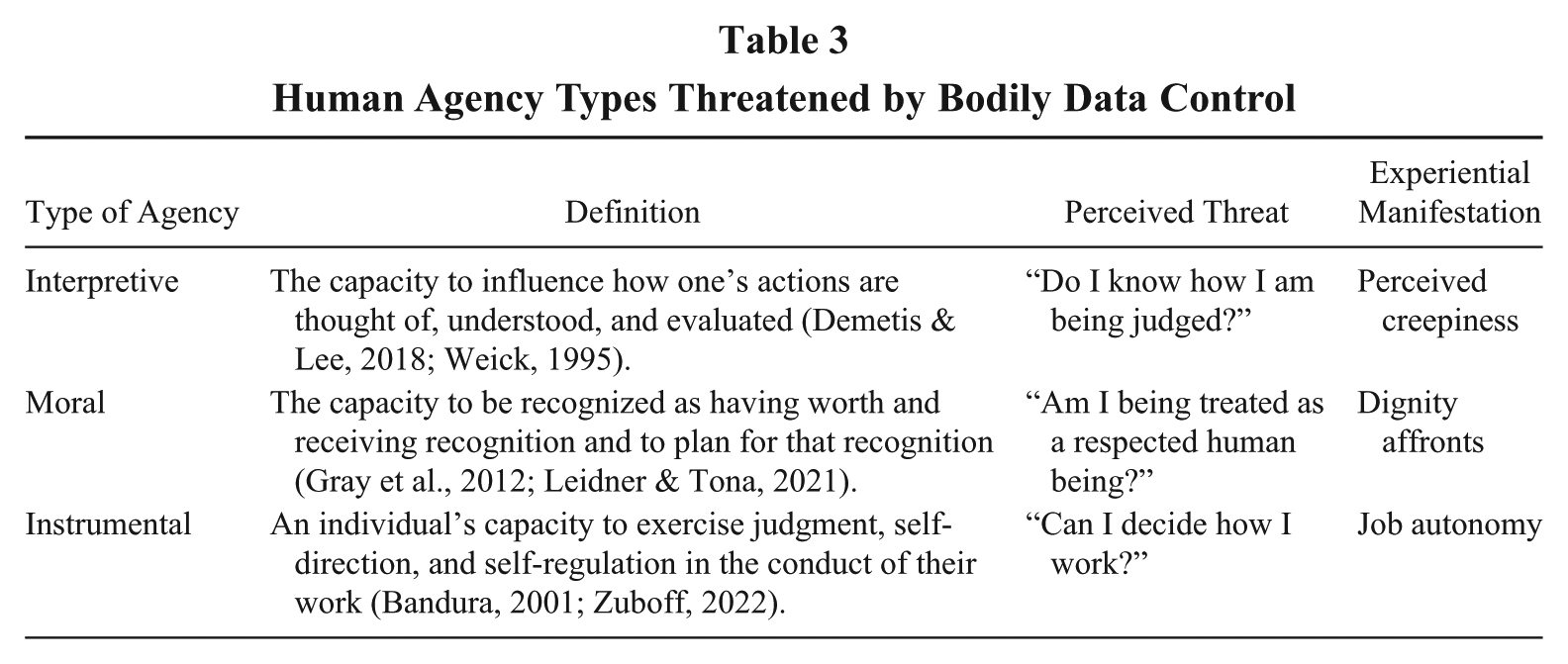
These agency types serve as theoretical mechanisms for understanding why bodily data control elicits job insecurity. When bodily data becomes an expected baseline for evaluation, workers may experience a decline in their understanding of how organizations evaluate workers using bodily data (i.e., threatening interpretive agency), how workers plan to secure respect and recognition for their achievements (i.e., threatening moral agency), and how workers exercise judgment and self-direction (i.e., threatening instrumental agency). Each agency threat undermines workers’ perceived influence over their organizational standing (i.e., job insecurity).
Although interpretive, moral, and instrumental agency are each grounded in the broader notion of human agency (Emirbayer & Mische, 1998), they are analytically distinct in what they enable workers to do. Interpretive agency concerns the capacity to understand how one is being evaluated (Hitlin & Elder, 2007; Weick, 1995). Moral agency concerns the capacity to be treated as a worthy person whose contributions merit recognition (Gray et al., 2012). Instrumental agency concerns the capacity to exercise discretion in task execution (Bandura, 2001). Bodily data control can threaten each type of agency, and each threat surfaces through a different experiential manifestation, which is why we treat them as separate theoretical pathways rather than interchangeable expressions of a single construct.
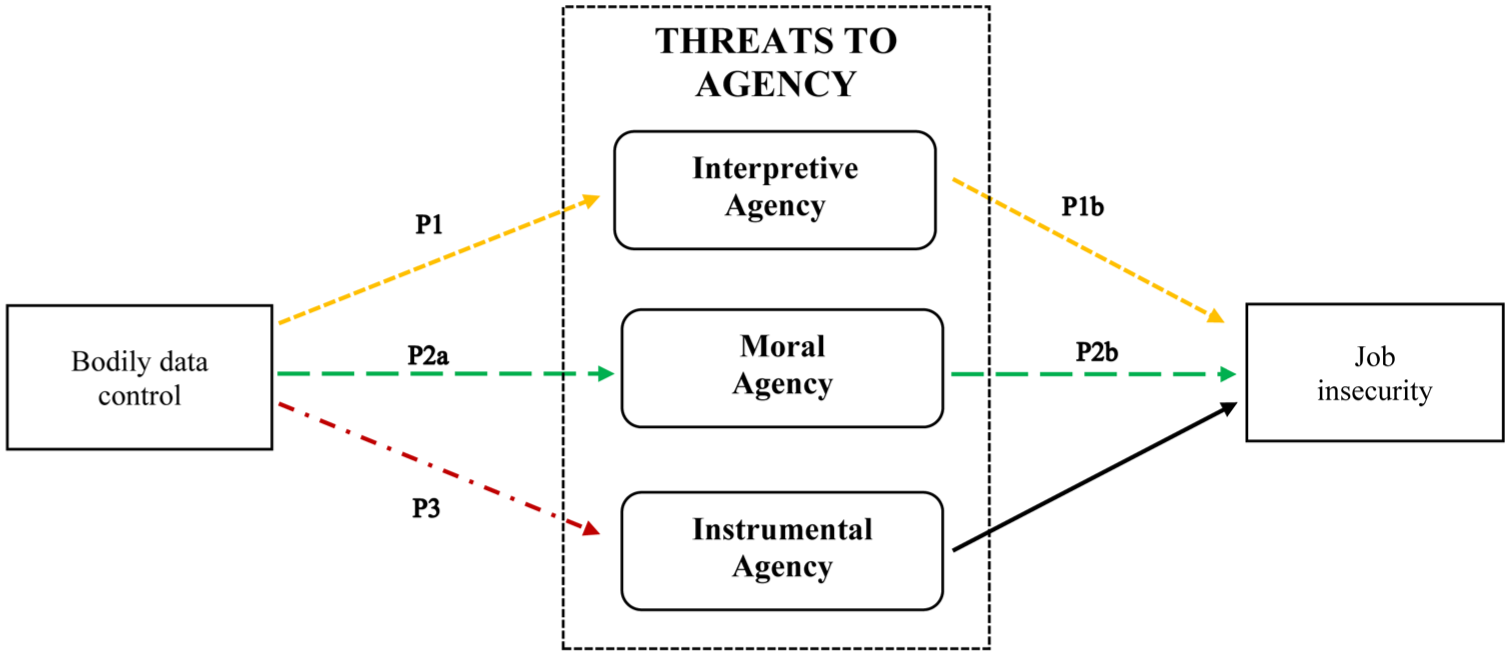
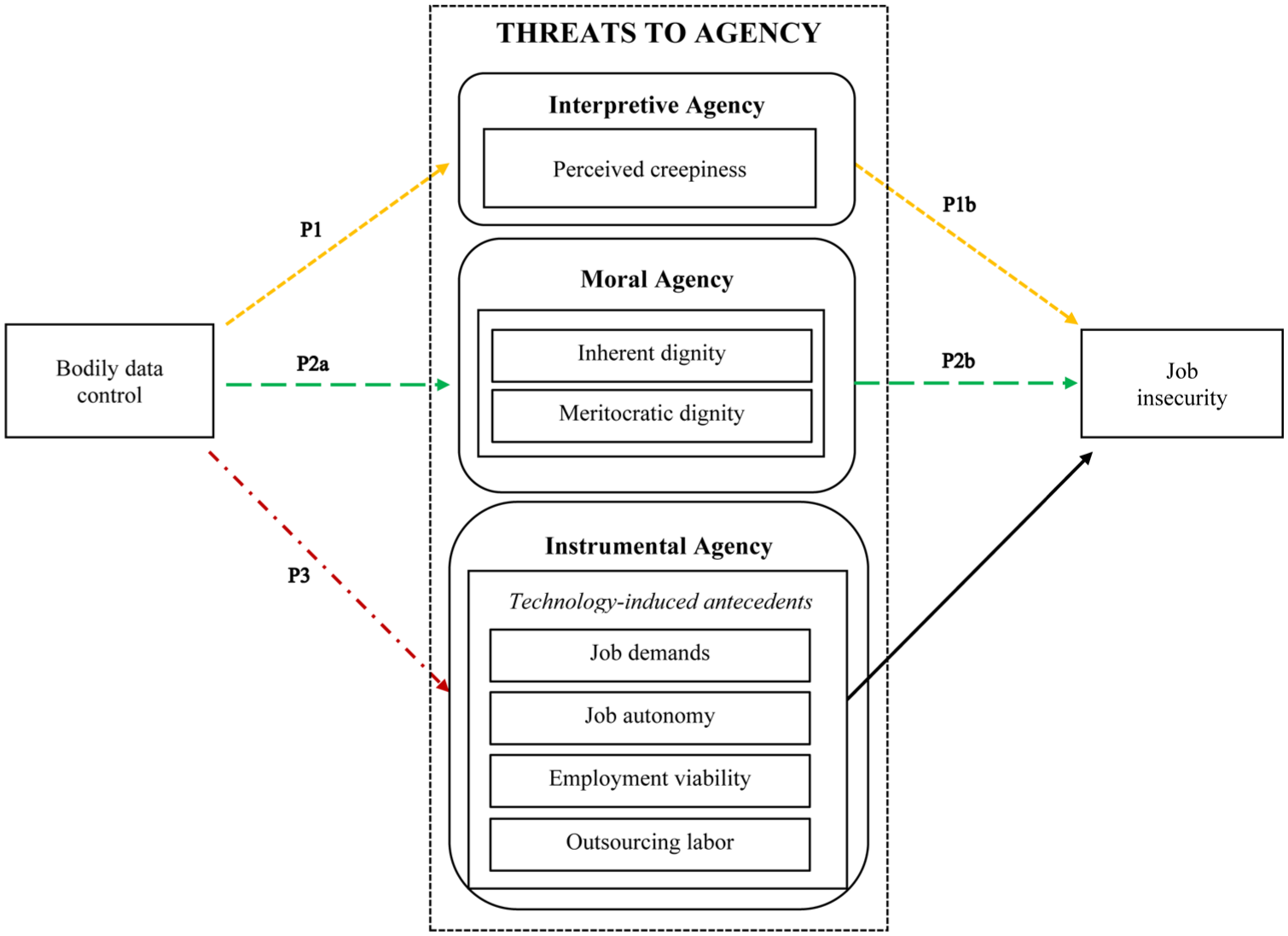
Our theoretical model is presented in Figure 1 with each pathway constituted by a threat to one of the three types of human agency displayed in Table 3. This is followed by an expanded view of the theoretical model, which illustrates how threats to the agency types manifest in practice as instantiations of heightened perceived creepiness, dignity affronts, and reduced job autonomy, respectively. The expanded theoretical model is presented in Figure 2. We emphasize that our theorizing centers on the link between bodily data control and job insecurity, rather than biometric technologies and job insecurity. Biometric technologies represent the innovation that has enabled bodily data control to emerge, but the managerial and salient outcome of the use of biometric technologies is bodily data control, which is the focus of our theoretical exploration.
Theoretical Model
Expanded Theoretical Model
The first input to our model builds on the previously discussed and established relationships between technology-induced antecedents and job insecurity identified in existing literature. Specifically, technology can elicit job insecurity by (i) intensifying job demands; (ii) reducing job autonomy; (iii) undermining perceptions of future employment viability as skills, roles, and evaluation criteria are rapidly reshaped by technological change; and (iv) increasing the precariousness of work stability by enabling outsourcing of labor (Ayyagari et al., 2011; Shoss, 2017; Sirola, 2024; Wang et al., 2020; Yam et al., 2023). While these relationships have been articulated in prior work, we position them here as established technology-induced antecedents that become especially salient when control over work, and, in our context, control over bodily data, is increasingly governed by organizational decision-makers.
At this stage, one might reasonably ask why bodily data control is theorized to primarily elicit job insecurity rather than related constructs such as job satisfaction, or even broader forms of employment insecurity. We acknowledge that bodily control enabled by biometric technologies may indeed spill over into more diffuse feelings of insecurity about one’s standing in the labor market or future employability. However, we focus on job insecurity because bodily data control creates a direct and proximal threat to the continuity of one’s current employment relationship. Bodily data is deeply personal, and its managerial appropriation can signal distrust and exploitation (Leidner & Tona, 2021), which may diminish enjoyment at work but, more critically, raise concerns about job retention. Moreover, bodily data control can produce pronounced power asymmetries when employees lack transparency into how bodily data is used in performance evaluation or disciplinary decision-making, thereby foregrounding fears of sanctions or termination (Park, Kietzmann, & Killoran, 2025). Finally, continual bodily data monitoring can induce persistent anxieties about momentary performance lapses that may jeopardize one’s position (Alimahomed-Wilson & Reese, 2021). While these dynamics may also contribute to broader employment insecurity over time, we contend that their most immediate impact is a perceived threat of job loss, which is a defining feature of job insecurity (Sirola, 2024).
Causal Pathway 1: Interpretive Agency and Perceived Creepiness
The first pathway through which bodily data control leads to job insecurity is through a threat to interpretive agency. When workers retain interpretive agency, they can reasonably think about and anticipate how their actions will be judged, and they can offer explanations, justifications, or corrections when misunderstandings arise (Leidner & Tona, 2021; Weick, 1995). Workers exercise interpretive agency when they can reasonably infer what constitutes proficient performance and how their behavior will be interpreted by those with evaluative authority (Hitlin & Elder, 2007). In other words, interpretive agency is sustained when evaluative processes are intelligible to those being evaluated. Bodily data control undermines interpretive agency by transforming physiological and behavioral data into authoritative indicators that speak for the worker, often without opportunity for the individual to clarify any ambiguities. Interpretive agency depends on the alignment between workers’ self-understandings of their performance and the evaluative criteria applied to them. Bodily data control disrupts this alignment by privileging algorithmic inferences of a worker’s performance over a worker’s interpretation of their own performance. Because bodily data is often treated by managers as objective, continuously observable, and analytically powerful (Killoran et al., 2025; North-Samardzic, 2020), workers may struggle to predict how managers are deciphering their bodily data. Yet physiological signals are inherently ambiguous. An elevated heart rate, irregular typing rhythm, or altered vocal tone can reflect effort, stress, fatigue, illness, or situational strain (Lai & Rau, 2021). Managers are rarely provided with clear insight into the underlying drivers of a performance proxy, such as why a worker has an elevated heart rate. This creates ambiguity, which destabilizes interpretive agency by raising the possibility that bodily data may be interpreted negatively and mobilized in disciplinary decisions.
Under bodily data control, workers have greater uncertainty as to how their performance will be interpreted, weighted, or mobilized in evaluative decisions. This uncertainty is not episodic. Bodily data can be stored, reanalyzed, and retrospectively invoked, meaning that today’s benign reading may become a potential liability in the future. As a result, workers may struggle to anticipate what their bodily data signifies when interpreted by managers, or how those interpretations will shape future outcomes. In this way, bodily data control destabilizes interpretive agency by undermining workers’ ability to make sense of how they are being judged.
Proposition 1a: Bodily data control is negatively associated with workers’ interpretive agency.
Agency is a structural capacity, but threats to agency are lived experientially (Bandura, 2006; Emirbayer & Mische, 1998). When organizations threaten a worker’s ability to think, plan, or act, those threats surface through affective and cognitive signals that reveal deeper disruptions in agency. In the context of bodily data control, threats to interpretive agency manifest as an affective response commonly described as perceived creepiness. Perceived creepiness refers to a state of unease arising from ambiguity about whether a potential threat is present and how it might materialize (McAndrew & Koehnke, 2016). We focus specifically on workers’ perceptions of creepiness stemming from bodily data control. We do not comment on any notions of creepiness based on the design of the technology (i.e., treating creepiness as an attribute or property of the technology; Torkamaan, Barbu, & Ziegler, 2019) which has been an approach used in other streams of research.
Perceptions of creepiness manifest experientially when workers have difficulty interpreting when a potential threat is present (Tene & Polonetsky, 2013). Consider Canon’s deployment of AI-enabled smile recognition cameras in its offices in China, which required employees to produce a smile that satisfied an algorithmic threshold before being granted entry into the building or permitted to book a meeting room (Vincent, 2021). The cameras were framed by Canon as a way to cultivate a positive workplace atmosphere. What makes this situation creepy, however, is not that an immediate threat is readily identifiable, but rather that workers cannot know whether their facial expression on any given morning will be read as insufficiently positive, or what organizational consequences that reading might carry. A worker arriving tired, distracted, or simply not yet composed for the day, faces an evaluative system whose criteria and stakes remain opaque to them. The perception of creepiness arises because there is an ambiguous perception of a potential threat (Zhong & Leonardelli, 2008).
A similar dynamic emerges in organizations where the vocal tone and speech patterns of customer service employees are continuously analyzed to infer emotional regulation (Roemmich, Schaub, & Andalibi, 2023). The employee may accept that calls are monitored by the organization, but what generates unease is the inability to anticipate whether subtle vocal fluctuations will later be framed as disengagement, stress, or diminished professionalism. Similarly, an office employee whose typing dynamics are analyzed to infer focus may not know whether brief pauses or slower typing rhythms will be interpreted as thoughtful deliberation or underperformance (Adjerid, Angst, Devaraj, & Berente, 2023; Killoran et al., 2025). In each case, workers are left wondering about how meaning is extracted from their bodily signals and how that meaning may shape decisions by managers.
This threat to interpretive agency, manifested experientially as perceived creepiness, has direct implications for job insecurity. When workers cannot reliably anticipate how their behavior and bodily states will be interpreted, they lose confidence in the predictability and fairness of evaluative processes. Even in the absence of explicit sanctions, the possibility that ambiguous physiological or behavioral signals could later justify discipline, stalled advancement, or termination can become a salient driver of employment uncertainty. This uncertainty can lead workers to second-guess their behavior, suppress their unique individuality, or anticipate negative consequences that may never fully materialize but nonetheless shape present perceptions of employment stability (Edmondson & Lei, 2014; Shoss, 2017).
Because perceived creepiness is rooted in ambiguity rather than explicit threat, it can be particularly potent. Workers may not know that their job is at risk, but they may feel unable to rule out that possibility. This persistent indeterminacy undermines their sense of influence over future employment outcomes. As bodily data control can restrict a worker’s capacity to interpret how they are judged, continued employment may appear contingent upon opaque evaluative processes beyond their control. Under such conditions, job insecurity becomes a rational response to diminished interpretive agency.
Proposition 1b: Diminished interpretive agency is positively associated with job insecurity.
Causal Pathway 2: Moral Agency and Dignity Affronts
The second pathway through which bodily data control elicits job insecurity is through a threat to moral agency. Whereas threats to interpretive agency concern the intelligibility of evaluative processes to workers, moral agency concerns whether workers are recognized as persons whose bodily data warrant ethical consideration (Gray & Wegner, 2012; Killoran et al., 2025). Moral agency is sustained when workers can reasonably expect that organizations will acknowledge both their inherent worth as persons and their meritocratic contributions as professionals, rather than reduce them to data inputs (Bastian, Laham, Wilson, Haslam, & Koval, 2011). When bodily data is treated exclusively as an organizational resource, workers risk being reconstituted as collections of physiological and behavioral data that can be extracted, ranked, and acted upon without regard for context or their unique individuality. In this way, bodily data control introduces the conditions for managerial control that bypass the moral recognition of human beings.
When bodily data becomes an authoritative basis for managerial control, evaluative decisions may bypass the relational and ethical dimensions that ordinarily invite managerial empathy, discretion, and contextual understanding. If physiological signals of engagement are treated as objective indicators of effort, reliability, or engagement (Demetis & Lee, 2018; Maltseva, 2020), workers may come to perceive that their worth is contingent upon their bodily data conforming to organizational performance standards, rather than their worth being recognized as a function of their individuality. In this way, bodily data control shifts the grounds of evaluation from moral consideration to bodily optimization, thereby eroding the conditions under which workers can expect to be treated as having worth.
Under bodily data control, physiological and behavioral proxies can become legitimate evidence of merit or deficiency (Downie et al., 2025; Martin, 2019). This shift is consequential because bodily data metrics often flatten the situational, relational, and experiential dimensions of work that typically inform moral judgment. For example, consider a warehouse employee whose wearable device continuously tracks physiological indicators such as heart rate variability and movement intensity to infer fatigue (Killoran et al., 2025). During a demanding shift, the employee’s fatigue score rises. The system flags the employee as operating at reduced capacity and automatically adjusts task assignments or triggers a performance review. Absent consideration of staffing shortages, equipment malfunctions, or overtime, the worker’s physiological strain is treated as a personal deficiency rather than as evidence of situational burden. In such cases, the worker is not merely evaluated unfavorably; they may also experience diminished recognition as a moral individual whose bodily state reflects contextual demands.
This diminishing of moral recognition has downstream consequences for how workers orient toward their future employment. In this way, bodily data control threatens moral agency by undermining the perception that organizational decisions will recognize workers as morally situated individuals. This is related to a worker’s ability and desire to plan, which involves considering future actions, setting goals, and strategizing based on expected outcomes and relational dynamics in the organization (Emirbayer & Mische, 1998; Vanneste & Puranam, 2025). When moral agency is threatened, this can reduce a worker’s confidence as to whether their plans will be supported and reciprocated by the organization, which can cause them to disengage from proactive planning, optimize for short-term organizational gains, and exhibit defensive behaviors to mitigate a potential diminishment in standing (Choudhary et al., 2025; Edmondson & Lei, 2014; Rogers & Ashforth, 2017).
Proposition 2a: Bodily data control is negatively associated with workers’ moral agency.
Threats to moral agency often manifest as experiential signals that reflect diminished recognition and respect (Leidner & Tona, 2021). In the context of bodily data control, we identify a threat to moral agency manifesting as affronts to dignity. Dignity refers to the recognition that individuals are beings of inherent worth who are entitled to respectful treatment and recognition of their achievements and status (Leidner & Tona, 2021; Pirson, 2019). Below we explain how threats to moral agency affront two types of dignity: inherent and meritocratic.
Inherent dignity refers to the moral worth individuals possess by virtue of being human, independent of performance outcomes or organizational status (Rosen, 2012). When bodily data control privileges physiological or behavioral data over contextual explanation, workers may experience a form of objectification in which they are treated less as persons and more as measurable entities (Leidner & Tona, 2021). Continuous monitoring of heart rate variability, vocal tone, micro-movements, or fatigue indicators can signal that bodily data is an organizational resource that can be scrutinized, rather than belong to a person who is deserving of respect. The normalization of extracting and acting upon intimate bodily signals may communicate that the organization regards the worker’s body as an instrument to be optimized rather than as an integral aspect of their personhood. In such cases, workers are positioned as biological inputs within a performance system. This shift from recognition to objectification constitutes an affront to inherent dignity because it undermines the expectation that one will be treated as a morally worthy individual whose bodily states warrant ethical recognition.
Threats to moral agency may also manifest as affronts to meritocratic dignity, which concerns the recognition individuals receive for their effort, skill, and accomplishments within an organization (Leidner & Tona, 2021; Rosen, 2012). Meritocratic dignity is sustained when workers can reasonably expect that evaluative systems will acknowledge the substantive quality of their contributions (Pirson, 2019). Under bodily data control, however, performance may increasingly be inferred from physiological or behavioral proxies, such as movement efficiency, engagement scores, or patterns of digital interaction, rather than from the professional discretion of human managers. When bodily metrics displace contextualized assessments of effort and competence, workers may experience a recalibration of how organizations regard merit. A highly skilled employee whose bodily data deviates from organizational norms may be flagged as inefficient despite producing superior work, while another employee whose bodily data conforms to organizational standards may be rewarded irrespective of output quality. In such contexts, recognition shifts from human accomplishment to bodily conformity. This shift can belittle a worker’s confidence that their expertise and dedication will be meaningfully acknowledged, thereby affronting meritocratic dignity by signaling that their standing within the organization is contingent upon biometric alignment rather than professional contribution.
Importantly, these dignity affronts do not require overt coercion, discriminatory intent, or explicit humiliation by managers (Greenwood & Wolfram Cox, 2023; Zuboff, 2022). These are more obvious affronts to dignity, but they do not represent the threat to moral agency that we are positing in this pathway. Rather, moral agency is threatened through the normalization of bodily data as an authoritative basis for managerial decision making. When organizations privilege bodily data over human explanation, workers may feel that their moral recognition is contingent upon biometric conformity rather than ethical consideration of their worth and individuality. In this sense, bodily data control threatens moral agency by eroding the conditions under which workers can expect to receive moral recognition at work.
This erosion of moral agency, manifested as dignity affronts, has direct implications for job insecurity. The recognition of moral agency enables workers to anticipate that employment decisions will reflect respectful treatment (Martin, 2019; North-Samardzic, 2020). When workers experience objectification or devaluation, they may infer that their continued employment depends less on moral recognition and more on their bodily data complying with organizational metrics (Alimahomed-Wilson & Reese, 2021). Disrespectful treatment, objectification, or devaluation communicates that one’s position in the organization is fragile and contingent, fostering fears of exclusion, sanction, or disposability (Hodson & Roscigno, 2004). The threat to job insecurity does not require an actual adverse outcome; the mere perception that bodily data could be invoked in future disciplinary decisions is sufficient to generate employment uncertainty and erode trust in how bodily data is controlled. Because dignity affronts implicate one’s standing within the organization, affronts to inherent and meritocratic dignity signal fragility in the foundations of the employment relationship.
Thus, threats to moral agency are particularly salient predictors of job insecurity because they transform evaluation from a question of performance into a question of worth. When workers perceive that biometric indicators override ethical consideration of their context or effort, they may lose confidence that organizational actors will protect their interests or treat them justly in future decisions. Continued employment may therefore appear contingent upon systems that do not recognize them as morally worthy contributors. Under such conditions, job insecurity becomes a rational response to diminished moral agency.
Proposition 2b: Diminished moral agency is positively associated with job insecurity.
Causal Pathway 3: Instrumental Agency and Reduced Job Autonomy
The final pathway through which bodily data control leads to job insecurity is by threatening workers’ instrumental agency. Whereas interpretive agency concerns understanding evaluation, and moral agency concerns recognition as a person of worth, instrumental agency concerns a worker’s capacity to exercise judgment when executing work tasks (Bandura, 2001; Hackman & Oldham, 1976; Zuboff, 2022). As in the prior pathways, threats to agency manifest experientially in ways that shape workers’ evaluations of their employment standing. For this final pathway, a threat to instrumental agency manifests as reduced job autonomy. Instrumental agency is the prior capacity workers possess to act with discretion, while job autonomy reflects whether organizational conditions permit that capacity to be enacted in practice.
As an example, some organizations collect and analyze behavioral bodily data when employees navigate warehouses (Alimahomed-Wilson & Reese, 2021), which is known in the human–computer interactions literature as behavioral biometrics (Ray-Dowling, Hou, & Schuckers, 2023; Stylios, Skalkos, Kokolakis, & Karyda, 2022). In such a situation, if an AI-embedded video camera calculates that a worker could save 15 seconds by following an alternative walking route to retrieve inventory rather than allowing the worker to choose their own route, managers may direct the employee to follow the route as specified by the video camera. Across thousands of employees, for instance, reducing walking by 15 seconds a day may amount to substantial efficiency gains over the course of a fiscal year. However, instructing workers to follow precise routes risks compromising job autonomy, which likely elicits job insecurity if employees feel they no longer have a choice in how they walk or the pace at which they walk.
This can be harmful in two ways. The first is that workers find greater meaningfulness in their work, and they often perform better, when allowed opportunities to socialize with others (Michaelson, Pratt, Grant, & Dunn, 2014). The warehouse employee may be taking an alternative route to engage in friendly conversation with a colleague before getting back to the task at hand. While managers may wish to ensure that employees do not excessively socialize at work, preventing employees from engaging in any social interactions can be damaging to their motivation and morale (Michaelson et al., 2014). Second, only relying on objective measurements of walking speeds and steps taken may overlook intangible considerations for performance variations, such as if a worker is grieving the loss of a loved one. Rather than penalize the worker for walking at a slower pace, providing compassion and autonomy to the worker may help with overcoming their grief (Kaunonen, 2000). Thus, only relying on an AI-enabled video camera ignores the multiplicity of factors affecting human performance.
Importantly, instrumental agency is not eliminated in these contexts; workers retain the capacity to decide how to act. Rather, bodily data control constrains whether that capacity can shape how workers execute tasks. This is unique from monitoring technologies that simply observe human behavior because bodily data control concerns bodily states that workers often cannot fully control. As such, an individual’s instrumental agency becomes conditional upon the alignment of bodily data with organizational performance standards. When workers perceive that their individual discretion to adjust pacing, socialize briefly, or deviate from standardized movement patterns is being scrutinized by biometric technologies and managers, they may infer that continued employment depends less on exercised judgment and more on compliance with organizationally imposed metrics (Alimahomed-Wilson & Reese, 2021).
As such, bodily data control threatens instrumental agency—and by extension their experienced job autonomy—due to the threat to individual discretion over how workers exert their bodies. While the use of any form of data to control workers will threaten job autonomy, the collection of bodily data is viewed as more invasive, is linked to individual identity, and has greater permanence than non-bodily data because it is a reflection of one’s biological self (North-Samardzic, 2020). Its use in managerial control blurs the line between professional and personal domains of life, thereby violating personal boundaries of one’s body (Killoran et al., 2025; Zuboff, 2022) and potentially limiting one’s freedom, damaging employee motivation and morale, and overlooking intangible considerations pertaining to work performance (Downie et al., 2025; North-Samardzic, 2020).
Proposition 3: Bodily data control is negatively associated with workers’ instrumental agency.
The relationship between diminished instrumental agency and job insecurity is grounded in the well-established link between reduced job autonomy and job insecurity in existing research. Individuals experience job autonomy when they are provided with the discretion to complete tasks how, when, and where they want (Deci & Ryan, 2000; Parker, 2014). Job autonomy is threatened, for instance, if a manager uses monitoring software to keep track of productivity when employees work from home (Wang et al., 2020). Instead of experiencing flexibility to complete tasks how and when they want, workers may experience greater stress when working from home because the software is continuously watching over them (Aloisi & De Stefano, 2022). This was particularly pervasive throughout the COVID-19 pandemic as many managers turned to monitoring software to keep track of employees (Brammer et al., 2020). Workers experienced stress because they no longer felt that they had complete autonomy over their work, and as such job insecurity was elicited due to the presence of monitoring technology. Because reduced job autonomy is the experiential manifestation of a threat to instrumental agency, we assert that the well-established relationship between job autonomy and job insecurity may extend directly to instrumental agency and job insecurity.
Discussion
Existing theories of job insecurity identify an array of individual, organizational and macro level antecedents that determine whether and to what extent an employee may suffer from instability in their future employment prospects (Jiang & Lavaysse, 2018; Shoss, 2017). In the technological domain, automated machines are increasingly seen as having an influential role in eliciting job insecurity due to the threat of reduced organizational standing and fears over worker obsoletion (Johnson, Bauer, & Niederman, 2021; Sirola, 2024; Yam et al., 2023). Technology-induced antecedents to job insecurity are particularly salient with the rapid emergence of autonomous AI systems, which have the capacity to threaten job autonomy and obviate existing human skills (Vanneste & Puranam, 2025). Management scholars contend that advances in AI and automated machines warrant theoretical advances to better understand how technologies and the analysis of novel forms of data collection can jeopardize employee wellbeing and job stability (Balasubramanian, Ye, & Xu, 2022; North-Samardzic, 2020).
The increasing adoption of biometric technologies highlights a critical development in the relationship between employees and organizations that remains underexplored in prevailing management scholarship related to job insecurity. Our contention is that the proliferation of biometrics has introduced the phenomenon of bodily data control, which is the growing expectation in organizational settings that workers’ physiological and behavioral data may be collected, analyzed, and acted upon as part of managerial decision-making. When managers exert control over the bodily data of employees, it enables novel opportunities for employers to scrutinize workers, which we contend leads to job insecurity in three unique ways. Our theorizing addresses this puzzle by identifying bodily data control as the operative mechanism through which biometric technologies reshape workers’ perceptions of employment security.
We propose a theoretical model with three causal pathways depicting how bodily data control elicits job insecurity through threats to human agency, specifically a worker’s capacity to think, plan, and act (Gray et al., 2007; Vanneste & Puranam, 2025). Each pathway corresponds to a distinct dimension of agency: threats to interpretive agency undermine a worker’s ability to think about how they are evaluated (Demetis & Lee, 2018; Smith, 2016); threats to moral agency undermine a worker’s ability to plan by destabilizing the belief that a worker’s plans will be supported and reciprocated by the organization (Leidner & Tona, 2021); and threats to instrumental agency undermines a worker’s ability to act by replacing personal discretion over task execution with organizationally imposed performance standards derived from bodily data (Zuboff, 2022). Crucially, we do not stop at the level of agency abstraction. Each pathway also specifies how agency threats surface experientially in organizational life, as perceived creepiness, dignity affronts, and reduced job autonomy, respectively. This is an important contribution: by linking abstract agency constructs to their empirical manifestations, we provide scholars and practitioners with a framework that is both theoretically grounded and recognizable in practice. Rather than treating bodily data control as a generic surveillance concern, our model reveals the specific mechanisms through which organizational authority over workers’ bodily data becomes consequential for employment security, and why those mechanisms are analytically distinct from one another.
To illustrate the practical relevance of our theorizing, we first ground the model in an organizational example before turning to its theoretical implications.
Illustration With a Vignette
To further exemplify the relational nature of the three theoretical pathways proposed in our processual model, we draw upon a fictitious vignette in which bodily data control elicits job insecurity. The use of a vignette is useful in management scholarship as an illustration of the value of theorizing in situated practices, with exemplary theoretical developments adopting this strategy (Baird & Maruping, 2021; Janssens & Steyaert, 2019).
We outline a fictitious vignette that illustrates two of the causal pathways in our theoretical model. We deliberately adopt a fictitious, rather than real-world, example for two reasons. First, a composite example allows us to construct the precise organizational conditions under which bodily data control operates, making the theoretical mechanisms more transparent than any single real-world case, which inevitably contains features that are incidental to the theory. Second, real-world examples of biometric monitoring in organizational settings are rarely documented with sufficient detail to trace the causal chain from bodily data control through agency threats to experienced job insecurity. This means that using such examples risks forcing theoretical assumptions onto ambiguous empirical cases. We acknowledge, however, that fictitious vignettes carry their own risk. A composite vignette reflects the assumptions of its authors (Janssens & Steyaert, 2019), and readers may reasonably ask whether the depicted conditions are representative of how bodily data control operates in practice. We have therefore constructed the example to reflect conditions that are empirically grounded in existing research on biometric monitoring in organizational settings, and we encourage readers to evaluate whether the theoretical mechanisms we identify are recognizable in the vignette as presented:
Maya is a senior nurse at a regional hospital that recently deployed wearable biometric devices to monitor staff heart rate variability, movement intensity, and recovery metrics throughout shifts. The system was introduced as a wellness initiative to help staff avoid burnout. Maya has 12 years of experience and consistently receives strong performance reviews. During a busy overnight shift, Maya experiences an elevated heart rate and reduced movement efficiency as she manages a difficult patient surge. The system flags her biometric data as physiologically compromised, and this assessment is included in a quarterly workforce analytics report reviewed by her supervisor.
Unlike earlier disruptions in which important nursing work became invisible to digitalized records (Bowker, 1997), what distinguishes Maya’s situation is that her body itself has become an organizational input she cannot interpret, contest, or control. Her elevated heart rate that night was partly attributable to a chronic health condition she has never disclosed to her employer. The system does not register that she managed the patient surge with the same professional competence she always demonstrates. It registers only that her physiological signals deviated from organizational norms and may have inferred something about her health she had not chosen to share. Unlike a documentation error she could correct, her bodily data cannot be revised. It is a permanent record of signals that belong to her body but are now interpreted by others, for purposes she cannot see. Although no immediate sanction occurs, Maya has no access to her own biometric record, no knowledge of how it was weighted, and no forum to explain that her physiological strain reflected exceptional effort rather than diminished capacity. She does not know whether the flag will be invoked in future performance reviews, factored into scheduling decisions, or referenced if she applies for a more senior role.
The fictitious example of Maya first illustrates how bodily data control threatens interpretive agency, which manifests as perceived creepiness. Maya cannot access her own biometric record, does not know how her physiological readings were weighted, and has no forum to provide context for the spike in her readings. The evaluative process has become unintelligible to her; she knows her bodily data has been flagged, but she cannot determine what that flag signifies, how it will be interpreted, or whether it will shape future decisions about her employment. This ambiguity is precisely the condition under which perceived creepiness arises (McAndrew & Koehnke, 2016). Maya cannot rule out that her bodily data will be mobilized against her, but neither can she confirm it. The result is a persistent, unresolvable uncertainty about how she is being judged, one that is difficult to contest because the data, and not her judgment of her own lived experience, is treated as an authoritative representation of her performance. This perceived creepiness, rooted in the opacity of how her bodily data is controlled and interpreted, generates job insecurity because Maya’s continued employment and opportunities for advancement now appears contingent upon evaluative processes she can neither access nor influence. This opacity is more difficult to navigate than it would be with non-bodily data—Maya cannot alter, delete, or reframe what her body produced that night, and her physiological record may have revealed information about her health she never chose to disclose.
Maya’s experience also illustrates how bodily data control threatens moral agency, manifesting as affronts to both inherent and meritocratic dignity. The system treated her physiological strain during an understaffed overnight surge as evidence of compromised performance rather than as a reflection of increased exertion during an extraordinary circumstance. In doing so, it stripped away the contextual and experiential dimensions of her work that ordinarily invite managerial empathy and discretion—conditions under which moral agency is sustained (Gray et al., 2012). Maya was not recognized as a morally situated individual whose bodily state reflected the demands placed upon her; she was reduced to a data point that deviated from organizational norms. This constitutes an affront to her inherent dignity because her worth as a person was subordinated to a biometric reading that does not account for her humanity during a stressful work experience. It also affronts her meritocratic dignity because her prior experience and performance record are not factored into the flagging of her performance by the wearable device. When recognition shifts from professional performance to biometric conformity, workers like Maya can no longer rely on their expertise and track record as a basis for employment security. It is this displacement of merit that makes bodily data control a particularly potent source of job insecurity.
Taken together, Maya’s experience illustrates how bodily data control simultaneously threatens two types of human agency, thereby reshaping the foundations upon which her employment security is experienced. While the example above illustrates two of the three causal pathways, we deliberately focus here on interpretive and moral agency because the healthcare setting often reveals the gap between physiological data and professional judgment that is central to both mechanisms (Adjerid et al., 2023; Zhang & Zhang, 2023), and we did not want to force fit all three agency pathways into one example. The third pathway, through which bodily data control threatens instrumental agency and manifests as reduced job autonomy, is illustrated through the warehouse example developed earlier in the paper.
Theoretical Implications
Our primary contribution is the introduction of bodily data control as a construct that captures a qualitatively distinct form of managerial authority, extending organizational analysis beyond tasks, outputs, and contracts into the physiological and behavioral states of workers themselves. Prior scholarship on the technology-induced antecedents to job insecurity has theorized displacement (Desouza, 2005; Roskies & Louis-Guerin, 1990; Yam et al., 2023), surveillance (Sprigg & Jackson, 2006; Zuboff, 2022), and skill obsolescence (Benach et al., 2014; Shoss, 2017) as mechanisms through which technology threatens employment stability. Our model reframes this conversation by identifying managerial authority over bodily data as an independent and analytically distinct antecedent to job insecurity. We contend that bodily data control operates not by threatening whether work will continue, but by reshaping the conditions under which workers can think, plan, and act within their organizational roles. This reframing has implications for how scholars conceptualize the relationship between emerging technologies and worker wellbeing more broadly, suggesting that the most consequential effects of biometric technologies may lie in the subtle reorganization of evaluative authority over bodily data.
A second theoretical contribution lies in the agency framework we develop. By distinguishing interpretive, moral, and instrumental agency as analytically separable dimensions of human agency, we provide a structured account of why bodily data control elicits insecurity through multiple pathways rather than a single generalized threat. This is theoretically important because it explains why bodily data control cannot be adequately theorized through existing frameworks of surveillance or privacy violation alone. Surveillance scholarship explains the negative effects of monitoring (Zuboff, 2022), but not why workers experience perceived creepiness when they cannot interpret how their bodily data are being evaluated. Privacy violation scholarship explains unwanted exposure to the collection of personal data (De Keyser et al., 2021; North-Samardzic, 2020), but not why workers experience dignity affronts when bodily proxies displace contextual judgment. Scholarship on job autonomy explains why reduced discretion can elicit job insecurity (Bader & Kaiser, 2017; Sprigg & Jackson, 2006), but not why the threat of bodily data control to instrumental agency feels categorically more invasive than non-bodily monitoring. We suggest this is because bodily data possesses properties that distinguish it from other work-related data. Bodily data has greater permanence and cannot be easily revised by the worker, it crosses the boundary between professional conduct and personal physiology, and it can reveal sensitive information, such as health conditions or emotional states, that workers never chose to disclose. These properties make bodily data control a qualitatively different evaluative condition, not merely an intensified form of existing monitoring.
Our theorizing also advances scholarship on the responsible governance of AI systems in organizational settings (Balasubramanian et al., 2022; Choudhary et al., 2025; Matthews et al., 2025). A growing body of management research has grappled with the fact that modern AI systems occupy an intermediate position on the agency continuum, in which AI systems are positioned as more agentic than rule-based technologies, yet lacking the full reasoning and moral capacity of human decision-makers (Baird & Maruping, 2021; Vanneste & Puranam, 2025). Our model contributes to this conversation by identifying the specific consequences of when managers delegate evaluative authority to biometric technologies that cannot account for the contextual, relational, and experiential dimensions of work. When AI-enabled biometric systems treat bodily data as authoritative performance indicators, they risk systematically displacing the moral recognition and interpretive transparency that workers depend upon to feel secure in their employment. This suggests that the governance of biometric technologies is not merely a technical or legal challenge, but a fundamentally human one. Organizations must attend not only to what biometric technologies measure, but to what they fail to recognize.
Finally, our model highlights the fragility of the relationship between a worker, their body, and their work under conditions of bodily data control. Prior scholarship has identified contexts in which access to bodily data can be beneficial, enhance performance, and foster trust when configured respectfully (Downie et al., 2025). Our contribution is to theorize the conditions under which this relationship becomes threatening rather than enabling. When bodily data is treated as an organizational resource that can be controlled, rather than as an expression of personhood, a worker’s body itself is transformed from a source of professional capability into a potential liability for their future employment. Workers can no longer rely on their expertise, judgment, or effort as the primary basis upon which their employment standing is secured. Instead, continued employment appears increasingly contingent upon bodily conformity to standards that workers did not set and face challenges contesting, and which may be difficult to observe. This, we argue, is a defining danger of bodily data control: it renders their bodies as data sources that can be used for purposes beyond their knowledge or control.
Future Research
Our theoretical model separates three pathways to clarify the mechanisms through which bodily data control threatens interpretive, moral, and instrumental agency, and elicits job insecurity. However, we acknowledge that in practice these pathways may co-occur. A worker whose movement patterns are continuously tracked may simultaneously experience uncertainty about how their data is being interpreted (i.e., interpretive agency), feel that their discretion over tasks is replaced by imposed performance standards (i.e., instrumental agency), and perceive that their worth as a professional is contingent upon biometric conformity (i.e., moral agency). Future empirical work should examine whether these agency threats operate independently or whether the experience of one could amplify the others. It is plausible, for instance, that the manifestation of perceived creepiness intensifies dignity affronts by heightening a worker’s sense of vulnerability, or that reduced job autonomy exacerbates perceived creepiness by removing a worker’s ability to adjust their behavior in response to ambiguity. Understanding the interactive dynamics would substantially deepen the explanatory power of the model and reveal conditions under which bodily data control produces severe consequences for job insecurity.
A second avenue for future research concerns the relationship between bodily data control and the broader landscape of AI-enabled organizational technologies. Existing scholarship has theorized how individuals develop trust toward AI systems based on perceptions of the AI system’s agency (Vanneste & Puranam, 2025). Our model suggests that this trust development may be fundamentally altered when the AI system is not merely assisting task execution but is actively extracting, analyzing, and acting upon intimate physiological and behavioral data about the worker. When bodily data becomes an input into AI-enabled managerial systems, the coupling between human and technological agency takes on a qualitatively different character (Killoran et al., 2025)—one in which workers are not collaborating with AI so much as being evaluated by it. Future research should examine how a worker’s perception of AI agency shapes their responses to bodily data control, and whether design interventions, such as increased transparency (Lebovitz, Lifshitz-Assaf, & Levina, 2022), can attenuate the agency threats our model identifies.
Third, future research should examine the relationship between bodily data control and automation as potentially interacting antecedents to job insecurity. Prior scholarship has established automation as a dominant technology-induced antecedent to job insecurity, primarily through the threat of displacement and skill obsolescence (Ashford, Lee, & Bobko, 1989; Yam et al., 2023). Bodily data control operates differently by reshaping the conditions under which workers exercise agency within their roles. Yet, in many contemporary organizational contexts, both forces are simultaneously present. Workers may face automation-induced displacement fears while also being subject to task monitoring by biometric technologies. Empirical research should investigate whether these two antecedents interact, and whether their combined effect on job insecurity is additive, synergistic, or whether one dominates under particular conditions. Such work would situate bodily data control within the broader technology-induced job insecurity literature and clarify its unique contribution relative to established antecedents.
Finally, our model focuses on constructs proximal to the individual worker’s experience of bodily data control. This is appropriate for an initial theoretical development, but it leaves important questions about the organizational and contextual conditions that moderate the relationships we propose. Future research should examine how factors such as managerial trust (Glikson & Woolley, 2020), organizational transparency (Lebovitz et al., 2022), and the degree of worker consent (Buolamwini, 2023) shape the extent to which bodily data control threatens agency and elicits job insecurity. It is plausible that workers who have meaningful input into how their bodily data is collected and used experience substantially attenuated agency threats, which would suggest that organizational governance practices may represent an important boundary condition for the model. Relatedly, job insecurity is frequently studied as an antecedent to downstream outcomes including turnover intentions, job mobility, and organizational commitment (Griffeth, Hom, & Gaertner, 2000; Shoss, 2017). Future research should examine whether the job insecurity elicited specifically by bodily data control produces distinctive downstream consequences, or whether its effects on withdrawal, motivation, and wellbeing mirror those of job insecurity arising from other antecedents. Our model offers an initial scaffolding for this broader research agenda, but the relationship between organizations, bodily data control, and worker wellbeing is likely far more complex than any single theoretical account can capture.
Conclusion
Biometric technologies are rapidly transforming the conditions under which workers are evaluated, monitored, and governed (Killoran et al., 2025; North-Samardzic, 2020). This paper has theorized how biometric technologies enable a growing organizational expectation that workers’ physiological and behavioral data may be collected, interpreted, and acted upon as a legitimate basis for managerial decision-making. We introduce bodily data control and explicate three agency-based pathways through which bodily data control elicits job insecurity. Specifically, we propose that bodily data control threatens interpretive, moral, and instrumental agency, and that these threats manifest experientially as perceived creepiness, dignity affronts, and reduced job autonomy, respectively. Together, these pathways reveal that a consequential danger of biometric technologies is that they systematically reshape who can access and appropriate bodily data. We hope this theoretical development serves as both a foundation for empirical inquiry and a call for more thoughtful governance of bodily data that recognizes workers as morally situated individuals whose bodily data warrant ethical consideration.
Footnotes
Acknowledgements
The authors would like to thank Dr. Nicky Dries and the two anonymous reviewers for their constructive feedback throughout the review process. Their support has been immensely helpful in bringing the manuscript to its full potential. We are also grateful to colleagues at the Gustavson School of Business, University of Victoria who provided feedback on earlier versions of this research.
