







Abstract
The aim of this article is to explore the structure of cities as a function of labor differentiation, gains to trade, a fixed cost for constructing the transportation network, a variable cost of commodity transport, and the commuting costs of consumers. Firms use different types of labor to produce different outputs. Locations of all agents are endogenous as are prices and quantities. This is among the first articles to apply smooth economy techniques to urban economics. Existence of equilibrium and its determinacy properties depend crucially on the relative numbers of outputs, types of labor, and firms. More differentiated labor implies more equilibria. We provide tight lower bounds on labor differentiation for existence of equilibrium. If these sufficient conditions are satisfied, then generically there is a continuum of equilibria for given parameter values. Finally, an equilibrium allocation is not necessarily Pareto optimal in this model.
Introduction
This work will attempt to address some of the classic, but relatively unexplored, questions raised in urban economics that deal with the economics of cities. Our questions include the following. Why do cities form where they do? What are the driving forces behind the formation of cities? What roles do increasing returns, gains to trade, and the location of marketplaces play? What role does the location of firms play? Is market failure necessary for agglomeration? Is perfect competition consistent with spatial modeling? Why do some cities grow faster than others? This set of questions frames our line of research. The answers to these questions have important policy implications, since the predictability of the effects of government actions rests on an understanding of the mechanisms driving the urban economy. The ability of policy makers to make informed decisions about contemporary issues such as government policy pertaining to migration to and from cities, or social policy directed at revitalizing cities, relies on information provided by urban economic theory.
In order to have a theory explaining city formation and structure, it is necessary to construct a class of models in which the locations of all agents are endogenous, including both consumers and firms. As explained in Berliant and ten Raa (1994), the nature of most of the existing literature is partial rather than general equilibrium in the sense that either the locations of consumers or firms are fixed. The literature reviewed here is distinct since the locations of all agents are endogenous, and thus these models have the potential to answer the questions we have posed.
There are many approaches to answering the questions addressed by our model that generally suggest different economic causes for city formation and growth and consequently different modeling strategies. Each theory relies on different forces to explain agglomeration and therefore has different consequences in terms of welfare. So it is important to generate testable hypotheses to distinguish among the theories. We categorize the literature on city formation into four groups, using the Spatial Impossibility Theorem of Starrett (1978), as interpreted in Fujita (1986) and Fujita and Thisse (2002), which states that there is no spatial equilibrium with agglomeration if the following conditions are met: (i) no relocation cost, (ii) consumers’ preferences and firms’ technologies are independent of location, (iii) the economy is closed, (iv) each location has complete competitive markets. Each of the four groups explains agglomeration by relaxing at least one of the hypotheses of the Starrett Theorem.
In the first group, city formation is explained using increasing returns to scale. This group violates (iv) since it assumes imperfect competition. Indeed, Fujita and Krugman (1995, 2000), Fujita, Krugman and Venables (1999), and Krugman (1991, 1993a, 1993b) use a Dixit-Stiglitz framework and increasing returns to generate city formation in a monopolistic competition context. 1 This work was preceded by Fujita (1988), Abdel-Rahman (1988, 1990), and Abdel-Rahman and Fujita (1990).
The second group of models uses spatial externalities to explain city formation (Beckmann 1977; Fujita and Ogawa 1982; Papageorgiou and Smith 1983; ten Raa 1984). These models violate (ii), (iv), or both, since agent utilities or production functions depend on the locations of the other agents and these externalities are not priced.
In the third group, agglomeration is explained by strategic interactions between firms (spatial competition a la Hotelling; for surveys see Gabszewicz and Thisse 1986, 1992). This group also violates (iv) since it assumes imperfect competition.
The fourth group of models (Berliant and Konishi 2000; Berliant and Wang 1993; Wang 1990) uses gains to trade and setup costs of marketplaces and transportation networks to generate agglomeration. This group violates (ii) and (iv), since there may be no marketplace (and consequently no market) at some locations, and therefore agents care about location.
Another explanation for city formation is the differentiation of labor. For example, Rochester, NY, has a highly specialized labor force that serves companies such as Kodak, Xerox, and Bausch and Lomb. These companies employ workers who know about optics and engineering. Another example is Silicon Valley that has a concentration of labor specialized in the production of semiconductors. This idea has not been modeled formally, although some attempts have been made to model the worker choice of human capital investment using very crude spatial structures (Baumgardner 1988; Benabou 1993; Kim 1991). Zenou (2009) surveys this literature and studies labor markets in various imperfect competition or search contexts.
The specific question we address in the present article is How does labor differentiation affect city structure?
In our approach (which can be considered as a fifth group), the formation of cities is explained by labor differentiation, gains to trade, a fixed cost for the transportation network, a variable cost of commodity transport, and the commuting costs of consumers. Since firms are used as marketplaces, our model violates (ii) and (iv) of the Starrett Theorem, similar to the fourth group above.
Observe that in all models of general equilibrium with endogenous locations (including ours), the main problem is to show the existence of a spatial equilibrium and to find its determinacy properties. Why is this a problem? When one introduces space in a general equilibrium framework with a continuum of consumers (and locations) and a finite number of firms, there are nonconvexities for both consumers (the consumption set and preferences are nonconvex due to the discrete choice of one location of residence) and firms (firm reaction correspondences are not convex valued since at given prices, a firm’s profit could be maximized at two different locations), and therefore the usual fixed point theorems relevant for proving existence of an equilibrium do not work.
On the consumer side, we can easily convexify the aggregate demand correspondence with a large number of individuals (see Hildenbrand 1974). Schweizer, Varaiya and Hartwick (1976), Ellickson (1979), and Grimaud and Laffont (1989) have used this technique to prove the existence of a spatial equilibrium. Observe that the number of locations in all of this work is finite. In contrast, our model and the standard models of location theory use a continuum of locations. In this case, Hildenbrand’s type of argument does not necessarily apply. As is common in the literature (see Fujita 1989), we use the bid-rent approach, imposing the condition that consumers can choose only one location, to solve the nonconvexity problem; this technique does not require a fixed point argument or convexity but relies on direct calculations.
How can we solve the firm’s nonconvexity problem? To the best of our knowledge, there are two techniques that work. Both of them fix producer locations, and solutions are computed for nonlocation variables given these locations. The two techniques use different methods of fixing producer locations. The first uses Negishi’s (1960) method that fixes firms at the Pareto optimal locations and more generally fixes the allocation at the Pareto optimum. Then one has to decentralize and find a price system that supports the optimum (see Wang 1990; Berliant and Wang 1993). Obviously, this method does not work if there is a market failure. The second technique consists of characterizing the spatial equilibrium. However, since there is in general a lot of endogenous variables (prices and quantities as usual, but also locations of producers and consumers), the characterization of equilibrium is difficult. This method was used by Fujita and Krugman (1995, 2000) and in order to characterize the equilibrium they resort to specific functional forms (e.g., constant elasticity of substitution [CES] utility functions and a Samuelsonian “iceberg” transport technology). This approach suffers from a lack of robustness in the specification of functional forms as well as from a large indeterminacy in the number and qualitative properties of equilibrium. They select one equilibrium. Moreover, consumer commuting is not allowed by this type of model. In our approach, we also use the (second) technique of calculating the equilibrium directly, but we avoid the problems encountered by Fujita and Krugman (1995, 2000). In essence, due to the interaction of firms, considered to be marketplaces as well for exchanging goods, we are able to characterize their equilibrium locations in general, and therefore to prove existence of equilibrium by employing a fixed point argument for all of the nonlocational variables.
A natural question that comes to mind is why, in a model of general equilibrium with endogenous locations (such as ours), does one not use randomized strategies to alleviate the nonconvexity problem and to prove existence of an equilibrium? Basically, there are two reasons not to use mixed strategies. First, if one studies what happens after a randomization is realized, one can easily end up at an infeasible allocation. For example, each firm randomizes over all possible parcels ex ante, but ex post, firms might happen to pile up on one interval, an ex post infeasible allocation. Mixed strategies also involve precommitment of firms to the parcels they get after randomization, and when the random draw is realized, they might have more profits with a different strategy. The latter effect is common to games allowing mixed strategies. The second, and perhaps more important reason, is that the obvious equilibrium with mixed strategies is where everyone is spread out uniformly by randomizing over all locations: it is the Starrett theorem in the context of randomization. Such an allocation clearly minimizes transport costs. There is no agglomeration, and it is uninteresting just as in the standard Starrett theorem. Equilibrium is an artifact of randomization. This is very similar to what is proposed in Koopmans and Beckmann (1957) as the solution where there is no equilibrium in their quadratic assignment model, and should be rejected for the same reasons.
To be more precise, our model uses a very general setting, allowing a multidimensional location space and multiple firms using different types of labor to produce different output commodities. Locations of all agents are endogenous as are prices and quantities. Firms anticipate the relocation of consumers, but influence land prices through their location decisions. As we shall explain shortly, we stick as close to perfect competition as possible while retaining existence of equilibrium. Firms use compact, convex sets of land while consumers buy densities of land. It is assumed that each firm can use only one type of labor and produce only one type of output. With reference to the labor economics literature, labor differentiation can be viewed either as general or specific human capital depending on the number of firms using a particular type of labor. Within this framework, we characterize the spatial configuration of firms in equilibrium. Firms are adjacent to each other at any equilibrium allocation. This is very similar to the principle of minimum differentiation although the force that is driving agglomeration in our model is the transportation cost of outputs. This result is used to prove existence and to examine the determinacy of equilibrium. The proof of existence is unusual in that it uses a mixture of bid rent and fixed point techniques. Concerning the determinacy analysis, we use differential topology techniques in combination with the bid-rent approach. This article can be counted among the first applications of smooth economy techniques to urban economics. To our knowledge, Berliant and Kung (2006, 2009) are the only predecessors, and they apply these techniques to New Economic Geography models.
We show that whether or not equilibrium exists and whether or not it is locally unique depends crucially on the relative numbers of outputs, types of labor, and firms. The multiplicity of equilibria is positively associated with the degree of labor differentiation. Finally, an equilibrium is not necessarily Pareto optimal in this model.
Loosely speaking, our main conclusion is as follows. When labor is not completely differentiated, in the sense that more than one firm is drawing from the same pool of labor, equilibrium might not exist; a counterexample (example 4) is provided in the Online Appendix. (This does not exclude existence of equilibrium for other examples.) Once one has sufficient conditions on labor differentiation for existence of equilibrium, generically there is a continuum of equilibria. This derives from the classical idea that indivisibilities, particularly in the order and location of firms in our model, both inhibits existence of equilibrium and, once equilibrium is found, allows variation in continuous endogenous parameters without altering the order of firms and without destroying equilibrium.
The remainder of the article is organized as follows. The second section sets up the model and provides the notation and basic definitions. In the third section, we characterize the locations of firms and consumers in equilibrium. It is unusual to be able to do this analytically. The fourth section examines the determinacy of equilibrium in this model. For given values of the exogenous parameters, we find that, depending on the number of labor types, firms, and output goods, the set of equilibria might be empty, might be finite, or might form a continuum. The fifth section provides sufficient conditions for existence of an equilibrium in the model. These conditions, in turn, imply that generically the set of equilibria forms a continuum. In the sixth section, we give an example showing that both welfare theorems can fail. The seventh section concludes. An Online Appendix, available at the first author’s website, contains complementary illustrative examples and all proofs.
The General Setting
The location space
Each firm uses only one type of labor, along with land, to produce exactly one output commodity. For each
Assuming constant returns to scale would not change the basic results but would change supply functions to correspondences, and this would make the differential topology argument used for the determinacy of equilibrium much more difficult.
In our model, absentee landlords are endowed with all of the land and all of the profit shares but consume only produced goods. It is standard in the literature of urban economics to employ absentee landlords to insulate the model from income effects in order to use a bid-rent approach (see e.g., Fujita 1989). Our results are easily generalized to allow consumers to be endowed with land or profit shares. 4 We can also allow “absentee” shareholders (as distinct from landlords) to have all the profit shares.
We assume that the markets for all goods (including labor) except land are competitive. This assumption of perfectly competitive markets will be made formal in the statements of the consumer and producer optimization problems and is important in order to prove that equilibrium exists. As we will see later, whatever the assumption on the transportation cost of goods, it is this assumption of perfect competition that makes good prices location independent. We will discuss later the assumption that the land market is not competitive.
Consumers of type

Firms use Lebesgue measurable subsets of (a) For each (b) Fix any

For instance, if
If firm
It is very important, at this point, to discuss issues related to the shape and proximity of land parcels to each other, especially as they relate to the rest of the literature. As discussed in Berliant (2007), we can sort models of location by what commodity space is used (and also hope to prove universal theorems that are independent of the choice of commodity space). One alternative is to use a general commodity space (such as the space of all Lebesgue measurable sets) and assume both that consumers like nicely shaped parcels and that producers find them more productive, hoping that nicely shaped parcels arise endogenously as equilibrium or optimal outcomes. This is the approach taken in a line of research developed by the first author and coauthors, culminating in Berliant and Dunz (2004). Production in this setting appeared first in Berliant and Jeng (1990), though productivity is not a function of shape in that ancient paper. Key to this literature is a new topology on sets, called the outer Hausdorf topology, which makes the commodity space compact but still allows preference for shape. Convexity/concavity properties are a big hurdle themselves. It is very difficult to characterize equilibrium parcels in this setting outside of some examples. Another alternative, used here as well as in more applied settings such as Berliant and Fujita (1992), is to exogenously restrict the commodity space to allow only nicely shaped parcels. For Theorem 1 below, we use the restriction on land parcels given in (a) and (b) above. But for our most of our results below, we will restrict land parcels even further to hyper-rectangles.
Consumers pay a commuting cost to travel to work. For simplicity, commuting costs are only monetary costs and therefore there is no time cost of commuting. Let
We assume that every pair of firms must be connected by a transport network (the cost of connecting any pair of firms is shared equally by each member of the pair) and that all consumers purchase their consumption goods at the location of a firm, that is firms are marketplaces. 6 These assumptions mean that transportation of goods takes place only between firms, where consumers purchase all their consumption commodities. The transportation network for commodities will connect all firms, even those producing the same good, since local demand and supply of consumption commodities might not be balanced. For example, this depends on where the absentee landlord shops. The absentee landlord might exhaust the commodity produced by one supplier, requiring that it be imported from another.
In the model, all markets are spatially global, but labor markets can differ due to labor heterogeneity. Variable transport cost can create differences in the price of a consumption good across locations and firms. That is the reason
More formally, let
Let
Our assumption about the cost sharing rule means that this rule is essentially equal division of the network transportation cost for connecting each firm to another. However, our results can be extended to arbitrary monotonic and lower semicontinuous functions of this fixed cost. Relocation costs for both firms and consumers are zero.
We could employ a more general transportation technology as in Berliant and Konishi (2000), which would specify a set of input requirements, each element of which can produce one unit of transportation services. For simplicity, we use the special case given above. The use of a more general technology will not affect the main results, as we shall explain in the third section below. Let us now define two important concepts.
Definition 1: Firm

Definition 2: Firm
We assume no transport cost between adjacent firms. This implies no transport costs between connected firms, because otherwise firms would simply ship to adjacent firms, and those firms would re-ship to the next firm. Thus, zero transport costs between adjacent firms actually implies zero transport costs among connected firms. Hence, we state the total cost for firm

where
Let

where

Notice that a firm does not think that changing its location will affect its unit price of land
Observe that the profit function depends on the location of firm
Observe moreover that, when a firm changes its location and locates farther away from other firms, this firm might think that its variable transportation cost will go up but, since it is competitive (in the product market), it thinks its output price would not change. Therefore, even with the assumption of positive variable transportation costs, good prices are not location dependent.
This implies location-independent (good and labor) prices. Thus, we have a constant wage gradient, which is just a special case of allowing wages to vary across locations. If wages are allowed to vary across firm locations but agents take the wage gradient as parametric, we would simply have more equilibria. Notice that if one type of worker can be used to produce two different products, although the equilibrium wage rate can be different, in equilibrium the utility of the workers of the same type must be the same. Thus, wage inequality for workers of the same type does not reflect inequality in terms of welfare.
If wages vary with residential distance from a firm, this is a form of price discrimination and seems to be incompatible with perfect competition. In this case, it is unclear what firms think wages would be if they move. Moreover, it seems unrealistic to assume that firms wage discriminate based on the residence locations of worker/consumers.
There are several alternative equilibrium concepts that could be used with this model. We use the simplest, namely perfect competition, taking prices and the actions of other agents as given, with one small deviation. We assume that the price of land faced by firms is constant across locations. An implication is that it is independent of consumer bid rent or the unit price of land paid by consumers. Another implication is that, in equilibrium, the price of land faced by firms will be at least as high as the maximal bid rent of consumers.
There are two reasons we make this assumption. First, the firms know that if they relocate, consumers will follow and bid up the price of land nearby. Although it would be best to model this process explicitly, the resulting model would be very complex and difficult to analyze. In particular, nonconvexities in reaction correspondences of firms would make the analysis attempted here impossible. Instead, we model this process implicitly through a constant price of land for firms.
Second, it is clear that at any possible equilibrium allocation, the bid-rent curves of consumers are highest near a firm and decline with distance from a firm. If firms pay the price given by the highest bid rent for parcels and have location-independent production functions, they will always want to locate where rent is lowest, namely as far away from their current location as possible. Such behavior is unlikely to lead to an equilibrium.
Perhaps the most natural alternative equilibrium concept is as follows. There are two stages, and the solution concept is pure strategy subgame perfect Nash equilibrium. The second stage is an equilibrium under perfect competition given fixed firm parcels. The first stage is a simultaneous move Nash equilibrium with firms choosing the parcels that they will use in production and will rent in the second stage. The firms know perfectly how their choice of parcel in the first stage will affect equilibrium in the second stage, including their land rent and the value of their output.
Although this equilibrium concept has intuitive appeal, there are three serious technical problems associated with it. First, the second stage competitive equilibrium will not be unique in general. This presents problems for both results concerning existence of equilibrium and determinacy of equilibrium. Of course, multiple equilibria in the second stage can cause nonconvexities in (or an ill-defined) first stage reaction correspondence. Possible remedies include using mixed strategies in the first stage, refining second stage equilibria so that they are unique, or imposing conditions on the economy so that second stage equilibria are unique. Any of these solutions will either complicate matters or limit the robustness of results substantially.
The second technical problem is that firms might not be connected in an equilibrium. Prices of mobile goods in the second stage can differ across locations, rendering the equilibrium concept very complex. Nonconvexities in first stage firm reaction correspondences can result. Moreover, the arguments we use for existence of an equilibrium and determinacy properties would no longer work, since they take as given the locations of firms.
The third technical problem with the alternative equilibrium concept is that if firms in the first stage choose a disequilibrium configuration, for example if two firms decide to use the same parcel of land, then payoffs are not well defined. The reason is that given such firm location choices, the second stage configuration of firms is not feasible, so there is no competitive equilibrium associated with it.
For these reasons, we use the first equilibrium concept, employing (virtually) perfect competition. This can be seen as a special case of the alternative equilibrium concept, where the transport cost faced by firms is much larger than the commuting cost faced by consumers, so that firms will always choose to form a connected set in equilibrium.
Let us turn to the consumer’s problem. A consumer of type

Observe that there is only one wage for each labor type since consumers are mobile and one unit of labor is supplied inelastically by each consumer. Define
Let us denote by
Let us now consider the absentee landlord’s problem. Let

where
The following are standard definitions.
If D is a Lebesgue measurable subset of
Definition 3: A feasible allocation is a vector






Equation (4) is the material balance condition for land. Notice that one unit of land is available at each point in
Definition 4: An equilibrium is a vector

such that
Definition 5: An equal treatment Pareto optimum is a feasible allocation

such that for each
What does equilibrium look like?
Example 1, found in the Online Appendix, motivates our first result and gives us good intuition about equilibrium in the case of two firms and two types of workers. We state the general result. 8
Theorem 1: Fix any equilibrium land allocation for firms,
The following comments are in order. First, in one dimension (
Second, since a firm takes everything as given except for transport costs (variable or fixed, or both), it will seek to minimize them. Thus, Theorem 1 will work even with positive variable transportation costs, provided that these costs are zero when two firms are connected. Thus, variable costs can be taken to be zero without loss of generality, since firms will be connected in equilibrium in any case. Now consider the case where variable transportation costs are non-zero even when firms are connected. Positive variable costs make no difference, in equilibrium, where they are absorbed by the producer. In this case, they simply are drawn from profits and can only have the effect of reinforcing the agglomeration of firms. An alternative assumption is that they are passed on to consumers in the form of higher prices for consumption goods. In this case, variable transport costs are irrelevant to a firm’s decision problem, since the firm does not pay them. Once again, Theorem 1 applies and firms are connected in equilibrium due to the fixed set-up cost of the transport network. Of course, intermediate cases, where variable transport costs are partially passed through to consumers via higher prices and partially absorbed by producers, are possible. Theorem 1 is robust to these variations since variable transport costs only serve to reinforce the agglomeration of firms. Variable costs will only drive firms together or, if costs are passed to consumers, be neutral.
Third, the assumption of zero transport costs between connected firms is not necessary to obtain Theorem 1. We simply must assume that total transport costs for a firm are minimized when the firm is connected to every other. For example, we could add a constant to the transport costs between firms, independent of location. If two firms are connected, then the transport cost is just this constant. If the two firms are not connected, then it is the constant plus the cost defined in the second section. This obviously leads to no alteration in the result and proof of Theorem 1. It will also be obvious that results in the fourth, fifth, and sixth sections will still be valid, provided that the constant does not exceed a firm’s profits.
More generally, the result given in Theorem 1 holds when the transportation cost function for a firm is any monotonic increasing function of the pairwise (closest point) distances between the firm in question and every other firm, except that it is assumed that the minimum of the function is attained when all firms are connected. In other words, transportation cost is a function of the entire configuration (specifically, when all firms are connected), not just pairwise distances. This function is lower semicontinuous, but it might not be continuous. The addition of a constant to the cost function given in the second section is a special case of this, as specified just above. The result can be extended even further. For example, consider the case when the location space is two dimensional. Assume that the transportation cost of a firm is equal to a monotonic function of pairwise distances between it and every other firm except in the case when the configuration of firm locations (i.e. the land they use) is convex; in the latter case we assume that the function reaches its minimum (as in the case of connected firms above). Then the same proof gives us that in any equilibrium (if it exists), the configuration of firms is convex. Of course the question of existence is then more difficult, since fewer configurations of firms are possible in equilibrium, so (as we shall see) labor must be more differentiated to give enough freedom in endogenous variables to prove that such an equilibrium exists. What we are saying, in essence, is that the equilibrium configuration is driven by assumptions about the transport costs faced by firms. The assumptions, in turn, are informed by our understanding of real-world cost functions as well as common sense, but variations are certainly compatible with the model and the techniques. Therefore, we can force any configuration of firms we choose as cost minimizing to be a necessary condition for an equilibrium using the ideas above.
Although these alterations would represent a stronger or a different result, we do not view them as substantial. In the end, the result is driven by what we assume to be the configuration that minimizes transport cost for the firms. Why do we not simply assume that in equilibrium, firms are connected? We could do that, but there are two issues. First, this is not an assumption on primitives. Second, for the purpose of welfare analysis in sixth section below, we need to calculate explicitly the cost of pulling firms apart, particularly for allocations that are not equilibria.
Last, at an equilibrium in which all firms are connected, the land price of any firm inside the interval (in one dimension) is constant and at least as large as the bid rents at the boundaries of the two extreme firms. In equilibrium, it is indeed not possible that any firm has a lower land price since the one next to it will be induced to move into the land area of the firm in question if the land price is lower. To see this, consider an “equilibrium” where land prices are not constant across connected firms. If land price is decreasing at the boundary of the land used by a particular firm, and if this firm expands its land use in the direction where the price is decreasing, the firm is not maximizing its profit since the marginal revenue product of land exceeds its cost. Although the first-order conditions for profit maximization of this particular firm might be satisfied at the “equilibrium” allocation, a marginal expansion of the firm land usage will yield greater profit since the second-order conditions for profit maximization will not be satisfied when land price decreases. Therefore, equilibrium land price is constant locally around this boundary of the firm’s land parcel. Moreover, our definition of equilibrium requires that the price of land is constant within a firm’s parcel. In fact, if it relocates it thinks the land price is constant and the same as at its current location.
A consequence of the assumption that firms think their land price is constant is a flat equilibrium rent gradient for all firms. This might be hard to accept, but there is some empirical evidence for it; see Schmenner (1981).
Determinacy of equilibrium
Examples 2 and 3, contained in the Online Appendix, illustrate the determinacy properties of equilibrium. We now study the general case by examining the dimension of the set of equilibria (the equilibrium manifold) for a fixed set of exogenous parameters. First, let us define the bid-rent functions.
The bid-rent approach is a well-known technique in urban economics using duality theory to find the maximal willingness to pay for land at each location (see Fujita 1989). The consumer with maximal willingness to pay at a location will live there in equilibrium. Our innovations are to combine it with differential topology methods for use in determinacy analysis, and to combine it with fixed point methods for use in proving existence of equilibrium. Moreover, we extend bid rent from a one-dimensional to a multidimensional tool.
Let
For this subsection only, we must alter our commuting cost function. The reason is that, as specified, it is not
Definition 6: The bid-rent function for a type

Define
These boundary problems have no effect on determinacy analysis, which is next, but can affect the proof of existence of equilibrium. The reason there is no impact on determinacy analysis is that we will restrict our analysis to interior (nonzero) prices and utility levels. We only prove that the system is smooth on this domain; equilibria must reside in this region, so determinacy analysis can proceed where variables do not hit boundaries. Obviously, to prove that an equilibrium exists, behavior of the system on boundaries matters. However, rather than worry about defining bid rent at all of these boundaries, it is easier simply to define excess demand correspondences directly at these boundaries, and be sure that they are upper-hemicontinuous. We shall do this in the proof of Theorem 4.
Since firms are connected in the spatial arrangement we have postulated, transportation (but not commuting) cost can be neglected. This simplifies matters substantially. The optimization problem (1) of firm

where
Of course, as in the case of bid-rent equation (9), there might not be a solution to equation (10) when the price of an input is zero. Once again, these boundary problems have no effect on determinacy analysis, which is next, but can affect the proof of existence of equilibrium. Thus, we shall take up this issue in the proof of Theorem 4.
We begin by restating the set of equations that define equilibrium. The goal, as in Berliant and Kung (2006), is to reduce the number of equations and endogenous variables from a continuum to a finite number. That is why we use bid rent. Substituting demands and supplies into the feasibility conditions (4)–(8) and using equations (9) and (10), we obtain:







We assume that for fixed output prices, fixed wages, fixed locations of firms, and fixed utility levels, all the consumer bid-rent functions are well behaved in the sense of Fujita (1989, definition 4.1, p. 99) and that each pair of bid-rent functions crosses on a set of measure zero. A related assumption is that bid-rent functions can be ordered by relative steepness (see assumption 4.3, p. 102 in Fujita 1989). Our definition is different from Fujita’s since consumers work in and thus commute to different places while in Fujita they all work in the same place (the CBD). Formally, the assumption is:


We use this assumption in order to be sure that the bid-rent functions of consumers do not coincide on an open set of locations. For if they were to coincide, the bid-rent approach would not lead to a unique distribution of population. In this case, we would have to deal with aggregate demand correspondences instead of functions and both determinacy and equilibrium analysis would be much more complicated, but the results would likely be similar. Our assumption would follow, for instance, if consumers have Cobb-Douglas utilities where different types of workers have different parameters attached to land consumption. We conjecture that our assumption is generic in utilities, though that idea is far removed from the point of this work.
We also want land consumption for workers and firms, composite good consumption, and firm labor demand to be well defined as functions of profit levels, utility levels, wages, and prices. That is the next step, and we will obtain this result in Lemma 1 below.
We reformulate the equilibrium conditions using a bid-rent approach (see e.g., Fujita and Ogawa 1982 or Fujita 1989).
Let
Let


Since we shall employ Walras’ law in the context of the bid-rent approach, we must define (out of equilibrium) rent collections:

This is consistent with equation (3) in equilibrium.
The remaining equilibrium equations are


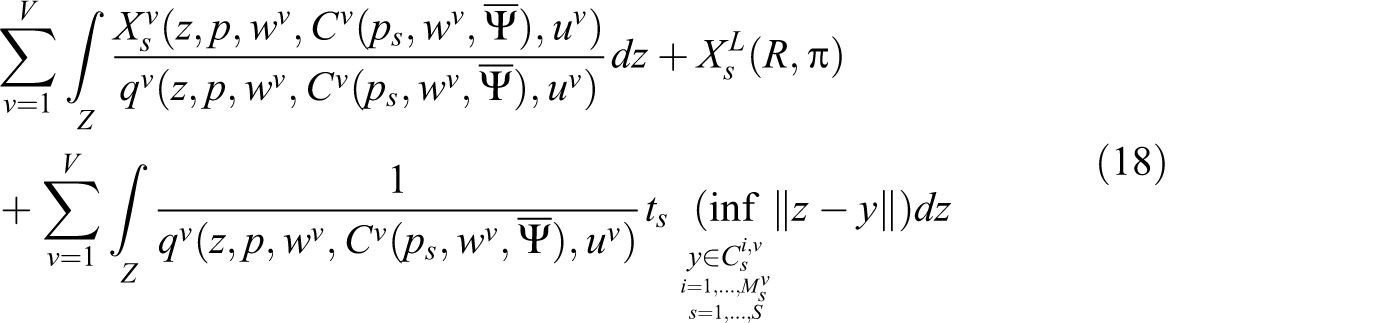
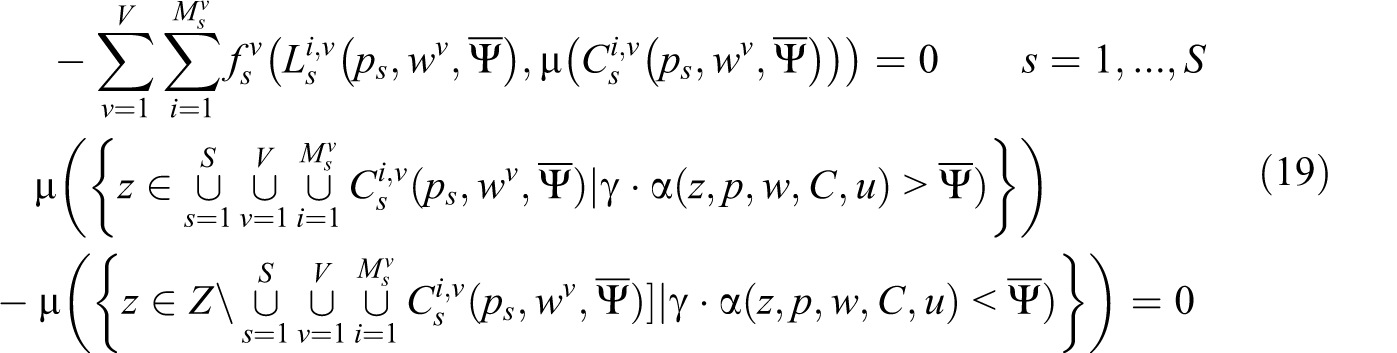
where equation (19) is the market clearing condition for land under the bid-rent approach.
We need to show that the LHS of equations (16)

and
We recapitulate our key assumptions here for completeness.
Lemma 1: Suppose that
To examine determinacy of equilibrium, we use the implicit function theorem (see Mas-Colell 1985, theorem C.3.2, p. 20). If zero is a regular value of the set of functions defined by the LHS of equations (16)
This is the point at which the results for models with location, such as this one, begin to diverge from those for more standard models without location. First, notice that there will be a different equilibrium manifold for each order of firms. In essence, the set of all equilibria will be the union of these manifolds. Second, there will be a distinction between the dimension of the equilibrium manifold under symmetry of the configuration of firms as opposed to asymmetry. This latter subject requires a definition.
Definition 7: If for all
The idea behind this definition is that a production sector is symmetrizable if and only if one can create a symmetric distribution of firms, placing the exceptional firm
Theorem 2: Let

This theorem is in accordance with examples 2 and 3, found in the Online Appendix. Indeed, in example 3 where
This means that existence and determinacy of equilibrium are very sensitive to both the degree of labor differentiation and the number of firms. What is the intuition about why the degree of indeterminacy is expressed according to formula (20)? Consider the firms with the same labor input and same output. These firms must have the same profit level in equilibrium. It is the number of such equal profit constraints that affects the formula (20). So as labor becomes more differentiated, there are fewer such constraints. Hence, the more differentiated the labor, the larger the variety of equilibria. Another way of interpreting the intuition behind formula (20) is that identical firms must offer the same wages to the same workers and this cannot compensate for locational and hence commuting cost differences between firms.
Theorem 3: Let

if the number of firms is even and

if the number of firms is odd.
What distinguishes symmetrizable production sectors is that we only need to deal with half (possibly plus one) the number of firms. This means that the number of constraints in a symmetric equilibrium, particularly in equation (17), can be dropped by half (modulo the central firm). The reason the last term in the indeterminacy formula is
In the general case, when
Existence of Equilibrium
Putting aside the problem of multiplicity of equilibria, we next provide sufficient conditions for the set of equilibria to be nonempty. In the Online Appendix, we provide example 4 where formula (22) tells us that equilibria should be locally unique (as the dimension of the equilibrium manifold is equal to zero), but the set of equilibria is in fact empty. This might seem paradoxical given formula (22), but the resolution, of course, is that the empty set is a manifold of any dimension.
Theorem 4: Fix
We have an analogous result when the production sector is symmetrizable, since in that case only half the firms matter.
Theorem 5: Fix

if the number of firms is even and

if the number of firms is odd. Suppose that the assumptions of Lemma 1 hold with
In cases not covered by these two theorems, it is easy to generate counterexamples like the one in the Online Appendix. If two firms are drawing their labor supply from the same pool of commuters, one of the firms is going to be farther away from the pool and will never be able to hire the labor it demands at any wage. Example 4 shows that the assumptions on labor differentiation in Theorems 4 and 5 are tight. When these conditions are satisfied, Theorems 2 and 3 imply (generically) that there is a continuum of equilibria.
The method of proof can be extended to more general settings. For instance,
Observe also that the assumption that markets for all goods (including labor) except land are competitive is used to prove Theorem 1. Indeed, our equilibrium concept is such that each firm takes all prices as given. If product and labor markets were not competitive, that is firms do not take all prices as given, then firm reaction correspondences would not be convex valued since at given prices, a firm’s profit could be maximized at two different locations. In this case, the existence of equilibrium could not be proved in the way we have done it.
Welfare Properties of Equilibrium Allocations
Theorem 6: An equilibrium allocation might not be Pareto optimal, and in particular might not be an equal treatment Pareto optimum.
The proof (found in the Online Appendix) proceeds by presenting an example where the equilibrium allocation is not Pareto optimal. This is accomplished by taking an equilibrium where the only two firms in the economy are adjacent, pulling them apart a little bit, and putting some consumers in between the firms, thereby reducing commuting costs. Although transportation costs rise, parameters are taken so that this is more than offset by the drop in commuting cost.
Notice that, if a Pareto optimum exists, it will not have adjacent firms (for the reason given in the proof of Theorem 6) and thus will not be an equilibrium allocation. Therefore, the second welfare theorem will also fail for this model and this example, provided that a Pareto optimum exists for this example. We do not prove that a Pareto optimum (equal treatment or otherwise) exists for this example since such a proof is both technical and peripheral to our work here.
Notice also that even though firms and consumers are price takers in all markets, we still have a market failure. More precisely, when a firm moves it anticipates the relocation of its workers, but it does not take into account that it affects workers’ commuting cost and hence utility levels. In a certain sense, there is an externality that causes a market failure.
Conclusion
This article has explained city structure driven by labor differentiation and transportation costs. We have examined the characteristics, welfare properties, existence, and determinacy of equilibrium.
It is immediately apparent from the sixth section that there is a role for the government in improving consumer welfare relative to an equilibrium allocation, since the two welfare theorems can fail. In the one dimensional example, the government might be able to improve welfare by separating firms and reducing consumer commuting cost. It would be interesting to examine this further in a more general setting.
Theorem 1 provides a testable implication of the model: that firms are connected in equilibrium. Comparative static properties of the model are within reach but messy. One can see that the more differentiated the labor, the larger the variety of equilibria. For example, in the homogeneous labor case for
Our results provide an illustration of the manifestations of indivisibilities in location models. Due to the discreteness with which firms must be ordered in one dimension, the set of equilibria for fixed values of other exogenous parameters can skip from emptiness to a continuum as labor differentiation is increased.
Our model can be extended in the following way. We have taken as exogenous the general and specific human capital of workers. We can make the choice of human capital endogenous by adding a first stage to the model in which each worker chooses an investment in human capital, with perfect foresight, that will determine their skill and type in the second stage. The first stage can be handled in a standard way, for example as in Rosen (1983). The second stage is the model examined in the present article where the populations of the various types of workers are endogenous and determined in the first stage. We intend to examine this more elaborate model in the future.
Finally, a referee has suggested that in place of the relatively simple model we have proposed, multiple types of workers should be introduced into Fujita and Ogawa (1982) and Fujita (1988). Berliant and Kung (2006) examine indeterminacy in a standard New Economic Geography model with one type of mobile worker. That analysis is rather difficult and complex compared to our analysis here, so it is doubtful that definitive statements about the dimension of the equilibrium manifold as a function of labor differentiation can be made. Moreover, Berliant and Kung (2006) find so many equilibria that the predictive capacity of the model is called into question.
Footnotes
Acknowledgments
We thank the anonymous referees, Masahisa Fujita, Roger Guesnerie, Hideo Konishi, Fan-Chin Kung, Val Lambson, Guy Laroque, Thijs ten Raa, Adam Rose, Jacques-François Thisse and Ping Wang, for valuable comments. The first draft of this article was written while the first author was visiting CORE in 1995. The authors retain full responsibility for any errors.
Declaration of Conflicting Interests
The author(s) declared no potential conflicts of interest with respect to the research, authorship, and/or publication of this article.
Funding
The author(s) disclosed receipt of the following financial support for the research, authorship, and/or publication of this article: The authors received financial support from CORE and National Science Foundation grant SBR-9319994.