







Abstract
There are few in-depth studies on urban collaborative innovation between subjects and cities. Based on the triple helix (TH) theory and innovation network theory, this study constructs the theoretical framework of the urban collaborative innovation system from the collaboration between innovation subjects and the spatial correlation between cities. By using the invention patent data of 30 innovative cities from 2014 to 2023, this paper empirically examined the rule characteristics, evolution trend, and synergetic degree of the urban innovation system in China. The results show that: (1) The innovation capacity of Chinese cities has been continuously enhanced, and the imbalance in innovation levels among cities is relatively prominent. Inter-city innovation cooperation has evolved from a “dual-core driven” network structure to a “multi-center driven” one. (2) The bilateral relationship of university-industry within a city is the closest. There are specific substitution and crowding-out effects between industry-university collaboration and industry-government collaboration. (3) In the trilateral relationship of university-industry-government, cities like Changchun, Shenyang and Dalian have relatively close tripartite collaboration, while cities like Shenzhen, Dongguan and Jiaxing have relatively loose tripartite relationships. (4) The inter-city correlation of urban agglomeration is prominently better than that of other regions, especially in clusters of the Yangtze River Delta and the Guangdong-Hong Kong-Macao Greater Bay Area. (5) The intercity tight-subject tight, encompassing 17 cities such as Nanjing, Guangzhou, and Hangzhou, is the most important collaborative category. The research results provide theoretical sustenance and policy enlightenment for coordinating the relationship between different subjects and cities in collaborative innovation.
Keywords
Introduction
The city is a virtual physical space, economic supporter, and social domain of national innovation-driven development (Zhang and Wang 2022). Improving urban innovation capacity is a critical way for China to build an innovative country, participate in global competition and cooperation in science and technology, and integrate into the global innovation network (Fan et al. 2022). With the growing risk and complicacy of innovation, it is difficult for a single subject in a single city to achieve the effective integration of the complete resources required for innovation (Yang et al. 2021). The flow of innovation resources among organizations, regions, and industries is becoming more and more frequent, and knowledge exchange and technical cooperation are becoming closer and closer (Abramo and D Angelo, 2022; Zhuang et al., 2021). Innovation represents the characteristics of cross-field, multi-subject, and cross-city integration, and the boundary between various innovation subjects and cities is progressively “melting” (Tao and Shuliang 2022). In consequence, collaborative innovation, which is based on the cooperation and interaction between university, industry, and government (UIG) and characterized by the flow and diffusion of innovation elements between cities, has become a meaningful way to promote high-quality economic and social development (De Silva et al. 2021; Guo et al. 2022).
The triple helix (TH) theory, born in the background of the knowledge economy, emphasizes the cooperation and interaction of UIG in the innovation process (Perkmann et al. 2013). The ceaseless progression and promotion of the innovation system can be realized by breaking the organizational boundary and generating the nonlinear effect of system superposition (Etzkowitz and Leydesdorff 1995). The TH theory provides a new paradigm and means for studying innovation systems. Its application field has expanded from focusing on the collaboration between innovation subjects to paying more attention to regional factors and spatial correlations (Tao and Shuliang 2022). The inter-subject collaboration reflects the interactive relationship of organizational elements within the regional innovation system. In contrast, the inter-city association reflects the spatial connection among the regional innovation systems. It is beneficial to reveal the coordination pattern and operation mechanism of the regional innovation system more comprehensively by combining inter-subject collaboration and inter-city correlation.
Innovation-driven is the real power for high-quality urban development (Chen et al. 2020). To improve the level of urban innovation, the core is to promote the efficient flow and sharing of innovation resources through the spatial aggregation of innovation elements and the collaborative interaction of innovation subjects (Song et al. 2021). And then achieve the spillover of knowledge and technology to improve urban innovation capacity (Vallance et al. 2020). So, what are the roles of UIG in the innovation system in China’s cities, and how are their synergy and coupling relationships? What are the spatial correlations between cities in the regional innovation system? What is the closeness of collaborative innovation between subjects and cities? The responses to the above questions are of great significance: (1) Exactly holds the law of urban innovation development in China and straightens out the collaborative relationship among different subjects and cities in the innovation system; (2) Perfect the theory of collaborative innovation and plan the strategy of urban collaborative development; (3) Enhance the realization of regional integration and boost the high-quality development of urban economy and society.
Therefore, based on the triple helix theory and the innovation network theory, this paper constructs the theoretical framework of the urban collaborative innovation system from two dimensions: the collaborative relationship among innovation subjects and the spatial correlation among cities. Based on the invention patent data of 30 core innovative cities in China from 2014 to 2023 and the three-spiral algorithm based on mutual information, this paper empirically examines the regularity, characteristics and evolution trend of collaborative innovation in Chinese cities. It reveals the degree of closeness of collaboration among the subjects within the city and the degree of correlation of cooperation among cities. With the aim of improving the theory of collaborative innovation and providing decision-making basis for the coordinated development of regional innovation and the construction of innovative cities.
Theoretical Model
As an essential space carrier of the national innovation system, cities are gathering places of various innovation elements and resources, and their development level determines the development of countries and regions (Johnston and Huggins 2016). In the age of a knowledge economy, the economic growth and competitiveness of cities depend more on innovation (Wang et al. 2021). Innovation drive becomes the decisive factor for the future development of cities (Vallance et al. 2020). Against this background, China started to pilot the construction of national innovative cities in 2008, and 101 cities have become innovative pilot cities so far. As a new model of urban development, innovative cities take innovation as the core power of economic and social development (Fan et al. 2020). Its essence is to increase the utilization efficiency of innovation resources via the aggregation and flow of innovation elements to accelerate the spillover of knowledge and radiate to other cities (Zhang and Wang 2022). The gathering and flow of talents, knowledge, technology, and other innovation elements makes the communication and cooperation between innovation subjects in different cities more smooth, thus improving innovation efficiency and regional innovation capability (Kang et al. 2019). The theoretical framework of collaborative innovation in innovative cities is shown in Figure 1. Theoretical framework of urban collaborative innovation.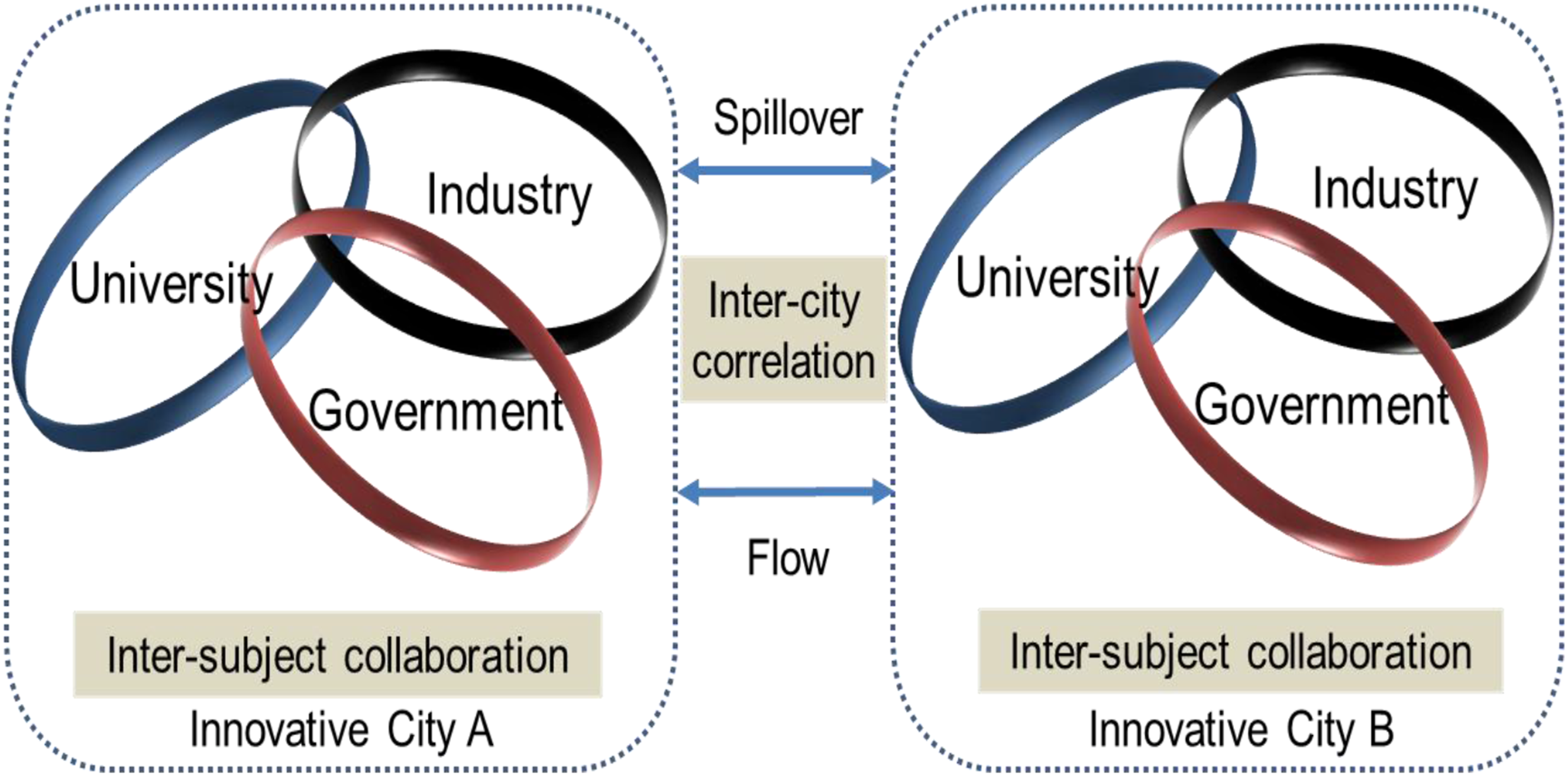
Urban innovation is a composite system composed of innovation subjects, innovation elements, innovation environment and innovation mechanism (Fan et al., 2023). Synergy innovation theory holds that the effect produced by the collaborative action of different elements within a system is superior to the sum of the individual actions of each element (Mota Veiga et al. 2024). The core of urban collaborative innovation is the organic concordance of innovation resources and the efficient spread of innovation elements between different subjects and cities (Crescenzi and Rodríguez-Pose 2017). Through the integration of complementary resources, the synergistic effect of 1 + 1>2 is generated (Fan et al. 2022).
The resource-based view theory holds that integrating various innovative elements and achieving efficient circulation of innovative resources are the keys to promoting the development of national and regional innovation systems (Chen and Yang 2012). When the innovation system coordinates and integrates various elements to carry out innovation activities, on the one hand, it can be achieved through the collaboration of the “university-industry-government” (UIG) within the city (Yang et al. 2021). Within the regional innovation system, UIG and other innovation subjects can spread and share innovation resources across organizational boundaries through cooperation and interaction and accelerate the emergence of innovation (Bachmann and Frutos-Bencze 2022). On the other hand, it can be achieved by accelerating the intercity diffusion and spillover of innovation resources and exerting the intercity correlation effect between urban innovation systems. Through the spillover effect, innovation elements cross geographical boundaries and achieve efficient flow and aggregation between areas (Baier-Fuentes et al. 2021). It reflects the correlation and interaction of innovation in territorial space. These two models basically cover the collaborative relationships within and between regional innovation systems (Bai and Jiang 2015). Consequently, only by combining the inter-subject collaboration with the inter-city correlation can the collaborative mechanism of the innovation system be demonstrated more systematically. To enhance urban innovation ability and realize regional integration strategy in China.
Collaborative Relationships Among Subjects in the Innovation System
From the perspective of inter-subject collaboration, innovative organizations enable participators to obtain complementary resources through dividing work and cooperation (Chen et al. 2022). To share the large-scale investment, reduce the risk of innovation, give play to the advantages of different subjects in the innovation chain, and advance the evolution and improvement of the innovation system (Xing and Lee 2024). The inter-subject collaboration underlines the integration of various innovation organizations and the cross-organizational diffusion of innovation resources in the system. In this way, universities, industries, and governments can complement each other’s advantages and accelerate knowledge creation, technical advancement, and achievement transformation (de Castro Peixoto et al. 2022; Sandoval Hamón et al. 2022).
In the context of frequent collaboration between innovation subjects and accelerated inter-organizational flow of knowledge, Etzkowitz and Leydesdorff put forward the TH theory in 1995 to explain the collaborative relationship between innovation subjects (Etzkowitz and Leydesdorff 1995). The TH theory provides a fundamental paradigm, analytical framework, and method for studying the relationship between UIG at the system aspect (Zhang and Chen 2020). It holds that the collaboration and interaction between UIG is a significant precondition for developing innovation in a country and region (Zhang et al. 2019). Three kinds of heterogeneous organizations create, transfer and internalize knowledge through interdependence and synergy, and drive the coordinated development of innovation system (Machado et al. 2024). The collaboration and interaction between innovation subjects are becoming more and more important to the national innovation system. And the national innovation system is organically composed of city innovation subsystems (James et al. 2023; Linton 2024). The collaboration between UIG within the innovation system can stride over their organizational boundaries and constitute an essential channel for knowledge dissemination and resource integration (Etzkowitz and Leydesdorff 2000). The closer the synergy between UIG, the more frequent the flow and diffusion of innovation resources, and the more beneficial to the generation of innovation achievements (Lerman et al. 2021). The free flow of knowledge, technology, and talent in the TH system are crucial to urban innovation and development (Champenois and Etzkowitz 2018).
Inter-City Correlation in Regional Innovation Systems
As for the inter-city correlation between urban innovation systems, the flow and spillover of innovation factors in different cities can be promoted through cooperation and linkage innovation (Hanley et al. 2022). To availably decrease transaction costs, optimize the allocation of elements, and improve urban innovation competitiveness (Yao et al. 2020). According to the theory of innovation cluster, innovation subjects with different resources gather in adjacent areas and frequently coordinate and converge. It will accelerate the flow of innovation resources across geographical boundaries and benefit from knowledge diffusion and technology transformation (Fan et al., 2025). Innovation resources are featured by scarcity and the pursuit of maximizing their value and will flow from cities with low marginal returns to cities with high marginal returns (Johnston and Huggins 2016). For urban innovation systems, this “choose the best” mechanism will promote the spread and spillover of innovation factors between cities and generate inter-city correlation (Zhou et al. 2018).
The innovation network theory emphasizes innovation cooperation through formal or informal institutions in the network, thus inducing the diffusion and transmission of innovation resources among network nodes. The participation of organizations in innovation networks is more conducive to obtaining valuable knowledge, technology, information, and other innovative elements (Arranz et al. 2020). The network connection between innovation subjects and regions is also conducive to transforming business values, such as knowledge capitalization and technology industrialization (Tang and Cui 2021). With the prosperity of the digital economy, innovation elements such as technology, knowledge, and information can more easily break through space and boundary restrictions (Li et al., 2025). Mobile space has become the fundamental resource allocation mode, promoting the formation of extensive, close, and complex network connections between cities. The innovation links formed by knowledge spillover and technology cooperation between cities gradually form the urban innovation network (de Castro Peixoto et al., 2022). The denser the urban innovation network, the closer the inter-city connections and the more conducive to creating innovative achievements (Guo and Minier 2021). The prosperity of an innovation network can effectively enhance urban innovation ability and realize regional integrated development (Fernandes et al. 2021).
The Intrinsic Relationship Between Subject Collaboration and Intercity Correlation
Intra-city subject collaboration and inter-city collaboration are not two separate and independent dimensions. They present an intrinsic relationship of basic support, extension and expansion, and mutual empowerment. The core carrier of inter-city collaboration remains the innovation subject, and its essence is the external manifestation of cross-city collaboration of the innovation subject (Marchesani and Ceci 2025). Without the foundation of subject collaboration within the city, inter-city collaboration will become an empty shell lacking substantive content. The deepening of subject collaboration within the city will inevitably give rise to the demand for cross-city collaboration, promoting innovation subjects to break through the administrative boundaries of the city and seek broader space for resource allocation and cooperation scenarios (Cheng et al. 2024).
Collaboration among subjects within a city serves as the prerequisite and foundation for inter-city collaboration. The collaborative interaction among universities, industries, and governments within a city is the core link for the agglomeration of innovation elements, knowledge creation, and technological breakthroughs (Köse et al. 2025). Within cities, through an efficient and collaborative mechanism among innovation subjects, the optimal allocation of innovation resources and the transformation of innovation achievements are achieved. Accumulating sufficient core resources such as knowledge, technology, and talent provides mobile and spillover support for cross-city collaboration (Chen et al. 2025). If there are barriers to collaboration among subjects within a city, innovation resources cannot flow and diffuse efficiently among universities, industries, and governments, limiting the city’s own innovation capabilities. It becomes difficult to produce innovative outcomes that can be radiated and shared, and it is impossible to form comparative advantages for participating in inter-city collaboration, leading to the city’s marginalization in the inter-city innovation network (Zhang et al. 2025). The Triple Helix theory posits that tight collaboration among UIG within a city is the core of efficient operation of the innovation system. The innovative synergy formed by this collaboration is the core driving force for cities to participate in inter-city collaboration and achieve cross-city flow of innovation elements (Etzkowitz and Leydesdorff 2025).
Inter-city collaboration is an extension and expansion of collaboration among subjects within a city, while simultaneously nurturing the optimization and upgrading of intra-city collaboration (Nilssen and Hanssen 2022). As the collaboration among subjects within a city continues to deepen, and the agglomeration of innovation factors reaches a certain scale, resource redundancy or demand gaps may emerge. Innovative subjects can address these issues through cross-city cooperation. Inter-city collaboration enables the two-way flow of complementary resources, compensating for shortcomings in technology, talent, and market, while also spreading their own advantageous innovation achievements to other cities, maximizing innovation value (Du et al. 2025). Collaborative innovation between cities drives the continuous optimization of collaboration models among innovative entities within cities (Du et al. 2025). Cross-city technological exchanges and cooperation prompt universities to adjust their talent cultivation directions, industries to optimize their innovation paths, and governments to improve their innovation policies, thereby breaking down barriers in the original collaboration among entities and enhancing collaboration efficiency (Zeng et al. 2025). Meanwhile, the innovation network formed by inter-city collaboration will enable subjects within cities to integrate into a broader innovation ecosystem. By accessing more cutting-edge knowledge and technologies, the innovative vitality of subject collaboration can be stimulated (Zhang et al. 2024). Promote the upgrade of urban collaborative innovation from “internal collaboration within a single city” to “cross-city linkage and collaboration” (Luo and Wang 2025).
In the regional innovation system, the core of the unity of subject collaboration and intercity connection lies in the efficient flow of innovation elements throughout the region and the optimal allocation of innovation resources throughout the region (Dai et al. 2024). The collaboration among urban subjects addresses the issue of integrating and activating innovative elements within the city (Wang et al. 2022). Inter-city collaboration addresses the issue of the flow and allocation of innovative elements among cities(Li and Zhao, 2023). Together, they form a complete chain for the coordinated operation of regional innovation systems (Dong et al. 2026).
To sum up, the theories of TH and collaborative innovation elaborate the operation mechanism of accelerating the efficient flow and spread of innovation resources and improving the urban innovation system through cooperative interaction between subjects. The theories of innovation cluster and innovation network explain why various innovation elements progressively converge to cities and generate inter-city correlation. The above views offer a theoretical basis for studying inter-subject collaboration and inter-city correlation in the urban innovation system. The spatial correlation between cities in a specific region and the geographical proximity characteristics between different types of innovation subjects have been theoretically explained (De Iudicibus et al. 2025; Tao and Shuliang 2022). However, there is a lack of empirical evidence from a global perspective on collaboration between industry, university, and government, as well as inter-city correlation. Therefore, this study attempts to construct a theoretical model of urban collaborative innovation and empirically examining the inter-subject relationship between UIG, and the spatial association between 30 innovative cities in China. It reveals the laws and characteristics of inter-subject collaboration and inter-city correlation in the urban innovation system.
Research Design
Research Methods
Triple Helix Algorithm
The TH theory holds that the interaction and cooperation of different subjects in the innovation system bring about the overlap, collision, and integration of information and resources at different levels (Leydesdorff 2003). It stimulates the innovation potential of the TH system, which is the embodiment of uncertainty in information theory (Leydesdorff and Ivanova 2021). Shannon believes that entropy represents the probability of discrete random events. The greater the uncertainty in the system, the greater the entropy. The more ordered the system, the smaller the entropy. The single-dimensional entropy is indicated as follows:

Pi is the probability of the ith event. In the case of bilateral variables, information entropy is indicated as follows:

Pij is the joint probability distribution of event i and event j. The trilateral information entropy is indicated follows:

The subscripts u, i, g represent the university, industry, and government in the innovation system.
According to information theory, the uncertainty and redundancy of information transmission among interrelated subsystems can be measured by mutual information T. The bilateral mutual information is indicated as follows:

The trilateral mutual information is indicated as follows:

Mutual information represents the reduced uncertainty of a random event due to the information of other random events (Hu et al. 2021). Calculating the redundancy caused by the cross-border flow of information reflects the degree of self-organizing and collaboration between the subjects and cities in the innovation system. Therefore, in the urban innovation system, mutual information can be considered a dynamic index to examine the closeness of inter-subject or inter-city collaboration.
The greater the value of bilateral mutual information is, the more frequently the data flows across the boundary, and the more uncertainty of the system is reduced. That is, the closer the synergistic relationship between the bilateral subjects or cities in the innovation system. The trilateral mutual information is used to measure the self-organizing and interdependence of the system, and it is negatively correlated. The smaller the trilateral mutual information, the stronger the interdependence between innovation subsystems and the closer the trilateral collaboration in innovation.
Therefore, this paper uses bilateral mutual information to measure the degree of correlation between two cities in the urban innovation system. The bilateral and trilateral mutual information is used to measure the closeness of collaboration between the two and the three of UIG in the urban innovation system.
Social Network Analysis
Social network analysis (SNA) is a popular method to analyze the connections among participants in the economy and society. These actors can be individuals, organizations, countries, cities, etc. (Miyashita and Sengoku 2021). The spatial correlation network in the innovation system has the characteristics open, dynamic, and diverse and its related structure is complex and changeable (Chang et al. 2021). SNA reflects the interaction between actors by portraying social networks through diagrams and matrices. It can accurately analyze various associations, including the space-time evolution of network density, path length, and centrality (Miyashita and Sengoku 2021). This paper uses SNA to study the spatial association network among 30 innovative cities in China. Specific indicators include:
Network density (ND): indicates the tightness of the spatial correlation network connection and is the ratio of the real number of links to the maximum possible number of links in the network. The greater the network density is, the closer the innovation connection between nodes is.
Average Degree (AG): measure the breadth of network connection. The arithmetic mean of the degrees of all nodes in the network, reflecting the average number of connections of the entire network.
Average Weighted Degree (AWD): measures the strength of a network connection. The arithmetic mean of the weighted degrees of all nodes in the network, reflecting the overall average connection strength of the network. The weighting degree is the sum of the weights of all associated edges of a node.
Average path length (PL): represents the average distance between two nodes in the network, which is used to measure the network accessibility and average distance between nodes. The shorter the average path length, the stronger the reachability between nodes in the network.
Average Clustering Coefficient (ACC): measure the local aggregation situation of some nodes in the network. The clustering coefficient is the ratio of the actual number of connections between node neighbors to the maximum possible number of connections. The closer the value is to 1, the tighter the connection between neighbors and the more stable the local area where the node is located.
Closeness centrality (CC): to investigate the level to which the innovation activities of node cities in the network are not affected or controlled by other cities. The greater the closeness centrality of a node, the stronger the network radiation ability of the node, the shorter the innovation contact distance with other cities, and the higher the efficiency.
Betweenness centrality (BC): describes how effective nodes play in the transmission of resources in the entire innovation network, reflecting the ability of nodes to act as “bridges” and “intermediaries” in the network. The greater the betweenness centrality, the more other paths the node is on, and the greater the control over the communication between other nodes.
Sample and Data Sources
As the core carrier and highland of regional innovative development, innovative cities gather national innovative resources internally and lead regional development externally, becoming the dominant force in the urban innovation network (Wang et al. 2021). According to the “National Innovative City Innovation Capacity Evaluation Report 2025”, the top 30 core innovative cities in China in terms of innovation capacity were selected as research samples. From the perspective of the innovative development pattern, the innovation level of Chinese cities shows a significant head agglomeration effect. Among the 298 prefecture-level cities and above across the country, the 30 core innovative cities mentioned above have filed 8,945,391 invention patent applications in the past decade, accounting for 62.4 percent of the total number of invention patent applications nationwide. Therefore, core innovative cities can to a certain extent represent the overall characteristics of the innovative development of Chinese cities. The intercity correlation and subject coupling relationship it demonstrates in the innovation-driven development can effectively reflect the general laws and characteristics of the collaborative and innovative development of Chinese cities. Selecting them as the research object has strong typicality and representativeness.
As an essential form of intellectual property, patent data is the most significant information technology source in the world. The report of the World Intellectual Property Organization (WIPO) shows that about 90 percent –95 percent of the world’s scientific and technological innovation output is contained in patents (Yao et al. 2020). The essence of patents lies in their inherent ability to confer economic value on innovations (Yang et al. 2021). Patent is an important symbol of the improvement of national and regional innovation ability, and is a key indicator for industry and academia to measure scientific and technological progress, innovation level and innovation performance (Zhuang et al., 2021). Patents play an important role in explaining innovation trajectories and processes, as well as providing support for intellectual property (Fasi 2023). The joint patent application is a normal pattern of collaborative innovation between UIG as well as cross-city science and technology cooperation (Hu and Mathews 2008). Coinvention patents can reflect the connection of relevant nodes in the innovation network and are the most direct and effective way to study knowledge sharing and collaborative innovation (Dang and Motohashi 2015). This paper uses the patent retrieval and analysis database of the State Intellectual Property Office of China (https://pss-system.cponline.cnipa.gov.cn) as the data source. Search the invention patents applied by different innovation subjects of UIG in 30 innovative cities in China. Since Chinese invention patents have a review period of 6–36 months, the patent data window is limited to 2014–2023.
According to the keyword of the patent applicant (patentee), invention patents are divided into three categories: university, industry, and government. Further classify the coinvention patents including both or three of the above names into four categories: “University-Industry (UI),” “University-Government (UG),” “Industry-Government (IG),” and “University-Industry-Government (UIG),” and make statistics by 30 cities. As public scientific research institutions are built and supervised by the government in pursuit of shared interests, they assume the function of public administration in science and technology. Its innovation behavior represents the government’s will to a certain degree, so we classify public scientific research institutions into the government category during patent retrieval (Tao and Shuliang 2022). To pursue the spatial correlation between cities in the innovation system, the coinvention patents of two cities in the 30 cities included in the applicant (patentee) or applicant address were further searched by year. We can obtain the database of inter-subject collaboration and inter-city correlation measurement in China’s urban collaborative innovation system.
Characteristics and Tendencies of Urban Collaborative Innovation in China
Characteristics and Tendencies of Inter-Subject Collaborative Innovation in Cities
The total number of invention patent applications in China’s core innovative cities from 2014 to 2023, classified by subjects, is shown in Figure 2. In terms of the total number of patents, there are huge differences among cities and an imbalance in innovative development among regions. Three cities, namely Beijing, Shenzhen and Shanghai, have a total of over 700,000 patents. Among them, Beijing leads the way with 1,330,243 patents, showing a significant lead. There are seven cities with a total of less than 100,000 patents, namely Changchun, Jiaxing, Shenyang, Dalian, Xiamen, Nanchang and Guiyang, most of which are in Northeast or western China. Characteristics and tendencies of patent cooperation between subjects of innovative cities in China.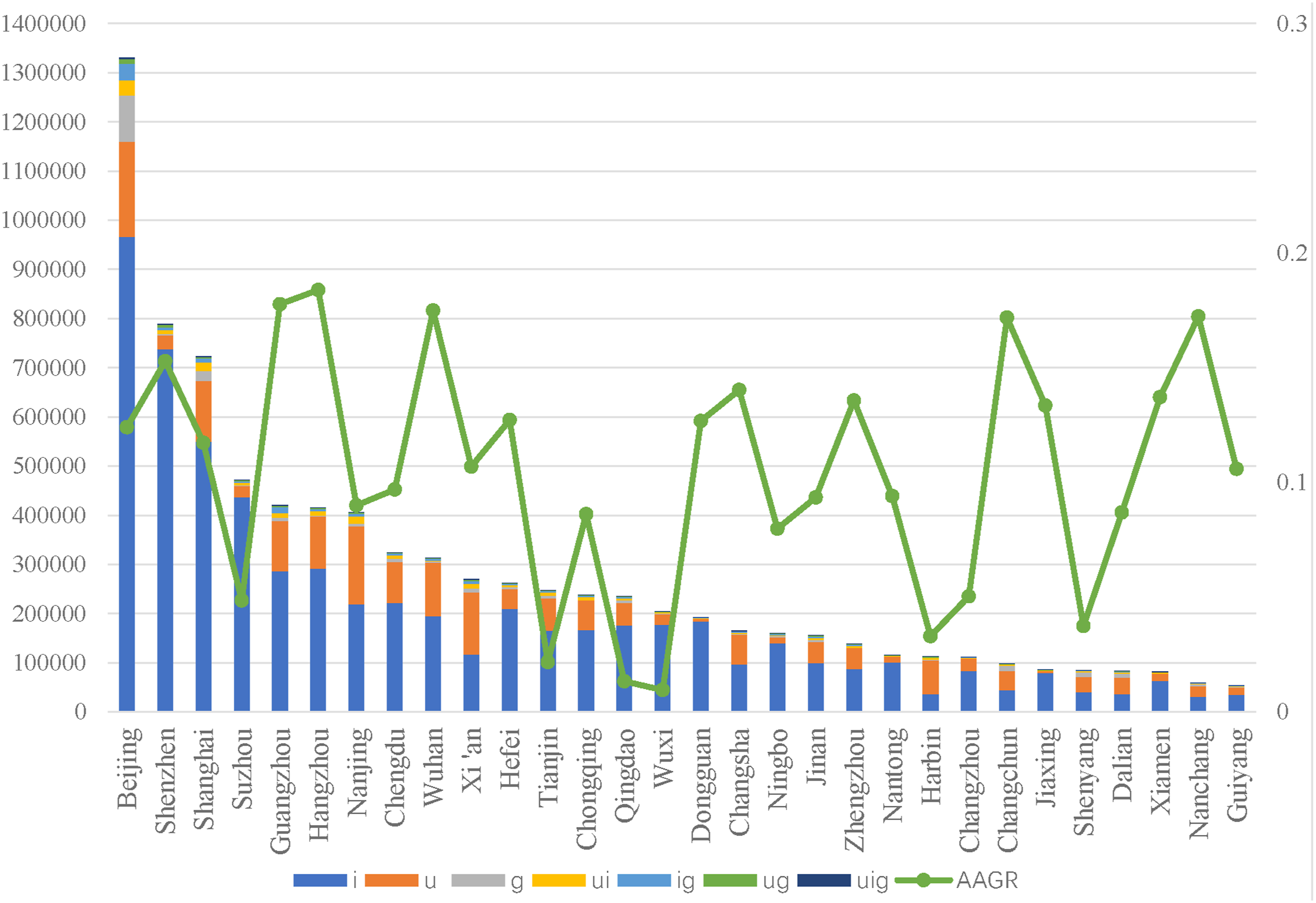
In terms of innovation subjects, industries are the main source of invention patents, accounting for 76.3 percent of the total. It shows that industries, as the leading force of scientific and technological innovation, play the most crucial role in urban innovation. The invention patents participated by universities accounted for 23.4 percent of the total, which shows that universities, as the main front of knowledge creation, have advantages in driving basic research and scientific innovation but are less dynamic in technological innovation. The number of patents involved by the government is small, accounting for only 4.6 percent of the total.
From the perspective of development trends, the overall growth rate is relatively fast, but there are significant differences among cities. The total number of invention patent applications in the 30 core innovative cities increased from 494,490 in 2014 to 1,226,114 in 2023, with an average annual growth rate(AAGR) of 10.6 percent. Six cities, namely Hangzhou, Guangzhou, Wuhan, Nanchang, Changchun and Shenzhen, have an AAGR exceeding 15 percent. This indicates that these cities have achieved remarkable results in implementing the innovation-driven strategy over the past decade, and they are brimming with innovative vitality and potential. However, the AAGR of six cities, namely Wuxi, Qingdao, Tianjin, Harbin, Shenyang and Suzhou, is lower than 5 percent, indicating that the innovation-driven development of these cities is somewhat weak.
Analysis of Collaborative Innovation Networks Among Core Cities
According to the number of coinvention patents between the two cities in China’s 30 innovative cities, an undirected correlation matrix is constructed. The SNA is used to analyze the characteristics of collaborative innovation networks in Chinese cities. Use Gephi software to draw the structure diagram of the inter-city innovation network in 2014, 2018 and 2023, as shown in Figure 3. The innovation network topology structure indicators are shown in Table 1. It presents the following three characteristics: Network structure of China’s inter-city innovation cooperation. Indicators of topological structure of intercity cooperative innovation network in China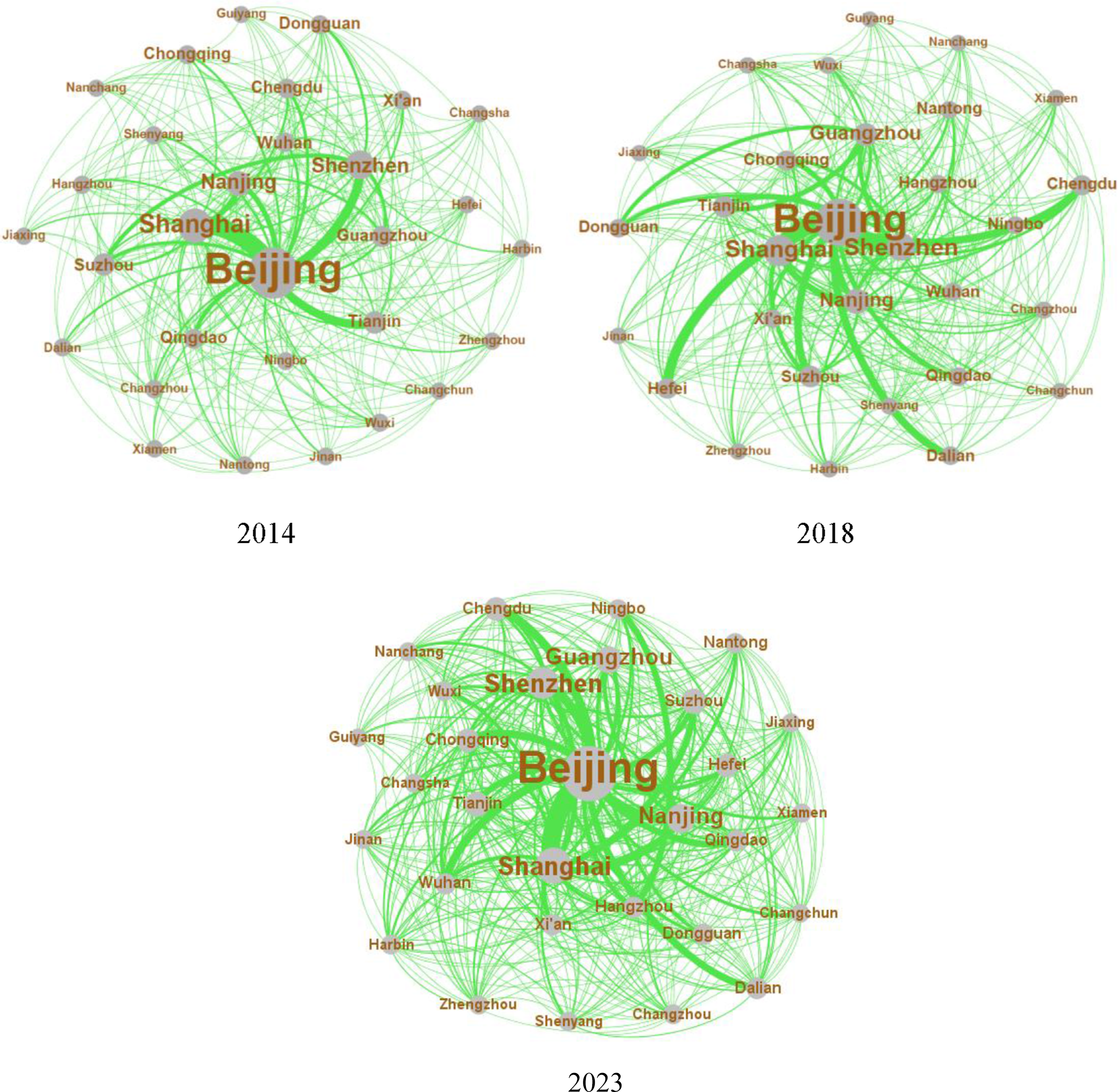
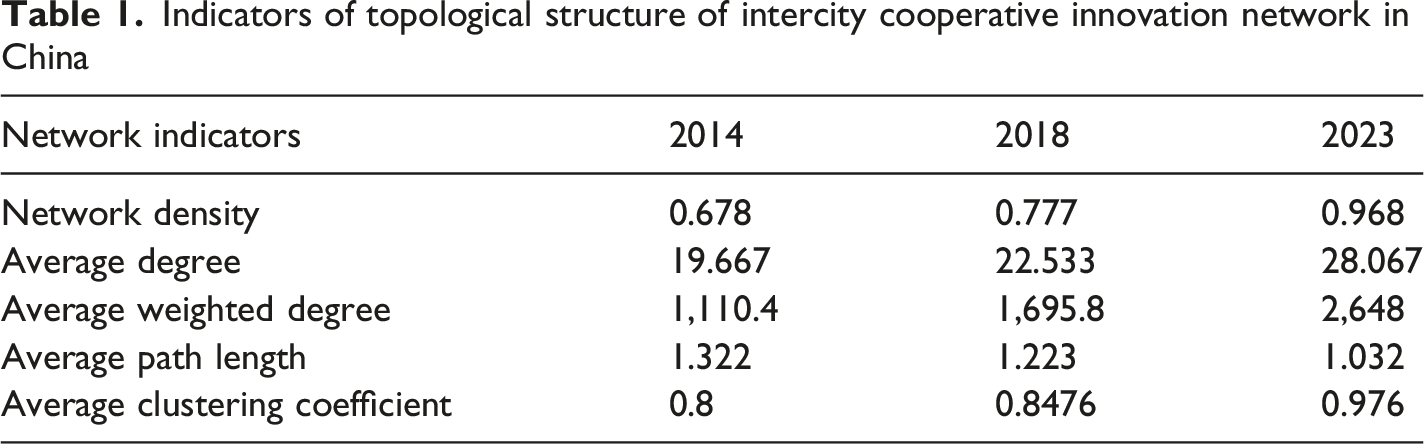
First, the intensity and breadth of China’s inter-city innovation cooperation have been continuously improved. The overall network is constantly expanding and cooperative connections are continuously deepening. From 2014 to 2023, the number of inter-city coinvention patents in China has significantly increased, growing from 16,743 to 79,410, with an average annual growth rate of 18.9 percent, far exceeding the growth rate of the total number of patents. It indicates that the overall scope and scale of urban innovation networks are constantly expanding. As shown in Table 1, the network density of intercity coinvention patents increased from 0.678 to 0.968. It shows that while the innovation network is expanding rapidly, the intensity of inter-city cooperation is constantly improving. The average degree and the average weighted degree have respectively increased from 19.667 to 1,110.4 to 28.067 and 2,648, indicating that both the breadth and depth of cooperation in China’s urban innovation networks have significantly improved. The network accessibility has been continuously optimized, with the average path length reduced from 1.322 to 1.032. It shows that the connections between nodes are increasingly affluent, the scientific and technological cooperation between cities is becoming more convenient, and the network structure of innovation cooperation is evolving toward complexity.
The average clustering coefficient has increased from 0.8 to 0.976, indicating that some urban nodes show a close collaborative trend and form significant agglomeration characteristics, and the phenomenon of local subnets has emerged in the innovation network. During the evolution of the network, urban nodes tend to prioritize connecting cooperative entities with similar attributes and convenient communication, such as cities within urban agglomerations, economic belts and industrial clusters. Furthermore, a regional innovation network with both regional attributes and industrial characteristics will be formed within a specific area.
Second, the urban nodes are hierarchical, and the overall network has evolved from a “positive pyramid” to a “multi-center network” structure. From 2014 to 2023, the top 10 node cities in terms of Weighted Degree were relatively stable, mainly being first - and second-tier cities with strong innovation capabilities in China such as Beijing, Shanghai, Shenzhen, Nanjing, Suzhou, Guangzhou, Chongqing, Hangzhou and Wuhan. The network status of these central cities has also risen rapidly. For instance, from 2014 to 2023, Beijing’s weighted degree increased from 9,407 to 15,608, and Shanghai’s from 4,859 to 9,273.
Closeness centrality reflects the innovative radiation ability of a city. In 2014, only Beijing and Shanghai had the closeness centrality of 1. In 2023, cities with closeness centrality of 1 evolved into 16 cities: Beijing, Shanghai, Shenzhen, Nanjing, Chongqing, Wuhan, Tianjin, Xi’an, Hangzhou, Suzhou, Guangzhou, Jinan, Harbin, Ningbo, Chengdu, and Wuxi. It shows that the innovation space network has evolved from the “dual-core driven” structure of Beijing and Shanghai to the “multi-center driven” network structure with Beijing, Shanghai, Shenzhen, Nanjing, Chongqing, Wuhan, Tianjin, Xi’an, Hangzhou, Suzhou and other cities as the innovation poles. The network center cities are more common, and cities are more active in carrying out innovation cooperation with other cities, so the network radiation capacity is constantly enhanced.
Third, the hub capacity of central cities has declined, and the direct effect of cooperative networks is more common. The betweenness centrality can reflect the ability of node cities in the intercity cooperation network as “hubs,” that is, the “bridge” role in each city in the innovation spatial association network. From 2014 to 2023, the betweenness centrality of most cities showed a decline in varying degrees, especially in innovation-core cities. For example, Beijing and Shanghai dropped from 14.8 to 0.69, and Nanjing fell from 13.1 to 0.69. It indicates that the “hub” position of innovation connection in core cities is declining, the direct cooperation network is more significant, and the “core-edge” effect of inter-city innovation cooperation is gradually weakening.
The Collaborative Innovation Relationship Between Core Cities and Non-Core Cities
The above analysis depicts the collaborative innovation relationship among China’s core innovative cities. The innovation collaboration between core cities and other cities should not be ignored either. To further explore the knowledge spillover and innovation collaboration between core cities and other cities among the 298 cities in China, the co-invention patent data of 30 core cities and other cities from 2014 to 2023 were retrieved from the China Patent Search Database. The results are shown in Figure 4. The co-invention patent with core cities and non-core cities.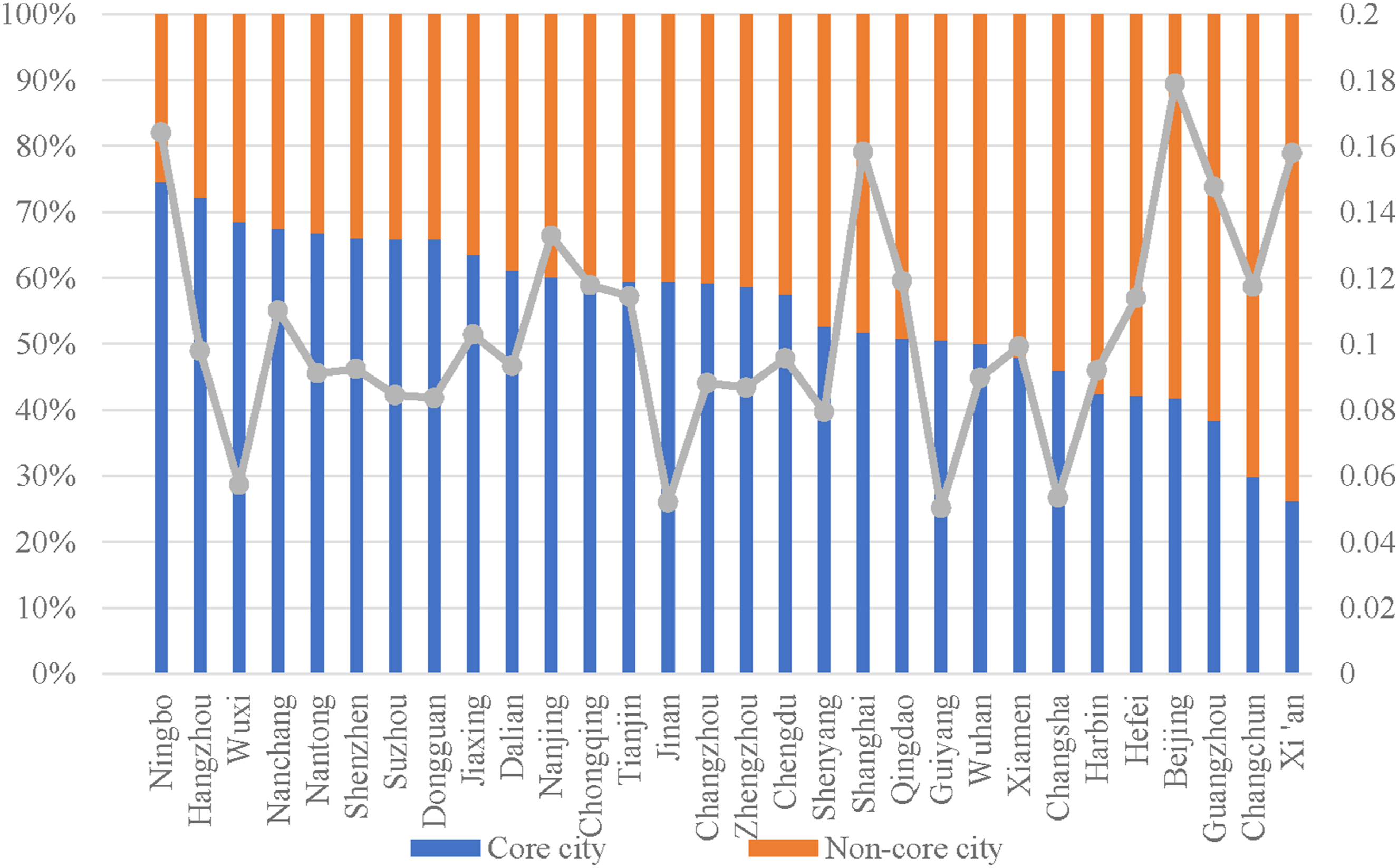
The bar chart presents the distribution characteristics of the proportion of coinvention patent between each city and core and non-core cities. Among the 30 cities, 22 have a coinvention rate with core cities exceeding 50 percent. It indicates that the collaboration among core innovative cities has become an important form of regional innovation networks, and the linkage among core cities is the leading force of regional collaborative innovation. Eight cities, namely Ningbo, Hangzhou, Wuxi, Nanchang, Nantong, Shenzhen, Suzhou, and Dongguan, have a coinvention share with core cities exceeding 65 percent. Among them, four cities belong to the Yangtze River Delta urban agglomeration, and two cities belong to the Guangdong-Hong Kong-Macao Greater Bay Area urban agglomeration. This highlights the core carrier role of urban agglomerations in regional collaborative innovation. The combined effects of geographical proximity, cultural homology, and policy coordination have promoted core cities within urban agglomerations to break through administrative boundaries, forming a high-frequency and high-intensity innovation network, which has become the core bond of inter-city collaborative innovation (Li and Ye 2021).
Eight cities, namely Xi’an, Changchun, Guangzhou, Beijing, Hefei, Harbin, Changsha, and Xiamen, have a coinvention ratio with non-core cities exceeding 50 percent, most of which are provincial capitals in Northeast China or the central and western regions. This indicates that these cities, leveraging their regional hub status, possess strong innovation radiation and driving capabilities towards surrounding non-core cities. They can effectively drive inter-city collaborative innovation within the region and establish a regional linkage innovation system with core cities as hubs.
The line chart reflects the proportion of coinvention in the total patent volume between each city and the other 297 cities. Overall, it presents a regional differentiation pattern with higher proportions in the eastern and central regions and lower proportions in the northeast and western regions. There are 14 cities with coinvention patents accounting for more than 10 percent of their total patent volume, among which Beijing, Ningbo, Shanghai, and Xi’an have proportions exceeding 15 percent. This indicates that these cities have achieved significant results in cross-regional cooperative innovation, and inter-city collaboration has become an important component of the regional innovation system. Conversely, the proportion of coinvention patents in Guiyang, Jinan, Changsha, Wuxi, Shenyang, and Changchun is less than 8 percent. This suggests that these cities are not sufficiently active in cross-regional cooperation and lack momentum in inter-city collaborative innovation. Considering regional characteristics, the eastern coastal and central core cities generally have a higher contribution to inter-city collaborative innovation due to their industrial foundation, innovation resources, and policy support advantages. However, some cities in the northeast and west, constrained by factors such as the ability to gather innovation elements and the perfection of collaboration mechanisms, have a low contribution to cross-regional collaborative innovation, reflecting significant differences in the breadth and depth of inter-city connections across different regions.
Econometric Analysis of Urban Collaborative Innovation Relationship Based on Mutual Information
To further explore the level of collaboration between UIG and the level of spatial correlation between cities in China’s urban innovation system, the collected patent data are used to calculate the mutual information of inter-subject and inter-city collaboration, respectively through formulas (1)–(5), and the results are as follows:
Econometric Analysis of TH Relationship Between UIG
The bilateral collaborative mutual information between UIG is shown in Figure 5. Within the urban innovation system, bilateral mutual information reflects the level of collaboration between any two of UIG. The larger the value, the more frequent the interaction between the two is and the closer the relationship is. From the perspective of overall synergy, the closest collaboration is between university and industry T(ui), followed by industry and government T(ig). While the collaboration between university and government T(ui) is comparatively loose. It shows that universities mainly focus on fundamental theory innovation and scientific research. In contrast, industries are more involved in applied research and technology innovation. The two are complementary in the innovation process and stage, and it is easiest to discover the innovation fit. While the innovation resources of universities and governments are not complementary, and the collaboration between the two sides lacks motivation and vitality. Bilateral collaborative mutual information between UI.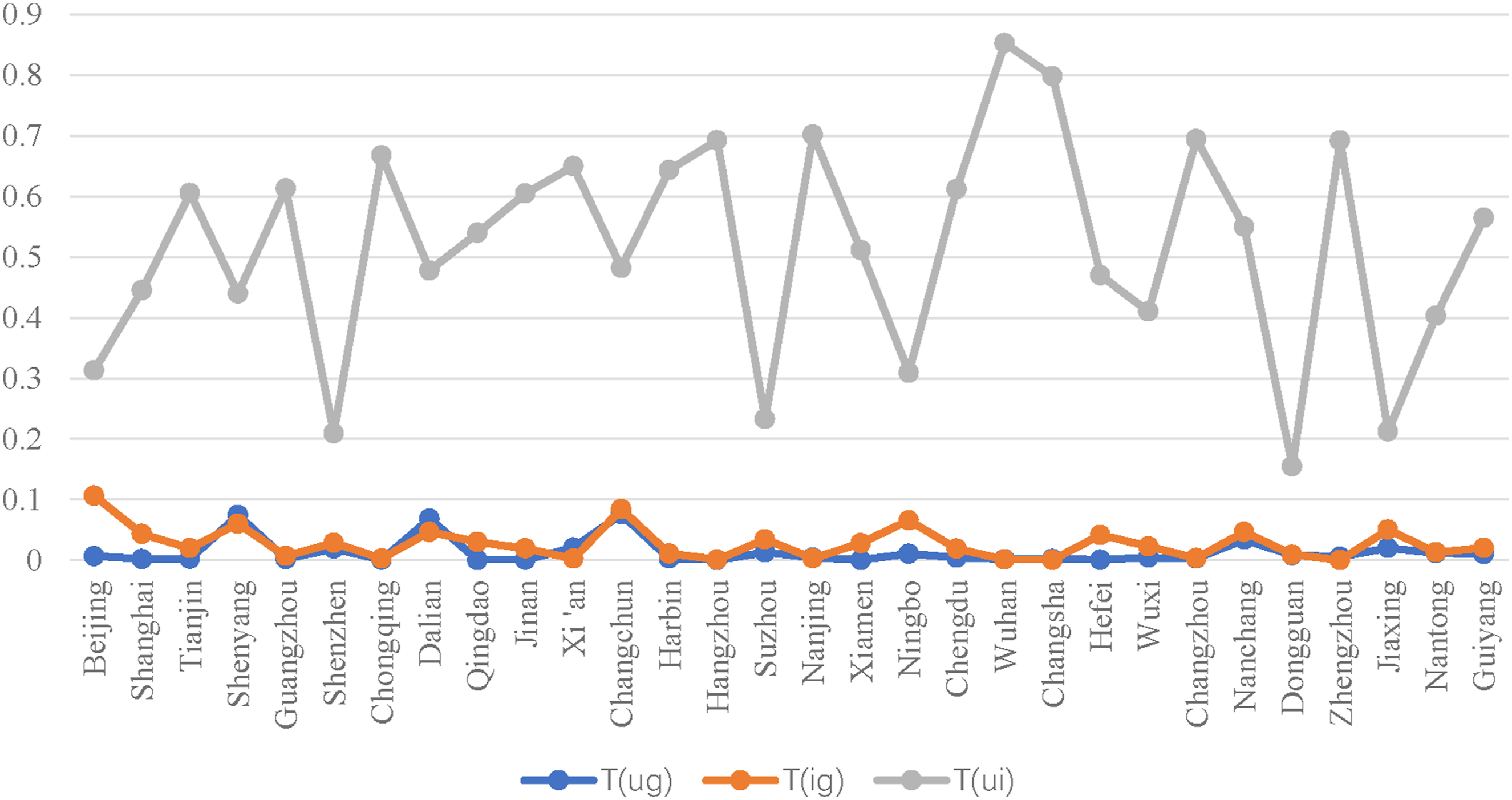
From the perspective of collaboration between universities and industries, the T(ui) values of Wuhan, Changsha, and Nanjing exceed 0.7. This indicates that these cities are rich in scientific and educational resources, with close ties and strong mutual dependence and coupling between universities and enterprises. All three cities possess the dual endowments of “abundant scientific and educational resources + solid industrial foundation”. Wuhan is home to top universities such as Wuhan University and Huazhong University of Science and Technology, forming advantageous industrial clusters in optoelectronics, automobiles, biomedicine, etc., with the research directions of universities highly aligned with local industrial needs. Changsha relies on construction machinery and new material industries as its pillars, with the research achievements of universities such as Central South University and Hunan University deeply embedded in the industrial chain. Jointly established laboratories and collaborative research projects between schools and enterprises have become the norm. Nanjing, on the other hand, leverages double first-class universities such as Nanjing University and Southeast University, as well as industrial carriers such as Software Valley and Economic Development Zone, to promote the deep integration of the digital economy, advanced manufacturing, and university research. The high T(ui) value confirms the strong coupling relationship between the two.
Five cities, namely Dongguan, Shenzhen, Jiaxing, Suzhou, and Changchun, have T(ui) values below 0.3. Among them, Shenzhen and Suzhou rank second and fourth in terms of total patent volume, respectively, serving as leaders in urban innovation in China. Industry exhibit a clear dominant advantage in innovation, yet the relatively weak university resources have become a constraint on urban innovation and development. The synergistic effect between universities and industries is not significant. Local universities in Shenzhen are primarily newly established, and their basic research supply capacity is insufficient. Industrise innovation relies more on external university technology input and integration of global scientific and technological innovation resources, lacking an endogenous foundation for local university-industry collaboration. Although Suzhou is a strong manufacturing city in the Yangtze River Delta region with prominent industrial capabilities, the match between the scientific research strength of local universities and the demand for high-end industrial development is not high. University-industry collaboration often remains at the level of technology outsourcing, lacking sufficient deep coupling. Changchun exhibits characteristics of industrial homogeneity constraints, with an industrial structure centered on the automotive industry, which has limited demand for diverse scientific research from universities. The mismatch between university research directions and local industries leads to a low T(ui).
Regarding collaboration between industry and government, the T (ig) value of eight cities, Beijing, Changchun, Ningbo, Shenyang, Jiaxing, Dalian, Nanchang, Shanghai, is relatively high. Among them, Beijing and Shanghai, as the national science and technology innovation centers, are rich in innovation resources. The government-led scientific research institutes are active in innovation, and the government’s leading and driving effect promote closer coordination between government and industry. In Beijing, relying on the Zhongguancun Demonstration Zone, the government has established a cross-entity collaboration platform to guide universities, research institutes, and industies to jointly tackle key issues. The government’s radiation and driving role has strengthened the depth of government-enterprise collaboration. In Shanghai, with Zhangjiang Science City as the core, the government promotes precise matching between public research resources and enterprise innovation needs. However, Dalian, Ningbo, Hefei, Changchun, and Shenyang are not strong in overall innovation capacity. The governments have innovation resources such as policies, funds, and information. It is more likely for industries to rely on governments to promote innovation performance. The dependence effect of industry on the government has strengthened the synergy between the government and industry. For example, in Shenyang, as an old industrial base, the government guides industries to cooperate with universities and research institutes through industrial transformation policies. The reliance of industry on government resources has further strengthened the collaborative relationship between the government and industry.
The mutual information between university and government is generally low. In particular, the T(ug) values of six cities, namely Qingdao, Hangzhou, Xiamen, Hefei, Chongqing, and Jinan, are less than 0.001. Combining the number of invention patents of each subject reveals that industries in these cities have a prominent role in innovation. At the same time, universities and governments give way to industries in innovation, and their relationship is relatively loose. For example, in Hangzhou, where the digital economy serves as the core, industries have become the absolute mainstay of innovation. Government policies emphasize industrial cultivation and market supervision, with relatively limited support for basic research in universities. The participation of universities and the government in innovation has been weakened, and the synergy between the two lacks a resource base and driving force, ultimately manifesting as a low T(ug) value.
The trilateral collaborative mutual information between UIG is shown in Figure 6. The trilateral mutual information T(uig) is a measurement index of the degree of interdependence and collaboration between UIG in urban innovation systems. The smaller the T(uig) value is, the more the cooperation between UIG in the city reduces the uncertainty of the innovation system and the closer the trilateral collaboration is. The cities with T(uig) values less than −0.15 include Changchun, Shenyang, Dalian, Nancheng, and Beijing, which indicates that the three parties of UIG in these cities have a close collaborative relationship. For example, Changchun takes the automobile industry as its core, with the government coordinating industrial layout, universities focusing on automobile technology research and development, and industries undertaking the transformation of research results. The three parties form a complete innovation chain of government guidance, university support, and industry implementation. The low position of T(uig) confirms the integrity and tightness of the collaboration among the three parties. Trilateral collaborative mutual information between UIG.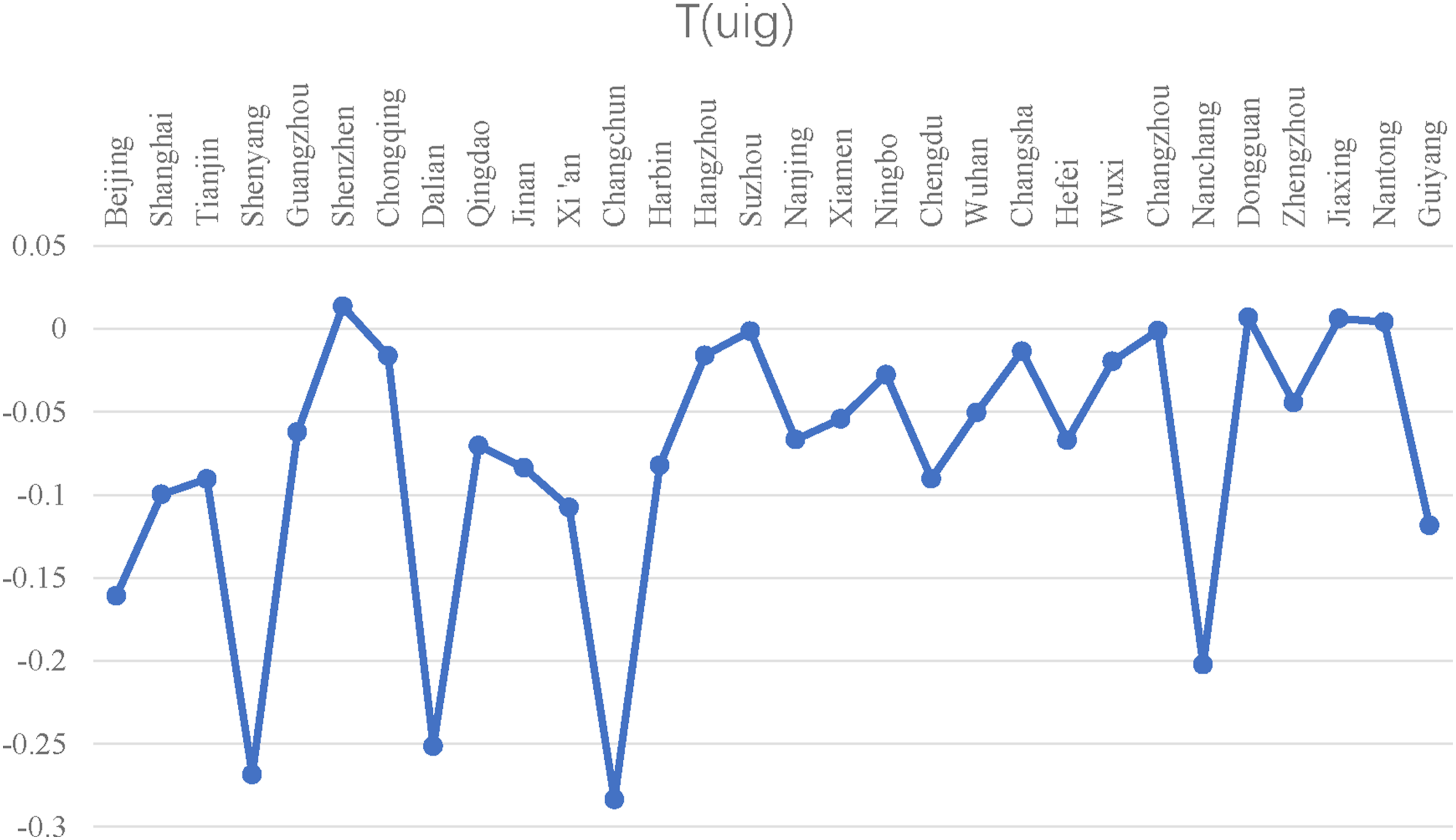
There are four cities with T(uig) values greater than 0, including Shenzhen, Dongguan, Jiaxing, and Nantong, which shows the tripartite relationship of UIG in these cities is relatively loose. Combined with other indicators, it can be found that these four cities generally have the weakness of low participation of universities or governments in collaborative innovation. The dominant advantage of industries in innovation is obvious, and the innovation development of UIG is unbalanced, resulting in the overall coordination of the innovation system is not high. Industries in Shenzhen and Dongguan exhibit outstanding innovation capabilities, becoming the absolute mainstay of innovation, yet the participation of local universities and the governments is significantly insufficient. Jiaxing and Nantong, due to the scarcity of scientific and educational resources, have a shortcoming in the supportive role of universities within their innovation systems. This results in a high T(uig) and a relatively weak overall coordination of the innovation system.
By further combining the bilateral and trilateral mutual information data from Figures 5 and 6, we can discover the differentiation logic of bilateral collaboration and trilateral collaboration (UIG). The core of this stems from the imbalance in the allocation of subject resources and functional boundaries within the urban innovation system. T(ui) and T(ig) curves are somewhat complementary. That is, cities with high mutual information between industry and university have low mutual information between industry and government. This indicates that in the urban innovation system, there is a competitive and crowding-out effect between industry-university collaboration and industry-government collaboration, with industries neglecting cooperation with the government while seeking collaboration with universities.
The difference between the bilateral and trilateral mutual information essentially lies in the distinction between local bilateral association and global system collaboration. The bilatera mutual information (such as T(ui), T(ig), T(ug)) can only capture the interaction frequency and closeness between pairs of subjects, which is a fragmented portrayal of local collaborative relationships in the innovation system. In contrast, trilateral mutual information T(uig) breaks through the local perspective of bilateral collaboration and evaluates the degree of system collaboration from the dimension of overall uncertainty. A smaller value of T(uig) indicates that the linkage among the three parties can better reduce information asymmetry, resource misallocation, and goal divergence in the innovation process. This means that the overall stability and collaborative efficiency of the innovation system are higher.
Taking a typical city as an example, Beijing’s T(uig) is < −0.15. The close-knit nature of its tripartite collaboration is not only reflected in the strength of bilateral interactions between universities and industries, as well as between governments and industries, but also stems from the formation of a deeply intertwined systemic closed loop of UIG. As a national core hub for scientific and technological innovation, Beijing boasts the advantages of basic research from top universities such as Tsinghua University and Peking University, the advantages of technology transformation and industrial implementation from central industries and leading sci-tech innovation industries, and the advantages of top-level design from the government in coordinating sci-tech innovation resources and planning innovation directions. The collaboration between universities and industries, governments and industries, and universities and governments in Beijing does not exist in isolation, but rather supports and complements each other. Ultimately, through system-level tripartite linkage, the optimal global allocation of innovation resources is achieved, which is also the core reason why its T(uig) is at a low level.
The T(uig) of Dongguan is greater than 0, and the collaboration among UIG shows obvious characteristics of looseness. The core issue lies in the fact that bilateral local coordination has not been transformed into a trilateral systemic closed loop, leaving the innovation ecosystem in a fragmented state. Dongguan, as a strong manufacturing city, has significant characteristics of export-oriented industries, with industry being the absolute main body of innovation. The collaboration between the government and industry has a certain degree of local intensity due to industrial investment promotion and park construction. However, the small number of local universities, the scarcity of scientific and educational resources, and the insufficiency in basic research and technological research and development capabilities have led to serious shortcomings in university-industry collaboration. The tripartite collaboration lacks closed-loop support, and the allocation of innovation resources is in a state of localization and fragmentation. A high T(uig) value is a direct reflection of the lack of overall coordination in the innovation system and its failure to eliminate systemic uncertainties through effective tripartite collaboration.
It can be seen from this that bilateral collaboration is the superposition of local connections, while tripartite collaboration is the emergence of systematic linkage. The differentiation between T(uig) and bilateral mutual information reveals the evolution of the urban innovation system from local collaboration to global synergy. Only when bilateral cooperation is embedded in the innovation ecosystem of tripartite collaboration can the optimal allocation of innovation resources and the maximization of system efficiency be truly achieved.
Econometric Analysis of Inter-City Correlation Degree
The bilateral mutual information of cooperation between the two cities is shown in Figure 7. T(ij) reflects the degree of association between cities and other cities in cross-regional collaborative innovation. The higher the value, the closer the inter-city correlation in the innovation system. It can be found that the top 10 cities with T(ij) values are Guangzhou, Suzhou, Nanjing, Hangzhou, Xi’an, Wuhan, Shanghai, Shenzhen, Wuxi, Chengdu. It shows these cities have a high degree of cross-regional innovation synergy and close inter-city connection. Among them, Suzhou, Nanjing, Hangzhou, Shanghai, and Wuxi are located in the Yangtze River Delta urban agglomeration and Guangzhou and Shenzhen are located in the Guangdong Hong Kong Macao Bay Area. It shows that urban agglomeration is an essential platform for promoting collaborative innovation among cities. In particular, the Yangtze River Delta urban agglomeration, with concentrated cities and convenient transportation, plays a vital role in leading technological change, allocating innovative resources, accelerating knowledge spillover, and other fields. Bilateral mutual information of cooperation between two cities.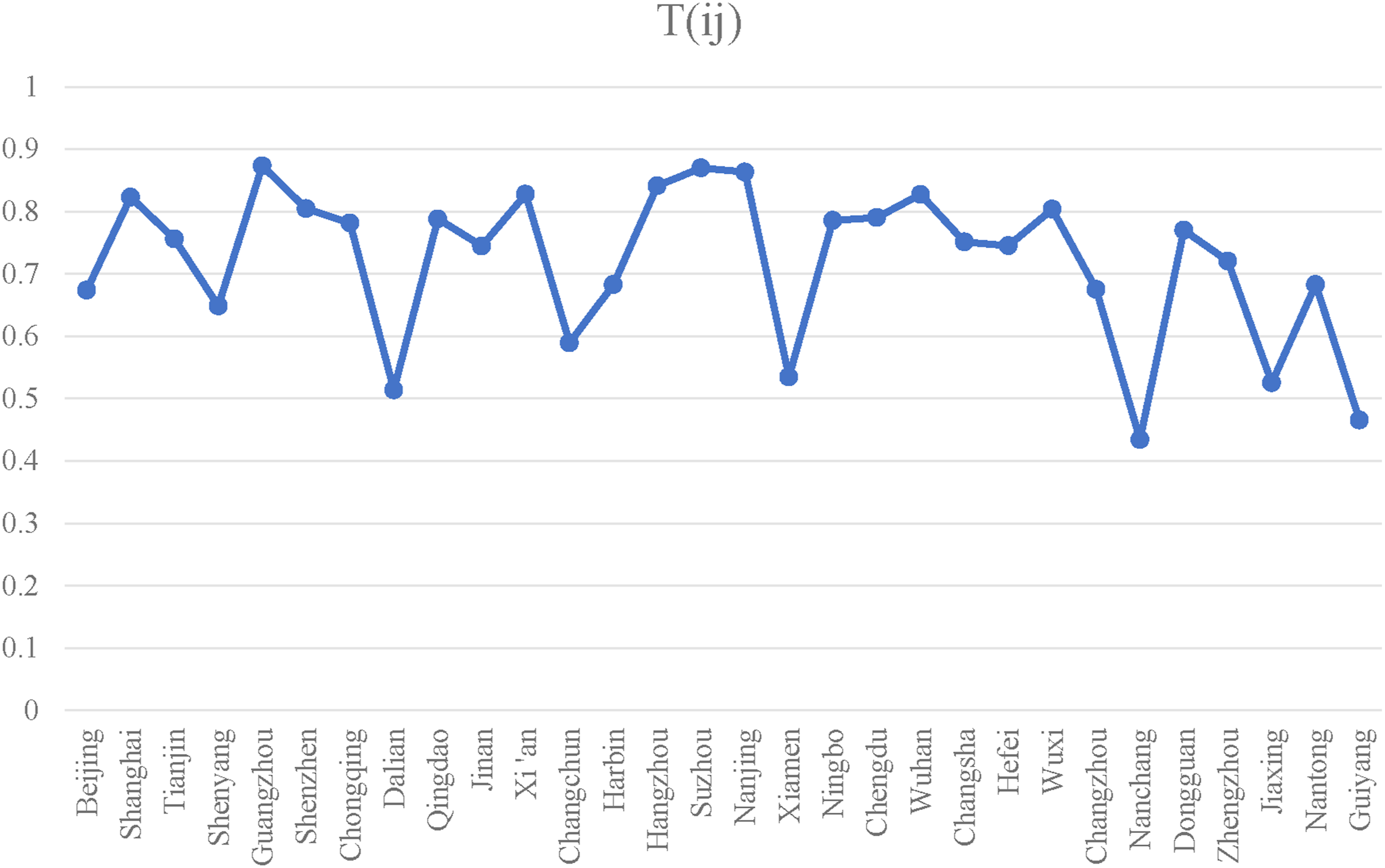
The T(ij) value is lower than 0.6 in six cities: Nanchang, Guiyang, Dalian, Jiaxing, Xiamen, Changchun. The synergistic effect between these cities and other cities in innovation is insignificant, and the inter-city connection is relatively loose. Among them, Nanchang and Guiyang are provincial capitals in the central or western regions, while Changchun and Dalian are northeast cities, far away from other cities with rich innovation resources. Therefore, geographical space blocks the development of inter-city collaborative innovation activities to some extent.
Two-Dimensional Matrix Analysis of Inter-subject and Inter-City Collaborative Innovation
The core logic of collaborative innovation lies in the cross-subject coupling and cross-space flow of innovation elements (knowledge, technology, talents, and capital) among the triple helix subjects (UIG). Inter-subject collaboration and inter-city correlation are not isolated dualistic characteristics but are the coupled results jointly driven by the resource endowments, functional positioning, and network embeddedness of the triple helix subjects. The matching relationship between the two reflects the interactive evolution law of “internal subject collaboration efficiency” and “external network connection strength” in the urban innovation system.
Therefore, to further explore the collaborative innovation relationship of each city, a two-dimensional matrix of inter-subject collaboration and inter-city correlation is constructed. Based on the bilateral or trilateral mutual information of the UIG in each city, the inter-subject mutual information T(is) is obtained, representing the closeness of the collaboration between innovation subjects. Inter-city mutual information T(ic) represents the closeness of the collaboration between cities. These two variables are defined in the coordinate system, as shown in Figure 8. The horizontal coordinate represents the inter-city association, and the vertical coordinate represents inter-subject collaboration within the city. According to the different quadrants of cities, 30 cities are divided into four types of collaborative innovation: intercity tight-subject tight, intercity tight-subject loose, intercity loose-subject tight, and intercity loose-subject loose. Two-dimensional matrix of inter-subject and inter-city collaborative innovation.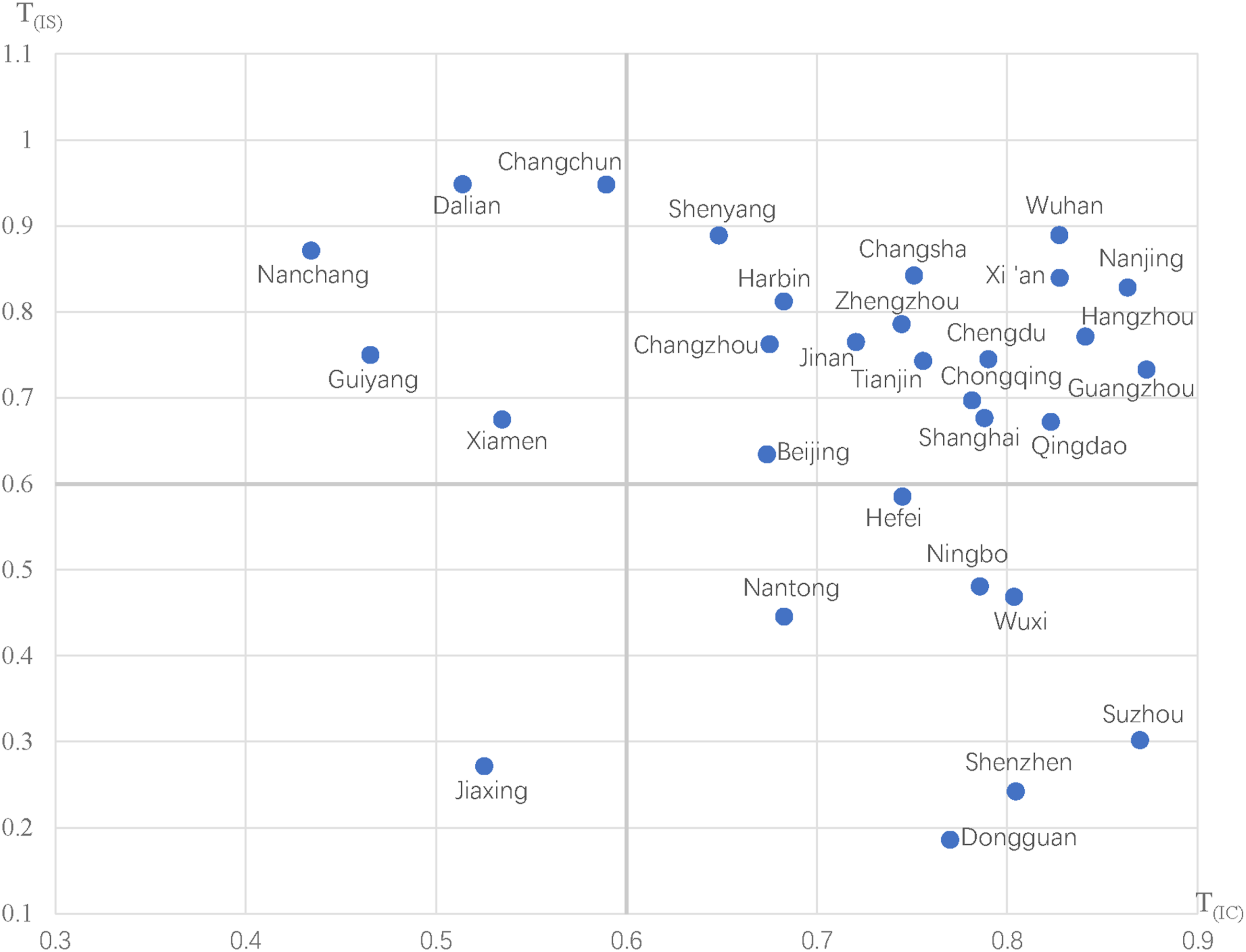
Intercity Tight-Subject Tight
It includes 17 cities such as Nanjing, Guangzhou, Hangzhou, Xi’an, Wuhan, Shanghai, Chengdu and Qingdao, accounting for 56.7 percent of the total number of cities, and is the most critical collaboration type. Most of these cities are rich in innovative resources, have convenient transportation, superior geographical locations and are full of innovative vitality. The mechanism of urban collaborative innovation is the two-way mutual promotion of the deep coupling within the triple helix subjects UIG and the strong network connection outside. Within the city, a closed-loop collaboration of knowledge spillover-technology transformation-policy empowerment has been formed among UIG. Universities and research institutions, as the sources of innovation, output innovative elements such as knowledge, technology and talents. The industry undertakes the transformation of scientific and technological achievements and feeds back market demands. The government provides policy and financial support through science and technology innovation platforms and industrial policies. The frequent interaction among the three parties has driven the high-level operation of the subject collaborative mutual information T(is).
Outside the city, the superior geographical location, well-developed transportation network (high-speed rail and aviation hubs), and the rich aggregation of innovative resources have enhanced the efficiency of factor flow between cities. Innovation elements flow across cities through industrial belts, urban agglomerations, metropolitan areas, etc. between cities, and the T(ic) of intercity collaborative mutual information continues to rise. The internal UIG collaborative dynamics provides crucial support for the external innovation network, while the external intercity connections feed back to the internal resource allocation, forming a positive feedback loop in the innovation ecosystem. This is also the core driving force for the continuous release of the innovative vitality of such cities.
Intercity Tight-Subject Loose
It includes seven cities: Suzhou, Shenzhen, Wuxi, Ningbo, Dongguan, Nantong and Hefei, presenting an asymmetric feature of strong external connection and weak internal coupling. This indicates that these cities pay more attention to benefiting from the externalities of urban networks, while the collaborative effect among the subjects within the cities is not significant. The innovative development of such cities mainly focuses on the outward-oriented collaboration among cities. On the one hand, it relies on the division of labor in the upstream and downstream of the industrial chain in regions such as the Yangtze River Delta and the Guangdong-Hong Kong-Macao Greater Bay Area (for instance, Suzhou connects with Shanghai’s scientific and technological innovation resources, and Shenzhen links up with the industrial clusters of the Guangdong-Hong Kong-Macao Greater Bay Area). Cities are deeply embedded in regional innovation networks, achieving close intercity connections through the efficient cross-city flow of knowledge, technology and capital, with T(ic) remaining at a high level.
On the other hand, there are structural shortcomings in the collaboration among UIG. The innovation resources of local universities and research institutions are relatively weak, and the supply of basic research is significantly lacking. This leads to a low level of inter-subject collaborative mutual information T(is) and insufficient coupling of internal innovation elements. Its innovative development relies on external network spillover, and the internal collaborative impetus is insufficient. In the long term, it is prone to fall into an external-dependent innovation bottleneck.
Intercity Loose-Subject Tight
It includes five cities: Dalian, Changchun, Nanchang, Guiyang and Xiamen, and is characterized by strong internal coupling and weak external connection. Such cities are mostly regional central cities or old industrial bases, and the allocation of UIG resources of innovation subjects within the cities is relatively balanced. The relatively complete government support system for scientific and technological innovation, the stable research capabilities of universities and the local industrial support have formed an internal collaboration network. The factor spillover effect among innovation entities is significant, and the T(is) value is relatively high. However, such cities are limited by their geographical location, transportation accessibility and industrial level, and have not been effectively integrated into the networks of national-level urban agglomerations or economic belts. The flow of innovative elements and the collaboration of the industrial chain are restricted, and the T(ic) value is relatively low. Innovation and development present an internal closed-loop type of collaboration. The externality of the innovation network is not strong, and the achievements are difficult to diffuse through the intercity network.
Intercity Loose-Subject Loose
The fact that there is only one city, Jiaxing, indicates that the cross-border flow of its innovative resources is not frequent. The spatial spillover and the synergy effect of subjects in the process of urban innovation are insignificant. The internal UIG resource endowment is weak, the supply of university research and the support for industrial innovation and transformation are insufficient, and T(is) is at a low level. Although it is adjacent to the two core science and technology innovation cities of Shanghai and Hangzhou, due to its own shortcomings in industrial capacity and scientific and educational resources, it has failed to absorb the innovation spillover from the core cities. The lack of coordinated layout with surrounding cities leads to a relatively low T(ic). Without internal collaborative impetus and external connection support, both the effects of subject collaboration and spatial correlation are difficult to manifest, making it an isolated island in the innovation ecosystem.
The matching of subject collaboration and intercity association essentially lies in the functional performance and collaborative evolution of UIG subjects in the dimensions of internal coupling and external embedding. The predicament of collaborative innovation among different types of cities lies in the misalignment of the main functions of UIG and the imbalance of network connections. Cities that are strong both internally and externally need to promote the upgrading of UIG from factor agglomeration to an innovation ecosystem. Those that are strong externally but weak internally need to make up for the shortcomings in internal collaboration and build an innovation network with internal and external linkage. The type that is strong internally but weak externally needs to break the internal closed loop through transportation interconnection and platform co-construction, and leverage the external network to amplify the collaborative effect. Cities with dual weakness need to prioritize making up for the shortcomings of UIG’s resources and gradually connect with regional innovation networks to achieve transformation.
Discussion
The above research applies the theories of TH, collaborative innovation, and innovation network to analyze China’s urban innovation system. It focuses on exploring the collaborative coupling relationship between UIG, as well as the inter-city correlation and synergy effect between cities. Therefore, this study presents some practical implications.
(1) The innovation capacity of Chinese cities has been continuously enhanced, with significant differences among cities and a major imbalance in urban innovation. The intensity and breadth of inter-city cooperation are increasing. The inter-city innovation cooperation network has evolved from a “dual-core driven” structure centered on Beijing and Shanghai to a “multi-center driven” network structure with cities such as Beijing, Shanghai, Shenzhen, Nanjing, Chongqing, Wuhan, Tianjin, Xi’an, Hangzhou, and Suzhou as innovation poles. The phenomenon of direct cooperation networks is more significant, and the “core-edge” effect of inter-city innovation cooperation is gradually weakening.
Therefore, Beijing, Shanghai, Shenzhen and Nanjing should give full play to the core hub role in the global innovation network, and promote the flow and diffusion of innovation resources to the new innovation poles. Chongqing, Wuhan, Tianjin, Xi’an, Hangzhou and Suzhou should give full play to their respective advantages in science and technology, intellectual resources, digital economy and other fields to build regional innovation highlands. Other innovative cities should actively undertake and gather knowledge spillovers, technology transformation, and industrial transfer from core cities and innovation poles to build a sound urban innovation ecosystem.
(2) In terms of the bilateral collaborative relationship between UIG, the relationship between industry and university in Chinese cities is the closest, followed by industry and government. The relationship between university and government is looser. In cities, there are specific substitution and crowding-out effects between industry-university collaboration and industry-government collaboration (Chang et al. 2021). In seeking to collaborate with universities, industries have neglected to collaborate with governments. It also shows that the functions of universities and public research institutions overlap in scientific and technological innovation, and their functional positioning and organizational boundary tend to be blurred (Zhuang et al., 2021).
Therefore, the formulation of urban innovation policies needs to go beyond the traditional bilateral subject thinking and shift towards building a trilateral collaborative ecosystem with deep interweaving among university, industry, and government. On the one hand, policy design should focus on eliminating the crowding-out effect of local collaboration on the overall system, and avoid disrupting the integrity of the innovation ecosystem due to excessive emphasis on a certain bilateral interaction (such as between university and industry or between government and industry). By building inter-subject innovation platforms and setting up tripartite joint research and development plans, efforts are made to promote cooperation from fragmented bilateral connections to systematic trilateral closed loops. On the other hand, for cities with weak scientific and educational resources or single industrial support, a differentiated “chain-filling and core strengthening” strategy should be implemented. By introducing external universities and research institutes and jointly building new research and development institutions, the shortcomings caused by the absence of local universities can be made up. Upgrade the original local collaborative advantages between the government and industry to an overall efficacy of the interaction of university-industry-government.
(3) Within the city, Changchun, Shenyang, Dalian, Nanchang, and Beijing have a close tripartite collaboration between UIG, while Shenzhen, Dongguan, Jiaxing, and Nantong have a relatively loose relationship. It is worth thinking that cities with close collaboration between UIG, except Beijing, are all cities with fewer total patents and weak innovation capacity, while Shenzhen with tremendous innovation capacity have loose tripartite collaboration.
There are two possible reasons for this: First, cities with less advanced science and technology innovation are in the primary stage of government-led collaborative innovation development. At this stage, governments play a more significant role in innovation resource allocation, achievement transformation, and innovation cooperation (Lei et al. 2012). The governments and universities have a relatively higher share in the innovation system, so the tripartite development of UIG is more balanced and closely related. Second, cities leading in science and technology innovation are at an advanced stage of collaborative innovation development where industries play an absolute leading role. These cities have strong innovation abilities, but the tripartite development of UIG is uneven. Industries have strong independent innovation capabilities. Some high-tech industries can achieve a whole innovation chain from knowledge, technology to product innovation through their internal R&D institutions (Togoontumur and Cooray 2023). They rely less on universities and governments, so the tripartite relationship between UIG is loose.
(4) From the perspective of inter-city correlation, cities such as Suzhou, Nanjing, Hangzhou, Wuxi, and Shanghai in the Yangtze River Delta, as well as Guangzhou and Shenzhen in the Guangdong-Hong Kong-Macao Greater Bay Area, have close inter-city connections and a high degree of cross-regional innovation collaboration. Urban agglomerations, as the core carriers of regional integrated development in China, have a significantly higher degree of intercity connection and cross-regional innovation collaboration than non-urban agglomeration areas. This conclusion can be further verified by the specific characteristics and data of China’s three major urban agglomerations (the Yangtze River Delta urban agglomeration, the Guangdong-Hong Kong-Macao Greater Bay Area urban agglomeration, and the Beijing-Tianjin-Hebei urban agglomeration). Considering that the 30 cities selected for the study can reflect the spatial correlation characteristics among the core cities in the three major urban agglomerations, while non-core cities find it difficult to demonstrate this correlation attribute. Therefore, the following text will focus on the three major urban agglomerations, conduct an in-depth analysis of their intercity connections and collaborative innovation characteristics, and clarify the intercity connection laws at the urban agglomeration level.
As a benchmark for the development of urban agglomerations in China, the Yangtze River Delta urban agglomeration, with its well-connected intercity transportation network (such as a high-speed rail network density ranking among the top in the country and interconnected intercity expressways), highly developed market environment, and relatively low regional administrative barriers, provides the optimal spatial carrier for the cross-regional flow and allocation of innovative resources (Dong et al. 2026). Core cities such as Suzhou, Nanjing, Hangzhou, Wuxi and Shanghai are closely connected, and the surrounding medium and small-sized cities are also deeply integrated into the regional innovation network. It fully demonstrates the spatial correlation advantages of the integrated development of urban agglomerations.
As the core carrier of China’s open economy, the urban agglomeration of the Guangdong-Hong Kong-Macao Greater Bay Area features “open leadership, dual-core-driven, and all-domain integration” in its intercity connections and cross-regional innovation collaboration. As the dual cores of urban agglomerations, Guangzhou and Shenzhen have formed a powerful radiation and driving effect by leveraging their respective innovation advantages. The intercity connections with surrounding cities such as Zhuhai, Foshan and Dongguan are becoming increasingly close, and the efficiency of cross-city flow of innovative resources is constantly improving.
Among the 13 cities in the Beijing-Tianjin-Hebei urban agglomeration, only Beijing and Tianjin are core innovative cities. To further verify the intercity correlation pattern of the Beijing-Tianjin-Hebei urban agglomeration, a search and quantitative analysis of cooperative patents among 13 cities were conducted to supplement and improve the comparative verification of the three major urban agglomerations. Research shows that the number of cooperative patents among cities in the Beijing-Tianjin-Hebei region has increased from 1,859 in 2014 to 3,317 in 2023, with an average annual growth rate of 6.0 percent, showing a relatively stable growth. Among them, the number of cooperative patents between Beijing and Tianjin increased from 763 to 782, with an average annual growth rate of only 0.27 percent. The number of cooperative patents between Beijing and 11 cities in Hebei Province increased from 802 to 1,229, with an average annual growth rate of 4.4 percent. The number of cooperative patents between Tianjin and Hebei has increased from 294 to 1,306, with an average annual growth rate of 16.1 percent.
The urban innovation network has evolved from a “one core and two poles” structure with Beijing as the core and Tianjin and Shijiazhuang as the innovation poles to a “multi-center networked” structure with deep integration among various cities. Administrative barriers among provinces in the Beijing-Tianjin-Hebei region remain prominent. The intercity connections of Shijiazhuang are significantly higher than those of other cities, and its leading edge is becoming increasingly prominent. The two-dimensional inter-city connections among Qinhuangdao, Hengshui, Chengde, Zhangjiakou and Handan are relatively close, while the intercity connections among Tianjin tend to be loose.
Compared with the urban agglomerations of the Yangtze River Delta and the Guangdong-Hong Kong-Macao Greater Bay Area, the intercity connections of the Beijing-Tianjin-Hebei urban agglomeration exhibit distinct regional characteristics. The cooperation between core cities (Beijing and Tianjin) has significantly slowed down, while the innovation spillover from the two core cities to non-core cities (cities in Hebei Province) has accelerated. The formation of this pattern stems from the combined effects of regional innovation positioning adjustments, industrial gradient adaptations, and the optimization of collaborative mechanisms. The construction of Xiongan New Area has achieved remarkable results, and the core city has played a significant role in exerting an innovative radiation effect and a digital element diffusion effect on other cities. The coordinated innovation in the Beijing-Tianjin-Hebei region is transforming from “dual-core aggregation” to “all-round radiation”. Administrative barriers between provinces remain prominent, becoming an important factor restricting the further deepening of intercity connections.
In conclusion, through in-depth analysis of the three core urban agglomerations of the Yangtze River Delta, the Guangdong-Hong Kong-Macao Greater Bay Area, and the Beijing-Tianjin-Hebei region, it can be clearly seen that the degree of intercity correlation among urban agglomerations is significantly greater than that among non-urban agglomeration areas. Among them, the intercity connections in the Yangtze River Delta and the Guangdong-Hong Kong-Macao Greater Bay Area are closer, and the level of cross-regional innovation collaboration is higher. Although there are administrative barriers at the provincial level in the Beijing-Tianjin-Hebei urban agglomeration, the trend of enhancing intercity connections and innovation synergy is significant.
Therefore, we should thoroughly learn from the successful experience of the urban agglomeration and give play to the leading role of the urban agglomeration and economic belt strategy (Fan et al. 2020). By establishing more cross-city innovation coordination organizations, the regional restrictions and administrative barriers will be broken to achieve the free flow of talent, knowledge, capital, technology, data, and other innovative elements (Ye et al. 2021). On the basis of the three world-class urban agglomerations in the Yangtze River Delta, Beijing-Tianjin-Hebei, and Guangdong-Hong Kong-Macao Greater Bay Area, we will build urban agglomerations such as Chengdu-Chongqing, the middle reaches of the Yangtze River, and the middle and lower reaches of the Yellow River. The level of regional integration should be improved by strengthening the functions of information exchange, resource sharing, coordination and management among cities. Formation of an urban collaborative innovation system with compact spatial organization, strong economic ties and a high degree of urban integration.
(5) From the two dimensions of inter-city association and inter-subject collaboration, the heterogeneity of urban collaborative innovation features are apparent. The intercity tight-subject tight cities are the most critical category of collaborative innovation, which shows that there is no mutual substitution effect in the coordination and interaction between cities and subjects (Fan et al., 2023). Most cities with solid innovation abilities are good at integrating and utilizing local and cross-regional innovation resources and have achieved remarkable results in open innovation. Suzhou, Shenzhen, and other cities with intercity tight-subject loose type are primarily located in the core area of urban agglomeration, with superior geographical location. Industries play a prominent role in innovation, but there are shortcomings in the lack of scientific and educational resources such as universities and research institutions. In Dalian, Changchun, and other cities with intercity loose-subject tight type, most industries are not prominent in innovation, and there are few surrounding innovative cities, so they fail to integrate into urban agglomeration or economic belt.
Therefore, we should implement differentiated policies of urban collaborative innovation. First, for cities with intercity tight-subject tight type, we should focus on improving the radiation and driving effect in urban collaborative innovation. Through knowledge overflow, innovation division, and other ways to promote the cross-boundary flow of innovation elements, advance the efficiency of innovation resource utilization, and drive the evolution and upgrading of the regional innovation system.
Secondly, for cities with intercity tight-subject loose type, the government should build a new kind of innovation consortium and increase direct investment in innovation in crucial core technologies, high-risk and huge investment fields. Encourage industries, universities and other organizations to take on more environmental social responsibility and collaborate on green science and technology innovation (Xing and Lee 2024). Through the combination of the innovation chain and industrial chain, industries can effectively use external resources. Vigorously develop science and technology intermediary, financial, and other service systems, so that they can become a bridge of collaboration and interaction between UIG and create a complete multi-helix innovation chain.
Finally, as the cities with intercity loose-subject tight type are at the edge of the urban innovation network, the central government should guide innovation resources to “factor depressions,” such as network edge cities from the system and operating mechanism. These cities should actively integrate into the innovation network and accept the scientific and technological radiation and knowledge spillover from the core cities. At the same time, urban agglomeration with compact space and close connections should be built within a particular region to achieve integrated development in policy connectivity and infrastructure construction. For example, digital technology should be used to bridge the “regional gap” of innovation resources, efficiently use and effectively allocate digital resources, and achieve rapid diffusion and complete penetration of innovation elements among cities.
Conclusion
Under China’s vigorous implementation of innovation-driven development strategy and innovative city construction, the theoretical framework is constructed from two dimensions of inter-subject collaborative relationship and inter-city spatial correlation in the urban innovation system. Using invention patent data of 30 major innovative cities in China from 2014 to 2023, we empirically examine the typical characteristics, evolutionary trends, and synergetic degree of urban innovation systems.
The findings are as follows: (1) The innovation capability of Chinese cities is constantly enhanced, and the imbalance of innovation level among cities is prominent. The inter-city innovation cooperation network is evolving from the “dual-core drive” of Beijing and Shanghai to a “multi-center drive” network structure with Beijing, Shanghai, Shenzhen, Nanjing, Chongqing, Wuhan, Tianjin, Xi 'an, Hangzhou, Suzhou and other cities as the innovation poles. (2) The bilateral collaboration between industry and university in cities is the closest. There are specific substitution and crowding-out effects between industry-university collaboration and industry-government collaboration. The functions of universities and public research institutions overlap in the field of scientific and technological innovation, and the organizational boundaries tend to be blurred. (3) The tripartite collaboration between UIG, Changchun, Shenyang, Dalian,and other cities are closely coordinated, and are in the stage of government-led collaborative innovation development. On the other hand, Shenzhen, Dongguan, Jiaxing, and other cities have a looser tripartite relationship and are in the stage of collaborative innovation development where industries are absolutely dominant. (4) The inter-city correlation of urban agglomeration is prominently better than that of other regions, especially the Yangtze River Delta urban agglomeration is active in cross-city collaborative innovation. Suzhou, Nanjing, Hangzhou, Wuxi and Shanghai in the Yangtze River Delta and Guangzhou and Shenzhen in the Guangdong-Hong Kong-Macao Greater Bay Area are closely inter-city and have a high degree of cross-regional collaborative innovation. (5) The intercity tight-subject tight cities are the most critical category of collaborative innovation, including 17 cities such as Nanjing, Guangzhou, and Hangzhou. Seven cities, including Suzhou, Shenzhen, and Wuxi, belong to the intercity tight-subject loose type city; five cities, including Dalian, Changchun, and Nanchang, belong to the intercity loose-subject tight type city; only one city, Jiaxing, belongs to the intercity loose-subject loose type city.
Although this study has achieved some valuable research results, there are certain limitations foreshadow possible future research problems. First, the measurement of urban collaborative innovation relationship in China is only based on patent data. Although joint patents can reflect the process and output of inter-subject and inter-city collaborative innovation, they cannot cover all forms of urban collaborative innovation system. Therefore, future research should explore the mechanism of urban collaborative innovation system from more research perspectives by investigating and collecting more indicators and data. Second, although this study has revealed the laws and characteristics of urban collaborative innovation, it does not further explore its influencing factors and deep-seated reasons. Therefore, a model of influencing factors of urban collaborative innovation will be built to examine the key factors affecting the collaborative relationship.
Footnotes

Author Contributions
Zhuang Tao: analysis data, writing the draft, reviewing and editing.
Zhao Shuliang: Conceptualization, Methodology, write the discussion.
Liu Linlin: write the abstract and rewritten some parts.
Funding
The authors disclosed receipt of the following financial support for the research, authorship, and/or publication of this article: This research was supported by Social Science Planning Research Program of Shandong (Grant nos. 23CSDJ61).
Declaration of Conflicting Interests
The authors declare no potential conflict of interest with respect to the research, authorship, and/or publication of this article
Data Availability Statement
Some or all data, models, or code that support the findings of this study are available from the corresponding author upon reasonable request.