







Abstract
Digital talent mobility is crucial for enhancing regional competitiveness, yet its influencing factors exhibit notable spatio-temporal heterogeneity. This study examines how interacting macro-, meso-, and micro-level factors shape digital talent mobility across urban agglomerations in China. GeoDetector is first used to identify key interaction effects, which are then incorporated into the Geographically and Temporally Neural Network Weighted Regression model for coefficient estimation under flexible and data-driven spatio-temporal weighting. The results show that the effects of macroeconomic and industrial conditions are highly uneven across space and time. This unevenness is further shaped by healthcare provision and air quality, which influence talent mobility both directly and by modifying the role of labour-market and development conditions. The findings show that digital talent mobility is characterised by interaction-dependent and spatio-temporally dynamic relationships. It provides evidence for more differentiated regional talent policies.
Keywords
Introduction
As a complex issue involving disciplines such as geography, economics, and sociology (Azoulay et al. 2017; Shi et al. 2024), population mobility profoundly affects labour market dynamics and the flow of knowledge, technology, and social resources. In particular, the mobility of high-quality talent facilitates resource reallocation and balanced regional development, making it a crucial driver of regional economic growth (Qiu et al. 2024). With the rapid expansion of the digital economy, digital talent possessing cross-disciplinary knowledge and innovative skills has become central to technological advancement and business model innovation (Huang et al. 2023; Li et al. 2024). Their movement has emerged as a critical component of national, regional, and urban competitiveness (Marchesani et al. 2023).
The rapid development of urban agglomerations has made digital talent mobility an increasingly important issue. Urban agglomerations are typically composed of multiple cities with high concentrations of economic, cultural, and technological resources, offering strong economic appeal, employment opportunities, and innovation capabilities (Fang and Yu 2017). They attract external talent and facilitate the diffusion of talent, technology, and innovation through talent mobility. However, such mobility may lead to uneven talent distribution, increase competition for resources, and widen regional development disparities (Gu et al. 2020). Examining digital talent mobility in urban agglomerations therefore helps clarify the sources of regional disparity and provides a theoretical basis for policies aimed at improving the allocation of talent resources.
However, digital talent mobility is inherently complex, shaped by the interplay of multiple factors rather than by economic conditions or policy measures in isolation. These factors often act simultaneously and interactively. For instance, Latukha et al. (2022) showed that the impact of industry- and individual-level factors on the willingness of top university graduates to migrate abroad may be moderated by policies related to talent attraction, development, and retention. Such interactions can generate mobility patterns and adjustment speeds that differ substantially from those implied by single-factor analyses (Marchesani et al. 2023).
Furthermore, digital talent mobility exhibits pronounced spatio-temporal heterogeneity. Spatial heterogeneity arises from regional disparities in economic development, technological capacity, and quality of life (Gu et al. 2021), while temporal heterogeneity reflects evolving economic conditions, policy changes, and social demand (Zhang et al. 2024). Certain regions may attract substantial inflows of digital talent at specific periods through policy support and industrial clustering, but subsequent economic or policy shifts can alter their attractiveness, thereby altering mobility patterns (Beerli et al. 2023). Consequently, digital talent mobility is a dynamic and evolving process, underscoring the need for adaptive and region-specific strategies.
The literature in regional science has long recognised the critical role of human capital flows in shaping regional innovation systems (Martinidis et al. 2022), agglomeration economies (Thisse 2018), and uneven spatial development (Xu and Zhu 2024). Although many studies have analysed the factors influencing talent mobility (Gu et al. 2020; Zhang et al. 2022), they primarily focus on average inflows and outflows under single-factor frameworks. These studies overlook the complexity of talent mobility within urban agglomerations, including multidimensional, cross-regional, and internal mobility. Besides, existing studies have relied on linear models (Schaeffer 2023), negative binomial regression models (Shi et al. 2024), and conditional logit models (Su et al. 2019) to explore the determinants of population migration, yet they provide limited insight into the interactions between different factors and the variability of these factors across spatial and temporal dimensions. Given that talent mobility significantly shapes the economic growth trajectories of cities and regions, systematically exploring these multifactorial interactions and spatio-temporal heterogeneity is critical for advancing regional science, informing debates on balanced development, spatial interactions, and the dynamics of collaboration and competition among cities in the digital economy era.
To address these limitations, this study applies a flexible spatio-temporal modelling strategy that accommodates complex and context-dependent variations in digital talent mobility. Building on the interaction effects identified by GeoDetector, the analysis incorporates these interaction terms into the Geographically and Temporally Neural Network Weighted Regression (GTNNWR) model developed by Wu et al. (2021) for coefficient estimation under data-driven spatio-temporal weighting. This integrated empirical framework retains the neural-network-based spatio-temporal weighting structure of the GTNNWR model, enabling more flexible representation of spatio-temporal decay and interaction-conditioned variation than traditional linear models or more restrictive kernel-based specifications. It allows for a detailed characterisation of how multiple determinants jointly shape mobility patterns, providing an interpretable framework for examining spatio-temporal heterogeneity without imposing restrictive assumptions on functional forms or decay structures.
This study makes several distinct contributions. First, it integrates multiple interacting determinants within a unified analytical framework and examines how their joint effects shape the direction and patterns of talent flows. Second, through dynamic spatio-temporal analysis, it uncovers the evolving nature of digital talent attraction across different locations and periods. Lastly, relative to traditional models such as the ordinary least squares and kernel-based regressions, it adopts a flexible spatio-temporal modelling approach that accommodates non-linear and adaptive weighting, enabling interaction-conditioned spatio-temporal heterogeneity to be captured and interpreted. The findings extend theoretical insights on human capital mobility within regional science and provide practical implications for regional policymaking.
This paper is organised as follows. The literature review first examines relevant studies on digital talent mobility, spatial interaction, and regional economic development. The methodology then explains how spatio-temporal heterogeneity and multifactor interactions are incorporated into the analysis of digital talent mobility. The empirical findings are subsequently presented and discussed. Finally, the paper concludes by offering with targeted policy implications.
Literature Review
Factors Influencing Talent Mobility
Talent mobility is influenced by multiple interrelated factors, commonly classified as macro-, meso-, and micro-level determinants, which jointly shape the direction, scale, and patterns of movement.
At the macro-level, broad economic, social, and policy conditions shape entire regions and exert long-term influence on talent flows. Key determinants include overall economic development, shifts in industrial structure, and the accelerating process of globalisation. Developed economies typically offer more abundant job opportunities and higher salaries, thereby attracting greater talent (Jin et al. 2022). Moreover, as traditional sectors wane and emerging industries rise, industrial restructuring significantly reshapes migration patterns. As Wang et al. (2022) found, industrial structure improved the prediction accuracy of population migration by 24.6 percent. Additionally, globalisation has expanded talent mobility beyond domestic confines, intensifying international competition and redefining the scope of talent attraction (Rezaei and Mouritzen 2021).
At the meso-level, the focus shifts to the specific economic and social conditions within industries or enterprises. Factors such as industry demand, employment opportunities, and living conditions play pivotal roles in shaping talent mobility. For example, Diao et al. (2021) and Wang (2022) indicated that high employment rates and a vibrant job market can attract more talent to a region. Innovation-driven enterprises often offer more career opportunities for tech and research talent (Liu et al. 2023), while higher income levels directly encourage talent mobility (Gu et al. 2024). In this regard, regional competitiveness and attractiveness are particularly prominent, as they determine migration paths and the scale of talent movement.
At the micro-level, the factors closely related to daily life, such as personal quality of life, working conditions, and social welfare, are strongly shape digital talent mobility. High-skilled individuals, particularly those with families, often prioritise quality healthcare and education when deciding on migration destinations (Kubiciel-Lodzinska and Maj 2021). Housing price is also a significant factor influencing the willingness to reside, especially in large cities, where high housing costs can become a major constraint on talent mobility (Zhou and Hui 2022). Beyond economic and welfare factors, non-economic aspects such as air quality and overall environmental conditions are increasingly influential (Zhang et al. 2022).
Measurement of Talent Mobility
A central topic in the literature on urban population mobility is the modelling and estimation of population flows, which serves as a foundation for addressing various urban challenges such as transportation planning (Harrison et al. 2024), economic growth (Gao et al. 2024), and epidemic prevention (Carney and Gushulak 2016).
To quantify population flows, researchers have developed various trip distribution models. Among these models, the gravity model (Relethford 1986) and the intervening opportunity model (Rogerson 1986) are widely recognised and extensively utilised. However, both models rely heavily on context-specific parameters and are limited in settings lacking sufficient calibration data (Simini et al. 2012). To address these limitations, several parameter-free models have been developed, including the radiation model (Simini et al. 2012), Population-Weighted Opportunity (PWO) model (Yan et al. 2014), and rank-based model (Liang et al. 2015). It has been noted that the radiation model performs well for intercity flows but is less accurate at the urban scale (Gu et al., 2023). In contrast, the PWO and rank-based models are better suited to intra-city mobility (Liang et al. 2015; Liu and Yan 2019). Therefore, this study applies the radiation model to analyse intercity mobility patterns of digital talent.
Spatio-Temporal Heterogeneity Model
Spatio-temporal non-stationarity is a fundamental characteristic of geographic processes. The Geographically Weighted Regression (GWR) model provides a foundational approach to estimate spatially varying coefficients by applying spatial weights (Brunsdon et al. 1996). The Geographically and Temporally Weighted Regression (GTWR) model was developed to enhance the GWR model by incorporating temporal variation alongside spatial variability (Huang et al. 2010).
Nevertheless, spatial processes often operate at multiple scales, and the single-bandwidth assumption in GWR and GTWR models may mask important multiscale heterogeneity. The Multiscale Geographically Weighted Regression (MGWR) model addresses this issue by assigning variable-specific spatial bandwidths for each covariate (Fotheringham et al. 2017). Wu et al. (2019) further proposed the Multiscale Geographically and Temporally Weighted Regression (MGTWR) model, which calibrates separate spatial and temporal bandwidths for each factor, allowing simultaneous examination of relationships across multiple spatial and temporal scales.
While GWR, GTWR, MGWR, and MGTWR models have been widely applied in academic research and practice, they still face certain challenges. One major limitation is the difficulty in selecting appropriate kernel functions to capture intricate spatial relationships. These models also require predefined weighting forms, which can restrict the representation of complex and nonlinear dependence across space and time (Ding et al. 2024; Du et al. 2020). Neural networks offer a flexible solution by learning weighting functions directly from the data. By incorporating neural networks into the spatial regression framework, the Geographically Neural Network Weighted Regression (GNNWR) model (Du et al. 2020) and the Geographically and Temporally Neural Network Weighted Regression (GTNNWR) model (Wu et al. 2021) have been developed. The value of these models lies in their ability to represent nonlinear relationships and spatio-temporal non-stationarity more flexibly. These models demonstrate substantial improvements over traditional spatio-temporal regression models and outperform other machine learning techniques, such as random forest (Ding et al. 2024; Xu et al. 2025; Yue et al. 2026).
The GNNWR and GTNNWR models are particularly suitable for contexts with multiple spatial hierarchies, long time series, and covariate effects that vary continuously across distance and time (Wu et al. 2021). In these models, the weight and bias parameters function analogously to bandwidths in GTWR and MGTWR frameworks, controlling the influence of observations across space and time. However, unlike traditional bandwidths, these parameters are learned directly from the data through neural networks, avoiding the constraints of predefined kernel functions and allowing for adaptive and nonlinear weighting across distances and periods (Wu et al. 2021). This data-driven flexibility enables the GTNNWR model to capture complex and context-dependent spatio-temporal decay patterns and varying factor intensities without imposing fixed kernel structures (Xu et al. 2025; Yue et al. 2026). Hence, applied to digital talent mobility in Chinese urban agglomerations, the GTNNWR model accommodates the distinct spatial and temporal dynamics of macro-, meso-, and micro-level factors, providing an interpretable framework for analysing mobility patterns and their evolution across cities and time.
Methodology
Variables and Scopes
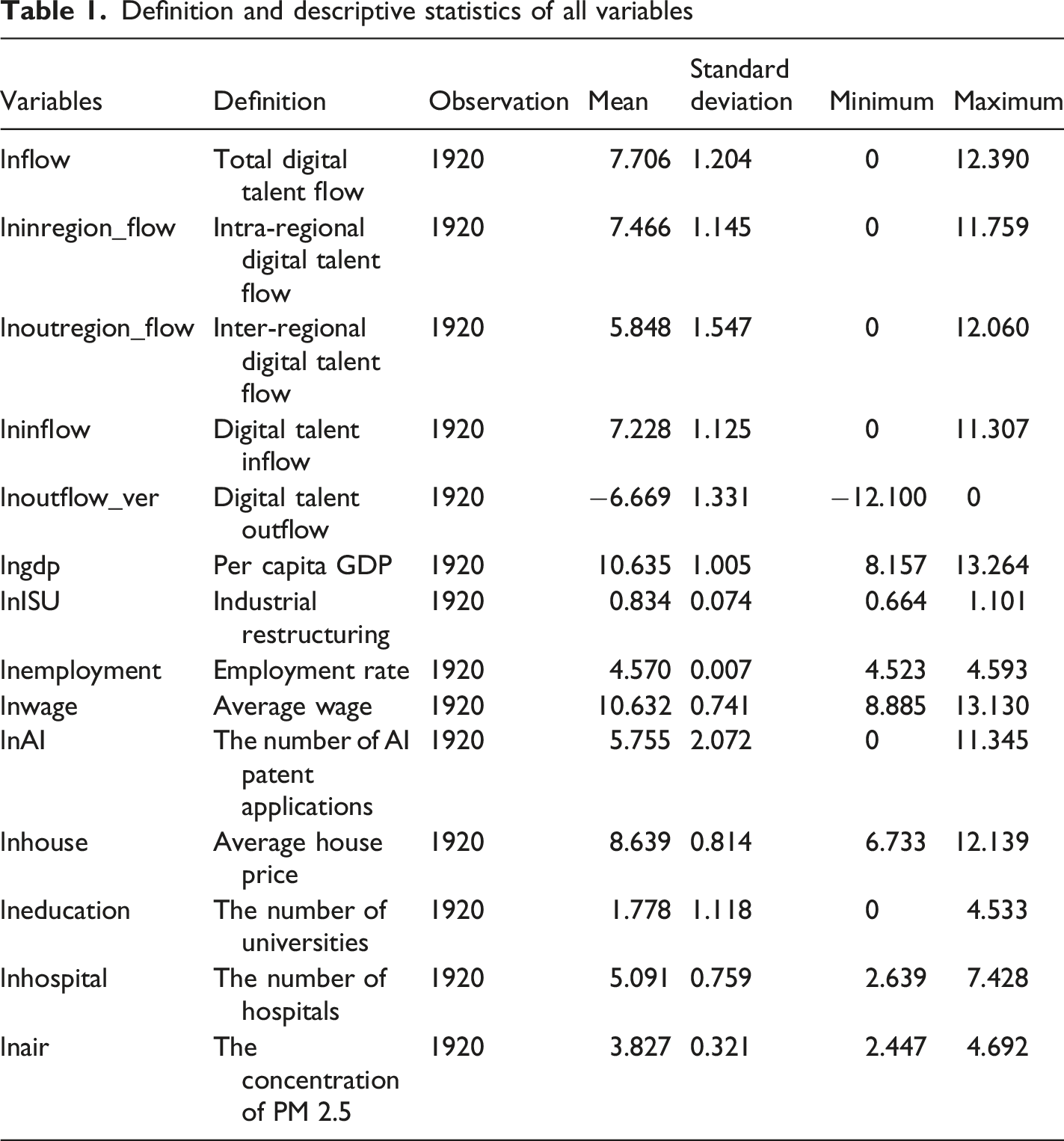
The dependent variable is digital talent flow. Digital talent is defined as individuals employed in information transmission, computer services, and the software industry, and the digital talent flow can be estimated using the radiation model (Simini et al. 2012). The model provides a parameter-free approach based on population distribution and distance, with emphasis on the opportunities and competition individuals face when choosing destinations. The digital talent flow


Assume there are


Then, the total digital talent flow of city

It should be emphasised that this study sets a minimum threshold for talent mobility of 1. It simultaneously investigates the intra-regional flow (if two cities belong to the same urban agglomeration, denoted as inregion_flow), and inter-regional flow (if two cities belong to different urban agglomerations, denoted as outregion_flow). In the analysis of digital talent outflow, the amount of outflow is defined as a negative value (denoted as outflow_ver).
Factors influencing digital talent mobility can be considered from three perspectives: macro-, meso-, and micro-levels. Firstly, at the macro-level, gross domestic product (GDP) per capita and industrial restructuring are selected as the main variables. GDP per capita (denoted as gdp) is measured by dividing regional GDP by the total population, while industrial restructuring (denoted as ISU) can be assessed using the industrial structure hierarchy coefficient (Ma and Cao 2022), that is

Secondly, at the meso-level, a high employment rate typically signifies greater demand for digital talent in the labour market. Average wages reflect the income level in a region, and higher incomes can attract more talented individuals. In addition, the level of Artificial Intelligence (AI) development in enterprises reflects the region’s investment and progress in technological innovation and digitalisation, which plays a crucial role in attracting digital talent. The employment rate (denoted as employment) and average wages (denoted as wage) can be obtained from statistical yearbooks, while the level of AI development (denoted as AI) can be measured by the number of AI patent applications (Nguyen and Vo 2022).
Lastly, at the micro-level, factors including housing prices, healthcare, education, and air quality are selected. Housing prices directly affect the cost of living for talent. High housing prices may deter talent inflows. The availability of healthcare and educational resources impacts the quality of life for talent, especially for digital professionals with families. Air quality, as an environmental factor, also plays a role since a better living environment typically attracts more talent. Housing prices (denoted as house) can be measured by the city’s average annual housing price, healthcare (denoted as hospital) and education (denoted as education) resources can be assessed by the number of hospitals and universities, and air quality (denoted as air) can be evaluated by the concentration of fine particulate matter (PM 2.5).
Furthermore, this study selects five major urban agglomerations in China as research subjects, namely the Yangtze River Delta, the Guangdong-Hong Kong-Macau Greater Bay Area, the Beijing-Tianjin-Hebei Urban Agglomeration, and the Chengdu-Chongqing City Group. The cities under each urban agglomeration are given in Appendix 1, and the map of these urban agglomerations is shown in Figure 1. The map of five urban agglomerations in China.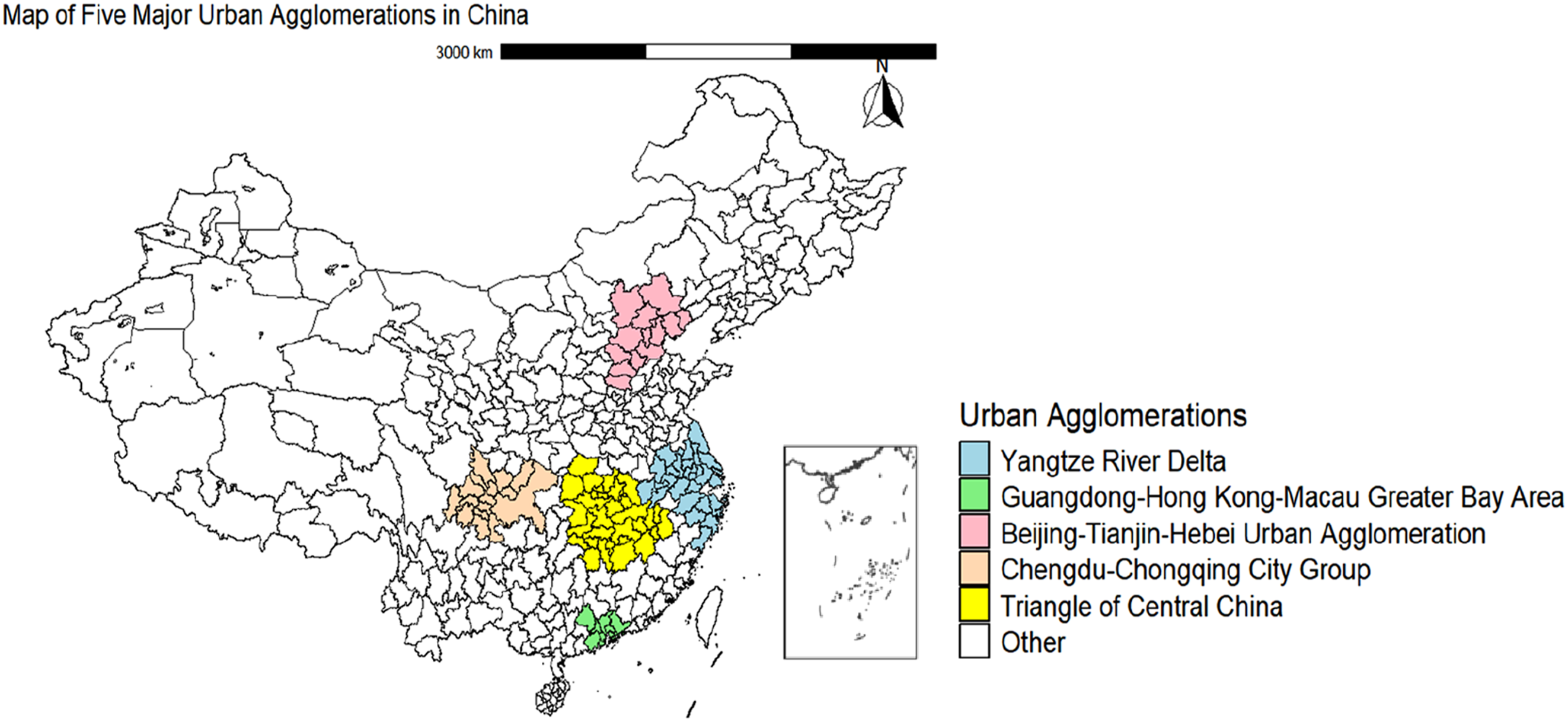
Definition and descriptive statistics of all variables
Models
Interaction Factor Selection based on GeoDetector
GeoDetector is a statistical tool designed to detect spatial heterogeneity, and it is not affected by multicollinearity. By comparing the spatial distributions of explanatory variables with those of the dependent variable, it assesses the extent to which their spatial patterns are associated. Moreover, using spatial overlay analysis, GeoDetector can assess the influence of multi-factor interactions on the spatial distribution of the dependent variable (Tu et al. 2024).
GeoDetector first stratifies the cities based on the selected independent variables. It creates 
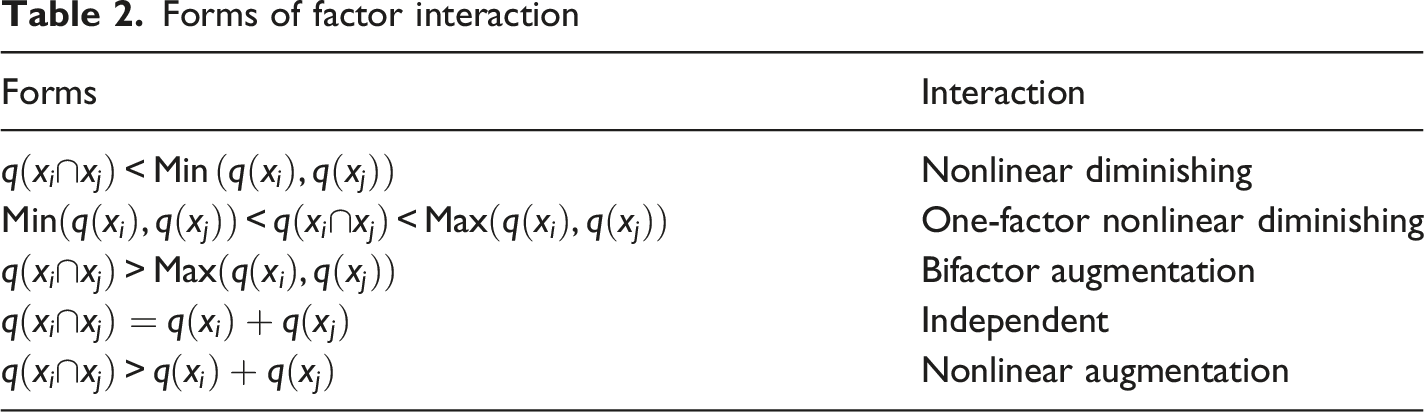
Forms of factor interaction
GTWR Model
Following the GeoDetector analysis, selected variables are incorporated into the model to analyse the spatio-temporal heterogeneous effects. Pioneered by Huang et al. (2010), the foundational concept of the GTWR model involves transforming panel data into cross-sectional data. It extends the GWR model by incorporating temporal interval distances within the kernel function to develop a spatio-temporal weight matrix. Then the parameter estimation and model selection proceed in line with the established practices of the GWR model. The GTWR model is given as
The parameters are estimated using a locally weighted least squares approach, where greater weights are given to observations closer to the analysed point. The estimated coefficient vector 

The Gaussian distance decay-based kernel function (Fotheringham et al. 2009) can be used to calculate 
The 

The bandwidth 

Drawing on Huang et al. (2010), the parameter
MGTWR Model
Like the GTWR model, the MGTWR model also requires the specification of a kernel function during regression. In this study, we continue to adopt the Gaussian distance decay-based kernel function proposed by Fotheringham et al. (2009), as shown in equations (11) and (12). However, the MGTWR model extends GTWR model by allowing variable-specific spatial and temporal bandwidths, accommodating the possibility that different explanatory factors operate at distinct spatial and temporal scales. The MGTWR model is specified as
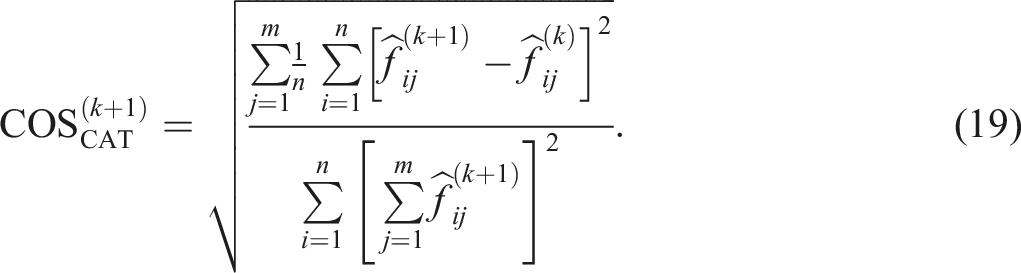
The parameters are estimated using the back-fitting algorithm, which estimates the unknown term individually, under the assumption that all other terms are known. It involves the following four steps. Step 1: The algorithm begins by assigning initial surfaces to the intercept and each explanatory variable, namely Step 2: Define a maximum iteration limit Step 3: At iteration Step 4: After each sweep, if



Interaction-based GTNNWR Framework
Motivated by Du et al. (2020) and Wu et al. (2021), this study employs the GTNNWR model to address the limitations of GTWR and MGTWR models, particularly their reliance on predefined kernel functions and fixed functional forms for spatio-temporal weighting. In settings where spatial and temporal dependence may evolve nonlinearly, such restrictions can limit the representation of heterogeneous decay patterns.
We first conduct a Spatio-Temporal Weighted Neural Network (STWNN) to calculate non-stationary weights. STWNN learns distance-weight mappings directly from the data, thereby reducing the underfitting risk associated with predefined kernel functions in the construction of the spatial weight matrix in equation (11). The weight matrix of the STWNN method is provided as
Second, equation (12) only considers the linear combination of spatial and temporal distance. We employ a Spatio-Temporal Proximity Neural Network (STPNN) to account for nonlinear spatio-temporal dependence and generate the corresponding spatio-temporal proximity 
By combining STWNN with STPNN, a spatio-temporal weight matrix for arbitrary points across time and space is
Since the ordinary least squares (OLS) coefficients capture the global average relationship in the study region, spatial non-stationarity can be viewed as the spatial variation of this average relationship (Du et al. 2020). The GTNNWR model can be formed as
The GTNNWR model transforms spatio-temporal relationships among observations into data-driven proximity measures and adaptive weights, allowing nonlinear distance and time effects, as well as non-stationary weighting structures, to be learned directly from the data (Qi et al. 2023; Wu et al. 2021). Figure 2 outlines the estimation process for GTNNWR model, where the red box indicates STPNN and the green box denotes STWNN. All STPNNs in equation (22) are assumed to share the same network structure and parameters. In this study, interaction effects identified by GeoDetector are incorporated into the GTNNWR model estimation, referred to as interaction-based GTNNWR (IGTNNWR) framework, thereby enabling the analysis of multifactor interactions alongside spatio-temporal heterogeneity. The workflow of this framework is also illustrated in Figure 2. The estimation process for the GTNNWR model and the workflow of the IGTNNWR framework.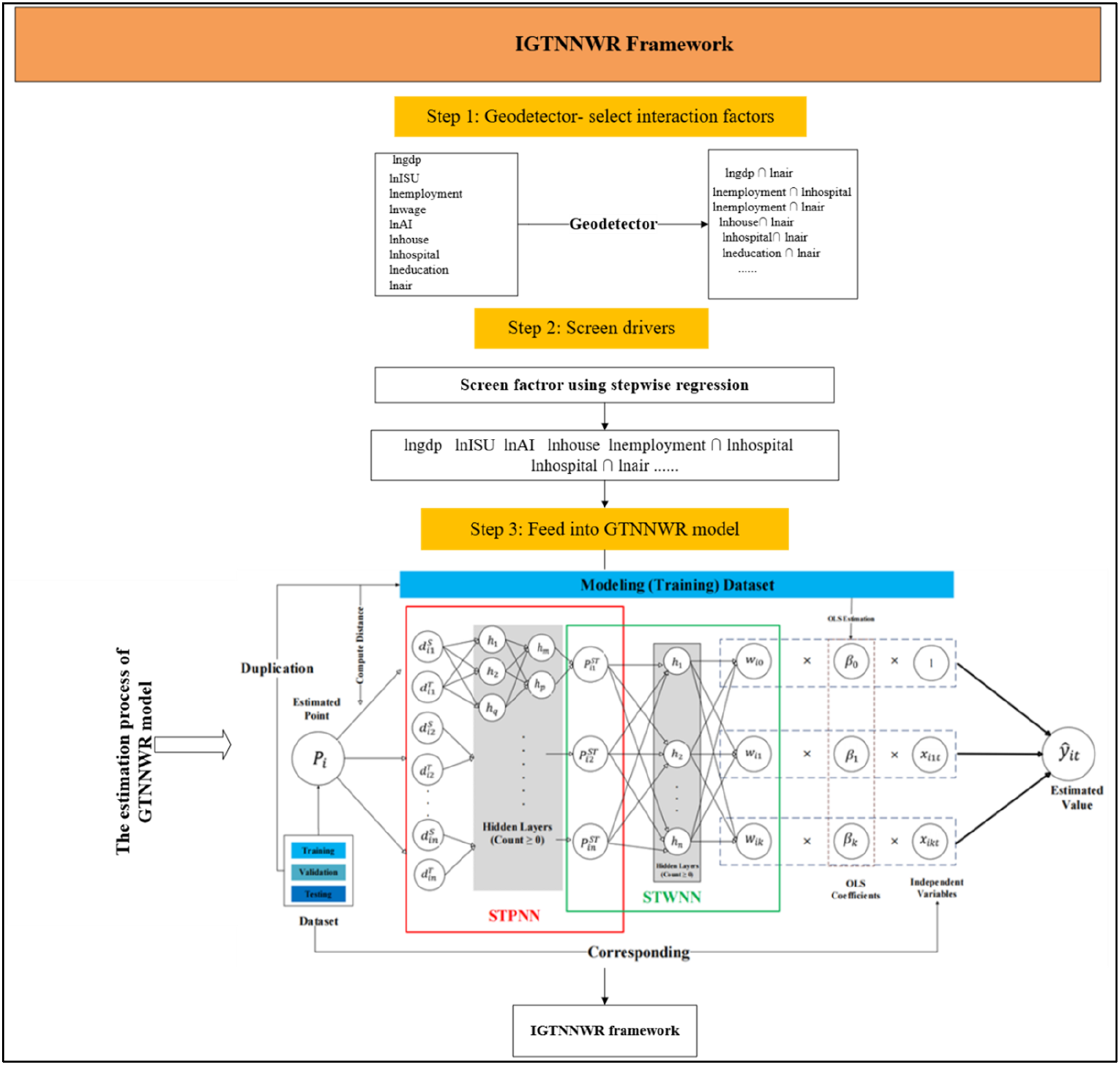
The representation capacity of the GTNNWR model depends on the learning capacity of STPNN and STWNN, which are integrated into a deep neural network with multiple hidden layers. Firstly, STPNN takes the spatial and temporal distances between pairs of observation points as inputs and adopts a three-layer architecture. Following robust parameter initialisation, it performs a fully connected linear mapping, applies batch normalisation (Ioffe and Szegedy 2015), and then introduces activation via the parametric rectified linear unit (PReLU) (He et al. 2015). During training, dropout is used for regularisation (Srivastava et al. 2014). The final output of STPNN is a single spatio-temporal proximity value. Secondly, STWNN takes proximity vectors from multiple neighbourhoods as high-dimensional inputs and processes them through multiple fully connected layers. Each layer successively applies linear mappings, batch normalisation, PReLU activation, and dropout, progressively refining the feature representation to capture complex and multiscale spatio-temporal dependencies. The final output layer produces a
These coefficient-specific weight outputs vary across locations and periods, thereby allowing the influence of each determinant to flexibly adjust over space and time. Unlike the MGTWR model, GTNNWR model does not provide explicit and directly quantifiable bandwidths for each variable, so scale interpretation is less direct. Its principal advantage instead lies in learning spatio-temporal weighting structures from the data rather than imposing a fixed kernel form. This data-driven flexibility makes the GTNNWR model particularly suitable for settings in which factor effects may decay nonlinearly and vary continuously over space and time.
The implementation process of the GTNNWR model is illustrated in Figure 3. First, the experimental data are randomly divided into two subsets: training data (including validation data) and testing data. To prevent overfitting, a 10-fold cross-validation procedure is employed for model estimation. The training data are split into 10 smaller subsets. In each iteration, 9 folds are used to train the model, while the remaining fold is used to validate the resulting model, repeating this process 10 times. After obtaining the optimal model parameters through cross-validation, the model’s performance is finally evaluated on the test data. The implementation process of the GTNNWR model.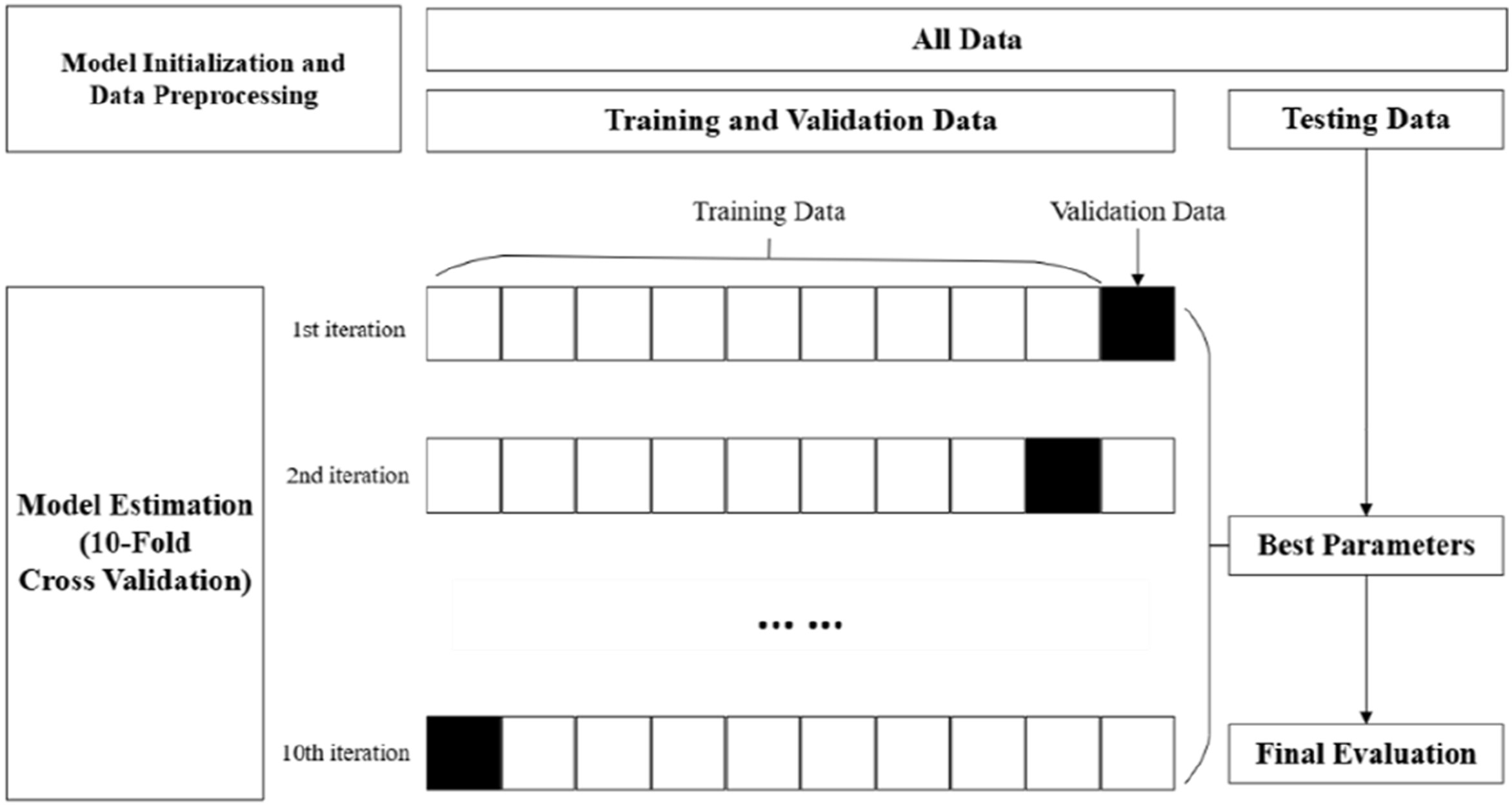
Results and Discussion
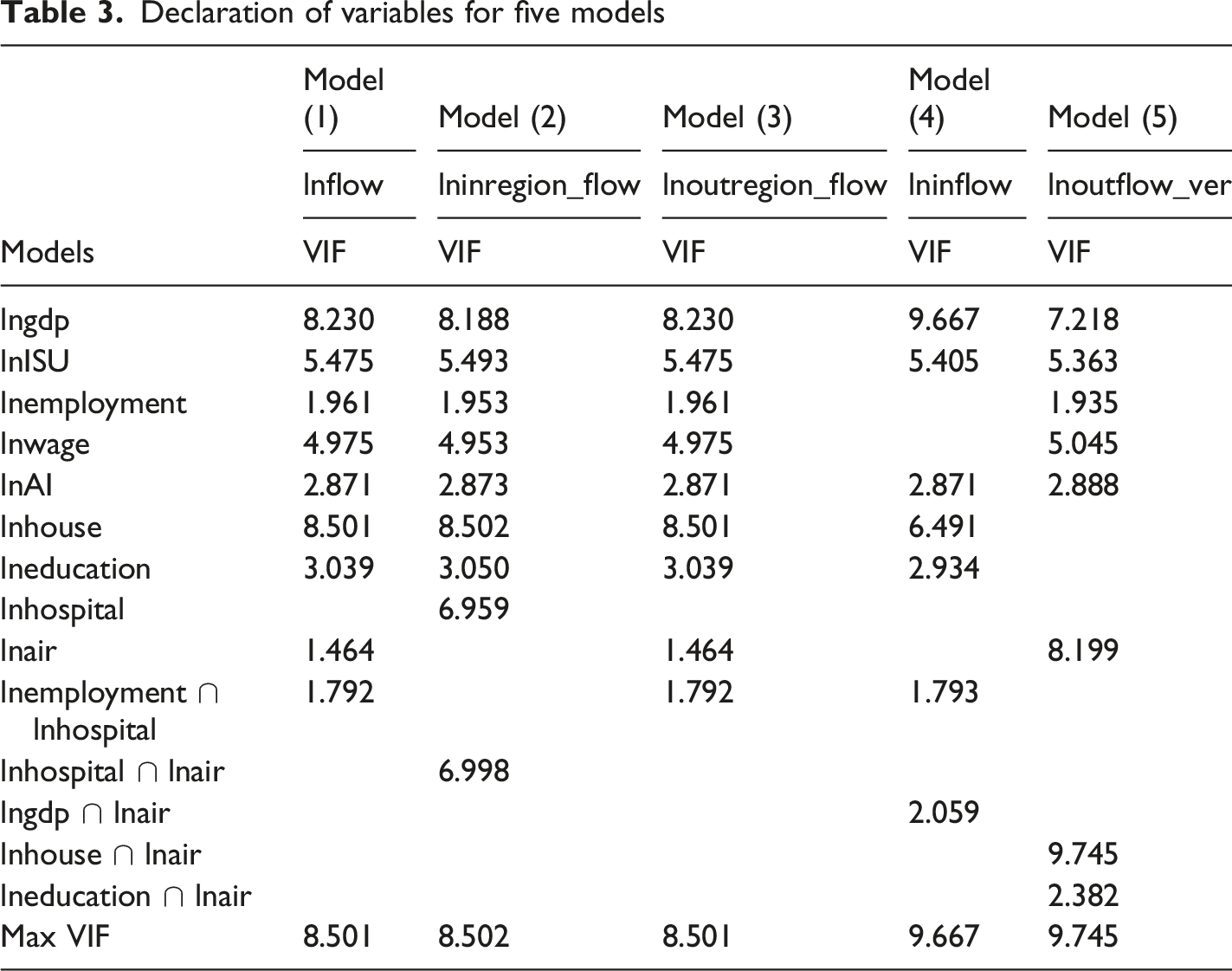
This study involves five models, with dependent variables as follows. Model (1) total digital talent flow (lnflow), Model (2) digital talent flow within urban agglomerations (lninregion_flow), Model (3) cross-urban agglomeration digital talent flow (lnoutregion_flow), Model (4) digital talent inflow (lninflow), and Model (5) digital talent outflow (lnoutflow_ver).
GeoDetector Analysis
Given the extensive 20-year span from 2003 to 2022, including data for every year might yield redundant information. We select the representative years 2003, 2008, 2013, 2018, and 2022 for GeoDetector analysis, and apply the natural breakpoint method to classify the data into three distinct windows.
Tables 6, 7, 8, 9 and 10 in Appendix 2 present the q values for the GeoDetector factor interactions for Models (1) to (5). In conjunction with the statements in Table 2, the results from GeoDetector indicate that factor interactions are either bidirectional or nonlinearly enhanced. It only displays the results of the two variable nonlinear enhancement in Tables 6 to 10 in Appendix 2. The italicised values indicate interaction effects with nonlinear enhancement that persist for four or more representative years, and these terms are retained in the subsequent models. It is observed that the nonlinear enhancement interactions between factors primarily occur between lnhospital or lnair and other macro- or meso-level variables. The urban healthcare conditions and air quality play a crucial role in talent mobility decisions.
Results of Screening Talent Mobility Drivers
Declaration of variables for five models
Comparison and Selection of Models
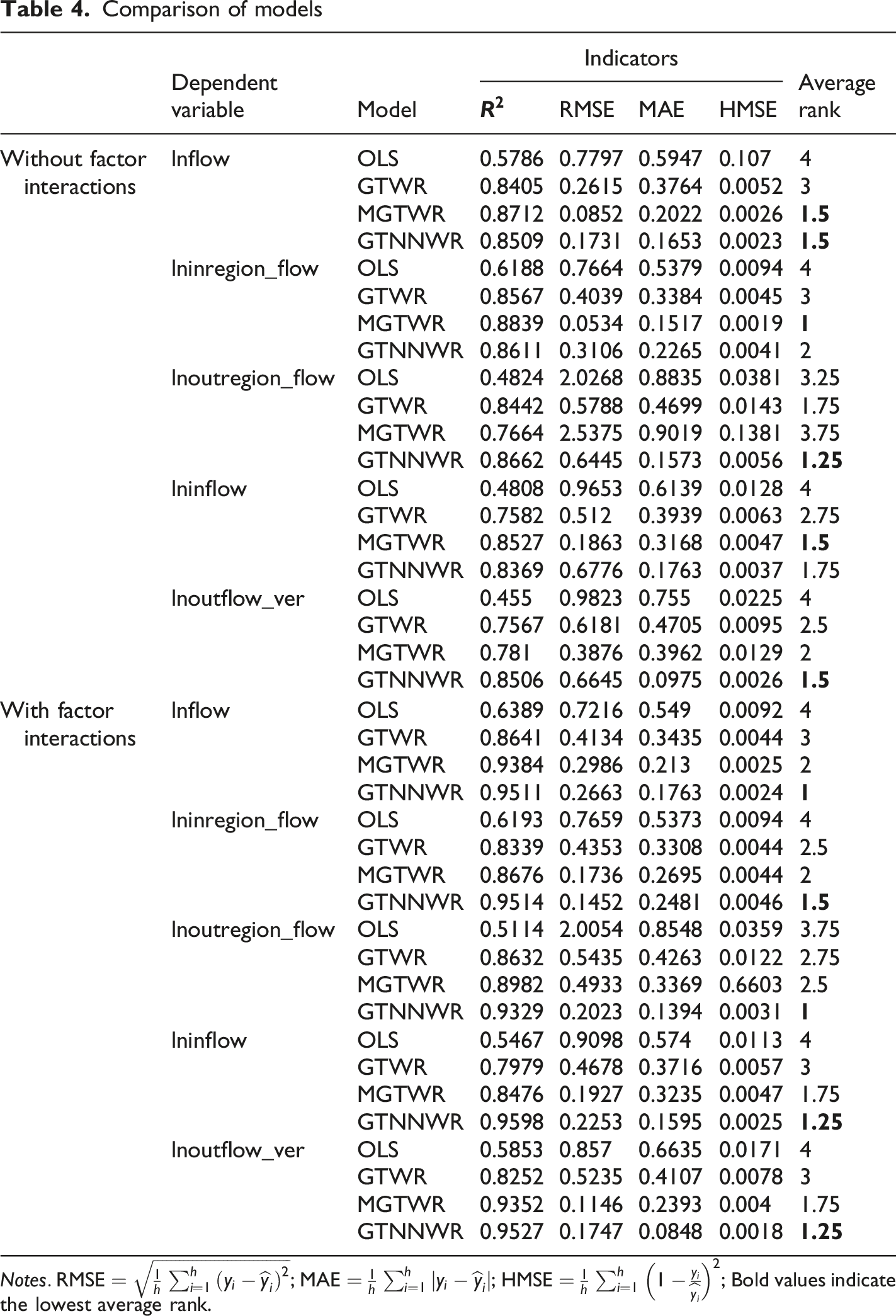
This study compares OLS, GTWR, MGTWR, and GTNNWR models under specifications with and without interaction factors. Since the empirical objective is to interpret the spatio-temporal heterogeneity of factors influencing digital talent mobility, model assessment considers both empirical performance and the capacity of each specification to represent spatio-temporal non-stationarity and interpretable local coefficient variation (Xu et al. 2025).
The OLS model is used as a global benchmark because it assumes spatially and temporally constant relationships. The GTWR and MGTWR models are included to assess whether kernel-based spatio-temporal specifications improve the representation of local heterogeneity. The GTNNWR model is further considered because its data-driven weighting structure allows greater flexibility in modelling complex and potentially nonlinear spatio-temporal variation.
For the GTWR and MGTWR models, the adaptive Gaussian kernel is applied. For the GTNNWR model, this study randomly divides the dataset into training data (85 percent) and testing data (15 percent) for model estimation. A 10-fold cross-validation procedure on the training set optimises the model parameters, and the testing set is used to assess out-of-sample fit. The loss function for the GTNNWR model is the mean squared error (MSE). Parameter optimisation for the neural network is performed using the mini-batch stochastic gradient descent algorithm. A simple grid search strategy proposed by Du et al. (2020) is used to determine the number of hidden-layer neurons. The GTWR, MGTWR, and GTNNWR estimations are implemented in Python 3.12.
Comparison of models
Notes
Table 4 shows that the spatio-temporal specifications generally improve upon the OLS benchmark across the five dependent variables. It suggests that digital talent mobility is not adequately captured by global average relationships. The inclusion of interaction factors also improves model fit in most cases, indicating that the interaction structures identified by GeoDetector have empirical relevance. Within this comparative setting, the GTNNWR model provides stable empirical results, especially after interaction terms are introduced. This pattern is consistent with its flexible weighting structure and supports its use in modelling nonlinear and nonstationary spatial processes. Similar evidence has been reported by Xu et al. (2025) and Yue et al. (2026).
To assess whether the candidate models provide substantively meaningful local variation, this study also examines the distributions of coefficient estimates. Table 11 in Appendix 2 reports the descriptive statistics for the coefficient estimates from the Interaction-based GTWR (IGTWR) and Interaction-based MGTWR (IMGTWR) frameworks. In both kernel-based models, coefficients vary substantially across observations and may take both positive and negative values. It indicates that spatio-temporal heterogeneity is an inherent feature of the data. At the same time, the overall directions of effects remain broadly comparable across specifications, which supports the stability of the main substantive relationships.
Descriptive statistics of the coefficients of IGTNNWR framework
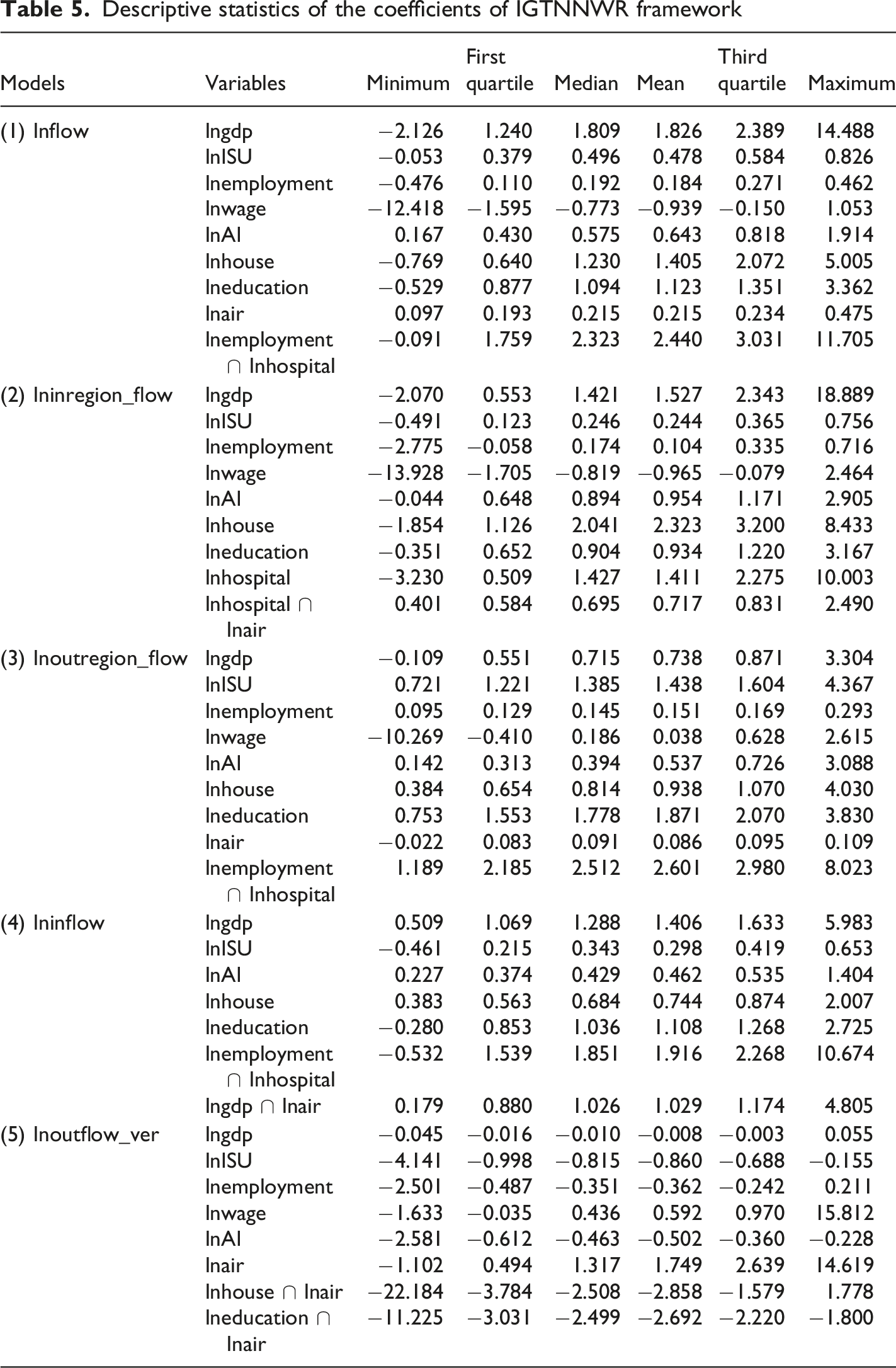
Overall, the IGTNNWR framework is used because it is well suited to the substantive analysis of spatio-temporal heterogeneity. It captures complex local variation, accommodates interaction-conditioned relationships, and provides coefficient distributions suitable for examining spatial, temporal, and interaction-related differences in the effects of influencing factors. The comparative results in Table 4 and the coefficient distributions in Table 5 and Table 11 in Appendix 2 jointly support its adequacy for the present empirical setting. Accordingly, IGTNNWR is used in the following analysis.
Results and Discussions of the IGTNNWR Framework
The coefficients of IGTNNWR estimation for all five models are presented in Figures 10−14 in Appendix 3. Across the five specifications, the estimated coefficients vary substantially by mobility type, city, and period, indicating marked context dependence in the factors associated with digital talent mobility. These patterns accord with the broader literature on talent migration and urban mobility, which has highlighted the combined roles of economic opportunity, wages, housing costs, public services, and environmental conditions (Gu et al. 2024; Jin et al. 2022; Wang 2022; Zhang et al. 2022; Zhou and Hui 2022).
For total digital talent mobility, the coefficient surfaces in Figure 10 in Appendix 3 indicate that economic growth remains an important driver, with stronger positive effects in Chengdu-Chongqing and Beijing-Tianjin-Hebei. Wage effects are generally negative for overall mobility and become more pronounced in several cities in recent years, particularly in Chengdu-Chongqing and the Greater Bay Area. Employment and AI-related innovation also contribute positively, although their direct effects are more moderate. These patterns are consistent with earlier findings that labour-market returns and innovation conditions remain central to talent migration and allocation (Gu et al. 2024; Huang et al. 2023; Liu et al. 2023; Wang 2022). Moreover, the interaction terms indicate that healthcare and air quality condition the strength of these economic and labour-market effects. The coefficient surfaces suggest that the association of these variables with total mobility is stronger where healthcare provision and environmental conditions are more favourable. These patterns are also consistent with recent evidence on the roles of public services and environmental quality in migration decisions (Kubiciel-Lodzinska and Maj 2021; Zhang et al. 2022).
A comparison of mobility within and across urban agglomerations further illustrates the heterogeneity. For intra-agglomeration mobility, the most salient coefficient patterns are associated with economic development, wage levels, and healthcare conditions, especially in Chengdu-Chongqing and the Yangtze River Delta (see Figure 11 in Appendix 3). For inter-agglomeration mobility, wage effects remain important, and the estimated patterns also point to a stronger role of the interaction of employment opportunities and healthcare quality (see Figure 12 in Appendix 3). It suggests that broader migration movements are associated with a wider combination of labour-market returns and public service conditions. Such variation across spatial scales is in line with earlier studies showing that migration drivers differ between local and broader destination choices and that opportunity-based and amenity-based mechanisms often operate jointly (Gu et al. 2020, 2021; Su et al. 2019).
The inflow model shows a similar combination of economic and amenity-related influences (see Figure 13 in Appendix 3). Employment opportunities and healthcare quality display comparatively strong positive associations with digital talent inflow, while economic development provides an important background condition for urban attractiveness. Meanwhile, the interaction between economic growth and air quality suggests that the positive association between economic development and inflow is weaker in areas with poor environmental conditions, particularly in Chengdu-Chongqing. This pattern accords with studies showing that urban amenities and environmental conditions affect both migration intentions and settlement decisions in China (Jin et al. 2022; Zhang et al. 2022, 2024). It serves as a significant warning to cities hoping to attract digital talent solely by boosting their economic output, highlighting that environmental and public service quality must improve in parallel.
For outflow, wage levels and air quality emerge as the most prominent factors (see Figure 14 in Appendix 3). However, air quality does not always function as a purely “negative factor”. Its influence on outflow can change as multiple factors interact and gradually strengthen over time across cities. On the one hand, digital talent seems to tolerate poor air quality, leading to weaker migration intentions. On the other hand, when air quality is combined with factors like housing prices or education levels, it significantly intensifies talent outflow. These patterns are supported by existing evidence that housing costs, education, and environmental quality jointly affect migration and residential decisions, especially among more skilled groups (Kubiciel-Lodzinska and Maj 2021; Zhang et al. 2022; Zhou and Hui 2022). It suggests that digital talent has a threshold for tolerating living conditions, and that when adverse factors accumulate, the probability of outflow behaviour increases.
Time Evolution of the Impact on Digital Talent Mobility
To reflect the temporal fluctuations of various factors, this study compares the time-series volatility of the estimated coefficients for each driving factor using a graphical representation (see Figure 4). Time evolution of the estimation coefficient of driving factors. (a) Model (1): lnflow, (b) Model (2): lninregion_flow, (c) Model (3): lnoutregion_flow, (d) Model (4): lninflow, (e) Model (5): lnoutflow_ver.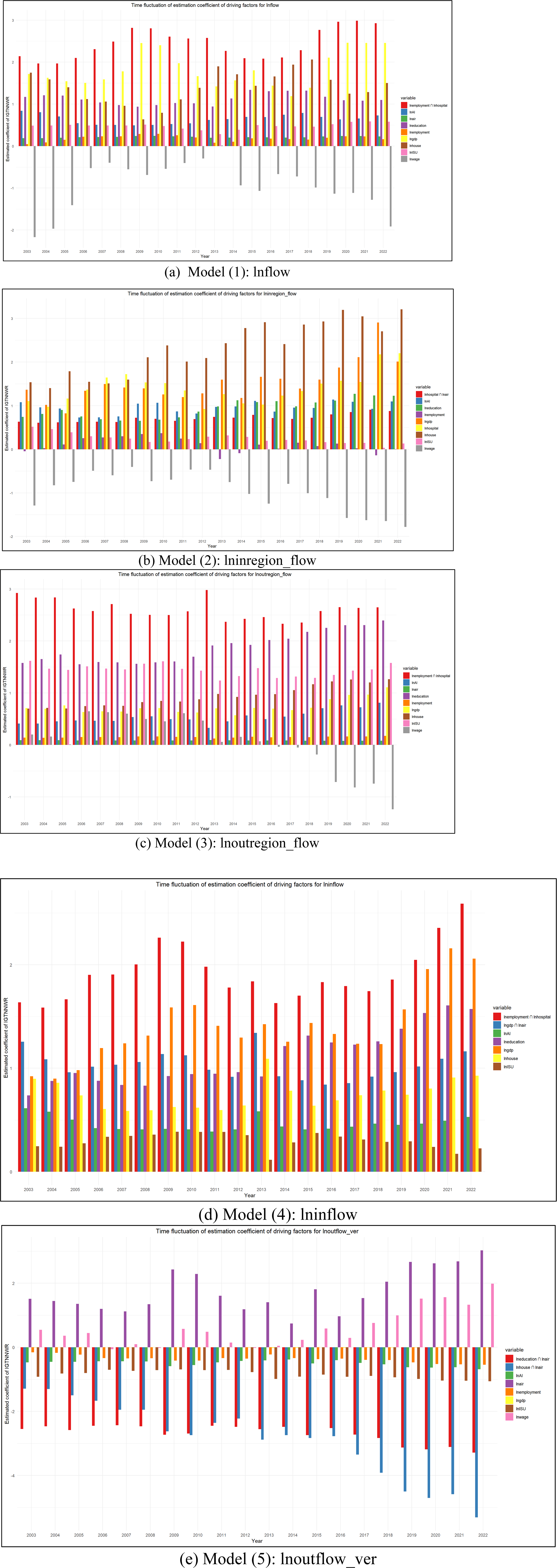
At the macro-level, both lngdp and lnISU remain positively associated with digital talent mobility, but their temporal patterns differ. The coefficient of economic growth is more strongly related to intra-agglomeration mobility and talent inflow, and its trajectory shows more evident cyclical fluctuation over time. By contrast, the coefficient of industrial restructuring is more stable and is more closely associated with cross-agglomeration mobility. In both cases, the corresponding coefficients for outflow remain comparatively limited. These differences are consistent with earlier studies by Wang et al. (2022) and Gu et al. (2024).
At the meso-level, lnAI shows a positive and relatively stable association with most forms of digital talent mobility over time. The coefficient of employment remains comparatively small and is occasionally negative for intra-agglomeration mobility in some years, indicating a weaker and less stable effect than that of other meso-level variables. Wage effects have become increasingly negative in recent years, with stronger associations for intra-agglomeration mobility than for cross-agglomeration mobility. The outflow model shows a more pronounced wage effect in the later period, suggesting that wage differentials become increasingly relevant to local retention. These temporal patterns are broadly in line with evidence that innovation conditions and wage structures are important, but not temporally uniform, components of talent allocation (Huang et al. 2023; Liu et al. 2023; Wang 2022).
At the micro-level, the coefficients for education and housing remain relatively stable over time, indicating that these factors provide stable background conditions for mobility decisions. However, the interaction terms related to healthcare and air quality display stronger temporal variation. The healthcare interaction effects remain positive and relatively stable, especially in cross-agglomeration mobility and inflow, where they amplify the coefficients of labour-market variables over time. Air-quality-related interaction terms become more pronounced in later years, particularly in combination with economic growth, housing, and education. The findings suggest that amenity conditions increasingly shape the time profile of digital talent mobility through their interaction with other urban characteristics. Such temporal strengthening is accordance with the growing importance of environmental quality, housing costs, and public services in migration and settlement decisions (Jin et al. 2022; Zhang et al. 2022; Zhou and Hui 2022).
Spatial Difference of the Interaction Effect on Digital Talent Mobility
Using the annual-average estimated results from the IGTNNWR framework, this study visualises the nationwide distribution of coefficients for interaction effects, as shown in Figures 5−9. Spatial difference of the interaction effect on lnflow. (a) The average impact coefficient of lnemployment, (b) The average impact coefficient of (lnemployment ∩ lnhospital). Spatial difference of the interaction effect on lninregion_flow. (a) The average impact coefficient of lnhospital, (b) The average impact coefficient of (lnhospital ∩ lnair). Spatial difference of the interaction effect on lnoutregion_flow. (a) The average impact coefficient of lnemployment, (b) The average impact coefficient of (lnemployment ∩ lnhospital). Spatial difference of the interaction effect on lninflow. (a) The average impact coefficient of lngdp, (b) The average impact coefficient of (lngdp ∩ lnair), (c) The average impact coefficient of (lnemployment ∩ lnhospital). Spatial difference of the interaction effect on lnoutflow_ver. (a) The average impact coefficient of (lneducation ∩ lnair), (b) The average impact coefficient of (lnhouse ∩ lnair), (c) The average impact coefficient of lnair.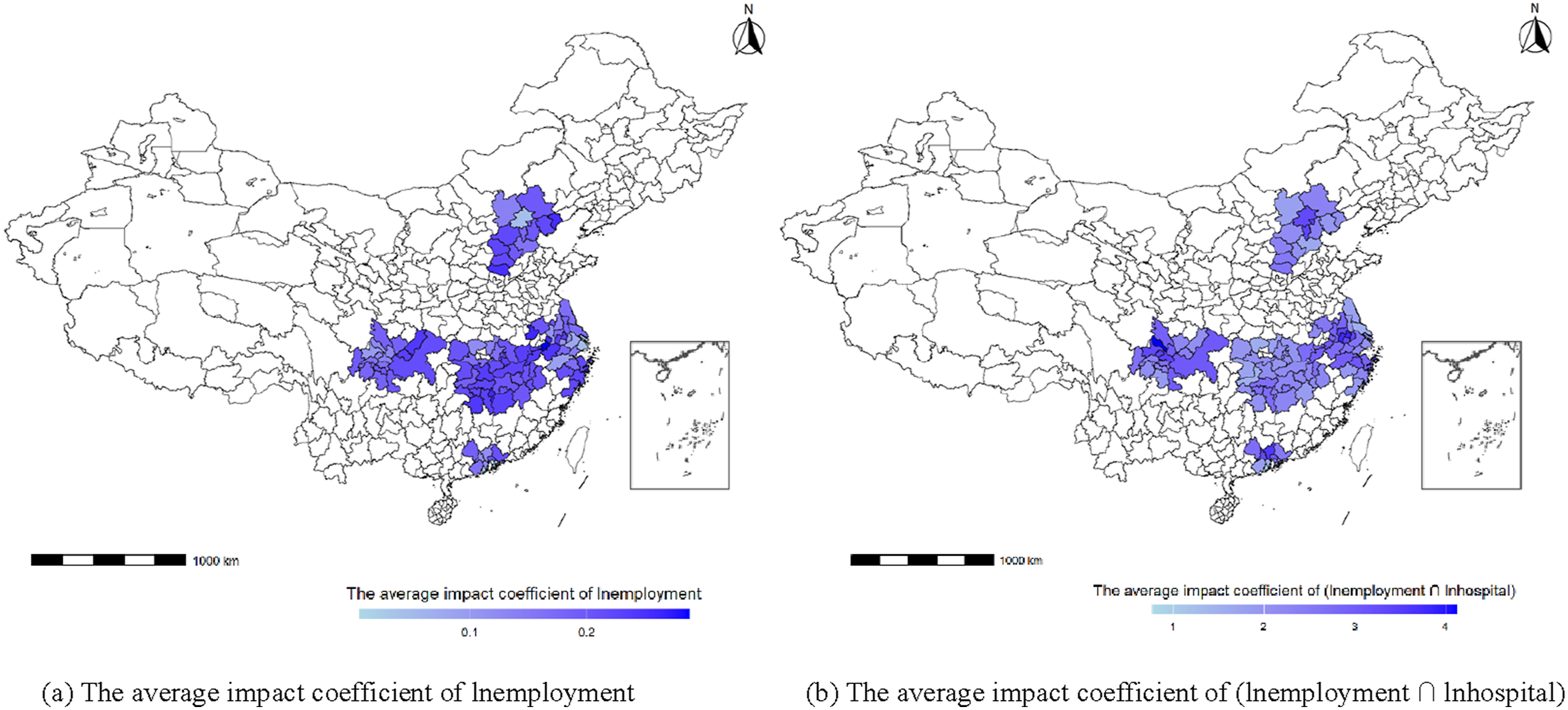
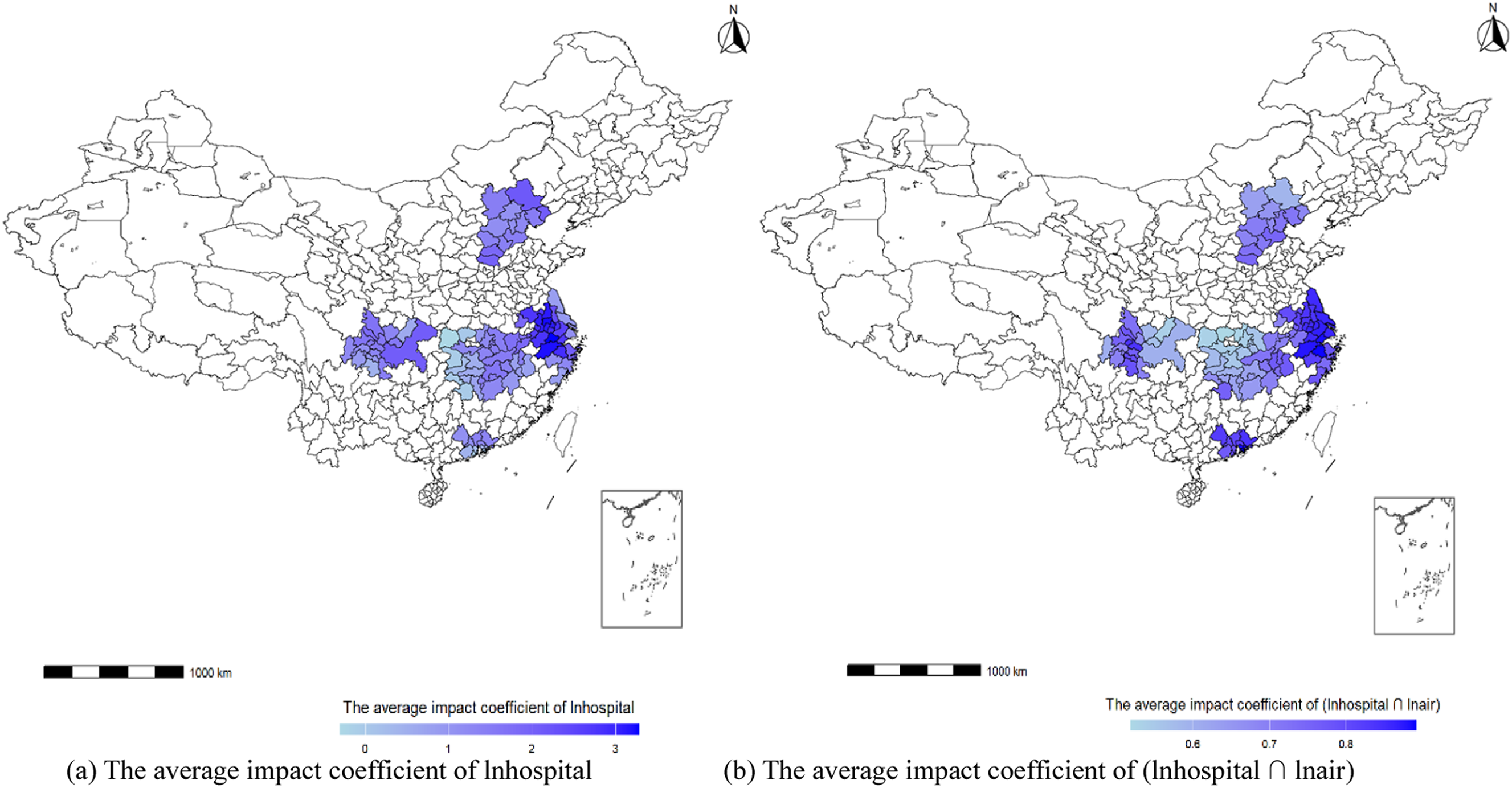
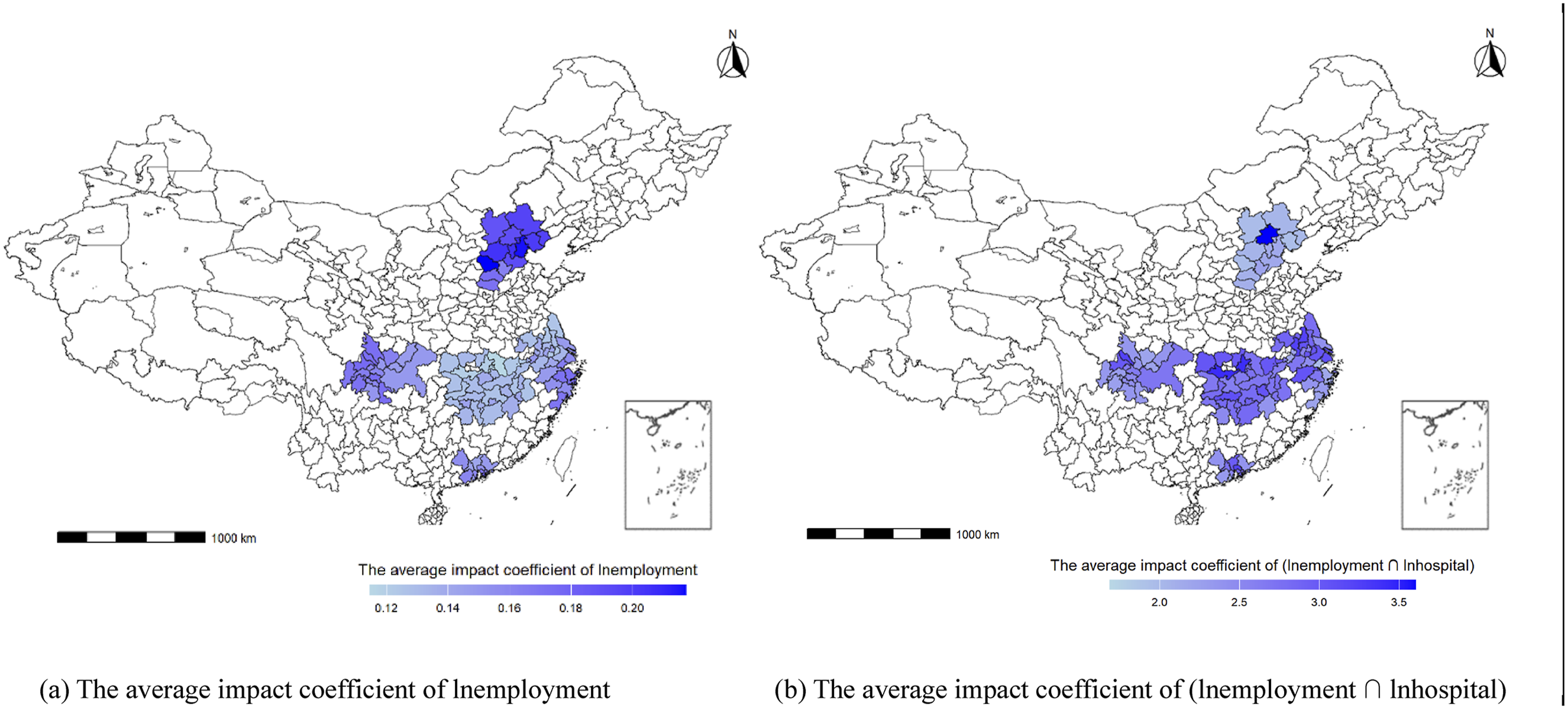
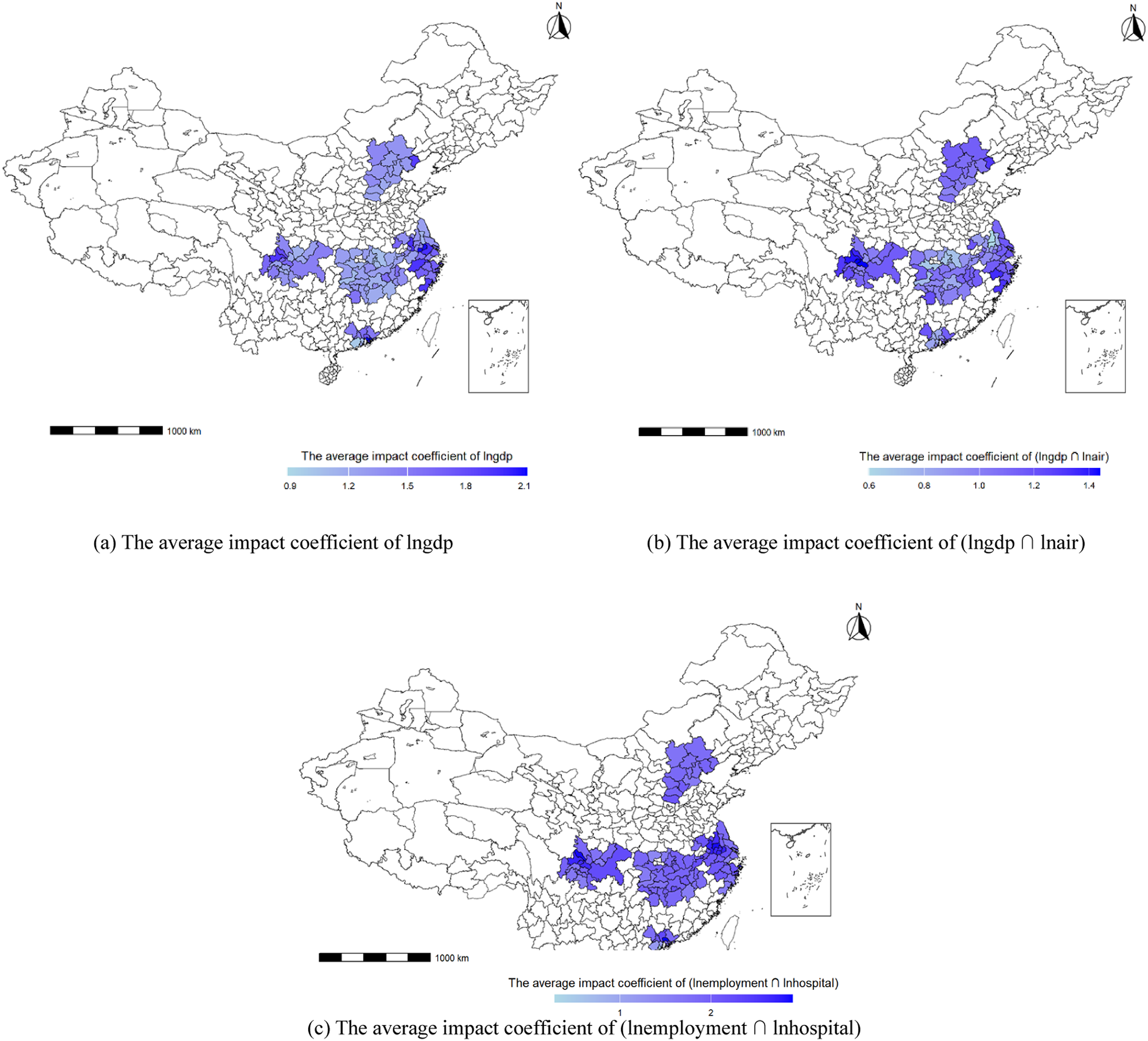
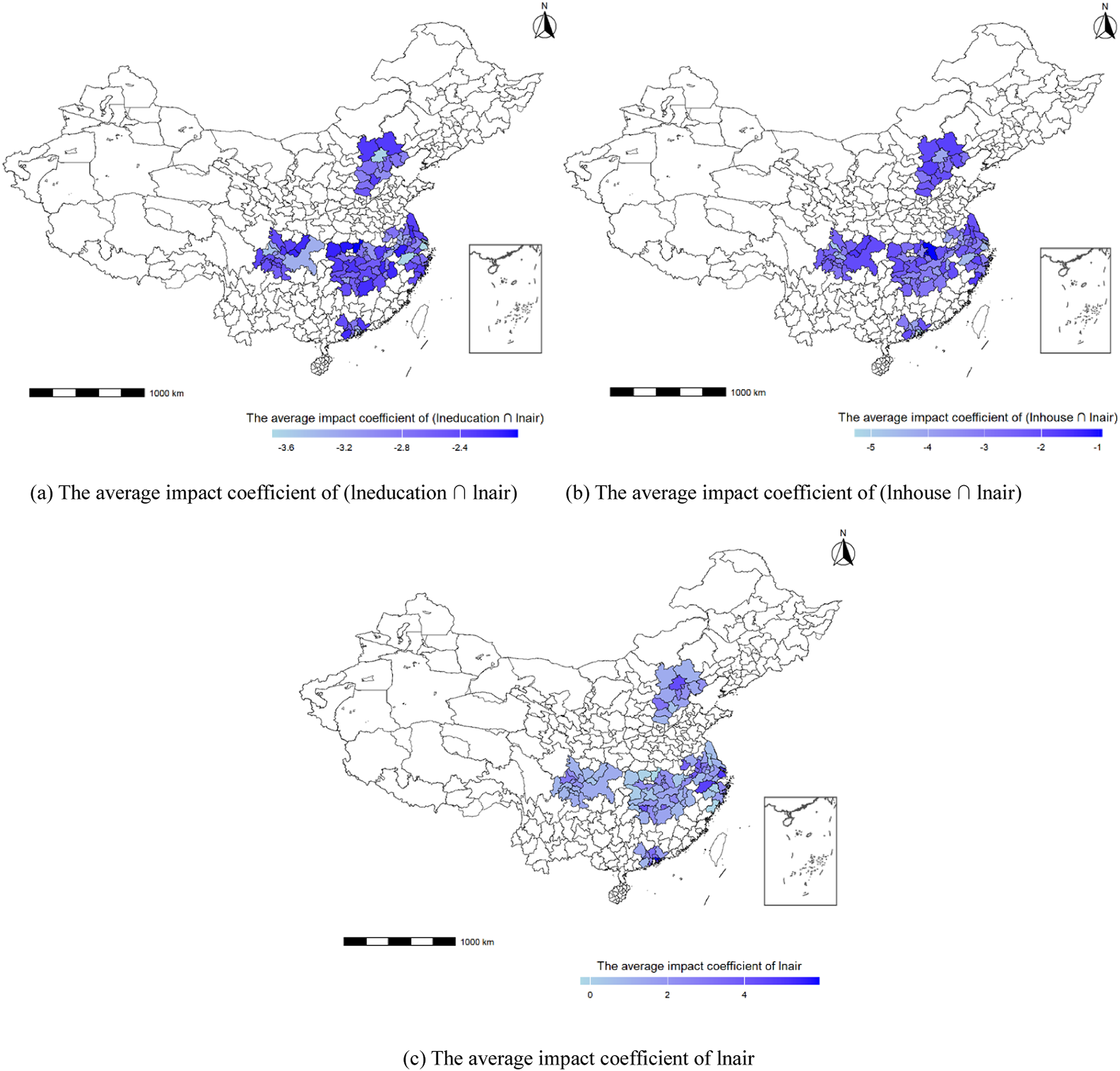
Figure 5 shows the spatial patterns of total digital talent mobility. The coefficient surface for employment indicates stronger effects in the peripheral areas of the major urban agglomerations, especially around the Triangle of Central China (see Figure 5(a)). By contrast, the interaction between employment and healthcare is more concentrated in core cities such as Guangzhou, Beijing, Chongqing, and Shanghai (see Figure 5(b)). This contrast suggests a clear spatial differentiation in which labour-market conditions are more strongly associated with total mobility in peripheral locations, whereas the employment effect in core cities is more closely conditioned by public-service capacity. Such spatial differentiation is consistent with the uneven distribution of labour-market and service advantages across Chinese urban agglomerations (Fang and Yu 2017; Gu et al. 2020).
For mobility within urban agglomerations, the healthcare-related interactions occupy a more central position in the estimated spatial structure. Figure 6(a) shows that healthcare quality has a positive influence, with the most significant impact in the Yangtze River Delta, followed by the Beijing-Tianjin-Hebei, while the impact in the Triangle of Central China is weakest. Air quality issues have diminished the appeal of healthcare conditions, most pronounced in the Beijing-Tianjin-Hebei and Chengdu-Chongqing regions, while the Greater Bay Area remains largely unaffected (see Figure 6(b)). These findings align with Zhang et al. (2022), who show that environmental conditions and public services jointly influence migration-related choices in Chinese cities.
Figure 7 reports the spatial interaction patterns for cross-agglomeration mobility. The direct employment effect is strongest in Beijing-Tianjin-Hebei, followed by Chengdu-Chongqing and the Greater Bay Area, and weakest in the Triangle of Central China (see Figure 7(a)). Once healthcare is introduced through the interaction term, the spatial ordering changes substantially. In particular, the interaction effect is weaker in Beijing-Tianjin-Hebei than in several other agglomerations (see Figure 7(b)). It suggests that public-service conditions do not simply reinforce the existing employment hierarchy across regions, but they alter its spatial expression. The result is aligned with the view that broader migration decisions depend on a combination of labour-market and amenity conditions whose relative importance varies across space (Gu et al. 2021; Su et al. 2019).
Figure 8 displays the interaction effect of (lngdp∩lnair) and (lmemployment∩lnhospital) in the inflow of digital talent. The coefficient surface for economic growth is concentrated in core cities such as Guangzhou, Chengdu, and Nanjing, indicating a stronger positive association between local economic conditions and inflow in these locations (see Figure 8(a)). When air quality is incorporated, the interaction term follows a similar spatial pattern but with weaker coefficient values, indicating that environmental conditions attenuate the inflow-related effect of economic growth while preserving its core-city concentration (see Figure 8(b)). The interaction between employment and healthcare is more evenly distributed across cities, though stronger coefficients persist in several core urban areas (see Figure 8(c)). Hence, the spatial attractiveness of inflow depends not only on economic scale, but also on how labour-market and public-service conditions combine across different urban contexts (Jin et al. 2022; Zhang et al. 2024).
Finally, Figure 9 illustrates the impact of urban air quality, housing prices, and education levels on digital talent outflow. The results indicate that digital talent exhibits a certain level of tolerance toward air quality, as higher levels of air pollution correlate with a lower outflow of digital talent, a trend that is even more pronounced in core cities such as Beijing, Shenzhen, Guangzhou, Shanghai, and Chengdu (see Figure 9(c)). When considering the combined effects of housing prices and education levels, the outflow increases significantly, with core cities also experiencing the highest degree of talent loss (see Figure 9(a) and (b)). The result is consistent with existing evidence that housing, education, and environmental quality jointly shape residential adjustment and migration among more skilled groups (Zhang et al. 2022; Zhou and Hui 2022).
Conclusions and Policy Implications
This study examines the factors associated with digital talent mobility across Chinese urban agglomerations by combining GeoDetector with the GTNNWR model. The results show that digital talent mobility is shaped by macro-, meso-, and micro-level factors. These estimated effects vary across mobility types, cities, and periods, and are further conditioned by interaction structures.
Several empirical patterns can be identified. At the macro-level, economic growth in the Chengdu-Chongqing and Beijing-Tianjin-Hebei exerts a significant positive influence on attracting digital talent, though its effect fluctuates with macroeconomic cycles. The restructuring of industrial sectors provides a stable and long-term impetus for inter-urban talent mobility, yet remains insufficient to curb talent outflow. At the meso-level, the suppressive impact of salary levels on talent mobility has deepened over recent years, especially in the Chengdu-Chongqing and Greater Bay Area, where high wages help consolidate local talent and reduce outflow. While employment rates and corporate innovation have contributed modestly to talent inflows, their overall influence is comparatively limited. At the micro-level, findings indicate that in the core cities of the Yangtze River Delta and Greater Bay Area, housing prices and educational resources exert a lasting impact on digital talent decisions, whereas the quality of healthcare services and air quality significantly moderate the influence of economic growth, housing, and educational factors.
Existing research has shown that labour-market conditions, wages, public services, housing, and environmental quality all matter for migration and talent allocation in China (Gu et al. 2024; Jin et al. 2022; Wang 2022; Zhang et al. 2022; Zhou and Hui 2022). This study adds to the literature by showing that the estimated effects of these factors vary across mobility types, locations, and periods, and are reshaped by interaction structures over space and time. By combining regression with data-driven nonlinear weighting, the IGTNNWR framework can capture the complex spatio-temporal trade-offs and broader variation more flexibly than global models and more restrictive spatio-temporal specifications. It allows to model how familiar migration drivers are reconfigured under different space and time conditions.
However, the approach has clear limits. Although the neural-network-based weighting structure provides a flexible representation of spatio-temporal heterogeneity, it is less transparent than kernel-based regression models and lacks explicit variable-specific bandwidths. For research questions centred on direct scale interpretation, multiscale models such as the MGTWR model remain informative. Future research may therefore explore post hoc scale summaries derived from learned weight functions, benchmark them against multiscale specifications, and extend the analysis to finer temporal resolution where data permit.
Several policy implications follow from these findings. First, talent policy should be differentiated by mobility type. For intra-agglomeration mobility and talent inflow, priority should be given to expanding digital employment, strengthening enterprise innovation demand, and improving local job matching. For cross-agglomeration mobility, the focus should shift to industrial coordination, cross-city recruitment channels, and inter-city placement mechanisms for digital talent in upgrading sectors. Second, wage policy appears to function more strongly as a retention mechanism than as a general attraction instrument, suggesting that coordination between core and peripheral cities is needed to avoid excessive local retention driven by wage differentials. Third, amenity-related conditions should be treated as integral components of talent policy rather than as secondary background factors. The estimated interaction effects indicate that healthcare provision, air quality, housing costs, and education resources jointly shape mobility alongside economic and labour-market conditions. Policies aimed at attracting and retaining digital talent should therefore combine employment and industrial measures with improvements in public services, environmental quality, and living costs.
Footnotes

Funding
The authors disclosed receipt of the following financial support for the research, authorship, and/or publication of this article: This work was supported by the Guangdong University of Science and Technology (GKY-2022KYQNW-18).
Declaration of Conflicting Interests
The authors declared no potential conflicts of interest with respect to the research, authorship, and/or publication of this article.