






Abstract
Citizen engagement in local decision-making processes is improving, especially with respect to environmental issues. This research evaluates environmental participation in three jurisdictions. We attempt to explain the success of participation by looking at the benefits of engagement. In all three cases, a significant degree of collaboration between local governments and not-for-profit organizations was present. Institutional commitment to engage the public was evident in the case of Newark, New Jersey, while Tonawanda, New York, delegated citizen engagement functions to the local environmental justice group. Even in less democratic regimes like Bishkek, Kyrgyzstan, active environmental participation at local levels was found to be effective.
Environmental Participation
Citizen participation in environmental matters is indispensable. Moreover, environmental participation is legally encouraged both domestically and internationally. The 1998 International Aarhus Convention, for example, states that citizens have the right to participate in a range of decisions where there may be an environmental impact (United Nations Economic Commission for Europe (UNECE) 1998). The Aarhus Convention also highlights the special role played by nongovernmental organizations to promote involvement. Principle 10 of the Rio Declaration on Environment and Development reiterates, “environmental issues are best handled with the participation of all concerned citizens” (United Nations 1992, 5). Domestically, the 1994 Executive Order 12898 also stresses the importance of citizen engagement.
Despite these legal requirements, citizen engagement is not systematically pursued, often due to the fear of misunderstanding, lack of trust, concerns over efficiency, and quality of decisions when engagement is used (King, Feltey, and Susel 1998; Frisby and Bowman 1996; Thomas 1990). But, when implemented correctly, participation may result in numerous benefits. In 2004, Irvin and Stansbury, examined participation in the watershed planning in the city of Omaha and constructed a framework of costs and benefits to explain the success and failure of participation. We use Irvin and Stansbury’s framework to evaluate participation in three different jurisdictions. First, we provide a brief summary of existing citizen participation studies. Second, the case of the Office of Sustainability in Newark, New Jersey, and its role in building trust with the community will be presented. Third, we evaluate the benefits of engagement in strengthening activist citizenship in Tonawanda, New York. Fourth, we will present a case of citizen participation in Bishkek, Kyrgyzstan, which resulted in a strategic alliance between community members and the local legislative council. The article concludes with an analysis of the advantages of citizen involvement in each jurisdiction and lessons learned.
Studies of Citizen Participation Dilemmas
Participation initiatives have emerged around environmental policy largely due to the increasing awareness of the correlation between health conditions, the environment, and the impact of industrial development on the lives of citizens (Dalton 2005). Collaborative efforts are often utilized to address complex environmental challenges (Koehler and Koontz 2008). In general, “the ideals of public participation have been central to the environmental movement” (Bingham, Nabatchi, and O’Leary 2005, 554). Studies, however, note difficulties in encouraging and sustaining citizen involvement, particularly at the local level. Barriers to participation, in general, include diverse factors, not limited to the perception that citizens are often apathetic, and lack trust in public officials (King, Feltey, and Susel 1998; Frisby and Bowman 1996; Kathlene and Martin 1991; Baker, Addams, and Davis 2005; Roberts 1997; Yang and Callahan 2007). These barriers, however, can be overcome when involvement is promoted collaboratively and when the process is beneficial both to citizens and to administrators. Irvin and Stansbury (2004) identified a comprehensive list of the benefits and shortcomings of citizen involvement in environmental decision-making processes (Table 1). Engagement benefits participants and public administrators differently. For example, a participatory process may help government to restore trust, build strategic alliances, and gain legitimacy. Concurrently, citizens can learn, inform the government of desires and needs, and gain skills for activist citizenship. Some shortcomings of engagement include the “possibility of a bad decision that is politically impossible to ignore” (Irvin and Stansbury 2004, 58). A participation process is useless for participants if their decisions and/or recommendations are not taken seriously. Irvin and Stanbury (2004) also note that citizens may develop more hostility toward government officials when the participation initiative is seen as disingenuous. Furthermore, local governments may be perceived as being wasteful of financial and human resources via the planning and implementation of engagement initiatives, which ultimately resulted in no citizen participation (Irvin and Stansbury 2004). Table 1 presents a detailed list of possible benefits and shortcomings of participation identified by Irvin and Stansbury (2004).
Advantages and Disadvantages of Citizen Participation in the Decision Process.
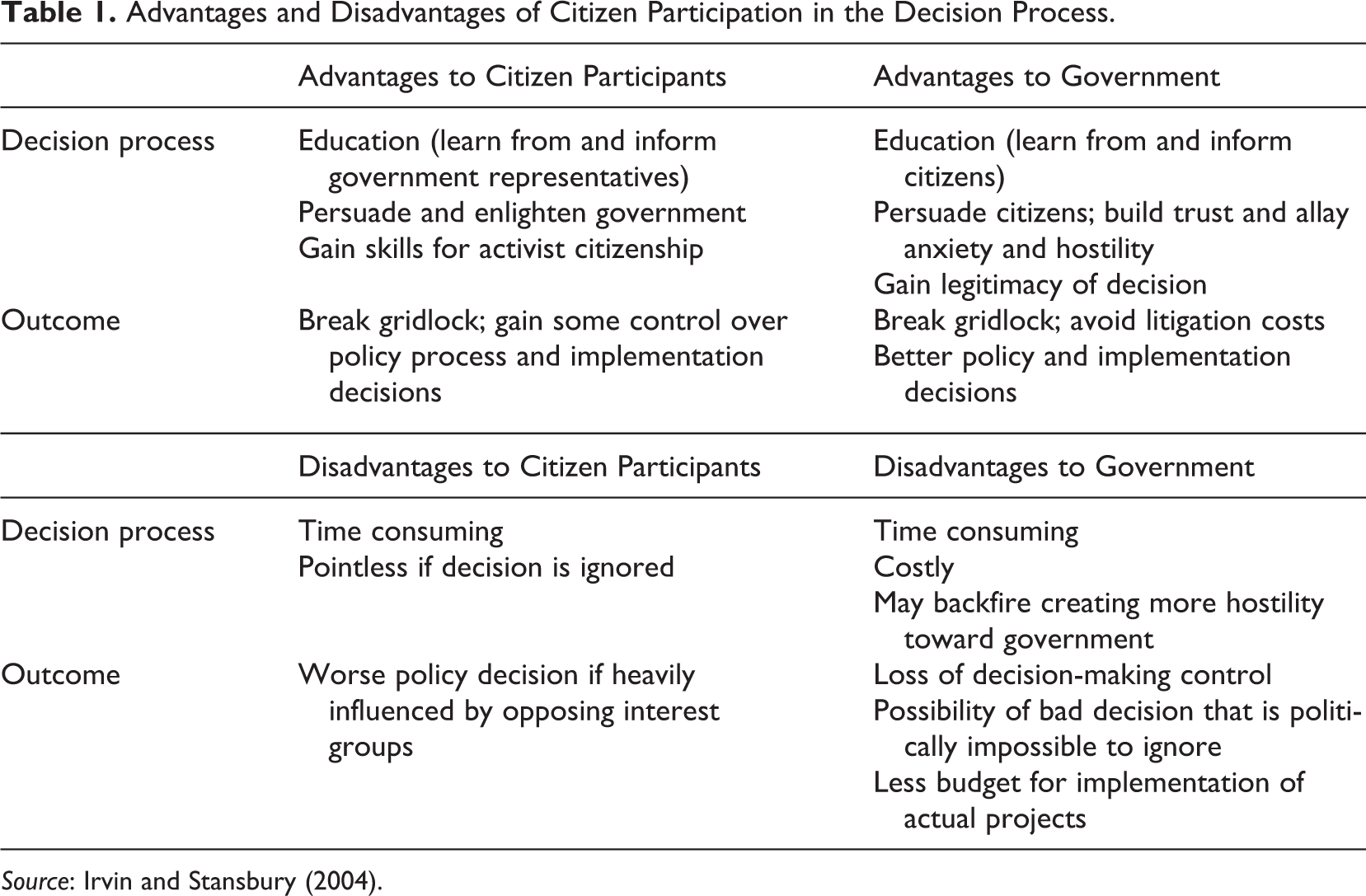
Source: Irvin and Stansbury (2004).
This project uses selected concepts from Irvin and Stansbury’s (2004) framework to identify the benefits of environmental participation in Newark, New Jersey; Tonawanda, New York; and Bishkek, Kyrgyzstan. The focus here is on participation benefits, rather than shortcomings, because the three cases examined serve as examples of effective environmental involvement, which can be assessed by understanding the benefits attained through the process.
Building Partnership through the Office of Sustainability in Newark, New Jersey
Newark is one of the most industrial, densely populated cities in New Jersey. More than 277,000 people reside in the city, with over two-thirds of the population being foreign born and a third of residents living below the federal poverty level (U.S. Census Bureau 2010). In addition to the socioeconomic challenges of the city, residents in Newark face several environmental problems including those generated by its transportation amenities, incinerators, and superfund sites. 1 As a result, Newark has become conducive to the emergence of environmental activism. For a long time, the local environmental groups and the municipal authorities did not have a systematic channel for communication.
The former Mayor, Cory Booker, promoted environmental sustainability through the establishment of the Office of Sustainability. The Office currently oversees environmental issues and works with residents and local not-for-profits in promoting environmental oversight. Participatory approaches in decision making that Office used include coproduction and the Newark Environmental Commission. Coproduction refers to the sharing of information from residents to city administrators. 2 For example, residents are asked to report through a hotline any concerns or evidence related to truck idling and other harmful activities occurring within the city’s limits (The City of Newark 2013). The financial benefits of coproduction are evident for the city because it decreases monitoring costs. Other coproduction activities include volunteer cleanup events and community gardens.
A second set of engagement techniques used by the Office relates to the institutional representation of community groups in the board. The Newark Environmental Commission was created within the Office. With members consisting of Newark residents, the Commission makes recommendations, oversees environmental policies and practices, and advises the Mayor and Council on environmental issues. 3 Having a semipermanent community representation is seen as an efficient strategy to promote a democratic and participatory decision-making process. It allowed adopting decisions without numerous and costly consultations on individual environmental matters.
The case of Newark is important as it demonstrates the formulation of an official institutional municipal structure, which addresses environmental challenges through a systematic engagement and partnership platform. Employing Irvin and Stansbury’s framework, we note that the citizen involvement tools used by the Office of Sustainability enabled effective decision making and building partnership with the community with limited costs. The inclusion of environmental community leaders within a municipal structure helped to ensure that concerned groups gained access to control over policy processes and implementation decisions, which Irvin and Stansbury consider beneficial for the community. In sum, the creation of the Office with a citizen participation foci lead to a continuous partnership between advocacy groups and city officials, benefiting both administrators and citizens. Although institutionalization of engagement is something desirable, a main shortcoming is that the funding of the Office depends on government resources, which may not be sustainable in the long run.
Strengthening Activist Skills through Engagement in Tonawanda, New York
Tonawanda is a small town with a population of 41,676 (U.S. Census Bureau 2010). Located in Western New York, Tonawanda is middle class and largely homogenous, with a median family income of US$51,416. The town has one of the highest densities of major sources of air pollution in the state and houses fifty-three industrial facilities, including a foundry, the Tonawanda Coke Corporation plant, and two petroleum distribution terminals. 4
Environmental issues have become an important dimension of the work of the local government of Tonawanda. In 2011, the municipality introduced the E3 (Economy, Energy, and Environment) business model, the primary goal of which was to develop partnerships with local, state, and federal environmental interests. A major and important partner of the E3 model is the Clean Air Coalition of Western New York (CACWNY)
CACWNY was created in 2006 by local activists to advocate for clean environment in Western New York. Among several responsibilities, the organization teaches residents to measure and report air quality—similar to the coproduction strategy used in Newark and distributes other educational materials. In 2013, CACWNY’s activism led to a federal search warrant of the Tonawanda Coke Corporation. As a result, the federal court requested the Tonawanda Coke Corporation pay a US$12.5 million penalty and US$12.2 million for criminal violations of the Clean Air Act (CAA) and the Resource Conservation and Recovery Act (RCRA; The United States Department of Justice 2008)
At the guidance of CACWNY, Tonawanda implemented a participatory budgeting process to enable the community to decide how to spend potential fines. CACWNY held several meetings with community members to develop projected proposals, elect community delegates, and explain voting procedures. As part of that budgeting process, a small group of residents narrowed down over 191 project proposals that were developed at community meetings (Bagley 2013). Citizens and residents voted for five of the final twenty-five environmental projects, which were all deemed priorities for the town. 5 Close to 600 people casted votes (Bagley 2013) and several environmental projects were selected. Strengthening activist citizenship skills among participants was one of the most important gains from the environmental involvement. The fact that many residents decided to vote is indicative of community trust in the process of engagement. Furthermore, given that it was promoted by a Grassroots organization, the second positive benefit was that the local government did not incur any expenses during the process. The main disadvantage of engagement through participatory budgeting is that it requires extensive organizational skills. Furthermore, if implemented in another setting, it could result in slow decision making because reaching a consensus is a key in the process.
Building a Strategic Alliance through Environmental Participation in Bishkek, Kyrgyzstan
Bishkek is the largest city in Kyrgyzstan with a population of over 1 million people. Kyrgyzstan hosts over 14,000 civil society organizations, with the majority headquartered in Bishkek (Tiulegenov 2008). With respect to the democratic progress, the country is considered partially free (Freedom House 2014). As a postcommunist country, it still continues with centralized decision-making practices, with limited political and economic powers shared with local governments (Mukanova 2007).
In 2008, the Kyrgyz and Canadian governments signed an agreement to construct a biolaboratory in Bishkek. The agreement was a part of Canada’s US$1 billion Global Partnership Program to help prevent nuclear, biological, and chemical agents from spreading in the former Soviet countries. Both Prime Ministers, with little publicity, signed the agreement in 2011. 6 According to the agreement, the Canadian government was expected to allocate US$60 million to construct a biological testing facility. 7 The Kyrgyz government identified the center of the capital, specifically in the currently underutilized Botanical Garden in Bishkek, as the potential location for the biolaboratory. For several years, the issue was not publicly discussed until the local environmental groups began organizing the public to protest against the proposed construction. Local environmental groups argued that the proposed location was in close proximity to residential dwellings, among other concerns.
Advocacy groups used online resources to bring the proposed biolaboratory to the public’s attention. Several protests were held in the city and over 10,000 residents signed a petition against the projected facility. The local community-based organization, Clean Environment, organized several events to inform and involve the public. Following numerous appeals from residents, the Bishkek City Council decided to conduct an open hearing, which was widely attended by the public. Bishkek City Council members created a special commission to investigate the issue. The commission requested a revision to the Kyrgyz–Canadian agreement, which according to the council largely advantaged Canada—without taking into consideration the interests of Kyrgyz citizens and the country as a whole (Pavlova 2011). The special commission consequently voted against the proposal.
Successfully blocking the construction of the biolaboratory in Kyrgyzstan was the cumulative result of appeals, hearings and protests coordinated by environmental justice advocacy groups, citizen participation, as well as aligning the interests of the local legislative power with citizens. The participatory event in Bishkek had numerous benefits both for the local legislative council and for citizens. Citizens succeeded in informing public administrators about their policy preferences, while the local legislative council improved its political status through collaboration with residents. This case is unusual for a hierarchical and semi-democratic country, where a municipality, specifically its legislative branch—using a citizen participation initiative, succeeded in overcoming a unilateral decision imposed by the central government. The main disadvantage of engagement through petitions and hearings is that it requires organizational resources to ensure representation of a wider group of population. Planning challenges, potential for disorder, and the adoption of an economically unsound decision (Irvin and Stansbury 2004) are other potential disadvantages of these forms of engagement.
Comparative Analysis of Three Cases and Lessons Learned
The goal of this project was to evaluate the results of environmental participation initiatives in three distinct jurisdictions and to identify the benefits of citizen involvement. In all three initiatives, community-based organizations partnered with local governments to advance their agenda, which was proven central to success (Table 2).
Comparative Analysis of Three Cases.
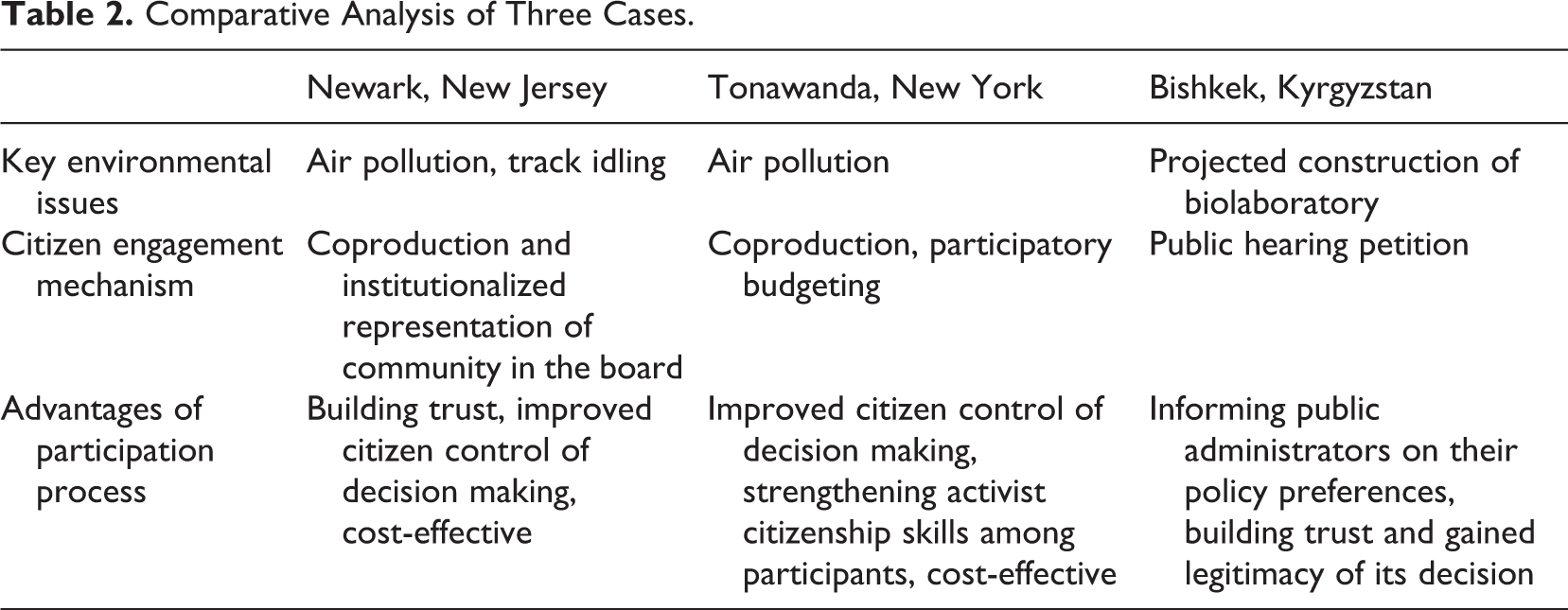
Using Irvin and Stansbury’s framework, we identified that building partnership was the main outcomes of engagement within the Office of Sustainability in Newark. Newark established two separate environmental oversight units; one within the city structure and the other resident led. The juxtaposition of resident and administrator oversight presents a communal responsibility for environmental concerns in the city potentially strengthening ties between these two stakeholder groups. These partnerships may arguably lead to an increase in trust between residents, advocacy groups, and city officials. Partnership was also a common attribute in the participation initiatives of Tonawanda and Bishkek. Furthermore, both jurisdictions had several distinct benefits from the process. While improving activist citizenship skills among residents was the principal gain from engagement in Tonawanda, participation in Bishkek resulted in strengthening local government and its relations with residents.
In general, Irvin and Stanbury’s framework was useful to identify the benefits of engagement for each group and how it leads to successful participation initiatives at the local level. The most important goal in our project is to demonstrate that citizen involvement in environmental matters in these three jurisdictions had benefits both for administrators and for citizens, which partly explains the effectiveness of these engagement processes. Moreover, concerns over costs were minimal for local governments in Bishkek and Tonawanda since most of the participation-related efforts were done by local community-based organizations.
Finally, the results in these three jurisdictions confirm that participation in environmental issues can be effective in both mature democracies and less democratic regimes (Li, Liu, and Li 2012). As the case of Kyrgyzstan demonstrates, in centralized authoritarian countries, environmental engagement serves as a tool to decentralize decision making by strengthening the political power of municipalities, potentially supporting Zakharchenko’s (2009) notion that environmental participation strengthens democracy. In sum, each jurisdiction discussed helps to illustrate how global communities of various population sizes and government structures can effectively use citizen participation to address environmental issues collaboratively.
Footnotes
Declaration of Conflicting Interests
The authors declared no potential conflicts of interest with respect to the research, authorship, and/or publication of this article.
Funding
The authors received no financial support for the research, authorship, and/or publication of this article.