







Abstract
How should regulatory authority over environmental policy issues be allocated? While there has been previous work on public preferences regarding environmental federalism, less attention has been paid to the opinions of local government officials, who are often on the front lines testing the limits (or not) of their authority. Using survey data of public and local official opinion about environmental federalism, this article finds that local government officials often see a significantly different role for national, subnational, and local government than their constituents, even after accounting for demographic differences between the groups. This article draws on data from two subnational jurisdictions in different countries (Michigan, United States and Ontario, Canada) and finds that the differences between the general public and local officials are durable even with a change in national context.
In the absence of an environmental catastrophe, the public rarely questions which level of government is responsible for ensuring environmental quality and has difficulty assigning responsibility (Cutler 2008, 2010). However, when disaster strikes or environmental questions arise in response to a new technology, residents often turn to the leaders of their local government—the level of government closest at hand—demanding that “government” take action or intently attributing blame to single authorities (Stokes 2015). Local officials, then, are left with the task of deciding whether or not they should intervene. But do local officials have the same idea as their constituents about which level of government ought to be responsible for environmental regulation? This article asks first whether public and local elected officials’ views on federalism over three environmental issues vary and how. This article then considers how durable differences between public and local official opinions are when the national context changes.
Literature Review
While there have been some recent studies on public opinion related to federalism across a range of policy arenas (see Lachapelle, Borick, and Rabe 2012; Kincaid and Cole 2011; Shaw and Reinhart 2001; Cantril and Cantril 1999; Schneider, Jacoby and Lewis 2011), David Konisky (2011) provides the most detailed, recent public opinion work specifically on environmental federalism. He finds a general preference for U.S. federal government responsibility across twelve environmental issues but also finds some tendency to prefer a government level that matched the scope of the problem. The best predictors of preferences were political orientation and education level; Republicans and conservatives were more likely to prefer greater state and local government responsibility, and respondents with higher education levels were more likely to prefer more federal government responsibility. This is consistent with recent public opinion surveys that show Republicans consistently have higher levels of trust in local government than Independents and Democrats (Gallup 2014).
Only a small number of studies have directly compared public opinions about environmental policy to those of government officials. Luloff and Hodges (1992), Broussard, Camille, and Brian (2008), and Konisky (2008) have all found differences between policy makers and their constituents with respect to environmental policy, but their studies have focused on the content of specific policies (i.e., “what should be done?”) rather than on federalism (i.e., “which level of government should decide what should be done, and/or carry out implementation?”). Fitzgerald, McCabe, and Folz (1988), Grossback (2002), and Bowman and Kearney (2011), in contrast, each looked at government official opinions on questions related to federalism but make no comparison with public opinion. A notable exception is Coke and Brown (1976), who compared public and official opinion in Ohio on whether land use regulation should take place at the state or the local level. They found that while the public was largely divided as to whether land use regulation should be controlled by local governments or the state, local officials largely preferred local control. The design of the Ohio study, however, did not allow the researchers to control for demographic differences between local officials and the public, which Konisky (2011) had shown was an important determinant of environmental federalist attitudes. By including the opinions of both the general public and local officials, but controlling for demographic factors, our study addresses whether these groups do differ in their views of environmental federalism.
Research Design
This article assesses whether there are differences of opinion between the public and local officials on the allocation of authority for environmental policy, specifically in the regulation of three different environmental policy issues: Great Lakes water quality, wind turbine siting, and hydraulic fracturing (“fracking”). None of these issues have been covered in previous published studies about opinions related to environmental federalism and, more specifically, about which level of government should have regulatory control. Therefore, together, these topics add diversity to the range of issues examined in previous studies and also add evidence about two emerging, contentious issues (fracking and turbine siting), which have received a good deal of attention owing to their controversy both in Canada and the United States.
Case Selection
Opinions about the regulation of Great Lakes quality, fracking, and wind turbine siting were asked of both the general public and local officials in Michigan and Ontario. There is long history of research that compares the historical roots of Canadian and U.S. citizen values about the role of government (Lipset 1990) and also whether citizen values are diverging or converging over time (Pierce et al. 2000). The general argument is that Canadians tend to have more trust in government and are more deferential than U.S. citizens, although that deference is not static (see Nevitte 1996). With respect to environmental issues, there is also a long history of research comparing Canadian and U.S. environmental federalism, particularly by Canadian scholars. This research has tended to emphasize institutional and regulatory similarities and differences as explanations for policy outcomes (see, e.g., Hoberg 1991; Howlett 1994, 2000; Illical and Harrison 2007; Rabe 1999; Van Nijnatten 1999). Hence, Ontario is a useful comparison to Michigan, as it similarly has wind energy development, fracking potential, and a vested interest in Great Lakes water quality. Comparing Ontario and Michigan allows us to study how robust differences between local official and public opinion are when there is a change in national context.
Data Sources
In late 2013, to capture public opinion, a telephone survey was conducted with randomly selected households in Michigan (n = 267) and Ontario (n = 407). All respondents were asked questions about regulation of the Great Lakes, in addition to demographic questions. To limit the overall length of the survey, roughly half (n = 340, 142 in Michigan and 198 in Ontario) were randomly assigned questions about regulation of hydraulic fracturing and the other half (n = 334, 142 in Michigan and 198 in Ontario) were given parallel questions about wind energy. (Additional details on survey methodology are available in Supplemental Text 1.)
The same questions asked of the public were also posed to local government officials in Michigan and Ontario but with some slight differences. First, in surveying the local officials, there was no split sample, and so respondents were asked about all three policy areas. Second, while the public opinion was gathered via telephone surveys, local government officials were surveyed through other means in Michigan and Ontario. In Michigan, surveys were conducted in late 2013 and were sent via the Internet and hard copy (when no e-mail address was available or as requested by the respondent) to the top elected and appointed official in each of the state’s 1,856 units of general-purpose local government—a census design, rather than a sample. A total of 1,353 jurisdictions returned valid surveys.
In Ontario, surveys were conducted in October 2014. A list of primary e-mail addresses for local elected leaders in all municipalities were compiled and used to send the surveys electronically. Surveys were sent to the top elected official of each municipal government in single or lower-tier municipalities, for a total of 407 municipalities. Forty-eight responses were received, producing a response rate of 12 percent. Re-contacts to try to boost response rates were impractical because of municipal elections in November 2014. Although this low response rate, and the subsequent margin of error it produces, limits abilities to detect small differences between Ontario local officials and other groups (i.e., Ontario public, Michigan officials), use of these data in a regression would tend to underestimate any differences that exist.
While the differences in survey mode, timing, and overall response rate may introduce some error, careful research design aimed to minimize this error. The primary concern of a change in mode is interviewer effects (Biemer and Lyberg 2003), but because the questions were brief and were not sensitive in nature, any effects are expected to be minimal. In terms of timing, there were no substantial changes in either fracking or wind energy policy in Ontario in the nine months between the public opinion poll and the survey of local officials that would be expected to introduce additional error. Finally, the primary concern over a low response rate is nonresponse error—that those who do not respond are systematically different than those who do. The Michigan Public Policy Survey consistently finds that opinions of local officials are most closely correlated to population size of the jurisdiction. In the case of the Ontario survey of local officials, the response rate is well distributed across population categories: 13.2 percent of the 106 municipalities with fewer than 1,500 residents responded as did 10.6 percent of the 141 municipalities with more than 10,000 residents. While the authors acknowledge the methodological limitations of this study, they should not overshadow the unique ability to compare responses of identical questions across these diverse populations.
Variables
Respondent opinions about environmental federalism are, themselves, the dependent variables in this study. For each of the three environmental policy areas—Great Lakes water quality, wind energy, and fracking—respondents were asked how much authority each of the three levels of government—federal, state/provincial, and local—should have (see question text and response options in Supplemental Text 2). As a result, there are nine dependent variables (i.e., three policy areas × three levels of government for each). These were each dichotomized into binary variables, equal to 1 if the respondent said that the level of government should have “a great deal of authority” over the policy and equal to 0 if the respondent said the level of government should have “some authority” or “no authority” over the policy; “don’t know” answers were marked as system missing. 1
The independent variables include a set of standard demographic characteristics typically included in opinion research: political affiliation, age, educational attainment, and gender. Political affiliation (for Michigan respondents) is captured by two dichotomous variables: “Republican” and “Other_party.” If a Michigan respondent answered they were a Democrat, they would have a 0 (zero) for both “Republican” and “Other_party” variables. Respondents who refused to give their political affiliation were marked as system missing for both of these variables. The “Age” variable is an ordinal variable ranging from 1 to 9 (where 1 is 18–25 and 9 is 90+). “Education” is a five-point ordinal variable where 1 is less than a high school diploma and 5 is a postgraduate degree. “Female” is a dichotomous indicator variable with females coded as 1 and males coded as 0.
In addition to these demographic variables, the model includes two more dichotomous independent variables unique to this research. The variable “Official” codes respondents who are local government officials as 1 and those who are members of the general public as 0. The variable we call “Michigan” codes both local officials and the general public who reside in Michigan as 1 and those who reside in Ontario as 0.
Supplemental Table 1 provides demographic characteristics of respondents based on whether or not they are a local government official and whether they are in Michigan or Ontario. Local officials in both Michigan and Ontario are disproportionately male compared to the general public. There are also more Republican local officials in the Michigan sample than there are in the Michigan general public. 2 Including the demographic variables within the logistic regression models allows for detecting differences between local officials and the public that do not arise merely from these demographic differences.
Hypotheses
Although this research asks about different environmental policy issues than did Konisky (2011), we hypothesize that the same demographic characteristics that Konisky’s research found to significantly impact attitudes about environmental federalism will also significantly impact attitudes about environmental federalism among our respondents, whether they are local officials or not, and, conversely, those that Konisky found as not significant will also not be good predictors in our model.
Finally, given previous research showing that Canadians tend to have higher trust in federal and state/provincial levels of government than Americans (Nevitte 1996), we would expect that Ontario respondents would welcome involvement by higher-level governments than Michiganders. That is, we would expect that national context will matter.
Results
Because Canadian political parties differ from those in the United States, two different sets of logistic regressions were conducted. The first set of regressions—which includes only data from Michigan—allows for inclusion of the political affiliation independent variables to test whether our dependent variables respond to the same demographic factors as in Konisky’s (2011) analysis. Indeed, consistent with Konisky’s earlier analysis, political affiliation and education are two of the strongest predictors of a respondent believing that a particular level of government should have a great deal of authority in environmental regulation (Hypotheses 1 and 2). Republican respondents are significantly less likely to see a large role for the federal government within all three policy domains. For example, they are four times less likely than non-Republicans to want the federal government to have a great deal of authority in regulating wind energy. Only on wind energy, however, do Republicans prefer a smaller role for the state than non-Republicans. This model also shows respondents with higher education levels prefer greater authority for the federal and state governments than those with lower education levels on Great Lakes water quality and hydraulic fracturing but not necessarily on wind energy. Conversely, and also consistent with Konisky’s earlier analysis, age and gender were significant in only one and three of the nine models, respectively (Hypothesis 3). (See Supplemental Table 2 for these findings.)
After confirming that the demographic factors in the study generally behave as they did in earlier work, a second set of regressions was run which dropped the political affiliation independent variables but which included all data from both Michigan and Ontario; the results of this set of regressions are shown in Table 1. In both the first and second sets of regressions, the strongest predictor of attitudes on environmental federalism is the independent variable corresponding to whether or not the respondent was a local official. In seven out of the nine regressions, local officials and the general public have significantly different responses—with odds ratios often exceeding 3-to-1, even after accounting for demographic differences between these two groups. The differences between local officials and the general public, though, vary based on the policy arena. On policies related to wind energy, local officials are four times less likely to want the state (and federal) governments to have a great deal of authority for turbine siting, and 3.59 times as likely as their constituents to see a large role for local governments. Within the arena of hydraulic fracturing, local leaders likewise are nearly 3 times less likely to see a large role for the federal government and 3.2 times as likely to call for a large role for local governments as their constituents.
Logistic Regression of Belief That a Particular Level of Government Should Have “A Great Deal of Authority” in Each of Three Environmental Policy Areas, Using Michigan and Ontario Responses.
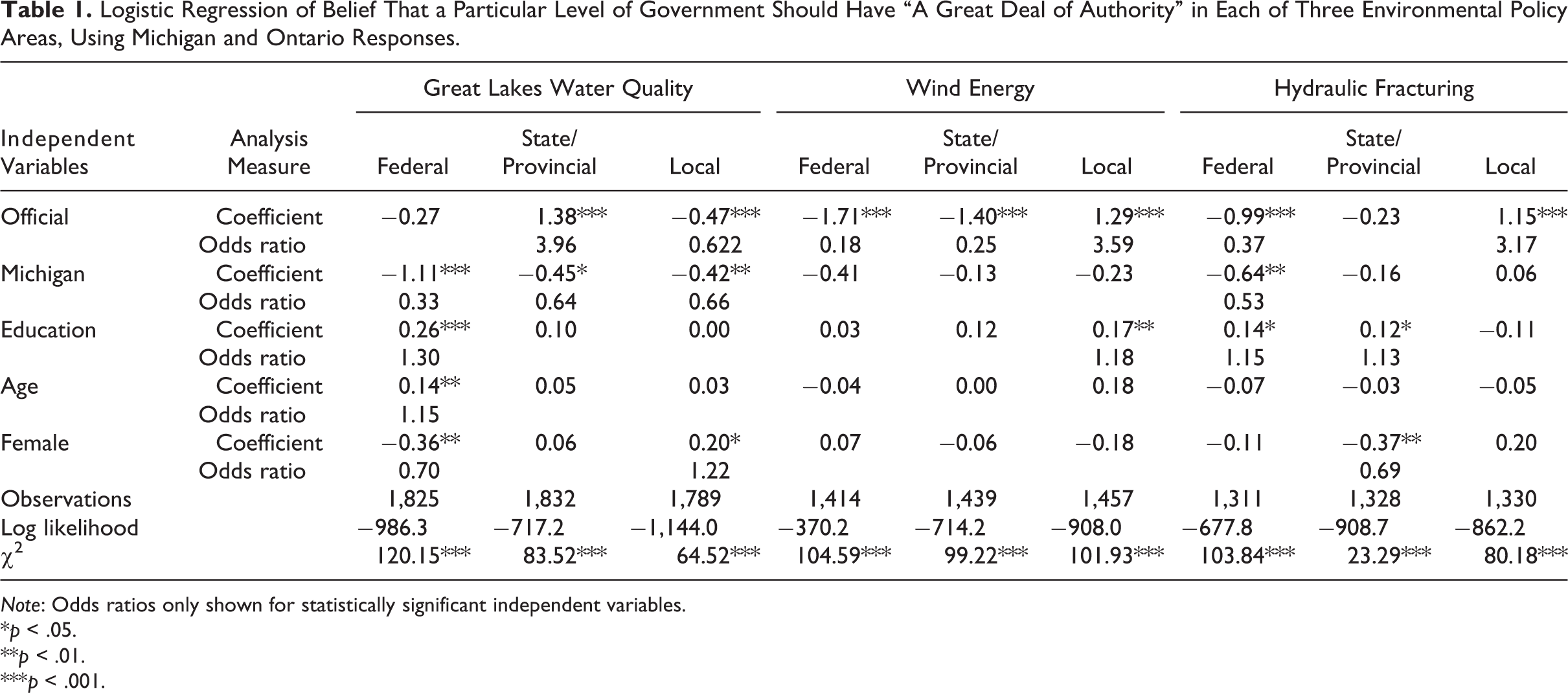
Note: Odds ratios only shown for statistically significant independent variables.
*p < .05.
**p < .01.
***p < .001.
This second set of logistic regressions also finds that context—whether the respondent is from Michigan or Ontario—is a relatively strong predictor in four of the nine regressions. Ontarians prefer all levels of government have a greater role in regulating Great Lakes water quality than Michiganders would prefer, as predicted in Hypothesis 5. However, the differences between Ontarians and Michiganders do not carry through to the other policy areas. For example, there is no difference of opinion between Ontarians and Michiganders on regulation of wind energy at any level of government. Thus, context matters but not as much as one’s status as a local official.
Explanations
The primary goal of this study was to determine whether local officials and the general public have similar views on environmental federalism. Data demonstrate that they do not, with one’s status as a local official (or not) being one of the strongest predictors of one’s environmental attitudes—stronger even than partisanship, level of education, or other demographic factors. However, the differences in opinion between local officials and their constituents are not entirely consistent with the hypothesis (Hypothesis 4) that local officials would prefer a larger role for their own local government. While the data do show local officials are more than three times as likely as constituents to say they prefer the local government to have a great deal of authority over wind energy and fracking, when asked about regulation to protect Great Lakes water quality, local officials see a smaller role for local governments than members of the general public—results which hold in both Michigan and Ontario. As a result, it appears that local officials do not simply want to grab more power, no matter the issue area. Indeed, on the issue of water quality, local officials are more than 3.5 times as likely as their constituents to say they would prefer the state/provincial government to take a leading role in regulation.
In some ways, the views of local officials, with the state/province in a lead role on water policy, reflect the current allocation of authority. However, it is unclear why the public expects local governments to play a larger role on this issue. It could be due to a perception or preference among the general public that more levels of government equal more protection or safety, or alternately a belief that protecting water quality does not require specialty knowledge of state/provincial or federal government, but is within the capability of local government (and perhaps individual citizens themselves) to take actions that can help minimize pollution. It can also simply be that citizens do not know or care who has formal authority (see Cutler 2008, 2010), and simply that a complex issue requires or demand many governments to be involved to ensure protection or quality is maintained.
These outcomes point to important opportunities for future hypothesis testing and theory building. Does the public desire shared authority due to a lack of information about the regulatory or authority structure in these policy areas? Or, does the public desire shared authority simply because they deem that more engagement from multiple levels of government might better ensure their well-being? Future comparisons with other issues and in other policy domains, combined with deeper analysis may help fill some of the lingering knowledge gaps about the rationale for similarities and variations on public and local official opinion on regulatory authority, particularly at the local scale.
Conclusion
For many years, local governments have been testing the boundaries of their regulatory authority over environmental issues, such as with pesticide use (Pralle 2006), climate change mitigation and adaptation (Robinson and Gore 2015), and even with emerging issues like fracking (Rabe and Borick 2013). Environmental issues, however, are not the only issues in which local governments test the bounds of their regulatory authority. Recent years have seen local governments regulate areas typically within the remit of national or state governments including civil rights (Cravens 2015) and substance use (Ybarra and Krebs 2016). The most common approach to studying attitudes toward federalism of these varied issues, though, is to look at public—rather than local official—opinion. This is perhaps understandable as the public is constantly being surveyed, while surveys of local officials are much less common. However, because it is local government officials—and not the general public—who decide whether and how local governments will respond, it is useful to understand how these local officials envision the ideal allocation of authority, and how their opinions differ from their constituents. While a difference in opinion may not result in any immediate policy or regulatory changes, particularly owing to regulatory authority for environmental issues often resting with state and provincial institutions, longer term, stable, and continued variation in opinion may signal where conflict between the public and different levels of governments may emerge. For this reason, understanding trends in and collecting data on local government perceptions of critical public issues seems to be an area of important and vibrant future research.
Footnotes
Acknowledgments
Barry Rabe, University of Michigan, and Christopher Borick, Muhlenberg College, played lead roles and provided invaluable assistance and guidance in the preparation and delivery of the survey instruments and in early reflections on the results. We would also like to thank Paul McKinley and Laura Klein (former Ryerson University graduate students) and Emma Maack (a former University of Michigan graduate student) for background research that helped inform this study.
Declaration of Conflicting Interests
The author(s) declared no potential conflicts of interest with respect to the research, authorship, and/or publication of this article.
Funding
The author(s) disclosed receipt of the following financial support for the research, authorship, and/or publication of this article: The public opinion survey was primarily funded by the Social Sciences and Humanities Research Council of Canada under the auspices of the Great Lakes Policy Research Network centered at Ryerson University in Toronto. Supplemental funds were provided by the Center for Local, State, and Urban Policy at the University of Michigan and the Muhlenberg Institute of Public Opinion. The survey of local leaders in Michigan was funded by the Center for Local, State, and Urban Policy at the University of Michigan. The survey of local leaders in Ontario was funded by the Social Sciences and Humanities Research Council of Canada under the auspices of the Great Lakes Policy Research Network centered at Ryerson University in Toronto.
