







Abstract
This study examines the determinants of public confidence in the honesty and integrity of state redistricting processes by analyzing responses to the 2011 and 2012 Cooperative Congressional Election Studies. Individual opinions about the redistricting process are matched to several state characteristics, including the presence of independent redistricting commissions, state legislative polarization, and legislative professionalism. Contrary to popular wisdom, the analysis reveals that neither partisan redistricting procedures nor political polarization reduce confidence in the redistricting process. Rather, public attitudes are determined more so by distaste for legislative professionalism and affinity for the party in control of state government.
Legislative redistricting is an inflammatory issue that is often blamed for increasing levels of partisan polarization—the precursor to legislative gridlock and stalemate that is often viewed distastefully by citizens (Hibbing and Theiss-Morse 2002). This article considers the connection between polarization, redistricting institutions, and citizens by focusing on the determinants of public trust in the redistricting process and testing whether polarized environments and partisan redistricting procedures erode citizens’ trust and confidence in the process of redistricting. Examining the effects of polarization as well as the public’s reactions to the redistricting process has the potential to inform both the ease with which states are able to reform redistricting and the broader role of polarization in evaluations of political processes.
This study distinguishes between legislative and nonlegislative processes of redistricting; the latter include independent redistricting commissions that have been popularized by reform groups. Nonlegislative redistricting processes have been implemented in a handful of states for the purpose of frustrating legislators’ self-interest in the redistricting process and increasing citizens’ confidence in the integrity of redistricting (Bickerstaff 2014). To date, the link between citizen perceptions and reformed environments is an underexplored area of interest.
Public perceptions of the redistricting process may develop through different pathways. For example, some citizens may not be aware of the redistricting institutions employed in their state, but nevertheless report higher or lower trust in the redistricting process based on the polarized legislative environment that they experience. On the other hand, some citizens may report positive or negative perceptions of the redistricting process based on their knowledge of the actual redistricting institutions employed in their state. Consequently, even if nonlegislative approaches to redistricting have no discernable effect on legislative polarization, citizens’ perceptions that they alleviate polarization might have a positive effect on beliefs in democratic institutions.
The analysis presented in this article also extends existing work on political process evaluations to develop the theory that polarization should heighten awareness of political processes that citizens perceive to be more distasteful. Assessing the role of polarization on perceptions of the redistricting process is important for understanding how polarized environments can affect evaluations of democratic governing processes. The process literature has thus far not adequately accounted for citizens’ reactions to political processes in real-world settings, often relying on abstract scenarios that may not translate into actual political arrangements. Polarization and redistricting are therefore used as a case study of sorts, the expectation being that the political environment will affect trust in processes. Of course, specific redistricting methods are largely unknown to citizens, but familiarity with redistricting processes may increase with greater interest in public affairs or political polarization, leading those with high interest or in more polarized environments to have stronger opinions about their confidence in redistricting processes.
State Redistricting Procedures
State redistricting processes may be thought of as being aligned along a “continuum of increasing separation from a legislative conflict of interest” (Cain 2012, 1818), from legislative redistricting to independent commissions. As noted by Goedert (2014), independent commissions are typically considered the most fair by reform groups, precisely because of this separation from legislative self-interest. Nevertheless, the most widespread redistricting processes currently in practice give the responsibility for drawing district lines to the legislature alone, although several states employ some form of mixed procedures.
Levitt (2016) provides an updated and comprehensive description of each state’s redistricting processes. Congressional districts are drawn by state legislatures in forty-two states, while state legislative districts are drawn by state legislatures in thirty-seven states. In between independent commissions and pure legislative redistricting are hybrid methods that mix state legislative and outside influences. For example, two states appoint advisory commissions to help the legislature figure out where congressional district lines should be drawn, while five states do this for state legislative lines. Two states use backup commissions to draw the congressional redistricting maps if the legislature fails to act, while seven states use a backup commission for state legislative redistricting. Elected officials may also serve as members on politician commissions, which removes redistricting responsibility from the legislature but not from legislators (this system of political appointees is used by two states for congressional redistricting and by seven states for state legislative lines).
Only six states draw both congressional and state legislative districts using independent commissions (Levitt 2016). Rather than working with the legislature, independent commissions remove redistricting responsibility from politicians and instead place it in the hands of nonelected actors. The degree of true “independence” from politicians’ influence is debated, given that it is still the state legislature’s responsibility to appoint individuals to the commission in five states, while two (Arizona and California) attempt to further distance themselves from political control through nominations from a state commission and state auditors, respectively (e.g., Cain 2012).
The multiplicity of redistricting processes employed in the states for congressional and state redistricting provides a challenge for our empirical analysis. In order to make the analysis more tractable, states are placed into three mutually exclusive groups: those that employ purely legislative procedures for drawing both congressional and state legislative lines, those that employ independent commissions for both, and all other states. This taxonomy is sufficient to evaluate the potential differences across the redistricting spectrum for public trust and confidence in the redistricting process.
Literature Review and Theory
The popular wisdom on the superiority of independent redistricting notwithstanding, the empirical literature on public reactions to redistricting is actually quite scant. Most of this literature is devoted to analyzing the effects of different redistricting systems on electoral prospects and incumbent behavior (e.g., McDonald 2004, 2006). In general, this research suggests that the overall effects of redistricting are marginal and muddied by other factors in the political environment (Abramowitz, Alexander, and Gunning 2006; Desposato and Petrocik 2003). Further, several recent studies cast serious doubt on the conventional wisdom that partisan redistricting is an important cause of polarization in legislatures (e.g., Masket, Winburn, and Wright 2012; McCarty, Poole, and Rosenthal 2009; McCarty 2015; Kousser, Phillips, and Shor 2016).
Only recently have scholars directly examined whether public opinion is responsive to redistricting procedures. Fougere, Ansolabehere, and Persily (2010) find some weak evidence that citizens in states with independent commissions perceive the process as more fair. However, the difference between the effect of independent commissions and other state redistricting institutions is not statistically significant. Further, the authors analyze survey data from 2006, which may limit the salience of decennial redistricting as an issue of public concern. This lack of saliency may inject some noise in public evaluations, which in turn would produce attenuation bias that reduces the size and significance of the estimated effect of independent commissions on perceived fairness of redistricting processes.
Panagopoulos (2013) reports a similar null effect in an analysis of survey data from 2008. However, the same concern about the lack of salience of the upcoming decennial redistricting applies. Panagopoulos also conducts a survey experiment in which respondents are asked to rate the fairness of redistricting when conducted by a state legislature versus an independent commission. Regardless of the experimental frame, respondents perceive no difference in fairness. However, it is unclear to what extent these survey responses to a hypothetical redistricting procedure can be generalized. For example, respondents who have no exposure to independent redistricting commissions (or legislative redistricting commissions) may not reasonably be expected to have a well-formed opinion on these institutions.
These recent studies also make clear that many citizens are likely not aware of the specifics of redistricting in their state. For example, in the survey examined by Panagopoulos (2013), 54 percent of respondents are unaware of the procedures employed in their state to draw district lines, while Fougere, Ansolabehere, and Persily (2010) cite a Pew Center poll, showing that 58 percent of respondents do not know what body of government is responsible for redrawing districts. However, the authors also note that citizens in states with proposed redistricting initiatives or litigation are far more likely to know about the process, and this awareness grows as Election Day nears.
Despite this evident lack of public awareness about redistricting procedures, a growing body of literature recognizes that although the public may not know the specific outputs of redistricting nor its institutional details, the public does react to governing processes (Hibbing and Theiss-Morse 2002; Bengtsson and Mattila 2009; Wojcieszak 2014; Font, Wojcieszak, and Navarro 2015). This process perspective argues that citizens do not have to know about specific policy outputs in order to inform their opinions about the government. Instead, citizens care more about the processes by which political decisions are made than the actual policy outcomes of decision-making. In other words, people do not need to know about the outcomes of redistricting methods in order to form a judgment about them.
Hibbing and Theiss-Morse (2002) argue that the public is particularly averse to political processes that reflect self-interest. Although varied across the states, redistricting processes are largely carried out by legislators themselves. Because the task carries a considerable amount of future implications for the safety of incumbents and advantages for one party over the other, the redistricting process is rife with self-interested behavior and should thus gather particularly negative reactions from the public.
The process literature therefore dovetails with the popular wisdom regarding the superiority of nonlegislative redistricting processes and leads to the primary hypothesis to be tested:
The process perspective described above does not preclude the fact that a significant portion of citizens may not be confident in what redistricting is or about its processes in the first place as clarified by Fougere, Ansolabehere, and Persily (2010) and Panagopoulos (2013). A common theme to both the studies, as well as the process literature, is that citizens with greater information and interest in politics will have more definite opinions regarding redistricting processes. This consensus generates a second hypothesis to be tested:
Popular wisdom also holds that partisan redistricting through state legislative majorities exacerbates legislative polarization, which in turn reduces trust and confidence in government. However, the popular wisdom regarding these assumed links does not hold up well to scrutiny. Several recent studies conclude that increasing state legislative polarization is more likely attributable to the preferences of constituents than to some set of institutional factors (e.g., McCarty, Poole, and Rosenthal 2009; Masket, Winburn, and Wright 2012;McCarty 2015). Nevertheless, Uslaner (2015) does show some evidence that increasing polarization in Congress has undermined citizens’ trust in government. To the extent that trust in government influences confidence in the integrity of specific institutions, this suggests that polarization in the state legislature may have an independent and detrimental effect on public confidence in redistricting. To date the connection between legislative polarization and confidence in institutions has not been tested in the context of redistricting, so the third hypothesis to be tested is:
In addition to the potential negative impact of polarization on trust, polarized environments may further shape citizen reactions to redistricting by making political issues more contentious and salient. Although the effects of polarization on public awareness are complex (Levendusky and Malhotra 2016), polarization has been shown to intensify the effects of party endorsements and help clarify political cues (Druckman, Peterson, and Slothuus 2013; Garner and Palmer 2011; Nicholson 2012). Therefore, polarization, like information and interest in politics, may serve to sharpen the effects of redistricting institutions on public confidence. This leads to the final hypothesis to be tested:
Of course, redistricting institutions and polarization are not the only state characteristics that likely influence public confidence in redistricting. For example, Richardson, Konisky, and Milyo (2012) show that both state professionalism and the concordance between individual partisan preferences and party control of state government are important determinants of approval of state legislatures. It therefore stands to reason that these same variables will be determinants of public confidence in the state legislative redistricting process, so they are included as control variables in the empirical analysis.
Research Design
Data
The determinants of public confidence in the honesty and integrity of state redistricting processes are analyzed by examining responses to the 2011 and 2012 versions of the Cooperative Congressional Election Study (CCES). Starting in 2006, the CCES is an annual venture comprising teams from multiple universities; each team submits a module of questions to be administered to 1,000 persons. In 2011 and 2012, the team from the University of Missouri included a question that asked respondents to rate their confidence in the “honesty and integrity of the redistricting process” in their own state.
Throughout this analysis, the dependent variable is respondents’ rating of the honesty and integrity of their state redistricting process. Responses were coded on a seven-point scale from “no confidence” to “great confidence.” The mean score is 3.76 with a standard deviation (SD) of 1.62; further, the distribution of individual responses is approximately normal (Supplemental Figure 1).
The CCES also includes a wealth of information about respondents’ demographics and political attitudes. The following individual-level attributes are included as controls: age in years and indicator variables for sex, race, Hispanic ethnicity, college education, party identification, and an indicator for self-reported interest in news and public affairs. Descriptive statistics for all variables used in this study are listed in Supplemental Table 1.
These individual-level survey data are matched to several pertinent characteristics of the state of each respondent. The primary state characteristics of interest are redistricting institutions. An indicator is included for states with independent redistricting commissions (Alaska, Arizona, California, Idaho, Montana, and Washington). Of note, Iowa is not included in this group of states, although it could be argued that in practice, the redistricting process in Iowa is also fairly independent of formal partisan influence. However, the results reported below are not sensitive to whether Iowa is included among states having independent redistricting commissions or not. A second indicator is included for states at the other end of the spectrum, where the legislature directly controls the redistricting process (Arkansas, Colorado, Connecticut, Hawaii, New Jersey, and Ohio). The omitted category is for all other states that employ some hybrid procedure.
Another state-level characteristic of interest is polarization. Following Shor and McCarty (2015), political polarization in each state legislature is measured by the average difference in party median ideological scores for each state in each year. For the time period examined, these state polarization scores range from about 0.5 to 3.0, with the median at approximately 1.5. The five states with the lowest legislative polarization scores in 2011 are Arkansas, Delaware, Louisiana, Rhode Island, and West Virginia; the five states with the highest legislative polarization scores are Arizona, California, Colorado, Kentucky, and Massachusetts. Because more populous states are also more polarized, the average polarization score matched to individuals in the survey data is 1.79.
Additional state-level control variables include state legislative professionalism and party concordance. Legislative professionalism is measured with Squire’s (2012) index. Party concordance is measured with the state legislature is a trinary indicator, taking the value +1 (−1) when an individual identifies with the same (opposite) party in control of the state legislature and taking the value 0 otherwise. Party concordance with the governor is defined in a similar manner.
Methods
The determinants of individual survey respondents’ confidence in the honesty and integrity of the state redistricting process are analyzed via several reduced-form regressions. The base model includes all of the individual-level and state-level variables described above. This model is sufficient to test Hypotheses 1 and 3, pertaining to the effects of redistricting institutions and polarization, respectively. Hypotheses 2 and 4 are tested by reexamining the base model using only the subset of respondents who are highly interested in public affairs or reside in states with highly polarized legislatures. The robustness of the results are checked by estimating several variants of the base model. Also, in every regression, standard errors are corrected for the nonindependence of individual observations caused by the grouping of observations within states (Primo, Jacobsmeier, and Milyo 2006).
For ease of exposition, only results of ordinary least square regressions are reported. However, because the dependent variable is categorical, all models have also been estimated using probit or ordered probit. Not surprisingly, the substantive results of interest are similar whether the dependent variable is transformed into a binary indicator of high (or low) confidence or whether it is treated as an untransformed seven-point ordinal scale.
Results
Before proceeding to the regression analysis, it is useful to first check the bivariate relationship between state redistricting institutions and legislative polarization. Figure 1 extends the analysis in Masket, Winburn, and Wright (2012) by plotting the time trends in legislative polarization for states with independent redistricting commissions, legislative processes, and all other states over the time period 2002–2014. This simple exercise yields several lessons. First, contrary to popular wisdom, legislative polarization is highest in states with independent commissions, followed by states with legislative processes and then all other states. In fact, independent redistricting processes are associated with about a 50 percent higher mean polarization score (p < .001), while legislative redistricting processes are associated with just a 9 percent higher legislative polarization score (p < .05) than all other states. Second, there is a significant positive time trend; legislative polarization is increasing by about .02 units per year. Further, the null hypothesis that this time trend is the same across all three groups of states cannot be rejected (p > .45). Finally, there is no evidence that legislative polarization jumps after the most recent round of decennial redistricting in 2011–2012.
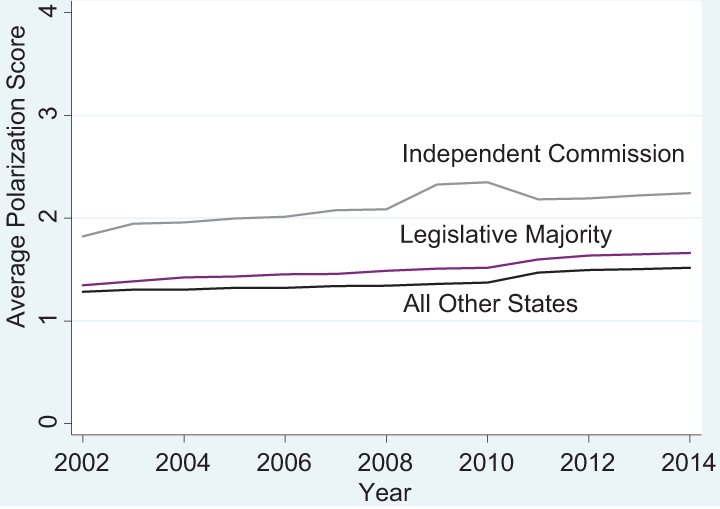
Average state polarization scores by redistricting process.
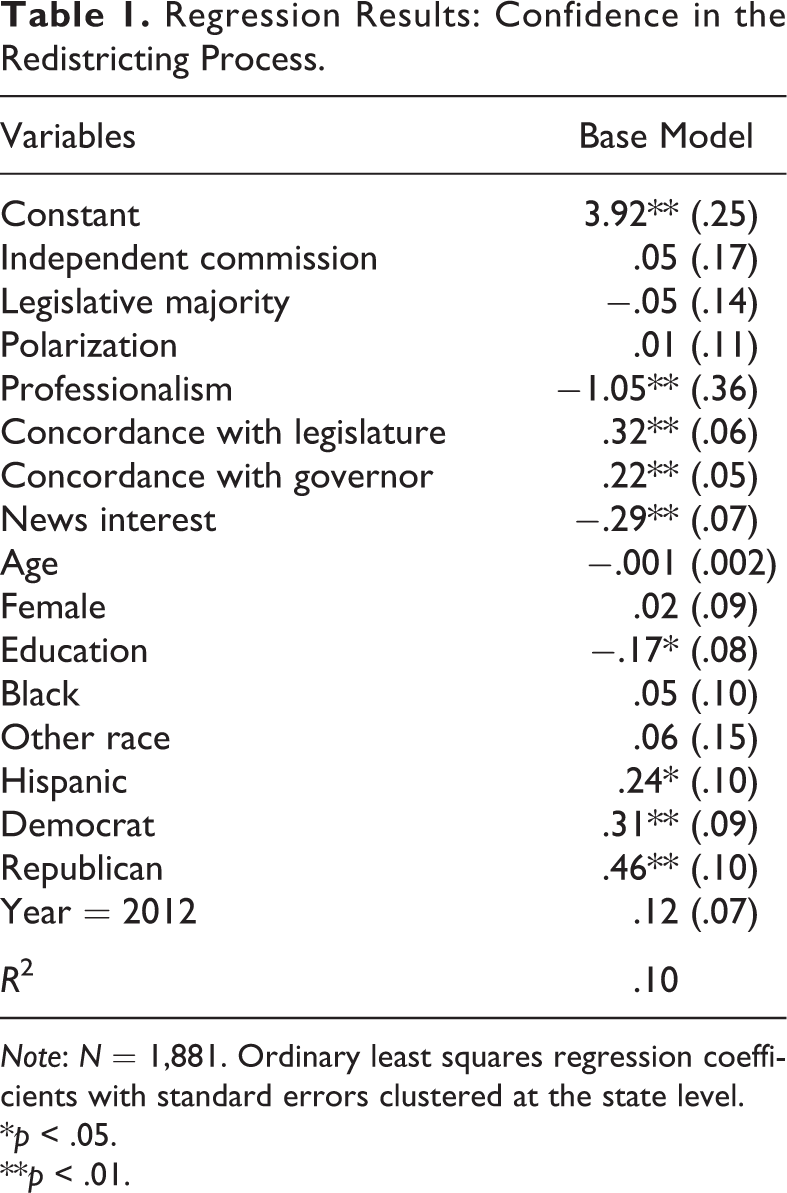
Table 1 shows the results of the regression analysis for the base model. The estimated coefficients on the indicators for redistricting institutions (independent commissions and legislative majority) are not statistically different from zero; further, these indicators are also not jointly significant. Moreover, the estimated coefficients for redistricting institutions are very small in magnitude; for example, a hypothetical move from a state with legislative redistricting to one with nonlegislative redistricting is associated with an increase in confidence in the integrity of redistricting of less than one-fifteenth of an SD in the dependent variable.
Regression Results: Confidence in the Redistricting Process.
Note: N = 1,881. Ordinary least squares regression coefficients with standard errors clustered at the state level.
*p < .05.
**p < .01.
State legislative polarization has a similarly insignificant and negligible impact on confidence in redistricting. For example, ignoring the absence of statistical significance, a 1 SD increase in legislative polarization is associated with an increase in confidence in redistricting of about 1 percent of 1 SD in the dependent variable. In addition, polarization and the redistricting indicators are not jointly significant either. Further, dropping either the redistricting indicators or polarization from the regression does not alter the estimated coefficients on the remaining variables in a substantive fashion as shown in Supplemental Table 2.
In contrast, other state-level attributes are significant determinants of confidence in redistricting. Legislative professionalism is negatively related to confidence in the redistricting process, while concordance with the party in control of the state legislature or governorship is positively associated with public confidence. Of these variables, concordance has the largest effect in confidence. For example, a change in control of both the legislative and executive branch of state government from an individual’s less preferred party to their more preferred party is expected to yield a one-point increase in the confidence scale (or about two-thirds of the SD for confidence). In contrast, the change in the value of the legislative professionalism score from the lowest extreme to the highest is just 0.57 units; a change of this magnitude in legislative professionalism would lower public confidence by a little more than one-half point on the seven-point confidence scale.
The regression results reported in Table 1 also demonstrate some interesting relationships between individual attributes and confidence in the redistricting process. For example, both news interest and college education are negatively related to confidence. Hispanic ethnicity and identification with a major party are positively associated with confidence in redistricting. However, the substantive effects of all these variables is actual quite small relative to the SD of the dependent variable. For example, the reduction in confidence in redistricting associated with a college education is just over one-tenth of the SD of the dependent variable. Party identification and Hispanic ethnicity have somewhat larger impacts, but even the largest of these effects (that for Republicans) is less than one-third of an SD in the dependent variable.
Overall, these estimates, together with the modest R 2 in the regression, suggest that trust and confidence in the honesty and integrity of redistricting is a highly idiosyncratic attribute of individuals. Further, there is no support for Hypothesis 1 or Hypothesis 3, as neither redistricting institutions nor polarization are significantly associated with confidence in redistricting.
In order to test Hypotheses 2 and 4, the base model is reestimated using only the subsample of respondents with high news interest (n = 1,046) or only the subsample residing in states with highly polarized legislatures (n = 864), respectively. However, this exercise produces no meaningful changes in the estimated coefficients of interest, as shown in Supplemental Tables 3 and 4. Consequently, there is also no empirical support for Hypothesis 2 or Hypothesis 4.
The findings described above are robust to the inclusion of generalized social trust as an additional individual control variable. In addition, these findings are not sensitive to different estimators that take account of the categorical nature of the dependent variable.
Discussion
Popular wisdom holds that partisan redistricting through state legislative majorities exacerbates legislative polarization and that these two phenomena together reduce trust and confidence in redistricting processes. However, the popular wisdom regarding these assumed links does not hold up well to scrutiny. Consistent with earlier studies, Figure 1 shows that polarization of state legislatures is actually higher in states with independent redistricting commissions compared to legislative or hybrid redistricting processes. Furthermore, polarization is increasing over time at similar rates in states with legislative and nonlegislative redistricting. These findings lend credence to recent scholarly claims (e.g., McCarty 2015) that increasing state legislative polarization is more likely attributable to the preferences of constituents than to some set of institutional factors.
This contrarian theme, at least vis-à-vis popular wisdom, continues throughout the subsequent regression analysis. There is no evidence that independent redistricting commissions are an important source of public confidence in the redistricting process. Nor is there any evidence that state legislative polarization reduces public confidence in state redistricting processes. Even among the most interested respondents or those in the most polarized political environments, there is no substantively or statistically significant association between redistricting institutions or polarization and trust in the integrity of the redistricting process.
These findings call into question not only popular wisdom redistricting methods and political polarization but also scholarly claims about process preferences. At least in regard to redistricting, public confidence in institutions is insensitive to the presence of independent redistricting commissions or less polarized environments. Instead, public confidence in redistricting processes is actually higher when it coincides with concordant party control of state government. This suggests that if anything, the public views the legitimacy of redistricting through a partisan lens; when their own party is in control of state government, the redistricting process is viewed more favorably, regardless of the particular institutions employed.
The themes discussed in this article are not unique to redistricting. Independent and bipartisan commissions are often proffered as means to restore public trust in the integrity of political institutions. This study casts doubt on such claims, although more work on the effects of various institutions on confidence in the integrity of those institutions is needed. But for now, there is good reason to be skeptical of broad claims regarding the necessity of process reforms to restore public confidence in the integrity of state government and political institutions.
One important caveat is that episodes of changes to redistricting processes are sparse. Consequently, it is not possible to estimate the effects of multiple and similar changes in redistricting institutions on changes in public attitudes, at least with the data examined in this study. Such a difference-in-difference analysis would provide much more confidence that redistricting institutions don’t really influence public trust in the integrity of redistricting. Future work should examine how trust in state government more generally is influenced by changes in redistricting procedures over a longer time period.
Footnotes
Declaration of Conflicting Interests
The authors declared no potential conflicts of interest with respect to the research, authorship, and/or publication of this article.
Funding
The authors received no financial support for the research, authorship, and/or publication of this article.

References
Supplementary Material
Please find the following supplemental material available below.
For Open Access articles published under a Creative Commons License, all supplemental material carries the same license as the article it is associated with.
For non-Open Access articles published, all supplemental material carries a non-exclusive license, and permission requests for re-use of supplemental material or any part of supplemental material shall be sent directly to the copyright owner as specified in the copyright notice associated with the article.
