







Abstract
Climate change and growth in coastal population make many American communities increasingly vulnerable to coastal disasters such as hurricanes, winter storms, and tsunamis. This research argues that neighborhood-level organizations can and should play a significant role in preparation for and response to such events. In particular, neighborhood and homeowner associations routinely play key roles in mobilizing community response to safety, physical decay, and infrastructure problems, all central concerns in preparation for and recovery from natural disaster. Neighborhood organizations then can act as lynchpin actors in a multiorganizational cooperation framework for disaster preparation, recovery, and resilience.
Given the size of the population in the United States that is vulnerable to coastal disasters—24 percent and growing (National Research Council [NRC] 2014, 11–16)—it is essential for public administrators to recognize the importance of proactive preparation and collaboration from the “bottom-up” (e.g., see, Caruson and MacManus 2012; Kapucu, Arslan, and Collins 2010; McGuire and Silvia 2010; Robinson et al. 2013; Waugh 1994). Research into the emergency management role of organizations and networks at the neighborhood level, what we call “multiorganizational cooperation” (see McGuire and Silva 2010), is important to coastal disaster preparedness, response, and recovery because the nature and circumstances of need vary significantly across neighborhoods and communities following coastal storms and flooding. We further argue that such cooperation is likely to matter in a wide variety of natural disasters affecting areas larger than a single community, such as wildfires, earthquakes, tsunamis, and winter storms.
The goal of this research is to examine the role of neighborhood-level organizations in community disaster preparedness, response, and recovery. Since neighborhood organizations commonly take on roles in promoting community safety, reducing physical disorder and blight, supporting property values, and acting as a representative for the neighborhood in local government, neighborhood-level organizations—for example, neighborhood associations, homeowner associations, community development corporations, and other such organizations—are likely to play significant but thus far largely undocumented roles in emergency preparedness and disaster response and recovery. Of significance to this line of research is to understand how these neighborhood-level organizations fit into, if at all, a multiorganizational disaster management construct that otherwise revolves predominantly around federal–state relationships. From the literature, we propose a framework that offers a more strategic approach to the integration of neighborhood organizations in community and state disaster preparedness.
Traditionally, the federal government’s activity in coastal disaster events is prescriptive and fiscal, while the state’s role is more logistical, especially relative to ensuring funds are disbursed and relief distributed (McGuire and Silvia 2010). This research explores whether and how neighborhood-level organizations are incorporated into the intergovernmental prescriptions of the federal–state–local emergency response apparatus. As McGuire and Silvia (2010) observe, disasters “…create such significant demands on the affected community that well-executed, multiorganizational responses become not only necessary, but essential” (p. 208). Thus, a need exists to study coastal disaster preparedness, response, and recovery from a multiorganizational cooperation perspective to assess what role neighborhood-level organizations play in promoting resilience and alleviating the slow pace of recovery for people and places affected by these disasters.
While this article draws primarily on literature in coastal disaster preparedness and recovery, the multiorganizational cooperation framework also applies to other forms of hazards, for example, earthquake, tornadoes, flooding, wildfire, drought, and noncoastal communities. While the current hazards literature suggests different types of hazards have different effects on local economies, the ability of a community to develop and maintain collaboration across neighborhoods, regardless of the nature of threat, is crucial, especially in risk communication programs (Paton and Johnson 2001). Consistent with the all-hazards approach, this cross-neighborhood cooperation approach is also applicable to the implementation of disaster mitigation and preparedness plans (Lindell and Perry 1992; Perry and Lindell 2003). In short, the multiorganizational cooperation approach we suggest focuses on how neighborhood stakeholders attempt to come to a consensus on ways to prepare, mitigate, respond, and recover from disasters.
Studying Coastal Disasters and Multiorganizational Cooperation
The NRC (2014, 14) provides a synopsis of the challenges facing coastal areas in the United States, which is particularly acute for east coast and gulf coast states as coastal counties in these states account for about one-quarter of the country’s population. Most important are the concentrations of people and the economic importance of these areas to the United States (NRC 2014). In fact, as the NRC observes for this area, the “[c]urrent population growth in southeastern Atlantic and Gulf coastal counties is nearly twice that of the national average.…these same coasts are subject to impact by some of the most powerful storms on Earth and the destructive potential of these events is increasing due to climate change and relative sea-level rise” (p. xi). Like most disasters, these coastal disasters pose significant disruptive possibilities to people, communities, business and industry, and the overall environmental, mental, and physical health of people and place (NRC 2014). The combination of coastal disaster potential with the significance of the area to the country’s well-being makes it an excellent example for understanding disaster preparedness, response, and recovery.
The most effective, though least practical, method for successfully managing those people and entities vulnerable to disasters is to prohibit development and settlement in these disaster-prone areas. Barring this extreme possibility, proper planning for coastal America “…necessitates that we move away from the current disjointed and largely reactive approach to dealing with coastal natural hazards and instead develop a more systematic, proactive approach…” (NRC 2014, xi). Moreover, as Goidel et al. (2019) observe, Disasters, by definition, overwhelm local resources and tax the capacity of local communities and individuals to effectively respond and recover. Yet, some communities are better prepared, better able to respond, and better able to recover from a natural disaster. These resilient communities serve as models for thinking about how communities and individuals can best prepare for a disaster. (p. 414)
In contemporary disaster-based intergovernmental arrangements, state governments coordinate disaster recovery based on an incident management system (e.g., in North Carolina, this is guided by the North Carolina Disaster Recovery Framework; North Carolina Department of Emergency Management 2018; see also Department of Homeland Security 2016; Federal Emergency Management Agency [FEMA] 2011, 2017). Although largely state-centric, most response plans include local governments and nongovernmental relief and recovery organizations, though these nongovernmental organizations are chiefly national- or state-based organizations; their inclusion is more as “supporting agencies” in this management framework (North Carolina Department of Emergency Management 2018, A-2-1). As a result, though much of the literature and public management frameworks for disaster preparedness, response, recovery, and resilience speak to the community level as vital to improving people and place—economic, social, mental, and physical conditions—most studies tend to focus on activity at state, federal, and local jurisdiction levels rather than on neighborhoods as units, thus, the necessity of research into the role of neighborhood organizations in postdisaster preparedness, response, recovery, and resilience.
The Multiorganizational Cooperation Framework in Disaster Preparedness, Response, and Recovery
As McGuire and Silvia (2010) observe, “emergency management is an ideal context within which to examine the general forces of intergovernmental collaboration” (p. 280). Yet, a review of this literature finds little research that documents the functions of neighborhood associations, homeowner associations, and similar neighborhood-level organizations in this intergovernmental process in the United States. Although disaster recovery efforts that mobilize and deliver many of their services at the neighborhood level, research in emergency response collaboration focuses on traditional federal–state or state–local government collaboration rather than sublocal activities (Kapucu 2008; McGuire and Silvia 2010; Robinson et al. 2013; NRC 2014; North Carolina Department of Emergency Management 2018; Waugh 1994). Although federal and state agencies dominate disaster preparedness, response, and recovery efforts, understanding local mobilization, collaboration, and cooperation among neighborhood associations, homeowner associations, and similar neighborhood-level organizations introduces a new dimension—multiorganizational cooperation—to this disaster preparedness, response, and recovery literature.
Other research documents the extensive role of neighborhood-level organizations in local matters, for example, land use and the physical state of the neighborhood (such as blight, development, and infrastructure; Craw 2017; Crenshaw and St. John 1989; Pendall 1999; Scally 2012). It is highly likely, then, that these neighborhood-level organizations play a significant role in disaster preparedness, response, and recovery (Fischer, Stahl, and Baird-Zars 2018). An investigation of the effect neighborhood-level organizations contributes to understanding the agency that communities have in their own recovery. This multiorganizational cooperation framework suggests a new avenue for community-based and participatory action approaches to disaster research, especially if focused on self-organized collective action (Coghlan 2010; Pasmore et al. 2008). Further, such an approach provides an opportunity to observe how neighborhood organizations make decisions on collaboration under high-stakes and high-stress conditions. Evidence that neighborhood organizations are collaborative partners following a disaster would challenge theoretical views that they reinforce patterns of fragmentation, isolation, and segregation in cities (Blakely and Snyder 1997; Meyer and Hyde 2004; Purcell 2006).
Although national strategies call for integration of community-level organizations and stakeholders into disaster preparedness and recovery (e.g., Department of Homeland Security’s National Recovery Framework and FEMA’s National Incident Management System and Whole Communities), these strategies largely exclude neighborhood-level organizations (FEMA 2011, 2017). As these strategies focus on emergency preparedness, response, and recovery, they provide little insight into the extent to which institutions at the neighborhood level are integrated into existing systems for disaster planning and response. The inclusion of neighborhood-level organizations is largely absent as most of the local-level strategies include mentions of private-sector organizations, national nongovernmental organizations, and local government (city and county; FEMA 2011, 2017). As a result, much needed information for state, local, and tribal officials for coastal disaster recovery, as well as an often-overlooked dimension to “Whole Communities,” lies in the neighborhood.
A better understanding of the role of neighborhood-level governance in disaster planning and response is particularly important as the search continues to address disparities in disaster resilience across neighborhoods. Should it be the case that neighborhood organizations help mitigate the costs of a disaster to socially vulnerable communities, emergency management professionals will have new approaches for enhancing preparedness, response, recovery, and ultimately resilience in these neighborhoods. Importantly, socially vulnerable communities such as low-income neighborhoods and tribal nation areas are more likely not to have jurisdiction over a particular geographic area and thus are likely to rely on collaboration with organizations coordinating recovery (e.g., neighborhood churches or similar community faith–based organizations). Investigating means for enhancing the agency of indigenous communities in disaster recovery has been identified as a particular priority by disaster response organizations (Pan American Health Organization 2014).
In addition to supporting cooperation and collaboration within neighborhoods, neighborhood organizations may play important roles in collaboration across neighborhoods and with nonprofit organizations and governments responding to disasters. First, relief efforts immediately following a disaster are typically distributed at the neighborhood level. Neighborhood-level organizations are in a position to act as facilitators to public and charitable relief organizations attempting to direct assistance to where it is needed. In relief efforts, contextual knowledge of a community typically is crucial to success, but external relief organizations are unlikely to have this information. Bennett and Kottasz (2000) note that, for the most part, external agencies are not aware of each other’s activities during emergency response. Quarantelli (1982), Granot (1997), and others make similar arguments, highlighting the ambiguity of first responders’ experiences during emergency response, for example, inconsistency of procedures, poor information distribution, and different cultures, values, and norms. Moreover, as pointed out by Dynes and Drabek (1994): “disaster victims know how to solve their problems better than outsiders” (p. 13), which is supported by McGuire and Silvia’s (2010) research finding that nongovernmental collaboration is of utmost importance in local emergency management. Hence, neighborhood organizations make important partners by reducing communication and coordination problems encountered by external relief and recovery organizations.
Second, little is known about whether and how collaboration occurs among neighborhood-level organizations and whether such collaboration is impeded by competition across neighborhoods for scarce resources following a disaster. Loss of power, damage to arterial roads and parks, garbage collection, restoration of normal levels of public safety and other services, and planning and permitting activities needed in reconstruction may create shared interests across neighborhoods in advocacy with city government or in collective action (see Feiock 2013; Go 2014). At the same time, competition for limited funds and attention from local government may reinforce, even exacerbate preexisting divisions across neighborhoods for local resources (Meyer and Hyde 2004; Purcell 2006).
A Multiorganizational Cooperation Framework for Neighborhood Disaster Resilience
Given these gaps in our understanding of the neighborhood’s role in disaster preparedness and response, we propose a conceptual framework that places neighborhood resilience at its center, that is, the capability of a neighborhood to rebuild and recover from an adverse event such as a hurricane. As a concept, resilience has gained wide interest after the adoption of the Hyogo Framework for Action 2005–2015, which called for building the resilience of nations and communities to disasters (Manyena 2006). The concept has been extended in the “Sendai Framework” for Disaster Risk Reduction 2015–2030. While disaster researchers have developed numerous indicators to measure resilience within the past decade, few agree on what and how the term should be measured (Norris et al. 2008). The dimensions have been broadly classified as ecological, social, economic, institutional, infrastructure, and community competence (Cutter, Burton, and Emrich 2010; Manyena 2006; Morrow 2008).
With the limited understanding of neighborhood-level organizations relative to coastal disasters, this multiorganizational cooperation framework focuses on appreciating how neighborhood-level organizations affect disaster preparedness, response, and recovery in three key ways: (1) intraneighborhood collective action (and impact): mobilizing and coordinating within-neighborhood residents and resources; (2) cross-community collaboration: collaborating with external actors to coordinate and deliver resources needed for recovery; and (3) community resilience: participating in the development of coastal disaster preparedness plans that guide the microlevel community to reconstruct and rebuild from physical damage (Andrew et al. 2013, 2016; Arlikatti and Andrew 2012; Craw 2017). From the literature, this research proposes that neighborhood capability in these (three) emphases depends on (a) neighborhood structural factors (particularly socioeconomic status and racial and ethnic composition) and (b) institutional capital (i.e., organizations and social relationships that reduce transaction costs for collective action). Figure 1 illustrates the key components to this conceptual framework for examining neighborhood-level disaster preparedness, response, and recovery.
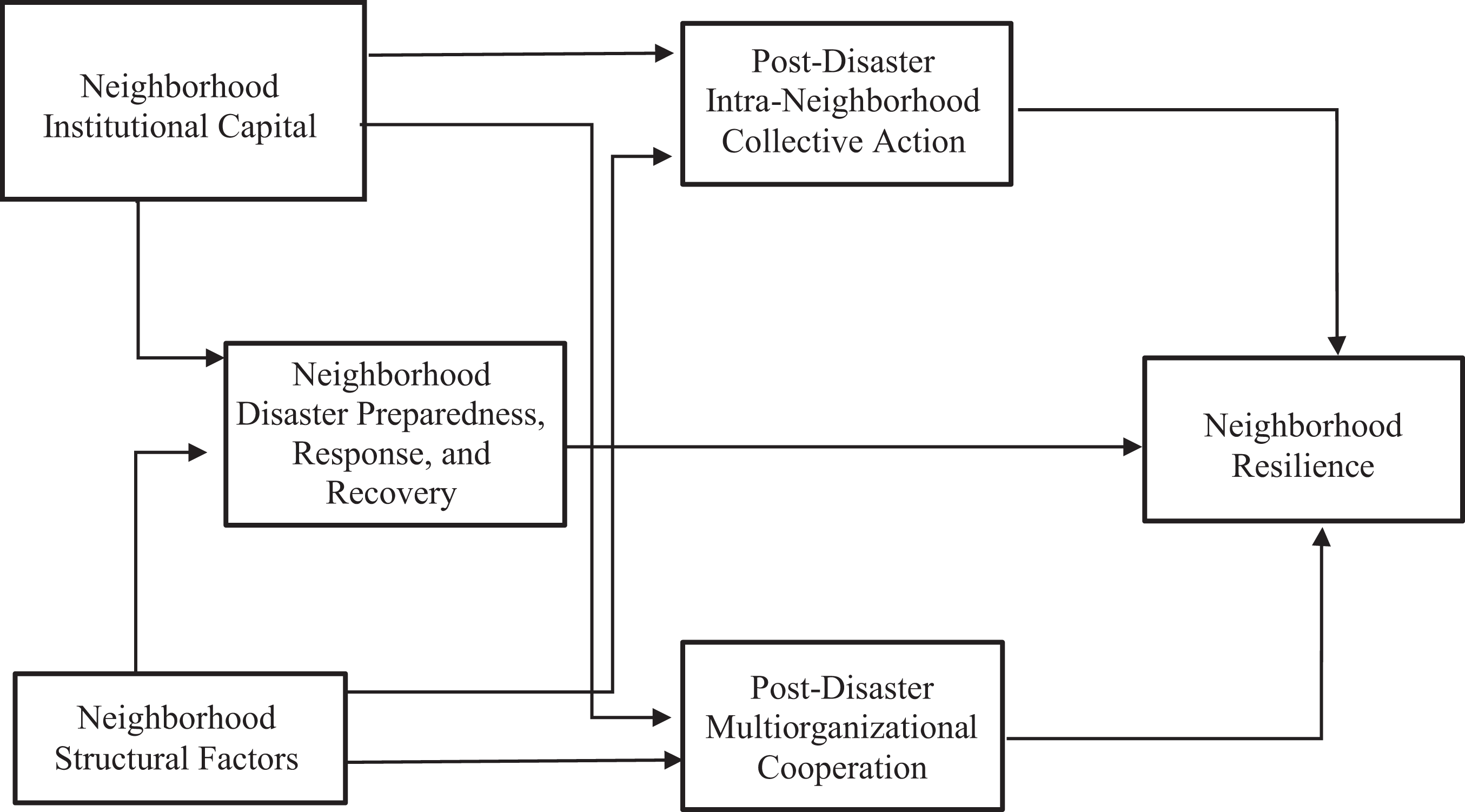
The multiorganizational cooperation and neighborhood disaster resilience framework.
Neighborhood Structural Factors and Disaster Resilience
A significant body of evidence suggests that the capability of a neighborhood to rebuild and recover varies with its social and economic characteristics. Recent studies of neighborhood-level outcomes from Hurricanes Ike in Galveston (2008) and Andrew in Miami (1992) suggest that the income and racial composition of a neighborhood is associated with prestorm preparedness, evacuation times, and with extent of poststorm damage (Peacock et al. 2014; Van Zandt et al. 2012). In their study of four Indiana communities affected by tornadoes in 2012, Sadri et al. (2018) find that social ties and capital are instrumental in the pace of neighborhood recovery.
A significant issue to address is the extent to which neighborhood organizations mitigate (or, perhaps, reinforce) the relationship between social vulnerability and neighborhood recovery. Recent research by Van Zandt et al. (2012) and Peacock et al. (2014) indicates that neighborhoods that are more impoverished, more nonwhite, and/or that face socioeconomic disadvantage also are slower to evacuate during a hurricane, suffer greater damage compared to more advantaged neighborhoods, and are slower to recover following a hurricane. Differences in land use density associated with income may also result in higher amounts of damage as a proportion of land value in lower-income communities (Brody et al. 2011).
Institutional Capital and Neighborhood Disaster Preparedness
A priori, this conceptual framework expects neighborhoods with more institutional capital to exhibit more effective mobilization of intraneighborhood collective action than neighborhoods with less institutional capital. This argument follows from an extensive literature on the effect of institutional arrangements and of social capital on collective action (Axelrod 1984; Ostrom 1990) including those actions addressing neighborhood dilemmas such as crime and social disorder (Sampson 2012). Joint activities within neighborhoods are crucial for the prevention or readiness of a community, effective implementation of plans, and responsiveness to the particular damage and circumstances the neighborhood faces following a coastal disaster. According to Andrew, Jung, and Li (2015), “local involvement is crucial for building local capacities and thus one way to estimate the likely success of emergency responses” (p. 656).
But emergency preparedness imposes significant transaction costs on a neighborhood. For example, voluntary participation in developing a plan in collaboration with local officials or in an initiative such as a Community Emergency Response Team (CERT) poses a classic free-rider dilemma (Olson 1965). Such efforts may have significant collective benefits for a neighborhood’s disaster preparedness but also imposes costs of time, resources, and even risk for participants (such as if participation commits a person to assisting in an emergency). In the absence of tangible incentives for individual participation then, emergency planning meetings may fail to draw significant participation from neighborhood residents.
In addition, information asymmetries in emergency planning may impose significant transaction costs at the neighborhood level. Residents have an understanding of the needs and circumstances facing their neighborhood that emergency planning officials will not typically possess but would be useful in emergency planning. This understanding could include information about the medical needs of members of the neighborhood, the condition of structures, and occupations of neighbors who could be helpful in an emergency (e.g., first responders and medical personnel). Without resident participation and willingness to reveal such information, emergency planning at the neighborhood level could be impeded.
Neighborhood institutional capital, then, could significantly affect the extent to which a neighborhood is prepared for a natural disaster. Neighborhoods with organizations and social relationships that reduce such transaction costs will generally engage, have greater participation, and draw on a wider amount of information. For instance, the North Carolina–based homeowner association support organization, HOA-USA, makes available a model homeowner association disaster plan that HOAs may choose to adopt (HOA-USA n.d.). And a number of city governments and county emergency management agencies, such as Knoxville, Tennessee (http://knoxvilletn.gov/government/city_departments_offices/neighborhoods/activities_and_programs/emergency_preparedness_program) and Pierce County, Washington (https://www.co.pierce.wa.us/2297/Neighborhood-Preparedness), work directly with neighborhood and homeowner associations to develop neighborhood-level emergency response plans. The existence of such preparation indicates that some degree of emergency preparedness planning occurs by way of neighborhood-level organizations. Moreover, prior research finds that social relations cultivated at the neighborhood level contribute to an increase in public trust, which encourages residents to voice their concerns, foster a hazard awareness environment, and highlight the importance of shared risks and responsibility (Comfort et al. 1999).
Institutional Capital and Postdisaster Collective Action
In a similar manner, neighborhoods facing postdisaster response and recovery face numerous collective action dilemmas that affect how quickly they recover and what land use changes they may experience following the disaster event. The immediate aftermath of a disaster exacerbates problems with high transaction costs for a neighborhood, such as crime, public safety, and physical disorder (e.g., damaged property and infrastructure). The sort of watchfulness and caretaking behaviors that limit crime (such as what Jacobs [1961] describes as “eyes on the street”) pose free-rider dilemmas: the collective benefit of increased safety poses individual costs on residents, such as the risk to personal safety from intervening with disorderly behavior or crime (Kang 2015; Skogan 1990). Home repair and maintenance have spillover effects that generate transaction costs: dilapidated properties signal disorder that may reinforce crime (Wilson and Kelling 1982), while home improvements may enhance property values for one’s home and the homes of one’s neighbors (Galster 1987; Hoover and Vernon 1959). Moreover, disasters change the physical and social landscape of a neighborhood. In many cases, disasters result in vacant land, generating new land use dilemmas (Pais and Elliott 2008). Research by Pais and Elliott (2008) indicates that neighborhoods more greatly damaged by a hurricane are more vulnerable to gentrification and other land use changes that may reinforce social disadvantage. In many cases, such land use changes may have effects on the native residents of a neighborhood that make it difficult for them to restore the predisaster state of the community.
As a result, neighborhoods with high institutional capital can be expected to better manage the collective action dilemmas that emerge following a disaster. Existing literature on the role of neighborhood organizations and social ties in managing neighborhood crime and disorder suggest that institutional capital typically reduces the transaction costs to crime prevention, for instance, by making it easier for third parties to intervene when witnessing disorderly conduct (Roos et al. 2014). In addition, neighborhood organizations and well-developed social networks provide ways to more quickly mobilize response and to more efficiently integrate external resources given their credibility and proximity to their member constituents (Fischer, Stahl, and Baird-Zars 2018). Those neighborhoods with less developed institutions might be expected to need additional assistance and resources to recover, and perhaps, strategies that rely less on neighborhood efforts. Go (2014), for instance, finds that better organized neighborhoods received prompter attention and more resources from local government in post-Katrina recovery in New Orleans. Yet, those well-developed neighborhoods, especially those adjacent to neighborhoods with less developed institutional standing, can provide additional institutional and logistic support for coastal disasters.
Neighborhood organization also is shown to reinforce local community resiliency (Gazley 2008; Jung and Minsun 2014). As well, the culture of volunteerism within neighborhoods influences residents’ decisions to positively respond to disasters, that is, engage in voluntary groups or activities (e.g., National Voluntary Organizations Active in Disaster, Citizen Corps and CERT, Mennonite Disaster Service, Samaritan’s Purse). In the literature on cross-sector collaboration, scholars argue for the need to recognize the importance of nonprofit sector contribution to disaster recovery assistance (Eller, Gerber, and Robinson 2018). The inclusion of local nonprofit organizations in disaster recovery can offset administrative failure during response (Jenkins et al. 2015; Simo and Bies 2007). Furthermore, cultivated social relations contribute to an increase in public trust that allows residents to voice their concerns, fosters a hazard awareness environment, and highlights the importance of shared risks and responsibility (Aldrich and Meyer 2015; Comfort et al. 1999).
A related issue to this is the possibility that the effect of neighborhood structural factors on resilience may be mediated by neighborhood institutional arrangements. The extant literature on neighborhood governance suggests that neighborhood organizations may significantly mediate neighborhood outcomes. For instance, in a recent analysis, Craw (2019) finds that neighborhood and homeowner associations significantly mediate the relationship between neighborhood racial and ethnic composition and property values. Moreover, these associations do so in differing ways: neighborhood associations tend to reinforce racial effects, while homeowner associations reduce them. Neighborhood organizations are in a position to advocate for resources for their communities, which may boost recovery in those communities that are organized but reinforce differences that exist between organized and unorganized neighborhoods (Fischer, Stahl, and Baird-Zars 2018). Neighborhood organizations are also significant participants in land use decisions that may affect the nature of postdisaster redevelopment and who such development benefits. Such considerations suggest that neighborhood institutional arrangements may moderate neighborhood outcomes in the postdisaster recovery process.
Neighborhood Institutional Capital and Cross-community Collaboration
The role neighborhood-level organizations play in facilitating cross-community collaboration is likely to significantly affect local disaster resilience. Feiock’s (2013) Institutional Collective Action (ICA) framework provides a set of testable propositions for collaboration between nonprofit and governmental organizations (Jang, Feiock, and Saitgalina 2013). In fact, this framework has recently been applied to study organizational networks developed during disaster response (Andrew et al. 2016; Jung and Minsun 2014); yet, no research evaluates the ICA’s efficacy in explaining or defining ad hoc collaboration in disaster response networks at the neighborhood level. In this case, some of the institutional capital may be emergent and some of it may be imposed, that is, cross-neighborhood organizations, which are supported by patrons or by local governments, encourage collaboration.
Cross-community collaboration is more useful in disaster situations than the status quo for several reasons. First, a cross-community collaboration highlights the importance of interdependency of local institutional organizations in disasters. Interdependency requires organizations to build trust and legitimacy. Kapucu (2008), studying four Florida hurricanes in 2004 (Charley, Frances, Ivan, and Jeanne), suggests that predisaster planning affects disaster response via open communication and the use of technology between major stakeholders (elected and appointed officers) and emergency responders. Moreover, cross-community collaboration in disaster preparedness provides residents and their leaders with training and experience in handling disasters or emergencies, including how best to deal with planning for disasters, and defining the roles in an emergency situation. Scholars have argued that through training and outreach activities, local residents and their leaders can better see their own role in dealing with disasters.
Second, consistent with the community emergency planning literature (see Lindell and Perry 1992; Perry and Lindell 2003), a cross-community collaboration means local leaders and residents must take an active role in disaster response planning. Joint community projects developed through a cross-neighborhood collaboration can assist neighborhood organizations and residents in developing a plan that take into account a wider geographical space. Local residents can learn from public agencies and other communities. Cross-neighborhood collaborations also extend the importance of shared governance in community disaster planning particularly the responsibility of boards of directors, staff, and residents. Neighborhood leaders are expected to work closely with municipal agencies and with other neighborhoods before and after disasters. Due to the nature of disaster response, we expect neighborhood leaders to be available during planning as well as during response and recovery stages of disasters. As pointed out by Alexander (2005), “in today’s complex world it is hard to see how the public can be protected adequately unless it takes some responsibility for its own security, as the task is simply too great for civil administrators to accomplish alone” (pp. 171–72).
Third, cross-community collaboration provides a way for local organizations to pool a diverse set of resources (tangible and intangible) together in order to augment their preparation for, response to, and recovery from a disaster. Robinson et al. (2013) in their study of network governance find that collaboration across a diverse set of organizations from various disciplines (public health, law enforcement) at different levels and sectors of governments is important when planning for disaster response. Emergency response can be enhanced when emergency preparedness activities across organizations are integrated. Such an integration encourages active participation among various stakeholders who can build trust, increase knowledge, and contribute to disaster response and recovery. While government agencies often take on the center role or “positioned at the core” during disaster response, neighborhood organizations at the peripheral also perform important function. These organizations work closely with voluntary organizations such as the Red Cross and other national relief organizations that are embedded in local communities and neighborhoods.
Approaching Analysis of Multiorganizational Cooperation
The ultimate outcome of interest in this analysis is understanding neighborhood resilience, that is, the capability of a neighborhood to rebuild and recover from an adverse event such as a coastal disaster (NRC 2014). As a concept, resilience is “the ability to prepare and plan for, recover from, or more successfully adapt to actual or potential adverse events” (NRC 2014, 19). The concept is of widespread interest with the adoption of the Hyogo Framework for Action 2005–2015, which called for building the resilience of nations and communities to disasters (Manyena 2006). The concept has been extended in the “Sendai Framework” for Disaster Risk Reduction 2015–2030. While disaster researchers have developed numerous indicators to measure resilience within the past decade, few agree on what and how the term should be measured (Norris et al. 2008). Yet, common dimensions of resilience are broadly classified as ecological, social, economic, institutional, infrastructure, and community competence (Cutter, Burton, and Emrich 2010; Manyena 2006; Morrow 2008).
Given the literature and the importance of neighborhood-level organization in multiorganizational cooperation, a few research propositions are offered to lead research on this topic; these are: Neighborhoods with greater institutional capital (i.e., organizations and social relationships that reduce transaction costs to collective action) experience greater intraneighborhood collective action and thus respond more effectively to disaster recovery problems. Neighborhood organizations that are more deeply embedded in relationships with local government and emergency management agencies before disasters more readily collaborate with local government and recovery organizations on disaster recovery efforts. Neighborhood organizations that are more deeply embedded in relationships with other neighborhood organizations before disasters more readily collaborate with other neighborhood organizations on disaster recovery matters. Neighborhoods with greater degrees of institutional capital develop more complete prestorm readiness plans and collaborative emergency management relationships than those that are less organized. Neighborhood organizations reduce the effect of social vulnerability on coastal disaster resilience.
The FEMA’s (2011) “Whole Communities” strategy calls for integration of community-level organizations and stakeholders into disaster preparedness and recovery. Research into local, neighborhood-level emergency preparedness, response, and recovery would provide insight into the extent to which institutions at the neighborhood level are integrated into existing systems for disaster planning and response. All indications are that state governments continue to struggle with integrating sublocal governance into disaster response planning. For instance, North Carolina’s experience in 2016 with Hurricane Matthew did not result in preventive measures implemented at the local level to mitigate hurricane damage (North Carolina Department of Public Safety 2017). Research here then can provide much needed information for state, local, and tribal officials on an often-overlooked dimension to “Whole Communities”: the neighborhood.
More generally, finding that neighborhood organizations and institutional capital are vital resources in disaster recovery would have significant implications for how to prioritize resources following a disaster. Neighborhoods in which institutions are well developed could be expected to mobilize response more quickly and to more efficiently integrate external resources. Those with less developed institutions might be expected to need additional assistance and resources to recover and perhaps strategies that rely less on neighborhood efforts. Most importantly, finding that neighborhood organizations help to mitigate the costs of a disaster to socially vulnerable neighborhoods would open new approaches for enhancing resilience in these neighborhoods. Such a line of research would be of particular importance for communities that lack resources and thus are likely to rely on collaboration with organizations coordinating recovery.
Footnotes
Declaration of Conflicting Interests
The authors declared no potential conflicts of interest with respect to the research, authorship, and/or publication of this article.
Funding
The authors received no financial support for the research, authorship, and/or publication of this article.
