







Abstract
The authors examine whether there are geographic biases in public administration research. They use a dataset of 557 research articles from top public administration journals in which specific state names appear in the title or abstract. Findings suggest that not only is a mass of public administration research concentrated in four states (Florida, California, New York, and Texas), but specific thematic topics and policy areas are associated with each of those states. In general, this suggests that authors need to consider if continuing these trends creates a blind spot for research bias in the field, where the collective understanding of a specific topic is disproportionately influenced by data from a single state. The broad implications are that how states serve as a research setting should be actively considered by authors.
Reviews of public administration research occur sporadically. Typically, they come in the form of meta-analyses or literature reviews aiming to identify trends within specific topical areas (e.g., McGuire 2006; O’Toole 2015; Kapucu, Hu and Khosa 2017) or involve scholars taking an introspective look at research trends in order to understand the direction of the field (e.g., Raadschelders and Lee 2011; Adams et al. 2014; Raadschelders et al. 2018). Typically, these reviews are used as a basis to identify shortcomings of the literature in general and set out an appropriate research agenda moving forward. However, missing from these reviews is consideration of trends related to states as research settings and whether the field has inadvertently oversampled data from a handful of states. Particularly for public policy and administration, institutional arrangements synonymous with geographic boundaries create distinct research settings in as far as states often have unique political and/or bureaucratic cultures. In fact, many scholars argue that states create natural experiments in how government functions (i.e., laboratories of democracy), which is likely why state governments are a popular unit of analysis (Brace and Jewett 1995; Woods 2021).
While national studies that incorporate data from all 50 states are common, it is also common for scholars to focus on one or a few states when asking specific research questions that lend themselves to a more confined geographic setting or institutional level, or to analyze a unique case. This does not present a research issue in and of itself, as case studies and other forms of single state studies can often make significant contributions to the field (Bailey 1991). However, the lack of coordination does have the potential to create biases in as far as a few states can form the basis of knowledge that is generalized across all states, even though other states may function differently based on political, socio-economic, or institutional dimensions (Jensen and Rodgers 2001). For instance, how well do lessons from Florida apply to South Dakota? What if the majority of our knowledge on a particular topic comes from Florida? The issue of a state-based geographic bias in public administration research is both intriguing and potentially troubling, as it draws new questions about whether there is adequate data and analyses to come to conclusions about the underlying truths of public administration.
Though the question of state-level geographic bias in public administration has not previously been taken up, other social scientists examine geographic bias and its causes and impacts. However, these studies tend to focus on the international, rather than the U.S. domestic. For instance, Skopec et al. (2020) explores the effects of national income on research publication and citation rates, and finds that North America and Europe receive 42.3 percent and 35.3 percent of the world's citations, respectively, while citations from research based in Africa, South America, and Oceania receive less than 5 percent of global citations combined. In general, these studies conclude that economically prosperous regions are more likely to draw attention from researchers (e.g., Meijaard et al. 2015; Skopec et al. 2020), and that geographic proximity between researchers impacts citation rates and knowledge flows (e.g., Fontana, Montobbio and Racca 2019; Wuestman, Hoekman and Frenken 2019). Specifically, in regards to the latter point, Abramo, D’Angelo and Di Costa (2020) argues that geographic proximity often correlates to field-knowledge or cognitive proximity, suggesting that scholars in similar topical fields may be located near each other and rely on data from similar regional areas. In general, this literature leads us to believe that geographic bias in state-level research likely exists and has important implications on the knowledge flow of public administration scholarship.
Thus, we ask: is public administration research well distributed across states, or does a mass of research on any particular topic come from just a few? The goals of this field note are to answer this question and consider its implications. In order to do so, we use a dataset of 557 research articles from top public administration journals in which specific state names appear in the title or abstract. Our findings suggest that not only is a mass of public administration research concentrated in four states (Florida, California, New York, and Texas), but specific thematic topics and policy areas are associated with each of those states. In general, this suggests that authors need to consider if continuing these trends creates a blind spot for research bias in the field, where the collective understanding of a specific topic is disproportionately influenced by data from a single state. The broad implication is that how states serve as a research setting should be actively considered by authors.
Methods & Findings
To examine this further, we constructed a dataset of articles for which specific states are a key aspect of the research setting. To do so, we conducted abstract and title searches using each state as a search term in eight general topic public administration journals: Administration & Society, American Review of Public Administration, Governance, Journal of Public Administration Research & Theory, Policy Studies Journal, Public Administration Review, Public Administration, and Public Management Review. We also include a ninth journal, State & Local Government Review, that specifically focuses on public administration issues at the state-level. We confined our search to articles published between 2000 and 2020. While this may not include every article in which the research setting is a single state or a comparison between a few states, it does include those in which the research setting was germane to the research, given that the authors specifically draws the reader's attention to that element in the title or abstract. We focus on general topic journals but also include the primary state focused journal in order to gain a broad perspective of how the field uses states as a research setting,
Importantly, this dataset is not confined to states as the unit of analysis, rather it is focused on states as a research setting. As many public administration scholars know, in the U.S., states create natural boundaries to a research setting that is important for economic, political, and social life and that correlate with institutional arrangements. Thus, what we are focused on here is whether some states make for more popular research settings than other states. As such, a variety of units of analyses are employed, including local governments or citizens, but in these cases, the research setting of a specific case is often an important contextual factor for the examination. For example, an article might examine citizen satisfaction with government services in Georgia (e.g., Poister and Thomas 2011) or assess local government sexual harassment policies in Michigan (e.g., Reese and Lindenburg 2002). In both cases, the states in which those studies are set provides context to the findings, but also creates biases because it means that one must extrapolate findings to other states with different economic, political, or social institutions.
This approach originally yielded 794 articles. Through an initial review, we removed book reviews, essays, and entries in which state names were used in a way that was irrelevant to the actual state (e.g., in reference to a university affiliation or an individual's name). Additionally, 58 articles contained more than one state name in the title or abstract. Thus, our final dataset included 557 unique articles with individual states examined 645 times. California (64), Florida (62), New York (78), and Texas (51) were the only states with more than 40 articles each, while South Dakota was the least common with zero entries (see Figure 1). Of course, it is not surprising that states with large governments and large populations would attract more attention from researchers than smaller states, due to both issues with sample sizes (i.e., it can be harder to collect an adequate sample size from smaller states) and the availability of data (i.e., large states often collect and publish more data). However, it is somewhat surprising that the four most examined states appear in approximately as many articles (255) as the 40 least examined states (262). Thus, one can quickly surmise that public administration research is not equally distributed across the country.
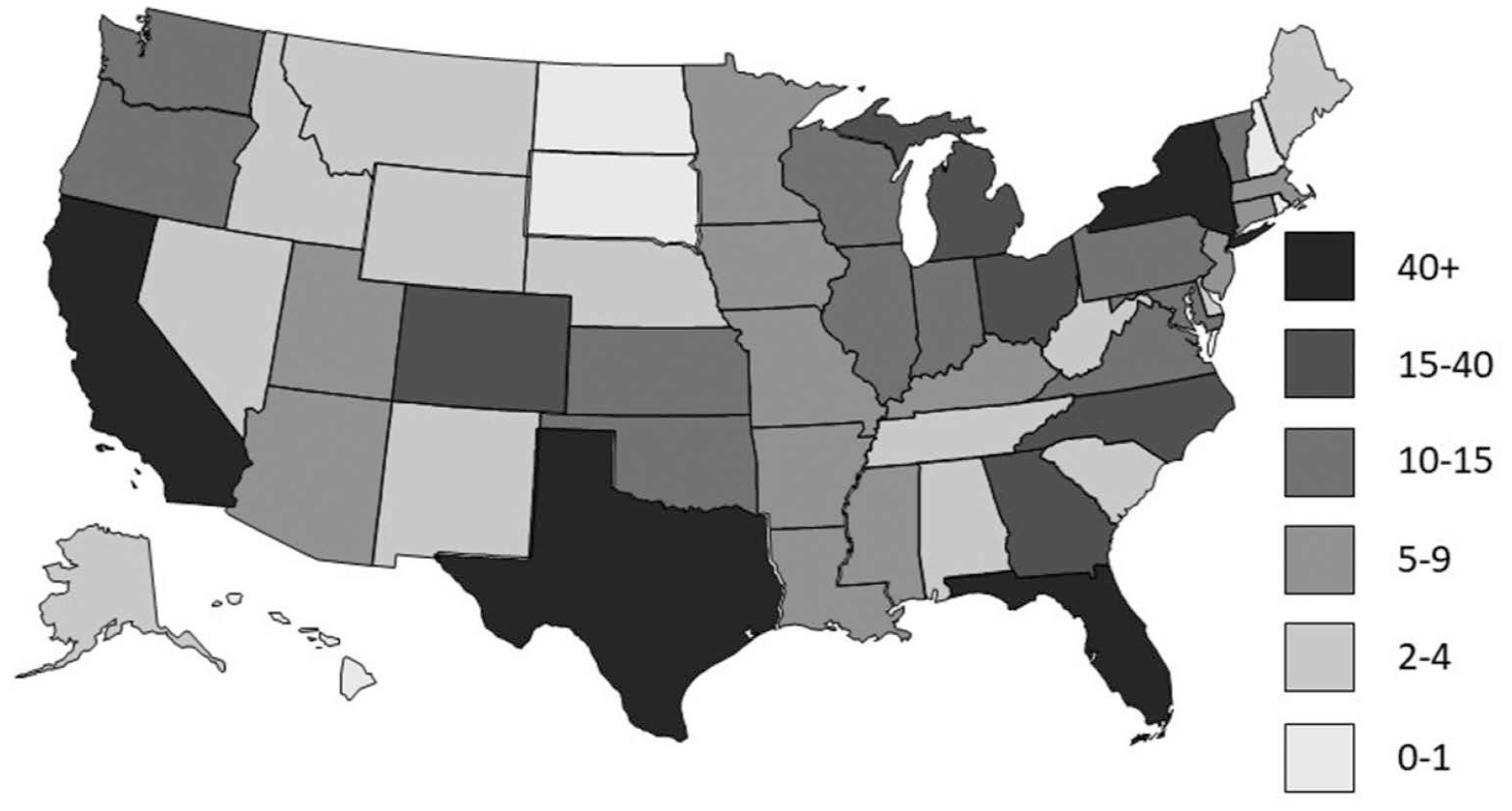
Article Count by State.
Given that we are interested in whether specific types of research questions are most likely to be answered using data from specific states, the purpose here is to identify how thematic and policy areas overlap with states. Thus, to add depth to understanding how states serve as a research setting, we use a three-step coding method. In the first step, we reviewed abstracts for each article making notes on the research settings, research questions, theoretical frameworks, methodologies, and other notable features. In the second step, we used an iterative approach to reduce those notes into a list of functional categories based on thematic and policy issues. We initially began with a large number of codes based on the terminology used by authors. In the third step, we reduced the number of codes by looking for commonalities. For instance, we condensed articles that examine citizen preferences or beliefs with those that examine administrator preferences or beliefs, because both sets of articles are related to the preferences or beliefs of a specific population that is defined by state boundaries. Of course, neither thematic nor policy area codes are mutually exclusive, and some articles were coded as falling into multiple categories. For example, an article on pandemic response was coded as being both an issue of emergency management and public health/healthcare.
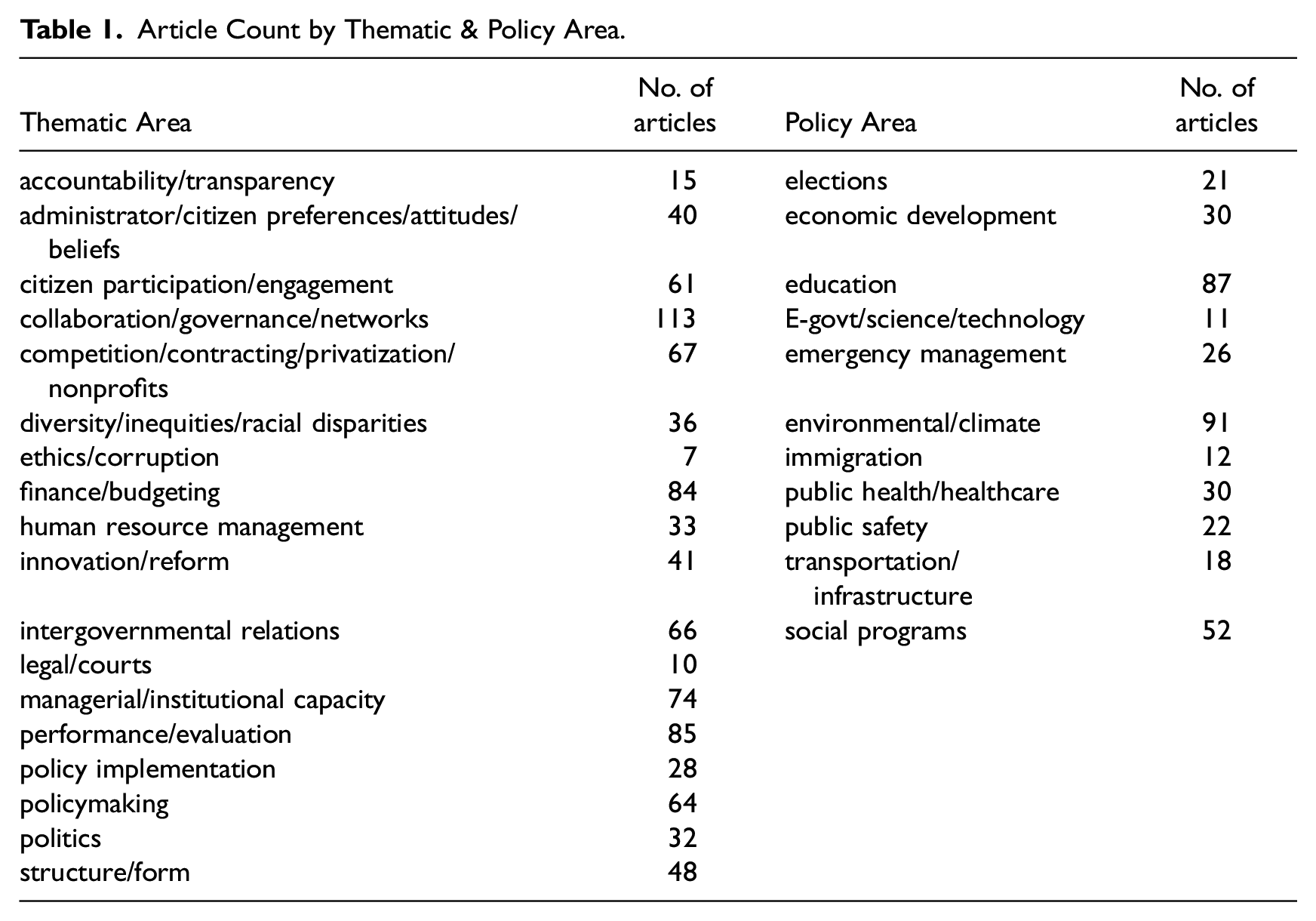
With this approach, we developed a list of 18 thematic and 11 policy areas. See Table 1 for a distribution of articles across subtopics, and the supplemental online appendix for a distribution of subtopics across states. Based on our coding, we identified outliers in which a concentration of articles on a specific theme or policy area were focused on a single state or a few states. Specifically, we looked for states in which the actual number of articles in our database was at least twice as high as the expected number of articles, based on the averages for both the state and topic. 1 In other words, we looked for incidences in which there are twice as many articles about a specific topic set in a specific state than what one would normally expect based on the distribution across the dataset. 2 We use averages in order to control for the natural propensity for more articles to be written about a few states; that is, more articles are certainly written about California than most states, but that is not particularly meaningful unless there is also a concentration of articles about California within a specific thematic or policy area. We use a multiplier of two to reduce the probability of including state/area concentrations that are biased by a small number of articles. Table 2 sums up these findings for thematic and policy areas, respectively.
Article Count by Thematic & Policy Area.
Article Concentrations by State & Thematic/Policy Area.
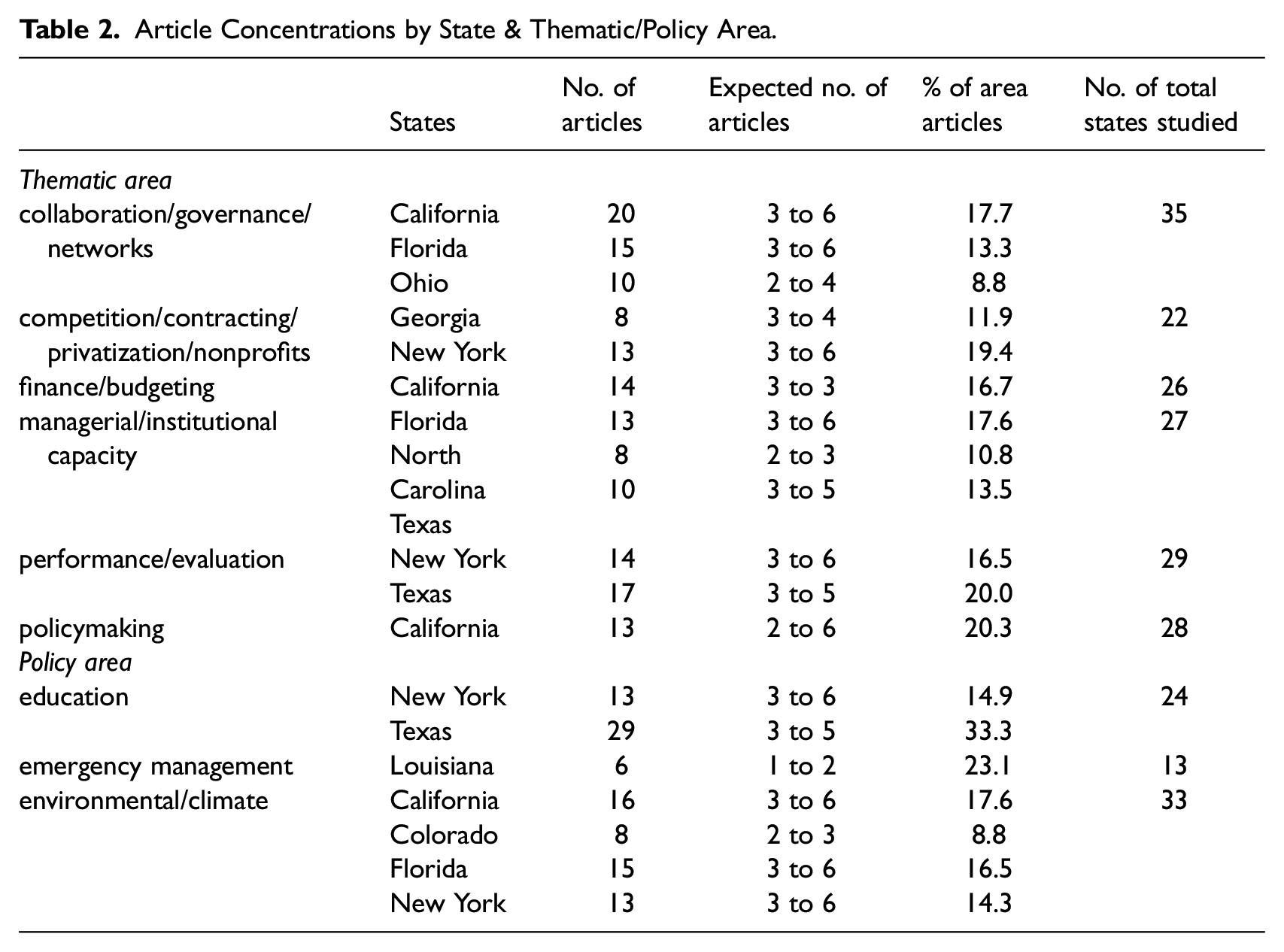
Three general points stand out from this analysis. First, for the most part, research is relatively well distributed across states, in terms of both thematic and policy areas. Out of the 18 thematic areas, we only identified six in which research is concentrated in a few states, and out of 11 policy areas, we only identified three. Additionally, we only identify nine states in which there is a concentration of research on a specific area/issue. Taken as a whole, this would suggest that overrepresentation of a few states is not prevalent across public administration research. In other words, research is distributed across states largely as expected for most thematic and policy areas. But, within specific areas, there is a notable amount of bias towards specific states. For instance, of the 113 articles on collaboration, governance, or networks, 40 percent are set in three states (California, Florida, & Ohio) while the other 60 percent are set in 32 other states, and of the 85 articles on performance or evaluation, 36.5 percent are set in two states (New York & Texas) and 63.5 percent in 27 other states. Additionally, of the 87 articles on education policy, 48.2 percent are set in two states (New York & Texas) and 51.8 percent in 22 other states, and of the 91 articles on environmental/climate policy, 57.2 percent are set in four states (California, Colorado, Florida, & New York) and 42.8 percent in 29 other states.
Second, of those states that make up more than their fair share of research in specific areas, the usual suspects keep popping up: Florida, California, New York, and Texas. Thus, not only do these four states make up a significant portion of articles in our dataset, they also make up a significant portion of articles on specific subjects. As previous literature suggests that large, wealthy regions are often over-studied in comparison to smaller, poorer regions, it would make sense for these states to be well represented in our dataset, but that does not quite explain why this only applies for certain thematic or policy areas and not others. Additionally, quantitative versus qualitative methodologies tend to vary by state with no clear trend as to what may be driving interest in these states. While around three-fifths of articles in the dataset used some form of quantitative methodology, this ranged from about three-quarters in Texas to about one-fifth in New York, indicating that quantitative methodologies are more popular to apply to some states and qualitative, for other states. Nevertheless, far fewer studies set in the big four states are framed as case studies, with about one-fifth of articles using a case study approach in the dataset as a whole compared to less than one-tenth in the four most popular states for research.
Third, there is an interesting correlation between the number of articles on a thematic or policy area and the concentration of articles within a specific state. Specifically, the thematic and policy areas listed in Table 2 are also the most studied areas in our dataset. On its face, this likely suggests that the articles concentrated in certain states are not displacing studies set in other states, but exist in addition to them. One dimension of this may be specific authors or research teams that are producing publications focused on particular research questions or datasets. For instance, Ken Meier is credited on ten articles set in Texas, most of which use education as a test case for public management theories, and Rick Feiock, on nine articles set in Florida that address an array of issues related to governance, collaboration, and networks; this should be unsurprising given the proliferation of both authors (e.g., Metz and Jackle 2017). There are a number of additional authors, either alone or in teams, across the dataset that have produced multiple articles set in the same states on the same topics. This may indicate that an abundance of research set in specific states on specific topics is being driven by a small number of prolific scholars and their co-authors.
Discussion & Conclusions
While our results are highly intriguing, they are not necessarily surprising in some ways. Scholarship on geographic bias points to regional and national wealth as a strong indicator of where disparities lie in research settings. We see a parallel phenomenon here as previous scholars examining geographic biases in research find that the wealthiest regions often get more attention than the least wealthy regions (e.g., Skopec et al. 2020). For U.S. states, this means that California, Florida, New York, and Texas, as the states with the largest economies (36 percent of 2020 U.S. gross domestic product) and populations (33 percent of 2020 U.S. population) (U.S. Bureau of Economic Analysis 2022), get the lion's share of attention from scholars in public administration, or at least, those who confine their studies to a specific state or states. Certainly, most seasoned scholars would argue that these are among the easiest states to study. But, in other ways, our findings do identify some unique trends that may be somewhat unexpected. Specifically, it appears that scholars prefer some states as settings to study certain thematic or policy issues, but not others. Of course, it remains unclear if these states are particularly well-suited to these questions or if it has just been more convenient to examine these questions with data from these states.
So, why then are Florida, California, New York, and Texas so interesting? Or, more precisely, why is collaboration, managerial capacity, and environmental policy so interesting in Florida, and performance and education so interesting in Texas? Do the answers to these questions also tell us why contracting and privatization in Georgia or emergency management in Louisiana are so interesting as well? The most likely explanations here are either that data availability makes these topics easier to study in some states as compared to others or that something particularly innovative is happening that specifically draws the attention of scholars. A more in-depth look at articles indicates that both explanations may be true to a certain extent. For instance, around two-thirds of the studies on education policy set in Texas seem to draw from datasets managed by the Texas Department of Education; in contrast, about half of environmental policy studies set in Florida are case studies surrounding collaborative water management systems throughout the state. While one is not a normatively better or worse reason to choose a research setting than the other, the difference is important for understanding why certain patterns of research emerge.
In-state authorship is also an intriguing dimension here. Certainly, there are more research-intensive universities in California, Florida, New York, and Texas than in most other states. If scholars are more likely to study their own states, then this could partially explain these patterns. On average, 59 percent of articles have at least one in-state author, but in California, in-state authors wrote 56 percent of articles, in Florida, 58 percent, in New York, 63 percent, and, in Texas, 61 percent. Notably, in-state authorship is essentially the same in the other 46 states. Based on that, geographic biases are not likely precipitated by the presence of more researchers in those states. Rather, it seems that a little more than half of authors are coming from in-state, meaning that there is still a significant portion of authors that are choosing to focus on states other than their own, and those four states happen to be popular choices. Furthermore, there are some states that are only written about by in-state authors (e.g., Idaho) and other states that are completely ignored by in-state authors (e.g., Alaska); however, given that most states have less than 10 articles, we cannot determine whether this is representative of trends related to specific states or just coincidence. While this does not account for researchers who did graduate work in one state and then moved to another, it does suggest that there is something more going on here than where authors are located.
Although in-state authorship may not be driving choice in states as a research setting, certainly, there is a pragmatic calculus to balancing the amount of work invested in a project and the probability that it gets published. Economies of scales and scopes often mean that larger states with urban areas are more likely to evolve in a way that is both interesting to scholars and telling about the functions and forms of government. Furthermore, the policy innovation and diffusion literature would also tell us that larger, high profile states often set the bar for innovation, with smaller states following their lead (Beery and Berry 2018). This would suggest that focusing on trend-setting states would be a practical manifestation of the want to study innovation and progress, foundational concepts in the study of public administration (e.g., Fry and Raadschelders 2013), and as an attractive selling point to journal editors or reviewers interested in publishing materials that will be read, cited, and have an impact. Obviously, this means that part of this geographic bias is due to prevailing socio-political and economic patterns as well as the prevailing norms of academic publishing that are unlikely to shift, leading to a question of whether this can be resolved in any meaningful way.
The primary concern here, though, is that the field's knowledge base has become or is becoming geographically biased towards a handful of states. While drawing parallels with research biases in relation to race or gender is inappropriate as biases in those cases have much more important implications for academia and society (e.g., Dion, Sumner and Mitchell 2018; Pritchard and Waklid 2021), many of the same questions and concerns that exist there also exist here, such as those surrounding the entrenched marginalization of certain populations and the fortification of power differentials between those in the in- and out-groups. Of course, in the cases of race or gender-based biases, scholars are less and less willing to accept answers limited by pragmatic concerns or institutional barriers when those answers fail to tell the full story. Moreover, geographic bias may also be particularly important at the current political moment. Given the angst directed at governments in general and academia in specific (e.g., Cantwell 2021) by populations in rural states that are often left out of the research record, this may be an imperative time to turn our focus towards places where people are most likely to question the legitimacy and functions of democratic governance, in order to both better understand the relationship between the people and the government in these places and to make these populations feel heard by the academy.
Additionally, there is an element of competition and its impacts on the advancements of the field that should be considered, specifically competition between scholars. On one hand, focusing on a small set of datasets or cases is a key avenue in which scholars are driven to ask new, innovative, and interesting questions. That is, scholars have to be innovative in thinking of new questions when using data that has already been used to answer the obvious questions. On the other hand, expanding research to incorporate new datasets or cases opens the door to expanding knowledge by applying the same questions and theories to new data. Innovation here plays out chiefly through methodologies, but theoretical contributions are equally as important. Both of these represent pathways by which administrative and policy theory develop and expand. However, the former also advantages scholars who have access to and expertise in these datasets or cases, while the latter opens opportunities for emerging scholars to make contributions to the field. Thus, geographic biases may be a manifestation of the entrenched power structures across public administration that encourage students to follow the lead of their mentors, which inevitably cuts some off from established avenues to success (i.e., Brewer et al. 1999). Of course, this also connects back to research teams and whether some of the geographic biases here are driven by a small group of prolific authors and their colleagues who benefit from access and connections.
Given these implications, we have four recommendations for remediation in the broader research agenda. First, and most importantly, scholars should think intentionally about why their research is set in the states that it is and the implications for the field as a whole in terms of producing geographically representative knowledge (i.e., Raadschelders 2011). Specifically, the question of “why does this state make a good research setting?” should be brought to the forefront, and scholars should consciously grapple with how much convenience is driving their choices. Of course, this is not to say that scholars should be penalized for or avoid research because it is convenient. It is to say that scholars should be honest and intentional about it, think through the implications, and at minimum, make recommendations for research strategies to extend their work into inconvenient places. This, in itself, is likely to move the field forward in being more conscious of geographic biases and its implications. Second, journal editors should consider special issues that focus on understudied states or regions, particularly at the nexus with specific theme or policy areas (e.g., emergency management in the Mountain West, or election administration in rural states). This would provide incentive, opportunity, and legitimacy to pursuing research focused on states receiving less attention.
Third, scholars should undertake meta-analyses, that would allow one to control for various factors such as socio-politics, to determine how the sampling bias issue has potentially impacted conclusions about various sub-topics. Additionally, scholars should consider using inter-state comparison as a robustness check, which would reduce the likelihood that observations from a single state become out-sized in the knowledge base and that a few states proliferate as research settings (e.g., Nie 2004 or Reich and Barth 2010). This may be particularly important for continued studies of California, Florida, Texas, and New York, so that data from those states is held in comparison to less studied states. Finally, authors should also consider new methodologies that are not limited by data availability or sample sizes, so these do not continue to serve as an impediment to studying small states. This could be achievable, for instance, through qualitative approaches where smaller n-sizes are counterbalanced with observational depth (e.g., Fitzpatrick et al. 2011). With respect to interview methods, the transition to telecommunication as a standard meeting venue since the presence of COVID-19 may make qualitative investigation in underrepresented states easier than it ever has been before. We believe a combination of these efforts is likely to produce the type of geographic diversity that would not only improve the knowledge base for other public administration scholars, but could also improve how practitioners engage with scholarship by seeing that there is research that hits close to home for everyone.
Supplemental Material
sj-docx-1-slg-10.1177_0160323X221110484 - Supplemental material for Is Florida Really that Interesting? State Geographic Bias in Public Administration Research
Supplemental material, sj-docx-1-slg-10.1177_0160323X221110484 for Is Florida Really that Interesting? State Geographic Bias in Public Administration Research by Luke Fowler and Dalten Fox in State and Local Government Review
Footnotes
Declaration of Conflicting Interests
The author(s) declared no potential conflicts of interest with respect to the research, authorship, and/or publication of this article.
Funding
The author(s) received no financial support for the research, authorship, and/or publication of this article.

Supplemental Material
Supplemental material for this article is available online.
Notes
Author Biographies
References
Supplementary Material
Please find the following supplemental material available below.
For Open Access articles published under a Creative Commons License, all supplemental material carries the same license as the article it is associated with.
For non-Open Access articles published, all supplemental material carries a non-exclusive license, and permission requests for re-use of supplemental material or any part of supplemental material shall be sent directly to the copyright owner as specified in the copyright notice associated with the article.
