







Abstract
This article presents the findings of a survey of unionized professors and professional librarians at a public university in Southern Ontario to examine their views on the prospect and desirability of “right-to-work” legislation and “paycheck protection” laws. The purpose of the study is twofold: first, to assess the level of opposition to such legislative initiatives among unionized faculty, and, second, to determine the extent to which the passage of such laws would undermine the dues base of the faculty union. Based on the findings of a mixed methods survey, we found that a strong majority of the university professors and professional librarians surveyed were opposed to “right-to-work” and “paycheck protection” laws and that their passage would not deter them from paying dues or authorizing expenditures for political action.
Introduction
As part of a growing wave of antiunion labor law reform in North America, right-wing politicians and their allies in many jurisdictions have proposed and, in some cases, implemented so-called “right-to-work” and “paycheck protection” laws. The passage of such legislation in border states in the United States has sent off alarm bells north of the border, where labor laws are comparatively more hospitable to unions. As one of the most densely unionized sectors in Canada (Dobbie and Robinson 2008), university workers and their unions have much to lose from the introduction of antiunion labor law reforms.
This article presents the findings of a survey of unionized professors and professional librarians 1 at Brock University, a public university in Southern Ontario, to examine their views on the prospect and desirability of “right-to-work” legislation and “paycheck protection” laws. The purpose of the study is twofold: first, to assess the level of opposition to such legislative initiatives among unionized faculty, and, second, to determine the extent to which the passage of such laws would undermine the dues base of the faculty union. Based on the findings of a mixed methods survey, we found that a strong majority of the university professors surveyed said that they were opposed to “right-to-work” and “paycheck protection” laws and that their passage would not deter them from paying dues or authorizing expenditures for political action.
“Right-to-work” laws essentially allow workers in unionized workplaces to opt out of paying union dues. While “right-to-work” laws purport to enhance worker democracy by giving unionized employees a choice to withhold dues and are said to fuel job growth (see, for example, Robinson 2014), such laws severely undermine workers’ collective power in the workplace and society more generally and fail to deliver the promised economic growth (see, for example, Lafer 2013). Under “right-to-work,” unions are no longer assured a steady and predictable income stream. Unions, however, must still offer their services (“duty of fair representation”) to members of the bargaining unit who choose not to pay their dues. This is commonly referred to as the “free rider” problem. “Right-to-work” laws are supported by many employer groups, right-wing think tanks, and neoliberal political parties because their implementation undercuts the growth and power of labor unions, one of the few institutions capable of effectively challenging corporate power in advanced capitalist democracies.
The term “right-to-work” was first used in 1941 by William Ruggles, a journalist for the Dallas Morning News who was worried that the growing power of the labor movement would not stop until all workers were union members (Kaufman 2015, MM43). The Taft-Hartley amendment to the National Labor Relations Act (NLRA, also known as the Wagner Act) in 1947 paved the way for “right-to-work” laws by granting states the right to bring in legislation outlawing union security clauses in the form of both closed shops and union shops. In closed shop workplaces, only union members can be hired, and in union shops, membership in the union is a requirement of continued employment. “Right-to-work” laws first gained ground in the Southern United States and plain states, as both a way to entice northern manufacturers to relocate, and as a way to disorganize working class organizations and interests (Canak and Miller 1990; Dixon 2007). Historians have also noted a racist element in “right-to-work” laws, which were viewed by employers and lawmakers as a way of decreasing pan-racial solidarity (Kahlenburg and Marvit 2012). “Right-to-work” was first championed by the racist Christian American Association whose leader Vance Muse warned against the effects that unions would have on racial interaction, claiming that “white women and white men will be forced into organizations with black African apes, whom they will have to call ‘brother’ or lose their jobs” (cited in Kaufman 2015, MM43). In 1947 alone, ten states (in the South and the Plains) passed legislation outlawing the closed shop. Another ten states were added to the “right-to-work” list in the following number of decades in the South, Plains, and Rockies. However, over the past several years, “right-to-work” laws have been adopted in what were historically considered to be comparatively pro-labor states (Wisconsin in 2011, and Michigan and Indiana in 2012; Greenhouse 2012, B1; Pasulka 2012).
These antiunion legislative reforms have emboldened conservative politicians in Canadian jurisdictions to propose similar reforms. The most high-profile support for “right-to-work” in Canada came from the Progressive Conservative Party of Ontario (PCPO) and its leader Tim Hudak. A pledge to repeal the “Rand Formula” was included in a “white paper” the party published in 2012 (Ontario Progressive Conservative Caucus 2012). The Rand Formula refers to the 1946 arbitration decision by Justice Ivan Rand that was used to resolve the eighteen-month Ford Strike in 1945 in Windsor, Ontario, where workers were striking to establish union security. In essence, the Rand formula allows unions to ask for a union security clause to be included in their collective agreements; these are clauses that require all workers to pay union dues without requiring them to become union members. In his decision, Rand wrote that
the employees as a whole become the beneficiaries of union action . . . It would not then as a general proposition be inequitable to require of all employees a contribution towards the expense of maintaining the administration of employee interests [and] of administering the law of their employment. (Rand 1946, 7)
After Rand’s decision, union security eventually became law in each Canadian jurisdiction.
The PCPO’s support for “right-to-work” in Canada’s most populous province, combined with its lead in public opinion polls over the governing Liberal Party throughout much of 2013-2014, mobilized the province’s unions to oppose the plan and engage in an unprecedented discussion with their members and the public about the implications of “right-to-work” for unions and workers in advance of the 2014 provincial election (Ontario Federation of Labour 2013).
As one of the most densely unionized sectors in Ontario, universities were a hotspot for discussions concerning the prospect of “right-to-work” legislation. This research focuses on a key group within the university sector—full-time faculty and professional academic librarians. The vast majority of full-time university faculty in Ontario is unionized. In fact, only three faculty associations in the province (at McMaster University, University of Toronto, and University of Waterloo) are not certified bargaining agents. While university professors do not typically spring to mind when one thinks about the union movement, the fact is that white-collar, well-compensated, public sector professionals in Canada are far more likely to be unionized than factory workers. In some of our earlier work, we found that faculty members were rather satisfied with the role that their unions played in enhancing working conditions and wages (Butovsky, Savage, and Webber 2015). Union dues are, therefore, in the eyes of many unionized faculty members, money well spent. That said, we also found that faculty members do not identify strongly with other workers on campus or the broader labor movement. That led us to wonder about the depth of their commitment to their unions and about the likelihood they would continue to pay their union dues if “right-to-work” legislation was introduced and payroll dues deductions were no longer automatic.
The Labor Relations Climate in Ontario
“Right-to-work” legislation tends to be introduced at times when the local labor movement is in a weakened state and right-wing political forces hold power. In post-Great Recession Ontario, unionized workers were experiencing restrictions on their ability to engage in free and fair collective bargaining due to the Liberal government’s austerity measures, which dictated wage freezes in the public sector and curbed union freedoms and imposed contracts in the education sector (Evans and Fanelli 2015).
Meanwhile, in neighboring U.S. states (including traditionally pro-labor states such as Michigan and Wisconsin), Republican state governments passed “right-to-work” laws, which put the predictable flow of union revenues in jeopardy. Back in Ontario, the PCPO, encouraged by the Liberal government’s shift to the right, published a white paper in the Fall of 2012 proposing “right-to-work” legislation as part of a suite of antilabor legislation, which also included a promise to adopt a “paycheck protection” law, which would forbid unions from spending dues money for political purposes unless expressly granted permission by individual union members. The party’s commitment to back “right-to-work” legislation was controversial. Not only had previous PCPO governments been unwilling to propose such legislation, but members of Hudak’s caucus publicly expressed concerns about its impact on the party’s electoral prospects. PCPO Member of Provincial Parliament John O’Toole, for instance, was reported as saying that “right-to-work” might bring on the political battle that took place in Wisconsin under Governor Scott Walker. Eleven PCPO candidates from Northern Ontario sent their leader a memo noting that they were ill at ease at having to sell “right-to-work” to their potential constituents (Brennen and Benzie 2014). After a string of by-election defeats in 2013-2014 in Waterloo, London, and Niagara, which saw union-backed New Democratic Party (NDP) candidates triumph in traditionally non-NDP ridings, the PCPO decided to withdraw their “right-to-work” proposal (Brennen, Vincent, and Benzie 2014). However, that did not stop the labor movement from organizing against the party in the upcoming June 2014 election, raising the specter that Hudak would pursue “right-to-work” as part of a broader, hidden antiunion agenda should his party be elected to office. It is within this context that our survey was distributed to full-time professors at Brock University, in Ontario’s Niagara Region. Before we turn our attention to the case study, we will review some of the relevant academic literature on the subject.
The Effect of Right-to-Work Laws in the United States and Great Britain
“Right-to-work” laws detract from a union’s dues base, reduce a union’s ability to serve its members, engage in political mobilization, and organize new members. U.S.-based research has attempted to measure the concrete effects of “right-to-work” legislation by tracking union density in those states that have adopted “right-to-work” laws. There are some methodological issues associated with teasing out the cause and effect of “right-to-work” laws as state governments that build the political capacity to enact “right-to-work” legislation are not typically the most hospitable for union organizing. Caveats aside, it appears that “right-to-work” laws lead to a 5 to 10 percent decline in dues paying union members and that this decline takes place in the first five years after “right-to-work” is passed (Moore 1998). The more substantial effect appears to be difficulty in recruiting new members. The organization of new members after “right-to-work” plunges by approximately 50 percent when compared with the pre-“right-to-work” period (Ellwood and Fine 1987; Moore 1998). This may be because of financial pressures caused by a drop in revenue.
The share of “free rider” employees—those who receive union benefits without contributing union dues—in “right-to-work” states varies from a low of 9 percent in Georgia to a high of almost 40 percent in South Dakota (Devinatz 2011). Delaney’s (1998) review of the research on the correlates of “free riders” found that women, those with higher education, and white-collar, service sector workers are more likely to free ride. So, on that basis, university faculty might be considered likely free riders.
Looking at the cases of Michigan and Wisconsin, two states that have recently become “right-to-work,” we see a substantial decline in dues paying members. In 2014, the first full year of “right-to-work” legislation in Michigan, union membership declined from 16.3 percent to 14.5 percent of wage and salary workers (Snavely 2015). Meanwhile, in Wisconsin, the National Education Association and the American Federation of Teachers have suffered membership declines from 30 to 50 percent since “right-to-work” passed in 2011 (Samuels 2015). These effects are particularly dramatic as “right-to-work” was only one part of a raft of antiunion legislation.
We can also look to the United Kingdom to get an idea of some potential effects of the introduction of “right-to-work” legislation. As part of a major restructuring of the labor relations regime in the mid-1990s, in the form of the Trade Union Reform and Employment Rights Act of 1993, the Conservative government gave union members the “right not to suffer deduction of unauthorized or excessive union subscriptions” (Baimbridge and Simpson 1997). Under the law, employees had to enroll in a dues deduction scheme every three years, and any change in the rate of union dues would also require the employee to re-enroll (Baimbridge and Simpson 1997). In the several years since the legislation, approximately three-quarters of union members re-signed for automatic dues deduction. Reviewing official statistics, the authors found that the drop in automatic dues deduction was more substantial for large unions compared with smaller ones. Baimbridge and Simpson (1997) conducted research specifically on the effects of this legislation on university professors. The authors of the study found that older and male faculty members were more likely than younger female faculty to sign up for union administered dues deduction. Baimbridge and Simpson conclude that no matter how successful unions are at retaining dues paying members, the transition from automatic check-off results in significant administrative costs and some precarity in union finances.
Fiorito et al. (2011) conducted research on the level of member engagement and the political capacity of faculty in the Florida State University system. The union mobilized in the face of a range of proposed antiunion legislation, including an ultimately unsuccessful bill that would have automatically decertified public sector unions with less than a 50 percent dues paying membership. In March 2011, the union began an intense campaign to sign up members through one-on-one meetings, public presentations, and campaign materials, including a YouTube video encouraging people to sign up. Fiorito et al. characterized the political threat to faculty unions as an opportunity to mobilize the rank and file. The authors note that many “committed free riders” joined the union during the campaign, and that membership rose from 23 percent to an unprecedented 41 percent (Fiorito et al. 2011, 503). While Fiorito et al. present the campaign as a victory of sorts, it is worth noting that had the “50 percent or die” bill passed, at 41 percent of dues paying members, the faculty union would have been decertified.
While the imposition of “right-to-work” laws could be viewed as an inadvertent blessing insofar as they might force “bureaucratic” union leaders to reconnect with the rank and file, there is an overwhelming left consensus that fetching dues is not time well spent for union leaders and that, on balance, “right-to-work” laws would not benefit the labor movement.
Survey Context and Findings
Brock University, located in the Niagara Region of Ontario, was founded in 1964 as a primarily undergraduate university built as part of a state driven mission to expand access to higher education. The Brock University Faculty Association (BUFA; noncertified) was established in 1965 to represent the interests of faculty but this association did not become a certified union until 1996, when faculty decided they needed formal union recognition to defend and advance their interests (Patrias and Savage 2012, 114-15; Savage, Webber, and Butovsky 2013). At this point, association dues shifted from voluntary to compulsory.
We conducted our on-line survey of all 562 Brock faculty members and professional librarians in October 2013. We received 236 out of 562 surveys for a response rate of 42 percent. In the university sector, this is considered a reasonably high response rate. The characteristics of our sample did not differ systematically from the entire union membership. When we compared the characteristics of our sample with that of the entire Brock faculty, we found no significant difference in terms of age, discipline, gender, and rank.
Overall, the majority of Brock faculty members indicated they would likely continue to pay dues if they became optional. Survey responses also indicated that discourses of fairness were the most effective at driving faculty opposition to “right-to-work.” Finally, on a related issue, a weaker majority of members indicated opposition to legislation restricting union donations to political and social justice causes.
How Would You Characterize the Probability That You Would Pay Union Dues If They Were Voluntary? (n = 228).
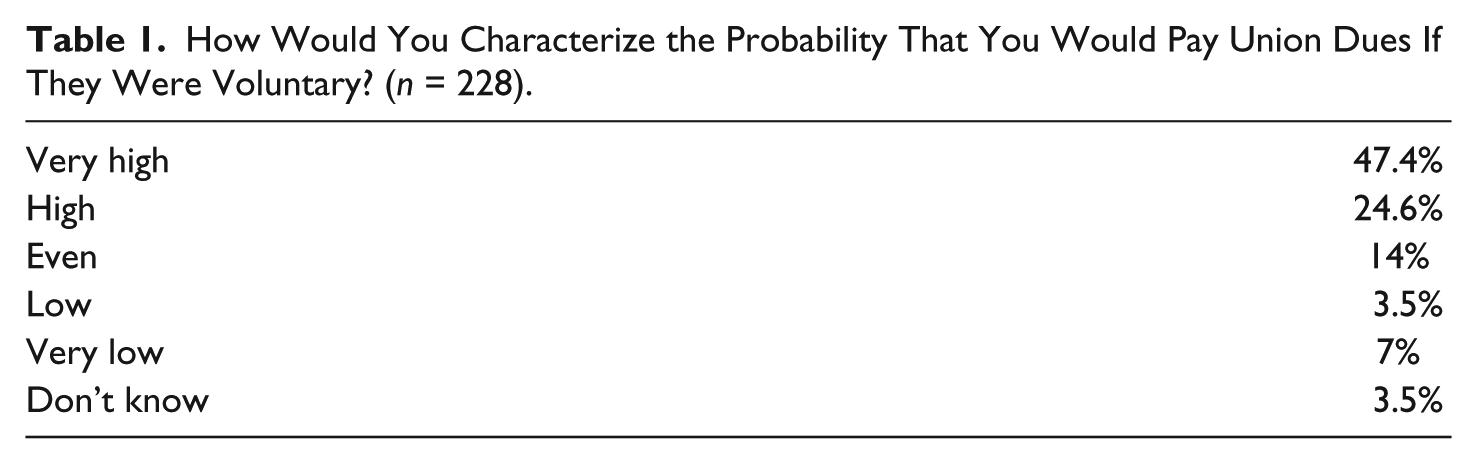
If we combine the “very high” and “high” probabilities, we get more than 70 percent of members who indicated they would submit dues voluntarily. Even if we were to figure that half of the “high” group would not, in fact, submit their dues voluntarily, that would still be about 60 percent. Said differently, only 10.5 percent of respondents said that the probability that they would pay union dues was “low” or “very low.” We have additional confidence in this finding given that only 22 percent agreed that union members should be given a choice about paying union dues. Fully two-thirds of the faculty did not think that paying dues should be a choice at all. In other words, there is strong support for the idea that employees who benefit from the work of the union should be required to pay their share. In fact, more than 72 percent of faculty members agreed that “it would be unfair for faculty members who choose not to pay union dues under a ‘right-to-work’ law to benefit from collective bargaining and contract enforcement as ‘free riders.’”
We also used the survey to determine members’ views on a separate, but related, issue concerning the prospect of legislation restricting a unions’ ability to spend members’ dues on political causes. Critics of unions sometimes take issue when unions spend their dues income on political or social justice causes that are not directly related to collective bargaining or contract administration. In fact, one of the key justifications for “right-to-work” laws is that people should not be required to pay dues that might be redirected to political causes that a member does not support. In the United States, “free-enterprise” lobby groups, notably Grover Norquist’s Americans for Tax Reform, have promoted what they call “paycheck protection laws” (Robinson 2014). These laws seek to restrict the use of union dues directed to political causes by requiring unions to obtain permission to use dues for political purposes from individual union members. The stated goal of these laws is to improve accountability and transparency with regard to union spending, but critics argue that their actual purpose is to undermine union’s political power (Lafer 2013). Unions and their supporters contend that decisions about how to spend dues are made collectively by the membership. Moreover, they add, corporations are not required to obtain consent from individual shareholders before making political contributions (Lafer 2013).
In the survey, we asked faculty members at Brock, “would you support a law that limited a union’s ability to spend dues on anything other than collective bargaining and collective agreement administration?” Fewer than 25 percent of respondents said that they would “definitely” or “probably” support such a bill. About 60 percent said they would “probably not” or “definitely not.” There was slightly more support (about 30 percent) for “a law that limited a union’s ability to spend a portion of your individual dues on political action or social justice causes without your expressed authorization.” In total, 57 percent of respondents told us that they would probably not or definitely not support such a law.
We supplemented our survey questions with opportunities for open-ended answers. On the question “do you have any other thoughts on ‘right-to-work’ legislation?” ninety-one out of 233 respondents provided an additional comment. Most respondents viewed “right-to-work” legislation as a thinly veiled method to harm unions organizationally. One respondent called “right-to-work,” “an attack on the labor movement, rolling back advances toward a more civilized society made by the efforts of working people.” Similarly, another member felt that, “right-to-work legislation ultimately results in the undermining of job security and jobs with decent salaries, benefits, and pensions, all of which contribute to a healthy middle class.” One member called it, “a mountain worth dying on.” Another described it, pithily, as “retrograde and ideologically-driven drivel.”
As noted above, there was a clear minority that wanted the ability to withhold their union dues. One member wrote, “in a democratic society individuals should have the right not to join a union if they so choose.” Other members focused on the question of individual rights to free expression and association. “Freedom of association should include the right to freedom FROM association. It’s wrong to force me to pay for an organization I don’t wish to participate in,” expressed one member. Similarly, one member remarked,
“right to work” legislation is too often framed as a union busting measure, where this is not always the case. Right to work is a freedom of speech issue that provides workers with a choice. If the choice to be part of a union and related benefits were obviously important to members then a significant majority would pay these fees.
Predictors of Commitment to Pay Dues Voluntarily
We see in Table 2 that there is substantial variation by discipline in the probability that faculty members will pay union dues if they were to become voluntary. 2 Almost two-thirds of faculty in the Social Sciences and Education indicated their probability of paying dues voluntarily was “very high.” Only about a quarter of faculty in Business and Applied Health Sciences characterized the likelihood as “very high.” This finding is consistent with other research on disciplinary differences in political attitudes and views on unions. For instance, Nakhaie and Brym (2011) found that faculty members in the social sciences and humanities of Canadian universities were more liberal on political issues and more pro-union than those in the natural sciences and business.
Probability of Paying Union Dues If Voluntary by Faculty.
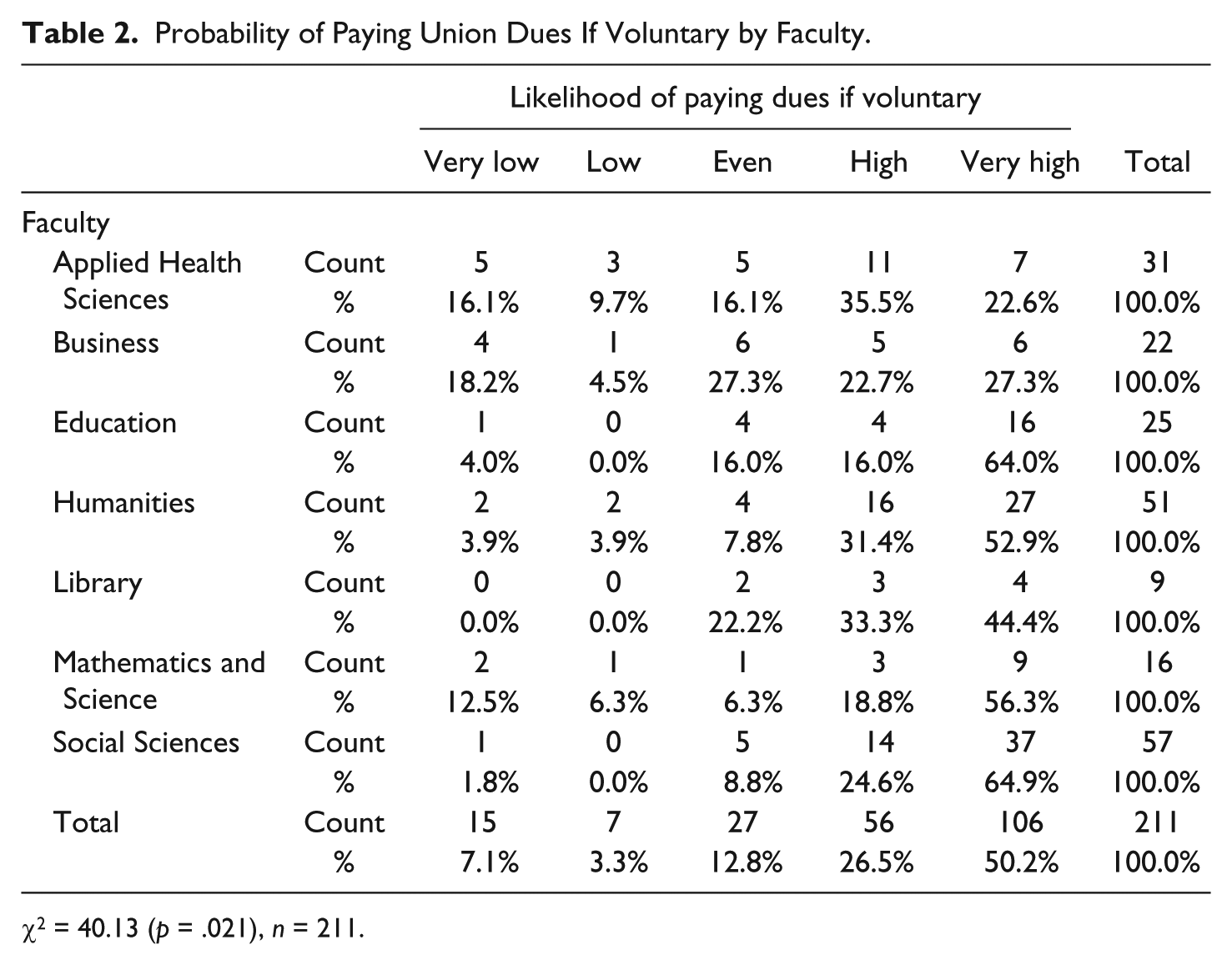
χ2 = 40.13 (p = .021), n = 211.
We see in Table 3 that older members indicated they were more likely to pay dues if they become voluntary. This could be because older members have a longer institutional history with the union and remember it as a noncertified faculty association (BUFA was certified in 1996). A less sanguine interpretation is that younger members, in general, are more entrepreneurial in their approach to academic work, hired in a context of the university attempting to move from being a primarily undergraduate teaching university to being more comprehensive and research-intensive in its focus. Such a generation gap was evident in responses to open-ended questions, which suggested a divide between younger, “more productive” researchers, on one hand, and older members who are seen as benefiting from union protection to the detriment of the reputation of the university on the other. These findings, however, are suggestive at best, as the results do not achieve statistical significance at the .05 level.
Probability of Paying Union Dues If Voluntary by Age.
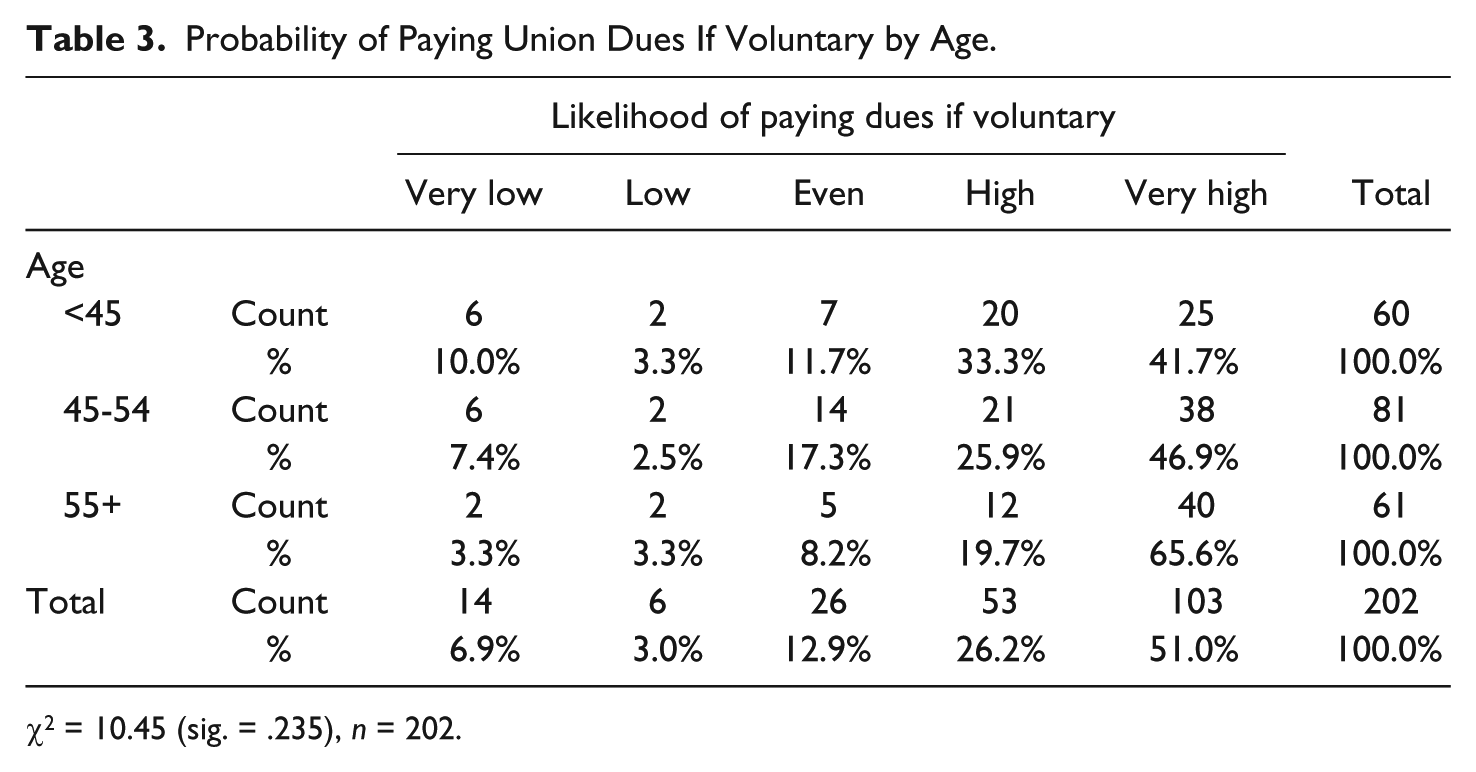
χ2 = 10.45 (sig. = .235), n = 202.
Predictors of Support for Restrictions on How Union Dues Can Be Spent
We also asked respondents about how they would like their union dues to be spent (Table 4). We asked, “Would you support a law that limited a union’s ability to spend dues on collective bargaining and administration of the agreement?” Overall, a clear majority of respondents were “definitely not” (32.3 percent) or “probably not” (28.6 percent) in support of such a law. We also looked to see if there was an association between discipline/faculty and views on how dues should be spent. Again, faculty members from Applied Heath Sciences and Business were the most likely to support legislation limiting where union dues could be directed, whereas faculty in the Social Sciences, Education, and Humanities were the least supportive. There was no relationship between age and support for legislation restricting where dues could be spent.
Would You Support a Law That Limited the Spending of Union Dues to Collective Bargaining and Administration of the Agreement?
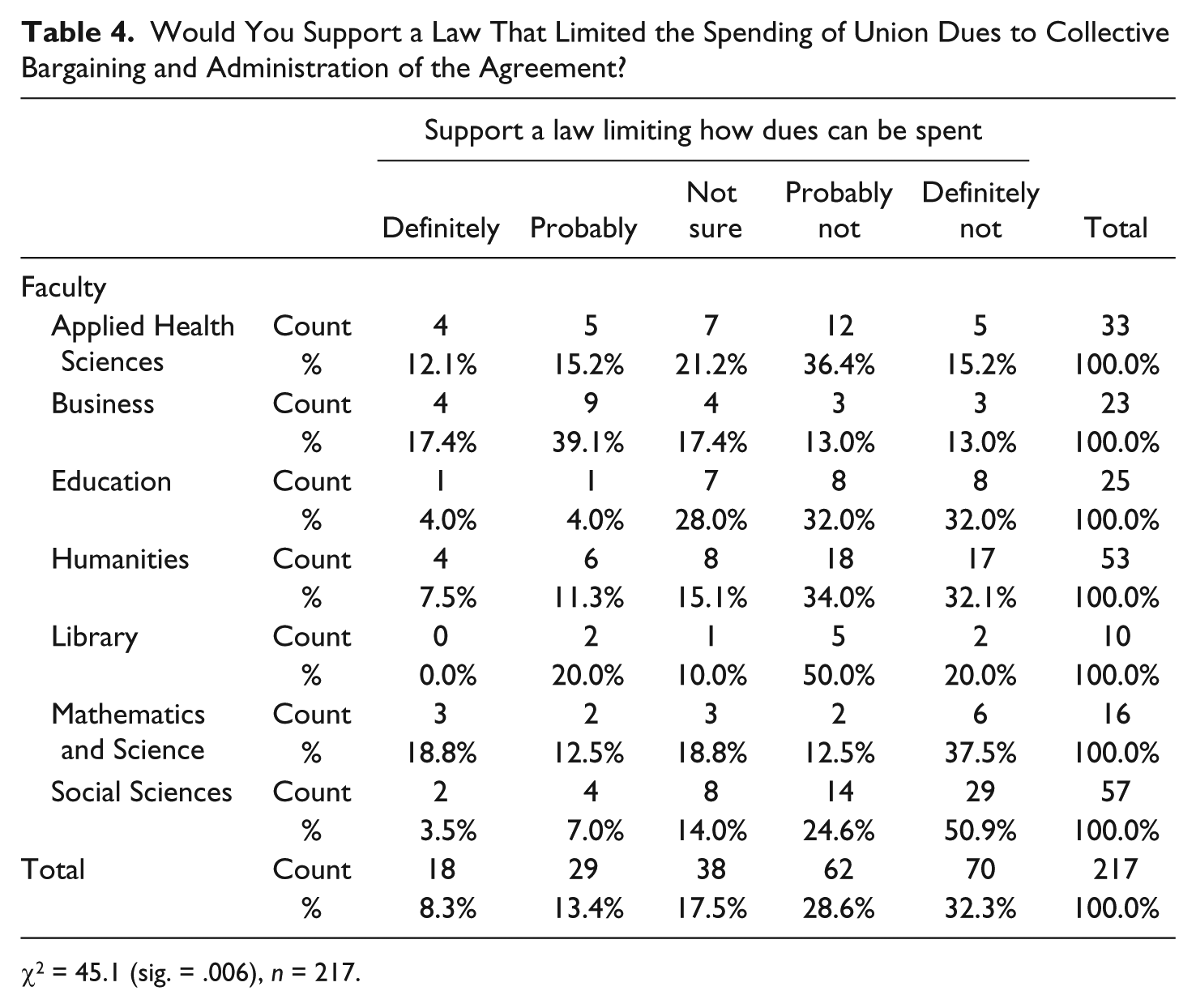
χ2 = 45.1 (sig. = .006), n = 217.
Gender
We found no relationship between gender and likelihood of paying dues. There was, however, a relationship between gender and support for legislation restricting the scope of union expenditures, with women indicating less support than men for this type of legislation (Table 5).
Would You Support Legislation That Restricted Union Spending to Collective Bargaining and the Administration of the Collective Agreement?
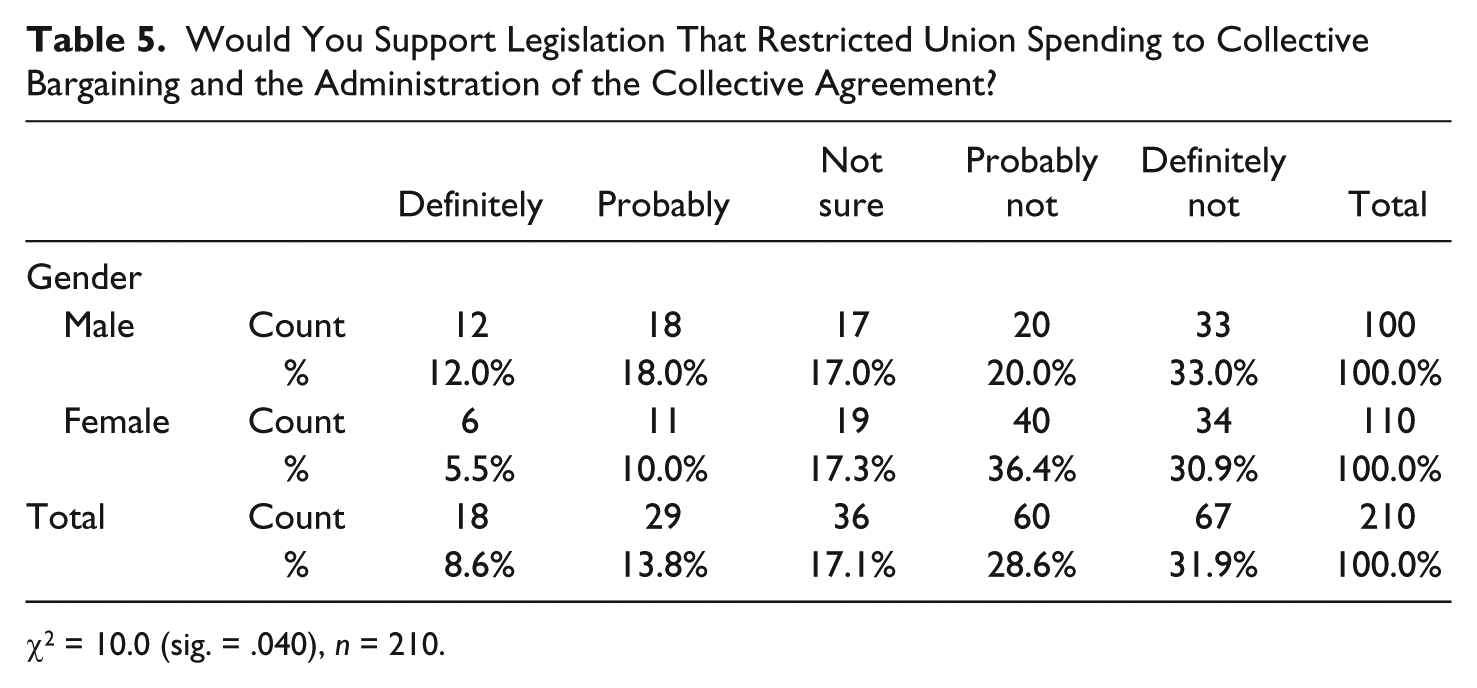
χ2 = 10.0 (sig. = .040), n = 210.
Open-Ended Responses to Restrictions on the Scope of Union Expenditures
Respondents were also given a chance to add additional comments following the questions asking about restrictions on the scope of union expenditures. Fifty-eight respondents (or just more than 50 percent) left comments on these questions. Many members felt that this sort of legislation would be unnecessary, “so long as each union expresses the democratically determined views of its members, then no legislation ought to limit any union’s ‘right to free expression.’” Another member added, “Unions are autonomous agents of civil society and no legislation should intervene in what democratically elected representatives choose to spend dues on.” However, an equal share of commentators indicated that they did not always support the faculty union’s political messaging and felt the union should stick to collective bargaining, “I think my union dues should only be to support collective bargaining and work related to the collective agreement. Leave social justice issues, in particular, up to individuals to support or not.”
How Do Faculty Members’ Views on Dues Payment Compare with the General Public?
In November 2013, just a few weeks after faculty were surveyed, the Canadian Association of University Teachers released the results of a Harris-Decima survey, commissioned by the association, on public perceptions of labor unions. Respondents were asked to choose the statement that most closely aligned with their own personal views: “everyone benefits, everyone should pay” or “individuals should have the right to opt out.” The poll found that Canadians, by a margin of 2 to 1, felt that all union members should pay dues if they benefit from what the union does. The framing of the question in the poll was consistent with the language of fairness being used by much of the labor movement, including the Canadian Labour Congress (CLC), the country’s largest central labor organization. At the time of the survey, the CLC was airing pro-union television ads using the tagline “Fairness works.” Both the CLC and its provincial affiliate, the Ontario Federation of Labour (OFL), also held town hall meetings in advance of the June 2014 Ontario provincial election highlighting the importance of defeating parties supportive of “back-to-work” legislation and other antiunion initiatives. Most union campaigns revolved around the notion that everyone should pay for a service from which they benefit.
Discussion and Conclusion
The results of our survey suggest that the impact of “right-to-work” legislation on unionized university faculty associations in Ontario might be relatively minor. At least at Brock University, unionized faculty members appear far more committed to paying voluntary union dues than other workers in other sectors. Given the marginal role that faculty unions play in the labor movement and the peculiar way they are viewed by mainstream unions (see Savage and Webber 2013), how do we account for these results? There are several factors at play.
First, in the case of the BUFA, and in the cases of most university faculty unions in Canada, a noncertified association (with voluntary dues) preceded the formation of a certified union (with mandatory dues; Rastin 2000; Savage, Webber, and Butovsky 2013). This is not normally the case when new bargaining units are certified in Ontario. The BUFA certified in 1996, but was established in 1965, a year after the university was founded. For that reason, there is a strong historical/institutional relationship between the association and its members. Before certification, upward of 75 percent of BUFA members were already voluntarily paying dues, albeit at a substantially reduced rate (Carroll 1995, 2). It should, therefore, not come as a big surprise that a majority of members would continue to pay dues if they became voluntary once again.
Second, although affiliated and a dues paying member of the provincial and national associations of faculty associations, the BUFA is an independent union in which all decisions and the large majority of dues income stays at the level of the faculty association. Faculty unions have the virtue of being local and directed exclusively by Brock faculty. Approximately 23 percent of faculty union dues go to provincial and federal federations of academic faculty associations, including the Ontario Confederation of University Faculty Associations (OCUFA), the Canadian Association of University Teachers (CAUT), the National Union of the Canadian Association of University Teachers (NUCAUT), and the Ontario Federation of Labor (OFL). Compare this with Canadian Union of Public Employees (CUPE) local 79, one of the country’s largest municipal locals, representing workers at the City of Toronto. CUPE Local 79 sends 57 percent of its dues to parent unions CUPE National and CUPE Ontario, plus smaller amounts to the OFL and the CLC. Moreover, the mil rate, or percentage of members’ income that goes to union dues, is relatively low compared with other Ontario public sector unions. BUFA members pay 1.3 percent of their income toward union dues. Comparatively, members of the Ontario Public Service Employees Union (OPSEU) pay a dues rate of 1.375 percent, members of CUPE Local 79 pay 1.55 percent, and members of the Ontario Nurses Association pay more than 2 percent of their pay toward dues. Because faculty association dues are lower and because a much larger proportion of dues stay directly with the faculty union, members arguably see more value for money locally. This economistic view was borne out in several of the qualitative comments from survey respondents.
However, support for the Association goes beyond a question of dollars and cents. In a previous study of university faculty and their views concerning the effectiveness of their unions, which also involved a survey of Brock faculty, respondents clearly identified their unions as key defenders of academic freedom and collegial governance in the university workplace (Butovsky, Savage, and Webber 2015). As neoliberalism continues to consolidate in the university sector, faculty unions are increasingly viewed as critical to defending the academic mission of the university, including the quality of education (Ross and Savage 2015). Faculty members increasingly recognize the important role faculty unions play in this regard.
Overall, faculty unions, such as the one we studied at Brock University, would likely withstand the implementation of “right-to-work” legislation because of the strength of individual members’ ties to the association, the relatively low level of dues, and the strong role of the union in protecting academic freedom, collegial governance, and the quality of the educational experience. In addition to these micro workplace-based factors, there are almost certainly larger socio/legal factors at play as well.
Lipset and Meltz (2004) have pointed to core political and cultural differences between Canada and the United States as explanations for union density divergence between both countries. Specifically, they point to a stronger social democratic tradition in Canada and a more supportive legislative environment for union organizing and administration. These core cultural differences may help to explain why Canadians are more positively predisposed to opposing antiunion legislation. The convincing defeat of the PCPO in the 2014 Ontario provincial election may lend credibility to this perspective. Despite the success of the labor movement’s “Stop Hudak” campaign, organized labor in Canada cannot afford to rest on its laurels.
While the reelection of the Ontario Liberal provincial government in June 2014 has momentarily defrayed fears that “right-to-work” will become a reality in the near future, the political climate that ushered in calls for “right-to work” and other antiunion measures has certainly not subsided. We can almost certainly expect a “right-to-work” proposal to resurface in one form or another in the years to come as Canadian conservatives parrot the antiunion policy innovations of Republicans south of the border. In the interim, the challenge for faculty unions is to politically engage their members in an organized and consistent way to build their collective capacity to resist such antiunion incursions in the future.
Footnotes
Declaration of Conflicting Interests
The author(s) declared no potential conflicts of interest with respect to the research, authorship, and/or publication of this article.
Funding
The author(s) received no financial support for the research, authorship, and/or publication of this article.