







Abstract
Existing research on work hour mismatches has examined gender and occupational differences, but it has largely assumed that these factors work independently of each other. This paper combines insights from the stress of higher status hypothesis and the concept of the ideal worker to examine the intersections of gender and occupation in relation to inequalities in workers’ abilities to control the amount of time they spend in paid work. I also offer a longitudinal and process-oriented analysis by examining how men and women in upper, middle, and lower prestige occupations differ in their chances of having hour mismatches, resolving mismatches, and in the methods through which they resolve them. Findings indicate that men and women experience different types of mismatches and men in upper level occupations are at greater risk of mismatches and least likely to find resolutions, yet outcomes are heavily influenced by the intersections of gender and occupation, illustrating the need for this type of analysis. There are few results to indicate differences in the mechanism of mismatch resolution by either gender or occupation.
Introduction
Many people today feel they are spending too much or too little time in paid work, and either problem can be a significant source of strain. Mismatches between the number of hours a worker spends in paid work and the number of hours they would prefer to work are one of the factors contributing to work-family conflict (Reynolds and Aletraris 2007), which has become increasingly ubiquitous in recent years. Over 70 percent of U.S. workers in a recent study reported some level of interference between work and nonwork activities (Schieman, Glavin, and Milkie 2009). Hour mismatches have been shown to have an impact on worker safety and organizational commitment (Stamper and Dyne 2001), as well as psychological and physical well-being for those working too many hours (Galinsky, Kim, and Bond 2001). In addition, workers who desire more hours often suffer from fluctuating and inconsistent work hours, which may not provide the income needed to support families (Lambert, Haley-Lock, and Henly 2012; Lautsch and Scully 2007).
Since the publication of The Overworked American (Schor 1991), researchers have learned a great deal about the factors that help generate hour mismatches. Mismatches have been shown to be quite common, with perhaps 30 to 40 percent of American workers wanting fewer hours at work, and 10 to 20 percent wanting more (Golden 2006), indicating that roughly 40 to 60 percent of workers will have an hour mismatch at any given point in time. Furthermore, people with mismatches typically want to increase or decrease their work week by five or more hours (Jacobs and Gerson 2004). Unfortunately, many people do not get what they want. In one of the few longitudinal studies of hour mismatch resolution, Reynolds and Aletraris (2006, 630) found that only 36 percent of men and 40 percent of women with mismatches resolved them over a one-year period.
Despite this scientific advancement, most existing studies have taken a relatively simplistic approach to studying inequalities in hour mismatches. Many studies focus on describing the prevalence of hour mismatches in the cross section or on identifying a comprehensive set of factors that help create them. Existing research has thus examined some effects of occupation on work hour mismatches, as well as the likelihood that different categories of people (by gender, race, etc.) will have hour mismatches. Few studies, however, have examined how hour mismatches change over time, and to my knowledge, only one study has examined how experiences with hour mismatches reflect the intersection of gender and occupation (Clawson and Gerstel 2014; Gerstel and Clawson 2014). Using surveys, observations, and interviews, they show that gender and class combine to influence temporal flexibility among men and women in different health care occupations and that men and women do gender differently according to class location.
In this paper, I combine insights from the stress of higher status hypothesis, which focuses on occupations, with the concept of the ideal worker, which highlights the gendered nature of norms regarding paid and unpaid work. Specifically, I use these ideas to examine how different combinations of gender and occupation are related to inequalities in workers’ abilities to control the amount of time they spend in paid work. By examining the intersection of gender and occupation, I am better able to study the heterogeneous experiences people have with hour mismatches. Considering gender and occupation as separate, largely one-dimensional categories neglects the reality of the social world in which, for example, neither all women nor all those in particular types of occupations share the same characteristics or experiences. My approach enables the understanding of women’s versus men’s abilities to obtain the work hours they desire at different levels of occupation, understanding each intersection as a unique location with its own potentially unique characteristics.
I also extend the literature by examining multiple inequalities in people’s experiences with hour mismatches. I examine how men and women in upper, middle, and lower prestige occupations differ in their chances of having hour mismatches and resolving mismatches, and differences in the methods through which they resolve mismatches. This attention to multiple inequalities highlights the dynamic nature of hour mismatches and some of the processes that generate the distribution of hour mismatches that are apparent in the cross section.
Inequality in Work Hour Mismatches
While there is a small body of research exploring how work hour mismatches are distributed among groups and which characteristics might affect their chances of resolution, the existing research has not particularly focused on inequalities by gender and has focused perhaps too closely on the experiences of managers and professionals. Furthermore, very few studies have taken a longitudinal perspective to examine differences in people’s ability to resolve hour mismatches or in the methods people use to resolve them. There is some evidence that the chances of having a mismatch or the type of mismatch one has are related to race (Bell 1998) and class (Lautsch and Scully 2007). It is unclear, however, how such predictors may interact with each other. Men and women in similar occupations, for instance, may have different experiences.
There is also some evidence that men and women resolve mismatches in different ways. Some people get the hours they want, while others come to prefer (or settle for) the hours that are available. Some research suggests, for instance, that women are less likely than men to reach a compromise over more hours and also less likely than men to achieve a reduction in actual hours (Reynolds and Aletraris 2010). Others indicate that men and women deploy gender roles differently depending on class advantage, with those in upper occupations relying on traditional gender roles while those in lower occupations who face entirely different constraints “undo” gender as they attempt to meet family and work obligations (Clawson and Gerstel 2014; Gerstel and Clawson 2014). More generally, there is some evidence that the methods used to resolve mismatches may be related to gender, marriage and children, education, occupation, and whether people want more or fewer hours at work (Reynolds and Aletraris 2010).
In short, while there appear to be inequalities in the chances of having a mismatch, in the odds of resolving a mismatch, and in the method of resolving a mismatch, few studies have offered detailed accounts of the factors related to those inequalities. In light of this gap in the existing literature, I focus on three central research questions:
Prevalence of Mismatches
I begin my examination of inequality by studying gender and occupational differences in the chances of having a mismatch. The proliferation of exceptionally long (greater than fifty hours/week) or short (less than thirty hours/week) work weeks has been documented across many industrialized countries, such as Australia (Wooden 2002; Wooden and Drago 2007), Canada (Sheridan, Sunter and Diverty 2001), Japan (Japanese Ministry of Health, Labour and Welfare 2004; Nemoto 2013), New Zealand (Callister 2005), the United Kingdom (Green 2001), and the United States (Jacobs and Gerson 2004). As a result of these expanded and reduced work hours, work hour mismatches have become prevalent in many nations (Bell and Freeman 2001; Jacobs and Gerson 2004; Lee 2004; Reynolds 2004; Reynolds and Aletraris 2006; Stier and Lewin-Epstein 2003).
The direction of hour mismatches is closely related to types of occupations. Although the desire for fewer hours is more common than the desire for more hours (Golden 2006; Golden and Gebreselassie 2007; Reynolds 2005; Reynolds and Aletraris 2006, 2010; Wooden, Warren, and Drago 2009), that desire is especially common among highly educated, professional workers (Clarkberg and Moen 2001; Golden and Gebreselassie 2007; Jacobs and Gerson 2004) and among men in upper and mid-level occupations, though women in these occupations also tend to report working longer hours than they would prefer (Williams and Boushey 2010). On the other end of the occupational scale, people in low-level jobs tend to desire more hours at work, and often rely on the extra hourly wages to support themselves and their families (Lautsch and Scully 2007; Williams and Boushey 2010).
Findings on mismatches and gender are mixed. Some studies have found little inequality between men’s and women’s chances of having a mismatch (Jacobs and Gerson 1998; Reynolds 2003; Reynolds and Aletraris 2006), while others find men are more likely to have mismatches (Boheim and Taylor 2003; Golden and Gebreselassie 2007).
Odds of Resolving Mismatches
The second type of inequality created by mismatches involves the odds of resolving a mismatch. Studies of mismatches find that many mismatches are created and resolved over time (Drago, Wooden, and Black 2009b; Reynolds and Aletraris 2006, 2010), though little work exists on this type of inequality due to the cross-sectional nature of most studies. The odds of resolving a mismatch are strongly tied to the type of mismatch one has. People consistently have been shown to have much more difficulty obtaining fewer hours of work than more hours of work, with many studies finding that the desire for fewer hours is more prevalent and less likely to be resolved (Böheim and Taylor 2003; Golden and Gebreselassie 2007; Merz 2002; Moen 2004; Reynolds and Aletraris 2006, 2010; Wooden, Warren, and Drago 2009).
Largely due to the relationship between occupation and type of mismatch, people in high-status occupations are less likely to resolve their mismatches since they are more likely to desire fewer hours (Drago, Wooden, and Black 2009a; Reynolds and Aletraris 2006). Those earning hourly wages in low-status jobs are more likely to want more hours and to get them (Boheim and Taylor 2003; Reynolds and Aletraris 2006). There is also evidence that switching employers may be one of the more effective ways to resolve mismatches (Reynolds and Aletraris 2006). Regarding gender, women may be slightly less likely to resolve their mismatches than men, particularly when they desire fewer hours (Reynolds and Aletraris 2010), and both women and men may be less likely to resolve a desire for fewer hours as their work hours increase.
Methods of Resolution
A third form of inequality, which is also the least studied, concerns the methods of resolving a mismatch. Reynolds and Aletraris (2006, 2010) and Drago, Wooden, and Black (2009b) have examined this type of inequality in particular. Using the first two waves of panel data from the Household Income and Labor Dynamics in Australia (HILDA) survey, Reynolds and Aletraris (2006) found that while many mismatches are created and resolved over a one-year period, these are resolved more often through changes in preferred hours rather than actual hours.
A study of workers in the United States found that over a five-year period, many people wanting fewer hours at work were unable to resolve their mismatches. When they do resolve them, they often do so by changing their preferences. Those in upper level occupations, who are more likely to desire fewer hours, are more likely to resolve mismatches through changes in preferred hours, as they have more difficulty changing their number of actual hours they spend in paid work (Reynolds and Aletraris 2010).
In addition, women wanting fewer hours were less likely than men to resolve their mismatches by working fewer hours, and more likely to resolve a desire for more hours by changing their preferences (Reynolds and Aletraris 2010). This type of resolution may be more indicative of settling for available hours rather than realizing an actual hour change to match preferences. Drago, Wooden, and Black’s (2009b) study also indicates that both men and women have difficulty negotiating the reductions they want through actual hours. Women left the labor force after the birth of children when they initially only wanted a reduction in hours. Men who desired a reduction or time off after a traumatic event such as the death of a spouse were also unable to achieve this by changing their actual hours.
Theory
A number of theories can assist in building our understanding of gender and occupational inequalities related to work hour mismatches. The stress of higher status theory and the notion of the ideal worker seem particularly useful. Still, an intersectional perspective suggests that either set of insights alone may be inadequate for explaining the tensions that workers face in the modern labor market and the power they might have to negotiate more satisfactory hours.
Neoclassical economic theory implies that mismatches will be rare and will be resolved quickly through changes in actual hours. This theory also assumes that preferences are relatively stable and that when they change, workers will easily get the hours they prefer in their current job. Leibowitz (2005, 196) elaborates that the economic model predicts that people will be able to choose the number of hours they spend in paid labor in order to maximize their well-being. Workers should then be able to adjust their hours to match their preferences.
Neoclassical economic theory, however, does not account for those workers who are unsuccessful in negotiating the hours they want. The concept of structural lag, also referred to as institutional lag, can help explain some of the discrepancy. This concept refers to the phenomenon of changing structures which have adapted at different rates. Because structures interact with one another, this creates tensions for people involved in two inconsistent institutions. In terms of labor, it has been documented that the nature of jobs available and the conditions under which people are required to work have not changed in step with the accompanying changes seen in the labor force.
Since the mid-1970s, large numbers of women have entered the labor force, along with increases in dual-earner families and single mothers. Workplaces, however, have remained structured for the stereotypical families of the 1950s, in which men worked to support their families while women remained in the domestic sphere, caring for home and children in order to support the man’s ability to commit unconditionally to his job responsibilities (Glass 2005; Kalleberg 2011b). Drago, Wooden, and Black (2009b, 395) write that the movement of women, and particularly mothers, into the labor force in recent decades . . . created mismatches as employees—both male and female—increasingly needed the ability to alter their work hours in response to family commitments while institutions, built for a very different labor force, remained unchanged.
I argue that the kinds of hour mismatches people have can be explained by the particular kinds of occupations people hold. The stress of higher status theory was developed by Schieman, Whitestone, and Van Gundy (2006) to help understand work-to-family conflict, yet it is also useful in helping to illuminate the origins of work hour mismatches and the chances that they will be resolved or resolved through a particular mechanism. The stress of higher status hypothesis contends that “higher-status occupations with more authority, autonomy, nonroutine work, demands, involvement, longer hours, and better pay tend to have higher levels of work-to-home conflict” (Schieman, Whitestone, and Van Gundy, 2006, 245). The amount of effort and energy required by high-status workers leads to increased work-to-home conflict as they work long hours at the office and then take work and work-related stress home with them. This is not to say that lower status workers do not experience stress, but that high-status workers experience particular stressors related to work-to-home conflict. Schieman writes, While the psychosocial and material conditions associated with professional occupations are generally beneficial (Hodson 2004), the stress of higher status hypothesis also identifies their potential costs. Specifically, workers in professional jobs tend to have more job demands and work longer hours (Clarkberg and Moen 2001; Maume and Bellas 2001 Moen and Yu 2000). (Schieman, Whitestone, and Van Gundy 2006, 244)
While there are many advantages of high status, the structural arrangement of high-status jobs also leads to negative consequences. It may seem counterintuitive, but workers in good, high-status jobs may also be unable to achieve a reduction in hours due to high job demands and pressures.
Based on Coser’s (1974) characterization of work as a “greedy institution” and using border theory to ground the idea that work and home role boundaries can become permeable and interfere with one another (Schieman, Whitestone, and Van Gundy 2006, 244), Schieman’s model highlights work-to-home conflict, interference, role blurring, and job pressure as dependent measures. Job characteristics typically considered resources also operate as demands which increase conflict and pressure for workers. One of the main predictions is that “individuals in higher status positions in the workplace—as experienced in the nature of activities, expectations, and responsibilities—are exposed to more job demands” (Schieman 2013, 274). Education becomes important by increasing access to high-status positions, thereby increasing exposure to “greater pressure and longer work hours among the well-educated” (Schieman 2013, 274).
Hour mismatches and the ways individuals resolve them are thus an indication of the schedule control issues and imbalances which often result from long working hours, one of the job demands that Schieman discusses as contributing to work-to-family interference (Schieman, Glavin, and Milkie 2009). Because “workers in professional jobs tend to have more job demands and work longer hours” (Schieman, Whitestone, and Van Gundy 2006, 244), they are likely to develop mismatches associated with the desire to work fewer hours, a mismatch which is more difficult to resolve than the desire for more hours (Böheim and Taylor 2003; Golden and Gebreselassie 2007; Merz 2002; Moen 2004; Reynolds and Aletraris 2010; Wooden, Warren, and Drago 2009). As a manifestation of time-based conflict, hour mismatches can be expected to reflect occupational differences.
The stress of higher status hypothesis, however, says little about potential gender differences. To produce better hypotheses, I combine its insights with those of theories that detail gender differences in norms and schemas surrounding paid work. Occupations and strategies for achieving work-life balance remain gendered in a number of ways (Moen and Yu 2000), with women and men finding themselves in different types of jobs (e.g., men are overrepresented in manual labor or machinery operating jobs, women in caretaking occupations like teaching and nursing) and held to different sets of expectations in their home and family roles (Pedulla and Thébaud 2015). Child care is still more likely to interfere with women’s job performance or hours than men’s (Maume 2006, 2008) and women continue to carry more of the burden of household obligations in many households (Hochschild 1997; Moen et al. 2013), though men are increasingly taking on more of these roles as well (Berdahl and Moon 2013; Williams, Blair-Loy, and Berdahl 2013a).
One of the dominant cultural schemas affecting workers is that of the ideal worker. The concept of an ideal worker describes one who possesses a particular set of personal and job characteristics. This worker is available to work full time as well as overtime hours with no need to take time off for childbearing or caregiving. Williams (2000) argues that the ideal worker norm defines good jobs in both working-class and middle/upper class contexts. This structuring of work limits the ability of caregivers to fit the ideal model. The ideal worker norm is consistent with the stress of higher status: as workers attempt to fulfill the role of an ideal worker, they internalize the norm of hard work, long hours, and job dedication (Hochschild 1997; Schieman, Whitestone, and Van Gundy 2006).
The ideal worker norm, however, produces different sets of conflicts for men and women. While men are expected to sacrifice home and family responsibilities for the sake of their jobs, committed fully to the “work devotion schema” (Blair-Loy 2003), women who attempt to meet this standard are met with resistance when they fail to meet the “good mother,” or “family” schema as well (Berdahl and Moon 2013; Williams, Blair-Loy, and Berdahl 2013a). Women in high-status occupations who do not cut back on work responsibilities become stigmatized as “bad mothers,” yet part-time work is often also devalued, leading some professional women to leave their jobs altogether rather than take advantage of flexibility policies which may be available (Williams, Blair-Loy, and Berdahl 2013a). Benard and Correll (2010) describe the consequences for mothers who violate gendered expectations of prioritizing family over paid work as use the term “normative discrimination.” Women who take time off from work in order to care for children, in turn, find it difficult to find good jobs again when they are ready to return (Williams, Blair-Loy, and Berdahl 2013a).
Drago, Wooden, and Black (2009a, 576) also suggest the ideal worker norm can be especially harmful to mothers, [i]n terms of norms, because the ideal worker norm requires extreme levels of commitment, it operates against anyone with unpaid caregiving commitments. As a result, penalties for deviance are often paid by new mothers in managerial or professional careers who request reduced hours or other types of flexibility.
Their study concludes that mothers who work long hours often do so against their preferences: . . . those mothers who work long hours tend to be conscripts. These results fit earlier claims that ideal worker jobs are gendered because women who perform substantial amounts of unpaid care in the home cannot compete successfully on the terrain of long hours. (Drago, Wooden, and Black, 2009a, 593)
Acker (2006, 2010) also discusses the gendered nature of organizations, pointing out organizational processes themselves lead to inequalities between men and women in the labor market.
The pattern of women leaving work became known as “opting out,” a misleading characterization of the compromises that working mothers make when they find themselves pressed between norms which do not allow them to both perform well at work and care for children at home. Stone (2007) explores the tensions that pit childrearing ideologies against workplace practices that demand extreme amounts of time and energy from workers in order to remain competitive. She argues that upper level working women are not choosing to leave the workforce by placing family over paid labor, rather they are pushed out by excessive work demands and husbands who contribute little at home. By framing these decisions as choices, the struggles and ambivalence women feel as they leave the work force is overlooked. While they may be privileged to be in a position to leave their jobs while still remaining economically stable, unlike many women in lower level positions and single parents, these women feel torn and understand that an ideal world would be one in which they would not have to choose between family and career demands. Gender stereotypes also make it difficult for men to balance work and family when they try to be involved fathers. Fathers who take time off for family responsibilities also face a backlash, being seen as less devoted workers, less of a “man,” when they fail to fit the stereotype of the man who becomes more committed to work after having children (Berdahl and Moon 2013; Williams, Blair-Loy, and Berdahl 2013a).
An intersectional framework can help in understanding the dynamic relationship between the occupational inequalities highlighted by the stress of higher status hypothesis and the gender inequalities drawn out by ideal worker norms. Intersectionality originated in black feminist scholarship as a way to conceptualize and account for multiple, interlocking, and sometimes competing inequalities by examining groups who inhabit spaces of multiple oppressions, such as black women in the United States (Crenshaw 1989). Collins (1986) explains that intersectionality is necessary to shift attention from explaining specific inequalities to explaining how systems of inequality work together within power structures. Yuval-Davis (2011) additionally argues for an intersectional analysis directed at all people, that “our analytical, intersectional gaze has to be directed also towards the powerful and not just the powerless” (2015, 638). It is the structure of work, whether a worker enjoys high status or is seen as unskilled and easily replaceable, that determines and often prevents workers from achieving balance among the need for compensation, the intrinsic rewards work offers, the desire for leisure time, and the demands of family life.
Using an intersectional framework allows for an examination of overlapping inequalities in work time sovereignty and acknowledges that individuals may fit into multiple categories with varying levels of advantage or disadvantage simultaneously (Choo and Ferree 2010; Walby, Armstrong, and Strid 2012). An intersectional approach “assumes that dominant groups control productive resources and major social institutions,” and “draw on an array of theories of social stratification to explain how and why ‘ascribed statuses’ influence labor market processes” (Browne and Misra 2003, 491). Workers may prove to be advantaged in one dimension, as in occupying a high-status position, yet disadvantaged in others—like gender—which require different levels of conformity and exert pressure to meet different types of demands. In contrast to the stress of higher status that emphasizes the importance of occupation, and to the ideal worker norm that emphasizes gender, intersectionality suggests that mismatches may reflect combinations of both gender and occupational status. Indeed, the work of Clawson and Gerstel (2014) suggests occupational location and gender together exert great influence over individuals’ ability to control working time. In order to understand how gender and occupation work together to create unequal outcomes for individuals in more complex ways than discrete characteristics alone, it is necessary to examine these intersections and ask how power imbalances shape outcomes for particularly situated workers.
While early intersectional scholars focused primarily on narrative and other qualitative methods common to feminist studies, there has been substantial research and discussion into the usefulness of an intersectional approach within a variety of methodologies. Collins (2007) calls for intersectional research to include a broad array of methods, pointing out that quantitative studies focusing on macro-level structural analyses are necessary for understanding intersections of identity categories. Debate has emerged as to the existence of categories or the appropriateness of assuming stable categories in intersectional analysis. Paradigmatic intersectionality, as outlined by Ange-Marie Hancock (2013), allows the conceptualization of complexity within and between categories while understanding that categories and power dynamics always exist within a particular social and historical context. McCall (2005, 1785), additionally, accepts that categories are “imperfect and ever-changing,” but delineating relationships between social groups “requires the provisional use of categories.” Exploring the relationships between work hour flexibility, gender, and occupation requires breaking down categories for the purpose of analysis, most closely adhering to what McCall terms the intercategorical complexity approach.
Hypotheses
Hypotheses 1 to 3 are generated by the stress of higher status hypothesis, which suggests that people in high-status occupations will work long hours and report a desire for fewer hours. These workers, though, will have difficulty resolving their mismatches, both because the desire for fewer hours is more difficult to resolve overall, and because these workers will have internalized the ideal worker norm and the value of hard work and long hours. When these upper level workers do obtain resolution, it will likely be through changing their preferences, as actual hour changes will be more difficult to negotiate.
Hypotheses 4 to 6 are related to gender and motivated by ideal worker and gendered norms which would predict women are less likely to be ideal workers and more likely to be able to adjust their work hours through actual hour changes. This may be reflected in the higher percentages of women who work part time, having greater control over their work hours and devoting more time to family or home matters.
Data
I will be using data from the Household, Income and Labour Dynamics in Australia (HILDA) Survey to examine this issue quantitatively by comparing gender differences in the chances of having a mismatch, the abilities of women and men from various occupational locations to resolve mismatches over time, and the methods they use to resolve them. The data come from a household-based longitudinal panel survey which began in 2001 and continues yearly through the most recently released wave covering the year 2015. The survey includes interviews with a representative sample of all adults age fifteen and older in participating households, is conducted annually, and contains extensive household and individual information. This analysis uses data from Waves 9 and 10, which correspond to the years 2009 and 2010.
While this study uses data from Australia to examine issues of gender and occupation in work time sovereignty, the Australian work force and labor conditions are similar to those of the United States and other industrialized nations. Like the United States, Australia has seen demographic changes over the last forty years, which include an influx of women into the work force, increased numbers of single-parent households, and rising child care demands. According to a 2014 report by the Australia Institute (Baker, Johnson, and Denniss 2014), Australian workers in general report working longer hours than they would prefer as well as unpaid overtime—“time theft” (see Karp 2018)—that is comparable with other Organisation for Economic Co-operation and Development (OECD, n.d.) countries, including the United States. Still, it should also be noted that the Australian labor force contains fewer women and more part-time workers than in the United States (Stier, Lewin-Epstein, and Braun 2001), and enjoys a wider social safety net which affords workers access to health care and other benefits without concern for maintaining a minimum number of work hours.
Dependent Variables
My analysis looks at three outcomes and therefore uses three dependent variables for different parts of the analysis. The first is a measure of those having a mismatch at Wave 9. This variable is coded for respondents who desired more hours, fewer hours, or the same number of hours. Respondents who desire the same number of hours are considered to have no mismatch. The wording of work hour questions is especially informative. By wording the questions about preferred hours in such a way as to encourage respondents to consider the possibility of resulting income changes, the HILDA questionnaire allows them to weigh possible outcomes that could result from work hour adjustments. Respondents were first asked to consider the number of actual hours they spend in paid work for main jobs and all jobs, including time spent working at home. Next, they were asked, If you could choose the number of hours you work each week, and taking into account how that would affect your income, would you prefer to work fewer hours than you do now? about the same hours as you do now? or more hours than you do now?
In addition, they were asked how many hours a week, on average, they would choose to work, again taking into account the possible effects of this change on income.
The second dependent variable indicates whether a mismatch present at Wave 9 was resolved at Wave 10. Those respondents who reported a mismatch at Wave 9 but reported wanting the same hours at Wave 10 were coded as having resolved their mismatch. Those respondents still reporting a mismatch between actual and preferred hours at Wave 10 were coded as having not resolved their mismatch.
The third dependent variable for the analysis indicates the method of resolution of work hour mismatches seen at Wave 10. A variable for the method of resolution was created using the presence of a mismatch at Wave 9 compared with the continued presence or resolution of the mismatch at Wave 10 along with information about how actual and preferred hours changed between the two waves. Respondents were coded as having no resolution, resolution primarily through actual hour changes, or primarily preferred hour changes. Compromises were determined by subtracting the absolute value of the change in preferred hours from the absolute value of the change in actual hours. If the difference in the magnitude of change was less than five hours, the respondent had a similar change in actual and preferred hours, with each converging toward a satisfactory level for the respondent at Wave 10. If both actual and preferred hours changed but with a greater than five-hour difference, the resolution was coded as due to the hours with the greatest amount of change—either in actual or preferred hours. Resolutions through preferred hours may indicate that respondents have “settled” (Reynolds and Aletraris 2010), or changed their preferences because they could not negotiate the actual hour changes they wanted. Alternately, it could indicate that the conditions responsible for the mismatch have changed, and the respondent no longer desires different work hours.
Explanatory Variables
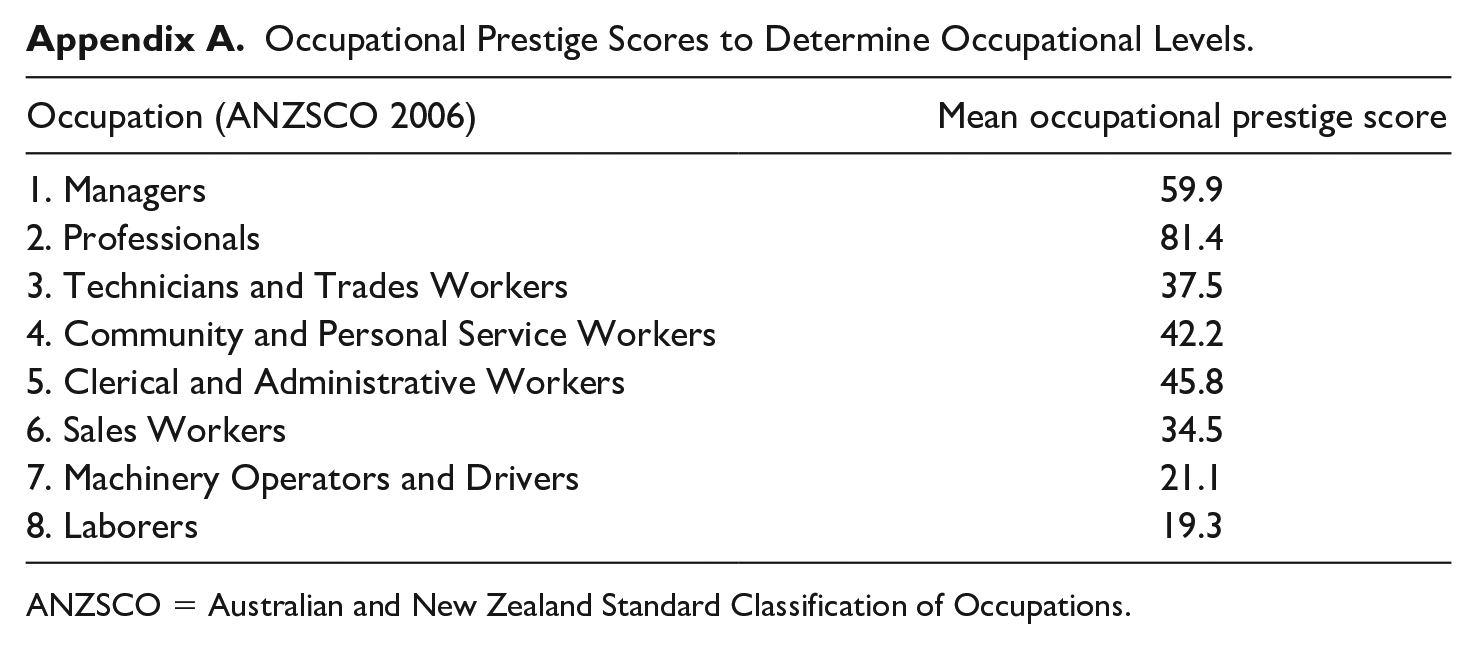
Important independent variables in the analysis include an intersection of gender and occupational category. Gender has been recoded into a dummy variable coded 0 for male and 1 for female. Occupational category is identified as upper, middle, and lower occupations. The Australian and New Zealand Standard Classification of Occupations (ANZSCO) codes indicate the respondent’s work category. In order to compare occupational level with mismatch resolutions, the mean occupational status scores were calculated for the eight basic occupational categories included in the HILDA ANZSCO variable. Occupational status scores range from 0 to 100, with 100 indicating the highest level of prestige associated with occupation. 1
Workers in Occupational Categories 1 (managers) and 2 (professionals) were coded as belonging to upper occupations due to high mean occupational prestige scores which are separated by about fourteen points from those in the middle. Workers in ANZSCO Categories 3 through 6, technicians and trade workers, community and personal service workers, clerical and administrative workers, and sales workers were coded into middle occupations due to clustered mean occupational prestige scores. Mean scores for these categories fall within an eleven-point range in the middle to lower middle range of possible prestige scores (34-45). ANZSCO Categories 7 (machinery operators and drivers) and 8 (laborers) were coded into lower occupations due to the thirteen-point difference in mean occupational prestige scores. The three occupational levels were then combined with gender to create six gender and occupation categories. 2 These categories are used to identify the relationship between the intersection of gender and occupation and the probability and type of resolution workers are able to achieve at different combinations (see Appendix A for how occupational levels were determined). While occupational prestige categories are not a perfect representation of class, they do act as an indicator of the levels of power and status occupants can access.
Control Variables
Key control variables include measures of family and life status. Age and age squared are included to account for changes which might occur over the life course. Level of education has been recoded to indicate whether the respondent had received at least a bachelor’s degree. This is consistent with research indicating that the receipt of a college degree is increasingly influential in stratifying occupations and producing favorable outcomes (Ammons and Kelly 2008; McCall 2000). Household composition will be another important independent variable for interpreting mismatch resolution, as people with spouses who have an income may be more able to decrease their own work income by decreasing hours; alternately, someone who has a partner or family relying on their income may be less likely to switch to fewer paid hours. Respondents were therefore coded as 1 for married and zero for not married. Children, and their ages, will also presumably have a significant impact on work hours. Men may seek to stabilize or even increase work hours as a result of young children, while women might decrease hours or leave the labor force altogether while raising children. Two categories of resident children are included: one variable is for any children aged zero to four years in the home and another for school-aged children aged five to fourteen present in the home.
In addition, the HILDA data contain variables for major changes within the previous twelve-month time period which may be useful in understanding respondents’ decisions regarding work hours. Because job changes have been shown to have a major impact on mismatches and resolution, I include life events for both involuntary job loss and voluntary job changes. A number of respondents experienced both of these events, and they were coded into the category of the most recent event. Those few respondents who were both fired and changed jobs in the same three-month quarter and for whom the order of events could not be determined were excluded from the analysis.
Job-related variables have been included to be consistent with the stress of higher status hypothesis. Accordingly, I have included variables for level of job demands, job security, job autonomy, schedule control, nonroutine work, supervisory position, and self-employment. Lastly, I have controlled for a subjective measure of prosperity, recoding this variable into three categories for those who report feeling prosperous or very comfortable financially, those who feel they are reasonably comfortable, and those who report they are “just getting by” or poor. This variable takes into account household prosperity level and how financially comfortable respondents feel regardless of marital status. 3 The relationships between these sets of variables will help in understanding which groups of people are able to successfully alter their work hours or if they find it to their advantage to settle for their current situation, in the form of changed preferences, rather than continue seeking actual hour changes.
Analytic Strategy
I include in my initial analysis the 5,073 individuals who answered questions about preferred and actual hours at both Waves 9 and 10, and had valid values for all pertinent control variables at Wave 10. Individuals who were less than twenty years of age and those who reported being full-time students were excluded from the analysis so as to concentrate on those individuals who were primarily involved in paid labor. 4 Because the survey asks about main jobs and all jobs, it is possible that some of these workers hold multiple jobs. The time span of one year allows enough elapsed time for an analysis of whether people are successful in resolving mismatches in the relatively short term, and how they resolve them, as well as limiting to some extent the amount of changes people might experience in their work and life situations. It also allows the inclusion of control variables which reflect major life events over the previous twelve-month period. The HILDA survey is ideal because it is a large, representative, longitudinal study which allows for an analysis of mismatch changes over time to determine whether mismatches were resolved and the methods used to resolve them when there is a resolution.
I first compiled descriptive tables indicating the incidence of mismatches of men and women by occupational level using the initial 5,073 respondents and conducting chi-square tests of significance for gender and occupation. Secondly, I compiled a descriptive table of the probability of resolving a mismatch by gender and occupational level, reducing the sample size to the 2,041 respondents who had a mismatch at Wave 9, also conducting chi-square tests of significance for gender and occupation. Finally, I compiled a table showing the chances of using one of the three particular methods of resolution, using only those respondents who reported at Wave 10 that they had resolved their mismatch from Wave 9, with a sample of the 782 participants who had a resolution by Wave 10, again testing for significance by gender and occupation.
After creating the three descriptive tables, I ran three corresponding regression analyses, including six intersections of gender and occupation and including control variables. The first is a multinomial logistic regression analyzing the probability of having a particular type of mismatch at Wave 9. This type of analysis was appropriate due to the three-category dependent variable with outcomes of wanting more, the same, or fewer hours.
The next regression I conducted was a logistic regression predicting resolution of mismatches between Waves 9 and 10. Logistic regression was necessary with the dichotomous dependent variable indicating whether a mismatch was resolved or not resolved.
Finally, I conducted another multinomial logistic regression to gain insights into the mechanisms by which people resolved their mismatches when they were able to resolve them. The dependent variable listed outcomes of resolution through actual or preferred hours, or a compromise between the two.
Results and Discussion
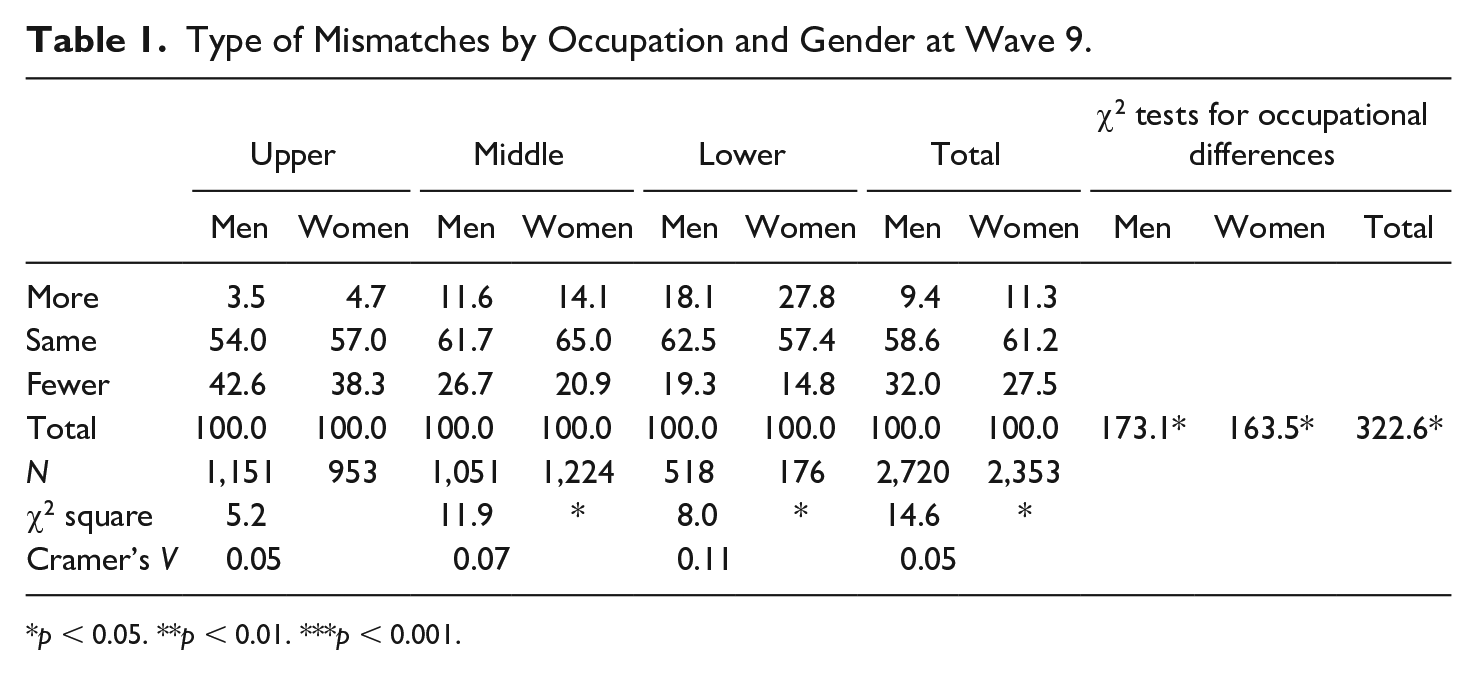
As indicated by the significant chi-square value at the right end of Table 1, men and women overall have different experiences with mismatches. First, while 41.4 percent of men have mismatches (9.4% want more hours and 32.0% want fewer hours), only 38.8 percent of women have mismatches. Men and women also tend to have different types of mismatches: men are more likely than women to want fewer hours of work, and women are more likely than men to want more hours of work. These results are consistent with gendered perspectives on the ideal worker which suggest that gendered norms about paid and unpaid work will make women more likely than men to adjust their work hours to accommodate responsibilities outside of work.
Type of Mismatches by Occupation and Gender at Wave 9.
p < 0.05. **p < 0.01. ***p < 0.001.
The size of the gender differences, however, varies by occupation, and differences are more pronounced in middle and lower occupations than in upper occupations. Consistent with predictions derived from the stress of higher status hypothesis, men and women in upper occupations have rather similar experiences: when they have mismatches, they overwhelmingly want to work fewer hours and gender differences are not quite significant at the .05 level. 5 Gender differences are more pronounced in the lower occupations as shown by the significant chi-square, and they are most pronounced in the desire for more hours. Over 27 percent of women in lower occupations want more hours, but only 18 percent of men in lower occupations report a desire for more hours. Men and women in middle occupations also have significantly different experiences with mismatches. Here, the difference is greatest in the desire for fewer hours, with 26.7 percent of men reporting that they would like to work fewer hours, but only 20.9 percent of women in middle occupations reporting this type of mismatch. These variations in gender differences across occupational categories suggest an intersectional perspective is useful in considering experiences with mismatches. It is also notable from the number of men in the lower occupational category is roughly three times the number of women, while the gender split in middle and upper occupations is much more evenly distributed.
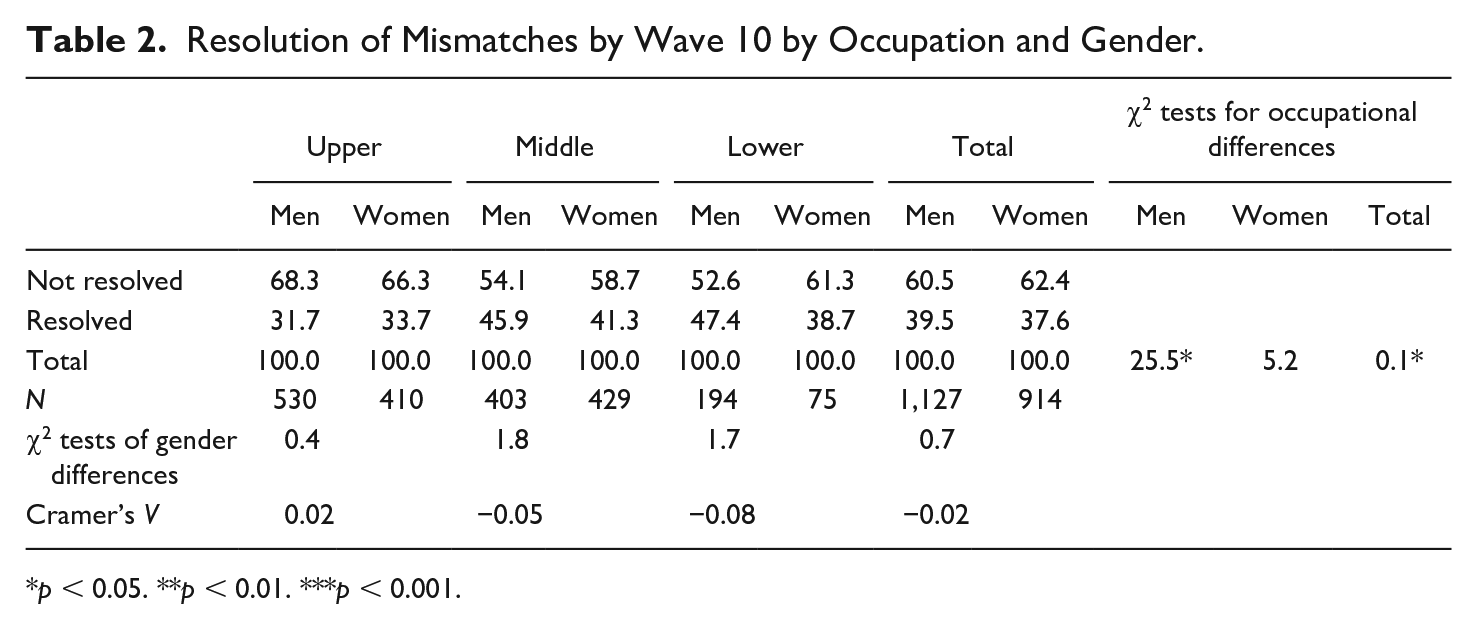
Gender alone does not appear to be a significant predictor of the chances of resolving mismatches. As indicated by the totals at the right end of Table 2, similar percentages of men and women who reported mismatches at Wave 9 had resolved them by Wave 10. There is some variation in the size of the gender differences by occupation. Gender differences are most pronounced in lower level occupations, but as occupational level increases, the gap between men and women in mismatch resolution narrows. Upper occupations show the smallest gender differences and a slight female advantage: 31.7 percent of men and 33.7 percent of women resolve their mismatches. In the middle occupations, that difference has reversed and increased to just over 4 percentage points, with almost 46 percent of men and 41.3 percent of women resolving their mismatches. There is a difference of about 9 percentage points in lower occupations, showing almost 38 percent of women and over 47 percent of men resolving mismatches. Even in the lower status occupations, however, these gender differences within occupational groups are not significant.
Resolution of Mismatches by Wave 10 by Occupation and Gender.
p < 0.05. **p < 0.01. ***p < 0.001.
In contrast, the effect of occupation within gender categories has a notable effect, but only for men. Supplemental chi-square tests show that among men, the chances of resolving an hour mismatch vary significantly by occupation. In general, men in upper occupations are significantly less likely to resolve hour mismatches than men in lower occupations. Roughly 47.4 percent of men in lower occupations resolved their mismatches and 45.9 percent of men in middle occupations resolved their mismatches. However, only 31.7 percent of men in upper occupations resolved their mismatches. Women, by contrast, appear to have the best chances of resolving a mismatch when they are in mid-level occupations. Roughly 39 percent of women in lower occupations and 33.7 percent of women in upper occupations resolved their mismatches, but 41.3 percent of women in middle occupations resolved their mismatches. Occupational differences among women, however, do not reach significance (Pr = 0.07). This suggests that the effect of occupation is moderated by gender. These results support the stress of higher status hypothesis among men and among women in upper occupations, but also suggest that gendered norms produce different patterns for men and women across occupations.
Finally, it appears that neither gender nor occupation influences the methods people use to resolve their mismatches. The totals column in Table 3 shows nearly identical chances of resolution by each method for men and women, with 33.9 percent of men and 34.8 percent of women resolving through the most desirable method, a change in actual hours. The largest gender differences among the lower occupations are among those who compromise, with 18.7 percent of men resolving through compromise between actual and preferred hours, compared with 13.8 percent of women. In middle occupations, men and women have very similar chances of resolution for each method. In the upper occupations, the story is similar. Only 28.9 percent of men and 35.8 percent of women report achieving resolution through actual hour changes. About 48 percent of men and 44 percent of women resolve their mismatches through a change in their preferred hours, while 22.9 percent of men and 20.4 percent of women reported that they compromised to resolve their mismatches.
Method of Resolution by Gender and Occupation.
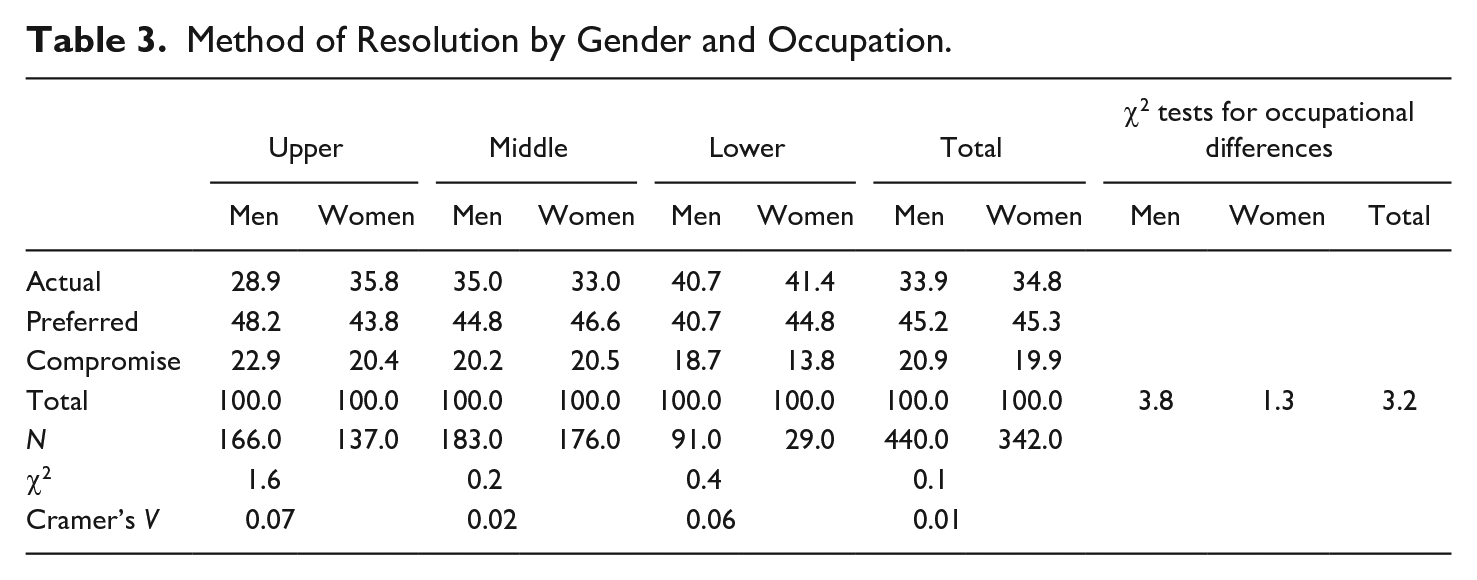
Overall, Table 3 indicates that across gender and occupation, roughly 45 percent resolve mismatches through changes in preferred hours. Approximately one-third resolve their mismatches through actual hour changes, and one-fifth through a compromise. Chi-square tests of gender differences in the method of resolving mismatches are not significant for gender overall, for gender within each occupational level, for occupation overall, or for occupation among men or among women. The indication that when mismatches are resolved, they are most often resolved through changes in preferences does point to a tendency to settle for the hours one has, with people in upper occupations continuing to work too many hours, as the stress of higher status suggests, and those in lower occupations unable to increase their actual hours. Men and women facing varying pressures and normative demands are perhaps arriving at similar outcomes through different sets of constraints.
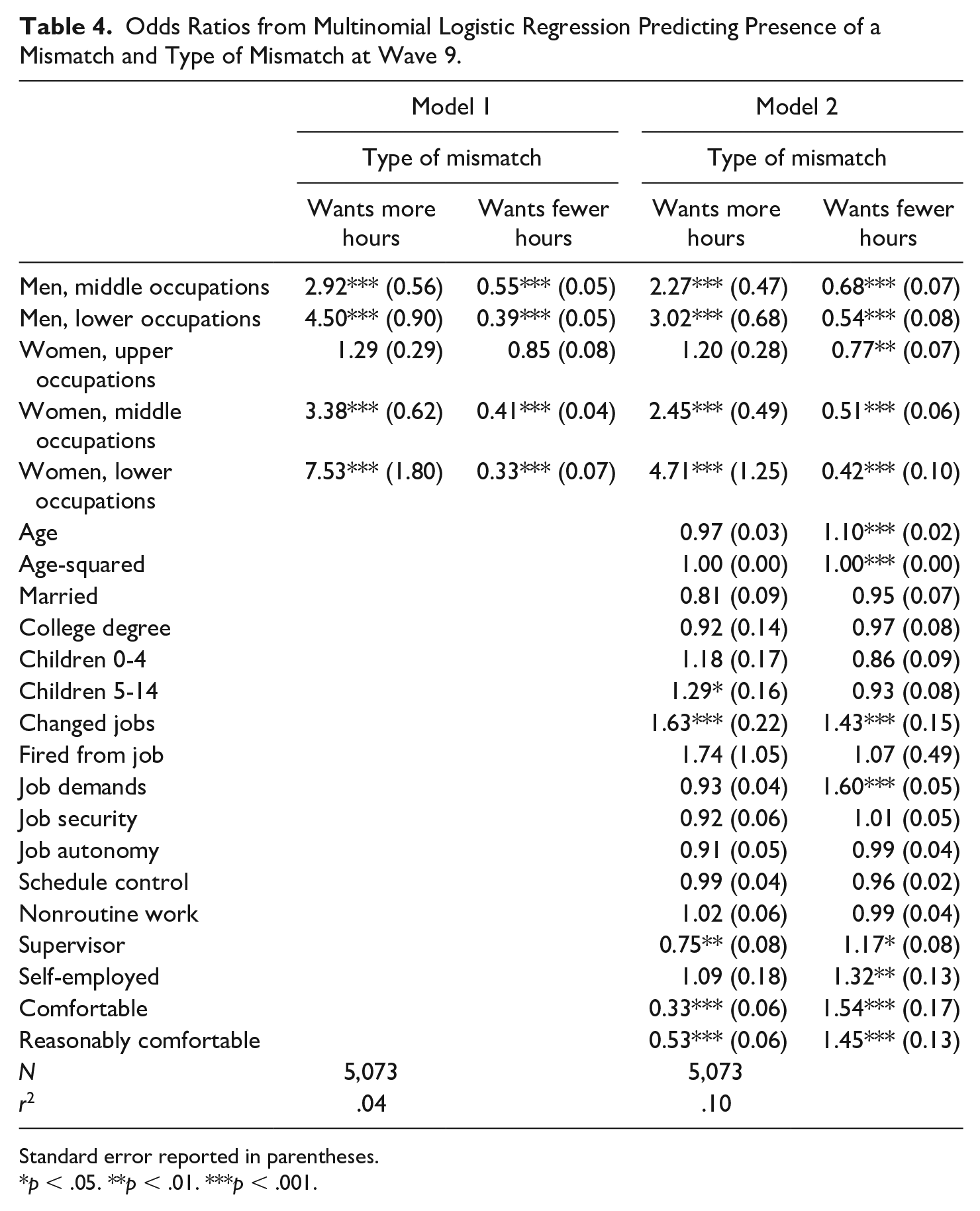
To examine whether these results remain after controlling for other factors, I estimate a series of regressions. Table 4 presents the results of a multinomial logistic regression showing how the odds of wanting more or fewer hours (rather than the same hours) at Wave 9 are related to combinations of gender and occupation, and the results support the stress of higher status hypothesis. Model 1 includes only the combinations of gender and occupation, with men in upper occupations serving as the reference category. This model is useful for testing hypotheses derived from the stress of higher status hypothesis, which predicts that those in upper level occupations will be more likely to have mismatches. Interestingly, men in upper occupations are significantly different from every category in the odds of wanting both more and fewer hours, except for women in upper occupations. This suggests that people in upper occupations are unique in terms of the mismatches they experience, regardless of gender. Women and men in both middle and lower occupations show a significantly greater desire for more hours and are less likely to develop a desire for fewer hours compared with men in upper occupations.
Odds Ratios from Multinomial Logistic Regression Predicting Presence of a Mismatch and Type of Mismatch at Wave 9.
Standard error reported in parentheses.
p < .05. **p < .01. ***p < .001.
Model 2 adds controls for a variety of personal, family, and job characteristics that may influence the chances of having a mismatch, but the results remain largely the same and indicate that most people are less likely than men in upper occupations to want fewer hours and more likely to want more hours. Men in middle occupations are 1.27 times more likely than men in upper occupations to desire more hours (rather than the same hours), and 32 percent less likely to want fewer work hours. Men in lower occupations have even more pronounced differences, as might be expected, being twice as likely as men in upper occupations to want more hours, and 46 percent less likely to want fewer. Women in middle occupations are 1.45 times more likely than men in upper occupations to develop a desire for more hours, and 49 percent less likely to want fewer. Women in lower occupations show the greatest odds of desiring more hours. They are 371 percent more likely than men in upper occupations to desire more hours and 58 percent less likely to want fewer.
The one notable change is among women in upper occupations. After adding the controls, they are still no different from men in upper occupations in the odds of wanting more hours. However, after controlling for family and job characteristics, the difference in the desire for fewer hours becomes significant, with women in upper occupations being 23 percent less likely to develop this type of mismatch than men in upper occupations. Supplemental tests indicate that this new result is related to the inclusion of job demands and schedule control in the model. 6 The lack of significance related to children may be the result of greater access to affordable child care in Australia, or that workers have arranged a satisfactory schedule prior to having children.
Figure 1 illustrates the contrasts related to wanting fewer hours by gender and occupation. As discussed in Table 1, gender is significantly related to type of mismatch for people in middle and lower occupations, but not among upper level workers. Occupational differences are also significant for both men and women. However, an intersectional analysis as depicted in Figure 1 tells a more nuanced story. When considering differences among those who desire fewer hours, men in upper occupations far exceed people in all other gender/occupation locations in their desire for fewer hours. Women in upper level occupations also want fewer hours and have significant differences with all categories except for men in mid-level occupations. Women in lower occupations are the least likely to desire fewer hours but are similar in this regard to women in middle occupations and men in lower occupations. In short, Figure 1 suggests that the effect of gender varies by occupation and the effect of occupation varies by gender. Gender differences in experiences of hour mismatches are especially pronounced in upper occupations.
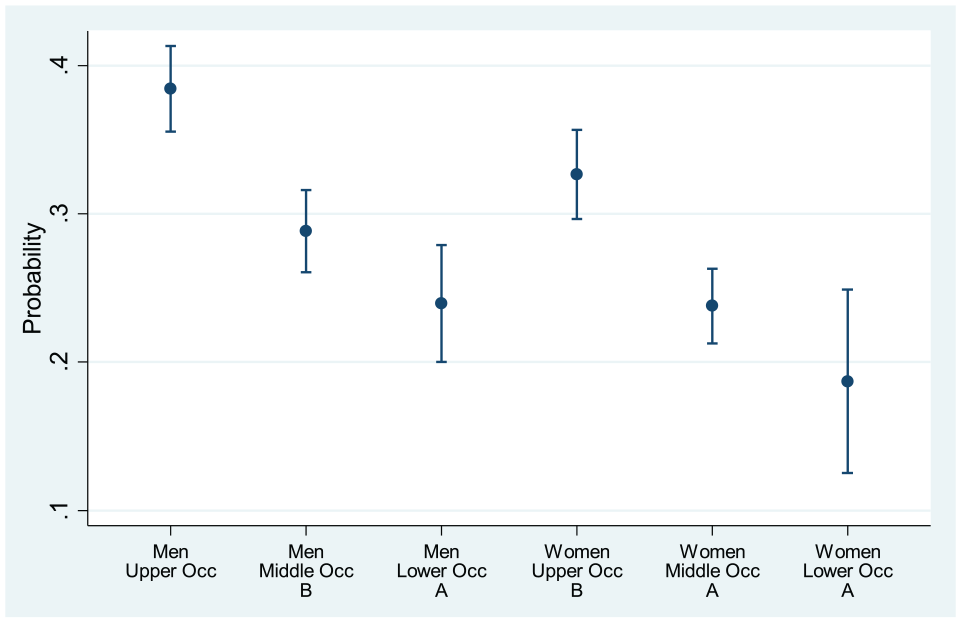
Probability of wanting fewer hours by gender and occupation.
Alternately, Figure 2 provides information on mismatches related to wanting more hours by gender and occupation. In this type of mismatch, it is women in lower level occupations who are significantly contrasted with all other groups in their greater desire for more work hours. Men and women in upper occupations are similar, as are men and women in middle occupations. People in mid-level jobs are also similar to men in lower occupations in their level of desire for more hours. Once again, the results provide clear evidence that gender and occupation interact. While men and women in similar occupations tend to have similar chances of wanting more hours and the desire for more hours is inversely related to occupational prestige, women in lower prestige occupations are far more likely than their male peers to want more hours.
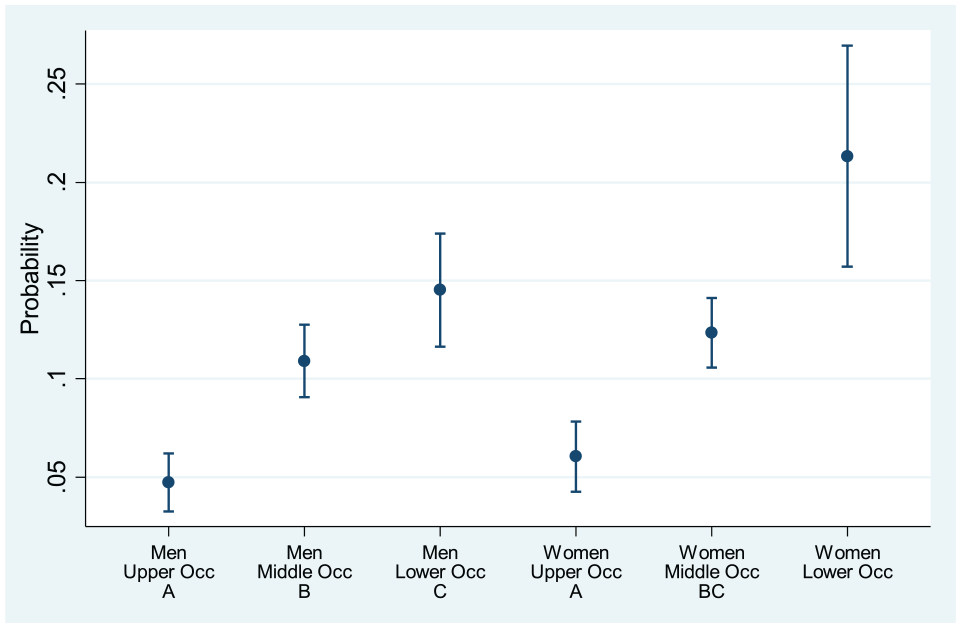
Probability of wanting more hours by gender and occupation.
Table 5 shows the results of a logistic regression examining the chances of resolving a mismatch. The dependent variable in this case is a dichotomous variable indicating whether the mismatch present at Wave 9 was resolved by Wave 10. The reference category for this regression contains those individuals who did not resolve their mismatches. Results again indicate outcomes for men in both middle and lower occupations are significantly different than for men in upper occupations. They are 69 and 67 percent more likely than men in upper occupations to resolve their mismatches, providing support for the stress of higher status hypothesis. Results for women in upper occupations are not significant, which may indicate that the stress of higher status works similarly for men and women in upper occupations, but the lack of significance among other occupational levels for women, and additional tests which show women in various occupational categories do not differ significantly from one another, may point to another process influencing outcomes for women as compared with men. Adding the control for wanting fewer hours is an important addition to the model because this type of mismatch is associated with decreased chances of resolution. To the extent that people with different gender/occupation combinations are more likely to want fewer hours, results from models that do not include this variable could be biased. The results in Model 2, however, are almost the same as in Model 1.
Odds Ratios from Logistic Regressions Predicting Resolution of Hour Mismatch between Waves 9 and 10.
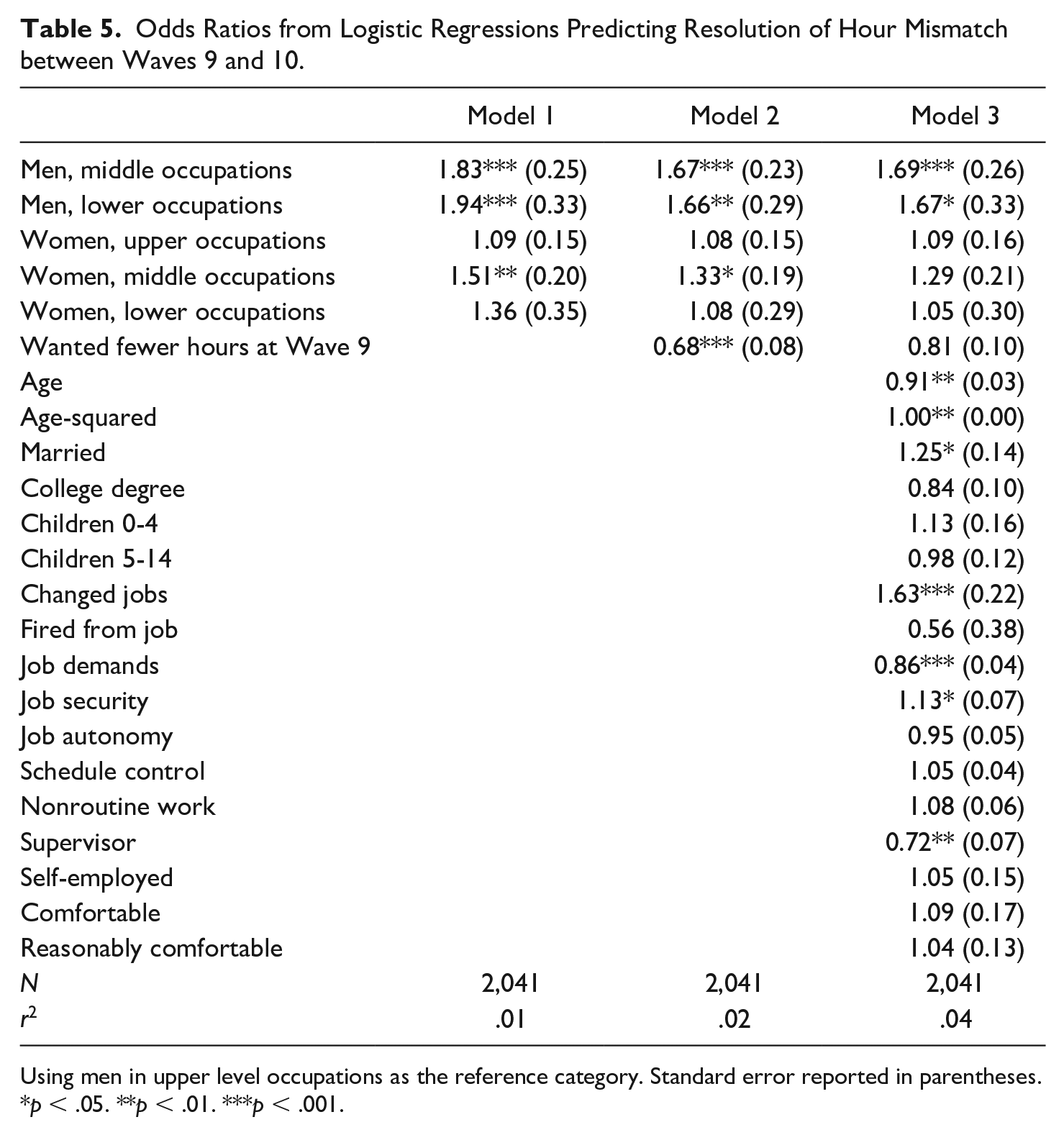
Using men in upper level occupations as the reference category. Standard error reported in parentheses.
p < .05. **p < .01. ***p < .001.
The addition of control variables, however, wipes out the significant results for women in middle occupations. Again, job demands appear to play a role, as they are negatively associated with resolution of mismatches. Supervisory positions also are negatively associated with resolutions, indicating that women in middle occupations report greater job demands and supervisory roles than women in upper or lower occupations, but if these demands were held constant, they would find it easier to resolve their mismatches. The addition of the controls brings women in middle occupations closer to women in upper and lower occupations in terms of resolving mismatches and removes the indication that they may have significantly different chances of resolving mismatches compared with men in upper occupations.
Figure 3 illustrates the contrasts among groups in the probability of resolving a mismatch, showing that most gender/occupation locations are quite similar, with the main contrasts being that men and women in upper occupations show lower odds of resolution than men in both middle and lower level occupations. People in similar occupations, however, appear to be similar their chances of resolution.
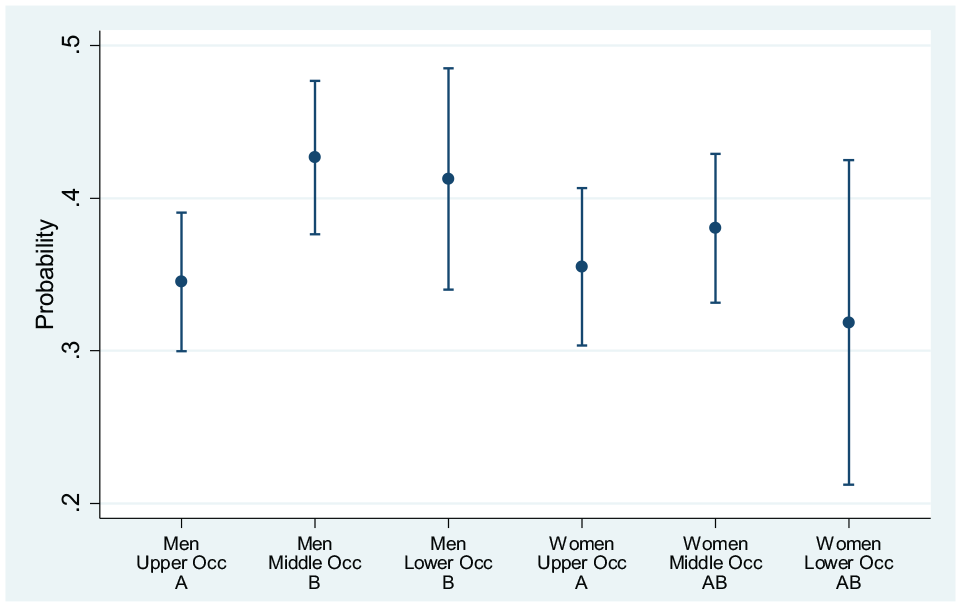
Probability of resolving hour mismatch by gender and occupation.
Table 6 displays the results of a multinomial logistic regression indicating differences in the odds of resolving hour mismatches through particular methods. The sample includes only those respondents who reported an hour mismatch at Wave 9 and resolved it by Wave 10, lowering the sample size and perhaps limiting significant results. The dependent variable is a three-category dummy variable indicating whether a resolution was achieved through actual hours, preferred hours, or compromise. The reference category of the dependent variable is actual hours. The reference category for the independent variables again is men in upper occupations. Model 1 lists only intersections of gender and occupational level, with no significant results. Model 2 adds a variable for having wanted fewer hours at Wave 9, and this situation is associated with 45 percent greater odds of resolving a mismatch through a change in preferred hours.
Multinomial Logistic Regression Showing Method of Resolution.
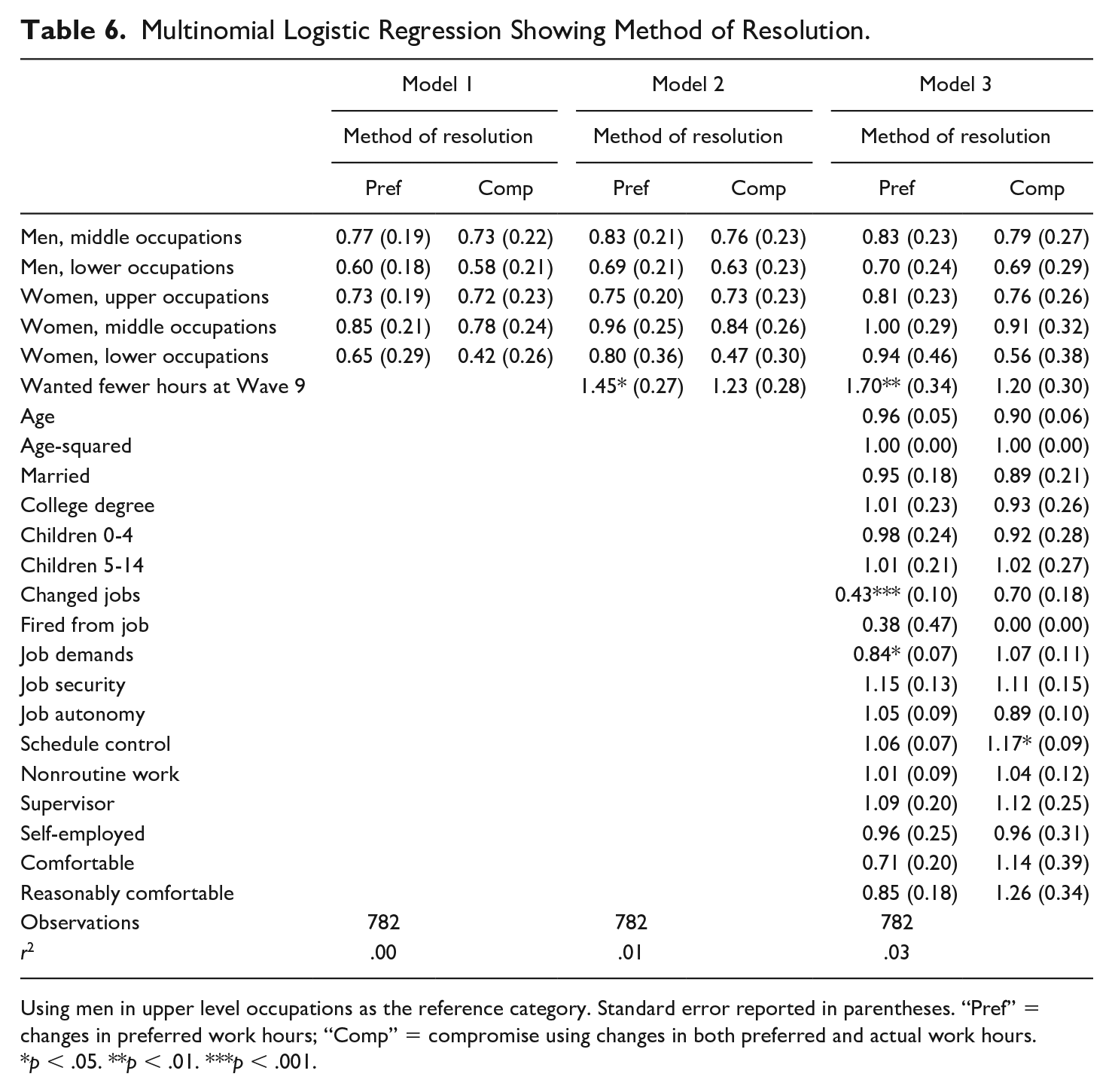
Using men in upper level occupations as the reference category. Standard error reported in parentheses. “Pref” = changes in preferred work hours; “Comp” = compromise using changes in both preferred and actual work hours.
p < .05. **p < .01. ***p < .001.
Model 3 includes controls for family and job characteristics and again yields few significant results. Wanting fewer hours has a greater effect, now showing that these types of mismatches lead to a 70 percent increase in the chances of resolution through preferred hours as compared with actual hours. Respondents who changed jobs were 57 percent less likely to achieve a resolution through preferred hour changes, and therefore are more likely to get the hours they wanted through actual hour changes. Job demands are again significant, showing high demands are associated with a 16 percent lower likelihood of resolving through preferred hours. Respondents who felt they had a good degree of control over their work schedules had a 17 percent greater chance of achieving a compromise between actual and preferred work hours. It does not appear that of those who resolved their mismatches from Wave 9, there were significant differences in the methods they resolved them by gender or occupation.
Conclusion
This study highlights how experiences with work hour mismatches reflect the intersections of gender and occupation. Prior studies have focused on the cross-sectional distribution of hour mismatches and offered little analysis of how often hour mismatches are resolved or the methods through which they are resolved. They have also assumed that people who share the same gender or broad occupational category have similar experiences. Drawing on insights derived from the stress of higher status hypothesis and the concept of the ideal worker, this study uses an intersectional lens to examine how experiences with work hour mismatches vary across the landscape of gender and occupation.
I began by examining how gender and occupation are related to the probability of wanting more or fewer hours than one has. The question of prevalence of mismatches produces the greatest evidence of inequality. I find that more men than women experience work hour mismatches, and that those in upper level occupations report more mismatches than their counterparts in middle and lower occupations. This is likely related to the fact that both men and women in upper level occupations tend to work more hours than those in middle or lower occupations. People in lower occupations (particularly women) show a greater chance of wanting more hours. These results are consistent with the stress of higher status hypothesis, which indicates that those in upper occupations will have demanding jobs requiring long work hours and that they will have difficulty reducing their hours of work. This is also predicted by the ideal worker norm which suggests those in upper level occupations will be reluctant to actually reduce their hours (even when they want to).
An intersectional perspective helps highlight the chances of having a particular type of mismatch, where the stress of higher status fails to explain gender differences within occupational categories and the ideal worker norm fails to account for occupational differences within gender categories. An understanding of the unique interactions of both gender and occupation is needed to account for these differences. This reveals varying patterns of inequalities across combinations of gender and occupation. Whereas Clawson and Gerstel (2014) find the unequal distribution of flexibility policies and practices across class affects how men and women at different locations negotiate or contest their use of time in the United States, I also find that inequalities in hour mismatches among Australian workers reflect the joint effects of gender and occupation.
There are also striking differences seen in the area of mismatch resolution. Men in the upper occupational category are the least likely to resolve their mismatches. Men in middle and lower occupations each have significantly different experiences from men in upper occupations. As occupational level decreases, men are more likely to resolve their mismatches. This is both consistent with the stress of higher status hypothesis and prior work which indicates that the desire for more hours, exhibited by men in lower occupations, will be easier to resolve.
While the stress of higher status hypothesis does a good job predicting men’s ability to resolve hour mismatches, a very different pattern emerges among women. Women have similar chances of resolving their mismatches whether they are in upper, middle, or lower prestige occupations. Their chances of resolution are not significantly different from men in upper occupations, which is to say they are not good. If resolutions were influenced primarily by institutional constraints (e.g., the availability of flexible work policies), then outcomes among women would vary by occupation and men and women in similar occupations would have similar experiences. This is not what my results indicate.
Given the different patterns found between men and women, additional insights are needed to supplement the stress of higher status and ideal worker concepts, especially for explaining the experiences of women in middle and lower occupations. Theories regarding gendered norms and expectations can help to illuminate the differences found in resolution of mismatches. These suggest that men and women prefer egalitarian divisions of home and paid labor, but fall quickly into gendered patterns when institutional constraints prevent this (Pedulla and Thébaud 2015), and people may avoid flexibility options altogether to distance themselves from the “flexibility stigma,” believing their supervisors and coworkers will see them negatively when they take advantage of these policies (Williams, Blair-Loy, and Berdahl 2013b). In addition, men and women in upper level occupations may use their access to flexibility to reproduce traditional gender roles, which may explain the higher perceived job demands of women who may also be bearing the bulk of household labor. Those in lower level occupations, meanwhile, experience higher levels of unpredictability in work time and use flexibility options to achieve nontraditional gender balance (Clawson and Gerstel 2014; Gerstel and Clawson 2014).
Men may feel pressured into the breadwinner role, because fathers who take off time for family obligations are seen as insufficiently masculine (Berdahl and Moon 2013), and this is consistent with findings that men across occupations continue to work many hours. The tendency for men to continue working long hours is reflected in my results showing the often unresolved desire for fewer hours. Conversely, women remain more likely to absorb the impact of childcare and housework (Williams, Blair-Loy, and Berdahl 2013a), and continue to have less flexibility than their male counterparts (Peterson and Wiens-Tuers 2014). These women get neither the additional hours they need nor the reduction in hours they want. Men in middle and lower occupations, meanwhile, have a greater likelihood of resolving mismatches than men in upper occupations, but women in middle and lower occupations do not see improvements over women in upper occupations in the probability of resolving their mismatches, even when they desire more hours.
Clearly, the kinds of occupations held by men and women shape the opportunities available to resolve conflicts as well as the social conditions that drive their willingness to take advantage of those opportunities. As mentioned earlier, men and women are relatively equally likely to be upper and mid-level occupations, but men are overrepresented in the lower level occupations of laborers, machinery operators, and drivers. Women in these jobs may suffer from the inconsistency perceived between their gender and their occupation, leading to a “chilly climate” (Cech, Blair-Loy, and Rogers 2018; Ostroff 1993) or relegating them to token status (Kanter 1977), thus making them less likely to receive additional hours as compared with men in those occupations.
Finally, results pertaining to the methods of resolution are highly inconclusive. Few differences can be seen in the methods by which people resolve their mismatches, in terms of either gender or occupation or the interaction of both. While it appears that workers are more likely to resolve their mismatches through changing preferences than through any other method, I still find that about one-third are able to change their actual hours and about a fifth compromise, with few notable differences across combinations of gender and occupation. Certainly, further study is needed to illuminate whether there are differences in the mechanisms of resolution along other dimensions.
Limitations and Implications
While the data used for this analysis allow generalizations to Australian workers, it is not clear whether similar patterns of inequality exist in other industrialized countries. The United States, for instance, is similar to Australia in a number of ways. Both countries have seen similar demographic and workplace changes since the 1970s. Rising rates of divorce, single-parent families, and women entering the labor force have been seen in both countries, along with reliance on private child care for working parents. Nevertheless, the two countries have different proportions of women in the labor force and in part-time work (Reynolds and Aletraris 2006, 624). Universal health care, credits for child care, and the overall stronger social safety net in Australia also change the way people make decisions about work hours (Drago, Wooden, and Black 2009b). An additional consideration is the recent Right-to-Request legislation passed in Australia, guaranteeing workers the right to request changes in work hours without fear of reprisals from employers (Charlesworth and Campbell 2008; Skinner and Pocock 2011). Employers are not obligated to honor these requests, and a recent study (Baker, Johnson, and Denniss 2014) found that many workers remain unaware of the legislation and rates of requests for change have not changed significantly since it was enacted. It is unclear how much this affects my analysis, though, since the law was not implemented nationwide until 2010. In short, more research is needed to determine whether workers in other countries have experiences like those described here.
More research will also be needed to reveal exactly why men and women in different types of occupations are unable to fulfill their preferences. Qualitative data could be very helpful in explaining why people make the choices they do regarding work hours and which obstacles they find most difficult to overcome.
Nonetheless, this study helps close the gap in existing research by revealing the complex contours of working time inequality. I show that people differ not only in their chances of having hour mismatches, but also in their chances of resolving them. I also show that the chances of having and resolving work hour mismatches vary by gender and occupation, but not in a straightforward way. These complex patterns have been veiled in prior research, which has assumed that people who share a gender or occupation have similar experiences with hour mismatches. This analysis, however, shows that experiences with hour mismatches are best understood through a joint consideration of gender and occupation.
Footnotes
Appendix
Occupational Prestige Scores to Determine Occupational Levels.
| Occupation (ANZSCO 2006) | Mean occupational prestige score |
|---|---|
| 1. Managers | 59.9 |
| 2. Professionals | 81.4 |
| 3. Technicians and Trades Workers | 37.5 |
| 4. Community and Personal Service Workers | 42.2 |
| 5. Clerical and Administrative Workers | 45.8 |
| 6. Sales Workers | 34.5 |
| 7. Machinery Operators and Drivers | 21.1 |
| 8. Laborers | 19.3 |
ANZSCO = Australian and New Zealand Standard Classification of Occupations.
Acknowledgements
I am indebted to the support and guidance of Jeremy Reynolds throughout this project. Patricia Richards and Justine Tinkler also offered advice and guidance for which I am truly grateful. I would also like to thank the anonymous reviewers for many helpful comments.
Declaration of Conflicting Interests
The author(s) declared no potential conflicts of interest with respect to the research, authorship, and/or publication of this article.
Funding
The author(s) disclosed receipt of the following financial support for the research, authorship, and/or publication of this article: This paper uses unit record data from the Household, Income and Labour Dynamics in Australia (HILDA) Survey. The HILDA Project was initiated and is funded by the Australian Government Department of Social Services (DSS) and is managed by the Melbourne Institute of Applied Economic and Social Research (Melbourne Institute). The findings and views reported in this paper, however, are those of the author and should not be attributed to either DSS or the Melbourne Institute.
