






Abstract
Job–education mismatch among immigrants in host countries poses challenges to economic assimilation and social integration. This study examines determinants of vertical mismatch among immigrants using PIAAC data from France, Germany, Canada, and the United States. Additionally a job mismatch severity index has been created, based on the Foster Greer and Thorbecke framework that quantifies mismatch intensity. Results from a complementary log–log model highlight key factors of job education that include immigrant generation, duration of stay, language proficiency, and relevance of work experience whereas the findings of FGT index reveal that lack of host-country relevant work experience significantly intensifies mismatch severity across all selected countries, underscoring its critical role in shaping immigrant labor market outcomes.
Introduction
Over the past few decades, a lot of immigrants receiving countries are paying attention to update their immigration policies in order to attract educated immigrants. This strategic step has been driven by the concerns over labor market shortage in developed countries. But despite focusing on improving the immigrant's integration into the host countries, the new cohort of immigrants have to face with several challenges such as discounted foreign capital by the employers. Many highly educated immigrants are forced to work for job in which they are overqualified that lead to much discussed issue vertical mismatch (Li and Lu 2023).
Among immigrants, the vertical mismatch has been cited as a major factor that led to labor market disadvantage (Abdulla 2025). Employers in the host country often lack awareness regarding the significance of foreign qualification and work experience accumulated by immigrants. As immigrants acquire host country's specific human capital, employers may gradually become more familiar with their capabilities. This undervaluation can stem from employers’ biases, potentially leading to increased instances of vertical mismatch among immigrants (Chen and Chen 2024).
A growing body of empirical literature has examined vertical mismatch among immigrants by utilizing the data from Programme for the International Assessment of Adult Competencies (PIAAC) to investigate this phenomenon. Notably, Pivovarova and Powers (2021) examined labor market mismatch among immigrants only in case of United States using PIAAC 2012 data, demonstrated that immigrants are disproportionately exposed to an education–job mismatch relative to native-born workers. Similarly, Dollmann et al. (2023), Aradhya, Grotti and Härkönen (2023) analyzed various dimensions of vertical mismatch within specific country's context. These studies confirm that vertical mismatch is a structurally embedded feature of immigrant's labor market integration rather than a temporary or idiosyncratic phenomenon. However, literature exhibits several important limitations that this study seeks to address.
Firstly, these studies examine the extent of vertical mismatch among immigrants through isolated analytical lens which is informative but presents a fundamental methodological limitation that led to incomplete and potentially misleading inference. Labor market integration is an inherently multidimensional process, shaped by the simultaneous interplay of individual level characteristics, structural constraints, and institutional context. Treating its determinants in isolation unable to account for the complex interdependencies among these factors, thereby complicating the mechanisms through which vertical mismatch arises and persists. For instance, language proficiency does not operate independently of generational status; second and third-generation immigrants are systematically more likely to acquire native-level language fluency because of their longer and deeper socialization within the host country's institutional environment. Similarly, the length of migrants stay in the host country is not merely a temporal phenomenon but a proxy for the gradual accumulation of host country's specific human capital, social networks, and institutional familiarity all of which interact simultaneously to shape labor market outcomes.
Secondly, the severity of education–job mismatch among immigrants has been assessed through the Foster–Greer–Thorbecke (FGT) index, which has primarily been used to measure disparities in the context of poverty (Omeje, Chukwu and Isiwu 2022; Ogwang and Mwabu 2024). Numerous studies utilize the FGT index to evaluate deprivation within poverty literature, where FGT1 captures only the average shortfall of deprivation, indicating depth, while FGT2 extends this by capturing the severity experienced by marginalized groups. Andriopoulou, Kanavitsa and Tsakloglou (2019) Demonstrate that although both measures reveal similar trends but FGT2 is particularly more valuable as it uncovers hidden disparities. In the context of immigrant labor market, education–job mismatch is not merely an isolated issue rather, it is a structural feature rooted within the labor market dynamics of the host country. Thirdly, due to the skewed distribution of response variable, the complementary log–log model has been employed to estimate the determinants of vertical mismatch among immigrants (Hasan, Le and Hoque 2021).
This study specifically focused on four selected OECD countries such as France, Germany, Canada, and United States due to its diverse migration policies and labor market structure. For instance, France's immigrant population is shaped by historical ties and regional proximity, with a large share of immigrants coming from Algeria (16%), Morocco (12%), and Portugal (7%). Immigrants enter France through several categories, such as family reunification, labor migration, and humanitarian reasons. France's labor market is dominated by the services sector. France follows the “immigration choisie” model by prioritizing skilled immigrants. According to the immigration policy introduced in 2024, France has implemented restrictions on non-European workers, requiring that job offers to be approved by regional authorities and followed by a valid residence permit (OECD 2024). Similarly, Germany is one of the countries attracting immigrants coming from Poland (10%), Russia (7%), and Turkey (9%). The Skilled Immigration Act 2024 has attracted educated professionals from non-European countries to fill the labor shortage gap. Germany's labor market is primarily dominated by the manufacturing sector. The country is facing acute labor shortages in the health sector and STEM fields. Recently, an opportunity card system has been introduced, where a point-based system makes it easier for professional immigrants to enter Germany (OECD 2024).
In Canada, most immigrants enter through programs like Express Entry, which is based on a points system that prioritizes workers from healthcare, information and communication sectors. The country's immigrant population includes a significant number of people from India (11%), China (11%), and the Philippines (9%). It hosts many students and foreign workers, but recent immigration policies have reduced the number of permanent work permits in response to an oversupply of workers (OECD 2024).
The United States is the largest recipient of immigrants in the world. Immigrants enter the United States mainly through family reunification and employment-based pathways. Most immigrants come from Mexico (24%), India (7%), and China (5%). The most prominent sectors in the US economy are healthcare, IT, and engineering (OECD 2024).
According to a report published by the United Nations (2025), in 1990 there were an estimated 154 million international migrants globally, a figure that has nearly quadrupled to 304 million by 2024. The countries hosting these migrants are predominantly developed nations, including the United States, Germany, France, and Canada. According to the International Migration Stock report of 2024, the immigrant share in these countries has risen from 5.8% to 15.2% in the United States, from 7.7% to 13.8% in France, from 15.4% to 22.2% in Canada, and from 8.7% to 19.8% in Germany, reflecting substantial growth in migrant populations from 1990 to 2024.
Numerous research studies indicate that vertical mismatch is a prevalent issue among immigrants, leading to adverse labor market outcomes, including reduced job satisfaction (Khalil, Almuth and Mayer 2023; McGuinness, Bergin and Whelan 2018) and increased turnover intentions (Maynard and Parfyonova 2013). Moreover, it also contributes to significant productivity losses, as both individuals and educational institutions make substantial investments that do not translate effectively into favorable labor market outcomes (Imai, Stacey and Casey 2019). Such discrepancies between the education levels of immigrants and the demands of their jobs underscore the necessity for targeted interventions to enhance alignment between skills and employment opportunities.
Numerous studies have identified several factors contributing to vertical mismatch among immigrants, including lack of work experience, poor language proficiency, differences in social and cultural capital, years of migrants stay in the host country, and immigrants generation (Ghio, Bratti and Bignami 2023; Kubiciel-Lodzińska et al. 2023; Lancee and Bol 2017). Among several other factors, native language proficiency plays a critical role in facilitating immigrants transition into the labor market. Immigrants who are not proficient in the host country's language tend to face a higher job education mismatch as compared to those workers who are highly proficient in the host country's native language (Budría and Martínez-de-Ibarreta 2021). Language proficiency helps immigrant workers to perform tasks more efficiently by lowering workplace communication costs that would otherwise create communication barriers (Winterheller and Hirt 2017). On the other hand, immigrants with poor language proficiency also suffer from a weak social network, which in turn increases the likelihood of vertical mismatch (Thondhlana, Madziva and McGrath 2016).
Another reason discussed in the literature is the immigrant's accumulation of work experience from their home country. Since human capital acquired in one country is specific to that country's specific educational standards and labor market requirements it is not always applicable or easily transferable across countries. Therefore, in host country these educational standards are often less valued by employers where racial and cultural discrimination also contributes to vertical mismatch among immigrants. As noted by Banerjee, Verma and Zhang (2019) previous work experience for immigrants is an important indicator of job–education mismatch. Furthermore, the devaluation of foreign work experience often also results in job education mismatch among immigrants. This situation highlights the dual barriers faced by immigrants such as they not only enter the labor market without the relevant local experience, but they also encounter biases that devalue their previous qualifications (Blackmore, Gribble and Rahimi 2017).
Regarding the duration of immigrants stay in the host country, there are two contrasting views on this matter. One opinion is that the longer immigrants stay in the host country, the higher the likelihood of education–job mismatch is, which lead to persistent dissatisfaction among immigrants (Belfi et al. 2022). Conversely, another perspective is that over time, immigrants gain experience related to the host country's labor market, attain fluency in the host country's native language, and develop social networks, which in turn lower the incidence of vertical mismatch (Drouhot 2024).
Moreover, the generational status of immigrants significantly influences the incidence of job–education mismatch. Few studies have analyzed this issue among first-generation immigrants and found that the likelihood of mismatch is higher among first-generation immigrants due to their limited exposure to the social capital of host country and lack of proficiency in the native language. However, this phenomenon tends to decrease as the migrant's stay in the host country increases (Drouhot and Nee 2019). Consistent with this reasoning the incidence of educational mismatch tends to disappear as immigrants eventually settle down in the host country. As analyzed in our study this leads to expect that among second and third generation immigrants the incidence of vertical mismatch decreases (Larsen, Rogne and Birkelund 2018).
Some researchers view job–education mismatch among immigrants as a sign of a labor market discrimination issue (Blackmore, Gribble and Rahimi 2017) where employers underestimate the level of education acquired by the immigrants which signals that workers might not be able to perform the assigned task effectively. In most cases during the hiring process employers rate workers based on their country of origin. For instance, employers negative perception about the immigrants coming from less developed countries such as Central Asia (Felker 2012) and Middle East (Oreopoulos 2011) and Latin American (Gandini and Lozano-Ascencio 2016) countries negatively affect the immigrants’ integration into the host country's labor market.
In contrast to this employer's positive perception about the immigrants coming from developed regions help immigrants to secure well-matched jobs. Therefore, if employers discriminate against certain immigrant workers, then vertical mismatch becomes a consistent feature of the labor market (Tzeng 2010). Another researcher (Cooke, Zhang and Wang 2013) found that despite having the highest qualification levels, Chinese immigrants in Australia see their qualifications and experience being devalued by employers. Vertical mismatch affect immigrant job satisfaction. Researchers have varied opinions on this, some believe that workers who are satisfied with their jobs despite mismatches are more likely to stay, while others think that dissatisfied workers are more likely to quit their current job (Frank and Hou 2018; Wassermann and Hoppe 2019). This dissatisfaction will lead them to search for a better-matched job to earn higher compensation for their education. As literature highlights, several factors create difficulties for immigrants during their transition in the host country's labor market, such as the nonrecognition or devaluation of foreign credentials, language barriers, irrelevant work experience, racial discrimination, and employers’ preferences for natives over immigrants. All these factors affect immigrants’ overall satisfaction.
After reviewing literature, we found fewer studies about job mismatch among immigrants in OECD region. Most of the previous research focused on the broader picture of labor market inefficiencies but our study will analyze this phenomenon through a deeper lens by incorporating important factors such as year of migrants stay in the host countries, Immigrants generation and by measuring job mismatch severity, etc. Hence, study will test the following hypothesis:
H01: (Assimilation hypothesis) First-generation immigrants face higher incidence of educational job mismatch as compared to second and third generations immigrants?
H02: (Convergence hypothesis) Over time, the vertical mismatch tends to decrease?
H03: (Cultural capital hypothesis) Proficiency in the host country's native language has negative impact on vertical mismatch.
H04: (Work experience hypothesis) Work experience has positive impact on vertical mismatch?
H05: (Deprivation Hypothesis) What socio-demographic characteristics influence the severity of vertical mismatch as measured by the FGT 2 index?
The findings of this study are used to recommend policies to assist policymakers to improve immigration policies that ultimately help immigrants to integrate in the host country's labor market smoothly. The rest of the study is structured as follows: Section 2 summarizes the review of literature, whereas Section 3 deals with the data and methodology. Section 4 explain the results and discussion, and Section 5 concludes the study.
Review of Literature
The first part of the literature review shed light on the theoretical framework, that laid the foundation for this study whereas second part critically analyze the empirical literature review that help to identify the research gap and explain how this study aims to address it.
Theoretical Background
The theoretical background concerning the phenomenon of vertical mismatch among immigrants is explained through assimilation theory, which describes how immigrants and their descendants impact the host country's labor market (Khoudja 2018). The neo-classical assimilation theory explains that the gap gradually converges with the duration of migrants stay as well as across generations. Several studies have pointed out that although there exist differences among immigrants from various countries but intergenerational assimilation exists in terms of labor market outcomes and educational attainment (Drouhot and Nee 2019). On the other hand, the pattern of integration differs across ethnic groups. The segmented assimilation theory suggests that immigrants integration into the host country's labor market depends on several factors, such as their human capital attainment, parental socio-economic background, and perceptions or beliefs about certain ethnic groups in the labor market (Zhou and Gonzales 2019). The descendants of immigrants receive education in the host country, gain proficiency in the local labor market and acquire social and cultural capital. This ultimately stimulates the process of integration into the host country's labor market. In contrast to this (Safi 2017; Shahrokni 2020) pointed out that in some cases there exist a persistency regarding vertical mismatch among immigrants due to racial discrimination. In contrast to this, Belfi et al. (2022) found that second and third generation of immigrants who belong to non-Western countries experience higher incidence of educational job mismatch.
Lack of information about the host country's labor market results in imperfect transferability of human capital, as workers often have insufficient information about the host country's labor market. According to information adjustment model, at the beginning of their careers, workers accept lower-level jobs due to lack of work experience, aiming to advance towards higher occupational status through on-the-job training (Piracha and Vadean 2013). This model fits well in the context of immigrants, as the cost of job searching is relatively higher for newly arrived immigrants due to nonfamiliarity with the labor market. Therefore, during the initial adjustment period, immigrants are willing to accept lower-level jobs while they search for better-matched employment. As their length of residence in the host country increases the incidence of job–education mismatch decreases.
There exist a debate about whether the vertical mismatch is a temporary or persistent phenomenon (Sevilla, Farías and Luengo-Aravena 2021). The career mobility theory argues that vertical mismatch is a temporary phenomenon. Workers accept jobs that are either below the level of education required by the position, but later on, they acquire work experience and training that eventually reduce the extent of job mismatch (Wen and Maani 2019). This view explains that vertical mismatch is a temporary phenomenon. In contrast to this, signaling theory considers it a persistent phenomenon. For instance, a worker's level of education signals their productivity. For immigrants, their educational credentials signal their productivity. In the host country's labor market, employers hold preconceived notions about immigrant workers. In most cases, employers undervalue the educational credentials of immigrants. (Kalfa and Piracha 2018). That in turn leads to persistent vertical mismatch among immigrants.
Empirical Literature Review
Education–job mismatch refers to the situation where workers are unable to secure a job that aligns with their acquired qualifications. It is a multidimensional phenomenon with various forms, including vertical mismatch and horizontal mismatch. Vertical mismatch occurs when the level of education required by an employer differs from the level of qualification obtained by a worker. It is further divided into two types: overqualification, where workers hold higher qualifications than the job requires, and underqualification, where the education level is lower than what the job demands. On the other hand, a horizontal mismatch occurs when workers are employed in jobs that differ from their field of study (Banerjee, Verma and Zhang 2019).
Education–job mismatch is not a recent phenomenon, it was initially studied in 1970 by Freeman, who mentioned in his book “Over Educated Americans” that an oversupply of university graduates resulted in lower returns on education. This triggered the interest of researchers like Smith and Finis (1978) who investigated this issue using microlevel data, where they compared well-matched workers to those who are mismatched with their jobs. As a result, they discovered a misallocation of resources that needs to be studied in detail.
There exist a bunch of studies on the phenomenon of vertical mismatch among immigrants that used the data from PIAAC, such as Chort (2017) studied the impact of job–education mismatch among migrant workers from Senegal to two developed countries, France and Italy, and two developing countries, Mauritania and Cote d’Ivoire. The author found that the likelihood of vertical mismatch among immigrants is higher in developed economies as compared to developing countries (12.7% as compared to 2.2%). The author further pointed out that the reasons for vertical mismatch are due to the nontransferability of educational credentials across borders and the migrant's weak social network. Similarly, Nieto, Matano and Ramos (2013) examined the social integration dynamics for migrants by measuring qualification mismatch using PIAAC data in case of Italy. Prokic-Breuer and McManus (2016) studied whether the immigrant's educational mismatch in Western Europe is apparent or real. By employing an extensive dataset from PIAAC for the 13 European countries, findings revealed that first-generation immigrants are facing overqualification for their present job. On the other hand, immigrants are less likely to be in a job that underutilizes their cognitive skills. Therefore, this study shows that the job–education mismatch faced by immigrants is more apparent than real. The main factors contributing to overeducation among immigrants are the quality of education, language proficiency, and the imperfect transferability of human capital.
Annen (2019) tried to answer the question about whether immigrants who have received education outside of Canada can apply their acquired knowledge in their current job or not. A labor market success index has been developed to test the assumptions of human capital theory. Results show that years of education, years of work experience, and skills positively affect labor market success, while being born abroad and obtaining the highest qualification from abroad results in adverse labor market outcomes. Pivovarova and Powers (2021) examined whether immigrants in the United States experience education–job mismatch. By using PIAAC data, they found that first and second-generation immigrants are more likely to be overeducated for their jobs as compared to third-generation immigrants. Meanwhile, Black workers have higher odds of being overeducated than White workers, regardless of their immigrant status. Dereli (2018) found the determinants of education–job mismatch in Turkey by employing household labor force surveys for the years 2009 and 2014. Results of the multinomial logistic regression analysis show that the likelihood of overeducation is greater among high school graduates and young workers with less work experience. Conversely, workers in the public sector have a lower probability of being mismatched with their jobs as compared to those in the private sector.
Huertas and Raymond (2024) analyzed the relationship among educational level, educational mismatch, and occupational status using data from PIAAC. An International Socio-Economic Index (ISEI) was developed to assign occupational status to each job. The findings concluded that the returns to education are not consistent. Budría and Martínez-de-Ibarreta (2021) studied the extent of employment education–job mismatch among immigrants based on their proficiency in the host country's language. Used a dataset from Household, Income, and Labor Dynamics in Australia (HILDA), where language proficiency was instrumented using the Bleakley and Chin strategy. The findings showed that younger children learn language more easily than older ones. The results from 2SLS and probit model indicated that among immigrants, higher proficiency in a foreign language decreased the probability of overqualification.
Hence, the objectives of this research are as follows:
What is the impact of years of migration and the immigrant generation on the extent of vertical mismatch among immigrants in selected OECD countries? Whether the gap between required and obtained education converges over time or not? What are the reasons behind the severity of the education–job mismatch among immigrants?
Data and Methodology
This study used a dataset from The Programme for the International Assessment of Adult Competencies (PIAAC), collected in 2018. It is a comprehensive dataset led by OECD to evaluate adult job-related factors for individuals aged 16–65 across different OECD countries. Regarding migrants, it includes information on workers’ education, immigration status, year of migration, work experience, language proficiency, etc. Vertical mismatch has been measured through subjective approach, respondents were asked to select the education level required by their job, while another question asked about the highest level of education they attained. Both required and attained education levels were classified using the International Standard Classification of Education (ISCED). Workers are classified as vertical mismatched when the education level required by their job is higher or lower than the level they have achieved.

Additionally, job–education mismatch has been measured through the realized match method. It is an objective approach which is defined as required education level as a function of a measure of central tendency of the educational level of the workers job comparing afterward the education of the employees with such benchmark.” The approach estimates the required level of education using a central tendency measure of the distribution of the required level of education for a particular occupational group, such as the mean or the mode. There is an educational mismatch if the actual education of the worker is greater than this threshold.
This study has selected realized match approach as it is indicated to acknowledge skills upgrading because of technological change or new formal qualification requirements (Capsada-Munsech 2019). Additionally, the mode is used as a threshold instead of the mean in order to account for critiques that suggest that the use of the mean could lead to asymmetry in the estimation of the mismatch because it is less sensitive to outliers.
Following Roosmaa, Saar and Liisa (2023), this study calculated the modal level of education based on four ISCED 2011 categories of workers (ISCED 0–2 primary education and less; 2 upper-secondary; 3 postsecondary nontertiary; 4 short-cycle tertiary education and higher) separately for each ISCO-08 two-digit occupation group in each country. In the next stage, the attained level of education of each individual is compared with the modal level of education for respondents’ occupation which results in following categories:
If Attained Education Level = Mode of level of Education for Occupation, they are defined as matched. If Attained Education Level > Mode of Education Occupation, classified as overeducation and being vertically mismatched. If Attained Education Level < Mode of level of Education for Occupation classified as undereducated and being vertically mismatched.
The analysis is conducted for four OECD countries: United States, Germany, France, and Canada.
As far as the estimation methodology is concerned a complementary log-log has been adopted. Logistic regression has three common link functions, such as the logit model, probit model, and complementary log–log model. The first two models are suitable when the dependent variable has a symmetric distribution, but the complementary log–log model is appropriate when the data has a nonsymmetric distribution. Following Miyittah et al. (2024) who argues that the complementary log–log model is suitable when the dependent variable does not show a 50% affirmative and 50% nonaffirmative response. Since the distribution of the response variable is skewed, the following complementary log–log model has been employed.

Here, β0 represents the constant, and β1 … βk are the coefficients of the explanatory variables, while X1 … Xk are the set of independent variables. p is the predicted probabilities.
Foster Greer and Thorbecke Index
FGT index is a powerful indicator originally developed to measure in poverty literature but its structure makes it highly adaptable to other context like in case of vertical mismatch. To answer the second research question, the Foster–Greer–Thorbecke Index of job mismatch severity has been constructed. The FGT poverty index has been adapted to the context of job–education mismatch in the following way.
Table 1 shows the FGT index which has been created through the following formula:

Foster Greer and Thorbecke Index.
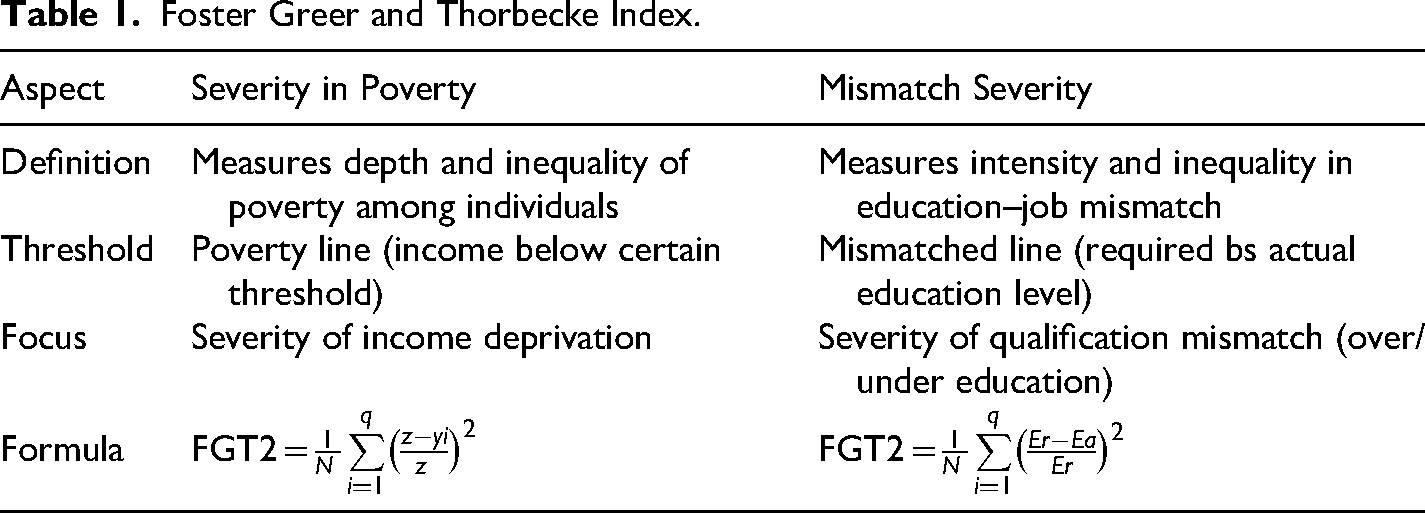
Independent variables include Immigrant Status, Gender, Year of Migration, Immigrant Generation, Highest Level of Education, Work Experience, Job Satisfaction, Sector of Employment, and Native Language.
Results and Discussion
Descriptive Statistics
Table 2 presents the descriptive statistics of all selected OECD countries. The distribution of data shows that vertical mismatch is highly prevalent across all countries such as in France 98.85% followed by Germany 98.38%, Canada 64.52%, and United States 97.49%. It demonstrates that the distribution of dependent is highly skewed. The variable gender is nearly balanced across all countries. Immigrants’ status shows that France has the highest proportion of immigrants (79.02%) followed by United States (76.18%), Canada (68.01%), and Germany (49.73%). The distribution of variable immigration generation shows that Canada has the highest share of first and second-generation immigrants followed by Germany, United States, and France. Results of descriptive statistics shows that France and Germany have highest concentration of respondents with the level of education in ISCED 1, whereas in Canada data shows more balanced distribution with a notable share in ISCED 2 and ISCED 3, United States has highest percentage of respondents having ISCED 1 with a moderate share across other levels. Similarly, for work experience majority of respondent have irrelevant work experience across all countries. The distribution of native language shows that France has highest proportion workers who have fluency in native language followed by United States, Germany, and Canada. For sector of employment variable, Canada has highest share of public sector employers (62.72%) followed by United States, France, and Germany.
Descriptive Statistics
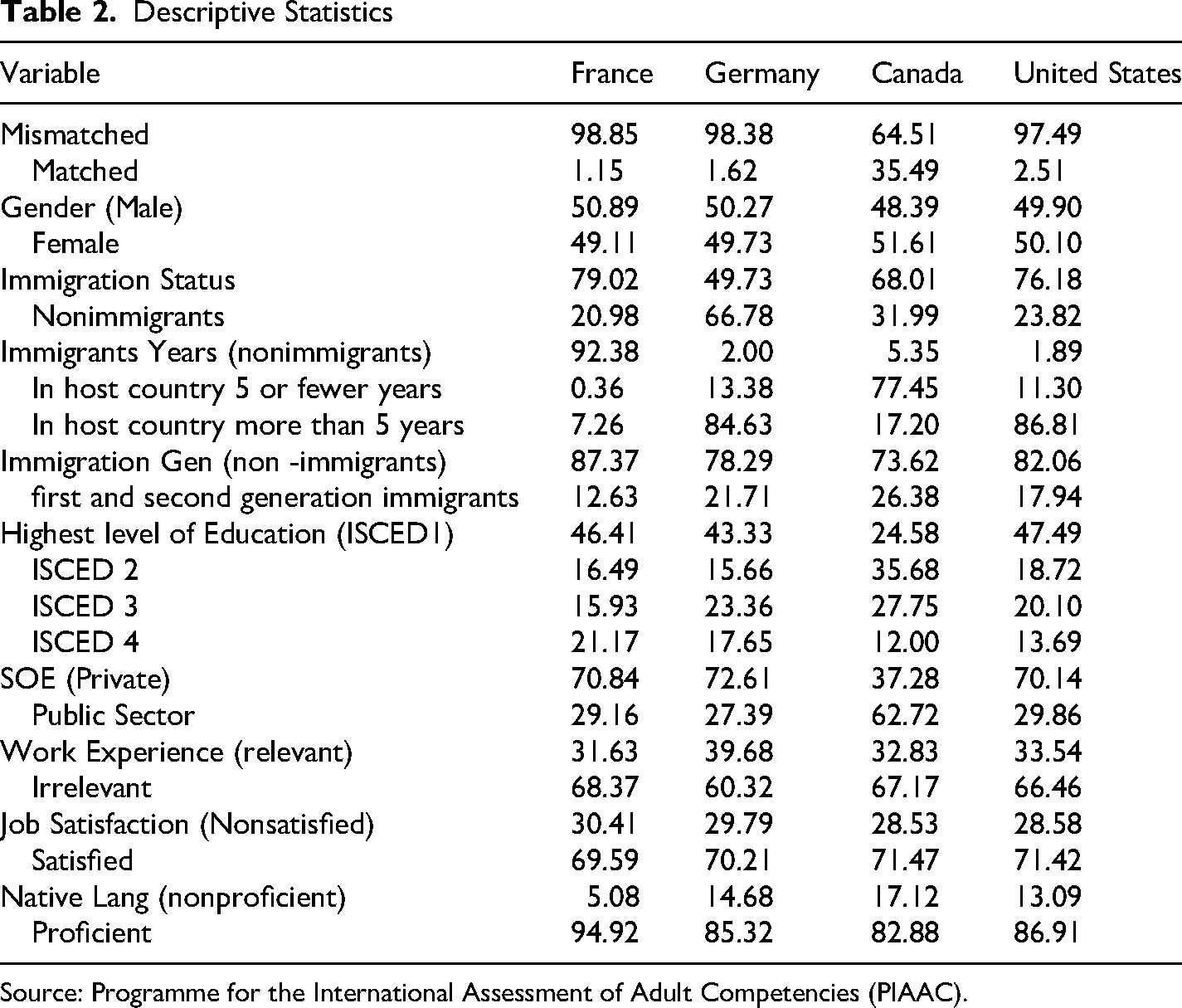
Source: Programme for the International Assessment of Adult Competencies (PIAAC).
Table 3 shows the results of multicollinearity using the variance inflation factor (VIF). It measures whether the independent variables are related to each other. If the VIF value is above 5, it indicates a multicollinearity issue with the data; if it is below 5, it suggests no multicollinearity in the model. As the table shows, the VIF value is less than 5, which means there is no multicollinearity in the model.
Diagnostic Test.
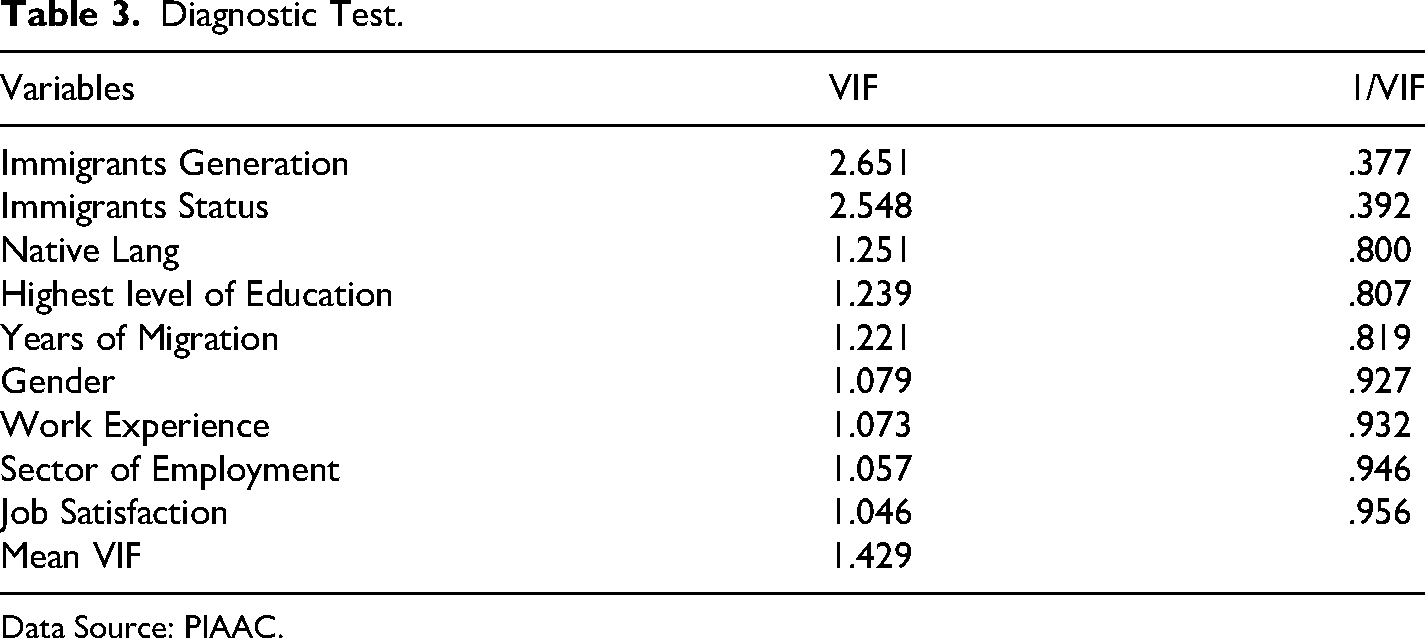
Data Source: PIAAC.
Table 4 presents the results of the complementary log–log model, focusing on the response variable of job–education mismatch, which has been measured through both subjective and objective measures. The dependent variable exhibits a highly skewed distribution, necessitating the use of a complementary log–log model to analyze the significant determinants of job–education mismatch among immigrants in four OECD countries such as France, Germany, the United States, and Canada.
Results of Complementary Log–Log Model.
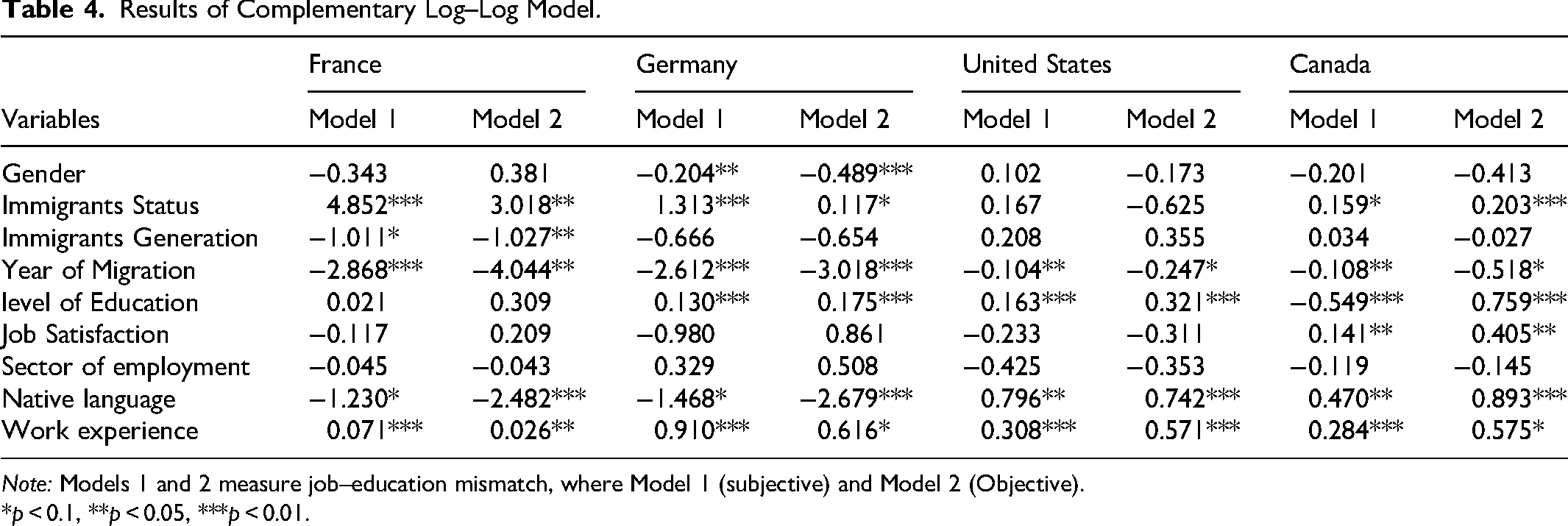
Note: Models 1 and 2 measure job–education mismatch, where Model 1 (subjective) and Model 2 (Objective).
*p < 0.1, **p < 0.05, ***p < 0.01.
To measure the job–education mismatch variable, both subjective and objective measures have been adopted where subjective measure is based on immigrants’ perceptions, and objective measures, derived from the realized match method. The results reveal that across all four countries, gender is the only significant variable exhibiting a negative relationship with job–education mismatch in Germany. Meanwhile, immigrant status has a positive and significant impact in France, Germany, and Canada. The immigrant generation variable is significant solely in France. Additionally, the number of years of migration demonstrates a significant negative relationship with job–education mismatch across all four countries.
Educational attainment also plays a crucial role; a higher level of education corresponds to an increase in job–education mismatch in Germany, the United States, and Canada. Job satisfaction positively impacts the response variable in Canada. Moreover, the sector of employment is significant in Germany, the United States, and Canada, while proficiency in the native language and work experience are significant across all OECD countries examined.
Discussion
Results of Complementary log–log model are presented in Table 4 where gender plays a significant role across both measures in Germany but with different magnitude (−0.204, −0.489) while it is insignificant in case of other countries it implies that the likelihood of vertical mismatch among male immigrants is lower compared to females in Germany's labor market. This may be due to the fact that male workers’ social networking is stronger than that of female workers. Due to a wider social network, male immigrants have more information about the host country's labor market. The insignificance of the gender variable in the case of France, the United States, and Canada is due to the institutional gender equality and labor market integration mechanisms compared to Germany (Guvenen et al. 2022). Results of robustness check also confirm that in Germany variable gender is negatively related to job education mismatch among immigrants whereas in case of United States it significant and positive.
Immigrants’ status exhibits same affect across both measures but has contrasting impact on different countries. For instance, it is positively and significantly related to vertical mismatch in case of France, Germany, and Canada but with slightly varying magnitudes across both objective and subjective measures such as in France the subjective and objective measures are quite close 4.852 and 3.018. Similarly in Germany the difference between both measures a quite large such as 1.313 and 0.117. In case of Canada the results of both measures are quite close such as 0.159 and 0.203. Overall, the results of subjective measures are much stronger than objective measure. While United States exhibit insignificant result. Several studies being conducted in case of Canada (Statistics Canada 2024), Germany (Falcke, Meng and Nollen 2020), and in case of France (Weber, Ferry and Ichou 2024) found that this occurs due to labor market discrimination and the imperfect transferability of human capital. Literature indicates that the causes of mismatch among immigrants in the Canadian labor market are the nonrecognition or devaluation of foreign-qualified workers’ educational credentials. In Canada, each provincial government has its own criteria for evaluating credentials; For example, Alberta has the Qualification Assessment Agency, British Colombia has the International Credentials Evaluation Service, and Ontario has the Internationally Credential Assessment Service. The evaluation processes in each province vary significantly. For instance, if a worker moves from one province to another, their educational credentials are reevaluated, and there is a chance that some qualifications might be considered inferior, which can increase the occurrence of vertical mismatch.
The significance of variable immigrant generation is observed in France with quite similar magnitudes across both subjective and objective measures ranging from −1.011 to −1.027 which indicates that second and third-generation immigrants are generally less likely to experience vertical mismatch as compared to first-generation immigrants. This outcome is consistent with the assimilation hypothesis, which posits that as immigrants progress through generations, they better integrate into the host country's labor market, leading to improved alignment between their education and job. A research conducted by Weber, Ferry and Ichou (2024) found that immigrants often face vertical mismatch, but the incidence of vertical mismatch is lower among second and third-generation immigrants, supporting the idea that vertical mismatch occurs due to imperfect transferability of credentials (Falcke, Meng and Nollen 2020). Another reason for assimilation related to the immigrant generation is that descendants of immigrants are fluent in the native language of the host country and have better knowledge of its institutions. While the results are insignificant in other OECD countries, this may be due to racial discrimination and labor market rigidity for immigrants, which ultimately lead to persistent vertical mismatch across generations (Shahrokni 2020).
The years of migrant's stay in host countries is linked to a decrease in the probability of job mismatch, as measured by both subjective and objective criteria, across all four countries. Notably, the magnitude of this decrease is significantly more pronounced in subjective measures which supports the convergence hypothesis (Khoudja 2018; Drouhot and Nee 2019). Which means that the gap between the level of education required and the level of education obtained converges over time as immigrants stay longer in the host country. Over time, immigrants learn how to navigate the host country's labor market. Each country has its own credential recognition system, and this process takes time for immigrants to obtain proper licensing. According to the Migration Policy Institute (2024), if immigrants obtain permanent residency in the host country, the chances of being mismatch with a job decrease, but obtaining permanent residency takes time.
For both Germany and the United States, the level of education displays similar effects across both subjective and objective measures. In Germany, the results indicate a consistent positive relationship with job–education mismatch in both measures with magnitude 0.130, −0.175 in Germany and 0.163–0.321 in United States, illustrating that higher educational attainment is associated with increased job–education mismatch. This outcome can be attributed to Germany's strict vocational education system, which tends to favor native-born workers with qualifications recognized within the local labor market. Consequently, immigrants, regardless of their educational background, may find themselves inadequately matched to the existing job framework, which does not account for foreign qualifications. Similarly, in the United States, the flexible and fragmented nature of the labor market, coupled with credential inflation, leads to highly educated immigrants frequently securing positions that do not align with their skill sets. This phenomenon suggests that while immigrants may possess advanced qualifications but systemic barriers in the host country's labor market push them to accept lower level job which results in job education mismatch. In contrast to the trends observed in Germany and the United States, Canada presents a contrasting picture. The analysis reveals that the subjective measure of job–education mismatch may indicate a negative impact with magnitude −0.549, while the objective measure shows a positive effect with magnitude 0.759. This divergence can be understood through Canada's point-based immigration system, which selects immigrants based on criteria that emphasize labor market relevance, such as education, work experience, and language proficiency. This selection process typically leads to better alignment of immigrants’ skills with job market demands.
Job satisfaction shows a significant impact only in case of Canada. The magnitudes observed across both subjective and objective measures range between 0.141–0.405 across both objective and subjective measures respectively. This is due to the economic factors, particularly the strength of the Canadian dollar, influence this relationship. Although immigrants may experience a mismatch between their education and job roles, the relatively high wages offered by the Canadian labor market leads to higher job satisfaction. This situation creates a unique dynamic in which, even if immigrants were to return to their home countries and find jobs that align perfectly with their educational qualifications, lower value of their home currencies may not provide them with a comparable standard of living. Consequently, the financial security offered by their positions in Canada fosters an enhanced perception of job satisfaction despite the inherent mismatch (Li and Lu 2023).
The role of native language proficiency in job–education mismatch exhibits considerable variation across countries, with distinct implications for immigrants in France and Germany compared to the United States and Canada. The magnitude of objective measures reflects a more substantial impact than subjective measures in all countries. These contrasting results depicts that as France receives immigration from countries where French is not spoken, there is a high demand for foreign workers who acquire fluency in the host country's native language. Therefore, immigrants who speak fluent French are able to integrate in labor market more efficiently (Bloemen 2023). Similarly, in case of Germany, the probability of job–education mismatch decreases among immigrants who are fluent in German language. Acquiring fluency in the native language reflects cultural familiarity and good communication skills. Hence these results support the cultural capital hypothesis in case of France and Germany. In contrast to this, United States and Canada depict completely different picture, regardless of fluency in the native language, the incidence of job mismatch increases among immigrants in these countries. For instance, in Canada the credential recognition is the biggest hurdle in the job matching process, where even professionally English-speaking individuals face difficulties if their credentials or degrees are not recognized. In Canada's immigration policy, the important requirement is the standardized English score, which creates a ceiling effect where most immigrants already possess language skills. This, in turn, explains the little variation in language proficiency used to account for mismatch.
Lastly work experience is positively and significantly related to job–education mismatch among both subjective and objective measures of job–education mismatch across all countries. An increase in work experience leads to a higher likelihood of education–job mismatch among immigrants in all four OECD countries. These results depict that as immigrants enter the labor market, they often accept lower-level jobs. Immigrants are forced to accept lower or entry-level jobs to meet their survival needs. The lack of work experience related to the host country's labor market results in persistent vertical mismatch (Belfi et al. 2022). The newly arrived immigrants have limited knowledge about the political, social, and economic infrastructure of the host country. As a result, employers tend to rate these individuals lower due to their lack of work experience, which ultimately leads to a mismatch between qualifications and jobs. In this context, institutional barriers also play a significant role when studying vertical mismatch among immigrants. For example, to obtain a job in a specific occupation, licensure requirements often mandate meeting certain formal criteria, such as legally recognized educational diplomas, standardized examinations, and citizenship or residency status. Therefore, most of the time, immigrants face difficulties in starting their careers due to the challenge of having their credentials legally recognized and succeeding in standardized exams (Li and Lu 2023).
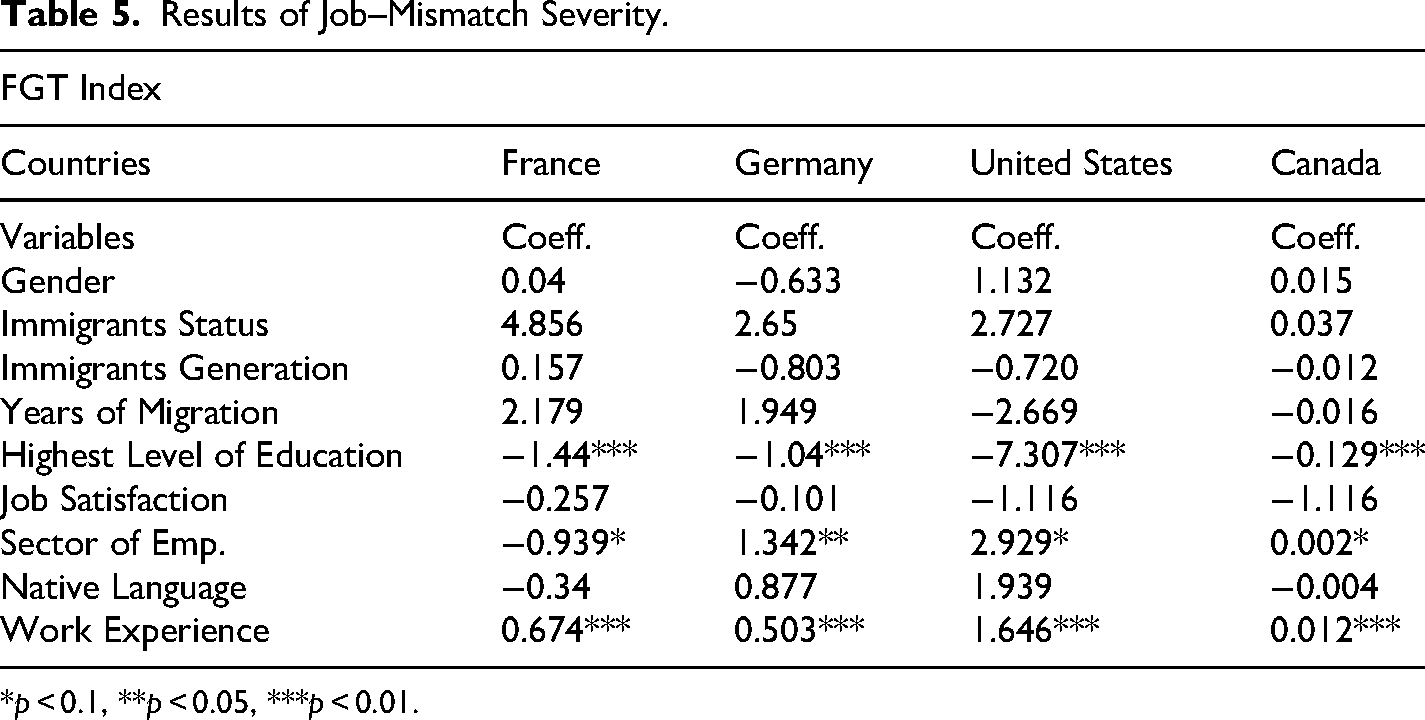
Table 5 presents the results of deprivation hypothesis. The phenomenon of job–education mismatch reflects the inefficiency of the labor market, where workers are unable to find jobs that match their level of education. This resource misallocation indicates a form of deprivation that has been measured by adapting the Foster–Greer–Thorbecke poverty index to the context of education–job mismatch. As shown in Table 5 immigrants work experience has led to an increase in the severity of vertical mismatch in all four OECD countries. This may be due to the lack of relevant work experience in the host country. The severity of vertical mismatch increases because, during the early stages of a migrant's arrival, it is difficult for them to integrate effectively into the host country's labor market.
Results of Job–Mismatch Severity.
*p < 0.1, **p < 0.05, ***p < 0.01.
In contrast, possessing a higher level of education significantly reduces the severity of vertical mismatch among immigrants. The data illustrate that individuals with advanced education are less prone to severe mismatches, as they generally possess a better understanding about the host country's labor market.
Lastly, working in the public sector increases the severity of vertical mismatch among immigrants across all OECD countries. It shows that being employed in the public sector leads to an increase in the severity of vertical mismatch among immigrants, as public sector organizations hire workers based on standardized criteria rather than the individual's level of education.
Conclusion
This study aims to analyze the factors contributing to vertical mismatch among immigrants in selected OECD countries, specifically in Canada, the United States, Germany, and France. The phenomenon of job–education mismatch has been examined through the lenses of convergence, assimilation, cultural capital, and deprivation hypotheses, providing a comprehensive framework for understanding the complexities of this issue.
To facilitate this analysis, microlevel data from the Programme for International Assessment of Adult Competencies (PIAAC), hosted by the OECD, was utilized. The dependent variable job–education mismatch has been assessed using both subjective and objective measures, with the latter employed to conduct robustness checks. Due to the skewed distribution of the dependent variable, a complementary log–log model was selected for testing the hypotheses related to convergence, assimilation, cultural capital, and deprivation. Additionally, a Foster–Greer–Thorbecke (FGT) index was constructed to evaluate the determinants of job–education mismatch severity.
The findings reveal that the assimilation hypothesis is supported exclusively in France, where the descendants of immigrants from European countries benefit from vocational training that facilitates quicker integration into the labor market. The convergence hypothesis is confirmed across all four OECD countries, indicating a general trend towards alignment between immigrants’ educational qualifications and employment as they spend more time in their host countries.
Furthermore, cultural capital, measured by proficiency in the native languages of the host countries, plays a significant role in determining job mismatch. In France and Germany, fluency in the local language corresponds with a reduction in vertical mismatch however, in the United States and Canada, where English is the primary language, the effect is completely opposite. Despite high levels of English proficiency, immigrants in these countries continue to experience increases in job mismatch, often attributed to systemic barriers such as credential recognition.
Irrelevant work experience further exacerbates job mismatch across all examined OECD countries, as many immigrants initially accept lower-level positions that do not correspond with their qualifications. This phenomenon persists as they encounter difficulties securing formal work contracts during the early stages of their transition. The results from the FGT index confirm that not only does the absence of relevant work experience increases the severity of job mismatch, but higher educational attainment led to reduce the instance of job–education mismatch severity.
The present study has certain limitations that future research could address, such as the fact that the general vertical mismatch has been analyzed, but it would be more appropriate to examine the sector-specific dimension of vertical mismatch. Another limitation is that this study cannot account for the amount of time required to obtain legal immigrant status in the host country, as the lack of legal documents affects the occurrence of vertical mismatch among immigrants.
Footnotes

Funding
The authors disclosed receipt of the following financial support for the research, authorship, and/or publication of this article: This work was supported by the Ibn Haldun University.
Declaration of Conflicting Interests
The authors declared no potential conflicts of interest with respect to the research, authorship, and/or publication of this article.