






Abstract
Background/Context:
Amid rising immigration from the African continent to the United States, researchers have begun to explore the transnational identities and networks of African immigrants. There is a small body of literature about whether educational supports for immigrant youth are differentiated to address the particularities of African immigrant youth.
Purpose/Objective/Research Question/Focus of Study:
Transnational theories presume that subjects use social networks to connect home and diaspora. They are encountering both perceived and lived social spaces to navigate belonging in and across space. This study asks, “How do youth from the African continent mediate transnational belonging in NYC?” Studying the experiences of youth has implications for the curricular and extracurricular spaces of schools wherein newcomer youth navigate how to belong in the diaspora.
Population/Participants/Subjects:
Research participants are 19 newcomer African youth from Centrafrique, Cote d’Ivoire, Ethiopia, Guinea, Mauritania, Niger, and Senegal. Most of the youth are multilingual and speak French and English as third or fourth languages.
Research Design:
This qualitative study draws from participatory action research and visual methods. The study was conducted with Sankofa Club, a weekly afterschool student-led club. In the club, students responded to stereotypes by producing websites about the continent and carrying out research within the club to compare their homes and share their migration stories.
Findings/Results:
The article presents “Africa” as a Mediated Transnational Space, produced by hegemonic structures, that youth mediate as they connect homes. The study finds that youth wrestled with their identification as African. It reexamines transnationalism and positions Africa as a social field through which youth are produced (come to be) as African subjects, redress their belonging to that field by contributing their own symbols and experiences, and use it as they navigate an Africa-in-NYC that does not adhere to continental boundaries.
Conclusions/Recommendations:
Educators can support the belonging to home, Africa, and the United States by representing Africa as a generative space in curriculum and social practices.
Immigration from the African continent to the United States is on the rise; the number of new African immigrants has doubled every decade since 1980 (Anderson, 2017). With more than 200,000 African immigrants, New York City (NYC) has the largest number of African immigrants in the country, over half of whom relocated from West Africa (Zong & Batalova, 2017). The rising presence of people from Africa 1 raises questions about the preparedness of the United States to be a recipient nation. This is a concern about not only educational and social services generally availed for immigrant populations, but also whether services are differentiated to address the particularities of people from Africa, specifically their linguistic/ethnic distinctions, religiosity, and fit within the United States’ racial hierarchy. The concern is particularly salient for youth who have formative experiences in U.S. schools.
A formative experience that immigrant youth have in U.S. schools is forming social attachments. Transnational theories and additive models of acculturation suggest that processes of becoming and belonging should incorporate linguistic, curricular, and cultural supports that retain young people’s connections to ethnic communities in the United States and their original home (Bartlett & Garcia, 2011; Gibson, 1988; Suarez-Orozco et al., 2008). Transnationalism proposes that young people belong in multiple spaces. It simultaneously acknowledges that the disrupted territorial attachments people have in these spaces transform how they belong (Ong, 1996). This has led to increased scholarship on how peer (Abu El-Haj, 2007; Bondy, 2015) and curricular (Salinas, 2006) misrepresentation interferes with social connections and identifications.
African youth are increasingly recognized in literature on belonging and transnationalism, although there are still gaps in our understanding of these youth and how they mediate belonging. African immigrants must reconfigure their Blackness within racist U.S. institutions and ideologies (Awokoya, 2012; Carnes, 2015; Waters, 1994). Blackness does not hold the value it had on the continent (Awokoya, 2012; Waters, 1994). African immigrants come from ethnically diverse countries, but in the United States, resignification as Black by peers and teachers overlooks ethnic and cultural distinctions (Awokoya, 2012; Okpalaoka & Dillard, 2012). Research on racial belonging indicates that this racial recognition leads to an ascribed African American identity, which some reject (Balogun, 2011), others resist by retaining ethnic or national identities (Clark, 2008; Whitehouse, 2011), and others embrace (Balogun, 2011). In linking identities, Okome and Vaughan (2011) found that the most common experience is “rupture and reconstitution.” Traoré (2004) similarly found that African students encounter the “colonial” language of savagery and darkness from their peers, against which they counter with positive images of the continent.
Using transnationalism, this study considers how youth mediate the perceived and lived spaces of home and diaspora. This article asks, “How do youth from the African continent mediate transnational belonging in NYC?” The study makes the experiences of African youth visible and significant as we contemplate their educational needs.
Living in Simultaneity
The Production of Africa
To write about and engage with Africa is to recognize it not merely as a place/continent, but as a construct invented through colonialism to substantiate global systems (Mudimbe, 1998). Decisions to implicate the continent or presume enough similarity to conflate continent and country are indicative of political and economic positions demanded of the continent during colonialism. In colonial discourse, Africa was a place against which Europe constructed its superiority and sophistication (Masolo, 1994). European and U.S. capitalism rely/relied on extraction and control of raw materials to support industrialization. This created a dependent relationship wherein Europe benefitted from African dependence (Wallerstein, 1992). The system relied on signification of Africa as savage, juvenile, and backward in climate and people to justify colonialism and slavery, erasing symbols of African peoples as capable of governing their resources (Blunt & Rose, 1994; Soyinka, 2012). This discursive and socioeconomic positioning changed little in postcoloniality. Africa remains depicted as underdeveloped, peripheral, and full of plight. Media and films sprinkle a discourse of doom over the smiling faces of dark-skinned, scantily-clad children and laud American saviors (Cole, 2012; Schraeder, 1998). This Africa wherein the continent becomes singular in U.S. discourse is one that immigrants to the United States encounter/confront.
Told within, different narratives of place arise. Africa has a rich intellectual history (Garang, 2013) that Western ways of knowing struggle to make intelligible (Soyinka, 2012). African scholars position the African subject at the nexus of multiple senses of being. They challenge Western hybridity and assimilation for their reliance on uneven sociocultural positions. Ethnophilosophy refuses the modern rationality by presenting an African subject through simultaneity (Appiah, 1992). Rather than desiring resolution of the logic/emotion and rationality/spirituality binaries, an African person lives stably within the tension. Being is rooted in communalism. Communalism cannot be reduced to consensus or community; it is the idea that wholeness of self arises in relation with others (Ikuenobe, 2006; Kaphagawani, 1998). Senghor (1970) distinguished the Western person who exists because they think, from the African who exists at the intersection of feeling, expression, and thought. This is reflected in Ubuntu, elder systems, and communal arrangements. It is also reflected in the harmonization of the universe that integrates the physical universe, humans, and ancestral spirits (Soyinka, 2012). Mbembe’s (2001) postcolony conveys the inability of Westerners to write/know this complexity of African-ness. Rather than striving toward resolution and differentiation, African ethnophilosophy produces possibilities for simultaneity, fluidity, and complexity. This way of being is reflected in the Christian who seeks a traditional healer when ill. Soyinka (2012) noted that Africa’s/Africans’ survival of slavery and colonialism reflects its resiliency. This study embraces this literature through methodologies that position African youth as knowledge holders, and analyses that do not seek hybridity and resolution.
Transnationalism
Immigration/emigration frameworks associated with assimilation perpetuate the invisibility of Africans. Transnationalism recovers subjects from Western binaries. In contrast to a stable subject, the transnational subject uses social networks to belong across and within space (Olson & Silvey, 2006). Transnational research explores how subjects belong to original and diasporic homes without disassociating from either (Levitt & Glick Schiller, 2004). Researchers have found that these subjects produce social fields in both homes (Voigt-Graf, 2004). Levitt and Glick Schiller (2004) defined social fields as “multidimensional, encompassing structured interactions or differing forms, depth, and breadth that are differentiated in social theory by the terms organization, institution, and social movement” (p. 1009). The social field has both ways of being and ways of belonging that may not be geographically coterminous. Here, people link with others across space through shared symbols, practices, and networks that shape experiences and interactions (Levitt & Glick Schiller, 2004). The social field is entangled in the varying struggles for power that grant social position and access to resources. For many immigrants, the social field takes on a physical dimension in ethnic enclaves that maintain direct relations with people in the first home. People’s choices about migration are shaped by access to institutions and networks requisite for economic and social opportunity in a secondary home (Voigt-Graf, 2004). Remittances and knowledge flow between homes (Levitt & Glick Schiller, 2004; Portes et al., 1999).
Geographers explore spatial productions from transnational flows. Places are variously implicated and produced in transnationalism. The trans prefix destabilizes the nation-state and considers geographic configurations that take up the local and global as mutually informing (Massey, 1994). The local matters because it is the space of experience, but it cannot easily be disaggregated from institutions and structures that transcend the nation and give it significance (Soja, 2010). Spatial analysis of transnationalism has found that social networks connect localities (Dunn, 2010). The migration of people in and out of a village may change how it is perceived within global capitalism and politics. Some migrants travel between locales, but increasingly, people are physically dislocated from spaces with which they identify (Appadurai, 1995; Pries, 2005; Vertovec, 1999). They rely on virtual spaces produced/maintained through memory and media. This has implications for how original homes are resymbolized while people simultaneously rely on media representations to determine their transnational movements.
There is sparse research on Africa–U.S. transnationalism. In Okome and Vaughan’s (2011) collected volume, academics share transnational narratives and scholarship. These scholars relocated to the United States in search of education or economic opportunity but are confronted by racial hierarchies that produce economic and social tensions (Okome & Vaughan, 2011; Waters, 1994). The where matters; Africans living alone in rural communities feel a stronger pull toward assimilation (Balogun, 2011). Urban enclaves offer social and economic communities/networks. Renne (2011) discussed agentive choices surrounding clothing, and Whitehouse (2011) documented imagined connections to home. Watson et al. (2014) found that young Africans rely on media technologies to connect across space. The Internet allows youth to follow and participate in home politics. Knight and Watson (2014) also found a vision of transnationalism that participates in economic returns to the continent. African communities can import products for personal or business use, creating local and transnational connections (Ebin, n.d.; Ness, 2011; Stoller, 2002). Others find that unactualized economic opportunities have limited the growth of African economic centers in the United States and the return of money to the continent. One consequence of limited economics is that African immigrants cannot afford to travel home, producing long periods of physical dislocation. This impacts local communities in West Africa that have taken up global identification (Obadare & Adebanwi, 2009). Small remittances and U.S. outlets for local goods produce transnational sensibilities in communities. Their members make transnational rather than national political and economic decisions to protect their self-interests. This study contributes to this literature by exploring how school-age youth, who migrated with their families, maintain and mediate transnational belonging in NYC.
Conceptualizing Social Space
Transnationalism involves spatial inquiry about people’s relationship to/within/between multiple, interacting places. Geographers’ social spaces conceptualize the subject and subject positions that connect people in/to place. Buttimer (1968) articulated that space has social and physical geographic components. For example, the designs of working- and upper-class neighborhoods reflect their temporal and material differences (Buttimer, 1968). Marxist geographers extend this in theorizing the triadic interplay between the conceptions that construct space, the perceptions of space, and lived experience (Lefebvre, 1991). Lefebvre (1991) concluded that groups do not have a social position until they perceive and experience space. Representational space is a discursive and perceptive arena wherein our attachments and detachments shape lived, social experiences. Senegalese vendors in Harlem reflect the interplay of discursive possibility, economic flows, and social connection. The wealthy United States that initiates migration is symbolic and material; for migrants, the symbolic association often precedes the material encounter. As immigrants in a Black neighborhood, successful vendors leverage Africa-Blackness as connected material experiences. The social space of Harlem comprises various actors encountering, engaging with, and/or re-signifying their Harlem.
Transnational social spaces are configured by artifacts, practices, and symbols created by interactions above and below the nation-state (Faist, 2000; Kivisto, 2003; Soja, 2010). It may be observed from the outside, but its practices are agentive spatial claims. The spaces cannot be removed from systems of power that make them necessary and to which they respond. The study of social space allows local articulation of their nature, attention to flows across spaces, response to discourse, and the study of the practices and resultant artifacts that structure movement and identifications with space.
Methodology
Research with African youth is intimately intertwined in and a result of colonial, imperial, and racist systems. I am writing from my position as a White woman, born in and living most of my life in the United States. Thus, I am engaged in the conundrum of inquiry that exceeds my experiences. I have lived on the African continent, although not in the areas from which my participants migrated. Living and working for Malawian organizations provided some experience with African ways of knowing and being, but this was temporary and insufficient. The experiences disrupted my conceptions of community/family, borders, and nation. It has also turned my attention to critiques of U.S. mis-representations and exploitations of Africa. On one hand, this makes me vulnerable to acting as a White savior, using my researcher position to “save” the continent from significations that have consequences for my colleagues. On the other, I invoke Spivak (1988), noting that producing voices of the subaltern requires academics to elevate unarticulated voices/experiences. This article voices African scholars often omitted in U.S. research. Furthermore, this study was designed as a collaborative research process with African youth in imagining the knowledge our encounters could produce.
Attending to these concerns, particularly the imperial tendencies of social science research, the author and a research assistant approached the youth as knowledgeable agents in search of space for discussion, inquiry, and synthesis of their experience mediating the United States as Black, African, and immigrant. The project began as participatory action research that used visual methodologies to support youth to examine systems of oppression and privilege (Cammarota & Fine, 2008). By the students’ request, the researchers took an increased role in designing activities around students’ proposed topics/inquiries.
Participants were newcomer youth at an international high school in NYC. Many chose to attend this school because of African/immigrant-related harassment they faced in middle school. The school promised to foster a positive environment that enabled freedom of dress and expression in first and second languages without peer judgment. The participants largely came from Cote d’Ivoire and Guinea (see Table 1).
Participant Home Country and Project Participation.
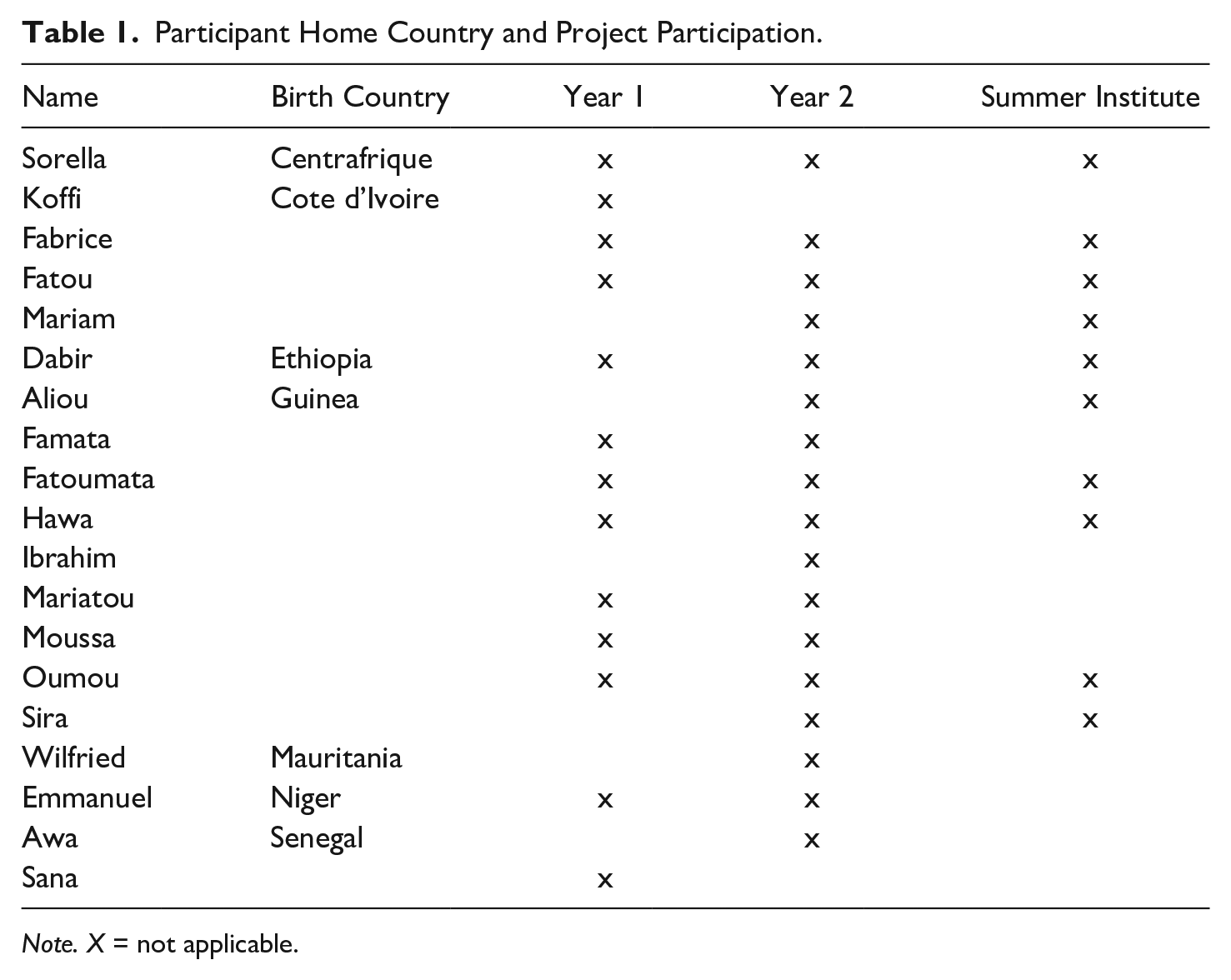
Note. X = not applicable.
The research was conducted with Sankofa Club, a weekly afterschool student-led club that supported African culture and identity. Sankofa Club was one of four place-based clubs at the small high school. Nineteen youth participated in the research across the two years. The data that comprise this study come from researcher notes taken during and following each weekly meeting, audio-recordings of group discussions, and student-produced artifacts. Table 2 presents a complete list of data. Youth were also invited to take us on walking tours (Pink, 2008). We were invited to walks in Brooklyn, the Bronx, and Little Senegal (Harlem) wherein groups of participants discussed important places in their neighborhood. We took notes on the places, how they introduced the places, our discussions, and social interactions.
Summary of Data Collection.
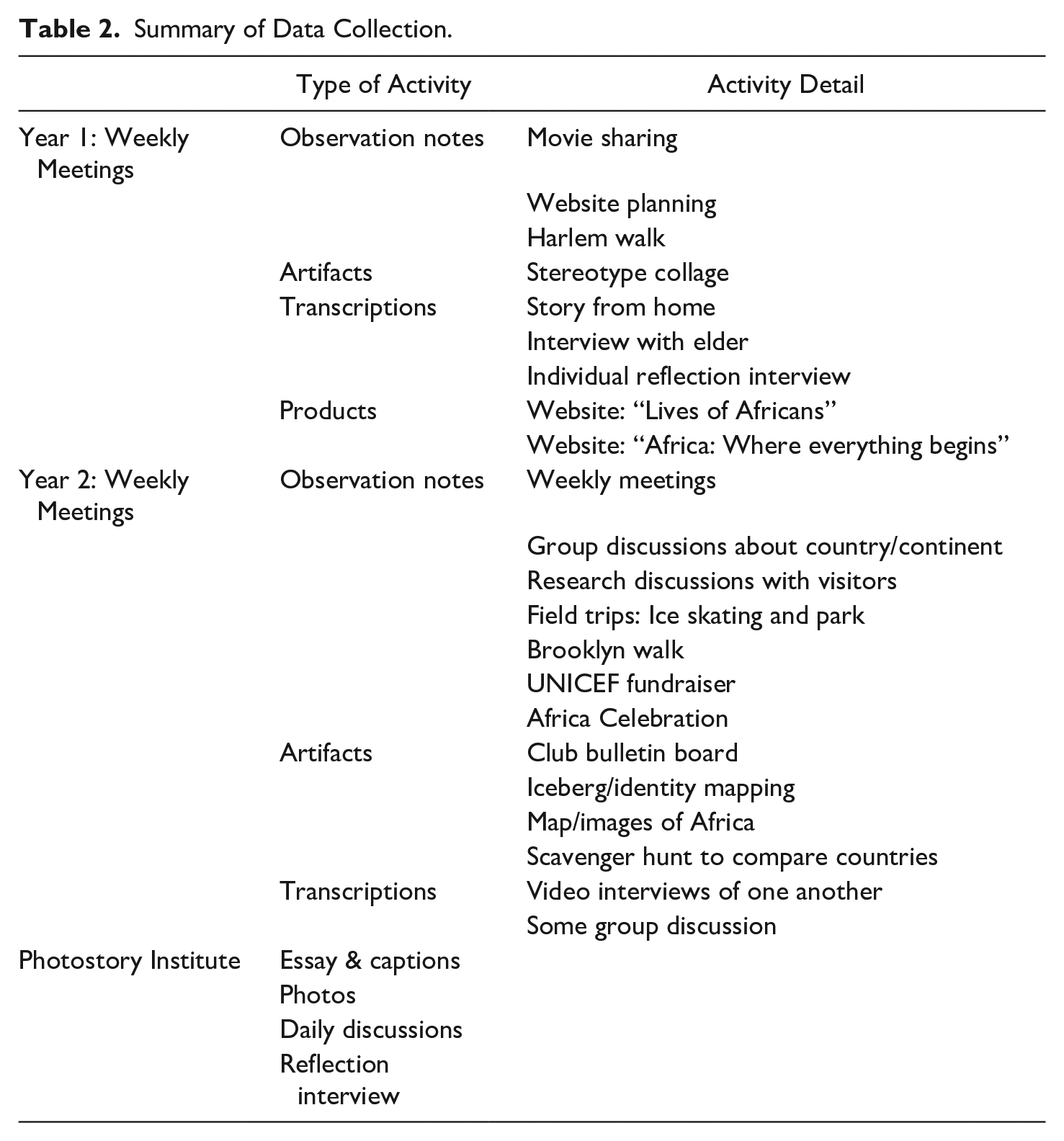
During the first year, club participants chose to develop websites that re-educated teachers and the public about the continent. The first was called “Africa: Where everything begins,” and the second, “Lives of Africans.” Each attempted to debunk stereotypes and produce competing knowledge about the contributions that Africa has made to religion, fashion, and history. Each web designer was interviewed about motivations for their page.
During the second year, participants chose two foci. The first was to learn more about the continent. We worked to educate one another and discuss experiences in and across places. These educative and contested conversations were recorded. The second project was a video about the experiences of youth in their original homes, their migration to the United States, and their experiences in the United States. The video was designed to supplement the websites. It was never completed, but in preparation, students wrote a protocol and interviewed one another.
The after-school time proved insufficient to carry out extensive projects. Youth asked to continue their work over the summer. The researchers conducted a one-week Photostory Institute (Blackman & Fairey, 2007) with 10 participants. The institute involved learning photography, taking daily photographs in the city, building a personal photostory, and daily group discussions. The photostories were exhibited at a coffee shop in Little Senegal, for the Bronx African Advisory Council, and at school. The Institute is analyzed and written about elsewhere (Schmidt, 2021). This manuscript uses limited data from the spatial navigations of two participants.
Analyses
The analysis involved an iterative process of coding and mapping. The researchers sorted the data using inductive and deductive codes. The deductive codes, drawn from the literature and theoretical framework, were largely used to create open codes. These include “Space,” “Identity,” “Representations of Africa,” “Immigrant stories,” and “Researcher subjectivity.” The annotations in our field notes and preliminary read of all recorded interviews and discussions produced inductive axial codes that collected the array of related responses. For example, “Immigrant stories” contained “Comparing US-Africa home” with its child codes “Discipline,” “Local stories/knowledge,” and “Home places.” Appendix A contains the complete coding tree and sample coding.
We mapped participants using all their data (essays, interviews, group discussions, field notes, webpages). Taking inspiration from Tufte (1990), we organized open and axial codes onto maps. This allowed the codes to be layered and placed in relation. The through line of the map was immigrant story. At one end were spaces lived in the home and the identities, experiences, and relations therein. In the opposite corner were the lived spaces in NYC. Personal and spatial identifiers/identities were linked to these spaces/experiences. Data that moved between spaces grew around the through line. On Fatou’s map (see Figure 1 for a simplified sample map), her desire to be a nurse connected her back to Cote d’Ivoire, while her decision-making and process of identifying the couturier in her photostory holds NYC and Cote d’Ivoire together. Data coded as misrepresentations appeared as a layer atop various elements of the map. Finally, because Africa appeared in each section of coding, the maps allowed us to visualize its connectivity. The mapping added subcodes, such as “Tension in the presentation,” to our original coding scheme.

Analytic map of Fatou’s data.
A dominant, threading presence on the maps and coding scheme was “Africa.” It was insufficient to connect homes without seeing the relationship to the larger representation of Africa. The sign of Africa was present in each of the coded areas, including how participants connected with family, how they made sense of change, and how they understood school. This is the major finding presented in this article: how Africa situated identities, immigrant connections, and spaces. This aligns with African ethnophilosophy and the refusal of linearity, simplicity, and coherence. The mapping allowed the codes to inform one another and produce social fields. The centrality of Africa, analyzed through the lens of social space, drew attention to the intersection of perceptions, conceptions, symbols, networks, and lived experience that produce a field. The function of Africa as something that mediated experiences is described in the following section.
Africa as a Mediated Transnational Space
The analyses are grounded in studying transnational flows and identities through spatial relationships. Transnational theories are bound in spatial thinking through social and network analyses. Voigt-Graf (2004) produced a model of transnationalism that summarizes the social networks and economic flows between original and secondary homes. This study, in its design and analysis, elevates how young people engage with their original and secondary homes. The analytic maps suggest that “Africa” as a signifier became an entity that participants contended with in their migration experiences. I propose that their experiences are reflected in the production and navigation of Africa as a Mediated Transnational Space (MTS). Africa here is an additional social field produced by hegemonic structures but functioning as an institution that regulates being and belonging (Levitt & Glick Schiller, 2004).
In the findings, MTS retains the multidirectional flow of people and identities across multiple spaces of belonging. African immigrant youth are less physically migratory, but their identifications and social navigations are shaped by transnational flows. Each youth identified/spoke about a local ethnicity and location that afforded them a socio-spatial position in their home. Their ethnicities and religions belonged to networks that transcended national boundaries. In migrating to the United States, they became residents of NYC and adopted and embodied Black and African attributes. They took advantage of U.S. and home connections that afforded them access to global flows (i.e., a U.S. passport for travel or involvement with Senegalese businesses).
Within that transnational space and resting beneath/atop the original–diasporic home connection is Africa. It took leaving the continent for Africa to become a place through which they identified. Africa, symbolized at the outset by the United States, became a primary socio-spatial field that shaped experiences in the secondary home and connections to the original home. The findings are organized to examine how these youth came to be African and then how they mediate senses of belonging to Africa, and, finally, to demonstrate how Africa functioned as a generative field in the city.
The Production of Africa
Africa was a social field offered to the youth because of their migration and settlement in a diasporic home that rarely recognized the complexity or spatial arrangement of their hearth. The representational space of Africa (Lefebvre, 1991) came to occupy a mediating space in youth’s lives and brought with it complicated identifications (Mensah & Williams, 2015). By the time I met these youth, they were already “African.” This research perpetuated this identification. We used it as a signifier in seeking “African” participants. Being that label was requisite for participation. It was further reflected by participation in the Sankofa Club. The club was for “African” students. There were also clubs for Chinese and Dominican students. The cohering of youth from Africa rather than offering Guinean, Ivoirian, and Senegalese Clubs suggests that the youth shared attributes akin to other nationally specific clubs.
Youth participated in an identity exercise that suggested differences in their personal ethnic identifications and the manner in which their U.S. peers read their Black (and sometimes veiled) bodies. During Sankofa Club, 11 participants drew “identity icebergs.” On their iceberg, participants distinguished between visible (those above the water’s surface) attributes that reflected how others viewed them, and their self-identities beneath the surface. On the surface were visible, physical attributes, such as height, age, and Blackness. The term “Black” was cosignified with African on seven icebergs. “African” stands out among descriptive attributes because it is a discursive descriptor. Beneath the surface, youth self-identified through multiple cultural attributes. Their home country or ethnic group appeared, and they emphasized languages, another means of recognizing ethnicity and/or home nationality. The concept “Africa” as part of their externally perceived self is prevalent in these identity exercises.
The presence of “Africa” as an identity/identifier with spatial signification became important for understanding the youth’s belonging and movement. Being seen as African first connoted their identities through (mis)representation of the continent by Americans who did not grasp the space of Africa. But being African came to afford them social connections and shared attributes that connected them to one another and spaces in the city. The next two sections explore the push/pull of belonging and these spatial navigations.
Positioning Oneself With/Against Africa
A social field comprises symbols and practices that construct lived/embodied experiences. Transnational research extensively studies networks that facilitate belonging. I situate “Africa” as a social field because it functioned as representational space through which participants mediated relationships and movements. With this social field present, the youth contended with Africa’s varying significations and their attachments/distance from them. The belonging process, engaged within the club space, began by re-signifying the continent and later producing lines of connection across locales.
In the first year of Sankofa Club, the youth fought against stereotypes of Africa with which they were associated. They proudly aligned with the rich history, social values, communalism, and wisdom shared across ethnic groups and localities on the continent but pushed against suggestions of backwardness. Most youth shared a story of being bullied and called “monkey” in another school. Sana was asked whether he ever fought a lion.
An exercise on the imagery of Africa saw youth wrestling with representation. I shared a YouTube video, “African men. Hollywood stereotypes.” The six African men in the video commented on clips from Hollywood blockbusters, such as Blood Diamond and The Last King of Scotland that presented violent, bumbling, bloodthirsty dictators as symbolic of African men. The young videographers laughed at how the world was fooled and presented themselves—graduate students and athletes—as counterexamples. This video resonated with the youth who had seen the films and shared concerns about misrepresentation. The youth decided to produce their own critique by playing film clips that exemplified erroneous representations. Someone found the opening scene from The Gods Must Be Crazy. They watched with the same hilarity as U.S. viewers. It seemed a distant and inane depiction. Sana stated, “This cannot have been made by people in Botswana,” but Dabir reminded him that people in the United States viewed each of them as Xi. This was an aha moment. They did not identify themselves with the foolishness of the character, but they recognized that their U.S. peers did. The film lost its hilarity. Continuing through the films, they contrasted the images of dictators and wildlife produced by Hollywood with their images/experiences on the continent—skyscrapers of Abidjan, vast homes, and men in Western suits. This contrasted the Africa that the U.S. signified them through with the Africa to which they could imagine belonging.
In her individual reflection interview, Sorella captured a tension shared by many of representing and being represented: I am African and I am civilized. Everybody is civilized. Everybody has education. We have cultures, we have traditions. We don’t live in the jungles and stuff. We are trying to pull them out from these bad thoughts. They have to learn that we also have something that we can share. . . . It’s beautiful how you live with your family; you have respect. In Africa, you need to respect the people older than you.
Sorella is summarizing some of the language—uncivilized, jungles—they heard because they were identified as African. In this interview, she educated me as researcher about the beautiful attributes of Centrafrique and, by association, Africa. This was a theme she and other students took up in their websites.
The Sankofa Club chose to produce websites that re-educated their peers and teachers. Specifically, “The goal is to challenge stereotypes and change the way people think about the continent of Africa.” “Africa: Where everything begins” had four pages: “Who we are,” “Country vs. continent,” “Stereotypes of Africa,” and “The Real Africa.” The stereotype page contained huts, lions, masks, and grass skirts. “The Real Africa” hosted individual projects that depicted assets and pride in their homelands: fashion, religion, and family. On the site, “Lives of Africans,” three participants shared stories of family, religion, and community. Many of these came from interviews with a parent or elder. The choices of topics and images—fashion, cityspaces, family values—positioned the stereotypes they heard in contrast with their experience. Their stories were largely about their home country. They ended the year with a schoolwide “Africa Celebration,” featuring local games, food, dance performances, and a fashion show. Across these embodied and virtual presentations, the youth projected an image of the home to which they identified and rejected the one embedded in the African social field they experienced when produced as African by U.S. peers.
Year 2 focused on learning about connections across the continent. Early in the year, we drew a collective conceptual map of the continent. Aside from the Rwandan genocide and Mount Kilimanjaro, there were few locational or cultural descriptors beyond West Africa and Ethiopia, where the youth lived. Because of their lack of knowledge about the continent to which they belonged, the year focused on learning about/researching the continent and sharing stories across contexts. The youth invited speakers from Sudan, Ethiopia, and Senegal. They asked speakers to discuss “general information about the country, language, clothes, religion, topography, drinks, food, sports, ethnic groups, and national groups in NYC.” Many of these categories were reflected in other exercises that depicted place/people. One afternoon, when Sankofa Club was lightly attended, the three Guinean and three Ivorian students held a throwdown comparing their countries. The categories of comparison included number of languages, largest city, unique foods, women in government, football, music, and security. The concrete cultural attributes that were at first presented with the presumption of difference increasing revealed shared attributes with which they began to associate African-ness.
A challenge that emerged across our time together was how to talk about their original home. We had many discussions about life in their home countries. The default position, like those of their websites, was to re-present home through positive images/rhetoric (Traoré, 2004). They felt pressure to defend the continent broadly, and their homes specifically. But their lived reality of home was complicated. The through line on the analysis maps was immigrant stories. During interviews for the unfinished video project, they shared reasons for migration. At best, their families immigrated for increased educational and employment opportunities in the United States, and at worst, they fled war or oppressive regimes. As we delved deeper into comparisons of their homes, immigration stories, and current events, they struggled to maintain only positive representations of home. Participants connected with cultural, economic, and political news at home. Ethnic tensions/distinctions from these homes found their way into connections with African communities in NYC. As they argued about politics or ethnic divides, they moved into speaking French or a local language, languages more proximate to the space of dissension, but not spoken by the researchers. Following one moment that erupted while recording immigration narratives, the participants offered to summarize their conversation.
I was speaking to her in Mandingo and [Aliou] said speak Fulani. And I was like you Fulani people. Everywhere you go you speak Fulani and we don’t get to understand anything so we have to listen to you guys anytime. [Fatou] was like Guinea is for Mandingo people and [Aliou] was like Guinea is not for Mandingo people, it’s Fulani, Mandingo, Soussou.
It’s only when we were talking and they start saying Guinea is for Mandingo people. And I say Guinea is not Mandingo people because Guinea is separated. The Fulani people have their place, the Mandingo and the Soussou have their culture. That is why I say Guinea is not just for Mandingo people.
Miss, Fulani people and Mandingo people don’t get along. Because in my country, one Fulani person and one Mandingo people want to be president and people are going to go to the street and fighting. They don’t want the other to be president.
Like me and Sira, we are friends, but when the election starts we separate (motion crossing her arms). I say this one and she say this one and we start fighting.
The original argument felt heated even though this recap was punctuated with laughter. The re-performance for Westerners changed the gravity of difference that cost people their lives. These conversations suggest that divisions on the continent were not left behind. Underlying the friendship between Aliou and Sira was the fight around politics and identity. The African social field, in this instance, might be a better place for belonging because it does not require Sira and Aliou to resolve their differences within Guinea to share this transnational space. Such moments interrupted the flow of optimism. Pessimistic discourses like conflict were not merely false signifiers of Africa as a field, but lived realities that shaped migration.
Aliou struggled more than most participants with positive representations; she was carefully navigating how and where to talk about her experiences. Following club meetings that emphasized the assets of African nations, she approached me for critical discussion. During one club meeting, only girls were present. While we were engaged in connecting as women, Aliou brought forth a social commentary seeking how to discuss this difficult past. I observed, While we spoke, Aliou took computer and started searching for images of Guinea. It started with showing us the massacre in Conakry on September 28, 2010. I did not get the whole cause other than its horrors and a claim to power. She talked about one opposition leader being cut off below knees. She showed the person who led it and death scenes. She said news reported that 900 people died, but everyone knows it was 1 million dumped bodies in river.
Aliou’s critiques made me wonder about a personal story she never chose to share, but her decision to introduce her critique subtly when the conversation was directed otherwise felt significant. She did not ask others, often just the researcher, to validate her critiques, but to hold space for her critiques amid conversation more oriented toward creating an Africa that enabled belonging.
If Africa sits as an abstract space they must mediate through their identification with it, these club spaces reflected youth efforts to determine how they would belong. They rejected the Africa of the inane and reassigned it modern clothing and urbanization. They upheld familial and community values and talked through conflict as a lived reality but not a necessary signification. Garang (2013) argued that the Western gaze is used to substantiate global racial hierarchy. People displace others with the hopes of elevating themselves. The youth found this in confronting an Africa in the United States that was symbolically similar to the colonial construction Mudimbe (1998) depicted. They sought to correct misrepresentation but recognized that it did not merely separate good and bad representations. Holding the two together allowed pride and skepticism to coexist. As with most places, there is not a single story: Home can have conflict and beauty, community and division. As MTS, Africa was a space through which they articulated homes on the continent. This social field was a lens that reflected back on, while also hovering over, this new home. Hence, the club space became a space for negotiating and thinking through the symbols they ascribed to Africa and, thereby, themselves.
Navigating Africa in the City
A social field contains the symbols and practices that shape lived experiences. Often, the social field explains people’s networks and interactions. I argue that Africa, and the struggle between continent and country, served as a field that youth mediated as they decided how to navigate NYC. The presence of Africa as an abstract mediated space influenced their connections and networks while also reminding them, as Ochonu (2014) argued, that decisions in their new home reflect status in their departed land. This section explores Fatou’s spatial navigations using observation notes from her neighborhood walk with sister Miriam and friends Aliou and Hawa, and photo walks and transcriptions of related interviews.
From the outset of the Bronx walk, sisters Miriam and Fatou noted that their movements were mediated by their uncle’s desire to keep them safe. As Fatou stated in her video interview, “He says I must focus on school. He does not let me go out.” Their lived experience in NYC included school, recreation on Coney Island, Little Senegal in Harlem where their uncle lived, and their home in the Bronx. The researchers took notes as we walked.
We convened and decided to walk to Fatou and Miriam’s mosque. This is the way they always walk with their family to the mosque. . . . We walked past a park where Miriam and Fatou said they frequently hang out. I asked where she meets people and she said at the park, in stores or at school. She talked about how in African stores people start talking to each other more frequently and she meets people that way. Though their parents go to the mosque for Friday prayer, they only go on the weekend, but spend much of Saturday and Sunday there with the other young people. We discussed what they wore to the mosque and how it was different from what they were wearing today. Only Aliou has a scarf, though both Miriam and Fatou occasionally wear one to school. Fatou seemed much more concerned about walking to the mosque without a headscarf and expressed her worry about being seen without it. I told her she could borrow my scarf, which she asked for once we were about 100 yards from the mosque. Miriam did not have one, so when we walked in front of the mosque, she held back. We then walked around the corner to a small African market where Fatou and Miriam are sent by their mother to run errands. We walk around and talk about the different foods that they buy. The girls have begun to take pictures, which calls the attention of the shopowner who says that if they come into his store and take pictures, they have to tell him why. Aliou explains they are taking them for their Sankofa Club in English and he says it is alright. She then gets a call and begins to speak to someone in Fulani. The man comes back to where we are standing and asks who speaks Fulani and again engages with Aliou about what we are doing. Out of their longer conversation, he begins walking around the store with us telling us about certain products. Arrive at the large African Market. When we walked in Miriam asked to speak to the manager using French. She explained that we were walking around and giving a tour and wanted to see if it was okay if we took pictures. Which he agreed to. . . . The girls begin to list the names of the print/fabric. Miriam, Hawa and Fatou begin speaking in Mandingo about the fabric. We continue to walk around the store and as we turn into the first aisle, a man stops the girls and asks them questions in Mandingo.
Having already positioned the youth as African for the purpose of research, we should expect a focus on African-ness in the city. However, on this walk, Miriam and Fatou implied that the masjid, markets, and park were their primary neighborhood spaces. When we asked about lunch, they acknowledged that they did not sit at restaurants here. Their life was recognizable through these spaces where they largely encountered other African immigrants. Attention to food and cloth reflected the commonality of the local within Africa. The markets were introduced as African and Ghanaian, but for the Guinean and Ivorian youth, the markets are equally familiar. Aliou selected baobab as Guinean, but quickly realized it was a fruit enjoyed in Cote D’Ivoire (and Malawi). We spent time with the cloth, partially lamenting its expense in the United States. While the significance of patterns was ethnically/geographically specific, the importance of cloth for women was shared. The walk moved between English, French, Mandingo, and Fulani. In walking into the African market, Aliou and Miriam chose to acknowledge the owner and presumed that asking in French would impose familiarity and garner a positive response. In the first store, the demeanor of the shopkeeper changed when Aliou spoke in Fulani; we became guests rather than visitors. Not all elders received their attention. When we were approached by a Black leader on the street, the girls looked at their phones and forced the researchers to engage with him; he was not read as an African elder whose attention needed to be returned. They moved between these spaces of seeing their local context reflected in the stores and then recognizing this common space of Africa that distinguished them from White researchers and other visitors.
The selection of places and products is significant. During her video interview, Fatou was asked what a visitor to Cote d’Ivoire should see. She replied, In my country, the best place to visit is the zoo with different kinds of animals. I would take you to the beach. There is a beautiful place—the gardens. And we have different kind of market and I can take you there. And different kind of mosque. People say in my country, people like to have fun, they like to dance. Also, different kinds of food.
The habits of one place transitioned into another. The markets, trips to the beach, and masjids were common means of maintaining African connections and cultures within a city that was not deemed safe. Miriam and Fatou acknowledged the importance of markets as spaces to meet other Africans. The family likely visited non-African spaces; however, these were not deemed socially significant. The products, spaces, and languages became contextual markers that were shared by those who took up “African.”
Hawa and Fatou went to Little Senegal during the Photostory Institute. Hawa had already decided to focus on fashion, and Fatou was still seeking her story. The researcher noted, Hawa with prompting would go talk to women on the street. Fatou would jump in and help her. I had little involvement. I got involved when I heard voices being raised and the man talking about how Columbia is bad and uses Harlem. The girls were taken aback as they did not live in the neighborhood and did not have context for his critiques and remarks. I went over and began agreeing with analysis of the situation and listening to his frustrations . . . I also mentioned that we were working with ___ a photographer next door. At this point, the conversation began to shift. . . . At the outset of the conversation he talked about how he made clothes for all sorts of famous people (including Tupac). Fatou, tailor in Cote d’Ivoire, decided that she wanted to do her photostory about an African tailor in NYC so she started asking him questions.
Fatou and others took pride in their Columbia connection, but it failed her in the politics of Harlem. As she reflected in her exit interview, I was a little bit scared. I think maybe it’s true, maybe it’s false. I say we have known you guys since ninth grade. So I didn’t mind him very much. Maybe he sees us like his children, and maybe what happened to him, he doesn’t want it to happen to us.
Fatou remembered the moment and shared her understanding of his perspective. Like her uncle, she perceived an effort to shield them from the negative city influences. What emanated from this moment was a connection between two tailors. She said, “I asked him how long he’s been a tailor.” That allowed her to establish a relationship. Her willingness to speak was mitigated by a familiar person in the shop. “Well, I guess I was shy to talk to him and I saw that lady. We are from the same family. She is my auntie. I felt more comfortable asking him questions.” They did not share a local language but the shared community, connection as African couturiers, and perhaps values created a relationship. Fatou proceeded to talk with and photograph his space over three days.
Fatou helped Hawa with her photos of women in African clothing. Hawa was Guinean, but knowing a language shared between Guinea and Senegal and being recognizable as a Muslim woman created familiarity as women. From the outset, she recognized that she needed to use her shared social position to reach women. Fatou described these interactions: “Me and Hawa don’t speak French, we speak Mandingo. Sometimes if I speak French, she doesn’t understand, so we speak Mandingo.” Hawa did not share a language commonly heard in the area. Fatou continued, As Africans we know how to talk between us. I just show them how to talk to them so they will accept her to take their pictures. As Africans, we respect each other, if you saw an old person and you don’t talk to them in a clear way or in respectful way, they might not.
These youth recognize a set of values that connected elders on the continent and remain significant for navigating in a city where many interactions happen across African communities.
Through sharing pieces of dialogue and field notes, I want to engage with Africa as abstract space of encounter that was mediated as a social field. While we only navigated portions of the city with young people, the spaces of/in neighborhood walks reflected the deep connections maintained to Africa/Guinea/Cote d’Ivoire through the narrow movement across a diverse city full of negative influences. Here, the foods, languages, clothes, and signs of respect were familiar. The greetings made in the market or the sharing of a story to gain a photograph were tools of respect and good behavior learned at home and useful for navigation among what have become African spaces within the city. Little Senegal is a tricky space because historically, it privileged Senegalese connections. Yet, Miriam and Fatou used a common trade and language to divert attention from nationality and to reposition the common field of knowledge—Africa. The masjid observations are included here because they engage the discussion of change. The masjid is one of the few diverse spaces the youth attend. Fatou’s and Miriam’s respective actions near the masjid reflected a deference of respect for religion and community. Not only was this a mosque, but it was their (family’s) mosque. The headscarf was not required of them in Cote d’Ivoire but is within or near mosques. As we approached, there was discomfort about the show of respect for Islam, and the girls adjusted accordingly. We see the youth walking through the city deferential to the spaces their families allow and using the connections through the shared field of Africa according to the shows of respect that comprise a local ethos.
Discussion
Transnational discourses are shifting the geographic foundations of social spaces because of increasing dislocation with spaces of belonging (Appadurai, 1995; Pries, 2005). The literature addresses the failure of the nation-state to account for networks across localities. This study shares those realizations but also brings a new space into the fold—Africa. Its deployment as a social field is not the embodiment of it as a place, but the recognition and mediation of its symbols. Appadurai (1995) depicted a virtual production of space to which one cannot physically belong. This is an apt articulation of the situatedness of Africa in the lives of these migrant youth. In the global imagination, the coherent articulation of the continent as a space and place are steeped in uneven geographies and colonial hierarchies (Mudimbe, 1998). Rather than “rupture and reconstitution” (Okome & Vaughan, 2011), the youth in this study wear the woes of this continental representation. They join a legacy of Black bodies that have been forcibly enslaved, tested, colonized, and nationalized. Literature on transnationalism has cited either the rupture between home and diaspora or an adoption of belonging across the homes. These youth articulate that belonging to Africa precedes stances of rupture or belonging to/in the United States (Okome & Vaughan, 2011). Its presence forces attention to global discourses and worldviews that fail to account for or understand the continent. Yet, for the youth, accepting this identification becomes an access point to transnational spaces. The youth are not recognizable subjects otherwise. This association is generative. The identification as Africa has empowered them in accessing spaces unavailable through local identity only. This entrée point will ultimately allow them to secure global access and the freedom of movement many of the youth seek. The additional space contains strong economic, political, and social networks (Mbembe, 2001).
Transnationalism examines the necessary creation of social spaces wherein groups acquire the capital needed to contribute to transnational flows (Kivitso, 2003; Levitt & Glick Schiller, 2004). The school and the Sankofa Club were significant social spaces for these youth. These youth selected an international high school because they did not belong in previous schools. They learned through African social networks that this school would recognize them. The school offered access to Sankofa Club, a voluntary space they choose over French Club or out-of-school activities. Here, the youth created space in which to learn, share, and think across their experiences. Their questioning and research, focused on learning about the continent, invited a deliberative space in which to engage with “Africa.” School and club affirmed their shared experiences being bullied, connecting with family, and respect for elders, which shaped their limited and intentional engagement with people and places in NYC. The websites and photostory presentations were an assertive effort to confront misrepresentation. The opportunity to belong to and control the attributes of Africa has implications for the willingness to transverse the city, both in seeking those who share an African or Muslim identification and in presenting the self to resist misrepresentation. Youth need(ed) formative networks/spaces that allow them to confront the being/belonging to/through Africa.
The youth in this study did not depict themselves as becoming (Suarez-Orozco et al., 2008). Instead, we see the multiple layers of place-based belonging—ethnic, national, and transnational/regional/continental—reflected in Fulani, Ivorian, and African. This study shares with Waters’s (1994) study of Black West Indian immigrants a differentiation from African American youth. As the youth resist acculturation and a unitary identification with place, they allow us to ponder the simultaneity of belonging understated in transnational literature (Kaphagawani, 1998). The findings show integration between Africa and the original home but not of Africa and the secondary home. Bartlett and Garcia (2011) support translanguaging and transcultural practices toward adaptation and belonging. African ways of knowing support the simultaneity layers of being and belonging rather than a resolution. This study disrupts the intentions of becoming as a primary focus on African immigrant youth, whether that be becoming Black or becoming American (Waters, 1994). Instead, we might focus on the belonging. Focused on the transnational, and specifically the formation of Africa as a space of mediation, the youth in this study reflect the importance of confronting how that space is scripted. Engaging with this field, how it is formed, and how it shapes identities and relationships may allow for a healthier contemplation of how one is situated in the diaspora. Educators can support Africa as a generative space of mediation.
This research implicates researchers and educators to critically and reflexively engage with our role in producing, maintaining, and positioning subjects in relation to Africa as a social field. This article rests in such a space. It elevates and maintains the continent as a common field. I began from a position of seeing the continent and knowing its limitations, which likely had an impact on my analysis and subsequent findings. Thus, one important takeaway is not merely the claim of Africa, but the stronger attention to the mediations around it and the complex wrestling and negotiations of the youth in this study. As researchers, we are shaped by our worldviews and limited in our ability to comprehend the continent and the experiences of the youth (Soyinka, 2012). Simultaneously, we need to provide platforms to bring youth from Africa into explicit conversations within transnationalism and immigration. Their negotiations have overlap and distinction with other groups of immigrants. The visibilities and experiences of these youth may all help transform the lenses we take into other immigrant/migrant/transnational communities and the educative outcomes of such queries.
Conclusions
African newcomer/transnational youth occupy complex social fields informed by the local narrative of African Americans, the global discourse of Africa, and pride-in-home values. African scholars purport that we not seek resolution but allow these discourses to multiply define their experience. But maintaining home is difficult when dislocated physically and encountering reshaping discourses. Schools, teachers, and researchers apply pressure to how young people know their original home. This article has not been about schools, but offers different areas of attention to literature on educating transnational youth.
This research challenges schools to think about social belonging, social networks, worldviews, and representations of Africa. We ask U.S. schools to do and be many things, one of which is a facilitator of social attachments, particularly of young people. This study has implications for teachers and the specificities of support for African immigrant youth. These youth live in simultaneity with their ethnic/linguistic, national, African, and American immigrant identities, a distinguishing array. Even if teachers and school leaders cannot become knowledgeable in the great number of cultures, they can think about the Africa they are helping these youth mediate. We can attend to how we recognize and signify the continent. We can reframe our own impoverished views of the continent, disrupt derogatory comments, and consider the images/films/news we portray. This is particularly true of curriculum. We are responsible for the curricular presentations that further the understanding of Africa that these youth started in their homes—through art, literature, math, and social studies. This may begin with recognizing that to teach about slavery, explorers, and imperialism/colonialism is not to teach about Africa, but to teach European stories of conquest. The study of the continent takes place by attempting to understand the local ethos, knowledge, lore, and social institutions. The greatest impact may be the creation of a more inclusive curriculum that troubles spatial productions.
This work also has implications for social aspects of schools. Here, the youth developed an important social space. Not all youth have this opportunity, and yet it was critically important to their shared experience navigating a multitude of social fields. Schools and teachers need to look for how and whether comparable social spaces are developed and understand how they function in how youth adopt spatial understanding and movements. Finally, African youth are strongly impacted by global and local racial inequities. Thus, issues of power and positionality are of great concern to young people. Schools can support their learning and decisions. Transnational is not a stable or externally assigned label. The networks reflect assertive but necessary socio-spatial practices.
Supplemental Material
sj-docx-1-tcz-10.1177_01614681221111060 – Supplemental material for “We Don’t Live In Jungles”: Mediating Africa as a Transnational Socio-Spatial Field
Supplemental material, sj-docx-1-tcz-10.1177_01614681221111060 for “We Don’t Live In Jungles”: Mediating Africa as a Transnational Socio-Spatial Field by Sandra J. Schmidt in Teachers College Record: The Voice of Scholarship in Education
Footnotes
Acknowledgements
The author acknowledge the research assistant - Charlotte Haynes - who participated in collecting data and leading the Sankofa Club.
Declaration of Conflicting Interests
The author declared no potential conflicts of interest with respect to the research, authorship, and/or publication of this article.
Funding
The author disclosed receipt of the following financial support for the research, authorship, and/or publication of this article: The author received internal support from a Teachers College Provost Investment Fund Grant.
Supplemental Material
Supplemental material for this article is available online.
Notes
Author Biography
References
Supplementary Material
Please find the following supplemental material available below.
For Open Access articles published under a Creative Commons License, all supplemental material carries the same license as the article it is associated with.
For non-Open Access articles published, all supplemental material carries a non-exclusive license, and permission requests for re-use of supplemental material or any part of supplemental material shall be sent directly to the copyright owner as specified in the copyright notice associated with the article.
