






Abstract
Background:
Classroom discourse featuring meaning making supports students achieving discipline-specific learning. However, moving beyond recitation requires developing beliefs, skills, structures, and practices. Any theorizing we do about developing discussion practice must attend to realities of culturally and linguistically diverse classrooms.
Purpose:
Our study offers a teacher education innovation that prepares ELA candidates to facilitate discussion, framed by a set of noticing lenses: noticing for collaborative communication, content learning, and equity. We asked: As they reflected on their first attempts at facilitating discussion in diverse secondary ELA classes, what did preservice teachers (PSTs) notice about their discussion practices and students’ engagement and response patterns?
Participants:
Our study features an inquiry course in a teacher credential program. Participants were 83 PSTs pursuing secondary English credentials, student teaching in diverse classrooms. Three-fifths identified as White, with 39% identifying as PSTs of color.
Design:
We constructed a database of multipage essays in which PSTs reflected on videotaped discussion tryouts. We developed a coding scheme from research literature and emerging themes from data review to capture what PSTs noticed. We organized themes conceptually using and adapting a multi-lens noticing framework. Additionally, we constructed vignettes to explore ways two PSTs were noticing discussion engagements among their diverse learners.
Results:
We found evidence of all three noticing lenses in the data. Of the three lenses, collaborative communication was densest. PSTs were preoccupied with “getting students talking.” PSTs also reflected on attempts at co-constructing meaning and tracking flow of ideas. Three-fourths documented noticing of cross-content literacy development. Fewer PSTs demonstrated attending to collaborative interpretation of literary works, an important aspect of ELA-specific discussion. Although PSTs were beginning to leverage cultural and linguistic knowledge, many were not yet responding to or educating about racism and other forms of bias. To demonstrate multi-lens noticing in practice, we present two vignettes of how PSTs interpreted salient moments in classroom discussion.
Conclusions:
Our research provides a launching for understanding what PSTs notice in early stages of leading discussion and highlights what is needed to jump-start this process early. Findings underscore the need to build authentic and tangible discussion-leading practice, with deeper attention to ELA disciplinary goals and equity. Our study highlights a framework as an analytical and pedagogical tool to help PSTs organize and reflect on emerging discussion practices. Framework and findings may serve as a heuristic for teacher educators committed to fostering learning about equitable discussion.
Thea, a White preservice teacher, was student-teaching an intermediate English language development (ELD) class with 9th through 11th graders. In her teacher inquiry course focused on learning to facilitate discussion, Thea engaged with multiple print and human resources to inform what she noticed in videotaped episodes of her first class discussion attempts. She closed a reflective essay about this work with observations and questions: Reflecting on my teaching has led me to not only critically view what I say, but what my students say as well. It has led me down what feels like Alice’s never-ending rabbit hole where I wonder which way is up and which way is down—Is my student uncomfortable because of me? Or because they don’t want to participate? Are they choosing not to be engaged because they don’t like the topics or do they dislike discussion in general? Do they not want the attention and the spotlight that sometimes comes with speaking up in a discussion? Or do they feel that I will simply take what they have to say, paraphrase it, and move on—not allowing any time to digest what is said?
Thea’s reflection on facilitating discussion highlights the complexity of learning to do this work thoughtfully. Long viewed as central to K–12 schooling, class discussion has had a complicated and problematic history, and Thea highlights some of the nuances of the process. Thea’s reflection also points to the need for pedagogical innovations in teacher education to embrace this complexity with rigor and clarity. If we wish for teachers to be equipped to develop expansive notions of practice, we need to design spaces in which preservice teachers (PSTs) such as Thea can examine their practice through meaningful lenses that illuminate goals and challenges. Thea is one of 83 PSTs whose reflective engagements with English language arts (ELA) discussions in diverse classes surfaced findings related to goals, challenges, and accomplishments for teachers at the very dawn of their teaching careers. We further elaborate on insights and questions Thea, and another PST, Tara, surfaced in illustrative vignettes. The study we report points to possibilities for pedagogical innovation in teacher education, informing curricular design, areas of need, and attention to key practices.
Background
Across subjects and grades, quiz-like practices have dominated classroom discourse. In such activity, classroom talk features a pattern of initiate/reply/evaluate (IRE), where a teacher initiates talk with a question that has a prespecified answer, a student replies, and the teacher evaluates the response (Mehan, 1982). Often described as recitation instead of dialogic teaching (e.g., Nystrand, 1997), such interaction supports informal assessment goals but leaves little room for exploratory talk in which learners contribute without expectation of producing final-draft answers (Barnes, 1992). By dialogic teaching, we mean collaborative co-construction of knowledge among participants sharing authority over content and discourse (Reznitskaya, 2012). Moving beyond recitation structures requires developing a belief that dialogic teaching supports learning and developing skills, structures, and practices necessary to make a discursive approach effective and integral (Osborne, 2015).
In recent years, studies have identified ways teachers foster opportunities to move past recitation toward discussion. Such studies help realize possibilities of meaning making through the social construction of knowledge (Vygotsky, 1962), or socializing intelligence in a classroom space (Resnick et al., 2015). Meaning-making discussion supports discipline-specific learning. Goals may include articulating one’s mathematical problem-solving process (Kazemi & Franke, 2004) or speculating about causation in history (Monte-Sano, 2010). In ELA, the focus of the present study, discussion may support multiple goals, including language development, writing process, text comprehension, and meaning making. For literature study, discussion may serve development of interpretations (Wilkinson et al., 2017) and thematic understanding that links knowledge sources, including personal narratives (Juzwik et al., 2008) and cultural and community resources as toolkits for meaning making (Lee, 2001).
Professional development projects have supported dialogic practice, including developing talk moves (Michaels & O’Connor, 2015), setting norms, and fostering meta-talk within discussions (Kuhn & Zillmer, 2015). Despite such advances, there has been less examination of efforts within teacher education (TE) in preparing PSTs to shape classroom discourse to support learning and not merely reporting. Such studies are essential for documenting what is possible, challenging, and problematic in guiding PSTs to enact effective facilitation of classroom talk for learning. However, institutional challenges often impede such efforts. Needs include structured time within crowded TE curricula and human and material resources to design innovative pedagogies. In secondary ELA methods courses, another persistent challenge is collapsing the divide between awareness and application (e.g., Caughlan et al., 2017). Such studies signal a need to link TE coursework with K–12 teaching and to sustain in-depth exploration of “special topics.”
Developing Dialogic Teaching As Equitable Classroom Practice
Our study attends to these needs and offers a TE innovation that prepares ELA teachers to facilitate discussion, our “special topic,” in culturally and linguistically diverse middle and high school classes. Classroom talk is unpredictable, contingent upon each talk-turn shaping and reshaping discourse. For this reason, methods to guide practice are important but insufficient. Teachers need to develop capacity to enact micro-adaptations (Corno, 2008) contingent upon varied classroom contexts and upon contributions from individual, diverse students whose perspective-sharing warrants attention. These contingencies call for learning to notice how students’ ideas move through discussion and how specific moments impact what unfolds next. Managing such noticing, reflecting, and responding can be particularly challenging because discussion is often ephemeral, leaving complicated, nuanced elements invisible to teachers and students.
Recent work has attended to this focus. In one set of studies in secondary English, video clubs guided preservice and in-service teachers to capture attempts at discussion leading, supported by peer response and feedback (Juzwik et al., 2012, 2013). Researchers utilized video-based responses of resident teachers leading whole-class discussion to unpack teaching moves. Teachers identified useful moves for their classrooms and discussed their own video-recordings of attempts at leading discussion. In other ELA work in TE courses, summer workshops, and small groups within schools, teacher educators guided PSTs to “approximate” full-class discussion facilitation by observing actions, rehearsing practices, and decomposing practice components (e.g., Kavanagh, Conrad, et al., 2020; Kavanagh & Rainey, 2017). These studies highlight ways teachers “took up” facilitation moves for successful classroom talk (Kavanagh & Danielson, 2020). Teachers managed to maintain complexity of practice, keeping content knowledge in focus while engaging in rehearsals, often a critique of decomposing practices (Kavanagh et al., 2019).
As a field, we must strive to situate this line of research in classrooms of racially and linguistically diverse students, and in communities less economically advantaged. This may ensure that what we learn about discussion facilitation is shaped by diverse communities, equitable opportunities, and “issues related to preparing future teachers to teach in racially, culturally, and linguistically diverse classrooms” (Caughlan & Cushman, 2013, p. 20). Calls have argued for decentering Whiteness in TE (e.g., Carter Andrews et al., 2021). One means of accomplishing this is to center the learning of PSTs of color as they develop discussion practices (Athanases, 2021; Higgs et al., 2021; Patterson Williams, Athanases, et al., 2020). Although issues of diversity were evident in the first research program we discussed (e.g., Juzwik et al., 2013), participants were predominantly White middle-class females. Field placements included middle and high schools in suburban areas, with a few in urban and rural areas, with approximately 25% students of color and 25% free-lunch (e.g., Caughlan et al., 2013). In the second research program, participants across studies mostly taught in Title I schools, with most students qualifying for free/reduced lunch (e.g., Kavanagh, Metz, et al., 2020; Metz et al., 2020). Demographics of PSTs and their teaching sites are important as we advance the field.
Our research extends such studies by restructuring TE coursework for an extended inquiry into knowledge and practice for facilitating ELA discussions, framed by a multi-lens framework for noticing across three crucial dimensions of equitable discourse. In a 10-week teacher inquiry course, PSTs reflected on their preconceptions and convictions about discussion, used situated practice opportunities in diverse K–12 classrooms where they student-taught, and conducted collective inquiry for rigorous exploration into complexities of discussion practice. Our study examines baseline acts of noticing, challenges, and areas underreported in PSTs’ noticing as they launch their inquiry. Classification and elaboration of baseline concerns can inform design for TE courses and spotlight areas of need and ways to direct attention to key practices. We asked:
As they reflected on their first attempts at facilitating discussion in diverse secondary ELA classes, what did PSTs notice about their discussion practices and students’ engagement and response patterns?
What challenges surfaced in PSTs’ reflections on their earliest discussion tryouts?
What discussion foci, if any, appear less frequently or less fully in PSTs’ noticing?
Framework
We frame our project as situated teacher learning, informed by the practice of noticing. Our framework extends this literature with the notion of multi-lens noticing.
Situated Practice Guiding Teacher Learning
We view PST learning as co-constructed through social participation in specific practice contexts (Lave & Wenger, 1991). Learning emerges from PSTs’ own actions in relation to those of others, requiring a TE pedagogy that combines real classroom experiences with reflection to develop a generalized understanding of practice (Korthagen, 2010). A realistic approach to teacher learning also highlights the need for collaboration and peer-supported learning (Lave & Wenger, 1991). TE programs may need innovative models to disrupt schooling discourses learned from apprenticeship of observation (Lortie, 1975) and to prepare reflective and agentive educators. The notion of “talk moves” in facilitating class discussion has emerged as a helpful frame in professional development projects but often gets taken up without tools and inquiry processes to examine purposes and limitations of enacting particular moves.
We posit situated context is a crucial consideration because discussion is improvisational and unscripted, with an unpredictable flow of ideas emerging from interaction between students and teacher (Sawyer, 2004). Discussion planning and in-the-moment decisions must respond to individuals, classroom norms, school culture, and larger sociopolitical contexts. Further, a situated, sociocultural view of discussion allows attention to diverse resources students bring (Moschkovich, 2002). Importantly, in the present study, PSTs conducted discussion tryouts in diverse local ELA classrooms, experiencing the complexity of orchestrating discussion that responds to unique contexts and participants. By “diverse” contexts, we refer to diversity across classrooms that serve students with differences in race, ethnicity, native language, socioeconomic status, and special needs, and within different locations (urban, rural, suburban). Any theorizing about the nature of discussion and teacher practice must attend to the realities of diverse classrooms.
Teacher Noticing in K–12 Classrooms
The practice of noticing characterizes a process of attending to focal aspects within any context. Studies in the learning sciences highlight how training and experiences help individuals shift what they perceive and how experts learn to notice important features within areas of expertise. Medical professionals learn to notice subtle symptoms that help them diagnose patients (Bransford et al., 1989), and lawyers and archeologists develop mental coding schemes for noticing critical features of their work (Goodwin, 1994).
Aligned with learning sciences research, teachers may develop the capacity to notice nuances of activity and interaction to guide them toward more effective learner-focused instruction. The literature highlights three aspects of noticing: attending to classroom interactions, reasoning about what was observed, and deciding what to do next (e.g., Jacobs et al., 2010). Classrooms are complex settings with many players and simultaneous interactions. Achieving the first goal, attentive observing, may require resources and tools. Recurring tools include video documentation of practice combined with video review and reflections within teacher communities (Rosaen et al., 2008). Videotaped episodes of first attempts at facilitating ELA discussions, for example, open a window onto elements of early practice that PSTs deem warranting attention, such as student thinking and actions (Sherin et al., 2011). As revealed in a review of 27 papers on noticing in mathematics education, PSTs’ written reflections, in combination with video analysis, are often used to determine how PSTs process classroom events during noticing and make sense of their findings (Amador et al., 2021). Analyzing videos of their own practice offers PSTs opportunities to notice interactions that are not easily observed in real time (Sherin & van Es, 2009), reflect on their identity as developing teachers (Schieble et al., 2015), and make connections between theory and practice (Koc et al., 2009).
Beyond observing what occurs in real time, effective discussion facilitators reflect on and interpret discussion moments that warrant action in subsequent lessons. By doing so, teachers may develop the capacity to interpret in the moment and respond with action in action (Schön, 1983). Such responsiveness may use micro-adaptations to planned instruction (Corno, 2008) or disciplined improvisation (Sawyer, 2011), particularly relevant for facilitating discussion. Undergirding such observation and improvised responses are ideas, principles, and competing priorities related to disciplinary learning, context specifics, and sociohistorical themes evidenced in the moment.
A Multi-lens Noticing Framework
We contribute to this body of work a multi-lens noticing framework. The larger project from which this study is drawn advanced a framework highlighting three noticing lenses focused on collaborative communication, content learning, and equity (Patterson Williams, Athanases, et al., 2020). This multi-lens framework organizes our analytic throughline, adapted for purposes of the present study.
Noticing for Collaborative Communication
Drawing upon research literature and our immersion in project data, we view this noticing lens as having two dimensions related to collaborative communication—noticing how talk is promoted and noticing how the talk constructs meaning across a discussion. For PSTs learning to facilitate discussion, gaining metacognitive awareness of the nature of classroom collaborative talk may necessitate isolating these two intertwined dimensions. The first dimension concerns eliciting and scaffolding student talk. In some literatures, teachers strive to achieve this goal by enacting “talk moves” that invite student contributions (e.g., Michaels & O’Connor, 2015).
The second relevant dimension is observing ways students and teachers use collaborative discussion to co-construct understanding. This may include substantive discourse, operationalized as authentic teacher questions (without prespecified answers), fostering of uptake to build cohesive talk, and high-quality evaluation of student remarks (Nystrand, 1997). These discourse elements have been associated with higher quality academic performance (Applebee et al., 2003). Although such “moves” often are cast as teacher actions, teachers may guide transfer of control for talk, fostering student question-asking, peer response and uptake, and probes for elaboration.
We have found it necessary to tease apart noticing how talk is promoted from noticing what the talk accomplishes in terms of building meaning across a discussion. Dialogic discourse includes meaning as negotiable and meaning making as generative (O’Connor & Michaels, 2007). Effective collaborative communication assumes multiple perspectives on a topic worth presenting (Wells, 2007). For PSTs, learning to attend to the building and navigation of ideas in the ephemeral space of collaborative communication is a worthy endeavor.
Noticing for Content Learning in Discussion
Different subjects feature unique conceptual and pedagogical foci that we might wish to see featured in classroom discourse. Recent work highlights the utility of discipline-specific talk moves and discussion foci for social studies (e.g., Monte-Sano et al., 2021) and science (Grapin et al., 2019). In the case of our project, we considered such foci for ELA; for example, noticing for ELA-related content moves beyond general meaning making to particularities of ELA disciplinary goals. Due to an ELA focus on texts, both literary and informational, the content-specific lens of our framework highlights ways in which teachers may notice how students interact with and interpret text. Because ELA supports literacy work across other subject areas, some text-based discussion foci include cross-content goals, such as making meaning from complex text, synthesizing information, and supporting an argument with evidence. Standards suggest students should engage in discussion around these language and literacy practices across content areas (Common Core State Standards English Language Arts & Literacy in History/Social Studies, Science, and Technical Subjects [CCSS ELA Literacy], 2013); however, other text-based discussion foci are more specific to ELA. These include building multiple interpretations of literary text, aesthetic appreciation, character study, plot development, and study of writing as craft. Much of the teacher noticing research has been conducted in math and science education (e.g., Barnhart & van Es, 2015; Sherin et al., 2011) and world language classrooms (e.g., Jackson & Cho, 2018), with less focus on navigating nuances of ELA. A baseline conception of noticing for ELA learning considers how students make sense of cross-content literacies and ELA-specific knowledge and skills.
A key development of late 20th-century English education was the shift from pursuit of correct interpretations (assessable through quizzes and IRE practices) to reader–text transactions that support meaning making, suggesting discussion should voice, challenge, and refine literary interpretations. Such transactions are informed by sociocultural contexts within which texts, characters, readers, and classrooms are situated and guided by consideration of postmodern interpretive lenses (e.g., deconstructionism, feminist, postcolonial). In recent decades, literary response moved from codified interpretations toward the complexity of multiple perspectives, aired within discussion spaces to develop and use theories to talk about emerging and complex ideas (Appleman, 2014; Beach & Swiss, 2010). The role of discussion facilitator gained complexity: not guiding students toward correct answers, but supporting exploration of tentative meanings and refining interpretations (Athanases, 1993; Sanchez & Athanases, 2023). Informed by such conceptions of literature response, a PST may need to attend carefully to what sense students make of text and how their interpretations and understanding are bolstered by peer discussion.
Noticing for Equity
The third lens of our framework draws teachers’ attention to issues and moments that may require redirection (Patterson Williams, Higgs, et al., 2020; van Es et al., 2017). Here, we define equity as addressing persistent patterns of difference in educational opportunities due to historical barriers to access, and responding to and educating about racism, linguicism, and other forms of bias that manifest in classroom interactions, curriculum, pedagogy, and the cultural infrastructure of a classroom. This necessitates an understanding of who is in the room, students’ cultural and linguistic backgrounds, and community cultural wealth they bring with them (Yosso, 2005). It includes how diverse learners relate to and make sense of texts depicting experiences far from their realities or so intimately familiar they trigger painful responses. A teacher may notice if and how learners tap their out-of-school experiences and funds of knowledge (Moll et al., 1992) and ways to take up cultural modeling pedagogies (Lee, 2001) as vehicles that privilege all learners’ knowledge as resources for meaning making.
Given that our study is situated in California, the state with the largest percentage (19.1%) of students classified as “English learners” (Snyder et al., 2019), linguistic diversity plays a prominent role in learning to notice for equitable discussion. Fast-paced discussions may not be ideal for emergent bilinguals (EBs), who often rehearse in their heads what they will say, wanting to get a “correct” answer that will not engender disapproval from teachers or peers. Worse, minoritized students often disengage, knowing they will not be called upon to contribute (Glick & Walqui, 2021). Learning to notice such occurrences is crucial for assessment of engagement that features learner assets and more equitable participation.
Additional equity considerations include: Who is served and not served by discussion practices? In what ways do historic patterns of injustice and inequities inform or inflect student interactions? In what ways are students’ diverse communicative repertoires welcomed as resources for learning? What role do race and gender play? In more democratic and student-centered discourse, what roles does the teacher play, at what times, with what differentiation among students? With a class discussion focus, noticing for equity includes creating individual and collective safety and support, attending and responding to equitable distribution of talk, and engaging larger historical and sociopolitical issues impacting the present moment.
Interactions Among the Noticing Lenses
Interaction among these lenses is important. For example, although collaborative communication may serve students’ learning in all subjects, it may unfold uniquely in ELA, where discussion serves as a laboratory for meaning making. Speaking and listening have always been central to ELA curriculum, and current standards for students and prospective teachers inform expectations of classroom communication. For example, by ninth grade, students are expected to “qualify or justify their own views and understanding and make new connections in light of evidence” (CCSS ELA Literacy, 2013). A PST submitting videos for national teacher assessment is prompted, “Explain how you elicited and built on student responses to promote thinking and develop students’ abilities to construct meaning from, interpret, or respond to a complex text” (Stanford Center for Assessment, Learning and Equity, 2013). Across these expectations, collaborative communication strategies (build on ideas, interpret, make connections) are linked explicitly to challenges of engaging with complex texts.
Also illustrating interaction between lenses, our conception of noticing for collaborative communication invites attention to equity. As teachers seek to promote multiparty talk for collaborative communication, they must learn to attend in particular to contributions of students from historically marginalized backgrounds, whose ideas may not be taken up as often, especially in White dominant spaces, and whose perspectives can be crucial to interpretations and texturing understanding. Such attention is central to learning to notice who takes up space and to position marginalized students as knowledgeable (Cohen & Lotan, 2014). Centering equity also includes leveraging students’ full communicative repertoires for learning (Athanases et al., 2019).
An interaction of lenses also occurs between noticing for content learning and equity. In ELA this may include critical literacy—how learners begin to see texts as conveyors of ideologies, partial perspectives, and unnamed biases. In our conception, then, noticing for students’ ELA content engagements considers both doing things with text and sociocultural perspectives on equitable use of resources for interpretation, how diverse learners engage outside knowledges in service of forging links, making meaning, and developing arguments. It also includes historical and political contexts within which texts are created and received. This multi-lens framework provides a means to understand the noticing PSTs engage in as they learn to lead ELA discussions.
Methods
Study Context and Pedagogical Process
The university-based postbaccalaureate program, the site for this project, credentials 150 California teachers annually. The program historically has fostered advocacy for equity, with particular attention to EBs (Athanases & Martin, 2006; de Oliveira & Athanases, 2007). PSTs held short-term school placements in the fall, and then in January began semester-long practice teaching in two secondary ELA classes, supported by two consecutive 10-week inquiry courses. Our study features the first inquiry course, as PSTs began long-term teaching. By inquiry we mean systematic, intentional activity (Cochran-Smith & Lytle, 2009), steeped in reflective practice (Schön, 1983), focused on learning and perceptions of one’s culturally and linguistically diverse learners (Athanases, Bennet, et al., 2013; Athanases, Wahleithner, et al., 2012).
Such inquiry positions PSTs as agentive, capable of engaging resources to build knowledge and practice beyond a “playbook” of methods and talk moves. Resources included research articles, teacher reports, and standards documents; instructors, supervisors, and teachers as human resources; and classroom experience with students, informed by surveys and interviews. The course text (Juzwik et al., 2013) collapses the theory/practice binary, synthesizing research on ELA discussion; provides constructs for “going dialogic”; and illustrates dialogic tools to support discussion. (For all resources and PSTs’ analytic processes, see Patterson Williams, Athanases, et al., 2020.)
Using a multicase study approach anchored by a central topic (Stake, 2006), the TE course featured collective inquiry. This enables PSTs to develop repertoires of knowledge and practices by collectively documenting cross-class patterns of student engagement, raising questions about the relevance of research studies and pedagogical tools, and engaging in sustained dialogue (Sanchez & Athanases, 2023). PSTs constructed joint exploration, developing methods and analyzing data together around common goals and questions. PSTs each videotaped two discussions they attempted in their placement classes and shared five-minute clips in group feedback sessions, aided by instructor coaching. Informed by reflections on their own schooling histories, course readings, and class discussions, PSTs composed written reflections about challenges and patterns in discussion tryouts.
Focal Participants
PSTs held BAs in English or related fields. All pursued secondary English credentials, several also were pursuing bilingual teaching certifications. Cohorts averaged 22 PSTs across four years (2015–2018), totaling 87, with complete datasets for 83. Just over three-fifths of PSTs identified as White, with 39% identifying as PSTs of color or mixed race (Table 1). PSTs practice-taught in culturally and linguistically diverse schools, many with higher numbers of students in poverty than national and state averages.
Teacher Demographic Information for All PSTs’ Reflections Analyzed: N = 83 (100%).
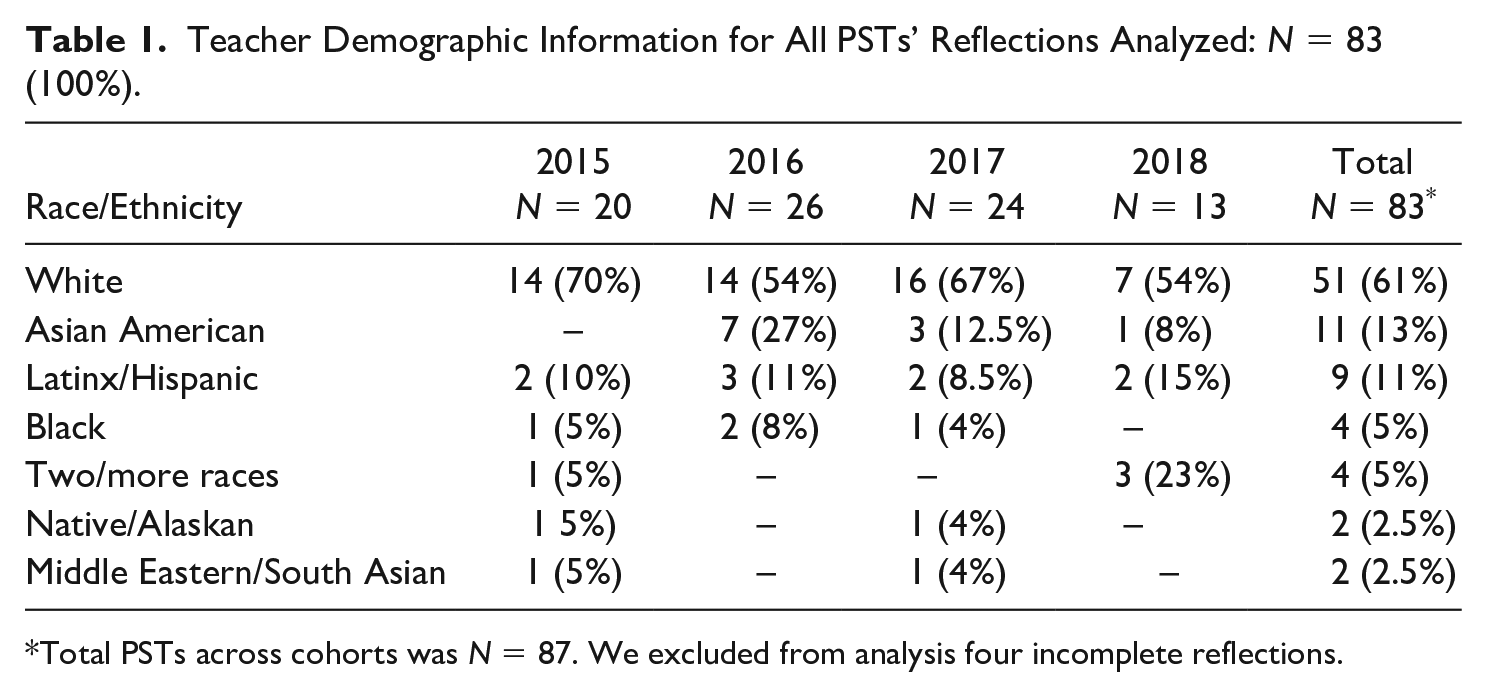
Total PSTs across cohorts was N = 87. We excluded from analysis four incomplete reflections.
Data Collection and Analysis
We constructed a database of multipage essays in which each PST (N = 83) used their videotaped discussion tryouts and principles for dialogic teaching to unpack what occurred. To understand what PSTs noticed and reflected on, we developed a coding scheme from research literature and emerging themes from data review. Analysis involved deductive and inductive coding (Strauss & Corbin, 1990). We began with open coding of 10 written reflections, labeling excerpts that captured what PSTs aimed to do and what they noticed about student behavior and learning, and about their own roles in shaping the discourse, informed by research. We followed with axial coding including negotiation, renaming, defining codes, recoding, and grouping codes (Allen, 2017) in weekly two-hour face-to-face meetings. Through analytical memoing, we surfaced preliminary themes we used to organize our coding. We collectively coded 20 more reflections using the coding scheme, with line-by-line focused coding, making minor adjustments to code definitions.
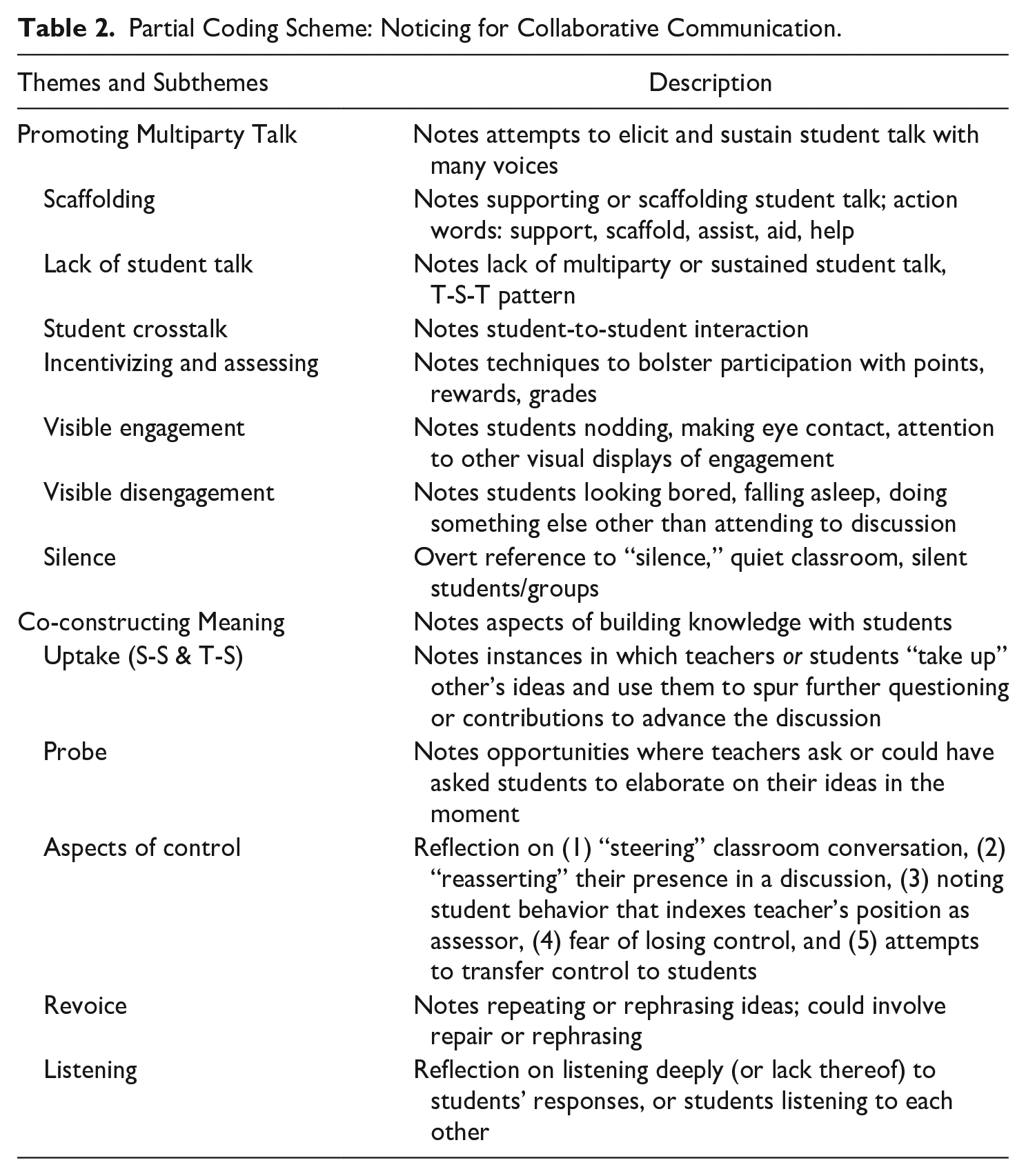
Three researchers coded the dataset using NVivo qualitative data analysis software. Over six months, our coding process involved repeated readings of PSTs’ reflections, weekly side-by-side coding practice, memo writing, and intercoder agreement checks to compare coded excerpts. Once greater than 80% agreement was reached, we coded data independently, then compared to check for definitional drift (Gibbs, 2007). In all, 10% of the dataset was coded by all coders, with Cohen’s Kappas ranging from 0.71 to 0.95 (average of 0.84), representing high agreement. Where discrepancies occurred, coders discussed to reach consensus and refined understanding of codes. Table 2 displays a partial coding scheme with data examples. (For the full codebook, see Appendix A.)
Partial Coding Scheme: Noticing for Collaborative Communication.
We produced NVivo code reports and wrote synthesis memos on emerging themes. Organizing frequency counts and illustrative examples, memos reported “thematic headlines”; for example, 90% of PSTs noticed interactivity and/or attempts to increase interaction across group or whole class multiparty talk. (For a sample memo, see Appendix B.) Memos explored PSTs’ common challenges and discoveries in learning to lead discussion. These included PSTs’ noticing challenges of relinquishing control and tensions surrounding revoicing student ideas. From these memos, we identified what was most salient and explored relationships between themes, such as how PSTs reasoned about impacts of text selection and questioning techniques to promote talk. Although our coding scheme and themes provided rigorous parsing of PSTs’ noticing, with over 50 nested subthemes (Appendix A), our preliminary results lacked utility for pedagogical application. This led us to conduct further conceptual work to better understand and frame our findings.
Within a larger project, our study became informed by emerging work on multi-lens noticing described in our theoretical framework (noticing for collaborative communication, content learning, and equity). Our early themes clearly aligned with one or more of the three noticing lenses (Figure 1). Therefore, we reviewed analyses for ways multi-lens noticing framed patterns in results, clustering early themes as they fit conceptually within each lens. The coupling of noticing lenses with intricate themes and subthemes in our codebook was important. The noticing lenses are broader, offering a global analytic and pedagogical tool to understand and organize noticing and could potentially be used to guide teachers’ noticing practice across content areas (macro-noticing). Our detailed analytic coding and thematic clustering operationalize the lenses and unpack important components (micro-noticing). The codebook and noticing lenses work together to aid understanding of both macro- and micro-noticing patterns of PSTs.
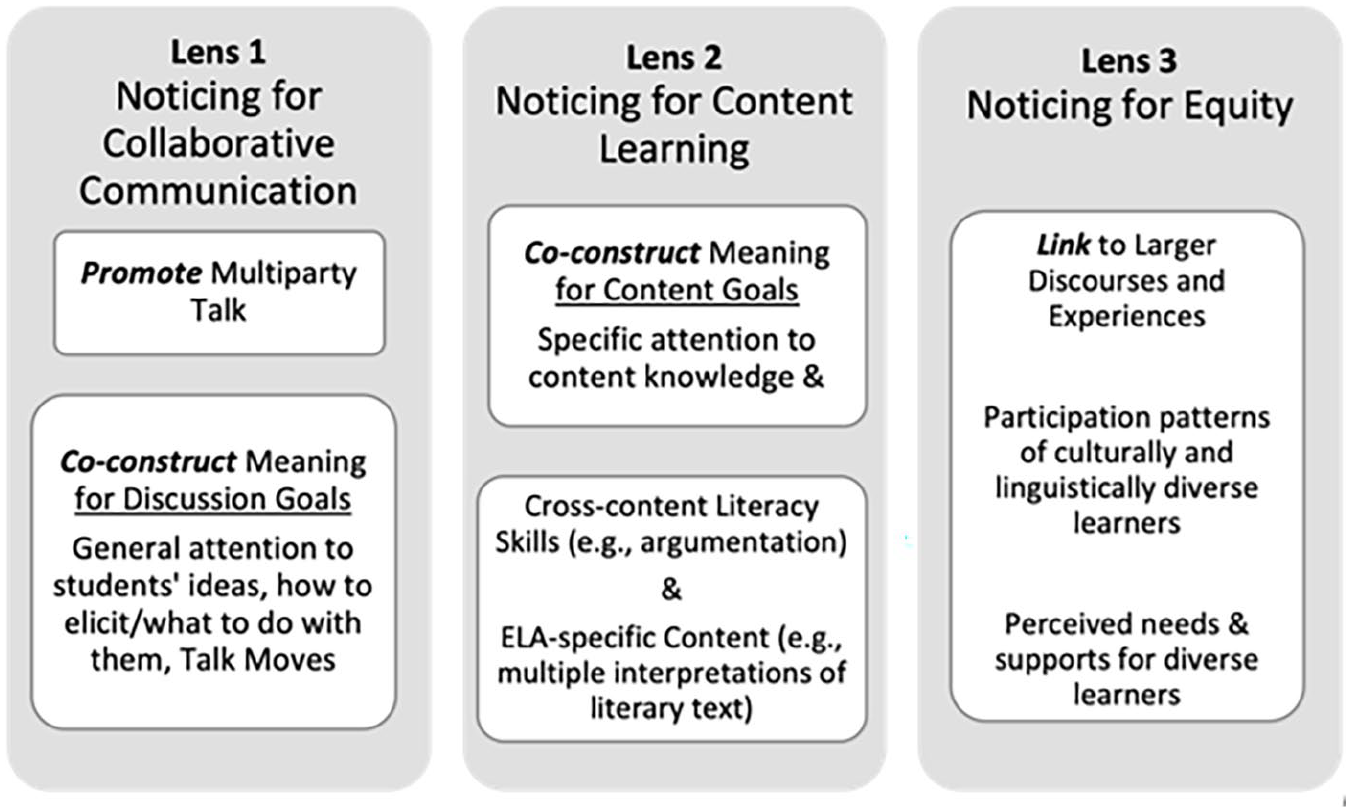
Coding themes clustered by three lenses of the multi-lens noticing framework.
Through deliberation and consensus building, we reorganized (without redefining) our early themes to better capture complexity of PSTs’ reflective noticing, using the multi-lens noticing framework. For example, a preliminary theme was co-constructing meaning, essential to the academic work of discourse, which had yielded 12 different subthemes (Table 2). Prominent subthemes in our analyses of co-constructing meaning were noticing the lack of student talk and scaffolding talk to prompt multiparty engagement. We also found PSTs noted the uptake of student ideas as a discourse process that could promote deep engagement. We found that these were related but distinct foci for noticing, the former assessing the amount of student talk or engagement in discussion and the latter focusing on the flow of student ideas. Thus, we teased apart the noticing lens for collaborative communication to better capture patterns from data.
To further unpack PSTs’ noticing for collaborative communication, the lens most densely represented in the data, two researchers coded excerpts of co-construct meaning (Table 2) to explore how nuances of ELA content surfaced within PSTs’ reflections. We asked, “What did PSTs notice about content-related ideas/learning?” Excerpts were coded as either cross-content literacy ideas, including unpacking informational text and argumentation, or ELA-specific content ideas, such as building interpretations of literary works and understanding character development. Finally, we selected two PST reflections to instantiate specific themes and ways the three noticing lenses framed PSTs’ reflections. We constructed condensed vignettes from reflections by Tara and Thea, both working to facilitate discussions in highly diverse classes, including 40–100% EBs, to explore ways these PSTs were noticing and reflecting on engaging their diverse learners.
Researcher Positionalities
The core research/authorship team included four experienced K–12 educators: the inquiry course instructor (a White male), a bilingual teacher educator (a White female), and two graduate student researchers (a Latin American native Spanish-speaker male and a White female). Other team members included two undergraduates (a Latinx male and a Hmong female) who read relevant literatures, reviewed data, and constructed reports. All team members shared goals of fostering and analyzing teacher learning to facilitate meaningful discussions as part of engaged, democratic discourse in diverse classrooms. When instructor and researcher are the same, context and student voices are needed (which we provide with PST voices forming the core dataset), as well as critical review of student work by outsiders to challenge potential self-fulfilling findings (Clift & Brady, 2005). Following this latter principle, team members who were not part of the project design or instruction conducted analyses independent of the instructor.
Results
To contextualize PSTs’ reports on noticing from first discussion attempts, we overview talk structures, content, and goals PSTs reported. For this analysis, we sampled two cohort datasets, checking for differences between groups (N = 33 PSTs, 66 discussions). Finding trends similar, we combined datasets to catalog PSTs’ discussion structures and content. Next, we used the multi-lens noticing framework to present noticing patterns. We unpacked themes with qualitative portraits, illustrative examples, and vignettes.
Designing Discourse-Based Instruction: Structure and Content
Although whole-class discussion was the dominant structure (73%), PSTs documented a mix of other structures, including Socratic Seminar, partner talk, small group, and Philosophical Chairs (a debate structure). Roughly two-thirds of discussions focused on a single text. Genres varied, but included novels and plays (42%), poems (17.5%), nonfiction articles and opinion pieces (15%), video (12.5%), memoir and nonfiction (5%), and short stories (2.5%). PSTs identified a mix of frequently taught, full-length literary works, including Of Mice and Men and To Kill a Mockingbird, as well as Things Fall Apart and The Kite Runner. PSTs included videos of Maya Angelou and Chinua Achebe, nonfiction texts about contemporary issues like youth incarceration, and song lyrics by Tupac Shakur, Jay-Z, and Billie Holiday. Data indicated some attention to selecting texts that represent diverse voices.
PSTs’ stated goals offer a window into their priorities and intentions. As they launched discussion practices in student-teaching placements, PSTs articulated three central purposes for discussion in their goal statements: engaging with text (43%), developing cross-content literacy skills (30%), and practicing discussion (27%).
Overview of Noticing Lenses
Across all four cohorts, we found PSTs’ reports rich in reflection and interpretation. Figure 2 highlights elements of teacher noticing (observe, reflect/interpret, act) informed by the three lenses. Ideally, PSTs would be equipped with beliefs, knowledge, and skills across all three lenses, and we found evidence of all three in the data. However, the figure shows the collaborative communication lens relatively larger than the content learning and equity lenses due to the preponderance of PSTs noticing features and issues related to collaborative communication across both subcomponents, promoting multiparty talk and co-constructing meaning. Our results move from most to least densely represented lens in the data.
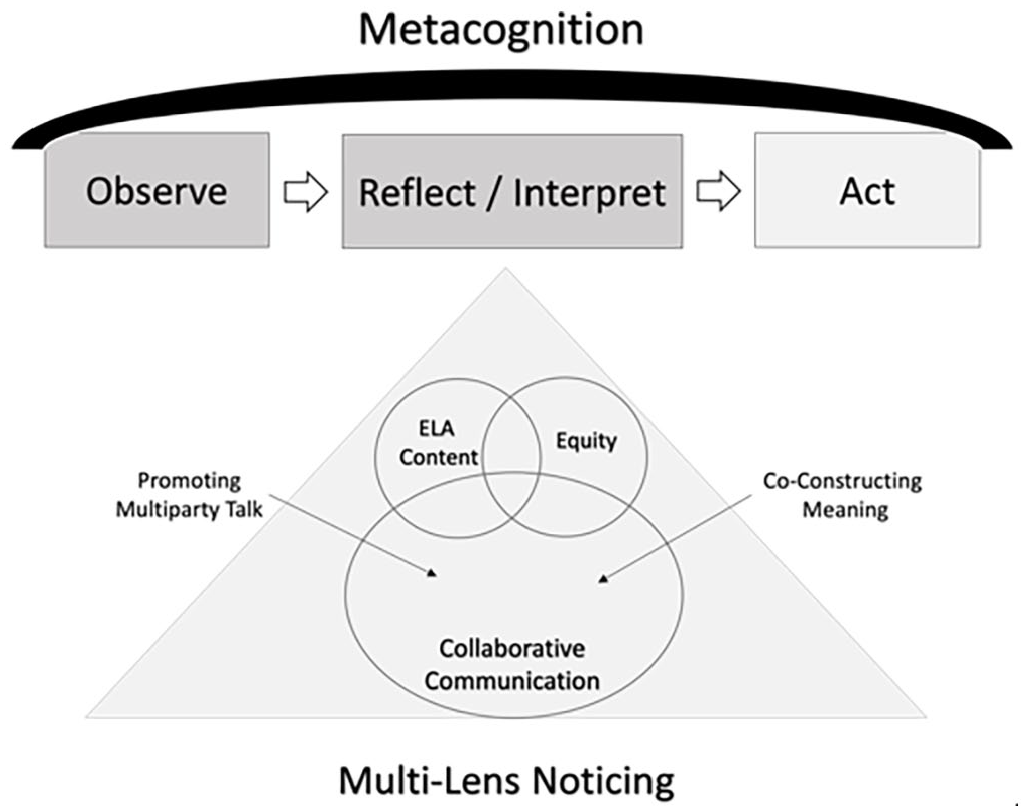
Multi-lens noticing in PSTs’ first attempts at discussion in diverse classrooms.
Noticing for Collaborative Communication: Promoting Multiparty Talk
Collaborative communication was densest in the data, yielding two subthemes (Table 3). We found PSTs preoccupied with “getting students talking.” A full 90% of PSTs reflected on promoting multiparty talk (Table 3), including eliciting, prompting, and sustaining multiple voices. This high percentage was not surprising because promoting talk among adolescents, in an artificial discourse space of schooling, can be difficult to achieve—what one PST called “engaging a critical mass” as discussion foundation. Many PSTs celebrated successes, stating for example, “students created the flow of discussion by responding to each other’s comments” and “many voices blend together as students from each group jump in.”
Noticing for Collaborative Communication.
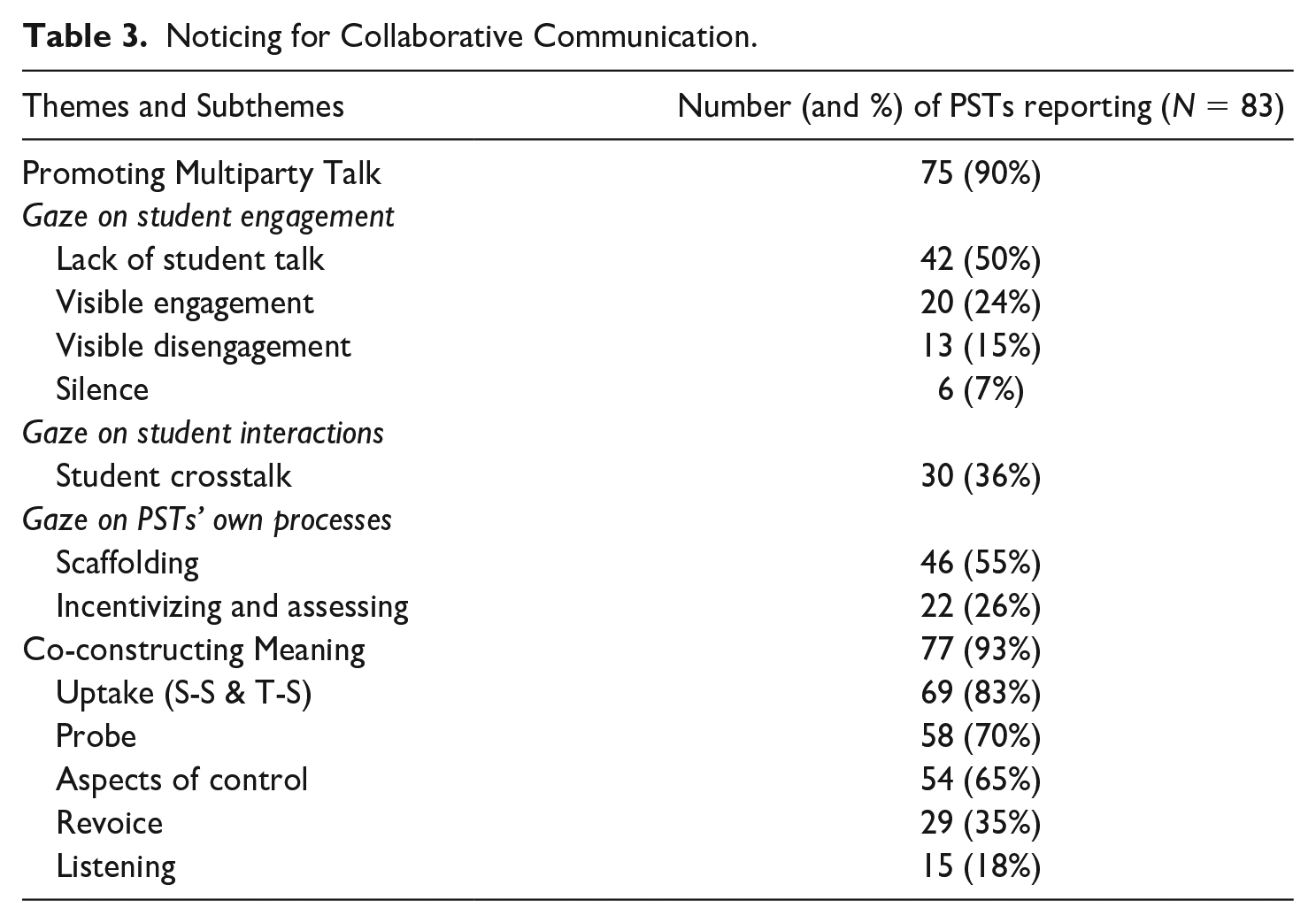
Twelve different subthemes capture foci of PSTs’ noticing for collaborative communication (Table 3). Two distinct categories emerged within this larger theme, promoting multiparty talk and co-constructing meaning. Within each subcategory, PSTs held their gaze in distinct but related ways: on student engagement, student interactions, and PSTs’ own processes (Table 3). For example, considering silence and visible disengagement prompted PSTs to consider scaffolding and additional ways to promote multiparty talk. This shifting gaze illustrates the relational, multifaceted nature of noticing through this collaborative communication lens.
Despite successes, 50% of PSTs noticed and reflected on lack of student talk (Table 3). One described, “Students did not seem comfortable speaking to each other.” Another PST noticed, “the same three students volunteer while the rest sit back and listen, fall asleep, and generally excuse themselves.” These PSTs noticed patterns—who dominates, whose voices are left unheard—crucial work for PSTs beginning to notice for equity within collaborative communication.
With a gaze on student interaction, many PSTs (Table 3) noticed tensions related to guiding student crosstalk (36%), such as grappling with how far off the intended topic a teacher should let students stray and how to manage heated debates. With a gaze on student engagement, PSTs reflected on (1) incentivizing/assessing talk (26%), (2) reasoning about engagement (24%) or disengagement (15%), and (3) silence (7%). Despite concerted efforts to promote talk, several PSTs reflected explicitly on silence. PSTs noticed silences can “become awkward for both teachers and students” and “created a lot of tension and unease.” The stillness of silence can seem paradoxical to collaborative communication; however, silence can be generative for those who prefer to observe before speaking or for EBs not yet confident in English. PSTs grappled with how to understand silence and what, if anything, to do about it.
Collaborative Communication for Co-constructing Meaning
Beyond promoting multiparty talk as a baseline focus, we see evidence of early attempts at co-constructing meaning, generating and tracking ideas across discussion. PSTs practiced and reflected on various dialogic moves, surfacing complexities in attending to ideas. Nearly all PSTs (93%) reflected on some aspect of co-constructing meaning (Table 3). Many reported attempting uptake to build coherence (83%), probing for elaboration (70%), and revoicing student contributions for varied purposes (35%). Overall, data indicate PSTs’ noticing moving toward centering ELA content, though reflections largely emphasized more generic, cross-content discussion goals and practices.
Nuances of Uptake
Most prominent were concerns with uptake, instances in which teachers or students “take up” others’ ideas, ideally using them to spur further questioning or advance discussion (Table 3). PSTs noticed ways students interacted with one another’s ideas, though often not yet reaching the level of rich discussion they sought. One described, “Even though students are discussing with each other, they are not responding to the ideas each other have and treat the discussion as a space to rattle off their own thoughts and move to the next person.” This PST reflected understanding that successful discussion includes more than “popcorning” ideas, and real uptake requires that students connect to, extend, or refute ideas in meaningful ways. PSTs at times noted that uptake and authentic questions require tracking flow of ideas to construct meaning with, not for, students.
Listening surfaced as an important challenge for PSTs, necessary for uptake to occur (Table 3). Deeply listening to student responses in the moment can be difficult for PSTs with many competing demands for their attention. One PST reflected on how hard it is “to really listen to my students instead of thinking about what I’m going to say next.” Another described, “I remind[ed] students to listen closely to what their partner is sharing.” PSTs experienced the challenge of learning to listen deeply and creating the expectation that students have something to learn from one another, both important precursors to co-constructing meaning in discussion.
Transferring Control
PSTs also attended to how their own moves reinstated notions of “teacher as central knowledge-holder” in ways they did not find student-centered. Aspects of control (Table 3) emerged as salient (65% of PSTs). PSTs reflected on ways they attempted to move from heavily teacher-controlled IRE structures of recitation (still prominent in schools) to opportunities for collective reasoning through building on and up of core ideas (Zwiers, 2020). Learning to engage with students as they co-construct meaning poses challenges, and PSTs noted tension between releasing control and guiding student thinking. One explained, “I played an active role of facilitator in the discussion that allowed me to ensure that students understood key meanings in the novel, but it also ensured students were less engaged in the discussion.” Roughly 50% of PSTs described future goals for relinquishing control and engaging more with student ideas. This is an important precursor to noticing for content learning and equity as PSTs ask, How do I release authority for interpretation and ponder issues of equity?
PSTs’ focus on teacher moves aligns with studies on new teacher reflection and the difficulty of attending to student ideas (Levin et al., 2009). However, PSTs reported grappling with key facets of co-constructing meaning through discussion, learning to listen to student ideas, trying on different facilitator roles, and exploring how and when to transfer control to students. Importantly, we found that much of PSTs’ noticing lies between “just getting students talking” and fully marshaling discourse in service of rich ELA work. PSTs attended to students’ thinking and co-constructing meaning, though many were not yet reflecting deeply on how these practices facilitate ELA learning.
Noticing for ELA Content Learning and Knowledge Building
We found PSTs reflected on nuances of ELA content goals (both cross-content and ELA-specific) in their discussions, gleaned from analysis of excerpts related to co-constructing meaning (392 excerpts from 77 PSTs). Here, we capture PSTs’ noticing of probing for what? listening for what? PSTs did not always include a clear focus on ELA content in their reflections, focusing prevalently on “just getting students talking.” Seventy-seven percent of excerpts document PSTs’ moves to support and highlight cross-content literacy skills work. Major themes included general comprehension of text and supporting an argument with evidence. One PST reflected, “I used a probing question to engage the students in thinking about context clues that might help them infer what the main idea of the text could be.” Several PSTs also reflected deeply on student ideas. For example, from discussion of an informational text about pesticides, a PST noticed: A student volunteers the definition of a pesticide. Although this struck me as out-of-context . . . I was eventually able to make the connection this student may have had in mind: pesticides would not be wasted on a plant for which there was a surplus. With this extrapolation, the comment could be realized as valuable and relevant.
Thus, many PSTs demonstrated noticing ways to leverage student contributions to build cohesive discourse focused on developing understanding of complex texts, what we characterize as “cross-content literacies” within ELA work. However, PSTs’ reflections indicated fewer instances of noticing in service of knowledge and practices unique to ELA that students are unlikely to encounter in other content areas.
As noted in our multi-lens framework, ELA frequently concerns spaces of ambiguity (Appleman, 2014) for building multiple interpretations and literary analysis, requiring input from learners engaged in ELA-specific practices. Notably, 17% of co-constructing meaning excerpts documented that some PSTs are already, even in the first few weeks of long-term student teaching, entering a space of no right or wrong answer, a particularly difficult arena for new teachers. These PSTs reflected explicitly on how students were building interpretations of literary works, often concerning issues of character and characterization within novels and plays. Among these, PSTs noticed that framing questions with compare/contrast or questions related to the arc of a character’s development across a longer work invited student interpretations. Importantly, PSTs noticed features of discussion related to complex texts and meaning making in general, and less frequently, related to interpreting literary works.
The following example shows a PST who reports noticing the impact of using uptake during discussion of Catcher in the Rye to advance ELA-specific knowledge building: At 1:10 I use Kyle’s idea of Holden associating with Ackley and Mr. Spencer to ask the students an authentic question, “What do you think this tells us about Holden?” By using uptake I was able to create authentic questions that flowed with the existing conversation as opposed to asking questions that changed the direction of the conversation.
This PST notices how in-the-moment questions that respond to students’ contributions help probe for multiple interpretations of character development.
Another PST reflected on discussion of Sophocles’ Antigone. Students were practicing literary analysis: “I ask students if they believe the prophet Tiresias is telling the truth and making a true prophecy or if Tiresias is lying with the purpose of making Creon king. This question has no right or wrong answer.” This PST explained, “Students would give a one-word answer or respond with a quote, but without analysis. . . . At moments like this, I uptake the question and ask the student to elaborate, explain, or justify.” This highlights a PST noticing the potential of uptake and questioning to apprentice students into the discipline-specific practice of developing evidence from literary works to support thesis development.
ELA-specific knowledge, such as understanding plotline, analyzing character development, and approaching text as a work of art and craft, is multi-perspectival and invites interpretation, demanding teachers to really listen to what students are saying and build on their ideas. PSTs’ reflections highlight some of these challenges, including eliciting student talk and tracking the flow of ideas simultaneously in ways that center construction of ELA knowledge.
Noticing For Equity: Beginning Attention to Diversity
Though reflections on noticing for equity were less robust, a majority (72%) of PSTs included some attention to who is in the room, attempting to make discussion content relevant to diverse students (Table 4). PSTs identified multiple purposes served by linking ELA content and discussion with local lives and discourses, beginning with promoting engagement, extending beyond to recognize linking can expand meaning and help youth feel their lives matter in the meaning-making world of the classroom.
Noticing for Equity: Linking Content to Students’ Experiences and Backgrounds.
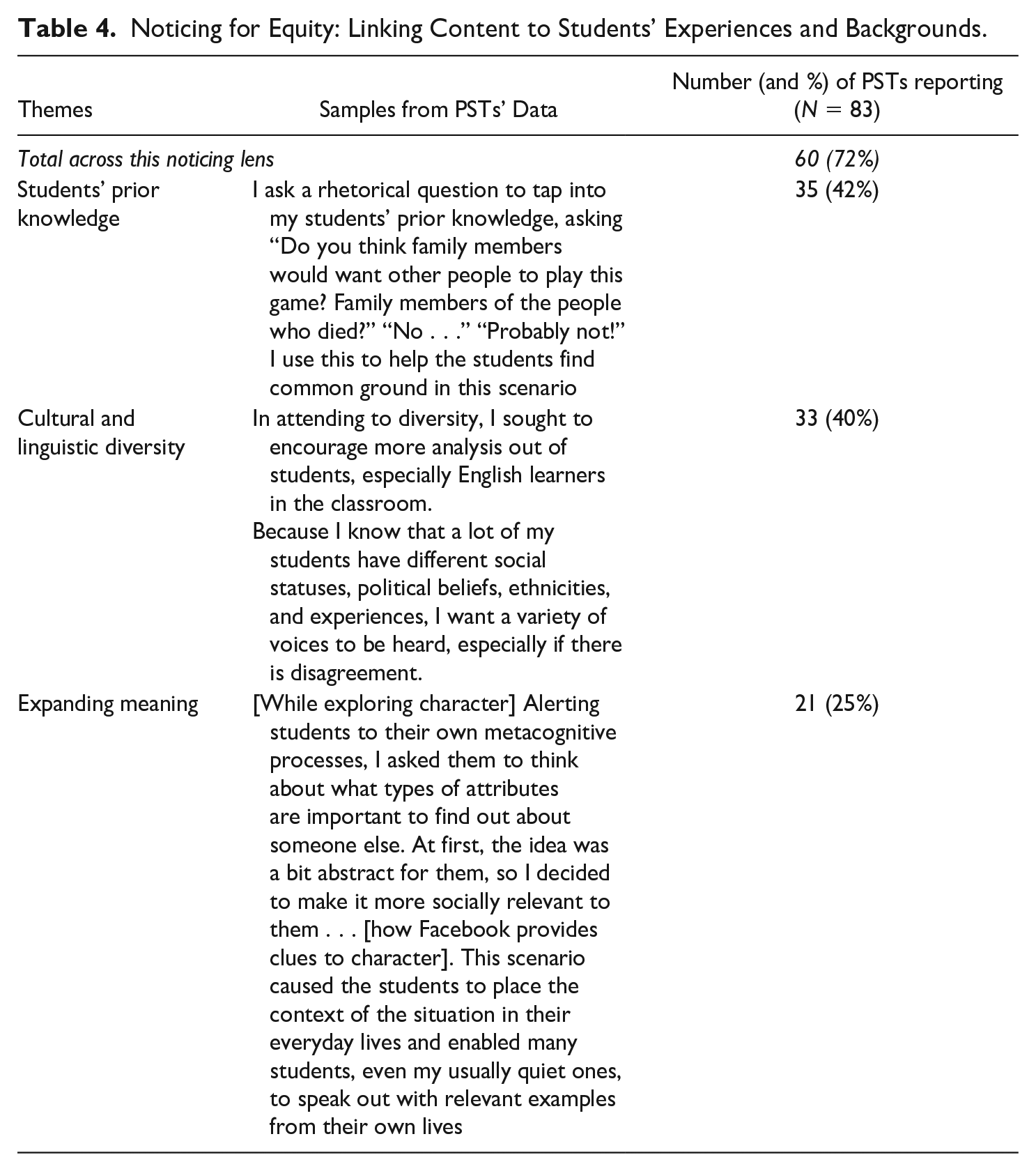
PSTs tapped students’ personal experiences and non-academic topics. One PST reflected, “Encouraging dialogic learning in the classroom enables time for students to tell personal stories . . . and makes the content both relatable and accessible.” At the intersection of noticing for ELA-specific content learning and equity, PSTs noted ways analyzing character development could include invitations to share experiences, feelings, and opinions. One PST explained, “I ask students to describe what Jane Eyre would be like in a modern context, as a student at their own school. This invites interpretation and engagement on a personal level, and draws upon prior knowledge/experience.” Although such insights may be common among more veteran teachers, important here is that even in their first attempts at facilitating discussion, these PSTs noticed linking classroom talk to students’ experiences created richer discussions and engagement increased for students who do not often contribute. This may be a crucial first step in developing an equity lens, aligned with the notion of resource pedagogies that engage students where they are to support academic learning (Paris, 2011).
Several PSTs noticed ways they facilitated culturally relevant discussions, positioning students as experts. In one example, a PST noticed a student sharing cultural knowledge: [He] shares about his Hmong people’s involvement in the Vietnam War, and how the Hmong have been dispersed across several countries, resulting in loss of language, culture, and safety. I ask him to share more about the . . . events in Laos, but do not probe excessively for personal information, recognizing . . . [he] shows signs of being uncomfortable when at a loss for an answer. Even though he may not have known exactly what happened with the genocides in Laos, [he] knew the importance the experience held for his parents, the danger involved, and its relevance to his life. . . . The student’s willingness to open up to the small group prompted the female student beside him to share another personal and cultural connection: her Mexican heritage and the strong ties to Catholicism.
By building on students’ knowledge, an equity lens moves instructional scaffolds from focus on accessibility to activating expertise. Wilkinson et al. (2017) report productive ELA discussions including extratextual connections, linking discussion to students’ lives, other texts and media, and knowledge established in prior discussions.
PSTs considered what counts as academic talk, and many developed more nuanced definitions that included sharing anecdotes, debating personal opinions, and more. These dialogic moments allowed PSTs to share more about themselves and their lives, and some found fluidity in their own use of “academic” language. Quoting MC Hammer to scaffold understanding of a term, one PST reflected: “Once again, I slip into a more informal register, but this allows me to incorporate culturally relevant knowledge and appeal more widely to my students.”
We found PSTs’ noticing for equity woven through themes surfaced from other lenses. This interconnectedness demonstrates PSTs’ conceptions of the importance of culturally relevant teaching that centers students’ experiences and leverages their insights, an important first step in addressing persistent patterns of difference in educational opportunities. These examples represent PSTs’ crucial beginnings of understanding equity through dialogic instruction.
Multi-Lens Noticing Framework Across Two Teacher Vignettes
Two vignettes with excerpts from PSTs’ reflections illustrate PSTs beginning to notice across the lenses and attend to the human nature of discussion.
Tara: Learning to Embrace Student Voice and Support Equitable Participation
Tara, who is African American, had recently begun practice teaching a 10th-grade college preparatory ELA course at a Title I school, with 91.5% students from low-income backgrounds (free/reduced-price lunch). Her class of 20 included students from diverse backgrounds: 6 Asian American (Hmong, Chinese, Vietnamese), 5 African American, 5 Latinx, 3 White, and 1 multiracial. Eight (40%) were EBs, bureaucratically classified “English learners.” Tara articulated her focus for discussions, aligned with a collaborative communication lens: (1) engage students in active listening, and (2) have students participate in think-pair-share to answer Macbeth study guide questions. For ELA-specific content learning, Tara aimed for students to “close-read a soliloquy, by paying attention to diction and tone” and “help students refine their analysis of literature.”
Tara guided students in unpacking hidden meaning in the prophecy that no man “born of a woman” shall harm Macbeth. She reflected on how her discussion questions may have prompted students to link historical context to present day: “Students recognize immediately that caesareans are much more common today than they were in Macbeth’s historical context. . . . One student observes, ‘If you have a C-section [back then], you die.’” Tara took up this student’s idea and probed how the C-section in medieval Scotland may have impacted Macbeth’s fate as king. She was pleased to notice how her probing led “students to apply knowledge of contemporary society to the text.” By taking up the comment and further probing, Tara enabled co-constructing meaning of the text with her students. Next, she reflected on her role as she tried to shift agency to students: I talked so much, in part, because I did not make it clear to students how they should participate in whole-class discussion; I did not enforce consistent procedures . . . some students chose not to participate at all . . . mostly female students. In the future, I must establish clear expectations for whole-class discussion, perhaps by using different formats . . . to engage more voices and ensure a better gender balance among participants.
Here, Tara noticed that, although she succeeded in promoting student talk, prompted a link from text to historical context, and worked to foster co-constructing of meaning, her voice remained dominant (I talked so much). Her reflective work also enabled Tara to raise questions about her early attempts related to equity and engagement. Tara’s reflection explores nuances of noticing for collaborative communication, including explicit guidance about participation, positioning of teachers in co-construction, and whose voices were represented. She noticed whose voices were heard and whose were not, raising an equity question regarding less participation from females in whole-class discussion, addressing equity and collaborative communication lenses simultaneously.
Reflecting on what she learned from her discussion attempts, Tara theorized that implementing clearer expectations and trying different discussion formats (other than whole-class) could increase equitable participation. We see also that she is beginning to examine multiple meanings silence can hold (Schultz, 2009) and a broader understanding of participation by noting how “side conversations” may represent productive engagement in dialogue about text, an important understanding for beginning teachers. Tara’s multi-lens noticing (ELA content goals of close reading and literary analysis, complexities of collaborative communication, and noticing for equity regarding who speaks) provides a window into PSTs’ observing, reflecting/interpreting, and planning future actions (aligned with Figure 2) when facilitating dialogic instruction in a diverse classroom.
Thea: Exploring Tensions in Revoicing to Broaden Notions of Academic Discussion
Thea, whose reflections opened our article, is a White female who student-taught in an intermediate English language development (ELD) class with 9th–11th graders. In her small class, there were four female and five male students, all EBs, bureaucratically classified “English learners.” Students’ home languages included Spanish, Chinese, Vietnamese, Tswana, and English. Thea’s discussion attempts took place at the beginning of a unit on communication. For her ELA-specific content learning design, she planned to activate students’ prior knowledge and included several opportunities to practice argumentative writing in preparation for a summative writing task. In her reflections of first attempts at leading discussions, a pattern emerged: the merits and tensions in teacher revoicing of student talk. Through the lenses of noticing for collaborative communication and equity, revoicing elaborated new understandings for Thea.
For example, Thea noticed how she positioned herself as the voice of “academic” English. She realized her motives for revoicing were not to facilitate discussion, but to neutralize students’ accented speech that sometimes “hinder them from properly articulating what they want to say.” She used the word “properly” to characterize classroom language use—first to describe students’ communicative abilities in English (properly articulating), then to justify her revoicing (I must properly repeat). She explained how this stance relates to academic English: “Today I struggled to promote multiparty in my classroom. At first I believed it was because I needed to interpret what my students said into ‘academic’ English so that other students could respond properly.” Thea’s use of “academic” in quotation marks suggests she may have been distancing herself from the term, or did not fully subscribe to the notion, though she still justified a linguistic ideology that cast Dominant American English as the norm. She problematized her tendency to recast or repair students’ speech by noting that such recasting and repair may have contributed to her “struggle” to promote multiparty talk, coupling equity and collaborative communication.
After viewing her videotaped discussions individually and in the company of peers who provided feedback on what they noticed, Thea reported an amplified understanding of revoicing: [My peers] mentioned that my ability to paraphrase/revoice helps students hear their own ideas in academic English. [I can] expand on their thoughts and introduce new vocabulary. . . . However, if I am constantly trying to revoice my students’ comments, is this getting in the way of allowing my students to respond to others?
Here, Thea described exploring functions and limitations of revoicing in discussion with her peers and questioned ways revoicing may unintentionally usurp power from her students (Herbel-Eisenman et al., 2009), aided by her peers’ video-viewing feedback.
Thea’s deep exploration of tensions around revoicing is quite notable for a beginning teacher and critical for bilingual learners’ opportunities to demonstrate their abilities to engage in co-constructed discussions. In fact, Thea described a shift in her understanding of “academic” English: “I truly believe my [EB] students are capable of engaging in dialogic talk. There have been many undocumented moments when I hear students make incredibly insightful comments about a text and it inspires other students to talk as well.” As in the questions she posed at the opening of our article, Thea was rethinking how to achieve two elements of learning to facilitate ELA discussions amply evident across our full database: noticing for collaborative communication and equity. The latter is particularly salient, as Thea worked to build cohesive talk among her culturally and linguistically diverse students. Through the lens of equity, Thea observed and problematized notions of academic language, evolving the idea of classroom discourse toward understanding that non-native-like English can be richly used in academic discussions (Bunch et al., 2012).
Across the Vignettes
These two vignettes from PSTs’ reflections on early discussion attempts illustrate ways PSTs reveal the multi-lens noticing framework in action. In addition, the vignettes demonstrate how the dialogic teacher inquiry pedagogical process led to new discoveries as PSTs engaged in the complex practice of classroom talk. As Tara and Thea reported their discussion tryouts, their noticing practice with their own videotaped discussion facilitation attempts, and their reflections on the process (solo and with peers), they discovered themes and raised questions of importance for their own practice. These included: what counts as discussion engagement and for whom; tensions in what occurs with constant revoicing of students’ remarks, especially contributions from EB learners; and the importance of making space for students’ full communicative repertoires to be tapped for discussion. As they reflected on their early discussion attempts, Tara and Thea illustrated themes, questions, and discoveries particularly relevant in learning to lead ELA discussions among culturally and linguistically diverse adolescents.
Discussion
Our findings highlight the need to build authentic and tangible discussion-leading practice, with deeper attention to what that means specifically for ELA disciplinary goals and equity. Collaborative discussion spaces for analytic exploration of text can move students toward critical analysis and valuing multiple perspectives. For PSTs, engaging with the complexity of situated classroom practice with diverse learners supports understanding of how to create such spaces. What PSTs choose to attend to, highlight, and reflect on in complex classroom environments has much relevance for what they learn and what they will later be able to enact.
As we argued, PSTs need more than generic talk moves as tools to shape classroom discourse in ELA. Our study highlights a multi-lens noticing framework as a conceptual and pedagogical tool to help PSTs reflect on their emerging discussion practices. Even in the foundational first attempts at promoting collaborative discussion, there is a great deal occurring. Data highlight that promoting talk among adolescents in an artificial discourse space is itself a major challenge PSTs experience. Eliciting talk, as our findings show, needs to be coupled with co-construction of ideas, building student-to-student discourse, fostering uptake, promoting listening, and practical tools that help young folks grasp how they can benefit from peer inputs in meaning making.
We found PSTs were much more likely to notice and reflect on students’ contributions related to cross-content literacies, as opposed to ELA-specific content (77% vs. 17%). This aligns with emphasis on informational texts and argumentation in CCSS and may represent an important shift in the field in which ELA courses are primary sites for cross-content literacy development. Although ELA crucially comprises both cross-content and ELA-specific goals, PSTs may benefit from greater support for understanding and noticing ELA-specific discourse practices and ideas in class discussion.
Extended treatment of discussion practice in TE courses, along with collective inquiry and videotaped noticing practice, are fruitful avenues for PST development. Our findings illuminate that using such knowledge, tools, and practices for discussion also requires disciplinary and equity focus. Although the majority of PSTs were beginning to notice and leverage students’ cultural and linguistic knowledge for content learning, most PSTs were not yet responding to or educating about racism, linguicism, and other forms of bias that manifest in classroom interactions and curriculum. Calling attention to the role of teachers and some problematic norms in the language of schooling, an important aspect of noticing for equity, is exemplified in Thea’s vignette. The vignettes highlight how linguistic diversity plays a role in PSTs’ first discussion attempts.
Our research contributes a conceptual framing of what PSTs focus on during early stages of leading discussions and highlights what is needed if we mean to jump-start this process early. Frameworks and findings such as those we advanced can contribute to meaningful and perhaps even expedited means of shaping purposeful talk to enrich ELA discussions in culturally and linguistically diverse classrooms. Projects focused on discussion in other content areas and projects featuring small-group and online discussion will highlight other content and interaction themes. Nonetheless, themes we surfaced and the multi-lens framework provide heuristics to deepen knowledge of early-career discussion challenges and ways in which teacher education can advance teachers’ knowledge and practice.
Our study has three limitations. First, like other qualitative studies of teacher noticing, we do not report predictive validity of noticing on instructional quality or student learning (König et al., 2022). Generalizability of findings may be limited, though we mitigate issues with reliability by using a large data set and rigorous coding process to capture noticing and its facets. Second, we centered our analysis on PSTs’ early attempts at facilitating discussion, at the launch of their extended teaching placements. This narrow focus did not enable us to examine teacher learning and development across time—an important area for future study. Our intention was to develop a baseline of PST noticing regarding discussion practice, so we sampled deeply across four cohort years, building a database typically difficult to develop with rapidly changing annual cohorts of TE participants. Third, the context within which the focal project was situated benefited from sustained attention to discussion, as part of a multi-year TE pedagogical innovation, with analyses supported by a larger grant-funded initiative. Other programs less fully resourced and with less opportunity for structural redesign likely will have less opportunity related to pedagogical innovations. Resources and innovations we developed relate to our commitment to make accessible to others what we learned through rigorous treatment of data with applications for research and practice.
Implications and Conclusions
Recent framing of teacher education research and pedagogy has characterized a “turn toward practice” with methods classes including practice opportunities beyond knowledge development (e.g., Kavanagh & Rainey, 2017). In a parallel vein, we position our noticing framework as a pedagogical resource that needs practice opportunities for application and refinement. To that end, the larger project within which this study is embedded has continued to explore the multi-lens noticing framework to foster teacher learning. In a kind of multi-level practice of noticing, our project team has used results of the present and related studies as “data” for our collective inquiry into our noticing of patterns in PSTs’ noticing. We have used such inquiry to reason about what the patterns mean, and we have used findings as prompts for pedagogical design and action. Among actions and practices we have explored are the following, some of which may help other teacher educators in crafting designs for practice. First, to test the viability of the framework as a pedagogical resource, the course instructor (Steven) used the framework as a conceptual tool to aid PSTs in noticing their own and others’ videotaped discussion practice. This occurred in subsequent enactments of the focal teacher inquiry course (beyond those examined for the present study), beginning with wide-open noticing practice, followed by uses of the lenses as conceptual organizers. PSTs reported enhanced clarity about what they noticed and might seek to notice. Second, our study findings and reflections suggest PSTs may need particular support in strengthening their noticing and practice related to an equity lens. Aligned with this finding, project team members applied the lenses to vignettes of practice to highlight moments of noticing for equity (Patterson Williams, Higgs, et al., 2020). Third, seven teacher partners, alumni of the focal class of this study who have participated in the larger project, composed and reflected on vignettes highlighting all three lenses. In a recent iteration, these teacher partners constructed guest workshops to guide a new cohort of PSTs to view video footage together, apply the lenses in reflective discussion and writing, and construct vignettes showcasing each of the three lenses (Mastrup et al., 2023). The teacher partners also have co-designed augmented reality scenarios, foregrounding the lenses and ways they overlap (Higgs et al., 2021). These scenarios prompt noticing and action and are coupled with think-alouds in which teachers report what they noticed, how they interpreted it, and why they did/did not respond in the moment of interacting with avatars in the augmented reality space.
Across these applications, we found PSTs used the lenses meaningfully to surface moments in their noticing and to highlight missed opportunities in their own and others’ practice. Reflective discourse highlighted the potential of these lenses to guide noticing practices, heightening attention to what the lenses feature. In ways such as these, we highlight possibilities for innovating, testing, and refining pedagogical tools to prepare teachers early and meaningfully for the complex work of guiding classroom communication for engagement, meaning making, and learning. Such ongoing uses of and inquiry into such tools also help surface continual discoveries and needs for follow-on empirical work in facilitating discussion for learning across grades, subjects, and contexts. In these ways, we can embrace practice-based teacher education—rigorously, reflectively, and continually mining unfolding patterns of practice as opportunities for continual design of pedagogical innovation.
Footnotes
Appendix A
Appendix B
Authors’ Note
The article has not been published or submitted elsewhere.
Declaration of Conflicting Interests
The author(s) declared no potential conflicts of interest with respect to the research, authorship, and/or publication of this article.
Funding
The author(s) disclosed receipt of the following financial support for the research, authorship, and/or publication of this article: Research reported in this article was supported by a Teachers-as-Learners project (Steven Z. Athanases, PI), School of Education, University of California, Davis, funded by the James S. McDonnell Foundation (Grant #220020519) and by a grant from the California Teacher Education Research and Improvement Network (CTERIN).