






Abstract

“Ethnic Studies courses
Extensive research demonstrates that students who take Ethnic Studies classes raise their GPAs, are more likely to graduate, and enroll in postsecondary education at higher rates than their peers (Bonilla et al., 2021; Cabrera et al., 2014; Dee & Penner, 2017). Ethnic Studies programs are thriving in several states and large school districts around the country, elevating achievement for racially minoritized and White students alike. With investment in Ethnic Studies programs nationwide, tomorrow’s students will be more engaged, think more critically, and graduate more ready for college or career (López et al., 2022; Sleeter & Zavala, 2020).
What Is Ethnic Studies?
“Ethnic Studies” is the umbrella term for several academic disciplines, including Native American/American Indian Studies, African American/Black Studies, Xicanx/Latine/Mexican American Studies, and Asian American/Pacific Islander Studies, which have a 50-year history in higher education. Ethnic Studies courses include curriculum that looks at historical and contemporaneous events through the stories and experiences of racially minoritized peoples. Ethnic Studies teaching is project-based and community focused, and it supports identity development while boosting student learning and strengthening civic engagement.
Why Do We Need Ethnic Studies?
Curriculum in U.S. schools almost always leaves out the stories of racially minoritized people. When students don’t see themselves in the curriculum, or they keep hearing the same stories over and over again, they get bored, feel alienated, and disengage or leave (Abdullah, 2020; de los Ríos, 2017). Ethnic Studies courses provide accurate teachings about how racially minoritized peoples have shaped, and continue to shape, American society, driving engagement for students and preparing them for active roles in civic life (Banks, 2012).
What Does the Research Say?
U.S. curriculum is heavily Eurocentric.
American Indian/Native Americans are placed in a pre-1900 context in more than 85% of the standards and are almost entirely spoken about in the past tense, erasing their modern existence (Shear et al., 2015).
Social studies textbooks contain almost no representation of non-White/non-Western people or ideas (Sleeter, 2011).
Ethnic Studies drives student achievement.
Ethnic Studies programs have positive effects on student attendance, GPA, earned course credits, graduation rates, and standardized test scores (Bonilla et al., 2021; Cabrera et al., 2014; Dee & Penner, 2017).
–Juan Carmona, Award-winning Texas educator and Mexican American Studies course author.
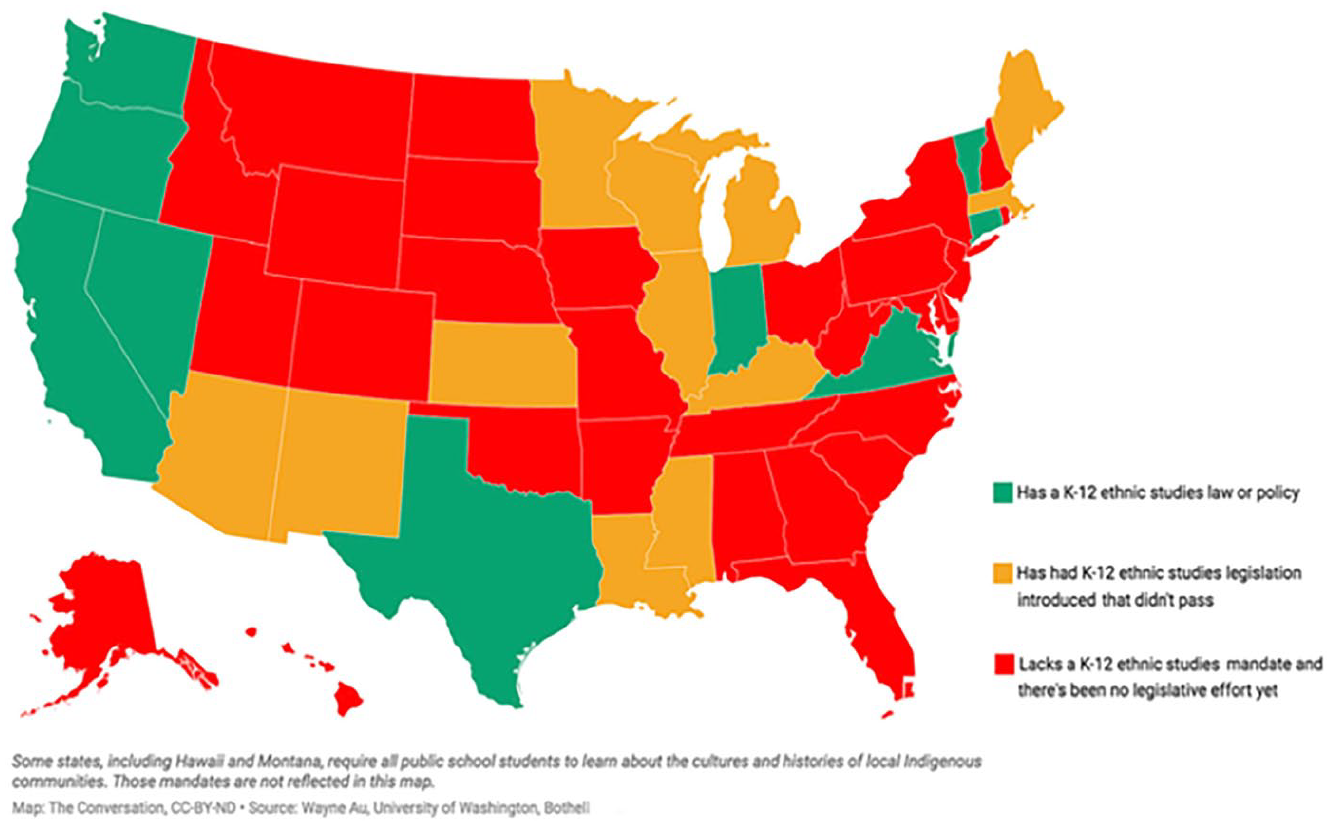
Students, educators, families, and communities are demanding Ethnic Studies programs—and state and local school boards are answering the call!
Be an Ethnic Studies Champion
Recent politicized attacks on school curricula have been framed as “anti-CRT” by those purportedly looking to protect (White) students from feelings of discomfort. Those advocating for truthful histories correctly name these efforts what they are: censorship campaigns. These censorship campaigns have put Ethnic Studies programs in jeopardy in many states. Ethnic Studies programs need material, financial, and political support at the national level to ensure that students can access Ethnic Studies programs across the nation. Following is a list of recommended actions that can support students accessing Ethnic Studies across the states.
Anyone: Write a letter to advocate for an executive order to Miguel Cardona, the secretary of the U.S. Department of Education, in support of Ethnic Studies.
Legislators: Open funding streams for HSIs and HBCUs to develop certificate programs in Ethnic Studies fields. ○ In-service and preservice teacher certificates ○ Broader certificates in discipline-specific fields based on local contexts and applied to any degree ■ For example, the University of Texas at San Antonio has a Mexican American Studies (MAS) certificate program that any graduate student can add to their degree plan, allowing them to apply a MAS lens to their jobs as engineers, lawyers, and doctors in their communities. ■ The University of California San Diego recently launched a similar graduate certificate in Native American Indigenous Studies (NAIS) (Kiddera, 2023).
Legislators: Develop loan forgiveness programs for Ethnic Studies educators following the TEACH model.
Community organizations: Host listening sessions and teach-ins with youth and elders in your district that center on non-White cultural and political history.
Legislators: Write a bill to include the language of “the numbers of Ethnic Studies provided in school districts” as a measure of equity in the Every Student Succeeds Act, Title I, Part A, Section 1111.
Footnotes
Declaration of Conflicting Interests
The author(s) declared no potential conflicts of interest with respect to the research, authorship, and/or publication of this article.
Funding
The author(s) received no financial support for the research, authorship, and/or publication of this article.