







Abstract
Background/Context:
The experiences of Black girls navigating elite, predominantly white independent schools remain underresearched in the academy despite this issue being integral in disciplines such as sociology, education, and African American studies. Within such institutions, Black girls must navigate the duality of their privilege in having access to the highest quality and resourced education with the marginality of being a demographic minority within a space controlled by cultural elites.
Purpose:
This study investigates the experiences of Black girls in independent schools via the accounts of Black-woman-identifying alumni of such institutions. This study utilizes a Black feminist framework for understanding the often overlooked excess challenges that Black girls are forced to face.
Research Design:
Through qualitative semi-structured, conversational interviews with 13 Black women graduates of 10 Mid-Atlantic and New England boarding and day schools, this study explores how the graduates reflect on their experiences navigating elite schooling during formative adolescent years, decision-making processes, and management of Black girl identities within the exceedingly white and wealthy context of independent schools.
Conclusions:
Significant themes that emerged from the qualitative data generated by this study include feelings of rootlessness from Black and white communities, difficulty navigating a racialized and gendered social hierarchy, and heightened levels of social anxiety and self-consciousness about physical and ideological selves. Through a thematic retelling from those who have lived through the challenges and understand how they are presented in these contexts, the significance of this study’s exploration of Black girls in independent school is the (1) liberation of these historically marginalized voices and (2) potential to provide current school leaders a framework for how best to support their students.
Independent schools are known for providing rigorous curriculum, unmatched resources, and an ability to put students on a trajectory toward prestigious colleges, careers, and peer networks. According to the National Association of Independent Schools, the accrediting body for more than 1,600 schools in the United States, independent schools are identified as follows: non-profit private schools that are independent in philosophy: each is driven by a unique mission. Each is governed by an independent board of trustees and each is primarily supported through tuition payments and charitable contributions. They are accountable to their communities and are accredited by state-approving accrediting bodies. (National Association of Independent Schools [NAIS], 2023)
These predominantly white institutions (PWIs) also hold a history of deep-seated social, financial, and racial exclusion. During the 2022–2023 school year, the population of independent school students was 52.1% white, 8.9% Asian American, and 6.5% Black/African American, with Middle Eastern, Native American, and Native Hawaiian/Pacific Islander students constituting less than 1.1% each (NAIS, 2023). The average annual tuition at these independent day ($29,653) and boarding ($66,555) schools is largely covered by students’ families, with the median percent of students receiving aid being 26.7% (NAIS, 2023). With a high price tag and history of exclusively serving white elites, the diversification of independent schools is slow process that forces the institutions to contend with their historical legacy of exclusion, educational philosophy and mission, and future goals for whom they want to educate.
It is also the case that independent school leaders have, over the course of a handful of decades, pushed to diversify their student and adult populations to keep up with the changing landscape of the United States. As a result, students from diverse racial and class backgrounds have found themselves in school environments with little institutional support to account for their social, emotional, and cultural needs (Nakkula & Toshalis, 2006). With many of these schools operating an antiquated white-masculinist programming model that most effectively serves their traditional clientele, Black girls, a slow-growing subpopulation within independent schools (NAIS, 2023), sit at the intersection of various forms of marginality. As such, they are implicitly tasked with the job of creating space for themselves within institutions that were not designed to support them. To survive and thrive, they must develop a specialized set of competencies dissimilar from their peers as they navigate issues of racialized, gendered, and classed marginalization within their school lives.
While existing research considers Black identity and culture in elite secondary schools (DeCuir-Gunby 2007; Ispa-Landa 2013; Jacobs, 2017; Purdy, 2018; Zweigenhaft & Domhoff, 1991), the present study aims to contribute to the discourse by delving into how gender and class complicate previous analyses of Blackness in elite schools; Black girls remain underresearched in the academy, and studies highlighting their intragroup diversity and negotiation of marginality and privilege are even more scarce. Through the current study, I investigate the experiences of Black girlhood within independent schools, using a semi-structured interview protocol with alumni of these institutions. My focus on young Black women who have attended and recently graduated from an independent school seeks to answer the following research questions: What are the racial and gendered challenges that Black girls in an independent school face? How do they make sense of their identities as Black girls within overwhelmingly elite and white spaces? What personal and academic management and navigational tools do they employ? My analysis moves beyond a simple acknowledgement of racism and racial imbalances within the realm of independent schools and instead works to reach a deeper understanding and explanation of gendered and racialized subjects making meaning of the confluence of this malaise (Dumas, 2014) and racial melancholia (Eng & Han, 2000) in this context.
Literature Review
The role of education in society is often debated, with various economic, political, and social spheres. Generally, education serves the purpose of developing the youngest members of society into citizens who will contribute to their local and greater communities once they are able. While many young people will grow into those who contribute to society through their labor, others, usually those in elite educational institutions, will grow into those who contribute knowledge production—medical doctors, professors, and lawyers. The importance of such a distinction between such tracks is simple: The histories of white and Black people’s access to education in the United States is starkly different. For whites, formalized educational opportunities trace back to the very foundation of the nation; for Blacks, overt laws barred them from educational opportunities as recently as 80 years ago (Du Bois, 2013; Purdy, 2018).
There is established research on Black subjectivity and development of racial identity in opposition to white hegemony in schools (Datnow & Cooper, 1997; Dumas, 2014; Ispa-Landa, 2013; Zweigenhaft & Domhoff, 1991). Scholars, in these works and others, highlight how Black students in these spaces generally experience social othering or separation from their white peers. Much of what this previous scholarship speaks to is the racialized subjectivity that Black individuals face in a white world and how a symbolic barrier persists between those racialized as Black versus white (Du Bois, 2013). In schools and beyond, many of the problems and inequities among people sociopolitically can be traced back to race and colonialism (Coloma, 2009; Du Bois, 2013; Massey & Denton 1993), which has implications for how students in today’s world experience schools, especially those with a lengthy history of racial exclusion.
With the increasing diversification of independent schools, many past studies on Black students enrolled in them have less applicability today, given the wider variety of Black identities within the school setting (Purdy, 2018). Social class background, ethnicity, and parental educational attainment are some of the factors that can contribute to how these students enter their school communities (DeCuir-Gunby, 2007). In elite schools, it is often the case that wealthier students hold the most social capital, controlling the social order in which all students participate. Such a clear link between hegemonic wealth and whiteness certainly made sense throughout the history of independent schools, given that wealth and whiteness were seen as synonymous (Purdy, 2018). However, today, with more variation among intersections of racial and class backgrounds, it is possible that students arrange themselves and are arranged by other metrics. The limitations in previous analyses of this context provide intellectual fodder for the gaps this research aims to address. It is also the case that even with the diversification of these elite independent schools, they still operate as “the white space,” a relic of the past in which Black people will always remain visitors (Anderson, 2015). This study conjectures a similar dynamic of hegemonic wealth and whiteness controlling the social hierarchy of these independent schools because of the historicity and coloniality still prevalent in these elite academic spaces.
Harm Within
While many of the most prestigious independent schools were founded more than a century ago, the foundation on which they stand is characterized by a legacy of wealth and opportunity hoarding that is reproduced even today. In more recent history, schools have made attempts to diversify their student bodies, and contemporary studies (Gaztambide-Fernández, 2009; Khan & Jerolmack, 2013) showcase a continued use of a white-masculinist framework that, at its core, seeks to consolidate an upper class, elite ruling party that predominantly benefits the white, wealthy, and male constituencies. The most “fundamental characteristic” of elite boarding schools is exclusion (Gaztambide-Fernández, 2009). When Black girls step into these spaces, they exist as the antithesis of what these schools have historically stood for, and this affects how they are perceived and treated, and how they see themselves. Studying elite independent schools and Black girls within them creates a more detailed picture of the scope of schooling experiences and the extent to which students can end up spending formative years in learning environments that are harmful to their development.
For many Black children and families in the United States, schooling is a site of suffering (Dumas, 2014). Drawing on Bourdieu’s concept of la petite misère, Dumas made the claim that working-class students suffer a malaise that stems from their growing consciousness of how their experiences often misalign with promises of educational opportunity and improved life chances, and run into clear conflict with hegemonic structures within school communities. Adhering to their long-standing history of catering to their economically advantaged and white clientele, independent schools have recently emphasized diversifying student populations, which has had a significant impact on both the schooling experiences of Black youth and their personal development. It is the confluence of Eng and Han’s (2000) racial melancholia—that is, the deeply felt heavy awareness of the history and persistence of anti-Blackness in their localized and greater contexts—and this malaise that contributes to much of the suffering Black students face in schools. Such suffering has real-world implications and effects on life outcomes for the students. There is evidence of linkages between interpersonal racism and social exclusion, and health outcomes for Black people (Goosby, Cheadle, & Mitchell, 2018; Goosby, Cheadle, Strong-Bak, et al., 2018). As early as childhood, exposure to discrimination is linked to negative mental and physical health outcomes, including sleep disruption and high blood pressure (Goosby & Walsemann, 2012).
Black Feminism In Education
In centering the racialized, gendered, and classed challenges Black girls face in educational settings in this research, I incorporate Evans-Winters and Esposito’s (2010) critical race feminism (CRF) framework into this analysis. CRF, a branch of critical race theory (CRT), takes on the central components of CRT in education—(1) the centrality of race and racism in society, (2) whiteness as property that can be used to one’s advantage, (3) a need for a challenge to dominant ideology, and (4) a commitment to uplifting structurally marginalized voices and communities (Solórzano & Yosso, 2002)—and adds to it by incorporating intersections of race, class, and gender. In the development of CRF, Evans-Winters and Esposito (2010) argued in favor of the need for intersectional considerations when looking at the educational landscape; because “feminist epistemologies tend to be concerned with the education of white girls and women, and race-based epistemologies tend to be consumed with the educational barriers affecting Black boys, the educational needs of Black girls fall through the cracks” (p. 12). Drawing on Kimberlé Crenshaw’s (1991) concept of intersectionality, CRF provides a framework to examine Black girls’ misogynoiristic (Bailey, 2021) experiences within schools and encourages researchers and educators to consider incorporating discourse that seeks to liberate and uplift Black girls in these spaces.
The central tenets of CRF that are most relevant to the current study are: (1) Black girls’ experiences and perspectives are inherently different from those of boys of color and white girls, (2) Black girls face multiple forms of discrimination because of the intersections of race, class, and gender within a system of white male patriarchy and racist oppression, (3) within the Black girl construct, there are multiple identities and consciousnesses (i.e. anti-essentialism), (4) there must be multidisciplinary writing about Black girls, and (5) this work calls for theories and practices that simultaneously work to combat gender and racial oppression (Evans-Winters & Esposito, 2010). This framework allows me to consider how the current study can contribute to discourse on lived experiences of Black girls in school communities—an area of the literature that remains relevant to researchers and scholars, as well as educators interested in improving their praxis.
Black Girls Are Their Own Makers
In the emerging field of Black girlhood studies, scholars are drawing attention to the importance of centering Black girls and their assets. Within the academy as well as individual institutions, narratives of deficiency are cooked up and projected onto Black women and girls (Evans-Winters & Esposito, 2010), despite their highly developed critical consciousness surrounding how they are perceived. The “oppositional gaze” that Black girls develop in response to negative stereotypes of emotional instability, hypersexuality, and lack of intelligence (Walton, 2013) forms a counternarrative that affirms their self-worth (hooks, 1992; Jacobs, 2016). Black girls’ oppositional gaze empowers them to recognize the gendered-racialized projections and expectations thrust upon them and provides tools for them to construct internal self-confidence that opposes such external attempts at devaluation (Jacobs, 2016). It is also through these acts of resistance against deficit-based narratives that Black girls develop resilience (Evans-Winters, 2005, 2014). While much of this existing research is focused on Black girls within urban, low-income contexts, this study argues that race-, gender, and class-based oppression within independent school contexts and the strategies that Black girls must employ to combat this oppression mirror those of the world outside the elite bubble.
Methods
One of the central goals of this study is to shed light on how this cohort of Black women make meaning from their experiences within elite academic institutions. As such, I used interview methods as the primary form of data collection for this study. Semi-structured, conversational interviews allowed for participants to recall their feelings, decision-making processes, and general experience navigating their independent schools. This format also encouraged participants to fully express the salient details and pressing memories from their secondary education. The qualitative nature provided opportunities for a more in-depth understanding of the complexities within participants’ experiences in independent schools. In identifying Black women who are in their first decade postgraduation, this study uncovers what experiences still linger after they gained distance from the space.
Site
This study relied exclusively on virtual communication because of the COVID-19 pandemic; email communication and Zoom interviews made up the virtual “site” in which this study took place. While I remained in California for the duration of data collection and writing, participants called in from a variety of cities and states along the Eastern seaboard.
Participants
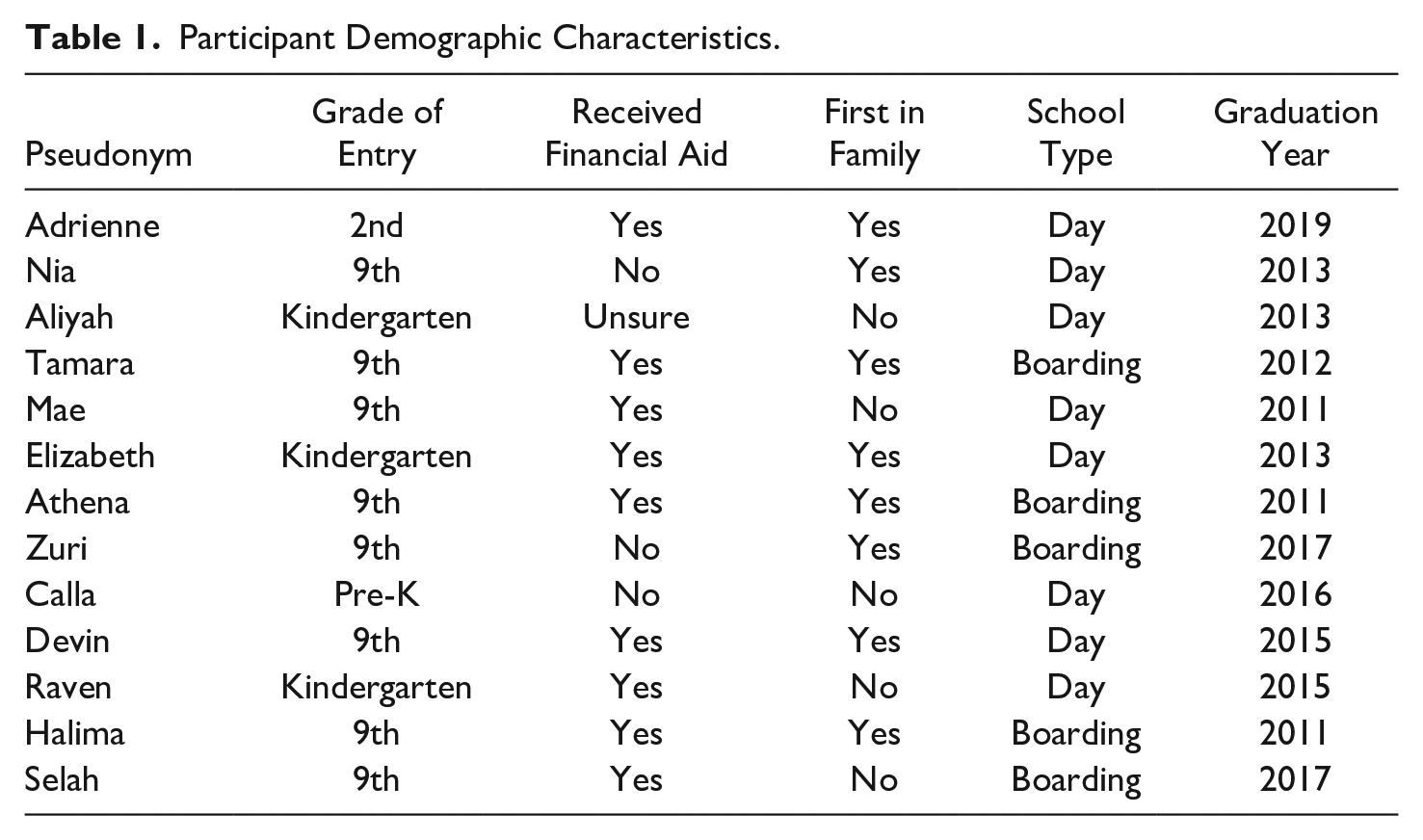
The sample consisted of 13 Black women 20–28 years old who were graduates of five independent boarding and eight day schools in the Mid-Atlantic and New England regions. While all participants identified racially as Black, nine of the 13 women referenced either their own or at least one parent’s immigration story (from regions of Ghana, Nigeria, Liberia, Haiti, Guyana, Trinidad, Jamaica, and Antigua). Seven of the women were the first in their family to enroll in independent schooling, while five had one or two parents or elder siblings who had attended prior; only one participant had three or more family members who had attended an independent school before they had. In terms of first year of entry, four participants began independent schooling in kindergarten or earlier, one in second grade, and eight in ninth grade. Participants self-reported how their families financed their studies; three reported zero financial assistance, nine reported some or all financial assistance, and one was unsure of whether their family received financial assistance to attend their independent school. At the time of data collection, three participants were working toward completing their undergraduate studies, and 10 had received bachelor’s degrees; 11 women attended/were attending private colleges and two attended public colleges. All participants were provided pseudonyms for the purposes of anonymity. Table 1 provides a visual breakdown of participants’ entry into and participation in independent schools, including time of entry, funding, first-generation status, school type, and graduation year.
Participant Demographic Characteristics.
Data Collection Procedure
I used an introductory questionnaire as my initial invitation to participants. Utilizing my network of fellow independent school alumni, former and current teachers, and former students, I was able to garner potential participants through initial posts on Facebook and Twitter. After receiving a handful of participants, I relied on snowball methods to identify more in order to round out the sample. The introductory questionnaire provided an overview of the study and asked demographic questions that allowed me to both identify their eligibility (e.g., school name, location, and class year) and craft a set of questions relevant to their schooling/individual experience. I then reached out via email to those who had completed the questionnaire and were eligible to participate, inviting them to a virtual interview with me. All interviews were conducted over the Zoom video communication platform during March 2021. Interested parties self-scheduled utilizing Calendly, appointment scheduling software. Interviews lasted between 55 and 90 minutes. I used Zoom’s transcription feature during the interviews, then reviewed and compared all transcripts with their audio files to ensure accuracy.
Interview Protocol
I collected the narrative data using a semi-structured interview protocol. The protocol included a set list of questions about students’ general experience in an independent school, specific challenges, identity development at school, navigational tools, and supplemental questions, depending on the direction of conversation and relevant demographic information retrieved from the introductory questionnaire (Cohen & Crabtree, 2006). The interview protocol used in this study was designed to elicit specific information related to the research questions. This approach allowed me to collect reliable comparative data on pertinent information, while also creating opportunities for new lines of thinking from probing. Each interview consisted of three main sections. The first consisted of the participant’s introduction to independent schooling and the initial moments of learning to fit in; the second section covered relationships, culture, and belonging; and the final section focused on their perceptions of lingering effects of independent schooling, what it takes to find “success” at their school, and whether the benefits outweigh the challenges. Based on responses to questions asked, I would probe about significant experiences and areas that required clarification to grasp a fuller picture of their accounts.
Data Analysis
Interviews were transcribed using Zoom’s transcription service, then reviewed alongside the audio recording for accuracy. As noted, the research questions determined much of the structure of the interviews and questions that I ended up asking. Significant themes began to emerge early in the data collection process. Data were analyzed through categorization (coding and thematic analysis) and contextualization (narrative analysis and individual profiles) of the salient themes that had emerged early on, particularly drawn from raw interview notes, then compared alongside a later review of interview transcripts. I came up with an initial set of codes, then re-sorted them into a secondary set. I compared participants’ experiences based on common themes across the data and settled on a common six codes that speak to the main challenges that affected participants’ identity management, navigational decision making, and development of “self”: (1) a social pecking order controlled by dominant culture, (2) cultivating relationships with white peers, (3) rootlessness, (4) (lack of) desirability, (5) inequitable school practices, and (6) pressures to temper oneself for fear of implications.
Researcher Identity and Positionality
As a Black woman who spent 13 years attending an independent school in New York City, four years attending an elite liberal arts college in the Mid-Atlantic, and then two years teaching at an independent boarding school in New England, I hold strong beliefs about Black girls’ educational pathways and their connections to elite, predominantly white education (Evans-Winters, 2019). My experience as a boarding school teacher, athletics coach, academic advisor, and dorm parent plays a significant role in my educational philosophy, as well as understanding of the micro-arenas in which Black adolescents learn to negotiate their identities within elite academic spaces. When engaging with young Black people, particularly those who attend(ed) predominantly white institutions, I look for the unnoticed competencies and heightened levels of self-awareness they must develop as they work to protect their core in the face of dominant societal and institutional norms. I pay attention to how they talk about themselves in relation to their school and various communities.
As a Black feminist, I strive through my research to alleviate Black girls and women from the deficit-based and widespread negative narratives ascribed to them, both in education and beyond. My research agenda is characterized by a commitment to using my social and academic positioning to bring silenced voices of Black girls forth, highlighting their challenges and successes; I am also committed to influencing independent school culture and leadership through this work. This commitment can be seen in both my research questions and methodologies. Throughout my interviews for this project, I built relationships with my participants and met their vulnerability with deep empathy, a result of shared understanding of the context of their experiences.
My positionality as both a student and educator who is acutely aware of the social, cultural, and political landscape of independent schools allows me to look closely at the individual experiences and personal narratives of my participants. This positionality affords familiarity that eliminates the burden of these Black women’s feeling the need to defend their access to these spaces or temper their emotions to avoid seeming ungrateful for their privilege. Instead, we were able to engage in a reflexive process that allowed for participants to share their truths.
Findings
All participants expressed having had to navigate challenges related to marginalized identities within independent school, much of which extended beyond the traditional growing pains of adolescence. A result of both structural and cultural factors upholding white hegemony, misogyny, and anti-Blackness within their individual school communities, participants’ experiences as Black girls in independent schools saw tremendous overlap; as a result, six major thematic challenges emerged from the data: (1) a social pecking order largely dictated by race, class, and gender; (2) complicated relationships with white peers; (3) rootlessness from Black and white communities; (4) (lack of) desirability; (5) inequitable school practices; and (6) heightened need for self-regulation. These six themes are depicted in the findings section.
Social “pecking order”
All participants spoke either directly or euphemistically to a social hierarchy within independent schools that plays a significant role in how all students participate in the sociocultural practices of the institution. Determined by a set of core identifiers, students are sorted into various rungs of the social “pecking order.” The more identifiers one holds, the likelier their chances of a higher status. This status mostly determines how students are sorted among their peers, but it also has implications for how adults choose to engage with them. Athena, a boarding school student, suggested that the hierarchical structure of the student population was largely driven by access to the following identifiers: (1) economic capital, (2) social capital, (3) whiteness, (4) masculinity, and (5) athletics, and that there is a clear, almost algorithmic, categorization of one’s role in the social order based on such: To be successful at [school name], you have to . . . have a lot of money, have social capital, know everybody. There are a lot of kids from Greenwich, Connecticut, which is one of the wealthiest towns in America. A lot of the kids that went to my school were from Greenwich or if they weren't . . ., they vacationed in Cape Cod; . . . aesthetically, that's what it looked like to be successful . . . to be popular, you have to be an athlete, specifically. . . . A Black male athlete. . . . You just had to be the quintessential white kid, honestly. You couldn't be emo; you couldn't be goth . . . there was just [a], preppy, white, “I vacation in Cape Cod and my mom has millions of dollars” aesthetic. . . . Think of everything outside of that, then don’t be that. And even if you're a person of color, like you kind of have to—I don't want to see subject—but mold yourself to fit in . . . some of the kids in my class did that. The experience is very jarring for Black people, unless you are a Black athlete. . . . it was easier for Black guys to integrate than the Black girls. (Interview, March 19, 2021)
Athena’s detailing of the levels of fixed social stratification among the student body reveals a strong understanding of the of ways in which people organized and are organized into social categories; they also reflect a high-level analysis of the hidden order, usually reserved for those who sit on the outskirts (hooks, 1992). Her assertion is affirmed by the accounts of Halima, who attended boarding school more than three states away. Halima identified a similar structure present in her own school community and went further to explain the differences between those controlling versus those controlled within the social sphere: As far as social capital . . . of course, were the rich wealthy white boys. Sometimes a [Black] basketball star felt like he was at the top because he still could date the white women, and that was seen as like an indicator status . . . . So sometimes “big man” on campus felt like whoever the Black basketball star was that year. [At the top] was white rich boys and those particular Black stars. Underneath, nonathlete Black boys probably and white girls. And then underneath that, probably somewhere is, well, probably Latina girls, then, and any kind of mixed girl who's working class, [they] had some kind of social capital. Then at the bottom, Black girls, by skin color. Sometimes there were middle- and upper-class Black girls who could also navigate . . . alongside white girls from time to time. Depending on their class background or if they made an effort to attach themselves a white girl who was more popular. (Interview, March 15, 2021)
Halima identified several significant components to this social structuring—the first being the ways that a certain combination of identities (such as Black, male, and athlete) had the power to circumnavigate other traditional gatekeeping identities (white, wealth, economic capital) (Ford, 2008). Additionally, she highlighted that among the Black girls who mostly reside at the bottom of the hierarchy, the rankings go as far as to distinguish by skin color/tone. While issues of colorism came up in a many of the interviews, especially in conversation about certain Black peers with privilege to align themselves with whiteness for social gain, Aliyah spoke to some of the social challenges that can come from a racially polarized social environment. Aliyah, a self-identified mixed person with a Black mother and white father, struggled to find community within her school because of her own discomfort in homogenous spaces and other people not knowing how to categorize her: I look weird for sitting at the [Black] table because I'm super pale . . . by the same token, I'm not going to sit with all the super-rich white kids or even just the super not rich middle-class white kids whatever because that is a different aspect of who I am. Just because I'm white passing doesn't mean it turns a switch off. It's not like, from nine to nine, I'm Black, from nine to nine I'm white . . . having to shape shift and not necessarily remove but . . . modulate up and down levels of what part of myself I'm allowed to be right now. . . . But [mixed] being an identity in and of itself was not an option, because then I was alone. (Interview, March 10, 2021)
With the dominant culture in independent schools controlled and enforced by white students, families, and school adults, all students whose culture does not align are subject to hegemonic control. In Aliyah’s narrative, she revealed difficulty finding community among peers of various racial and class backgrounds because of the segregated nature of her school’s social sphere. Quite often, when Black students gather at a “Black table,” it is usually in opposition to white hegemony and as a means for socioemotional protection (Tatum, 2017). Because of the assault on Black students with less ambiguous racial identity, Aliyah expressed challenges with gatekeeping and exclusion from such spaces for fear of her perceived ability to weaponize whiteness within. As a result of whiteness and eliteness mainly controlling the social arena, she was largely left to her own devices to decide which part of her identity she wanted to align with and which she would need to cast aside. The essentialism within school communities largely introduced by admissions practices and perpetuated by social dynamics contributed greatly to the predicament Aliyah expressed.
Navigating Relationships With White Peers
Initiating, developing, and sustaining meaningful relationships with white peers was increasingly challenging for all participants with each passing year of independent schooling, despite participants’ accounts of significant amounts of time spent with white “friends” and peers. Those relationships struggled to endure, and almost all the Black women found themselves in enclaves with other Black girls by their junior and senior years. Adrienne, an independent school student since elementary school, shared how her relationships with white peers began and then shifted over time: [At first, friendships] formed over shared interests. I liked certain kinds of music . . . in middle school, and so I would gain friends from there and also theater . . . . But they were into weird microaggressive things like trying to touch my hair and I don't like their politics, they were just very strange to me. In sophomore year. I think I had my moment where I was like “I can't do this,” and so I kind of just mostly cut ties with my white friends . . . really the last two years of high school I didn't really talk to them that much. Then I would mostly hang out with my Black best friend. (Interview, March 12, 2021)
Adrienne felt forced to make a choice between continuing her long-standing friendship with white peers with whom she shared interests, and protecting her emotional well-being from their constant microaggressions; as she got older, it became more difficult to spend time with those whose acts and beliefs felt disrespectful to her Black identity. On the other hand, several women chose to make a distinction between friends and acquaintances and the extent of the superficiality within the school community. Mae, who entered her school in ninth grade, expressed confusion around the social norms of forming relationships: I was definitely friendly with everyone, but not necessarily friends with everyone. . . . This is my first time, en masse, with white people, and there were a lot of lessons I learned about “friendly” versus “friend.” I'd always been in school environments where somebody was your friend, or they weren't. But this was the first school environment, and it also coincided with being my first majority-white learning environment where I learned that some people are friendly but they're not your friends . . . I really had to sit down with all of this—the students kept saying, “Oh my gosh I love you so much!,” and then they would talk about each other behind their backs, and the schools where I'm from and the neighborhood where I'm from, nobody would [do that]. You just say, “This my girl,” and you meant it. You wouldn't talk about that person behind their back. I had a lot of cordial relationships with a lot of students at [school name], and only a couple of friends. (Interview, March 12, 2021)
In Mae’s depiction of the culture clash between her home community’s practices and those present at her independent school, she highlighted her own need for an assessment of her new context and the choices one must make in creating and sustaining relationships with peers at school, even when they don’t quite make sense.
Rootlessness
Another common theme emerging from these data involved feelings of rootlessness and lack of control over one’s identity for Black girls in independent schools. All participants spoke to moments in which they struggled to be themselves because they had few models of how a Black girl or woman like them could find space within their school or exist beyond it. Nia, who grew up in an all-white town and public school before attending her independent school, revealed difficulties in figuring out who she was and wanted to be: I didn't have an authentic self until I got to college . . . I didn't have an authentic self when I was growing up . . . I never felt like I could be that because I didn't know what that was. I'd been around white kids my whole life. So, I had no problem making whatever changes . . . I had no idea what [being yourself] was. I think I was still trying to figure that shit out all the way up until I got to college, and I was really around Black people to really determine who I am. But the 10 [Black students] that were in my grade, I mean, they had also been corrupted by the system, so I don't really know if anybody, really, any of us knew who we were, or really felt any sense of loss. (Interview, February 23, 2021)
Nia’s discussion of herself and others as “corrupted by the system” speaks to the ways in which Black students struggle to remain in control of themselves—mentally and emotionally—in predominantly white contexts and the extent to which they are denied access to role models who can support their development as Black thinkers. Tamara, a Black woman who gained access to her boarding school through a local sending program in her home city, made a similar statement about the lack of support that Black students are afforded in understanding how their school context can be drastically different from home. She asserted that as a result, Black students often feel detached from their school and home lives because of their shifted social location: I think some people go there and get lost, especially Black students. And there's no perfect way to prepare for that. Even [sending program name], and I offer this critique with grace to them often now, as an alum. I said, “You know, the main preparation y'all got us or tried to instill for us, for the schools, was academic. You guys did no real preparation for us in terms of what it would actually be like to be a 13-year-old kid in these spaces and figuring out who you are, and this type of environment.” There’s a social cost. There's a cultural cost. I remember some points in high school feeling hella lonely when I came home, because a lot of my friends went to school together here in [home city] and I wasn't with them. And so, there are some things that you lose . . . it's so intangible right? . . . . you are in the middle of your adolescent development, right? And so, when you layer that, with being Black, at a PWI, that's just a lot. (Interview, February 27, 2021)
Tamara’s narrative highlighted how being academically prepared for the rigor of her school’s curriculum could not mitigate the extreme social and cultural cost she felt at her boarding school. When the dominant culture, as well as the student and adult populations of one’s school, is overwhelmingly white, Black students are openly deprived of opportunities to engage with alike peers.
(Lack Of) Desirability
Issues of desirability and self-confidence begin to set in from quite a young age for Black girls in independent schools. Within this current study, a significant number of participants recalled moments in which they felt undesirable and undesired, both outwardly and internally. Elizabeth enrolled at her independent school in kindergarten and spent the duration of her formative years there. By second grade, she showed signs of frustration with her appearance and recounted the moment of drawing self-portraits as a defining one in her understanding of herself: I drew myself with white skin, blonde hair, and blue eyes, and nobody said anything to me about it. They just let it rock. They didn't even address it. So, my classmates were like “That doesn't look like you,” and I was like, “Well, but they said it doesn't have to be perfect.” But they were like, “No, but it doesn't look like you at all,” and I was like, “Well, this is the way I want to look, so I'm going to draw it this way,” and no [adults] did anything. It wasn't until my parents came home from Parents’ Night and my mother pulled out the picture and she said, “Explain this to me. What's going on here?” and I explained that I just picked those colors because I thought they were prettier . . . and she said, “But why do you think they're prettier?” and I told her because they just are. (Interview, March 17, 2021)
Elizabeth’s explanation of attempts at intervention from her peers, but not adults, affirms other participants’ narratives of lack of support and need for self-defense. Elizabeth’s narrative depicts how she was left to her own devices to feel comfortable drawing herself, despite knowing that her portrait would look different from others, then defend her actions without any mediation from the teachers. Seemingly benign moments like Elizabeth’s memory from second grade plant seeds and serve as the root for continued trauma for Black girls as they move into adolescence. Not only do those memories remain in the minds of these girls into adulthood, but they also reinforce the lack of address to those who cause the harm. Selah, a boarding student who arrived at her school in ninth grade from an inner city, also became the subject of such trauma, even without the historicized experiences of being a Black girl in the earliest grades of independent schooling. When asked to explore whether she would send a hypothetical future daughter to her alma mater, she gave the following response: I would not send my girl child to [school name]. I wouldn’t want to subject her to this kind of mental abuse, abuse on your self-esteem, all of that. Maybe a boy child, he might have a good time, but we'd also have conversations about how to be and not to be in regard to being respectful, especially to other Black girls and girls of color . . . I don't know if I’d do that to a daughter . . . I had parents [and a home community] who would reinforce that I am beautiful, smart, all of that . . . and that was still really hard for me to deal with going there and feeling like I was at the bottom of the barrel, especially as a teen when you're starting to develop feelings and all of that. That was really terrible. Just feeling like you're not the beauty standard. So . . . beyond trying to get her to have self-esteem and reinforce that internally, I don't know what else there would be to do. Because I feel it's kind of unfair to impose that on Black girls and other minority girls. That they have to find their self-worth from within, when everyone else's beauty and et cetera is validated and reinforced by society and other people around them. (Interview, March 15, 2021)
Selah’s accounts amplify the developmental battle and cost to a Black girl’s sense of self often faced within these institutions. She also drew a gendered distinction between experiences, drawing attention to the suffering that Black boys can inflict on their counterparts within the school. This feeling of being undesirable permeates various areas of campus life, especially in the boarding school context. With the significance of attraction and desirability within the process of establishing a social order at the adolescent level, Black girls like Elizabeth and Selah are relegated to lower rungs of the social order because of the societal and institutional perceptions of Black women and girls.
“It is just a different school if you are black”
Part of the challenge for Black women in independent school is the intangible nature of many of the racialized, gendered, and classed interactions they have with adults and peers alike. Often schools will boast goals of meritocracy and equity, despite their actions showing highly unjust practices (Khan, 2011). More than half of participants spoke about moments in which they felt they had received the short end of the stick. Devin arrived at her all-girls independent school in ninth grade because of her mother’s impressions of the doors that such an education could open for her. Despite her family’s goal of using her elite high school education as a ticket to an elite college, she faced challenges with receiving equitable access to resources within the school and often felt that she was treated differently from the white girls in her school. In the example of college counseling, she detailed the palpability of her feelings of mistreatment: My senior year, during the whole college process . . . all the Black girls in my class were kind of advised in a different way, told that schools that were very much so target schools were reach schools . . . . The Black girls in our grade, . . . we all thought she was incompetent, the one person who was our college advisor. We were like, “What did she say to you?” [and] “What did she say to you?” and I remember she was saying to me that Howard was a reach school for me . . . not that there's anything wrong with Howard, but also no, absolutely not, that is a safety school and a half for me . . . it was a “What are you talking about and are we looking at the same transcript?” kind of thing . . . she was also recommending, almost exclusively, HBCUs to all of the Black girls. . . . So we all kind of navigated that process ourselves, and I was lucky enough that one of my mom's . . . friends was a college admissions person, so she guided me through the process . . . we were just like, “Okay, you know what she's doing, too? Okay, like this is some bullshit.” (Interview, March 11, 2021)
Devin’s telling of the disparity between Black and white students faced within her school outlines the extent to which she felt she had to support herself to achieve her goals. Despite being at a well-resourced independent school, she, along with other Black girls in her class, were tasked with guiding themselves when school adults failed to uphold the institutional mission. Such happenings can also occur in other areas of an independent school, beyond cocurricular venues. In her interview, Adrienne highlighted how disciplinary processes are a visible area in which race, class, and gender can determine enforcement: It’s mostly administrators or [certain athletics coaches] who [perpetuate unfair treatment]. . . . Also if it was a student whose family is a legacy or they're donating a lot then there's also that aspect. . . . There was one time where [description of an incident involving two students breaking school rules] . . . one was our class president and [he] made a speech about how he was sorry, kind of, but it was vague . . . but he still stayed as our class president. There are no real consequences when white boys—they also played sports, which was thing—when they do things, nothing really happens . . . there are no consequences or there are shady consequences for when white people, particularly white boys, either overtly or covertly, break rules . . . [sometimes] it is like they . . . wanted to push how far they could go without getting caught. (Interview, March 12, 2021)
Adrienne’s explanation of the multiplicity of levels of the inequitable disciplinary practices at her school mirrors Devin’s retelling and contributes to the pattern of Black girls having to develop heightened levels of sociocultural competency to equitably participate in school offerings. Knowing that the best college counseling advice must come outside the counselor’s office or that breaking school rules yields differed consequences signifies an alternate knowledge base of the navigational capital it takes to move through independent schools.
Tempering Oneself For Fear Of Implications
Eight participants also expressed internal challenges related to arbitrating their socioemotional selves while in school, many of which had lingering effects long after their graduation. While much of adolescence can be characterized by learning to temper oneself in relation to the various spaces they inhabit, for Black girls in the independent school context, there are heightened pressures resulting from isolation, projections of ignorance from other community members, and the college preparatory nature of these institutions. Raven spent 13 years at her independent school and revealed the lasting trauma to her psyche that resulted from challenges of being at her school for so long: I think a lot of the things I struggle with now as a young adult probably can find their roots during my time at [school name]. I’m really sensitive about . . . how people perceive me. . . . I'm really [pause], I'm really [pause], I think I developed [pause], I think I need to overachieve in order to demonstrate that I'm impressive, you know? I think I need people to see me as being intelligent or as being really competent and really smart and highly accomplished. . . . I felt really deficient, you know? I was lacking. I think I compartmentalize pretty well. . . . Sometimes I feel like maybe I'm over-exaggerating my experiences there, maybe they weren't as bad as I'm remembering them as being, because I feel the way I'm describing it now, it seemed like it was completely hopeless, and I was unhappy all the time. And that's true to an extent . . . I have really bad anxiety. I think it is a product of having gone to [school name] . . . I struggle with . . . low self-confidence and low self-worth and anxiety and all that, I think that's a consequence probably of having gone there. (Interview, March 19, 2021)
In her interview, Raven talked about the challenges of being a dark-skinned, low-income Black girl at her all-girls independent school and the ways in which she struggled to find space in her school despite being well-liked by many peers. Identity-related challenges affected her schoolwork, and she spoke at length about how she is still working through these traumas with mental health professionals today. Raven’s feelings of deficiency in her academic work are notable, given that school leaders will often blame Black students’ academic troubles on lack of training prior to enrolling at their institution. Raven is considered a “lifer” at her school, having begun her studies there in kindergarten. Her story parallels Calla’s, despite their vastly different personal histories. Calla was a legacy student who enrolled prekindergarten at her school. She is also the daughter and niece of three independent school alumni, two from the same institution. In her narrative, she described anxieties related to how her actions could negatively represent herself and Black women in greater society: I felt like I had to be on my “A Game” all the time. . . . not using AAVE, not using that vernacular, making sure that I was speaking very clearly, coherently. . . . There was no room in my mind for looking like I didn't know what I was talking about. . . . If I were the only Black person in that class, I wanted to make sure that I was putting the best representation of myself forward, because there were so little Black people . . . I don't think anyone would have thought this but, in my mind, I didn't want people to think that somehow, I was lesser, whatever that means. And so, I felt my own internal pressure to make sure that I was always doing what I needed to do . . . when I was touring parents around campus and this one white woman told me that I was “very articulate” . . . I had to save face because I couldn't “black” on this woman in the middle of an admissions tour for [school name]. I'm representing the school. So, I just gave off some remark about how I've been going to the school since I was four, so I'm glad that they were able to give me such a “comprehensive vocabulary.” But moments like that were . . . I wouldn't say often, but it was often enough where I was like okay like I'm a Black woman in a predominantly white space, excelling, and sometimes that makes people a little bit [pause] threatened, in some respect. (Interview, March 12, 2021)
Calla’s recollection of the internal pressures of avoiding perceptions of Black women as angry is connected to the oppositional gaze Black women develop as a result of misrepresentations of Black womanhood in the media (Walton, 2013). As adolescents, Black girls become acutely aware of the disproportionate negative stereotyping of Black femininity and feel immense pressure to avoid contributing to it—for both themselves and other Black girls and women whom they will never meet. Performing well in academics and school leadership roles is not only a matter of learning, growing, and preparing for future academic and professional endeavors; it is also one of controlling localized and widespread perceptions of Black womanhood in society. For Calla or Raven to allow for anyone to walk away from an interaction with a negative feeling would have grave implications for the treatment that another Black woman or girl could face in any setting—a tremendous burden on both personal well-being and mental capacity, as well as an explanation for the heightened levels of anxiety with which these girls are graduating.
While the themes outlined in this section do not represent the totality of challenges these Black women faced during their time as independent school students, they represent significant overlap of experience related to Black girlhood. Considering the diversity of participants (school type, class background, skin tone, legacy status, etc.), their realities within this elite schooling context remain largely the same. School communities are microcosms of society, and the plight against Black women more broadly is inextricably linked to what participants faced within their independent schools. Both external and internal forces related to their marginalized status within privileged spaces amplified socioemotional challenges for these Black women. As a result of having to navigate such barriers and sustain quality academic performance concurrently, participants were required to do more and be better than their peers, despite these efforts going unrecognized.
Discussion
The purpose of this qualitative study was to explore how Black girlhood is experienced within predominantly white, elite, independent schools to make sense of the challenges of these students pursuing their education within a white-masculinist framework. In emphasizing the uniqueness of Black girls’ perspectives within their schools, this work takes on a critical analysis that aims to push schools that define themselves as “accountable to their communities” (NAIS, 2020) in order to acknowledge and address the additional strains this population faces outside the normative academic, adolescent, and identity challenges faced by their broader student bodies. Comparable with similar research on independent schools and the suffocatingly elitist culture perpetuated in these spaces (DeCuir-Gunby, 2007; Gaztambide-Fernández, 2009; Jacobs, 2019; Khan, 2011), I found that participants in this study were acutely aware of the dominance of wealth, whiteness, maleness, and athletics in the school’s formal and organic processes. Many of the women talked about both how their peers would weaponize certain privileges and how they could see which adults would allow them to—many of whom held similarly powerful identifiers. It is often the case that the performances of subordinate identity traits are used for social exclusion, among school adults and youth (Ispa-Landa, 2013). While these incidents did not occur for every participant in every area of school life, the comprehension with which they each described such occurrences has implications for which students experience schools differently along race, class, and gender lines, and how. Black girls are hyperaware of such juxtapositions because of their developed oppositional gaze (hooks, 1992; Jacobs, 2016; Walton, 2013); they must exercise enhanced navigational tools, knowing that they are differently viewed and regulated.
With various intentionalities and understandings of how they strategized moving through the day to day, participants quite clearly relied on a similar set of practices within their own independent school contexts to achieve their own metrics of success. Despite acquiring a certain agility and putting it into practice, Black girls in independent schools still experience social ramification because of broadly held societal beliefs about Black women and their desirability. In this current study, participants expressed challenges with having to make the choice between taking on a chameleon-like identity, one that required them to mute or stunt themselves to fit in, or remain on the margins, relegated to the bottom of the social order. These issues, while inclusive of intimate relationships and Eurocentric beauty standards, go beyond the simple “who likes whom” of adolescent social order and dating. Much of high school, particularly in independent schools, is felt as a search for purpose—in one’s academic, social, athletic, and academic role—and for Black girls, they tend to be beat out in the various arenas by those who hold more powerful identifiers (Carter-Andrews et al., 2019; DeCuir-Gunby, 2007). As a result of these circumstances, Black girls are positioned between a rock and a hard place in terms of figuring out who they are and how they want to be perceived; some participants expressed significant anxieties related to how they presented themselves academically, socially, and politically because they knew the precarity of their role in their school space. This precarity at times threatened their engagement, sense of belonging, and general confidence, which runs parallel to prior research on Black girlhood and the institutional violence they face each day at school (DeCuir-Gunby, 2007; McArthur, 2018). More broadly, the heightened feelings of precarity, sustained over time, have implications for their socioemotional and mental well-being beyond graduation and into adulthood (Goosby, Cheadle, Strong-Bak, et al., 2018).
Limitations
A significant limitation of this study is the reflexive approach of interviewing Black women who were, at one point, Black girls in independent schools, but have since been removed from those spaces. While this was an intentional methodological choice to capture the salient memories of their time, I know that talking with Black girls currently enrolled in independent schools could have yielded different results—they would still be in the process of Black girl adolescent development versus reflecting on it. Participants in this study were able to retell stories of overt, covert, later, and earlier occurrences, but their removal from the independent school context and growth beyond it certainly played a role in how they discussed those salient memories. A second limitation is the confluence of African American (descendants of U.S. enslavement) and immigrant Black (African, Caribbean, Afro-Latinx) experiences under the umbrella of Black American-ness. Because populations of Black people within the elite schooling context are limited, I kept my participant sample broad by leaving it open to Black-identifying women. As mentioned in the Participants section, nine of the 13 participants in this study referenced their own or their parent(s) immigration story, which raises two questions. The first is: How can we explore the racialized differences of recently emigrated Black people versus those of families with two or more generations spent in this country? A second, related, question is: How does immigrant status relate to stratification within the Black community; are there Black individuals who are more or less able to gain access to elite schools as a result? Despite the many strengths of this study, future research might consider exploring these various lines of inquiry that are situated just outside the scope of this work.
Conclusion
Black girls with access to elite independent schools are constantly navigating the duality of marginality and privilege. They receive world-class education, and yet, many of these students feel cast to the margins of those spaces; they often end up with significant traces of socioemotional pain that lingers far beyond their graduation. With much of the existing literature on Black girls taking on a deficit-based approach, it is easy for one to read about the struggles Black girls face in elite schools and view them as deficient, ungrateful, or just having a bad attitude. There is so much more to the plight of Black girlhood in elite schooling contexts, and a critical examination of the conditions under which they are learning and growing is necessary. With this study, my goal was to contribute to that conversation, looking at the additional hurdles that Black girls are required to clear to achieve the same milestones of their white and male counterparts.
Despite the hurdles outlined in this article, Black girls’ experiences in independent schools are not all bad. Through their reflections of immense difficulty, participants expressed positive recollection of friendships, supportive teachers, and extracurricular opportunities that provided academic and personal enrichment. For many, it took an internal conversation acknowledging the heightened challenges and finding intrinsic motivation to “get out” and make it to a place where they could be valued. These movements to diversify independent schools show some positive effects but require continuous consideration of what needs to be done to support their minoritized populations. When evaluating school programming, leaders must also think critically about what they are missing and who has the experience and skill set to let them know where those gaps are. To foster belonging, one must hear from those who have historically been silenced and excluded. Institutions that have historically catered to the rich, white, and powerful have a duty to critically examine their practices, especially if they are going to champion themselves for recruiting and admitting historically marginalized students. These students provide so much more to these institutions than they are given credit for, and they learn to do so under conditions that far exceed what is asked of them. The untapped potential, competency, and magic of Black girls existing, surviving, and thriving within independent schools is, hopefully, soon to be recognized. Educators, especially the white ones, must not assume they are providing enriching experiences to all students equally. If independent schools continue to applaud themselves in their efforts to provide world-class education to their students, they cannot rest on their laurels and remain comfortable with their offerings. So much of what Black girls achieve is in the face of resistance; they deserve better.
Footnotes
Declaration of Conflicting Interests
The author declared no potential conflicts of interest with respect to the research, authorship, and/or publication of this article.
Funding
The author received no financial support for the research, authorship, and/or publication of this article.