






Abstract
This study examines the moderating effect of gender on the relationship between student–faculty interaction and academic self-concept. Using data from a large public Hispanic-serving institution (HSI) in Southern California, the analysis suggests that although student–faculty interaction positively impacts academic self-concept for all students, the effect is stronger for female students. Despite these gains, a persistent gender gap remains, with female students reporting lower academic self-concept than male students. These findings emphasize the importance of tailored initiatives to improve student–faculty interaction and academic self-concept, especially for female students.
Introduction
As female students continue to enroll in college at higher rates than their male counterparts (Irwin et al., 2023), understanding the factors that contribute to gender gaps in student success and well-being becomes increasingly important. One key area of focus is the relationship between student–faculty interaction and academic self-concept. Student–faculty interaction refers to the quantity and quality of dialogue between faculty and students both inside and outside the classroom. Academic self-concept refers to students’ perceptions of their own academic competence and confidence.
Astin’s (1984) involvement theory and Weidman’s (1989) model of undergraduate socialization are widely recognized frameworks for understanding the relationship between student–faculty interaction and academic self-concept. (See Kim & Sax, 2017, for a review.) According to Astin’s theory, student involvement in meaningful college experiences is crucial for their learning and development. Interactions such as faculty feedback, support, and role modeling provide these meaningful experiences and foster the development of academic self-concept among students. Similarly, Weidman’s model emphasizes the role of socializing college experiences in shaping affective outcomes, including academic self-concept. Through these interactions, faculty help students evaluate their beliefs and behaviors and evolve throughout their college years.
Consistent with these frameworks, research generally finds that students who report more favorable interactions with faculty also tend to report more favorable self-perceptions of their academic abilities. This positive relationship is supported among a variety of samples, including students at four-year, predominantly White institutions (PWIs) (Cokley, 2000; Cole, 2007; Kim & Sax, 2014; Komarraju et al., 2010; Sax et al., 2005) and two-year community colleges (Crisp, 2009). It is also supported among different racial and ethnic subsamples (see Cole & Griffin, 2013, for a review), including Asian American students (Kim et al., 2009), Hispanic/Latinx students at Hispanic-serving institutions (HSIs) (Cuellar, 2014) and PWIs (Nunez, 2009), and Black/African American students at both PWIs (Cole, 2011) and historically Black colleges and universities (HBCUs) (Berger & Milem, 2000; Cokley, 2002; Franklin et al., 2017). Finally, this positive relationship is supported among subsamples of different academic majors, including engineering students (Colbeck et al., 2001; Litzler et al., 2014; Vogt, 2008) and students in the science, technology, engineering, and mathematics (STEM) fields (Huang & Brainard, 2001; Kim & Sax, 2018).
Notably, many of these studies have focused on general effects, which refer to the overall impact of a variable on a population without considering social identities. This approach suggests a uniform impact on all students’ academic self-concept, regardless of their differences. With respect to gender, it assumes that female and male students benefit equally from student–faculty interaction. However, in recent decades, there has been a shift from this “one-size-fits-all” approach to more tailored approaches that consider social identities (Kim & Sax, 2009, 2017). This shift has led to an increased focus on conditional effects, which examine how the impact of student–faculty interaction is shaped by factors such as gender. Conditional effects recognize that the benefits of student–faculty interaction may vary for female and male students due to their differences.
To further illustrate this point, several recent studies have yielded interesting results on student–faculty interaction, academic self-concept, and the conditional effects of gender. Using a nationwide longitudinal sample of STEM students, Kim and Sax (2018) found that positive faculty support was associated with an increase in students’ mathematical self-concept, but this effect was only significant for male students. Similarly, using a nationwide sample of graduating seniors, Parker et al. (2022) found that students’ academic self-concept improved with higher levels of student–faculty interaction, but gender played a significant role, with female students generally reporting lower academic self-concept than male students. Finally, using a nationwide sample of undergraduate students, Mayo and Le (2023) found that mentoring support from faculty positively impacted students’ academic self-concept. However, they noted that female and nonbinary students reported lower levels of academic self-concept than male students, even though the degree of mentoring support from faculty was similar across genders.
Ultimately, these findings highlight the need for further research into the conditional effects of gender on student–faculty interaction and academic self-concept. To address this gap, the present study employs moderated multiple regression, incorporating an interaction term for student–faculty interaction and gender. This method allows us to directly test the significance of differences in relationships between variables within a single model, providing a more nuanced understanding of these interactions. Informed by the literature, we propose three hypotheses: (1) Female students will report lower levels of academic self-concept than male students; (2) student–faculty interaction will positively impact academic self-concept for all students, regardless of gender (general effect); and (3) gender will moderate the relationship between student–faculty interaction and academic self-concept, resulting in different effects for female and male students (conditional effect).
Methods
The present study was conducted at a large, public Hispanic-serving institution (HSI) in Southern California. Data were sourced from the 2021 Diverse Learning Environments Survey (DLE), conducted by the Higher Education Research Institute (HERI) at the University of California, Los Angeles (UCLA). The survey was sent to 15,017 students enrolled in a degree, credential, or certificate program during the spring 2021 semester. A total of 1,514 students responded to the survey, yielding a response rate of 10.1%.
The final sample for this study focused on 1,025 undergraduate students aged 18 or older who identified as female or male and provided complete data on all covariates and key variables of interest. The majority of participants identified as female (71.2%, n = 730), and the most frequent age group was 21 to 24 years (38.3%, n = 393). The sample included first-years (14.8%, n = 152), sophomores (12.9%, n = 132), juniors (30.9%, n = 317), and seniors (41.4%, n = 424). The majority of participants identified as Black, Indigenous, or People of Color (BIPOC) (78.0%, n = 799), including those who identified as Asian/Pacific Islander (20.4%, n = 209), Black/African American (4.9%, n = 50), Hispanic/Latinx (52.3%, n = 536), and Other (7.1%, n = 73). Additionally, 37.3% (n = 382) of participants identified as White. First-generation students made up 34.9% (n = 358) of the sample, and the majority of participants received Pell Grants (51.9%, n = 532). Finally, the most frequent total family income from all sources was bimodal, with 10.9% (n = 112) of participants reporting $40,000 to $49,999 and 11.7% (n = 120) of participants reporting $100,000 to $149,999.
Student–faculty interaction was assessed using three items: “Faculty empower me to learn here,” “Faculty believe in my potential to succeed academically,” and “At least one faculty member has taken an interest in my development.” Participants rated these items on a four-point scale, ranging from 1 (strongly disagree) to 4 (strongly agree). An overall index was created by calculating the mean of the three items, with higher scores representing higher levels of student–faculty interaction. The items demonstrated high internal reliability, as indicated by Cronbach’s alpha (α = 0.757).
For academic self-concept, participants were asked to “Rate yourself on each of the following traits as compared with the average person your age.” The four items were academic ability, mathematical ability, intellectual self-confidence, and drive to achieve. Participants rated these items on a five-point scale, ranging from 1 (lowest 10%) to 5 (highest 10%). An overall index was created by calculating the mean of the four items, with higher scores representing higher levels of academic self-concept. The items demonstrated high internal reliability, as indicated by Cronbach’s alpha (α = 0.712).
The data were analyzed using SPSS 29, using both complete case deletion (n = 1,025) and multiple imputation by chained equation (MICE) for the key variables of interest (n = 1,071). The results from these two methods were compared as part of a sensitivity test. The analysis included reliability, descriptive, and correlation analyses, as well as t-tests for independent samples, and moderated multiple regression. The outcome variable, academic self-concept, was evaluated in three steps. Step one included the covariates (age, BIPOC, and class standing). Step two included the main effects (student–faculty interaction and female). Step three included the interaction term (student–faculty interaction × female). For ease of interpretation, student–faculty interaction was mean-centered prior to conducting simple slope analysis, setting high and low levels as one standard deviation from the mean. The results from both the complete case deletion analysis and MICE analysis were found to be highly comparable. However, due to limitations in SPSS 29 with pooled R2 change statistics, the results from the complete case deletion analysis were reported.
Results
In the preliminary analysis, the data were examined for regression assumptions including independence of observations, linearity, homoscedasticity, multicollinearity, outliers, and normality. Two results were noteworthy. First, the correlation (r = 0.952) and collinearity statistics for “female” (tolerance = 0.034, variance inflation factor (VIF) = 29.550) and the interaction term “student–faculty interaction × female” (tolerance = 0.031, VIF = 32.449) were found to exceed typical thresholds for multicollinearity. However, this was expected due to the inclusion of “female” in the interaction term. Second, two outliers were identified based on studentized deleted residuals. However, neither of the outliers was found to be high leverage or highly influential points as per Cook’s distance, which suggested they did not unduly affect the model. To ensure the robustness of our results, analyses were conducted with and without the outliers, and the results were found to be highly comparable. Therefore, the results with the outliers were reported.
In the primary analysis, reliability, descriptive, and correlation analyses were conducted on the key variables of interest. Notably, a positive correlation was found between student–faculty interaction and academic self-concept (r = 0.249, p < 0.01). To further investigate these variables, t-tests for independent samples were conducted. No significant difference was found in student–faculty interaction between female students (M = 3.144, SD = 0.544) and male students (M = 3.080, SD = 0.599) (t(1,023) = 1.657, p = > 0.05); however, consistent with Hypothesis 1, female students were found to have significantly lower academic self-concept (M = 3.455, SD = 0.623) than male students (M = 3.725, SD = 0.630) (t(1,023) = −6.286, p < 0.001), suggesting the presence of a gender gap.
The results of the moderated multiple regression predicting academic self-concept are provided in Table 1. In Step 1, inclusion of the covariates was found to be statistically significant (△F(3, 1021) = 8.584, p < 0.001), explaining an additional 2.5% of the variance in academic self-concept. Notably, a one-unit increase in class standing corresponded to a 0.056 increase in academic self-concept (B = 0.056 ± 0.027, p < 0.05). By comparison, a 0.142 decrease in academic self-concept was found for participants who identified as BIPOC compared to White participants (B = −0.142 ± 0.048, p < 0.01). In Step 2, inclusion of the main effects was found to be statistically significant (△F(2, 1019) = 53.444, p < 0.001), explaining an additional 9.3% of the variance in academic self-concept. A one-unit increase in student–faculty interaction corresponded to a 0.279 increase in academic self-concept (B = 0.279 ± 0.034, p < 0.001), which can be interpreted as a general effect, applying to both female and male students (Hypothesis 2). In addition, consistent with the t-test for independent samples, a 0.280 decrease in academic self-concept was found for female students compared to their male counterparts (B = −0.280 ± 0.042, p < 0.001), further supporting Hypothesis 1. Finally, in Step 3, the inclusion of the interaction term was found to be statistically significant (△F(1, 1018) = 4.863, p < 0.05), explaining an additional 0.4% of the variance in academic self-concept, suggesting the presence of a moderator effect (Hypothesis 3).
Moderated Multiple Regression Predicting Academic Self-Concept.

Note: n = 1,025.
1 = 18 years; 2 = 19 years; 3 = 20 years; 4 = 21–24 years; 5 = 25–29 years; 6 = 30–39 years; 7 = 40–54 years; 8 = 55 years or older.
First-year = 1; Sophomore = 2; Junior = 3; Senior = 4.
White = 0; Black, Indigenous, and People of Color = 1.
Male = 0; Female = 1.
p < 0.05; **p < 0.01; ***p < 0.001.
Simple slope analysis was used to further assess the moderator effect. As illustrated in Figure 1, academic self-concept was predicted by student–faculty interaction for both female students (B = 0.330, p < 0.001) and male students (B = 0.173, p < 0.01). A one-unit increase in student–faculty interaction corresponded to a 0.330 increase in academic self-concept for female students and a 0.173 increase for male students. Notably, the coefficient slope for female students was found to be stronger than for male students, which can be interpreted as a conditional effect (Hypothesis 3). This suggests that student–faculty interaction has a more substantial positive impact on academic self-concept for female students compared to male students. Taking these results as a whole, female students reported lower levels of academic self-concept than male students at low, average, and high levels of student–faculty interaction. Although female students experienced greater gains from student–faculty interaction—helping to narrow the gender gap in academic self-concept—ultimately, the gender gap remained.
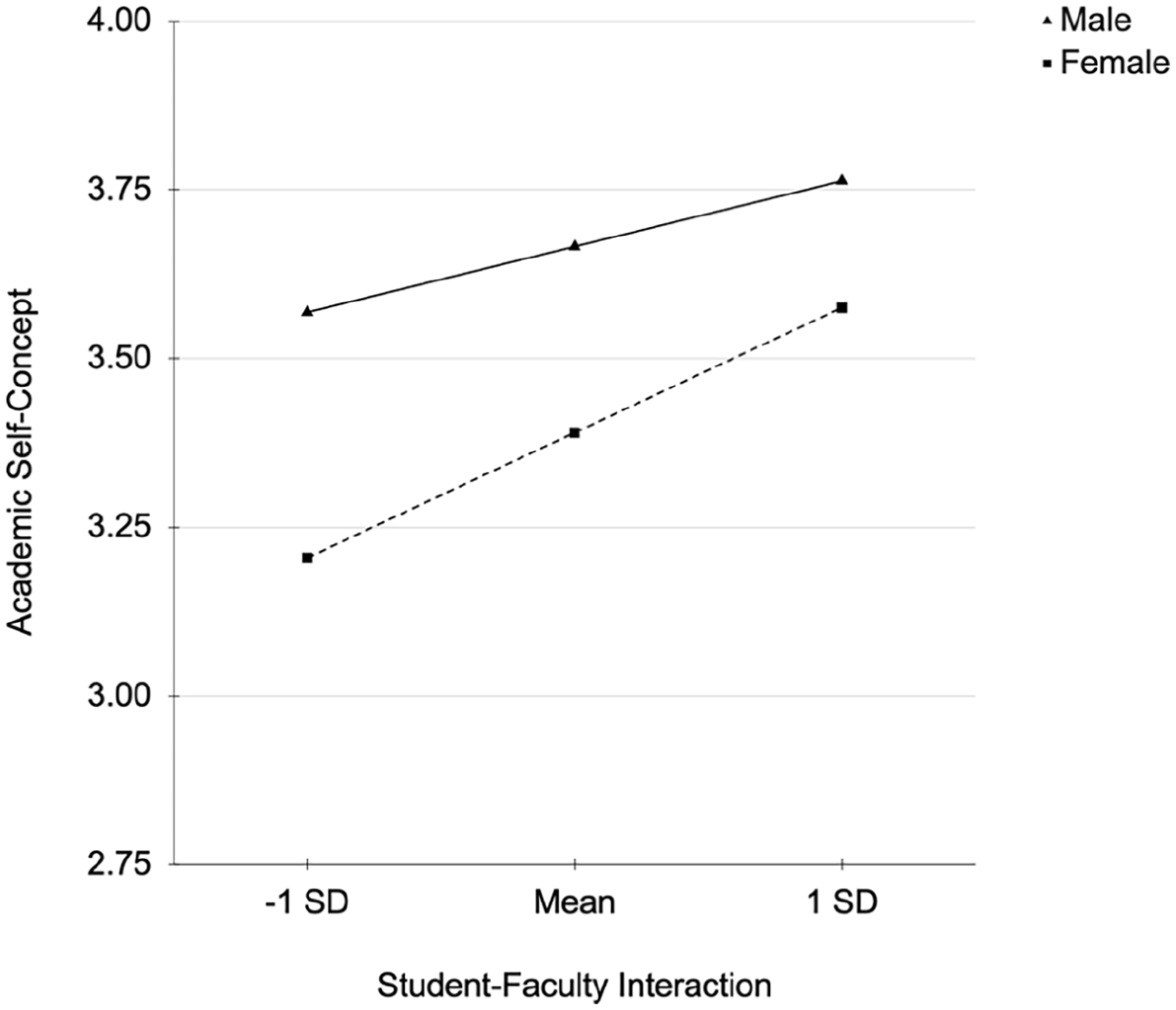
Moderating Effect of Gender.
Discussion
The present study examined the moderating effect of gender on the relationship between student–faculty interaction and academic self-concept. Our findings suggest that female students have lower academic self-concept than male students (Hypothesis 1), highlighting one of many persistent gender gaps in higher education. Our findings also suggest that student–faculty interaction positively impacts academic self-concept for all students, regardless of their gender (general effect) (Hypothesis 2). Finally, our findings suggest that the positive impact of student–faculty interaction on academic self-concept is stronger for female students than for male students (conditional effect) (Hypothesis 3). Collectively, these findings suggest that although student–faculty interaction is beneficial for all students, it is particularly beneficial for female students, thus helping to reduce—but not eliminate—the gender gap in academic self-concept.
The results of our study are likely influenced by underlying gender biases that impact both student–faculty interaction and academic self-concept. Female students frequently encounter implicit and explicit biases in higher education, which can undermine their academic self-concept (Colbeck et al., 2001; Kim & Sax, 2017). These biases may manifest in various ways, such as faculty members being less approachable or supportive of female students, or female students feeling less comfortable seeking help due to academic norms and stereotypes (Kim & Sax, 2009, 2017). Despite these challenges, our findings suggest that student–faculty interaction has a stronger effect on the academic self-concept of female students than their male counterparts. Consequently, when female students do interact with faculty, the support they receive can significantly increase their academic self-concept, likely helping to reduce some of the negative effects of gender biases (Cokley, 2000; Kim & Sax, 2018).
Although the present study provides valuable insights, it was based on a single-site convenience sample from the DLE survey conducted by HERI at UCLA. Future studies should further validate these findings using data from all DLE participating institutions. Using a multisite sample would not only increase the generalizability of the findings, but also capture greater diversity of student experiences across institutional contexts. Future studies would also benefit from more comprehensive measures of student–faculty interaction, considering factors such as the quality and nature of these interactions (see Cole, 2007). Finally, future studies should examine the longitudinal effects of student–faculty interaction on academic self-concept, providing insights into how this relationship evolves over time (see Kim & Sax, 2018; Parker et al., 2022). This is especially important because both student–faculty interaction and academic self-concept are likely to change as students progress through their academic journey.
While acknowledging these limitations, our findings lend themselves to several recommendations for improving student–faculty interaction and academic self-concept. These recommendations are grounded in Astin’s (1984) involvement theory and Weidman’s (1989) model of undergraduate socialization. First, institutions should consider initiatives that emphasize the importance of meaningful interactions with students and provide faculty with strategies to engage all students effectively. Given our findings that student–faculty interaction positively impacts academic self-concept for all students, these initiatives should focus on the quality of student–faculty interaction. This might include workshops on inclusive teaching practices and training sessions on effective communication and feedback techniques. As Weidman (1989) suggests, faculty are important agents of socialization. Thus, improving faculty’s ability to provide feedback and support helps students better internalize academic norms, which are key to developing a strong academic self-concept.
Second, institutions should consider initiatives that provide students and faculty additional opportunities to collaborate outside of the classroom. Again, given our findings that student–faculty interaction positively impacts academic self-concept for all students, these initiatives should focus on the quantity of student–faculty interaction. This might include networking events to foster regular connections between students and faculty, and joint research projects for close collaboration. Consistent with Astin’s (1984) involvement theory, expanding opportunities for student involvement allows students to invest more time and effort in their education, thus reinforcing and improving student success and well-being outcomes, including academic self-concept. This also provides more chances for faculty to act as socializing agents, as per Weidman’s (1989) theory of socialization.
Finally, institutions should consider initiatives that directly support the academic self-concept of female students. Given our findings that female students have lower academic self-concept than male students, creating supportive environments is essential for addressing gender gaps in higher education. This might include academic clubs that foster a sense of community and belonging, and leadership programs that empower female students to take on leadership roles and develop their skills. Weidman’s (1989) model emphasizes the importance of these environments where female students can learn from and support each other. These efforts provide safe spaces for socialization, mentoring, and skill development, helping female students see themselves as capable and competent scholars.
In conclusion, the present study highlights the role of student–faculty interaction in improving academic self-concept, particularly for female students. By implementing these initiatives, institutions can foster more inclusive and supportive academic environments for all students, while also ideally helping to reduce gender gaps in higher education. Future research should continue to examine these dynamics across diverse samples to further improve our educational practices.
Footnotes
Declaration of Conflicting Interests
The author(s) declared no potential conflicts of interest with respect to the research, authorship, and/or publication of this article.
Funding
The author(s) received no financial support for the research, authorship, and/or publication of this article.