







Abstract
Context:
The study is situated in Tennessee, following the 2022 passage of the Age-Appropriate Materials Act (AAMA). This legislation required schools to maintain and publicly disclose a complete list of educational materials while implementing review processes to ensure content appropriateness relative to student age and maturity levels. The AAMA’s scope extended beyond school library collections to encompass all materials accessible to students, including those in teachers’ classrooms.
Purpose:
This study investigates how educators make sense of ethical tensions created by Tennessee’s Age-Appropriate Materials Act of 2022, with attention to how emotions shape their reasoning, decisions, and actions. By centering educators’ lived experiences, the study contributes to understandings of ethics, affect, and professional agency in policy-constrained contexts.
Research Design:
The data set for this study comprises 30 semi-structured interviews conducted in summer 2023 with educators across Tennessee. Guided by the theoretical frame of ethical sensemaking and using reflexive thematic analysis, the study examines how participants interpret, negotiate, and respond to ethical tensions between professional values and policy mandates.
Conclusions:
Educators’ engagement with education policy is shaped through emotionally laden processes of ethical sensemaking, in which teachers actively negotiate tensions between professional values, institutional constraint, and care for students. These negotiations often take the form of “ethical truces” that sustain moral agency, enabling educators to enact ethical responsibility through subtle, relational, and often invisible forms of advocacy. Supporting educators in these contexts requires greater attention to the emotional labor of ethical decision-making and to how professional agency is cultivated in contemporary policy environments.
While debates over censorship have long characterized the United States’ educational landscape, the focus on restricting young people’s access to certain materials has intensified markedly since the 20th century, a period defined by growing societal emphasis on childhood innocence and vulnerability (Kidd, 2009; Pickering, 2023). These concerns have manifested most visibly through a steady rise in formal challenges—the primary mechanism through which restrictions on reading materials are enacted. Today, more than 90% of documented challenges occur in public libraries and schools, placing teachers and librarians on the front lines of the censorship debate (Johnson et al., 2023; van Beynen & Symulevich, 2023). Recent patterns suggest that the increases in such challenges demonstrate a wave of politically motivated and strategically organized campaigns to reshape access, rather than isolated incidents of objections to particular content (Albanese, 2021; Koss & Paciga, 2023). Reflecting this shift, book bans have been reported in K–12 education across 41 states and 247 school districts, impacting an estimated 2 million students (PEN America, 2025). In 2024 alone, the American Library Association recorded 2,452 unique titles challenged, marking the third highest annual total on record. This figure dramatically exceeds the annual average of only 273 unique titles challenged between 2001 and 2020 (American Library Association, 2025).
Instructional materials available in schools are under increasing scrutiny from parents, school boards, lawmakers, and conservative political groups (Harris & Alter, 2022; Schroeder, 2023). In recent years, numerous state laws requiring the reporting and removal of “divisive” materials have been enacted (Goncalves et al., 2024; Kelly, 2023). Most recently, in January 2025, the Department of Education issued revised guidance emphasizing parental authority in educational content decisions, rescinded previous directives characterizing book removal as potential civil rights violations, and questioned the framing of content restrictions as “banning” (U.S. Department of Education, Office for Civil Rights, 2025). This policy orientation represents a notable departure from earlier federal positions and underscores the dynamic, and increasingly contested, nature of regulatory guidance. For educators, such shifts may introduce profound emotional and ethical strain because they must continually work to reconcile evolving mandates with professional commitments to equity, representation, and care (First Book, 2023). Additionally, restricting the materials available in school and classroom libraries may hinder students’ motivation and engagement, reduce their reading volume—a key determinant of literacy development—and even “alienate them from reading altogether” (Dennis, 2025, p. 8). Research indicates that adolescent readers in particular are drawn to literature characterized by complexity and a degree of “disturbingness” that stimulates discussion and critical reflection (Ivey & Johnston, 2024). This type of engagement helps students make sense not just of text but also of their “relational, moral, and intellectual lives” (Ivey & Johnston, 2013, p. 255).
Tennessee’s Age Appropriate Materials Act (AAMA, 2022) exemplifies the broader trend toward prescriptive oversight of instructional content, raising important questions about how educators interpret, enact, and manage their professional responsibilities within such policy contexts. Thus, drawing on in-depth interviews with 30 K–12 educators (28 teachers, two librarians), this study explores how educators navigate this complex ethical terrain through processes of ethical sensemaking, or the interpretive process of making moral meaning amid competing professional and policy demands. We specifically trace how educators reasoned through the moral dilemmas that AAMA provoked, attending to how emotions played a role in their ethical judgments and actions.
Literature Review: Educators’ Responses to Restrictive Content Policies
Restrictive content policies, including book bans and censorship efforts, contribute to an increasingly complex and high-stakes environment for educators. Some researchers have argued that these policies create a “chilling effect,” undermining teacher autonomy in instructional practices and ultimately impacting educators’ professional well-being and sense of efficacy (Anderson, 2023; Woo et al., 2023). Such effects contribute to feelings of fear, anxiety, and uncertainty as teachers navigate new constraints on curriculum and materials selection (Ervin, 2025; L. B. Kelly, 2023). For example, in one national study, two thirds of educators reported that such policies negatively impacted their ability to teach effectively, undermined their professional judgment, and contributed to heightened stress levels (First Book, 2023). Although a strong majority (87%) viewed book bans as rarely or never justified, nearly half acknowledged that these restrictions currently influence, or have the potential to influence, their selection of classroom materials (First Book, 2023). Other scholars have emphasized that policy interpretation rarely occurs in isolation: rather, educators’ responses are mediated by institutional structures, such as mandated literacy curricula (Kelly & Taylor, 2024). As a result, educators must continually negotiate tensions between compliance and professional autonomy within an environment of heightened political and public scrutiny (Dawkins & Eidson, 2021; Moeller & Becnel, 2020).
One response to these pressures is self-censorship—that is, the voluntary restriction or removal of certain materials—not because of explicit mandates, but as a precautionary measure to avoid potential conflict or controversy (Anderson, 2023; Borsheim-Black, 2024; Medina et al., 2024; Pérez & Duarte, 2025; Price, 2023; Tudor et al., 2023; Waxman, 2021). Further, educators may engage in soft censorship, a more subtle form of restriction that involves limiting student access to text through placement, omission from displays, or exclusion from class discussions (Ginsberg & Chae, 2025). Such practices significantly reduce the chances that students will come across diverse materials during their day-to-day school experience. Dávila (2022) outlined eight stances that educators adopt when choosing to select or avoid texts, including a curriculum-first stance (prioritizing alignment with standards); a law-abiding stance (avoiding texts that depict law-breaking or “deviance”); and a protection stance (omitting materials deemed potentially upsetting). These strategies reflect the intersection of circulating policy mandates, pedagogical aims, and educators’ personal ideological commitments, as well as their assessment of risk within specific school contexts.
Yet, despite the pressures of restrictive policies and book challenges, research indicates that educators engage in various forms of resistance and professional agency in response. Teachers and librarians draw on professional ethics, institutional knowledge, and collaborative networks to defend intellectual freedom and preserve access to diverse materials (Falter & Mackenzie, 2024; Parker, 2023; Pollock et al., 2022). In one study, educators characterized book challenges as a “symbolic battle” over students’ rights to access diverse reading materials, positioning themselves as defenders of intellectual freedom (Sachdeva et al., 2023). Other research emphasizes the contextual nature of teachers’ responses: Decisions about whether, when, and how to teach contentious materials are shaped less by national discourses than by the demographics and specific contexts of local school communities (Giunco et al., 2024; Woo et al., 2023, 2024). Research also demonstrates that teachers’ responses may fall on a continuum from preemptive self-censorship to overt resistance and that these responses are mediated by institutional support, community context, and educators’ own moral and professional commitments (Griffith & Reid, 2025; Kelly et al., 2024; Pollock et al., 2023).
Despite this growing body of research, there is a need to better understand the nuanced processes through which educators interpret restrictive policies and reconcile them with their ethical and professional identities. Yet understanding this may offer deeper insights into the tensions that arise between professional judgment and policy compliance. This study seeks to extend existing work by examining how educators navigate these emotionally charged processes of ethical sensemaking as they confront policies that challenge their personal and professional values.
Context: Tennessee
The study is situated in Tennessee, following the 2022 passage of the Age-Appropriate Materials Act. This legislation required schools to maintain and publicly disclose a complete list of educational materials while implementing review processes to ensure content appropriateness relative to student age and maturity levels (AAMA, 2022). The AAMA’s scope extended beyond traditional library collections to encompass all materials accessible to students, including those in teachers’ classrooms (Tennessee Department of Education, 2022). Following public expressions of concern regarding the laws’ broad and ambiguous wording (Brown, 2022), a 2023 amendment refined its parameters by explicitly prohibiting materials containing “nudity or descriptions or depictions of sexual excitement, sexual conduct, excessive violence, or sadomasochistic abuse” within K–12 educational contexts (Tennessee General Assembly, 2023a). Despite an unsuccessful legislative attempt to exempt classroom materials from these requirements (Tennessee General Assembly, 2023b), the comprehensive implementation proceeded, prompting significant administrative adjustments and professional concerns within educational institutions throughout the state. Reports indicated that at least some schools began to modify or bypass their established review protocols, with several preemptively removing books from library shelves (Aldrich, 2024a, 2024b). The AAMA followed closely on the heels of Tennessee’s legislation banning the teaching of “divisive concepts” associated with critical race theory, including the ideas that “a meritocracy is racist or sexist” or “all Americans are not created equal” (Kelly et al., 2024). Collectively, these legislative efforts embody what Laats and Meehan (2024) termed the ongoing “‘school culture wars’: the continuous struggle over who holds the authority to define the knowledge and values taught in public schools” (p. 212). Against this backdrop of expanded policy oversight, data were collected for the present study.
Theoretical Framework: Ethical Sensemaking
In this study, we employ ethical sensemaking as the interpretive framework for examining how educators in Tennessee responded to the policy shifts surrounding AAMA. Ethical sensemaking refers to the processes by which individuals or groups construct meaning in morally complex situations through engaging with, interpreting, evaluating, rejecting, or responding to ethically charged dilemmas within organizational contexts, such as schools (Gephart et al., 2010; Reinecke & Ansari, 2015). Whereas traditional sensemaking theory emphasizes how actors cognitively interpret and implement directives presumed beneficial for the organization (Caughron et al., 2011; Coburn, 2001), ethical sensemaking foregrounds equivocality, or “the existence of several, simultaneous interpretations” (Weick, 1995, p. 4), and the presence of competing moral principles (Sonenshein, 2007). This perspective, therefore, is valuable for attending to the “excruciating difficulty” individuals experience when confronting situations in which their professional, institutional, and moral obligations conflict (Bauman, 1993).
Ethical sensemaking offers a generative lens for analyzing educators’ experiences with content regulation policies for three interrelated reasons. First, it accommodates the moral pluralism inherent in educational settings, where diverse stakeholder interests and ethical commitments converge. For instance, educators are frequently held accountable to their state, district, and school administrators, while simultaneously serving the needs of their students and local community. Second, ethical sensemaking is not purely rational or cognitive, but is fundamentally shaped by emotion, intuition, and embodied moral awareness (Fatien Diochon & Nizet, 2019). Finally, it illuminates how individuals construct ethical truces—that is, provisional, workable understandings that allow them to move forward even when moral consensus is unattainable (Reinecke & Ansari, 2015). Through this lens, educators’ decision-making can be understood not as the resolution of ethical conflict but as an ongoing negotiation of coexistence, enabling them to act within contested policy environments while striving to maintain professional and moral integrity.
Methodology and Methods
Data Collection and Participants
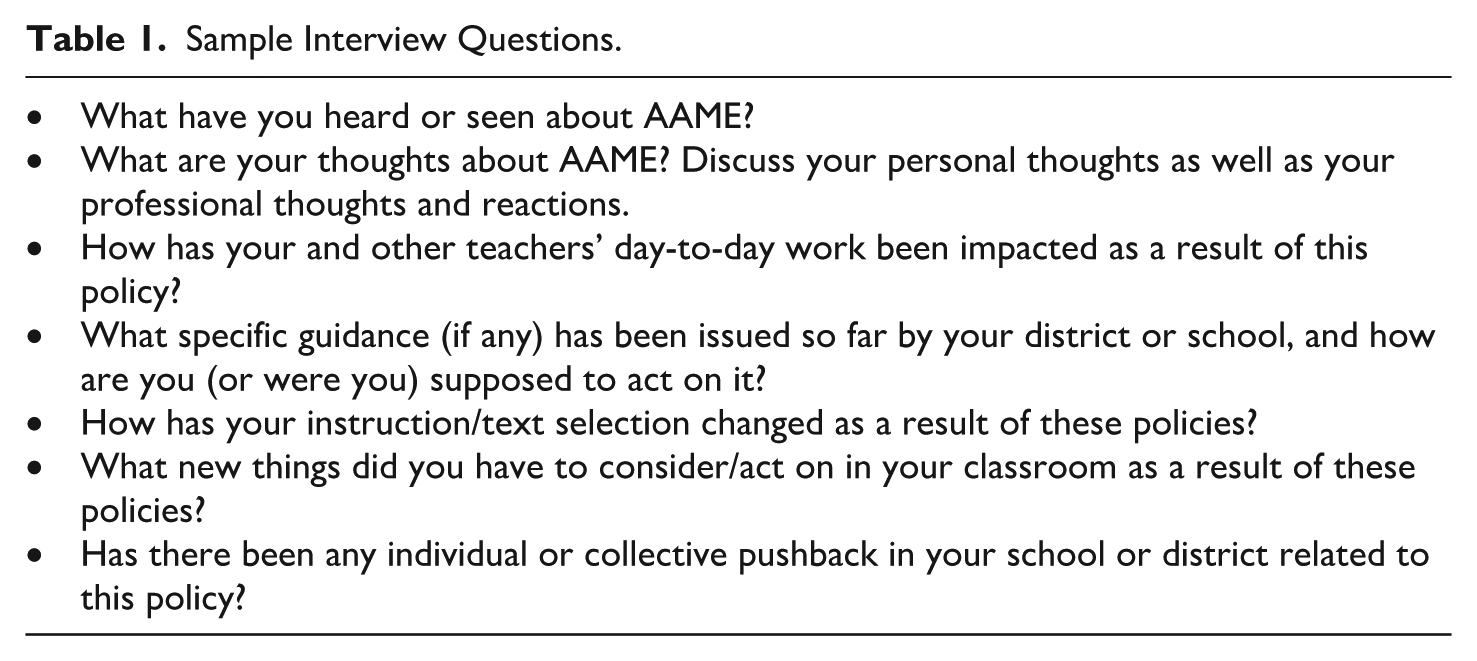
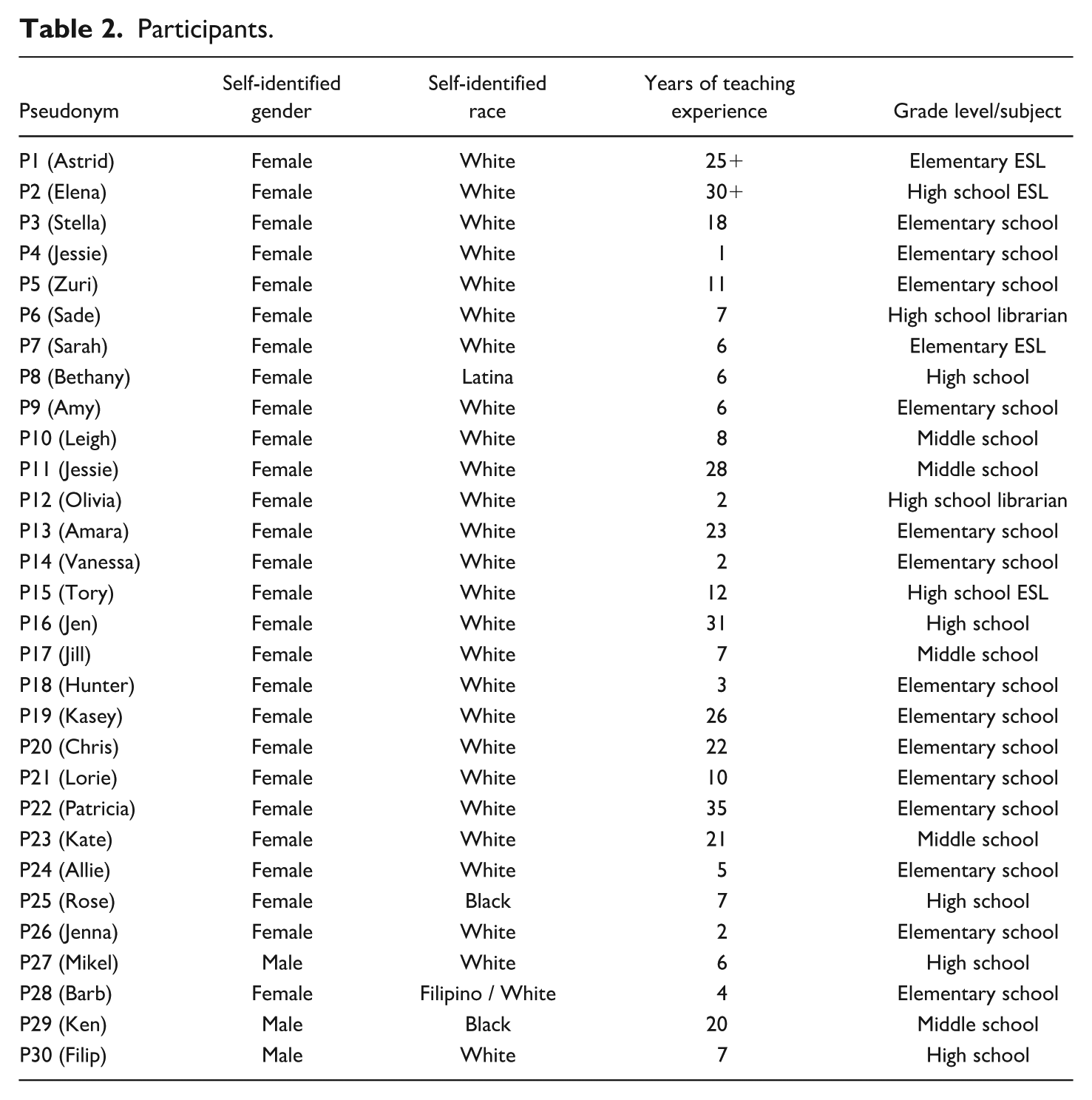
The data set for this study comprises 30 semi-structured interviews (see Table 1) conducted in summer of 2023 with educators across Tennessee. Participants were recruited through email invitations distributed directly by the authors and via state and regional advocacy networks (e.g., EdTrust, NAACP), as well as professional organizations such as the Tennessee Library Association. Following institutional review board approval, all interviews were conducted and recorded via Zoom, lasting between 30 and 60 minutes. Transcripts were generated by Zoom and then reviewed and re-transcribed by the researchers for accuracy. Six transcripts were removed from the data set because those participants were not directly impacted by the AAMA. Furthermore, we excluded five additional participants from the final stages of analysis because they reported explicit agreement with the AAMA and did not engage in ethical deliberations. These educators noted that their religious or moral beliefs precluded “inappropriate materials” in their libraries, describing their stance as pre-compliance with the law. Demographic information for participants is outlined in Table 2.
Sample Interview Questions.
Participants.
Data Analysis
Data were analyzed using reflexive thematic analysis (RTA; Braun & Clarke, 2021), an approach that views themes as co-constructed through interaction among the data set, the theoretical lens applied, and the interpretive engagement of the researcher (Byrne, 2022). This process is necessarily iterative and recursive, requiring continual movement between coding, theme development, and critical reflection. While rooted in a six-phase structure of familiarization, coding, theme generation, theme review, theme definition, and reporting, RTA emphasizes the importance of subjectivity, positionality, and epistemic reflexivity as integral to the analytic process. Thus, it serves not only to identify patterned meanings in a data set, but also to interrogate how that meaning is produced as part of the broader social and political context. In this study, RTA enabled a nuanced examination of how educators navigated and negotiated ethical sensemaking amid shifting policy imperatives.
Data analysis followed an iterative process, with reflexive journaling employed throughout, to help us surface and trace how our personal and professional assumptions played a role in shaping our interpretations. The analytic process began with an initial immersion in the data, achieved through iterative listening of interview recordings and the production of interview summaries, or researcher-generated descriptions of “what participants said in relation to a particular topic or data collection question” (Braun & Clarke, 2019, p. 5). During this phase, each researcher independently analyzed and coded the data. Next, we engaged in weekly joint meetings to compare, contrast, negotiate, and reconcile interpretations.
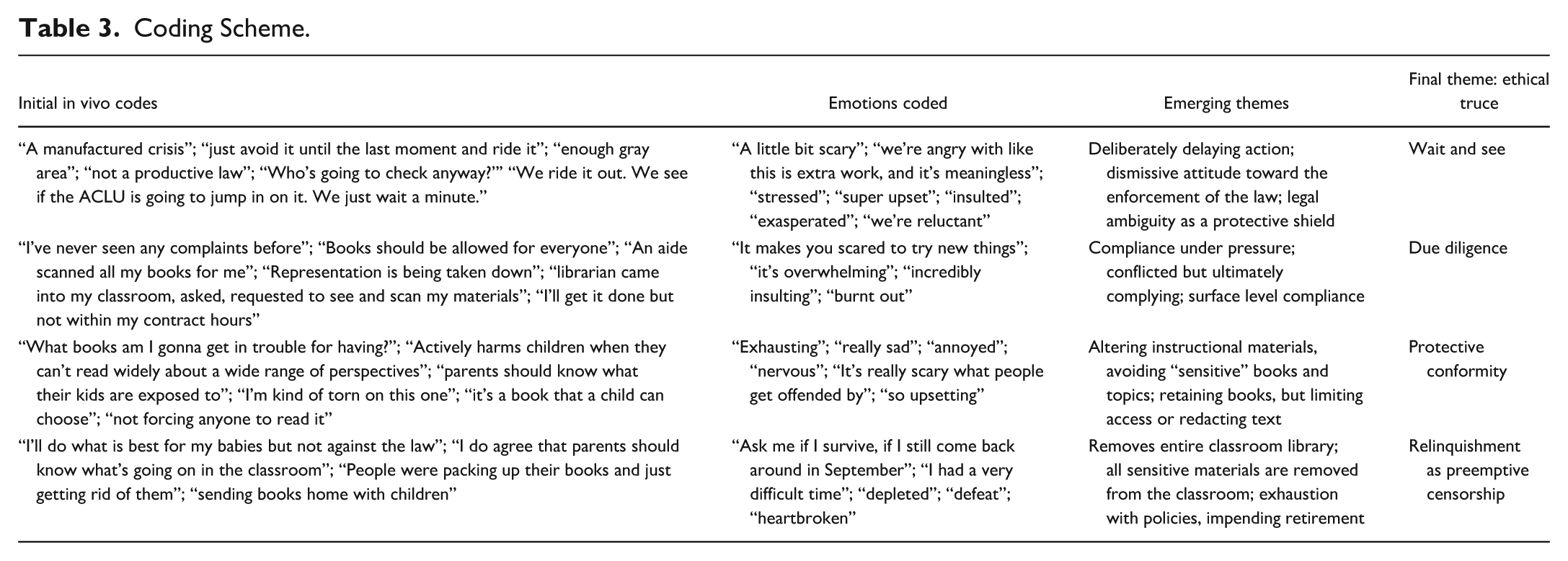
Initial interpretations were generated systematically by working through the data to identify repeated, salient features. A cluster of codes, for example, revealed teachers’ skepticism and strategic delay, including phrases such as, “a manufactured crisis”; “just avoid it until the last moment”; “enough gray area”; “not a productive law”; “Who’s going to check anyway?”; and “We ride it out. We see if the ACLU is going to jump in on it. We just wait a minute.” We then created broader patterns and preliminary themes by analyzing the interrelationship among codes. Pattern development was followed by an iterative refinement phase in which themes were merged, split, or eliminated to ensure conceptual fit with the research objectives. For example, the mentioned codes were synthesized into the following patterns: deliberately delaying action; dismissive attitude toward the enforcement of the law; and legal ambiguity as a protective shield. Notably, participants’ responses were often emotionally charged, reflecting the affective dimensions of policy enactment and the tensions inherent in their professional roles. For example, we coded the following range of emotions: “a little bit scary”; “we are angry”; “stressed”; “super upset”; “insulted”; “exasperated”; and “reluctant.”
The subsequent phases involved a deeper refinement of the themes. We analyzed the interrelationships between all themes, confirming that each was internally cohesive while remaining externally distinct and, collectively, that they meaningfully advanced the overall analysis. Thus, subsequent stages of the analysis were guided by the conceptual framework of ethical sensemaking, with a particular focus on the role of emotions within ethical truces, understood as the negotiated settlements through which participants reconcile professional values with the material and discursive pressures of policy contexts (Reinecke & Ansari, 2015). We identified instances in which participants articulated such truces, the normative logics that underpinned them, and the actions that emerged as a consequence. By way of illustration, the cluster of codes described earlier was combined into the ethical truce “wait and see,” which we defined as an ethical sensemaking strategy in which educators deliberately postpone or ignore implementation, based on the historical expectation that the policy’s force would dissipate over time. The ethical truces negotiated by participants manifested in a range of responses characterizable on a continuum of ethical sensemaking in regard to the policy. We display them as ethical truces to illuminate the subtle, often overlooked strategies through which educators negotiate, adapt, and quietly respond to top-down mandates. Table 3 provides an example of how analytic phases correspond to each ethical truce.
Coding Scheme.
Trustworthiness and Warranting of Analytical Claims
To strive for analytical rigor, the research team engaged in sustained critical dialogue through weekly meetings, systematically interrogating emergent themes, problematizing our own interpretive assumptions, and continually reengaging the data through the theoretical framing of ethical sensemaking. In doing so, we sought not only to understand the complexities of educators’ ethical negotiations but also to make connections between these and the broader structures of educational policies and accountability within which such negotiations unfold. We illustrate the categories of the tentative, provisional ethical truces that educators reached through detailed accounts of four participants and their ethical sensemaking toward establishing their truces. These accounts work not only to exemplify the central analytical categories from our analysis but also to humanize the broader patterns we observed and provide a level of nuance necessary for understanding the complexity of ethical sensemaking. In doing so, this work responds in part to the call for additional insight into how teachers negotiate the censorship policies in today’s climate (Sachdeva et al., 2023).
Authors’ Positionalities
As scholars, we must acknowledge and critically reflect on how the complexities of our positionalities inevitably shape the trajectory of the study and its outcomes. Each member of the research team is currently a university professor; collectively, we teach a range of courses across literacy, policy, multilingualism, and English as an additional language education. Our past professional classroom teaching experiences span U.S. and international classrooms, and each of us has worked extensively with multilingual learners and developing readers throughout our careers. As such, our interest in this topic is driven in part by our instructional foci and our longstanding histories as educators. Other salient aspects of our identities include being an immigrant second-language learner, a first-generation college graduate, and a lifelong resident of rural Appalachia. These personal experiences mean that we all have witnessed firsthand the importance of books in children’s lives, including our own, and the importance of choice and access as a lever of engagement. These lived experiences and beliefs inform not only our commitment to teacher autonomy and professionalism, students’ right to diverse literature in schools, and the detrimental nature of surveillance in schools, but also the theoretical and methodological choices underpinning this study. These personal and professional commitments undoubtedly influenced the project’s design, the research questions we posed, and the ways in which we approached data collection and analysis. While acknowledging the complexities of our positionalities in shaping the trajectory of this work and its outcomes, we strove to simultaneously maintain analytic rigor through reflexively and systematically documenting our observations and assumptions throughout the research process (Emerson et al., 2011), returning to the literature to ensure that our developing conclusions were aligned with the analytic and theoretical framing we chose (Denzin & Lincoln, 2018), and fostering a continuous dialogue of reflexivity by acting as critical friends throughout the process, to safeguard the integrity of our work.
Findings
This article examines how educators engaged in ethical sensemaking around the AAMA, tracing how emotion, moral conviction, and professional identity played a role in their decision-making about how to respond to the policy. Educators experienced the legislation as ethically dilemmatic, navigating tensions between moral responsibility, professional integrity, and institutional compliance. Through emotionally laden processes of ethical sensemaking, they constructed ethical truces, or temporary resolutions that enabled them to act within increasingly complex educational terrain. These truces highlight the multiple ways that ethical sensemaking unfolded across the data, illustrating how educators in our study worked to reconcile competing obligations to students, policy, and their own ethical commitments. The four ethical truces described here reflect a continuum of responses through which educators worked to reconcile competing demands of policy compliance, professional identity, and moral stances. Truces 1 and 4 mark the outer bounds of this continuum, where educators’ reactions were most divergent, while Truces 2 and 3 reflect the most frequently articulated positions.
Ethical Truce 1: Wait and See
The “wait and see” approach, which was adopted by three of the participants who were interviewed, reflected a deliberate decision to take no immediate action in response to the AAMA. These educators expressed personal opposition to the legislation for varied reasons, describing it as “a manufactured crisis,” “aimless censorship,” “a conservative push,” and a threat to “the separation of church and state.” Although they affirmed parents’ rights to be informed about “the topics, books, and materials” used in classrooms, they questioned what one called “just handing the keys to parents when parents are not the curriculum experts.” Another cautioned, “It’s a really slippery slope to have a law like this that is so ambiguous,” allowing “basically any member of the public to deem something inappropriate.”
For these educators, ethical sensemaking centered on reconciling opposition to the law with perceived risks of action. Their decision to “wait and see” was marked by strong emotional dilemmas. Teachers in this category described fear of retribution for inaction (“I don’t want to be in jail”) on the one hand, and “hatred” of the law itself on the other. These emotional responses were not separate from their reasoning but intertwined with it, influencing and shaping how they assessed risk and moral responsibility in relation to their decision to “wait and see.”
Crucially, these participants reframed the policy’s ambiguity as a form of protection. Their sense of uncertainty over its parameters was reframed as a space of safety, allowing them to wait without concern of inviting scrutiny over their choice. For example, one educator reasoned that the law was “subjective” enough that her administration would not “fire” her for refusing to scan books. Another researched court cases, concluding that the legislation contained “enough gray area” to permit “plausible deniability.” A third explained, “You can’t prove that this is not a private bookshelf that students don’t have access to. So if they take issue with nudity in a book of Bosch paintings, well, that could be for enriching my own knowledge of art history.”
Through this interpretive process, educators crafted an ethical truce grounded in emotional self-protection and critical reading of the law’s vagueness. The “wait and see” stance thus represented not passivity, but a form of moral reasoning in which inaction became an ethically justified response, allowing educators to preserve their sense of integrity while deferring compliance. Elena’s case, shared next, offers a detailed illustration of this approach.
Elena, a White female ESL teacher with 30 years of experience, expressed strong disagreement with the AAMA. She viewed both the law and its policymakers as participants in a political performance rather than engaged in a genuine effort to improve education and protect students, noting that policymakers were “playing god with what [teachers] can and cannot show the students in the classroom.” More broadly, Elena viewed the law as an example of a conservative “agenda” to “vilify public schools.” Her ethical sensemaking reflected a long view shaped by her professional experience with educational policies that appeared to her to be enacted, only to disappear with little follow-up. She explained,
They make these changes, and then you don’t know which ones they are really going to be serious about. It’s on every level. It’s from the school to the district to the state. Let’s try this flavor of the week now. So which ones are they really committed to?
This skepticism regarding oversight served as her primary justification for waiting to act. Before committing to taking action, she would wait to see if the policy was actually implemented and then, if it was, whether those in authority were going to check individual teacher compliance.
Are we really going to do this? Because who’s gonna check, read all those lists of all the teachers in the whole city? Who’s gonna really check and read and verify that all these titles are appropriate? And so we just sort of ignored it.
Elena explained that waiting it out is a common tactic that educators employ to protect themselves and their students from policies they view as unnecessary or even harmful. She noted that teachers at her school had heard nothing from the state since some teachers had uploaded the book lists, strengthening her belief in avoidance as a viable strategy.
We just avoid it until the last moment and ride it out because we have experience with this. They make these policies. They make these changes, and then you don’t know which ones they are really going to be serious about. Let’s try this flavor of the week now. So which ones are they really committed to? We ride it out. We just wait a minute until we hear back from the Union, the ACLU. What has the Supreme Court said? But this takes time.
Ultimately, Elena resolved to continue her usual teaching practices, emphasizing that the policy made her angry; she said, “Unless somebody comes in my classroom and takes all my books away and tells me I can’t do anything, when I shut my door, I’m gonna do what I want to do.” Her ethical truce—to wait for further guidance and act only if enforcement occurred—stemmed from confidence in the inertia of the system, which, in turn, lessened her fear of professional reprisal while allowing her to preserve a sense of moral integrity. Elena’s case thus exemplifies the “wait and see” truce, in which educators balanced opposition to policy with pragmatic restraint, transforming institutional ambiguity into an ethical space for quiet resistance.
Ethical Truce 2: Due Diligence
Across the data, one central pattern of ethical sensemaking involved following the explicit requirements of the AAMA—that is, “doing due diligence”—while maintaining strong personal opposition to the policy. Among the nine participants who adopted this stance, ethical reasoning centered on reconciling the expectations of the law with their professional and moral convictions, a process marked by emotions of frustration, fatigue, and fear. These educators uniformly rejected the law’s assumptions, arguing that it silenced their professional judgment and excluded their expertise from decisions about classroom materials. This exclusion produced a pervasive sense of professional devaluation; participants described it as “tiring to be mistrusted,” rendering their “degrees worthless.” Many viewed the legislation as politically motivated, contending that “politicians want to control education for their own benefit,” and unnecessary, given existing district protocols for book challenges. For several, the policy directly contradicted their professional commitment to student representation; one argued, “People don’t understand the power of literature for kids that feel like they’re on the outside.”
Ethical sensemaking for this group thus unfolded as an emotionally laden negotiation between conviction and constraint. They voiced fear about “pushback,” job loss, and reduced professional credibility, coupled with anxiety over what they viewed as the law’s “vagueness” and frustration over the workload it imposed. Yet, rather than reject the law outright or self-censor their materials, these educators reached a pragmatic truce: They complied with the policy by scanning and reporting their books but did not act to remove or preemptively restrict access to them. This compliance functioned as a protective strategy, allowing educators to maintain their sense of professional ethics while demonstrating procedural obedience. In this sense, “doing due diligence” represented a form of ethical sensemaking through which teachers balanced moral opposition and self-preservation, translating emotional tension into a manageable, if uneasy, equilibrium. Olivia’s experience illustrates this ethical truce in action.
Olivia, a White high school librarian with two years of experience, articulated a strong moral stance of maintaining open student access to texts and materials. She viewed herself as a “curator” of an inclusive and transformative library space and opposed the AAMA on the grounds that book lists were “always publicly available.” Olivia worried that the law would pressure teachers to “get rid of all their books,” restricting access and undermining her stated mission to promote inclusion and empathy. She explained,
One of the reasons that I love the library, that I discovered once I started my degree, was that there is a lot of emphasis on inclusion and diversity. What does it mean for the library to be a safe space? What is the importance of having books that are both windows and mirrors? Books that you see yourself reflected back in, and books that let you look into other people’s lives. How does that foster empathy? How does that make for conversation? So there’s so many wonderful things, and I think I went in just so excited to be a curator of that space and to contribute to that.
After the AAMA’s passage, however, Olivia’s conviction was fraught by fear and uncertainty. She described receiving anonymous, sometimes hostile phone calls from people who voiced anger about books that were not even present in her collection, leaving her feeling “cut out of the equation” and professionally disempowered:
I went to school to do this job, and we learned about book challenges. . . . But it felt like none of that was applicable in this situation. . . . You are being cut out of the equation, and not only that, your professional expertise is being completely disregarded, and sometimes tarnished. I did not feel like I had a lot of power to do anything or change anything.
Olivia’s ethical sensemaking revolved around this conflict between integrity and security. “I can’t imagine how you wouldn’t be conflicted if you care about wanting to stay employed and having insurance but you also have integrity.” Fear of losing her job, income, or health insurance ultimately outweighed her opposition to the law. Yet, she refused to equate compliance with agreement. To navigate this, she crafted what she called a “due diligence” approach by fulfilling the law’s explicit requirements to the minimum extent necessary. Olivia explained,
I have done exactly what has been required of me to comply with this, and I’ve made sure that my principal knows, “Hey this is available, here are the instructions. Here are the things. Let me know if you need anything.” And those are in email. And so no one can say that I did not do my due diligence as part of this job.
Although Olivia meticulously documented her compliance, she established firm ethical boundaries. She refused to preemptively remove books, instruct teachers to discard theirs, or report noncompliance, believing that such actions would “overstep” her role. Like others in this group, Olivia’s “doing due diligence” truce enabled her to navigate emotionally charged dissonance through redefining compliance as procedural rather than ideological and preserving a sense of professional and moral coherence amid the pressures of surveillance and fear.
Ethical Truce 3: Protective Conformity
A third pattern of ethical sensemaking, evident among six participants, involved protective conformity, in which teachers made subtle adjustments to instruction and access that reduced exposure to potentially controversial materials without removing them entirely. Like those who employed truces described earlier, these educators expressed agreement with the ideas of parental rights and transparency in schools, noting perspectives such as, “I guess I can see both sides of this argument,” and “Let them come in and look, there’s nothing bad here.” Nonetheless, they opposed the AAMA, and their ethical deliberations were marked by heightened emotional tension as they struggled to balance conviction with the fear of appearing noncompliant. They viewed the policy as politically motivated and pedagogically harmful, but also described feeling vulnerable to the personal and professional risks of open resistance. The resulting tension between moral conviction and perceived vulnerability became the central site of ethical deliberation.
In navigating this tension, participants struggled to balance multiple obligations: to their students, to their own beliefs about representation and equity, and to the institutional structures that governed their employment. Their accounts revealed not outright rejection of the law, but an ongoing process of moral reasoning shaped by emotion, context, and constraint. One teacher, expressing anxiety and frustration over how to interpret the law’s vague standards asked, “Which books are bad? Who is in charge?” These questions reflect the ethical sensemaking of this truce in action, as educators sought to determine what counted as responsible action when both compliance and defiance carried moral and professional risks. We present Hunter’s experience as an encapsulation of this truce.
A White elementary teacher with three years of experience, Hunter maintained her classroom library but refrained from using certain books in lessons. She supported parents’ rights to know what students read but criticized the “unpaid time” and “absurd” workload imposed by the law. Initially, she hoped compliance might build public trust: “Maybe this is a way they can see, hey, this teacher has 2,000 books, and I can’t find a problem with them.” Yet, as administrators flagged topics such as slavery, civil rights, and gender as “sensitive,” she recognized the growing conflict between her beliefs about inclusion and the law’s expectations: “I want my students [to be] represented in the materials. . . . If a student has two dads and they see a book with two dads, they need to be able to feel that, too.” Still, Hunter described herself as a “rule follower.” Losing her job “was not a viable option.” Guided by district interpretation, she reached a compromise: She would keep all her books but not use potentially “risky” ones for instruction. “It’s a free-choice kind of book. We are not pushing any agenda, but we’re also not erasing the existence of people.”
Hunter’s decision reflected both resistance and compliance—an ethical truce born from emotional labor, fear, and care. Ultimately, for Hunter and other educators in this theme, ethical sensemaking involved negotiating a truce that prioritized job security while minimizing perceived harm. Some became “extra careful,” keeping only “neutral books that aren’t too touchy,” while others relied on vetted district curricula to deflect responsibility (“If someone did have a problem, they would talk with the literacy coach”). Still others retained diverse classroom libraries but limited use to independent reading. Through these choices, teachers enacted ethical sensemaking as a process of emotional calibration and pragmatic adaptation—an effort to uphold core values within the confines of compliance.
Ethical Truce 4: Relinquishment as Preemptive Censorship
At the furthest end of the continuum, one participant, Astrid, engaged in preemptive censorship by simply removing all her supplementary classroom books before any directive required her to do so. We include her case to illustrate how, under sustained emotional and institutional pressure, ethical sensemaking can culminate in a truce of relinquishment, in which compliance and quiet resistance become intertwined in an almost paradoxical effort to preserve agency through surrender. Astrid’s decision reflected not indifference, but moral exhaustion, a survival strategy shaped by fear, frustration, and despair, yet anchored in care for her students and a desire to maintain professional autonomy within an increasingly constrained landscape.
Astrid, a White English as an additional language teacher with 26 years of experience, was deeply opposed to the AAMA, viewing it as the latest in a series of policies that “micromanaged” teachers and undermined professional autonomy. Emphasizing that teachers “know what’s best for [their] kids” and agreeing that “parents should know what’s going on in the classroom,” she described the legislation as part of a broader pattern of disregard for educators’ expertise. The cumulative effect, she said, was “depletion” and “heartbreak,” linking her own discouragement to the wave of teacher attrition across the state. “I can do anything for four more years,” she repeated, expressing both endurance and defeat.
Books, for Astrid, were resources she considered essential to equitable instruction. She described using supplemental texts to “fix those holes” in literacy and support developing readers. After the AAMA, however, she found herself in an acute moral dilemma: between doing “what’s best for my kids” and “falling in line.” Her sensemaking process unfolded as she weighed these competing commitments, aware that resistance could jeopardize her career just years before retirement. Joking grimly, she remarked, “Ask me at the beginning of the year if I survive.” This language of survival captured how she and other veteran teachers described teaching under the AAMA: as enduring a professional environment in which compliance, rather than care, had become the metric of safety.
Ultimately, Astrid’s ethical truce took the form of preemptive removal. Unable to reconcile the emotional burden of noncompliance with her convictions about good teaching, she decided to send all her classroom books home with students rather than catalogue them for district review. This act, though technically compliant, also carried traces of creative defiance. Rather than risk selective censorship by submitting her materials for review, Astrid preemptively removed them all. Yet in doing so, she redirected the books to the very population from whom the AAMA ostensibly sought to restrict access. Although we cannot know whether her materials would have been censored, her technical compliance could also be understood as a form of quiet, human-centered resistance. In giving away “bundles and bundles of books,” Astrid sought solace in the belief that her students would “utilize” them at home. “The families do not have a lot of print in their homes, so the benefit was a lot of kids got books.” Emotionally, the decision was devastating. Astrid recalled, “It just broke my heart because I was like, all of these resources, all of these wonderful books. People were packing up their books and just getting rid of them, which crushed me.”
Astrid’s ethical sensemaking thus resolved into a truce of relinquishment, which involved painful emotional negotiation between integrity and survival. Her decision was born of exhaustion, but it also carried an undercurrent of moral agency: a refusal to let the books simply disappear into institutional control. By sending books home with students, she reoriented compliance toward care, transforming a restrictive mandate into an opportunity for students’ access beyond the classroom. Her experience captures the paradox of ethical sensemaking under constraint, where acts of compliance may simultaneously signify protection, loss, and quiet resistance.
Discussion
Our findings trace how educators engaged in ethical sensemaking in response to the AAMA, highlighting the complex, emotionally laden processes through which they interpreted and enacted the law. Their decisions were not passive acts of policy compliance but deeply moral and emotional negotiations. The process of interpreting and enacting the law required teachers to weigh conviction against constraint, balancing professional ethics, fear of reprisal, and care for students. In this sense, emotions such as fear, anger, guilt, and heartbreak were not peripheral to decision-making but constitutive of it, shaping how educators reasoned, justified, and, ultimately, acted.
Echoing prior research that highlights the moral and political complexity of teachers’ work under restrictive educational climates (Giunco et al., 2024; Kelly et al., 2024; Pollock et al., 2023; Sachdeva et al., 2023), our findings show that teachers’ responses to the AAMA were neither uniform nor purely rational. Participants broadly supported transparency and parents’ involvement in principle, yet they rejected the law’s underlying assumptions and its deprofessionalizing effects. Their ethical sensemaking resulted in a range of ethical truces—that is, temporary, emotionally calibrated compromises that included waiting, doing due diligence, and engaging in both protective conformity and preemptive censorship. These truces were not simply strategies for compliance or resistance but emotionally grounded acts of moral negotiation that allowed educators to forge temporary coherence between belief and behavior amid constraint. Yet, as the continuum of responses revealed, the emotional toll of sustained moral strain sometimes collapsed the space for negotiation altogether. At its furthest edge, ethical sensemaking resolved not in resistance but in resignation—a truce of self-protection marked by exhaustion and moral fatigue, yet still threaded with evidence of moral agency and care.
The emotional and moral negotiations evident in teachers’ ethical sensemaking cannot be disentangled from the broader ideological forces shaping educational policy and practice. For example, participants’ conditional agreement with the idea of transparency coexisted with unease about how that principle operated in practice. Drawing on Foucault’s (1975/1977) notion of the normalizing gaze, we interpret this unease as evidence for how surveillance has become naturalized in the educational culture of the United States, producing the conditions under which teachers monitor themselves in anticipation of external scrutiny. Framed as accountability, transparency functions as a technology of control that classifies and disciplines educators while appearing neutral (Borsheim-Black, 2024; Ryan, 1991). In our data, this normalization of oversight surfaced in participants’ descriptions of self-protection, expressed as the impulse to act before being asked or to remove before being questioned. Such self-disciplinary practices mirror what Sachdeva and colleagues (2023) described as “stealth” or “pre-emptive” censorship, where books quietly disappear, justified by internalized fear of sanction or even job loss. In this sense, the AAMA not only constrains what teachers might teach, but also reshapes the moral terrain of teaching itself, prompting educators to transform ethical responsibility for students’ learning into personal vigilance against possible accusation (Peeters, 2013; Shamir, 2008) and to operate from a defensive posture by selecting materials and planning instruction based on predictions regarding what might be deemed problematic by external stakeholders (Borsheim-Black, 2024; Dávila, 2022; L. B. Kelly et al., 2024).
The emotional labor entailed in this process was a notable feature of each ethical truce. Teachers described fear of reprisal, anxiety about ambiguity, frustration with bureaucratic oversight, and heartbreak at perceived devaluation. These emotions were not peripheral to ethical sensemaking but constitutive of it. This continual emotional labor (Benesch, 2020) was central to teachers’ ethical sensemaking process. Emotions shaped how educators interpreted moral conflict, assessed risk, and justified action. Thus, the “excruciating difficulty” (Bauman, 1993) of moral choice under competing obligations both arises through and is navigated by teachers’ emotional labor. As Ervin (2025) and Loh and Liew (2016) noted, emotional dissonance arises when pedagogical ethics collide with sociopolitical demands. Our study extends this insight by showing how emotions are not merely a response to constraint but a medium through which ethical understanding is produced. Yet, the cost of this labor is high: Sustained fear and uncertainty contribute to exhaustion, burnout, and resignation (Kariou et al., 2021).
Finally, educators and scholars have rightly called for resistance to censorship and for advocacy that ensures diverse representation in schools (Lowery, 2023). Yet much of this discourse tends to elevate loud, visible forms of protest that make defiance legible to policymakers or the public. Our findings reveal a parallel, quieter form of ethical engagement that unfolds within the boundaries of compliance. In these emotionally charged contexts, teachers enact advocacy through endurance, subtle adaptation, and the preservation of care under constraint. Ethical sensemaking, in this light, is not only about deciding what is right but also about feeling one’s way through competing rights and risks. Recognizing emotion as integral to ethical reasoning helps explain why educators’ responses vary and how moral agency persists even when political or institutional conditions make overt resistance untenable. Future research might explore how emotional labor mediates ethical sensemaking and how educators transform moral discomfort into either action or adaptation over time.
Limitations
While this study contributes to the growing research examining educators’ perceptions and negotiations around policies that restrict and govern instructional materials used in schools, we note several limitations. First, the study involved a relatively small number of participants in one U.S. state. Although this provides contextual consistency, given that all educators we interviewed were operating under the same law, it may limit the transferability of the findings to broader contexts. Still, our findings resonate with previous research that highlights the emotional burden of such policies on educators, the existence of fear-based instructional decision-making, and a range of educator actions and stances in relation to the policy (Dávila, 2022; Kelly & Taylor, 2024; Pollock et al., 2023; Woo et al., 2023). Second, because participation was voluntary, it is possible that those most motivated or most affected by the AAMA were overrepresented. Educators who chose not to participate—whether due to time constraints, lack of interest, or fear—may hold different perspectives that remain unexplored. Future research would benefit from comparative, multistate, or longitudinal designs that capture how emotional, ethical, and professional responses evolve across time and policy environments.
Conclusion
As content restrictions and book banning continue to expand across the United States, understanding educators’ ethical sensemaking becomes increasingly urgent. Our findings demonstrate that teachers’ responses to restrictive policies are deeply emotional processes through which moral meaning and professional identity are negotiated. Emotions such as fear, frustration, guilt, and heartbreak are not incidental to decision-making; they constitute the terrain on which educators reason, compromise, and act. Recognizing emotion as integral to ethical sensemaking reframes how we understand teachers’ agency under conditions of surveillance and constraint.
Amplifying educators’ voices in both research and policy design is therefore a matter not only of inclusion but also of epistemic justice. Teachers’ emotionally informed judgments reflect forms of professional wisdom that cannot be replicated through bureaucratic policy mechanisms. Supporting educators in navigating these ethical and emotional tensions through professional learning, institutional support, and public trust might strengthen both teacher well-being and democratic schooling itself. For teacher educators, this underscores the need to prepare practitioners to navigate ethical dilemmas by cultivating reflexivity, solidarity, and moral resilience. For instance, teacher preparation programs can encourage preservice teachers to engage in a critical examination of their own professional identities and the emotional labor associated with policies that impact the work of educators. The use of reflective tools, such as critical emotional diaries, can contribute to a more grounded awareness of preservice teachers’ emotional responses, thereby enhancing their capacity to navigate and respond to these policies effectively (Kelly et al., 2020). Teacher education curriculum design could also incorporate opportunities to critically examine how policies shape local educational contexts and then to create action plans for their future teaching, thereby promoting an understanding of the necessity of advocacy as part of their profession. Such engagement further prepares preservice teachers to articulate their ethical positions with greater clarity to various audiences. Ultimately, resisting censorship requires more than defending access to books; it requires valuing the emotional and ethical labor through which teachers sustain care, judgment, and integrity in their classrooms.
Teacher education, therefore, must prepare teacher candidates for conscientious sense-making, readying them for the sustained care, discernment, and courage required to navigate and respond ethically to constraining educational policies.
Footnotes
Declaration of Conflicting Interests
The authors declared no potential conflicts of interest with respect to the research, authorship, and/or publication of this article.
Funding
The authors disclosed receipt of the following financial support for the research, authorship, and/or publication of this article: The authors received a grant from the East Tennessee State University Research Funding Program to support this research.
