







Abstract
Background:
The academic performance of Black and Latino young men has long been a source of concern in educational circles. Advanced Placement (AP) classes—challenging courses that can earn students college credit—underserve Black and Latino young men. Some argue that racially minoritized young men who do well in school pay a social price for doing so, losing friends by way of AP participation. Ultimately, the exclusion of young men from the most challenging high school coursework has implications for their educational attainment.
Objective:
This study complicates notions of masculinity, popularity, and academic achievement. First, young men are not entirely absent from AP. In addition, experiences of “popularity” are complex and varied, and how popularity corresponds with AP participation is uncertain for this group.
Research Design:
Leveraging social network analysis and relational ethnography, this study explores social status, relationships, and AP participation at an urban school. The social network data consist of 78% of a class of 164 juniors. Relational ethnography focused primarily on eight young men in two separate friend groups at the school.
Conclusions:
The data illuminate two versions of popularity with implications for AP participation. Young men with more friends were more likely to participate in AP classes. This “interpersonal popularity,” the ethnographic data show, facilitated support systems and dispositions conducive to AP enrollment. Meanwhile, young men with fewer friends, in more exclusive, widely respected friend groups, remained outside the AP program. This “reputational popularity” necessitated status maintenance and provided fewer avenues to advanced coursework. Findings broaden theoretical understandings of masculinity, popularity, and academic engagement in urban contexts.
Advanced Placement (AP) courses have been expanding over the past decade to serve more students from marginalized backgrounds (Kolluri, 2018). This expansion has been celebrated as progress toward broadening college access to students traditionally excluded from advanced high school courses (College Board, 2014). Many young men of color, however, remain outside the reach of the growing program. While Black and Latinx students are underserved 1 by the AP program, the persistent absence of young Black and Latino men is particularly troubling (Kolluri, 2020; Lackey & Lowery, 2020).
These inequities may have consequences for postsecondary attainment. Black and Latinx students generally, and Black and Latino boys in particular, are significantly underrepresented at four-year universities and among holders of bachelor’s degrees (National Center for Education Statistics, 2020). Challenging high school learning experiences have been shown to be an integral component of college preparation. Adelman (1999, 2006) demonstrated that measuring the “academic intensity” of students’ high school coursework is a stronger predictor of postsecondary success than GPA and standardized test scores. Long et al. (2012) found that taking a “rigorous” high school course is associated with a statistically significant 5%–8.8% increased likelihood of obtaining a bachelor’s degree. Taking multiple AP or honors courses could increase that likelihood even more. Course-taking patterns by gender and race likely have important implications for educational attainment.
This mixed-methods study examines young men’s participation in challenging coursework. Specifically, I interrogate the social processes—namely, popularity and friendship dynamics—that impact the engagement of Black and Latino boys in AP at an urban high school. In so doing, I adopt the lens of relational sociology, a vision of the social world that sees relationships and social status as core drivers of social phenomena. The driving question of this research is: How do young men’s relational positions influence a masculine academic identity as aligned or misaligned with participation in Advanced Placement? This investigation deepens our understanding of access to academic challenges in high school and illuminates the resources and obstacles of marginalized young men along their paths to college preparedness.
Leveraging the theorizing of relational sociologists, I assume here that young men’s decisions about whether to take on academic challenges are made in relational contexts, and I argue that understanding their academic decisions necessitates a framework that emphasizes social interactions and network positioning. I describe “relational masculinity,” a theoretical frame that emphasizes the network contexts of academic engagement and masculine academic identity development in high school. Identity is shaped by both dominant social categories and relational interactions (Brubaker & Cooper, 2000). Young Black and Latino men are negotiating a masculine sense of self as well as their social status and peer connections in deciding whether to enroll in AP courses. I outline two forms of popularity that shape access to advanced academic courses: interpersonal popularity and reputational popularity. Next, I introduce social network analysis and relational ethnography, methodological tools that I leverage to map the relational contexts that compel young men’s engagement in academic challenge. Finally, I present data from a mixed-methods study on young men in the junior class of Sunrise High School, whereby friendships and popularity shaped their identities and willingness to take on challenging course loads during this pivotal year of high school.
Literature Review: Systemic Oppression and a Troubled Masculine Academic Identity
Young women surpassed young men in college-going outcomes in 1981, and the gap has since expanded considerably (Farrell & Gray, 2018). For young Black and Latino men, these gaps are particularly wide (Harper, 2012; Saenz & Ponjuan, 2009). Advanced Placement—a program dedicated to college readiness—might be an important component of these gender inequities in college-going. Black and Latino men are underrepresented in AP.
Black and Latinx youth are underserved generally by AP, Black and Latino boys even more so. K–12 schooling often racializes advance course-taking in ways that discourage Black and Latinx students from participating in AP (Lewis & Diamond, 2015; Tyson, 2011). Compared with dual enrollment, another opportunity for high school students to earn college credit, racial gaps in AP course-taking are wide (Xu et al., 2021). Looking at gender in addition to race, further disparities emerge for young men. Young Black women took 72% more AP exams than young Black men, and young Latina women took 40% more AP tests than young Latino men in 2019 (Kolluri, 2020). Educators apply deficit ideologies to young men that limit their ability and willingness to engage in AP (Lackey & Lowery, 2020). Given the association between AP and college success, particularly for students who pass AP tests (Finn & Scanlan, 2019), AP can be an important lever to improve educational outcomes for Black and Latino young men.
Many scholars of masculinity, race, and education explore how systemic oppression impedes learning among young Black and Latino men. A particularly forceful social structure that constrains opportunities for marginalized groups is the organized system of meanings oriented around stereotypes of race and gender. Potent stereotypes shape how men of color are perceived in academic environments. Howard (2014) lucidly documented how legacies of slavery and oppression have compelled five constructions of Black masculine identity—conceiving of Black men as anti-intellectual and brutish, lazy, hypersexualized, criminal-minded, and gang-affiliated. Latino men have been cast in similarly dubious terms. López (2012) noted that prominent political commentator Lou Dobbs successfully framed waves of Latinx immigration as teeming with gang members and drug dealers. Donald Trump fomented similar anti-immigrant hysteria all the way to the presidency. Steele and Aronson (1995) asserted that pervasive social stereotypes represent potent “threats” that, when activated, can significantly undermine academic performance. These conceptions of masculinity as incompatible with schooling can have ramifications for how young men engage in urban schooling contexts (Majors & Billson, 1993; Morris, 2012). Dominant groups have carefully constructed images of young men of color to reify existing hierarchies, and these processes play out in the schooling experiences of young Black and Latino men.
Abstract stereotypes regarding low-income boys of color, however, may be less keenly felt than the overt treatment of their teachers, counselors, and administrators in urban schooling contexts. For decades, researchers have articulated ways that teachers pathologize and underserve the poor (Rist, 1970; Ullucci & Howard, 2015). In poor urban districts, students tend to face harsher disciplinary consequences than students from schools that serve wealthier populations (Noltemeyer & Mcloughlin, 2010). Racial discipline disproportionality has also been well documented in the literature on Black boys, and although the evidence on Latino boys is more mixed, some studies suggest that Latino boys are punished more harshly than White students (Gregory et al., 2010). Relatedly, van den Bergh et al. (2010) found that teachers’ implicit biases are strongly associated with achievement outcomes. Musto (2019) demonstrated how Black and Latino boys are deemed “bad” for the same behaviors for which White and Asian students are deemed “brilliant.” This scholarship emphasizes that to understand the impacts of race- and class-based oppressions, researchers need to attend not just to abstract structural oppressions, but also to the social interactions with educators that impact their academic opportunities.
Systemic oppression and classroom experiences might impact how young men engage in AP. Ford and colleagues (2023) traced inequalities in advanced course participation back to histories of oppression that have resulted in inadequate educational opportunities and deficit perspectives of young Black men. The oppressions endured between history and the present day for them and other marginalized groups can influence test scores (Ragin & Fiss, 2017), and those scores can have a strong impact on whether these students have opportunities to participate in AP (Iatarola et al., 2011). Interactions with classroom teachers and counselors can also shape how students engage in AP. Being identified by a teacher for AP matters for AP participation (Rodriguez & Hernandez-Hamed, 2020), and counselors matter as well (Francis et al., 2019). Inequities within and beyond schools can shape whether marginalized youth enroll in their school’s most challenging courses.
Here, I suggest that researchers concerned with academic engagement and AP participation might also pay attention to young men’s relationships among their peers. Despite all the challenges outlined earlier, many young men excel (Harper, 2015; Pérez & Taylor, 2016). An asset orientation of young men and their schools has demonstrated a multitude of successes among this group—by leveraging cultural assets to “beat stereotypes” and enroll in AP (Mcardle & Turner, 2021), by way of nurturing campus climates (Cooper & Hawkins, 2016), and by enacting resilience (Huerta, 2018). In what follows, I build a theoretical framework that understands academic and racialized masculine identities as relational processes informed by friendship connections and popularity. I borrow from previous scholars who have understood popularity and social positioning for its diverse manifestations, and I conceive of popularity as “interpersonal” or “reputational.” Understanding how young men navigate status and friendship, and consider academic challenge in urban schools is essential for educators and researchers concerned about the academic opportunities of Black and Latino young men. Given the significant ways the social ecology of high schools can shape young men’s academic identities, this study offers important insights about expanding academic opportunity for this marginalized group.
Theoretical Framework: Academic Identity and Relational Masculinity
As noted earlier, the predominance of the literature has found that young men’s academic performance is constrained by systemic and institutional oppressions. Ideologies of masculinity frame working-class Black and Latino manhood as antithetical to academic success, and these young men are often treated by their teachers in ways that further discourage academic engagement. The incongruence between their sense of self and their classroom expectations leads numerous educational researchers to assert that marginalized students must choose between two dichotomous and irreconcilable identities: “street” and “school.” Black and Latinx youth can be either “street” or “decent” (Anderson, 1999), “street smart” or “school smart” (Conchas, 2012), “street kids” or “school kids” (Flores-Gonzalez, 2002), and “street savvy” or “school oriented” (Nasir et al., 2009). Certainly, the alignment of community (or “street”) life and school life is an important component of academic identity construction. A student’s academic sense of self is shaped by their belief regarding whether their intersecting identities of race, class, and gender are valued in school settings.
Scholarship on the relational underpinnings of these processes is underdeveloped. Some research suggests that Black and Latino students pay an inevitable social price for academic excellence, and those who engage academically do so at the expense of social status, developing identities that are “oppositional” to schooling (Fordham & Ogbu, 1986; Fryer, 2006; Ogbu, 1987). Though this research has been criticized for misrepresenting the educational orientations of Black students in general (Ainsworth-Darnell & Downey, 1998; Tyson et al., 2005), some critics acknowledge oppositionality in some contexts. Prudence Carter (2005), for example, noted that young men of color are more likely to adopt noncompliant dispositions in school, and Karolyn Tyson (2011) noted that in diverse, academically tracked schools, oppositionality can sometimes arise among Black students who experience exclusion from advanced classes. These scholars helpfully show that conformist pressures in marginalized communities can constrain academic opportunity through relational mechanisms. However, other scholars have found that some relationships among Latino and Black students might encourage academic engagement, especially for young men (Harper, 2007; Riegle-Crumb & Callahan, 2009). Indeed, as Riegle-Crumb (2010) noted, more research is needed to explore the intersections of race and gender for marginalized young men and women on the path to postsecondary education.
Relational networks are complex and multilayered. An assumed linear trajectory of social marginalization and social pressures toward masculine academic apathy or success belies the messy relational contexts in which young men are situated. A different approach, and the one taken here, emphasizes that some men take on academic challenges, and others do not. Relational ties can pull students’ identities in different directions. In what follows, I leverage relational sociology in outlining a theoretical framework to capture the relational contexts of Black and Latino men that shape their ability to access AP courses at an urban high school.
Relational Sociology
Decisions about academic coursework are negotiated amid systemic oppressions and local relational contexts. To frame these latter processes, I lean on the theory of relational sociology, a theoretical approach that pushes against compartmentalized framings of identity. Relational sociology rejects the categorical destiny suggested by many cultural and critical frameworks (Emirbayer & Desmond, 2015). Relational sociologists draw on network theory and Bourdieu’s concept of “field” to analyze social processes, illuminating relational processes as important components of social inequalities. Relational sociology compels researchers to train a theoretical lens on processes informed by student relationships. Students’ academic identities are not hogtied within individual or structural constraints, but rather are interwoven within dynamic webs of relationships that constitute their social world (Kolluri & Tierney, 2020). Through theoretical notions of networks and fields, I seek to gain a deeper understanding of how young men of color understand their place in advanced coursework at an urban high school.
Networks: Mapping How Students Are Socially Connected at School
How students are situated within the social networks of a school can impact their academic engagement (Du Bruyn & Cillessen, 2006). Two network dynamics are likely at play with respect to AP participation. The first regards friendship. Robust studies have emphasized the ways that peer groups can influence academic behaviors (Chen et al., 2020; Fortuin et al., 2016; Willis, 1977). Grosbras and colleagues (2007) found that for teenagers, whose brains tend to exhibit heightened sensitivity to peer influence, the primacy of social relations may have a biological foundation. McCabe (2016) combined network analyses with interviews to assess the ways in which friendship networks influence success in college. Some studies have investigated peer networks and academic outcomes in high school (Rambaran et al., 2017; Shin & Ryan, 2014), and one study has looked at these processes as influenced by masculinity at an all-boys school (Lusher, 2011).
A second relational dynamic involves social positioning. Where are young men situated in the social network at their school? Are they popular? Some important work has considered high school popularity and its implications for academic achievement. As noted earlier, some scholars have argued that young men who achieve academically sacrifice popularity to do so (Lundy & Firebaugh, 2005; Majors & Billson, 1992; Ogbu, 1987), whereas other scholars have demonstrated the multilayered nature of popularity, complicating its potential effects on academic achievement. In a study in schools in the Netherlands, Du Bruyn and Cillessen (2006) differentiated between “populistic” and “pro-social popular students.” In an Australian study, Lusher (2011) emphasized that popularity might unfold by way of “influence” or “friendship.” In a study on adolescents in South Korea, Shin (2020) emphasized that students might be “popular,” “liked,” and “admired.” Van den Berg and colleagues (2010) reviewed the international literature on popularity, finding “preference” (being well liked) and “popularity” (being influential) as distinct categories of social status. These distinct visions of popularity can have different influences on academic engagement.
Social networks may hold particular significance to boys of color as they decide whether to take advanced courses. AP participation entails substantial time expectations that might conflict with social commitments. Ideals of masculinity may require that young men consider social status when deciding on AP enrollment. Past negative experiences with teachers might further constrain AP opportunity and elevate the importance of peer dynamics. Challenging academic opportunities are likely negotiated within relational webs of the urban high school campus.
Field: Understanding Conflict and Meaning in Social Relations at School
Importantly, relational sociologists emphasize that networks alone are inadequate for understanding social processes. The relational world also entails cultural meanings and power dynamics. Seeing the social world exclusively as an array of network connections can obscure the webs of meaning (Geertz, 1975) that undergird social processes. As Emirbayer and Goodwin (1994) wrote, “Network analysis gains its purchase on the social structure only at the considerable cost of losing its conceptual grasp upon culture, agency, and process.” They argued that network theories, although useful, “ruthlessly abstract” relationships from cultural contexts and in so doing “drain such relations of their active, subjective dimension and their cultural contents and meanings” (pp. 1427–1428). Social network analysis alone thus offers only a shallow representation of the social world.
In addition, relational considerations include power dynamics. Bourdieu (1991), in many ways a founding father of relational theorizing, asserted that power is at the heart of social analysis. In theorizing power and relationships, relational sociologists have elevated the Bourdieusian notion of field as a centerpiece of relational theorizing (Desmond, 2014; Emirbayer, 1997). Fields are spaces “of conflict and competition” (Bourdieu & Wacquant, 1992, p. 19) that contain a collection of finite resources that are won or lost by way of relational interactions. Thus, fields are locations of contestation. “Every field constitutes an open space whose boundaries are dynamic borders which are the stake of struggles within the field itself” (Bourdieu & Wacquant, 1992, p. 104). Bourdieu often emphasized professional and educational fields, whereby individuals who could most fluidly adopt the rules of engagement in these settings positioned themselves atop the field. Fields illuminate the social world as a series of overlapping sites of struggle wherein social actors occupy disparate positions based on symbolic frames and differential applications of capital and habitus. When considering the academic engagement of young men, seeing them in the competitive fields of practice can deepen our understanding of how they engage in academic challenges.
Relational Masculinity
Most research on young men in school has not been grounded in relational theories, focusing instead on systems and ideologies associated with masculinity and race in schooling contexts. How might we consider relational sociology alongside the breadth of research on the misalignment of masculine identity and schooling? Here, I seek to merge relational sociology with research on masculine academic identity, discussing the ways that young men’s visions of academic self are shaped by masculine ideologies and relational positioning.
While some scholars have emphasized the relational nature of gender enactment (Ridgeway & Correll, 2004), how this process is pertinent to young men in schools is under-examined. Masculinity is often viewed in essentialist terms in line with dominant social constructions of urban masculinity. Young men of color are “hard” (Carter, 2005; Morris, 2012). They are “bad boys” (Ferguson, 2020; Musto, 2019). They exhibit “cool pose” and compete for social dominance (Majors & Billson, 1993). They are punished and overpoliced (Rios, 2017). Certainly, the impacts of pervasive masculine ideologies and oppressions powerfully shape how young men of color engage in their schools and the broader social worlds. A relational lens, however, might allow us to see how young men’s different positions in their social networks can produce distinct experiences at the intersection of masculinity and academics.
Relational sociologists explicitly reject essentialist framings of the social world (Emirbayer, 1997). Social actors are understood more effectively by seeing their “bonds” rather than “essences” (Tilly, 1998). Brubaker and Cooper (2000) suggested that relational understandings of identity might accompany categorical understandings. “In some settings, people may understand and experience themselves in terms of a grid of intersecting categories; in others, in terms of a web of connections of differential proximity and intensity” (p. 17). Each component of identification wrestles with fixed attributes within a moving relational context. Of course, we adopt labels—often of race, class, gender, and so on—to make sense of who we are. Essential categories of identity are central to this self-analysis. However, identity is also shaped by relational positioning, the process of identifying oneself by a location in social networks. In this latter component of identity, relational webs are prioritized.
Leveraging notions of identity that emphasize categorical and relational components, I consider here the concept of relational masculinity (Kolluri, 2023)—combining identities grounded in social structure and those shaped by interpersonal relationships—to understand young men’s experiences in schools (see Figure 1). Ridgeway and Correll (2004) emphasized that gender ideologies matter, but gender is ultimately enacted and produced in relational contexts. I aim to see young men by way of dominant notions of masculinity as well as how they are situated in their social networks. Although they are all impacted by widely understood expectations of manhood, how they enact masculinity is wrapped up in the web of relationships that constitute their social world. The concept of relational masculinity might matter for AP participation. While some have emphasized the misalignment of marginalized masculinity and academic excellence (Carter, 2005; Majors & Billson, 1993; Morris, 2012), I propose examining relational processes to reorient our understanding of masculinity in such a way that young men are viewed as amenable to academic challenge. Paying attention to notions of status and friendship in the construction of masculinity in schools can broaden our understanding of young men’s academic engagement.
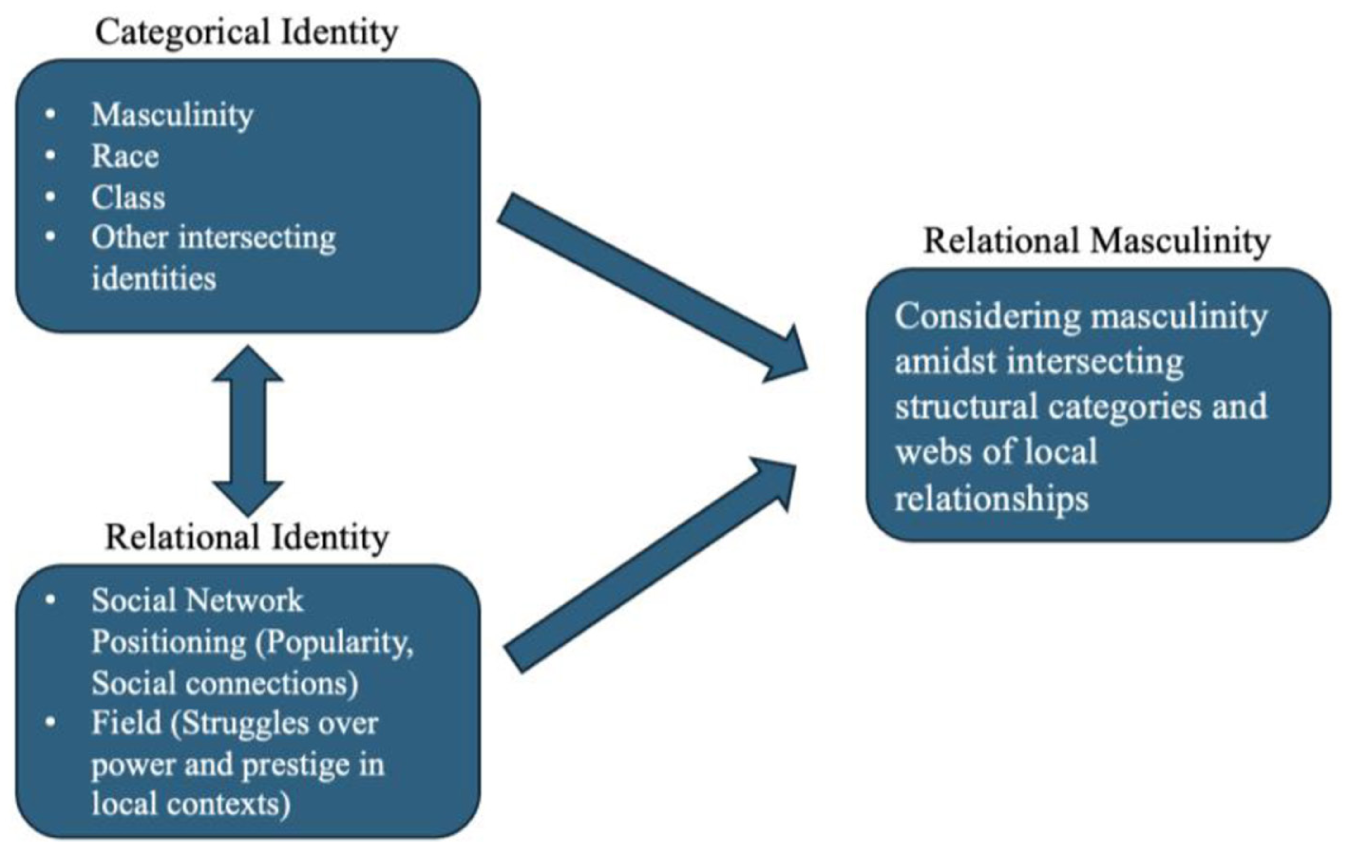
Relational Masculinity.
Data and Methods
Research Site
Sunrise High School endures challenges typical of schools in working-class urban contexts. It was at one point an overcrowded beacon of the Southern California community in which it sits, but it is now visibly under-enrolled and underfunded. A vast campus is sparsely populated. Old buildings are repeatedly marred with graffiti and then covered over with paint slightly mismatched with the original hue. Athletic fields are dry and littered with discarded cardboard lunch boxes and snack wrappers. Behind this façade of decline, however, is a spirit of community and pride. Administrators are energetic and kind. The principal greets each student as they walk into the front entrance at the start of each day. Teachers are predominantly people of color, and many are beloved by their students. Some Black students visit teachers at their houses. Latinx students often joke with teachers in Spanish. Students reject negative framings of their school from politicians and the media. Generally, they like their school. Amid the positive energy, real academic challenges remain. In particular, AP classes are hard to fill, and only a handful of boys take the courses.
Capturing the complex reality of Sunrise High—the persistent challenges and communal possibilities—necessitated a diversity of methods. I looked both to the general patterns of AP participation and to the local processes that shape engagement in challenging learning opportunities. First, I conducted a social network analysis, collecting surveys of AP participation, demographic data, and friendships from 78% of the junior class at Sunrise High, of a total of 164 juniors. Next, I conducted more than 200 hours of participant observations, focusing mostly on two groups of young men (eight in total) who are the focus of this study, each with differing levels of engagement in AP coursework. The data collection occurred between April 2018 and June 2019. The study tracked the students as they began courses in the fall, worked to succeed in them throughout the school year, and decided whether to enroll in AP courses during their senior year.
Data Collection
The social network analysis measured two components of the Sunrise High network: “centrality,” the popularity of students by the number of friendship nominations they received, and “homophily,” the tendency of students to nominate friends who were similar to them in AP participation (a “birds of a feather” phenomenon). While the social network data allowed for a bird’s-eye view of relationships and AP participation, a relational ethnography allowed for a deeper understanding of the cultural meanings and processes at Sunrise High that shape gendered patterns of academic engagement. Relational ethnography (Desmond, 2014) is an ethnographic approach to data collection and analysis that asserts the primacy of relational processes to social outcomes. I focused ethnographic observations on young men inside and outside of the school’s AP program. See Table 1 for a detailed explanation of data collection.
Summary of Data Collection.
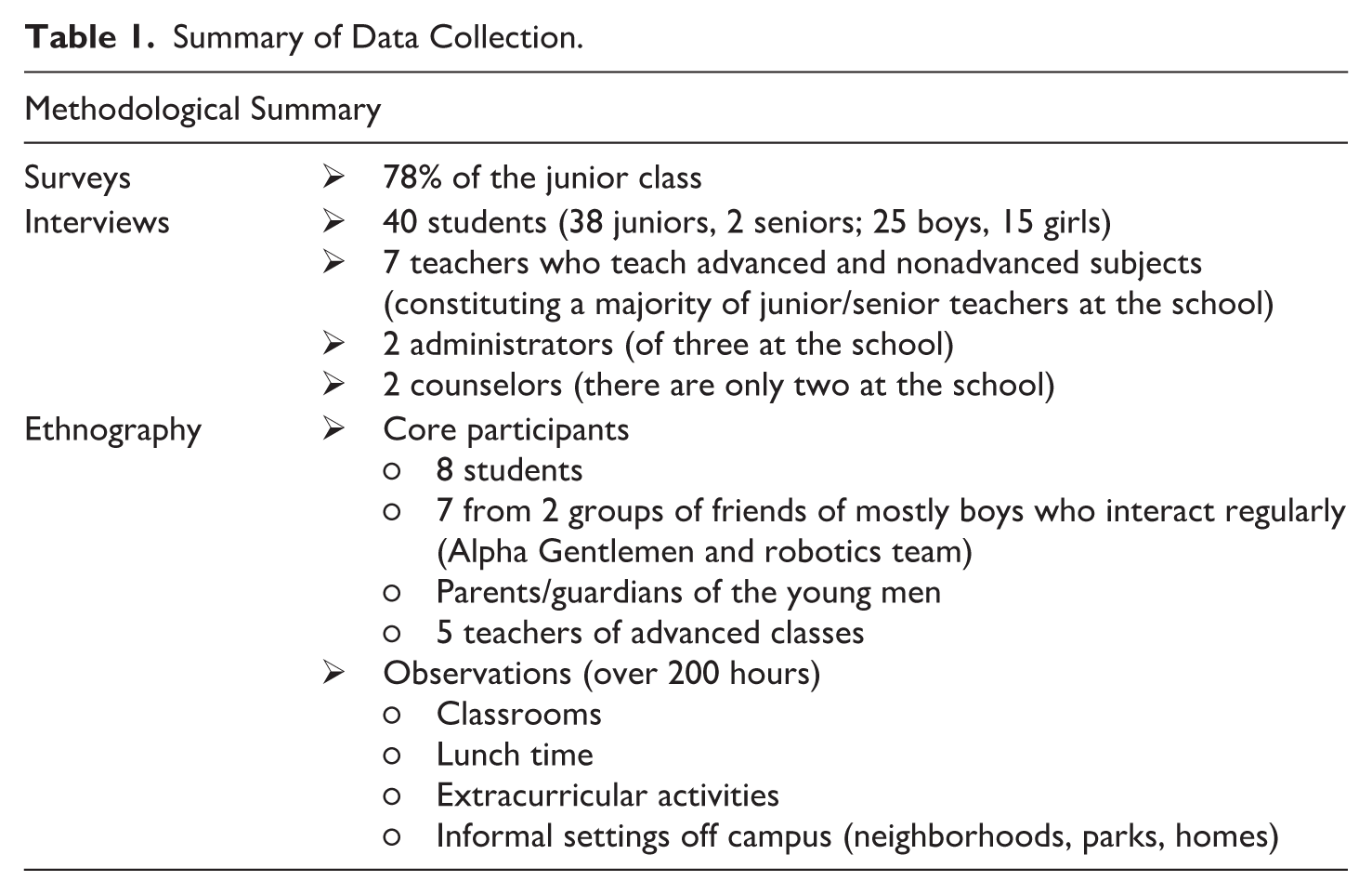
Through mixed-methods research, I sought a “fruitful” combination (Weis et al., 2019) of quantitative and qualitative approaches. Combining methods can allow scholars to capture the complexity of the social world, mapping its broad patterns and its more subtle contours. Such an approach may be particularly important in capturing the relational world (Emirbayer & Goodwin, 1994). Here, the surveys allowed me to map social networks at Sunrise High, while the ethnography allowed me to explore cultural meanings and social processes that produced the statistical patterns found in survey data. Data collection leveraged multiple methods to capture a thorough rendering of masculinity, relationships, and AP participation at Sunrise High.
Surveys
Social network analysis is a statistical approach grounded in graph theory. Social network analysts map relational ties across a particular network. They analyze social processes by way of two network components: ties between individual actors, and the social structure of the broader network (Scott, 2017). First, the structure of the network in which actors are embedded can impact outcomes. On an individual level, one’s network “position” matters. A node with many alters is deemed “central” in the network. Centrality can have important implications for social outcomes (Scott, 2017). Central actors can leverage relational ties for resources or can associate behaviors with social prestige. Whether a particular behavior, such as advanced course participation, is associated with network centrality can be measured by social network analysis. Network structures influence how actors within them engage in the social world. Social network analysts also seek to understand homophily: whether network ties exist between social actors with similar characteristics. In the context of AP participation, homophily means that students who take AP might tend to be connected with other students who also take AP. Although social network analysis looks to a variety of network properties to understand social phenomena, I focus here only on centrality and homophily for their associations with challenging academic engagement among young men.
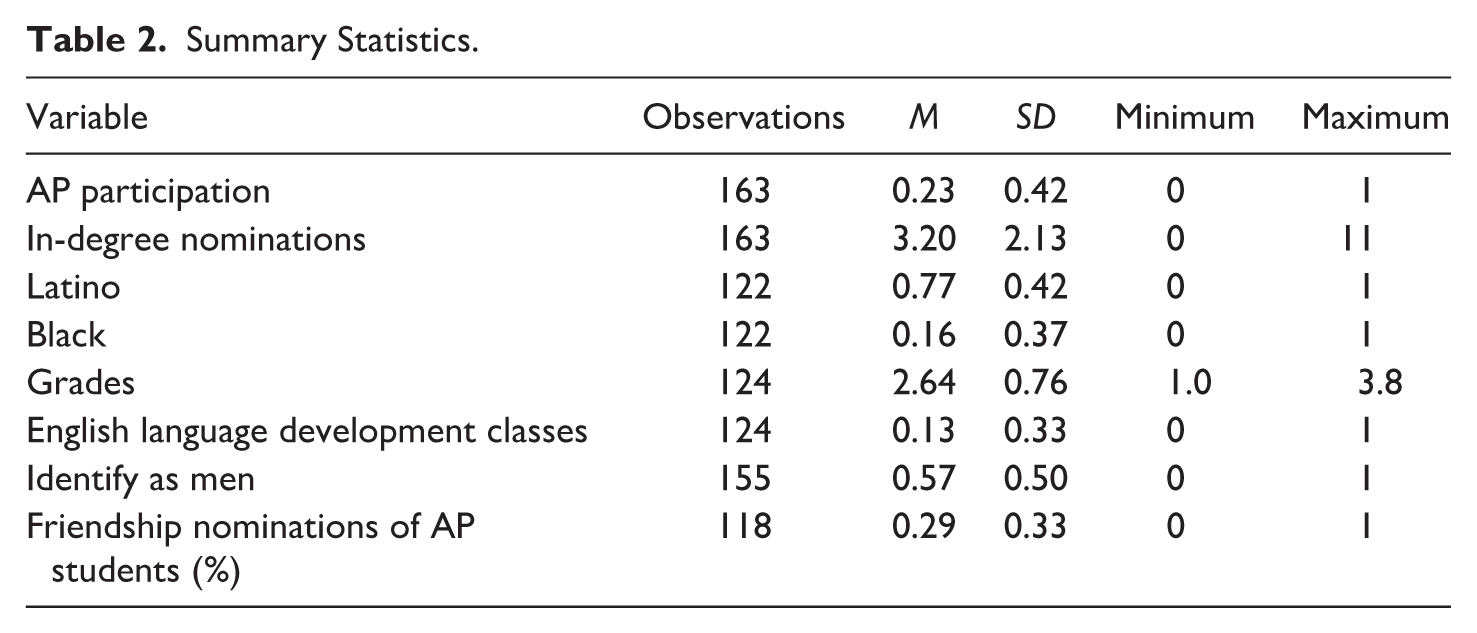
For this study, I received completed surveys from 78% of the junior class, a completion rate that can compensate for some of the negative impacts of missing data in social network analysis (Kossinets, 2006). The survey asked students to report their friendship ties and academic and extracurricular experiences (see Appendix). The statistical data used in this study were obtained from surveys and school enrollment data. The ELD status and AP course participation were determined by enrollment data. Friendship nominations, race, gender, and grades were determined from student surveys. Students reported their typical grades (mostly A’s, A’s and B’s, etc.) and not a specific GPA because many students likely were uncertain of their GPAs. I then estimated their grades as a GPA on scale from 0 to 4 points. I also asked about other factors such as extracurricular participation and beliefs about competition and peer support. The full survey is included as an appendix, and the summary statistics are detailed in Table 2.
Summary Statistics.
Ethnography
Interviews and observations allowed me to elevate the social processes that shaped the survey findings. The survey was completed at the end of the 2017–2018 school year so that over the summer, I could begin to work on recruiting students for interviews. For the first week of school in August, I observed AP and non-AP classes and refined my interview questions based on my observations. Most of the interviews were completed in the first month of school. However, I continued to conduct interviews sporadically throughout the year as I came across more students and staff with experiences relevant to my research questions. After many of the interviews, I recruited participants for the in-depth ethnographic portion of the study. Those observations, representing the bulk of the research, took place from October 2018 to June 2019. Most observations took place in classrooms, where I observed student engagement and relationships in and out of AP classes. However, I also spent time with students outside of class, focusing mostly on eight young men in two distinct social groups at Sunrise High. I visited their homes, met with their parents, and connected with their friend groups at lunch and during extracurricular activities. In all, I spent more than 200 hours observing at Sunrise High and in the surrounding community.
My positionality as a brown, multiracial man in his mid-30s shaped my observations. I looked young enough to be a (much) older sibling to the young men I worked with, and I had robust experience working with youth in schools. Though I had not been connected to the school before, and did not initially know the students, many eventually saw me as a relatable mentor who they could reach out to for advice. I felt at ease when we spent time in informal settings, and we spoke openly about personal aspects of their lives. That said, there was a distance between us based on age and class. I was a middle-class parent with two kids at home. They were teenagers in working-class contexts. While I could present myself as a mentor to them who would listen to their challenges, understanding their experiences was a challenge—after data collection, I drove off to my private graduate university or my suburban neighborhood home. To address this distance, I sought to achieve trustworthiness (Guba, 1981) of the data, and I detail those methods in the ethnographic data analysis discussion that follows.
Data Analysis
Social Network Analysis
I used regression and social network tools to investigate the impact of relational contexts on AP participation. All data were taken from the surveys distributed to students in spring 2018. I analyzed survey data using STATA. In addition, I used UCINET, software designed specifically for analyzing social network data. UCINET computes statistics that summarize social network structures such as homophily and centrality and allows for visual representations of the network. The analysis of social networks considered centrality and homophily.
Regarding centrality, I ran logistic regressions to test whether network centrality (number of in-degree nominations) predicted AP participation as a categorical variable (0 = not in any AP classes, 1 = in at least one AP class). This process included two models with slightly different control variables. In the first model, I tested whether AP participation could be predicted by in-degree nominations, controlling for race (Black and Latinx) and English language status (0 = not in English language development courses, and 1 = in English language developments courses). I conducted separate analyses for girls and boys to qualitatively measure differences in how in-degree nominations predicted AP participation. In the second model, I ran the same logistic regression controlling for grades (0.0–3.8) as well. This allowed me to test the extent to which relationships between AP participation and in-degree nominations were moderated by grades.
As such, the two equations are as follows:


I ran two tests for homophily in AP class-taking among school friends. First, I measured the extent to which ties were homophilous in AP class-taking for the entire network (which includes boys and girls, and the friendship nominations among them). I used two tests: Moran’s i test and Geary test. Moran’s i test measures the percentage of one’s ties that hold a similar characteristic. AP participation was treated as a dichotomous variable, and the percentage of like-ties is reported and measured for statistical significance. The Geary test measures the extent to which one’s ties are similar rather than identical. Thus, AP participation was treated as a continuous variable (0–4 AP courses) and student ties were tested for similarity (e.g., a student taking 3 AP classes was more similar to a student taking 2 AP classes than they were with a student taking 0 AP classes). Then, I tested homophily for boys’ and girls’ friendship networks separately (testing all of their ties for sameness on AP course-taking). I ran tests for homophily on AP participation using a dummy variable and fitting a linear regression to test the relationship. The regression reported the association between AP participation and the percentage of friendship nominations that were also in AP classes. This test allowed me to compare the homophily of AP participation between young men and women using the same control variables from previous analyses. The regression equation is

Ethnography
Ethnographic data collection and analysis occurred concurrently. I typed up field notes within a few days of each observation. I transcribed each interview after completion and subsequently conducted more interviews. Though the larger project included 40 interviews of boys and girls, the analysis for this study involved only the interviews with eight boys, who are the focus of the ethnographic portion of this study, and their teachers. I wrote analytic memos intermittently throughout data collection, and the memos suggested emergent themes that informed subsequent investigations. The iterative process allowed for flexibility throughout data collection.
I coded the data concurrently with data collection as well, combining deductive and inductive coding processes. Initial codes were grounded in theoretical frameworks of relational sociology and intersectionality. I read transcripts and field notes for social processes stemming from relational contexts and identities such as race, class, and gender. Subsequent codes emerged from the data, and I used both in vivo and descriptive codes to capture them. Once codes began repeating, I stopped creating new codes and made a codebook of 14 codes—four parent codes and 10 subcodes—which I used to code the remainder of the data. Approximately the last half of the data were coded with the codebook, and previously coded data were re-coded to match codebook codes. Codes included concepts such as perceptions of advanced coursework, interpersonal relationships, and status. These codes were applied to student utterances and observations to make sense of how different boys were making sense of their involvement or noninvolvement in the most academically challenging classes at their school. After coding, I organized data into themes. Building from the categories illuminated in the coding process, I outlined core concepts that had emerged from the data.
In analyzing data, I sought trustworthiness. As argued by naturalistic methodologists who have established the boundaries of qualitative methodologies, trustworthiness of data necessitates transferability and credibility (Guba, 1981). I pursued these objectives in three ways. First, I aimed for “thick description” in field notes and data presentation to address the extent to which findings at Sunrise High might be transferable to other contexts. Second, when possible, data were corroborated. If one student mentioned an occurrence, I sought to triangulate that information from another interview or observation. For example, when a student complained about his AP Biology teacher, I consulted with the teacher, other students, and my own observations in the class to clarify their interactions in that course. Third, I conducted member checks. After the completion of data collection and the development of key themes, I read back my finding about each student to them, confirming that the events occurred as I had reported them. In doing so, I sought to convey to readers a reliable account of the social world at Sunrise High whose findings can be reasonably applied to similar contexts.
Through data collection and analysis across multiple methods, I was able to see broadly and deeply into young men’s experiences at the high school. Understanding how young men consider AP participation in relational networks necessitated both of these lenses. The survey data allowed for a holistic view of gender, relationships, and AP participation at Sunrise High. Patterns emerged that would not have been apparent with ethnographic methods alone. However, looking at these broad patterns elides the processes that would produce them. Through ethnography, the how of gender, relationships, and AP participation emerges. Even if this how might not be true in all cases across the high school, it offers a processual account that can be logically considered (Luker, 2009) within this context and others. Through mixed methods, “qualitative and quantitative research [are] used together produce more complete knowledge necessary to inform theory and practice” (Johnson & Onwuegbuzie, 2004, p. 21).
Findings
Though a slight majority of the student body were young men, young women outnumbered young men by almost two-to-one in the AP classes available to the junior class. Only 17% of the junior class boys participated in at least one AP course. These initial data suggest that AP participation is not popular among young men at Sunrise High School. Interestingly, however, the social network analysis data suggested that young men in AP were popular. Despite the scarcity of young men in AP classes, the young men who did participate in AP were among the students with the most friends at the school. Ethnographic data nuanced this finding further. Young men in my sample in the most AP classes saw themselves as unpopular, and those in my sample outside AP classes envisioned themselves as among the highest status students at the school. This disparity—between what I call interpersonal popularity and reputational popularity—is what I present here. First, I present data from social network analysis at Sunrise High demonstrating how young men are positioned in the school’s social networks and their participation in AP classes. Next, I present data from my ethnographic research at the school, elevating how young men’s experiences and understandings of social status shaped their willingness to tackle challenging academic coursework.
Social Networks and AP Participation Among Young Men at Sunrise High School
Students were embedded in crisscrossing friendship groups that bound them together and shaped their scholastic endeavors. Students’ academic outcomes were linked to those of their peers. In Figure 2, I map out those links. Each junior who took my survey is indicated by a shape—a circle for the young women and a triangle for the young men—and each arrow is drawn to a person they nominated as a friend on the survey. Students in green are in at least one AP course. Students in red take no AP courses. The patterns I outline here—the relative popularity of AP young men and the homophily of relational ties—can be visualized by way of Figure 2. The relative absence of green triangles on the outskirts of the network suggests the centrality of AP boys, and the density of AP participants connected on the center-left portion of the graph suggests homophilous ties among AP participants who tend to be more central in the network.
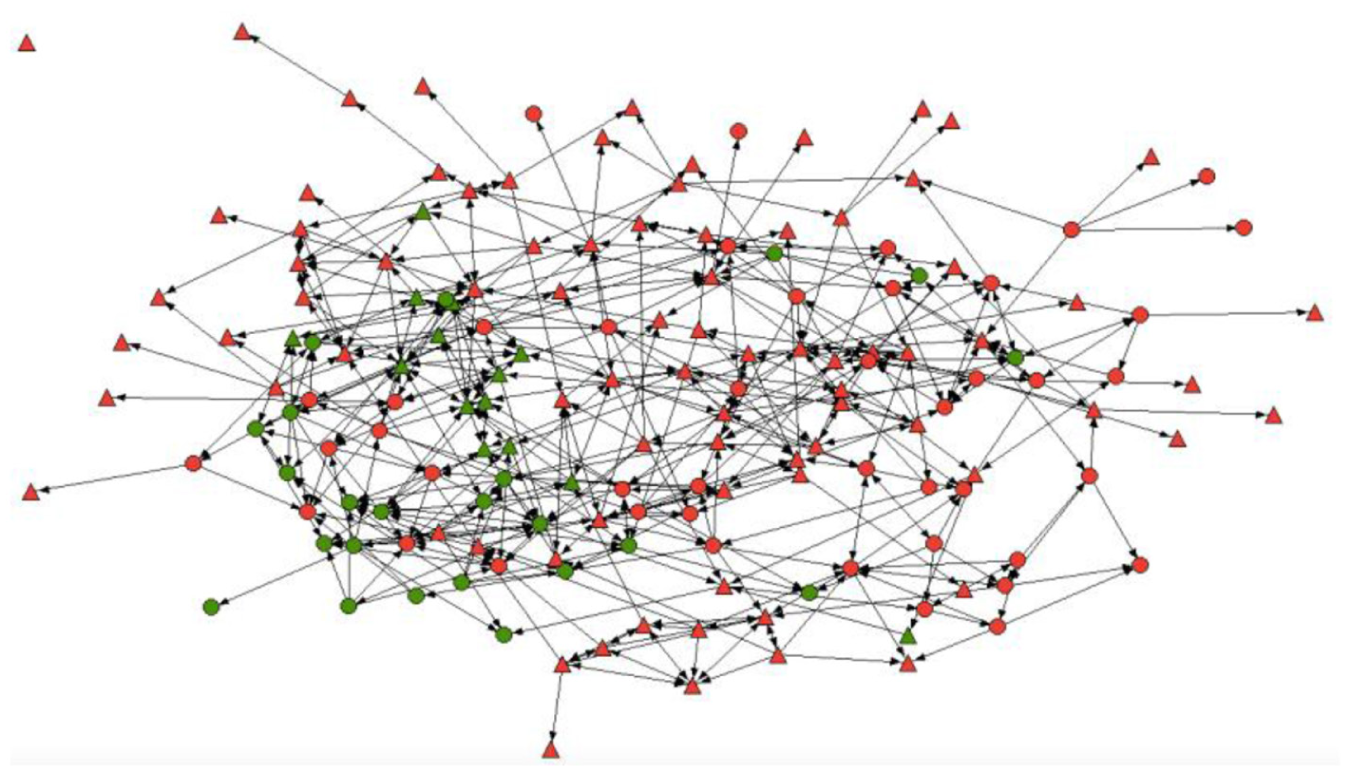
The Social Network of the Sunrise High School Junior Class.
Next, I present social network data that quantify these links. Specifically, I focus on two elements of the social network and the ways in which they are patterned with AP participation. First, I look to social position (i.e., popularity), analyzing how in-degree network centrality is associated with AP enrollment for boys and girls. Next, I look to relational ties, highlighting the ways in which ties are homophilous along the lines of AP participation. I also present these data by gender.
Social Position
The social network data from Sunrise High undermined the trope of the socially awkward AP nerd. AP boys were central in the network—on average, more people nominated them as friends. Given dominant conceptions of urban masculinity, one might expect that young men would pay a social price for participating in AP. “Coolness” among this population would preclude participation in challenging coursework. Surprisingly, however, AP participation was associated with higher popularity for young men of color at the school. Specifically, for boys, one additional in-degree friendship nomination was associated with a 39% increase in odds of AP participation (p = .03). AP girls did not have the same popularity gains associated with AP participation as the young men (~12% increased odds), and the relationship was not statistically significant (p = .46). See Table 3.
Logistic Regression Predicting AP Participation for Boys and Girls at Sunrise High School (odds ratio).
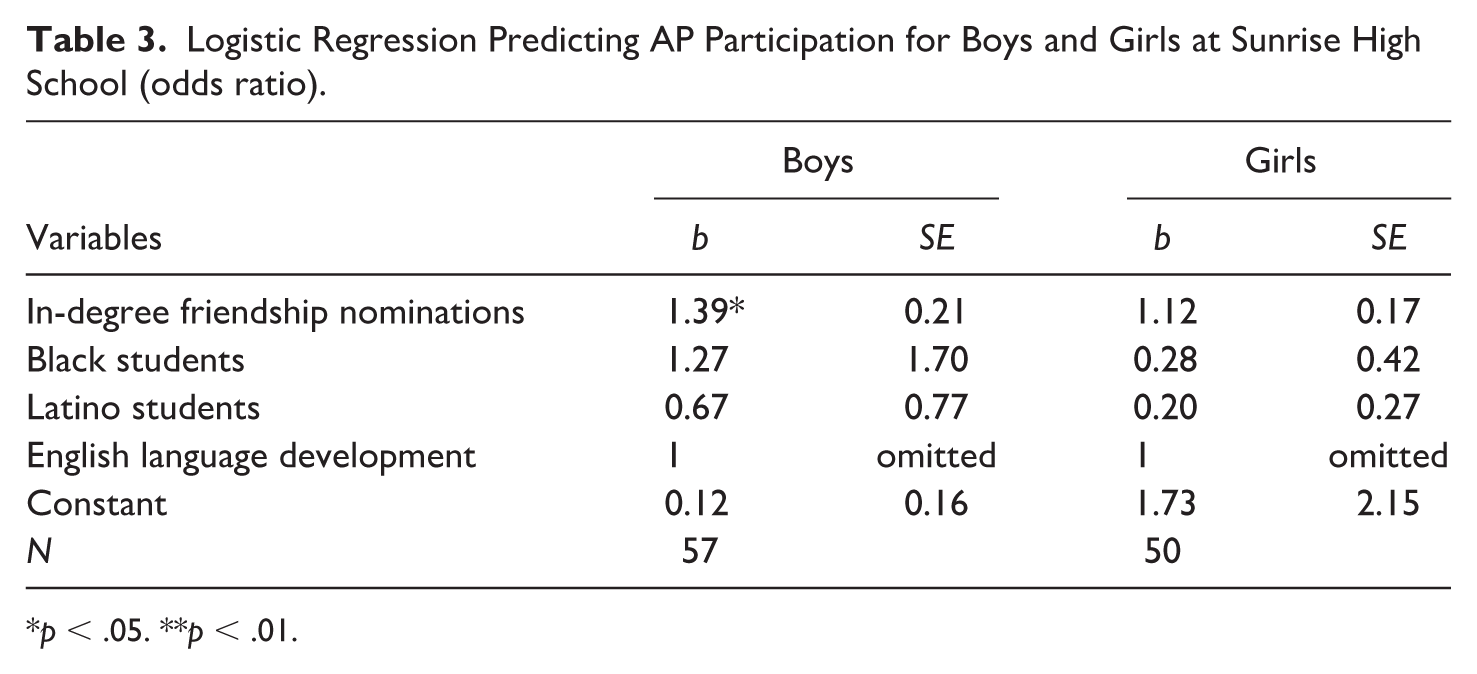
p < .05. **p < .01.
Grades partially moderated the relationship between friendship nominations and AP participation (see Table 4). Controlling for grades in addition to the other variables in the model, one additional in-degree friendship nomination was associated with a 26% increased likelihood of AP participation (p = .15), down from 38% in the previous model. For women, after controlling for grades, in-degree friendship nominations are associated with a 12% lower likelihood of AP participation, eliminating the positive association between in-degree friendship nominations and AP participation from the previous model. Young men with more friendship nominations were more likely to participate in AP at Sunrise High.
Logistic Regression Predicting AP Participation for Boys and Girls at Sunrise High School (odds ratio).
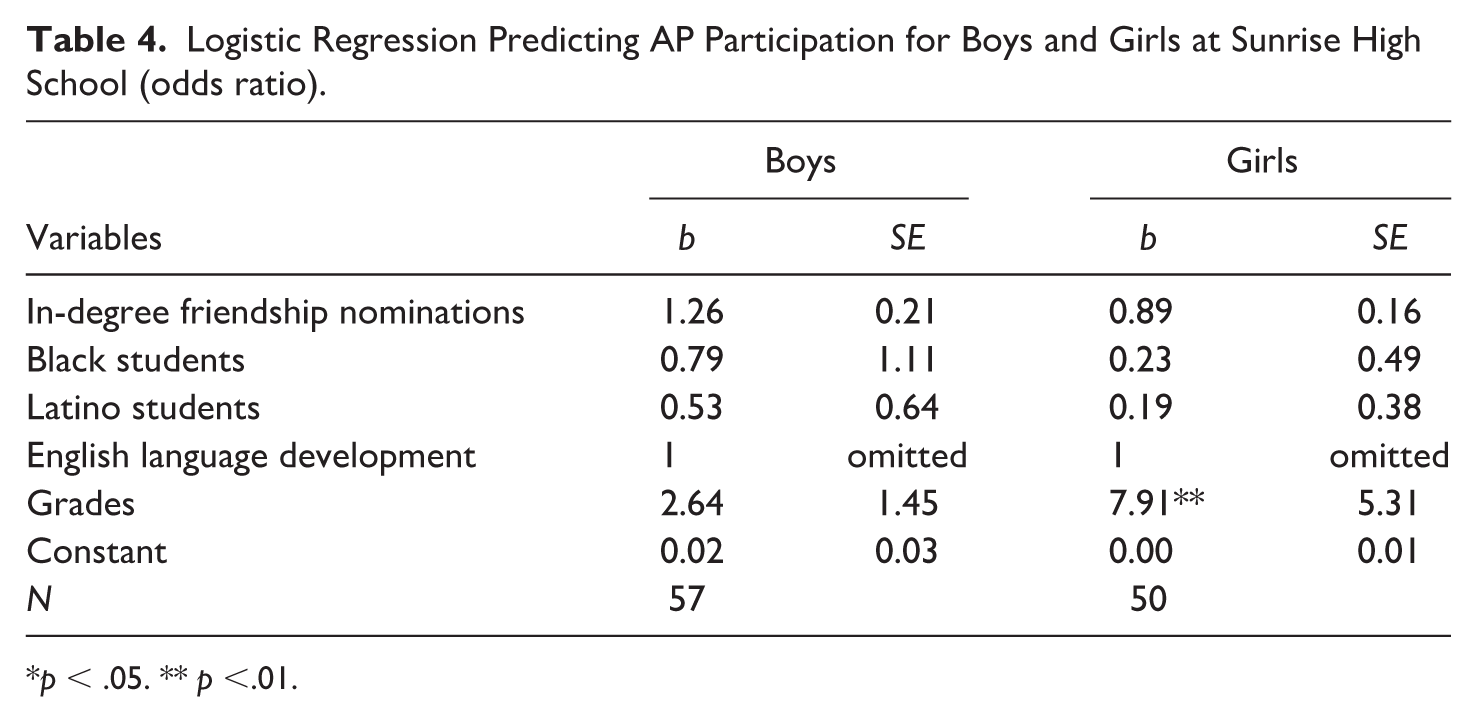
p < .05. ** p <.01.
Relational Ties
To further investigate the role of relationships in AP course-taking, I used social network analysis tests for homophily to measure the extent to which students were friends with peers with the same AP participation (or nonparticipation) as themselves (also called “network autocorrelation”). The statistical tests of network homophily found strong and statistically significant associations between network ties and AP participation. Students were much more likely than random to report friendships with other students who were taking the same types of classes. I ran two tests that each measured homophily slightly differently. The results of the first Geary test found network autocorrelation between the number of AP classes (0 to 4) and friendship ties to be .559 (where 0 = no correlation and 1.0 is prefect correlation) and p value of less than .001. This finding suggested that students in higher numbers of AP classes were more likely to be friends with students who were also taking a high number of AP classes. The same was true for students who took few AP courses. The results of the second Moran i test, where AP participation was coded as a dichotomous variable (1 = takes AP classes, 0 = does not take AP classes), assessed the extent to which students who were in at least one AP class were associated with one another, and did the same for students who were in no AP classes. Like the findings supportive of homophily in the Geary test, the Moran’s i statistic indicated that in-group ties (i.e., ties to peers with the same AP participation score) were significantly more likely than out-group ties. Again, the presence of a tendency toward homophilous ties was statistically significant (p < .001). For the Moran’s i tests, homophily appeared to be mostly driven by AP students nominating other AP students over non-AP students at a rate of nearly six-to-one (density of friendships sent from AP students to other AP students was 6.2%, while the density of friendships sent from AP students to non-AP students was 1.3%). See Table 5 for complete statistics.
Moran Test of Density of Ties Between AP and non-AP Students.
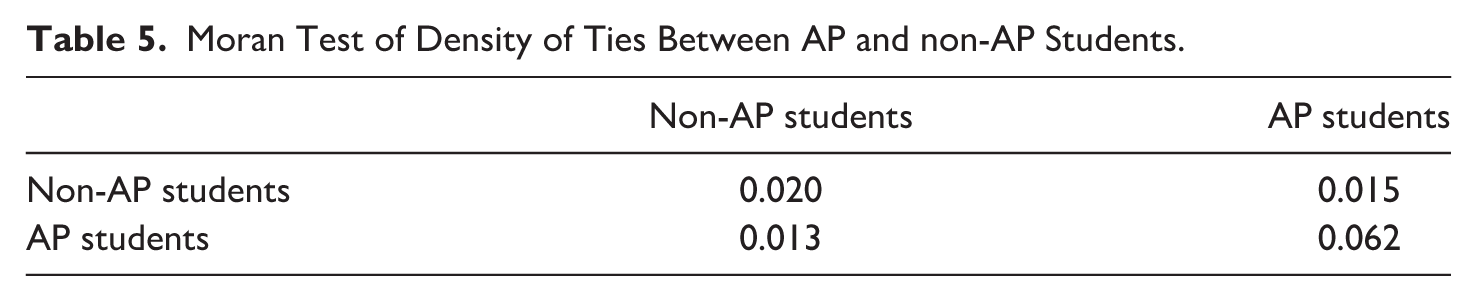
UCINET analyses were incapable of comparing homophily by gender. Using STATA, I fit a logistic regression comparing AP participation and percentage of friend nominations who were also in AP. Separating the data by gender, homophily along the axis of AP was positive for both boys and girls. However, the observed homophily was stronger among young men than young women. Using logistical regression analysis and controlling for all the variables in the model, I explored the likelihood of homophilous ties in separate regressions for girls and boys. Table 6 reports the likelihood of homophilous ties by AP for both boys and girls at Sunrise High. Going from 0% of friendship nominations in AP to 100% of nominations in AP was associated with 79 times greater odds of participation in AP for young men (p = .001). While women whose friends were all in AP also had higher odds of being in AP, the association was statistically insignificant (p = .3) and smaller (a threefold increase in odds of AP participation). Overall, these data suggest that boys are more likely than girls to report friendships with students who take similar types of courses.
Logistic Regression Predicting AP Participation (odds ratio).
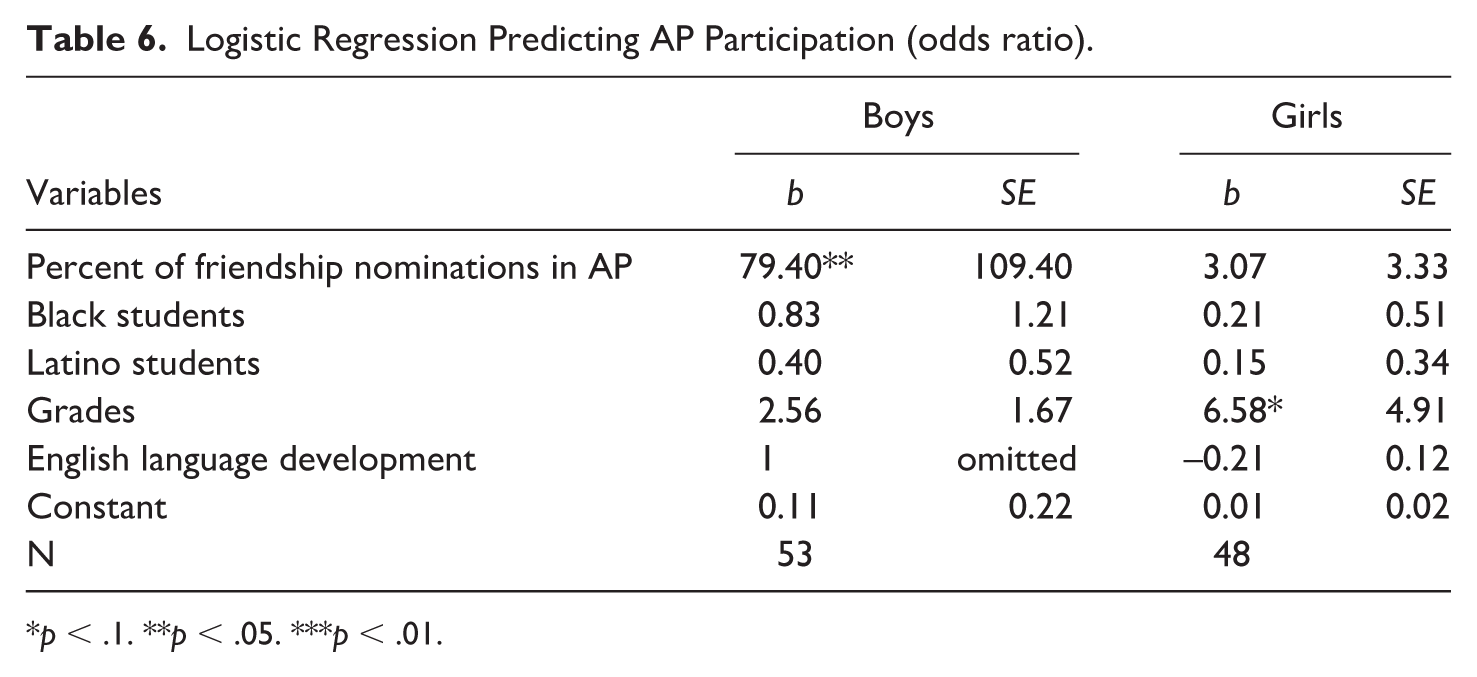
p < .1. **p < .05. ***p < .01.
The data are suggestive of the important role that relational ties might play in AP participation for young men—namely, that friendships and social positioning might influence how young men engage in AP classes. Young men with a higher percentage of friendship nominations were more likely to be in AP classes. Young men whose friends were in AP classes were almost 80 times more likely to be in AP classes themselves. These patterns appeared less significant among young women at the school. However, because these statistics are cross-sectional, causal inferences are uncertain. Multiple processes might explain the existence of the similarity in AP participation between students and their reported friends. First, inferences from these statistical analyses must negotiate the potential for revere causality. One might argue that friendships and social positioning influence AP participation; alternatively, AP participation might also influence friendships and social positioning. For example, students might join AP classes because they have friends in the class, or they might make friends with people in their AP classes. The direction of the relationship cannot be discerned from the cross-sectional data. Second, some unobserved variable might be driving a spurious relationship. For example, perhaps socially outgoing students were more likely to take AP and more likely to make friends driving the observed homophily. Thus, the survey data spoke to the importance of peer networks, but more work is to be done. What is behind these statistical relationships deserves further investigation. Interviews and observations of young men at Sunrise High can help to disentangle the processes behind these patterns.
Status, Relationships, and AP Participation among Young Men at Sunrise High School
The presented findings may be somewhat surprising. On the one hand, aligned with larger patterns of gender and AP participation, young men were much less likely to be enrolled in AP classes. On the other hand, those who that did enroll were more likely to be nominated by their peers as friends. The prevailing patterns of AP enrollment by gender suggested that masculinity was averse to academic challenges. However, those students who defied masculine expectations were seemingly rewarded with more friendships. At Sunrise High School, did AP participation make young men popular? Was AP considered the “cool” thing to do?
Ethnographic data revealed two processes at the intersection of popularity and AP course-taking. In what follows, I outline how reputational popularity—young men deemed popular by way of participation in exclusive social circles who sought to maintain distinguished reputation around campus—discouraged AP participation. Meanwhile, interpersonal popularity— enjoyed by young men who described robust friend groups—encouraged AP participation. These relational processes informed how masculine social actors considered AP opportunities.
Reputational Popularity
Here, I share data from observations and interviews with three young men—Jordan (0 AP classes), Tayshaun (0 AP classes), and Darryl (1 AP class, but dropped it in the second semester)—who valued reputation as a centerpiece of their efforts at school. Each of these young men was a member of the “Alpha Gentlemen,” or “Gents,” a group of approximately a dozen young Black and Latino men who met Wednesday afternoons to discuss academic and professional success. Though the young men had mostly decent grades, few took any AP classes. The club was selective and highly visible—a small group with a grandiose reputation. Its name was derived from a prominent Black fraternity of which their faculty advisor was a member. The focus on being high status and exclusive had implications for participation in AP. “The Gents got a history of being, the top dog,” one of the young men explained to me. “We can’t accept everybody,” the group’s advisor said. “There’s quite a few that we turn away.” Indeed, the process of becoming an Alpha Gentleman was challenging, entailing multiple steps. The potential Alpha had to first approach the advisor to explain why he wanted to participate and to collect an application. The application required teacher recommendations and a written articulation of the reasons the applicant hoped to be a part of the group. Then, the prospective Alpha Gentleman had to defend his interest in the group in a closed-door session with all fraternity members, who peppered the applicant with questions about his fit and potential contributions to the collective. The Alphas took these applicants seriously, and they carefully considered how the program would benefit the potential member and how the potential member would benefit the group. Reputation was at the center of many of the conversations of young men in the program. “They only care about girls, reputation, and stepping,” one told me about the others in the group.
Jordan, for example, served as the group’s sergeant in arms, aiming to protect the group’s status on campus. He said, “I enforce the rules . . . I’m basically, you could call it the muscle of the group . . . I don’t want a bad reputation for the Gents.” Jordan earned decent grades and lamented whenever he earned a C. “I don’t want to be average,” he told me. He resisted AP because he was worried about trying to keep up with the pace of work. “I don’t want to set myself up in a position where I might fail a class, when I can just take a regular class.” Indeed, time was thin. Much of Jordan’s time was spent securing his place atop the social hierarchy. He viewed the Alpha Gentlemen as the most popular students on campus. “We are more active around school, we step, we’re social, everybody knows us,” he said. “We friendly and sociable, we don’t cause any problems with anybody. Everybody just like us.” Relatedly, I watched Jordan on his birthday entirely ignore a chemistry lecture, talking with a young woman next to him and perusing the birthday messages he received “all over Snapchat.” In the tension between curating reputation and learning chemistry, reputation won out.
Darryl, similar to Jordan, described himself as distinct from the “try-hards” in AP classes. “I just want to get my grades, graduate, and enjoy my life,” he said. In class, Darryl aimed to entertain, and he found that his goofiness endeared him to other students in his classes.
People start coming around you more. You know, people like funny people. They come to you . . . get a laugh or something, you know? Like this dude right here. [Darryl points to a young Black man walking past us.] He's funny. Goofy kid. I like hanging out with him. He goofy.
Darryl said he and his peers placed their energy in making friends, being “goofy,” and talking to young women. He described himself and his peers attempting to balance commitments to significant others against a desire to interact with many young women. “We Alpha Gentlemen. We like females, so we talk to females. A lot of girls finding out that we’re talking to some of them, so they be upset. . . . we got to attend to our reputations.” When I asked Darryl who the popular kids at school were, he said, “All the Alpha Gentlemen. Simple as that. That’s easy. Kids will tell you. Everybody will tell you. All of them. . . . The girls, even some of the guys, you got people who want to be in the club.” Reputational concerns had academic costs for Darryl as well. Darryl had enrolled in an AP class early in the year, but he left the course because he and the teacher clashed over his classroom playfulness and lack of work completion. Darryl enacted a goofy, enigmatic persona that prioritized social status over academic success.
Tayshaun was less outgoing than Jordan and Darryl, but he sought out the Alpha Gentlemen for the exclusive social circle. He said when he initially transferred to the school at the end of freshman year, he “kind of fell into the wrong crowd.” He explained, “I used to ditch a lot, and like when I’d come to class, I would get a weird reaction, like “Oh, [you’re] still in this class?” Upon joining the fraternity, Tayshaun severed his old relationships with less focused peers, purposely shrinking his social circle. He occasionally saw an old friend on campus, but said, “If I see him, I’ll be like ‘what’s up,’ shake his hand, and keep it pushin.’” Tayshaun described his relationships with the Alpha Gentlemen as incredibly tight-knit, and said, “they are like my brothers.” His old relationships were supplanted with these new ones. Tayshaun credited the tireless Alpha Gentlemen advisor, Mr. Carpenter, for getting him on track. He now says he gets “mostly Bs” but has spurned opportunities to join AP. In class, his focus wavers depending on the lesson—I watched him play an entire game of Madden football on his mobile phone in science but eagerly answer questions about immigration in history—but despite his new academic focus driven by the club, Tayshaun’s peers did not push him toward AP participation.
By way of visibility and exclusivity, Alpha Gentlemen’s social positioning seemed to limit their engagement with AP. They took on playful personas that inhibited their academic focus in class. Their humor and play reaffirmed their status position among their peers who viewed them as social leaders. Additionally, they dedicated much of their personal time to social considerations such as parties, performances, and romantic interests. Although they sought good grades, and conversations would occasionally focus on how to maintain them, they reported not encouraging one another to take difficult classes. The deliberately tight-knit, exclusive nature of their group precluded broad friendship networks that might encourage more challenging academic engagement. Efforts to secure their reputations within their exclusive club proved prohibitive to participation in AP.
Despite the perception among many Alpha Gentlemen of their widespread popularity, these three young men received fewer than the average number of friendship nominations on the social network survey. Darryl received three friendship nominations. Tayshaun received two. Jordan received one, all below average. Their perceived position as school leaders contrasted with survey data suggesting that few students saw them as friends. The Alpha Gentlemen were concerned about their reputations. They perceived themselves as the most admired and well-known students at the school, and their club was exclusive. The lack of interpersonal connections with their peers and dedication to status maintenance appeared to impact their willingness to participate in the school’s most challenging courses.
Interpersonal Popularity
In a sample of 164 juniors at Sunrise High, only six students received more friendship nominations than Lucas, who received seven. Based on my social network analysis, Lucas was among the most popular students at Sunrise High. In my time talking with students and teachers, however, I found that while people liked Lucas, few would place him as one of the “cool kids” at the school. Lucas did not perceive himself to be as revered as the members of the Alpha Gentlemen. Lucas explained, “I know I'm not gonna be the coolest guy, as long as to me, as long as my friends like me, that's good.” Indeed, Lucas was mostly uninterested in some of the more common concerns of teenage boys, such as sports, romantic relationships, fashion, and popularity. Lucas’s hair was in a perpetual state of dishevelment. His parents contrasted him with his sister, who obsessed over her stylish wardrobe. Lucas wore whatever they bought him. He played on the volleyball team but mostly sat on the bench. He spoke infrequently, and when he did, his voice carried no farther than an arm’s length. Nonetheless, surveys suggest that Lucas had many friends. For AP students like Lucas, who took three AP classes, their interpersonal popularity provided numerous relational pathways to deeper engagement in academic challenges. Young men in AP classes discussed being less concerned about status, but they tended to have more robust social networks. The socialization of young men toward AP participation seemed to be occurring at least in part by way of their relational ties.
To Lucas, notions of reputation and hierarchy were largely inconsequential, and he engaged in his schooling and social interactions in a way that invited academic collaboration. “I was never raised to put myself above everyone else,” he said. “If someone does try to confront me to prove they are better, don't worry about it. If they're better than you, that doesn't matter.” This egalitarian spirit shaped how Lucas engaged with his peers. Lucas participated in engineering and robotics clubs that were centered on collaboration and ingenuity. He and his immediate friend group made course-taking decisions together, committing to supporting one another in the process. In deciding whether to enroll in AP World History, Lucas described an elaborate back and forth with his closest friends. “They were pretty much confident the whole time. . . . So then I wanted to be ready with them.” Though they ultimately backed out of AP World History as sophomores, he and his friends signed up for AP U.S. History as juniors. In multiple AP classes, their conversations veered frequently to academic challenges and opportunities—a stark contrast to the experiences of the Alpha Gentlemen.
David was one of the friends in Lucas’s closest circle and was also a participant in the engineering and robotics clubs. He largely agreed with Lucas’s assessment of popularity and was uninterested in being considered “popular.” He explained, “There’s this bad side of being popular. It makes you seem as unapproachable.” David was profoundly approachable. His sociability is captured by the nickname, “Mayor Díaz,” given to him by his science teacher. When a man with David’s last name ran for mayor, David’s widespread appeal earned him the nickname. Unfortunately, when the candidate lost, the science teacher told me she had to change his nickname—he could no longer be Mayor Díaz. “Sadly, Wiener won again,” said David, chuckling childishly about the name of the mayor who defeated Díaz.
Like Lucas, David had a large group of friends (nominated six times on the social network survey) and engaged his friends regularly to consider class work and academic opportunity. In one class with a substitute, David and Lucas were the only two students in the course who were completing work. They checked in on each other sporadically throughout the period while other students excitedly shared Snapchat stories and played online games. Though students approached the boys occasionally to socialize, the pair stayed focused for most of the period on their assignments. David found inspiration in the academic focus of his friends such as Lucas. He explained, “So if you stay with them, and stick with them, that mindset kind of rubs off on you, and you tend to do the same thing,” he explained.
Farrel, a Black young man in a different friend circle than Lucas and David who received five friendship nominations from the Sunrise juniors, took a similarly resistant stance against the notion of popularity. “A lot of football players care about it. I guess they want to be really well-known, go to every party and all that . . . I just don't care. Because I hate the popular word . . . I'm just a normal person.” Farrel also described leveraging friend groups to walk with along a coordinated academic path. Farrel recalled his initial entry into AVID in middle school: “[An administrator] said, ‘You want to be an AVID for your seventh and eighth grade year? Go to the middle school to sign up.’ So we all went together.” Again, a collectivist spirit shaped his academic and social endeavors and encouraged college preparatory pursuits.
Many of Farrel’s friends were now in the AP Biology class, where they leaned on one another for academic support. Farrel discussed his relationships with the other Black and Latino young men in the course:
I'm friends with all of them. And we all challenge each other in the class to do our work. We just challenge each other. . . . We all have group chats for classes, and if we are all having a problem . . . we all get on the phone. We are talking to each other trying to figure the answer to the question.
For Farrel, a resistance to hierarchical conceptions of popularity produced opportunities to engage with many peers and to get broad support in challenging classes.
These AP students—Lucas, David, and Farrel—were popular. Their popularity, however, was more subdued and inclusive than that of the Alpha Gentlemen. They were not highly visible on campus. They spoke little of parties or romantic interests. They interacted with many students, and amid the breadth of friends and their interests, their conversations were often academic in nature. They made academic decisions in collectives and preferred collaboration to competition. Their lack of interest in the status hierarchies of their high school created the context for large, nonexclusive friend groups and collectivist academic efforts. Their social lives and visions of masculinity were distinct, and they earned more friendships and more academic opportunities than the more visibly popular young men at their school.
Certainly, not every young man who enjoyed interpersonal popularity was in AP classes. Of the 13 young men in 11th grade with six or more in-degree friendship nominations, seven took no AP classes at all. However, in comparison with the 17% participation rate of boys generally at Sunrise High, friendship nominations were strongly associated with AP participation. In conjunction with the social network data indicating that young men in AP have more friends, the experiences and perspectives of Lucas, David, and Farrel suggest that social positioning can influence academic engagement for young Black and Latino men at Sunrise High.
Discussion
The under-enrollment of young men in Advanced Placement at Sunrise High School was unsurprising. Numerous scholars have delineated the challenges of young Black and Latino men in schools (Carter, 2005; Ferguson, 2020; Morris, 2012). Nationally, they participate far less frequently in AP than their peers (Kolluri, 2020). Understanding how young men become participants in their school’s most academically challenging courses was the driving force of this investigation. As others have noted (e.g., Warren et al., 2016), young men’s underrepresentation in AP is not due to cultural or individual deficits. Rather, young men of color face systemic oppressions that constrain their ability to fulfill their academic potential. Yet, as this study emphasizes, despite challenges of masculinity and oppression, many still achieve. In line with relational sociologists (Desmond, 2014; Emirbayer, 1997), I suggest that relational processes and positioning—popularity and friendships—shape young men’s experiences at the intersection of masculinity and academic opportunity.
Who constituted the popular crowd at Sunrise High was a complicated question with important implications for AP participation among young men. This work builds on that of other scholars who have illuminated the multitudinous nature of student popularity (Lusher, 2011; Shin, 2020; Van den Berg et al., 2010) and suggests how distinct experiences with popularity apply to young men considering college preparation. Through a relational lens, I offer two frames of popularity to understand young men’s participation in AP. First, reputational popularity characterized the students who were highly visible on campus and widely known. Second, interpersonal popularity was a measure of friendship ties at Sunrise High. These students could be more subdued, but they tended to have more friendships and thus more potential avenues of support. Through ethnographic investigation, I found that students with reputational popularity were uninterested in AP classes. They dedicated more time to maintaining their perceived elevated social status and kept a more exclusive group. Students with interpersonal popularity, meanwhile, tended to take more AP classes. By leveraging robust social networks, they leaned on trusted peers to facilitate their participation and comfort in academically challenging environments. Thus, the students’ positions in the relational networks of Sunrise High shaped their access to AP classes.
Through analysis of the Sunrise High social network, a clear pattern emerged: Young men in AP classes had more people who considered them friends. From a deeper interrogation of the relational processes these young men were experiencing at Sunrise High, two relational processes emerged that distinguished AP participants from nonparticipants: (1) exclusive versus inclusive friendship groups and (2) social superiority versus egalitarianism. Each of these distinctions underscored relational masculinity and shaped how masculine identities became aligned or misaligned with intense academic engagement.
Exclusive Versus Inclusive Friendship Groups
According to the social network analysis, students with more friendship nominations were more likely to be in AP (p = .03). In one model, one additional friendship nomination was associated with 39% greater likelihood of AP participation for young men (compared with 12% for young women). In a model controlling for grades, this relationship was statistically insignificant (p = .15), but an extra friendship nomination predicted a 26% greater likelihood of AP participation for young men. For young women, the friendships predicted a decreased likelihood of AP participation after controlling for grades. Thus, popularity at Sunrise High predicted AP participation, certainly for young men, and less so for young women.
However, in observing and talking with the young men at Sunrise High in and out of AP, there emerged distinct versions of popularity. Some young men outside of AP perceived themselves to be popular because of their participation in an exclusive club. Darryl, Jordan, Tayshaun, and their peers in their group kept a tight, close-knit social circle that sought to maintain an elevated status in the Sunrise social network. They did not have close relationships beyond their circle. They attended parties, juggled multiple relationships with young women, and connected seldomly and only superficially with young men outside the club. Tayshaun, like others in the group, severed prior relationships when he got involved in the club. Students in AP, such as Lucas, David, and Farrel, had more friends but were less involved in the social events at the school. They did not view themselves as “popular” and expressed distaste for the notion of popularity entirely.
The influence of masculine ideologies might shape these processes. Certainly, young men in AP and young men out of AP performed masculinity differently at Sunrise. Exclusivity mirrored masculine ideals of independence and competition. The Alpha Gentlemen were independent and saw themselves as distinct from the other students at the school. The young men in AP with larger social networks saw themselves as more enmeshed in the broad fabric of the school. They adopted more collectivist ideals less prominent in American visions of masculinity (Kimmel, 2017).
Friendship structures shaped AP course-taking. In more collaboratively inclined, inclusive social groups, young men guided each other toward academic challenges. Their networks of support were more robust, and thus the young men were more likely to encounter friends in AP. This finding is further supported by social network data. Young men in AP had more friendship nominations, and those who reported that all their friends were in AP were much more likely to be in AP themselves (p = .001). The same relationship was not observed among young women. For young men, having a friend in AP seemed particularly important to one’s participation in the program. Indeed, Lucas and Farrel both articulated robust conversations about AP enrollment and academic support in their friend groups. Boys leveraged interpersonal popularity to enroll and succeed in AP.
Social Status Versus Egalitarianism
Relationships at Sunrise High were imbued with ideology. The Alpha Gentlemen valued reputation. They sought to maintain their social standing and worked diligently to do so. They presumed their own popularity and sought the respect of their peers. They performed at rallies, juggled romantic relationships, and were loudly playful in their classes. The AP students, meanwhile, valued egalitarianism: being a “normal person.” They explicitly rejected popularity. They were relatively quiet in school and did not want to be perceived as “unapproachable.” Their easygoing, personable dispositions endeared them to many at Sunrise.
Again, the AP students’ egalitarian approach was in contradistinction to pervasive ideals of masculinity in urban contexts, and the unmasculine nature of their relational identities was aligned with academic engagement. These young men rejected a “hard” (Carter, 2005) “cool pose” (Majors & Billson, 1993) illuminated in prior literature on young men in schools. As such, they unabashedly leaned on one another for support. They expressed vulnerability, reaching out for help on group chats when necessary and sharing hopes and concerns about potential AP enrollment. In seeking reputation and status, the students outside the AP program did not express the same vulnerability. In addition, their reputations required much effort to uphold. Amid the careful navigation of the Sunrise High social dynamics, they lacked time and energy for intense academic pursuits. For the boys in AP, just being “normal” did not necessitate an expenditure of the same amount of social energy. Though all the young men I spoke with had college-going aspirations, young men who adopted a masculinity that elevated egalitarianism over social status were more apt to prepare for college in the school’s most challenging classes.
On Relational Masculinity and Advanced Placement
This study further explores the way masculinity develops relationally in the social world. Masculinity is not preformed and inevitable, with all young men marching gradually toward its pure expression. Rather, masculinity is diverse and relationally constituted. As Ridgeway and Correll (2004) asserted, gender ideologies are constituted in part by way of “social relational contexts.” However, rather than these relational contexts furthering a prescribed vision of gender, the diverse visions of masculinity enacted by the young men at Sunrise High aligned with the heterogeneous conception of masculinity advanced by Connell (2020).
Additionally, how these heterogenous masculinities form is a product of dominant ideologies and relational interactions. While some young men at Sunrise High viewed their masculinity as entwined with social status, others did not center status in their conceptions of identity. Some young men saw popularity and reputation as essential, and others found it problematic. As other scholars have noted (Chen et al., 2020; Fortuin et al., 2016), these different experiences with popularity had academic implications. Young men who saw reputation as a core component of their masculine experiences were less likely to take the school’s most advanced classes. Those young men less concerned with reputation were comfortable in challenging academic spaces.
In this relational analysis, masculinity and academics might be considered different and contrasting fields of practice (Bourdieu & Wacquant, 1992). In the field of masculinity, social status is conferred along lines of exclusivity, playfulness, and social dominance. In the field of academics, collaboration and studiousness convey social rewards. Students leveraged their distinct sets of knowledge and dispositions as well as their networks to gain access to the rewards of these fields. However, the particulars of the fields were often in conflict; blazing a trail in one field might mean erecting barriers in another. These contrasting fields of masculinity and academe create conflict for young men, who navigate masculinity, popularity, and academic opportunity in different ways across the social network of Sunrise High.
The concept of relational masculinity moves beyond seeing young Black and Latino men solely by way of oppositionality (Fordham & Ogbu, 1996; Lundy & Firebaugh, 2005) or oppression (Ferguson, 2020; Musto, 2019; Rios, 2017). Instead, I see young men at Sunrise predominantly as relational, their academic engagement as a function of friendship and social status. While some quantitative studies have demonstrated the numerical value of friendships for young men (Riegle-Crumb & Callahan, 2009) and others have statistically demonstrated different versions of popularity (Lusher, 2011; Shin, 2020; Van den Berg et al., 2010), this study synthesizes and advances this previous work on relationships, gender, and academic achievement. The social network analysis at Sunrise High further underscores the ways that friendships are associated with academic success specifically for young men. Without more qualitative, naturalistic inquiries, however, the sociocultural processes producing these patterns remain clouded. The ethnographic findings emphasize how different visions of popularity impact engagement in challenging courses such as AP.
Of course, elevating relationships is not intended to understate the importance of race. As scholars have noted (Howard, 2014; Morris, 2012), young Black and Latino men are navigating intersecting oppressions that shape the conceptions of their identities—conceiving of them as brutish, anti-intellectual, and criminal—and these perceptions of Black and Brown masculinity can shape their interactions with teachers (Musto, 2019). In schools and society, their masculinity is “marginalized” (Connell, 2020). Perhaps, though, these racializing processes of young men may elevate the importance of relationships. If intersections of race and gender tug young men away from academic engagement, the importance of relational connections to pull them back is amplified. In my observations, young men never discussed explicitly their racial/ethnic or gender identity, but as an observer of their day-to-day experiences, the importance of gender and race was clear. Through a relational method that centers process and cultural meanings (Emirbayer & Goodwin, 1994), I emphasize how Black and Latino boys apply different versions of marginalized masculinity to fields of practice, with significant ramifications for their engagement in the most challenging courses at their urban school.
Conclusion
Scholars have offered a detailed accounting of the struggles of Black and Latino young men between high school and college (Howard, 2014; Noguera, 2003; Saenz & Ponjuan, 2009). Advanced Placement avoidance among young men might play an important role in young men’s academic challenges between high school and college. The findings here shed light on the processes that shape young men’s interactions with academic experiences in an urban school. The argument here is optimistic. Young men in urban schools are not hopelessly constrained by ideologies of masculinity, and their teachers are not racist and inept. Neither young men nor their teachers are culturally or personally deficient. Instead, relational contexts inform young men’s consideration of AP coursework. Of course, structural processes that deny young men of color access to relevant curricula are important, but seeing how students are situated in relational contexts is also necessary for understanding gendered patterns of educational engagement.
This work has implications for practitioners and scholars of education. Future research can further interrogate the ways in which young men understand their identities and their positions in social networks, and interrogate how these ideas shape their experiences in schools. Attending to dynamics of gender and popularity in high schools can inform educators who seek to expand access to academic challenges in high school. Given the extent to which friends matter to AP participation, teachers and counselors might leverage young men’s friendships to welcome more young men into AP—asking students in AP to bring in friends to discuss the course with trusted staff. Educators might specifically attempt to broaden the social networks of students concerned with hierarchy and reputation, facilitating opportunities for relationship building to create stronger academic networks of support. Targeted interventions might be directed at young men most concerned with reputation. Black and Latino young men are not destined to remain on the periphery of AP coursework. School leaders need to consider the social positioning of young men, perhaps as early as elementary school, to ensure their access to challenging academic content. Considering the relational construction of masculine identity can support teachers and researchers who are concerned about their access to college preparatory curricula.
Footnotes
Appendix
Acknowledgements
The author wants to acknowledge those who greatly supported him in completing this study. William G. Tierney, Kayla de la Haye, and Julie Posselt offered helpful advisement and mentorship throughout this research. The anonymous reviewers also offered very useful feedback. The author also wants to acknowledge the students and teachers at Sunrise High for their support with this work.
Declaration of Conflicting Interests
The authors declared no potential conflicts of interest with respect to the research, authorship, and/or publication of this article.
Funding
The authors received no financial support for the research, authorship, and/or publication of this article.