







Abstract
Background:
School choice policies have expanded rapidly across the United States over the past several decades, especially in the state of Arizona. Research suggests that widespread school choice policies have had negative consequences for minoritized families. However, more research is needed to better understand the experiences of minoritized families with school choice policies.
Purpose:
We examine a specialized public school in Arizona with high out-of-district open enrollment, located within a gentrifying, working-class community of color. Using the lenses of Whiteness as Property and racial capitalism, we highlight how racial, legal, and economic forces led families of color to be displaced and dispossessed of rights to equitable access to schools. We respond to the following research question: How do race and social class shape families’ experiences with a school embedded in a district that is navigating and leveraging Arizona’s competitive school choice environment?
Research Design:
To address our research question, we conducted a qualitative embedded case study of a focal school. An embedded case study, which entails one or more subunits of analysis, is well-suited to our study in that we consider the subunit of the school as embedded in its school district, within the context of Arizona’s hypercompetitive school choice policy landscape. We interviewed in-district and out-of-district parents with and without access to the school, district administrators, and school board members. In addition, we conducted observations and collected publicly available documents.
Conclusions:
Our research provides a window into the ways that ostensibly innocuous school choice policies may displace and dispossess families of color of various social classes. Based on this study, we offer several implications. First, our study shows the necessity of using a theoretical lens that accounts for the intrinsic nature of racism in our policy, legal, and economic systems. Second, the research demonstrates a clear connection between families’ educational displacement and dispossession, and Arizona’s hypercompetitive school choice environment. Third, our study illustrates how school districts, as they navigate a competitive school choice landscape to compete for enrollment, may leverage school choice policies in ways that displace or dispossess families of color across social classes.
School choice policies have expanded rapidly across the United States over the past several decades. Currently, all states allow some form of school choice, such as intradistrict open enrollment (transfer among schools in a district), interdistrict open enrollment (transfer between districts), charter schools, magnet schools, and public funding for private school attendance (e.g., vouchers) (e.g., Erwin et al., 2022; M. Garcia, 2021). As an early adopter of pro–school choice policies, Arizona has long been at the forefront of school choice, most recently becoming the first state in the nation to mandate universal school vouchers (Morton, 2023; Ruth et al., 2025).
Research suggests that this development has had, in general, negative consequences for families of color in Arizona and the nation. Despite proponents’ claims that school choice can enhance equity (Bifulco, 2009; Pogodzinski et al., 2019), it has instead propelled the decrease of funding to some school districts and disadvantaged many racially and economically minoritized families (Bell, 2009; M. Garcia, 2021; Grooms, 2019; Lenhoff, 2020). Though much scholarship has demonstrated the effects of school choice policies (e.g., Lenhoff et al., 2022; Yoon & Lubienski, 2017), more research is needed to provide a focused understanding of how districts’ navigation of state-level school choice policies affects families of color across social classes.
We address this area with a qualitative embedded case study of a school in an Arizona school district that both navigated and leveraged the state’s school choice policies. The Valley View School District (VVSD), 1 which faced shrinking enrollment and financial issues, attracted out-of-district families through City Garden (CG) School. CG, a specialized, highly rated, and exclusive public school with a high out-of-district population, was located within a lower-income community of color and a financially struggling school district. We respond to the following research question: How do race and social class shape families’ experiences with a school embedded in a district navigating and leveraging Arizona’s competitive school choice environment? To address this question, we conducted interviews with in-district and out-of-district parents with and without access to CG, district administrators, and school board members, and we conducted observations. We apply the lenses of racial capitalism (Robinson, 2000) and Whiteness as Property (Harris, 1993) to analyze the racial, legal, and economic forces that shaped families’ experiences. Our findings illustrate how families of color within and outside VVSD experienced forms of displacement and partial or full dispossession of the rights to use and enjoy CG. Ultimately, this study illustrates a paradox 2 : In a state that boasts about robust school choice policies, families of color in and beyond VVSD had little choice.
Literature Review
To ground our study of families of color within a district navigating Arizona’s school choice environment, we turn to literature on school choice in the United States generally, and Arizona specifically. We especially focus on school choice policies’ unequal impact.
School Choice Nationwide and in Arizona
Nationwide, school choice policies have been on the rise since the 1980s and 1990s, when many school districts shifted from mandated desegregation efforts to school choice initiatives (Lenhoff, 2020; Straubhaar et al., 2021). As of recent years, 24 states had interdistrict open enrollment policies (Erwin et al., 2022), and 19 states had universal private school choice programs (Lieberman et al., 2024). Proponents suggest that school choice promotes racial and economic integration, along with enhanced academics (Bifulco et al., 2009; Pogodzinski et al., 2019). But researchers have found mixed academic outcomes (Jabbar et al., 2019) and exacerbated educational disparities (Bierbaum et al., 2021; Bifulco et al., 2009; Horsford et al., 2013).
Arizona is one of most hypercompetitive school choice environments in the country (Sampson et al., 2022). Its state legislature enacted several school choice policies in 1994, ushering in intra- and interdistrict open enrollment and support for charter schools and vouchers (D. Garcia et al., 2025; Powers et al., 2018; Ryman, 2015). State law mandates that districts accept students outside of district boundaries and incentivizes districts to bus in out-of-district students (D. Garcia et al., 2025). Plus, districts must compete with charter schools, which attract 21% of public school students in the state (https://azcharters.org), and private schools, which are increasingly funded through vouchers (Morton, 2023; Ruth et al., 2025). These conditions have led to severe underenrollment in some districts (D. Garcia et al., 2025).
School Choice’s Unequal Impact
Families seek school choice for many reasons, including tailored educational experiences by way of magnet or Montessori schools (Debs, 2021), access to higher achieving schools or districts (Clerge, 2023), controlled exposure to diverse communities (Lenhoff et al., 2022; Posey-Maddox, 2014), distance (Yoon & Lubienski, 2017), safety (Demps, 2022), and more. However, school choice can negatively impact minoritized families (Lenhoff, 2020; Lubienski, 2005). Next, we discuss families’ unequal experiences with school choice as related to residential contexts, school selections, distance from schools, and navigation approaches.
Unequal Residential Contexts
Residential segregation—historically and today—is intimately linked to the contexts of educational inequity in which school choice operates. Historically, redlining and white flight pushed families of color into the urban core while white families moved to the suburbs, ultimately contributing to racially and economically segregated neighborhoods (Clerge, 2023; Cobb & Glass, 2009; Lewis & Diamond, 2015). More recently, the trend has been reversed, with the increasing gentrification of urban areas (Baum-Snow & Hartley, 2020). Meanwhile, this residential segregation exacerbates inadequate education funding and inequitable educational opportunities (Carter & Welner, 2013). In addition, school districts can worsen injustices by restricting access to schools, such as occurred in the Detroit area to block the enrollment of Black students (Lenhoff, 2020). As Welner (2013) explained, schools and districts may implement policies to subtly or overtly exclude students who may be perceived as less desirable.
Limited Selection of Schools
Within these segregated residential contexts, families of color contend with an inadequate selection of schools (Lareau et al., 2021). Those sending their children to white-dominant receiving schools face deficit, anti-immigrant, and anti-Black views (Chávez-Moreno, 2021; Green, 2017; Jenkins, 2022; Ishimaru, 2019). For instance, Demps (2022) recounted how her Black son was criminalized in his white-dominant school. Moreover, children of color experience structural inequities in “racially integrated” suburban schools because white families “work to secure their children access to the best classes, teachers, and tracks” (Lewis & Diamond, 2015, p. 159). Meanwhile, some Black middle-class families choose schools based on racial diversity and a holistic curriculum (Clerge, 2023).
Finding an adequate school within the context of school choice policies can be difficult. Cooper (2007) found that low-income and working-class Black mothers experienced exhaustion and frustration in the quest to find decent schools. Similarly, another study showed that, for Black middle-class parents, school choice entailed a near-impossible series of trade-offs (Posey-Maddox et al., 2021) in searching for a school with both racial diversity and rigorous academics (Lareau et al., 2021). Moreover, school choice policies are often misleading (French, 2025).
Distance From Desirable Schools
In addition, minoritized families often live greater distances from desirable schools than white or middle- and upper-class families. Bell (2009) found that, despite working-class families using similar strategies to select schools as affluent families—and even considering more possible choices—their selection pools included a “higher proportion of failing, non-selective” schools (p. 201). Indeed, premier schools are often located in higher-income neighborhoods, creating barriers for lower-income families (Bierbaum, 2021; Yoon & Lubienski, 2017). The disproportionate impact on families of color reflects many school desegregation plans from the 1960s to 1990s that placed the burden of busing on Black children (Horsford et al., 2013).
Families Navigating School Choice
Inequity in school choice is also tied to the ways that families navigate complex schooling landscapes. Indeed, research shows that high-socioeconomic-status families have more capacity to take advantage of school choice than their counterparts (Jheng et al., 2022). In addition, families rely on social networks to gain “hot knowledge” about school options—information circulated through both “storytelling” and “rumor” that helps parents interpret the local educational landscape (Bader et al., 2019; Ball & Vincent, 1998). These casual yet powerful parent conversations often reflect racialized assumptions about school quality and help white middle-class families maintain their social status (Cucchiara, 2013; Roda & Wells, 2013).
Conclusion to Literature Review
Overall, school choice has reframed education as a market commodity that contributes to school segregation by race and class (Cobb & Glass, 2009; Grooms, 2019; Lenhoff, 2020; Sampson et al., 2022). This article adds to the extant literature by using the lenses of Whiteness as Property (Harris, 1993) and racial capitalism (Robinson, 2000) to provide fine-grained insights into the ways that school choice maintains this injustice.
Theoretical Framework
We analyze families’ experiences with VVSD’s navigation of school choice policies through Whiteness as Property (Harris, 1993) and racial capitalism (Robinson, 2000). The former demonstrates how the privileges of whiteness function as property, as protected by the law, and the latter contends that capitalism and racism are inextricably intertwined. These two theories allow us to consider racial, legal, and economic forces in our embedded case study.
Whiteness as Property
Whiteness as Property, advanced by legal scholar Cheryl Harris in 1993, argued that there are “assumptions, privileges, and benefits that accompany the status of being white,” which are “affirmed, legitimated, and protected by the law” (pp. 1713–1714). Among these privileges, Harris described various rights that are associated with being white in the U.S. Of particular interest to us are the “right of use and enjoyment” and the “absolute right to exclude” (Harris, 1993). The former reflects the ways that white people, within legal rights, actively use whiteness to maintain privilege and domination. Relatedly, the absolute right to exclude points to how, through the law, white people can exclude people of color from whiteness and its associated privileges. This exclusion is built on white supremacy and racial subordination.
Related to the phenomena of school choice and its intersection with geographical boundaries, Harris (2020) offered a more recent analysis of Whiteness as Property in the context of Black Lives Matter protests and the initial onslaught of the pandemic. In this analysis, she noted that, despite the pandemic being global, it followed distinct, racialized boundaries:
Zip codes do more than encode maps; they tell stories. Black geographies, Latinx spaces, “ghettos,” “barrios,”— all places where “others” live—are structurally deprived of the means or opportunity to protect, to provide shelter (in place), their occupants always in fraught relation to place, to property, to rights. (pp. 3–4)
In this way, whiteness operates through “racial/spatial structures” that provide opportunity and protection to whites while enacting a “racial geography of exclusion” (Harris, 2020, p. 6). The law, as the arm of the state, legitimizes, entrenches, and reentrenches this inequity and exclusion through policies, such as those related to school choice, that might reflect equity but instead often reify inequity based on who can enact these choices (Harris, 2020).
Racial Capitalism
While Harris (2020) noted that the property functions of whiteness are intertwined with capitalism, Robinson (2000) described this phenomenon as racial capitalism. According to Robinson (2000), racism is a material force that evolved hand in hand with capitalism as Europeans colonized throughout the globe and enslaved millions of people. Thus, racism “enshrines the inequalities that capitalism requires” (Melamed, 2015, p. 77).
Racial capitalism entails processes of dispossession and displacement. Dantzler (2021) defined dispossession as the “explicit taking of both physical land and property and the erasure of symbolic forms of occupation” (p. 121). An example of dispossession is the ways in which education systems have literally appropriated land and removed the people from it to gain profit (Gerrard et al., 2022). The process entails “denying the existence and worth” of the original inhabitants of the land (Gerrard et al., p. 430). Displacement follows from dispossession, as people are forced off their land—as with gentrification (Dantzler, 2021; Rucks-Ahidiana, 2022). In the educational sphere, school gentrification may be a precursor to neighborhood gentrification (Posey-Maddox, 2014). This generally occurs when schools are infused with more resources, exclude minoritized families, and experience a cultural shift—school-level changes that can usher in neighborhood-level gentrification (Posey-Maddox, 2014).
Dispossession involves extracting value from both the land and the people (Dantzler, 2021; Gerrard et al., 2022), a process that can entail white people capitalizing on “nonwhiteness” as a commodity (Leong, 2013). Examples of extracting value can be found in the education system, which creates and reproduces “hierarchies of worth” (Gerrard et al., 2022). For instance, white students accrue benefits from participating in a “diverse education,” exploiting “relationships or affiliations with nonwhite individuals in order to accumulate for themselves the capital associated with nonwhiteness” (Leong, 2013, p. 2157). Students of color, though, are unable to use diversity for their benefit. It is this idea of extraction of value that connects racial capitalism and Whiteness as Property (Cowley, 2022). Following Cowley, we combine Whiteness as Property and racial capitalism into a dual theoretical lens that demonstrates the ways that racism is inherent in our interconnected legal and economic systems. In contrast to simplistic economic models of school choice (e.g., Burgess et al., 2015), this lens can elucidate the raced and classed experiences of middle- and working-class families of color with VVSD as it navigated and leveraged Arizona’s hyper–school choice policies.
Context
VVSD, which houses CG, is in a central part of a city in Arizona. In 2020, when we began this study, 79% of district students were Latine, 9% were Black, and 6% were white (non-Latine), with smaller percentages of Indigenous, Asian American, and multiracial students. More than 90% of the students qualified for free or reduced-price lunch, and 18% of the students were categorized as English learners. In addition, about 42% of students were open-enrolled. These percentages remained roughly the same by 2023, the end of our data collection. The district has experienced gentrification, as white and middle-class people without children have moved into central-area housing, driving up home costs and rents. This has contributed to a shrinking student population and ongoing budget issues in the district. (Indeed, after data collection for this study concluded, the district closed two of its schools because of declining enrollment.)
In addition, the district has a history of desegregation that is relevant. The U.S. Department of Education Office of Civil Rights (OCR) began desegregation oversight of VVSD in 1983. This brought state-generated desegregation funding to the district, which continued after the OCR terminated this oversight in 1995. One way the district complied with the oversight was by creating a magnet school—a school other than CG. An OCR document from 1983, as quoted in a later document, stated that the district should “increase the opportunities for minority students to attend school in a more integrated environment” by bringing white students into the district. The “minority students” were the district’s “Black and Hispanic” students, which were necessarily in-district, given that open enrollment was extremely limited at the time. The ideology of these documents is problematic and deficit-oriented. Nonetheless, they demonstrate that in-district Black and Latine students were the intended beneficiaries of the desegregation funding.
VVSD opened CG, a K–8 school, in the early 1990s for neighborhood children, not for desegregation. The school is in a neighborhood that today is racially diverse and gentrifying but had been home to a majority-Black population starting in the early 1900s, due to de jure segregation. Originally, the neighborhood included a large park with a lake, a swimming pool, and a baseball stadium. However, by around 1920, the city appropriated most of the park and filled in the lake. Today, the neighborhood still includes a century-old residential area and a much smaller park, but now also an industrial area. U.S. census data illustrate the process of gentrification. The 2020 U.S. census showed that, of the residents in CG’s census tract, 8% were Black, 3 37% were Latine, 4 and 43% were white, with smaller percentages of Indigenous and Asian American residents. The 2020 median income in the census tract was $35,272, compared with a median income of $67,799 in the county overall, and 11% of families lived below the federal poverty line. In contrast, in 2010, 51% of the residents of the census tract were Latine, 25% were Black, and 20% were white, with 49% of families living below the poverty line.
Though this neighborhood is still the home of CG, the school now serves a 79% majority of students from outside the district (see Table 1). This shift occurred in 2015 and 2016, when VVSD turned CG into the specialized school that it is today. The neighborhood children who had attended the previous iteration of the school were sent to Wilson School, about a mile away. An administrator explained, “We closed [CG], and those kids had to go to [Wilson].” The district supported the current iteration of CG with part of its desegregation funding, up until the time of the study—even though the school did not serve the students who were the intended beneficiaries of the funding, given that its population was mostly out-of-district. As shown in Table 1, in comparison with the district, the school, which had about 450 students in 2020, served fewer students categorized as English learners or students eligible for free or reduced-price lunch, and more white or open-enrolled students. Interestingly, 44% of all white students in the district elected to attend CG rather than one of the district’s 12 other school options. Participants said affluent white families selected CG because they considered it the district’s best school, even though it was not close to their home. Also, CG included a free preschool, a rarity in the district.
Valley View School District and City Garden Student Demographics.
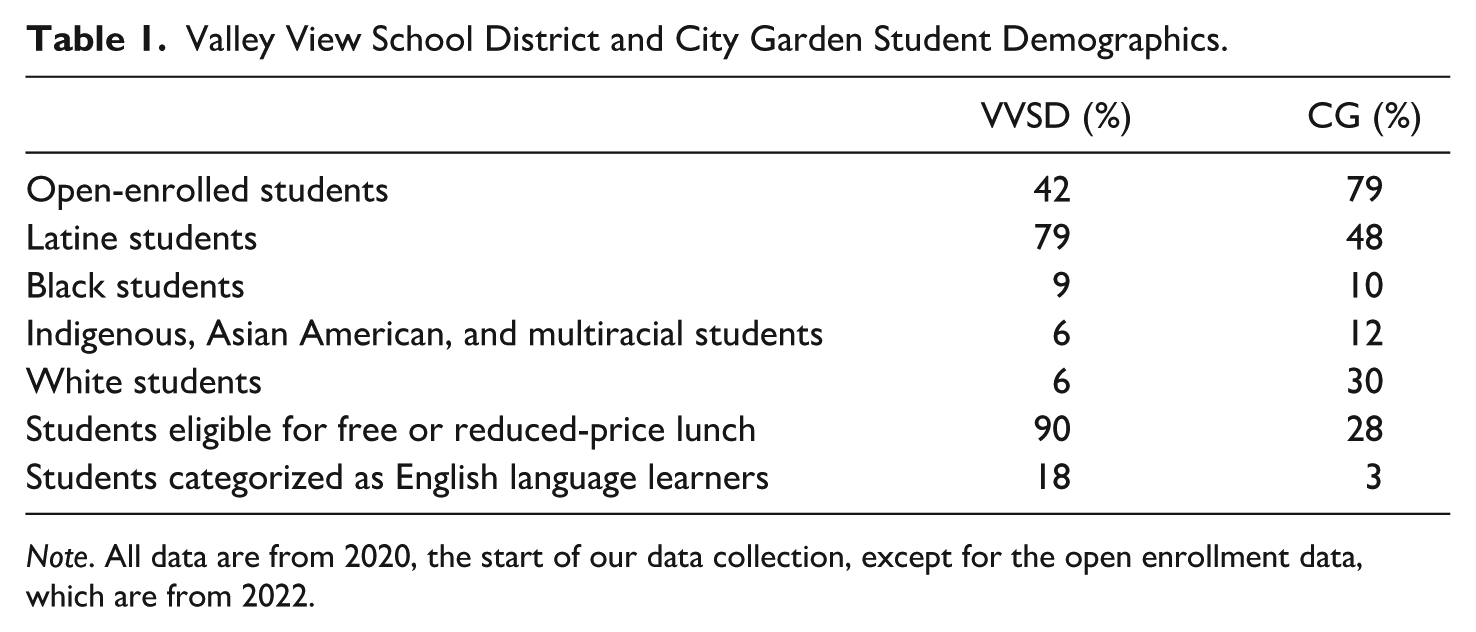
Note. All data are from 2020, the start of our data collection, except for the open enrollment data, which are from 2022.
VVSD used a lottery system to determine CG’s enrollment, as dictated by state school choice policies, but some categories of students had priority. The district’s priority list mirrored Arizona state regulations regarding open enrollment:
Currently attending in-district transfer students and their siblings
Previously enrolled out-of-district students and their siblings
Children of employees
Homeless and foster children
In-district transfer students
Out-of-district students
As this list makes clear, the district did not prioritize children living in the neighborhood. However, the district could have chosen to do so because state policies do not explicitly bar such preference. Because the school was in high demand, parents in the know would enroll their child in the preschool so they could remain at the school through eighth grade.
Methods
Positionality
We draw on Boveda and Annamma (2023) in examining our positionalities and how they have influenced our research, especially as related to axes of power. We especially employ their sociocultural lens to consider the identities we share with the participants and each other as related to “interlocking systems of oppression” (p. 307).
Melanie is a white, cisgender, middle-class woman who is not a parent. Stemming from her racial and class privilege, the flipside of racial and social class injustice, she always had easy access to quality public schooling, unlike the participants. The group nature of this project provided checks to this author’s understanding throughout the process. Carrie is a mixed-race Chicana and Black cisgender woman who grew up in a working-class family in Northern Arizona. She is a motherscholar of two school-age children, one of whom attends a school in the same district as CG, which is located in the neighboring district from where she lives. Her children’s father, however, resided in the district of CG, and in previous years, they have tried to enroll both of their children in CG but were placed on the waiting list and never selected to attend. This process prompted her understanding of CG’s enrollment practices. Her other child attends a nearby charter school that specializes in the arts. Although Carrie is a staunch supporter of public schools, she has also had to grapple with many issues of racism toward herself and her children in both private preschools and public grade schools. These experiences prompted questions that helped to contextualize the study we highlight in this article. Ronnie is a Mexican, white-presenting male, currently raising two elementary-age stepchildren and a newborn. As a PhD student and first-generation college graduate, he identifies with experiences of educational struggle—such as being pulled in a wagon across South Sacramento by his mother to attend a quality elementary school—while also acknowledging the racial privilege he has benefited from, striving to practice reflexivity by learning from his research team and participants. Christina is a Chicana first-generation college graduate, 20-year educator, single mother, and doctoral student. Her child is of Black and Mexican American descent and attends a public Montessori in a Phoenix suburb as part of the district’s choice program. She comes to this work as a person who has been to public and private schools, with knowledge of systems that have served as both oppressive and, at other times, privileged. Brooke is a third-generation Mexican American cisgender woman and doctoral student. Growing up, she attended public schools where her academic needs were consistently met. She is currently employed by her school and is privileged by the tuition benefits that enable her to pursue her education and other projects, such as this publication, with reduced financial barriers. The “interlocking systems of oppression” (Boveda & Annamma, 2023, p. 307) that some authors share with parent and other family participants provided rich insights into the data. Especially helpful were the experiences of Carrie, Ronnie, and Christina in accessing quality education.
Research Design
We employ a qualitative embedded case study methodology (Stake, 1995; Yin, 2018) for this research. A case study “is an empirical inquiry that investigates a contemporary phenomenon within its real-life context, especially when the boundaries between phenomenon and context are not clearly evident” (Yin, 2018, p. 15). An embedded case study specifically entails one or more embedded subunits of analysis. This approach is well suited to our study in that we consider the subunit of CG, as embedded in VVSD, within the context of Arizona’s hypercompetitive school choice policy landscape. Moreover, ours is an instrumental case study (Stake, 1995) that aims to provide insights on the experiences of families of color in this multilevel school choice environment. Often, case studies investigate a “bounded” system (Merriam, 1998); however, for this study, the boundaries are complex. Thus, we consider families both included in and excluded from the embedded subunit of CG, and both in- and out-of-district families.
Data Collection and Participants
Our data collection began February 2020 and ended in November 2023. The lengthy data collection period was due to the COVID-19 pandemic, which impacted the school district and our personal lives. In this case study, we employed qualitative methods of interviewing, observation, and public document collection and analysis. We interviewed 27 participants overall between February 2020 and March 2023 (see Table 2).
Study Participants.
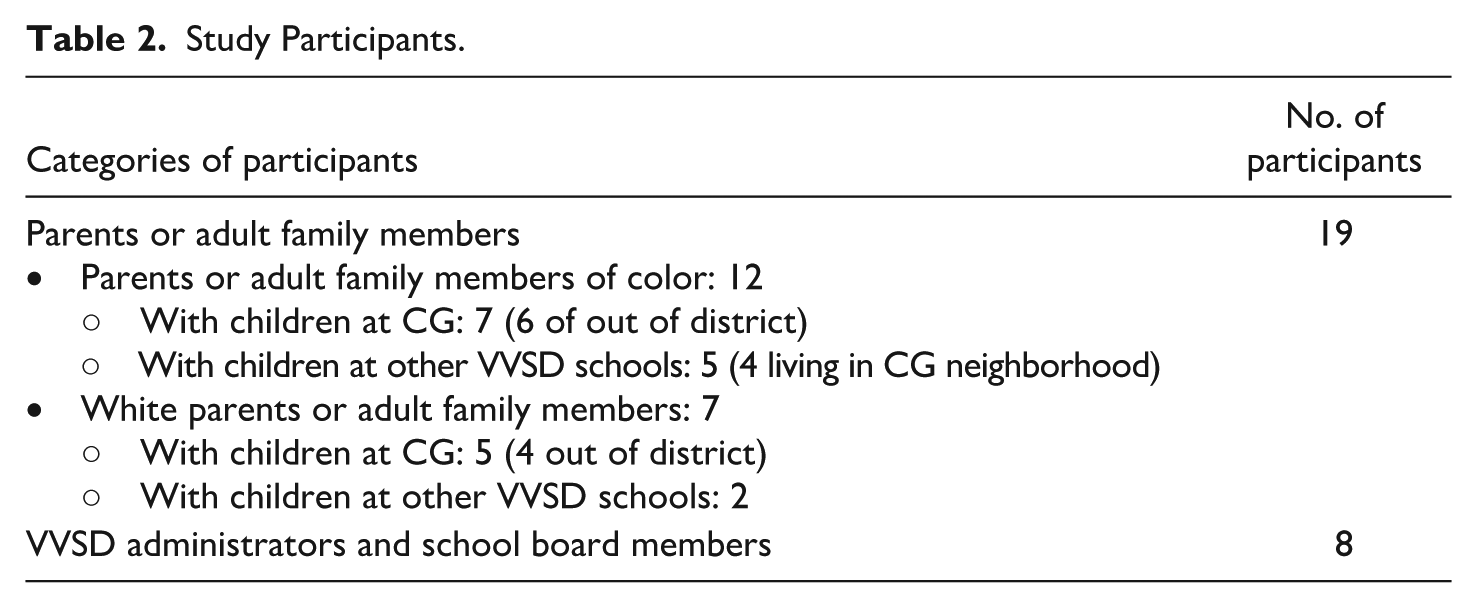
We recruited parent and adult family member participants through a variety of approaches. To recruit parents and family members of children who lived within VVSD boundaries but did not attend CG, we leveraged connections at other schools in VVSD. In addition, we canvassed the neighborhood around CG, going door-to-door in a two-block radius of the school in November 2022 and November 2023. In the first visit, we talked with a total of two children and seven adult family members, four of whom became participants. In the second visit, we talked with three adult family members and two children, none of whom became participants. None of the parents or adult family members we spoke with in the CG neighborhood—either participants or nonparticipants—had children attending CG even though all of them had children within the age and grade range of the school.
We recruited parents or adult family members of CG students through a combination of convenience sampling and snowball sampling. We first contacted those parents we already knew at the school and those named in a list provided by the principal of CG. From there, participants recommended other participants, and we recruited more participants by attending a parent-teacher association (PTA) meeting. We leveraged our connections and used publicly available information to recruit VVSD administrators and board members through purposive sampling.
We used the same interview protocol for all parents and other adult family members; however, we sometimes omitted questions, depending on relevance and participants’ availability. We asked this group of participants which school district they lived in and the district where their child attended school. We asked for their views of their school, district, and school board, and how these addressed equity issues. When applicable, we asked why their child did not attend the neighborhood school (CG or a different school), and why they chose their child’s school. The interview for district administrators and board members focused on their experiences as an administrator or board member in the district and their views of out-of-district students. Asking about these students was tantamount to asking about CG, given that it had the largest population of out-of-district students. All interviews were audio recorded and transcribed using a professional service.
We collected a variety of publicly available documents during the data collection period: school board meeting agendas and minutes, pertinent news media articles (about the VVSD or CG), information from VVSD’s website, and postings from the CG Facebook page. All documents were available online, which we downloaded or screenshot.
We also conducted observations, such as during our visits to the CG neighborhood. We wrote field notes and made voice recordings about our visits and conversations with nonparticipants. We also observed two school board meetings and one PTA meeting.
Analysis
We used an iterative approach to data analysis that involved both inductive and deductive analyses (Erickson, 1986). The research team began by creating the coding scheme for the interview transcripts; we (1) generated a list of a priori codes based on the research questions and empirical literature and (2) engaged in initial coding (Saldaña, 2009) of two interview transcripts. We then synthesized our code lists into a finalized coding scheme, which included eight overarching categories: (1) school and district competition, (2) geographies, (3) equity, (4) school district, (5) school board, (6) policy and politics, (7) CG, and (8) funding/resources. Some of the relevant subcodes included out-of-district/open enrollment, gentrification, race, social class, demographics, admissions, and family motivation to attend CG. We applied the code “race” when people mentioned race or ethnicity in general, racism in general, or specific racial or nationality groups. Many parent/family participants were forthcoming about race, but some participants, especially district administrators, obliquely alluded to race without using any of those terms, such as by referring to social class, desegregation, or geographical areas of the city.
We engaged in cycles of intercoder reliability activities to ensure shared meanings for the codes. We then coded all the interviews using MAXQDA software; 70% of them were coded by two members of the research team. We analyzed the observation notes and documents to provide triangulation and contextual information for themes we found in the coding of the interviews. When data from different sources did not align, the team discussed these issues, floated hypotheses for the discrepancies, and tested the hypotheses with the dataset.
After all the data had been coded, we learned about the theoretical framework of racial capitalism (Robinson, 2000). We delved into readings about this theory and compared it with Whiteness as Property (Harris, 1993), a theory with which we were familiar. We did not recode our data because our existing codes had already captured the intersections of race and social class that the two theoretical frameworks required. Instead, with these theories in mind, we revisited our coded data to consider whether or to what degree families of color experienced dispossession of the rights to use CG and exclusion leading to displacement. As shown in the findings section, we found the theories to be a direct fit to the experiences of working-class families of color in the CG neighborhood. With further analysis, though, we also found that middle-class families of color outside the neighborhood also experienced aspects of dispossession and displacement. We triangulated our analyses through the second canvassing of the neighborhood in November 2023 and by verifying that different categories of participants were reporting the same phenomena.
Sharing the Analysis
We shared the findings individually or in small-group meetings with select participants, community members, school board members, the district superintendent, and another district administrator. The superintendent responded in a defensive manner, explaining that neighborhood students were not enrolled at high numbers because of the district’s desegregation order and that the school they are zoned for is a “good” school. Later, in a school board meeting, when a school board member mentioned this study and questioned the admissions policy for CG, the superintendent said that the study was “biased” and offered no further explanation. However, some board members (including study participants) and the other district administrator noted that our results aligned with patterns of inequity they had already observed and expressed the desire to address the issues the analysis uncovered. Thus, we engaged in a form of member checking, thereby increasing the trustworthiness (Lincoln & Guba, 1985) of the study.
Limitations
One of the most significant limitations of this study is that we did not interview teachers or administrators at CG School. Thus, we did not gather insights about the implementation of open enrollment policies from CG staff. An additional limitation is our sample size, especially as related to CG neighborhood participants. Even though we talked with many other neighborhood residents informally, gaining additional participants would have shed more light on the experiences of neighborhood families.
Findings
We found that families of color experienced dispossession and displacement related to VVSD and CG, but these experiences differed depending on where the families lived and their social class. Families of color in the largely working-class neighborhood surrounding CG, who were generally unable to enroll in CG, faced acute dispossession and displacement. The middle-class out-of-district families of color with children attending CG also experienced some aspects of displacement and dispossession.
“Más alto grado”: Dispossession of Rights of Use Affecting Neighborhood Families of Color
VVSD dispossessed (Dantzler, 2021) neighborhood families of color of the right to use and enjoy (Harris, 1993) CG. Indeed, our analysis suggests that very few of the children in the neighborhood attended the school even though it was the closest geographically, and parents had tried to enroll them.
This dispossession entailed a shift in the racial demographics of CG teachers, according to a neighborhood parent of color, Araceli. She had been a student at the school as a child and remembered that the teachers were “all Black, pretty much” when she attended. Likewise, a 1995 OCR document also stated that CG (among some other schools) housed most of the Black teachers in the district. Through tears, she recounted her fond memories of the school, like “teachers knocking on the door to pick us up, to take us to school.” Today, most of the teachers at the school are white, according to a CG parent. This change might reflect the erasure of the neighborhood’s “symbolic forms of occupation” (Dantzler, 2021) of the school.
Moreover, the neighborhood families’ dispossession of the rights to use the school meant being blocked from its many benefits. One of the benefits of CG denied to neighborhood families was the high academic ranking of the school. Though these types of school rankings fail to reflect the true quality of a school, they nonetheless reflect society’s valuation of the school. These rankings were understandably important to some neighborhood family members, such as Belén, a parent of color, who mentioned that she looked up CG and found out that it was highly ranked, with an A in the state’s letter grade system. Belén explained,
Por lo que me he informado, es muy buena, que los estudiantes tienen más alto grado, o sea, buenos como en las demás escuelas, pero en las otras escuelas está un poco más bajo, pero ésta yo he investigado y está más alto todo. (Well, I’ve looked into it, and it’s a very good school; the students have a very high academic level. I mean, some schools are better, some others have a lower academic level, but for what I know, this school has the highest level.)
Thus, Belén was well aware of the fact that CG had a higher ranking than any surrounding school, highlighting the dispossession that her family experienced in being barred from the school. This was especially stark considering that Wilson School, which received the CG neighborhood children, had a lower ranking than CG, as another parent noted.
Other benefits of the school were unknown to neighborhood families, coming up in interviews with school district leaders or parents of CG students. For instance, as the school’s pseudonym implies, the school had a very lush, green campus; this was mentioned by 10 CG parents. The school boasted a vegetable garden, a meditation garden, an outdoor kitchen featuring a pizza oven, and an orchard. The school also included a habitat where chickens lived. A white CG parent named Sandra described her awe at the garden when her child first started at the school: “The garden is beyond words.”
Another benefit of CG was its free preschool. This preschool served 3- to 6-year-olds and featured an engaging, hands-on learning environment. However, we did not meet anyone in the neighborhood whose child attended this preschool. In fact, very few neighborhood parents of color even knew about the preschool. Josué, for instance, had tried to enroll his child but was denied. An excerpt from our field notes about our neighborhood visit in November 2022 illustrates this:
[We talked] with some people that we never interviewed who had little kids and who didn’t know that there was a preschool at the school. For instance, at the neighboring house [across the street from the school], the woman had two kids, one 3-year-old and one 2-year-old. She had no idea that there was a preschool at the school. . . . A man we spoke to, who[m] we did not interview, said that he had a 2-year-old. He did not know that there was a preschool at the school.
Similarly, in a visit to the neighborhood in November 2023, we heard much of the same. The field notes of one author indicated, “I talked with two mothers of 3-year-olds who had never heard of [CG]. . . . I also talked with a father of a kindergartener. He had sent his son to [a nearby Head Start program]. . . . He didn’t know anything about [CG].” 5 Of note: Head Start is a program for families at or below the poverty line. This father lived within two blocks of two free preschools but had only heard of one of them. This father’s experience and that of other residents suggests that most neighborhood residents had not known about CG’s preschool.
Overall, VVSD’s enrollment policies for CG appeared to dispossess most neighborhood families of CG School, including the right to use and enjoy all that the school provided—such as its symbolic academic status as a high-ranking school, a lush outdoor learning environment, and a free preschool. This dispossession was inextricably linked to displacement, which occurred through the district denying entry to the school and sending families to a school farther away.
“Who’s on the waiting list first”: Exclusion and Displacement of Neighborhood Families of Color
By dispossessing neighborhood families of color of CG, VVSD displaced them to other schools (Dantlzer, 2021). The outsized percentage of out-of-district students at the school—as shown in Table 1—hints at this. In addition, our interviews and conversations with families further explained how the district excluded (Harris, 1993) neighborhood residents from CG and displaced them.
Three of our participants who resided within two blocks of CG reported that the school did not allow them to enroll their children. As described in the context section, VVSD did not prioritize neighborhood children. Belén, who lived across the street from the school, found this out when she tried to enroll her older son in first grade:
Desde el primer grado, nos cambiamos para estos departamentos y luego metimos aplicación porque está cerca. Podemos cruzar la calle, no hay necesidad de bus o de esto. Metimos aplicación y no nos aceptaron. Nos dijeron, “está muy lleno, lo ponemos en lista de espera si es que hay un cupo nosotros le llamamos.” Y hasta la fecha no me han llamado. (In [my son’s] first grade, we moved to these apartments, so we applied to that school because it’s really close. We can cross the street, and we didn’t need to take a bus or something. We applied and they didn’t accept us. They told us, “It’s really full. We will put him on the waiting list, and if there is space, we will call you.” And to this day, they haven’t called.)
When Belén recounted this to us, it was seven years later, and her older son was in middle school. In other words, the school never called back. At the time when she called the school and was told she couldn’t enroll her son, she retorted, “‘Yo vivo aquí enfrente’” (I live here, opposite [the school]), and recalled the school representative saying, “No, pero usted, no, esta no, no es su área” (No, but you, this isn’t your area).”
Like Belén, Renee, a parent of color who lived a block from the school, also tried to enroll her daughter at a young age, specifically preschool:
It was like, who’s on the waiting list first, and then if you had a sibling that went there and it just went on and on and on. So it was like, by the time she would probably even be considered, it would be no point
Renee decided not to pursue enrolling her daughter after facing that blockade, wanting to avoid switching her daughter to a new school after she had settled in her existing school. This exclusion from CG was especially upsetting because her family had attended that school: “I [went] here; four of my brothers and sisters were here. And I think a generation before us went here as well.” As mentioned earlier, Araceli also attended the school as a child.
VVSD’s exclusion of neighborhood families from CG equated to their displacement because they had to send their children to schools farther away in the district. For instance, Belén had to drive her children to and from a school in a different neighborhood every day, even though she lived across from CG. Likewise, Josué, who lived a block from CG and who had also been barred from enrolling his daughter, reported that his daughter took a bus to school. He explained that it was especially difficult to get to his daughter’s school to pick her up early if she was sick or to attend family events because he did not have a vehicle. To get to the school, he had to take the city bus. Some participants commented that other families in the neighborhood chose to send their children to charter schools nearby. One participant even pointed to multiple houses around us and named every charter school the residing family’s children attended.
The exclusion and displacement from CG that Renee, Belén, and others noted was patterned along lines of race and social class. For instance, one person we met recounted how every day, he saw lines of cars with white people picking up their kids from school, which is in sharp contrast to the neighborhood’s racial demographics. Likewise, Josué noted both social class and racial barriers to attending CG:
But from my experience, it’s based off of income and based off of job-related. So if you have a job and you have income, you go to that school. Oh, if you don’t have a job or income, you can’t go to that school. . . . If you have a white last name, you’re more capable of getting in. If you have a Hispanic last name, it’s a little more trouble to get in.
The whiteness of the school in comparison with the neighborhood is something that Belén also noted:
Hay puros blanquitos casi, pues, no hay de eso, son como seleccionados, quién puede entrar y quién no puede entrar. Para mí se me hizo eso que, no, pues: “Tú, sí, calificas, pero él no califica.” Como que hay discriminación. (Almost all their students are white. There is no, they are selected, which student can get in and which cannot. For me, it was like that: “Yes, you qualify, but he doesn’t qualify.” There is discrimination.)
Though we did not find evidence of the school intentionally displacing the neighborhood students from the school, this was the de facto outcome of the enrollment policies. Interestingly, state data indicate that white students comprise just 32% of the school. However, the relative whiteness of the school’s students in comparison with the racial composition of the neighborhood was stark enough for Belén and other neighborhood residents to notice.
Likewise, even some parents of CG students noted the demographic differences between the school and the neighborhood. One CG parent of color, Antwon, commented that VVSD’s use of CG as a specialized school “felt very colonial.” He cited the history of the CG preschool moving from a prior location into its present site:
And the optics of it as well, that you have this preschool that has a much larger out-of-district and a much larger white population than was currently existing there going over to [CG] at a time when, I mean there was mostly students of color over there.
Other parents made similar comments. For instance, Cassandra, a CG parent of color who evidently noticed Belén mentioned, “There's a house that was right across the street and I watched every day how the mom was taking her kids to a school every day . . . but her kids weren’t in [CG].”
Regardless of intentions, VVSD, capitalizing on desegregation funding and the state’s school choice policies, effectively excluded neighborhood families from CG (Harris, 1993), displacing (Dantlzer, 2021) them to schools outside their neighborhood.
“Diversity . . . was a huge priority”: Displacement of Out-of-District CG Families of Color
Middle-class out-of-district families of color whose children attended CG had much different experiences than neighborhood families. However, they still experienced aspects of displacement through a constrained set of choices. Even though displacement follows from dispossession, for the out-of-district families of color, we start with a focus on displacement because these families faced a narrow set of school choices that prompted them to leave their neighborhoods to seek out VVSD, specifically CG.
In appraising school choices, many out-of-district families of color looked for racial diversity. Of the five CG parents of color who mentioned diversity, three implied a desire for a school that included students of their children’s racial background or provided a less racist environment. Of note: Two of these parents were Black, and the third identified as mixed race (Black and white), and all were middle class. These were the only three Black-identifying or mixed-race Black-identifying parents in our sample of out-of-district CG parents of color. Cassandra, one of these three parents, lived in a school district that was about 55% Latine, 25% white, and less than 3% Black. She explained that, in addition to CG's pedagogy, diversity was a draw: “The other aspect that was super important for us was diversity. So making sure that our child was amongst people that shared and also didn't share her racial background and things like that. So that was a huge priority.” Considering the racial demographics of her local district, her child’s racial background, and the embeddedness of anti-Blackness in education (Dumas, 2016), we interpret her desire for diversity to include her child attending a school with a higher percentage of Black or mixed-race students, among students of other races.
The other two Black parents were more explicit about finding a racially welcoming environment for their children. Claudia, who lived in a majority-white suburb, explained that diversity was essential in choosing CG:
I think one thing . . . [my husband and I] love about [CG] is . . . the diversity. We [at the school] have diversity: SES, race, gender identity, all like across a full spectrum. That’s what we really wanted for our kid to have. We don’t want her to be the only mixed kid in our class. We don’t want her to be the only Black girl in her class. We don’t want her to be the only kid whose parents have to work.
In addition to alluding to social class, Claudia explicitly stated her desire for her child to be among other “mixed” or Black children.
Antwon also sought out the diversity of CG for his child’s well-being. He had lived in a majority-white district when his child started school and lived in a majority-Latine area at the time of the interview. He began by explaining, “The most important thing to me, honestly, was the diversity that could be found at the school.” He added that he wanted to ensure that his child would not experience the racism that he had faced as a child in the suburbs:
I grew up in . . . [this metropolitan area] and I despised the . . . [western suburban] schools largely just because of how mediocre and racist I found them. So I didn’t have a desire to put my child in a similar environment.
He commented that CG was better than any alternatives.
For the three out-of-district Black or mixed-race Black CG parents, open enrollment policies provided access to a school environment where their children would not be racially isolated and could be more shielded from racism. Thus, the decision to seek out CG could have been a strategy to mitigate the negative effects of anti-Blackness on their children. The cost of this constrained choice, 6 though, was leaving their neighborhoods and driving their children to and from school. Indeed, Claudia, who lived in a northwestern suburb of the metropolitan area, commented that the one-way drive to the school took at least 45 minutes. Likewise, Antwon commented that when his child originally began at CG, he had lived in a northwestern suburb that was also about 45 miles away from the school. Thus, the parents were not literally excluded (Harris, 1993) from their neighborhood schools or forced to leave their neighborhoods to look for schooling, but they faced a constrained set of school choices that compelled them to leave. Overall, our analysis suggests that the three middle-class, out-of-district Black or mixed-race Black parents, confronted with limited diverse school options, experienced aspects of displacement (Dantlzer, 2021).
“Able to navigate whiteness”: Dispossession of Rights of Use Affecting Out-of-District CG Families of Color
The middle-class out-of-district families of color whose children attended CG had access to the many benefits that neighborhood families were denied: a high-ranking school with a beautiful campus and a free preschool. However, these families faced aspects of dispossession (Dantzler, 2021) nonetheless. They did not experience the full value (Gerrard et al., 2022) or right to use and enjoy (Harris, 1993) CG. Instead, many contended with racism and felt compelled to volunteer their time to address racism and advance equity in the district and school.
Racism in VVSD and CG arose in both structural and interpersonal forms. The school exemplified a “colorblind approach” 7 and had some “problematic aspects” related to “cultural misunderstandings,” according to Cassandra and Antwon. One of the public instances of racism came when a CG teacher made blatantly racist comments at VVSD school board meetings against the Black Lives Matter movement. A group of parents sought to remove the teacher from the school, but VVSD refused. Claudia explained what the teacher said at the board meetings: “We had a teacher at [CG] who made multiple public comments at the school board. . . . She was basically saying how, in so many words, Black and Brown kids need to assimilate in All Lives Matter.” This issue increased Claudia’s concern about which teacher her daughter was placed with, considering the possibility that other CG teachers also harbored such views. We corroborated this incident with archived school board meeting minutes. During one meeting, community member comments highlighted the concerns among families about racism stemming from this CG teacher, named as “dangerous” for students, especially students of color.
Moreover, Anisa, also an out-of-district CG parent of color, noticed that most CG teachers were white, while most students were children of color. She commented, “It still tends to attract a white female teacher. And so the vast majority of the teachers read as that. . . . There are some teachers of color, but it still feels like that’s the general kind of gist of it.” Likewise, the PTA membership was predominantly white, even though white students were the minority. Anisa noticed that, in the first PTA meeting of the school year, there were “all different shades, all different types.” But “then who’s left typically is mostly white, English-dominant-speaking parents.” The PTA events reflected this white dominance, not taking “into consideration other cultures very much,” she reported. Not all CG parents of color we interviewed, though, mentioned racism at the school, and two parents of color expressed only praise for the school.
To combat racism and other issues, some CG parents of color volunteered their time to advocate at the school or district levels. Some of this advocacy included attracting and retaining resources for CG that were not available at other schools, thereby helping to reproduce the inequitable status quo. However, much of the advocacy was directed toward racism and equity. Three mothers we interviewed—Claudia, Anisa, and Cassandra—especially devoted significant time and energy to equity. Claudia advocated alongside other parents against the teacher who spouted racist language about Black Lives Matter. She commented, “We rallied in our little [CG] community group. I think there was, like, 30-some letters were written about it.” She also attended board meetings to speak out on the issue. She commented that she felt compelled to act on behalf of other families because she had “the privilege to miss work and all that to go.” Like Claudia, Anisa felt a duty to advocate for more than just her own child. She did this by attending the meetings of the PTA, a predominantly white space. She explained,
I really go out of my way and really try to make those PTA meetings . . . because I am a person of color, because I’m also used to being in very white spaces after receiving my PhD. I feel like if anyone’s going to translate this, I guess I’m up. . . . There are other, some very highly educated Chicanos that also have their kids there [CG] that also have ideas of how things are. . . . But I do think that it is on us a little bit more because we have tools of being able to navigate whiteness in a certain way, to help possibly navigate with some other parents that don’t feel as comfortable doing that in these spaces that ultimately end up feeling very white, very white-run, very white.
Anisa went on to comment that the dominant language in PTA meetings is English, which is not the main language used by many family members. As is clear from her words, she felt a duty to serve as a navigator and translator for other CG families who do not have her level of formal education or her experience in navigating whiteness.
Cassandra also engaged in collective advocacy to advance equity in VVSD and CG. She was a member of a district-level advisory council of parents of color that focused on equity and the budget. However, she did not feel that the group held any influence in district decisions. She commented, “It seemed more like they were checking a box, like we have this parent advisory group.” In addition, Cassandra also engaged in advocacy at CG. When she first enrolled her daughter, she wanted “to see more initiatives around diversity and equity” since the school didn’t “talk about race or racism.” She and other parents cofounded a diversity committee that met regularly and brought issues to the principal, such as the need to translate newsletters into Spanish, the dress code, and the color-evasiveness (Annamma et al., 2017) of the curriculum. In general, she described herself as part of a group that banded together when “these moments bubble up with drama around . . . equity or social justice.” However, she faced considerable pushback, causing her to disengage from the work:
And then I think just out of being overwhelmed and not seeing the community as receptive to some of that stuff, myself and the person who was leading and sharing that committee, we just kind of dropped out. We just were like, OK, we’re tired. We’re done.
Despite the roadblocks she faced, Cassandra nonetheless characterized her advocacy as a “privilege” that she and some other parents held because of the flexibility they were afforded in their workplaces and their knowledge of how to “appeal to the folks in the district.” Cassandra’s comments on her duty to advocate because of her social class echoed those of Claudia and Anisa.
Thus, the middle-class out-of-district families of color, even though they had rights to use CG, had to contend with racism, and many felt obligated to engage in the labor of advocacy. In this way, VVSD and CG dispossessed these families of the full value (Dantlzer, 2021; Gerrard et al., 2022) and right to “use and enjoy” (Harris, 1993) the school.
Discussion
Families of color who participated in this study, despite where they lived—whether within walking distance or a 45-minute drive from CG—shared one experience. They did not have access to high-quality schools in their neighborhoods that were also racially and economically diverse as well as socially and emotionally safe for their children. Thus, paradoxically, families had little school choice within the school choice landscape. This paradox is apparent through the application of both Whiteness as Property (Harris, 1993) and racial capitalism (Robinson, 2000), showing how many families faced dispossession and displacement as VVSD leveraged the state’s school choice policies.
School Choice Was Not a Choice for Neighborhood Families of Color
Families of color who resided in the neighborhood experienced dispossession (Dantzler, 2021) of access to CG, a relatively highly ranked K–8 school with a free preschool that offered holistic experiences of beautiful gardens, space to meditate, connections with animals, and fresh food. This school was the closest to their homes, and many parents wanted their children to attend this school; yet, they could not access it because of how VVSD leveraged state school choice policies, such as the admissions policy. These systems included an admissions policy that prioritized children in the CG’s preschool and the practice of relying on word-of-mouth advertising by current and former families of CG—most of whom did not live in the neighborhood or even within the school district boundaries. Moreover, the families experienced displacement (Dantzler, 2021); they were forced to travel outside their neighborhood for a school. VVSD, as situated in the state’s school choice policy landscape, dispossessed and displaced neighborhood families of color in ways that originated from and contributed to Whiteness as Property (Harris, 2020) by denying them the right to use and enjoy CG and legitimizing their exclusion. This exclusion worked to maintain value in whiteness and white spaces, which ultimately contributed to inequitable access to the educational opportunities at CG.
Thus, in a state that prides itself on school choice, families of color in the neighborhood were unable to choose their neighborhood school. They lived within walking distance of the school and had district residency, which, for many of them, included the right to vote on the VVSD governing board and bonds that helped to fund CG. But they were unable to enroll their children in this school. Instead, families who lived outside the district—a disproportionately white group—took up 79% of the school’s capacity. This left 21% of seats for in-district students, and even fewer seats for families of color in the neighborhood. The dispossession that these families of color experienced led to their displacement by forcing them to leave their neighborhood school.
Our findings align with previous research demonstrating how systems have legalized the raced and classed restriction of access to premier schools (Lenhoff, 2020; Yoon & Lubienski, 2017). Unlike schools highlighted in these studies, however, CG was in a working-class, historically Latine and Black neighborhood, and families who lived within walking distance of CG had to travel to schools outside the neighborhood. This lack of accessibility to CG for working-class families of color from the neighborhood also suggests the phenomenon of “school gentrification” (Posey-Maddox, 2014). CG was a gentrified school that offered middle-class and disproportionately white children an urban community with distinct resources and palatable, middle-class racial diversity while keeping out the families of color who lived nearby. In addition, our findings evoke the disproportionate burden of desegregation that Black children endured in the 1960s to 1990s (Horsford et al., 2013). Yet, unlike many previous desegregation plans, in this case, majority working-class Latine children were sent to a majority-Latine school outside their neighborhood to make room for middle-class and disproportionately white children whose families resided outside the district.
The Dilemma of School Choice for Middle-Class Families of Color
Somewhat like the neighborhood families, the middle-class families of color who resided outside the district experienced aspects of displacement from their own neighborhood school, and then partial dispossession (Dantzler, 2021) of CG’s benefits. Some of these families, selecting among a constrained set of choices for a diverse and racially welcoming school, were compelled to leave their neighborhoods, entailing aspects of displacement. Although they were able to access this “ideal” school, they were nevertheless partially dispossessed of CG’s benefits because they expended energy and resources to push back against inequities and shape the district and school to be less racist.
As Whiteness as Property suggests (Harris, 1993), racism is embedded in ways that protect whiteness. Some out-of-district families of color traveled to CG in hope of finding a refuge for their children. In making this constrained choice, they navigated racially, economically, and politically segregated neighborhoods and inequitable schools (Carter & Welner, 2013; Clerge, 2023; Cobb & Glass, 2009; Lewis & Diamond, 2015), compelling them toward self-displacement from their neighborhood schools and the maintenance of structures of whiteness (Dantzler, 2021). However, the out-of-district CG families of color found that CG was not necessarily a refuge. They were partially dispossessed (Dantzler, 2021) of the right to use and enjoy (Harris, 1993) this school because of the structural racism embedded through Whiteness as Property. Some families and their children experienced acts of racism, color-evasiveness (Annamma et al., 2017), implicit forms of exclusion from the PTA, and a predominantly white teaching staff, which did not reflect the students in CG. Because of this, they worked hard to navigate these structural and interpersonal forms of racism. These efforts left some of these families fatigued and overwhelmed, and eventually, some disengaged. The dilemma of school choice for these families of color builds on the existing research (Clerge, 2023; Cooper, 2007; Demps, 2022; Lewis & Diamond, 2015). Considering ubiquitous anti-immigrant, anti-Black, and subtractive views of youth and communities of color (Chávez-Moreno, 2021; Green, 2017; Ishimaru, 2019; Jenkins, 2022), it is not surprising that CG families of color experienced aspects of displacement from their neighborhood schools, sought out CG as a refuge, and faced dispossession as they encountered racism in the school and district.
Conclusion
Our research on CG provides a window into the ways that ostensibly innocuous school choice policies may displace and dispossess families of color of various social classes. Based on this study, we present several implications. First, our study shows the necessity of using a theoretical lens that captures the complexity of school choice. The dual theoretical lens of Whiteness as Property (Harris, 1993) and racial capitalism (Robinson, 2020) reveals how these policies dispossess families of color across social class of the rights to use and enjoy quality schools, thereby excluding and displacing them to other schools. In contrast to economic models and other simplistic understandings of school choice, this dual theoretical lens shows the complexity of the interconnected systems that shape the experiences of families of color in a competitive school choice environment. Only a theoretical lens that accounts for the intrinsic nature of racism in our policy, legal, and economic systems can demonstrate the fallacy of universal “choice.”
Second, thanks to our theoretical framework, our study shows a clear connection between families’ educational displacement and dispossession, and Arizona’s hypercompetitive school choice environment, created by decades of permissive state-level policies. Thus, we caution against state-level school choice policies, such as the open enrollment policies that VVSD leveraged. Although at face value, these programs may seem to offer freedom, in practice, this “freedom” to choose comes at a cost to neighborhood communities and families of color (Sampson et al., 2022). In addition, we caution against states opting in to the new federal school choice program, part of the 2025 “Big Beautiful Bill,” which will siphon funds to private schools, possibly prompting districts to engage in even more aggressive school choice tactics (D. Garcia et al., 2025). Instead, we urge states to provide equitable and adequate resources, services, and support for all neighborhood schools and consider how to integrate more resources toward the design of more diverse neighborhood communities in order to decrease the need and desire for families to enroll their children in schools outside their communities.
Third, our study illustrates how school districts, as they navigate a competitive school choice landscape to compete for enrollment, may leverage school choice policies in ways that displace or dispossess families of color across social classes. We encourage district leaders to implement inclusive enrollment policies, weighing the need for increased enrollment against the real-life harm of school choice policies. They can prioritize neighborhood communities in their enrollment policies, engage in outreach and recruitment within school neighborhoods, provide information about school offerings (e.g., preschool), and intentionally listen and respond to families of color.
Research can also contribute to this intervention. Future scholarship on school choice can augment the body of quantitative literature with more qualitative studies that explore the complexities of school choice related to various intersecting identities (e.g., race, class, sexuality, language, and disability); these studies could use case study methods to elucidate how districts and schools maintain or disrupt the status quo via a variety school choice policies (e.g., open enrollment, vouchers, charter schools) in different locales and geographic regions. Thus, we leverage the realism offered by racial capitalism and Whiteness as Property (Harris, 1993; Robinson, 2000) to urge both researchers and educational leaders to acknowledge and counter the ways that white and middle- and upper-class districts and families have exploited school choice policies to their benefit. Our current political environment includes many federal and state officials who are praising, supporting, and expanding school choice policies. Thus, we urge researchers to document, explore, and expose intended and unintended consequences of school choice policies over time—implications of which could contribute to a focus on strengthening neighborhood schools, and advancing inclusive and equitable choice policies and practices.
Footnotes
Declaration of Conflicting Interests
The authors declared no potential conflicts of interest with respect to the research, authorship, and/or publication of this article.
Funding
The authors received no financial support for the research, authorship, and/or publication of this article.
