







Abstract
Background/Context:
Teacher leadership is frequently traced to U.S. reform movements of the 1980s, a framing that narrows the construct’s historical timeline and overlooks earlier traditions of teacher-led professional coordination and advocacy. By centering the history of Black teachers in the segregated South, this study challenges the dominant periodization and foregrounds a longer professional lineage grounded in equity, advocacy, and collective responsibility.
Purpose/Research Question:
This study examines the following question: What historical evidence highlights the teacher leadership practices of Black teachers in southern segregated schooling communities? The objective is to determine whether contemporary conceptualizations of teacher leadership can be traced to what is known historically about Black teachers’ professional work, particularly within the oppressive social, political, and educational contexts of the Jim Crow–era South Carolina.
Research Design:
Guided by critical historical inquiry, this study takes the form of a historical case study of the Palmetto Education Association’s Department of Classroom Teachers (PEA-DCT) from 1956 to 1967. Archival records were analyzed using qualitative frequency-based coding aligned with the seven domains of the Teacher Leader Model Standards. Frequency counts were treated as ordinal indicators of relative emphasis, supplemented by memo writing and iterative interpretation to preserve historical nuance.
Conclusions/Recommendations:
The PEA-DCT case demonstrates that Black teachers enacted leadership as integrated professional practice embedded within organizational systems they designed and sustained. The study recommends that the field account for this deeper historical lineage when defining teacher leadership and urges scholars to foreground equity, professional dignity, and collective responsibility as foundational rather than emergent dimensions of the construct.
Teacher leadership researchers often locate the rise of teacher leadership in the U.S. educational landscape in the early 1980s (Little, 2003; Nguyen et al., 2020; Pounder, 2006; Wenner & Campbell, 2017; York-Barr & Duke, 2004). This framing, however, reflects a short memory, because it overlooks earlier decades when teachers—particularly Black teachers in southern segregated schools—were engaged in collective collaboration, organized advocacy, and coordinated professional growth efforts oriented toward school improvement and equity. By situating the “rise” of teacher leadership in the 1980s and ignoring the critical historical contributions of Black teachers, the field has mis-historicized its development and obscured a longer tradition in which teaching encompassed both professional and pedagogical responsibilities and leadership regarding advocacy, equity, and justice. In this way, York-Barr and Duke’s (2004) yet-unchanged claim that teacher leadership remains “largely atheoretical” (p. 291), alongside Wenner and Campbell’s (2017) finding that issues of social justice and equity remain underrepresented in the literature, simultaneously underscore this manuscript’s central argument: the field of teacher leadership is not only atheoretical but also ahistorical.
Surfacing the history of Black teachers’ leadership shapes the objectives of the study. Specifically, I explore whether today’s conceptualizations of teacher leadership can be traced from what we know historically about Black teachers, particularly as they worked against the oppressive social, political, and educational contexts of de jure segregation. For the purposes of this paper, I argue that the 1980s timestamp both overshadows the deeper lineage of teacher leadership and contributes to the field’s ongoing struggles to (1) define the concept (Berg & Zoellick, 2019), (2) pin down effective teacher leader practices (Hunziker, 2022) within contemporary and future contexts, and (3) expand the field’s still-emerging commitments to advocacy, equity, and justice (Bradley-Levine, 2018, 2022; Hart, 2021; Manner & Warren, 2017; Wenner & Campbell, 2017). In the aggregate, the study seeks to understand Black teachers’ leadership practices as both historical and conceptual evidence for reconstructing what we know about teachers’ leadership.
The research is guided by the following question: What historical evidence highlights the teacher leadership practices of Black teachers in southern segregated schooling communities? Pursuant to this aim, this article draws on archival evidence from the Palmetto Education Association (PEA), South Carolina’s Black teacher organization during Jim Crow, to examine how Black teachers in segregated schools enacted leadership. Through a historical case study of the PEA’s Department of Classroom Teachers (PEA-DCT), I show that Black teachers enacted leadership through professional infrastructures that confirm, extend, and challenge contemporary teacher leadership discourse. In doing so, the study presses for a fuller accounting of Black teachers’ contributions to the field, and thereby contributes to the histories and scholarship regarding Black education, Black teachers, and teacher leadership.
Conceptual Framework: Past as Prologue
This study is guided by critical historical inquiry (McCullum & Alridge, 2023), an approach that situates educational practice within its social, political, and racial contexts while interrogating how historical narratives are constructed and mobilized. Rather than treating history as static record, critical historical inquiry views the past as an analytic resource capable of unsettling dominant assumptions and expanding contemporary possibilities. This orientation resonates with Black intellectual traditions that understand the past as prologue (Danns et al., 2015) and align with Sankofa’s insistence that we retrieve what has been left behind to move forward (Quarcoo, 1972; Temple, 2010). In this study, critical historical inquiry provides the conceptual grounding to reposition Black teachers’ leadership during segregation not as peripheral to teacher leadership’s development but as central to understanding its longer genealogy.
The framework informed the design of this study as well, which takes the form of a historical case study of the Palmetto Education Association’s Department of Classroom Teachers (PEA-DCT). Following McCullum and Alridge’s call to use history critically, the design centers the localized leadership of everyday Black teachers to illuminate teacher leadership as a much longer-standing professional practice than universally recognized. In doing so, it challenges the ahistorical tendencies of the teacher leadership literature and foregrounds dimensions of social, political, economic, and professional activism that are often excluded from today’s reform-focused understandings (Wenner & Campbell, 2017). This approach also resists traditional historical tendencies to iconize individual heroes, instead highlighting “the efforts and strategies of everyday people who challenged racial injustice and struggled for equality” (McCullum & Alridge, 2023, p. 382)—in this case, Black teachers in South Carolina.
Critical historical inquiry also shaped the use of archives in this study. Archival sources (e.g., meeting minutes, newsletters, reports, and correspondence) were approached as artifacts of intellectual labor, professional agency, and collective struggle. As McCullum and Alridge (2023) posit, traditionally held archives hold “the power to either oppress or liberate” (p. 386). In this case, I sought to use the archives as a liberatory space that allows us to see teacher leadership beyond its accountability and school reform–era boundaries.
The framework further guided the coding and analysis of data. I employed the Teacher Leadership Model Standards (Teacher Leadership Exploratory Consortium, 2011) as a heuristic to organize and code instances of teacher leadership in the archival documents. In doing so, I drew on McCullum and Alridge’s understandings of “history of the present” (2023, p. 384), which frames the past through contemporary categories rather than isolating it as temporally distant. This approach creates what has been described as a “sagittal relationship” (p. 385) between past and present, where the meaning of archival evidence emerges most clearly when connected to current frameworks and expectations. Such a process allowed for a reconstruction of teacher leadership that revealed continuity across time. Ultimately, this study then exemplifies critical history by problematizing the present and highlighting the ways in which historical Black teacher leadership evidenced what today’s standards attempt to formalize.
Finally, the framework shaped interpretation through a genealogical lens. Drawing on McCullum and Alridge’s (2023) discussion of “history of the present,” the analysis examines how archival evidence illuminates contemporary debates about teacher leadership. This approach does not collapse past and present; instead, it traces continuities and tensions across time, allowing Black teachers’ historically situated leadership practices to inform and complicate current frameworks. In this way, the conceptual frame positions Black teachers’ work as both historically specific and conceptually generative for reconsidering teacher leadership histories.
Background and Significance: Intended and Unintended Outcomes of Segregation
Black teaching and leading during Jim Crow unfolded within a system intentionally designed to maintain white supremacy by institutionalizing racial segregation and inequality. Jim Crow laws did not merely separate; they structured educational, economic, and political life to ensure white dominance and Black subordination (Tischauser, 2012). Within this system, segregated schools were deliberately underfunded and constrained. Still, despite the oppressive conditions of the segregated south, Black educators and communities transformed their schools into sites of care, academic rigor, and collective advancement—what Bullock (1967) frames as the unintended outcomes of segregated life.
Historians document that Black teachers functioned not singly as instructors but also as activists, organizers, and institutional leaders in struggles for racial uplift and civil rights (Alridge et al., 2023; Cecelski, 1994; Loder-Jackson, 2015). Graduation and college-going rates among Black students increased through the mid-20th century (Rury & Hill, 2011), reflecting both community advocacy and deliberate pedagogical efforts by Black educators committed to students’ intellectual and personal development (Juergensen, 2015). Black teachers also leveraged professional pathways to strengthen their own preparation. When southern universities excluded them, many pursued graduate study in northern institutions and returned to their communities with advanced credentials (Fenwick, 2023; Sanders, 2024). In doing so, they positioned themselves as intellectual and organizational leaders at local and state levels.
Scholars consistently describe Black teachers in the segregated South as exemplary pedagogues and moral leaders (Acosta et al., 2018; Givens, 2021; James-Gallaway & Harris, 2021; Walker, 2000), as well as advocates for democracy and educational freedom (Anderson, 1988; Baker, 2006; Du Bois, 1935; Foster, 1997; Kelly, 2010; Ladson-Billings, 1994; Walker, 2005; Woodson, 1933). These professional traditions, however, were profoundly disrupted during desegregation, when thousands of Black teachers were dismissed or demoted (Fenwick, 2023), and the professional associations that sustained their intellectual and advocacy infrastructures were dismantled (Fairclough, 2007; Walker, 1996, 2018). Such professional ruptures underscore the magnitude of what was lost professionally and pedagogically when those networks collapsed.
Recovering this history matters not only for making more precise what we know about Black teachers in the segregated south but also for clarifying contemporary debates about how teacher leadership is defined and practiced, by whom, and under what conditions. All considered, these unintended outcomes illuminate the distinctiveness and significance of Black teachers’ leadership practices and reify why defining the concept without them as a reference point is troubling. With this context established, the paper now turns to engage the extant literature on teacher leadership.
Revisiting Teacher Leadership Research: Dominant Frameworks, Gaps, and Possibilities
Teacher leadership has been defined, studied, and debated for more than four decades, yet the field continues to wrestle with its scope, purpose, and theoretical grounding. Early syntheses framed teacher leadership as teachers’ influence beyond the classroom through collaboration, professional growth, and school improvement (Little, 2003; York-Barr & Duke, 2004). Later reviews refined these definitions, pointing to waves of development tied to neoliberal reform agendas (Castner et al., 2017) and accountability movements (Shen et al., 2020; Silva et al., 2000). Even as this body of scholarship has expanded, persistent questions remain about whether teacher leadership is a role, a set of practices, or an orientation toward professional and communal responsibility (Berg & Zoellick, 2019; Nguyen et al., 2020).
Despite variation in definition, a striking pattern persists: the 1980s serve as the construct’s origin point. The accountability era ushered in by A Nation at Risk (National Commission on Excellence in Education, 1983) formalized teacher leadership in response to political scrutiny of schools. Silva et al.’s (2000) “wave” model, later extended by Pounder (2006) and Adams and Gamage (2008), describes successive reform-oriented shifts emphasizing managerial influence, distributed collaboration, and systemic reform. Notably, more recent scholarship gestures toward advocacy and equity as a possible “fifth wave” (Berry, 2013; Bradley-Levine, 2018, 2022; Hart, 2021). Yet even these expansions remain anchored to a late 20th-century origin story. Although earlier scholarship acknowledges teachers’ leadership dating back to the early 1900s (Murphy, 1995; Ovando, 1996; Smylie, 1997), these antecedents are rarely integrated into dominant periodizations.
At the same time, the field remains conceptually unsettled. Nguyen et al. (2020) found that only a small fraction of empirical studies explicitly defined teacher leadership. Some scholars emphasize influence (Muijs & Harris, 2003; Wasley, 1992), others role-based hybridity (Bagley, 2016; Katzenmeyer & Moller, 2001), and still others collaborative or instructional dimensions (Childs-Bowen et al., 2000; Schott et al., 2020; Smith et al., 2017). Wenner and Campbell (2017) describe the result as “conceptual muddiness,” which has led to persistent definitional chaos for the term. I argue that this definitional instability is intertwined with how the field misperiodizes its own development.
Equity and justice have also occupied a marginal position in foundational teacher leadership scholarship. Jacobs et al. (2014) found little attention to equity in graduate leadership programs, and Wenner and Campbell (2017) report that only a small percentage of studies address diversity or justice. Although critical teacher leadership scholarship has pushed the field toward advocacy-centered models (Bradley-Levine, 2018, 2022), justice-oriented traditions remain undertheorized within dominant narratives. Together, the literature suggest that the field has struggled to both define teacher leadership clearly and integrate justice-oriented practice into its conceptual core. The result is a field that continues to debate what teacher leadership is, even as the next wave to include advocacy and equity within its boundaries emerges.
By contrast, when viewed alongside Black teachers’ histories, this instability becomes more visible. As Anderson (1988), Foster (1997), Kelly (2010), Givens (2021), Morris (2001), and Walker (1996, 2001, 2018) document, Black educators consistently defined their practice through advocacy, professional growth, and community uplift. Fortunately, their clarity of purpose (Croft, 2022) stands in relief to the definitional paralysis that continues to trouble the contemporary teacher leadership field. In this sense, a deeper historical grounding via Black teachers’ professional and pedagogical traditions offers both an anchor and a guide for today’s teacher leadership, particularly the fifth wave, which increasingly emphasizes equity, advocacy, and social justice.
Methods: Timeline Expansion and Archival Research
The project employs a historical case study design to recover and analyze the leadership practices of Black teachers during Jim Crow. Situated within the tradition of historical case inquiries associated with Black segregated schools (i.e., Houchen, 2020; Walker, 1996), this work is committed to recovering Black teachers’ leadership activities and rhetoric by examining the records of the Palmetto Education Association’s Department of Classroom Teachers (PEA-DCT). The research then relies on archival sources, such as organizational records, reports, and correspondence, to capture how Black teachers in segregated schooling communities exercised leadership in ways that are aligned with contemporary expectations of teacher leadership and inform present debates in the field regarding what teacher leadership is and what it has accomplished and can accomplish.
Expanding the Historical Timeline of Teacher Leadership
Consistent with Hall’s (2005) “Long Civil Rights Movement,” the study expands teacher leadership’s historical timeline beyond its conventional 1980s origin story. By situating teacher leadership within earlier decades, the analysis documents multidimensional forms of professional collaboration and advocacy that predate reform-era framing and provides a broader genealogy for understanding the construct. Thus, methodologically, Hall’s framework justifies shifting teacher leadership’s 1980s timestamp to earlier time periods, which allowed for a more accurate historical scope to examine Black teachers’ leadership practices in this study.
Data Sources and Archival Materials: The Palmetto Education Association’s Department of Classroom Teachers (PEA-DCT)
With the justified expansion of teacher leadership’s historical timeline before 1980, I located physical archives holding Black teachers’ professional organizational documents during the Brown era and into the late 1960s, when Black teachers’ professional organizations were surgically dismantled in the name of desegregation (Hale, 2018; Walker, 2005). I focus on the PEA, South Carolina’s professional Black teacher organization during Jim Crow, because its comprehensive archive provides opportunities for examining Black educators’ advocacy and professional work in the segregated South. Established in 1900 to expand professional and training opportunities for Black educators, the PEA emerged in response to systemic neglect, underfunding, and discriminatory practices that left Black teachers with limited access to consistent training or advancement (Potts, 1978). From its inception, the PEA sought to improve teaching competencies, raise professional standards, and promote greater educational opportunity for Black students and educators.
The PEA’s long trajectory thus provides a sustained view of how Black educators organized collectively across local, state, and regional levels to strengthen teacher training, improve school conditions, and advance racial and social justice (Cunningham, 2021). As such, the PEA stands as a strong representation of the dual commitments Black educators held as both professionals and activists, because it demonstrates how their work in schools was inseparable from the broader pursuit of equality.
Within the broader PEA, I focus on the Department of Classroom Teachers (PEA-DCT), which provides the clearest evidence of Black teachers’ leadership. Established in 1956 as a parallel committee to the white-only National Education Association’s Department of Classroom Teachers and active until the two organizations’ merger in 1967 (Karpinski, 2008), the PEA-DCT represented South Carolina’s Black practicing classroom teachers (Potts, 1978). Its explicit identification of members as teachers is significant, because Black educational historians have noted that determining professional status within Black associations can often be challenging (James-Gallaway & Harris, 2021). Thus, the PEA-DCT’s teacher-centered orientation makes it particularly appropriate for examining how Black teachers enacted leadership during segregation.
The PEA-DCT’s records span the Brown and desegregation eras and contain a rich variety of organizational and professional materials (South Caroliniana Library, n.d.). These include annual and regional meeting minutes, constitutions, and presidents’ reports that capture governance structures and decision-making processes. Extensive correspondence files provide insight into teachers’ concerns, negotiations with state and national affiliates, and communications with policymakers. The collection also preserves questionnaires, survey instruments, and member-authored papers documenting perspectives on school and teacher leadership, instructional practices, working conditions, and policy reforms. Complementing these are memoranda, NEA releases, and programs from professional gatherings that illustrate how South Carolina’s Black teachers participated in wider state and national networks of advocacy and professional development. As such, the PEA-DCT’s records chart their organizational activities and highlight the leadership practices of everyday Black teachers in shaping pedagogy, policy, and professional culture under Jim Crow’s oppressive contexts.
Analyzing the PEA-DCT’s Archival Data
To examine how Black teachers enacted leadership, I used qualitative frequency coding (Boyatzis, 1998), employing the Teacher Leader Model Standards (Teacher Leadership Exploratory Consortium, 2011) as a priori analytic categories. The seven standard domains—collaboration, research use, professional learning, instructional improvement, data use, community engagement, and advocacy—served as a heuristic framework for identifying leadership practices within the archival record. A domain was coded as present when document evidence aligned with model standard descriptors. Frequency counts were then tabulated to identify patterns of emphasis across domains. Following Boyatzis (1998), frequency scores were treated as ordinal indicators of relative emphasis rather than measures of intensity or value. Therefore, a frequency-based approach allowed me to systematically account for how often each domain appeared in the archival record. As Boyatzis explains, in frequency coding, especially regarding historical documents, the number of times evidence is coded becomes its score, and the resulting scores should be treated as ordinal for purposes of analysis. Adopting this ordinal approach provided a structured way to interpret Black teachers’ leadership practices, particularly the domains they emphasized in their efforts to support and advocate for Black students and themselves in segregated Southern schools.
Analysis unfolded in several stages. Over the course of multiple archival visits, relevant documents were identified, cataloged, and coded. Memo writing accompanied coding to contextualize findings and guard against decontextualized interpretation. Triangulation across document types strengthened analytic consistency and reduced reliance on single-source evidence. The materials were then coded according to the seven Teacher Leader Model Standards (Teacher Leadership Exploratory Consortium, 2011). Table 1 summarizes the standards domains, their focus, and examples of evidence from the archival records of the PEA-DCT.
Teacher Leadership Domains, Foci, and PEA-DCT Archival Evidence Examples.
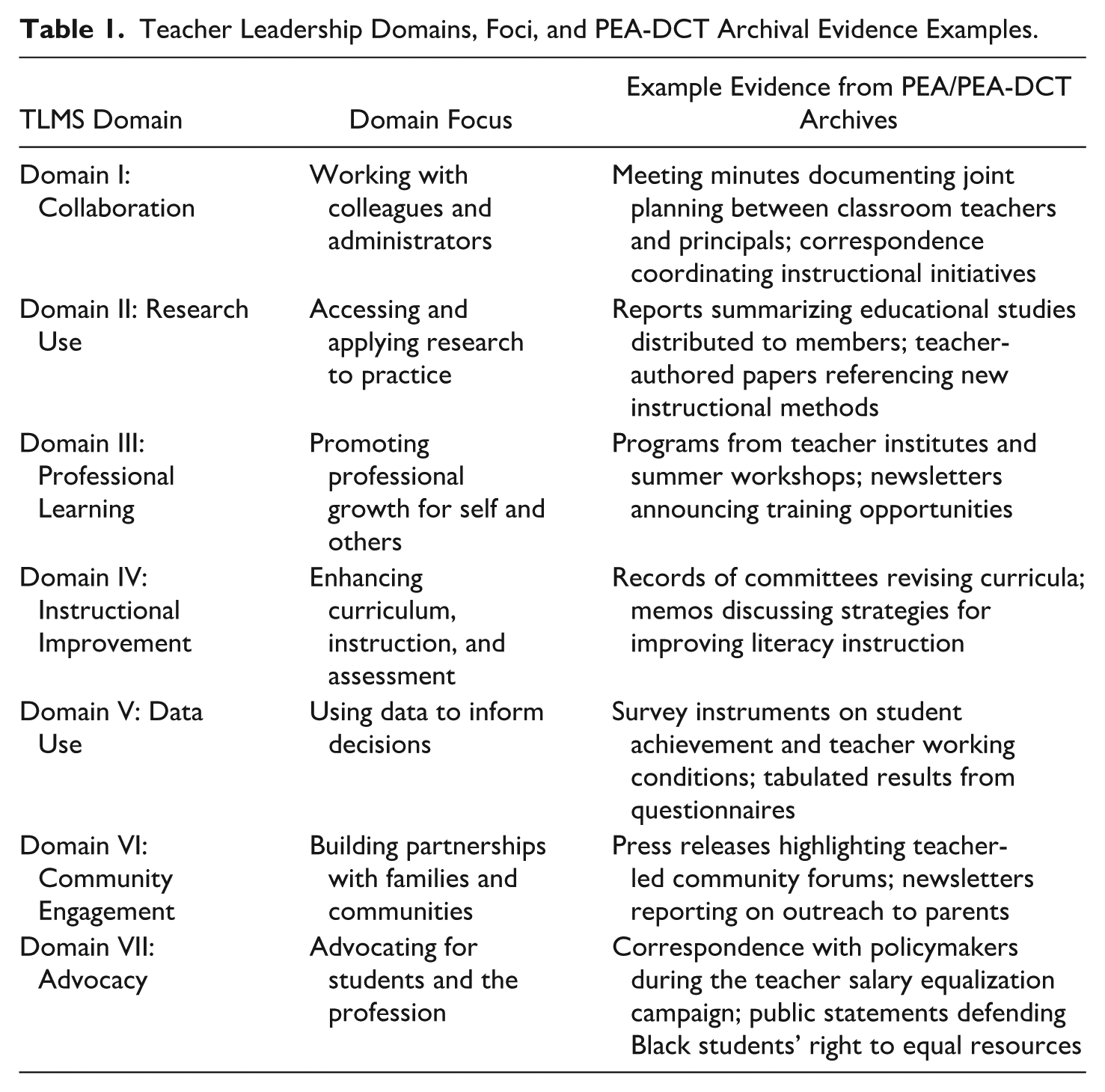
Throughout the process, I wrote analytic memos to document emerging themes, contextual nuances, and interpretations of leadership practices. Coding was iterative; I revisited and refined the categories to ensure reliability, clarify ambiguous cases, and account for overlaps across domains. Finally, I synthesized the findings by comparing coded evidence with contemporary understandings of teacher leadership, which allowed me to identify both continuities and divergences between historical practices and modern frameworks. This analytic strategy addressed the central research question by providing direct evidence of how Black teachers exercised leadership in their segregated schooling communities.
Limitations of the Analytic Approach
Although frequency coding offered a structured way to track patterns of leadership activity across a large archival collection, it cannot fully capture the nuance, complexity, and layered meanings of Black teachers’ leadership practices. To address this limitation, frequency coding was paired with memo writing and iterative interpretation to ensure that coded instances were situated within their broader historical and social contexts. This combination of systematic coding and qualitative interpretation provided both analytic rigor and sensitivity to the complexity of Black teachers’ leadership.
Trustworthiness and Rigor
As with all archival research, interpretation is shaped by what was preserved and whose voices were recorded. To enhance trustworthiness, findings were corroborated across multiple document types and situated within broader historiography of Black education. The structured coding frame provided analytic consistency, while memo writing preserved historical nuance.
Researcher Positionality
My interpretation of the archival materials is shaped by my intersecting identities and lived experiences. As someone who centers my Blackness, but also is a former high school teacher leader and now an educational leadership faculty member and teacher leadership researcher, I approach this work with a deep investment in understanding how leadership has historically been enacted by Black teachers. My mother’s family is from South Carolina and attended segregated schools, and I grew up hearing stories about the central role that Black teachers played in our communities. These personal histories inform both my scholarly commitments to and my interpretive lens filtering this work. As Milner (2007) reminds us, researchers’ personal and cultural backgrounds inevitably shape the questions we ask, the data we privilege, and the meanings we assign to evidence. Acknowledging this positionality is an important component of rigor for making transparent how my own standpoint intersects with the histories I seek to recover and reclaim.
Results: Frequencies and Exemplars of Black Teacher Leadership (1956–1967)
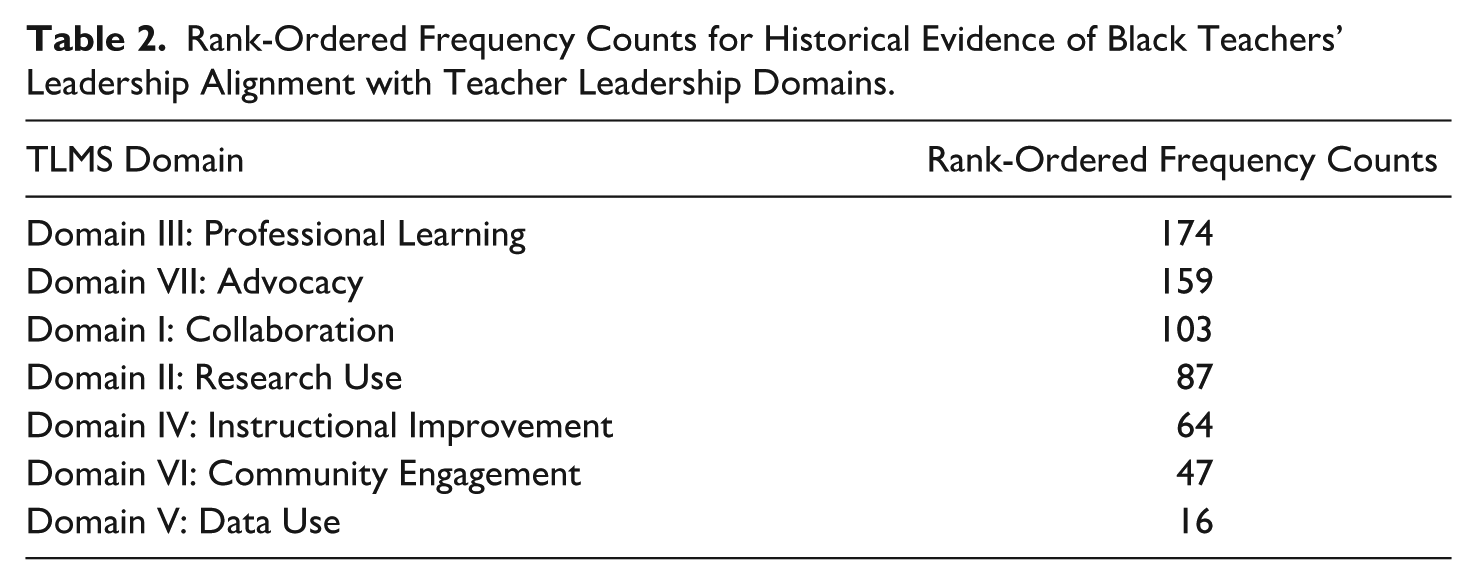
Guided by a priori coding to the Teacher Leader Model Standards, the findings combine frequency evidence with archival excerpts to illuminate how Black teachers enacted leadership (1956–1967). Table 2 reports domain frequencies. The most robust evidence appears in professional learning (Domain III), advocacy (Domain VII), and collaborative culture (Domain I), followed by research (Domain II), curriculum and instruction (Domain IV) with assessment/data (Domain V), and community engagement (Domain VI). Results are presented in rank order of the domains with the highest frequency counts and followed by a summary of findings that highlights the major themes that emerged from analysis.
Rank-Ordered Frequency Counts for Historical Evidence of Black Teachers’ Leadership Alignment with Teacher Leadership Domains.
Domain III: Promoting Professional Learning
With a frequency count of 174, Domain III is the most frequently coded area in which historical evidence of Black teachers’ leadership appears. Archival materials from the PEA-DCT document more than participation in professional learning; they also document the collective design, coordination, and dissemination of that learning across local, district, and state contexts. The documented workshops, planning conferences, and sustained professional gatherings discussed in this section reflect alignment with Domain III by showing how PEA-DCT teachers designed, facilitated, and advocated for ongoing, collaborative professional learning directly connected to instructional improvement.
For example, each September, the PEA-DCT convened an annual Planning Conference in which county presidents, district chairpersons, standing committee members, and local membership chairpersons gathered to establish the professional agenda for the year (Potts, 1978). Participants selected themes, reviewed county-level NEA projects, assigned discussion group leaders, appointed recorders, and coordinated workshops that would extend through six congressional districts and 46 county associations. A 1964 memorandum from PEA-DCT President Rubye J. Johnson clarifies that the planning-meeting structure was intended to ensure that teachers would “come together from time to time to discuss their problems, exchange ideas, and formulate and execute plans for their personal improvement and in turn for the improvement of those whom they serve,” including their students, colleagues, and the broader Black community (Box 17, Folder 614). These planning documents reveal that professional learning was not confined to individual enrichment. At the district level, county officers met to “plan a program for the year” and share “organization information, techniques, and ideas” that would prepare them to train teachers in their respective counties. At the local level, teachers organized around needs “peculiar to their respective counties” and implemented collective initiatives such as public relations campaigns, workshops, newsletters, and Teaching Career Month programming, which were later reported to the state body (Box 18, Folder 616). The PEA-DCT further recommended that the parent PEA convene classroom teacher presidents, county presidents, district chairmen, and principals in joint workshops to address “the most pressing, current problems of the Association” and to encourage counties to undertake collaborative projects recognized at the state level (Box 18, Folder 644).
Within this coordinated structure, professional learning opportunities were conceived and facilitated by Black classroom teachers. Archival records document workshops designed to “improve classroom instruction and provide in-service training related to teacher competency” (Box 18, Folder 639). Agendas and programs include titles such as “Time for Professional Growth” (PEA, 1959), “Teaching Is Our Profession” (NEA, 1961), “Exploring and Informing for Quality Teaching” (DCT-PEA, 1962), and “I Teach a Child of an Automated Society” (DCT-PEA, 1965) (Box 18, Folder 636). These materials indicate attendance at professional learning events as well as the organization of statewide instructional conversations led by classroom teachers themselves, which is, on its own, historical evidence of Black teachers’ leadership.
What emerges from the archival record, then, reflects a multitiered statewide structure of professional coordination. PEA-DCT teachers established professional priorities at the state level, facilitated learning at the district level, and organized colleagues at the county and school levels for delivery and implementation; that is, professional learning in the segregated contexts under which Black educators taught and led functioned as a mechanism for collective planning, shared problem solving, and coordinated instructional improvement. Rather than isolated participation in development activities, the PEA-DCT’s archival documents illustrate how teachers structured and sustained professional learning as organized influence across an interconnected network.
Domain VII: Advocating for Students and the Profession
The second most frequently coded area, with a frequency count of 159, is Domain VII, which documents advocacy efforts directed simultaneously toward students and the profession. Archival records show that the PEA-DCT linked these priorities explicitly. The Seventh Annual Planning Conference adopted the theme “Teaching, a Profession: Spotlight on the Child” (Box 18, Folder 644), and in 1964 the committee issued eight recommendations for teachers’ roles in advancing educational initiatives. Some addressed “upgrading the teaching profession,” while others emphasized “the importance of a flexible curriculum and providing for individual differences among children” (Box 18, Folder 643). Workshop notes from 1966 further articulated responsibilities that joined professional accountability with student-centered commitments, including preparation, cultivating relationships, teaching critical thinking, preparing students “not for today, but for the time in which students are to operate,” and “accepting the responsibility of improving the image of our profession” (Box 17, Folder 633). These materials reflect advocacy framed not as abstract policy or organizational work but as an extension of classroom teachers’ responsibility.
Although advocacy for salary equity, tenure, and curriculum reform is common to teachers’ professional associations, the archival record makes clear that these initiatives, like the professional learning described in the previous section, were organized and executed by practicing classroom teachers. The PEA-DCT was constitutionally limited to classroom educators, and its advocacy was operationalized through teacher-to-teacher organizing at school and county levels. Its teacher members served as legislative committee chairpersons and information contacts who met directly with county delegations, attended school board meetings, and coordinated local efforts to advance shared pedagogical and professional goals (Potts, 1978). In fact, in 33 of 46 counties in South Carolina, PEA-DCT members organized meetings with legislative delegations to present the PEA’s educational agenda and secure local press coverage (Box 18, Folder 622). Meeting minutes record that:
it was most important for legislative committee chairmen to know the members of the county delegation; and to participate in any meetings in the county in which the school programs were discussed, and legislative action in behalf of schools, also to attend meetings of school boards. (Box 18, Folder 618)
Essentially, evidence from the archival records document Black classroom teachers’ political advocacy as they mobilized colleagues and engaged policymakers through structured, collective action to effect positive change beyond their classrooms and school buildings.
Because context matters to teachers’ leadership, it is important to highlight that such organizing unfolded within the constraints of Jim Crow South Carolina, where Black folks, in general, and Black teachers, in particular, operated without basic employment protections. The PEA-DCT documented that “No teacher in the State has any degree of security. There is no form of administrative approval of their work that gives them any promise of security” (Box 18, Folder 622), and South Carolina was among only 10 states lacking tenure legislation during the period of interest (Box 18, Folder 637). A 1964 letter from PEA-DCT President Rubye J. Johnson described “the dismissal of our teachers from their jobs,” noting cases of forced relocation and the denial of employment recommendations as the desegregation efforts began to take hold (Box 18, Folder 615). When teachers were pressured to sign loyalty questionnaires regarding NAACP affiliation, the PEA-DCT Executive Committee resolved “that the Association use its entire resources if necessary for the defense of the teachers” (Potts, 1978, p. 97). Under these conditions, advocacy required coordination, mutual protection, and sustained collective action. In this way, the archival evidence shows PEA-DCT members organizing to collectively defend one another and safeguard their professional standing within a shifting, though no less racially hostile, system. Their documented campaigns for salary parity, tenure protections, policy inclusion, accreditation equity, and access to material resources reflect clear alignment with Domain VII, as PEA-DCT teachers worked together to inform policy engagement, fortify public representation, and advance both student learning and the professional dignity of Black educators.
Domain I: Collaboration
Domain I, focused on collaborative culture, appears as the third most frequently coded area, with a frequency count of 103. The archival record demonstrates alignment with Domain I by evidencing how PEA-DCT members institutionalized collaborative structures, facilitated collective problem solving, and cultivated trust-based professional cultures that supported educator development and student learning.
Archival materials indicate that collaboration was not merely an organizational value but a structural requirement embedded in the PEA-DCT’s governing documents. Article II, Section 3 of the Constitution states that the department aimed to “bring classroom teachers of the state into sympathetic cooperation” (Box 18, Folder 620), and Article VII, Section 3 required coordination of programs with state and local PEA officers, committee chairs, and district leaders. Additionally, early organizational documents clarify that collaboration was oriented toward shared problem solving rather than symbolic unity. A foundational document titled “Reasons for Organizing” lists objectives such as “to give classroom teachers an organization in which to study their own problems” and “to secure group action to solve these problems” (Box 18, Folder 633). Planning conference records further show teachers identifying regional goals and coordinating strategies intended to foster “better understanding and closer cooperation among administrators, school board members, and classroom teachers” (Box 18, Folder 639). Meeting minutes from 1963 note a consensus that teachers needed to “meet often. . .to be informed, to express ourselves, and to do the business we desire to do” (Box 18, Folder 644). These founding documents are significant not because they represented broader organizational ideals but because they codified expectations for how Black classroom teachers in South Carolina would engage one another as professionals.
Materials also document collaboration across racial lines during the transition toward desegregation. In July 1966, Executive Secretary W. E. Solomon organized a statewide Conference on Faculty Desegregation, supported by a $3,800 NEA grant, that convened supervisors, principals, and teachers from predominantly white and predominantly Negro schools across 70 communities (Box 18, Folder 623). Solomon wrote that educators needed “to sit down with our counterparts and discuss the guidelines on school desegregation” and “to get to know, through a discussion of issues, the persons we will have to work with in the schools and in teacher organizations.” Notably, the South Carolina Education Association, the white-only teacher organization in the state, declined to co-sponsor the conference; yet, the PEA-DCT proceeded independently. This effort illustrates Black classroom teachers’ leadership in coordinating structured dialogue across racial and institutional boundaries, even in the face of significant political tension.
Domain II: Accessing and Using Research to Improve Practice
With a frequency count of 87, the next most frequently coded domain concerns accessing and using research to improve instructional practice and student learning. Archival materials indicate that inquiry was embedded in the PEA-DCT’s organizational expectations, much like the professional learning and collaboration approaches discussed in earlier sections. Official recommendations directed classroom teachers to “Engage in and encourage research” (Box 18, Folder 644), and members were urged to remain current by “keeping up to date on the latest developments in new content, teaching materials, techniques, and innovations through reading, research, observation, visitation, meetings, college courses, and professional conferences” (Box 18, Folder 645). Conference proceedings described research engagement as essential “to make teachers aware of new educational trends in an effort to develop a willingness to investigate or experiment with new procedures and techniques” (Box 18, Folder 639). Participation in the PEA-DCT thus carried an explicit expectation that teachers would study, test, and refine their practice, both individually and collectively.
However, these Black educators did not merely discuss the importance of research to their practice; they actively embraced it as a cornerstone of their practiced professional responsibilities. For example, the archival record documents research enacted collectively and embedded within instructional programming. Beginning in 1957, the PEA’s Natural Science Division, in collaboration with the PEA-DCT, organized the first Palmetto Science Fair among junior and senior high schools statewide. Teachers developed project guidelines, established evaluative criteria, and supervised student investigations in mathematics, chemistry, biology, and physics. For 11 consecutive years, two top winners advanced to the National Science Fair, and in five of those years South Carolina’s Black schools produced a national winner (Potts, 1978, p. 88). This initiative institutionalized systematic inquiry as a structured component of classroom practice, which required teachers’ leadership to coordinate standards, evaluate evidence-based student work, and disseminate results across schools. In this example, research methodology was not flatly discussed; it was operationalized through collaborative statewide instructional practice and service.
In addition to classroom-based initiatives, PEA-DCT leaders participated in national research efforts. For instance, Hudson L. Barksdale, one of the presidents of the PEA-DCT, coordinated the department’s participation in the NEA Study Conference on the Utilization of Teacher Time (1959–1961), which convened classroom teachers from across the United States to examine preparation time, class size, noninstructional duties, and working conditions (Box 18, Folder 632). The study’s objectives included developing standards for working conditions, publishing those standards, and identifying strategies for their implementation. When Barksdale reported on the PEA-DCT’s participation, he positioned South Carolina classroom teachers within a national research effort aimed at shaping policy and professional practice. Thus, these Black teachers’ participation documents a profound commitment to research engagement and embodied the teacher leader model standards’ emphasis on collaborating with other organizations engaged in researching critical education issues.
Domain IV: Facilitating Improvements in Instruction and Student Learning
With a frequency count of 64, this section examines historical evidence of Black teachers’ inquiry undertaken to address concrete instructional challenges within specific school contexts. One notable example is a 1962 school-level research study, later published statewide in the PEA’s official journal, titled “Helping the Underachievers Improve: A Research Report” (Box 3, Folder 94). The study emerged from faculty-wide concerns about fourth graders’ reading proficiency and readiness for fifth grade. Jessie T. Butler, a fourth-grade teacher working in collaboration with the principal and fellow teachers at East End Elementary School, initiated the study and coordinated a six-month intervention that included supplemental reading instruction, home visits, and parent conferences. Student progress was tracked over time, and results indicated measurable gains in reading performance and successful promotion to the fifth grade. The study’s findings were shared with the broader membership through publication, which was available in every segregated schooling community’s library in the state.
District-level records further illustrate teacher-facilitated instructional refinement. At a November 1964 Sixth District meeting, PEA-DCT teachers collaboratively developed a framework for “Teacher Competence in an Automated Society” (Box 17, Folder 615). Participants emphasized the importance of evaluation tied to action, noting that teachers must engage in the evaluation of their practices and, when they do, “accept what you find and do something about it.” Members also encouraged colleagues to “Share with other teachers, ideas, methods, and valuable professional information,” and stressed the need to “Accept the child where he is, and work with him from there.” These statements reflect structured reflective dialogue grounded in student outcomes and collegial exchange. Rather than limiting instructional improvement to individual classroom experimentation, the district meeting functioned as a forum in which teachers collectively articulated expectations for practice, linked instruction to student competency, and affirmed shared responsibility for improving teaching and learning. In doing so, they enacted reflective practice rooted in student learning, supported one another’s professional growth, and coordinated instructional priorities in ways that align closely with the contemporary articulation of this leadership domain.
Domain VI: Collaboration with Families and Community
Although less frequently coded than other domains (n = 47), archival evidence shows that PEA-DCT members worked intentionally to strengthen relationships between schools and families. Convention proceedings regarding community involvement and work with families repeatedly affirmed that “children are the first concern” (Box 18, Folder 631), thereby constituting a framework where educators and families work together as shared partners in supporting Black students. PEA-DCT district records further document sustained attention to organizing and structuring parent–teacher associations (PTAs), including discussions at the First District meeting regarding the establishment and maintenance of effective local units (Box 18, Folder 643). In practice, these teacher-initiated PTAs functioned as structured forums in which teachers and families deliberated about student needs, school conditions, and shared responsibilities; and, within South Carolina’s segregated educational system, they provided organized and important avenues for Black parental participation.
Teachers’ community engagement also extended to addressing material barriers that affected students’ educational access. Archival records show PEA-DCT members leading the way in the state for the implementation of Head Start programs (Potts, 1978):
. . .Interested members invited Mrs. Greenberg, the national director of Headstart, to South Carolina to discuss the possibility of organizing Headstart programs in South Carolina. The first community sponsored project was started in the city of Greenville, and the first college sponsored project was begun at Voorhees College in Denmark. According to Mr. Solomon, “those efforts of the Palmetto Education Association to sponsor Headstart Programs brought about a change in the attitude of the State Legislature and the State Department of Education.” After some delay these programs were sponsored by the state Department of Education. (p. 113)
The efforts described by Mr. Solomon, the parent organization’s leadership, confirm that PEA-DCT members understood that, for educational improvement to occur, there would need to be structural initiatives, like Head Start, in place to support Black children’s readiness to learn, and, ultimately, all children’s in the state once the South Carolina Department of Education followed their lead.
Additional records further illustrate how PEA-DCT members understood community visibility and communication as integral to their professional roles. Workshop notes and district meetings emphasized cultivating “better relations between the home and school; better relations between the parent and teacher; and better relations between the teacher and student” (Box 18, Folder 644). Teachers were encouraged to maintain active participation in churches, civic organizations, and local associations, reflecting longstanding Black cultural traditions in which professional identity was inseparable from standing within the community (Box 17, Folder 633; Box 18, Folder 636). Although teachers’ professional organizations routinely encourage community engagement, in segregated South Carolina such practices carried heightened significance. Under these conditions, teachers’ public presence functioned as a strategic means of sustaining institutional credibility, mobilizing community resources, protecting educational opportunities for Black children, and repositioning Black teachers as public intellectuals at a time when they and their schooling communities were considered inferior due to their Blackness. Thus, community engagement was embedded in the structural realities of the PEA-DCT as a form of collective advancement rooted in traditions of mutual accountability and communal responsibility. In this context, PEA-DCT members embodied the leadership functions now articulated in Domain VI of the model standards by grounding their work in community knowledge and needs, and modeling and teaching collaborative engagement with families.
Domain V: Promoting the Use of Assessments and Data
Although references explicitly coded under assessment appear less frequently (n = 16), records indicate that PEA-DCT members embedded diagnostic attention to student learning within their instructional and organizational leadership practices. The Teachers’ Bulletin (1940) articulated classrooms in which “the child and his needs should be the focal point” (Box 8, Folder 258, p. 13), urging teachers to use student assessment and perception data to revise curricula in response to their “immediate needs, interests, individual differences, preparations, opportunities, and future needs” (p. 11). Organizational documents further reflect that assessment was understood as a professional competency linked to school improvement; PEA-DCT materials identified effective teachers as “able diagnosticians of pupil difficulties” (Box 18, Folder 29). Under Hudson L. Barksdale’s presidency in the 1960s, the PEA-DCT expanded workshops focused on using evidence of student performance to improve instruction and raise achievement levels (Potts, 1978). Diagnostic expertise was thus positioned as a defining feature of Black teachers’ professional leadership.
At the same time, PEA-DCT leaders, following directives from the parent organization and working in collaboration with the Research Committee, leveraged student and teacher performance data to advance claims for structural equity. Organizational discussions referenced graduation rates and test outcomes to document systemic disparities affecting Black students (Potts, 1978), while all Black teachers in the state were asked to provide documentation of educational attainment and years of experience to quantify inequities in compensation relative to white teachers with comparable credentials (Box 1, Folder 2). By insisting on parity in accountability measures and promoting systematic use of data for both instructional improvement and professional equity, the PEA-DCT positioned assessment as a tool for refining classroom practice and as a mechanism for securing equitable access to resources, recognition, and compensation. In this context, PEA-DCT members enacted the leadership functions associated with purposeful data use by actively and collectively promoting the use of student and teacher data to guide instructional improvement and professional advancement.
Summary of Findings
In 1959, Hudson L. Barksdale, the first president of the PEA-DCT, provided a comprehensive presidential report that captured the essence of Black teachers’ leadership. In the report, he explains that the department focused on the collective professional growth of its members “to help them with their problems, to inform them about professional matters. . .to encourage professional growth. . .and to stimulate a greater pride in the teaching profession” (Box 18, Folder 633). His statement reflects the integrative nature of PEA-DCT members’ leadership orientation and illustrates the interconnectedness of their professional work; it also sets the stage for the broader themes that emerged across the archival record. Because the PEA-DCT was constitutionally limited to practicing classroom teachers, this work was enacted not by external administrators or policy elites but by rank-and-file Black teachers enacting their brand of teacher leadership through an organized professional structure.
Black Teachers’ Leadership as Integrated Practice
The archival evidence shows that Black teachers’ leadership practices were rarely confined to a single domain. Professional learning, advocacy, collaboration, research engagement, assessment, and community partnership consistently intersected. Teachers designed and facilitated statewide planning conferences while also serving as legislative contacts in their counties. They organized instructional workshops, coordinated research initiatives, and implemented assessment practices while simultaneously pressing for tenure protections, salary equity, and equitable accreditation standards. More than occupying traditional leadership roles, Black classroom teachers enacted leadership as an interconnected practice in which instructional improvement, organizational coordination, and professional advocacy were mutually reinforcing. This integration suggests that teacher leadership constructs were embedded in their everyday professional work.
PEA-DCT Teachers as Organizational Architects
Of note, professional association advocacy itself is not historically unique to Black educators. However, the archival record makes clear that the initiatives described in this study were conceived, organized, and implemented by practicing classroom teachers within the PEA-DCT structure. Members chaired committees, coordinated county meetings, met with legislative delegations, designed statewide programming, and supervised collaborative research initiatives. They built systems for communication across 46 counties, facilitated structured dialogue during desegregation, and established formal mechanisms for family engagement. In segregated South Carolina—where Black teachers lacked tenure protections and faced political and professional retaliation for their justice work—these organizational efforts also served as mechanisms of mutual protection and collective advancement. The evidence therefore demonstrates that Black classroom teachers in South Carolina were not merely participants in professional association activity; they functioned as architects of its agenda and operational drivers of its implementation.
Equity as an Organizing Principle
Across the teacher leadership domains, equity functioned as a guiding principle that linked student opportunity with professional, personal, and collective dignity. Diagnostic assessment practices were used to tailor instruction to students’ immediate and future needs, and research initiatives institutionalized inquiry as part of instructional refinement. At the same time, PEA-DCT members advocated vigorously for the profession itself. Teachers mobilized graduation data, test performance outcomes, and credential documentation to demonstrate racialized disparities in compensation, accreditation standards, and access to resources. Campaigns for tenure protections, salary parity, equitable evaluation, and inclusion in state accountability systems reveal that Black teachers understood professional equity as foundational to educational improvement. Initiatives such as securing Head Start programs and advocating for free textbooks further illustrate how teachers addressed structural barriers that affected both students’ readiness to learn and the legitimacy of Black schools within a segregated system. In this way, advocacy for students and advocacy for the profession were not separate endeavors; instead, they were intertwined strategies aimed at strengthening schooling communities, elevating teacher status, and expanding educational access.
Discussion
This study set out to examine whether contemporary conceptualizations of teacher leadership can be traced back to historical evidence of Black teachers’ work under de jure segregation. Drawing on archival materials from the PEA-DCT, the findings illuminate how Black classroom teachers in segregated South Carolina enacted leadership through sustained professional coordination, research engagement, legislative advocacy, and community partnership. More than presenting these teachers’ leadership as episodic or role-based, the PEA-DCT’s archival record reveals their leadership as structured professional practice, embedded within an organizational system created and maintained by Black classroom teachers themselves.
Situating these findings within the broader historiography of Black educators (e.g., Fenwick, 2023; Foster, 1997; Morris, 2001; Walker, 2013) underscores that teacher leadership footholds, such as professional collaboration and collective action for change, have long characterized Black teachers’ historical leadership work. The PEA-DCT case adds specificity to this tradition by documenting how Black teachers built quintessential teacher leadership infrastructures like planning professional learning opportunities, research initiatives, and legislative engagement that enabled collective action in 46 counties across the state. Black teachers’ leadership, in this context, was not confined to influence, as is often described in contemporary teacher leadership research (Nguyen et al., 2020). Instead, it was strategically organized through durable professional mechanisms in the forms of a national and state organization for Black educators and a dedicated department to its classroom teachers.
These findings also bear on ongoing debates regarding the scope and definition of teacher leadership. The PEA-DCT case demonstrates that collaboration, inquiry, assessment, advocacy, and community engagement operated not as fixed domains but as mutually reinforcing dimensions of Black teachers’ professional work. Whatever definitional consensus the field ultimately reaches, it should account for the historical record of Black teachers’ leadership, documented both in the broader historiography of segregated southern schooling and in the archival evidence presented here. At minimum, this case suggests that teacher leadership may be understood as the professional, collaborative, intellectual, and equity-centered work of teachers that shapes instructional practice and improves the broader conditions under which schooling occurs. Such a formulation aligns with collaborative influence models (York-Barr & Duke, 2004) while extending them to include historical forms of systemic engagement that scholarship on teacher leadership for social justice (Marshall & Anderson, 2008; Mundorf et al., 2019; Pham, 2022) and critical teacher leadership (Bradley-Levine, 2018, 2022) has urged the field to foreground.
Several limitations warrant acknowledgment. First, revisiting teacher leadership through this historical lens does not position the PEA-DCT as the singular origin of the construct, nor does it suggest that professional organizing was unique to Black educators. Instead, the study contributes to a more complete account of teacher leadership’s development by foregrounding leadership traditions that have not consistently been centered in the field’s dominant or historical narratives. Although scholarship documents that Black teachers’ professional organizations simultaneously coordinated pedagogical and equity-centered advocacy efforts across the segregated South (Walker, 2019), this study examines only one state-level organization within a particular political and racial context. Additional archival research across regions and organizational forms would further clarify the contours and variation of historical teacher leadership practices. Even so, the PEA-DCT materials provide a substantial record of Black teachers’ coordinated leadership activity that expands the empirical base upon which teacher leadership scholarship has typically relied.
Final Word
Ultimately, recognizing Black teachers’ historical leadership contributes to a more historically grounded understanding of teacher leadership’s development in that it invites the field to situate contemporary frameworks within a longer professional lineage that demanded intellectual rigor, organizational coordination, and sustained advocacy for equity and justice. In this light, teacher leadership appears less as waves developing in the 1980s and more as an enduring professional practice with deeper roots than prevailing timelines have attempted to acknowledge. Vanessa Siddle Walker (2013) once shared that Mordecai Johnson, reflecting on the needs of Black children in segregated schooling communities, asserted: “We know, don’t we. We must be the agents of what we know” (p. 213). As educational researchers and practitioners committed to meeting the needs of all children in any political climate, we, too, must be agents of what Black educational history and this archival collection make visible: a teacher leadership tradition grounded in equity, professional dignity, and collective responsibility.
Footnotes
Declaration of Conflicting Interests
The author declared no potential conflicts of interest with respect to the research, authorship, and/or publication of this article.
Funding
The author received no financial support for the research, authorship, and/or publication of this article.
