







Abstract
Context:
Early reading achievement is shaped by students’ skills and by the motivational, socioeconomic, and institutional conditions in which literacy learning occurs. In Türkiye, this issue is salient because schooling is constitutionally monolingual, although many fourth-grade students report speaking a language other than Turkish at home. This home–school language mismatch raises questions about how reading confidence, socioeconomic status, and school academic climate are associated with achievement across levels of exposure to Turkish.
Purpose:
This study examines how students’ confidence in reading, school emphasis on academic success, and socioeconomic status are associated with fourth-grade reading achievement in Türkiye. It also investigates whether the estimated indirect association between reading confidence and achievement through school emphasis on academic success varies by socioeconomic status. Analyses are conducted separately across four groups defined by students’ frequency of speaking Turkish at home: always, almost always, sometimes, and never.
Research Design:
The study uses cross-sectional data from the PIRLS 2021 Türkiye national sample. After screening, the analytic sample included 5,421 fourth-grade students: 3,836 who always spoke Turkish at home, 698 who almost always did so, 743 who sometimes did so, and 144 who never did so. Reading achievement was analyzed using five PIRLS plausible values; the focal predictors were reading confidence, school emphasis on academic success, and home socioeconomic status. Hayes’s PROCESS Model 59 was estimated within each home-language subgroup, with coefficients combined across plausible values and interpreted as conditional associations.
Conclusions:
Reading confidence was positively associated with achievement across all four home-language groups, with the largest coefficient among students who never spoke Turkish at home. School emphasis on academic success also showed positive direct associations with achievement, suggesting that academic climate is especially relevant in linguistically constrained contexts. The estimated indirect pathway through school emphasis on academic success was detectable in the “sometimes” subgroup, while a comparable but less precise estimate appeared in the “never” subgroup. Socioeconomic status remained strongly associated with achievement, especially among students with less frequent exposure to Turkish at home. The findings support combining reading-confidence supports, academically focused school climates, and language-responsive policies for students navigating home–school language mismatch.
Keywords
Early reading achievement at the primary level plays a pivotal role in shaping students’ long-term academic development and success. Around the ages of 9–10, children transition from “learning to read” to “reading to learn,” a shift that creates a foundation for future attainment (Willms, 2022). This transition remains a central concern in contemporary literacy debates, with recent scholarship emphasizing both the salience of fourth-grade reading outcomes and the need to interpret them through an equity lens (Cervetti & Hinchman, 2024). However, success at this juncture depends not only on decoding and comprehension but also on the linguistic and contextual conditions in which literacy learning unfolds. Specifically, the alignment—or misalignment—between the language spoken at home and the language of instruction at school has emerged as a central correlate of reading development. Students who encounter a mismatch frequently struggle with this critical transition, risking weaker academic integration and diminished reading self-confidence (Bellocchi & Bonifacci, 2024; Bruggink et al., 2022; Gallagher et al., 2023; Yang et al., 2018). This concern also resonates with recent scholarship on teaching culturally and linguistically diverse learners, which underscores the need for instructional and professional frameworks that are responsive to linguistic diversity rather than organized around monolingual assumptions (Leider et al., 2024).
A robust body of research shows that reading performance is associated with interrelated factors spanning individual, family, and school levels (Bozkuş, 2025; Demir et al., 2024; Rakesh et al., 2025; Toste et al., 2020). Among these, home–school language mismatch is especially consequential because it is linked to both linguistic competence and students’ self-beliefs about reading. Drawing on this perspective, learners facing mismatch often report lower reading self-efficacy, anticipate failure, and exhibit avoidance of reading tasks—patterns strongly associated with slower literacy growth (Cummins, 2021; Kilpi-Jakonen & Alisaari, 2022). At the individual level, students’ reading self-confidence (SCR) is a key motivational resource associated with engagement with texts and resilience in the face of setbacks (Abid et al., 2023; Hemmerechts et al., 2017; Nag et al., 2019). Although SCR is consistently related to achievement, the mechanism through which this relationhip is conditioned by school-level climate and socioeconomic status (SES) remains understudied (Albayrakoğlu & Yıldırım, 2022; Bozkuş, 2025; Chen et al., 2021; Kılıç Depren & Depren, 2021; Toste et al., 2020).
School contexts are pivotal in this ecology. Recent work has likewise underscored the importance of school climate as a condition that may enable improvement processes and shape educational outcomes, particularly in contexts facing substantial performance challenges (Harbatkin et al., 2024). The quality of the learning environment and the norms teachers communicate about success are associated with how students construe difficulty and calibrate effort. Schools that emphasize academic success and provide supportive climates can help support self-efficacy and buffer against the negative affect often associated with language mismatch (Bozkuş, 2025; Chen et al., 2021). Conversely, weak expectations or insufficient structural supports may coincide with existing disadvantages (Chen et al., 2021). SES further complicates these dynamics. Students from low-SES households typically have fewer language-rich resources, limited access to instructional support, and fewer opportunities for guided practice, which tend to be associated with lower levels of confidence and performance—even in schools with strong academic emphasis (Nag et al., 2019). By contrast, high-SES students often benefit from enriched input, tutoring, and diverse reading materials, facilitating alignment with school expectations (Demir et al., 2024; Rakesh et al., 2025).
In Türkiye, these issues are especially salient. Crucially, Progress in International Reading Literacy Study (PIRLS) 2021 data indicate a positive association between frequent use of the language of instruction at home and reading performance, particularly when comparing students who speak the language of instruction always or almost always with those who do so only sometimes or never, who demonstrate markedly lower reading achievement (Mullis et al., 2023). This disparity underscores the need to probe the psychosocial and contextual mechanisms—particularly SCR, school emphasis on academic success, and SES—through which achievement gaps emerge or are alleviated. Existing scholarship documents SES effects on literacy, yet evidence is limited on how SES interacts with school emphasis on academic success (SEAS) and home language use to shape the SCR–achievement link (Albayrakoğlu & Yıldırım, 2022; Rakesh et al., 2025). Understanding SES as a moderator is therefore crucial for specifying which interventions are effective, for whom, and under what linguistic conditions.
The present study integrates Bronfenbrenner’s ecological systems theory and Bandura’s social cognitive theory to conceptualize these multilayered processes. Bronfenbrenner (2005) locates development within nested systems extending from the microsystem to the macrosystem, foregrounding institutional and cultural contexts that contour opportunity structures (Bozkuş, 2025; Rakesh et al., 2025). Bandura (1997) emphasizes the role of self-efficacy in shaping motivation and performance, clarifying how beliefs like SCR are linked to persistence, strategy use, and susceptibility to feedback (Toste et al., 2020). Together, these frameworks situate psychological processes within school and societal arrangements, supporting an analysis in which the associations among SCR, SEAS, SES, and reading achievement can be examined within a conditional process framework rather than as confirmed causal pathways.
Using nationally representative PIRLS 2021 Türkiye data, this study examines whether SEAS statistically mediates the association between SCR and reading achievement and whether SES moderates both the direct and indirect pathways, conditional on students’ frequency of speaking Turkish at home (always, almost always, sometimes, never). By disaggregating analyses across home-language exposure groups, the study assesses whether motivational and contextual factors operate similarly when the language of instruction is more or less present in the home environment. The contribution is twofold: empirically, this study offers an integrated descriptive account of how individual and school-level factors are associated with achievement in a monolingual system serving linguistically diverse students; practically, this study aims to inform policies and practices that promote equity for learners from low-SES and linguistically marginalized backgrounds through climate-focused supports that complement skill development (Mullis et al., 2023).
Theoretical Background
Reading Confidence and Reading Achievement
Reading literacy is conceptualized by international assessments such as PIRLS and the Programme for International Student Assessment (PISA) as a multifaceted skill that goes beyond basic comprehension. These frameworks emphasize interpreting, evaluating, and reflecting on texts to achieve personal, academic, and societal goals (Organisation for Economic Co-operation and Development [OECD], 2023). PIRLS 2021, for instance, assesses both literary and informational reading, focusing on higher-order skills like inference-making, integrating ideas, and critical evaluation (Mullis et al., 2023). Similarly, PISA incorporates digital and multimodal literacy, requiring students to navigate ambiguity and distinguish fact from opinion (OECD, 2021, 2023).
A key factor associated with reading success within these frameworks is reading confidence. Although theoretically distinct—with self-efficacy referring to judgments of capability to perform specific tasks (Bandura, 1997) and self-concept reflecting broader self-perceptions of competence—large-scale assessments like PIRLS operationalize these constructs as a unified dimension termed “Students’ Confidence in Reading.” In line with Bandura’s framework, this study utilizes the SCR construct to capture students’ global perceived capability, which is associated with their willingness to engage with challenging texts and persist through difficulties (Honicke et al., 2023; Toste et al., 2020). Empirical studies consistently demonstrate a positive, reciprocal relationship between confidence and achievement. Meta-analyses indicate a moderate correlation (r = 0.22) between self-efficacy and reading performance, with confident readers showing greater persistence and strategic competence (Toste et al., 2020).
Large-scale assessments reinforce these findings. PIRLS 2021 data reveal that students with high confidence significantly outperform their less confident peers. In Türkiye, for example, fourth graders with strong self-beliefs score above international benchmarks, whereas those with low confidence fall below national averages (Mullis et al., 2023). Bandura’s (1997) framework explains this dynamic: students who believe in their abilities invest more effort, monitor comprehension actively, and recover better from setbacks (Honicke et al., 2023). Conversely, low confidence leads to avoidance, anxiety, and reduced exposure to complex texts, hindering skill development (McBreen & Savage, 2021).
Recent research further supports these patterns. Correlational studies by Abid et al. (2023) and Wani and Ismail (2024) demonstrate a strong relationship between robust reading self-beliefs and higher test scores and deeper engagement. Hemmerechts et al. (2017) and Costa et al. (2024) find that confident readers employ more sophisticated strategies, such as comprehension monitoring and critical evaluation. In contrast, students with low confidence often disengage, limiting their opportunities to practice advanced literacy skills (McBreen & Savage, 2021).
Importantly, reading confidence is malleable. Interventions targeting self-efficacy—through structured mastery experiences, positive feedback, and gradual challenge—improve both motivation and achievement (McBreen & Savage, 2021). This has critical implications for education systems, particularly in linguistically diverse or disadvantaged contexts. Integrating confidence-building strategies (e.g., fostering enjoyment, reinforcing perseverance) alongside skill instruction can help bridge performance gaps, especially for students navigating mismatches between home and school languages (OECD, 2023).
Home Socioeconomic Status (SES)
The PIRLS 2021 framework defines socioeconomic status using a composite index that integrates parental education, occupational prestige, the number of books at home, and access to digital devices (International Association for the Evaluation of Educational Achievement [IEA], 2023). These indicators reflect the material, cultural, and informational capital available in the home environment, all of which contribute to the quality and quantity of students’ literacy experiences.
A substantial body of research confirms that SES is among the most consistent predictors of students’ reading development, showing associations with not only their early language acquisition but also their long-term academic trajectories (Taylor et al., 2023; Yeung et al., 2022). Children from high-SES families tend to benefit from rich literacy environments, characterized by frequent adult–child reading, access to diverse texts, and structured learning routines. These affordances have been associated with vocabulary growth, syntactic development, and early decoding skills, all of which are foundational for reading proficiency (Mullis et al., 2023; Salas & Pascual, 2023).
In contrast, children from low-SES households often face multiple disadvantages. They are less likely to be exposed to complex language input, have fewer literacy materials at home, and may receive limited parental support for academic tasks (Demir et al., 2024). These early gaps, once formed, tend to widen over time and are difficult to remediate through schooling.
Beyond cognitive access, SES is associated with students’ self-efficacy beliefs and academic outcome expectations. Students from more affluent backgrounds tend to report robust perceived capabilities, including in reading (Ma et al., 2023; Yeung et al., 2022). The PIRLS 2021 data confirm that high-SES students tend to report higher levels of reading enjoyment and confidence, both of which are associated with superior literacy outcomes (IEA, 2023).
Yeung et al. (2022) demonstrated that reading confidence partially mediates the relationship between SES and reading performance; that is, children from higher-SES households are more confident in their reading abilities, and this confidence, in turn, is positively associated with their performance. These findings highlight that SES is associated with more than material access, extending also to the psychological dimensions of literacy development.
Frequency of Speaking the Language of the Test at Home
In PIRLS 2021, the variable “frequency of speaking the language of the test at home” captures students’ home-language use and its relationship to their academic development. Although this measure does not directly indicate ethnic background or migration status, it reflects broader linguistic, cultural, and structural dynamics, including language policy, family language preferences, and access to bilingual support (Chen et al., 2021).
Multiple studies have shown that frequent use of the school language at home is associated with stronger reading achievement. Students who regularly use the language of instruction outside school exhibit better vocabulary knowledge, reading fluency, and comprehension skills (Al-Obaydi et al., 2024). Consequently, this linguistic continuity between home and school environments not only reinforces vocabulary and comprehension but also fosters reading confidence, as students feel more capable of managing text-based challenges (Bellocchi & Bonifacci, 2024; Nag et al., 2019; Toste et al., 2020).
However, this relationship is mediated by other contextual variables, such as SES and school-level support. Students from low-SES households who do not speak the school language at home are doubly disadvantaged, lacking both linguistic familiarity and material resources (Bellocchi & Bonifacci, 2024). In contrast, students from high-SES homes may compensate for language mismatch through parental scaffolding and enriched home literacy practices.
Cross-national studies have confirmed these patterns. In European countries such as Germany, Austria, and Switzerland, home language use explains a substantial portion of the academic achievement gap between immigrant and nonimmigrant students (Kilpi-Jakonen & Alisaari, 2022). However, these disparities often reflect broader inequalities, with language serving as a marker of deeper structural disadvantages.
Importantly, multilingualism is not a liability. Research has shown that bilingual students often outperform their monolingual peers in areas such as cognitive flexibility and attentional control (Adesope et al., 2010). However, the benefits of bilingualism depend on the sociopolitical and educational contexts in which students are located. Without institutional recognition and support, language diversity may become a barrier rather than an asset.
Therefore, the school’s emphasis on academic success can be a critical compensatory factor. Schools that promote high expectations, differentiated instruction, and inclusive pedagogies can help mitigate the challenges faced by students who do not speak the test language at home (Bruggink et al., 2022). Longitudinal studies have shown that language-related achievement gaps can narrow over time when schools provide sustained language support and culturally responsive teaching (Weidl & Erling, 2025).
School Emphasis on Academic Success (SEAS)
SEAS is a school-level construct introduced in the context of international large-scale assessments to capture the degree to which schools prioritize excellence in academics. As operationalized in the PIRLS and Trends in International Mathematics and Science Study (TIMSS), SEAS reflects shared expectations, norms, and practices that promote high academic performance (Hooper et al., 2017; Ye et al., 2024). It includes elements such as curricular rigor, teacher effectiveness, parental involvement, and a culture of high achievement.
SEAS has been consistently associated with improved student outcomes across multiple countries and subject areas. In PIRLS 2016, a multilevel analysis of Portuguese data found that SEAS was the strongest school-level predictor of reading performance (Lopes et al., 2022). Similarly, TIMSS 2019 data from East Asia and Scandinavia linked SEAS with higher mathematics and science achievement (Ye et al., 2024).
SEAS is particularly beneficial for students from disadvantaged linguistic or socioeconomic backgrounds. It functions as an institutional scaffold, helping students access academic language and remain engaged in learning despite external challenges (Albayrakoğlu & Yıldırım, 2022; Michael & Kyriakides, 2023). High-SEAS schools tend to employ more effective instructional strategies and create environments where all students are expected to succeed and are supported to do so.
Furthermore, SEAS often interacts with other variables, such as SES and home language. Research shows that the effect of SES on achievement is partially mediated by school climate variables like the SEAS, suggesting that schools can buffer against home-based inequalities through institutional emphasis on success (Nilsen & Gustafsson, 2014). However, this effect was not uniform. For example, in Sweden, the predictive power of SEAS disappeared when instructional quality and opportunity to learn were controlled. Recent research has also highlighted the indirect effects of SEAS. Scherer and Nilsen (2016) reported that SEAS was associated with student motivation in ways linked to teaching quality, which was in turn related to learning outcomes. Accordingly, SEAS appears to relate to achievement both directly and indirectly through its associations with effective instruction and motivation.
Türkiye Caught Between Structural Monolingualism and Linguistic Diversity
Türkiye is sociologically a multilingual and multicultural society, despite the fact that its education system is largely structured around a monolingual instructional regime. Linguistic inventory studies document the breadth of languages spoken within the country: Although Pinnock (2009) reports that as many as 46 different languages are spoken in Türkiye, Ethnologue (2023) classifies 19 living languages as currently in active use. Official statistics on the ethnic and linguistic composition of the population are not systematically disclosed due to the overarching definition of “Turkishness” in state records; however, independent studies consistently estimate that approximately 15–23% of Türkiye’s population has a mother tongue other than Turkish (KONDA Research and Consultancy, 2021; Yadirgi, 2017). Within this group, Kurdish speakers—primarily those using Kurmanji and Zazaki—constitute the largest share, followed by communities speaking Arabic, Laz, Circassian, Bosnian, and Armenian. Aydın (2020) similarly notes that Kurds account for roughly one-fifth of the population and are geographically concentrated primarily in Eastern and Southeastern Anatolia.
This sociolinguistic diversity is also reflected in educational outcomes: PIRLS 2021 data indicate that 28.9% of fourth-grade students in Türkiye report speaking a language other than Turkish at home with varying frequency (Mullis et al., 2023). This figure suggests that home–school language mismatch is not an exceptional condition affecting a marginal group, but rather a structural reality that warrants serious consideration in discussions of early literacy development and equal learning opportunities.
What renders the Turkish case theoretically distinctive, however, is not the level of linguistic diversity per se, but the manner in which this diversity is governed within the framework of nation-state ideology. Historically, education in Türkiye has been conceptualized as a primary instrument of nation-building, and linguistic diversity has been treated less as a societal resource than as a perceived threat to national unity (Aydın, 2020). This orientation is most clearly manifested in the constitutional regulation of the language of instruction. Article 42 of the Constitution of the Republic of Türkiye explicitly stipulates that “no language other than Turkish shall be taught as a mother tongue to Turkish citizens in any institutions of education or training,” thereby prohibiting the pedagogical integration of linguistic diversity into formal schooling. This constitutional provision represents a continuation of the centralized and monolingual education system institutionalized through the 1924 Law on the Unification of Education (Tevhid-i Tedrisat Kanunu), which positioned the language of instruction as a cornerstone of the state’s ideological cohesion (Aydın, 2020). The policy of nonrecognition has extended beyond schools to other state institutions; for instance, Kurdish-language speeches delivered in the Grand National Assembly (TBMM) have historically been recorded as “unknown” or “non-Turkish” languages.
In addition, Türkiye has entered reservations to Articles 17, 29, and 30 of the United Nations Convention on the Rights of the Child—provisions directly related to minority children’s rights to preserve and develop their language, culture, and identity—citing constitutional and Lausanne Treaty considerations. These legal constraints collectively limit the institutional recognition and protection of the linguistic rights of children whose mother tongue is not Turkish, effectively framing students’ home languages not as pedagogical resources but as legal and bureaucratic obstacles within educational settings.
This structural configuration exemplifies what Pinnock (2009) conceptualizes as the global “missing link” in education: the absence of a bridge between the language children acquire at home and the language used in school. According to Pinnock, the alignment between home language and school language is among the most fundamental determinants of educational quality and achievement. In Türkiye, where this bridge is systematically ignored, the education system provides neither transitional bilingual education programs nor structured “Turkish as a second language” support for students whose mother tongue differs from the language of instruction (Coşkun et al., 2010; OECD, 2021). In the international literature, this approach is commonly described as a “submersion” or “sink-or-swim” model (Derince, 2012; Skutnabb-Kangas, 2000), whereby students are immersed in an instructional environment dominated by a language they do not yet command, without any preparatory or scaffolded support. Extensive field research conducted by Coşkun et al. (2010) demonstrates that this process generates consequences extending beyond academic underachievement, producing what they describe as a “language wound”—a traumatic process marked by silence, disengagement, and psychosocial vulnerability.
Cross-national comparisons further underscore the exceptional nature of Türkiye’s approach. Reports by the United Nations Educational, Scientific and Cultural Organization (UNESCO) and the OECD indicate that in many countries with substantial linguistic minority populations—such as Germany, Canada, and Spain—support mechanisms facilitating access to the academic language of instruction are considered a standard component of educational provision (OECD, 2023; UNESCO, 2016). The World Bank (2021) similarly identifies language barriers as one of the principal structural impediments to educational equity in contexts comparable to Türkiye. Yet, because linguistic diversity is institutionally rendered invisible in Türkiye, the academic difficulties experienced by students with home–school language mismatch are often attributed to individual deficits rather than to structural inequalities embedded in policy design (Kızıltaş & Kultaş, 2025).
It is within this context that the core variables of the present study—Student Confidence in Reading and School Emphasis on Academic Success—assume heightened theoretical significance. In such a monolingual policy context, SCR may serve as a key motivational resource, while SEAS may be related to the magnitude of SES-related associations with achievement gaps (Bandura, 1997; Chen et al., 2021). Building on this premise, the present study tests whether the indirect association between SCR and reading achievement via SEAS varies systematically across levels of home–school language alignment and socioeconomic advantage.
Accordingly, under Türkiye’s rigid monolingual education policy, it is reasonable to expect that as the frequency of speaking Turkish at home decreases—that is, as linguistic mismatch intensifies—the mechanisms linking individual motivation, school climate, and academic achievement will differ in magnitude and configuration. To examine these conditional processes, the study assesses whether an estimated indirect association involving SEAS and the moderating role of SES vary across home-language exposure groups. Although these theoretical frameworks (Bandura, 1997; Bronfenbrenner, 2005) were originally formulated in directional terms, the cross-sectional design of PIRLS allows for the examination of associations and predictive patterns rather than the testing of causal claims. Accordingly, the present study focuses on the strength and configuration of the relationships specified in the proposed model, interpreting the estimated coefficients as conditional associations rather than causal effects.
The originality of this study lies in its conceptualization of Türkiye as a boundary condition—a context in which linguistic diversity is present but pedagogically unsupported. By treating Türkiye as an analytically revealing case—where policy design minimizes institutional language scaffolding despite substantial linguistic heterogeneity—the study may help delineate theoretically informative boundary conditions for how motivational resources and school climate may operate under heightened linguistic constraint. Although grounded in the Turkish context, the findings may offer broader implications for education systems that combine linguistic diversity with monolingual policy regimes and may contribute to international debates on equity, language policy, and the conditional processes shaping educational outcomes.
Purpose of the Research
Using PIRLS 2021 Türkiye data, this cross-sectional study examines how reading self-confidence (SCR), school emphasis on academic success (SEAS), and socioeconomic status (SES) are associated with reading achievement (RS) among fourth-grade students, and whether these associations vary by the frequency of speaking Turkish at home (always, almost always, sometimes, never). The full conceptual model, including the direct, indirect, and moderating paths examined, is presented in Figure 1. Within this framework, the study addresses three research questions:
How much variance in RS is explained by the combined model within each language-exposure subgroup?
Within each subgroup, how are SCR, SEAS, SES, and their interaction terms related to RS, and is an estimated indirect association through SEAS detectable in the SCR–RS association? (See Figure 1.)
How do these patterns differ across the four language-exposure subgroups?
Findings are interpreted as conditional associations rather than causal effects.
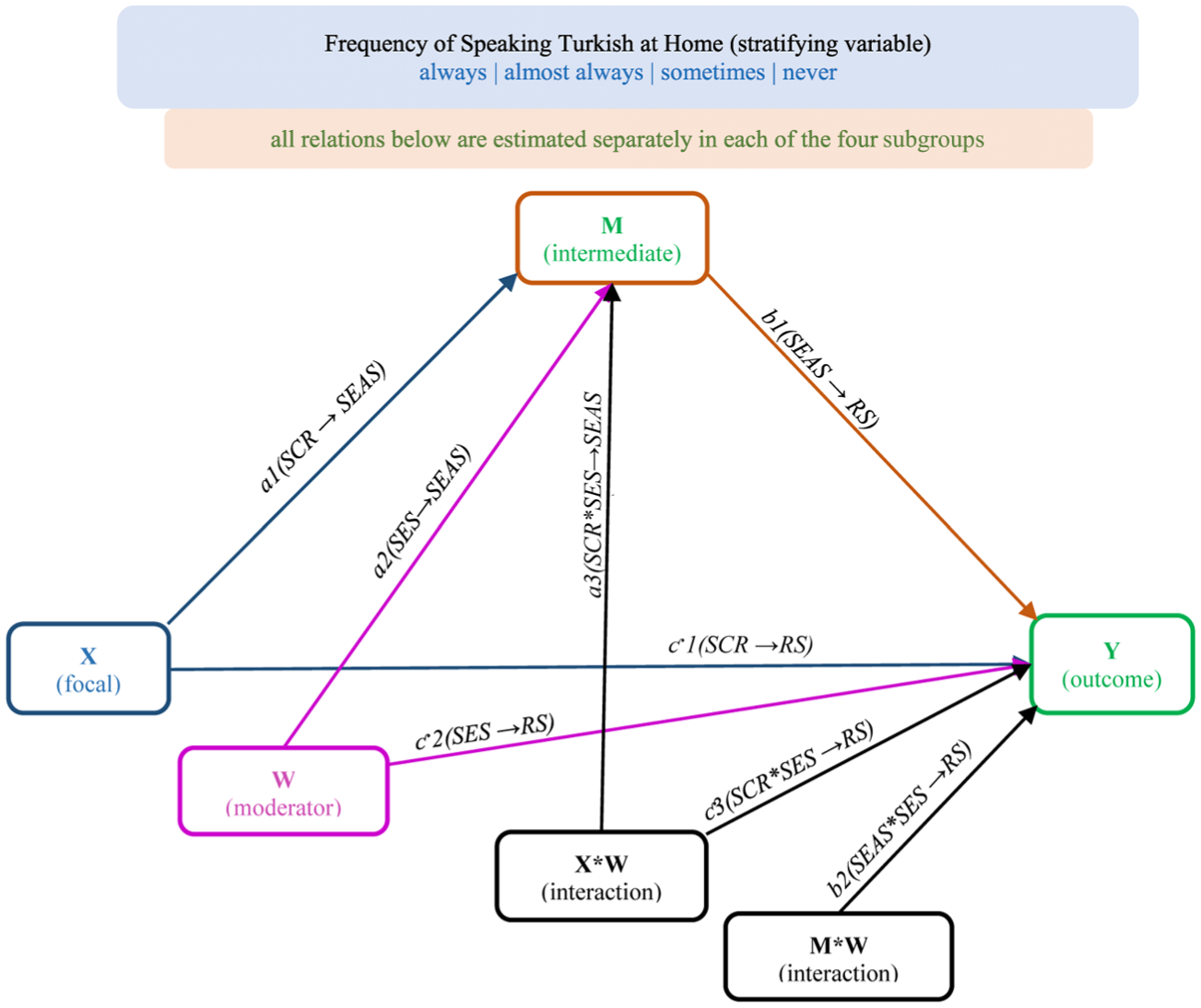
Conceptual Model of the Estimated Conditional Process Framework Examined Across Home-Language Exposure Subgroups (Hayes Model 59).
Figure 1 depicts the full conditional process framework as specified in Hayes’s (2022) Model 59 and should be read alongside three interpretive notes to avoid causal overreading of the statistical model. First, the directional arrows reflect the statistical ordering required by the regression-based estimation of Model 59 rather than claims about causal direction. Given the cross-sectional design of PIRLS 2021, all paths are interpreted as conditional associations; where theoretical directionality is plausible, its substantive direction is understood to run from the broader institutional and structural context (SEAS, SES) toward student motivational resources (SCR) and performance (RS) rather than the reverse. (See the directionality note in the Analytic Approach section.) Second, although SEAS is modeled in the M position of Hayes’s notation, it is not interpreted as a causal intermediary between SCR and RS. A student-level motivational construct (SCR) cannot plausibly produce changes in a school-level climate indicator (SEAS); SEAS is therefore more appropriately viewed as a school-level contextual factor whose association with the SCR–RS relationship is examined descriptively within the Model 59 framework. Third, the terms labeled a3, b2, and c'3 are not independent paths but interaction components that represent the moderation of the a2, b1, and c'1 paths, respectively, by SES. Accordingly, they are interpreted as describing how the strength of a given association depends on SES level rather than as distinct causal pathways. Finally, the entire model is estimated separately within each of the four home-language subgroups (always, almost always, sometimes, never), and the comparison of coefficient patterns and variance estimates (R²) across these subgroups constitutes the core analytic contribution of the study (RQ3).
Methods
Data Source and Participants
This study drew on the national dataset for Türkiye from PIRLS 2021 (IEA, 2023). The dataset includes information on fourth-grade students’ reading performance in Türkiye, along with contextual indicators related to students’ reading habits and to the educational environments of students, teachers, and families.
The PIRLS target population consists of fourth-grade students enrolled in formal education. The PIRLS assessment employs a two-stage, stratified sampling design using a random-start fixed-interval systematic sampling with a probability proportional to size approach. In the first stage, a sample of schools was drawn; in the second stage, one or more intact classes of students were selected from each sampled school. Intact classes were sampled rather than individuals across grade levels to maintain the classroom structure.
In the sample determination process, PIRLS selects the schools that will participate in the application. In 2021, 1,227,228 fourth-grade students were enrolled in 17,562 schools in Türkiye. To measure the reading skills of these students, 6,032 students from a sample of 192 schools participated in the PIRLS 2021. The study explicitly stratified the data by school type (public and private) and region (13 strata), with particular emphasis on the public school stratum. In large schools (size > 179), two classrooms were systematically sampled. In the PIRLS 2021 administration, the frequency of speaking Turkish at home was not used as a stratification or balancing criterion in the sample design. Therefore, it was not possible to make direct inferences about the representativeness of the subgroups formed based on this variable. School-level exclusions consisted of special needs schools, schools with a different structure or curriculum, and very small schools (size < 9). In accordance with the PIRLS 2021 technical standards, these criteria are applied as exclusion criteria during the sample selection process. Students with intellectual or functional disabilities, as well as non-native speakers who are identified as being “functionally unable to read or speak the language of the test,” are not included in the PIRLS 2021 assessment (Almaskut et al., 2023). This exclusion procedure is implemented prior to test administration; consequently, data are not collected from these students, and they are not included in the final dataset.
Sample Preparation and Screening for the Main Analyses
The present analyses draw on data from the PIRLS 2021 Türkiye sample of 6,032 fourth-grade students. Before conducting the main analyses, the study followed a two-step screening procedure to obtain the final analytic sample.
First, patterns of missing values for the focal variables were examined. No missing values were observed for SEAS (0%). The proportion of missing values was low for SCR (1.3%, n = 81) and for the home-language variable (2.4%, n = 142). The highest proportion was observed for SES, with an overall rate of 7.8% (n = 469). To evaluate whether SES missingness was systematically related to home-language group membership, we computed the within-group proportion of SES missingness using the subsample for which home-language information was available (n = 5,890). Within-group SES missingness rates were comparable and did not disproportionately affect the smaller linguistic-minority groups: approximately 9.1% in the “always” group (383 of 4,219), 7.2% in the “almost always” group (54 of 752), 2.6% in the “sometimes” group (20 of 763), and 7.7% in the “never” group (12 of 156). The within-group distribution of SES missingness does not indicate systematic imbalance to the disadvantage of the smaller “sometimes” and “never” subgroups and is therefore unlikely to have introduced systematic bias into the subgroup analyses. Participants with missing values on any focal variable were excluded from the main analyses (n = 585 excluded).
Second, in screening for multivariate outliers among the remaining 5,447 participants, we removed 26 cases for which Mahalanobis distance exceeded the critical value of χ²(4) = 9.48773, p < 0.05 (Tabachnick & Fidell, 2019). The final analytic sample thus comprised 5,421 participants: 3,836 who always spoke Turkish at home, 698 who almost always spoke Turkish, 743 who sometimes spoke Turkish, and 144 who never spoke Turkish.
Measures
The key variables utilized in this study are derived context questionnaire scales constructed by the IEA using Item Response Theory (IRT) scaling methods (specifically the Rasch partial credit model) to ensure international comparability and psychometric validity (Yin & Reynolds, 2023). The variables used in the analyses, their codes in the dataset, and their structural characteristics are detailed below (Yin & Reynolds, 2023):
In the analysis process, rather than using the raw items constituting these variables, the final values—precalculated, standardized, and presented as single continuous scores in the dataset by the IEA—were utilized. Because these variables were included in the analysis as single scores/items, internal consistency (Cronbach’s Alpha) coefficients were not recalculated within the scope of this study; instead, the psychometric validity and reliability evidence provided by the IEA in the international technical report was relied upon.
Analytic Process
Analytic Approach
In this study, regression-based conditional process analyses based on Hayes’s (2022) Model 59 were estimated separately for each language-exposure group defined by the frequency of speaking Turkish at home in order to examine whether the association between students’ SCR and RS was linked to SEAS as an indirect pathway, and whether this indirect association varied by SES. Although multilevel modeling is designed to account for the nested structure of educational data by partitioning variance across levels, the present study prioritizes the identification of conditional process mechanisms linking student- and school-level constructs rather than the decomposition of variance components. Accordingly, a regression-based conditional process approach was adopted to allow for a more explicit and substantively interpretable examination of complex interaction pathways.
Dividing the sample into subgroups may increase the number of statistical tests and, in turn, inflate the risk of Type I error while also reducing statistical power—particularly in smaller groups—resulting in wider confidence intervals and less stable estimates. These risks were explicitly addressed by reporting bias-corrected bootstrap confidence intervals (5,000 resamples) for all conditional indirect effects and by grounding interpretation in pattern-level convergence across subgroups rather than in the statistical significance of isolated coefficients. Although a pooled model with interaction terms could offer a more parsimonious alternative, introducing home-language exposure into the already complex Model 59 framework would require higher-order (three- or four-way) interactions that are difficult to interpret substantively. For this reason, the subgroup-based analytic strategy was retained to facilitate clearer examination of the mechanisms operating within each language-exposure context.
Because the SEAS index represents school climate, it is inherently a school-level construct, and a multilevel modeling framework would allow for the separation of within-school and between-school effects. However, the primary focus of the present study is not variance partitioning but the examination of conditional process relationships. Accordingly, SEAS was incorporated within the regression-based conditional process model, and heteroscedasticity-consistent (HC3) robust standard errors and bootstrapping were employed to reduce potential bias arising from the hierarchical structure of the data. Within this framework, findings related to SEAS are interpreted as associational patterns without decomposing within- and between-school components. Finally, although mediation analysis theoretically implies a causal sequence, the cross-sectional nature of the data necessitates that the findings be interpreted as relational rather than causal.
A note on assumed directionality is also warranted. Although the statistical model includes an estimated indirect pathway through SEAS, the present study recognizes that, from a theoretical standpoint, a student-level motivational construct (SCR) cannot plausibly produce changes in a school-level climate indicator (SEAS). The modeled SCR → SEAS is therefore best understood not as a directional influence but as a correlational pattern that the regression framework requires in order to estimate the conditional indirect association. Conceptually, SEAS is more appropriately viewed as a contextual factor that may confound or condition the SCR–RS association rather than as a variable downstream of SCR. Accordingly, throughout the manuscript the present study retains Hayes’s Model 59 as an analytic tool but interpret the reported indirect pathway descriptively as a conditional association whose assumed causal direction, following Bandura (1997) and Bronfenbrenner (2005), runs from the broader institutional context (SEAS) and structural position (SES) toward student motivational resources (SCR) and performance (RS), rather than the reverse.
The model choice was theory-driven: Bronfenbrenner’s ecological perspective motivated the joint specification of psychological (SCR), contextual (SEAS), and structural (SES) factors, while Bandura’s social cognitive theory supported specifying SCR as a motivational construct expected to relate to self-regulatory processes and responsiveness to environmental supports.
Assumptions and Diagnostics
Following best practice for conditional process analysis (Hayes, 2022; Hayes & Rockwood, 2017), comprehensive diagnostics were conducted. Descriptive and bivariate checks revealed no irregularities. The sample size comfortably exceeded heuristics for multiple regression with up to three predictors (Tabachnick & Fidell, 2019), ensuring adequate power. Tests of normality (Kolmogorov–Smirnov, Shapiro–Wilk) were significant (p < 0.05), yet skewness (–0.45 to 1.16) and kurtosis (–0.59 to 1.21) lay within ±1.5, indicating approximate univariate normality (Tabachnick & Fidell, 2019). Multicollinearity was negligible (VIF = 1.00–1.29). Residuals were approximately normal (|skewness| < 1.1; |kurtosis| < 1.7), with slight positive departures in the “never” subgroup, but remained within confidence bounds; Durbin–Watson ≈ 2.00 supported error independence. Breusch–Pagan tests indicated heteroscedasticity in three of four language-exposure groups; consequently, all regressions used HC3 robust standard errors, strengthening inference under variance nonconstancy (Field, 2009). Given heightened estimation sensitivity in the “never” subgroup, the analysis supplemented inference with bias-corrected and accelerated bootstrap confidence intervals (Hayes, 2022).
Plausible Values and Estimation
PIRLS 2021 provides five plausible values (PV1–PV5) for achievement. The full model was estimated separately for each PV, and coefficients and standard errors were combined using Rubin’s rules, thereby respecting multiple-imputation principles. The PROCESS macro does not support sampling weights, so analyses were conducted unweighted. However, given the large analytic sample, material bias from omitting weights was deemed unlikely. To empirically verify this assumption and rule out demographic bias, the distribution of gender—a key covariate—was examined across the four language groups. The gender composition remained balanced across all subgroups: always (49.2% female, 50.8% male), almost always (47.9% female, 52.1% male), sometimes (55.0% female, 45.0% male), and never (45.1% female, 54.9% male). This relative stability indicates that the findings are unlikely to be confounded by significant demographic disparities despite the unweighted approach.
Results
The results of the conditional indirect relationship analysis, conducted using Hayes’s (2022) PROCESS macro Model 59 framework, are presented in Figure 2 and Tables 1, 2, and 3. Figure 2 summarizes the estimated conditional process model in which students’ self-confidence in reading is directly associated with reading achievement and is also linked to reading achievement through an indirect pathway involving school emphasis on academic success, with these associations conditioned by students’ socioeconomic status.
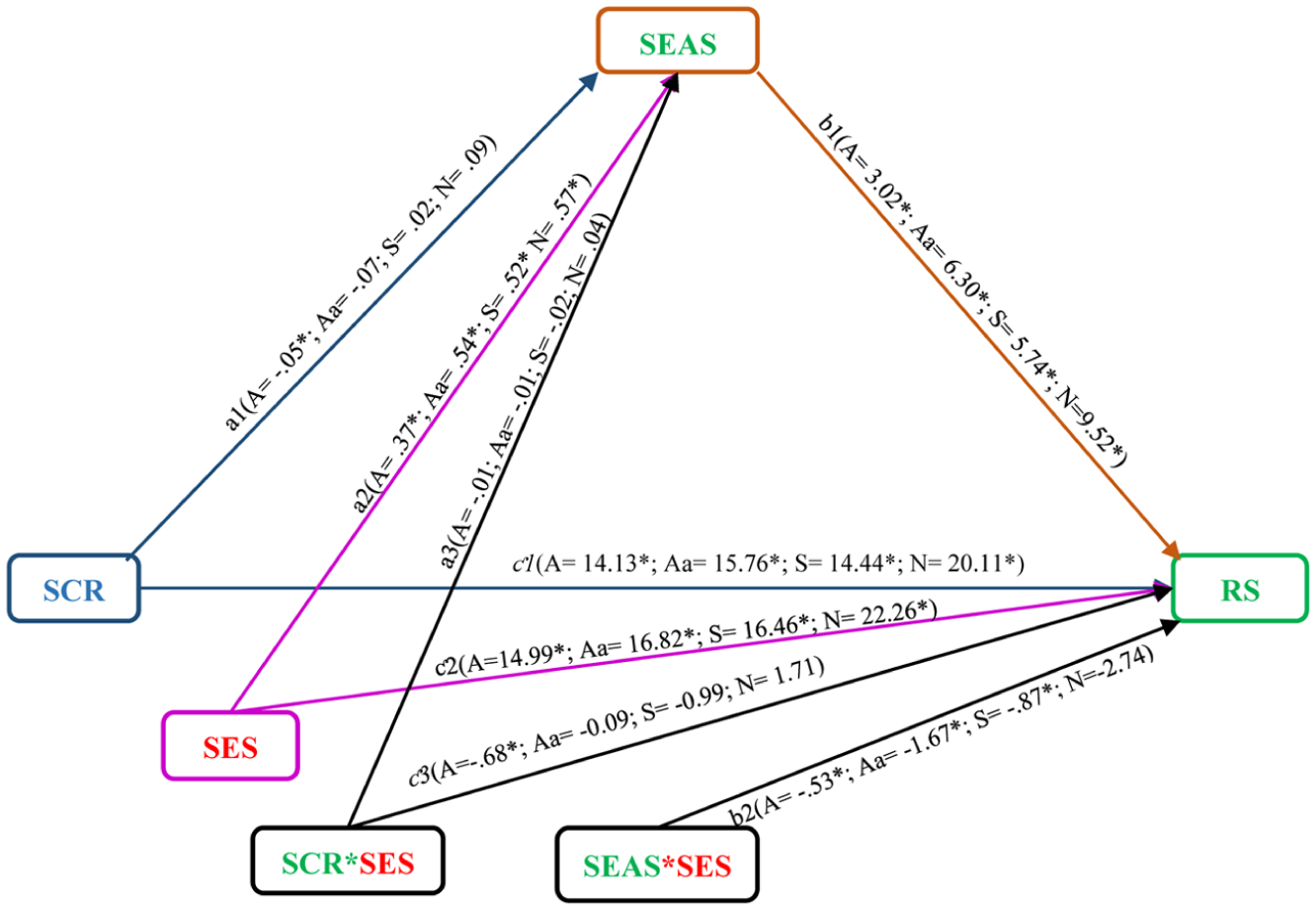
Statistical Model of Moderated Mediation Linking Reading Confidence to Reading Achievement.
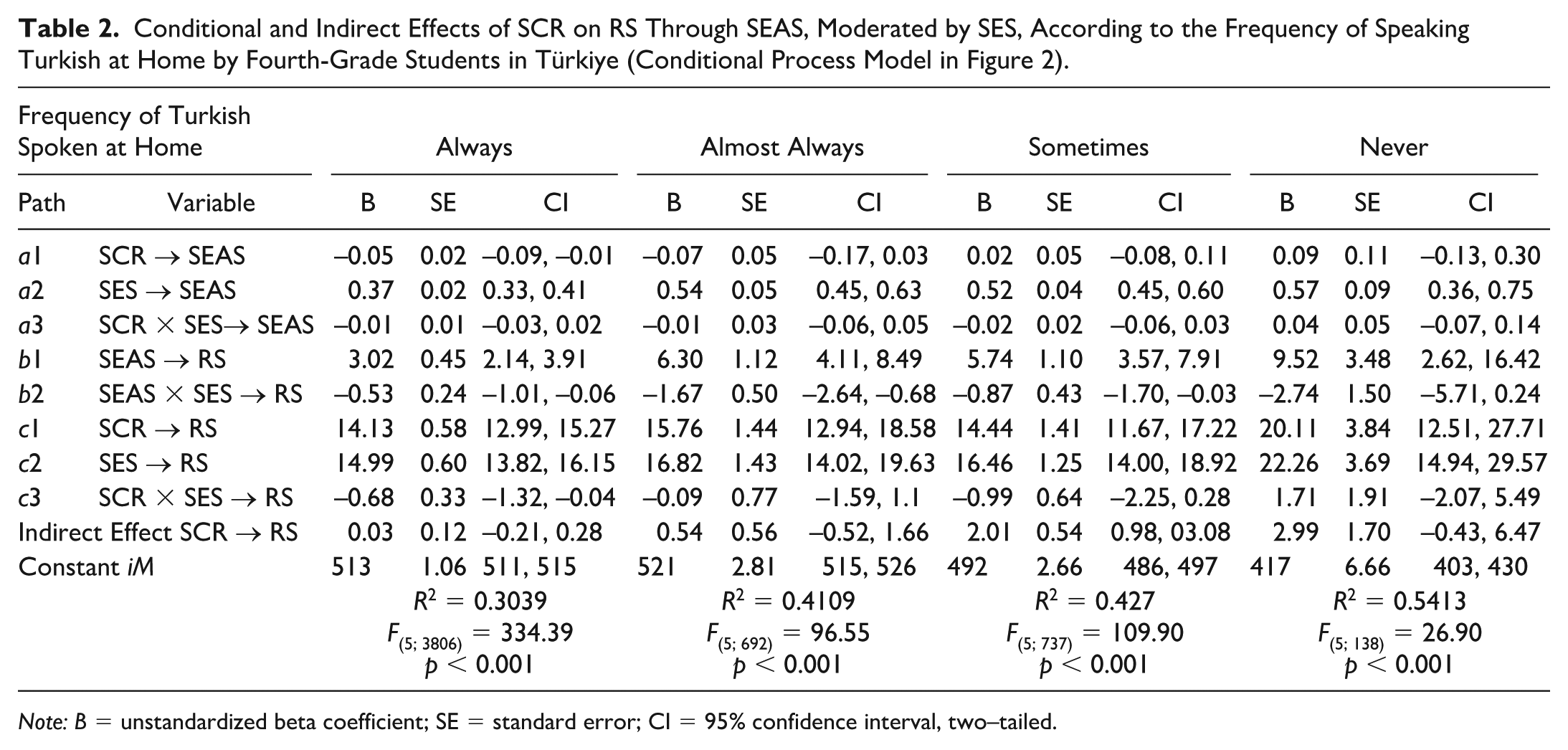
Descriptive Statistics by Frequency of Speaking Turkish at Home.
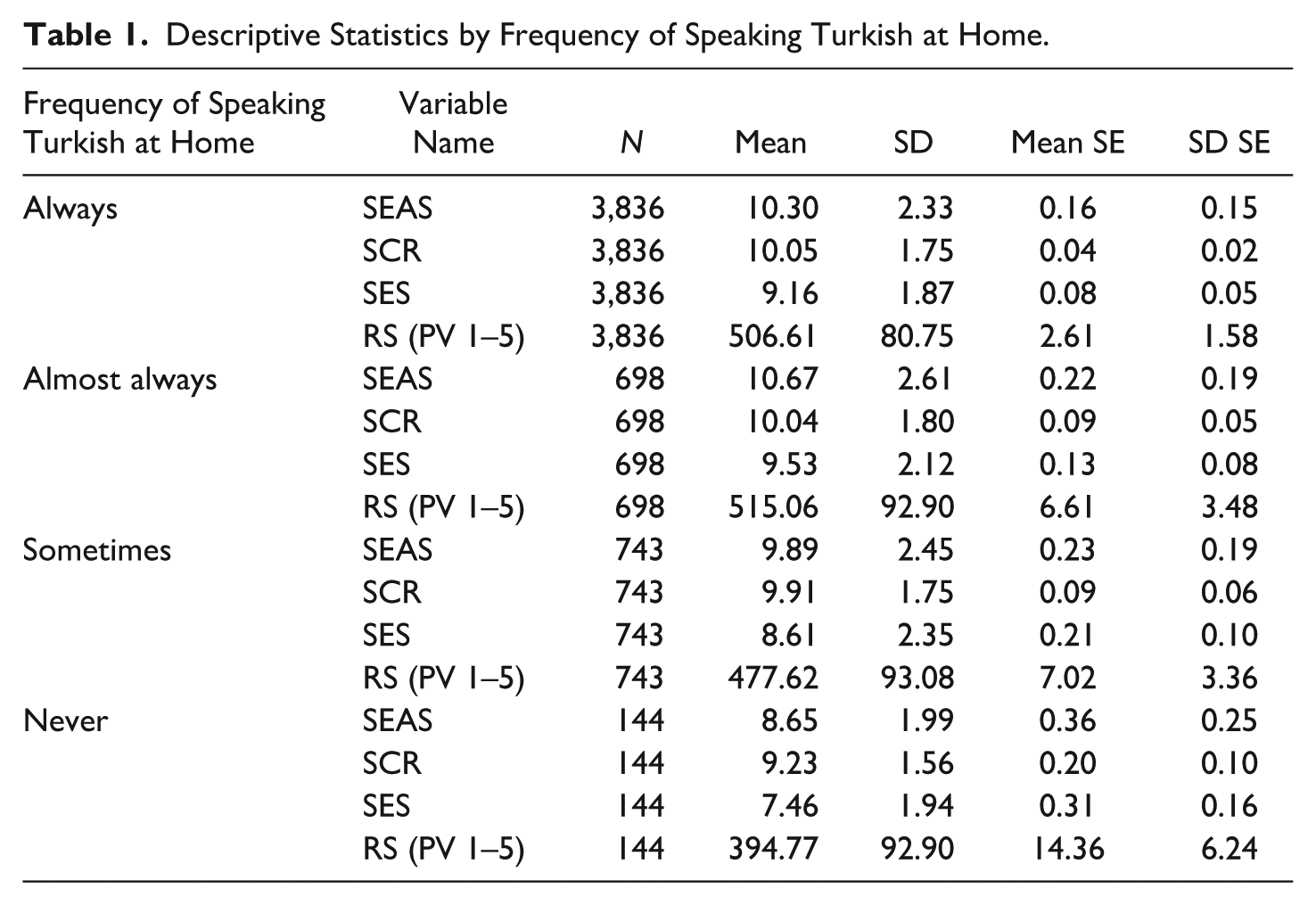
Conditional and Indirect Effects of SCR on RS Through SEAS, Moderated by SES, According to the Frequency of Speaking Turkish at Home by Fourth-Grade Students in Türkiye (Conditional Process Model in Figure 2).
Note: B = unstandardized beta coefficient; SE = standard error; CI = 95% confidence interval, two–tailed.
Relative Conditional Indirect Effects of SCR on RS Through SEAS Across SES Levels and Frequency of Speaking Turkish at Home.
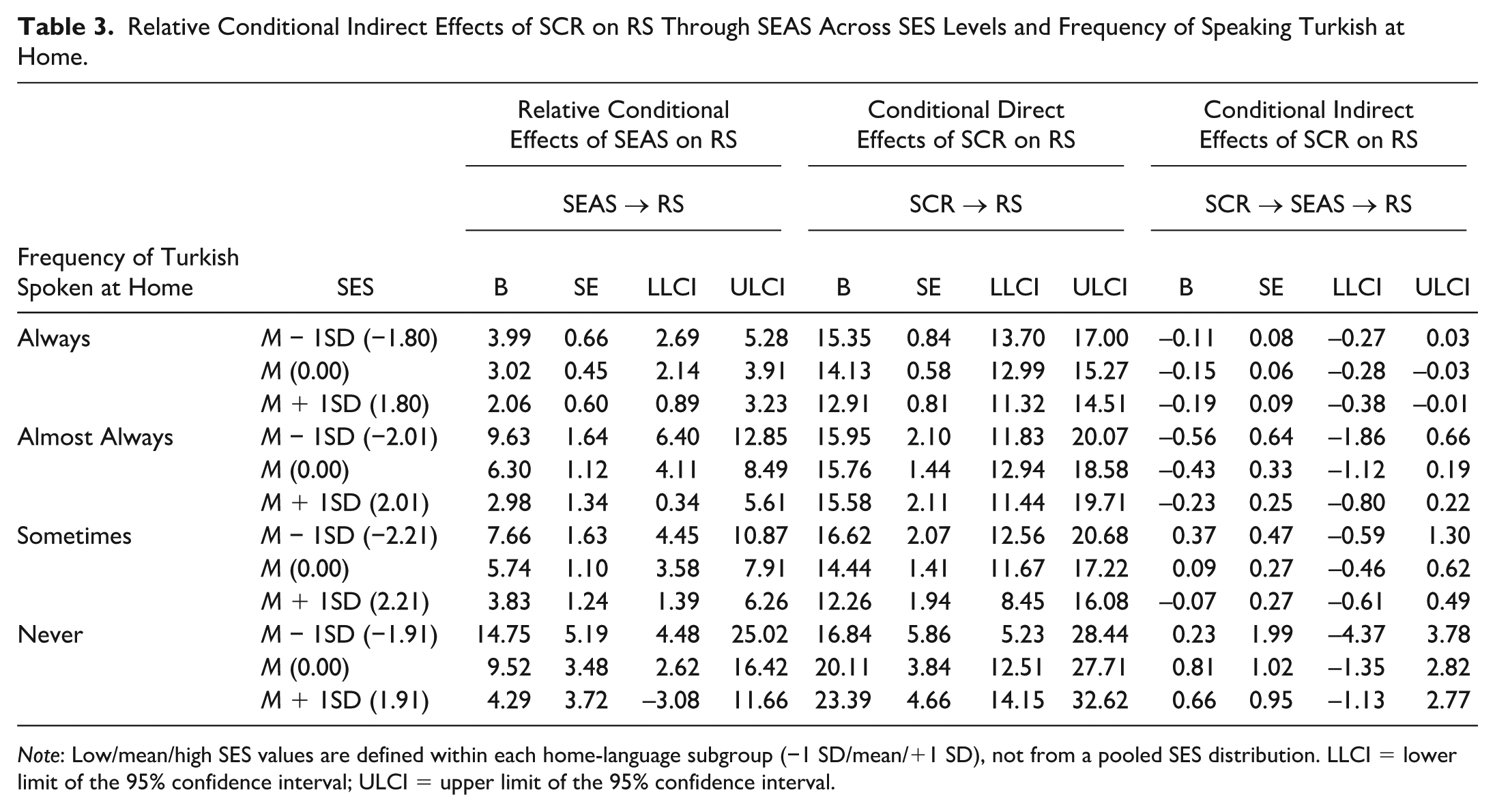
Note: Low/mean/high SES values are defined within each home-language subgroup (−1 SD/mean/+1 SD), not from a pooled SES distribution. LLCI = lower limit of the 95% confidence interval; ULCI = upper limit of the 95% confidence interval.
According to the descriptive statistics (see Table 1), higher frequency of speaking Turkish at home is generally associated with better outcomes, though the relationship is not strictly linear at the highest levels. Students who spoke Turkish “almost always” demonstrated the highest average scores in school emphasis on academic success (SEAS = 10.67), reading achievement (RS = 515.06), and socioeconomic status (SES = 9.53). Students who “always” spoke Turkish followed closely (SEAS = 10.30, RS = 506.61, SES = 9.16). In contrast, these values decreased substantially among students who “never” spoke Turkish at home, with corresponding means of SEAS = 8.65, RS = 394.77, and SES = 7.46.
As shown in Table 2 and Figure 2, the conditional process model indicated that the combined associations among SCR, SES, and SEAS accounted for a significant portion of the variance in RS. However, the model’s explanatory power differed depending on students’ home language exposure. Among students who always spoke Turkish at home, the model explained approximately 30% of the variance in RS (R2 = 0.3039, F(5, 3806) = 334.39, p < 0.001). For those who spoke Turkish almost always, the model explained 41% of the variance (R2 = 0.4109, F(5, 692) = 96.55, p < 0.001). In the group that sometimes spoke Turkish, the explained variance was approximately 43% (R2 = 0.4271, F(5, 737) = 109.90, p < 0.001). The highest explanatory power was observed among students who never spoke Turkish at home, with the model accounting for 54% of the variance in RS (R2 = 0.5413, F(5, 138) = 26.90, p < 0.001).
Regarding the estimated indirect pathway involving SEAS, the SCR–SEAS association was statistically significant and negative only among students who always spoke Turkish at home (B = −0.05, SE = 0.02, 95% CI [–0.09, –0.01]). As shown in Table 2, this association was not significant for students in other language groups. In contrast, the relationship between SES and SEAS was statistically significant and positive across all groups, with its strength increasing as the frequency of Turkish spoken at home decreased: always (B = 0.37), almost always (B = 0.54), sometimes (B = 0.52), and never (B = 0.57). The interaction term between SCR and SES in predicting SEAS was not statistically significant in any group, indicating that SES did not moderate the SCR–SEAS relationship (see Table 2 and Figure 2).
The direct relationship between SEAS and RS was statistically significant and positive for all language groups. This association was weakest among students who always spoke Turkish (B = 3.02), moderate among those who spoke it almost always (B = 6.30) and sometimes (B = 5.74), and strongest among those who never spoke Turkish at home (B = 9.52). The SEAS × SES interaction was statistically significant for the always (B = −0.53), almost always (B = −1.67), and sometimes (B = −0.87) groups, but not for the never (B = −2.74) group, indicating that SES moderated the SEAS–RS association in the first three groups. Across all groups, the negative sign of b2 suggests that the positive SEAS–RS association tends to be attenuated at higher levels of SES.
According to Table 3, the strength of the direct relationship between SEAS and RS varied significantly depending on students’ SES. In all language-use groups, the association between SEAS and RS was strongest at low SES levels and weakest at higher SES levels. For example, among students who always spoke Turkish at home, the SEAS–RS relationship was strongest at low SES (M – 1 SD; B = 3.99), decreased at mean SES (B = 3.02), and dropped further at high SES (M + 1 SD; B = 2.06). A similar pattern was observed for the almost always, sometimes, and never groups in the latter. Notably, among students who never spoke Turkish, the SEAS–RS relationship was as high as B = 14.75 at low SES and declined to B = 4.29 at high SES.
Similarly, the direct relationship between SCR and RS was statistically significant and positive for all groups. This association was strongest among students who never spoke Turkish at home (B = 20.11) and weakest among those who always spoke Turkish (B = 14.13). According to Table 3, the strength of this relationship declined with increasing SES among students who always (B = 15.35 → 14.13 → 12.91), almost always (B = 15.95 → 15.76 → 15.58), and sometimes (B = 16.62 → 14.44 → 12.26) spoke Turkish. However, in the group that never spoke Turkish at home, the SCR–RS relationship increased with SES (B = 16.84 → 20.11 → 23.39), indicating positive moderation.
The analysis also showed that the direct relationship between SES and RS was significant and positive across all groups. Importantly, the strength of this relationship increased as Turkish was spoken less frequently at home: B = 14.99 for students who always spoke Turkish, B = 16.82 for those who almost always spoke it, B = 16.46 for those who sometimes spoke it, and B = 22.26 for those who never spoke it. This pattern suggests that the predictive role of SES becomes more pronounced in linguistically diverse home contexts.
As indicated in Table 2, the SCR × SES interaction on RS was statistically significant only among students who always spoke Turkish at home (B = −0.68), indicating negative moderation of the SCR–RS association in that group. Furthermore, in this group, the estimated indirect SCR–RS association through SEAS became increasingly negative with rising SES—B = −0.11 at low SES, B = −0.15 at mean SES, and B = −0.19 at high SES. In the remaining language groups, the 95% confidence intervals for the conditional indirect estimates included zero, so those indirect estimates were not statistically distinguishable from zero.
Discussion
The findings reveal a suggestive pattern where the explanatory power of the model increases substantially as students’ frequency of speaking Turkish at home decreases. Although the model accounted for 30.4% of reading score variance among students who “always” spoke Turkish at home, this figure rose to 54.1% for those who “never” did. This gradient effect underscores how contextual factors—particularly school academic emphasis and socioeconomic status—become increasingly salient under conditions of linguistic mismatch (Bronfenbrenner, 2005). Consistent with ecological systems theory, the results indicate that students navigating linguistic disparities between home and school may be more sensitive to institutional conditions. This interpretation also aligns with recent arguments that fourth-grade reading should be understood not simply as a generalized reading crisis but as an equity issue that is unevenly distributed across student groups (Cervetti & Hinchman, 2024).
Consistent with social cognitive theory (Bandura, 1997), self-confidence in reading emerged as a consistent predictor across all groups, though its relative magnitude varied across language subgroups. Specifically, the direct SCR–RS association (Table 2) was largest among students who never spoke Turkish at home (B = 20.11) and smaller among those who always spoke Turkish (B = 14.13), with intermediate values for the “almost always” (B = 15.76) and “sometimes” (B = 14.44) subgroups. This pattern suggests that when linguistic barriers exist, students rely more heavily on internal motivational resources (Bandura, 1997). These findings support the premise within social cognitive theory that strong self-efficacy beliefs assume greater importance in adverse learning conditions (Bandura, 1997), with SCR potentially serving as a psychological compensatory mechanism (Bellocchi & Bonifacci, 2024).
The current results extend prior research demonstrating how linguistically marginalized students depend more substantially on self-efficacy beliefs to meet academic demands (Kilpi-Jakonen & Alisaari, 2022; Toste et al., 2020). Particularly for students with minimal Turkish exposure at home, SCR appears as a crucial personal resource for navigating institutional expectations misaligned with their linguistic reality (Cummins, 2021; Hemmerechts et al., 2017). This finding reinforces Bruggink et al.’s (2022) contention that motivational factors gain primacy in monolingual education systems lacking formal language support structures.
SEAS showed statistically significant direct associations with RS across all language exposure groups, with particularly strong associations among students who never spoke Turkish at home. This pattern is consistent with the interpretation that structured academic environments may coincide with compensatory processes for linguistic disadvantages in systems like Türkiye’s that provide no transitional language support. This reading of SEAS as a consequential contextual condition is consistent with broader evidence that school climate can play a substantive role in shaping school improvement processes and outcomes (Harbatkin et al., 2024). The results suggest that clear institutional expectations and consistent messaging may accompany attenuated associations between language-related barriers and achievement.
A notable finding emerged regarding the estimated indirect association involving SEAS, which was statistically detectable only in the “sometimes” subgroup. In this group, the indirect association between SCR and reading scores through SEAS was statistically detectable, albeit with modest magnitudes. However, the point estimate was also directionally larger in the “never” subgroup, although its confidence interval included zero and likely reflects limited power in a smaller subgroup (N = 144). This pattern may be consistent with what has been described in the literature as a translanguaging threshold, where moderate bilingual exposure makes students particularly receptive to environmental supports. When students experience partial rather than complete exclusion from the school language, institutional climate may be more strongly implicated in the estimated indirect association between motivational resources and achievement. The nonsignificance of the indirect pathway in the other groups suggests that, in those contexts, SEAS may be more appropriately described as a direct correlate of achievement rather than as evidence of a stable indirect association linking SCR to RS (Chen et al., 2021; Tomaszewski et al., 2024).
Bandura’s (1997) concept of environmental structuring helps explain SEAS’s direct effects, particularly for students with no Turkish exposure at home. For these learners, formal school systems appear crucial for achievement, likely because they lack access to informal, language-rich support networks outside school. The minimal indirect estimates in these groups further suggest that institutional conditions, in conjunction with individual motivation, may be particularly relevant for performance among the most linguistically disadvantaged students (Bellocchi & Bonifacci, 2024; Bozkuş, 2025).
SES consistently predicted reading achievement across all groups, with larger estimated coefficients among students who sometimes or never spoke Turkish at home. Although socioeconomic advantage is positively associated with achievement generally, this association appears more pronounced when combined with linguistic disadvantage. Importantly, high SES was not associated with a full attenuation of the gaps linked to language mismatch, underscoring the limitations of economic capital alone in overcoming language barriers (OECD, 2022; Scherer & Nilsen, 2016). This interpretation is also consistent with the timing of PIRLS 2021, which followed substantial COVID-19–related disruptions to schooling. In Türkiye, distance education was implemented largely via the Educational Informatics Network (EBA), yet access to digital learning opportunities was sharply stratified by SES: students from disadvantaged households often faced limited internet connectivity, inadequate devices, and less supportive home learning environments (OECD, 2021; Ökten, 2024; TEDMEM, 2021). During extended school closures—reported to be among the longest across OECD countries (OECD, 2021)—the compensatory function of schools was constrained, potentially shifting learning opportunities more heavily to households and thereby intensifying SES-linked disparities. In this context, the comparatively pronounced SES associations observed in the PIRLS 2021 Türkiye data may reflect not only enduring structural inequalities but also pandemic-era conditions that temporarily amplified the dependence of achievement on home resources (OECD, 2021; TEDMEM, 2021).
The analysis revealed a positive SES–SEAS relationship that intensified with decreasing Turkish use at home. This suggests high-SES families often access schools with stronger academic climates, particularly in linguistically diverse contexts. However, the SEAS–SES interaction showed negative trends in most groups, suggesting that the association between school climate and achievement tends to be weaker at higher levels of SES. This aligns with research suggesting lower-SES students depend more on institutional supports, whereas higher-SES students benefit from additional resources like private tutoring (Rakesh et al., 2025; Taylor et al., 2023).
The interaction estimates should be interpreted in light of the large disparities in subgroup size across the home-language categories. The negative SCR × SES interaction reached statistical significance only in the “always” group (N = 3,836; B = −0.68), whereas the “never” group (N = 144) showed a larger positive coefficient (B = 1.71) but with substantially wider uncertainty. Accordingly, subgroup contrasts are interpreted cautiously, with attention to both coefficient magnitude and confidence-interval width rather than to statistical significance alone. Future research with larger targeted samples is needed to evaluate the stability of these interaction patterns among students with the greatest home–school language mismatch.
These differential SES effects support context-sensitive developmental models. Rather than operating as a universal moderator, SES’s influence appears contingent on sociolinguistic factors, echoing Bronfenbrenner’s (2005) chronosystem framework. The interpretation of these findings is closely tied to the structural characteristics of the Turkish education system, which is highly centralized and institutionally monolingual. Although a substantial proportion of primary school students in Türkiye grow up in linguistically diverse households, public schooling is conducted exclusively in Turkish, as mandated by Article 42 of the Constitution, and does not include institutionalized transitional bilingual education or systematic Turkish-as-a-second-language support for students whose home language differs from the language of instruction (Coşkun et al., 2010; Kaya & Aydın, 2013). Existing research documents early and persistent disadvantages associated with this policy framework for linguistically minoritized students, who often enter school without sufficient proficiency in the instructional language and are expected to adapt rapidly without pedagogical scaffolding (Coşkun et al., 2010; Derince, 2012). Within this context, the strong associations observed between SEAS, SES, and reading achievement—particularly among students who never or only sometimes speak Turkish at home—can be understood as compensatory responses to systemic language exclusion. Although Türkiye has implemented equity-oriented material support policies, such as the nationwide Free Textbook Distribution Project, since 2003 and conditional supports including subsidized meals primarily within the bussing (taşımalı eğitim) system, these initiatives are designed to alleviate economic deprivation rather than address linguistic barriers to learning (Kaya & Aydın, 2013). As such, they may improve access to schooling but remain insufficient to offset the absence of language-sensitive instructional support. Consequently, in a monolingual policy environment lacking transitional language structures, family socioeconomic resources and school-level academic climates assume heightened importance for student achievement, helping to explain why SES and SEAS effects intensify as home–school language mismatch increases.
In summary, students who never or only sometimes speak Turkish at home are more dependent on external structural supports and internal motivational beliefs to achieve success in a monolingual school system. These findings extend current literature by showing that the predictive power of individual and contextual variables is not uniform but varies significantly according to students’ linguistic backgrounds.
From a research standpoint, the findings highlight the need to disaggregate data by language exposure to uncover nuanced interaction effects between individual and contextual variables. Future work should explore how these dynamics evolve across grades and in multilingual education systems offering bilingual or heritage language instruction.
From a policy perspective, the results underscore the importance of language-inclusive education policies. In countries like Türkiye, where Turkish is the sole instructional language, multilingual students remain structurally disadvantaged unless school-level support systems explicitly recognize and address these challenges.
Practically, the findings call for enhanced teacher training, the integration of culturally responsive pedagogies, and school climate initiatives that foster both high expectations and psychological safety. Special attention should be given to linguistically diverse and socioeconomically disadvantaged students, for whom reading confidence and school climate are not just beneficial, but essential to educational success.
Limitations
Several limitations warrant caution in interpreting the findings. First, the analyses rely exclusively on PIRLS 2021 Türkiye; therefore, the results are context-bound and their generalizability to other countries or policy regimes is limited. Moreover, because the PIRLS sampling design was not stratified by home-language use, subgroup estimates by frequency of speaking Turkish at home may carry greater uncertainty in some groups. Second, the focal constructs—SCR, SEAS, and SES—were derived from student and principal self-reports, which are susceptible to measurement error and response bias (e.g., social desirability, differential response styles). Third, although Model 59 enables estimation of conditional indirect associations, the study design is observational; accordingly, the reported patterns should be interpreted as associations and conditional processes rather than causal effects.
Fourth, subgroup analyses by frequency of speaking Turkish at home involved uneven and, in some cases, small cell sizes—especially the “never” group—potentially reducing statistical power and the precision of estimates, as reflected in wider confidence intervals for some effects. Fifth, although the SCR scale is internationally validated within the PIRLS framework, this study did not conduct formal measurement invariance testing (e.g., multigroup CFA) across home-language subgroups within the Turkish sample. Accordingly, comparisons across linguistic groups should be interpreted with caution, because full scalar equivalence cannot be empirically assumed. Future research should explicitly examine configural, metric, and scalar invariance to ensure that the construct carries equivalent meaning across different language-exposure groups.
A sixth contextual limitation is that PIRLS 2021 was administered in the wake of COVID-19–related disruptions. In Türkiye, extended school closures and unequal access to distance-learning resources likely amplified pre-existing SES disparities through the digital divide (OECD, 2021; Ökten, 2024; TEDMEM, 2021). Consequently, the magnitude of SES-linked gaps observed here may partly reflect pandemic-specific conditions that temporarily shifted learning opportunities from schools to homes. Future studies should assess the robustness of these patterns by comparing PIRLS cycles before and after the pandemic and by explicitly modeling indicators of instructional disruption and access to digital learning resources. Seventh, the conditional process models were estimated in a single-level framework; thus, standard errors may be sensitive to school-level clustering. Although heteroskedasticity-consistent standard errors and bootstrapped confidence intervals were used, these choices do not fully substitute for multilevel modeling. Therefore, the magnitude and statistical significance of some effects should be interpreted conservatively, and future work should replicate the model using multilevel structural equation modeling or sampling-design–aware cluster-robust estimators.
Finally, the model incorporated a limited set of variables and omitted plausible confounders or explanatory factors (e.g., teacher quality, classroom instructional practices, school resources, and language-support practices). Future research would benefit from weighted, multilevel, and longitudinal designs; richer covariate sets; and mixed-methods triangulation to strengthen inference about underlying mechanisms and to evaluate generalizability across policy contexts.
Taken across the four home-language subgroups, three comparative patterns emerge. First, model explanatory power, the direct SCR–RS association (c'1), the SEAS–RS association (b1), and the SES–RS association (c'2) all increased monotonically as home exposure to Turkish decreased, reaching their largest magnitudes in the “never” subgroup. Second, the SEAS × SES interaction (b2) likewise showed a strengthening negative moderation across the “always,” “almost always,” and “sometimes” subgroups (B = −0.53, –1.67, –0.87), while the substantially larger “never” estimate (B = −2.74) did not reach statistical significance given the smaller subgroup size. Third, the estimated indirect pathway through SEAS was statistically detectable only in the “sometimes” subgroup, with a directionally comparable but nonsignificant estimate in the “never” subgroup. Together, these patterns suggest that motivational, institutional, and structural factors are more tightly coupled with reading achievement as home–school language distance widens, while the indirect pathway is most clearly detectable under conditions of moderate rather than complete home–school language mismatch.
Conclusions
Using nationally representative PIRLS 2021 Türkiye data and a conditional process framework, this study shows that reading confidence, school emphasis on academic success, and socioeconomic status are jointly associated with fourth-grade reading achievement in ways that depend on students’ home-language contexts. SCR was a consistent, positive predictor of achievement across all groups, with the largest coefficients among students who had minimal exposure to the language of instruction at home—a pattern consistent with the interpretation that self-efficacy may function as a compensatory resource under linguistic disadvantage. SEAS showed a robust direct association with achievement in every group. An estimated indirect pathway involving SEAS was statistically detectable only in the “sometimes” subgroup; however, the point estimate was also directionally larger in the “never” subgroup but accompanied by a wider confidence interval that included zero, likely reflecting the small subgroup size. Accordingly, rather than inferring that institutional emphasis is uniquely efficacious at moderate dual-language exposure, the results are more appropriately described as showing that an estimated indirect association is detectable at moderate exposure and cannot be ruled out at greater exposure. SES had a strong, positive association with achievement, and this association was more pronounced where home–school language misalignment was greatest, underscoring the intersection of structural and linguistic inequities.
Theoretically, the findings are consistent with an ecological account in which individual dispositions, school climate, and socioeconomic conditions are jointly related to literacy outcomes. They also align with a social-cognitive view in which efficacy beliefs are associated with performance when environments supply clear expectations, feedback, and opportunities for mastery.
Within the limits of large-scale assessment, data policy and practice should therefore proceed on two fronts. First, cultivate high academic expectations and coherent instructional routines at the school level, with particular intensity in settings serving students with low SES and limited home exposure to the language of instruction. Second, embed confidence-building and language-responsive supports—explicit vocabulary instruction, structured talk, guided reading with strategy instruction, and formative feedback—so that motivational gains are converted into measurable achievement. In the Turkish context, where monolingual policy coexists with a multilingual student population, early identification of language needs, judicious use of translanguaging pedagogies, and differentiated instruction are likely to narrow persistent gaps. More broadly, the results advocate context-sensitive, equity-focused designs that integrate motivational, institutional, and structural levers when serving linguistically diverse learners.
Footnotes
Declaration of Conflicting Interests
The author declared no potential conflicts of interest with respect to the research, authorship, and/or publication of this article.
Funding
The author received no financial support for the research, authorship, and/or publication of this article.
Ethics in Publishing
The author confirms that this manuscript has not been published previously and is not under consideration for publication elsewhere. The author has approved the final version of the manuscript and agrees to be accountable for all aspects of the work.
Declaration of Generative AI and AI-Assisted Technologies in the Writing Process
During the preparation of this manuscript, the author used Claude to improve academic language, structure, and clarity. After using this tool, the author reviewed and edited the content as needed and takes full responsibility for the content of the publication.