







Abstract
Background:
Community colleges have played an essential role in expanding access to higher education for students from historically minoritized backgrounds, many of whom enter with aspirations to transfer. However, community colleges operate within a broader transfer ecosystem in which students of color continue to experience disproportionately low transfer rates. As critical sites where students make academic progress toward transfer, classrooms remain underexplored in transfer research and in efforts to understand and address transfer disparities.
Focus of Study:
This study is guided by the strategic racial equity framework and examines classroom interactions and policies in relation to the transfer trajectories and aspirations of community college students of color. The study also explores faculty perceptions of their role in students’ transfer progress and the ways their class policies and practices contribute to or remove barriers to transfer.
Research Design:
Stemming from a larger mixed methods project, this qualitative study drew on individual, semistructured interviews with 22 students and seven educators from one large Midwestern community college. This article centers on five students who discussed the role of race in relation to their classroom experiences as they prepared for transfer and on three faculty members who taught high-enrollment courses. Interviews with students addressed their academic progress toward transfer, including classroom and racialized experiences. Faculty interviews focused on their teaching practices and perceptions of their role in supporting students’ transfer progress. I used the strategic racial equity framework to draw attention to hidden contributors to transfer inequities for students of color while also harnessing students’ strengths and faculty members’ efforts to support transfer progress within and beyond the classroom.
Conclusions:
The findings reveal that classrooms are racialized and racializing spaces that mediate transfer through students’ experiences with exclusionary pedagogical practices, racial microaggressions, and other racialized interactions. These experiences took emotional and academic tolls on students that at times disrupted their transfer trajectories. Faculty who sought to support students of color through equity-centered practices and policies lacked the institutional resources and time needed to sustain the level of deep equity-centered work they desired. The findings affirm that advancing equitable transfer requires a commitment to embedding racial equity throughout the college, with renewed attention to the classroom. This includes preparing and supporting educators to better serve students of color along their transfer trajectories, strengthening racial bias reporting systems and institutional accountability, and supporting colleges in redefining and working toward equitable transfer and student success through classroom-centered and structural changes.
Community colleges have historically played a critical role in expanding access to higher education and serving as democratizing institutions for students from historically minoritized backgrounds (Kisker et al., 2023; Wang, 2017). Although transfer is the primary goal for most community college students, outcomes remain low and racially inequitable, with students of color 1 experiencing significantly lower transfer rates than their white peers (Velasco et al., 2024; Wang, 2020), often described as the racial transfer gap (Crisp & Nuñez, 2014). These disparities reflect not only the institutional challenges facing community colleges but also a broader transfer landscape influenced by power, with better resourced four-year universities and colleges dominating admissions and course articulation agreements (Schudde & Jabbar, 2024).
Although transfer has been recognized as a racialized process (Jain et al., 2011) and much attention has been given to the structural barriers that contribute to the racial transfer gap, to the best of my knowledge, no research has examined the classroom as a racialized site connected to transfer trajectories. This oversight between the classroom and transfer leaves a critical gap to be explored, given that classrooms are where community college students spend most of their time (Wang, 2017) and where racism and racialized ideologies are reproduced (Rodgers, 2025).
Current research on racialized experiences in the community college classroom is disconnected from transfer, though it offers insights into the microaggressions, stereotypes, and deficit views that manifest (e.g., Cuellar & Johnson-Ahorlu, 2016; Naca, 2022). In contrast, a separate body of research has documented ways to support students of color in the classroom through practices such as racial microaffirmations and other equity-centered approaches associated with higher grade point averages (GPAs), retention, and positive transfer-related outcomes (Crisp, 2010; Huber et al., 2021; Tovar, 2015; Wang et al., 2022).
Although prior scholarship has emphasized the centrality of the classroom (e.g., Deil-Amen, 2011; Wang, 2017, 2020), transfer research has largely sidelined the classroom to privilege conversations around pathways and transitions. My study builds on the thesis that the classroom is a critical site of students’ academic trajectories (e.g., Wang, 2020) and offers a conceptual shift by framing transfer not as a later outcome, but as an ongoing process that is negotiated through day-to-day classroom interactions and faculty practices within racialized learning spaces. My study draws on the perspectives of students of color and faculty members from a community college in the Midwest to better understand their classroom experiences in relation to transfer. The questions guiding my study are: (1) How do classroom interactions and policies influence the transfer trajectories of community college students of color? (2) How do faculty perceive their role in students’ transfer progress, and in what ways do their class policies and practices contribute to or remove barriers to transfer?
Background Literature
I situate my study by tracing transfer as a racialized process and discussing the centrality of community college classrooms and racialized experiences captured in community college literature and higher education more broadly. These perspectives position the gap my study seeks to fill by bringing community college classrooms into focus as racialized sites where transfer unfolds for students of color.
Transfer as a Racialized Process
Community colleges enroll almost half of all college-going students of color every year, many of whom are also first-generation college students. For most, transfer is their top aspiration, tied to hopes for upward mobility (Del Real Viramontes, 2025; Wang, 2020). However, transfer-aspiring students often face structural challenges, such as fast-changing articulation agreements attributed to universities’ influence over transfer, including admissions and how earned college credits are applied toward a degree (Blaney, 2025; Schudde & Jabbar, 2024).
Although progress has been made in broadening transfer support for students through efforts like guided pathways, disparities in transfer outcomes persist across racial/ethnic groups (Causey et al., 2020; Jenkins et al., 2025). In a 2020 report from the National Student Clearinghouse Research Center, white students had the highest transfer rate at 53.2%, compared with 37.2% for Latina/o/x/Hispanic and 28.4% for Black students (Causey et al., 2020). Similar racial gaps also emerge across academic milestones, like course completion rates, which impact students’ time-to-degree and transfer (King, 2021; Parnes et al., 2020).
Community colleges have been characterized as racialized organizations, often treated as delegitimized and chronically underfunded institutions while being charged with meeting the needs of a predominantly minoritized student body (McCambly et al., 2023; Zhu & Wang, 2025). Advisors and faculty are tasked with navigating articulation agreements and credit transfer policies; however, even with their efforts to build and implement these policies, much of this work ultimately happens in the classroom, where students move through requirements and where the bulk of transfer progress is made. Despite the classroom’s critical role in transfer, little is known about what happens in classrooms for students of color and how these experiences are connected to transfer trajectories.
Centrality of the Classroom for Community College Students
Because course completion is the direct avenue to transfer and students’ educational goals more broadly, the classroom is the centerpiece of a community college education. As Wang (2020) describes, many community college students have limited time to engage in campus life the same way that four-year students can; consequently, the classroom is often the only opportunity they have to interact with their institution, making classroom experiences all the more critical to understand. Meanwhile, the high-stakes nature of “gateway” and developmental coursework, especially in math and English, often slows students’ academic progress or pushes them to drop out of college altogether (Deil-Amen, 2011; Hagedorn et al., 2007; Wang, 2020; Xu, 2016).
An established body of research shows the importance of faculty–student interactions and validating practices in the classroom, such as integrating students’ backgrounds into coursework, leveraging their lived knowledges, and engaging in proactive outreach and support (e.g., Baber, 2018; Rendón, 2002). Positive interactions between faculty and students, such as open lines of communication about coursework expectations and supportive conversations during and after class, are significant to students’ aspirations and overall academic experience (Rodriguez et al., 2016). Similarly, engaging faculty approaches, such as active and contextualized learning in which students work collaboratively and are invited to connect course content to their lived experiences, can play an important role in students’ persistence and success (Wang, 2020). Beyond these interactions, nurturing students as whole persons through flexible and responsive teaching practices helps students feel seen and supported (Bickerstaff et al., 2021; Wang, 2020). Classroom practices such as these have been linked to higher GPAs, increased retention, greater self-efficacy, and higher student satisfaction (Crisp, 2010; Parnes et al., 2020; Wood et al., 2015). In much of the transfer literature, though, classrooms are still largely disconnected from transfer, rather than being the single place on which transfer possibilities depend. As a result, we know much less about how classroom experiences, especially for students of color, allow students to make transfer progress.
Racialized Classroom Experiences
Racism takes many forms on college campuses, with consequences extending beyond academic engagement to cause serious health concerns such as hypertension, anxiety, and depression, particularly among Black students (Lomotey & Smith, 2023; Smith et al., 2012). These manifestations of racism emerge through racial microaggressions (e.g., Suárez-Orozco et al., 2019), exclusion and marginalization (e.g., Naca, 2022), harmful stereotypes (e.g., Wang, 2020), and hostile campus climates more broadly (e.g., Cuellar & Johnson-Ahorlu, 2016; Hurtado et al., 2015). For community college students of color, these racialized experiences also intersect with broader structural inequities; for example, students of color are disproportionately represented in developmental courses, which are more likely to be taught by part-time faculty who lack access to institutional teaching supports (Bahr & Gross, 2016).
These patterns have been well documented across higher education, but less attention has been paid to how racialized interactions play out in community college classrooms. To the best of my knowledge, only one study has centered on these very dynamics. Casanova and colleagues (2018) found that racial microaggressions, such as demeaning students of color’s intelligence or asking multilingual students to speak only in English, led students of color to become more withdrawn and disengaged during class. Similarly, in Wang’s (2020) book, students of color share experiences with racial biases and call attention to the need for greater institutional responsibility in building equity-centered transfer pathways.
In contrast, positive racialized experiences have been documented as defense mechanisms that can offset the harmful impacts of racism (Huber et al., 2021). Huber and colleagues (2021) introduce the concept of racial microaffirmations, defined as everyday strategies of validation and acknowledgment that people of color use with and among one another in the context of structural racism, such as a simple head nod. Relatedly, Cross and Carman (2022) show that diverse faculty representation is related to positive outcomes for community college students of color. As a whole, research on the racial transfer gap has been largely quantitative, with a focus on outcomes; meanwhile, studies exploring students’ racialized experiences have been predominantly qualitative and offer rich insights, though often disconnected from outcomes like transfer. In exploring students of color’s classroom experiences and faculty’s understanding of their role in facilitating student transfer progress, this study seeks to bridge and add to these subsets of literature.
Theoretical Framework
This study is guided by the strategic racial equity framework (Garces & Gordon da Cruz, 2017; Jayakumar et al., 2018) to critically analyze how classroom interactions, other practices, and policies influence the transfer process and aspirations for students of color. The framework puts forth three principles: (1) attending to the dynamic relationship among power, race, and identities; (2) actively naming and addressing hidden contributors to inequity; and (3) generating power among marginalized communities of color. The framework was developed with the goal of institutionalizing transformative policies and practices that promote access to resources and full participation for communities of color. Further, the framework acknowledges that racial disparities in access to and outcomes in education have hindered the ability of minoritized people to engage fully in institutional life.
I focus on the second principle more deeply in my study because of its relevance and ability to support a more granular analysis of how racialized classroom interactions, instructional practices, and course policies can operate as hidden contributors to transfer inequities. Still, the first and third principles remain important contexts for my study. The first principle offers a more layered and intersectional understanding of race as always working in relation to context, student identities, and power, including power preserved through policies. Meanwhile, the third principle encourages generating power among marginalized communities and suggests that racial equity cannot be realized through fleeting moments of interest convergence but instead must be grounded in historically marginalized communities through relationship-building, coalition-building, and other forms of community organizing that can inch toward lasting change.
To the best of my knowledge, the framework has not yet been applied as an analytic framework integrated into research design or data analysis in empirical education research. The framework has been engaged in fields such as social work, though it has largely been used as a guiding conceptual lens. For example, Moore et al. (2022) integrated the strategic racial equity framework with racial liberatory pedagogy as their study’s conceptual framework and as a guide for praxis in revising social work curriculum to better prepare graduate students to address the needs of Black and other minoritized communities postgraduation. Here, the framework informed their understanding of how to raise students’ consciousness around structures and policies that (re)produce racial inequities in their field of social work.
Such prior applications demonstrate the framework’s conceptual reach, but also point to an opportunity to integrate it into empirical work as an analytic framework and as a guide for methodological decisions. Furthermore, applying the strategic racial equity framework to community colleges, which enroll half of all students of color annually, extends its bearing beyond secondary and university settings to closely analyze the racialized classroom setting. As such, it provides an analytical foundation for this study and a practical tool for colleges to develop equity-centered classroom and transfer strategies.
Methods
Research Context and Design
This study is an independent part of a larger transformative mixed methods study on holistic supports for community college students, which includes a partnership between one large, public university and a partner community college, Gates College, 2 both located in the Midwest. Gates College is an urban community college with an emphasis on career and technical education (CTE) but that functions as a comprehensive community college with more than 150 academic programs. These programs include technical certificates and transfer pathways, with Gates being the largest transfer feeder to the state’s public university system. Around 25,000 students enroll at Gates College each year, and 35% identify as students of color, with around half being the first in their family to attend college.
In this article, I draw from the qualitative strand of my independent sequential explanatory mixed methods study (quan→QUAL, Plano Clark & Ivankova, 2016), where results from the quantitative survey informed the development of the qualitative strand. The qualitative strand used a descriptive approach to prioritize the richness and diversity of participants’ descriptions, focusing on the “who, what, and where” of their experiences while staying close to their own language and meanings during data analysis (Kim et al., 2017, p. 23). This approach synergizes well with the strategic racial equity framework and my study’s line of inquiry by supporting a careful detailing of how racialized experiences, along with institutional conditions across college contexts, may reproduce transfer inequities.
Data Collection
This qualitative study draws from semistructured interviews with students and faculty, which offered detailed insight into their classroom experiences. Students were identified through a survey administered between October and December 2023 to all eligible (degree-seeking) students. Around 1,600 students responded to the survey on holistic supports, with 567 indicating that their educational goal was to transfer. Among these respondents, 193 identified as students of color. I sent interview recruitment emails to approximately 100 students from this group. From there, I purposively sampled the 22 students of color who agreed to be interviewed (see Table 1) to represent as many racial/ethnic backgrounds as possible. Five students are included in this article because they addressed race and racism in the classroom when discussing their transfer experiences.
Student Participant List and Background.
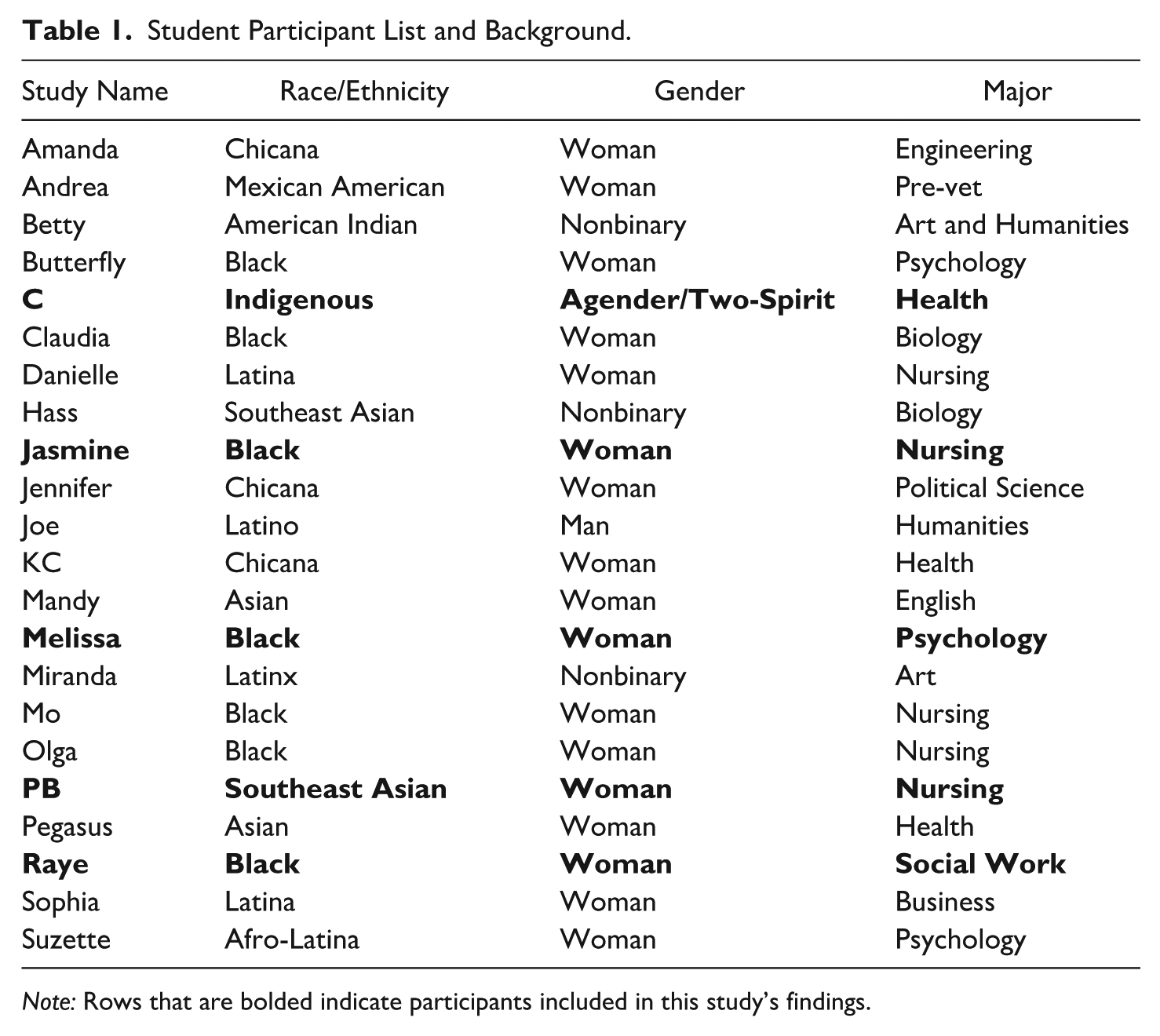
Note: Rows that are bolded indicate participants included in this study’s findings.
Student interviews were conducted over Zoom and ranged between 60 and 90 minutes. These conversations focused on motivation and academic progress toward transfer, classroom experiences, and racial/ethnic discrimination across campus, among other topics. Students received a $25 gift card upon completing their interview.
Faculty were recruited via email using the college directory to supplement students’ reflections on the classroom and to better understand the perceptions faculty hold about support for transfer. Faculty were also recruited based on their roles in high-enrollment courses that are most critical to transfer (e.g., math, English). The three faculty members who volunteered came from three different fields—English, math, and engineering—and served in the same or similar position at Gates College for 5 to 10 years. Faculty interviews lasted 45–60 minutes and focused on their practices and perceptions of their role in supporting students’ transfer progress. Though the larger mixed methods study included interviews with seven educators in various roles, this article centers on these three faculty members, given its focus on the classroom (see Table 2).
Faculty and Staff Participant List and Background.
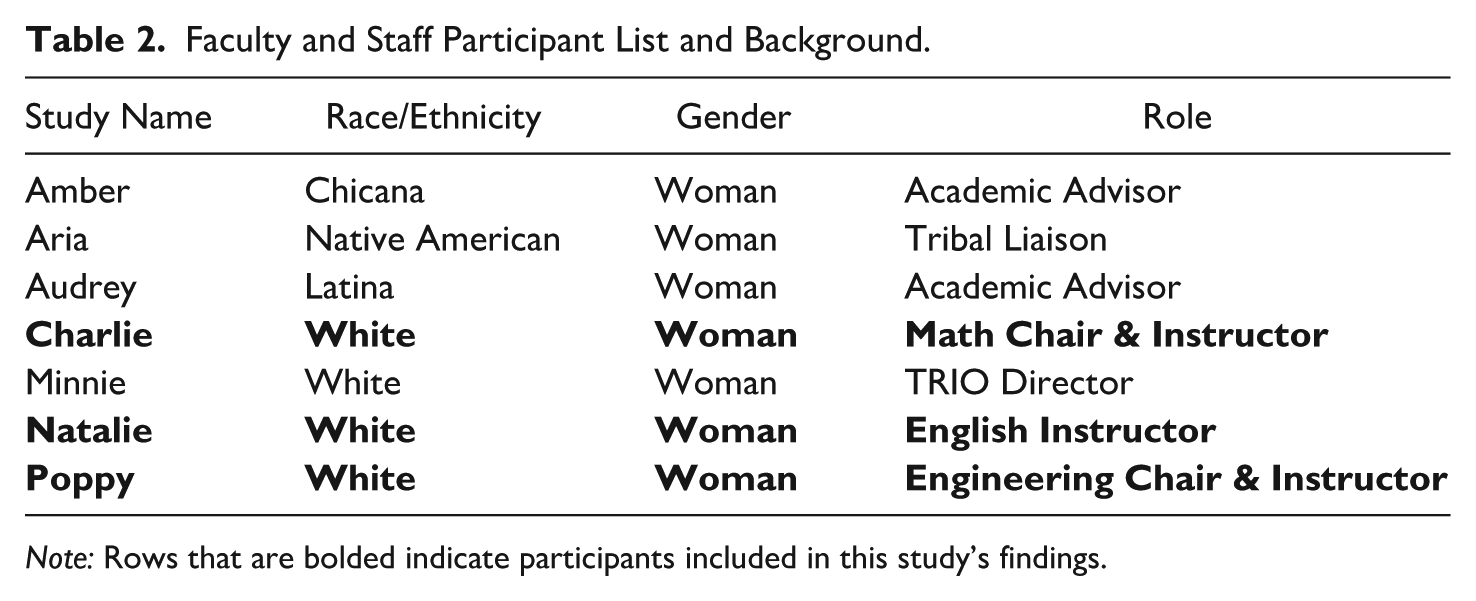
Note: Rows that are bolded indicate participants included in this study’s findings.
Data Analysis
I manually coded interview data using thematic analysis, which is a deductive theory-guided approach to analyzing data, followed by inductive coding to further develop my study’s themes and subthemes (Vanover et al., 2021; Wyse et al., 2017). Throughout the coding process, I consulted participant memos that I wrote after each interview, which included my personal reflections on our conversations (Ravitch & Carl, 2019). I also outlined the strategic racial equity framework’s principles and deconstructed them into key concepts and ideas based on the foundational text by Garces and Gordon da Cruz (2017). This outline guided my deductive analysis by helping me identify and categorize codes related to racial inequities and students’ agency. I then inductively coded using an in vivo scheme to allow new ideas to emerge and to stay close to participants’ chosen words (Vanover et al., 2021).
After completing deductive and inductive coding, I compared codebooks to build a more nuanced thematic scheme. I triangulated across inductive and deductive codes and reflexive memos to develop deeper descriptions and interpretations (Vanover et al., 2021). This thematic analytic approach supported a more holistic understanding of how racial and transfer inequities persist.
Limitations and Caveats
My study has several limitations and caveats that should be considered when engaging the findings. I interviewed 22 students in the larger project, and around five explicitly described racist or racially charged classroom incidents. In line with a qualitative descriptive approach, however, the findings developed from these few student participants are intended to offer depth and richer insight into how racialization takes form within the classroom and becomes consequential to students’ transfer, rather than to evaluate the breadth of racialized experiences across all participants. As such, the findings cannot be generalized to all transfer-aspiring community college students of color; instead, their reflections harness the at-times painful emotional and academic impacts of racialized classroom experiences for students of color navigating a predominantly white community college.
In the same spirit of descriptiveness, this study included interview data from three faculty interviews. Despite multiple recruitment efforts, only three full-time faculty members participated and were included in the analysis. Their interviews nevertheless revealed important points of synergy around equity- and student-centered classroom practices and helped me better understand faculty–student interactions. A final caveat is that faculty were not directly connected to the student participants through the courses students were enrolled in. In other words, students and faculty were not referencing the same courses, as reflected in the findings.
Trustworthiness and Credibility
To ensure I honored participants’ experiences, I invited them to offer their feedback on my analysis through member checking, which gave them the opportunity to validate how their experiences were represented in the findings and to revise or expand their responses (Collins & Onwuegbuzie, 2013). In this case, I emailed participants their quotes and my analysis of them to ensure they felt accurately represented. I also relied on multiple researchers as thought partners to discuss challenges during analysis and interrogate my personal assumptions about students’ experiences. Finally, I engaged in reflexive memoing to document developing interpretations and reflections as the interviewer (Ravitch & Carl, 2019). These memos helped maintain my awareness and document challenges across the research process, from research question and protocol development through data analysis and reflection.
Positionality
As a Chicana, first-generation, former community college student from a low-income background, I have experienced dueling college experiences. One where I failed courses and fell through the cracks, and the other marked by a transformative academic experience shaped by supportive educators. These distinct experiences influenced how I approached participants, because I understood firsthand how broader social systems beyond the college environment impact students, especially minoritized students. During interviews, I sought to build rapport by acknowledging our shared cultural and personal backgrounds when appropriate and staying attentive to participants’ emotional comfort and boundaries. Given that many reflections involved experiences of emotional harm and racism, I became hyperaware of the need to approach interviews with reciprocity and deep respect for the trust participants extended to me in sharing vulnerable moments. For example, when participants recounted emotionally difficult or racially charged experiences, I slowed the pace of our conversation and created space for them to guide the direction, whether they needed a long pause or redirect in order to prioritize their well-being over moving through interview questions.
Throughout data collection, I also reflected on the many privileges I carry, including having transferred from a community college to a university, my role as a researcher, and my overall access to higher learning. These privileges necessitated my reflections about the power I hold as a researcher in interpreting and representing participants (Milner et al., 2025). My assumptions were often called into question as I learned about students navigating emotionally and academically detrimental experiences in the classroom and throughout college. I reconciled tensions between my own experiences and students’ contrasting ones by interrogating my interpretations through memoing and conversations with trusted researchers. During data analysis, I became more intentional about analyzing participants’ reflections within broader social and historical contexts to keep race and power central (Milner et al., 2025). These checkpoints helped maintain my accountability to students of color, as I hoped to elevate their narratives of strengths and the areas where they can be better supported in their community college education and pretransfer processes.
Findings
The findings are organized into two themes and supported by subthemes that capture how the classroom operates as a site through which students of color’s transfer trajectories are disrupted or made more possible. Student and faculty insights reveal that transfer is not just an aspired-to goal but an active, ongoing process constantly shaped and reshaped through everyday classroom interactions, faculty pedagogical decisions, and institutional conditions that impact what faculty and students are able to do. These two overarching themes show how racialized classroom conditions can disrupt students’ transfer aspirations and trajectories, and how equity-centered instruction and curriculum, when supported by institutional resources, can advance students’ transfer progress and reinforce their aspirations.
Racialized Classroom Conditions that Disrupt Transfer Progress
Students of color described racialized classroom interactions that became barriers to their academic engagement and complicated their progress toward transfer. Students explained that racism in the classroom took the form of repeated harmful interactions with faculty and peers, along with curricular and pedagogical practices that perpetuated racial harm. These classroom conditions pulled time and emotional energy away from their coursework and at times hindered their ability to remain on track toward transfer.
Racialized and Gendered Classrooms as Barriers to Transfer
Raye and Melissa, 3 two Black women students, described overt and covert racialized interactions with instructors and peers in courses that were critical to their transfer. These interactions left them feeling disrespected, marginalized, and stripped of autonomy in ways that directly impacted their transfer trajectories.
Raye, pursuing social work for transfer, first described the interlaced impact of gendered racism throughout her life. She shared that she was “fighting the system” from a young age as she experienced incarceration and battled to keep her child out of foster care. Determined to “beat the system” for the sake of her son, she reflected:
Getting my education, educationally equipping and protecting myself to fight the system . . . the system’s happened to me for 17 years, but I had no education about what was really happening . . . to me and my son. I decided I wanted on the other side of this fence.
Raye was motivated by her upbringing and personal experiences when she decided to enroll in the social work for transfer program at Gates, where she hoped to gain the tools and knowledge to advocate for herself, her son, and her community. In a human services internship class, Raye described experiencing unfair and biased treatment from her instructor. Although she aspired to a career in social work, the instructor denied her request to be placed in a social work–related internship and instead assigned her to a local food pantry.
Also disregarding her serious injuries after a recent car accident, Raye expressed her frustration, telling him:
“I cannot lift those cans . . . my car just flipped over on me. I have a C6 vertebrae fracture in my neck, which means I have a cracked spine in the top of my neck. . . . I am not able to do that type of work.” And he tried to send me there anyway.
This experience left her feeling disrespected, especially after discovering most of her classmates were “doing supervised visits for foster kids” and “every last one of them are within the Department of Human Services,” where she aspired to intern. As Raye joined the class virtually during her recovery, she realized that “there were a bunch of white people in the classroom.” She expressed her disappointment to her instructor and peers, saying, “How are all of these people in these positions? But you tried to put me in a food pantry. . . . this is why all our Black kids is getting taken because y’all don’t put Black people in these positions.” As the class sessions progressed over a couple of weeks, Raye reflected on how her instructor, a Black man, would tend to favor white students in his class:
I would see how he would, you know, encourage the other students in his class and advise them and give them meaningful talks and cultivate what was inside of them and the potential that he saw in them. And these were white students.
Raye ended up dropping the class because of the disrespect and marginalization, but described how she persisted toward transfer despite this experience: “The next person probably would have dropped out of school, and he didn’t care anything about that, because I’m a Black woman.. . . Nobody bothered to apologize.” Raye’s experience spotlights how racialized and gendered classroom interactions can interfere with students’ transfer trajectories by depriving them of opportunities critical to their academic plans, while at the same time chipping away at their autonomy to make decisions aligned with their goals.
The intersection of race and gender deepened the harm and illustrates the often-implied expectation that Black women remain resilient in the face of adversity, with little to no regard for their well-being. Another layer of Raye’s experience sheds light on how these dynamics can operate through intraracial and gendered hierarchies, where proximity to whiteness, rather than a shared racial background, influenced whose aspirations were supported in the classroom. Her experiences also reflect how such exchanges undermine students’ agency and disrupt their academic progress. As Raye herself noted, these interactions are consequential enough that other students might have stepped out of higher education altogether. Raye’s difficult decision to drop her required human services internship course ultimately delayed her progress because the class was only offered once a semester, and her experience reflects a pattern among transfer-aspiring students who face racism and sexism in the classroom.
Melissa, a psychology major, was also the only Black student in her African American studies class. Reflecting on the discomfort and disheartening instructor interactions, Melissa shared:
I had to miss a day of school because I was sick. I told my professor that, but he didn’t answer my email, which is weird, because professors always answer your email.. . . next class I was like, “Hey, I emailed you, but I didn’t hear from you back.” And he was like, “Oh, I saw it, but I didn’t have to respond.” I was like “Oh.” It was just negative. That class itself is kind of weird because I’m the only Black person. . . . Everyone else is white. The professor is white himself. So, I am uncomfortable in the space because like, the white people don’t talk to me. Or they kind of give me these weird, like death glares. And mind you, the part that’s so funny to me is that this class is about the history of African American music. Like, you are taking a class about my history.
Melissa’s classroom experiences reveal racialized dynamics that not only influence students’ likelihood of completing the class, as seen in Raye’s experience, but also their level of engagement and comfort. As the only Black student in her African American music class, a space initially meaningful to her, Melissa described feeling overlooked by her instructor yet hypervisible in ways that brought about discomfort, such as receiving “death glares” from peers that felt racially charged. Melissa’s and Raye’s experiences reveal how Black women are often rendered simultaneously invisible and hypervisible as targets of gendered racism, along with other attacks on their well-being. The impacts extended beyond the well-being of Raye, Melissa, and other students to their academic engagement and sense of connection to the class, which, as an ethnic studies course, was expected to serve as a space of affirmation rather than exclusion.
These multilayered racialized experiences reflect the conditions under which students of color are able to maintain their progress toward transfer, a process that takes place mostly in the classroom as students complete required coursework. For both Raye and Melissa, racism and unresponsiveness from instructors created classroom environments that threatened their autonomy and emotional safety as two of the only Black women in predominantly white classes. Given that opportunities for academic engagement are closely related to transfer outcomes, building racially and ethnically affirming and humanizing classrooms are critical to students’ forward transfer progress.
Students’ Emotional and Advocacy Labor to Persist Toward Transfer
Beyond racialized interactions, two students, PB and C, described the emotional and advocacy labor required to navigate and resist racialized harm in the classroom while remaining committed to transfer. This labor demanded their time and energy that would otherwise be reserved for coursework critical to transfer preparation; instead, it was expended to address racism and seek accountability from instructors and peers.
For example, PB, a Southeast Asian woman, described an experience in a developmental psychology course she was taking to fulfill a transfer requirement for nursing. During a class discussion prompted by the textbook, which presented a deficit-based portrayal of Mexican American people, PB noticed that her instructor and white peers were “perpetuating stereotypes on Mexican people . . . it [the textbook] portrayed types of work that Mexican people usually do but the discussions got frayed away into personal opinions.” Despite reporting this behavior to the department chair, she noted that she “[doesn’t] think the instructor was penalized.” PB was the only person to speak out during the class by asking, “Should we be saying those things?” Meanwhile, her instructor “was agreeing with those students . . .”. PB went on to elaborate on her expectations around faculty accountability:
You [the instructor] should have been a better facilitator in this discussion. . . . It’s kind of just hurtful . . . discussing how, especially if your instructor is white, how this affects you as a student of color, and being able to explain that to them, you know, or that’s from a marginalized background.
In PB’s experience, neither faculty nor students were held accountable for remarks that reinforced racial stereotypes. Her efforts to report this situation depict the burden placed on students of color who address and challenge these racialized harms.
C, an Indigenous two-spirit student majoring in health sciences, faced a similar issue with a textbook and instructor in their Native American History class. C shared:
The language is offensive. The textbook’s preface from the author said I know your community does not like being called Indians, but I’m old and I don’t care, so I’m going to use that interchangeably with other progressive things . . . this is sanctioned by my professor, who’s white, by the way, to put that out there. I’ve had to fight for the last two years about this.. . .
C also spoke with administrators about the harm caused by the book and instructor, but there has been no change. When asked about what it meant to be an Indigenous student at Gates College, C responded, “A punching bag. There’s so many things that just take an emotional toll on us. We are constantly being told we have to just deal with it when people say things offensive, or there’s offensive things around the school. . .”. C wondered, “How long does this have to take before something is actively done?” Despite students of color advocating for racial equity in the classroom, harmful practices persisted with students’ lived experiences and communities inaccurately represented.
This overall lack of institutional accountability deprioritizes racial equity as a commitment and exhausts students. Rather than focusing on their forward progress toward transfer, students instead diverted their energy toward surviving hostile classroom environments and advocating for individual and institutional accountability, rendering transfer an emotional and political process negotiated in everyday classroom interactions. In the section that follows, students and faculty members share how classrooms can advance racial equity and better support transfer-aspiring students of color.
Classroom Practices and Institutional Conditions Supporting Transfer Possibilities
Faculty practices, in combination with institutional conditions, influenced the extent to which classrooms operated as sites of transfer support or obstacles for students. Faculty understood their role as one of actively supporting students and building equity-centered classrooms by affirming students’ backgrounds, developing engaging curriculum, and nurturing their aspirations.
Pedagogical Practices that Foster Transfer Aspirations and Trajectories
Some faculty members at Gates College meaningfully integrated race-forward discussions as a way for students to reflect on how race and racism influence their intended career fields and pathways. Jasmine, a Black woman student in Gates’s nursing program, described how her instructors actively engaged students in discussions about race, particularly in healthcare. She recalled a moment when her instructor disrupted the conventional framing of health predispositions and race:
My teacher was saying a lot of times we hear that risk factors for certain diseases are certain races. And she was saying that she didn’t like that term. . . . it’s not particularly the race, but the circumstances that these people have to endure . . . poverty issues . . . that put them at risk for these diseases.
This discussion alone broadened Jasmine’s perspective and resonated with her deeply, shifting her understanding of healthcare as embedded in larger social systems. The discussion also reinforced her hope to see more representation of people of color in healthcare fields. She reflected, “Seeing somebody that looks like you, I feel can make all the difference.” Through reflections on race, these classroom opportunities encouraged Jasmine to think more critically about her role in relation to larger social systems and what it means to be the representation she often lacked. In contrast to earlier student reflections, Jasmine’s experience speaks to the possibility of thoughtful race-conscious instruction that can support students’ trajectories and reinforce their commitment to long-term goals. Jasmine shared that this course and the facilitation of it motivated her to persist toward transfer to eventually become a charge labor and delivery nurse.
Natalie, a white English instructor, similarly hoped to engage students in critical discussions about racial and social conditions. She facilitated discussions as students developed their course research projects, encouraging them to adopt “equity-minded sense making and being careful to not apply a deficit mindset.” She shared an example of her practice, “So, when we were looking at the population of students who stopped attending, rather than saying, ‘Oh, they are dropouts, they quit,’ like, thinking about . . . well, what were the barriers that prevented them from continuing?” Through these facilitations, Natalie hoped to empower her students with tools to critically analyze racial and social inequities across multiple areas of their lives.
She also highlighted the importance of thoughtful course design that integrates resources and supports students’ goals, noting, “I invite a lot of different people, like success coaches . . .”. Natalie’s leveraging of outside expertise demonstrated how faculty can create more equitable classrooms and support students’ academic aspirations. Through these efforts, she hoped that fostering race-consciousness would help students feel “validated and represented.” More broadly, by challenging stereotypes and integrating purposeful discussions, faculty created space for critical dialogue that reshaped classroom narratives of equity while simultaneously advancing students’ progress toward their goals.
Faculty Reflexivity and Policy Changes to Support Students of Color
For other instructors, such as Charlie, a white math instructor, confronting a challenging classroom conversation on race led her to reflect on how her practices might have contributed to inequities, which ultimately pushed her to shift her approaches to best serve students of color. Charlie recalled a moment when a math lesson involving incarceration rates sparked uncomfortable and harmful racist classroom dynamics:
So, there are, I mean, there definitely are some things where I don’t think I create a great space for students of color to feel comfortable. . . . I did do a lesson once in math reasoning that was around incarceration rates, I couldn’t facilitate the conversation, because people were saying things that were racist, and I did not know how to sort of make space for my students of color to not feel incredibly uncomfortable in that space, you know. And so, one of the things we asked the ESC [equity support center at Gates College] to do is to build a facilitation guide to help people with conversations like that. And so, there’s a sociology instructor helping to build some sort of a facilitation support so that we can deal with that stuff a little bit better in conversation.
Charlie elevates the importance of self-awareness and faculty accountability when conversations become harmful to students of color. Her experiences with racial dynamics in the classroom also reveal that even in subjects seemingly unrelated to race, like math, racism and racialized interactions are still present.
Charlie further reflected on how her previous practices and policies may have unintentionally created a space “that was not welcoming to students of color.” Some of which she recounted:
If you [a student] miss a test and you don’t email me in advance, you can’t make it up. . . . I was very strict on things because I thought it was helping prepare them for the workforce. . . . Earlier in my teaching career, every time I thought someone was being lazy, they would turn around and tell me the most heart . . . oh my gosh. Stories that just made me feel like such a jerk. . . . they just had so much going on in their personal life. . . . There are tons of faculty that still do that now. . . .
Over time, Charlie realized that some policies did not serve students well and were far disconnected from their realities. She encouraged other faculty to shift their approach, “One thing you can do is change your policies to recognize that our students are adults and human beings, and a lot of them have families, you know, like money issues, a lot are returning adults.” For her, operationalizing racial equity in the classroom required more than individual effort. She aspired to systemic change and stressed the need for institutional support to integrate equity-centered policies across departments. Both Charlie and Natalie’s experiences suggest that advancing racial equity in the classroom requires faculty to critically reflect and act through race-conscious, student-centered approaches, as well as institutional support that prepares them for this work.
Faculty Working Conditions and Their Consequences for Transfer Support
In conversation about their working conditions, faculty briefly touched on the structural challenges that inevitably influenced classroom climates and the level of support they could realistically give to students. For example, Natalie shared that she worked weekends and nights to keep up with her grading and course preparation, reflecting:
I pretty much work every weekend, most of the weekend, and I work a lot of nights because there really aren’t enough hours in the day to do all the prep and grading that I need to do. . . to feel like I’m doing my job well.
Meanwhile, Charlie brought light to how part-time faculty, who made up over half of Gates College’s instructional staff, were often excluded from professional development opportunities, including those focused on classroom equity:
Over half of our faculty are part-time, but they’re not really considered faculty . . . why would I exclude them? They don’t get paid for anything except being in the classroom really, and I’m like, “Yeah but that’s terrible for them. That doesn’t mean you exclude them [from professional development opportunities].”
She noted that excluding part-time instructors eventually has consequences for students of color in foundational courses. Charlie described these as “high-impact, high-enrollment classes with much higher percentages of underrepresented students,” often taught by part-time instructors, and where “a lot of students really struggle.” She stressed the importance of supporting overworked instructors who manage heavy enrollments in developmental courses like English and math, which are required for transfer. She reflected, “The closer you go towards transfer, the smaller the percentage of students of color,” emphasizing the critical role of well-supported faculty in promoting students’ progress. Without access to professional development opportunities, part-time faculty seemingly lacked the knowledge and training necessary to holistically support transfer-aspiring students of color.
Taken together, faculty emphasized the need for Gates to invest in supporting them, particularly part-time instructors, through professional development and sustainable workloads. Poppy, chair and instructor of engineering, argued that meaningful faculty–student support requires direct and individualized engagement that cannot be replaced. She explained:
It’s never going to be an efficient model, and everybody wants to try to figure out how to make things work, but at the end of the day, it’s about meeting one on one with students, and there’s absolutely nothing that can replace that . . . it requires way more resources. But, I mean, if you really want to support students, like, that’s what it takes, and there’s nothing that you can do to get around that and save time and money. You just need more people working directly with students.
These reflections offer a broader understanding of how faculty’s ability to cultivate student success depends on high-quality, meaningful interactions, and without institutional changes to support educators, these interactions risk becoming the exception rather than the norm. For students of color aspiring to transfer, equitable outcomes hinge on ensuring access to and engagement with quality academic support in the classroom.
Discussion
As noted in the findings, community college classrooms emerge not as neutral spaces of learning but as sites that are racialized and racializing. As racialized spaces, classrooms reflect the institution’s broader structural inequities like hiring practices that result in ethnic studies courses taught by instructors who are part of the racial majority rather than the communities represented in the course. They are further racialized as students of color are disproportionately concentrated in developmental (i.e., high enrollment) courses, where enduring racial disparities surface and progress toward transfer is often slowed (Wang, 2009, 2020). Classrooms are racializing through the practices, policies, and course materials that communicate to students whose identities and knowledges are valued. The findings, in this sense, speak to the strategic racial equity framework by illuminating the ways in which classroom practices and course policies can operate as hidden contributors to transfer inequities. For some students, these experiences delayed their progress and heightened their risk of being pushed out; nevertheless, students advocated for themselves and one another. Meanwhile, some faculty worked to engage in racial equity efforts in their classrooms but needed greater institutional support and resources to sustain their work.
In line with extant literature, race remains a pervasive undercurrent that determines how student engagement and academic progress are experienced (Long, 2016; Rodgers, 2025). Students in this study described racial microaggressions and stereotypes (Lomotey & Smith, 2023) perpetuated by both peers and faculty, which influenced their classroom engagement (King, 2021; Naca, 2022) and transfer trajectories. The findings reaffirm the importance of faculty–student interactions and equity-centered classroom support as integral to students’ academic confidence and progress (Deil-Amen, 2011; Wang, 2020). My study extends current research by positioning the community college classroom as a mediator of transfer that supports, slows, or even has the potential to stop students’ transfer progress. In alignment with the strategic racial equity framework, the findings suggest that racialized interactions, faculty decisions, and faculty capacity impact students of color’s transfer trajectories by influencing access to critical transfer coursework and opportunities for classroom engagement and support—areas that are less frequently centered in the transfer literature.
Racialized classroom interactions took emotional, mental, and academic tolls on students. In this way, the racialized and racializing nature of classrooms became structural and institutionalized barriers that limited how students of color engaged with their education and placed their transfer trajectories at risk by delaying progress or causing students to question if they belonged or wanted to persist. The findings also revealed how students transformed racialized experiences into motivation to demand institutional accountability for the ways racism manifested in their classrooms. These actions also reflect that transfer is a political process for some students of color who challenge institutions to push beyond the status quo toward real structural changes that are more responsive and racially equitable (Garces & Gordon da Cruz, 2017).
Despite their efforts, students in this study who reported racially charged incidents did not receive a response, which exposed the limits of institutional accountability and left them carrying the burden of responsibility. Faculty members also confronted institutional limitations in supporting transfer-aspiring students of color, with those who hoped to prioritize racial equity work needing extra time and intentional development opportunities to thoughtfully integrate supportive strategies into their classrooms. These findings build on scholarship elevating the centrality of the classroom in community college students’ academic experiences and success, especially the importance of building stronger learning and support structures for historically minoritized students (see, e.g., Wang, 2020). Consistent with this scholarship, my findings suggest that faculty practices and course policies are integral to transfer progress and that, without proper institutional support for students and faculty, classrooms can reproduce inequities rather than dismantle them. In shifting attention from pathways and transitions (e.g., Jain et al., 2020; Jenkins et al., 2025) to the classroom itself, my study theorizes transfer as an active, emotional, political, and racialized process rather than a culminating outcome, where community college classrooms act as racialized spaces in which transfer trajectories are negotiated through classroom interactions and faculty decisions and practices.
Implications for Policy and Practice
In line with the strategic racial equity framework, the findings suggest that colleges prioritize the full participation of students of color across the institution, with special attention to the classroom. Students revealed areas for meaningful change, including strengthening accountability systems for addressing racism, realigning course materials, and building instructors’ capacities to actively support transfer progress and well-being. Consistent with extant scholarship on classroom engagement and faculty–student interactions, these implications highlight that equity-centered change requires a reimagining of community college structures, along with serious pedagogical shifts (Deil-Amen, 2011; Wang, 2024; Xu, 2016).
A priority for students was having transparent systems for reporting and addressing racism and bias, while also calling for colleges to deliver tangible outcomes that show students their well-being is valued and that they are willing to act against racism. In practice, this means making opportunities to report highly visible and easy to navigate. For example, SUNY Westchester Community College offers a strong model, with a reporting webpage that defines bias and hate incidents, provides a straightforward reporting form, outlines investigation procedures, lists supportive resources, and communicates confidentiality and protections against retaliation. This kind of transparent and supportive reporting system demonstrates how colleges can move closer to accountability.
Because the findings point to the influential role of faculty’s practices and policies, faculty should be supported in reflecting on and adapting their approaches in ways that affirm and sustain their students. It is important to recognize that these efforts exist within a broader sociopolitical context in which leaders, faculty, and other stakeholders such as board of trustee members may feel uneasy about how racial equity-centered work can be implemented, which makes it all the more important to understand strategic, responsive approaches that are attentive to institutional realities. As prior work suggests, responsive equity efforts do not always need to be overt to be impactful; for example, microaffirmations and other validating practices, along with holistic classroom approaches, can support students of color’s persistence and confidence (Huber et al., 2021; Rendón, 2002; Wang, 2020). Further, reflection opportunities for instructors could occur on a regular basis through semesterly teaching evaluations to identify areas for growth and change, or through weekly self-assessments of whose participation is centered in class, which students may be inadvertently overlooked, and how to engage them more intentionally.
Additionally, colleges should encourage the thoughtful integration of discussions of race and racism across the curriculum, including through on-campus equity centers and partnerships with community organizations focused on racial justice, to provide educators with tools for facilitating effective conversations. As shown in my study, racialized discussions take place even in “race-neutral” classes like math, which speaks to the need for institutionally supported, race-conscious pedagogy across the college. Faculty, especially those teaching ethnic studies courses, should adopt course materials authored by scholars and writers from the communities being studied and engage students in culturally affirming ways. Relatedly, institutions can prioritize hiring qualified instructors from these communities and ensure that pedagogy is grounded in lived experience and attentive to students’ cultural backgrounds.
A final note for leaders, who are crucial to student success, is to acknowledge the value and assets many faculty and staff bring to campus (Wang, 2024). This work demands additional resources to support faculty development; leaders should work with institutional research teams to provide department chairs and faculty with disaggregated course-level data to identify courses where students of color face barriers and to target support where it is most needed. Leaders can provide faculty with structured time and incentivized professional development, especially for part-time faculty, to deepen racial equity work in the classroom. Investing in paid, accessible professional development for adjunct faculty is imperative given that they mostly teach high-enrollment courses critical to transfer (e.g., math, English). As faculty suggested, without true institutional commitment, equity-centered teaching remains siloed and dependent on individual capacity; with it, colleges can build enduring supports that benefit faculty and pave stronger transfer pathways for students of color.
Future Directions for Research
My study offers implications for research, particularly regarding what racial equity in the classroom means to part-time and full-time community college faculty and students and how it comes to life for them. Prior studies have addressed that faculty often face barriers related to their working conditions, including limited time and heavy workloads—challenges especially present in under-resourced community colleges (Bahr & Gross, 2016; Wang, 2024). Consistent with this literature, faculty in this study described efforts to integrate equity-centered practices into their courses, but noted the limited time they had to fully operationalize them. Future research could explore how faculty across departments make time for and sense of racial equity work in teaching, along with how these practices and policies evolve through opportunities like professional learning communities.
Although my larger independent study did not specifically set out to document overt and covert racism in classrooms, participants nevertheless revealed that these racialized experiences often disrupted their trajectories. This aligns with extant scholarship showing that classrooms are places where racialization is produced and negotiated through interactions and pedagogy (Casanova et al., 2018; Rodgers, 2025). Future work could detail how these classroom-level dynamics intersect with transfer progress to better harness the racialized nuances of teaching and learning, especially through observational methods. Studies could also more closely delineate how racism in the classroom influences immediate academic engagement and longer-term aspirations and transfer pathways for students of color. Another line of inquiry could integrate a more intersectional lens; although my study centered race, participants discussed how gendered racism affected their personal and academic experiences. Future studies can disentangle how racism, culture, and other dimensions of identity intersect across groups to more holistically capture the complexity of students’ transfer journeys.
Finally, the strategic racial equity framework was integral for identifying hidden contributors to inequitable transfer outcomes for students of color. Future research could carry forward this framework to other higher education spaces, such as curriculum design and pedagogy, to interrogate how decision-making may inadvertently reproduce racial inequities.
Conclusion
Despite the classroom being arguably the most critical space for community college students, most of whom are students of color, it functions as a racialized and racializing space that mediates transfer. My study places a classroom-focused lens on transfer to nuance how students of color’s interactions during transfer coursework play a role in their transfer trajectories. The findings describe the toll on students’ emotional well-being and academic progress as a result of racialized interactions and exclusionary pedagogical practices. Although students advocated for institutional change, their concerns were often dismissed, which signaled to them the limits of accountability that their college, leaders, and faculty were willing to assume. Faculty who sought to advance racial equity in the classroom described lacking enough time and preparation from their college. These findings reaffirm that advancing racially equitable transfer cannot rest on the individual efforts of students or faculty. Instead, it requires a commitment to embedding racial equity throughout the college, with special attention to the classroom. Creating transfer pathways that genuinely support students of color requires confronting how racism manifests in everyday classroom exchanges and committing to structural changes that redefine what equitable transfer and student success entail.
Footnotes
Acknowledgements
I would like to extend my deepest gratitude to Dr. Xueli Wang for being a treasured mentor and generous supporter throughout my dissertation journey and as I worked through this manuscript, which was born from that work. I would also like to thank the Teachers College Record editors and anonymous reviewers for their thoughtful feedback and support in strengthening my work, and the student and educator participants who trusted me to be a vessel for their truths.
Declaration of Conflicting Interests
The author declared no potential conflicts of interest with respect to the research, authorship, and/or publication of this article.
Funding
The author disclosed receipt of the following financial support for the research, authorship, and/or publication of this article: This study was conducted as part of a larger research project supported by the Spencer Foundation (#202300075). Any opinions, findings, and conclusions or recommendations expressed herein are those of the author and do not necessarily reflect the views of the Spencer Foundation.
