






Abstract
Background:
Hispanic-Serving Institutions (HSIs) have acknowledged culturally responsive pedagogy (CRP) as a transformative approach to addressing equity in higher education. However, faculty often lack the formal training and communal support necessary to implement CRP meaningfully. With HSIs enrolling nearly two-thirds of all Latinx undergraduates, understanding how institutions cultivate servingness through faculty development is essential.
Focus of Study:
This study examines how faculty members who participated in a CRP-focused curriculum design institute characterize their experiences as both learners and educators. It explores how these experiences shape their teaching philosophies, classroom practices, professional identities, and understanding of servingness. The central research question is: How do faculty characterize their experiences of learning and teaching as a result of their engagement in a CRP-focused curriculum design institute?
Research Design:
This study employs a qualitative, embedded case study design to analyze the experiences of 25 faculty participants across disciplines at an HSI. We analyzed interviews and classroom observations from faculty participants for this study. Guided by CRP and servingness frameworks, the thematic analysis revealed how this institute fostered transformation, cultivated pedagogical reflexivity, and built communal capacity.
Conclusions:
Findings suggest that faculty experienced both personal and pedagogical transformation, practiced reflexivity as an ongoing process of teaching with intentionality and equity, and built communal capacity by cultivating cross-disciplinary connections that advanced servingness as both a pedagogical and institutional commitment. Together, these insights highlight that CRP is not only a matter of individual teaching strategies but also a structural shift, positioning faculty development as a powerful lever for equity-centered transformation in higher education.
Teaching is frequently experienced as an isolated practice, with few opportunities for collaboration, critical reflection, and mutual support (Kezar & Maxey, 2014; Stupnisky et al., 2019). Too often, discussions about pedagogy only come up in moments of classroom crisis, such as when a class goes poorly, a student raises a concern, or an issue escalates (Lefstein et al., 2020). In this context, faculty development initiatives that intentionally cultivate connection, shared learning, and collective care provide more than just professional support; they also build communities that promote personal well-being and serve as powerful levers for advancing equity in instruction and institutional culture (Eib & Miller, 2006). Faculty community building, understood in this way, is a powerful yet often overlooked catalyst for pedagogical and institutional transformation in higher education (Strong et al., 2019).
Faculty community building is particularly critical at Hispanic-serving institutions (HSIs), where the mission to “serve” Latinx students extends beyond access and enrollment. In this study, faculty community building refers to the intentional process through which faculty create and sustain a space for shared reflection, relational learning, and collective responsibility for equity-oriented teaching (see Wenger, 1998), understanding community as the creation of a “social learning space” where faculty move beyond isolated work to engage in a shared purpose (Wenger-Trayner & Wenger-Trayner, 2020). This kind of community-centered faculty development is especially essential at HSIs because, as Garcia (2019) notes, being an HSI is more than a status; it is a practice of servingness, which requires institutions to enact culturally affirming practices that reflect and respond to the lived experiences of their students. This includes creating curricula, programs, services, and pedagogies that are socially just and culturally responsive in order to support Latinx student success (Garcia, 2019), and faculty play an important part in this work. Through their curriculum design, pedagogical approaches, and relationships with students, faculty directly shape the academic climate and student experiences, influencing their sense of belonging, engagement, and persistence (Bensimon et al., 2004; Dee & Daly, 2009; Garcia, 2019).
One way faculty take up this responsibility for servingness in their teaching is through culturally responsive pedagogical approaches. Culturally responsive pedagogy (CRP) has emerged as a widely recognized framework for advancing equity in higher education, particularly in contexts serving racially and ethnically diverse student populations. CRP emphasizes the integration of students’ cultural knowledge, lived experiences, and identities into learning, challenging deficit-oriented approaches that position students as lacking or underprepared (Gay, 2002; Kiyama et al., 2018; Ladson-Billings, 1995; Rendón, 1994). In higher education, CRP has been associated with increased student engagement, a strengthened sense of belonging, and more affirming classroom climates for historically marginalized students (Castillo-Montoya, 2019).
Despite growing recognition of CRP’s value, many educators, particularly those who do not share their students’ cultural or linguistic backgrounds, report feeling unprepared to apply CRP effectively and meaningfully without ongoing institutional and pedagogical support (Bensimon, 2007; Castillo-Montoya, 2019; Ching, 2019; Gay, 2010). This challenge is especially pronounced in disciplines like STEM, where faculty are often trained as content experts with limited formal preparation in pedagogy (Twombly & Townsend, 2008). Even when faculty are motivated to teach in culturally responsive ways, they may lack the institutional structures, professional norms, or peer support needed to translate equity commitments into everyday teaching practice.
The need for intentional faculty development is particularly urgent given the rapid growth of HSIs. As of 2023, more than 600 institutions enrolled approximately 63% of all Latinx undergraduates, reflecting a 185% increase since 1995 (Excelencia in Education, 2024). However, in order to reach their full potential as HSIs, intentional investment in faculty development programs that go beyond technical training is increasingly emphasized. And these programs must provide spaces for fostering communal learning, critical reflection, and identity transformation to enact servingness in meaningful ways (Garcia, 2019; Kezar, 2018).
Prior research has demonstrated that faculty development programs that focus on culturally responsive teaching can shift mindsets and reshape classroom practices (Haviland & Rodriguez-Kiino, 2009; Massar, 2022; O’Leary et al., 2020). Much of this scholarship, however, examines outcomes at the level of individual faculty learning or overall program effectiveness (e.g., changes in attitudes, self-reported practices, or course artifacts). Although these studies provide important insight into whether professional development initiatives are effective, they offer limited understanding of how faculty learning unfolds through collaborative interactions or how it is shaped by institutional context.
Building on scholarship on CRP and CRP-informed faculty development, this study asks how faculty who participated in a curriculum design institute at a research-intensive HSI characterize their experiences as teachers and learners. Using CRP and servingness as complementary analytic lenses, this qualitative study draws on interviews and course observations with 25 faculty members from a range of disciplinary backgrounds who attended this five-day, interdisciplinary curriculum development institute (the Institute) with a specific goal to redesign one of their existing courses through the lens of CRP.
Although the Institute’s original goal was to improve student outcomes, our research shows that faculty members also experienced transformation in their teaching and professional identities, cultivated reflexivity as an ongoing practice of teaching with intentionality and equity, and built communal capacity by collaborating across disciplines to share responsibilities for servingness. Together, these experiences illuminate how CRP-focused faculty development can serve as a catalyst for pedagogical innovation and institutional change.
Theoretical Framework
In this study, we integrated a theoretical framework that brings together CRP and the concept of servingness to examine faculty learning and community building at an HSI. We draw on CRP as our pedagogical and analytic framework for understanding how faculty engage questions of culture, identity, and equity in their teaching, while using servingness to account for the institutional and organizational conditions that shape whether such pedagogical commitments can be enacted, sustained, and shared.
Overview and Evolution of Culturally Responsive Pedagogy (CRP)
CRP is grounded in asset-based traditions that affirm students’ cultural and linguistic knowledge as foundational to academic success (Gay, 2002; Gutierrez et al., 1999; Kiyama et al., 2018; Ladson-Billings, 1995; Moll & Gonzalez, 1994). Early formulations of culturally relevant pedagogy, introduced by Ladson-Billings (1995), emphasized three interrelated goals for teaching students of color: academic success, cultural competence, and critical consciousness. This framework positioned culture not as an add-on to curriculum but as central to learning and identity development. Subsequent scholarship expanded and refined these ideas. Gay (2002, 2018) advanced culturally responsive teaching by foregrounding the role of instructional practices that leverage students’ cultural experiences as strengths and challenge deficit assumptions in classrooms. Gay’s (2018) work emphasized the pedagogical enactment of cultural responsiveness, focusing on how teachers translate equity commitments into everyday classroom practice. Building on these contributions, Paris (2012) introduced culturally sustaining pedagogy, which extends beyond responsiveness to argue for the active preservation and nurturing of the cultural practices of historically marginalized communities. Paris and Alim (2017) explicitly argue that “relevant” and “responsiveness” alone may be insufficient if it does not attend to the ongoing production and maintenance of cultural practice (p. 5). Ladson-Billings (2014) similarly revisits culturally relevant pedagogy to highlight the need to situate pedagogical work within broader analysis of race, power, and inequity.
Despite important theoretical distinctions among culturally relevant, responsive, and sustaining pedagogies, including their historical origins, political commitments, and analytic emphases, scholarship has often situated these approaches as part of a broader equity-oriented and asset-based pedagogical tradition (Jett, 2012). For example, Aronson and Laughter (2016) intentionally synthesize this body of work under the umbrella of culturally relevant education, arguing that they engage in overlapping pedagogical work aimed at fostering inclusive and culturally affirming learning environments; similar integrative framings appear across reviews of equity-oriented pedagogy literature (e.g., Dover, 2013).
In this study, we use CRP as a pedagogical and analytic lens that examines how faculty integrate students’ cultural knowledge, experiences, and identities into their teaching and curriculum. We adopt CRP as a practical umbrella term that reflects how culturally informed pedagogy is learned, named, and enacted by faculty in a higher education context (Castillo-Montoya, 2019; Salazar, 2013). Using CRP in this way does not suggest that culturally relevant, responsive, and sustaining pedagogies are all the same, nor does it minimize their distinct contributions. Rather, it allows us to analyze faculty teaching practice as it is actually carried out—often in blended, evolving, and context-specific ways—using the language faculty themselves use. Likewise, we do not treat CRP as a comprehensive theory that explains all aspects of equity in higher education. CRP helps us examine how faculty attend to culture, identity, and equity in their teaching, but it does not by itself account for the institutional structures and collective responsibilities that shape faculty work. When CRP is understood mainly as an individual teaching approach, responsibility for equity-oriented pedagogy often falls on individual faculty members, with limited attention to the institutional structures that support or constrain their practice (Bensimon, 2007; Kezar & Maxey, 2014). This limitation is why we pair CRP with the concept of servingness, which foregrounds institutional responsibility for equity-oriented practice.
Servingness as an Institutional Extension of CRP
To address this limitation, we draw on the concept of servingness (Garcia, 2019) as an institutional framework that extends the pedagogical focus of CRP. Servingness is particularly salient in the context of HSIs, which enroll a large and growing number of Latinx students and are uniquely positioned to advance culturally affirming educational practices. Although HSIs comprise approximately 21% of U.S. higher education institutions, they enroll about 65% of Latinx undergraduates, underscoring their central role in promoting Latinx student success (Hispanic Association of Colleges and Universities, n.d.).
At the same time, HSIs have frequently been critiqued for focusing solely on access and enrollment numbers without sufficiently transforming institutional practices to meet the holistic needs of the students they serve (Garcia, 2019). In response to this critique, Garcia (2019, 2023) articulated servingness as a multidimensional framework that shifts attention from enrollment status to equity-driven organizational change, which encompasses academic and nonacademic outcomes, structural components, and cultural practices that collectively shape students’ experiences in HSIs (Garcia, 2019; Garcia & Cuellar, 2018). Núñez et al. (2015) and Garcia et al. (2019) further reinforce this institutional framing of servingness by cautioning against celebratory or enrollment-driven interpretations of HSIs. They argue that HSIs must be examined not merely as demographically defined spaces but as sites where equity depends on intentional institutional practices. Moreover, drawing on Ray’s (2019) theory of racialized organizations, subsequent scholars (e.g., Garcia, 2019; Vega et al., 2022) contend that the racial structure of an institution shapes what equity work is possible and who bears responsibility for it, positioning servingness as institutional commitment rather than demographic status alone.
Within this reframing, CRP emerges as a key mechanism through which servingness is enacted in practice. Research demonstrates that incorporating culturally relevant and interdisciplinary curricula, particularly those that reflect students’ identities and experiences, enhances academic engagement, personal empowerment, and retention (Altschul et al., 2006; Banks, 2010; Carter, 2008; Chavous et al., 2003; Vasquez, 2005). From a servingness perspective, these pedagogical practices are not isolated innovations but expressions of broader institutional commitments to equity. In this study, faculty development, specifically participation in the Institute, serves as an important site where CRP and servingness intersect. Through the Institute, CRP is not only introduced as a pedagogical approach but also enacted as a communal practice (Wenger-Trayner & Wenger-Trayner, 2020), as faculty collectively engage, interpret, and implement culturally responsive practice in alignment with institutional commitments to servingness at an HSI.
Literature Review
CRP in Higher Education Contexts
Culturally responsive pedagogy (CRP) emerged primarily from K–12 contexts but has become increasingly central to higher education as colleges and universities enroll more racially, ethnically, and culturally diverse student populations (Dessources et al., 2020; Hutchison & McAlister-Shields, 2020; Johnson & Elliott, 2020; Pappamihiel & Moreno, 2011). In the university context, CRP is situated within a broader tradition of equity-oriented pedagogies that emphasize validation, belonging, and the affirmation of students’ cultural identities as central to learning. One foundational framework informing college-level CRP is Rendón’s (1994) validation theory, which posits that students from historically marginalized backgrounds thrive when faculty actively affirm their cultural identities and capacities. This theoretical foundation has paved the way for contemporary college-level CRP, as higher education scholars conceptualize CRP as an approach that centers students’ cultural knowledge as an academic asset rather than a deficit, emphasizing the integration of students’ experiences into curriculum, pedagogy, and assessment (Castillo-Montoya, 2019; Montenegro & Jankowski, 2017; Salazar, 2013).
Empirical studies in higher education demonstrate that CRP contributes to positive student outcomes, including increased academic engagement, sense of belonging, and persistence for racially minoritized students (Castillo-Montoya, 2019). In the STEM contexts, culturally responsive mentoring and teaching practices are critical for retaining women and students of color in fields that have historically excluded them (Ong et al., 2018). These findings highlighted the importance of CRP not only as a pedagogical strategy but also as an equity-oriented framework that shapes how students experience academic spaces.
The relevance of CRP is particularly pronounced within minority-serving institutions (MSIs), where institutional missions explicitly emphasize access, equity, and student success for historically underserved populations. CRP contributes to “meaningful faculty–student engagement” at MSIs, which is considered both foundational and not limited to instructional spaces (Gasman, 2026, p. 7). In alignment with Rendón’s (1994) scholarship cited earlier, CRP at MSIs “validate students’ experiences and affirm their place in the academic community” (Gasman, 2026, p. 7). Despite this alignment, putting this into practice is not always easy. One particular study found that faculty at an MSI had a genuine desire to refine their instructional practices through a CRP lens but did not yet have the immediate knowledge or skill set to do so (Warren et al., 2020). The implications of this speak to the need for intentional faculty development efforts that align with and advance the mission of MSIs.
Faculty Development in Higher Education
Faculty development in higher education has evolved from an early focus on technical instructional proficiency toward a more holistic integration of faculty members’ professional, organizational, and personal identities (Sorcinelli et al., 2006). Traditional faculty development models often emphasized isolated, remedial interventions aimed at improving individual teachers’ performance (Gillespie et al., 2010). However, research consistently critiques these decontextualized approaches as insufficient for producing sustained changes in teaching practice or professional identity (Garet et al., 2001; Quinn, 2012).
Scholarship in faculty development increasingly frames it as an ongoing process of professional learning situated within social and relational contexts (Webster-Wright, 2009). Drawing on Wenger’s (1998) theory of community of practice (CoP), learning is understood not merely as an individual acquisition but as a collective process of negotiating meaning through engagement in a shared domain of interest. With faculty communities of practice, instructors developed mutual trust, shared language, and opportunities for equity-oriented pedagogical innovations (Camblin Jr. & Steger, 2000; Teeter et al., 2011; Wenger-Trayner & Wenger-Trayner, 2020).
Within this broader landscape, CRP-informed faculty development has emerged as a prominent strategy for advancing equity-oriented teaching in higher education. Scholars argue that CRP-focused faculty development can support shifts in faculty attitudes, foster critical reflexivity, and encourage more inclusive pedagogical practices (Devereaux et al., 2010; Haviland & Rodriguez-Kiino, 2009). In the HSI context, CRP-oriented faculty development provided opportunities for community building and the exchange of pedagogical ideas, encouraging faculty to adopt more culturally responsive classroom practices (Strong et al., 2019). STEM-specific studies further demonstrated that CRP-focused workshops deepened faculty awareness of identity and equity issues, improving student engagement and sense of classroom community, both of which were strong predictors of STEM persistence (Dang et al., 2023; O’Leary et al., 2020).
Despite these promising findings, much of the faculty development literature continues to emphasize individual-level outcomes, such as gains in knowledge and skills, while giving comparatively less attention to institutional or organizational impacts. A recent systematic review of faculty development programs found that changes in institutional culture, sustained collective practice, and communal learning structure remain comparatively underexplored in faculty development research (Kohan et al., 2023). This suggests that although faculty development can support meaningful changes in teaching practice, more research is needed to understand the communal and institutional mechanisms through which such change becomes sustained and scaled.
Methodology
The Context
The university in which this study was conducted was designated an HSI in 2018. Faculty from across the institution began expressing interest in culturally responsive frameworks and curricular training yet did not have the time or the capacity to explore these topics on their own. At the same time, HSIs across the country were paying more attention to the importance of culturally responsive and inclusive teaching practices as a critical element of servingness. We launched the Institute as a smaller, synchronous pilot initiative during the summer of 2021. The Institute has evolved into an in-person, week-long, summer immersion focused on training and coaching faculty toward the implementation of culturally responsive practices and pedagogy into existing courses of all modalities. The Institute brings together faculty from across the university and region to thoughtfully redesign an existing course through workshops, discussions, and pedagogical practice.
The Institute is structured around approximately 30 hours of intensive facilitated workshops. The format is reflective of engaged, culturally responsive learning wherein faculty participants practice and workshop content, activities, and skills that they aim to eventually integrate into their own courses. It is, by design, not structured like an academic conference. Instead, participants move together through two or three workshops a day, with ample time given for introduction of new content, reflexive practice, engaged activities, and practiced implementation. Workshops are focused around five main areas: (1) philosophy and pedagogies of culturally responsive teaching, (2) learning goals, (3) practice and assessment, (4) curriculum and content, and (5) communication (e.g., syllabus, learning management software).
Each workshop is aligned with one or more of these five areas. For instance, we begin the Institute by introducing participants to the terminology, frameworks, and philosophies of culturally responsive pedagogies and move into a session connected to place and land. The focus on place and land centers Indigenous knowledge systems, offered by Indigenous leaders in the field who share examples from their own engagement, scholarship, and practice. Each day offers different disciplinary examples of what culturally responsive teaching and learning looks like across STEM, social sciences, arts-based teaching, and more. Sessions are facilitated by disciplinary experts and faculty across multiple institutions who share with great transparency how they have implemented these efforts—both what has worked well and what has not.
Since the pilot program in June 2021, 191 faculty members from multiple colleges and disciplines have participated in the Institute. In total, 195 courses have been redesigned to integrate culturally responsive course design, content, methods, assignments, and assessment. Enrollment in these 195 courses reaches over 78,000 students. In fall 2021, the university was awarded a Department of Education Title III grant, which provided funding to support STEM faculty from designated gateway courses to participate in the Institute. With the support and collaboration of the College of Science, more than 60 STEM faculty have participated in the Institute over the last four years. The Institute has also grown to include faculty from HSIs and emerging HSIs across the state and region.
One terminological note is necessary before proceeding. Faculty participants in the Institute learned about multiple culturally informed pedagogical traditions, including culturally relevant and culturally sustaining pedagogies. However, in both the Institute and faculty members’ teaching practice, these approaches were most often referred to collectively as culturally responsive pedagogy. Faculty did not typically separate these traditions when describing or implementing their teaching; instead, they used CRP as a foundational term to guide equity-oriented, asset-based instructional decisions across disciplines. We follow their lead in this manuscript, using CRP as the organizing term throughout the analysis.
Research Design, Participants, and Sampling
An embedded case study design (Yin, 2013) guides this study, whereby faculty and their courses represent the larger, bounded case, and each individual faculty member represents an embedded case. Each embedded case includes the course that the faculty member has (re)designed. Embedded case study design allows for analysis within specific course redesign. Former faculty participants from the last four years of the Institute were invited to participate in the study (June 2021–June 2024). Per institutional review board (IRB) approval, we only invited faculty from the host university described above. In total, 191 faculty from 15 distinct academic colleges within the university have participated in the Institute over the last four years. We draw upon the individual interviews, course observations, and pre/post syllabi from 25 faculty participants across a variety of disciplinary backgrounds who agreed to participate in this study; that is, all faculty from the host university who (1) completed the Institute and (2) taught their redesigned course at least once were invited to participate in the study. We engaged purposeful sampling to recruit participants for the study. Purposeful sampling contributes to what Patton (2002) describes as information-rich cases and helps to learn in depth about the central importance of the purpose of the research and illustrate the central questions guiding the study. Purposeful sampling also supported our goal, and that of qualitative research more broadly, to offer in-depth understanding rather than generalizations (Patton, 2002).
In Table 1, we share details about each of the participants, including the disciplinary college they are in, the course modality and approximate enrollment, and the data collected for each participant. We also have information on the specific department or program each faculty member teaches in and the specific course they redesigned, but we have not included that information here in an effort to maintain confidentiality.
Study Participants and Data Collection.
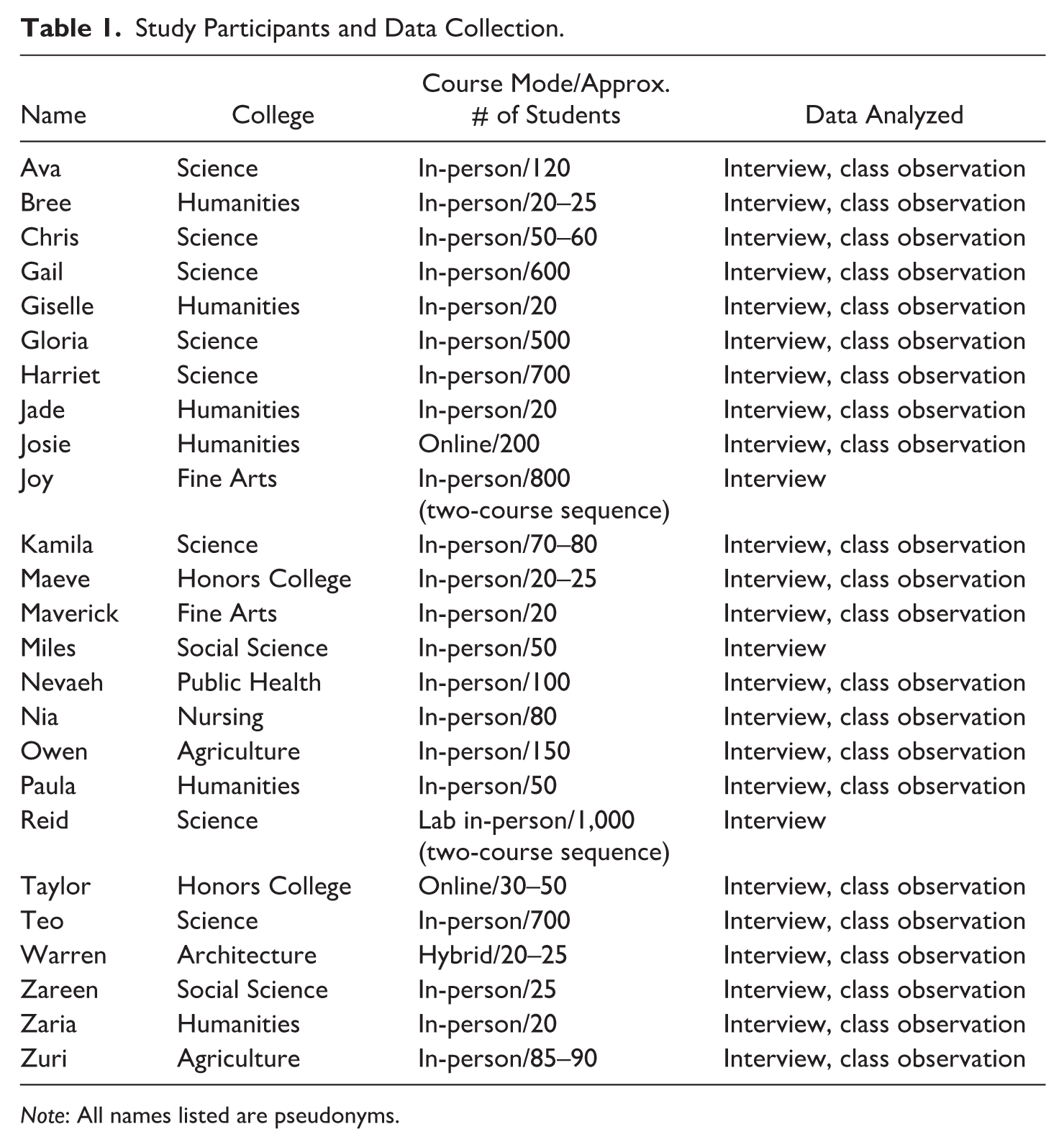
Note: All names listed are pseudonyms.
Data Collection
Five distinct points of data were collected for this study: (1) interviews with faculty participants, (2) pre- and post-Institute survey assessments administered to faculty, (3) end of year surveys, (4) teaching observations, and (5) pre and post syllabus. For the purposes of this manuscript, we draw on individual interviews and course observations for the analysis.
Individual interviews were completed with former Institute faculty participants and lasted approximately one hour. All interviews were conducted over Zoom. Audio files were saved and transcribed. Interviews focused on faculty participants’ redesigned courses, shifts in their teaching practice over time, and their overall experience with participating in the Institute. We also asked faculty to describe how they’ve utilized culturally responsive pedagogies beyond the course they redesigned and how and when they observed students’ reactions and/or examples of success in response to their redesigned elements. For instance, interview questions focused on understanding the course that was the focus of participants’ redesign efforts, their understanding of CRP, as well as their own learning and application, continued collaboration, and gains in student learning and development. We share four examples from the interview protocol below.
Can you tell us a little about the course you worked on while engaged with the Institute? What changes did you make to the course and your teaching after participating in the Institute? How has your understanding or perception of culturally responsive curriculum and frameworks shifted over time? In what other ways have you applied what you’ve learned from the Institute to other areas (e.g., community, caring for students, with colleagues, etc.)? What were your most relevant learning outcomes and gains from the Institute? What gains have you seen from your students?
Faculty participants were also asked if members of the research team could observe the course they redesigned. Two members of the research team attended as nonparticipant observers and paid close attention to specific moments, communication, activities, content, or actions that signaled culturally responsive pedagogy and curriculum. We utilized the university’s teaching center course observation rubric as the starting point for course observations. This choice was intentional because we wanted to align our observation assumptions with the expectations that faculty and instructors have when being observed for annual and promotion review. As noted, we paid closer attention to inclusive and culturally responsive teaching practices. Observation notes were then compared and summarized between the two research team members. The length of each course observation was dependent upon the course itself. In-person courses were scheduled from 50 to 75 minutes, whereas observation in asynchronous courses ranged depending on the number of modules developed and the specific module observed. In total, we observed 22 courses, which is three less than the 25 faculty with whom we conducted interviews. This discrepancy was the result of courses no longer being offered and/or not scheduled during the time of data collection. Observation data helped to triangulate interview data and to observe culturally responsive principles in practice.
Data Analysis
For the interview and observation data, the thematic analysis process followed three rounds of coding, as outlined by Saldaña (2021). Initially, we applied open coding to all data, focusing on how CRP was described and understood by the participants. In this stage, we also employed in vivo coding to extract words and phrases from participants’ language, ensuring faculty voices remained central to the analysis. Open coding resulted in the identification of 93 original distinct codes and subcodes. In the second round, we conducted axial coding, which involved grouping and linking initial codes to identify emergent themes and relationships across participants’ descriptions. This step helped organize the data into more coherent categories and provided a deeper understanding of how faculty conceptualize and implement CRP in their teaching practices. Axial coding established the foundation for connecting individual codes to broader themes and allowed for recategorizing of codes (Saldaña, 2021). The third round involved theoretical coding, which was guided by our conceptual frameworks of CRP and servingness. Here, we applied predefined codes based on CRP principles (e.g., community knowledge, academic success, elements of care) and servingness indicators (e.g., fostering belonging, structural support) informed by our frameworks and literature, while also allowing for emergent themes to arise directly from the data. For instance, indicators of these codes included specific examples of CRP shifts, like updated content; adjustments to assignments, like students co-designing assignments or options for assignments; connections to place-based curriculum; and examples of multiple measures of student learning and understanding of material, among others. This phase emphasized aligning the coded data with the study’s theoretical lens, enabling a more structured interpretation of the findings. One of the main codes informing this manuscript, “community of faculty,” was coded 55 times.
Interpretative analysis (Jones et al., 2013) was integrated throughout the second (axial coding) and third (theoretical coding) rounds as a reflective and iterative process. During axial coding, interpretative analysis allowed us to explore the contextual meaning of relationships between codes, ensuring that the emergent themes captured the depth of participants’ experiences. In the theoretical coding phase, interpretative analysis helped us to critically evaluate how the themes aligned with or extended the CRP and servingness frameworks. This iterative process ensured that the analysis remained both grounded in the data and theoretically robust.
To enhance validity and reduce bias, data were analyzed within MAXQDA software, with each transcript and observation note reviewed by at least two members of the research team. This collaborative approach allowed for both consistent and divergent interpretations, contributing to a more nuanced and credible analysis. Specifically, interview transcripts and observation notes were independently reviewed by multiple members of the research team; this was followed by meetings in which areas of convergence and divergence were identified and discussed. Divergent interpretations were examined in relation to researchers’ backgrounds, institutional roles, and positionalities. This process informed refinement of code definitions and analysis, and strengthened the credibility, rigor, and nuances of the findings (O’Reilly & Kiyimba, 2015).
Trustworthiness
To establish trustworthiness in this research project, a central marker in qualitative research signaling rigor and reflexivity (O’Reilly & Kiyimba, 2015), we assembled a research team of four individuals with diverse disciplinary backgrounds and perspectives on curriculum development and culturally responsive teaching. This multidisciplinary team provided multiple lenses for interpreting the data, enhancing the rigor and depth of the analysis. After each point of data collection, the team engaged in debriefing sessions to reflect on and discuss how the data were being interpreted. These collaborative sessions allowed us to identify potential biases and center transparency in our data collection and analysis processes (O’Reilly & Kiyimba, 2015), and ensure that our analysis remained consistent with the study’s goals and frameworks.
Given our close collaboration with Institute participants during their summer engagement, we developed authentic relationships with faculty members, which strengthened data collection procedures and contributed to trustworthiness in the study’s design. Faculty members were familiar with the project and readily agreed to participate in interviews and course observations. Many expressed enthusiasm for the opportunity to receive feedback after their observations, aiming to further enhance their courses and teaching practices.
By fostering these relationships and maintaining open communication with participants, we ensured that the study design was both rigorous and ethically grounded, building trust and sincerity throughout the research process (O’Reilly & Kiyimba, 2015). Before turning to the findings, we offer more about the positionality of the two authors.
Positionality
Both authors of the manuscript have been involved with the research project since its inception. Below we share reflections from our own reflexive process as we aim to understand our relationships or positionality between ourselves as researchers, the participants, and the aims of the research project (O’Reilly & Kiyimba, 2015).
Author 1 approached this study as a doctoral student and a research associate for the Institute. Over a four-year period, she served on the Institute’s advisory team, contributing to the planning and organization of the program and leading its longitudinal assessment efforts. Because she was not a member of the faculty, she occupied a unique observer position that bridged the space between program design and the classroom’s reality. Her positionality is further shaped by her identity as an Asian woman in academia and an international scholar with an immigrant background. These identities informed her analytic sensitivity to how belonging and cultural knowledge are negotiated within academic spaces. Navigating U.S. higher education as both an “outsider” and an “insider” sharpened her attention to moments where equity-oriented intentions are unevenly interpreted, constrained, or reshaped in practice. This perspective directly shaped her analytic focus on pedagogical translation—whether and how culturally responsive commitments articulated in faculty development settings were enacted in ways that meaningfully reached students.
Author 2 developed the Institute as part of her portfolio of responsibilities while serving in a university-wide faculty affairs role. She worked closely with colleagues within the university’s teaching center to map out an intentional assessment and research plan for the Institute that was implemented from day one. Thus, author 2 has been intentionally and actively collecting data on the Institute while simultaneously leading and overseeing the Institute. She approaches this work in a multifaceted way—as an education professor, she has taught about and engaged culturally responsive and asset-based pedagogies and frameworks her entire career. As a first-generation college student and Latina from a working class background, she has moved through an education system that frequently did not reflect who she is, nor did it reflect her cultural knowledge. Thus, she approached the Institute—both in practice and as a research project—from a lens of lived experience, coupled with deep pedagogical and theoretical knowledge. Although she is no longer serving in a university-wide faculty affairs role, she is committed to this work, not because it is a required element of her job but because she recognizes the profound impact these efforts have on both student and faculty experiences.
Findings
The following section presents three themes that emerged from the data that captured the outcomes and processes of faculty learning: (1) Transformational Faculty Development Experiences, (2) Cultivating Pedagogical Reflexivity, and (3) Building Communal Capacity for Servingness: Connection, Care, and Bridgework. Across themes, we foreground participants’ voices through extended quotations and integrate observational evidence to illustrate how faculty meaning-making translated through pedagogical and institutional practice.
Transformational Faculty Development Experiences
Faculty consistently described the Institute as a space of transformation, a pattern that emerged across interviews with faculty from multiple disciplines. Rather than emphasizing discrete teaching strategies, participants described the Institute as creating space for reflection on values, positionalities, and practice, which in turn reshaped how they approached their work in and beyond the classroom.
Two interconnected threads of transformation emerged across the data: the personal reorientation and the pedagogical change. Personal transformation experiences appeared in how faculty spoke about shifts in mindset, self-awareness, relationships, and professional values, while pedagogical transformation showed up in more tangible changes to classroom practices, including grading policies, syllabus language, flexibility, and instruction. For many faculty, these two forms of growth were inseparable: changes in teaching practice were deeply rooted in shifts in how they understood themselves as educators.
For Gloria, a faculty member from the College of Science, personal transformation occurred through a shift in purpose. Gloria described how the Institute helped her reflect on how much her teaching had been influenced by institutional demands and expectations:
I think that a lot of what I reflect on in my teaching kind of path. . .is that I spent a lot of time doing things for the people above me. And then I stopped caring. I started doing stuff for the people [students] that I am teaching. Because to me, they are the ones that really matter. . . . I would rather have them come out of this course feeling more resilient, more capable, more empowered, than making any administrator happy.
This shift in purpose was accompanied by a structural change in how she managed her preceptors. While other classes in her department use a selective “filtering” process, choosing only the top performing students, Gloria restructured her selection policy to be inclusive and mission-driven:
In terms of who I take, it’s just basically whoever wants to. I know that some people filter and some are very selective with who they take. I take people who want to do it. . .they want that experience of working with me. Again and again. Sometimes they really enjoy kind of paying it forward. They had a great experience with preceptors when they were students, and so they really want to pay it forward to students and help them learn [the subject].
Classroom observations of Gloria’s large-enrollment course showed how such shifts translated into structural practice. In a class of approximately 500 students supported by multiple preceptors, the instructor coordinated closely with her preceptors explicitly to invite student participation, used name tents to personalize interactions, and publicly amplified students’ responses for the whole class.
For Gail, another faculty member in the College of Science teaching content-heavy courses, transformation took the form of a personal reorientation in how she understood her role as a STEM educator. Rather than redefining her disciplinary identity, Gail became more intentional about what she wanted her students to gain from the course beyond content mastery.
What are things that we just want from the students that, you know, we will maybe talk to them more informally, that we can, you know, add and try to be more intentional about sharing with the students. And so I think that’s the biggest change. . . . It’s like, other goals I have for you, you know, that are not content based.
Gail also reflected that this shift challenged long-standing expectations in STEM that faculty must maintain distance and position themselves solely as content experts. Through the Institute, she and her colleagues came to view “student-centeredness” as central to culturally responsive practice.
It was really freeing and liberating when . . . we arrived there on our own. . . . like, oh, we can just, like, be student centered . . . and that doesn’t have to be like, it also feels so, so hard . . . because it’s like, this is not my expertise. [But] elevating student voice . . . that’s really the key part.
This shift was observable in practice through an activity Gail implemented at the start of the semester, in which she intentionally shared her own background and values before inviting students to do the same. Observations further reflected this orientation through intentional pauses for discussion, validation of student contributions, and language emphasizing learning processes over getting perfect scores. In Gail’s case, transformation did not involve altering the core curriculum or assessments, but expanding what it meant to teach science in ways that affirm students as whole people within an HSI context.
For Giselle, a faculty member from the College of Humanities, her transformation was characterized by a shift in systemic awareness and institutional belonging. Although she felt her teaching was already “embedded” in CRP, the Institute provided a framework to connect her class to the broader mission of HSI:
This work helped me realize that teaching at an HSI means recognizing your role in a bigger system, one that can either uplift or undermine our students. The Institute made me want to be part of that transformation, not just do my job and go home.
She further described how the Institute helped her bridge the gap between her specific field and the institutional priorities:
I felt like there was such a disconnect between [my field] and articulating that with culturally responsive pedagogy. . .but finding this community and realizing we’re all working toward the same goal made me feel like the university space was finally mine.
This shift from individual instructional work to participation in broader institutional mission reflects how the Institute supported faculty in situating their teaching within systemic commitments to servingness.
Cultivating Pedagogical Reflexivity
Whereas the previous theme centered on how faculty experienced transformation through participating in the Institute, this theme focuses on pedagogical reflexivity as a core learning process. Participants described how the Institute invited them not just to feel affirmed or inspired, but to critically interrogate their assumptions, question their positionalities, and reexamine what and how they teach.
For Josie, a faculty member from Humanities, the Institute’s session on land as pedagogy,
1
which was led by an Indigenous scholar who shared knowledge rooted in their own communities and relational responsibilities, sparked a deep and uncomfortable reflection on how her personal and family history was entangled with broader systems of power and colonization. Josie shared,
The Institute opened my eyes in some ways very uncomfortably to . . . ways that I was perceiving what constitutes the status quo in my own life as well as in my teaching. The most useful was the land-based pedagogy. That was what changed my perspective so much, and what I have tried to build into all my interactions with other people. My students being some of those people.
Josie’s reflexivity extended to questions about the limits of representation and servingness within curriculum:
How do we help students not feel that we’re dis-including their culture, because there’s only so much you can cover? And the more religions, the more cultures you cover, the more fragmented it becomes, and they can’t really do a deep dive into that. . . . How do we make something that doesn’t mention any Hispanic cultures or religions in the course still be Hispanic serving? How can we be Native American serving if we don’t have that in the course?
This line of questioning illustrates pedagogical reflexivity as an ongoing negotiation rather than a resolved stance, but also a dynamic tension that is marked by attentiveness to the ethical boundaries and possibilities of the HSI classroom.
For Maverick, a faculty member in the College of Fine Arts, pedagogical reflexivity was catalyzed by student critiques that disrupted long-standing disciplinary traditions. The Institute provided the framework for him to move from a defensive stance to a reflexive one, allowing him to recognize his own positionality, especially interrogating how whiteness operated in his curriculum.
It really helped me focus on not what I taught, but how it was received by my students. . .trying to shift my perspective from a white perspective to what does this look like to my students who are not part of the majority populations.
For Maverick, this reflexive shift extended directly into his curriculum. He described how the Institute prompted him to examine the dominance of Eurocentric voices in his courses:
We were doing plays that were mostly written by white authors. . . . I started thinking, we are not doing justice to our students. They are not getting the opportunity to do stories written by people of color, written by queer artists, written by people who look like them.
For Nevaeh from Public Health, pedagogical reflexivity involved recognizing dismantling forms of “linguistic gatekeeping” embedded in assessment practices. During the Institute’s session on inclusive grading, she realized that her previous policies often prioritized compliance over actual understanding. She shared,
I wanted students to think deeply, but I was grading them on how well they conformed to academic writing. I had to rethink what I was really assessing. Was I rewarding understanding or compliance?
Nevaeh’s reflexive insights extended beyond her classroom and informed her administrative role, where she helped initiate a strategic audit of core course syllabi to assess inclusivity and diversity.
In our strategic plan, we are going to work with our committee on inclusion and equity. . .to identify the kind of criteria that we are going to use to sort of audit those core courses to see if they are inclusive and diverse. . .the Institute has helped inform how to do that.
At the same time, participants described how reflexivity developed in the Institute often collided with the disciplinary culture, department norms, and faculty career stage. For example, Teo from the College of Science described the difficulty of maintaining the reflexive stance he developed in the Institute when the disciplinary and department culture can remain a significant barrier.
I think the challenges is that you know in Science, we are taught to be objective. . . . So when I started bringing in these ideas of belonging or cultural validation, I felt like I was speaking a different language than my colleagues. . . . You feel like you are on an island. You have this transformation in the Institute, but then you go back to a department that hasn’t changed at all.
This sense of being “on an island” was echoed by Warren, who felt a persistent nervousness about the work he was trying to do as an early career faculty who just started.
I’m always a little kind of nervous to like, Oh, I hope but what I’m sharing is, like related or it’s useful, or it makes sense that how I’m kind of tying the Institute through the classroom. . . . I don’t know if that’s like, kind of what’s been intended for the program or, you know, just happens to be my own kind of how my brain is processing through things.
Maeve from the College of Humanities further illustrates how the Institute created space for critical self-examination that shaped pedagogical practice. Before participating in the Institute, she operated under the assumption that her courses were naturally inclusive and culturally responsive because she teaches “humanities.” However, she began to realize that that wasn’t the case.
I always really thought of this class as being more like Humanity-centered but building a revised version. . .made me really think about how I actually hadn’t thought about who the students are, and how they enter this class, and what they know or don’t know.
For Maeve, the Institute shifted CRP from something assumed to a practice requiring continual reflection and intentional enactment.
Building Communal Capacity for Servingness: Connection, Care, and Bridgework
For many participants, the most enduring impact of the Institute was not individual transformation alone but participation in a faculty community grounded in shared learning and purposes. The data suggest that a primary outcome of the Institute was the organic development of community of practice (Wenger, 1998). They described the Institute as a rare institutional space where connection and shared purpose were actively cultivated as a community where vulnerability and mutual learning were central. Zuri from College of Agriculture shared,
The community of practice, it was really nice. It’s a very unique space. I think it’s very helpful because you are able to be vulnerable, and you are able to share things that you are working through. And then you get to see that other people are working through them, too.
Participants valued the opportunity to engage as learners themselves, alongside colleagues from their own units. Taylor from Honors College, who participated in the Institute with a team of instructors in her department, reflected:
I think there was like five or six of us [from her college attending the Institute]. And I was just like really excited to like, just have that time together. And to really focus in on some of the things that we felt like we were already doing really well around culturally responsive pedagogy and inclusive design and then also really learn from this outstanding team. . .just like co-create that space together. I just found it to be, honestly, probably one of the most, like, authentic and value-driven experiences.
The Institute also provided affirmation and connection to faculty who were typically isolated in their departments. Gail appreciated the collective environment that allowed for a shared processing of pedagogical challenges with peers:
We were in the same room. . . . So we did it all together, and that helped. We’re still talking about it now. . . . I’ve shifted language and a lot of my prompts, and even if they’re small changes, it’s still pretty impactful. . . . It was just a really great experience in that it was nice that the Institute brought together a community of faculty to share ideas, interests, be in solidarity a little bit. . . . It was like self-care and work at the same time.
Gail’s account shows how communal engagement enabled faculty, particularly in STEM fields, to process pedagogical challenges collectively rather than in isolation.
The Institute also created spaces for belonging for minority faculty who often felt isolated in their home department. Zareen from College of Social Sciences reflected on the emotional weight of being the only Hispanic faculty member in her department and how much it meant to be in community with others who shared similar values: “Knowing there [were] others here and chatting. . . . It’s a social and I am an introvert, but everyone needs social interaction. . . . Connecting with the community was a very good outcome for me.” Similarly, Bree from Humanities described the validation of affirming minoritized communities: “Being in the space of seeing yourself reflected. . .it’s validating. . .what minoritized communities bring and produce matters.” Giselle added, “I’m still in touch with these people. . .those types of connections that for me personally continue to work towards making this space feel like it’s mine. And it didn’t always feel that way.”
Classroom observations of Giselle’s course further showed how this sense of belonging was translated into practice. During one of her classes, a dancer from a local Hispanic community facilitated collective movement exercises designed to help students release physical tension and stress associated with work and academic demands. The instructor participated alongside students, modeling shared engagement rather than instructional distance, and invited students to explore nontraditional, creative forms of expressions connected to their research projects. These practices expanded what counted as knowledge and participation in the classroom, reinforcing servingness as collective, relational, and community-based.
For many faculty, this experience of connection sparked a deeper commitment to sustaining CRP not only in individual classrooms but also across institutional contexts. As Taylor put it:
I need to seek out and learn from practitioners who center this work and do this work in really meaningful ways that center students and their agency. I need to surround myself with a team of faculty that can help me implement the work. And then I need to support a team and grow that work too, while still checking my own biases all the time and recognizing I’m going to mess up, too.
The data showed that faculty acted as bridges, carrying the Institute’s learning back to departments that lacked formal pedagogical training, but also experienced active pushback. Ava identified a persistent institutional gap rooted in the assumption that disciplinary expertise alone equals teaching excellence, a norm she encountered as resistance to CRP within her department. Ava commented:
Just because you have a PhD and you are an expert in your content area doesn’t mean you know anything about pedagogy, and that’s part of the main problem with institutions in general. . .some people don’t care. They’re experts in their area, and that’s enough for them to think that it’s effective.
In response, Ava engaged in informal institutional advocacy, sharing Institute materials during departmental retreats and distributing pedagogical resources to colleagues. Ava shared,
I’ve been recommending it to a lot of folks in my department. And I’ve taken what I’ve learned from the curriculum and given a presentation at our departmental retreat. . . . I’ve prepared a lot of documents to distribute. . .so I don’t know all of the ways in which this curriculum has kind of like moved beyond me and my classes. . . . But I hope that it has kind of done that a little bit.
Together, these accounts reveal that the Institute’s most enduring contribution was not a set of discrete teaching strategies but the cultivation of a faculty community grounded in shared values, mutual accountability, and cross-disciplinary solidarity. Connection, care, and bridgework emerged not as incidental byproducts of the program but as core mechanisms through which faculty internalized and extended servingness beyond their individual classrooms. This communal orientation, which was built through structured time together, vulnerability, and collective purpose, positioned the Institute as a site where servingness became not only a pedagogical commitment but also a relational and institutional practice. It is through this lens that the following discussion examines the broader implications of these findings.
Discussion
This study examines how faculty engaged in a CRP-focused faculty development institute and how that engagement shaped their teaching practices, professional identities, and understandings of servingness at an HSI. Although the Institute was initially designed with the goal of advancing student outcomes, the findings reveal that faculty underwent transformation—both personally and pedagogically—through a deeply communal learning process. Participants consistently characterized the Institute as a relational and humanizing space where they could reflect, reconnect with their purpose, and generate collective momentum for equity-centered change.
Guided by the question, How do faculty participants characterize their experiences as both teachers and learners through their engagement in a CRP-focused Curriculum Design Institute?, this study highlights three central contributions. First, faculty experienced community in nested and overlapping ways. The Institute became a unique space where pedagogical reflection was embedded in caring, authenticity, and vulnerability, all of which were frequently lacking in typical faculty development or departmental cultures. Rather than occurring in isolation, learning was deeply relational. Participants built trust across disciplines, affirmed one another’s values, and shared the emotional and intellectual labor of CRP. For STEM faculty who often work in environments that de-emphasize pedagogy, this collective experience was especially significant.
Second, this sense of community was not a singular outcome but rather an ongoing process embedded within interpersonal relationships, disciplinary dialogues, and broader institutional structures. The Institute provided an opportunity for faculty not only to develop CRP skills but also to model CRP for one another by listening across differences, naming tensions without fear, and co-constructing knowledge. These communal practices reflect the kind of culturally responsive and sustaining pedagogies advocated by Ladson-Billings (1995), Gay (2018), and Paris and Alim (2014, 2017), which emphasize affirmation, connection, and transformation. Finally, these practices also reflect possibilities for communities of practice (Wenger, 1998). As previously shared, these practices are shaped not by the typical neoliberal and individualistic norms of academe but by the “social learning space,” challenging isolated work with collective learning, developing, and ultimately institutional transformation (Wenger-Trayner & Wenger-Trayner, 2020).
In doing so, this study contributes to the CRP literature in higher education by showing that faculty themselves benefit from culturally responsive spaces. Whereas most CRP research focuses on students, this study underscores that faculty, particularly those from minoritized backgrounds or under-resourced disciplines, also need spaces where they feel seen, supported, and sustained. The Institute became such a space, validating what Garcia (2019) and Aguirre (2024) have argued: that CRP is not just a teaching strategy but a cultural and institutional practice that must include faculty well-being and identity development.
A further contribution of this study is the finding that servingness emerged not only as a framework guiding the Institute’s design but also as an outcome for faculty themselves. Although servingness is often associated with student support, this study shows how participating in cross-disciplinary, equity-focused spaces helped faculty internalize servingness as part of their professional identity and responsibility. Faculty embraced servingness as an active, shared commitment to equity, relationship-building, and responsiveness. The Institute contributed to operationalizing servingness by encouraging faculty to examine their own positionalities, confront discomfort, and reimagine their classrooms as sites of care and community. These insights align with Garcia’s (2019, 2023) call for institutions to enact servingness through culturally affirming practices and organizational transformation. What this study adds is that faculty development itself can be a powerful mechanism for advancing servingness—not only for students but also for faculty.
Taken together, these findings contribute to the growing literature that positions HSIs as sites of both promise and complexity (Foulis & Gillen, 2024; Garcia & Okhidoi, 2015). Rather than assuming faculty are simply agents who implement CRP, this study reveals how they come to inhabit it through collective sense-making, care-based engagement, and bridgework across institutional gaps. Faculty participants did not only gain strategies for inclusive teaching; they also developed a deeper sense of belonging, responsibility, and mutual accountability that is central to the practice of servingness.
Implications for Policy: A Note About Political Time and Place
It would be careless of us to offer this study without also acknowledging the current political context and climate around equity-centered efforts. When the Institute was initially developed in 2021, there was positive momentum around the growth of HSIs across the country. The momentum was coupled with ample opportunities for federal funding through the Department of Education’s Title III and Title V efforts, the Department of Agriculture, and the National Science Foundation, among others. At the same time, organizations broadly, including postsecondary institutions, were more visible and vocal about their support of diversity, equity, and inclusion, as well as justice and equity-centered efforts. Following the divisive, vitriolic, and harmful ideology of the second Trump administration, federal funding was stripped from minority-serving institutions and any researcher or initiative engaging in research or programming perceived to be aligned with equity-focused work. This included Title III funding being stripped from the Institute. The drastic shift in federal funding immediately affected how institutions implemented these new restrictions. Many postsecondary institutions followed suit, removing and shifting equity-focused efforts from their institution’s practices and commitment. For some institutions, the changes to equity-focused efforts were because of a mandate, for others they were due to a threat, and for some they were a form of early compliance, all of which resulted in shifts in institutional policy and support. We further explore implications to practice and pedagogy in a section below. The Institute has persisted—not because we drastically shifted the work’s focus but because of a collective commitment across the institution and network of regional HSIs.
Implications for Research
This manuscript represents the first that our research team has shared based on the data collected from faculty who attended the Institute over the last four years. Admittedly, one limitation of research is that we are in the early stages of analyzing the full scope of data (interviews, pre/post assessments, surveys, observations, and syllabi); we expect that in time we will have an even more nuanced understanding of how faculty experienced their (re)design and the changes made to their curriculum and pedagogy through a culturally responsive lens. And yet, a powerful story about forming communities across disciplines, identities, and content has emerged and can help us to shape implications for communities of practice moving forward.
Additionally, we acknowledge that because of disciplinary silos and workload requirements across research, teaching, and service, opportunities for collaboration across disciplines are often challenging or not rewarded. It is beyond the scope of this project to explore the areas of research and service, but future research could examine opportunities for interdisciplinary collaboration across the tripartite of faculty roles. Future research should also include the perspectives of students in the redesigned courses. A limitation of this study is that we focused solely on faculty experience and perspectives. It will be useful moving forward to also track and include student data in the form of student surveys and interview data, as well as standard success metrics like course grades, progression through chosen majors, and retention rates.
As noted above, the Institute has persisted because of its institutional partners and regional network of HSIs, an established collective commitment. Although we are aware of the pragmatic and daily operational connections that bring this network together, we have not yet fully explored how this network of equity-centered scholars has worked across disciplinary silos, policy and budgetary restrictions, losses of grant funding, and organizational changes to ensure the Institute persists. Future research should explore how mid-level organizational collaborations operate as an equity-focused strategy.
Implications for Practice and Pedagogy
We encourage others who work with faculty learning communities or communities of practice to consider the importance of cross-disciplinary spaces when developing faculty professional development opportunities. Likewise, when doing so, we encourage colleagues to take the time needed to establish the reciprocal and relational aspects of the space that allow for community to form. One of the earlier learning moments when leading the Institute came after the pilot program in 2021. Initially, the goal was to include one faculty member from each academic college at the Institution for a smaller pilot group of 20–25 participants. Although we accomplished this goal, we experienced a tension in the implementation and recognized that faculty participants continued to feel isolated in the work, and a sense of community was more intentionally developed when they could work in clusters connected to their department or discipline. We implemented this shift the following year, which not only provided more intentional course design across department curriculum but also offered space for connection and belonging within and across academic units. We encourage others to consider the importance of faculty clusters, not only in hiring practices but also in faculty development efforts.
All too often these efforts occur on top of faculty members’ ongoing workload responsibilities during the academic year. We encourage those leading faculty development efforts to consider dedicating time outside of the academic year so that faculty can participate with focus and without distraction. Because many faculty members will not be on contract, compensating them for this additional time and effort is essential and must be recognized in annual and promotion evaluation reviews. When building these initiatives, we encourage dedicated time for developing the community commitments, expectations, and norms that help facilitate meaningful, reciprocal relationships. In doing so, a space is co-created that invites practice, transparency, and even mistakes when workshopping culturally responsive efforts.
Just as the learning is collective, the expansion of faculty development efforts is also collective. Because the work is interdisciplinary, the development of the efforts must also include partners from across campus and beyond. No one person can be responsible for understanding and sharing how culturally responsive efforts are taught across all disciplines. Thus, the collaborative efforts of the work must begin with those involved with the planning, from recruitment to leadership support to workshop development to assessment. Consider assembling a cross-institutional and cross-disciplinary advisory team that includes faculty, instructional designers, staff, and students. When designing these efforts, do so in collaboration with faculty who are already deeply engaged in this work, because co-creation is central to the development of trust and relationality. Bring in facilitators who offer varied ways of implementing culturally responsive teaching in an effort to reinforce that there is no one way to design this work. Also build in regular check-ins and follow-ups with faculty participants who undoubtedly will have ideas on how faculty development should evolve. Finally, openly and transparently communicate with institutional leaders like deans, directors, and department heads to ensure that faculty development efforts are also meeting the needs of organizational units.
Faculty development efforts do not have to be limited to individual institutions. Given the continued and rapid growth of HSIs across the country, we anticipate there will be more interest in and need for faculty development and curriculum development spaces. We encourage HSIs and other minority-serving institutions to consider working together around institutional consortia and/or institutional types to share resources across colleges and universities. Collective consortia work will be especially important as human and financial resources continue to be limited.
At an individual level, it is clear that faculty participants found that students responded affirmatively not only to shifts in content and curriculum but also to how they, as individuals, shared space with the students. When faculty members brought in their own cultural knowledge, histories, and identities, it cultivated spaces for students to do the same. We encourage other faculty members and instructors to feel confident in doing so because it can be a powerful and inclusive message to students.
We argue that centering servingness as an HSI is not about making it more palatable to institutions or funders, though we fully acknowledge that adjusting terminology around such efforts can help sustain initiatives during the current political climate. Servingness has always been about centering minoritized students’ “ways of knowing and being, with the goal of providing transformative experiences that lead to both academic and nonacademic outcomes” (Garcia, 2019; Garcia & Koren, 2020, p. 2). Yes, servingness practices benefit minoritized students. When implemented well and with intention, they also benefit the entirety of students, faculty, and staff at an institution. Thus, the culturally responsive, servingness work that faculty are engaged in during the Institute is about good teaching practice. It is about an intentional shift away from deficit assumptions about students and a move to creating possibilities of student success from asset-based ideologies and practices.
For this reason, culturally responsive pedagogies and servingness efforts are centrally about student success. These efforts move our institutional goals and imperatives on retention and persistence forward. We encourage institutional leaders to integrate culturally responsive teaching initiatives, and the faculty development connected to it, into department, college, and university strategic goals. It is a practice that every instructor should be engaging in and every institution should be supporting regardless of political administration and climate.
Conclusion
This study significantly contributes to the ongoing conversation about creating and sustaining culturally responsive teaching and learning environments in higher education settings. The findings show that transformation reflects the Institute’s outcome, reflexivity reflects the process of achieving those outcomes, and building communal capacity reflects the practice of nurturing servingness across disciplines and identities. Sustaining CRP is more than individual commitment; it is a communal effort to achieve systemic change, positioning faculty development as a powerful lever for equity-centered transformation in higher education. In today’s political climate of uncertainty and heightened scrutiny around equity and inclusion, this study emphasized the need to create spaces where faculty can engage in culturally responsive, humanizing, and community-oriented practice. Supporting faculty in this way is critical not only for the success of Latinx and other historically minoritized students but also for strengthening the capacity of HSIs to truly live up to their designation and commitment to servingness.
Footnotes
Declaration of Conflicting Interests
The authors declared no potential conflicts of interest with respect to the research, authorship, and/or publication of this article.
Funding
The authors received no financial support for the research, authorship, and/or publication of this article.
