






Abstract
Background:
Technology and the tech industry have gained increasing power in many societies over the past half century. In Israel, like other countries in the Global North, the public education system has experienced a shift toward enterprise culture, with policymakers and educators jointly collaborating in idealizing the Israeli high-tech sector.
Focus of the Study:
In light of the growing dominance of tech ideology in the Israeli education system, the study explores how dominant views of the tech industry may influence teachers’ perceptions of the industry and tech ideology’s role in education. We were particularly interested in exploring how a host of factors, including teachers’ previous professional experience in the tech industry (or lack thereof) and the content area they teach, shape their perspectives on the involvement of the tech industry in Israeli public education.
Research Design:
Our data consists of interviews with 22 Israeli high school teachers. The participants were purposively chosen to include two groups of teachers who differ in their professional experience and background: teachers who joined the profession following substantial experience in the tech industry and teachers who joined the teaching profession early on and evolved solely through its ranks.
Conclusion:
Findings suggest that (1) teachers both admire and resist tech ideology and its impact on schools, and (2) their attitudes toward the tech industry relate to their educational aims, highlighting the significance of tech involvement and its hegemonic impact on the future of teachers and public education. The discussion employs institutional isomorphism to illustrate how the education system might imitate the tech industry, identifying discursive and normative conditions under which institutional educational change may be legitimized or resisted.
Neoliberal reforms have reshaped the teaching profession in many countries in recent decades. While varying by context, these reforms typically include a mixture of policies such as decentralization, scripted curricula, high-stakes testing, accountability, and privatization (Apple, 2004; Cochran-Smith et al., 2018). These policies often align public schools with private sector logics and produce new forms of teacher subjects known as “enterprising subjects” (Ball, 2003b; Rose, 1989).
A shift toward enterprise culture in education and curriculum marks a particular type of neoliberal intervention in education. As technology and science become key to global economic growth, education is increasingly expected to serve national competitiveness (Peters, 2001). Peters (2001) suggests that “enterprise education” in the British public education system fosters the development of an autonomous, self-reliant “entrepreneurial self.” Similarly, teachers in the United States seem to believe that they ought to prepare students for the future labor market by fostering entrepreneurial qualities, starting as early as elementary school (Aronson & Bialostok, 2016). Recent studies have found similar trends in the Israeli education system, as policymakers and educators jointly collaborate in idealizing the Israeli high-tech sector (Alfi-Nissan et al., 2021).
Technology and the “digital sublime” (Mosco, 2004) have gained increasing power in many societies over the past half a century. Over 50 years ago, Cox referred to the “symbolism of technology” as the “meanings technologies have above and beyond their merely technical function” (1971, p. 129, emphasis in original). This symbolism of technology has taken on religious and spiritual dimensions (Geiger, 2020), and in schools, it is reflected in the growing presence of technology products and companies in classroom life. This trend is part of the broader neoliberal push that invites external agents into public education (Slakmon, 2016). The ideological belief in tech as a model for education is evident in platforms like Summit Learning, an online platform developed by Summit Public Schools, a network of charter schools supported by the Zuckerberg Foundation (a foundation created by Mark Zuckerberg, CEO of Meta). The platform offers individualized learning heavily reliant on technology. In the words of Summit Learning’s CEO, “It [Summit Learning] looks more like Google or Facebook than a school” (Singer, 2017), suggesting that the platform offers an educational experience that resembles a technology firm more than a traditional school.
In this study, we explore how Israeli high school teachers perceive the dominance of tech ideology in public education. We are particularly interested in exploring how a host of factors, including but not limited to teachers’ previous professional experience in the tech industry (or lack thereof), the content area they teach, and the type of school they work in, shape their perspectives on the involvement of the tech industry in Israeli public education. We use the framework of institutional isomorphism (DiMaggio & Powell, 1983) to offer an explanation for why teachers might “carry” tech ideology into schools or resist it. Thus, this study does not aim to trace policy formation or institutional change, but rather to examine teachers’ sensemaking and discursive positioning within conditions of tech-sector dominance.
Literature Review
To ground our exploration of Israeli teachers’ perspectives on tech dominance in education, the literature review discusses two main strands of scholarship. First, we look into research on neoliberal reform, the involvement of external agents in education, and the dominance of technology in education globally. Second, we review literature on Israeli education and the Israeli tech industry.
Neoliberal Reform and the Dominance of Technology in Education
The impacts of neoliberalism on teachers and the teaching profession have been well documented in the Global North. Research shows that neoliberal reforms have been reducing teachers’ autonomy and agency, mainly through scripted curricula and high-stakes testing (Dunn, 2018; Jeong & Luschei, 2018; Thompson & Jones, 2021). These reforms appear to leave a mental toll on teachers’ well-being, contributing to stress, despair, and feelings of being ignored and devalued (Ball & Olmedo, 2013; Guerrero-Nieto & Quintero, 2021; Schroeder et al., 2020). Standardization, accountability, and performativity reforms have also harmed collaboration among teachers (Crawford-Garrett et al., 2017; Thompson & Jones, 2021) and student–teacher relationships (Brown, 2017; Dunn, 2018). As marketization and managerialism reforms become prevalent in public education, it becomes more challenging for teachers to resist them (Apple, 2004; Giroux, 2013; Hall & McGinity, 2015; Taylor & Hikida, 2025).
The entry of external actors—and the business sector in particular—into public education represents a distinct form of neoliberal intervention. In many countries, a combination of nonprofit and for-profit organizations now offer and deliver a host of school activities, including but not limited to teaching, teacher training, and curriculum development (Cochran-Smith et al., 2018; Lubienski et al., 2022). In the United States, the business sector’s involvement in schools became prevalent during the 1980s (Feuerstein, 2001). Critical scholars of private sector involvement in education argue that, despite potential benefits, such as access to financial resources, these interactions may have adverse consequences for the education system. Some of these negative implications include a shift toward marketization of education, supporting private interests, and an exacerbation of inequity in public schools (Mickelson, 1999; Rowe, 2025; Sims, 2017).
The involvement of the tech industry in education has its particular characteristics and implications, due to its unique position in society, yielding significant economic, cultural, and symbolic capital. Hendrikse et al. (2022) go so far as stating that big tech companies have “effectively become the sun in the new socio-technical solar system” (p. 60). Indeed, tech companies in the United States have increased their involvement in education not only through “ed-tech” initiatives (educational technologies designed for and sold to schools and other educational settings) but also through educational reforms, curricular design, and pedagogical support (Sims, 2017; Williamson, 2018). Similar trends are found in Israel (Davidson et al., 2024; Tamir & Davidson, 2020; Tamir et al., 2025).
Although the tech industry enjoys significant economic and social prestige, many leading tech companies have been criticized for contributing to the spread of hate and disinformation, and for fostering addictive behaviors, including among children (Karppi & Nieborg, 2021). These risks are magnified with the growing spread and dominance of artificial intelligence (AI) technologies (Bengio et al., 2024).
Absent from this discussion are teachers’ perspectives, overshadowed by the dominance of the tech industry and its increasing involvement in public education. In this context, we consider tech ideology as expressed in the belief that communication technologies from the telegraph onward can solve complex social problems such as economic inequality, ethnic conflict, or mass ignorance when they are deployed in society (Carey, 1992). From the late 1960s, the information technology (IT) industry emerged as a key developer of computational software, hardware, and networks. Its owners and adjacent intellectual boosters believed these technologies could constitute online environments that would supersede traditional forms of social organization such as public democratic politics (Turner, 2006; Turner & Larson, 2015). As digital technology systems took on an infrastructural role (Plantin et al., 2018), their very use as novel infrastructures became a signifier of enlightened modernity echoing past attitudes toward roads or the electricity network (Larkin, 2013). For example, tech ideology is expressed in the belief that the application of IT in the healthcare sector would herald a new era of efficient, privatized, and personalized medical services (Geiger, 2020). Within education, tech ideology manifests through the empirically questionable belief that the technology industry’s labor practices should serve as a model for the education system—positioning them as efficient mechanisms for educational delivery, promoting the idea that schools should prepare students for tech careers and that integrating tech products will inherently improve education.
Israeli Education and the Tech Industry
Known as the “start-up nation,” Israel’s booming high-tech industry now accounts for over half of the country’s exports and offers significant economic rewards, although only to a narrow segment of society (Maggor & Frenkel, 2022). For example, though the ultra-orthodox Jewish and the Arab-Palestinian communities together amount to around a third of the Israeli population, their share of the high-tech workforce amounts to only 4.7%. Women and those living in Israel’s geographic periphery (i.e., rural areas remote from the country’s center) are also underrepresented (Israel Innovation Authority, 2022a). Such patterns of underrepresentation are not unique to the Israeli tech industry; for example, in the United States tech industry, black and Latinx minorities, as well as women, are also underrepresented. This underrepresentation is not the product of formal exclusion by firms but rather stems from systemic inequalities, such as limited representation in top STEM universities, which train many workers, and from reliance on homophilic social networks of existing workers for recruitment (Neely et al., 2023).
Traditionally, the Israeli education system had been a centralized system composed of three streams of public schools (Jewish-secular, Jewish-religious, and Arab-Palestinian schools), which are fully funded by the Israeli Ministry of Education (MOE). 1 Nonetheless, the Israeli education system, like many other education systems in the Global North, has experienced an influx of neoliberal reforms that have invited external agents, including nongovernmental organizations (NGOs) and corporations, into schools (Addi-Raccah, 2006; Yemini et al., 2018). The Dovrat Committee 2 opened the gate for a myriad of neoliberal reforms in the education system, which allowed the entrance of the business sector by supporting the involvement of both nonprofit and for-profit organizations in Israeli schools (Yonah et al., 2008). Among these actors are tech firms, which are now involved through initiatives such as tutoring, mentoring programs, guest lectures, company tours, and support for school leadership (Davidson et al., 2024; Tamir & Davidson, 2020; Tamir et al., 2025). At the same time, Slakmon (2016) illustrated that Israel’s MOE has been implementing various technological initiatives, such as cloud services, digital content and books, and the use of students’ personal devices in school, with barely any criticism publicly voiced by educators. This uncritical adoption reflects what Slakmon terms “technological determinism”—the belief that technology is the driving force of social change. As Slakmon writes, the debate shifts from whether to adopt tech to merely how to do so, while accepting technology in education as inevitable (p. 141).
One possible explanation for the uncritical adoption of technological tools and tech ideology in Israeli schools is that the vision of Zionist tech personnel is deeply entrenched as an ideal within the Israeli education field (Alfi-Nissan et al., 2021). According to Alfi-Nissan and colleagues (2021), the notion of Zionist tech personnel refers to a dominant cultural ideal within Israeli education and policymaking discourse. This ideal promotes a hybrid entrepreneurial subject that is autonomous, initiative-taking, and hardworking on the one hand, while simultaneously embedded in ethnonational collectivist values on the other, emulating the hybridity they believe Israeli tech personnel embody. We use the term here descriptively, to situate teachers’ narratives within a broader national and economic imaginary rather than to endorse a normative political position.
As tech firms continue to gain influence in contemporary society in the Global North, schools and the teaching profession are being reshaped (Selwyn, 2016; Williamson, 2018). Although teachers’ perspectives on implementing technological products in the classroom have been studied extensively, much of this research adopts an instrumental approach, focused on effectiveness and barriers to implementation (e.g., Abel et al., 2022; Dinc, 2019). In contrast, this study aims to explore how teachers perceive the broader social and cultural implications of embracing tech ideology in public schools. In Israel, the growing dominance of tech ideology in education positions the tech industry as a legitimate and even desirable agent of reform, entrusted with advancing, dismantling, and reconstructing educational systems (Slakmon, 2016). Such shifts have contributed elsewhere to a de facto erosion of teachers’ professional status, autonomy, and roles. Russakoff’s (2015) account of education reform in Newark illustrates this dynamic, documenting the aggressive involvement of Mark Zuckerberg and local politicians while educators’ voices were largely ignored or diminished. At the same time, research highlights that teacher quality remains the most significant factor in student learning (including the effective mediation of educational technologies), outcomes, and the development of students’ social-emotional learning (Darling-Hammond, 2000; Schonert-Reichl, 2017). It is therefore critical to examine how teachers perceive the increasing presence and ideological influence of the tech industry and neoliberal reform in schools. Their perspectives are not only underheard but also essential to understanding how educational change is experienced, interpreted, and possibly resisted within the classroom.
Theoretical Framework
To better understand teachers’ perspectives on tech dominance and involvement in public schools, we use the concept of organizational isomorphism. DiMaggio and Powell (1983) considered isomorphism as the homogenizing process of organizational change that results in organizations becoming similar, not necessarily more efficient. They identify three mechanisms of institutional isomorphic change: coercive, mimetic, and normative.
Coercive isomorphism refers to formal and informal pressures by the state or powerful organizations through laws, regulations, or social-cultural expectations. The pressure can manifest as an explicit state mandate, a subtle invitation by a powerful organization to coordinate with another, or through NGOs conditioning support. An example of coercive isomorphism can be found in Amdur and Mero-Jaffe (2017), who illustrate the ways Israeli accountability policies force schools to adopt similar practices. National mandates, such as standardized testing, reporting procedures, and performance standards, impose clear expectations on schools with little room for flexible adaptation. To avoid sanctions or negative consequences, school leaders and teachers often align their practices with state-defined accountability measures, resulting in similarity across schools. Indeed, though not often theorized through the notion of coercive isomorphism, accountability policies have been reshaping school systems and teachers’ work in other countries of the Global North, including the United States (e.g., Apple, 2004; Cochran-Smith et al., 2018), Australia, and the United Kingdom (e.g., Mayer & Mills, 2021).
Mimetic isomorphism concerns organizational imitation at times of uncertainty. Organizations often imitate those seen as legitimate and less risky, because it’s easier, cheaper, and reputationally safer than developing new practices amid uncertainty. This imitation can occur through employee transfer or with help from mediating organizations, like consulting firms. For example, Lewis et al. (2023) illustrate mimetic isomorphism through the rise of new leadership positions across school districts in the United States, particularly the rise of the chief equity officer. They show that many districts adopted this role by modeling it on the chief diversity officer position in higher education, reflecting field-level pressures to resemble organizations that are considered more successful. The expansion of roles such as chief academic officer also reflects a broader shift toward corporate-like leadership structures in K–12 systems. Although the role of chief diversity officer was created as part of districts’ efforts to resist racism and racial inequities, the researchers suggest that those roles can become largely symbolic as they are standardized across districts.
Lastly, normative isomorphism focuses on professions as sources of organizational homogeneity. In their struggle “to define the conditions and methods of their work” (DiMaggio & Powell, 1983, p. 152), professionals and professional organizations socialize workers through formal education, professional training, and professional networks, which set rules for professional behavior. An example of normative isomorphism in the educational context appears in Puttick’s (2017) study of secondary school geography departments in England, illustrating how teachers across different schools often adopt similar practices, routines, and departmental structures because of shared professional norms.
Whereas mimetic and normative isomorphism help explain the internal processes occurring within a field, coercive isomorphism refers to the environment surrounding the analyzed field, as external pressures—such as regulation, accreditation, and scrutiny—are forced upon the organizational field (DiMaggio & Powell, 1983; Frumkin & Galaskiewicz, 2004). At this study focuses on teachers’ perspectives as internal actors in the field, we focus on mimetic and normative isomorphism.
DiMaggio and Powell (1983) hypothesize several predictors of isomorphic organizational change, including the dependence one organization has on another, uncertainty driving imitation of more successful organizations, and the influence of professional networks and training. These predictors may explain how and why the education system might be influenced and reshaped, and perhaps imitate the technology industry.
Although the literature does not offer much discussion on teachers as carriers of or resisters to tech ideology specifically, there is ample scholarship that views teachers as social agents who support and endorse middle-class ideology and values, as well as the interests of elite and business groups (e.g., Apple, 1978, 2012; Giroux, 1980). This research body illustrates how schools are often mechanisms of social and cultural reproduction (Ball, 2003a). On the other hand, both teachers and teacher educators have long promoted and studied the potential power of teachers as agents of social change and justice (e.g., Bourn, 2016; Smylie et al., 1999). We use institutional isomorphism as a lens through which we examine whether teachers carry, adopt, or resist (intentionally or unintentionally) tech values and ideologies.
Government agencies are often seen as key drivers of institutionalism and coercive isomorphism; however, Frumkin and Galaskiewicz (2004) argue that they are also susceptible to the same institutional pressures, including mimetic and normative isomorphism. By exploring the ways in which teachers perceive tech ideology and how these positions might be informed by their professional background, this paper explores whether and how the Israeli public education system is susceptible to the force that the tech industry imposes on society. Specifically, we address the following research questions:
How do teachers perceive the dominance and impact of the tech industry in society?
How do teachers perceive the tech industry’s involvement in the public education system?
How are teachers’ stances toward the tech industry shaped by their previous professional backgrounds?
Exploring teachers’ perceptions of tech dominance and its involvement in the Israeli public education system can illuminate the significance and implications of such involvement on the ground, through teachers’ experiential knowledge.
Methods
This qualitative exploratory study looks into how dominant views of the tech industry may influence teachers’ perceptions of its role in education. Our data contains interviews with 22 high school teachers in the Israeli public education system. We designed a purposeful sample that includes two groups of teachers who differ in their professional background: 12 interviewees are teachers who joined the profession following substantial experience in the tech industry, and 10 joined the teaching profession early on and evolved solely through its ranks. Additionally, a third of our interviewees altogether (seven teachers) have had experience as teachers working with volunteers from the tech industry in their schools.
Participants
All participants work in Israeli public high schools in either Jewish-secular, Jewish-religious, or Arab-Palestinian schools, and include teachers with and without prior tech industry experience (see Table 1 for a full description of the interviewees). The participants vary demographically: 13 interviewees (59%) were men compared to 9 (41%) women. Although most of the teachers in Israel are women (82%) (Israeli Knesset, 2020), our dataset oversampled men due to our interest in teachers with previous occupational experience in the tech industry, which is characterized by a high percentage (67%) of male employees (Israel Innovation Authority, 2022b). Conversely, among the teachers who have solely worked in teaching throughout their careers, 7 out of the 10 are women. Teachers’ experience ranges from 1 to 34 years of teaching.
Description of Participants.
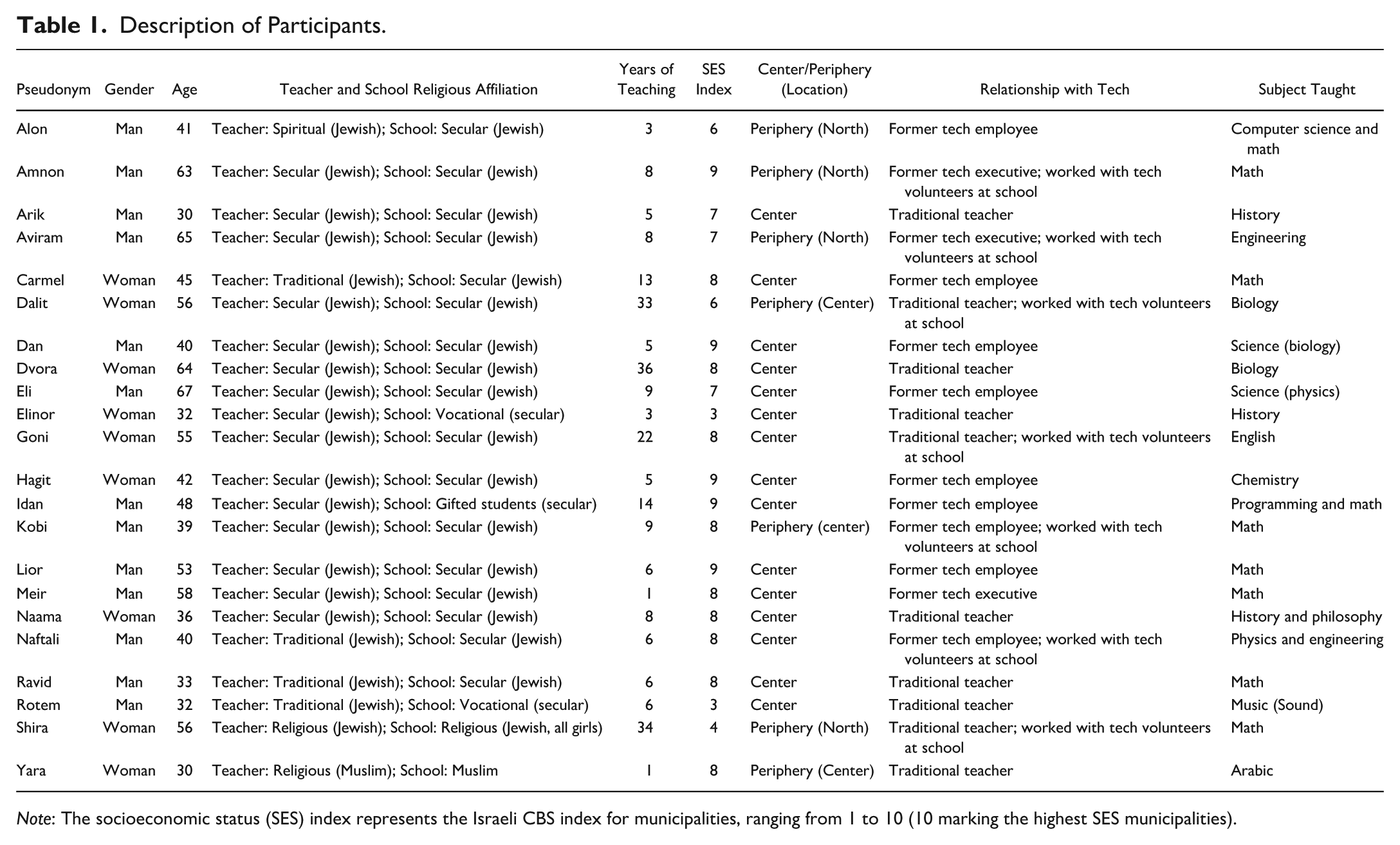
Note: The socioeconomic status (SES) index represents the Israeli CBS index for municipalities, ranging from 1 to 10 (10 marking the highest SES municipalities).
Most teachers (14) teach in schools located in Israel’s sociogeographic center—urban areas predominantly populated by the middle-class—while 8 teach in the periphery, which includes mostly rural and remote regions with lower socioeconomic status. Additionally, a school’s sociogeographic location may also be associated with differences in technological infrastructure and connectivity. Previous research has documented a disparities in infrastructure, as well as access to and implementation of information and communication technologies, between the Jewish and Arab-Palestinian population in Israel, which is also reflected in a gap between Jewish and Arab-Palestinian schools (Masry-Herzallah & Stavissky, 2021; Nachmias et al., 2010). The schools the interviewees teach in span socioeconomic deciles, though most are in higher-ranked municipalities (according to the Israeli Central Bureau of Statistics [CBS] index for municipalities). Because the tech industry is primarily concentrated in wealthier central areas (Israel Innovation Authority, 2022a), it is plausible that schools located in Israel’s periphery will have less access to such companies or employees.
Twenty teachers teach in Jewish-secular schools, including vocational and gifted schools, and two work in Arab and Jewish-religious schools. 3 The oversampling of teachers working in Jewish-secular schools likely resulted from limitations of our sampling approach, which relied on social media recruitment, our professional networks, and snowball sampling. Thus, although the data captures diverse experiences of teachers in Jewish-secular schools located in Israel’s sociogeographic center, the findings disproportionately reflect the experiences of the country’s largest demographic group—secular Jewish teachers. Future research should adopt more intentional recruitment strategies across school sectors to ensure that the perspectives and experiences of teachers in Jewish-religious and Arab-Palestinian school contexts are more fully represented.
Data Collection
Interviews were carried out in 2022. Teachers were initially recruited over the internet, through online teacher forums on Facebook and WhatsApp, and then through snowball sampling. All interviews were conducted in Hebrew online via video conference and lasted 60–90 minutes each. They were transcribed verbatim and analyzed using Dedoose, a qualitative data analysis software. Excerpts from the interviews were translated into English by the research team. The semi-structured interviews (Adams, 2015) were developed and informed by prior scholarship on the involvement of external agents, and specifically the private sector, in education. The interview questions focused on teachers’ professional experience, their experiences of and perspectives on working with tech volunteering programs, and their perspectives on the impacts of tech involvement on schools and broader society (see Appendix A for the interview protocol).
Data Analysis
The first stage of data analysis began with initial in vivo coding (Charmaz, 2014). As a research team, we independently read the same four transcripts and then met to discuss potential codes and areas of convergence and divergence. In the second stage, we adopted Jackson and Mazzei’s (2013) “plugging in” approach, which encourages researchers to iteratively “plug” theory into the data analysis and data into theory interpretation. The research team met regularly to discuss the initial in vivo codes, consider emerging themes, and explore how theory, specifically institutional isomorphism, could illuminate patterns in the texts. At the same time, we remained attentive to theories that appeared to fit the data through these emerging themes (Jackson & Mazzei, 2013). For example, during the initial coding stage, we generated codes such as “resilience,” “excellence,” and “entrepreneurship and innovation.” When thinking with theory, these codes were grouped to explore broader individualistic and neoliberal educational aims. This analytic process facilitated the refinement of our research questions, the finalization of the codebook upon agreement, and the identification of the primary themes evident across the interviews. The primary themes included educational aims (e.g., individualistic aims, social aims), teachers’ stances toward tech industry involvement (e.g., enthusiastic support, harmful to school mission, reflects arrogance/contempt), teachers’ perspectives toward the tech industry (e.g., catalyst of inequality, high cultural capital, valuable organizational culture, high symbolic capital), and reasoning for the tech industry’s entrance into schools (e.g., teachers’ relatively weak status, exposure to the outside world, teacher shortage).
Findings
Teachers presented varied approaches to the dominance of tech ideology in public schools and society. Two key themes emerged: (1) teachers’ stances toward tech ideology, and (2) the relationship between teachers’ stances and how they define their aims for education. These themes illuminate the teachers’ perceptions of the tech industry’s role in Israeli society and schools, and how educators’ perceptions of the industry may interact with their previous working experience and social/ideological values. These themes also align with the theoretical discussion of teachers as carriers of or resisters to tech ideology. We noticed that teachers’ relative acceptance of tech ideology was linked to their view of tech’s societal status as well as their personal educational values. Importantly, these perspectives are not strictly binary; rather, they span a continuum from acceptance to rejection. The findings further suggest that teachers with prior tech industry experience were generally more receptive to tech ideology, whereas those without such experience exhibited more varied attitudes.
Teachers’ Stances Toward Tech Ideology
Teachers’ responses ranged along a spectrum—from strong admiration of tech’s societal role to critical questioning of its dominance. Figure 1 provides a visual overview of this analytic spectrum, which serves as an interpretive guide for the findings that follow.
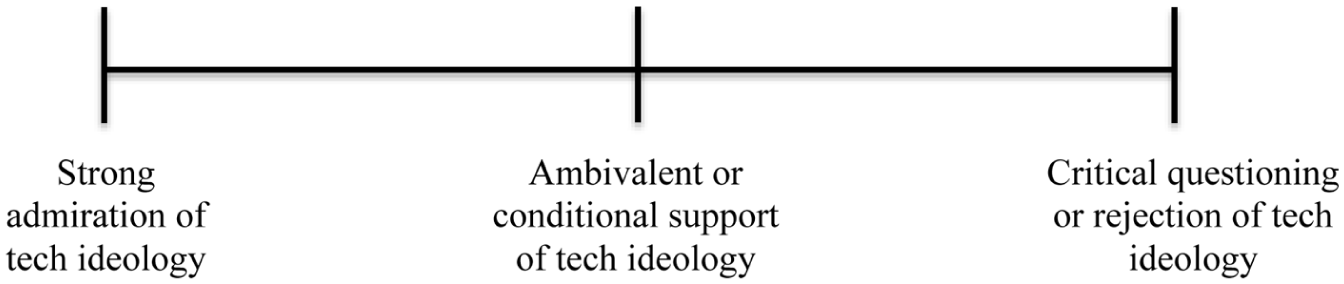
Teachers’ Stances Toward Tech Ideology: A Spectrum from Admiration to Critical Questioning.
We interpreted teachers’ accounts along the spectrum according to how they framed the tech industry’s societal role, ranging from strong admiration of its moral, economic, and national contributions, through ambivalent or conditional support, to critical questioning and rejection of its social, ethical, and political implications. As suggested earlier, teachers’ positioning reflects dominant orientations in the interviews rather than fixed dispositions.
Admiring Tech Ideology
Interviewees’ acceptance of tech ideology was evident in the significant symbolic, economic, and cultural power attributed to the industry, its employees, and its products. For instance, Alon, who transitioned from tech to education and teaches computer science and math, described the many roles the tech industry assumes in Israeli society:
One role is to represent the country in this amazing thing—all the time, people talk about the Israeli brain, etc. Once, it was more academia, today it’s high tech. It has enormous income . . . from taxes. And they [tech employees] are a type of inspiration.
Dalit, a veteran biology teacher, explained how she emphasizes to her students the tech industry’s significance in Israeli society: “These guys [tech employees] do great things for the benefit of humankind, literally up to the level of saving lives.. . . These people make our lives better—even to the level of saving souls.” Similarly, Dan, a science teacher with professional experience in tech, noted:
These industries [tech] are not just the Israeli engine of growth; they’re the growth engine of the world.. . . Our ability to advance human knowledge—to discover new things—that’s technology, that’s our society, traveling to space, a cure for cancer—all these are high tech.
These teachers’ narratives reflect civic republican values by framing the tech industry as a unifying force that contributes to the common good and national identity. Alon’s narration, in particular, resonates with Israel’s self-perception as a knowledge-based society in which technological innovation represents collective national achievement. Similarly, Dalit and Dan’s emphasis on life-saving technologies and scientific advancement positions the tech industry as a morally valued public actor. Notably, these narrations foreground the industry’s societal and humanitarian contributions, sometimes in mystic terms, while giving limited attention to broader social, political, or economic tensions associated with the tech sector.
Rotem, a music teacher at a vocational high school, stated that high tech has “A very significant role in the development of things. Tech companies can advance society. Whether it is by reducing [socioeconomic] gaps and whether it is by being leaders of public opinion . . . making our lives easier.” Rotem attributed to the tech industry not only the legitimacy to influence public opinion but also the civic responsibility and ability to reduce social disparities. Shira, a math teacher at a Jewish-religious school for girls in Israel’s periphery, spoke about the value of the tech industry in society with great passion:
[Tech is responsible for] most of the income tax that goes into the state—a big economic role. They have a role in the emotional and mental resilience of Israelis. That’s a huge [source of] pride. Even aside from economics, it’s a spiritual resource, it’s a big flame, force, and security. Many good things. And I haven’t talked about the products themselves, which is something that contributes to humanity as a whole.
Teachers’ responses represent a wide range of understandings of what constitutes high tech (including medical, biological, and pharma industries), as well as diverse ways of valuing the sector. Many of the interviewed teachers demonstrated a sophisticated awareness of the industry’s infrastructural role in society (Plantin et al., 2018). At the same time, their accounts tended to emphasize the benefits and importance of technological innovation, while paying less attention to questions of power, governance, and accountability associated with the growing influence of larger private technology firms and the role the public has played in funding the industry (Maggor & Frenkel, 2022).
Aviram, a former CEO of a multinational tech company, expressed strong support for the sublime contributions to students when they are exposed to the industry’s workplace and when students interact with tech industry volunteers:
The very fact that students walk around [name of a security tech company], and they see that in this company, people speak quietly in the hallways, because, you know, in school—it’s hell! . . . and one must clean up after himself if he spills coffee on the counter. You know—the added value. It is not solely the working hours [with the students]. For the children, the contribution is beyond enormous.. . . It opens them up to a different world. Suddenly, there is coffee. The toilets are clean!
In this detailed narration, Aviram revealed his support of tech interventions in schools and admiration of the status-laden norms and culture that the tech industry carries with it in society—an “added value,” in his words, that could and should be passed on to students. Although this account highlights Aviram’s criticism of public schools as insufficiently clean and well-maintained, at a deeper level it reflects a broader and common critique of public sector institutions as inefficient, corrupt, and archaic, whether or not such claims accurately reflect schools’ actual conditions. Aviram was even more up front later in the interview as he said, “Tech companies and tech personnel, they bring. . . You know what, let’s call it by its name: there is a sense of exaltation to it.” Teachers’ narrations highlight the high status attached to the tech industry in terms of its social, economic, cultural, civic, and even spiritual responsibility.
Questioning Tech Ideology
Other teachers expressed concern about the social and ethical impact of the tech industry. Kobi, who teaches math and has professional experience in tech, assigned several negative contributions to the tech industry, including harmful products and social inequality:
It is very paradoxical. On the one hand, it [tech] pushes the economy, OK. I understand that from a national perspective, industry is a good thing and it is blessed. But there are dark sides to this industry that we don’t like to discuss. There is bad technology that we don’t want to be developed, but it makes the economy grow, so we’re fine with it. I don’t want to disregard the fact that there are good things that the industry and technology bring. But . . . there’s a very big gap here. I mean, there’s a sort of world that really has a lot of money, and it shrinks the worlds next to it.
Kobi’s paradoxical stance aligns with a broader neoliberal logic in which economic imperatives are prioritized, even when they produce clear social harms, overshadowing ethical considerations.
Questioning the digital sublime, Naama, a history and philosophy teacher with no tech experience, noted, like Kobi, “I don’t think that all technological advancement promotes society; sometimes it actually harms it.” Elinor, a history teacher at a vocational high school, also addressed the damaging aspects of products developed by the industry:
There are tech companies that promote bad things in the world.. . . The question is whether technology is in the service of society.. . . If it [the product] has something to do with weapons and war, I am not sure that they [tech employees] have any reason to come and speak with my students.
Most of the interviewees who tended to support tech ideology did not address the types of products tech companies manufacture, and they frequently discussed the tech industry as a single positive bundle. In contrast, teachers who embraced a position of questioning tech ideology challenged the notion that all technology is inherently good.
Furthermore, Naama questioned the broader status value that is attributed to the industry and tech employees:
I’ve met people who say “high tech” because they work in a tech company that develops some technological product, and they work the entire day in front of a computer, but eventually, they find the right moments to plant commercials in a video game for children. It’s outrageous. . .. Once, being a “salesman” [said in English] was considered morally questionable, and today, under the cover of technology, it is no longer considered morally questionable—being a salesman, targeting children. Everything is painted under the colors of technology and programming. So, it became an object of admiration, and I think teenagers are unable to see past the ethos they [tech personnel] produce.
In this narration, Naama argued that using its symbolic power, the tech industry “washes” its negative implications while changing social perceptions around hierarchies in the labor market and regarding the products it develops.
As teachers practice “critical vigilance” (see Anderson & Cohen, 2015), questioning tech ideology can be seen as a form of resistance to the digital sublime—challenging the dominant discourse that unquestioningly celebrates tech’s role in society. This stance contrasts with that of other teachers who attributed economic, cultural, and symbolic might to the tech industry, accepting it as an entirely positive package and promoting tech values and ideology. We found that more often, teachers who come from a technological background tended to carry with them perceptions that supported and idolized tech ideology, compared to teachers with no tech experience. Moreover, it appears that expressions of resistance to tech ideology were more common among teachers who teach social science and humanities subjects than STEM subjects. This may not be surprising, because tech ideology and neoliberalism often prioritize STEM subjects over the humanities. Importantly, all the teachers we interviewed who transitioned from the tech industry into teaching now teach STEM subjects, creating some overlap between supporters of tech ideology with prior tech experience and those teaching STEM (see Table 1). However, even teachers without professional tech experience who teach STEM subjects tended to be more supportive of tech ideology. In contrast, more critical perspectives were voiced by teachers of social studies and the humanities—disciplines that traditionally emphasize critical approaches.
Although mostly expressing support for tech ideology and its involvement in the Israeli education system, Aviram voiced a more balanced opinion in a later part of the interview:
This really burns in my bones—the tech industry must not dictate, not slightly, to the education system—it’s forbidden! Forbidden! The tech industry should come out of goodwill to volunteer.. . . If the high tech comes to the education system and says: “Look, guys, we think you’re in trouble, we’ll help you. We have the knowledge to build a strategy for a product, strategy for a company, strategy for an organization—we know, we’ve done it”—that’s fine. But if they [tech] come as if they are the owner of the century and dictate their opinion—that’s awful—because they don’t know how to be educators. So “oh my god” if they come and dictate! But if they come and consult in terms of processes and organization-wise [that’s OK].
In this more nuanced statement, Aviram seeks to draw a clear distinction between tech interventions he considers appropriate for the education system and those he deems unwelcome. However, this statement underscores the value Aviram attributes to the tech industry’s organizational culture, perceiving it as a model for schools and suggesting that the industry could contribute to the education system by consulting on organizational and strategic issues despite not being familiar with education nor with practices of professional consultation. Similarly, Hagit, a chemistry teacher with prior experience in the health-tech sector, noted that the tech industry “should be involved but not intervene,” a view echoed also by Amnon. In these cases, the teachers described the tech industry as a powerful player that can and should benefit the education system through organizational guidance and involvement, but they also called for some undefined restrictions. These accounts reveal teachers’ complex and ambivalent perspectives on tech ideology.
Although these teachers seem to value tech’s contributions, their concern about the industry dictating educational practices underscores tension between educational autonomy and the instrumentalization of schools for economic purposes. This ambivalence suggests a broader ideological struggle—whether schools should prioritize critical civic engagement or function as training pipelines for an industry whose values may not align with public education’s broader social mission. This will be further discussed in the following theme.
The Relationship Between Teachers’ Stances and How They Define Their Aims for Education
Teachers’ stances toward tech ideology often aligned with how they defined the purpose of education, whether primarily in individualistic and neoliberal terms or as serving broader social and civic missions.
Individualistic and Neoliberal Educational Aims
Teachers who embraced tech ideology frequently described education as a means of preparing students for future participation in the labor market, emphasizing skills such as teamwork, resilience, innovation, and entrepreneurship. For teachers with professional experience in the tech industry, these aims were often reflected not only in discourse but also in the design of classroom activities that were aligned with organizational practices common in tech workplaces.
Lior, a math teacher with previous experience in tech, emphasized the soft skills he intentionally cultivates in his classroom, which he describes as directly informed by his industry background: “Brainstorming: that you work in teams.” Lior framed collaborative work not simply as a pedagogical strategy but as preparation for professional norms associated with tech workplaces. Similarly, Naftali, a physics and engineering teacher with experience in both military and private-sector tech, described a project-based learning assignment modeled on industry project management practices: “They [students] work with a Gantt chart and plan their projects. They work on a budget. Although it doesn’t really cost them money, we price it for them in pretend.. . . They carry out risk and alternative analyses.” In this case, students are asked to engage with tools (e.g., Gantt charts, budgeting, risk analysis) and modes of thinking that closely resemble those used in corporate and start-up environments. Naftali further framed the tech industry as an occupational summit for students, embodying excellence, innovation, and progress. Together, these practices reflect an orientation toward entrepreneurship and market-based rationalities, alongside disciplinary content. Meir, a math teacher who has vast experience in the tech industry in high-ranking positions, also envisioned a similar program and said he wanted to “really do [with the students] a small ‘business’ [said in English] and economic analysis of different sorts.. . . A bit of Excel work. And make it real—I mean the realest in the world.” These remarks reveal how industry-derived practices and values are translated into pedagogical goals.
Indeed, it was common among carriers of tech ideology (whether they have experience in tech or not) who supported tech intervention in education to endorse neoliberal values and discourse. For instance, Aviram said: “The only customers of the education system are the pupils and the parents.” Using an economic and neoliberal discourse, according to which the education system and students are economic actors competing in a market, is a manifestation of Aviram’s endorsement of capitalist and neoliberal values.
Although without former experience in tech, Dalit encouraged her students to adopt an individualistic approach that views the labor market as highly competitive:
I see my role as mainly focused on values: to teach students that there are very important values in this world and that it’s very important to contribute to society and do things for others. And I keep telling them that one day, when they get a job interview for a company they want to work for, together with them, there will be 20 more [candidates], at best, that are just as good. So finally, what can help them get that job compared to others, are those things that they can say that they did more than be excelling students.
Despite referring to her role as an educator for social values, it seems that Dalit views such social values as instrumental for students to earn leverage in future competition in the labor market.
Likewise, Dan explicitly said: “In my opinion, I prepare them [students] to understand what is required of them in high tech . . . make them understand that a subject that can be very very boring might be super important and worth a lot a lot of money.” In pegging a subject to its market value, Dan was employing a neoliberal frame to emphasize that his role as an educator was to prepare his students for a career in tech. Alon further stated: “Even when I teach in the classroom, I feel as if I am preparing them for the day after—for life, working in high tech, for the market, let’s call it.” Many other teachers with professional backgrounds in the tech industry and supporters of tech ideology broadly stated that equipping students with valuable soft skills is among their main educational aims, as well as preparing students for white-collar jobs in the labor market. Those teachers noted these two intertwined educational aims—teaching soft skills and preparing for the labor market—as among the main rationales for interacting with tech companies. Teachers with professional backgrounds in tech also argued for the added value they have as teachers, because they can connect the theoretical content they teach to the “real world.”
Across these accounts, teachers’ self-reported practices and framing suggest that, for some teachers, the tech industry functions as an implicit reference point for what counts as a successful organization, important knowledge, and desirable futures. This reflects selective translation of tech-associated practices (e.g., project management tools and market-oriented language) into education. Through these self-reported practices and stances, individualistic and neoliberal aims, including preparation for the labor market and teaching soft skills, become embedded in everyday classroom activity.
Social Educational Aims
In contrast, teachers who resisted tech ideology emphasized social justice, diversity, and community building as key educational goals, viewing their educational mission as part of a broader social commitment.
Eli, a science teacher with tech experience, criticized the Israeli education system for failing to offer equal opportunities to all students: “The education system hasn’t been able to offer equity in the periphery . . . these claims should be directed at the education system for allowing such gaps to develop.” Later, Eli asked:
What is the role of an education system emphasizing physics, math, and English? Is the role of the education system to foster a generation of people with a wide range of wishes, hobbies, desires, and abilities or to raise employees for high tech?
Eli’s vision of education as fostering diverse desires and abilities contrasts sharply with the instrumentalist view of education as merely a feeder to industry, highlighting a commitment to democratic values over individualistic and economic imperatives.
Naama also expressed resistance to tech ideology through her support of social commitment, social justice, and humanistic values in education:
Education should resist capitalism, resist consumerism culture, resist rape culture, speak about consumerism and its harms, especially in wealthy communities. And I think that’s one of the most important goals, at least for me, to criticize this, show kids these damages.. . . This is quickly translated into humanistic education.
In this powerful statement, Naama places capitalism alongside other exploitative phenomena she regards as deeply damaging and positions education as an important social site that must actively resist exploitation. Although she does not explicitly theorize the relationship between capitalism and sexual violence, her remarks can be read as expressing a broader ethical critique of social systems that normalize harm and inequality. Read analytically, this critique resonates with perspectives that understand capitalism as entangled with forms of structural violence, without this framework being articulated directly by Naama herself. Similarly, Kobi critically rejected the prevailing view of education as a means to support the industry’s needs.
Several teachers expressed resistance by rejecting the idea that the education system’s role and destiny are to serve the industry. Eli’s comment is illustrative: “I realize that high tech, how do you say? Is the economic locomotive. But I don’t think that it is the education system’s role to produce wheels for the locomotive.” Goni, an English teacher with 22 years of experience, expanded on this perspective while tying her rejection of tech ideology with greater resistance to capitalist values:
If you allow the entrance of too many practical aspects, capitalist if you wish, to school, you also make it some kind of a boot camp toward, you know.. . . So, when you think of greater involvement of the private sector in the public system, you also insert the private sector’s values of gaining profits as a superior value. I mean, what’s more important—to learn a poem by Leah Goldberg
4
or to study programming with C++? I don’t know. That’s a valid question.
Similarly, Shira, a math teacher, feared that the massive entrance of tech companies and tech ideology into schools would “put an end to the humanities.” She stated that focusing “on what brings financial benefits to the country, and less focus on the humanities, is quite a problem.” These remarks reveal some teachers’ rejection of and resistance to tech ideology and reflect a commitment to a civic vision of education that prioritizes critical thinking, social equity, and cultural values over market-driven goals. At the same time, such interpretations also reveal a dichotomous view of what is valued in education, rather than a nuanced approach that affords equal importance to both the humanities and STEM or technology-related subjects.
Teachers’ social commitment was often manifested in their support for diversity and inclusivity. Many women teachers highlighted the low representation of women in the tech industry. Shira raised a question regarding the current level of inclusivity in the tech industry as related to the demographic profile of students attending her school: “We are girls and peripheral and religious.” Dvora and Elinor (who have not worked in tech), as well as Hagit, Carmel, and Kobi (who have worked in tech), also spoke about the need to socially diversify the tech industry.
Yara, a Muslim teacher who teaches in a school serving Arab-Muslim students, expanded on the topic, discussing the need for role models from the Arab-Palestinian community. She questioned the relevance tech involvement plans might have for students in her school:
I have no idea if they [students] have the mindset for something like that [tech involvement]. They don’t have the mindset at all. They have so many issues on their mind and so much mess at home. So, they come to class, and they’re not really there.
Yara explained that there is a greater chance that models from the community could connect with students and mentor them toward economic prosperity. 5 Yara later questioned the capability of tech employees, mainly Jewish White men, to fully understand and accept Arab-Palestinian women in the industry, not to mention her Arab-Palestinian students. This absence of relatable role models within the tech industry challenges its capacity to serve as a universal symbol of opportunity and equity.
Connecting her social commitment and adherence to diversity and inclusivity values, Elinor, echoing Yara’s statement, said: “It matters what the company develops or who its employees are. I assume that a company in which all its employees are White men has a certain organizational culture.” Here, Elinor explained that she is less interested in interacting with tech companies that employ mainly members from Israel’s hegemonic social groups because they do not represent wider society. Elinor insinuated that such companies are less able to connect with and have a positive impact on the students at the vocational school where she teaches.
Teachers’ insights about inclusivity and the demographic composition of the tech workforce appear as a critique of tech’s inability to address broader social inequalities, which challenges its symbolic might. At the same time, these teachers seem committed to resisting such structural barriers to inclusion and promoting social educational aims and values.
Discussion
Building on teachers’ experiential knowledge, we argue that their perceptions, shaped by their professional backgrounds, are deeply rooted in and reflective of the economic, cultural, and political power structures that characterize Israeli society, where the tech industry holds a prominent position. Teachers’ expressions reveal stances of both admiration and resistance to tech ideology and its societal role, shaping their educational aims and informing their views on tech’s role in public schools.
Rather than treating teachers’ attitudes as causal drivers of system-level change, we understand them as sites where hegemonic logics are normalized, negotiated, or resisted. We use the terms “carriers” and “resisters” of tech ideology to explain why some teachers have internalized tech’s ideology while others have adopted a more critical stance that challenges tech-driven efforts to reshape the education system and align it increasingly with corporate values and practices. This distinction helps conceptualize how isomorphic pressures can be perceived and practiced in diverse ways in the same institutional field, challenging a more deterministic view of institutional isomorphism. Carriers of tech ideology align with the trend of implementing neoliberal educational policies across the Global North, mimicking the private sector. As Apple (2006, p. 23) noted, “For all too much of current government policies in many nations, what is public is bad and what is private is good.” The dominance of tech ideology in the Israeli education system exemplifies this tendency.
The concept of institutional isomorphism (DiMaggio & Powell, 1983) is useful in understanding how, why, and when the education system imitates the tech industry, adopting its values and culture. We focus on mimetic and normative isomorphism based on teachers’ narratives because coercive isomorphism involves external pressures less relevant to teachers’ perspectives in this context (see Frumkin & Galaskiewicz, 2004).
First, many teachers’ embrace of tech ideology—viewing the tech industry as a model for education—exemplifies mimetic isomorphism, where organizations imitate more powerful institutions, such as through employee transfer (DiMaggio & Powell, 1983). Teachers with tech experience often import industry practices and outlooks into their education careers, advocating for schools to adopt a start-up-like culture that prioritizes efficiency and accountability, and embraces the innovative spirit of the tech sector. Similarly, we have previously shown that tech employees who volunteer in public schools bring with them external norms, expectations, and temporal practices (Davidson et al., 2024; Tamir & Davidson, 2020). Teachers’ perspectives on such programs also support the idea that these tech employees, formally and professionally external to the education system, carry practices and ideologies native to the industry into public education. Illustrative of these practices, outlooks, and ideologies are teachers’ examples of the types of activities they do in the classroom when they aim to provide students with soft skills demanded by the tech industry (e.g., working in teams with a budget), as well as the way they viewed their role as preparing students for a competitive labor market.
Mimetic isomorphism also appears in teachers without tech experience who nonetheless admire the industry and see it as a model for education. In the eyes of these teachers, the tech industry serves as a model organization from which the education system can learn and students should aspire to take part in. This imitation is particularly profound as it is manifested by some teachers’ adoption of and adherence to individualistic and neoliberal educational aims. The labor market and tech industry in Israel, governed by neoliberal policies, reinforce these aims (Slakmon, 2016). These teachers attribute significant social, economic, cultural, and political power to the industry, frequently contrasting its prestige with the declining status of teachers and public education.
Second, normative isomorphism appears in teacher preparation programs designed for tech employees, creating professional networks that bolster the tech industry’s influence in education. Several of our interviewees transitioned into teaching via such programs. As suggested earlier, normative isomorphism addresses a specific form of professional socialization (DiMaggio & Powell, 1983). These training programs foster networks of former tech employees who are positioned within the education field—and sometimes beyond—as possessing superior knowledge. Although we did not collect direct data on the training programs or these professional networks, this theme emerged from the interviews and is central to the concept of institutional isomorphism. In our interviews with teachers with former professional experience in tech, several of them shared that they have transitioned into teaching via such programs and have discussed their ongoing relationship with colleagues they met in these alternative preparation programs. Future research could explicitly examine how the presence of tech actors in schools reflects normative isomorphism in action.
Though we did not ask teachers about their practices in school or the classroom, interviewees revealed how some teachers reject tech ideology and its dominance in education. These teachers’ accounts show a rejection of the efforts to alter and change the education system to resemble the private sector, and the tech industry specifically. Teachers who rejected the involvement of tech companies in schools—through employee transfer and volunteering programs—frequently supported social and community-based educational aims. We argue that embracing such educational aims represents a form of resistance to and rejection of an uncritical embrace of the industry’s educational authority.
Beyond illustrating the relevance of institutional isomorphism to the case of tech intervention in education, this study extends the concept by highlighting teachers as agentic mediators of isomorphic pressures. Although the concept of isomorphism traditionally focuses on organizational changes at the institutional level, our findings demonstrate how symbolic power, professional prestige, and ideological forces—especially those around the tech industry in Israel—are negotiated and selectively adopted by teachers in their everyday sensemaking. In this view, isomorphism functions not only as a structural force but also as a cultural and ideological process that emerges through teachers’ perceptions and practices.
Conclusion
Many of the teachers we interviewed (as well as principals, see Davidson et al., 2024; Tamir et al., 2025) maintain that schools ought to be more connected and in touch with “the outside world.” The questions that remain are: What should such connections look like? Whose values should be emphasized? And what might be the costs of maintaining these relationships?
The findings of this study reflect a central tension in education: whether schools should primarily prepare students for existing economic opportunities or foster broader humanistic and civic values. Teachers in this study complicate this dichotomy. On the one hand, they recognize the importance of preparing students for the labor market by giving them access to technological pathways, especially in a society that attributes significant political and symbolic power to the tech industry. On the other hand, they warn us that excessive focus on preparation for the labor market can narrow the purpose of schooling, intensify inequalities, and overshadow civic and ethical elements of education. By focusing on teachers’ perspectives, this study illustrates how they think about these contradictions and highlights the need to balance economic and market needs with educational goals.
As political and economic forces change the field of education, teachers’ perceptions of the dominance of tech ideology in schools illuminate its potential risks to educational quality, equity, and teacher professional status. Moreover, the findings of this study can help us better recognize the potential consequences of accepting the tech industry’s material and symbolic power in public education without sufficient scrutiny. Future studies could look further into how teachers’ stance around tech ideology and the adoption of technologies in public education might shape their practices in the classroom. This is especially important now, given the rise of generative AI and its growing influence on curriculum and instruction (Alfarwan, 2025). Because this study focused on teachers’ perspectives, we were unable to discuss the effects of institutional isomorphism on the system and structural level. Additionally, although we did not empirically examine the role of teacher organizations in the processes by which individual ideologies aggregate into systemic forces, we see this as a potentially important next step for advancing our theoretical framework. Therefore, we encourage future research to explore how teachers’ ideological orientations—individually and collectively—may contribute to isomorphic pressures that shape educational structures and practices.
As the digital sublime gains greater societal power globally, there is a pressing need to scrutinize whose interests are being served when educators accept it as gospel and to consider this gospel’s broader implications for students, educators, and broader society.
Footnotes
Appendix A
Declaration of Conflicting Interests
The authors declared no potential conflicts of interest with respect to the research, authorship, and/or publication of this article.
Funding
The authors disclosed receipt of the following financial support for the research, authorship, and/or publication of this article: This work was supported by the Israel Science Foundation [grant number 2399/19].
Ethical Approval
This study received ethics approval from the Institutional Review Board at Tel Aviv University (approval 0000454-4). All participants provided verbal informed consent via online video application regarding their participation in the study.
