






Abstract
Background:
Doctoral students’ role as mentees is well documented in studies on faculty–student mentorship in science, technology, engineering, mathematics, and medicine (STEMM); however, they also frequently serve as mentors to earlier-stage (e.g., undergraduate) students. To date, studies have not yet substantively investigated how the mentoring support doctoral students receive from past and present mentors may motivate them to serve in a similar role.
Research Questions:
Focusing within the field of informatics, this qualitative study examined how past and present mentors shaped doctoral students’ understanding of their possible pathways to and through doctoral education and their motivations to be mentors. We asked: (1) How do informatics doctoral students make meaning of their past and present mentors as possibility models or anti-mentors in their educational pathways?, and (2) What aspects of relationships with past and present possibility models or anti-mentors shape informatics doctoral students’ motivations to become mentors?
Research Design:
Guided by the theoretical perspectives of graduate socialization and possible selves, we used a critical constructivist paradigm with narrative inquiry to make meaning of participants’ past, present, and future development as mentors. The data for this study included adapted education journey maps and two semistructured 60- to 75-minute interviews with 10 informatics doctoral students, with each data source exploring how past and present mentors serve as possibility models or anti-mentors in doctoral students’ trajectories as mentees and emerging mentors. We then applied a three-part analytic process to establish organizational, theoretical, and substantive categorizations and facilitate our (re)storying process of participants’ narratives.
Conclusions:
We offer three overarching findings discussing how, as participants received mentorship and conceptualized their motivations to provide support as mentors, they reflected on: (1) clarifying mentoring philosophies and values, (2) redefining potential pathways as mentees and mentors, and (3) understanding stage-ahead mentoring as fundamental to doctoral student training. By positioning doctoral students as mentors rather than only mentees, this study advances our understanding of the roots and potential consequences of mentorship in doctoral education, thereby informing how the next generation of mentors is trained.
I could have done much more if I had a good mentor. If I had someone to guide me to “avoid these paths and take these paths” and just give me perspective on the consequences of different things. I think that would have been really helpful for me. So that’s one thing that I aim for [as a mentor]. I want people to have a different experience than feeling this kind of loss or unclear direction, or at least not understanding what the available options are early on.
As Diego, a participant in our study, reflected on the absence of mentorship 1 in his trajectory toward doctoral education, he recalled wanting to become the mentor he did not have. His words underscore mentorship as a key support structure in doctoral education (National Academies of Science, Engineering, and Medicine [NASEM], 2019), especially for students with systemically minoritized 2 identities in rigid academic cultures like those in science, technology, engineering, mathematics, and medicine (STEMM) disciplines (McGee, 2021; Posselt, 2020). For some STEMM doctoral students, mentors can be possibility models who represent many ways of becoming while preserving one’s agency (Breen, 2014). Yet, not all mentorship is high quality. In some cases, students may engage with anti-mentors who fail to provide support through unhelpful behaviors, benign neglect, or abuse of power (Limeri et al., 2019), representing a negative path one wishes to avoid replicating. Although the role of doctoral education in scholarly development is well established (Austin & McDaniels, 2006; Feldon et al., 2023), its potential to prepare future mentors has gone unrealized. Thus, it is crucial to examine the mentorship STEMM doctoral students receive from possibility models and anti-mentors as potential sources of knowledge regarding their own emergence as mentors.
Although mentorship has often been conceptualized as a faculty–student relationship, STEMM doctoral environments also host many other relationships and networks (e.g., Ahn & Cox, 2016; Blaney et al., 2020), some of which offer unique benefits. For example, doctoral students are in a rare position to receive mentorship from other doctoral students, postdocs, and faculty while simultaneously providing mentorship to earlier-stage (e.g., undergraduate) students as “stage-ahead” mentors (Wofford, 2022). Differential mentoring structures may be of particular interest to STEMM disciplines that face faculty shortages, such as computing, 3 where faculty face ongoing challenges with high teaching and advising loads (Computing Research Association, 2017), often tasking these responsibilities to doctoral students. However, little is known about how doctoral students learn how to be mentors (e.g., from past and present mentors) and what motivates them to become mentors during their doctoral journeys.
This narrative inquiry explored how 10 doctoral students in informatics, an interdisciplinary subfield of computing, described how past and present mentors shaped their understandings of possible pathways through doctoral education, and how these understandings motivated them to become stage-ahead mentors. As such, we asked:
How do informatics doctoral students make meaning of their past and present mentors as possibility models or anti-mentors in their educational pathways?
What aspects of relationships with past and present possibility models or anti-mentors shape informatics doctoral students’ motivations to become mentors?
Theoretical Perspectives
Theories on graduate socialization (Weidman & DeAngelo, 2020) and possible selves (Markus & Nurius, 1986) guided our exploration of how informatics doctoral students’ experiences with mentors shaped their motivations to become stage-ahead mentors.
Graduate Socialization
Socialization has long underscored research on U.S. doctoral education (Feldon et al., 2023), representing “a stage-based theory that characterizes graduate student development as dual acculturation to both disciplinary and institutional norms that facilitate transitions into and through graduate study” (Feldon et al., 2023, p. 337). This process includes anticipatory, formal, informal, and personal stages (Weidman & DeAngelo, 2020). Anticipatory socialization involves learning behaviors and adopting values, attitudes, norms, and knowledge to become part of a specific group (Bess, 1978; Gardner, 2010). We focused on how the anticipatory stage of becoming both a doctoral student and a mentor—as well as the expectations resulting from these anticipations—evolved from students’ reflections on their past and present possibility models or anti-mentors. Our operationalization of socialization elevates recent understandings that advance socialization as bidirectional. Bidirectional socialization emphasizes how doctoral students utilize agency to align their academic/professional trajectories with their values, identities, and knowledge rather than being passive recipients of norms and values in their discipline (e.g., Blaney et al., 2022; Perez et al., 2022; Portnoi et al., 2015).
Possible Selves
Representing one way to examine how individuals navigate socialization, possible selves highlight how one connects perceptions of their past and future selves to behaviors (Markus & Nurius, 1986; Rossiter, 2007). Possible selves are often discussed through the language of “antecedents” and “consequences.” Antecedents include perceptions informed by one’s sociocultural and historical context, proximal social interactions, and engagement with environmental symbols or models (Markus & Nurius, 1986). Through antecedents, individuals make meaning of their past selves and how enduring commitments or concerns drive behavior. Consequences represent a cognitive extension of this action, whereby one regulates their behavior based on self-schemas, self-concept, and relevant knowledge (Markus & Nurius, 1986). Notably, one’s possible selves are interconnected with social systems (Erikson, 2007; Markus & Nurius, 1986; Vignoles et al., 2008), such as those in doctoral education. Previous research has demonstrated how students’ motivations, including at the doctoral level, are grounded in possible selves (Henderson et al., 2018; Karimi & Asadnia, 2020). We engaged these and other specific insights to STEMM disciplines in the review of relevant literature.
Connecting Graduate Socialization and Possible Selves
Although graduate socialization and possible selves each holds unique theoretical value, they are even more valuable as a unified framework for this study (Figure 1). We examined how participants reflected on past and present mentors as a form of anticipatory socialization, during which they activated understandings of their past selves and self-concept (bolded in Figure 1). Individuals then carried antecedents forward to drive decision-making in doctoral education and conceptualize their motivations to become mentors. By viewing students’ development of possible selves (the boxes in Figure 1) as an iterative process in graduate socialization (as reflected in the arrows), we argue that doctoral students engage in a continuous cycle of reflection—informed by their past and present mentors—as they become mentors themselves.
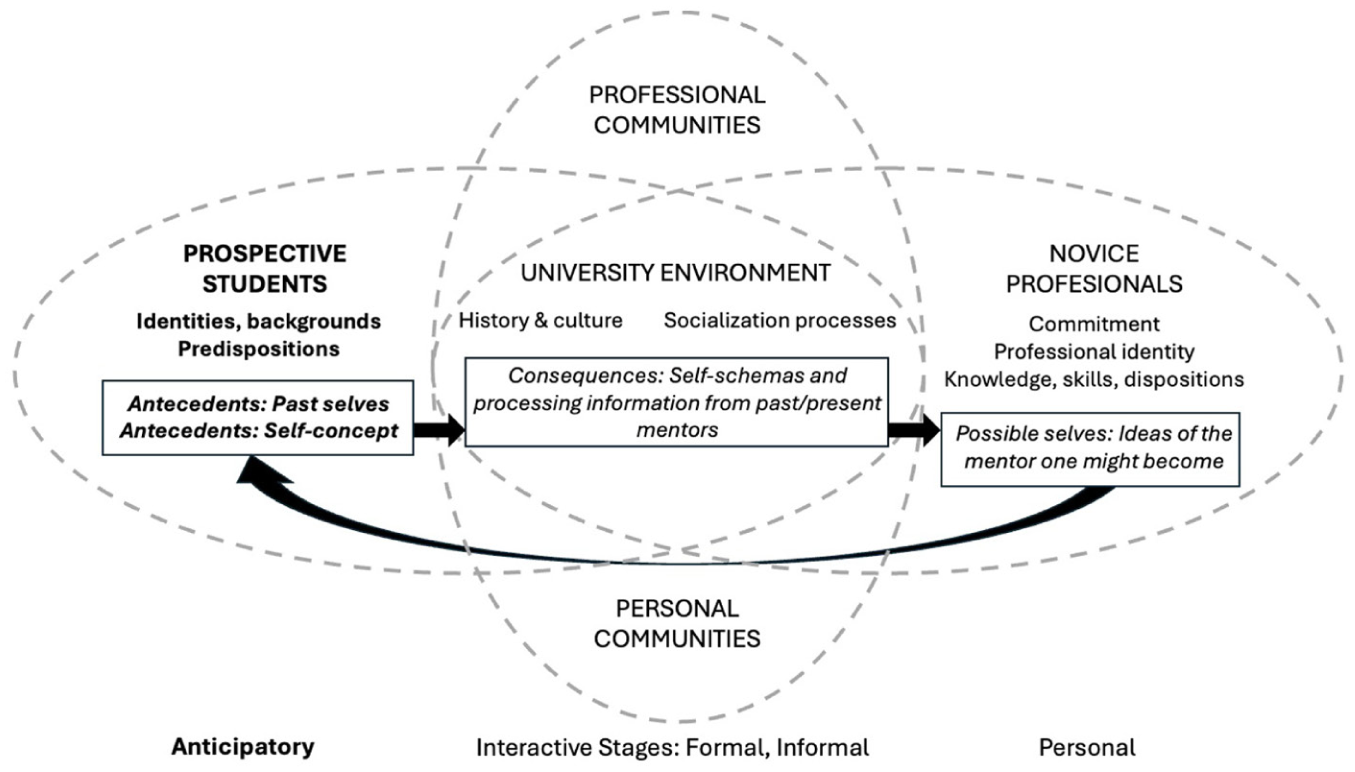
Unified Conceptual Framework of Graduate Socialization and Possible Selves.
Review of Relevant Literature
We situated this study within the literature on socialization, mentorship, and doctoral education in STEMM and computing fields. Research on key socialization agents, disciplinary culture and power, possibilities in doctoral education, and doctoral students’ development as mentors was particularly pertinent to our study conceptualization, and we discuss each in the following sections.
Past Mentors as Socialization Agents
Relationships with prior mentors profoundly impact students’ knowledge about STEMM doctoral education (Wofford & Blaney, 2025). Past mentors from many realms (e.g., faculty advisors, peers, family) shape anticipatory socialization via influencing one’s motivations, expectations, and perceptions of a STEMM doctoral program or career (Gardner, 2007, 2010; Tuma et al., 2025). Specifically, mentors contribute to anticipatory socialization by setting expectations grounded in their beliefs, experiences, and behaviors (Gardner, 2010; Wofford et al., 2021). While new doctoral students develop anticipatory socialization through a constellation of lived experiences, mentoring interactions, and reflections about their doctoral environments (e.g., institutional prestige, disciplinary culture; Gardner, 2010; Posselt, 2020; Williams et al., 2018), such constellations of information are often guided by previous mentors.
Individuals also draw on their knowledge of norms and values in prior disciplinary environments (e.g., undergraduate research experiences [UREs]) to conceptualize anticipatory socialization for STEMM doctoral education (Boden et al., 2011; Luedke et al., 2019; Williams et al., 2018). In UREs, for example, Luedke and colleagues (2019) documented how identity-focused mentorship that prioritizes agency among Students of Color aided their development of various competencies, increased their exposure to undergraduate research, and provided opportunities to center their cultural identity within their scholarly identity. Despite mentorship in UREs contributing to undergraduate students’ plans for graduate school (Eagan et al., 2013), faculty mentorship is not universally positive across race/ethnicity and gender for URE students in life sciences (Aikens et al., 2017) or among graduate school aspirants in computing (Wofford et al., 2022).
Further, doctoral students’ past mentors contribute to complex perceptions of power and prestige, including with institutional selection, research expectations, and organizational structures (Gardner, 2010; Williams et al., 2018). Given that faculty advisors have been seen as primary mentors, doctoral students have often been socialized to follow in their footsteps (Austin & McDaniels, 2006). Such traditional structures, however, limit the efficacy of mentorship: studies have shown that prospective doctoral students benefit from multiple mentors who provide different forms of support (Wofford, 2023), and reciprocal relationships between mentors and mentees better value contributions of both parties (Feldon et al., 2023). Because individuals make sense of the cultural norms and expectations of their scientific disciplines throughout their doctoral pathways (Posselt, 2020), it is crucial for anticipatory socialization processes to value reciprocity, agency, and mentoring networks that illustrate multiple ways of being a scientist.
Power and Cultural Norms in Socialization
Organizational norms and disciplinary cultures—both crucial to STEMM socialization—materialize in dynamic ways and shape the (re)creation of behaviors, norms, and perceptions that uphold or disrupt inequities (Reinholz et al., 2019). STEMM doctoral students’ interactions with salient individuals and institutional environments often reify inequitable structures and cultures, such as individualism and racialized labor (Burt et al., 2018; Hernandez & Posselt, 2024; Perez et al., 2022). Unfortunately, hostile environments remain rampant in STEMM doctoral education, with those who ought to be mentors (e.g., faculty, peers) sometimes reinforcing dominant power via covert and openly racist behaviors (McGee, 2021). These hostile environments, in some ways, have been maintained through the apprenticeship model of doctoral socialization, which has long been pervasive across disciplines (Bieber & Worley, 2006), as faculty have trained doctoral students to assimilate into the norms and values of a given discipline, even when problematic.
Disciplinary culture in computing departments maintains computing fields as the least racially and gender-diverse STEMM fields, as structural forces work together to uphold racism and sexism (NASEM, 2018; Vakil, 2018). Traditionally, socializing environments in computing have passively reproduced inequitable cultural dynamics through stereotypical cues (Cheryan et al., 2015) or practices of homophily in mentorship (Gallivan & Ahuja, 2015). Socialization and mentoring processes in computing are influenced by broader societal structures, including raced, classed, and gendered hierarchies (Ramirez et al., 2024; Reinholz et al., 2019). Such structural forces then influence disciplinary culture and, subsequently, how mentorship functions through a lens of (in)equity (Wofford, 2022). For example, meritocracy and individualism are often reinforced as cultural dynamics in computing departments (Vakil, 2018). When perpetuated via mentorship, these values run counter to the ethic of care that creates environments where minoritized doctoral students in STEMM can thrive (Griffin et al., 2020). The absence of conscious efforts to disrupt power in these relationships can perpetuate hostile practices in mentorship, highlighting the need for intentional mentorship that reimagines organizational norms and disciplinary cultures at individual and institutional levels.
While the growing emphasis on research productivity in STEMM departments has led to academic cultures where faculty mentors often fund doctoral students through grants they are awarded (Maher et al., 2019), the extent to which faculty value students’ holistic well-being alongside their research productivity varies dramatically (e.g., Burt et al., 2021; Griffin et al., 2023; Wofford & Blaney, 2021). This institutionalized model of mentorship upholds the perception that mentorship is a top-down relationship—reinforcing inequitable power dynamics, given the power faculty hold over doctoral students’ progress (Feldon et al., 2023; Gutzwa et al., 2024). However, recent work has depicted mentoring as a reciprocal, bidirectional dynamic that views doctoral students’ agency, lived experiences, and cultural knowledge as assets to the scientific enterprise (Feldon et al., 2023). This conceptualization promotes reciprocal relationships for doctoral students as mentees (of faculty) and as individuals who utilize their agency to become mentors—a role to which the present study is attuned.
Pathways Charted by Possible Selves
Doctoral education serves as the primary training ground for developing individuals’ professional identities as scientists (Hancock & Walsh, 2016). Likewise, doctoral education serves as a key site for individuals to reflect on how their past, present, and future selves contribute to their professional identities (Mondisa, 2021). Beyond scholarly development, doctoral students with faculty aspirations must understand future expectations about teaching, service, and mentorship to fully understand their possible selves (Feldon et al., 2023). Recent inquiries have theoretically leveraged possible selves to understand students’ pathways to and through STEMM doctoral education (Blaney et al., 2025; Deters et al., 2021). However, researchers have seldom considered how doctoral students’ use of self-schemas might foster new imaginings of what students want as both recipients and providers of mentorship.
In using possible selves as a tool to understand STEMM doctoral mentorship, we discuss literature on key foci of possible selves—namely, antecedents, consequences, and social comparisons. Doctoral students often draw from past experiences to make meaning of their expectations for the PhD and their mentors (Baker & Pifer, 2015; Park & Schallert, 2020; Wofford et al., 2021). For one, Baker and Pifer (2015) discussed how one’s prior teaching and research experiences, as well as their perceptions of organizational characteristics, shaped divergent understandings of “fit” in doctoral education. Consequences, as theorized via possible selves, also apply to students’ STEMM doctoral journeys. As students transition to a new domain, they modify their behaviors. In doctoral mentorship, consequences arise from students’ adaptive behaviors as mentees (e.g., navigating hostility or mismatched expectations with PhD advisors; Breen et al., 2024) or as mentors (e.g., struggling to hold more power in a relationship; Wofford, 2022). Because doctoral education is rife with social comparisons (Pifer & Baker, 2014; Steele & Parson, 2025), doctoral students often make meaning of their past, present, and future selves in comparison to others; these comparisons can be detrimental if rooted in competitiveness and pressures for productivity which, unfortunately, are common in STEMM (Steele & Parson, 2025). Further, mentorship itself serves as a system for comparisons, as doctoral students ascertain how their roles (as mentees or mentors) are (dis)similar to others and assign value to these comparisons.
Navigating Possible Selves as Mentees and Mentors
As discussed, STEMM doctoral students occupy a liminal space in their identity development as both mentees and mentors. In this nebulous space, agency is a crucial mechanism for helping STEMM doctoral students cultivate possible selves, enhancing their success as current doctoral students and contributing to future success as early-career scientists. A shared goal of doctoral education is to increase doctoral students’ capacity to make independent decisions, including in their academic, professional, and personal trajectories (Johnson et al., 2023). Thus, creating relationships that honor students’ agency is integral to the efficacy of their training and preparation for the future (Feldon et al., 2023; Golde, 2005).
Among the many benefits of reframing STEMM doctoral education to place greater value on students’ agency, this reframing can facilitate doctoral students’ imagination of new possibilities for receiving and providing mentorship. Decades of studies demonstrate the importance of agency and self-advocacy in doctoral mentorship (Golde, 2005; Lilley & Larnell, 2022). In STEMM, doctoral students have counteracted isolation and a lack of support by exercising agency in mentorship to create new possibilities for ownership of their trajectories (Golde, 2005). Making space for STEMM doctoral students’ agency has fostered bidirectional, reciprocal relationships in which students have shaped their own academic, professional, and personal experiences (Feldon et al., 2023). Further, as STEMM doctoral students begin to identify as scientists, they may wish to serve as mentors to earlier-stage students. However, few studies have documented why doctoral students become mentors (Dolan & Johnson, 2009; Wofford & Henning, 2025). Further, it is crucial to understand how doctoral students’ mentoring motivations may reflect past and present socialization forces and the possible selves they envision.
Methods
Guided by a critical constructivist paradigm—an epistemological lens acknowledging how one’s knowledge is shaped by individual perceptions and systems of power (Kincheloe, 2005)—we employed narrative inquiry to illuminate how possibility models and anti-mentors shaped doctoral students’ pathways and mentoring motivations. Narrative inquiry centers on individual and collective lived experiences through storytelling, making meaning of how such stories contribute to individuals’ past, present, and future development (Clandinin & Connelly, 2000; Kim, 2016). This paradigm and methodology afforded us the opportunity to center participants’ worldviews, as narrative inquiry “uses stories to understand the meaning of human actions and experiences, the changes and challenges of life events, and the differences and complexity of people’s actions” (Kim, 2016, p. 11). Our use of narrative inquiry highlights moments and stories, positive or negative, in participants’ experiences.
Data Source and Participants
To address our research questions, we analyzed the narratives of doctoral students in mentoring roles at Palm Coast University (PCU, pseudonym), a Research 1 university in the western United States. PCU was selected due to existing administrative support for graduate-level computing programs and large graduate enrollments. We first used criterion sampling, followed by snowball sampling (Maxwell, 2013), to recruit participants who were: (1) graduate students in a computing-related field, and (2) currently serving as a mentor to at least one undergraduate student in a computing-related field.
The first author began recruitment by emailing computer science faculty at PCU, one of whom forwarded study information to leaders of a club for informatics graduate students. The president of this group disseminated study recruitment materials (i.e., flyer, Qualtrics questionnaire to gather demographics and mentoring engagement) to all members. Initial recruitment yielded high interest from informatics doctoral students. Although we did not initially seek to focus on a single computing subfield, maintaining this focus led to more nuanced understandings of doctoral students’ experiences in their field’s culture. Informatics centers on the nexus of people and technology, blending theoretical understandings from the social sciences with practical interventions from computer science (Groth & MacKie-Mason, 2010). As such, the norms of informatics draw from a variety of disciplines. This interdisciplinarity may also shape how doctoral students make sense of their possibility models or anti-mentors in their trajectories and mentoring motivations.
Table 1 presents a profile of study participants, with the final sample comprising 10 informatics PhD students with diverse social identities and educational trajectories. Participants also spanned varying stages of their PhD pursuits, from first to sixth year.
Profile of Participants (n = 10).
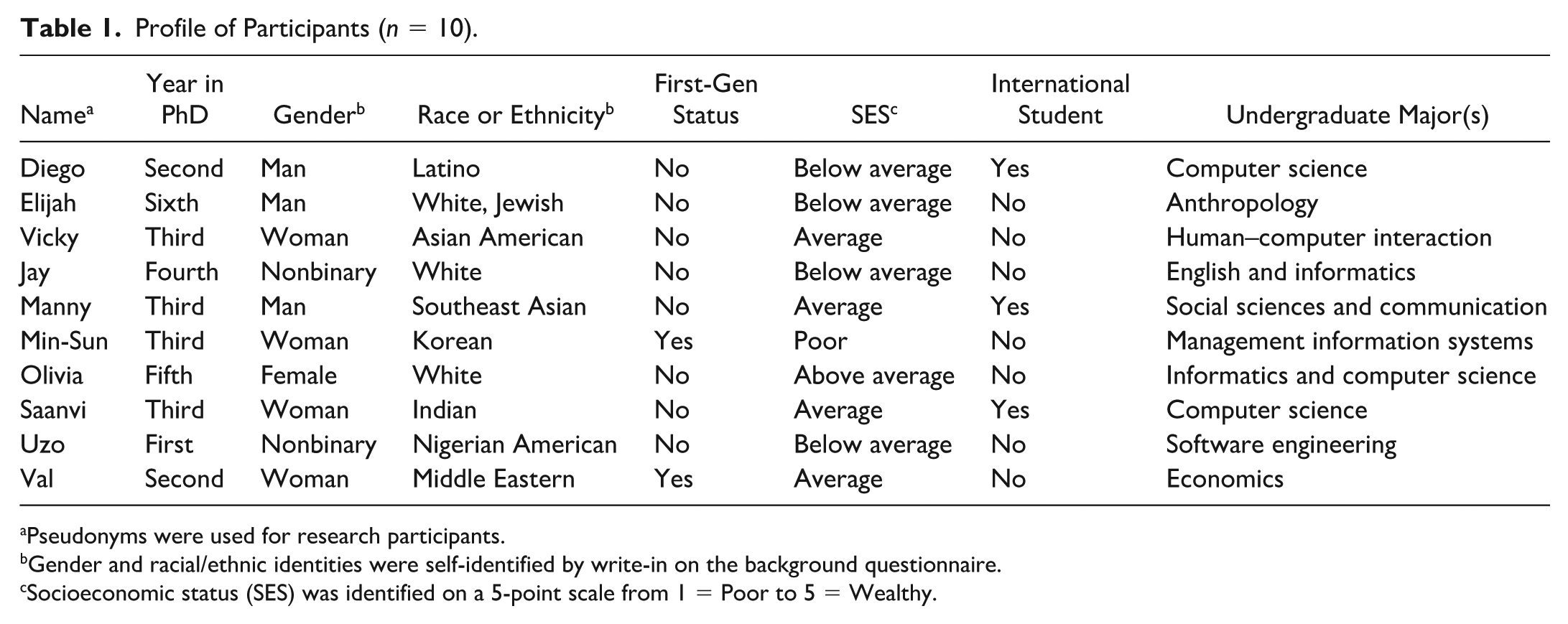
Pseudonyms were used for research participants.
Gender and racial/ethnic identities were self-identified by write-in on the background questionnaire.
Socioeconomic status (SES) was identified on a 5-point scale from 1 = Poor to 5 = Wealthy.
Data Collection
The data corpus for this study included adapted education journey maps (Annamma, 2017) and two semistructured 60- to 75-minute interviews.
Education Journey Maps
Education journey mapping is a critical qualitative method with origins in disability critical race theory, a sociospatial dialectic, and critical race spatial analysis (Annamma, 2017). Leveraging mapping techniques as a visual form of narrative inquiry, participants created maps as visual artifacts of their stories. Prior to the first interview, the first author provided participants with a written (emailed) prompt to create an adapted education journey map. This prompt instructed participants to consider their educational journey from beginning to present and draw their relationship with school. Building on Annamma’s (2017) prompt, we specifically asked participants to focus on their experiences receiving or providing mentorship. All other attributes of Annamma’s original instructions were retained, providing participants with examples of how they could use symbols, visuals, or colors to illustrate their maps. By adapting these mapping techniques to create mentoring journey maps, we examined how physical space and temporality emerged in doctoral students’ journeys toward becoming stage-ahead mentors. We also told participants that they would have an opportunity to explain their map during the first interview.
Semistructured Interviews
Participants completed two semistructured interviews via Zoom, each lasting 60–75 minutes. Semistructured interviews are common in narrative inquiry, providing one way to use questions as “guided conversations” that collectively help the interview “maintain its focus rather than dictate its direction” (Kim, 2016, p. 163). Participants began the first interview by narrating their maps—a practice that prioritizes agency (Kim, 2016). Further, reciprocity and generosity are vital to education journey mapping (Annamma, 2017), prompting the first author (who led data collection) to share her own map after participants shared theirs. Bidirectional storytelling was essential to building rapport and creating a relational data collection process. Following discussions about our maps, the remainder of the first interview focused on participants’ mentorship experiences (as both recipients and providers of mentoring) prior to graduate school. Follow-up questions centered on understanding the role of prior mentors (e.g., “Tell me about your decision-making process to come to PCU. How did you get here? Did you have a mentor in this process?”), yielding important stories to explore the presence of possibility models and anti-mentors.
The second interview focused on doctoral students’ experiences as stage-ahead mentors. Interview questions guided conversations about the motivations, practices, social identities, and structures shaping participants’ experiences. To explore how receiving mentorship shaped participants’ mentoring motivations, we asked: “How would you describe your motivation for being a mentor during graduate school?” After this interview, data were transcribed verbatim and de-identified with participant consent. Participants were asked to select their own pseudonyms, and other individuals mentioned in their narratives were assigned pseudonyms.
Analysis
Using a critical constructivist paradigm within narrative inquiry, we explored how individuals made meaning in their lives while understanding the role of institutional and societal power (Kim, 2016; Kincheloe, 2005). Our analysis began via an initial reading (i.e., precoding) process in which the first author highlighted interview dialogue and sections of maps pertaining to the research questions (Layder, 1998). We then followed Maxwell’s (2013) three-part analytic process to establish organizational, theoretical, and substantive categorization for interview data. Organizational categories helped refine the focus (i.e., influence of past and present mentors), and we collaboratively developed a flexible codebook to investigate this as well as theoretical and substantive categories (Table 2). After ensuring that the codebook aligned with our theoretical perspectives and methodological approach, both authors began coding individually. We used Dedoose to organize codes and apply them as collaborators. After individually coding two of the same interviews, we discussed code relevance and refined the codebook before moving forward. This intentional and collaborative review afforded us the opportunity to refine codes early on, ensuring clarity and consistency within code descriptions and application to excerpts from participant interviews. Upon completing coding, we re-established narratives by building analytic memos for each participant (including highlighted and coded data from maps and interviews) and for each research question, then integrating the memos to establish findings.
Categories for Coding.
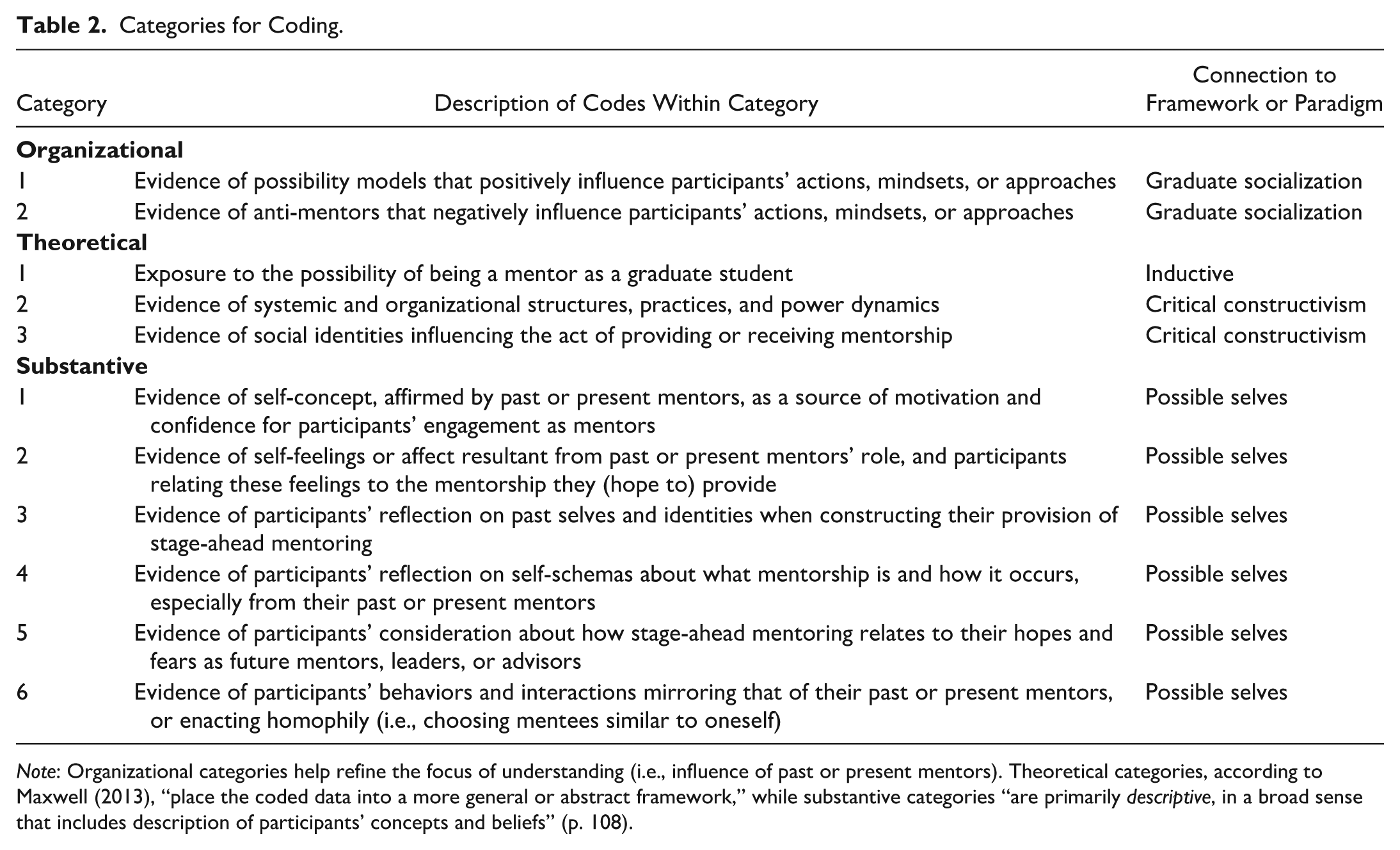
Note: Organizational categories help refine the focus of understanding (i.e., influence of past or present mentors). Theoretical categories, according to Maxwell (2013), “place the coded data into a more general or abstract framework,” while substantive categories “are primarily descriptive, in a broad sense that includes description of participants’ concepts and beliefs” (p. 108).
Trustworthiness
To advance trustworthiness, both authors kept reflective journals and engaged in peer debriefing, often grappling with assumptions and narrative understanding. In addition, we reviewed each other’s coding, ensuring consistent interpretations across authors. These strategies enhanced dialogue and established deep trust with decision-making throughout the analysis stage (Spall, 1998). We also included participants in analysis by asking them to review the purpose of the study and their individual quotes contributing to our understanding. Then, we interacted with participants via an adapted “cartographer’s clinic” (Annamma, 2017). Clinics were held individually to preserve confidentiality in a shared academic department. After completing interviews, the first author scheduled clinics as follow-up conversations where each participant answered five questions about their maps concerning the highs and lows (i.e., topographic elevations and depressions), perceived (dis)similarities with other doctoral students’ journeys, aspects they loved, elements that may benefit future stage-ahead mentors, and anything that stood out to them as unique. After these clinics, which lasted 15–30 minutes and served as a key form of member checking, participants’ insights were shared with the second author to clarify the findings.
Positionality
Collectively, our worldviews draw on lived experiences, professional investments, and a commitment to equity-minded mentorship. The first author’s motivation for this study grew from establishing mentoring opportunities as a graduate admissions practitioner and as a faculty member. The second author’s motivation, as a recent doctoral candidate, stemmed from receiving faculty mentorship and simultaneously providing mentorship to undergraduates. During data collection, the first author discussed how her professional investments, as well as her socially constructed racial, gender, and class identities as a white, cisgender, middle-class woman, led to varying privileges and challenges that were (dis)similar from participants. The second author also leveraged his racial and gender identity as a cisgender Black man and a first-generation college student to meaningfully connect with participants’ stories. By reflecting on the role of our social identities in data collection and analysis, we openly discussed how these identities shaped our past and present mentorship and shared investments, leveraging these perspectives as a strength to our interpretation. We also collaboratively reflected on our mentoring relationship, reaffirming our commitment to a mutually beneficial partnership with an ethic of care.
Delimitations
In alignment with narrative inquiry, we adopt delimitations as “a detailed account of reasoning which enlightens the scope of the study’s core interest as it relates to the research design and underpinning philosophical framework” (Theofanidis & Fountouki, 2018, p. 157). By focusing on the subfield of informatics at a single institution, we gained a better understanding of specific disciplinary and institutional norms. These decisions added depth to our analysis, and the findings—though most directly relevant to informatics—remain transferable to other STEMM fields. Importantly, our focus on informatics is not intended to silo disciplinary contexts within STEMM; rather, it acknowledges that each discipline and field operates with unique values and norms, yet ultimately all can (and should) learn from each other. Contextually, study participants also held more diverse social identities than is typical in other computing fields (e.g., computer science; Siek & Batten, 2025), which may be unique to this department or subfield, given the geographic location and that informatics focuses on social-technological progress.
Findings
In what follows, we present findings across research questions to unify participants’ insights about what they received and what they wanted to provide as mentors. We offer three findings regarding how possibility models and anti-mentors contributed to: (1) clarifying mentoring philosophies and values, (2) redefining potential pathways as mentees and mentors, and (3) understanding stage-ahead mentoring as fundamental to doctoral student training. Notably, participants defined mentorship in their own words, resulting in conceptualizations of possibility models and anti-mentors that included family, K–12 teachers, faculty, peers, and workplace mentors. Uzo reflected a common sentiment, saying: “We don’t need everything from one person,” which we elaborate on in the findings.
Clarifying Mentoring Philosophies and Values
Participants widely discussed how possibility models and anti-mentors demonstrated their philosophies and values through their actions. Transparency, agency, and empowerment were common values participants received as mentees and hoped to provide as mentors.
Receiving Mentorship
Participants’ mentors provided key networking opportunities and information. In this vein, possibility models were often faculty or advanced peers who connected participants to people or information they would otherwise not know. Olivia, Manny, and Vicky noted that they would not have made it to their specific PhD programs without possibility models opening potential pathways. In discussing PhD plans with a former faculty mentor, Manny said:
They had a huge impact in terms of where I applied and where eventually I said yes to, and I believe had an impact on why I got in certain programs. So, Jim [PhD advisor] knew Kenneth [former professor] because they were at the same university for a while, and I’m pretty sure Kenneth called Jim and said, “You better get this guy.”
Manny perceived his faculty possibility model, Kenneth, as affecting the PhD programs to which he applied and using his network to shape admission decisions. Similarly, Vicky recalled that meeting with an undergraduate faculty mentor “was how I found out about PCU specifically, and a bunch of the other schools I ended up applying to were based on her recommendation.” Vicky went on to say that her first faculty advisor at PCU “was maybe not necessarily trying to take students,” but that her (now retired) advisor changed her mind because of Vicky’s possibility model. Notably, faculty possibility models did not dictate where participants pursued their PhD; rather, they were brokers of information and connections that informed participants’ decisions.
Faculty possibility models often worked to debunk the hidden curriculum (i.e., unwritten rules governing notions of “success”), with Elijah and Diego describing faculty who shared information implicitly known to a select few. Elijah said his undergraduate faculty mentor “blew my mind by letting me know that you get paid to go to PhD programs, which was just not something that I knew. . .”. Diego also spoke about a faculty possibility model who was “a great resource to know the nonofficial criteria that were not explicit on websites and procedures that were not that clear.” Across both stories, participants’ identities as being from working-class backgrounds and, in Diego’s case, international contexts also shaped their views of (un)available information and how possibility models could disrupt the hidden curriculum.
Nearly half of participants’ past and present mentors also demonstrated commitments to agency, a defining feature of being possibility models. As an undergraduate student new to research, Min-Sun described how graduate students’ actions built a sense of trust. Reflecting on her undergraduate research contributions, Min-Sun recalled, “When I did this, I didn’t realize this tacit mentorship that I experienced in the research assistantship was foundational to my pursuit of graduate studies.” Previously, Min-Sun had a tumultuous academic pathway, transferring institutions several times; receiving trust and agency from peer possibility models fundamentally reshaped her self-perceptions of what was possible for her academic pursuits.
Further, when participants spoke about their PhD faculty mentors, agency was a prominent trait. As a first-year PhD student, Uzo experienced the beginning of this agentic relationship and noted that Anthony (their faculty advisor) would “be like, ‘you’re a grown-up, so just do what you want,’ which is empowering in the sense that he’s just like, ‘you make your own decisions, I don’t control you.’” Vicky and Saanvi agreed, describing their faculty mentors’ styles as prioritizing their development as independent scholars. Saanvi stated: “She’s never like, ‘work on this because I’m working on it,’ it’s always been, ‘what do you want to work on?’” The ways faculty mentors prioritized Uzo, Vicky, and Saanvi’s goals was crucial to their roles as possibility models, as mentors leaned into multiple options rather than one static path.
Validation and empowerment were also core to the mentoring practices of possibility models for half of the participants. For some, early validation came via K–12 teachers making computer science seem accessible by “enjoying the process of learning how computers work” (Olivia). For others, mentors became possibility models by displaying confidence in participants, which—for some—was their only source of external validation. One of Manny’s early teachers “was the first person outside of my parents who actively encouraged me and pushed me,” as this teacher expressed to Manny that he had a knack for the school paper. Min-Sun, Uzo, and Saanvi noted specific K–12 teachers who invested significant time in them, creating opportunities and motivation for them to engage. This motivation had a lasting impact, as depicted by Uzo. One of Uzo’s K–12 math teachers was “really excited about the things I could do. . .so that made me do better in math.. . . She was literally the only reason I went into engineering.” Although not all K–12 experiences were positive—as Uzo noted that other K–12 teachers were dismissive and underestimated their abilities—validation and empowerment from even a single possibility model created a ripple effect.
Motivations to Provide Mentorship
Engaging with possibility models and anti-mentors provided many participants with clarity about what mentorship could be. Participants came to see the ability to provide agentic, empowering support as a key motivator for becoming mentors. For one, Olivia shared that her undergraduate faculty mentor provided meaningful opportunities for undergraduates, which shaped her motivation to provide similar opportunities as a stage-ahead mentor. Olivia recalled that, because of this possibility model, “I’ve very much been of that open mindset [and] letting undergrads be empowered to do more than they think they can.” This role clarity also aligned with Olivia’s existing values, such that Olivia stated feeling “more satisfied and happier when I’m helping other people and empowering them in some way. . .that fundamental value set has always been a part of me [and] pushed me into that trajectory [of being a mentor].” Further, Manny reflected on knowledge transparency as a core personal value, noting: “I always promise to talk about this whole notion of the hidden curriculum. A lot of people enter graduate school, and there’s a lot of things we don’t know about.” Receiving insights from possibility models and reflecting on his personal values to “pay it forward,” Manny was motivated to make knowledge transparent as a stage-ahead mentor. As such, Olivia and Manny’s interactions with prior possibility models demonstrated how values motivated their desire to be mentors.
Similarly, Uzo and Vicky reflected on how their values were shaped by possibility models or anti-mentors and how such values motivated them to mentor. Uzo emphasized being “naturally inclined to try to support other people.. . . I feel like I can have a real impact when I’m having an open and honest conversation with somebody else and they’re actually receiving information.” This sentiment echoed the value Uzo placed on the open communication they received from their own mentors, thereby motivating Uzo to envision a similar role. Moreover, Vicky related her values and philosophical reflections to her mentors’ engagement with academic culture. Vicky “considered going to grad school for education and all this, like seeing myself in the role of a teacher,” as she had always enjoyed teaching and mentoring. To Vicky, fulfilling these value-based commitments served as an act of resistance, because her current doctoral faculty mentor (who was both a possibility model and an anti-mentor) promulgated the “ethos” that teaching and mentoring were less important than research training in doctoral education.
Some participants notably discussed mentoring motivations through stories about salient individuals they—at the time—thought of as mentors, but later realized these individuals did not share their view of what a mentor should be. As such, they brought a critical eye to whether certain qualities fell within the purview of mentorship. For Diego, Olivia, Uzo, and Min-Sun, hindsight was a tool to define anti-mentorship. Diego, Olivia, and Uzo defined anti-mentors as self-serving, upholding a “predator relationship” (Diego) or being “a real pain” (Uzo). Diego juxtaposed this anti-mentorship with other faculty: “I had really great professors, as well, that I kind of regret not choosing as advisors.” By comparing vastly different approaches, Diego drew on his anti-mentor as a source of motivation and clarification for what not to be. Min-Sun also expressed, “you can be mentored in a particular way that seems beneficial for you at that particular time, but in the long run it does cause a lot more harm.” Elaborating on the effects of anti-mentorship, Min-Sun noted that the “immediate gains were pretty good,” but that her anti-mentor encouraged what she later learned to be unethical behavior. Across these reflections, participants clarified which behaviors warranted the title of “mentor” and how such behaviors informed their desire to become mentors.
Redefining Potential Pathways as Mentees and Mentors
The narrative structure of data collection yielded varied insights into the starting point of receiving mentorship (e.g., parents, early teachers), the inclusion of workplace mentors, and the process of redefining potential educational pathways as mentees. In concert with receiving such mentorship, participants were motivated to provide holistic and identity-relevant mentorship as stage-ahead mentors—often echoing the presence or absence of this support in their trajectories.
Receiving Mentorship
Jay, Diego, Olivia, and Saanvi all spoke to family as possibility models that positively shaped their educational pathways. Family, especially parents, paved the way for early alignment among values, personal development, and disciplinary choices. Jay indicated their mom as their first mentor, recalling in elementary school, “I was having difficulty taking the step from very simple books to more complicated short chapter books. . .so [my mom] modeling hard work and dedicated study. . .was really important.” Although Jay did not know their mom was a possibility model at the time, they later realized how their mom showed possibilities that were not readily identified at school. Further, Olivia noted, “I like the opportunity to ask big questions. . .my dad really shaped me into that bubble of wanting to ask a lot of big questions.” Olivia explained that this willingness to ask questions made her “more receptive to having a lot of different mentors” because she felt comfortable asking clarifying questions. When receiving mentorship as an undergraduate, Olivia recalled that Anna (a faculty possibility model) “allowed me to ask these big questions again, but in an academic space, [which] was really attractive to me.” Diego and Saanvi similarly described family members as holistic possibility models, discussing “likes and dislikes” (Diego) and shaping the value they placed on receiving support beyond academics.
Conversely, Min-Sun, Vicky, and Saanvi viewed some family members’ guidance as anti-mentorship. Notably, Min-Sun and Vicky were children of Asian immigrants, and Saanvi was an international student from India; each described how culture influenced the mentorship they received from family. For example, Vicky recalled how her parents’ academic pressure extended to choosing a college major: “My parents were like, ‘you should major in business. . .business has the highest starting salary,’ and I was like, ‘I don’t really give a shit about business.’. . . So I started off as a business major and absolutely detested it.” Vicky saw business as “the worst possible match” and was “trying to figure out what direction I could go in that would be okay to my parents but not as terrible for me.” After taking a first-year course in computing because “it was the thing to do,” she pursued Human–Computer Interaction—a major that she told her parents also had a high starting salary, thus satiating their desire for her financial success. Saanvi had a similar experience with her parents’ educational guidance, sharing:
My parents didn’t understand the point of getting a PhD, so there was a lot of drama from there like, “don’t do it,” and “get a job, get on with your life” and stuff like that. That was challenging for me to handle because they saw themselves as mentors through my life.
Saanvi’s interpretation that her parents viewed themselves as mentors greatly shaped her meaning-making of their support, as she saw their combativeness regarding her PhD aspirations to stand in opposition to the support she expected mentors to convey. She further discussed how generational knowledge and education were closely intertwined with her lived experience, demonstrating the interconnectedness between receiving mentorship about potential educational pathways and cultural knowledge. Collectively, these stories about anti-mentors speak to the ongoing pressure that parents placed on participants’ academic decisions.
Additionally, as participants navigated varying educational pathways, workplace mentors also shaped their perceived future opportunities, with Diego, Saanvi, and Olivia discussing past and present mentors who became possibility models. Diego, for one, spoke highly of his previous boss who “gave me advice about all aspects of working and also some life experiences,” thereby helping Diego navigate his job. Saanvi and Olivia, on the other hand, recounted workplace possibility models they met during their PhD internships. Saanvi reflected that her mentor at a tech company “taught me how to work fast and concise, which is something that PhD students aren’t really used to. . .. She taught me how to succeed in that environment.” This mentor also “had a knack for understanding the strengths of a certain person” and assigned work that aligned with these strengths, demonstrating to Saanvi how mentorship could be asset-based. Olivia also recalled receiving holistic support during her tech internship. Olivia discussed how “my manager was always there for my personal well-being,” which made Olivia see him as a possibility model and grow more comfortable asking questions. Finally, while interning in Congress, Olivia felt validated by the “wonderful lady power force I had in DC,” speaking to two women who served as identity-affirming workplace possibility models.
Motivations to Provide Mentorship
When envisioning who they wanted to be as a mentor, participants often used hindsight to gain clarity on their possibility models or anti-mentors. For Min-Sun and Diego, anti-mentors informed their motivations to become mentors. When asked about whether her background shaped her decision to be a stage-ahead mentor, Min-Sun quickly said, “Yes, because I didn’t have one growing up. There’s a lack of direction for lower-income working-class first-generation immigrants. We are literally thrown into the world, and our parents are far too busy to be available to us.” Having to raise herself and lacking mentorship in her early years, Min-Sun was motivated to provide mentorship to those with similar backgrounds. Min-Sun’s story illustrates how she drew on prior mentors to shape the guidance she wanted to provide regarding possible pathways. Diego’s recollections were similar and—calling back to the introduction of this manuscript—his anti-mentor created a “really narrow vision in the beginning, because there wasn’t anyone to give me a good perspective of things that were available.” For Diego, this experience motivated him to be the mentor he wished he had and to pursue a PhD.
Additionally, the clarity that participants gained about their pathways from possibility models or anti-mentors influenced their motivations for providing (dis)similar support as stage-ahead mentors. After discussing the competitive nature of the faculty job market with a possibility model (a former professor) and receiving transparent, practical advice for their faculty career aspirations, Jay was motivated to take on a role where they could provide similarly honest information to mentees. At the time of data collection, Jay was serving as a mentor to an undergraduate student in their advisor’s lab. As this undergraduate mentee was considering her future options for graduate school, Jay noted that they wanted to “have the same positive impact on her that I had as an undergraduate, but also avoid. . .the slightly more idealized impression that I feel like I got.” As such, it became clear that Jay aimed to use a similarly transparent approach to providing mentorship as that which they received.
Finally, some participants received mentorship that blended identity and career pathways, and receiving this mentorship shaped Vicky’s motivations for being a mentor. In discussing her possibility models and career choice, Vicky shared:
The faculty I was really close with were almost all women. And we would chat about how she would have to make this choice about [whether] she was going to stay as faculty or have a kid. Or how she came to [city] because she was following her husband. . .so reflecting on how family obligations and gender expectations played into their trajectory was something we always ended up chatting about.
As a stage-ahead mentor, Vicky wanted to offer undergraduates honest insights about the role of identity in fellowship applications. Thus, Vicky’s mentoring motivations stemmed from receiving identity-relevant mentorship and a desire to provide similarly authentic support.
Understanding Stage-Ahead Mentoring as Fundamental to Doctoral Student Training
Participants reflected on their own stage-ahead mentors (as undergraduate mentees of PhD students) as a primary set of possibility models. Participants often built these relationships through institutional mentoring or undergraduate research programs. By receiving stage-ahead mentoring support, participants came to view doctoral education as a training ground not only for emerging scholars but also for emerging mentors. Collectively, these possibility models motivated participants to pay it forward as mentors.
Receiving Mentorship
Over half of the participants mentioned receiving stage-ahead mentorship in labs or institutional programs. Although Manny was the only participant to mention university-wide structures, his experience stood out because it represented institutional exposure to mentoring possibilities. Notably, Manny recalled how this institutional program “partnered [undergraduates] up with graduate students as mentors to guide them through any of the constraints they may have.” Partnerships with graduate students were also common in research labs, and several participants received valuable support from PhD students as undergraduates. Often, this support came in the form of day-to-day learning. Olivia, for one, discussed a PhD student in her undergraduate research lab who was “so supportive of everything I did, even if I failed” and challenged her to take risks—all of which felt much more achievable to Olivia because of this “unnaturally high level of support.” Further, participants recalled how current PhD students served as possibility models for them as they applied to doctoral programs. In discussing challenges and supports, Diego recognized that doctoral student possibility models provided “a really good resource to get a glimpse of what is realistic [during] a PhD.” Across participants, receiving stage-ahead mentorship from someone who was accessible, honest, and relatable in their experiences provided crucial support.
Motivations to Provide Mentorship
Participants, including Olivia, Diego, Min-Sun, Manny, and Uzo, explicitly viewed their own stage-ahead mentors as demonstrations of who they wished to be. Olivia noted “watching Caitlin do her PhD” and collaborating with PhD students as an undergraduate who “let me work on a lot of their work and let me co-author on their papers.” These experiences with possibility models were crucial, as Olivia gained a better understanding of how undergraduates could learn with her as a doctoral student and felt motivated to replicate this opportunity. Stage-ahead mentors also helped participants recognize possibilities beyond formalized mentorship, as Min-Sun recalled that receiving stage-ahead mentorship “led me to believe that these formal hierarchies of mentorship aren’t integral to progress.” Notably, Min-Sun critiqued hierarchical knowledge structures in academia and similarly perceived stage-ahead mentorship as one way doctoral education could value knowledge from many individuals—not only faculty.
Finally, drawing from his experience as a mentee, Manny was motivated to become a stage-ahead mentor in the same university program. In doing so, Manny wished to stand by his core values of pedagogy and mentorship, grounded in an ethic of care. In fact, Manny thought “everyone should be required to take pedagogical and also mentorship classes” as he did, attributing toxic elements of U.S. academic culture to the fact that “no one knows how to teach or become a mentor.” Overall, receiving stage-ahead mentoring before becoming a stage-ahead mentor motivated participants to recognize their value in enhancing undergraduates’ knowledge acquisition and navigation of structures in uniquely collegial and caring ways—thereby reflecting their hopes to become possibility models for future PhD students.
Discussion
This study examined how informatics doctoral students made meaning of how their past and present mentors, as possibility models and anti-mentors, shaped their educational pathways and motivations to be stage-ahead mentors. Together, we garnered novel insights about doctoral student socialization through their conceptualizations of past, present, and future selves. In what follows, we discuss three key contributions of this study in conversation with key theoretical and empirical research on graduate socialization and possible selves in higher education.
First, findings shed light on how possible selves can serve as a theoretical tool to examine the lasting impact of anticipatory socialization (and its agents) in doctoral education. Despite researchers documenting the crucial role that prior mentors play in shaping one’s expectations for doctoral education (Baker & Pifer, 2015; Luedke et al., 2019), few have examined the ongoing influence of prior mentors on the processes and outcomes of graduate socialization. Previous work on anticipatory socialization has focused on doctoral students’ transitions and anticipated professional roles (Bess, 1978; Wofford et al., 2021). Yet, as seen in Figure 1, anticipatory socialization extends into the formal and informal stages of socialization (including university environments, professional communities, and personal communities). The present study is one of the first to illustrate how anticipatory socialization continues to shape doctoral student development—specifically as emerging mentors—by understanding antecedents and consequences that shape possible selves.
Second, although scholars have increasingly advocated for bidirectional approaches to STEMM doctoral socialization (Weidman & DeAngelo, 2020), hierarchical, traditional apprenticeship structures (i.e., unidirectional socialization) remain prominent across fields and disciplines (Bieber & Worley, 2006). Corroborating recent research (Blaney et al., 2022; Griffin et al., 2020), our study advances knowledge about how receiving mentorship that offers transparency, agency, validation, and empowerment positively shapes doctoral student development, especially for students with systemically minoritized identities. However, prior studies still narrowly focus on faculty–student relationships within doctoral education. Broad understandings of mentorship revealed meaningful insights into the roles of multiple types of mentors, expanding on Tuma et al.’s (2025) findings about how family, peers, mentors, and professors shape undergraduate students’ motivations and career decisions in STEMM. Participants drew from a lifetime of interactions with possibility models and anti-mentors to make meaning of their positive and negative experiences receiving mentorship and, subsequently, their motivations to be mentors.
Third, participants who received mentorship from doctoral students as undergraduates or master’s students (thereby receiving stage-ahead mentoring) demonstrated intrinsic motivations to become mentors. Existing studies have shown how doctoral students provide important mentorship to earlier-stage students, often serving as more accessible and relatable sources of knowledge than faculty for mentees who may aspire to doctoral education (Ahn & Cox, 2016; Dolan & Johnson, 2009; Wofford, 2022), yet these studies have not thoroughly shown how receiving stage-ahead mentoring provides doctoral students with concrete models and archetypes for how they may be able to “pay it forward” and serve as mentors to the next generation of doctoral aspirants. Our findings address this gap by showing how stage-ahead mentorship shaped participants’ knowledge acquisition before doctoral education and how their motivations related to socialization outcomes (e.g., becoming a stage-ahead mentor as a form of professional identity) drew from these possibility models.
Overall, participants drew from insights around past and present mentorship—both positive and negative—to inform their anticipatory socialization, conceptualization of bidirectional socialization in mentorship, and understanding of the values they wanted to enact as stage-ahead mentors. To date, many scholars have discussed mentorship through a lens of role modeling or apprenticeship (Austin & McDaniels, 2006; Feldon et al., 2023), and this focus may have contributed to a stilted perspective that all mentorship is high quality. Some recent studies have explored negative mentorship (Breen et al., 2024; Tuma et al., 2021), and our findings extend this research by illuminating how anti-mentors shape doctoral students’ conceptualizations of possible selves. By employing a broader perspective that allowed participants to ruminate on positive and negative experiences with possibility models and anti-mentors, we document inherent limitations to “role modeling” as the basis for mentorship. A role modeling lens implies that there is one role to be modeled and one way to assume this role; however, there are many ways to be a mentor and enact mentoring support that aligns with one’s values, as these narratives demonstrate. Similarly, while we offer “possibility model” and “anti-mentor” as two categories of enacted mentorship, we expect that mentorship regularly falls on a continuum, akin to Johnson’s (2014) Mentoring Relationship Continuum model. Bearing in mind this continuum of mentorship, alongside a lens that acknowledges the many possibilities of being a mentor, will ultimately generate more nuanced insights into mentorship and bidirectional socialization.
Implications
Several key recommendations emerged from our study, holding the potential to reshape doctoral student mentorship (in informatics and other fields) through intentional practices and policies. We collectively encourage faculty and academic leaders to cultivate stronger support for doctoral students, as recipients and providers of mentorship. This suggestion also requires that academic leaders both incentivize and hold faculty to account for the mentorship they provide. Abuse, harm, and—even if benign—neglect are unfortunate realities in faculty–doctoral student mentorship (Tuma et al., 2021). Left unchecked, these anti-mentoring practices have deep consequences for doctoral training and, generally, mental health and well-being. High-quality mentorship should be an expectation of all faculty, rather than the effort of a dedicated few. Academic leaders (at all levels) should integrate routine accountability measures for faculty mentoring practices (e.g., an annual review category for mentorship, as is common for teaching activities). In alignment with Tuma and colleagues (2021), we suggest that department chairs should also be trained to identify negative mentoring behaviors, engage in potentially difficult conversations to reduce relational harm, and escalate appropriate concerns to human resources. Further, when doctoral students serve as mentors, their labor as mentors must not be exploited—rather, doctoral students who provide mentorship should be incentivized and rewarded.
Mentoring initiatives at the institutional level offer critical opportunities to incentivize and support doctoral student development. Yet, several participants in our study highlighted challenges to accessing mentoring opportunities. One approach to expanding mentoring opportunities could be to create institutional constellations of stage-ahead mentoring. Such constellations (i.e., networks in which stage-ahead mentors with different trajectories can provide unique support) can encourage mentors and mentees to come together and share knowledge in bidirectional, mutually beneficial ways. Stage-ahead mentoring constellations could serve as mechanisms to dismantle the hidden curriculum, with practical sessions led by varying stage-ahead mentors that offer insights on navigating doctoral education, leveraging agency in mentorship, reflecting on lessons from possibility models or anti-mentors, and more.
Facilitating stage-ahead mentoring panels and training may also be an effective way to harness possible selves. For one, earlier-stage students may attend panels where they can learn from more advanced students about providing and receiving mentorship, while simultaneously envisioning their future selves as mentees or mentors. Although other scholars have recommended strategies for faculty mentor training (Johnson et al., 2023), doctoral students must also have access to resources such as the Entering Mentoring curriculum (Pfund et al., 2014) or the Equity-Minded Mentoring Toolkit (Wofford et al., 2023) to elevate their contributions to the current mentoring culture and prepare for future positions.
Finally, as with graduate teaching assistant training policies, establishing mentoring training policies would benefit doctoral students, both as mentees and as emerging mentors. This approach might provide doctoral students with an opportunity to participate in university-wide mentoring training to develop skills for mentoring earlier-stage peers. For example, training may focus on topics such as developing supportive cultures for first-year PhD students, navigating collaboration with peers on research projects and conference presentations, and maintaining healthy personal and academic boundaries as doctoral students. Engaging in mentoring training can help doctoral students envision their approach to mentoring while also constructively critiquing their current experiences as mentees by noticing what is and is not part of their mentors’ practices. As such, mentoring training can be a developmental and reflexive practice that supports doctoral students’ roles as mentees and their roles as mentors.
Directions for Future Research
This study offers ample opportunities for future research. Although we gained depth in our understanding by focusing on a single institution and subfield of computing, much remains to be learned across other institutions and fields of study. For one, scholars could examine doctoral students’ experiences receiving and providing mentorship at historically Black colleges and universities (HBCUs). Doing so could offer insight into how identity-affirming environments for Black students may influence doctoral students’ meaning-making of possibility models, anti-mentors, and mentoring motivations. Second, given that each STEMM discipline and field has specific norms, values, and socialization expectations, it is vital to examine how possibility models and anti-mentors shape doctoral students’ pathways and mentoring motivations in other disciplines. With this knowledge, disciplinary societies (e.g., the Association for the Study of Engineering Education) could offer doctoral students structured opportunities to engage in stage-ahead mentorship that meet disciplinary needs and normalize mentorship as a shared responsibility of the field.
Additionally, although these findings illuminate how possibility models and anti-mentors shaped doctoral students’ motivations to mentor, it is also important to dive deeper into the mentoring practices that stage-ahead students either adopt (in replication) or reject, based on the mentorship that they receive. This direction may benefit from longitudinal data collection—both qualitative and quantitative—to gather perspectives over time. This type of study may also benefit from document analysis to learn about potential written resources doctoral students navigate as mentees or mentors (e.g., formalized mentoring compacts, expectation agreements, institutional policies). Finally, given that many doctoral students engage in mentorship via hybrid or virtual formats, qualitative scholars may wish to use observations or reflective journaling to learn how virtual mentoring opportunities could serve as a bridge to doctoral education (and thus shape anticipatory socialization) or offer greater accessibility than in-person mentorship alone.
Conclusion
Universally, doctoral education is assumed to be the primary training ground for researcher development (Feldon et al., 2023). Yet what would doctoral education look like if individuals’ development as mentors were formalized as a key socialization outcome? Doctoral students do not begin their studies as blank slates; rather, they draw from a wide variety of possibility models and anti-mentors to anticipate their developmental opportunities and contributions. Without a holistic understanding of doctoral students’ trajectories, stage-ahead mentoring may unfortunately fail to meet its potential as a place of possibility and agency, thereby limiting how doctoral students see themselves as mentors for the next generation.
Footnotes
Acknowledgements
We extend our sincere gratitude to the participants of this study for their thoughtful engagement and generosity during the data collection process. An earlier version of this manuscript was presented at the 2024 annual meeting of the American Educational Research Association.
Declaration of Conflicting Interests
The authors declared no potential conflicts of interest with respect to the research, authorship, and/or publication of this article.
Funding
The authors disclosed receipt of the following financial support for the research, authorship, and/or publication of this article: Funding for this study was provided by the UCLA Graduate Division and P.E.O. International. The views in this article are those of the authors and do not necessarily represent the views of the funding agencies.
