







Abstract
In this article, I examine the rhetoric of democratic science within the field of synthetic biology. The still emerging field of synthetic biology claims to be a new kind of science based on the promises of affordable medicines, environmental bioremediation, and democratic, do-it-yourself (DIY) science practices. I argue that the formation of a more democratic, DIY portion of this field represents an intervention into ethics debates by becoming “the proper informed public.” Through an analysis of twelve DIY and community-based synthetic biology organizations’ websites, I found that democratic science was presented as a novel, progressive approach to science that addresses ethical concerns and at the same time produces better scientific results. In part, these claims were made possible through a reconfiguring of the boundaries between Science and the Public where scientists lay claim to solidarity with the public at large in opposition to traditional biosciences and Big Bio. My research suggests that the superficial use of the language of rights and democracy relegitimizes the primacy of scientific discovery to solve societal problems. I further suggest that by becoming the proper informed public, ethical challenges from publics critical of genetic sciences may become delegitimized.
Keywords
Introduction
On September 1, 2011, Science published a news story, “A Lab of their Own,” documenting the creation of the first physical do-it-yourself (DIY) synthetic biology spaces (Kean 2011). The article title plays on Virginia Woolf”s famous essay “A Room of One’s Own,” which addresses the difficulties and needs of women writers. Woolf’s essay has long been claimed as an important feminist text, but it has also been criticized by feminists for its lack of analysis of how race, class, and other socially salient categories differently situate women writers (e.g., Walker 1985). The subject in the Science article, however, is not women but rather tinkerers. The title evokes the argument, now mostly accepted, that women are deserving of rights and justified in claiming a right to space, after having been systematically discriminated against and disenfranchised. I ask in this article how does this evocation and transfer to DIY scientists/tinkerers happen and what does it do? In particular, how is this community of tinkerers defined as needing space of their own and does the discursive-material production of a disenfranchised DIY science community matter to bioethics and social justice? I argue that the democratic arm of the field of synthetic biology is an ethical intervention itself—in that it makes an argument for doing science differently (democratically, in community outside of traditional labs). However, I show that it also becomes the most legitimate stakeholder as it becomes what I call “the proper informed public.” Importantly, I show that central to this formation is an appropriation of traditional social justice rhetoric of inclusion and democracy, while the proper member of this public is an identity-politics–free entrepreneurial citizen—that is a universalized subject, undefined by gender or race, who is focused on liberal ideas of economic freedom. I ground my analysis in feminist and antiracist theory that alerts us to how the explicit use of color-blind and gender-blind politics actually (ironically) produces gendered and racialized forms of power. I suggest that the substitution of tinkerers for the disenfranchised subject defines the terms for legitimate bioethical debate on issues of fairness and social justice. I suggest we pay attention to this because through this intervention it potentially constrains larger ethical debates. The focus becomes whether tinkerers should be permitted to conduct science outside of traditional settings, potentially obscuring other ethical debates about social justice related to the kind of knowledge being produced and its societal impact.
The emerging field of synthetic biology claims to be a new kind of science based on the promises of affordable medicines, environmental bioremediation, and democratic, DIY science practices. Based on genomics and recombinant DNA technologies, synthetic biology uses engineering principles and analogies to the history of computer innovation to inspire a new generation of scientists—both inside and outside of universities. In this article, I focus on the promise of a more democratic science by looking at the community within synthetic biology that intersects with DIY biology and sets up shop for the most part outside of traditional scientific lab spaces—in shared kitchens and garages. 1
In December 2010, Genspace opened in Brooklyn, NY, claiming to be the first community biotechnology lab in the world. As of July 2014, The Synthetic Biology Project (a project of the Woodrow Wilson Center) identified on its website (www.synbioproject.org). Thirteen community lab spaces in cities in eight countries around the world, including Australia, the Netherlands, and the United States. Although DIY biology does not account for the majority of synthetic biology work being done, 2 many accounts suggest a co-emergence of DIY biology 3 and synthetic biology in the early 2000s (Tocchetti and Aguiton 2015). This raises questions about the centrality of a democratic ethos to the field at large. That is, if synthetic biology shares founding members with the DIY biology movement, does it also share foundational principles related to the ideal of more accessible, democratic sciences? Beyond the field itself, what role might ideas of more democratic sciences play in debates surrounding science ethics and public participation in science?
The field of synthetic biology emerged after The Genome Project and The National Human Genome Research Institute’s Ethical, Legal and Social Implications Research Program (ELSI) into a world celebrated as a postracial and postfeminist society. This moment of emergence for synthetic biology matters for several reasons. For one, this science owes a debt to the genomic sciences of the past. Kelty (2010) argues that Big Bio was and is necessary for this “rogue” science to prosper through the use of scientific and technological advances that make possible more efficient and affordable manipulation of genetic materials. At the same time, the ethics lessons learned from the interactions among scientists, ethicists, and nonacademic publics have also shaped the new ethics models being developed in tandem with this technoscientific endeavor. Finally, calls for color-blind and gender-blind politics support claims that the US civil rights movement of the mid-twentieth century and the temporally overlapping women’s movement have solved the United States’s problems with racism and sexism, respectively, relegating these topics to history books. Critical scholars and activists have criticized this claim to a postracial, postfeminist political and cultural landscape in the twenty-first century. 4 Dominant discourses of a postracial United States were widely promoted after the election of the first African American president of the United States in 2008. Postfeminist discourses can be seen collaborating with neoliberal impulses for increased individual choice that disallow critical analysis of patterns in women’s employment, education, and consumerism (Gill 2008). These discourses silence further critiques of continued discrimination and power inequities along lines of race, gender, and other socially salient categories of difference. Instead, we are implored to use universal language of equal rights for all or everyone. Further, the historical narrative of these dominant discourses of a postidentity politics United States and Western world has been mobilized to further differentiate between a more progressive Western world and a less progressive non-Western world. Most disturbingly, this discourse of a progressive postfeminist West has been used as justification for invasions of Afghanistan and Iraq during the first part of the twenty-first century by producing a racialized other who does not respect women’s equality in the ways that Americans do (Puar and Rai 2002; Riley, Mohanty, and Pratt 2008). What does war or employment and education discrimination have to do with synthetic biology’s promises to tinker with DNA in garages to create “a world where mushrooms can be turned into furniture, algae can be used to conduct electricity, and glowing plants can replace streetlights” (Public Broadcasting Service [PBS] 2014)? Much has been written about the relationship among ethics, public participation and legitimacy in the sciences, but surprisingly little of it has addressed the contexts of racial and gendered power in which those relationships form, shift, and generate new knowledge projects. As Campbell (2009) argues, science and technology studies can benefit from feminist theory that asks who is producing knowledges and for whom and why are we asking certain questions. Importantly, we must ask this of the knowledge we ourselves are producing. In this article, I ask how dominant discourses of a postracial and postfeminist world shape the development of DIY synthetic biology community ethics and potentially obscure deeper principles of democratic science grounded in social justice.
In this project, my aim is to understand the discourses circulating about democratic science and the use of rhetorical strategies (persuasive uses of language) on these websites. In this way, I credit the authors with agency in creating their image at the same time as I attempt to understand the larger discourses that shape the possibilities of their utterances. I draw on critical science studies scholarship that suggests we must analyze the race/gender/sexual politics underlying universalizing claims (Campbell 2009; Pollock and Subramaniam 2016) in order to explore the political work DIY synthetic biology discourse is doing, and thus the limits of its seemingly revolutionary vision of democratic science. I specifically ask what is the potential effect of the discursive moves I identified above on social justice claims about who gets to have a say in science and who doesn’t. This work is part of a larger project in which I apply Nancy Naples (2013) question “How do progressive frames achieve wide acceptance and become institutionalized in various social practices but lose the critical feminist or progressive intent?” (p. 9) to the increasing use of democratic ideals in science. In this article, I specifically focus on how social justice rhetoric about democratic science is applied to democratic-oriented synthetic biology spaces. I approach these questions by examining (1) how these communities define themselves through their websites (who is included in their community) and (2) their rationale for creating more democratic sciences. I then conclude with a discussion of what impact these discourses have on science and ethics debates.
The Emergence of Synthetic Biology and a New Ethics
Synthetic biology most commonly refers to an interdisciplinary field that aims to merge engineering and biology methods to create new technologies. The idea is to be able to synthesize segments of DNA to create biological entities with new functions or even create new organisms from scratch that will somewhat naturally reproduce within scientists’ control and therefore produce a limitless source of raw materials. Although the promise of this kind of genetic engineering has elicited excitement and hope for some, it has also prompted fear and ethical concerns about playing god, creating life, and biosecurity. Synthetic biology has garnered so much attention that it was the topic of President Barack Obama’s first Presidential Commission for the Study of Bioethical Issues. Many synthetic biologists have argued against government regulations, proposing self-regulation instead. One attempt to formalize this self-regulation was made by DIYbio.org as they convened workshops to propose self-defined codes of ethics for the field in 2011 (DIYbio.org).
The emergence of formal scientific ethics in the twentieth century has been, in part, about the relationship between the public and institutional sciences (Wilson 2012). Scientific research continues to rely heavily on government support, and thus public support for projects remains important. Genetic research has come under particular ethical scrutiny. Despite preemptive conferences of scientists and ethics regulations, public debates about genetic research and technologies continued. As scientists planned to map the human genome, anticipation of ethical concerns from the public prompted the development of ELSI (ethical, legal, and social implications) programs alongside development of the technologies. However, many argued that ELSI programs remained ineffective due to their emphasis on evaluating downstream effects and saw an opportunity to incorporate more collaborative, integrated models for ethics in synthetic biology (Rabinow and Bennett 2009).
Although developing new ethical approaches to science is useful work (with which I myself have engaged), I argue here that we need to understand these new democratic sciences themselves as ethical interventions and evaluate their significance as such. I therefore give this background on ethics not to suggest an ethical evaluation of doing science outside of traditional scientific spaces but instead to situate this novel science within a long history of ethical struggles among scientists, bioethicists, policy makers, and publics. Reardon (2013), who has insightfully analyzed genomic histories from eugenics to modern day personal genomics, cautions that there has been a transition from ethics to justice in which the problem of human genomics has shifted from “one of powerful scientists exploiting vulnerable subjects” to “one of powerful institutions exploiting people” (p. 181). Here, I build on this insight about the relationship between ethics and justice/democracy by examining how proponents of democratic genomic sciences position themselves within ethics debates as the people mobilizing against powerful institutions.
At the same time that we see shifting discourses about ethics, we continue to see a push for increased science literacy in response to the lack of public support for certain science agendas. The need for an informed public is frequently brought up in response to ethical deliberations about controversial sciences. So, as bioethicists have created more ethical practices for scientists, scientists have pushed for greater science literacy to produce a more informed public that will understand the need for science to move forward, assuming what has been called a deficit model of public understanding (Irwin and Wynne 1996). If we consider public accountability and support to be central to scientific ethics, this raises questions about defining the public and its relationship to science, which I examine in the next section.
Defining the Public and Participation
Feminist and other science studies scholars have demonstrated over and over that the split between science and the public is a false binary. A wide range of scholars from differing disciplinary traditions have argued that scientific knowledge is always contingent on the historical and cultural context in which it is produced (Haraway 1988; Harding 2004; P. H. Collins 1999; Jasanoff 2004; Kuhn 1962). While this point is not contested in science studies, attention to power and social justice is not universally accepted as integral to a clear contextual analysis of knowledge production (Campbell 2009; Pollock and Subramaniam 2016). Feminist science studies scholars have maintained this point as central to their field. In this way, not only do we argue that understanding formations of scientific knowledge must be grounded in an analysis of power, but also that we should be accountable and reflexive about power in our own knowledge production (Campbell 2009). The assumption of always culturally contingent knowledge begins with the insight that scientific knowledge is produced by people and that these people (scientists) do not exist in vacuums. Therefore, the idea of the public as outside of science has always been complicated. At the same time, there are segments of the public that have more and less access to science and the benefits and harms of science are distributed disproportionately. Therefore, instead of speaking of the public as a monolithic body, we must speak more specifically about publics and understand these publics as discursively and materially forming, never self-evident, or entirely stable. This task of determining the boundaries of communities within the larger public has proven no less difficult than describing the boundaries between the public and science (Fraser 1990; Warner 2002). Who, then, is the proper public to whom science should be accountable, how is it formed, and what is at stake in defining this public?
In the last couple of decades, public participation and engagement efforts within scientific and government programs have proliferated in what Jasanoff (2003) has called the participatory turn. Science studies scholars, scientists, and policy makers have debated, practiced, and analyzed techniques for creating the most democratic and legitimate sciences (e.g., Benjamin 2013; Campbell 2009; H. M. Collins and Evans 2002; Epstein 1996; Eubanks 2009; Jasanoff 2003; Lövbrand, Pielke, and Beck 2011; Reardon 2013; Stilgoe, Lock, and Wilsdon 2014; Wynne 2007). Some have asked questions about the legitimacy of different participation practices, criticizing forms of “invited participation” (Bogner 2012; Wynne 2007) where groups of public stakeholders are determined externally instead of self-organizing as a concerned community that focuses on the equitable distribution of power to create sciences that are more democratic (Campbell 2009; Eubanks 2009). Others have critically examined what, in this neoliberal moment, such discourses of more just and participatory science do to/for ideas and practices of science, justice, and ethics (Benjamin 2013; Goven 2006; Reardon 2013). Benjamin’s (2013) work on public participation in stem cell research debates in California carefully illuminates the changing definitions of the people with particular attention to which communities are mobilized as authentic public participants and how that changed over the course of the political debates. Tutton (2007, 190) urges us, in his work on the discourse of participation around the UK Biobank, to “both chart and analyze the shift in discourses.” This article considers the rhetorical and discursive moves of new democratic science in this moment. Using a feminist approach to science studies, I not only historically situate such shifts in this moment but also argue that contextualizing them requires attentiveness to how power differentially affects communities and that our analysis should strive for greater social justice (Campbell 2009).
Feminists have long called for more democratic sciences. These calls have been grounded in the insights of feminist science studies scholars who have combined science studies understandings that scientific knowledge is historically and culturally contingent with feminist epistemologies that argue for the importance of those marginalized in society creating knowledge (Harding 2004). Therefore, calls for more democratic sciences have argued that the purpose of knowledge production and the methods for creating science must be based in investments in creating social justice (Douglas 2009; Jen 2015; Kourany 2010; Longino 1990; Minkler and Wallerstein 2011). To reframe this in terms of discussions of public participation, feminists’ arguments for public participation in the form of more democratic sciences have tried to recenter the needs and knowledges of those publics traditionally marginalized from and by Science 5 .
By arguing for more democratic science practices, DIY biologists claim to represent a public outside of traditional science. However, in one of the first examinations of the physical spaces created by community synthetic biology labs, Meyer (2013) argues that the boundaries between traditional (university) science and DIY science are much more permeable than one might think based on the declarations of DIY biologists. Similarly, by analyzing counterculture images such as the hacker and the outlaw versus the criminal, Kelty (2010, 6) questions whether DIY biology marks a radical departure from traditional sciences or is instead “simply a leaky boundary between what used to be elite science and something slightly less elite.” Jen (2015) intervenes and asks more specifically why all the figures of democratic biology are coded as masculine, contrasting these typical DIY biology figures with those of “Ms. Science” and “the feminist biohealth hacker.” These scholars broadly raise questions of who gets to do science, who can be a scientist and how the public is defined (Jen 2015; Kelty 2010; Meyer 2013). I examine how synthetic biologists rhetorically position themselves against traditional science and ask what this might mean for discourses of ethics and public accountability.
Postcolonial, de-colonial and critical race studies scholars have pointed out that democracy and inclusion politics are not necessarily enacted to create more justice (e.g., Grosfoguel 2011; Koikari 2009; Said 1979). For example, in recent times, we have wars being fought in the name of spreading democracy and creating gender equality. Moreover, the foundation of liberal democracy itself has been shown to support colonization and othering through the production of rights for certain classes of people (Lowe 2015). Working within these systems, disenfranchised classes of people have claimed rights as a matter of social justice. Thus, claims for democracy, rights, and inclusion are socially and historically situated and cannot be judged out of context. As a belief in democracy and inclusion for all is invoked as evidence in and of itself of a better, more just way of doing science, I argue that we must examine these calls for democratic science more closely because of the varied ways that democracy is and has been used as justification for a variety of inequitable social arrangements.
Methodological Approach
I will analyze how a community identity is discursively constructed for the democratic arm of synthetic biology and will ask what that might mean for the field at large and for science and ethics more generally. I do so using a discursive analysis of the content of websites of democratic synthetic biology groups. Synthetic biologists, and particularly the community/DIY/democratic segments of the field, have a pronounced Web presence that is a good site for analysis. Websites of groups can reveal the production of organizational identities, as material is added to produce an intentional image of the organization to outsiders (Sillince and Brown 2009) as well as organize communities (Kahn and Kellner 2004; Aelst and Walgrave 2002; Stein 2009). In this case, self-conceived democratic synthetic biology websites tend to be well-developed and have an “About” section that explicitly lays out their “Mission,” “Vision,” and/or “Purpose,” lending themselves to a clear analysis of their intentional public image. Also, all of the websites have ways of contacting members of the group to join or to attend an event. Websites list events, workshops, donation links, blogs, and twitter posts as ways to invite people into the community. Research on social movements’ use of websites has also shown that the Web has been integral in forming the identity of newer political movements (Kahn and Kellner 2004; Aelst and Walgrave 2002), depending on their access to resources (Stein 2009). For the groups under consideration in this study, the skills and resources necessary for website development are readily available. Using Web content for critical discourse analysis has been less popular than using traditional media in part because of the large scope of the Web (Mautner 2005). In this case, the websites represent a more clearly defined set of materials rather than a wider discourse analysis that includes other media such as video blogs, interviews, news reports, and published materials. As the media, governments, and some activists have called for ethical debate about the field of synthetic biology, there is also a need for gaining public support. Analyzing the rhetoric found on websites has been used to examine how organizations in need of favorable public opinion gain legitimacy (Sillince and Brown 2009).
The Synthetic Biology Project (www.synbioproject.org) has undertaken research on characterizing the field, with particular focus on the more democratic segments of synthetic biology. One of their projects is to maintain a map of synthetic biology labs around the world. Through this interface, I selected those that were listed as community labs. There were a total of thirteen as of July 1, 2014. One of those labs did not have a website that worked and one was primarily an artist space within a university setting, which left eleven community lab websites to analyze. To this, I added one other project that is central to the infusion of democratic principles into the field at large—BioBricks Foundation. Although this project is not a local community lab, it promotes open sharing and building of a larger democratic international synthetic biology community through its work.
I identified the following recurring themes through a preliminary reading of the twelve sites: Novel/revolutionary/new paradigm Democratic/participation/public/everyone/all Accessible—economically and physically Diverse Transparency/open access/open source Discovery/innovation/problem-solving/solution based/solution driven Future/predictive Ethical/self-regulating Science education/literacy Entrepreneurial/business/self-employed Antibig business, antibureaucratic, antitraditional science
I then extracted quotes (a few words to full sentences) from the twelve websites that represented claims about their organization’s relationship to democratic science and coded them based on the list of themes. Lindsay Turner working on the project as a research assistant extracted quotes independently and also coded them, using my categories. I then merged the lists, looking for inconsistencies, and we discussed differences in our reading and coding decisions. The analysis below is based on the consensus thematic coding (examples of these extracts can be found in the Table 1 and throughout the text that follows).
Who Belongs? Who Is Part of the Community?
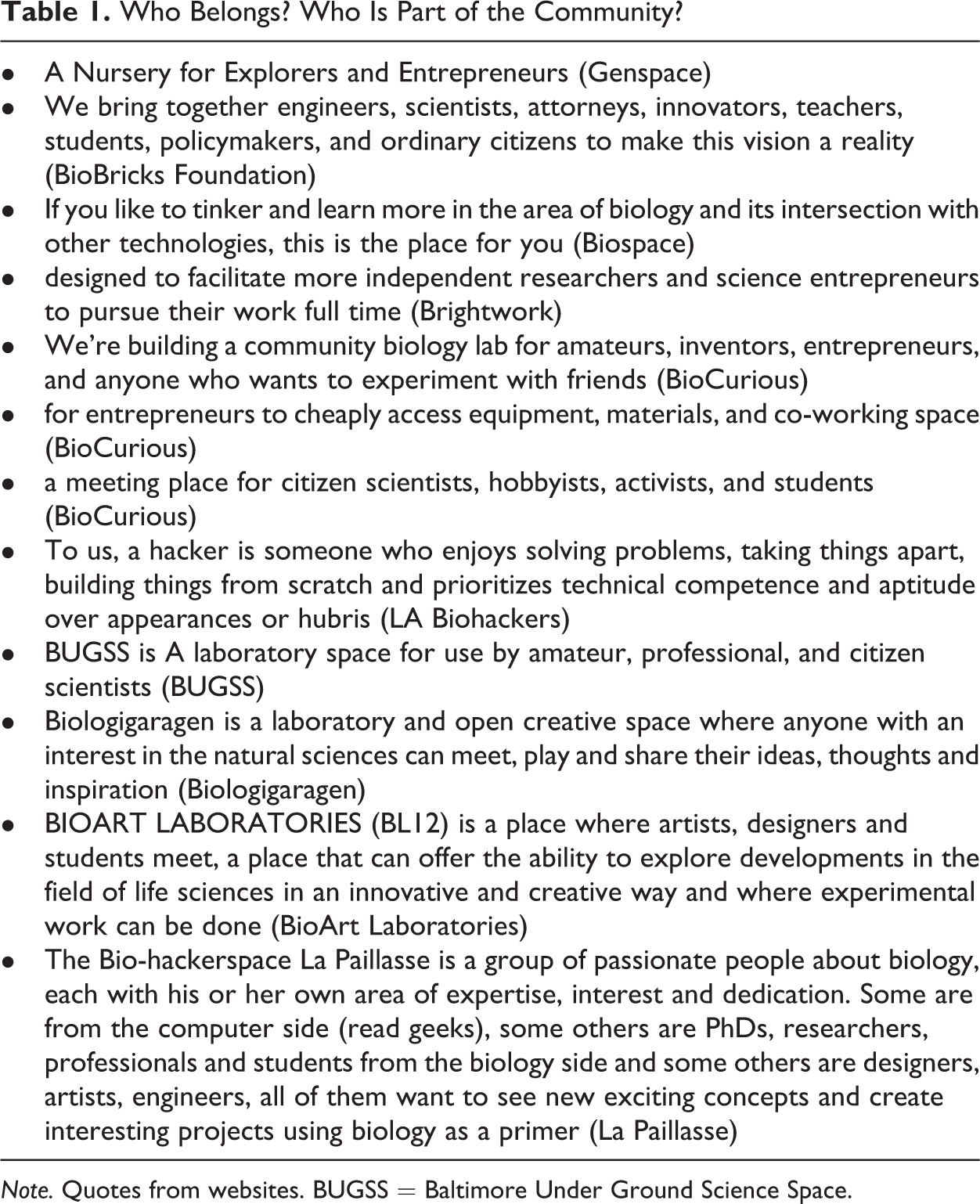
Note. Quotes from websites. BUGSS = Baltimore Under Ground Science Space.
Results and Analysis: Democratic Discourse in the Forming of the DIY Synthetic Biology Community
We believe fundamental scientific knowledge belongs to all of us…(BioBricks Foundation)
A common claim across democratic synthetic biology websites is that science belongs to everyone. This is posed as a right and a fundamental truth. The problem they pose and seek to correct through their work is that science has been kept out of the hands of ordinary people. Here, I first analyze identity claims that position DIY biologists as the public (despite close connections with traditional sciences) and then analyze assumptions underlying the value of democratic science in their claims. I show that a proper informed public is formed by positioning lab members as outside of traditional science but within acceptable social standards (in part by setting up racialized boundaries) and focusing on scientific literacy. Further, the assumption that an entrepreneurially driven science will be able to solve societal problems is embedded in the formation of this particular public. In the conclusion, I ask questions about what the boundary crossing between Science and the Public and assumptions about the value of democratic sciences might mean for science, ethics, and public participation debates.
Who Are “We”?
Throughout the websites, there are potentially conflicting claims—the organizers are both providing services to a community and are the community, they are also scientifically trained, believe strongly in the power of science for good, and are against science as usual and the science elite. Here, I wish to examine who the “we” and “all of us” are said to be through various examples on their websites. To break this question down into useful categories, I ask (a) what kind of person makes up the community and, importantly, (b) who is not included in “we.” (a) For the love of Science—Tinkerers just want to have fun?
Democratic-oriented synthetic biology projects are for “everyone,” “all of us,” “anyone,” and “the public” according to websites. So, who is everyone, who counts as part of the community these organizations serve? These organizations are for a type of person who wants to “tinker,” “explore,” and “create.” The community in these community-oriented organizations is made up of those who have a passion for science. Looking at Table 1, we see that this may include those who identify as tinkerers, hackers, artists, scientists, explorers, and/or entrepreneurs.
There seems to be an equally strong emphasis on science for fun and science entrepreneurship. I argue that this pairing naturalizes the capitalist spirit of innovation for profit. For example, “A Nursery for Explorers and Entrepreneurs” suggests innocence and the need for nurturing if exploring and entrepreneurship are to be properly developed. A particular public is formed here despite claims of inclusion for everyone. That public loves science has a drive to explore and tinker and thereby the spirit to create and profit. The subject of this public fits into what Willey and Subramaniam (2017) argue represents a shifting white masculine subject who is passionate about science, thereby making them more social/normal at the same time as being able to remain socially unaccountable through the naturalization of their asocial/genius brain. Elsewhere, I argue that a new subject, that of the Tinkerer, emerges by invoking (neo)liberal rights discourses (Giordano, Forthcoming). Here, I argue that the image of a nursery, which is associated with childhood, naturalizes the Tinkerer and their desire to innovate.
In social justice–oriented community science models, communities (including scientists) gather to solve problems that are specific to local communities. Curiously, this reason for coming to the lab (with an already identified problem) seemed to be mostly absent from the organizations. There are a few exceptions; the most explicit is from Biologigaragen in Denmark: We hope to foster a culture of citizen science with biological focus and to develop knowledge, tools and software that are available for people to develop solutions based on their personal, local and specific needs. (Biologigaragen) Our aim is to assist local associations, forward-thinking industrial partners and citizens in creating awesome biological projects. (Biologigaragen) (b) Who “we” are not!
In claiming what these spaces are and who they are, there are also claims about who they are not. Implicit in the claim that they are creating a democratic, transparent and accessible space to do science, is the assumption that this is in opposition to the status quo of science.
At times this is explicitly called out, for example: Unlike traditional institutions, our diversity is our strength and the source of our innovation. (Genspace) Access to the source of these [scientific] developments, the laboratory, is rare, and rules and protocols resulting from the scientific nature of these places, can hinder the freedom of the individual. So, a different approach is required…(BioArt Laboratories) Access to knowledge shouldn’t be limited to academia and all of the restrictions associated with it. (Biospace) With a gift to the UC Davis College of Biological Sciences, you don’t have to limit your philanthropic goals. You will be a key player in eradicating disease, feeding the hungry, rehabilitating the environment and developing sustainable energy sources, all while helping the next generation build a solid educational foundation for future scientific breakthroughs. (UC Davis)
This distancing from traditional sciences paints a rebellious, revolutionary image analogous to a popular narrative about the early days of personal computing. A closer look suggests that, perhaps also, and similar to the framing/selling of the story of computers, the DIY biology revolution has limits (Kelly 2009). Biohackers attempt to carve out space(s) between the elite scientific institutions that hinder their creativity and the criminal space of “the outlaw” (Kelty 2010). The distancing from the criminal or terrorist was evident on some websites. For example, LA Biohackers explain that hackers are not bad: Despite the common misconception in the media that “hackers” are villains bent on stealing national secrets or vandalizing your Facebook profile, the term has a much more benevolent meaning amongst the people to whom the term is applied. (LA Biohackers)
On many websites, there are references to adhering to safety regulations set forth by the government, which also alerts us to the limits of their societal rebellion. They are still law-abiding citizens. Their revolution is a measured one. For example, BioCurious states that it is “a training center for biotechniques, with an emphasis on safety” and that their “biology lab functions at a Biosafety Level—1 level, which is equivalent to what you would find in a high school biology lab. We require all our members to undergo safety orientation.” Although, “training center” is used in various contexts, considering the centrality of the specter of bioterrorism to the field, I want to suggest how we might read the choice of this phrase within this particular context. Here, the use of “training center,” which rings similar to “training camps” that have become associated with the precursor terrorist, seems here again to play on that boundary between rebellious and safe.
At the same time as terms such as “everyone” and “all of us” seem to code for a belief in a postracial society, evoking ideas of the terrorist, outlaw, or criminal have never been race or class neutral. Arguably, these images help to define these spaces as safe not only through the adherence to regulations but also through the racialized boundaries created through the distancing from antisocial actors and actions. In ethics debates, the first concern surrounding these new technologies and their regulation is bioterrorism and therefore bioterrorists. That means that the formation of this community of tinkerers has to be understood in the context of the ongoing “war against terror,” which has been used as code for a white US- and European-led war against “the Arab and Muslim world.” The color-blind application of inclusion for all thus already excludes those not considered “us.” This positioning allows this community to participate in ethical debates and work jointly against bioterror.
On the BioBricks Foundation website, “ethical” appears often in lists of descriptors of the kind of science they promote, suggesting that we are to understand it to be a fact of the kind of science rather than a process up for discussion. Ethics within these debates has often been reduced to safety concerns. Therefore, I read the consistent mentioning of “safety” as a way of alerting the public to their ethical behavior.
Why Should Democratic Science Be Important to All of Us?
For the most part, it is an unexplained assumption on the websites that democratic science is better. However, there are several implicit claims about why it is better and important. These claims fit into one or more of the following categories: (1) accessible science is a right, (2) democratic sciences will increase public interest and understanding of science through literacy, and (3) democratic sciences will create better science and science makes the world a better place. (a) Accessibility as a right
The right to science is claimed on almost each of the websites analyzed. Rights discourse in terms of social justice is used to combat exclusion (when a group is kept from enjoying the right in question). As I mentioned above, the organizers who typically have access to science already move back and forth between claiming noninclusion for themselves and on behalf of the larger public.
Biospace argues that “access to knowledge shouldn’t be limited to academia…” Here “shouldn’t be” indicates a broadly shared right to knowledge. The lack of access to resources in the academy itself has been a familiar critique from feminists, and others concerned about how access has been granted along gender, class, ability, and race lines. The critique found through these DIY websites often list educational, occupational, and sometimes economic barriers to access for all. The question of who should be the gatekeepers to scientific knowledge production is placed on the table, at least for the moment. However, in this moment, the opportunity for a closer examination of how gatekeeping works is lost through the quick dismissal of academia as the culprit and tinkerers as the group deserving of inclusion. My point is not to say that academia does not gatekeep. The larger picture, however, shows us that academia is not the only place in society where gatekeeping happens, and we must ask whether setting up shop outside the gates of academia means that everyone would have equal access (particularly if those setting up the shop have the access required to move freely between both spaces). The question has been central to those experimenting with democratic science projects and the idea of feminist sciences. For example, Longino (1987) argues that without a larger societal change, an ideal of feminist science cannot be reached. Researchers using community-based participatory research methodologies constantly evaluate the power dynamics between communities and their academic partners (Eubanks 2009; Minkler and Wallerstein 2011).
With discourses of rights come discourses of our responsibility to exercise our rights. This imperative to participate is evident on several websites. For example, BioArt Laboratories explains that it “is an initiative that aims to make this (biotechnological) progress and its implications the collective responsibility of society.” BioCurious “is a completely volunteer run non-profit organization…Joining the lab helps us continue to serve the community,” and Biologigaragen urges “participation” by specifying that it “is a user driven project which relies on active participation.” Through this imperative scientific citizenship is defined, and I argue the responsibility for inclusion is put back on those who participate or do not participate. This rhetoric is common in debates about electoral politics in the United States, in which populations (and individuals) not exercising their right to vote are blamed for the lack of representation of progressive politics.
(b) Science literacy/education
Related to the idea of a right to scientific knowledge is the goal of science literacy and education. DIY biologists do not simply advocate providing access to resources; they also demand access to the language of science. Several of the sites offer classes to members and/or nonmembers. These classes (sometimes called “workshops” and “training centers”) are hands-on and teach scientific methods to those who attend. In describing the importance of their workshops, Open Wetlab explains that they “emphasize the principles of demystification and democratization” (BioHack Academy) and this linking of democratization and demystification underscores the importance of science literacy for all. In another example, Biologigaragen states: The aim is to give these groups and citizens a space where they, without prior knowledge, can learn about the biotechnology around them—how it functions and how to apply this knowledge and self-made equipment in their everyday life. The best way to inform the dialogue about 21st century science is to have the stakeholders understand it from a hands-on perspective. To that end, we offer biotech classes to people with no prior lab training.
The concept of scientific literacy for the public has a history that some have argued is entwined with the history of public demands for more accountability and public criticism of new sciences and technologies (Giordano 2017). It is common in the sciences to argue that we must have a more educated public that will support science. When the public is skeptical of science, the response has generally been that “they” (the public) do not understand it properly. In contrast, science literacy for the general public has been pushed by social justice–oriented educators who believe in critical engagement with science (e.g., Roth and Barton 2004). Social justice advocates have argued for feminist or critical science education in which science is taught based on the needs of the community. They have argued for science education that will be useful in people’s everyday lives. They have also argued that science literacy should not be conducted for more public buy in but rather so that ordinary people can become part of critiquing and producing scientific knowledge themselves (Roth and Barton 2004). The invocation of these social justice arguments can be seen in the examples above. In the conclusion, I will consider what the effect of producing this specific, more informed public might mean. (c) More science = better world Become a member to make the world a better, more sciency place! (BioCurious)
Throughout the websites, the claim that science can make the world better is ubiquitous as an unchallenged assumption. This is not surprising, as others have found that in fields such as nanotechnology scientists believe strongly that science benefits society, thereby closing off conversations about broader ethics (Bassett 2012) The assumption in this case is paired with a claim that doing science in a more transparent and democratic fashion will create even better results. That is, put together, the assumptions lead us to: science does good for the world, so by having more science and more ideas there will be more progress and innovation, leading to an even better world. Although linking democratic science to better science has also been a claim of feminist scientists, the understanding of the link is quite different. In these new DIY science communities, the idea of democratic science seems to mean anyone can give input and practice science. The theory behind why this is better is that there will be more minds working on the project. Here quantity matters. Based on interviews with many synthetic biologists, including Drew Endy, Roosth (2013) found that there is a common belief in the field that their model of openness will lead to better biology. Feminist calls for more democratic science for better science begin from an assumption that science is not necessarily good (nor bad) but rather that science serves the interests of those who produce.it. Therefore, when feminists use the modifier better it indicates a hope that science will change for the better by putting science into the hands of marginalized groups because it might serve their interests thereby creating greater social justice. In contrast, it appears that DIY science communities begin with a vision of science as unquestionably good and so better modifies it to an even more awesome version. As the BUGGS site puts it, We have thermocyclers and centrifuges and incubators and all the other tools you’ll need to explore this world. (BUGSS) The mission of BosLab is to open scientific exploration to all & to help solve problems we face on Earth. (BosLab)
Conclusions
My analysis of the rhetoric of democratic science on synthetic biology community websites shows how these labs stake the claim not only of being part of the public (as opposed to institutional science) but, more specifically, the proper informed public. Here, I discuss (1) the discursive-material production of this public through the rhetoric of democratic science and (2) possible implications of this formation.
Becoming the Proper Informed Public
Based on the large percentage of DIY biologists who are members of traditional scientific institutions, Meyer (2013) argues that DIY biology is not an “established ‘amateur science’ but rather a ‘promised’ amateur science, a citizen science ‘in the making.’” (p. 123). It is this promise and what is “in the making” that I focus on here. Understanding publics as discursive formations (Warner 2002), I argue that the rhetoric of democratic science produces a specific public. A collective identity, tinkerers, is formed as an identity that should have rights (access to science). I do not mean this in the literal sense of trying to gain legal protection based on the tinkerer identity but rather that the most understandable and acceptable social justice discourse (in the West) of inclusion and rights is evoked in the forming of this community as disenfranchised. The use of universals such as “everyone,” “all of us,” and the use of “we” in opposition to traditional sciences that keep people out creates the sense of a public that transcends all lines of difference. At the same time, as they are established as a public in opposition to institutional science, the language on the websites makes it clear that they are good, law-abiding rebels. I add the qualifier “proper” in this context to signal that this sense of proper (as in respectable) is connected to their presentation as being the most appropriate (proper) speakers for the public based on their tinkerer identity. They are liberal subjects deserving of rights—they are proper citizens who are demanding inclusion and the right to do science. Through this careful construction, their demand for rights is just rebellious enough to appeal to a sense of justice, yet still nonthreatening to the (neo)liberal order from which (institutional, traditional) science garners its legitimacy in the first place. To be considered a legitimate public, they must appeal not only to the public at large but also to scientists. The appeal to scientists occurs through the promotion of science literacy and education, which demonstrates that the public will be informed.
Implications of Becoming the Proper Informed Public
What does the production of this proper informed public do? We should understand this formation not as creating a radical departure from the way science is done but instead as an ethics intervention. On some websites, the desire to engage directly in ethical discussions is mentioned. For example, consider once again Genspace’s statement that “The best way to inform the dialogue about 21st century science is to have the stakeholders understand it from a hands-on perspective.” Statements like these position these informed stakeholders to have a unique claim to being the proper public. In the tradition of liberal democracy, there is an imperative to join this proper public if you would like to have a say. However, as shown above, there is a specific type of person who belongs to this public; I show above that one requisite is that that person agrees with a set of assumptions and values about the ethical value of synthetic biology and genomic science. This (implicitly) produces illegitimate (and mostly illegible) publics who exist outside of this proper informed public. That this particular public is set up as those interested in innovation through biological tinkering means that all ethical questions arise after the assumption that science should be done. Therefore, the terms and boundaries of the ethics debates are prescribed in certain ways. There is the potential to delegitimize and cut off other public concerns about the ethics of genomic research (and other ways of knowing or seeking a better world) because of this claim to be the proper public. If science ethics is about being accountable to the public, and the boundaries of science and public are merged in this case, then there is no need for external ethics because these spaces represent the public itself.
As Reardon (2013) suggests, the call for justice in democratic genomic research has created a shift from concerns about scientists harming the public to a concern against bureaucratic (bad) interests against the public. Reardon suggests that the move to democratize and create justice through inclusion in genomic data collection and access to one’s own data has replaced ethical deliberations over genomic research that were seen as cumbersome and limiting scientific progress. She cautions us to pay attention to how these moves obscure broader ethical concerns about the choice to do genomic research in the first place, especially in light of indigenous activists’ concerns, both about more pressing social issues that are impacting their health and about not receiving adequate attention and funding. In the present case, an argument is discursively produced that may shape policy and broader public debates around the rights of tinkerers to freely innovate. Postracial and postfeminist discourses are evident in the neutral (color-blind, gender-blind) language of “inclusion of all.” This suggests that there is a lack of power analysis or deeper social justice concern in DIY synthetic biology’s calls for justice through more accessible science, ultimately meaning that dominant epistemologies will remain intact.
While ideas of a unified public sphere (where a natural rationality will lead to fairness and checks on state power [Habermas 1991]) are not new, critiques by other critical theorists of universality are not new either. For example, Laclau and Mouffe (1985) argue that even critical interventions to promote democracy as a universal misses the importance of difference along lines of identity politics. The claim to universality and the goal of consensus can silence dissenting, already marginalized opinions. Brown (1995), while agreeing with the problematic of universalizing moves in democratic discourse, has argued that it is important to be wary of identity politics, which are easily incorporated by capitalism’s flexibility through a neoliberal appropriation of inclusion politics and foreclose more radical possibilities for freedom. In the lab rhetoric of the synthetic biology community, we find a mobilization of both the idea of a universal subject—through language of access for everyone—at the same time as disenfranchisement discourse is used—pushing for the inclusion of tinkerers as a particular identity. This demonstrates the flexibility and dangers of neoliberalism in appropriating the language of democracy and the language of disenfranchisement. To heed Brown’s caution, we should pay attention to this move and ask more questions about what this appropriation of social justice language of expanding democratic control is doing.
As tinkerers become the disenfranchised subject in need of a “lab of their own,” the focus of ethics debates is redirected to the rights of the tinkerers, which not only might mean a lack of focus on traditionally disenfranchised groups but also may define the boundaries of the ethics debates around rights and access to science. Brown (2015, 128) argues that the way certain forms of inclusion and participation (in the case of governance decisions) have been incorporated without any real “capacity to decide fundamental values and directions…cannot be said to be democratic any more than providing a death row inmate with choices about the method of execution offers the inmate freedom.” She quite strongly argues that this kind of appropriation of democracy actually represents the “the language of democracy used against the demos (p. 128).” The present case is similarly superficial in its use of democratic inclusion—in this case into the institution of science. That is, I wonder if we are being offered a false sense of choice between institutional sciences and democratic sciences. Democratizing science projects within the academy or government (such as public engagement) have been criticized and analyzed for the ways in which Brown’s (2015) analysis often holds true (Tutton 2007). That is, that public engagement efforts are used simply to legitimize research and do not actually work to change or question research questions. I suggest that a self-organized democratic movement (such as DIY biology) may also appropriate in the name of the demos, and so we should closely analyze the possible implications of such a mobilization of democratic control over science.
Such mobilization produces a proper public to deliberate on ethical matters, and it implies that the mere formation of this public settles many ethical decisions. That is, the position (which already dominates much ethics discourse) emerges that there is an ethical imperative to advance scientific research for the public good. This is echoed in major policy reports as well. For example, The Presidential Commission for the Study of Bioethical Issues (2010) seemed to begin (and end) with the assumption that scientific progress itself is an ethical position. The idea that community laboratories may advance science for the common good is suggested in part through a narrative of returning science to a more pure form, before it was corrupted by big business and bureaucracy (though many have argued that science was never any more pure or objective [Harding 2004; Epstein 1996; Delfanti 2011]). In the case of tinkerers in synthetic biology community labs, at the same time as evoking social justice language and ideas for the rights of citizen scientists, the institution of Science remains good for creating a better world. We should be alert to this superficial appropriation of social justice rhetoric that ultimately excludes social justice claimants who might challenge the neutrality of science itself as part of making a better world.
Footnotes
Acknowledgments
Thank-you to Lindsay Ilana Turner for assistance with data collection and Courtney Caviness for research assistance during the final stages of revision. Thank-you to Angie Willey and Anne Pollock for generously reading drafts of this article and providing valuable feedback. Also, thank-you to two anonymous reviewers and the editors who provided excellent and thorough feedback.
Declaration of Conflicting Interests
The author(s) declared no potential conflicts of interest with respect to the research, authorship, and/or publication of this article.
Funding
The author(s) disclosed receipt of the following financial support for the research, authorship, and/or publication of this article: Support for this project was provided in part through The National Science Foundation (#1456707).