







Abstract
Recent discussions on technology and gender-violence prevention emphasize that technoscientific applications often advance pro-punishment logics that enact gendered inequalities. Less attention has focused on racialized dimensions and how technology might advance abolitionist and transformative justice agendas. In response, this article considers how inventors mobilize technology as a frontline response to sexual violence, in which technoscience—rather than police—enables individuals, friends, and family to provide safety and mutual aid. Through analysis of seven popular technologies produced between 2010 and 2020, this paper documents how their “abolitionist sensibility” is accompanied by fellow-traveler discourses that are unattuned to intersecting power relations. Findings suggest that while this sociotechnical imaginary is reacting to state power, it reinforces a race-neutral and techno-optimistic vision for building a violence-free future. These power-evasive politics may thus signal increased susceptibility to carceral creep and coercive surveillant regimes. After discussing these double-edge politics, I conclude by discussing power formations that are left unexamined in the imaginary and how to cultivate a counter-carceral praxis in line with transformative justice goals.
Introduction
In December 2012, thousands of young people in India took to the streets to protest the violent sexual assault of Jyoti Singh. The Delhi gang rape case captured the world’s attention, and overnight Singh became a global symbol of normalized gender violence and a consequence of the law and law enforcement’s failure to protect women (Figure 1). As hundreds of thousands of people marched and launched sit-ins at Parliament, Manisha Mohan, an aerospace engineering student at SRM University, took another action. She began exploring how new forms of wearable technology could assist women when police and legal institutions would not. The concept of wearable technology intrigued Mohan (2018), and she believed it held the potential, as she often says, “to give voice” to women who did not have one. At SRM University, and later at MIT, Mohan invented several anti-rape technologies, including an electrified bra, capsules that release repulsive odors, and Intrepid. The latter is a wearable adhesive composed of conductive hydrogel that when attached to a woman’s underwear can detect if it is forcibly removed. When triggered, it sends an SOS text of the wearer’s GPS location to a predetermined relative or friend rather than the police. Mohan’s technologies first received international acclaim after she won a fellowship in 2014 at the prestigious Innovation Scholars-In-Residence program, where India’s top inventors and thinkers present their latest innovations. In the following years, Western media outlets repeatedly covered her inventions, popularizing Intrepid as an example of how technology might offer a market-based solution to violence.

Delhi gang rape sparks mass protest at Raisina Hill, by Suzanne Lee, 2012.
Mohan is one of many inventors who believe technology can empower women socially and physically. As a kind of “popular feminism” (Banet-Weiser 2018), this development has also become big business. In January 2019, Market Research Future released an investment report speculating that between 2017 and 2023 the global market for such “smart safety technologies” will grow by US$52 billion. The report identified major players in personal safety technologies including well-known corporations such as General Electric and Ericsson, as well as Revolar, a small, Latina-owned company, formed in 2015 to produce wearable panic buttons that “empower women to stay connected to friends, family, and contacts anytime, anywhere.” Revolar’s panic button is a wearable device intended to give women autonomy and a sense of security from the pervasive threat of sexual violence through peer-to-peer support. Other popular products created by independent inventors include ROAR’s AlwaysOn panic button for hotel staff, and Undercover Colors’ SipChip, a single-use test for detecting “date-rape drugs” in beverages. (Undercover Colors’ company motto is “Science is one tool in our safety kit.”) Heralded as some of the #MeToo movement’s greatest successes (Campbell 2019), these products are part of a growing effort to use technoscience as a frontline response to sexual violence, knitting together traditions of the mainstream feminist movement with an emerging form of technological activism.
This article considers how inventors mobilize technology as a political practice of sexual assault resistance and to what extent it responds to interlocking systems of power. Specifically, this analysis reveals how, through their imaginative work, inventors link anti-violence technology to political action in which technoscience—rather than police—enables individuals, friends, and family to provide safety and mutual aid. As this normative vision comprises a “staging ground for action” (Appadurai 1996, 7), it seeks to mobilize gender equity through a power-evasive inclusion through technology paradigm. In this paper, I argue that through a kind of gender hegemony, designers position these products as a safety solution effective for all women, regardless of social location and without attention to racialization, class, and other social hierarchies. And, despite appeals to inclusion, reducing violence to matters of gender relations comes at a cost. Inventors do not ask how racialization saturates gender and other interlocking forms of oppression, such as class, sexuality, dis/ability, and citizenship. As a result, anti-violence inventors merely scratch the surface of the complex power relations underpinning sexual violence, sidestepping important struggles and sites of subversion within anti-rape movements (Combahee River Collective 1977; Richie 2000). In examining how anti-violence technology can articulate whiteness and gender hegemony, my purpose is not to criticize individual makers but to critique their efforts by pointing to the need for design and sociotechnical paradigms that are better attuned to dynamic power relations.
The findings presented in this article should thus be understood as part of a broader effort grappling with the complexities and paradoxes of anti-violence technology (see Bivens and Hasinoff 2018; Quinlan 2020; Sim 2021; White and McMillan 2020). By working outside of policing, which responds unevenly to survivor claims and criminalizes women of color and other minoritized people in systems of surveillance, control, and punishment (Ritchie 2017), I suggest we might still find resistant possibilities in the noncarceral affordances of these technologies. However, any transformative possibilities risk being lost when citizen-activists fail to recognize what Higginbotham (1992) calls the “metalanguage of race.” In other words, race, as a global signifier, shapes discursive understandings and representations of survivors and perpetrators. When race and other social hierarchies are left unattended, this anti-violence imaginary is subverted by a fragile “abolitionist sensibility” susceptible to what Kim (2020, 254) calls carceral creep, whereby carceral forces incrementally dominate a feminist movement once devoid of its presence and, in fact, reinforces whiteness as a normative standard and a consumer approach to addressing structural inequalities.
This article proceeds by briefly reviewing feminist critiques of anti-violence technology and summarizing theories of how sociotechnical imaginaries (Jasanoff 2015) function as political performances that enable and constrain particular social actions. After explaining my methods, I trace the imaginary that emerges in relation to seven popular products envisioned as empowering alternatives to police action and race-neutral social change. These include “smart” panic buttons (Intrepid, Nimb ring, ROAR, and Revolar), personal date-rape drug tests (KnoNap, Undercover Colors), and odor-repelling jewelry (Invi Bracelet). I conclude by discussing power formations left unexamined in the imaginary and how to strengthen a counter-carceral praxis of anti-violence technology.
Critiques of Anti-Violence Technology: Rape Myths and “Cute” Rape Prevention
Wearable anti-rape technology has existed in the United States since at least the 1970s, when inventors first began patenting wearable devices to prevent assault and identify perpetrators. In contrast to the discreet and miniature designs of contemporary products, the designs of these “first-wave” technologies (c1970-2010) were bulky and more physically invasive for the wearer. These defensive technologies took the forms of cut-proof or locking undergarments and weaponized female condoms with jagged “teeth” that would lock onto assailants’ bodies, serving as a mode of “street justice” and a method of identification (Shelby 2019). As many of these designs were intrusive or simply uncomfortable to wear, it is perhaps no surprise these early products were never commercial successes. A more viable landscape for wearable anti-rape technology began to form only after 2010, driven in part by advances in smart technology.
The rapid commercial rise of smart anti-violence technologies caught the attention of some feminists, who criticized these products for appealing to tired gendered tropes. In particular, feminists argued the designs of these products reinforce rape myths—prejudicial, stereotyped, or false beliefs about rape, rape victims, and rapists that serve to deny and justify men’s sexual aggression against women (Lonsway and Fitzgerald 1994). In the article “The Anti-rape Gadgets That Never Delivered,” technology writer Rae Paoletta of Gizmodo (2017, np) declared, “these products willfully ignore—or worse, play into—the widely debunked ‘stranger danger’ narrative surrounding sexual assault, especially when research suggests three of four rapes are committed by someone the victim knows.” In this way, anti-violence technologies often bolster rape myths by describing which situations are deemed dangerous, falsely suggesting strangers are most likely to be a perpetrators, and misidentifying what constitutes “vulnerable” and “safe” behaviors.
Outspoken members of the Western feminist blogosphere likewise cast “cute” anti-rape technologies as yet another way to put the onus of rape prevention on vulnerable women. In The Verge, Robertson (2014) levied a critique at the pink self-defense industry for further individualizing rape prevention. In The Daily Beast, Allen (2015) recounts how anti-violence strategies and technologies further the troubling expectation women can stop rape as it happens, reinforcing the myth that “rape is rape” only if physical resistance can be proved. Regarding Undercover Colors’ date-rape drug-detecting fingernail polish (a prototype never actually sold), writer and renowned activist Lindy West famously wrote on Twitter, “How about women don’t have to wear a special nail polish and dunk their fingers in every cocktail to not get raped?” (BBC 2014). Amid this public backlash about the gendered format of the product, the company abandoned the design in favor of the SipChip—a gender-neutral, date-rape litmus test that attaches to a keychain.
Scholars have voiced similar concerns about anti-violence technologies perpetuating gendered rape myths, commercializing assault, and disproportionately placing the burden of prevention on women. Media scholars Bivens and Hasinoff (2018) conducted an extensive analysis of 215 digital anti-rape smartphone apps and 807 of their features. They argue most products reinforced one or both of these two rape myths: sexual violence is most often perpetrated by strangers, and potential victims are responsible for preventing sexual violence. These findings point to a core tension between the discursive aims and the material realities of anti-violence technologies. Although anti-rape safety apps are meant to foster women’s agency and empowerment (White and Rees 2014), they paradoxically reify stereotypes of women as weak because they “construct women as physically and psychologically incapable of resistance” (McCaughey and Cermele 2017, 248). Moreover, while misrepresenting rape through gendered and racialized tropes, anti-rape technologies may increase tech-facilitated harms, “particularly in relation to the GPS communication technologies that allow many people to virtually identify where a woman is at all times” (White and McMillan 2020, 1129).
These fruitful studies offer valuable insight into how anti-rape products reinforce hegemonic beliefs about sexual violence and gendered vulnerability. However, they do not fully confront how interlocking systems of oppression shape the experiences and outcomes of using anti-rape technology. What is also overlooked in existing criticisms is that within this imagining, many anti-rape inventors—at least for now—call for an explicit break from policing and punishment as a frontline response to violence. That is, inventors of anti-rape technologies prescribe women’s safety as being inclusively managed not through carceral feminism (Kim 2020) or liberal law, but through a neoliberal model of consumption, gendered self-surveillance, and networked information technology.
Without endorsing the consumption or surveillance aspects of anti-rape technology, this framing offers possibilities to think outside of the retributive justice approach to gender-based violence and police reformist agendas. In this way, anti-violence technology politics align, at least in part, with abolitionist calls to transform how we deal with violence (Whalley and Hackett 2017), and in Kaba’s (2021, xviii) words, “envision a world where we address harm without relying on the violent systems that increase it.” Additionally, given how citizen-activists argue these products are the necessary “prescription” to keep women safe, I suggest anti-rape technologies are best understood as an anti-violence sociotechnical imaginary (Jasanoff 2015): a set of normative ideas, beliefs, and world-changing visions about technology’s central role in sexual assault prevention and gender equity. Recognizing violence prevention as a sociotechnical imaginary enables consideration of how innovation, research investment, and justice ideologies intertwine to shape social norms, and who is likely to be served by these political formations.
Sociotechnical Imaginaries as Performances of Power
Sociotechnical imaginaries are collectively held, institutionally stabilized, and publicly performed visions of how technology can produce a desirable future (Jasanoff and Kim 2009). The desirable futures of sociotechnical imaginaries are grounded in the dominant belief that technology orders chaos and brings about steady, positive change. As political performances, sociotechnical imaginaries are composed of “specific practices of storytelling and visualization, habits of organizing space and time, and structures of pleasure and anxiety” (Kenney and Mamo 2020, 193). In this way, sociotechnical imaginaries are constitutive and performative of politics that “not only help to reconfigure [people’s] sense of the possible spaces of action but also their sense of the rightness of action” (Jasanoff 2015, 23). Both state and nonstate actors, including activists and corporations, develop sociotechnical imaginaries (see Kroløkke 2019; Sadowski and Bendor 2019); thus, multiple imaginaries can coexist (in tension or productively). In querying power, sociotechnical imaginaries reveal how publics use technoscience to reshape their own identities, the identities of others, and their social environments outside of formal political contexts (Pickersgill 2011).
Multiple imaginaries have advanced technology’s role in sexual assault prevention, reporting, and investigation. For instance, the dominant notion that forensic science reveals the “truth” and prevents future crime by identifying criminals led to the initial development of the sexual assault kit in the 1970s (Quinlan 2017), which both encouraged mainstream feminist collaboration with police and proffered the illusion that forensic science, as a truth regime, would make the legal system more responsive to rape cases. This future never materialized, however, and decades later systemic problems in rape kit testing have prompted a new wave of rape kit activism aimed at tackling the backlog of untested kits (e.g., End the Backlog n.d.). Mirroring earlier normative stances, contemporary backlog activism is driven by a techno-optimism that Quinlan (2020, 6) describes as “tied to a broader faith in technology to rectify the injustices of discriminatory and prejudicial policing, bring justice to victims, and prevent future crime, as well as a trust in American criminal justice institutions to solve social problems.” Here, the pro-punishment discourse that police and law are the proper response to sexual violence (Richie 2012; Kim 2020) collides with the belief that using carceral technology leads to crime reduction and other social optimizations (Jefferson 2020; Carceral Tech Resistance Network 2021), despite evidence to the contrary.
The appeal to mobilize technology in violence prevention often carries techno-utopian imaginings embedded in particular power relations that introduce fellow-traveler discourses. Examining US government investment in bystander intervention phone apps, Beaton (2015, 111) reveals that while the state seeded the “idea of mobilizing social networks to prevent violence against individual women,” it was the app developer crowd who remade anti-rape politics. Rather than promoting classic women’s self-defense discourses of physical empowerment, app creators favored models of continuous digital self-surveillance, which they encoded into the designs of their products. As other scholars have pointed out, they also encoded gendered ideologies, which Kate Sim (2021, 2) notes constitutively “g[a]ve shape to [the] design, implementation, and use of such devices and software.” Although bystander intervention apps shift the locus of safety away from police and toward community, many app designs nonetheless advance coercive data and surveillant regimes, and sustain white heteropatriarchy through performative scripts.
Taken together, these observations highlight the multiple and complex imaginaries advancing technology’s role in sexual assault prevention, reporting, and investigation. Moreover, they underscore how different ideologies are infused into the form and function of technologies in ways that may generate two-edged outcomes. In this analysis, I engage these topographies of power to reveal how anti-violence products materialize relationships among vulnerability, safety, and social change with implications for the role of technology in transformative justice futures.
Methodology
To understand how inventors imagine technology as the future of rape prevention, this analysis draws on an archive of material on popular smart and wearable anti-rape products. It consists of the actual physical products, as well as primary and secondary source materials (n = 535), including product documentation and websites, product advertisements, TV product placements, news coverage of anti-rape technologies, blog posts, public presentations, and interviews with inventors, created between 2010 and 2020. To assemble the collection, I used targeted web searches, relied on the Internet Archive’s Wayback Machine to recover websites that were changed (e.g., Sadowski and Bendor 2019), and used Google Alerts from January 2016 through December 2019 to receive notifications of new products and online content. While multiple alerts often referred to the same product, this duplication was useful in identifying anti-rape products with an active e-commerce presence and that are popular enough to capture the attention of technology trade journals, bloggers, and news organizations. As I was looking for technologies whose sole purpose is violence prevention, I excluded smartphone apps (e.g., Bivens and Hasinoff 2018) as these are specialty software that do not greatly change the communicative function of a smartphone.
Producing the archive clarified the major players in the anti-rape market: Invi Bracelet, Intrepid, KnoNap, Nimb ring, ROAR, Revolar, and Undercover Colors. These companies/products received frequent or major news coverage, suggesting these are among the most visible anti-rape technologies and thus important to examine. Table A1 (see Appendix) provides background information on the founder-inventors and their companies. The majority of these products were developed by women (Revolar, KnoNap, and ROAR), by first-generation US immigrants (ROAR, Undercover Colors), or by inventors who self-identify as racial or ethnic minorities in the US context (Revolar, KnoNap, and Intrepid). The Nimb ring, Invi Bracelet, and Undercover Colors are the only products discussed here that are not produced by companies with all-women founders. Notably, the majority predate the 2017 mainstream #MeToo movement and 2020 anti-police violence uprisings.
This analysis surfaces commonalities and gaps identified across materials and contextualizes the material-discursive practices underpinning technological violence prevention. I developed thematic codes and theoretical explanations looking specifically at the intersections of violence, technoscience, and social change (Timmermans and Tavory 2012), and coded documents using ATLAS.ti. I focused particular attention on the presence of gender hegemony and the absence of how racialization and other social hierarchies particularize assault. In carrying out data analysis, I also reflected on ethnographic insights gathered from working with anti-violence organizations serving criminalized survivors between 2015 and 2021. As companies often adjust messaging and product features, I revisited product websites to ensure useful information was not overlooked and the analysis aligned with how companies imagine the significance of their technologies. This points to a limitation in studying commercial technology: messaging and affordances can rapidly shift. It also underscores that sociotechnical imaginaries—while stable—are adaptable to technological developments, political and market shifts, and cultural feedback. Nonetheless, through analysis, it became evident this imaginary envisions a violence-free future through the noncarceral technological rescue of vulnerable women.
Narrating Technology in a “World Free of Violence”
Inventors and proponents of anti-violence products perform an imaginary of tech-facilitated safety that departs from the dominant paradigm of carceral feminism by (1) narrating gender-based vulnerability, (2) emphasizing inventors’ expertise, and (3) prescribing gendered justice through a techno-fix. This analysis reflects on how the imaginary obscures and mobilizes gender and racial power dynamics, and how these insights can help develop counter-carceral technologies that more explicitly refuse the fellow-traveler harms of white logics, capitalism, and coercive and surveillant data regimes (see Cifor et al. 2019).
Constructing Risk, Narrating Vulnerability
Stories of anti-rape technology begin by establishing women’s vulnerability to sexual violence as a persistent threat and condemning the institution charged to manage sexual violence risk—police—as unreliable and limiting. That is, inventors narrate the legitimate threat of sexual violence in ways that suggests a mistrust of carceral logics and state power, thus warranting a consumer-controlled and technological solution.
In presenting this narrative, inventors communicate and quantify sexual violence risk by citing and hyperlinking to prevalence data from public health researchers and prominent advocacy bodies. While the Invi Bracelet is the lone detractor in articulating intersectional vulnerabilities, other inventors and companies are restrictive in their citational practices. They choose statistics that emphasize gender hegemony and categorical vulnerability, even when the research they cite includes information about how race, ethnicity, and sexuality shape vulnerability to violence. For instance, ROAR, a company that produces the AlwaysOn panic button for hotel staff and (formerly) the Athena for everyday use, 1 constructs vulnerability on their website through four statistics centering race-neutral gender identity. Under a header stating, “Every day, women face the threat of harassment, assault, and violence,” they note: “37% of women say they do not like walking home late at night; 65% of women have experienced street harassment; 1 in 4 college women will be sexually assaulted; and 1 in 3 women experience violence from their intimate partners in their lifetime” 2 (Figure 2). Although the sources hyperlink to research specifically detailing the different experiences of Native Americans, Latinas, queer Black women, and Asian Americans, 3 the company’s public-facing narrative repeatedly emphasizes hegemonic constructions of victimhood—meaning the false assumption there is a universal experience of vulnerability that subtly articulates white, cisgender, middle-class womanhood (Richie 2012, 92).
When anti-rape companies do narrate intersecting power relations as a factor in sexual violence, they focus on student status. On the KnoNap website, a cocktail napkin capable of detecting twenty-six of the forty most common date-rape drugs, visitors encounter three statistics—“one in three,” “one in thirteen,” and “one in thirty-three”—followed by this explanation: “1 in 3 women experience some form of sexual violence throughout their lifetime. 1 out of every 13 college aged [sic] individuals suspect having had a drink laced with a drug. 1 in 33 men experience some form of sexual violence throughout their lifetime.” 4 The cited statistics hyperlink to studies detailing how low-wealth, nonwhite, and lesbian and bisexual women are more likely to be among the one-third. However, on the landing page, KnoNap keeps the focus broadly on categorical gender identity and college age. Undercover Colors, who produces the SipChip date-rape drug test, 5 uses similar power-evasive citational politics, referring to risk rates for college students and simply “American women” (Figure 3).
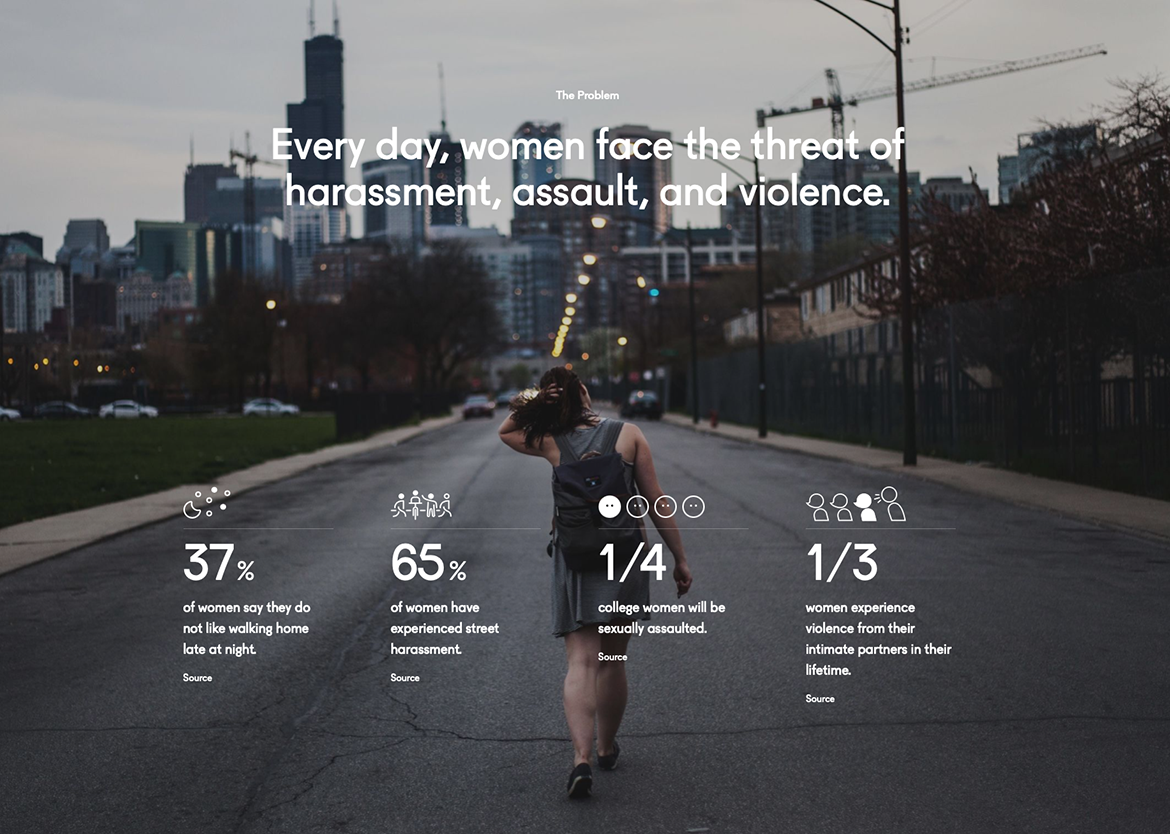
“The Problem.” Screen captured from https://roarforgood.com/pages/our-story by the author on November 1, 2018.
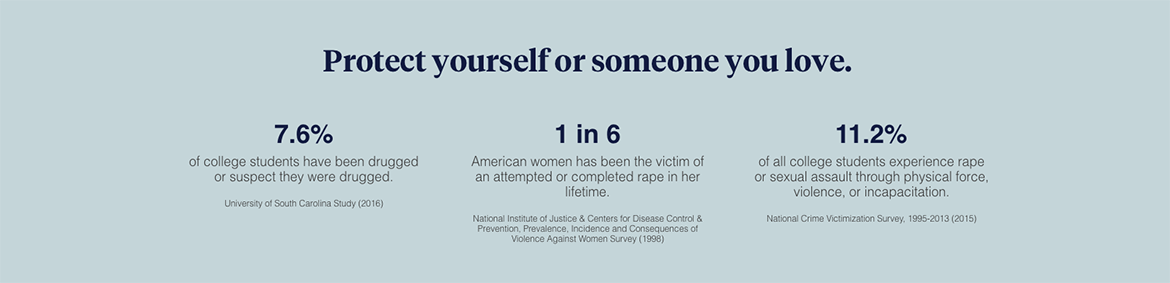
“Protect Yourself or Someone You Love.” Screen captured from https://www.undercovercolors.com by the author on December 15, 2019.
The strategy to selectively communicate vulnerability primarily and narrowly in terms of gender is intentional, as the companies are aware of the disparate vulnerabilities of people on the racial and sexual margins. Most companies cite statistics from RAINN, whose analyses draw on data collected in the US National Crime Victimization Survey. RAINN’s website communicates how race overdetermines sexual violence, by showing, for example, that Native American women are twice as likely as other ethnic groups to experience a rape or sexual assault. 6 Similarly, KnoNap and Undercover Colors hyperlink to research on college students discussing hierarchies in vulnerability based on cis- and transgender identity. This data describe that 21 percent of transgender, genderqueer, nonconforming (TGQN) college students have been sexually assaulted, compared to 18 percent of non-TGQN females and 4 percent of non-TGQN males. 7 In centering (cis)gender identity, anti-rape technology companies can presumably construct the widest possible customer base. However, in doing so, the anti-violence imaginary—as political practice—misses opportunities to foster transformative ways of thinking about how sexual violence is interconnected to other social justice struggles, such as racial, economic, disability, sexual, and trans justice.
Efforts to define sexual violence risk emerge alongside a diagnosis of how legal institutions and authorities are to blame for this continued vulnerability, revealing their abolitionist sensibility. Through anecdotes and tacit knowledge claims, the police and criminal legal system become a productive foil for communicating the utility of the companies’ products. In his 2016 Indiegogo campaign, Leo Bereschansky, the creator of the Nimb ring, a GPS-connected smart ring that sends out emergency alerts to preselected contacts, explains he developed the concept after his friend Kathy Roma was sexually assaulted and stabbed near a police station. The campaign includes a testimonial by Roma—who now works for the company—and describes how the smart ring directs women to community-based safety resources, emphasizing, “we believe that society is ready to provide its members with peer-to-peer help even in extreme situations.” 8 Similarly, the ROAR Athena user manual urges readers to “talk to your contacts about adding them as an emergency contact and give them a heads-up on what you want them to do in a distressing situation.” Rather than a call to police, emergency alerts go to friends and family who are identified as more reliable and responsive than state actors.
To further articulate the waning credibility of police and the criminal legal system in managing future sexual violence risk, proponents of anti-rape technology point out that even when police respond to calls and investigate cases, the logic of rape law requires proving lack of consent, thus creating fundamental challenges in prosecuting perpetrators. In a 2018 Forbes article, tech journalist Julian Vigo details problems with the legal response and argues the affordance brought by a technological silent witness will help women navigate their “precarious public presence.” He asserts, “Rape is one of the toughest crimes to prove and then to convict.…In the absence of better prosecutorial measures or the presence of a witness…technology offers victims a video witness to the crime or even the possibility of frightening away the would-be rapist.”
9
Revolar similarly positions its panic button as more reliable safety response and better experience than navigating the challenging sociolegal landscape. In a blog entry entitled “End Victim Blaming,” cofounder Jacqueline Ros writes: According to RAINN, 68 percent of sexual assaults are never reported. Why? There are many reasons.…[but] Women and men who try to report their assaults are put through a legal ringer that is emotionally exhausting. Often, they are made to feel ashamed as if they did something wrong…. Revolar will play a huge role in empowering individuals to stand against the odds by helping those who feel vulnerable have their voices heard.
10
Collectively, the sociotechnical imaginary resists instantiating feminist ideas into policing and state power and, instead, frames personal technology as facilitating the more reliable modes of safety located in interpersonal networks. Despite breaking from pro-punishment politics, proponents’ power-evasive language subtly articulates to whiteness and minimizes how experiences of interpersonal and state violence are constitutively shaped by race, sexuality, disability, and other intersecting oppressions.
Emphasizing Techno-entrepreneurial Expertise and Tacit Knowledge Standpoints
As knowledge workers in the imaginary, inventors use expertise to shore up the legitimacy of the anti-rape technology market through narratives about how products are driven by credible scientific knowledge production. Inventors express a classical conception of technoscientific expertise, demonstrated through statements about their entrepreneurial and elite “maker” identities that enable them to develop these objects and bring them to market. This expertise relies on the inventors’ stance as objective knowers well-versed in the scientific method. Paradoxically, in interviews, inventors express their subjectivity as racial, gendered, and/or ethnic outsiders and call attention to how their socially situated knowledge enhances their ability to address vulnerability. This amplification of standpoints stands in stark contrast to the gender hegemony expressed on their product websites—an absence likely attributed to their efforts to construct the widest possible consumer base.
Anti-rape companies foreground the expertise of their inventors through statements about their personal ties to academic institutions. The headline of nearly any article about Manisha Mohan’s inventions contains a statement about her prestigious status as an MIT-trained graduate student. The KnoNap advertisements emphasize Danya Sherman’s connection to George Washington University and provide a lengthy list of major corporations and prestigious technology organizations backing the product. 11 On the SipChip website, the “About” portion leads with the statement, “SipChip™ was created by the Undercover Colors’ team of scientists with more than 60 years of knowledge in lateral flow technology.” 12 The Invi Bracelet website simply offers a headline of “Pioneering Research” followed by descriptions of how Roel van der Kamp, the inventor of the bracelet, teamed up with Dr. Charmaine Borg, a psychologist at the University of Groningen, and linking to their peer-reviewed research on the technology. 13 Inventors’ connections to prestigious academic institutions and their use of the scientific method legitimate anti-rape products as being accountable to the epistemic and normative demands of survivors.
The imaginary makes clear anti-rape products rest on credible science practices that enroll women and women’s interests in the design process. For inventors, technology promises control over sexual violence, and they take care to describe how the power of technoscience can make this dream come true. On her website, Yasmine Mustafa of ROAR details how her team used qualitative techniques to determine the design for their wearable alarm, and suggests existing tools, like pepper spray, have a “user experience problem” 14 because women have to take them out of their pocket. On the ROAR website, the company reiterates that their designs are “backed by science,” with thirty-four months of extensive research and product development, twelve personal defense instructors and police officers interviewed, and 557 Athena device users tested. 15 Similarly, Manisha Mohan describes how she developed Intrepid by analyzing data from survivors and designing a study to gather feedback from 338 online participants and twenty users to “understand the real-world feasibility” of the product. 16 Mohan emphasizes that systematically testing these inventions in the real world is necessary to make the product relevant to women and argues her “technosocial approach can help improve user safety and prevent sexual assault.” Through such knowledge claims, inventors clarify that their products enable evidence-based safety, stabilizing the perceived reliability of techno-justice.
In interviews, some inventors also weave their tacit knowledge as “outsiders” into their “maker” identities to point out how they are better positioned to frame the commercial and social change agenda of anti-rape technology. In a 2017 Forbes article, ROAR’s Yasmine Mustafa writes about her background as an undocumented Kuwaiti immigrant and Gulf War refugee who had to work low-wage jobs in the informal labor market. She explains that working for “unscrupulous people who knew [she] had no other way out and could ask [her] for anything” catalyzed her “entrepreneurial” spirit and led her to her progressive ethics of tech labor. The article describes Mustafa celebrated receiving her US citizenship with a trip across South America, where “in every hostel and on every bus she’d hear stories from women about attacks, muggings, or sexual assaults they’d endured.” 17 After returning to Philadelphia and learning a neighbor had been sexually assaulted on the street, “that’s when the Athena was born.”
Similarly, Jacqueline Ros and Andrea Perdomo, the Latina inventors of the Revolar panic button, describe how their “cultural commonalities set a rock-solid [business] foundation” that strengthens their business and shapes the legitimacy of their product. In a 2015 interview for Smart Girls, Ros emphasizes that her intention for the product is a good-faith effort driven by personal experiences with acts of sexual violence. She describes, “I came up with the idea for the company and product when I was taking an entrepreneurial class in college. By the time I was a senior at the University of Florida, my sister was sexually assaulted twice. Several of my friends were raped. I had to do something. I used my graduation money to patent the idea.” 18 In this same interview, Ros evokes her multiple identities of advocate, maker, entrepreneur, and social outsider to invoke the common political idiom, “pull yourself up by your bootstraps.” Ros’s close friend, Andrea Perdomo, joined her in the start-up venture after Perdomo’s grandmother was kidnapped in Colombia and could not be located for eight months. 19 In a 2017 interview with Colorado Business Magazine, Perdomo explains the importance of her and Ros’s shared ethnicity. She said, “we have the same values.…I looked at her business through the lens of having been born in Columbia [sic] and moved to the U.S. with my family for safety and security purposes.” 20
While inventors blur the conventional boundary between their technoscientific expertise and their tacit knowledge as both women and racial and ethnic outsiders in the big tech world, they also describe how their nonwhite racialized identities become points of contention when asserting their expertise and promoting their technologies. In a 2017 interview with Women of Wearables, Perdomo elaborates on how she and Ros have faced challenges in the tech community because of their indentity. Perdomo said, “I didn’t want to believe that being a female founder would be different. But the more I got into this journey, the more I realized that people have unconscious bias about women. And for me, being young and Latina was just an added bonus.” 21 Ironically, these examples show founders’ awareness about how intersecting power relations shape one’s vulnerabilities—an awareness that, as discussed earlier, is absent from product promotions.
Prescribing a Techno-fix to Catalyze Social Change
Inventors synthesize their findings into easily digestible facts that cast anti-rape technology as a simple, self-controlled solution to address violence and vulnerability, and promote safety. Through this prognostic framing, inventors reconstruct the risk management affordances of their products into acts of gendered self-determination, personal judgment, and control over surroundings. The KnoNap website emphasizes their product is a passive, knowledge-increasing tool that requires no technical skills: “All someone has to do is place a few drops of their drink on a designated part of the napkin. If there is a drug presence, there will be a color change around the saturated area.” 22 The Invi Bracelet likewise describes how nonviolent forms of safety can be achieved in three simple steps: (1) press safety button, (2) pull with force, and (3) use scents for defense. 23 Through these synthesizing statements, inventors collapse the complexities of vulnerability and prevention into a single action or sequence performed by an individual at the moment a threat is encountered.
In line with other performances of the imaginary, articulations of techno-safety invoke gender hegemony. Undercover Colors combines the tagline, “Portable, discreet, fast, and accurate,” with an infographic illustrating how, in four easy steps, the SipChip product offers women a self-controlled safety mechanism: “All a woman needs to do is (1) carry the SipChip, (2) place a drop from her drink onto the strip, (3) wait for the results, and (4) check the results.” 24 The KnoNap calls for women to take control, using the tagline, “Because you are your first and best line of defense” 25 (Figure 4), while the Revolar urges women to “Discover the power of Revolar,” followed by a quick list of the object’s affordances, namely that it is “simple and fast,” “optimized for daily use,” and “small and stylish.” 26 These claims rearticulate anti-violence goals through “ready-made” design innovations. The ability to foster equity and prevent violence becomes achievable through a self-controlled techno-fix as a frontline form of safety—and it fits in a purse.

“You Are Your Best Line of Defense.” Screen captured from https://www.knonap.com by the author on December 15, 2019.
In a 2017 interview with The Guardian, Jacqueline Ros of Revolar describes how users of their product are part of a new mobilized public that endorses anti-rape products as a source of self-determination for all women: “whether it’s the mother of a transgender child who’s starting college, a domestic violence survivor who says it helps them get up and go to work every day, or someone who was raped as a teenager and has now bought it for their daughter. The technology has been applicable to so many more people than we ever imagined.” 27 Although a “transgender child” is mentioned, the assumed consumer is still, presumably, a cisgender woman. Moreover, founders do not make explicit connections to racial or trans justice projects that would more fully illustrate how community-based safety and intervention can disrupt not only violence within communities but also violence directed at communities—such as when police and other state actors are culpable agents of violence. In this way, the abolitionist sensibility of anti-violence technology can be characterized as “fragile” as it is unmoored from a political recognition of interlocking forms of violence that might foreclose carceral creep.
Under a motivational framing of fostering gendered justice, inventors offer a call to arms, inviting women and their allies to become part of the anti-rape technology movement through technological consumption. The tag line for Invi Bracelet announces, “We are building a global culture that rejects sexual violence and promotes equality.” 28 The company explains further that they are building “a world free of sexual violence,” and they “…invite you to join us. With the Invi Bracelet we make people more resilient, while spreading knowledge and awareness, because only then this world can exist. Join the strong people, wear the Invi Bracelet and help promote these values.” Undercover Colors similarly states, “We want to use our skills to help create change. Sexual assault is a complicated problem, but we believe the SipChip™ can help eliminate many situations in which sexual assault occurs.” 29 Likewise, ROAR adopts a techno-empowerment discourse, saying, “We envision a world where everyone can live their lives boldly…where technology empowers people to thrive.” 30 In their narration of techno-empowerment, individual responses add up to collective actions only through purchasing specific consumer devices.
In this framing, inventors articulate anti-rape technology as both responsive to the problem of violence and forward-looking in imagining a future where technology fixes the gender inequity that leads to sexual violence. Importantly, however, inventors understand technoscience not as an “end” but as a means to an end. On a 2019 podcast with Deloitte’s Chief Internet of Things Technologist Robert Schmidt, Manisha Mohan describes her hope that in five years, projects like Intrepid will not be needed. 31 In another interview, she reiterates that her product will catalyze cultural change, arguing, “The only thing that will truly impact rape culture is when people (mostly men) stop raping. To do that, we need holistic solutions, such as Intrepid, that address the trends toward objectification, violence, enslavement, and reduced empathy.” 32 She clarifies that “holistic solutions,” such as Intrepid, will “set the stage” for cultural change and “raise awareness.” Jacqueline Ros of Revolar similarly describes how users of the product comprise an important “movement of people taking back their lives…we don’t allow fear to make us hide.” 33 KnoNap echoes this social movement sentiment, emphasizing that the seemingly mundane nature of its product should not be minimized: “KnoNap is not a napkin company. KnoNap is a safety company. We work to empower, educate, and advocate against the issues of drug-facilitated sexual assault and crime.” 34 Through statements such as these, inventors use motivational language that suggests new forms of justice will be fostered through their products.
The Sociotechnical Imaginary as an Instrument of Legitimation
The anti-rape imaginary legitimates informal modes of justice that disengage from police and the retributive model of justice. That is, it maps an overarching structure that stipulates technological alternatives without expanding and strengthening policing and the criminal legal response. It also provides a mechanism for delivering this model to vulnerable people by using safety products to facilitate women’s access to family and community-based resources. A community-based or mutual aid strategy might yet push beyond the power-evasive models of consumption and surveillance these technologies promote. As an activist strategy, inventors and their companies could reinforce the relationship between vulnerability and intersecting oppressions to foster the immediacy of mutual aid strategies. They might acknowledge how the state participates in the peculiar and often violent surveillance and regulation of Black, Indigenous, immigrant, poor, and other marginalized people. They could still question why neoliberal policies have led to a retrenchment of resources that has made women of color more vulnerable to violence and devasted low-wealth communities and communities of color (Richie 2012). They might interrogate how networked communication technologies can increase the punitive surveillance of Black and poor communities (Browne 2015; Mason and Magnet 2012), and confront how their technologies can advance these projects. These actions could have meaningful outgrowths, as racist legacies and state-sponsored systems of surveillance produce precarity in Black and other women of color’s lives—even when seeking protection against violence in their homes (Ritchie 2017). However, without explicit recognition of these dynamic power formations, this kernel of a noncarceral ethos—to draw on the strengths of the community—legitimates other problematic onto-epistemologies.
The imaginary currently has little to say about racialization and its effects on vulnerability to interpersonal as well as state violence. Science and Technology Studies scholars decry such power-evasive techno-fixes as duplicitous, in that they perpetuate racial and socioeconomic divides (Benjamin 2019; Eubanks 2018). By universalizing vulnerability through an unstated premise of white racial homogeneity, this sociotechnical imaginary reinforces knowledge about sexual violence that legitimates the positionality of white, middle-class cisgender women. It neglects more radical sites of knowledge and resistance that recognize that socio-legal and socio-technical practices are constituted through intertwined race, gender, class, and postcolonial oppressions—and thus is likely susceptible to carceral creep. Black feminists have long disputed gender hegemony (Combahee River Collective 1977; Davis 1981). Such universalism masks how race, sexuality, class, dis/ability, and cis-normativity particularize sexual violence. As Benjamin (2019) argues, while technology can produce and reproduce racial inequality, it can also undo these practices through a critical consciousness that centers the margins. Getting there also requires confronting how data and devices may be put in service of nonconsensual and coercive practices.
The imaginary of anti-rape technology also legitimates consumption as a form of sexual violence justice. Investors rarely discuss the for-profit nature of their products, preferring to emphasize how their innovations will generate social change. Their attempt to minimize capitalist undercurrents is not surprising, yet it is undeniable that the cost of these products will be prohibitive for many women. This disconnect raises serious questions about the power-evasive inclusion through technology paradigm. As with carceral feminism, middle- and upper-class women will be most likely to reap the affordances offered by anti-rape technologies. The Revolar panic button, at $39.99, is at the lower end of the cost scale of these products, with the Invi Bracelet costing nearly twice as much, at $70. While even $39.99 is too expensive for many, the Revolar may seem quite affordable compared with the monthly subscription fee of $29.95 required to use the Nimb ring. The SipChip boasts $5 per test, yet someone concerned about drink spiking might use numerous single-use drug tests per outing, further limiting its accessibility. In short, poor women—who are multiply-burdened and are already disproportionately vulnerable to violence—are unlikely to be able to benefit from these interventions. This inequity is especially problematic as these women are subject to enhanced surveillance by police and the criminal legal system. Such an incongruity reveals how capitalism threatens the liberatory potential of noncarceral safety interventions.
Conclusion
Following other feminist analyses, this article illuminates how ideas about vulnerability, safety, and justice take form in sociotechnical systems. The aim is not simply to identify and criticize commercial rape prevention; rather, it is to draw attention to the need for design and technoscientific communication better attuned to dynamic power relations. As many feminist scholars have argued, inattention to interlocking systems of power undermines anti-gender violence movements and limits opportunities to attract allied justice movements. Without these political commitments, the fragile abolitionist sensibility of anti-violence technology could easily be supplanted with pro-punishment affordances through carceral creep that recenters police as frontline responders. Scholars, activists, and practitioners concerned with gender-based violence and noncarceral forms of justice are asking urgent questions about technology. As Parvin and Pollock (2020, 324) observe, “the work of design is also the work of reimagining social structures and organizations.” This analysis invites those concerned to actively pursue counter-carceral technologies, policies, and narratives that are conscious of dynamic power relations in such reimagining.
Footnotes
Author’s Note
This manuscript has benefited from panelist and attendee feedback received at a 2020 American Sociological Association panel organized by Safiya Noble.
Acknowledgments
The author would like to thank the anonymous reviewers and editorial staff for their generative engagement with this article. She also extends her gratitude to Mary McDonald, Kate Henne, Ray Noll, Steve Epstein, Héctor Carrillo, Jennifer Singh, Anne Pollock, and Sherie Randolph for their generous comments on earlier versions of this work and to the American Council of Learned Societies and Sexualities Project at Northwestern University for institutional support.
Declaration of Conflicting Interests
The author(s) declared no potential conflicts of interest with respect to the research, authorship, and/or publication of this article.
Funding
The author(s) disclosed receipt of the following financial support for the research, authorship, and/or publication of this article: American Council of Learned Societies (Mellon/ACLS Fellowship).

Notes
Appendix
Popular Anti-rape Technologies and Inventor Backgrounds.
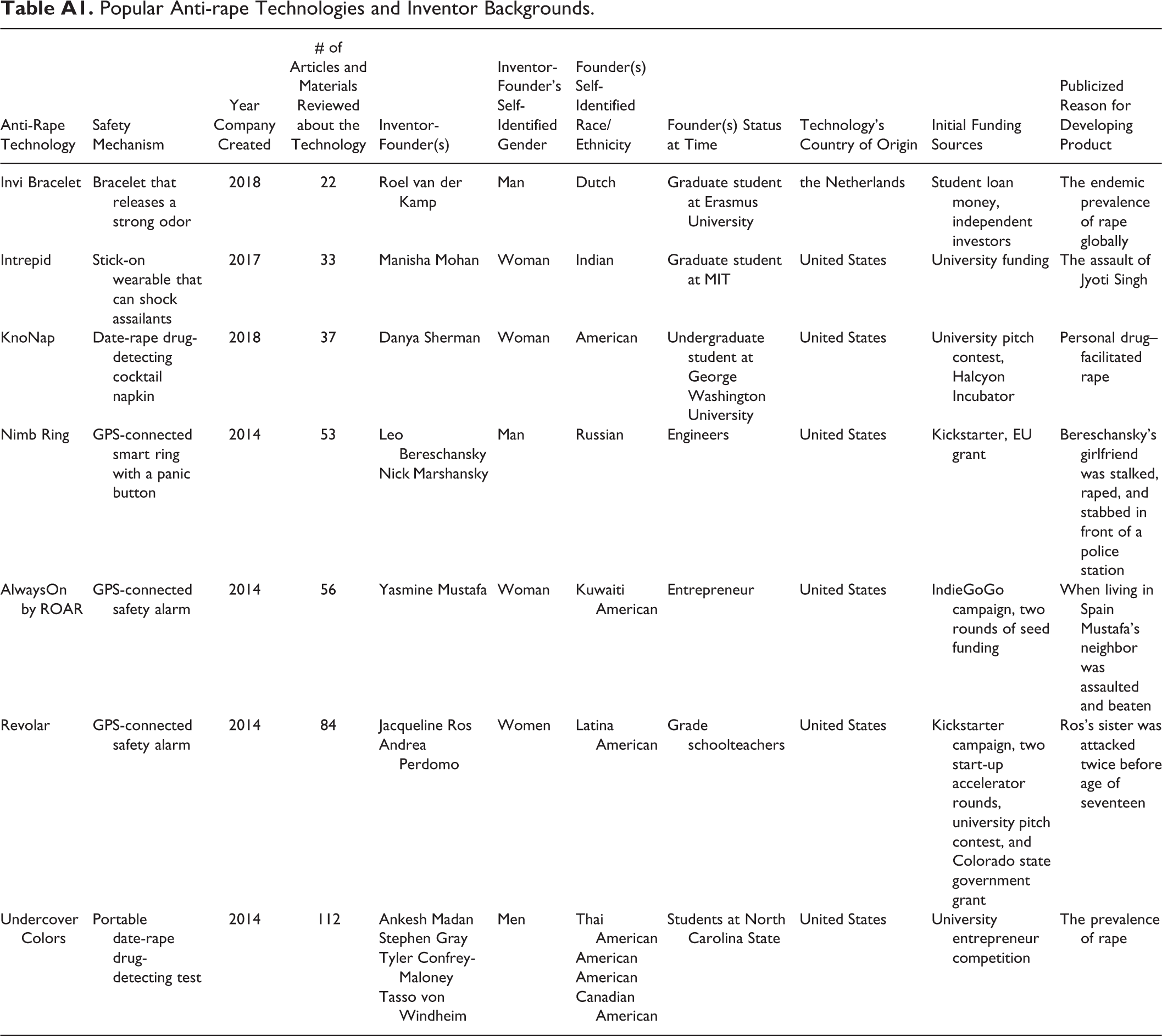
| Anti-Rape Technology | Safety Mechanism | Year Company Created | # of Articles and Materials Reviewed about the Technology | Inventor-Founder(s) | Inventor-Founder’s Self-Identified Gender | Founder(s) Self-Identified Race/Ethnicity | Founder(s) Status at Time | Technology’s Country of Origin | Initial Funding Sources | Publicized Reason for Developing Product |
|---|---|---|---|---|---|---|---|---|---|---|
| Invi Bracelet | Bracelet that releases a strong odor | 2018 | 22 | Roel van der Kamp | Man | Dutch | Graduate student at Erasmus University | the Netherlands | Student loan money, independent investors | The endemic prevalence of rape globally |
| Intrepid | Stick-on wearable that can shock assailants | 2017 | 33 | Manisha Mohan | Woman | Indian | Graduate student at MIT | United States | University funding | The assault of Jyoti Singh |
| KnoNap | Date-rape drug-detecting cocktail napkin | 2018 | 37 | Danya Sherman | Woman | American | Undergraduate student at George Washington University | United States | University pitch contest, Halcyon Incubator | Personal drug–facilitated rape |
| Nimb Ring | GPS-connected smart ring with a panic button | 2014 | 53 | Leo Bereschansky Nick Marshansky |
Man | Russian | Engineers | United States | Kickstarter, EU grant | Bereschansky’s girlfriend was stalked, raped, and stabbed in front of a police station |
| AlwaysOn by ROAR | GPS-connected safety alarm | 2014 | 56 | Yasmine Mustafa | Woman | Kuwaiti American | Entrepreneur | United States | IndieGoGo campaign, two rounds of seed funding | When living in Spain Mustafa’s neighbor was assaulted and beaten |
| Revolar | GPS-connected safety alarm | 2014 | 84 | Jacqueline Ros Andrea Perdomo |
Women | Latina American | Grade schoolteachers | United States | Kickstarter campaign, two start-up accelerator rounds, university pitch contest, and Colorado state government grant | Ros’s sister was attacked twice before age of seventeen |
| Undercover Colors | Portable date-rape drug-detecting test | 2014 | 112 | Ankesh Madan Stephen Gray Tyler Confrey-Maloney Tasso von Windheim |
Men | Thai American American American Canadian American |
Students at North Carolina State | United States | University entrepreneur competition | The prevalence of rape |