







Abstract
The more digital democracy applications lower the costs of political participation, allowing ordinary citizens to propose their own policy initiatives, the more they increase the burden of decision for the very same citizens, who are required to debate and vote on many issues. Drawing from this paradox, this article considers how the designers and administrators of six popular decision-making software (DMS) have introduced software features and norms of use whose function is to reduce the aggregate burden of decision for participants in digital democracy initiatives (DDIs). Building upon Andrew Feenberg’s definition of the design code of technology as a technical stabilization of social demands, this article considers how different DMS stabilize the democratic interventions of a plurality of actors, affecting political equality along two axes of the democratic process: the relationship between the exchange of opinions and the synthesis of opinion and the relationship between agenda setting and voting. This article concludes that the design code of digital democracy software reflects an ongoing tension between the need of governing actors to make the democratic process manageable and the pressure of social actors to make it more equal and inclusive.
Over the past decade, a number of decision-making software (DMS) and digital democracy applications have been introduced in the public domain. Designed to boost the participation of ordinary citizens in political parties as well as local and national policy initiatives, these applications have enabled a “second wave” of DDIs (Gerbaudo 2021). As compared to early e-democracy experiments, the initiatives of the second wave present three distinctive features, which concern the dimensions of technological innovation, normative regulation, and the actual scale of participation in digital democracy.
First, on a technological level, the second wave of digital democracy has been enabled by a new generation of software applications supporting decision-making functionalities. These were virtually absent from the first generation of e-democracy initiatives such as electronic town halls, discussion forums, and online petitions and polls (Smith 2009; Blumler and Coleman 2009). Because of their emphasis on deliberation and consultative nature, these experiments were criticized for incorporating a demanding conception of citizenship and for having a negligible impact on policymaking (Chadwick 2009; Vedel 2006). By contrast, on a normative level—the second dimension considered—the initiatives of the second wave are frequently binding. This means that they have a higher political weight and substantive impact on policymaking than the largely consultative processes of previous decades. For example, beginning in the 2010s, a number of cities around the world begun to involve citizens in urban planning and participatory budgeting projects via digital consultations. And some political parties, especially in Europe, have been adopting consultation platforms with the ostensible goal of empowering their ordinary members (Gerbaudo 2019). Third, on a social level, the initiatives of the second wave have enabled mass participation, reaching peaks of tens of thousands and even hundreds of thousands of participants in a single consultation.
Although they can be analytically separated, in actuality, the technological dimension, the normative dimension, and the sociopolitical dimension are closely interrelated within a DDI. For example, highly usable DMS and binding consultations are likely to encourage participation. In turn, rising participation is likely to legitimize the institutionalization of an initiative. Further, the initiatives of the second wave have been combining online and off-line engagement, deliberation and participation, in hybrid formats which have extended the scope of digital democracy (Elstub and Escobar 2019). At the same time, over the past few years, the second wave of digital democracy has begun to face a number of challenges. These range from declining participation rates to the low quality of deliberation to the limited substantive impact of some initiatives on legislation and intraparty democracy (Gerbaudo 2019, 2021; Borge-Bravo, Balcells, and Padró-Solanet 2019; Deseriis and Vittori 2019). It is unclear, however, whether such challenges must be primarily attributed to the design of such initiatives or whether they are mostly caused by nontechnological factors such as cyclic ebbs and flows in participation.
In order to assess whether and how software design affects democratic participation, we will distinguish between DMS and DDIs. Because DMS falls within the technological dimension of a DDI, the design of its functionalities and architecture can be analyzed relatively independent of the norms of use and the actual uses of the software. Further, DMS is designed to be used within the Internet, whose affordances abate the costs of participation to a wide range of social and political activities (Benkler 2006; Shirky 2008; Earl and Kimport 2011). This means that cost reduction is a “meta-affordance,” that is to say, an affordance that enables in turn other democratic affordances such as the capacity for individuals to remotely form groups, deliberate, and make decisions without delegation (Deseriis 2021). Thus, in the same way as forums, Usenet groups and email lists had reduced the costs of debating and deliberating in the 1990s, the DMS introduced in the late 2010s have reduced the costs of making decisions within a group, organization, or polity. But what is the impact of cost reduction on the overall quality of the decision-making process? And is cost reduction sufficient to increase political equality within a polity?
To address these questions, this article begins by noting that increasing the direct participation of citizens in the political process inevitably results in an increase of the aggregate input data. This raises the question of how such data are to be accessed, processed, and organized and by whom. Simply put, more information means more knowledge, and thus more power, whose distribution is, in the case of digital democracy, largely dependent on technological design. Theoretically, this problem will be framed by bringing together the critical theory of technology developed by Andrew Feenberg with Robert Dahl’s theory of the democratic process and Cass Sunstein and Edna Ullmann-Margalit’s concept of second-order decisions. Methodologically, the relationship between cost reduction and political equality will be analyzed through a comparative assessment of the functionalities of six DMS—Consul, Rousseau, Decidim, Pol.is, Loomio, and LiquidFeedback (LQFB)—which have been used in a number of DDIs over the past ten years. By combining a close reading of the DMS’s features and three semistructured interviews with DMS developers and administrators, this article will show how each DMS implements different strategies for reducing the burden of decision for users. In particular, we will demonstrate how different strategies of cost reduction affect political equality along two critical dimensions of the democratic process: the relationship between the exchange of opinions and the synthesis of opinion on the one hand and the relationship between agenda setting and voting on the other hand. As we will see, DMS and DDI designers deploy a variety of filters, which render the decision-making process more manageable but also embed power in technical implementations and norms of use over which users have often little democratic control.
Democratic Interventions into the Design Code of DMS
In order to ask whether and how DMS increases political equality, we must first clarify the scope and impact of digital technology. The dominant instrumentalist view of technology holds that technologies are just “tools,” that is, value-neutral means whose ethics and politics are determined a posteriori by their use. According to Feenberg (2017), the instrumentalist view values technology exclusively for its efficiency. Technological efficiency, however, is not politically neutral insofar as it “translates particular interests into technical arrangements conducive to the exercise of managerial authority” (Feenberg 2017, 57). This is evident, for example, from the way e-government applications often frame citizens as customers, allowing them to rate the efficiency of government services but without affording any decisional power in the actual allocation of resources (Sorice and De Blasio 2019). Against this technocratic view, Feenberg (2002, 2017) argues that social actors can challenge the instrumental rationality of technology via “democratic interventions” into technical codes which specify the functioning of particular artifacts or of entire technical domains. In limiting the power of experts, these interventions introduce norms and values into the “design code” of technology, which exceed the norm of efficiency: The code identifies the larger social meaning of technical designs, the stabilized intersection of social choice with technical specification…For example, the social demand for wheelchair-navigable sidewalks became a specification for construction projects. The rights of the disabled were translated into a specific slope. Taken in isolation the slope appears merely technical, but in its context it has a political significance captured in the code. (Feenberg 2017, 56-57)
In a similar vein, the design code of DMS stabilizes the democratic interventions of a plurality of actors and in particular of the transnational social movements against autocracy and austerity that emerged in the first half of the 2010s. For example, the design code of Loomio and Pol.is is inspired by the consensus-oriented decision-making protocols of the Occupy movement. Similarly, software such as Consul and Decidim encode the demand for “real democracy” of the 2011 Spanish indignados and the participatory impetus of the grassroots coalitions (convergencias) that won municipal elections in several Spanish cities in 2015. Finally, LQFB and Rousseau were initially released to satisfy demands for software tools that could scale decision-making from local meetings of activists in the German Pirate Party and the Italian Five Star Movement (5SM), respectively, to the national party level (Deseriis 2020).
The plurality of these interventions and the resulting variety of DMS suggest that there is no universal standard for how DMS is to be designed. If this variety is unavoidable, and even desirable, given the existence of alternative and competing models of democracy (Held 1996; Della Porta 2013), each DMS places a different type of burden on users. For example, consensus-oriented DMS is more demanding than DMS that is designed to support referendum-type consultations. Such differences, however, do not preclude the possibility of adopting normative criteria whereby the quality of different democratic processes can be assessed. In particular, the five criteria for an ideal democratic process outlined by Dahl (1989)—effective participation, voting equality at the decisive stage, enlightened understanding of the problems, control of the agenda, and inclusiveness—are useful to determine whether DMS contributes to increase political equality within the demos.
Dahl (1956, 1989, 2006) defines the concept of political equality in both substantive and procedural terms, allowing us to gauge whether a DDI satisfies norms and values that go beyond the norm of efficiency. Dahl’s (1989) first criterion—the effective participation of citizens in the decision-making process—rests upon the notion that citizens must have an adequate and equal opportunity to participate in decisions that affect their well-being and interests (p. 109). Thus, effective participation serves as a general principle and springboard for the following three criteria: the adequate and equal opportunity for citizens to participate in the opinion-forming process and acquire an enlightened understanding of the problems, the opportunity for citizens “to decide how matters are to be placed on the agenda” (p. 113), and the equal opportunity for each citizen to cast a vote on binding decisions. The fifth principle, inclusiveness, is rooted in what Dahl calls the strong principle of equality, which states that a political order can be considered “fully democratic” only if it does not exclude a priori a part of its adult population from the decision-making process.
Thus, effective participation is a general principle which can be broken down into three components: opinion formation, agenda setting, and voting. In this article, we assess how DMS affects each of these components by simultaneously lowering the costs of participation and multiplying the decisions participants have to make. The fifth and last principle, inclusiveness, could be operationalized by assessing the impact of the digital divide and DMS usability on political participation (Norris 2001; Van Dijck 2020). Due to the limited space available, we will defer this important task to subsequent studies, limiting ourselves to a few observations on the usability of DMS at the agenda-setting level.
Design-level Norms and Use-level Norms as Second-order Decisions
As noted, the design code of each DMS embeds a specific conception of democracy and of political participation. Thus, DMS that is based on a “minimalist” notion of participation—such as voting—places a lower decisional burden on users than DMS based on a “maximalist” notion of participation (Carpentier 2011) and a strong conception of democracy (Barber 1984). To borrow from Dahl, minimalist DMS only supports voting equality by allowing users to participate in plebiscites. By contrast, maximalist DMS also encourages the exchange of opinions and the opening of the agenda to all participants. From this perspective, DMS can be divided in two large families: plebiscitary DMS and deliberative DMS. Whereas such classification reflects a classic distinction between direct democracy and deliberative democracy (Held 1996; Kriesi 2005), most DMS does not neatly fall into either one of these categories. To be sure, DMS such as Rousseau and Consul are mainly designed to support referendum-type consultations. Loomio, Pol.is, Decidim, and LQFB, on the other hand, embed deliberative features, which allow users to set the agenda, debate proposals, and search for a common ground. At the same time, plebiscitary DMS often embed deliberative functionalities while deliberative DMS also include voting functionalities.
In spite of these overlaps, there is little doubt that collective agenda setting and deliberation are more complex and demanding processes than voting, especially when they are scaled to include hundreds and possibly thousands of participants. At the same time, high-frequency consultations via plebiscitary DMS can also place a significant burden of decision on users (Deseriis and Vittori 2019). Further, while sustained participation in various stages of a decision-making process highlights the democratizing potential of DMS, the more participation tends to increase the more it increases the burden of decision for users on the receiving end. Here, we investigate this democratic paradox along two axes: the relationship between the exchange of opinions and the synthesis of opinion, which concerns the quality of deliberative democracy, and the relationship between agenda setting and voting, which concerns the quality of direct democracy.
In order to alleviate the cognitive and decisional burdens users have to face under conditions of sustained participation, DMS designers rely on what Sunstein and Ullmann-Margalit (1999) call “second-order decisions.” These are nothing but strategies “for reducing the problems associated with making a first-order decision” (Sunstein and Ullmann-Margalit 1999, 3). Second-order decisions include a wide range of strategies such as rules, standards, routines, heuristics, small steps, and delegation (pp. 8-11). Sunstein and Ullmann-Margalit also note that second-order decisions can place a high or low burden on the agent at the beginning or the end of a process. For example, designing a rigorous standard for a selection procedure may be initially time-consuming. However, once the standard is defined, it allows the selecting agent to process a high number of applications with minimal effort. Conversely, an actor delegating someone to represent her interests may initially do so with minimal effort but may subsequently experience high costs to verify that the trustee is reliable.
In the case of DMS, the relationship between second-order decisions and decisional burden is complicated by the fact that the aggregate input of users inevitably affects the burden for each user on the receiving end. In order to alleviate this aggregate burden, DMS designers implement different strategies, which can be grouped in two types of filtering mechanisms: technological design-level rules and use-level norms. Whereas a technical filter is part of the software architecture and has a direct impact on end use, a use-level filter is typically managed by the administrators and moderators of a DMS after its release (Figure 1). A technical filter can be as simple as a software rule that subjects all proposals to moderation or that prevents users from discussing more than one proposal at a time. A normative filter, on the other hand, aims at regulating DMS use after its release. For example, two different city administrations may decide to introduce two different quorums for citizens’ initiatives presented via the same DMS.
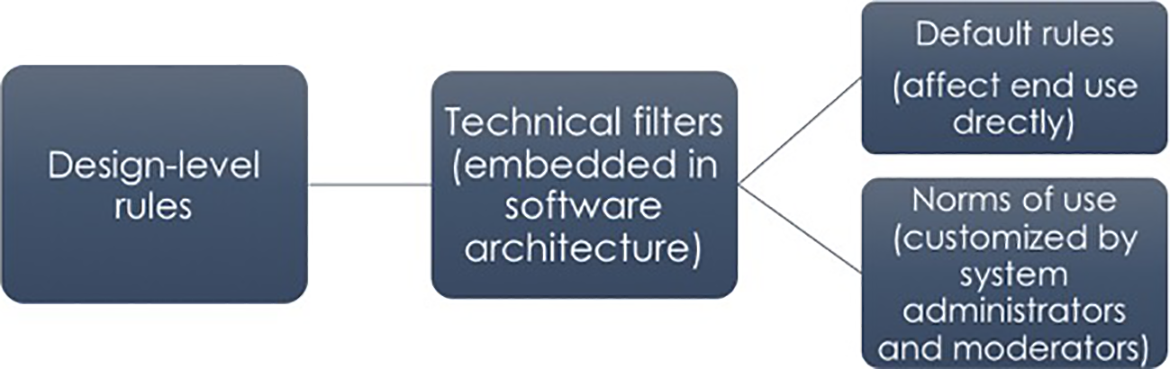
Second-order decisions in decision-making software.
Although use-level norms vary significantly from use case to use case, they are also part of the DMS’s design code. This is because software engineers set design-level rules within which a range of norms can be adopted and implemented. In this respect, use-level filters have the function of adapting different democratic models to specific contexts. In the remainder of this article, we consider how design-level rules and use-level norms affect the relationship between the exchange and synthesis of opinion on the one hand and agenda setting and voting on the other hand.
The Impact of Second-order Decisions on the Exchange and Synthesis of Opinion
DMS is a specialized type of software, which is mainly designed to transform users’ opinions into decisions. This operationalizing bias of DMS is nothing but an instance of the general capacity of algorithms to transform knowledge into information, that is to say, a question or a problem into a measurable output (Finn 2017). In this respect, DMS is not intended to inform and shape users’ initial opinion about an issue (whose formation is implicitly delegated to an individual’s primary group, social networks, political communities and institutions, the media, etc.). Rather DMS presents users with “initiatives,” “proposals,” “issues,” or “consultations” that require them to make one or multiple decisions. These may include endorsing a proposal for general consideration, suggesting amendments to proposals, rating other user’s statements and comments, or voting for or against a proposal. It is through this multistage decision-making process that users bring their opinions to bear on the final outcome of the process.
For this reason, in this section, we consider how deliberative DMS implements second-order decisions that affect the exchange of opinions among users as well as the synthesis of opinions. Among our selected cases, four DMS—Loomio, Pol.is, Decidim, and LQFB—embed deliberative software features. Within this group, it is possible to introduce a further distinction between two consensus-oriented DMS (Loomio and Pol.is) and two deliberative DMS that do not require users to reach consensus (Decidim and LQFB). In the next two subsections, we first consider the first group to then move to the latter. Due to their predominantly plebiscitary nature, Consul and Rousseau will only be considered in the next section.
Disabling and Enabling Rules in Consensus-oriented DMS
As is known, achieving consensus places a high burden on groups—a burden that increases exponentially with the expansion of the group size. In this respect, it must be noted that Loomio and Pol.is are designed for different audience sizes and different typologies of users. Loomio was originally designed by a group of New Zealand activists as an online extension of the physical assemblies held by the Occupy movement in various public spaces around the world in 2011-2012. As such, the software is intended for relatively small groups of activists or members of an organization who are already part of a community. By contrast, Pol.is was designed by a Seattle-based company as a scalable deliberation tool for addressing controversial issues within potentially large groups of social media users. Thus, if Loomio’s target group are small-to-medium collectives and organizations, Pol.is is geared toward medium-to-large organizations, which may be interested in polling their own members or the public at large. Notwithstanding this difference in scale, both DMS embed rules that reduce participants’ burden of decision. Such rules can be divided in two categories: disabling rules that prevent participants from discussing multiple proposals at the same time (Loomio) and conversations from escalating into flamewars (Pol.is) and enabling rules that nudge users toward consensus.
To begin with, both DMS allow users to submit and discuss only one proposal at a time. Whereas on a purely technical level this constraint is unnecessary, it exemplifies Feenberg’s definition of the design code as a technical stabilization of social choice. Indeed, if Loomio’s designers were to exclusively follow the norm of efficiency, they would allow the submission of multiple proposals at the same time, given that asynchronous communication is a native and nearly universal feature of online media. However, as Richard Bartlett, one of the cofounders of the Loomio collective explains, the software designers have chosen to disable such option: We often hear from people who want to be able to write multiple proposals at the same time. But we do not offer that option, because a proposal is designed to have the undivided attention of the group. That functionality would be diminished if we would have multiple proposals running at the same time. You are in a different set of mind when you ask yourself what the group can agree on. We want to push people towards convergence, without frustrating them and allowing for a certain degree of flexibility. (Bartlett and Deseriis 2016, emphasis in original)
Similarly, Pol.is is an artificial-intelligence facilitated deliberation tool designed to engage social media users in conversations on controversial issues while avoiding some of the pitfalls of online discourse such as flamewars and trolling. As a “generative” polling tool, Pol.is introduces a clear division of labor between those who start and administrate a conversation—typically, a formal organization which can pay the company for providing the service—and those who are meant to participate in it. Whereas such division does not allow ordinary users to submit their own proposals, it allows them to participate in a structured conversation, which is partly guided and partly spontaneous. After framing the initial question, the administrators of a Pol.is consultation “seed” the question with a variety of opinion statements, which are meant to catalyze the first responses. Users can “approve,” “reject,” or “pass” the seeding statements that are presented to them. They can also write their own statements, which are forwarded to other users for rating. However, users cannot directly reply to each other. Colin Megill (2016), CEO of Pol.is, explains the choice of disabling replies with the impossibility of scaling dialogue beyond a certain participation threshold: If you think about it, sitting in a stadium of 100,000 people if you can talk directly to someone across, and then someone else can talk to you, this information structure just breaks immediately. I think trolls kind of helped us realize how broken this information structure is. Basically, replies, at scale, don’t work. We did away with replies. That’s part of the core, that’s part of the foundation.
Disabling direct replies is not unique to Pol.is. Such feature first appeared in Your Priorities, an Icelandic participation platform that displays comments for or against a proposal in two separate columns with the goal of assessing support and facilitate decision-making, without letting users engage in personal attacks (Simon et al. 2017, 45). In Pol.is, this anti-flamewar feature is coupled with a dynamic polling system that allows a machine-learning algorithm to process user’s responses in real time and cluster participants in opinion groups. Thus, administrators can easily identify the statements users belonging in different opinion groups agree upon and build on them for developing new statements, which may further expand the ground for convergence.
This last point shows how the disabling rule that prevents flamewars and trolling is coupled with protocols that positively support the search for consensus. Administrators can in fact rely on a dynamic map—updated in real time—to easily identify the relative position of each opinion group (Figure 2). Further, users themselves can visualize the position of their own group on the map and appreciate how it changes relative to other groups as they rate statements or write their own. In this respect, Pol.is’s user interface has a reflexive function, which puts all users in the condition of participating in the search for consensus.
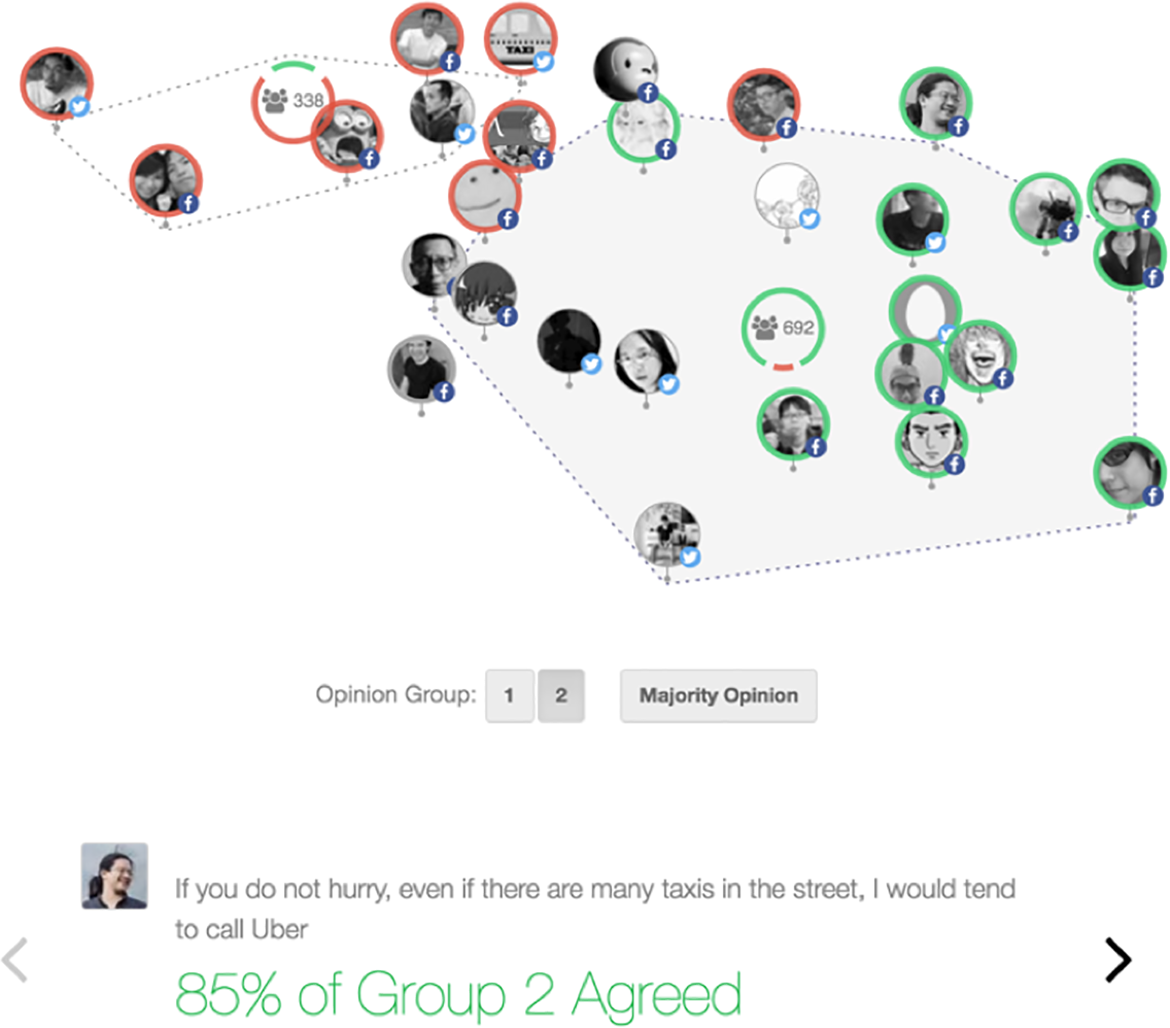
Screenshot of Pol.is-based consultation on licensing of Uber vehicles held in Taiwan in 2016.
The reflexive function of visual aids is not unique to Pol.is. It also appears in Loomio, whose UI includes a pie chart, which displays the percentage of users who “agree,” “disagree,” “abstain,” or “block” a proposal. Discussions in Loomio group do not differ from those held in mailing lists and online forums. However, when a participant decides to draft a proposal, all users in the group receive an invitation to indicate whether they agree or disagree with it. As Bartlett notes, rather than marking the end of the decision-making process, the proposal functions as a fresh invitation for everyone in the group to participate again. At that point, it is really common for those who had not participated in the discussion to come back and express their opinion about aspects of the conversation that had been neglected or downplayed. The added value of Loomio is that the deliberation and the conclusion are displayed side by side. The disagreement is visualized through a pie chart, in a way that you must pay attention to it, so that the concerns can be resolved. (Bartlett and Deseriis 2016)
In sum, although they operate at different levels of scale, Pol.is and Loomio share two types of design-level rules (or second-order decisions): disabling rules, which alleviate the decisional burden by removing common features of online forums such as parallel voting processes and direct replies; and enabling procedures, which break down the burden of searching for consensus into a series of user choices. These are algorithmically aggregated and visually represented as temporary group outcomes, which are offered to participants for further reflection and adjustment. This means that the burden of synthesizing different and possibly conflicting opinions is evenly distributed among participants, even though some participants—namely, the initiators of the discussion—may have a more active role in steering the group toward consensus.
Finally, it is worth noting that although Loomio and Pol.is were originally designed to support consensus-oriented decision-making, both DMS—and Loomio in particular—can be customized to support decisions based on qualified majority or simple majority rules. This is because most DMS is designed to support a variety of processes so as to expand the range of potential uses. As we will see in the next section, a nonconsensus-oriented deliberative DMS such as Decidim can also accommodate a wide range of participatory processes.
Exchange and Synthesis of Opinion in Nonconsensus-oriented Deliberative DMS
Although reaching consensus can be demanding and costly, the idea of breaking down the decision-making process into discrete units is by no means exclusive to Pol.is and Loomio. Decidim and LQFB also divide the decision-making process in distinct phases and actionable steps with the goal of allowing participants to debate proposals while eschewing the search for consensus. Further, similar to Loomio and Pol.is, Decidim and LQFB are designed to address different types of publics. Whereas LQFB was launched in 2009 and quickly adopted by the Berlin branch of the German Pirate Party to develop its political program and prepare resolutions for party conventions at the federal party level, Decidim was released in 2016 by the City of Barcelona to encourage citizen participation in urban planning and participatory budgeting projects (Jabbusch 2011; Barandiaran and Calleja-López 2018).
Thus, Decidim institutionalizes participatory processes that are locally grounded and mostly focused on the allocation of resources. More specifically, the DMS is meant to function as a digital infrastructure that supports four types of participatory frameworks: initiatives, processes, assemblies, and consultations (Decidim 2020). Each framework treats the opinion-forming process differently. For example, in the case of the assemblies functionality, Decidim simply provides contact information and an event calendar for upcoming meetings of groups and associations as well as links to meeting proceedings, where available. Thus, this functionality has a negligible impact on the deliberative process, which occurs almost exclusively within off-line meetings. In the case of the processes functionality, however, registered users can debate urban plans and participatory budgeting projects via an interface that supports conversational threads. The UI allows users to endorse proposals and comments as well as to mark their own comments as positive, neutral, or negative, a design that is meant to spark debate and promote deliberation (Aragón et al. 2017). This design, however, does not guarantee that deliberation will effectively occur within the platform. Rather Decidim reduces the burden of decision through the adoption of a hybrid model of participation which outsources some components of the deliberative process to neighborhood assemblies and some others to traditional representative bodies.
In contrast, LQFB is designed to scale agenda-setting, deliberation, and voting within the platform. In particular, LQFB’s design-level rules address the question of the synthesis of opinion by granting the proponents of an initiative the right of accepting or refusing amendment suggestions. At the same time, initiators have to strike compromises if they want to successfully advance their proposals through the four phases of LQFB’s decision-making process: admission, discussion, verification, and voting (Figure 3). In this way, proponents must win the support of other participants and especially of those users who have signaled that their support is subordinated to the implementation of their suggestions.
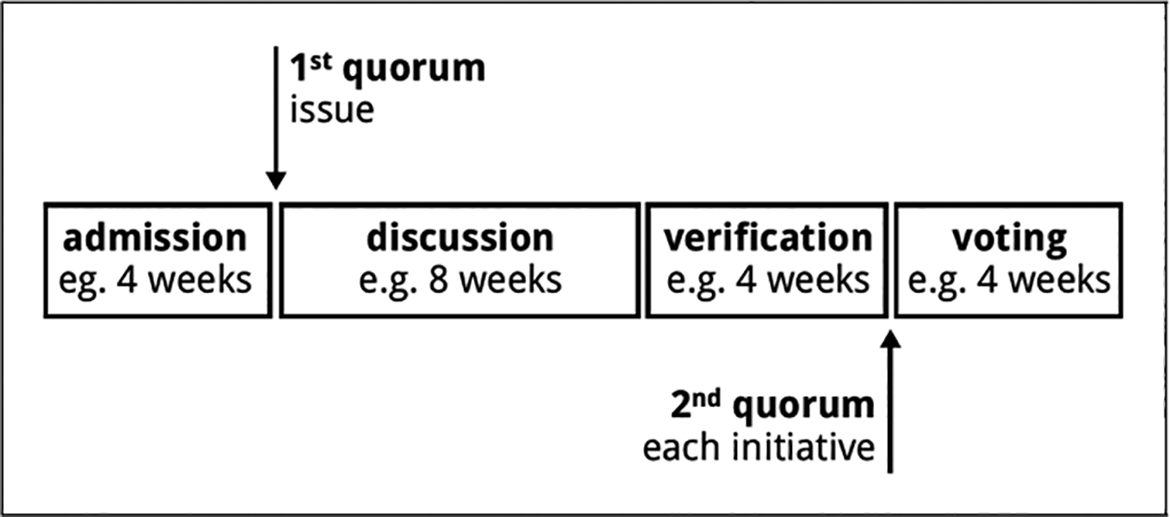
The four phases of LiquidFeedback’s decision-making process (Behrens et al. 2014, 67).
This is particularly true of participants who hold a high number of proxy votes. Indeed, the most defining feature of LQFB is that users can transfer delegations to other users. These can in turn transfer their own vote and the received proxies to users they trust for making a decision on a specific initiative, a topic area, or everything. Martin Haase, a member of the Pirate Party who received a high number of delegations in LQFB, notes that transitive delegations can be difficult to handle because users have to ask themselves multiple questions: Who is the person I want to delegate to? Has this person delegated to other people? And what happens if I don’t take part in this ballot? You have to think quite a lot about it. So even if it is simple in principle, the implications are difficult. (Personal communication, October 21, 2016)
Further, transitive delegations can create significant differences in voting power among users. Indeed, it is not uncommon for delegates at the end of one or several delegation chains to hold far more proxy votes than the average user. According to the LQFB’s designers, this imbalance does not constitute a democratic deficit because proxies can be revoked at any time. In particular, intermediate proxy holders can keep in check the power of those who hold many delegations by threatening to withhold their support if their requests are ignored (Behrens et al. 2014, 32). This means that the so-called superdelegates—a term introduced to describe LQFB users who held a high number of delegations—must maintain a cooperative style of leadership. Similarly, the proponents of an initiative must always be open to potential amendment suggestions, so as not to alienate potential supporters.
In sum, in this section, we have considered two consensus-oriented and two nonconsensus-oriented deliberative DMS. We have also seen how trust and scale are important variables that affect software design. In the case of Loomio, scale is reduced and trust is based on preexisting social ties, which are leveraged to nudge users toward consensus. At the same time, the whole group is encouraged—through the support of a reflexive visual aid—to search for consensus. In this sense, drawing from the aforementioned work by Sunstein and Ullmann-Margalit (1999), it can be argued that second-order decisions in Loomio follow a low-high distribution, that is, the burden of decision is low at the beginning of the decision-making process but increases as participants search for consensus. In contrast, in Pol.is, scale is potentially large and the exchange of opinions does not rely on preexisting networks of trust. If achieving consensus in such a scenario is potentially quite costly, the DMS designers combine a number of strategies to reduce the collective burden of decision. First, the user-friendliness and habitual use of the social media UI lower the costs of access to the DMS. Second, the impossibility for users to reply to each other removes the risk of interpersonal conflict. Third, an algorithm performs temporary syntheses of opinion by clustering users into opinion groups. And fourth, the final synthesis of opinion is delegated to the promoting organization, which makes decisions based on the poll results. Thus, second-order decisions in Pol.is follow a low-low distribution as users ultimately engage in the process just for the duration of the poll (Table 1).
Typologies of Second-order Decisions in the Deliberative Process.
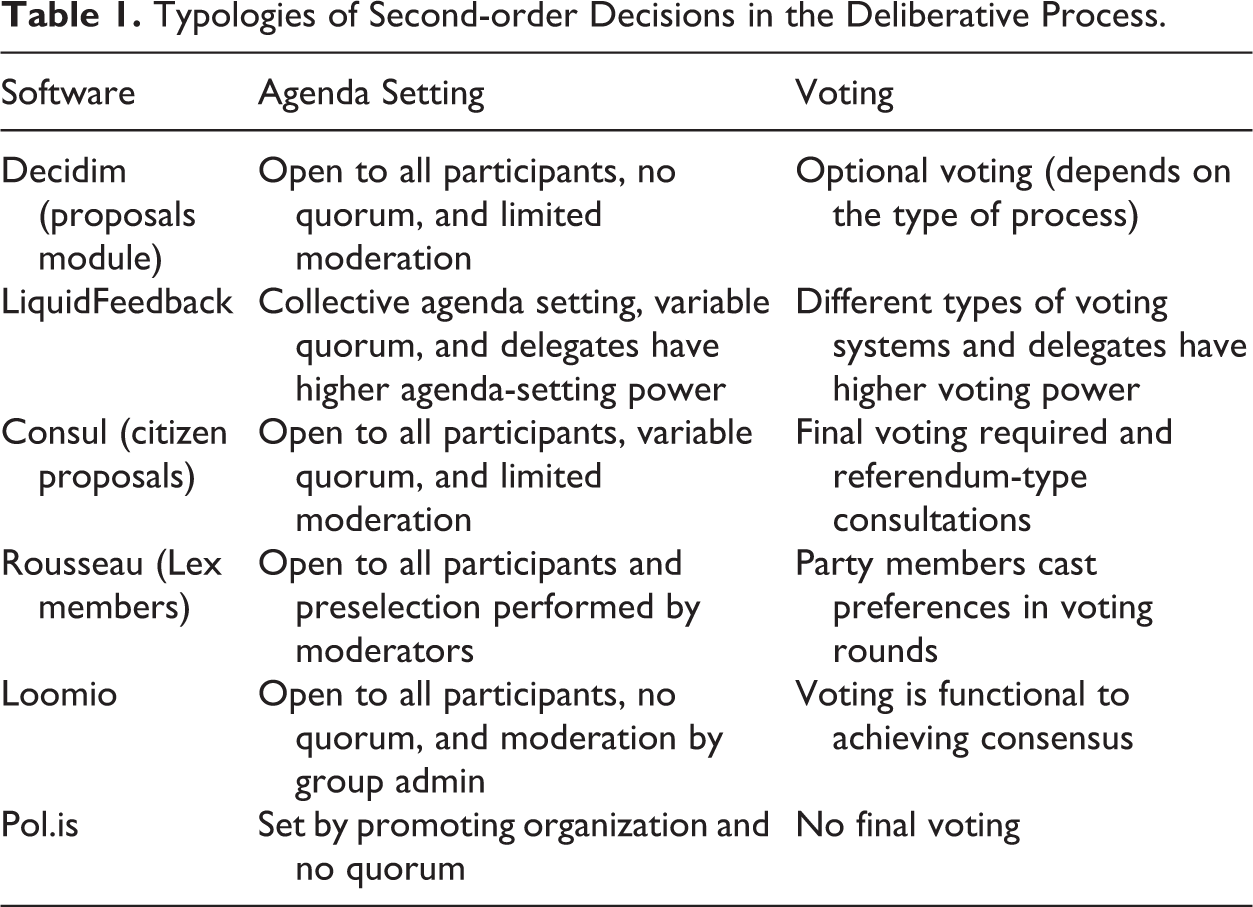
With regard to LQFB and Decidim, nonconsensus-oriented deliberation reduces in and of itself the aggregate burden of decision for the group. In the case of LQFB, the software is designed to reward competence and promote specialization via the transitive delegation system. However, allocating delegations is a demanding task. For this reason, transitive delegations are a type of second-order decision that can be classified as high–low, that is to say, a decision that is initially costly but that spares participants the need of having an opinion on each and every issue. Finally, the fact that the proponent of an initiative is in charge of performing the synthesis of opinion further reduces the burden for the group. In the case of Decidim, the exchange of opinions is largely delegated to assembly meetings and individual users—with limited in-platform interaction—while the synthesis of opinion is performed after the end of the online process. Thus, because of its reliance on a preexisting social and political infrastructure, this type of second-order decision can be classified as low–low (Table 1).
Overall, as shown in Table 1, designers implement a number of strategies to reduce the burden of decision for individual users, which can be grouped in four types of second-order decisions: (1) internal delegation to other users of the system (LQFB), (2) externalization of the synthesis of opinion to organizationally appointed facilitators (Pol.is and Decidim), (3) delegation of intermediary syntheses to algorithms (Pol.is), and (4) external reliance on preexisting social ties (Loomio and Decidim).
The Impact of Second-order Decisions on Agenda Setting and Voting
As noted, according to Dahl, effective participation entails that members of the demos must have adequate and equal opportunities to place matters on the agenda and vote at the decisive stage of the decision-making process. Agenda setting and voting are strictly connected in citizen-initiated mechanisms of direct democracy (CI-MDDs; Altman 2011, 2019) such as citizens’ initiatives, recall ballots, and referendums insofar as citizens have both the capacity to place issues on the agenda and vote directly on any issue. Whereas CI-MDDs are constitutionalized in polities such as Switzerland, California, and Uruguay, they have also been recently introduced—albeit with a lower degree of institutionalization—in several Southern European and Latin American cities as well as in political parties such as Podemos and the 5SM through DMS such as Consul and Rousseau.
To be sure, all DMS feature some type of voting, be it in the form of endorsements, ratings, or expressions of approval and disapproval. But voting at the decisive stage of the decision-making process is central to direct democracy DMS. Further, in all direct democracy initiatives, proposals typically undergo a selection process as they are submitted for general consideration. It is here that a number of second-order decisions—what we have called design-level rules and use-level norms—are deployed to reduce the aggregate burden of decision for both moderators and end users. Design-level rules pertain to the technical dimension of the DMS and include the configuration of administrator and moderator privileges, the user-friendliness of the UI, and the possible presence of functionalities for the endorsement of proposals. Use-level norms pertain to the sociopolitical dimension of a DDI and include norms restricting access to the DMS to specific categories of persons (e.g., the members of a party), norms defining quorums or support thresholds, and norms concerning the human moderation of proposals. In the following two subsections, we focus on the relationship between these rules and norms and the agenda setting dimension of a DMS. Because voting at the decisive stage is not a second-order decision, but rather a form of direct participation, we only consider whether the DMS embeds this feature or not.
Design-level Rules and Agenda Setting
Let us first consider the design-level rules. First of all, the configuration of administrator privileges has a clear impact on agenda setting insofar as a system administrator (or appointed moderator) can have preliminary access to proposals before these are made available to all users. Thus, from an ideal point of view, the most democratic DMS is the one that grants administrator privileges to all users or that allows all users to access simultaneously the same information. Among the six software analyzed in this article, the DMS that satisfies the most this equipotential condition is LQFB insofar as users can access all users’ initiatives as they are posted and endorse the ones they wish to move to the discussion phase. The DMS that is farthest away from granting equal agenda-setting rights to users is Pol.is, which grants exclusive rights to set the agenda to organizations and institutions that are willing to pay for a customized version of the generative polling tool. This means that users can only respond via their social media accounts and not launch their own polling initiatives. Between these two extremes, Decidim, Rousseau, and Consul allow citizens and members to submit proposals but they put moderators in charge of screening the proposals according to certain criteria. Finally, although Loomio grants administrative rights to the founder(s) of a group, all participants can submit their own proposals based on existing discussions. Further, the initiator of a proposal can set the terms of agreement (agree, disagree, and abstain) and decide whether to include decision-making options such as the block, which indicate that consensus is required (Figure 4).
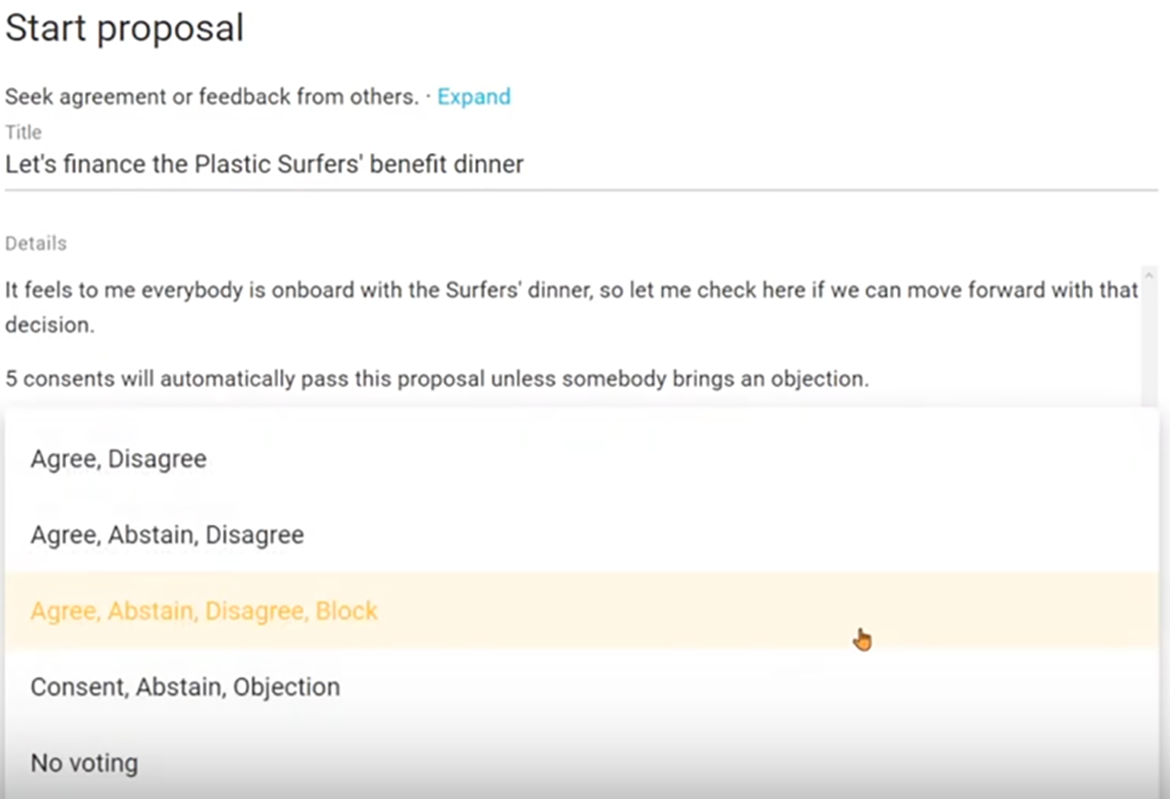
Screenshot of drop-down menu in Loomio excerpted from video tutorial “Loomio basics: Polls and proposals” (published on youtube.com on February 20, 2020).
The second design-level norm is dictated by the user-friendliness of the interface. As a rule of thumb, the more the form for the submission of proposals is detailed and demanding, the more it will tend to exclude participants with low literacy skills and little time on their hands. For example, the proposal-writing forms of Decidim, Consul, and LQFB constitute a low barrier to entry as users are required to fill a few text fields such as the title, subtitle (or summary), and a more extended description of the proposal. Loomio offers an even more basic template, with only two text fields, title, and details. Lex Members, the direct legislation area of Rousseau, requires users to fill title, summary, extended description, summaries of preexisting Italian legislation and comparable legislation in other countries, and the expertise of the proponent. If it is true that this set of requirements sets a higher barrier to entry (at least vis-à-vis Loomio, Consul, Decidim, and LQFB), it is also true that Lex Members hosts proposals for parliamentary bills, which usually have a wider scope and impact than proposals for local initiatives. Further, Rousseau’s higher requirements can be explained with the fact that the DMS does not allow proponents to refine their proposals by collecting feedback from other participants and that each proposal has to compete against others in the voting phase. These considerations suggest that the user-friendliness of the UI should always be considered in relation to other software features—and thus as part of the wider DMS architecture—and not in isolation (Deseriis 2021).
A software feature that is particularly relevant to agenda setting is endorsements. In our select group, endorsements are present in Consul, Decidim, and LQFB while they do not appear in Rousseau, Loomio, and Pol.is. Endorsements give users the opportunity to collectively determine what needs to be put on the agenda and in what order of priority. As such, they constitute a form of collective moderation. This does not mean that all endorsements have equal weight. In the case of LQFB, participants holding a high number of proxy votes have more sway than the average user in propelling a proposal past the required support threshold. For this reason, initiative proponents must convince superdelegates to support their initiative. Support thresholds, however, are not fixed and any DMS which features this mechanism usually allows system administrators to determine the quorum based on a number of sociopolitical considerations. In the next subsection, we consider the impact of use-level norms on the setting of the agenda and voting.
Use-level Norms and Agenda Setting
Although use-level norms are typically defined outside of the DMS—for example, at the level of party statutes and city ordinances—and are implemented by system administrators, they are integral to the design code of the DMS (understood as a technical stabilization of social choice). This is particularly clear if we compare the use of quorums in Participa Podemos, the participation portal of Podemos, and Decide Madrid, the participation portal of the City of Madrid, which runs on Consul and for which the software was originally developed.
Consul was released in 2016, a year after Pablo Soto, Miguel Arana, and Yago Bermejo Abati left the Participation Team of Podemos to join a municipal coalition (convergencia) that won the 2015 elections in Madrid. The three left Podemos in part because of a divergence with the party leadership over the definition of the quorum that was needed in order to pass member-initiated proposals (iniciativas ciudadanas) to the voting phase. As Miguel Arana remembers, the party decided to fix the threshold at 10 percent of the party membership (over 50,000 endorsements, as of this writing) even though the Participation Team had proposed a much lower threshold: we were having huge fights, amazing fights because we [the Participation Team] told them [the party leadership] that 10 percent was a suicide, it was impossible to make it work. But in the beginning they wanted the 20 percent and it was absolute nonsense. We said the 2 percent and we were fighting and at a certain moment we agreed because there was no other choice, which was the 10 percent. (Personal communication, March 16, 2017)
Shortly after the three were appointed by the City of Madrid to run a range of participatory initiatives, Soto presented the first version of Consul (Calleja-López 2017, 156), which fixes the support threshold for citizens’ initiatives at 1 percent of the city electorate (approximately 25,000 endorsements). As a result, the City of Madrid was able to organize its first citywide referendums based on citizens’ initiatives in February 2017. By contrast, Podemos never organized a consultation based on member’s initiatives in spite of the fact that thousands of proposals have been uploaded to Participa Podemos (Deseriis and Vittori 2019).
If the difference between a 1 percent quorum and a 10 percent quorum has clear political consequences, even 1 percent can constitute a significant barrier in the long run. Indeed, since February 2017, the City of Madrid has not been able to organize other referendums based on citizens’ proposals. By contrast, the system developers and administrators of Decidim, who initially drew inspiration from Consul, decided not to implement any support threshold for citizens’ initiatives. As a result, nearly 90 percent of the 10,860 proposals that were discussed on Decidim as part of the Barcelona SAP were submitted by ordinary citizens (Borge-Bravo, Balcells, and Padró-Solanet 2019). Similarly, Rousseau does not implement any support threshold for legislative proposals that are submitted by 5SM members in the Lex Members area. However, the 5SM parliamentary group moderates the proposals enforcing several normative filters, which include constitutionality, financial feasibility, and consistency of the proposals with the party line (Deseriis 2017). Agenda-setting filters based on human moderation are also applied in Consul and Decidim, but the actual criteria that moderators adopt to screen proposals can vary from instance to instance of the same software. Further, as noted, moderation criteria are use-level norms that add to technical filters embedded in the software interface such as web forms and endorsements.
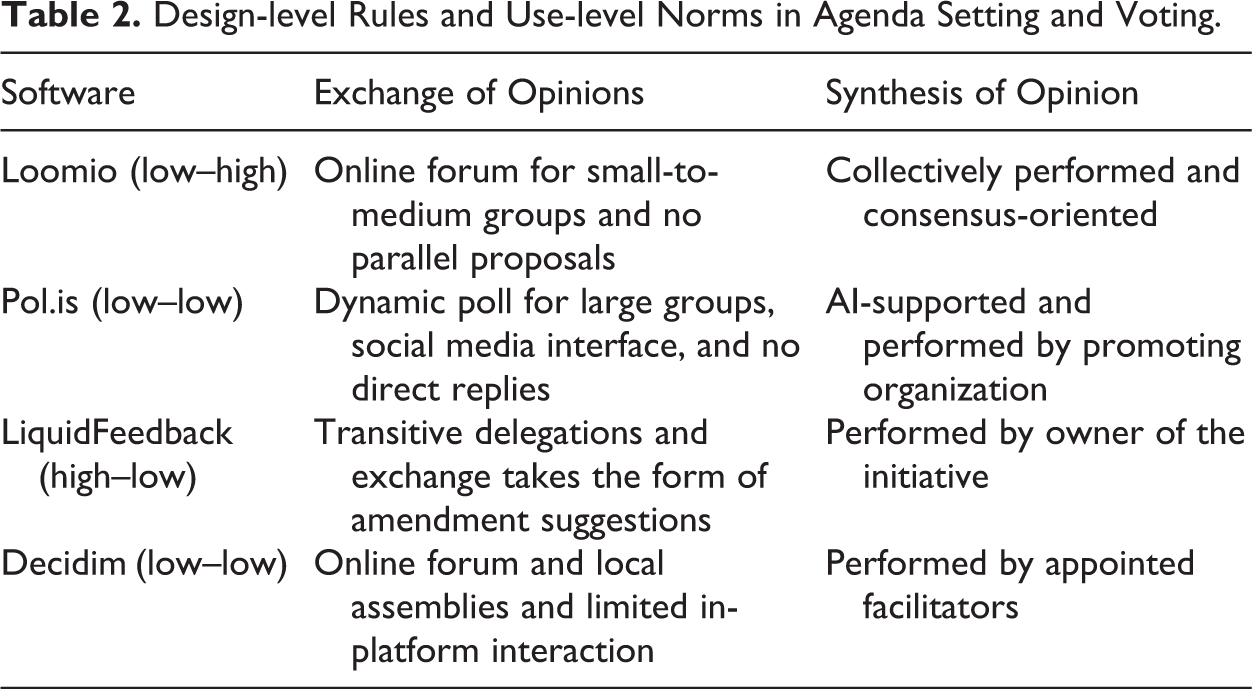
Overall, depending on their configuration, use-level norms can produce a lower or higher burden for the voter. Whereas stricter selection criteria reduce the burden of decision for participants, they also limit their capacity to affect the agenda. In Table 2, the six DMS are ordered on the basis of their capacity to support political equality at the agenda-setting level. Decidim is the most democratic DMS because it lets ordinary citizens post proposals with minimal human moderation and, as noted in the case of the Barcelona SAP, it does not implement any quorum based on endorsements or a final vote. (However, in other types of consultation processes, organizers may introduce a module vote as needed). LQFB is also very democratic at the agenda-setting level because all participants select the proposals that are to be admitted to the discussion phase, even though some participants have more power than others. Consul is quite open to ordinary users’ input. However, as we have seen, the quorum can constitute a veritable barrier to the implementation of citizens’ proposals. In the case of Rousseau, the DMS allocates only the Lex Members area to direct legislation proposals and these are heavily filtered by moderators appointed by 5SM MPs. Finally, Loomio and Pol.is sit at the bottom of this ranking because consensus-oriented DMS are mostly concerned with deliberation rather than with the input and the output of the decision-making process. Although in the case of Loomio, all participants can draft proposals based on existing discussions, it is also true that this is not a particularly significant dimension of the process given that small groups tend to be structurally open to the input of their members. By contrast in the case of Pol.is, the normative goal of achieving consensus within a large-scale consultation requires the deployment of a much heavier filter at the agenda-setting level. In fact, the DMS removes both the possibility for participants to set the agenda and to vote at the decisive stage of the decision-making process.
Design-level Rules and Use-level Norms in Agenda Setting and Voting.
Conclusion
In this article, we have analyzed how six digital democracy applications implement political equality in three stages of the decision-making process: the setting of the agenda, the exchange and synthesis of opinions, and voting. The relationship between agenda setting and voting is relatively linear within plebiscitary software: the more DMS implements technical and normative filters that select and reduce the items on the agenda the more the burden of decision for participants is reduced. The relationship between the exchange of opinion and the synthesis of opinion is significantly more complex. As such, it requires a more sophisticated set of second-order decisions. Whereas some DMS implicitly rely on preexisting social ties to build trust among participants, they support processes whose scalability remains necessarily limited. By contrast, DMS that aims at scaling deliberation beyond relatively small and politically homogeneous groups must rely on types of second-order decisions that are based on complex and abstract mediations such as transitive delegations and AI algorithms.
These considerations suggest that there are no easy technological fixes or one-size-fits-all solutions to the participatory demands of social actors. Whereas some of the DMS considered in this article have reached some level of institutionalization, especially at a local level, none of them has emerged as a standard for digital democracy. As noted, this is expected given that participatory democracy is a constantly evolving set of theories and practices. But the variety of DMS designs can also be attributed to the difficult task of increasing political equality in one area of the democratic process (e.g., agenda setting) without reducing it in a related area (e.g., the enlightened understanding of the problems). In this respect, the analysis of second-order decisions in the design of DMS can provide important insights for understanding the relationship between quantity of participation and quality of participation within and through the different phases of the democratic process.
As we have seen, DMS designers have to grapple with the unintended effects of a desirable outcome of all DDIs—namely, that an increase in participation inevitably corresponds to an increase in the aggregate burden of decision for participants. The purpose of this article has been to demonstrate that in order to reduce such burden, DMS designers and administrators make choices, which are often cloaked in technical implementations and obscure norms of use, but that have nevertheless profound implications for the overall quality of the democratic process. In this sense, the most significant lesson to be learned from this comparative analysis is that while digital cost reduction may help absorb cyclic and contingent “excesses” in political participation, this does not guarantee in itself a democratization of the political process. Rather, our findings suggest that the more the aggregate volume of input data increases, the more technical, normative, and political filters become salient. We divided these filters into two macrocategories. First, we identified technical filters internal to the DMS, which are meant to reduce the burden of decision at different stages of the decision-making process. These range from seemingly mundane features of the user interface to more complex types of filtering mechanisms. Second, we isolated normative filters introduced at an organizational level such as variable quorums for the admission of proposals, moderation criteria, and human facilitation. Although these filters vary from use case to use case, their relative importance increases as the complexity of the decision-making process and the number of participants increases. In this respect, this article has called for a thorough examination of the technological, normative, and political mediations that make the burden of decision in DDIs manageable for the whole community. On the other hand, this article has assessed the design of DMS and DDIs through the yardstick of political equality, a cardinal principle of democracy. This normative approach has allowed us to ask who benefits from such manageability and how a manageable burden affects the overall quality of a democratic process. In this way, we have suggested that the design code of DMS is not just a technical stabilization of social demands, but a flexible set of rules, norms, and specifications, which mediate between the needs of governing actors to manage the democratic process and the pressure of social actors to make it more equal and inclusive.
Footnotes
Acknowledgments
The author would like to thank the interviewees of this article and the journal’s editors and peer reviewers for their valuable feedback.
Declaration of Conflicting Interests
The author(s) declared no potential conflicts of interest with respect to the research, authorship, and/or publication of this article.
Funding
The author(s) disclosed receipt of the following financial support for the research, authorship, and/or publication of this article: Research for this article was funded by the European Commission through the Marie Curie programme (H2020-MSCA-IF-2015—GA: 701513).
