







Abstract
Museums and archives rely on databases and similar technologies to manage their collections, but even when tailor-made for memory institutions, databases require considerable adaptation to remain usable over long periods of time. To better understand how collection staff maintain and migrate databases over multiple years and decades, we talked to archivists from the US-based Archon User Collaborative and collection managers from the University of Michigan Research Museums. We found that the collection staff uses terms taken from quilting for database curation: they “tie” and “weave” a “patchwork of data systems” together. We extend their quilting metaphor as an analytical lens and show what can be gained through a shift in framing database work as a craft. We describe database curation as a process of creating a quilted infrastructure: a long-lived knowledge system that is sustained by the use of multiple “digital surfaces,” a reliance on a community of practice, intergenerational transfer of “quilts,” and by leveraging invisibility to conduct work. We argue that this nonnormative mode of computing needs better support from both software developers and administrators. We also show that although the invisibility of craft practices offers practitioners independence, it also can increase their precarity.
Introduction
Museums, archives, and other memory institutions are fundamentally sites of maintenance and care—of collections, of records, and, increasingly, of complex digital infrastructures. Indeed, “curation” shares the same Latin root as the word “care:” cura (Bailer 2019; Flanders and Muñoz 2012; Fisher 2013). 1 Yet the curatorial focus of libraries, archives, and museums (LAM) is often at odds with the efficiency- and innovation-driven ethics underlying information technologies and data systems they rely on and must maintain. Software systems change quickly and frequently, whereas LAM collections and their data are meant to persist indefinitely. Databases are typically designed on principles of standardization and “normalization,” whereas LAM collections are necessarily heterogeneous and idiosyncratic. A primary metric for database design is often “query speed” and search efficiency; while LAMs certainly need effective information retrieval, they also need mechanisms to effectively update and maintain records on an individual basis.
How do LAM professionals adapt, combine, and maintain information technologies to serve a curatorial ethic? How do they extend the usability of short-lived software to support long-term collection management? We argue that it is by creating and maintaining quilted infrastructures, seamful sociotechnical systems stabilized through craft practices. In interviews with archivists from the Archon User Collaborative and collection staff from the University of Michigan Research Museums (UMRM), participants frequently spoke of weaving a “patchwork quilt” of legacy data sources, and of the creative piecework needed to maintain databases in the face of obsolescence. We further this metaphor and use quiltmaking as our analytical lens, thereby revealing four ways that LAM staff “quilt” their long-lived, bricolage infrastructures through the piecing together of data systems, community-based database creation and maintenance, the intergenerational transfer of quilted databases over time, and leveraging the invisibility of both quilting and infrastructure work.
We extend earlier work exploring the role of “seamfulness” (Inman and Ribes 2019; Vertesi 2014) in infrastructure development to show that quilting can stabilize an otherwise precarious bricolage of systems. Maintenance requires attention to aspects of infrastructures designed to fade into the background (Bowker and Star 2000; Star and Ruhleder 1996); here, we show that seamfulness in quilted LAM infrastructures helps prevent them from totally fading from view.
By explicitly centering craft in our analysis, we use a feminist lens to foreground alternative approaches to data work. As D’Ignazio and Klein (2020) argue, normative modes of computing privilege a single situated standpoint, which risk marginalizing other positionalities and experiences. By acknowledging multiple standpoints—and multiple effective ways of computing—“we arrive at a richer and more robust understanding of the world” (D’Ignazio and Klein 2020, 136). We are particularly interested in centering practices that prioritize maintenance and care over innovation or forced obsolescence (Jackson and Kang 2014; Mattern and Choi 2019; Russell and Vinsel 2018). We find that craft practices are critical to infrastructure maintenance but can enable “job creep” and burnout when individualized and left invisible.
Motivation
The technology at the center of this study—the database—is a prime site to observe the tension between innovation and sustainability. Databases are omnipresent in the modern workplace. In LAMs, they are needed to store catalog records, digital assets, and other documentation related to the collection. In some LAMs, they also facilitate computational access to catalogs for digital humanities or biodiversity research, treating the collections records as data in and of themselves (Matienzo and Rudersdorf 2014; Padilla et al. 2020; Robertson et al. 2014). As we discuss below, the primary goal in managing a database is to manage the data collection it contains—but this entails simultaneous maintenance of the database software and the computer hardware. The tension between innovation and sustainability lies in the differing timescales of this maintenance: data collections accrue slowly and steadily, yet software and hardware can change relatively rapidly and are beyond the control of collection staff responsible for data collection.
In science and technology studies (STS) and related fields, studies of the database have rarely focused on this tension around maintenance, and focused instead on the database as a novel form of media (Manovich 2002), its role as a mediator of knowledge (Bates, Lin, and Goodale 2016; Bietz and Lee 2009; Hine 2006; Leonelli 2014), and on the impact of the materiality of its data structure (Castelle 2013; Dourish 2017; Dourish and Mazmanian 2013; Kirschenbaum 2008; Manovich 2002; Thomer and Wickett 2020). In computer and information sciences, the literature centers on the creation of curated databases from an engineering standpoint (Brodie and Stonebraker 1995; Buneman et al. 2008; Vassiliadis 2009) and on the implementation and adoption of new standards and technologies, including databases (e.g. Acker 2021; Donaldson and Yakel 2013; McDonough 2009; Yakel and Kim 2005). Some of this work examined the implications of maintaining legacy data and systems (Diao and Hernández 2014; James and Punzalan 2015; Wu 2016), navigating technical debt (e.g., Geiger et al. 2018; Hirsch and Ribes 2021), and supporting other “slow” or “purposeful” work with data and databases (Feinberg 2017; Palmer et al. 2013). Here, we draw on this STS, LIS and other literature, as well as prior work on repair, maintenance, and upkeep by using quilting as an analytical lens.
Of particular interest to our study is craft’s role in maintaining and repairing technology. “Craft” is skillful manual labor or tasks that must be done “by hand” and that require significant expertise developed through practice.
2
Craft practices are necessary for the reuse and repair of technology (Jackson and Kang 2014; Rosner and Ames 2014; Steinhardt 2016). Therefore, to ensure a technology’s sustainability over time, a software or hardware system must be able to break down and be restructured as a way to continue forward (Steinhardt 2016). Yet, maintenance work is often overshadowed by the flash of innovation and capitalism’s lionization of (typically male and white) “genius” creators and entrepreneurs (Russell and Vinsel 2018). Steven Jackson offered the following provocation to center the craft of repair over replacement: What if we care about our technologies, and do so in more than a trivial way? This feature or property has sometimes been extended to technologies in the past, but usually only ones that come out of deep folk or craft traditions, and rarely the products of a modern industrial culture. (Jackson 2014, 232)
To understand craft and its relation to technical work, we must recognize it as a situated concept. Craft is not a set practice, but a framing of work practices influenced by temporal and geographical contexts (Adamson 2017). Historian Glenn Adamson argues that the concept of craft formed alongside and in reaction to the concept of modernity, with craft as an “antidote” to industrialization (Adamson 2013, xv). Expressly, in the United States, craft has been invoked in the postindustrial world, “as a way of slowing down and connecting more to the world around us” (Adamson 2021, 273). This joining of craft to modernity highlights its political qualities as a tool to shape public memory, especially in regard to labor practices (Adamson 2013, 2021; Connerton 2009). For example, Keshavarz and Zetterlund (2019) note that historic reports of craft in Sweden focus only on work done by the “fully legalized modern Swede” and erase contributions of Indigenous and migrant craft workers. This aids in creating an idealized craft worker that matches state politics.
Craft has also been used as a lens to unpack work often viewed as mundane or unvaried. Barley and Orr (1997, 12) argue that technical work is inherently “craftful” and that it “sits at the intersection of craft and science, combining attributes of each that are normally thought to be incompatible.” Here, they invoke craft to complicate the idea that skillful technical work is purely a matter of following instructions; rather, it involves many ad hoc decisions and manipulations on the technicians’ part (Barley and Orr 1997). Craft has often been positioned as a “moral corrective to alienating forms of industrial production” (Dawkins 2011, 262), framed as a more feminine/feminist response to the patriarchal values often embedded in cultures of engineering and innovation (Cheatle and Jackson 2015; Rosner, Friedman, and Stolterman 2018; Rosner and Fox 2016). Scholars of computer-supported cooperative work and information systems have discussed the role of craft in scientific work (Flannery 2001; Mentis, Rahim, and Theodore 2016), design (Bardzell, Rosner, and Bardzell 2012; Buechley and Perner-Wilson 2012), and data cleaning (Muller et al. 2019; Plantin 2019; Thomer et al. 2022). These framings of craft allow us to focus on three qualities of database maintenance that other lenses do not: care, community, and invisibility.
Our Analytical Frame: The Patchwork Quilt
Quilting was a common metaphor used by our participants in describing their database work; we extend the metaphor and use quilting as an analytical lens to draw out the craftful qualities of database maintenance more thoroughly.
Four aspects of quiltmaking are particularly salient in our analysis. First, quilts are composite objects that typically have three layers: an outward-facing front (typically made of many pieces of cloth) that is the most decorative and complex component (Figure 1); a middle layer that provides insulation; and backing. The parts are kept together by stitching or tying, bringing the three layers into a single object (Figure 2). Quilts are often patched and mended over time to fix holes and blemishes to enable extended use.
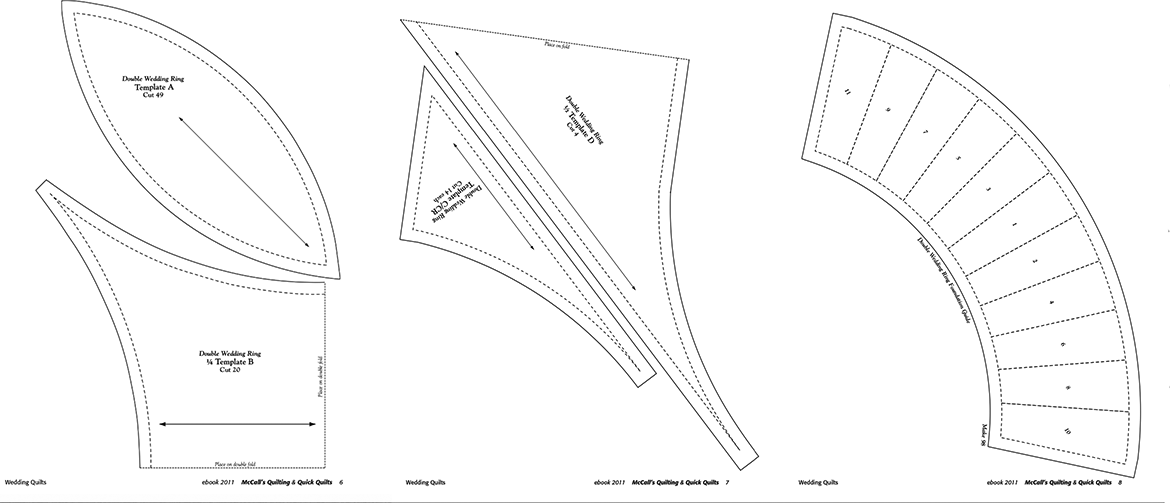
The double wedding ring is a common quilt pattern that creates an optical illusion with its design but requires strict adherence to a pattern to successfully complete the desired visual pattern. Used with permission from Golden Peak Media. Source: “Double Wedding Ring Quilt Pattern” (2002).
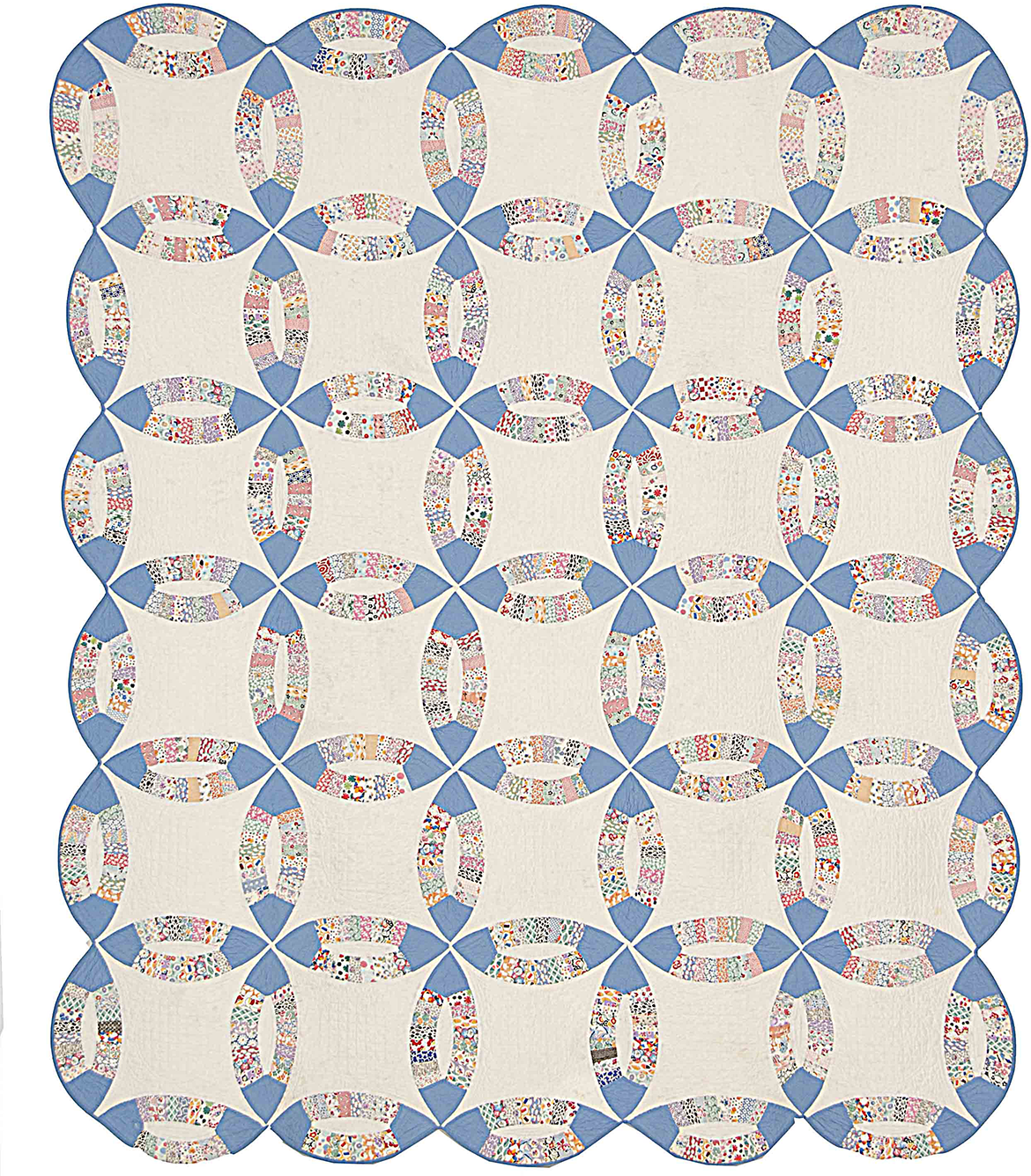
Example of a completed double wedding ring quilt. Source: Image used with permission from the Rocky Mountain Quilt Museum (Jones 1930).
Second, quiltmaking utilizes community labor. Hand-sewing a quilt takes an extraordinary amount of time, even for skilled quilters, and collaboration speeds up the process. Quilting parties or bees are held in the home or outdoors as social gatherings, where multiple (primarily female) members of a household or community work on a quilt together. In addition to speeding up work, quilting bees provide an occasion to socialize with friends and neighbors (Fry 1990), a form of mutual aid (MacDowell 2004), and an opportunity for sharing ideas and creative expression (Butler 2019).
Third, quilts come to represent intergenerational labor within one family (Higgs and Radosh 2013). As they are used, they are patched and resewn with each generation of users adding their own impact on the object. They consequently become heirlooms that are passed from one generation to another.
Finally, quilting is a skill whose labor has been rendered invisible. As a craft often led by women, only within the last few decades has quilting been critically engaged with, expanding past nostalgic evocations of white quilters (Klassen 2009) and including the cultural and economic value it has had within Black communities (Cash 1995; Butler 2019; Fry 1990). This invisibility may prove an asset for some crafters, because when labor is overlooked, it can give laborers space to be creative and to innovate (Plantin 2019; Thomer et al. 2022).
Two Knowledge Infrastructures in Limbo
The cases presented in this paper share the goals of most LAM collections: to create a digital database describing the contents of physical archives or collections. Patrons need a database to find and use specific objects held by the institution, and collections staff use it to care for the physical objects that make up the collections. Though LAMs are primarily concerned with curating artifacts and records—the data—in their databases, these data have a longer life span than the hardware and software they are stored on and depend on other components to “survive” (Figure 3).
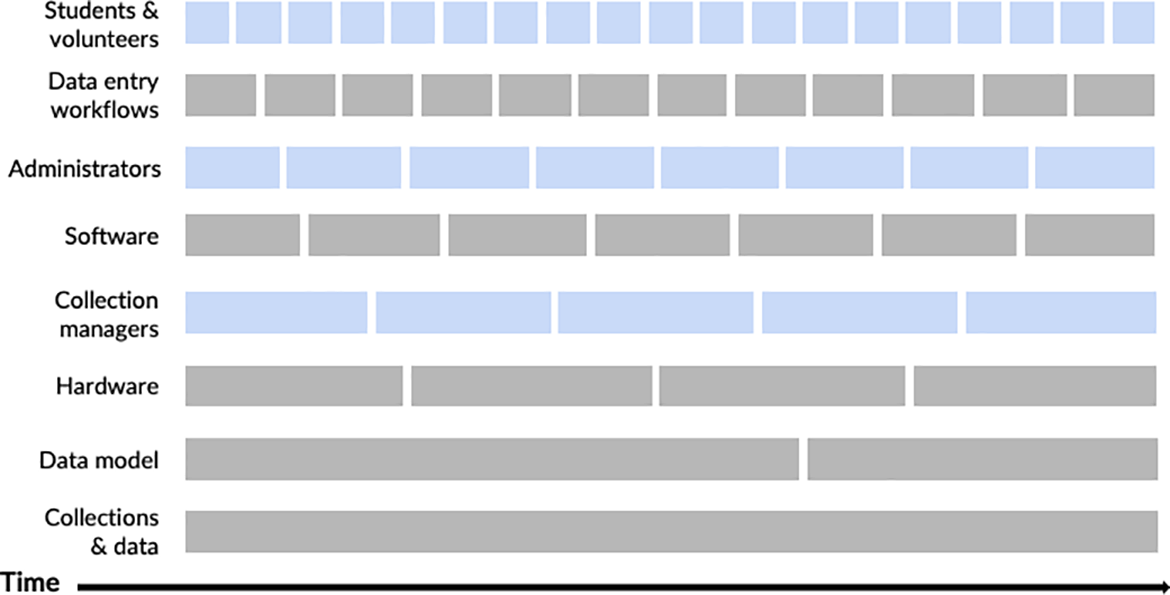
The tempo of libraries, archives, and museums (LAM) technology and staff changes over time. Staff turnover and technical changes happen at different rates. The collections and data in LAMs have a much longer life span than any other components but depend on more frequently changing components to “survive.”
Collections staff rarely have significant control over the software they use. Commercial databases such as Access and FileMaker allow customization, but most LAMs do not have the staff to run these systems. Software specifically designed for LAMs include commercial systems (e.g., Axiell Collections, CatalogIt, PastPerfect, Argus, and more) and open-source, community-developed platforms (e.g., Specify, Arctos, Collective Access, ArchivesSpace, etc.), which also have limitations. Open Access databases tend to be less customizable for an individual collection’s data structure or workflow, and while developers often try to be responsive to requests for changes and customization, this is by no means guaranteed. Furthermore, both off-the-shelf and LAM-specific software may be unexpectedly changed or sunset by the software developer. These changes can be highly disruptive because many LAMs do not have full-time information technology staff, and most collection staff do not have significant training in database administration.
We report on two case studies of LAM collections navigating a database migration: UMRM, and a community of archivists that currently use or have recently migrated from the open-source archive platform Archon. In both cases, LAM staff have had to maintain data systems during periods of limbo in which one system became obsolete/unsupported, but a new system had not yet been selected, developed, or implemented. Case studies presented in this article were developed through semi-structured interviews with curatorial staff, reviews of public documentation of collections and collections systems, and in some cases reviews of the databases themselves (IRB University of Michigan Institutional Review Board approval ID: HUM00152271). We used an inductive coding approach to identify themes (Miles, Huberman, and Saldaña 2020). After themes related to craft and quilt-like practices emerged, we re-reviewed our findings using quiltmaking as an analytical lens.
University of Michigan Research Museusm
From May 2018 to October 2019, we spoke with fourteen collection managers at the UMRM, all of whom were in the midst of a yearslong database migration. The UMRM include five museums: the Museum of Anthropological Archaeology, the Kelsey Museum of Archaeology, the Herbarium, the Museum of Paleontology, and the Museum of Zoology. Each collection maintained its own databases, for up to sixty years in some cases (see Estabrook 1979). These databases were all highly idiosyncratic in their structure, content, and development. In 2011, the university administration decided to migrate these disparate databases into one unified system.
The migration process was by no means simple or straightforward. An initial attempt in 2012 at migration to EMu (a commercial collection management system by Australian-owned KE Software, which has since been purchased by the Sweden-based Axiell Group) ultimately failed. Administrators believed one instance of EMu could work for all the UMRM collections, but concerns emerged in the pilot phase. KE Software eventually suggested creating individual database silos for each collection—exactly the problem the new system was supposed to solve. The contract was dissolved in 2014 before any collections were migrated.
Now, the museum is migrating the records for all its biological collections (Herbarium, Zoology, and Paleontology) to Specify, and cultural heritage (Anthropological Archaeology) to Collective Access. When we spoke with the collection managers, some database migrations had been completed, but others were facing major obstacles, and it was unclear if they would ever successfully be completed. In several cases, managers found it necessary to use multiple systems to complete their workflow while in mid-migration. Several also said that Specify or Collective Access alone could never meet their needs entirely and that even after completing this migration, they would still require auxiliary systems.
The Archon User Collaborative
From August 2019 to February 2020, we spoke with archivists from the Archon User Collaborative, who were all navigating an impending migration out of Archon. Archon: The Simple Archival Information System is an open-source archival management system developed at the University of Illinois at Urbana–Champaign (UIUC). Originally launched in 2005, it was designed to serve as a general, searchable system for archival collections that stores finding aids and catalog records, compatible with both Machine-Readable Cataloging (commonly called MARC) and Encoded Archival Description records, two common standards within the archive field. Archon was popular in the archives’ community, but its development was discontinued by UIUC in 2014.
Despite the system’s obsolescence, an active user community remains in the form of the Archon User Collaborative, which comprised thirty-two US-based members at the time of our writing (Archon Users Collaborative n.d.). A professional working group of Archon users already existed, but the Collaborative was formed by archivists still using Archon after its termination. In 2017, the Collaborative funded LibraryHost LLC to update the Archon code (Archon Users Collaborative 2018), but this update has since become obsolete too.
The original goal for the user collaborative was to maintain the system until a better alternative could be found. Many users thought this might be ArchivesSpace. So far, several archives are yet to complete a migration to ArchivesSpace, and others found it did not meet their needs.
The Craft of Database Maintenance
Sewing Multiple “Surfaces” Together
In interviews, collection staff described their database curation work as fundamentally relying on process of metaphorical quiltmaking, sewing multiple data systems together to create a stronger, better functioning whole. The process of bringing multiple systems together was repeatedly described using language such as “patch” (ARCH_002), “linking” (ARCH_003), and “tie” (UMRM_001). One participant went so far as to describe their database as a “patchwork quilt” composed of multiple “digital surfaces” (ARCH_002)—that is, multiple individual data management systems that they saw as a singular, albeit dispersed, collection.
This quilting looks different in each instance. For one archivist, their piecework involved managing six or seven digital collections scattered over different systems containing tens of thousands digital objects. Their hope was that this digital quilt would eventually become more than metaphorical: Our current [collection] in Archon is about 30,000, but we would like to have all of our digital content that’s archival throughout the whole library, because there’s a bunch of ContentDM collections. We’d love to have all of those also available through this new tool. And that then would double that, bring it up to, I don’t know, 60,000, maybe 100,000…then we could potentially get rid of ContentDM. We could maybe get rid of ArcaSearch, which is another full text tool that we use for our student newspaper, historic student newspapers. So we could bring them all together into one. (ARCH_002) Currently we use Microsoft Access. We actually have, I think, four different Microsoft Access databases that’ll be kind of funneling into Collective Access, and various spreadsheets and things that have been used to track loans and things over the years. But, Microsoft Access is our main database that we have right now…. One is our main collection database that has our archaeology and ethnographic collections, the other is our ethnobotany database, so that’s plants…. We have an images database, that mostly has information about our slide collection, and then we have a collection evaluation database. It has insurance values, so that’s kept separately. And then NAGPRA [North American Graves Protection and Repatriation Act] has their own database…. So I guess technically there’s five Microsoft Access databases. And there’s also little subsidiary Access databases kind of floating around, like the…curator has a database holding information about archaeological sites….The…curator had a couple different databases for photographic collections or also site databases and stuff like that. (UMRM_003)
Through the lens of quiltmaking, we see that bringing multiple systems together into one broader workflow is fundamental to the craft of database curation. Further, we see that it is critical to support the work of keeping these different systems conceptually or functionally “stitched together.” Most frequently, multiple systems were needed because one platform alone was not sufficient to support all the nuances of a curatorial workflow. Participants also used multiple systems or created custom auxiliary systems to support unique individual projects and preferences. This was especially common in the biological collections at the UMRM (and thoroughly disapproved of by the systems administrator, who worried it would lead to duplicate records). Curators and other collection staff created their own databases using tools ranging from Access to Excel to support their research goals or data entry preferences, resulting in multiple subject-specific databases that were linked in concept but not in practice. Using multiple pieces of software complicated the design of a database “quilt,” but it also improved its functionality and flexibility.
In some cases, however, using multiple systems was a coping mechanism to get work done despite breakdowns in other aspects of the workplace or database. Just as a quilt wears over time, databases need updating, reconfiguring, and reworking. In quilting, patches are used to replace and repair squares and seams; in databases, this piecework takes the form of creative workarounds to keep a system running past its stated obsolescence date. A collection manager (UMRM_001) at the University of Michigan Museum of Paleontology (UMMP) described a particularly extreme example of patching systems together as a coping mechanism. The UMMP’s collections are old in a number of ways: the museum itself was founded in 1837; the database was first created in the mid-1980s; and the fossils it contains are millions of years old. At the time of our interview, this respondent was in the process of migrating the paleobotany (ancient plants) and vertebrate paleontology (ancient animals with skeletons and spines) collections databases into Specify, a collections management database developed specifically for natural history collections. The UMMP records had initially been converted from a library-style card catalog: one containing locality records that described the sites whence fossils were excavated and another describing individual fossils, their collectors, and other anatomical or taxonomic notes (UMRM_001). At some point in the 1990s or early 2000s, these data were migrated into a FoxPro database: a general-purpose database system which was sunset in 2015 (Henson 2017). Despite becoming obsolete, the collection manager had no choice but to continue using the now defunct system. There wasn’t another database yet available to migrate to. Eventually, he decided to migrate all the collections to Specify, but during the migration period, he developed a patchwork system to query the legacy database via newer technology: R scripts to access the FoxPro system. He explained, I have been using R for a long time. It’s my comfortable scripting place. And I can do searches there that I can’t do using FoxPro. Things like regular expression searches, or approximate searches when there are spelling errors or things like that. I also can tie together; even though the inventory is not part of the database, the catalog numbers are the unique identifiers. They are the key. So I can tie specimen records to the inventory that way when I need to. (UMRM_001)
Community Collaboration
By and large, our participants did not do their quilting in isolation; just as quilts are made by a collective in a “bee,” the creation, maintenance, and migration of participants’ databases similarly draw on collaborative labor done by practitioners using the same database management software or facing the same data-related challenges, working as part of informal and formal networks. Community collaboration provides support not available from system administrators or Information Technology (IT) departments. IT staff can help set up a new computer or install new software, but they usually lack the disciplinary expertise necessary to help select what database to use or assist with complex data cleaning, both online and in person. LAM practitioner communities fill this gap.
The Archon User Collaborative is perhaps the clearest example of a databasing bee. This user group was created while Archon was still an active system; when Archon’s end of life was announced in 2014, the collaborative shifted from development to discussing migration paths and otherwise supporting other members. This shift has not been easy, but it was important to community members: We want to continue as an active user group…. We’ve kind of taken that step back where we’re not going to be a software development group. We are not a committee that’s going to be seeking constant updates. But I do think it’s important that we stay active as a user group just to be on the same page as everybody else that’s using it…. [W]e still at least are connected to each other, you know? (ARCH_001)
While participants at the UMRM did not have a similar collaborative, they did describe extended disciplinary and practitioner networks to which they turned for advice and guidance in selecting database systems and navigating migrations. UMRM collection managers were also drive to share their data and collections with the broader scientific community. Multiple participants said that the ability to share data through community platforms such as Vertnet, GBIF, and iDigBio was a critical feature needed for a database. They also wanted to share data via the University of Michigan–specific platforms, such as Deep Blue Data and the library’s institutional repository.
That said, some of the problems the UMRM faced in its migrations can potentially be ascribed to a breakdown in the local University of Michigan community’s cohesion. The individual disciplinary museums within the UMRM were initially working together to migrate to one unified data system. Collections with similar data tried to collaborate to find a data schema that would work for everyone, as one participant described: My predecessor worked with [name omitted] at the [Museum] to kind of figure out ways in which our databases kind of overlapped, to come up with a template or framework that we could both work from. So they were at least sort of nominally similar in some ways so that, you know, eventually, some day in the future when it goes online or whatever, at the library or however it goes online, that there’s similarities in the way that it’s structured. (UMRM_003)
Databases as Intergenerational Objects
The importance of community extends beyond a single generation. In both quilting and database curation, functional heirlooms are passed down to the next generation. LAM databases have longer lineages than in most other workplaces: they are the latest manifestation of a generations-old cataloging system, and the data they contain is meant to last for perpetuity (or at least, for as long as possible). Contemporary maintainers rarely have a hand in creating the databases they work with, and, consequently, they are acutely aware that any changes or additions they make will be passed down to their workplace descendants.
This intergenerationality can be either an asset or an obstacle. When database managers are able to consult directly with their predecessors, they describe their work as following an apprenticeship-like model, in which they learn their craft from a senior expert. A zoology curator, who had been with the museum since the 1980s, described hers: I learned it from the people who were working on it at the time. And at the time, as I recall we had a printed copy. When we added specimens to our database, one of the steps was to actually print on very special archival paper and put it in a notebook basically. That’s how it was done. We still had this special large format printer. It was this wide [hand motion] because our paper was wide. It was really interesting. I just watched how it was done. (UMRM_010) It was a big process when I first took a look at Filemaker [database] and decided what fields in there were redundant. A lot of it were vestiges from the old database when they weren’t doing things properly. And I tried to clean it up but we were trying to make things better. (UMRM_012)
Because our participants were in the midst of or had recently completed a database migration, a key concern was making future migrations easier for future generations of collections staff. As one archivist put it, That first jump [migration] was the hardest because it was so un-standardized. So unprepared for any kind of data manipulation. And so now much of the data, it’s not perfect, but much of the data is in tables where each data point is in a discreet column. It has parsable data, so you could take it and you could restructure it and do queries that are more advanced, then you could take data points and combine them or split them up or do replacements and all that stuff. Before Archon, none of that was really possible in the scale that I’m talking about. So for me, we’re always thinking in terms of how can we be poised for the next jump? (ARCH_002)
Navigating (In)visibility
Our fourth and final parallel between quilting and database maintenance lies in their shared tendency toward invisibility. Quilting is often overlooked as both a skill and an art. Similarly, database maintenance and migration are often invisible aspects of LAM work, in that they have (historically, at least) been considered auxiliary to the “real” work of collections management or archival work (Thomer et al. 2018). Though more recent job descriptions for archivists and collections managers sometimes call for database expertise, our interviews revealed the extent to which this expertise is self-taught—and the extent to which collections staff are working without support from IT or administrative departments. Many of our participants did not have formal training in database management or creation, having learned on the job. At UMRM, one vertebrate zoology collection manager had no prior experience with databases because they didn’t really exist when she first started her job: When I first started, there were no computers. No personal computers. Then we started using the mainframe. So I had some experience using the mainframe computer. And there was a basic word processing program on there. And then when we got personal computers, we went through several different brands. And the early ones were terrible. Just terrible. They were so buggy. You would be typing along and all of a sudden it would crash. (UMRM_009) I also lead our ongoing database migration for the collection management system. Now, I was doing that even before I was interim director, because it needed to be done, and I felt I was probably the best person to do the job. So I just volunteered to take the lead on that. (ARCH_003) I write the grants, I fund the programs, I hire the staff, I fire the staff. I’m the one who appraises collections. I’m the one who essentially acquires the collections. We arrange and describe the material. We’re a one-person shop. (ARCH_004) We wouldn’t have twenty grand to drop on something. Right now we pay LibraryHost to be our host for Archon, and we have a specific separate server from everybody else, which is an additional cost, but it’s still less than $1,000 a year for us. And that has been absolutely critical because we are still a small school, a small repository, with only two FTE [full-time employees] and we don’t have our own budget line. We are just part of the library budget. (ARCH_001)
At UMRM, the database did not completely disappear from funding lines; university administrators had planned to purchase an expensive system that was ultimately abandoned, and eventually, funded one IT staff member from the university to assist with migration to open-source systems (Specify and Collective Access). However, the support was insufficient, so collection staff’s day-to-day needs were either overlooked or in conflict with the preferences of the IT department. This was particularly challenging for collections that had developed their own ways of working after years of underfunding. For instance, an herbarium collection manager admitted to continuing to use a legacy database after being asked to phase it out. His work’s invisibility became a double-edged sword: his preferred system wasn’t officially supported because his work wasn’t well understood by administrators, but he was able to subvert administrative dictates because his work remained invisible. Prior to the university-wide decision to migrate to Specify, he used to catalog specimens using Symbiota, a biodiversity data management system. Staff members were used to the unique workflow of this system and were hesitant to change once Specify was implemented: For many situations, Symbiota was an easier interface…And so for a while, we didn’t have a lot of training in how to get the Specify interface to really work for us. We were still developing it. And we had at least one person doing data entry. And well, it would just be easier to do it in Symbiota and be done with it. (UMRM_014)
Quilting as a Way of Stabilizing Seamfulness in Infrastructures
In using quiltmaking as an analytical lens, we explicitly center a set of common—but sometimes disregarded—data practices in our participants’ work: the craft needed to maintain lasting but pieced-together infrastructures. As in prior work, we find that knowledge workers deploy multiple strategies to patch, bridge, amend, alter, customize, and bring together heterogeneous infrastructures to make them fit for use (Erickson and Sawyer 2019; Inman and Ribes 2019; Law 2002; Vertesi 2014; Voida, Harmon, and Al-Ani 2011). Often, creative practices such as these are framed as a means of temporarily “satisficing” requirements for a job (Prabha et al. 2007; Simon 1972). However, we argue that our participants’ data practices go beyond short-term satisficing and that the resulting infrastructures achieve a level of a stability and reliability not ordinarily found in bricolage. These quilted infrastructures are stitched together from many pieces—but where many seamful systems are “fleeting, nonstable, even ephemeral” (Vertesi 2014, 277), quilted infrastructures are “stitched” together for long periods of time, patched and repaired along their seams, and passed down from one generation to the next. The varied pieces in these quilts are brought together to serve a long-term curatorial ethic focused on the preservation of collections and their records.
Our quilting lens was originally inspired by participants’ language and practices but also aligns with this earlier line of work that describes seamfulness in heterogeneous systems. For example, Vertesi (2014, 280) documents (metaphorical) quilting practices’ ability to bring together heterogeneous systems: Patchwork recalls Law’s (2002) “pinboard” metaphor, but here I suggest something in between the distinct elements of the pinboard and the narrative whole by suggesting attention to local patchings that bring these elements together into loose alignments. More appropriate might be the metaphor of “tacking” or “basting:” a practice in quiltmaking that loosely sews patches together in advance of permanent stitching.
The Tension between the Aesthetics of Best Practice and “Everyday Use”
The day-to-day work of infrastructural quilting would likely not be recognized as a “best practice” for many database developers, yet it facilitates the everyday use of databases in a way that strict adherence to best practices might not. Through a quilting lens, we see this as a tension between the aesthetics of (database) design, and the practical, everyday functions that a (quilted) database must meet. Writer Alice Walker (in Walker and Christian 1994) described a similar tension between aesthetics and use in her short story Everyday Use, about two sisters’ disagreement over the function of a family quilt. While visiting home, sister Dee insists on taking a quilt made by her grandma back to the city with her, even though they were promised to her sister, Maggie. Maggie values the quilt to keep warm at night; Dee views it as an art object to be hung on the wall and admired, scoffing at the notion of putting such an object to “everyday use.” One use will lead to the quilt’s deterioration, while the other will preserve it by rendering it nonfunctional. The story ends with their mother interjecting that the quilt stays with Maggie, because their grandma would have wanted the quilts to be used, and besides, “Maggie knows how to quilt” and can repair them when they do get worn out.
In databases, this tension manifests as a navigation of best practices that are often unrealistic and unachievable in many workplaces (Bopp, Benjamin, and Voida 2019; Thomer and Wickett 2020). A perfectly normalized system might satisfy the “aesthetics” of database design, but as we saw in the UMRM case, a singular system might not be realistically implemented without rendering it less-than-functional (Tufano et al. 2015). Like the quilt in Walker’s story, a perfectly formed database functions more as an object of display—the display of data normalization and standardization—rather than an object of everyday use. To be clear, we are not arguing that data quality and normalization are not important in a long-lived system; rather, we echo Rawson and Muñoz’s (2016) warning to avoid “cleaning” data to the point that it loses its meaning.
The curatorial ethics and craft practices revealed by our participants align with a philosophy of “everyday use.” This ethics conflicts with the dominant, innovation-focused ethics guiding most technology development, which prioritizes profit, innovation, and forced obsolescence (Russell and Vinsel 2018). Quilting as a mode of maintaining knowledge infrastructures aligns with a feminist data approach that necessarily disrupts normative modes of computing (D’Ignazio and Klein 2020). What would it mean to treat these as a different sort of best practice? In this framing, “worn out” computer systems being used long after their sunsetting are not failures—but a sign of success that a tool lasted longer than planned.
Craft and the Politics of Invisible Labor
Though it is tempting to close this paper by waxing poetic about the importance of “hands-on” work with data and software, we are also mindful about “craftwashing” (Black and Burisch 2021; Mastani 2021) the precarity of some of our participants’ roles and their infrastructures, or lapsing into “vocational awe” (Ettarh 2018). Instead, we close by emphasizing that while infrastructural quilting represents a creative approach to computing that should be better supported, it also is a reaction to scarcity: a coping mechanism in the face of organizational failure to consistently and systemically support infrastructure maintenance.
One reason for this precarity is that participants’ quilting practices were largely invisible to administrators. As in other craftful work, the skill with which they kept their infrastructures running ensured their labor went unseen and under-supported (Barley and Orr 1997; Nadim 2016; Plantin 2019; Thomer et al. 2022). Though invisibility affords craftspeople more independence in their work (Thomer et al. 2022), here it also perpetuated the underfunding of infrastructure projects and threatened to undercut the formation of long-lasting communities of practice because the practices are not institutionally supported. As a result, our participants are at risk of becoming trapped in a vicious cycle of job creep (Sias and Duncan 2019) and invisible work: LAM workers maintain infrastructures even when they lack sufficient resources; the infrastructure does not break, and the work to maintain remains obscured; and jobs slowly expand to encompass the shadow work of maintenance without a corresponding increase in compensation or support.
Craft practices are indeed important to support as a nonnormative mode of computation—but are also important to keep visible so that they are not perversely leveraged to enable dysfunctional organizational dynamics. We close by pointing to radical librarian Fobazi Ettarh’s work on “vocational awe” as instructive here. Vocational awe is essentially the lionization of library and related professions as capital-V-Vocations rather than jobs. When a job is viewed as a calling, workers are expected to go “above and beyond” for their work. This leads to issues like job creep, burnout, and under-compensation, which, in turn, deepen inequity: as Ettarh notes, if a job doesn’t pay well, then only those who already have money can afford the position. By recognizing the skill, labor, and precarity of craft in infrastructure maintenance, we hope to contribute to making this work visible, and hopefully, eventually, well compensated.
Footnotes
Acknowledgments
Many thanks to our interview participants for their time and insight; to the Data, Archives, and Information Science (DAIS) research group at the University of Michigan for feedback on early drafts; and to the anonymous reviewers who helped us improve this paper immeasurably. Additional thanks to Golden Peak Media and the Rocky Mountain Quilt Museum for permission to use their copyright images.
Authors’ Contribution
Conceptualization and study design: Andrea Thomer; data collection: Alexandria Rayburn and Andrea Thomer; analysis: Alexandria Rayburn led development of quilting as analytical lens and Andrea Thomer led further theorization; writing: Andrea Thomer and Alexandria Rayburn; and funding and administration: Andrea Thomer.
Declaration of Conflicting Interests
The author(s) declared no potential conflicts of interest with respect to the research, authorship, and/or publication of this article.
Funding
The author(s) disclosed receipt of the following financial support for the research, authorship, and/or publication of this article: This research was funded by grant #RE-07-18-0118-18 from the Institute for Museum and Library Services.
