







Abstract
This paper problematizes the obsession with “scaling up” that is visible in numerous technological domains. Using the case of hydrogen mobility projects in France, we identify a tension between a discourse of rapid scaling for nationwide deployment, and projects undertaken by local authorities and private companies who make small-scale experiments with hydrogen cars and charging stations more dense, by adding uses, actors, and technical functionalities. We use the term “deep scaling” to characterize the latter approach. By examining projects focusing on “ecosystems” of hydrogen mobility, we discuss the consequences of deep scaling for the geographic and economic extension. In this configuration, technologies are not expected to expand to vast territories by remaining the same at a bigger scale. Instead, they are attached to local sites and develop alongside them, which raises the issue of the connections between those sites. The analysis of deep scaling allows us to identify potential alternatives to ready-made discourses of scalability and contribute to the analysis of the politics and practices of scaling.
A Scalability Imperative
Scalability has become a desirable quality in technology development projects and “scaling up” an imperative for innovators (Pfotenhauer et al. 2022). The pressing needs of energy transitions have added new urgency to this call, as local attempts at crafting energy or transportation innovations are expected to contribute to the global issues related to climate change. Thus, the reference to scalability is pervasive in the many “pilot projects” “demonstrators” or “test beds” in domains such as electric or autonomous mobility, smart grids, or new renewable energy sources (Engels, Wentland, and Pfotenhauer 2019; Laurent and Tironi 2015; Marres 2020; Naber et al. 2017). The scalability of technological innovation is expected to solve the contradiction between the breadth of global issues and the situatedness and limited character of the many local experiments promoted in innovation policies and companies’ strategies. Scalability functions as a promise of future extension and a possible criterion for the evaluation of experimental projects. The question “can it scale?” has become a crucial one for public and private funders of real-world experiments eager to see promises of future extensions materialized as returns on investment. In this paper, we claim that pluralizing scalability offers theoretical and practical resources to formulate a productive critique of the scalability imperative.
A reason to pluralize scalability so is that the scalability imperative is also ambiguous. Anna Tsing’s definition of scalability as “the ability of a project to change scales smoothly without any change in project frames” (Tsing 2012) works well to characterize capitalist endeavors that simplify local conditions to expand the size of production. The plantation is a good illustration of Tsing’s critique of scalability, which, by contrast, insists on the value of what is “nonscalable” and all too often ignored, if not violently eliminated, by scalability operations. Tsing is careful to say that “it would be a huge mistake to assume that scalability is bad and non-scalability is good,” and one can rightly hope that such profound transformations as climate change will provoke large-scale answers. Tsing also insists on the messiness of scalability operations, which detailed studies of attempted expansion of local tests have well illustrated (Ehrenstein and Neyland 2018).
Tsing’s critique of scalability invites us to be attentive to the politics of the contemporary scalability imperative. Yet it needs further development to make sense of current manifestations of this imperative, particularly visible in situations where technological innovation is meant to radically transform large-scale systems, be they transportation networks or energy infrastructures. Tsing’s critique functions well with an understanding of capitalism as based on economies of scale, whereby the production of one single prototype, once proved effective, can be multiplied so that costs are radically reduced. Yet there are other modalities of capitalist extension, particularly visible in contexts of transition. For instance, the expectation that local experiments should exponentially grow to respond to global issues such as poverty or climate change, or blitzscaling, operates within a moral economy of investment, whereby what matters is the anticipation of future value (Muniesa and Doganova 2020). Often inspired by the tech sector, blitzscaling is less about standardization and mass production (as in the plantation model), and more about staging convincing demonstrations addressed to investors, often at the cost of neglecting the amount of work needed to carefully adjust technological and social evolutions (Pfotenhauer et al. 2022).
This shows that the scalability imperative may take various forms. Accordingly, this paper argues that there are analytical and political interests in pluralizing scalability. We show that understanding contrasting versions of scalability is crucial to undertake a meaningful critique of the contemporary manifestations of this imperative. Such a critique should be able to characterize the situated ways in which the problem of scalability is phrased (or, in other words, how scalability is problematized), their associated economic and political worlds, and their implications for the definition of such terms as “local” and “global.” We argue that a way of examining the plurality of scalability is by exploring the kind of material and imagined territory associated with it.
Scalability and Territory
Scholars of sociotechnical transitions point out that “upscaling” frequently presupposes the growing adoption of an innovative product over time without considering the plurality of valuation and institutional interventions required to “upscale” innovation (Geels and Schot 2007; Van Dijk 2018). Instead, they propose to explore the various ways of going “beyond experiments” by analyzing the effects produced by the connections between various experimental sites (Turnheim, Kivimaa, and Berkhout 2018). Their work shows that upscaling of real-world experimental settings can adopt various formats, depending on what is transformed, what circulates, and what is added to the initial test (Naber et al. 2017). Yet pluralizing scalability, as we seek to do in this paper, requires one more analytical step regarding the definitions of “local” and “global.” Speaking of “upscaling” or seeking to go “beyond experiments” functions on the hypothesis that local experiments should reach broader levels to ensure meaningful change. This approach tends to assume that one knows what local and global scales are. These two terms, however, are not independent of how the problem of scalability is framed.
To illustrate the latter point and its economic and political implications, we focus on the relations between scalability and territory in contemporary innovation projects related to energy transition. We explore situations where local governments are engaged in the promotion of real-world experiments, and where territories become laboratories for these experiments. We show that problematizing scalability also means acting on and with territories, imagining future territorial developments, and defining what the local and the global are.
We encountered the term “territory” repeatedly in our empirical investigations, when innovators or civil servants spoke about experiments supported by local public bodies. References to experiments are frequent in domains related to energy transitions. Regions and other subnational entities have been prone to engage in innovation projects (Sigfusson 2007; Bulkeley and Broto 2013), often phrased in experimental terms and conducted through real-life tests (Bergvall-Kåreborn and Ståhlbro¨st 2009; Evans and Karvonen 2014; Gross 2016; Karvonen 2018; Karvonen and van Heur 2014). In our analysis, the term “territory” allows us to bring together the material transformations induced by situated experimental projects (when new infrastructures are built), with the imagined geographies associated with anticipated future developments (when these infrastructures are meant to be expanded). In the co-productionist terms developed within Science and Technology Studies (STS), this means bearing in mind both ontological considerations (about what things are) and normative ones (about desirable economic and social order), and both material interventions and anticipated developments (Jasanoff 2004; Jasanoff and Kim 2015).
Investigating the relations between scalability and territory is particularly important because it relates to who benefits from the envisioned extension of technological initiatives and who bears the costs (be they economic or not) as well as who has a say in it and who is excluded. Thus, real-world experiments combine various, possibly conflicting, objectives and result in tensions related to both the scalability objective and the kind of territory where experiments are conducted and where they are expected to be upscaled. For instance, tests of self-driving cars can bring together local public bodies looking for long-term transportation solutions to meet local needs, sensor companies seeking to test their technologies for future applications in domains other than mobility, and national funding agencies looking for learning opportunities about the kind of self-driving cars they should support (Haugland and Skjølsvold 2020). In experimental situations such as these, who benefits from a given experiment in the long term, who has an interest in replication and extension, and how the potential for replication and extension should be evaluated are not self-evident. This makes the problem of scalability a practical issue for the actors involved in experimental innovation projects. It also makes it a possible source of inequalities and exclusion if, for instance, inhabitants serve as guinea pigs for testing mobility solutions, but see none of the long-term benefits after they are replicated elsewhere. The expectation that local experiments ought to reach larger scales might well be detrimental to the territories that are turned into laboratories. But if the reaction to these exclusion mechanisms is the promotion of “the local,” as if it were easily defined and opposed to any attempt at “large-scale” interventions, then how can meaningful responses to global issues, such as those raised by climate change, be envisioned?
We argue that a productive way of addressing this question consists of accounting for the variety of scalability problems and approaches to what “the local” is or for the ways in which it relates to “the global.” Using hydrogen mobility as an empirical case, in the remainder of this paper, we show that inquiries into the diversity of the problematization of scalability offer analytical and political paths to pluralize the local-global scale. Considering that defining the range of problems and solutions (i.e., “problematizing”) is both an empirical entry point to explore actors’ initiatives and an opportunity for theoretical development, 1 we contrast two problematizations of scalability. The first is based on the expectations that economies of scale can derive from the extension of a given technical object beyond the experimental space, while the second is based on processes whereby the intensification and densification of local technical, economic, and social ties are the prime objectives of experimental projects. We introduce the term “deep scaling” to describe the latter processes. We show that deep scaling is associated with a politics of scalability that seeks to meet situated needs and that grounds economic value in the development of territorial ties, thereby raising issues of competition and coordination across territories.
Contrasting these two versions of scalability allows us to illustrate two types of material intervention and imagined geographies—two versions of the local and the global, and two ways of extending the territories. By doing so, our goal is not to claim that one version of the problem of scalability is more desirable than the other. Instead, we demonstrate the importance of pluralizing how scalability is framed for developing a relevant critique of the scalability imperative.
The Hydrogen Economy, Scalability Issues, and the Question of Territories
Hydrogen has been considered a promising source of energy for years and is currently the focus of renewed interest as a renewable source of energy for transportation (Bakker and Budde 2012; Hultman and Nordlund 2013). In Europe, it is the subject of several public policy programs that support demonstrators, pilots, and test beds for both hydrogen production and use. Examples include numerous tests of hydrogen vehicles (buses, trucks, cars, and trains) and electrolyzer pilots for the production of green hydrogen through the electrolysis of water. In all these cases—hydrogen projects take the form of experiments conducted in territories that serve as testing sites for new mobility and energy production technologies.
Scalability has been a desired quality of these initiatives, which are expected to contribute to the development of what specialists call the “hydrogen economy”: an industrial organization associating the production, transportation, and use of hydrogen in such ways that it becomes an economically viable energy carrier. The term “hydrogen economy” points to the extent of the material and social infrastructures needed to make hydrogen viable at technical, economic, and social levels—something that has been achieved for the dominant “carbon economy” at the cost of a general reordering of global material and economic relations (Mitchell 2009). The term “hydrogen economy” also compels us to investigate the scalability imperative. If it is no less than “an economy” that ought to be constructed, then simply extending tests of isolated components cannot guarantee the future viability of hydrogen as an energy carrier. A single demonstrator of hydrogen production or a type of car running on hydrogen does not necessarily mean the technology will be produced, marketed, or adopted at any point in the future. “Technical feasibility” may well be tested, but extracting any supposedly “technical” problem from the material infrastructures, business models, and uses that will contribute to defining any future hydrogen economy is a daunting task (Callon 1980a).
In spite of these challenges, the construction of the “hydrogen economy” has been an objective of several innovation policies. A good example is Japan where, in 2014, the government created a Council for a Strategy for Hydrogen and Fuel Cells aimed at turning Japan into “a hydrogen society” (Behling, Williams, and Managi 2015). The Council considered that the scalability of hydrogen projects depends on government support in funding demonstration projects as well as the infrastructure needed for making hydrogen available to vehicle owners in major cities. In this perspective, local demonstrators are associated with these large-scale infrastructures, and local tests with a nationwide one led by a public–private partnership. Eventually, the experimental phase is meant to prove the feasibility of hydrogen production and use, before both can be scaled up when production sites multiply in a decade. Here, scaling up hydrogen experiments means ensuring that economies of scale make it possible to decrease the production and circulation costs of hydrogen and of the artifacts using it (such as cars).
We encountered this way of thinking about the scalability of hydrogen experiments in France voiced by people who were critical of French hydrogen development programs. In interviews and observations,
2
we repeatedly heard vivid criticisms of hydrogen projects as they were conducted in France, which would often be compared unfavorably against examples such as Japan. Critics contrasted what they perceived as large-scale state support programs in other countries, with local experiments in France. Several people spoke about the absence of a national strategy in French, unlike in Germany, Korea, the United States, and China, which engaged in infrastructure building at the national level. During a professional seminar, we attended as observers, a former vice-president of a French energy industry group, in charge of research and innovation at the time, and now CEO of his own company in hydrogen production, commented on the French hydrogen projects in these terms: Sorry, I’m going to be politically incorrect. When we made the gas system, when we made the highways, the ports, the hospitals, we didn’t have ecosystem, we said “let’s do it on a national scale!” I know that in France we glorify local territories, but there is no expertise, no financing, the ecosystems are not industrial policies, and this is proof that there is a lack of leadership in Europe. In the United States, in China, they don’t do that. What does the U.S., China do? We don’t need ecosystems but billions from the authorities. We need a plan, a big project!…. Local governments have no technical resource, no vision or funding! (Event 1)
These criticisms echo other critical evaluations of pilot projects, demonstrators, and test beds more broadly. Scholars have spoken of “the city of permanent experiments,” referring to a model of urban organization whereby technologies are experimented with across entire cities, without necessarily leaving the experimental stage (Kitchin 2018). Such a model fits with “test-bed urbanism” or even “Frankenstein urbanism” (Cugurullo 2018; Halpern et al. 2013), where experiments are ways of governing the city that articulate future promises but which are never really fulfilled and which contribute to the fragmentation of urban space into various pockets of geographical, regulatory, and social exceptions (Laurent et al. 2021). Although critics of the French hydrogen programs we met do not use the same analytical language as these scholarly analyses, they also diagnose a proliferation of permanent experiments. They identify multiple initiatives led by local public bodies in search of public funding or eager to use them as marketing tools, which are eventually detrimental to the success of hydrogen mobility (if not the whole energy transition).
Yet the diagnosis of permanent experiments made by critics of French hydrogen programs also functions within a ready-made understanding of scalability. This diagnosis is based on the apparent simplicity of the distinction between a given technical object (typically a hydrogen car) and its testing grounds, which takes for granted both the possibility to extract this object from its testing sites and the value of mass-producing it. Such assumptions might be challenging to validate in contemporary real-life experiments where technologies and their environment are simultaneously tested (Engels, Wentland, and Pfotenhauer 2019; Marres 2022). Academic analysts of real-life experiments, either critical or hopeful, also point to the diversity of the envisioned futures of real-life experiments, as many different people are involved and compatibility between their visions cannot be taken for granted. They show, for instance, that companies’ objectives and interests might conflict with those of local public bodies or inhabitants (Goldman 2011; Haugland and Skjølsvold 2020; Laurent 2019; Pow 2011). Keeping this in mind, it is striking that the critics of the nonscalability of French hydrogen projects are all employees of large industrial companies hoping to mass-produce hydrogen cars. A public relations manager of one of the main French car companies commented that: In France, we talk about building local ecosystems but it is very experimental and not coordinated. How do you want us to start producing hydrogen cars on a massive scale without any certainty of support, and without any guarantee about the possibilities of being able to refuel all over France? (Interview 19)
This way of posing the problem of scalability and the type of solution it requires determine who invests (possibly companies and certainly the state) and who benefits (possibly users and certainly companies). This problematization of scalability goes with an imagined geography that sees local experiments as prototype testing grounds and envisions a national space unified by standardized public infrastructures. The frequency of this framing of the issue in our empirical investigations should not lead us to take it for granted. As we see in the following sections, the actors involved in French hydrogen experimental programs are not advocates of “local experiments” (as if this were opposed to “global extension”), but rather proponents of another problematization of scalability, in which the relations between scalability and territory are different; local and global are defined differently, and costs and benefits are allocated differently.
A Territorial Approach
In France, the initial interest in hydrogen matched the narrative of the critics described above. A group of companies established in the Région 4 Auvergne-Rhône-Alpes, all members of the French professional organization for hydrogen and fuel cells called France Hydrogène started to promote hydrogen mobility in 2014. These companies specialized mainly in hydrogen fuel cell technologies for gas storage in vehicles or in processes for the production of green hydrogen through water electrolysis processes. In 2014, they devised a “captive fleet” strategy, which materialized in a project called HyWay. This project consisted in simultaneously developing hydrogen production means, refilling capacities for vehicles, and hydrogen vehicles in the same circumscribed territory (between the cities of Lyon and Grenoble). In this captive fleet strategy, customers are professionals. They are “captive” in that their vehicle use can be predicted, taking into account the professional imperatives that require them to travel on specific routes.
France Hydrogène allied with local, national, and European public actors to fund the HyWay project, which it saw as an initial testing phase before future developments (Tenerrdis 2017). The captive fleet approach made it possible to control several parameters of users’ mobility, which in turn made it easier to decide on the location and design of charging stations. HyWay could then assess users’ perceptions of the vehicles’ reliability, the technical issues encountered with these vehicles, and the appropriate size of refueling stations.
The captive fleet strategy proceeded not only from an experimental approach requiring that certain parameters be controlled but also, if not more, from financial constraints. Acting on a well-defined territory makes it possible to limit infrastructure costs by accurately identifying the production capacities of refueling stations. The HyWay project intended to cover its costs by selling hydrogen and hydrogen cars at levels determined by the number of vehicles in the captive fleet. This made it much easier to plan potential costs and benefits. As a member of France Hydrogène explained to us: We assumed from the outset that the customers were not private individuals, but rather companies and institutions. [France Hydrogène’s] investments in the stations and their refilling capacity are sized in relation to the number of vehicles by captive fleets. We seek an economic balance in relation to costs by ensuring the existence of a customer base. (Interview 18)
The first phase of HyWay was concluded in 2017. France Hydrogène built on its experience with HyWay in Auvergne-Rhône-Alpes to argue for an approach to hydrogen mobility that would be based on initiatives conducted in local territories. The organization was instrumental in launching thirty-nine state-supported programs to promote partnerships between companies and local public bodies in the development of hydrogen. Experimental projects have also been financed by dedicated investment programs, including the “Hydrogen Deployment Plan for Energy Transition” (Marchal and Bodineau 2022). These programs were often the target of the critics we encountered in the previous section. Rather than seeking to cover the whole national territory with large-scale infrastructures, these programs made public–private consortia compete with one another to attract public funding contributions for projects tailored to local needs. Here, the French state did not act as a centralized sovereign leading a national plan, as it used to do in energy policy (Hecht 1998), or as it planned to do in electric mobility programs in the 1970s (Callon 1980b). Rather, these hydrogen policy initiatives are characteristic of state interventions that connect innovation policy and territorial development. In this approach, territories need to develop their own projects, as France Hydrogène had done in the Auvergne-Rhône-Alpes Region, since state-supported initiatives define technological specifications or types of use in terms of broad objectives only. Territoire is the French term used in these programs to refer to cities, rural zones, and other types of localities united by administrative structures and/or cultural similarities. 5
The term territoire was used in a call for projects called “Hydrogen Territory” launched by the Ministry of the Environment in May 2017 and inspired by France Hydrogène. It aimed to “encourage the emergence of territories wishing to become involved in the economic deployment of the hydrogen sector” (Planète-verte conseil 2016). The connection between support for hydrogen mobility and territorial interventions was also visible at the time at the European level. In 2017, the European Commission launched a program called Hydrogen Valleys within its “smart specialization” strategy, which seeks to articulate territorial development and innovation policies (Laurent forthcoming). HyWay had been instrumental in the development of national and European support mechanisms for hydrogen, and Auvergne-Rhône-Alpes benefited from these mechanisms to fund the second phase of the project, called Zero Emission Valley (Zev), which became one of the three European pilot programs (Région Auvergne-Rhône-Alpes 2020). Auvergne-Rhône-Alpes received European funding for 1,000 hydrogen vehicles, 20 stations, and 15 electrolyzers by 2023. The region also received financial support from the state, as part of the “Hydrogen deployment plan for energy transition” launched in June 2018 by the Minister of Environment. The “Zero Emission Valley” project was then scheduled to use €52 million (USD56.4 million) of public money over ten years, from Auvergne-Rhône-Alpes, the French state, and Europe.
Auvergne-Rhône-Alpes also organized a public–private partnership with ENGIE (an energy producer) and Michelin (a tire manufacturer) by creating a joint venture called Hympulsion, which contracted with local public bodies interested in developing new mobility services. These contracts stated that cities and towns in which stations would be situated would hire project managers in charge of supervising infrastructure work, the enrolment of users, and the organization of public events to promote Zero Emission Valley. The contracts had a crucial economic component. The local public bodies that signed them undertook to meet or exceed a minimal use of hydrogen, by identifying companies that would opt for hydrogen vehicles for their employees. This allowed Hympulsion to ensure baseline profits and plan additional infrastructures for the production and use of hydrogen. 6
The explicit objective of the Zero Emission Valley project was to extend the circulation space for hydrogen-powered vehicles. The initiative was presented by the Region as a “deployment” project, not an experimental one (Région Auvergne-Rhône-Alpes 2017). Rather than explore the economic viability of captive fleets, as earlier projects had done, the objective was to multiply infrastructures and users while ensuring the economic viability of this extension within Auvergne-Rhône-Alpes. This extension had a dual material and social aspect: it referred to the growing number of hydrogen production sites and charging stations and to more intense contractual partnerships with local public bodies. This extension process relied on public–private partnerships that associated cities and towns with the Hympulsion joint venture, which were meant to ensure an ever-increasing integration within Auvergne-Rhône-Alpes.
The extension of the production and use of hydrogen achieved by multiplying contracts with local public bodies offers financial guarantees and is meant to build political support. Yet it also means that the planning of infrastructures depends on the willingness of local public bodies to engage in the extension strategy. This situation has an important consequence, namely that the construction of an efficient network of infrastructures at a regional scale requires the constant organization of new projects by companies in order to increase the number of stations in the Auvergne-Rhône-Alpes region and further develop the infrastructure network. Thus, local managers are already envisioning a “Zero Emission Valley 2” project, featuring new refueling stations for buses, trucks, trains, and hydrogen-powered boats. In 2017, the member companies of France Hydrogène started to speak about an “ecosystem strategy” to refer to the goal of diversifying hydrogen mobility users. The ecosystem would comprise professionals driving hydrogen cars and using stations as well as hydrogen buses that would increase the consumption of hydrogen in stations, secure profitability, and make the regional transportation network denser.
“Ecosystem” is the same term that the critics of the French experimental program used to deride initiatives such as Hyway and Zero Emission Valley. They claimed the term was a vague reference to trendy innovation concepts, with no relation to how actual economic and social change can operate. Yet for the actors involved in Hyway and Zero Emission Valley, “ecosystems” denote other ways of designing sociotechnical systems, envisioning the sources of economic value, and posing the problem of scalability. Thus, the evolution from Hyway to Zero Emission Valley replicates an initial experiment—not outside but within the same territory. Here, what matters is the multiplication of local arrangements which makes it possible to add new production and charging stations and eventually to go beyond cars in captive fleets. In this configuration, deployment is not about extracting a given technical object (such as a car) from its testing site, standardizing it, and distributing it widely so that economies of scale can be reached; it does not mean that the same product is distributed beyond the initial geographic scope of the experiment. Rather, deployment points to an intensification of relations among local actors and to a densification of material infrastructures. In this configuration, scalability is not about “upscaling” but about the ability to intensify social and economic links (through contracts between companies and public bodies) and make denser production and transportation infrastructures. Here, scalability is the quality of what can be increasingly attached to the territory, both because public bodies are involved as funders and partners and because the flows of energy, people, and transportation means are increasingly related to local needs. This is why we speak of “deep scaling” to characterize a way of problematizing scalability as a matter of increasing the density and intensity of technical and social ties.
Geographic and Economic Extension
Critics of ecosystems claim that scalability can refer only to the ability to mass-produce standardized objects and that there is no point in scaling up hydrogen mobility if locally tested infrastructures are not extended to the whole country. Hence, only extension through standardization could ensure the creation of long-term economic value. For their part, proponents of ecosystems also envision economic profits and geographical extension, but they formulate them in different terms. As it turns itself into a testing site for hydrogen mobility, the Région Auvergne-Rhône-Alpes seeks to tailor transportation systems to local needs and to invest public resources for the sake of future economic and social development in its territory. In doing so, the region has been an inspiration to others. For instance, in 2019, a group of private companies and public bodies in the Région Grand Est launched a project called DINAMHySE, which was explicitly inspired by the hydrogen mobility initiatives in Auvergne-Rhône-Alpes. The project consisted of ten new, purpose-built refueling stations supplied with hydrogen produced by local electrolyzers by 2023 and forty to hundred by 2028. By 2023, 500 light commercial vehicles and 20 heavy transport vehicles (buses, trucks, and boats) were to be produced, and then by 2028, 2,000-5,000 light vehicles and 80-200 heavy vehicles. The production of 9,000 tons of decarbonated hydrogen by 2023, and 18-36 kilotons by 2028 was also foreseen (Pôle véhicule du future 2019). From the Région Auvergne-Rhône-Alpes to the Région Grand Est, what circulated was not a given technical object, not even a specific project, but an objective of territorial implantation, a perspective of associating future transportation means to local means, and a mode of action based on coordination between public and private actors. National private actors (such as France Hydrogène) and public bodies such as expert groups involved in funding experiments related to renewable energy, 7 which acted as umbrella organizations stimulating local initiatives, ensuring the gradual adoption of the ecosystem approach.
This means deep scaling is not antithetical to geographical extension if it is understood as a country being gradually covered by territory-based transportation ecosystems with varied characteristics. The map produced by France Hydrogène (see Figure 1) is a good illustration of the expected multiplication of experimental territories, each bound to gradually transform their material and social characteristics through the densification of material infrastructures and the intensification of social and economic relations.
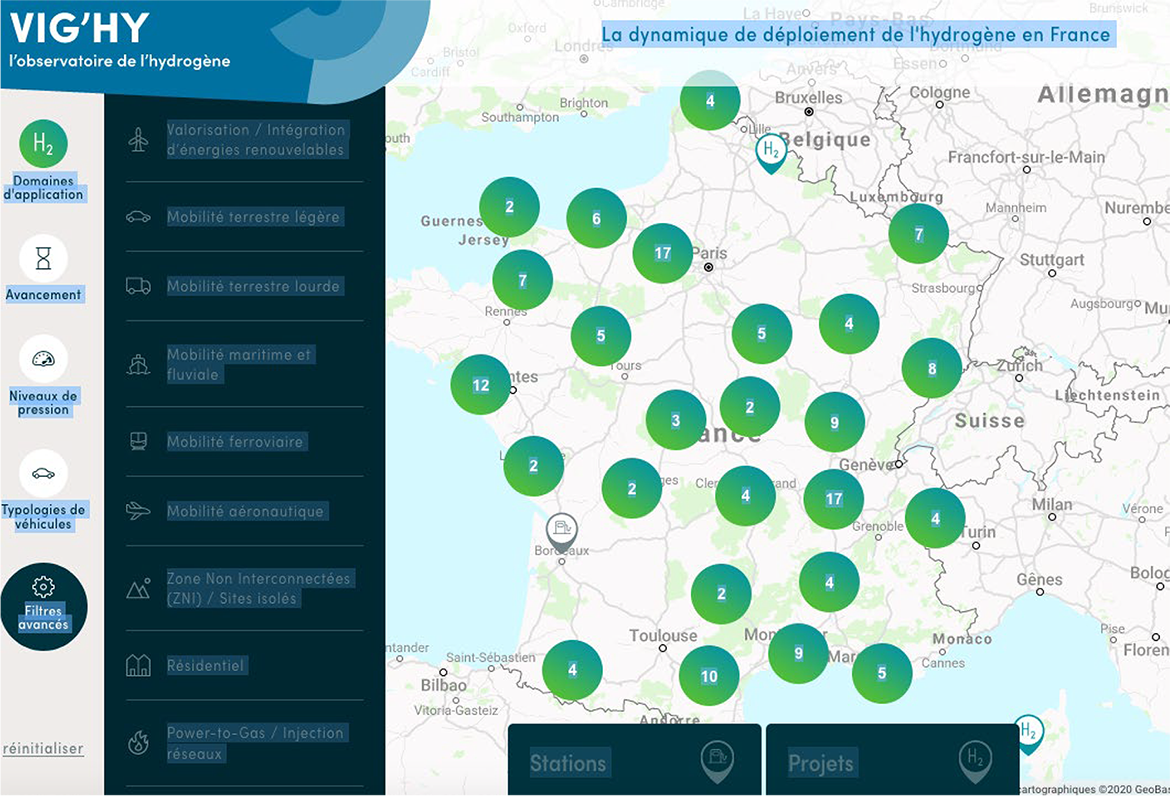
Map of transport-related hydrogen projects developed in France in 2022. The circled numbers correspond to the number of projects developed per geographical area.
The map illustrates the territorial dynamic of the deep scaling model. The national territory is gradually covered with infrastructures and circulating vehicles but not in a unified or centrally planned manner. Vehicles used in territory A can circulate in territory B, but the locations of the infrastructures are designed for specific uses in each territory. A hydrogen Parisian taxi will not be sure to find a suitable refueling station if it goes all the way to Montpellier in the south of France and will do so only if the territorial ecosystem around Montpellier has been designed for the same use. This is not guaranteed because the Montpellier ecosystem might have been designed to operate fleets of commercial vehicles, with refueling stations not optimally placed for taxis traveling long distances or within a city’s commercial zones.
This raises several issues around deep scaling. Should one accept that hydrogen mobility will be mostly reserved for local uses, such as well-known companies’ professional routes on limited distances, or public transportation in cities? If this is the case, how can a balance be achieved between the territorial adaptation at the heart of deep scaling and economic profitability? The proponents of local ecosystems have answers to this question. In addition to being local public bodies, they are also large private companies involved in the production of hydrogen as well as much smaller ones that build production sites and charging stations and offer services to help cities and towns to plan future stations. For these two groups of private actors, the captive fleet models described in the previous section are meant to be economically viable, with the Japanese and German models as counterexamples. The manager of the DINAMHySE project told us that: The challenge is to lock in political support and use it to ensure that the stations are minimally profitable. Our project aims to build local ecosystems and to ensure that stations are available for those who need them. Conversely, in Germany they have stations all over the country but no associated vehicles, so it must be hard for them in terms of profitability. (Interview 11)
These examples show that deep scaling is associated with its own practices of valuation (Muniesa 2011). Here, value does not originate in the mass production of standardized products or from an anticipation of future profits that can be convincing for investors. Instead, value is inherently associated with the specific characteristics of the local territory where hydrogen is used and with the ability to transform this territory. While the standardization of infrastructures and products is crucial for the car companies that criticize ecosystem-style experiments, the actors engaged in deep scaling see prospects for economic value in the gradual multiplication of ecosystems across the country, even if there is no standardized transportation infrastructure. Hydrogen producers envision growing volumes of hydrogen production, while the companies that build and operate charging stations are currently developing associations with larger energy firms to extend their interventions across various local ecosystems.
We can now envision the implications of deep scaling. In the world of deep scaling, dealing with the problem of scalability means ensuring localized public interventions to identify and answer local needs as well as broader public support (such as national or European funding programs) for territories to engage in innovation projects. Contrary to what critics of the French hydrogen strategy would say, envisioning scalability in terms of deep scaling does not mean sticking to the local level and the experimental phase at the expense of a larger extension. Rather, the world of deep scaling redefines the “local” and “global” scales. Territories are now seen as dynamic entities—managed by public bodies competing with one another to attract public and private investments, gradually transformed as technological projects become denser. What becomes large scale are volumes of hydrogen, flows of users, economic revenue, and geographic spaces as experimental sites appear in various places. When the local and global scales are redefined in those terms, then the allocation of costs and benefits and the possibilities for intervention are shifted, and the politics of scalability is transformed. When the problem of scalability is phrased in terms of upscaling of local experiments through the mass production of a given technology (like a hydrogen car), asymmetries arise regarding whether the inhabitants of territories meant to be testing grounds for pilot projects have a say in these projects, who pays for large-scale infrastructural investment and who benefits from it, and who has the ability to act at the national level and who does not. When the problem of scalability is phrased in terms of deep scaling, the political roles of territories are radically redefined. No longer-passive testing grounds for companies to test their products or passive beneficiaries of statewide interventions meant to ensure the robustness of standardized transportation networks, territories become actors of innovation projects, in charge of looking for external partners to support and engage in experiments. Deep scaling imagines a geography of uneven extension, where territories are no longer backgrounds but economic entities competing with one another to attract projects and partners. Here, the state is not endowed with the ability to plan infrastructures across its entire territory: it is the coordinator of competition across territories. Asymmetries are no longer about the dichotomies between those who make choices and those who have no alternative but to accept them; they are between those who can (or want) to be active economic players and those who cannot. These asymmetries result in empty spaces between ecosystems. The imagined geography of deep scaling leaves many territories and people aside.
Conclusion: Pluralizing Scalability
The energy transition requires new technical, social, and economic approaches of a global nature, large enough to meet the contemporary challenges of global warming. This is often translated into a call for scalability, with local experiments expected to evolve from situated tests to mass production. This reasoning fits well with the understandings of energy transition as a new source of economic growth. Yet it also faces persistent challenges: what is expected to be “scaled up” and how to do so are never self-evident. These challenges are particularly acute in technical domains where a general overhaul of energy production, transportation, and use is required. Making hydrogen a widely distributed energy carrier implies such an overhaul. This is what the expression “hydrogen economy” points to and what explains the insistence from industrial and policy actors on the need for scaling up hydrogen solutions. In practice, however, the scalability of hydrogen projects proves much more diverse than a simple call for “upscaling hydrogen solutions” may suggest. We have described some territory-based projects in which what matters has been the gradual densification and intensification of hydrogen uses in ways that tie economic value with the ability to assemble local ecosystems. In this vision, scalability does not refer to the quality of a given technical object that can be mass replicated through standardization for the sake of diminishing costs, as the economies-of-scale reasoning would have it. Rather, scalability is what allows a given initiative to stimulate additional developments by adding means of energy production, transportation, and uses in a given territory. Scalability here is the quality of what can be attached to future technologies and uses, and scaling is best described as the ability to go deeper into a given territory by multiplying the numbers of economic actors, the possibilities of use, and the connections between producers, transporters, and users. We speak of “deep scaling” to point to this version of scalability. 8
The contrast between deep scaling and the expansion of standardized products that other actors envision is helpful to start a renewed critique of scalability that does not take for granted terms such as “local” and “global.” The world of economies of scale through mass production of standardized products associates local territories—seen as a laboratory for prototype testing—with a global one that emerges only if covered by unifying infrastructures. Deep scaling brings together situated tests and extends them by multiplying various ecosystems, where each develops according to local particularities, whether related to the identities of the actors involved or local geographical or social characteristics. These two ways of problematizing scalability are each associated with their own imagined geographies and sources of economic value. They each result in inclusion and exclusion mechanisms. Scaling up through standardization of products and infrastructures tends to ignore the diversity of local particularities and to favor homogenous interventions instead. The world of deep scaling, by contrast, is that of initiatives designed to respond to specific territorial needs. Deep scaling also functions with state support programs or European policies that articulate a concern for local needs and an explicit focus on territories, which compete to attract funding and launch new projects. While this subnational focus has opened up new ranges of possibilities for territories, one can also speculate about the consequences of this approach for territories that are left out. Envisioning geographic and economic extension by multiplying local ecosystems implies coordination issues and raises questions, not only about the fate of the spaces between ecosystems but also about the possibility of formulating shared goals.
By analyzing the manifestations and consequences of deep scaling, we do not claim that one problematization of scalability is more desirable than the other. Rather, we aim to pluralize the scalability imperative and to develop an analytical attention to the variety of the problematizations of scalability. This analytical attention offers a kind of critique that does not operate on a ready-made “local to global” scale. It does not commend “local” interventions, as if what counted as local could easily be identified, nor criticize the failures of upscaling experiments, as if moving “up” was straightforward. Rather, this critical approach to scalability asks questions such as when the problem of scalability is framed, what is the local? What is the materially realized or discursively imagined geography of extension? What sources of economic value does it envision? What types of policy intervention does it require? And, what are the overall consequences in terms of inclusion or exclusion?
The empirical examples in this paper support our claim that exploring these kinds of questions is a way to undertake a critique of the scalability imperative that can be practically and theoretically meaningful. This imperative often functions as an impractical injunction for actors of innovation projects, particularly local public bodies eager to ensure that the inhabitants of the territories they run benefit in the long term and do not serve as guinea pigs before massive replication elsewhere. Opening up reflection about the long-term perspectives and day-to-day operations of scalability can provide these actors with additional critical resources to engage in innovation practices that are more responsive to local needs and concerns. Perhaps more fundamentally, analyzing varied versions of scalability offers a way of exploring the implicit theories of innovation and society that the problem of scalability always implies. Some of these theories reduce complex problems to individual technical questions, adopt a linear vision of technical progress in which social adaptation is taken for granted, and eliminate sources of economic value more complex than those dependent on mass-producing standardized products. Other approaches define the problem of scalability as a matter of convincing investors of future value, often making exponential speed a value in itself. Yet others, as in deep scaling, seek to deepen material and social ties and extend ecosystems, distributing economic and political power unevenly across territories. A critical analysis of how scalability is problematized allows for more sophisticated understandings of innovation dynamics and for envisioning other associations with social progress.
Footnotes
Appendix
Events Attended.
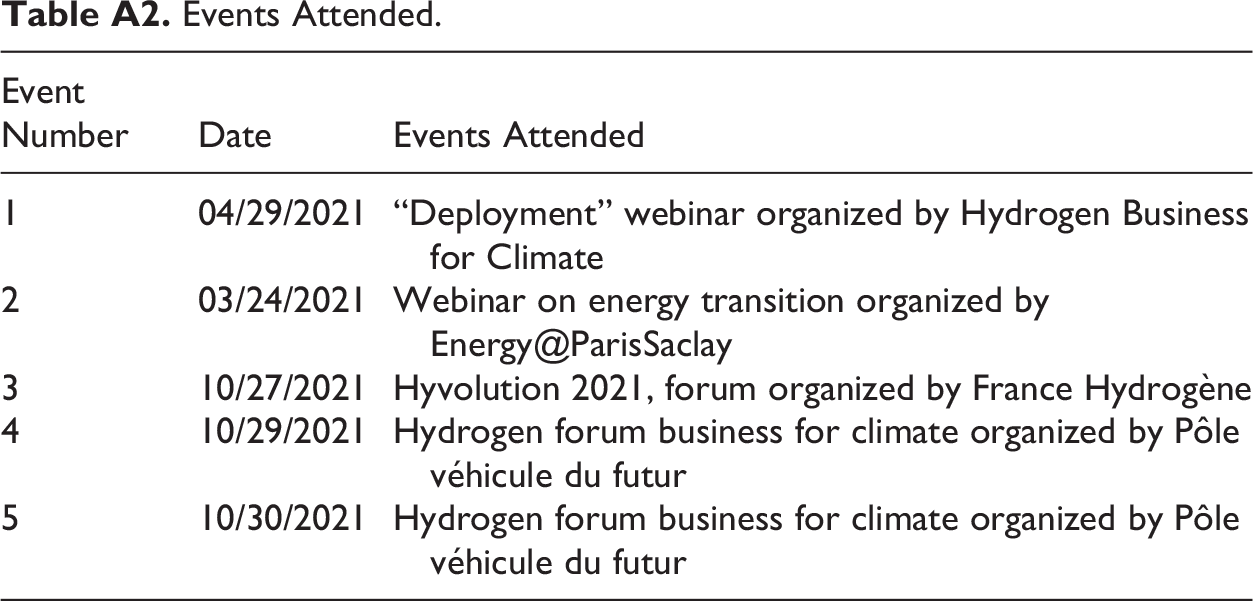
| Event Number | Date | Events Attended |
|---|---|---|
| 1 | 04/29/2021 | “Deployment” webinar organized by Hydrogen Business for Climate |
| 2 | 03/24/2021 | Webinar on energy transition organized by Energy@ParisSaclay |
| 3 | 10/27/2021 | Hyvolution 2021, forum organized by France Hydrogène |
| 4 | 10/29/2021 | Hydrogen forum business for climate organized by Pôle véhicule du futur |
| 5 | 10/30/2021 | Hydrogen forum business for climate organized by Pôle véhicule du futur |
Acknowledgments
The authors would like to thank the participants in the “Science, Technology and Democracy” workshop organized by Margo Boenig-Lipstin at ETH Zurich on February 16-18, 2023, as well as Virginie Boutueil, Béatrice Cointe, Philippe Bezès, and the two anonymous reviewers for their feedback and comments on earlier versions of the article.
Declaration of Conflicting Interests
The author(s) declared no potential conflicts of interest with respect to the research, authorship, and/or publication of this article.
Funding
The author(s) received no financial support for the research, authorship, and/or publication of this article.
