







Abstract
In March 2011, the Fukushima Nuclear Disaster released radiological contamination across a large part of Japan. Formal protective actions taken included mass evacuations, food restrictions, and decontamination programs; decisions about where to live, what to eat, and how to live with radiological contamination were taken both formally and informally. Informing the implementation, continuation, and cessation of protective actions taken by officials and by residents involves a plurality of determinations about radiological contamination. Collections of human and nonhuman entities come together, as qualculative agencements to produce new radiation knowledge and to produce qualculations which produce action and effects in response to the incident risks. I developed the “Assembling the Qualculator” framework to examine the constituent parts of these knowledge-making agencements. The framework identifies four qualculative roles that human actors perform (resource generator, gatekeeper, qualculator, and user) alongside three kinds of qualculative resources within the agencement. Two contrasting examples of schoolyard monitoring in Fukushima are explored through the lens of the framework. This highlights how the almost limitless number of qualculations in emergencies becomes constrained by resource availability, temporality, and spaces, and that qualculative potential is stabilized through formal emergency structures and policy instruments.
Introduction
In March 2011, a major earthquake and subsequent tsunami off the east coast of Japan caused, amongst other things, damage to the Fukushima Daiichi Nuclear Power Plant. This eventually led to multiple releases of radiological contamination across a large geographic area, predominantly affecting Fukushima Prefecture and neighboring regions. Protective actions included mass evacuations, food restrictions and controls, and also an enormous decontamination program (Fukushima Nuclear Accident Independent Investigation Commission (NAIIC) 2012; IAEA 2015). Many of these protective actions continue today, although not necessarily in the same ways as during their peak. The implementation, continuation, and cessation of protective actions taken by individuals and different knowledge communities is informed by a plurality of judgments about radiological contamination. These judgments are based on information about radiation in Japan since 2011; what exactly was released, how much was released, where it is (or was, or will be), and what impacts it might have on humans and nonhumans, what kinds of questions scientific information is trying to answer, and so on.
The production of radiation knowledge appears superficially, at least, to be the archetypal site of calculative knowledge production, given the scientific practices (measurement and quantification), technical devices (Geiger Counters and Scintillators), and numerical data (0.23 microsieverts (μSv) and 100 becquerels (Bq)) involved. However, decisions and actions involving radiation were not determined by numerical data alone, but incorporated views about how those numbers were generated (who produced data, which devices they used, and what their methods were), alongside other political, social and cultural reasons for making the decision (e.g., policies, thresholds, and standards in use at the time, as well as family or economic influence), and also the availability and accessibility of the data. “Knowing” anything about radiation is the result of complex constellations of entities coming together to do “radiation knowledge production.” This includes having access to measuring devices and things to measure, knowing how to work the device, how to interpret any results, and what action to take. But how does the process of radiation knowledge construction work? And who or what participates in it and what shapes or constrains knowledge-making possibilities? I use the concepts of agencement and qualculation to explore these questions.
I begin by introducing the concept and process of qualculation more concretely. I then use examples from my data to demonstrate how qualculation can be extended productively by examining the resources and human roles involved. Based on my data, I developed a conceptual framework for analyzing human roles within knowledge-producing agencements, called “Assembling the Qualculator.” Assembling highlights the ongoing work of becoming within the agencement. I suggest that human actors within qualculative agencements perform one or more of at least four different roles in the process (gatekeeper, resource generator, qualculation performer, and user) and that they rely on access to qualculative resources. The framework exposes different capacities that human and nonhuman actors have to contribute to knowledge-making processes. It also draws attention to the role that the spaces and times of qualculation play in defining what qualifies to enter into an agencement producing a judgment about radiation. As such, this article contributes to social science debates about collective knowledge construction, the politics of knowledge production, and epistemic (in)justices in disasters.
I end by highlighting implications for emergency management practitioners and demonstrating how this expanded framework will provide social science scholars with a tool to further examine the politics of knowledge production, expertise, tensions, and epistemic injustices in other research settings.
Method
This paper is based on ethnographic research undertaken in 2018 and 2019 (including two periods of fieldwork totaling over seven months in Japan), which examined the creation and use of radiation knowledge following the Fukushima Daiichi nuclear power plant disaster in Japan in March 2011. My data includes: (1) notes on participant observation from activities such as farming, facilitating radiation workshops for children, making a radiation monitor, and accompanying scientists on research fieldtrips; (2) transcripts from semi-structured interviews conducted in English, and Japanese (with a translator) with a wide range of participants from international and national nuclear industry bodies, academics and radiation scientists, and citizens involved in radiation monitoring, and regulators, as well as (3) photographic and documentary data published in response to the disaster (government decontamination guidelines, leaflets and maps, academic studies, and national reports). Ethical approval for the project (Elstow 2023) was received from Lancaster University's Faculty of Arts and Social Sciences and Management School Research Ethics Committee. Informed consent was obtained from participants for semi-structured interviews using a participant information sheet. Where I gathered data through participant observation, I introduced myself as a researcher to those present, offering a business card with my academic contact details where necessary. Initial recruitment targeted government, research, and volunteer-driven organizations involved in radiation measurement, predominantly through a local journalist who acted as a gatekeeper. Participants were recruited through a snowball technique from there; their names, where provided, have been anonymized.
Theoretical Position
Agencements
This article starts from a position that radiation knowledge is constructed by infinite socio-material agencements (Deleuze and Guattari 1987), which is to say, “a mode of ordering heterogeneous entities so that they work together for a certain time” (Müller 2015, 28). Introduced in the French language by Deleuze and Guattari (1987), the term agencement means “arrangement” or “fixing,” in the sense of “in connection with.” It is sometimes translated into English as assemblage, although this has been criticized as a mistranslation (Marcus and Saka 2006; Phillips 2006; Venn 2006), which fails to convey the dynamic nature of the original French term. Assemblage is static and depicts the final state coming together. Instead, agencement points to the “process of linking heterogeneous elements in an open-ended process” (Gherardi 2016, 687). The two concepts are linked; therefore, agencement is the process of forming an assemblage (Gherardi 2016, 687).
In this paper, I deploy agencement (as a dynamic collection of entities, human and nonhuman, coming together in a particular arrangement with agency to make change) as a means to describe the collection of entities that come together to produce new knowledges and understandings about radiation. Radiation knowledge-making agencements include human entities (who, for example, determine the kinds of questions that are being asked, put their bodies forward for inspection for radiological materials, or use radiation monitoring devices to make measurements of specific things) and nonhumans (such as protocols for what, where, and how to measure radiation, tools for measuring radiation, standards and thresholds, weighing scales, animal and plants, lanyards, maps and coloring pens, and so on). Agencements are active, involving social practices (e.g., data management and interpretation), working alongside associated practices (e.g., farming food crops or providing a safe space for educating children). These arrangements of entities and practices come together at certain times, in certain situations, or in certain spaces, and they are therefore in flux over time.
Qualculations Within Agencements
The second lens through which I approach the construction of radiation knowledge is through qualculation (Cochoy 2002). Cochoy originally coined the term qualculation to describe consumers’ cognitive processes in economic markets and product purchasing decisions, in situations where numerical information was lacking or unhelpful, and where numerical calculation was a challenge. Supported by Latour's (1987) notion of “centres of calculation,” and the idea that calculative agency “is distributed among humans and nonhumans” (Callon and Muniesa 2005, 1236), qualculation involves not only human actors (consumers, producers, and marketers), but also nonhumans, such as shopping trolleys, pricing infrastructures, and shop layouts (Cochoy 2008).
Qualculation suggests that all kinds of calculation involve socio-material objects manipulating resources in a single spatiotemporal frame with distributive agency (Callon and Muniesa 2005). Radiation protection involves knowledge-making agencements extracting entities from one place, arranging them in certain ways, and producing a new entity in the form of a judgment or decision (I can eat this, you may not live here, and this schoolyard is clean enough for children to play in). Callon frames qualculative work in economic markets, as taking place inside market agencements which frame possibilities of what can be done and what is done in those spaces. Economic markets “consist of arrangements that play a double role. They contribute to imposing guiding frameworks on individual actions and provide them with motives, while channeling collective action toward the conclusion of commercial transactions” (Callon 2021, 49). I use qualculation as the product of a particular kind of agencement, to examine the process of decision-making in relation to radiation protection measures.
The qual of qualculation indicates that an evaluation is not solely about numerical values, but concerns qualifying and qualities—not everything makes it into the qualculative space. Faced with a choice between products for which there is no price, or where the price is the same and therefore cannot steer the consumer toward a rational choice, consumers “compensate for the lack of numbers by taking qualitative elements into account” (Cochoy 2019, 309). Callon and Muniesa (2005, 1230) recognized that economic accounts made calculation the result of “disembodied agents…their preferences and calculative competencies,” whilst sociological accounts of market calculations showed that economic calculations are complex, but tend to suggest that very little arithmetic calculation takes place at all (Knorr Cetina and Bruegger 2002; Miller 1998). However, whilst consumer decision oscillates between “calculation” (numerical evaluation) and “qualculation” (qualitative estimation), there is no radical difference between the two processes; they are two sides of the same coin (Cochoy 2019, 310). Any evaluation involves both numerical and qualitative judgment (Callon 2016).
Qualculation does away with any distinction between a calculation (as being objective and quantitative) and judgment (as being more subjective and qualitative). Instead, it directs attention toward the selection of things that are included (which entities qualify), who participates in these activities, how these are ordered, and the means by which determinations are made. As I demonstrate, various factors influence what eventually qualifies to enter a radiation knowledge-making agencement, how things get ordered along the way, and which human actors interact in the agencement at different times.
Qualculation has been used to investigate various accounting and economic practices, including intellectual capital (Rooney and Dumay 2016), electricity markets (Aune, Godbolt, and Sørensen 2016), and carbon accounting (Lippert 2018). It has also gained ground as a useful tool through which to examine more diverse settings, including the making of judgments and non-judgments in rail disaster inquiries, Quaker meetings, and Television fundraising (Callon and Law 2005). Moser and Law (2006) investigate information flows in medical practices using qualculation; aging and self-measurement of health data is the concern for Moreira, Hansen, and Lassen (2020), whilst Rhodes and Lancaster (2021, 859) trace model projections related to viral elimination and use qualculation to understand how projections “detach from their calculative origins as social and policy practices.” An “overflow of the efforts of qualculation” was offered as an explanation for why certain quantifiable health standard calculations did not take hold in the UK (Phoenix 2021, 293).
Conceptually, qualculation is the right tool for exploring radiation knowledge-making, because a wide array of human and nonhuman entities are implicated in wider processes for making judgments and decisions about radiation. Callon and Muniesa articulate a three-stage process for performing a calculation and note that the process applies equally well to qualculation. First, they point out that “relevant entities are sorted out, detached, and displayed within a single space” (Callon and Muniesa 2005, 1230). Second, those entities are manipulated, transformed, and are ordered within the space—relations are created between the entities. The third part of the process is that “a result is extracted. A new entity is produced. A ranking, a sum, a decision. A judgement. A calculation” (Callon and Muniesa 2005, 1230). The new entity circulates in new places without the “calculative apparatus” following it (Callon and Muniesa 2005, 1231).
Callon and Law (2005) highlight three important things about thinking qualculatively and about qualculative possibility. First, the outcome is nothing other than the result of the relations and manipulations performed along the way. Second, the product of qualculations—the objects made in the spatiotemporal frame—does not pre-exist; they are made by it. And third, that there are innumerable ways of arraying and manipulating entities in that space. These points are important in relation to radiation knowledge, because they suggest (a) there are infinite arrangements and arrays by which we might make radiation knowledge; (b) that quantitative data about radiation are just one of many kinds of qualculative resources that make decisions and judgments about radiation possible; and (c) that radiation knowledge does not pre-exist before it is called it into being through processes for knowing about it.
I position knowledge as being the product of multiple ongoing qualculations produced by an ever-changing agencement; entities coming together in particular times and spaces and in particular formations.
Assembling the Qualculator
Cochoy's (2008) research on qualculation during supermarket shopping excursions highlights that other humans (e.g., shoppers at home) and nonhumans (e.g., shopping trolleys) play a part in the eventual purchasing decisions made by the initial trolley-pushing-shopper. So qualculation is distributed between human and nonhuman actors. However, the process of qualculation as articulated by Callon, Muniesa, and Law says relatively little about when and how human actors are involved in the qualculation process and what form this involvement takes. I observed in my data that different human actors operated in different places along the process, bringing with them different nonhuman entities into the process along the way. The configurations of the agencement changed and limited the particular qualculative possibilities of that specific agencement.
Specific examples of agencements used to produce knowledge about contamination and make sense of safety in Japan emerged in my data. For example, I spoke to government decontamination officials and other citizens involved in making sense of contamination within school environments. We explored how each of the groups operated to understand the potential for contaminated food entering the school meal system, and the potential for school grounds to pose a contamination risk to children and adults. For both groups, this involved taking steps to understand where contamination was and how much there was; determining whether this presented a risk involved looking at particular potentially contaminated items, performing radiation measurements using specific methods and specific tools, and then interpreting the generated data to understand what risk, if any, the situation presented. However, the constellation of entities that came together to produce these judgments about whether the food or environment was “safe” or needed further decontamination differed depending on who was looking for an answer. In order to demonstrate how the agencement comes together in particular ways, I introduce my “Assembling the Qualculator” framework, which is constituted by different kinds of qualculative resources as well as four roles for human actors. After introducing the framework, I present two comparative examples from my research on schoolyard contamination using the framework.
My Assembling the Qualculator framework offers a more explicit overview of human and nonhuman entities within qualculative agencements. It is inspired by Deville, Guggenheim, and Hrdličková (2016) “Assembling the Comparator” concept, which highlights how different entities are brought together to undertake comparative work (itself a specific type of qualculation). My framework builds on previous work highlighting what makes qualculations possible or not possible (Callon and Law 2005), and how a judgment is created (Callon and Muniesa 2005), by focusing attention on the interrelations between the producers and consumers of the qualculative products, and how entities “qualify” to make it into the qualculation. The framework highlights power dynamics and tensions at play, and that certain things act to stabilize particular arrangements. It is a way of paying attention to the constituent parts of a qualculative agencement, and it could in the future be used to examine acts of knowledge-making in other settings, such as knowledge-creation in emergencies in general.
In the next two sections, I say more about qualculative resources—the nonhuman entities within the agencements—before outlining the four qualculative roles performed by human entities, and providing two examples to show this in action.
Qualculative Resources
Qualculations need resources; things that go into, or “feed” (Deville, Guggenheim, and Hrdličková 2016, 106), qualculations. These things are isolated, ordered, and manipulated (Callon and Law 2005, 719) during the qualculation process. Resources can be quantitative or qualitative, material or social. The material elements of a practice can be broken down into working in the background as infrastructures, in action as technical tools and devices, or used up within the practice itself (Shove 2016). Qualculative resources for radiation qualculations can similarly be divided into infrastructural, devices, and things that are used up.
Radiation knowledge-producing Resources are
I want to draw attention to three points about qualculative resources. First, some resources are spatially or temporally influenced. Resources may be located in specific places that become logistically, practically, financially, or temporally unavailable for some or all actors who might want to use them. For example, in Fukushima, some kinds of radiation monitoring devices did not exist at all immediately, or there was insufficient supply to meet demand. Other devices were just in the wrong place. Internal contamination is measured using devices such as Whole Body Counters (WBCs). They are large, cumbersome devices that are difficult to move. Getting WBCs to the populations that needed to use them took time and was only available for a given period. The first unit arrived in Fukushima in June 2011, “and was provided on loan for three months from Ningyo-toge Environmental Engineering Centre of the Japan Atomic Energy Agency” (Hayano 2016, 15). Second, resources used in one qualculation could be the product of earlier qualculations. A determination to set the threshold of decontamination activity at 0.23 μSv per hour (μSv/h) is the output of one very specific qualculation made by the Japanese Government to determine which areas required a special decontamination plan and also which level of government was responsible for managing that. However, 0.23 μSv was also frequently an input to other qualculations, such as individual people making determinations about whether to return to their homes. And third, an infinite network of resources might support a qualculation. This observation builds on the notion from actor network theory (Latour 1996) that it is always possible to zoom in or out of a network, as they are infinite. The key point is that qualculations require resources that support, enable, or are used up in the process, but these are not available in all places, at all times. It also highlights their cyclical nature; qualculations are built on and stabilize earlier qualculations.
Qualculative Roles
In my data, I discerned at least four roles that human actors performed within the qualculative agencement.
Radiation knowledge-producing agencements include many different human actors—governments, scientists and scientific institutions, funding bodies, citizens, businesses, and families—and any actor may perform one or more roles simultaneously. However, not everyone is equally able or obliged to participate in all roles: a scientist or engineer may be more able to generate new resources than a member of the public, and a politician or policymaker may be better placed to set the agenda for research or action after a disaster, thus more capable of gatekeeping access to funding and resources, than a member of the public or a school teacher. So, the situation is not static and will change over time as the situation develops. Additionally, multiple actors may perform the same role, or may perform multiple roles within the qualculative agencement; an engineer is not restricted to resource generation, and a policymaker does not only act as a gatekeeper.
Having defined descriptors for roles allows for more precise understandings of the varied ways in which humans can be enrolled in qualculative processes and how this links to qualculative resource availability and access, the possibility of tensions between roles emerges. Qualculation users, for example, may be obliged to take action in response to a qualculation made by someone else; may need to prove to other people that their qualculation was valid; or may want to perform their own qualculation, but lack access to the qualculative resources needed to do so.
One participant told me they were using high-end devices, we weren’t just buying the cheapest thing we could possibly get, I mean, to some extent we were buying the only thing we could get because the super high-end was the only stuff we could get… [the cheaper devices] had sold out across the world […and] if we were going to ask people to go and collect data…we wanted the results to be able to withstand scientific scrutiny—we did not want someone to come in and say oh well, none of that work is useful. So, we developed a hardware and a software platform to both collect data and publish it. (Formal interview, 9 July 2018)
A person may have gained access to funds and technical devices needed to make a radiation measurement; have already produced their own qualculative resources (a radiation measurement); and performed their own qualculation. Nevertheless, this may be insufficient to prompt action by the third party, as I show in the longer example about schoolyard monitoring below.
It is easy to imagine that where different organizations and different members of a community are making readings of radiation and interpreting them to take action, they may have differing views on what good measurements look like, how to interpret a reading, what action to take, and when. Furthermore, not everyone is equally able to participate in all qualculative roles, or have equal access to the resources needed to make qualculations. This can be seen as different qualitative processes engaging in struggles to become realized, and is similar to arguments about “performativity struggles” (Callon 2020). For example, one way of understanding internal contamination in human bodies is to use large, heavy WBC devices, which are difficult to move. However, there were only a small number of WBCs available, and they were initially at least only found in healthcare settings or research institutes, with access controlled by medical professionals. Medical professionals are also needed to interpret any readings generated by the counter. In contrast, over the coming months and years, a network of volunteer-run, community and government-run food monitoring stations slowly emerged, which meant access to a means to understand contamination in home-grown food and make decisions about whether to eat it or not became more accessible to the general public. Some of the machines involved in these public food monitoring stations removed some of the interpretive work required by displaying a big tick or cross on the output depending on whether the food was above or below the food contamination threshold set by the government, and they became widely accessible in places such as public service stations (Figure 1).

A publicly accessible food monitoring station in Iitate village (Fukushima, Japan) showing a food sample as being above the threshold 100 Bq/kg limit for consumption, marked X to indicate that it should not be eaten (Image credit: Louise Elstow, May 2019).
The four human roles and three kinds of resources described above are visualized in Figure 2 as coming together as part of a qualculative agencement. I turn now to two longer contrasting examples of such qualculating agencements from my fieldwork to draw attention to the consequences of thinking through how the resources and roles work together to constrain qualculative possibilities of radiation knowledge-making in Fukushima. Doing so highlights why there are tensions and politics to who and what is able to contribute to the making of radiation knowledge. I show that certain qualculations are more or less possible and legitimized in different times and different spaces. Alongside the agency of human actors, resources, space, and temporality all inform what qualifies to enter the qualculation.
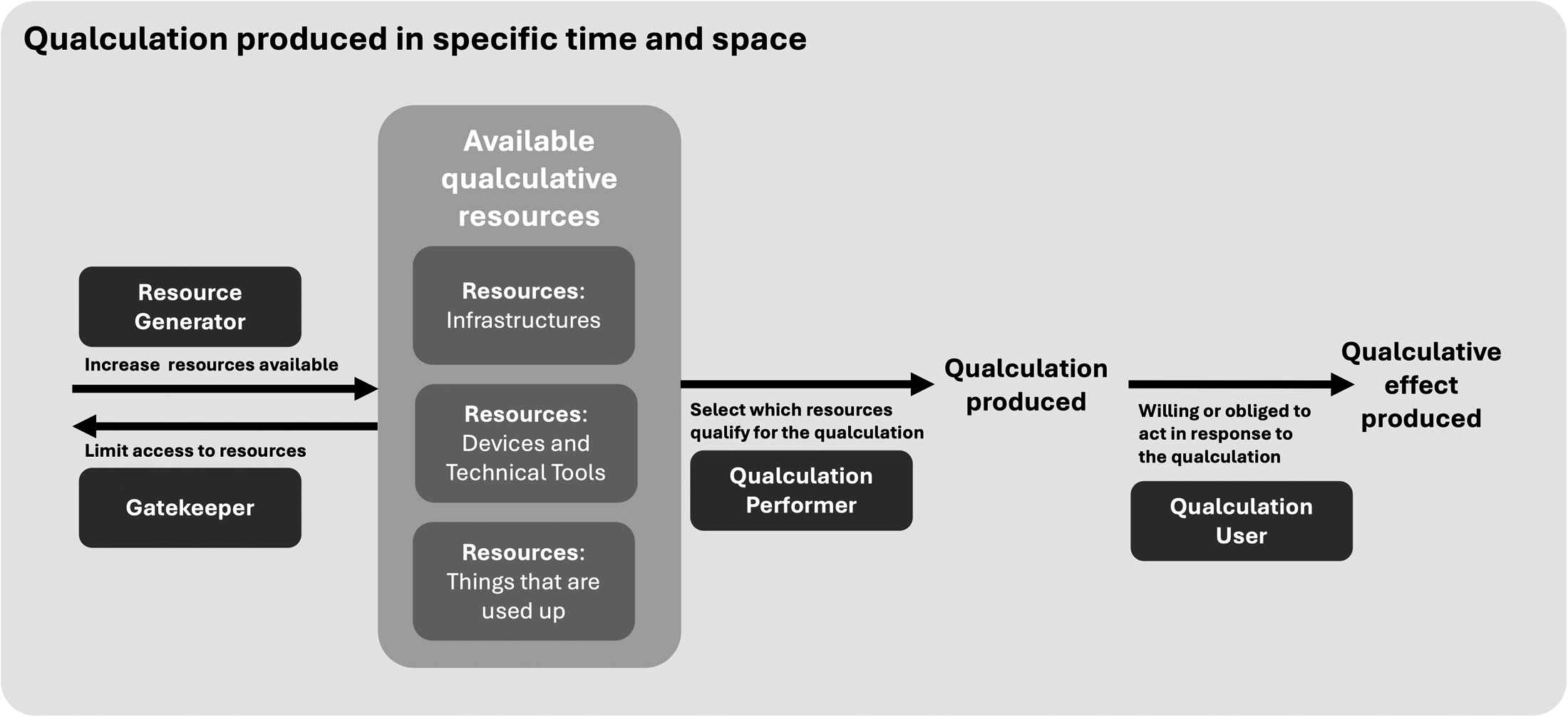
An overview of the Assembling the Qualculator framework presented here, describing how qualculative resources are produced and make it into a qualculation to produce a qualculative effect. Developed by the author for this paper.
Qualculative Agencement in Action
In August 2018, I spoke to Noriko, a woman in her forties, about her radiation monitoring activities. She was not formally trained in radiation monitoring; however, she had been working to monitor and understand radiation in Fukushima for the past seven years. We met in a busy café, as people took shelter from a storm; rain was lashing the windows. Over cups of tea and coffee, Noriko shared pages and pages of information her group had put together. Her work involved monitoring radiation and sharing this information with residents, local authorities, and the school district, as well as campaigning for better monitoring and signage in schools and for changes to the school food policy. She initially joined her group because she noted a “discrepancy between her judgment and the information the government provided,” and she wanted to protect her children from the effects of radiation.
We spoke at length about her radiation monitoring activities in the years since the nuclear disaster. These began when she was handed a handheld radiation measuring device by a citizen group engaged in post-disaster activities, and was tasked with measuring radiation inside people's homes and discussing the results with them. She noted helping residents to understand what the measurement meant and talking with them about their worries and concerns often seemed more important than providing the specific measurement itself. I got given a Geiger counter. At that time a Geiger counter was not easily available. […My] role was to use the Geiger counter to take measurements three times a day, one in the morning, afternoon and evening and then share the data with my network…I’ve got a Geiger counter which is not really available to other people. And also, I have a network, so I made a leaflet to inform people that I can do the free measurement. (Formal interview, 9 August 2018)
Noriko explained that a few years later, she set up another group that campaigned for better radiation protection within schools. She was a parent of two young children at school in a coastal town in southern Fukushima prefecture. She and other parents were worried about their children's radiological safety whilst at school. Government monitoring in schools did not allay her concerns. Her group shared information about what different schools were doing and saying to parents about radiation contamination at school, including how school meals were produced, and how the schoolyard was determined to be a safe place for a child to play and be educated in. She and the other parents came together as a group so that they would not be labeled as individual “monster parents” (in Japanese: モンスターペアレント). An individual concerned parent, especially a concerned mother, could easily be dismissed as being “hysterical and emotional,” so she tried to rely on her scientific methods and to “be really calm and speak slowly” to be able to convince school authorities to do more by producing calculations that showed that levels of radiation in the schoolyard were too high.
Formal schoolyard monitoring was conducted according to decontamination guidelines issued by the Ministry of the Environment (MoE 2013). Table 1 summarizes the two contrasting radiation monitoring activities undertaken in schoolyards: by the government decontamination teams and by Noriko's group. The table explains how each group assembles their qualculative agencement, which different qualculative resources are included, and who is able to perform the different qualculative roles.
Summary of Two Schoolyard Radiation Monitoring Agencements, Based on Data Collated in Fukushima, Japan, in 2018.
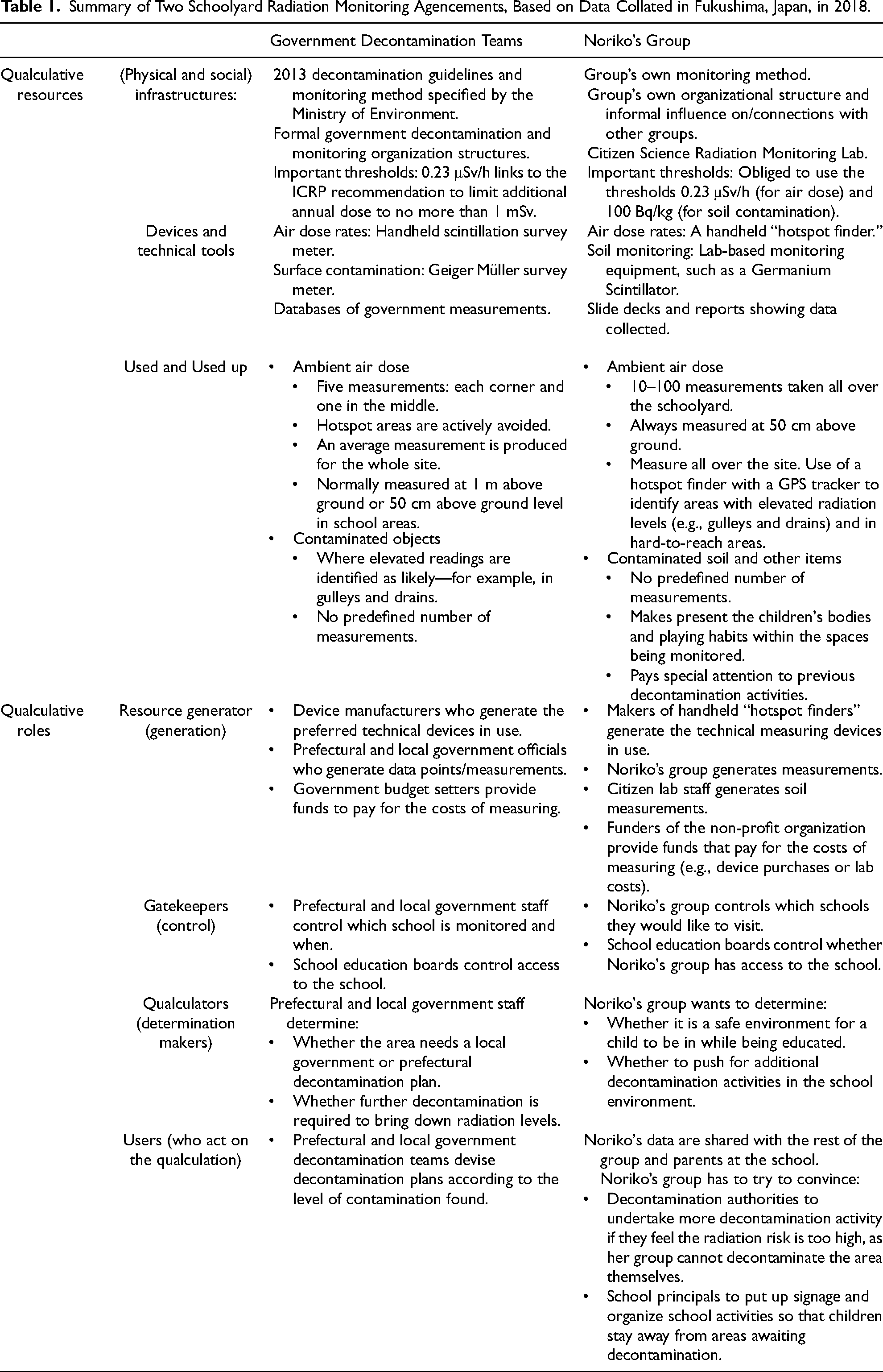
These two kinds of activities both produced understandings about contamination in the same schoolyards, yet they produced different judgments about whether the schoolyards were “contaminated.” The table shows that whilst both sets of radiation monitoring activity generate measurements about the radiological contamination of the schoolyard, these measurements are incorporated into different radiation knowledge-making agencements.
There are clearly tensions between the two measuring systems, and the agency each had to effect change in the schoolyard. In the following paragraphs, I expand on the information summarized in the table to provide more context for the examples provided.
The MoE government decontamination guidelines outlined a standardized method for monitoring radiation in public areas, including in schools and play areas. Principally, measurements were generated in order to inform decisions about whether the area required any additional decontamination in order to bring radiation levels down below a defined threshold, rather than to provide reassurance to anxious parents. The process specifies that measurements should be taken in five places around the school grounds, specifically “avoid[ing] measurement points such as those that are under trees or in street drains, where the dose rate may be locally high, since the purpose of the measurement is to determine the average dose rate for the whole area” (MoE 2013, 24). Measurements should normally be taken at 1 m above ground level, but in school environments, measurements can be taken at 50 cm instead because children's bodies are closer to the ground. The average ambient air dose is then calculated for the whole site, using the average value of the five measurements. If the average dose is above 0.23 μSv/h, the guidelines state that the area would be subject to further decontamination. This 0.23 threshold is based on the international standard set by the International Commission on Radiological Protection (ICRP) (MoE 2022), which recommends that the additional external radiation dose to a member of the public should be no more than 1 μSv/year (ICRP 2007). 1 No instructions are provided for identifying hotspots in a school environment; however, the guide does highlight that areas such as drains and depressions may have higher levels of radiation, significantly affecting a person in that area. It is inferred that one-off measurements might be taken in such areas; hotspots are identified by targeted monitoring rather than general detection. Here it is possible to see that different parts of the schoolyard have to qualify to make it into the qualculation.
Noriko explained to me that her group's method was to take lots of measurements (she showed me a map of one schoolyard with over 100 measurement markers on it). Five was insufficient to build up a proper picture of the places where children played. Aligned to this qualitative focus on children and how they might act in schoolyards, Noriko's group used a “hotspot finder” radiation monitor and moved around the whole schoolyard actively seeking them out. When they found a hotspot, they would send off soil samples to a community radiation monitoring lab in a nearby town for the soil contamination levels to be checked. Noriko also noted that in the immediate aftermath of the disaster, initial ad hoc decontamination efforts by school staff had meant bags of contaminated soil had been left in piles on site, unrecorded and potentially in disintegrating bags. One soil sample they took was 130,000 Bq/kg (the contamination limit for most food is set at 100 Bq/kg). These kinds of areas and types of contamination did not qualify to enter into the government survey's qualculative agencement, whereas Noriko's group actively included them in their agencement.
Noriko argued that the government method did not pay enough attention to these hotspots, which were important because they were precisely the kinds of places that children might choose to spend time in. She described children sitting digging up dirt with their hands, younger children potentially putting contaminated soil into their mouths, and highlighted that narrow gaps between buildings make enticing places for children to play and hide. Her group additionally used their calculations (which were based on quantitative measurements as well as qualitative understandings of how children behaved in the school environment) to press school management to install barriers or signage to prevent children from accessing places where elevated radiation levels were identified but not yet decontaminated.
In 2013, Noriko's group made an unsuccessful appeal to the City Mayor for more stringent limits for permissible radiation levels in schools and kindergartens. In order to push for further additional schoolyard decontamination, she and her group were obliged to use government thresholds despite not agreeing with them. Noriko's group tried to form “positive” relationships with local decontamination teams so that the teams would try to find creative ways to undertake additional decontamination, even in places where decontamination had already formally been marked as completed, and there was no formal need for additional decontamination.
Alternative Agencements
The two examples show that the schoolyard-radiation-monitoring qualculations undertaken by government workers and by Noriko's parent group were embedded in two different but equally complex radiation knowledge-making agencements. Knowing whether to be concerned about the schoolyard radiation levels meant committing to a particular agencement, which guided Noriko and government workers toward a particular judgment of “too high/low enough” or “more decontamination needed/no more decontamination needed.” Noriko formed her group because a qualculation from multiple parents using scientific and replicable methods had more agency to effect change than concerns raised by a single worried parent, who may be more easily dismissed. Their methods aligned with the government's, but incorporated different things. The two groups were able to address subtly different goals and pay attention to different things, with some entities present in both agencements. Whilst Noriko's agencement includes her group's choice of radiation monitoring device, an increased number of measurements and locations, it still includes the government's thresholds (0.23 μSv/h or 100 Bq/kg). It must do this in order for the product of the agencement to convince formal authorities to take action. Noriko's group paid more attention to the interaction between radiation and children's bodies active in those spaces, in contrast to the generic adult body envisaged by government guidelines. Her group sought out hotspot areas, precisely because the habits of children might make these places more enticing, and thus more likely for a child to come into contact with contaminated materials by sitting on them, hiding in them, and even eating them. In her method for monitoring radiation in children's bodies, their play activities, and ad hoc decontamination efforts were actively brought into the qualculation, in a way that they were not in official qualculations.
The two examples begin to show how spaces define and are defined by qualculative agencements and gatekeepers control access to the physical and virtual spaces of knowledge-making (e.g., laboratories and databases) and to sites to be monitored (e.g., schoolyards or people's homes). Noriko told me it was often difficult for parents who wanted to monitor contamination in schools to gain access to school property for the purposes of monitoring air, soil, and food samples, whereas government officials were more able to access these spaces. Conversely, local government officials in Fukushima sometimes struggled to gain access to people's homes to do residential monitoring (Kenens et al. 2022). Control and authority over particular spaces is a key influencer over qualculative possibilities achieved by any given agencement, and this control and authority sits with gatekeepers.
The examples also show that some qualculations made by specific qualculative agencements can have more agency to enact action, in comparison to alternative agencements. This highlights the tension presented by the idea that being able to make a qualculation (e.g., proclaiming an area to be decontaminated and therefore seen as “clean”) is not the same as being able to or having to act on it (e.g., having to play, live, or work in an area marked as decontaminated). Producing new radiation knowledge does not necessarily oblige another party to act, or to overrule another qualculation made by another party. So, although Noriko's group was able to produce qualculations which they understood to mean the schoolyard was still contaminated, they could not always successfully challenge qualculations made by government monitoring teams, which viewed the same yard as decontaminated. Noriko's group was only sometimes able to make compelling enough qualculations to prompt government decontamination teams to take action to decontaminate again with a new method, or for school principals to put up signage or barriers to stop children from accessing the contaminated locations.
The two examples provided in this paper are of specific agencements making specific qualculations in relation to the contaminated status of schoolyards in Fukushima. There are multiple cases documented of citizens’ groups struggling to contest the official designations of clean/safe/uncontaminated, or at least to propose alternative ways of knowing about radiation in the aftermath of the 2011 Fukushima Daiichi Nuclear Power Plant disaster (Brown et al. 2016; Kenens et al. 2020; Kimura 2019, 2022; Morita, Blok, and Kimura 2013; Morris-Suzuki 2014). In these examples, concerns were frequently discredited and labeled as generating “fuhyo higai” (風評被害, usually translated as “harmful rumors” in English, but the Japanese term is used even in English) if alternative agencements (e.g., those including parents, villagers) tried to suggest that contamination was more concerning than government accounts allowed for (Kimura 2016). In this way, these alternative judgments were given less agency to effect change than formal representations of contamination (or lack thereof). There are tensions between the products of the various agencements (the judgment or knowledge produced by it), and also tensions between who and what is able to be a constituent part of the agencement itself and in what performative capacity.
A final note is that qualculations, and the action that they precipitate, are not permanent; markers of previous judgments of contamination can wither over time. Noriko showed me photos of school children sitting next to a faded sign hanging on a fence advising them about the elevated radiation levels in that area. Her group had convinced the school principal to point out contamination hotspots, but although the contamination had not been removed, the judgment (made physical by the sign) was less and less visible. Over time, the school was being reclaimed as a place designated “decontaminated” by the official agencement, and could as such be viewed as being part of the production of “organized ignorance” on the part of the school and government decontamination teams (Dedieu 2022).
Agencements in Formal Emergency Management Structures
Zooming out from two specific examples from my fieldwork (summarized in Table 1), this section briefly explores some wider implications of applying the framework (presented in Figure 1) on knowledge creation and within the formal structures of emergency management in relation to contamination emergencies.
In emergencies, formalized incident management structures and policy instruments (e.g., emergency plans, legislation, and procedures) provide stability to knowledge-making by harmonizing what makes it into formal agencements and streamlining the kinds of qualculations that are made and used by them. They create and control access to particular kinds of qualculative resources, meaning some qualculations are more likely to be created by agencements involving certain spaces, because spaces and tools are more (or less) accessible to certain groups. They also influence who is able to perform which qualculative role, by defining who is allowed to make certain formal kinds of judgments (typically this will relate in some way to a notion of safety—being “safe” to return to, “safe” to eat or “safe” to use, or “safe” to be close to). The luxury of being able to make or access resources, to manipulate them, and to then make a decision (on your own behalf or for someone else) is not afforded to everyone equally. In Japan, for example, the government mandated that people in evacuation zones had to leave, and set mandatory requirements for food monitoring and control, and for decontamination, which applied to specific places or things. Under most normal (democratic) circumstances, where to live, work, and what to eat are things broadly within the control of individual citizens, rather than specified by the state. 2 Formal structures and instruments also inform the dispersed spaces within which agencements are formed. For example, certain methods for generating, qualifying, or ordering resources are only acceptable in certain places (e.g., decisions made in incident control rooms or advice provided by scientific advisory cells), or by certain actors (strategic coordination groups or “gold” officers or by specific institutions); these produce particular qualculative agencements that can only be produced in those situations.
Additionally, actors within official emergency management structures are more likely to be able to access qualculative resources more readily than those outside official structures, who may—initially at least—operate with access to fewer qualculative resources. Members of the public, for example, are less likely than government agencies, scientific and technical organizations to have access to specialist equipment needed to detect or measure contamination. They may not have the funds available to buy specialist equipment or skills to make or interpret qualculative resources themselves. Without access to their own qualculative resources and unable to make their own qualculations, actors outside formalized structures frequently have to rely on qualculations made on their behalf. They may also be organizationally, infrastructurally, or politically excluded from various roles, or have to rely on or be obliged to act on a qualculation made by another potentially untrusted agencement. Tensions may therefore arise not just between “the public” and “the authorities,” but also between different organizations within the emergency response structure. Whether people have agency to ignore government orders to take a certain course of action depends on various factors, including whether authorities are trusted to make decisions, whether contraventions are detectable, enforced, or even enforceable.
The material and social dimensions of spaces restrict which entities make it into the agencement and when qualculations are possible. Immediately after any kind of disaster, the need for new understandings may not immediately be met by the pre-existing agencements, either informally or within formal structures. As time goes on, more and more agencements become possible outside formalized structures, drawing on different qualculative resources and involving different spaces to address different concerns. Time can also limit the qualculative possibilities. For example, Iodine-131 was one of the main contaminants in Fukushima. However, with a half-life of only eight days, dose assessment based on direct monitoring is only possible within the first few weeks before the iodine decays below detection limits. Because no internal dose monitoring program was implemented immediately after the Fukushima disaster to measure thyroids directly, people's doses had to be modeled based on where they had been and what they had eaten (IAEA 2015).
Over time, different agencements become or cease to be possible. The potential for qualculations is therefore not limitless; it is always constrained by the particular configuration of the agencement and resources available in those spaces and at those times.
Conclusion
Emergencies establish different working relationships and expectations about who is responsible for making decisions, and who is obliged to follow the judgments made. Certain entities and actors have authority (or the expectation of such) to make qualculations on behalf of others in a way that they may not under normal circumstances. Action in emergencies is often regulated by preconceived plans, technical documents, and guidance, which constructs the imagined disasters of the future and define the boundaries of what is permitted or acceptable in particular settings/spaces and at certain times/phases. These material parts of wider emergency management agencements define the roles, spaces, and temporalities of knowledge-making agencements. It is, therefore, important to consider who is able to participate in designing and steering the production of radiation knowledge, because such knowledge and decision-making affect individual lives, by determining for them where they can go, what they can do, what they can eat, and so on. It matters who has access to technical devices to create data, and it matters who has power, authority, and access to resources already in existence.
In this article, I extend the concept of qualculation by attending to the resources, spaces, and temporalities of qualculative agencements, as well as the different human roles within the qualculation process. Thinking about knowledge-making in emergencies through the lens of qualculation helps explain why there may be tensions between stakeholders with drastically different agency to influence the construction of a qualculation—what should be included in it, what to pay attention to, what is important, and so on. Differing priorities about what is important mean that the agencements include or exclude different entities, and will operate in different places and at different times. This expanded concept of qualculation will be useful to professionals working in emergency management, as they have opportunities before incidents arise to consider how the plans and instruments they create constrain and limit or enable qualculative potential.
The Assembling the qualculator framework presented in this article contributes to wider debates in social science about what and who is able to participate in knowledge construction (not only in emergencies), speaking to notions of epistemic cultures (Knorr Cetina 2007), epistemic (in)justice (Fricker 2007), and disaster (in)justices (Lukasiewicz and Baldwin 2020), as well as the liveliness of the nonhuman in collective knowledge-making. It also underlines the fallacy of thinking about measuring and quantification activities as simple acts of neutral objectivity. Scholars working with the concept of qualculation may use this four-role and resources framework to more closely investigate the differing potential of various stakeholders and entities within knowledge-making activities. Overlaid with attentiveness to resource availability and spatial and temporal dimensions, this provides opportunities for a more nuanced understanding of knowledge communities and how they operate.
Footnotes
Acknowledgments
The author would like to thank her participants for their invaluable insights into radiation monitoring in Japan after the Fukushima nuclear disaster. Thank you also to Joe Deville for his suggestions and prompts during the editing process.
Declaration of Conflicting Interests
The author declared no potential conflicts of interest with respect to the research, authorship, and/or publication of this article.
Funding
The author disclosed receipt of the following financial support for the research, authorship, and/or publication of this article: This work was funded by the ESRC (NWDTC CASE award 2016–17) and the Japan Society for the Promotion of Science (SP18107).
