







Abstract
In this paper, I examine the social, subjective, and scientific implications of the hunter hypothesis, an evolutionary etiology for Attention Deficit Hyperactivity Disorder (ADHD). By tracing its presence in Chilean “everyday life” narratives and “neuropsychiatric” discourses, I argue for greater attention to the ancestral imaginaries within evolutionary etiologies. This perspective aims to enhance the study of medical categories as tools for self-understanding and biosociality, to foster interdisciplinary collaboration in mental health research, and to engage with calls for greater participation from neurodiverse individuals and communities. The article is structured in two parts. First, I explore the two-way encounter with the hunter hypothesis, examining its origins and interpretations in both “everyday life” and “neuropsychiatric” Chilean contexts. Second, I analyze the undertheorized role of ancestral imaginaries in scientific and medical speculation, seeking to enrich critiques of evolutionary thinking. I show how other legitimate speculations and testable scientific fictions become possible if we move beyond linear and dichotomic evolutionary narratives. The conclusion emphasizes that engaging with imagination should not involve adopting fixed speculative frameworks. Instead, it calls for democratizing access to scientific speculation to open it up to more nuanced strength-based narratives.
Introduction
This paper explores the social, subjective, and scientific implications of an evolutionary etiology for the Attention Deficit Hyperactivity Disorder (ADHD). The “hunter hypothesis,” informed by genetic findings and scientific speculation, posits that traits such as hyperactivity, inattention, and impulsivity were adaptive in ancestral hunter-gatherer environments more than 40,000 years ago but have since become maladaptive. By tracing the presence of this hypothesis in Chilean “everyday life” narratives and “neuropsychiatric” discourses, I argue for greater attention to imaginaries of ancestral human environments and groups within scientific speculation and the circulation of etiological hypotheses. This approach enhances the study of medical categories as tools for self-understanding and biosociality (Bradley 2021; Gibbon and Novas 2008), while also supporting calls for interdisciplinary collaboration in mental health research (Bemme and Béhague 2024) and engaging with demands for greater participation from neurodiverse individuals and communities (Stenning and Rosqvist 2021), specifically within the emergent field of Critical ADHD Studies (Brown, Rosqvist and Jackson-Perry 2024).
The hunter-gatherer hypothesis became central to my work because it simultaneously emerged in my ethnographic shadowing of diagnosed individuals and my genealogical inquiry into the Chilean construction of adult ADHD. This intersection highlighted the interplay between scientific speculation and intimate practices of subjectivation. Evolutionary speculative claims entangle with everyday life through supposed alignment between contemporary ADHD behaviors and traits once adaptive in ancient hunter-gatherer societies. Yet, what human environments looked like 40,000 years ago remains far from settled; this is a contentious, speculative domain. Without direct epistemic access, debates over human ancestry unavoidably speculate when depicting ancestral environments and temporally distant socialities (Hubálek 2021). This ancestral speculative leap often invites linear evolutionary narratives (Descola 2024; Ingold 2011), which social scientists and biological anthropologists have critiqued extensively, particularly on the inferential legitimacy of evolutionary explanations (Matsumoto 2021; Rellihan 2012; Rose and Rose 2010; Smith 2019).
Nonetheless, even if the hunter-gatherer hypothesis and broader evolutionary frameworks are contested and likely unverifiable, they still seem to serve as resources for self-understanding beyond a pathologizing lens (Troisi 2025), potentially contributing to a strength-based approach to ADHD and other neurodiversity categories (Brown, Rosqvist and Jackson-Perry 2024; Schroder, Devendorf and Zikmund-Fisher 2023). This depathologizing potential adds an ambiguous layer of complexity that seems worth exploring. This article dwells on that ambiguity, aiming to show that engaging with imaginaries driving scientific speculation can open a path toward more robust critiques of medical categories. Furthermore, moving beyond simple linear evolutionary narratives makes room for other legitimate speculations and testable scientific fictions, fostering social justice through interdisciplinary and collaborative knowledge production.
Following the methods section, the article is structured into two main parts. First, I trace the two-way encounter with the hunter hypothesis, exploring its origins in both “everyday life” and “neuropsychiatric” contexts while observing the questions it provokes. Second, I examine the under-theorized role of ancestral imaginaries within evolutionary speculation, aiming to enrich critiques of evolutionary thinking and propose new pathways for interdisciplinary collaboration. The conclusion underscores that engaging with the realm of imagination should not lead us simply to adopt opposing speculative images. Instead, it calls for democratizing access to scientific speculation through critical collaboration among social scientists, evolutionary psychiatric and genetic experts, neurodivergent individuals, activists, and neurodiverse scholars.
Methods
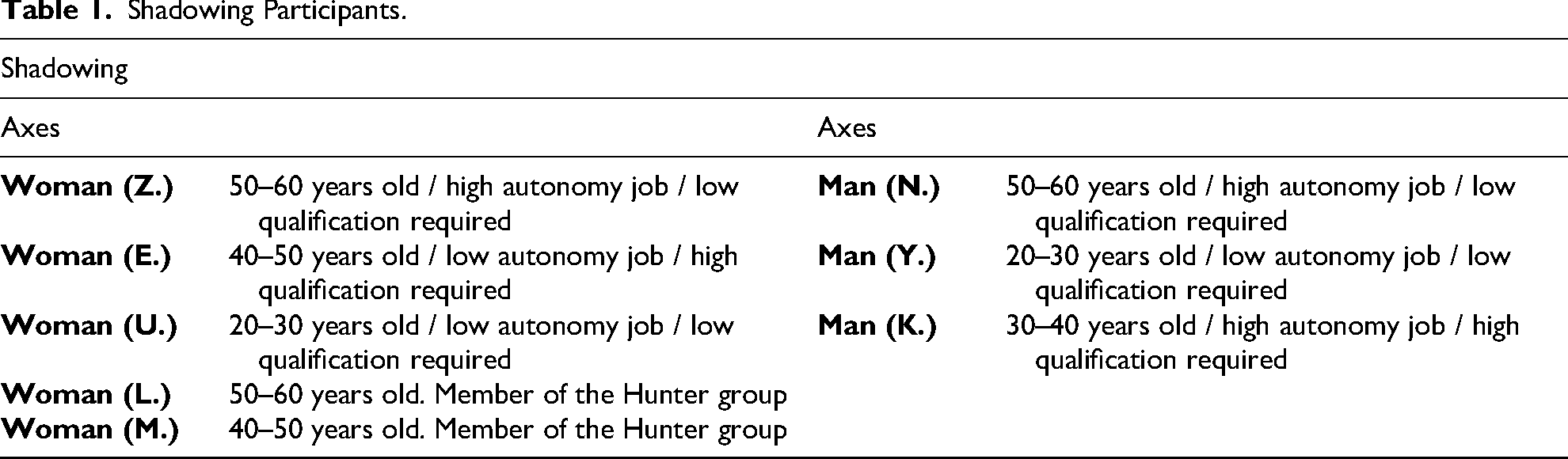
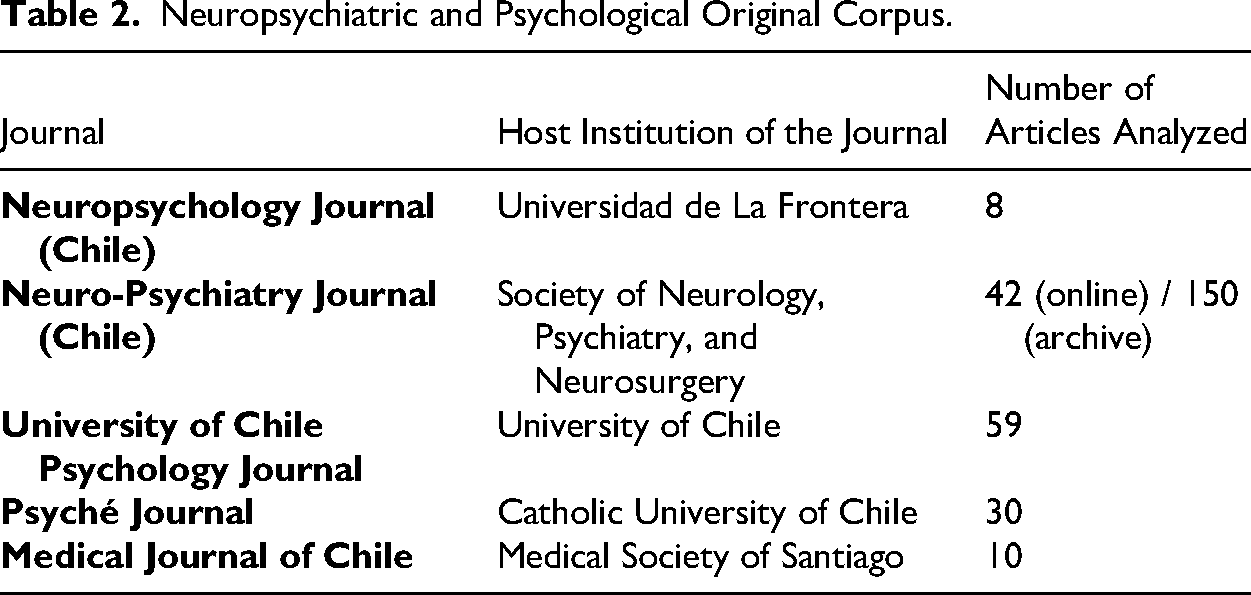
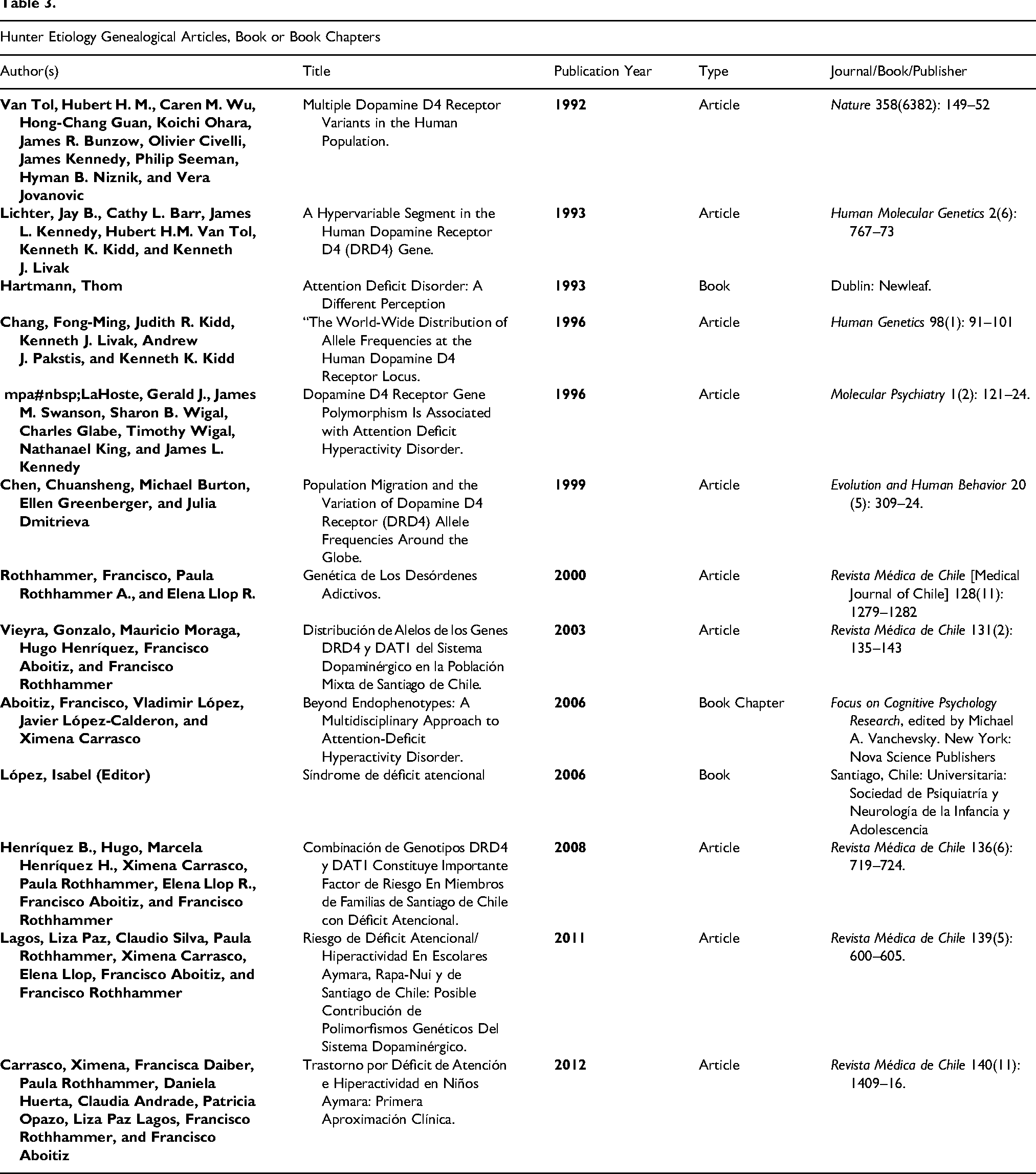
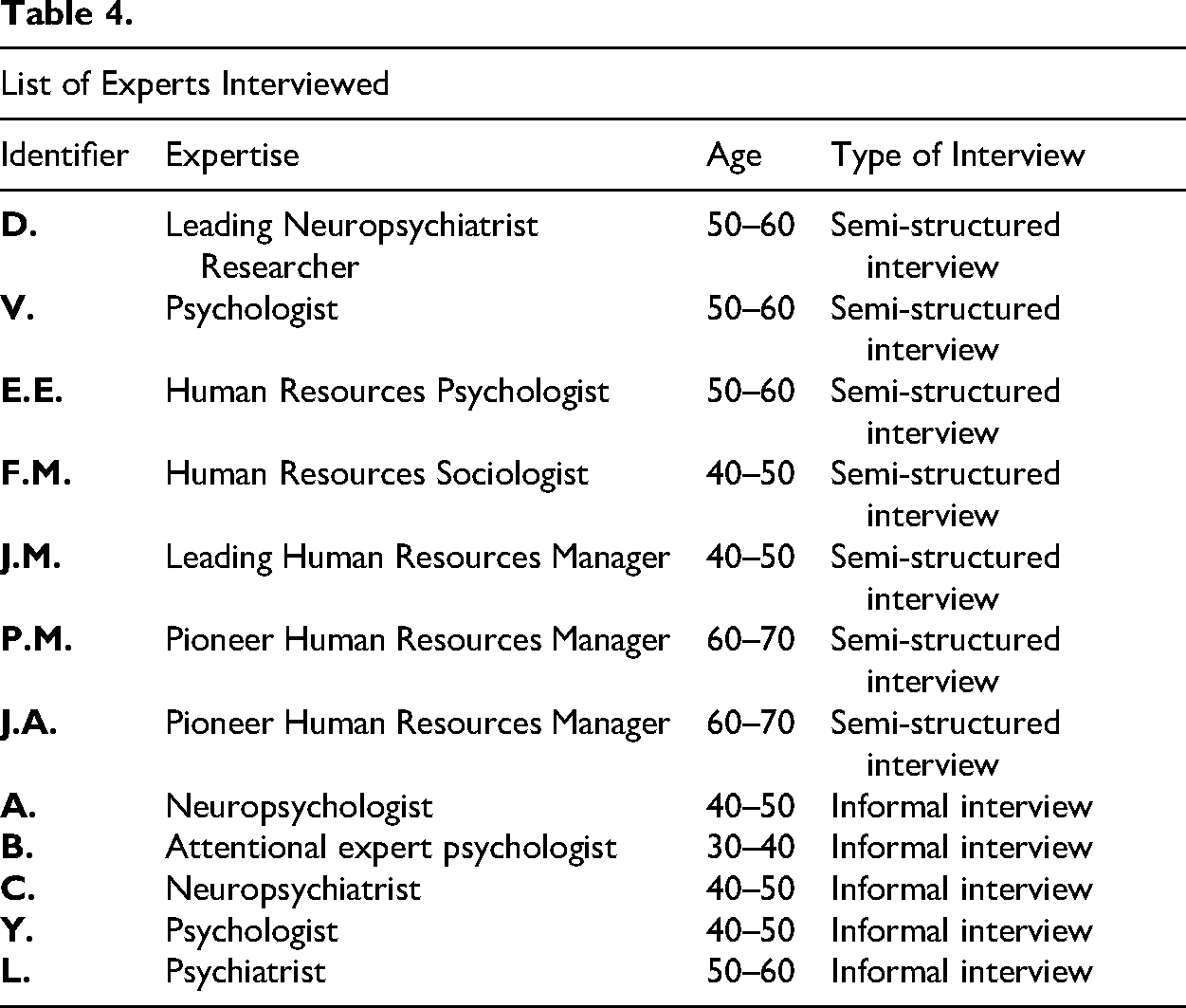
This article builds on findings from my doctoral research, which employed a three-layered methodological approach to examine the social and subjective experiences of adults with ADHD in Chile (2018–2021). Grounded in existing theoretical insight that connects the clinical and managerial dimensions in the historical emergence of ADHD diagnoses, I structured the inquiry into three interconnected realms and corresponding materials: (i) neuropsychiatric and psychological journals; (ii) management journals; and (iii) everyday lived experiences using shadowing techniques. For this article, I draw specifically on materials from my shadowing of participants (see Table 1), as well as genealogical literature on the Hunter Hypothesis (see Tables 2–4).
Shadowing Participants.
Neuropsychiatric and Psychological Original Corpus.
Shadowing
I developed an ethnographically inspired method known as shadowing. This technique, described as rapidly intensive (Trouille and Tavory 2016), consisted of accompanying six diagnosed adults in their everyday life and work environments. I met each participant at least four times, for a minimum of four hours per session, over a period of three months. The group was selected to maximize diversity, as I aimed to identify the “common” aspects of ADHD experiences across highly varied individuals. The primary axes of variation were: (i) age; (ii) degree of autonomy at work; and (iii) the level of qualification required for their job. To ensure balance, I included an equal number of men and women and sought, as much as possible, to include individuals diagnosed in both childhood and adulthood. I recorded everything I could recall in two notebooks, either immediately after a shadowing session or, at times, while observing. I later transcribed these notes into a digital document for analysis. Quotations are approximative, preserving key concepts and ideas.
Neuropsychiatric and Psychological Corpus
My research focused on the documentary archaeology and genealogy of ADHD in Chile, examining the specific intra-scientific concerns that have shaped the local construction of the category. For the broader study, I analyzed 299 articles published in Chilean journals since the 1970s (see Table 2), and conducted and transcribed 12 expert interviews—both formal and informal (see Table 4). I approached both corpora through a qualitative content analysis and a genealogically inspired strategy, coding the materials using qualitative analysis software and tracing the “descent [provenance]” (Foucault 1994) of the problematization of attention within Chilean neuropsychiatric discourse. While the full range of materials informed my broader understanding, the analysis in this article primarily draws on the journal corpus and the genealogical material concerning the hunter hypothesis (see Table 3), along with an interview with D., a prominent Chilean male neuropsychiatrist aged in his 50s.
The Hunter Hypothesis: A Two-Way Encounter
I first learned about the hunter hypothesis from
From Personal Mythology to Managerial Interests, and Back
The intimate experience of feeling different yet deficient within a given society is central to understanding the insights offered by the hunter hypothesis. Among the “Hunter group” and other individuals I shadowed during my doctoral research, a recurring theme was the haunting experience of being different. 2 This was a painful difference because it often led to rejection by peers or superiors, such as teachers or employers, fueling constant self-doubt about their abilities. The question, “Am I good (for something)?” captures this internal restlessness, blending moral and performative concerns, as I have discussed elsewhere in relation to ADHD more broadly (Sir 2023). As a result, many adults with ADHD pursue jobs or activities aimed at countering external distrust, even as the internal anxiety often associated with ADHD persists (Cripe et al. 2024; Crook and McDowall 2024; Nielsen 2021).
The contents and horizons of such experiences vary according to sociological dimensions, but many adult ADHD stories are marked by a recurring negotiation with failure—including the failure to understand what is happening to them. The feeling of being a bicho raro, or a “freak,” emerged in various accounts across my fieldwork. Yet, regardless of their proximity to the diagnosis, all individuals also described themselves as being particularly creative and expressive in their approach to even ordinary tasks. This is where the hunter hypothesis occupies a unique and sensitive position, shaping interpretations of these capacities. During the 2018 group meeting referenced earlier,
Since then, the group has continued to read, discuss, and learn, guided by what they call the “optimistic side” of ADHD, as framed through the hunter hypothesis. This perspective reframes typical ADHD symptoms—hyperactivity, inattention, and impulsivity—as adaptive traits suited to ancestral hunter-gatherer environments, rather than defects. It provides a “resignifying vision,” as
The grammar of hidden potential is often tied to “neuro” descriptions of mental health categories, especially in market-driven contexts (Béliard et al. 2019; Ehrenberg 2018). This discourse reframes former disorders as potentially profitable traits, emerging at the intersection of therapeutic and management interests (Paltrinieri 2017). Indeed, Thom Hartmann (2012), neither a scientific nor a medical professional but a progressive talk-show host, developed an interest in ADHD after his child was diagnosed and conventional explanations left him dissatisfied, as he recounts in public talks. His goal was to offer a more positive interpretation of ADHD traits, helping “ADHDers” feel confident and marketable. Hartmann (1999, 70) encapsulated this vision in a comparative table contrasting ADHD traits as a “disorder” with the “hunter perspective” and the “opposite farmer (non-ADHD) traits.”
As the table illustrates, traits like “distractable” are reframed as “constantly monitoring the environment:” a short attention span punctuated by intense focus becomes “able to throw themselves into the chase at a moment's notice;” “poorly planned” and “impulsive” are recast as “flexible, ready to change strategy quickly,” and so on. Given that Hartmann's primary audience were employers and employees from the 1990s, it is unsurprising that his narrative aligns with what Boltanski and Chiapello (2011) identified at the turn of the millennium as the “new spirit of capitalism”—a shift characterized by the rise of networks, projects, and adaptability, replacing values of stability and standardized career paths.
However, for both Hartmann and the Hunter group organized by
For
A (Chilean) Neuropsychiatric Rabbit Hole
To my surprise, the hunter etiology had also gained significant traction in Chilean applied research on ADHD, as [The Human] species has been characterized by a peculiarity which is that [over forty] thousand years ago, we underwent what was called the cognitive revolution: from making rough stone axes, we moved on to making ornaments … and shortly after that agriculture arrived, and from there we spread. After this … civilizations began to develop and institutions emerged, especially education. And upon appearing, then, certain forms of attention … that were not so important before beginning to be selected. Attention, especially sustained attention and executive networks. Before, hunter-gatherers used their executive networks very little, you see, huh? They were not paying attention there trying to solve a problem … they were walking, they had to be very alert … but a different kind of alert, a general alert … .So there is like a transition of modes of attention … and attention deficit … is like an example of those who haven't adapted well. (D., Neuropsychiatric expert, personal interview, 2019)
This account parallels Hartmann's (1999, 23) description of ADHD origins. “People with AD[H]D,” he wrote in his influential bestseller, “are the leftover hunters, descendants of ancestors who evolved within hunting societies thousands of years ago.” This typifies a “mismatch evolutionary hypothesis,” suggesting that “mental disorders are naturally selected psychological traits that were once adaptive for our ancestors but are now maladaptive in modern contexts” (Maung 2024, 2–3). Furthermore, in one of the few systematic Chilean books on ADHD dating back to 2006, the research team suggests that ADHD is better understood as an “endophenotype” rather than a disorder. They define an endophenotype as “latent, genetically loaded traits that are indirectly related to classic behavioral symptoms defined in DSM-IV or IC-10” (López 2006, 16). In another article, the team notes that “it is widely accepted that to reach further developments in the search for etiological factors and therapeutic answers, it is mandatory to identify what has been called endophenotypes: a reliable set of heritable cognitive and physiological impairments which may be considered core deficits in the disease” (Aboitiz et al. 2006, 4). Thus, the Chilean team proposed an evolutionary perspective in which the endophenotype of ADHD may have corresponded to an ancestral attentional mechanism, in which sustained attention was not necessary as it is today, and where mechanisms of peripheral attention were more relevant. Recent studies indicate that the 7-repeat allele of the DRD4 gene is a relatively new gene, which was intensely selected during the period when modern humans populated the planet, when migratory behavior was likely favored. This period would correspond to a condition in which the endophenotype of ADHD was completely adaptive … .However, the conditions imposed with the advancement of culture and civilization implied an emphasis on sustained attention that has become increasingly prominent. (López 2006, 36)
The Dopamine Receptor D4–7R stands out as key genetic evidence supporting the hunter hypothesis. This mutation aligns with earlier Chilean research on the genetic links between “novelty-seeking” endophenotype, criminality, and addiction (Rothhammer, Rothhammer A. and Llop R R 2000). Through this lens, the researchers recontextualized long-standing concerns about the morality of individuals with ADHD (Caliman 2008; Lakoff 2000) at a genetic level, connecting risky behaviors to the selective pressures of hunter-gatherer lifestyles. Chilean geneticists Rothhammer, Rothhammer A. and Llop R R (2000) argue that what's inherited are not specific behaviors (e.g., alcoholism) but a phenotype—a set of inclinations like impulsivity and risk-taking—rooted in dopamine-related genes. Dopamine mechanisms are at the core of these inclinations, and so are the genes associated with them. Thus, within Chilean research, DRD4 is a prime candidate to explain both ADHD (Vieyra et al. 2003) and novelty-seeking behaviors (Rothhammer, Rothhammer A. and Llop R R 2000).
During the 1990s dopamine receptors, particularly D4, emerged internationally as a promising focus in molecular psychiatry due to their pharmacological role and notable polymorphism, allowing allele repetitions from 2 to 10. A 1992 article on D4 polymorphism states “[it is] the first report of a catecholamine receptor family displaying polymorphic variation in the human population (Figure 1). Such variation among humans may underlie individual differences in susceptibility to neuropsychiatric disease” (Tol et al. 1992, 149). Similarly, the earliest article cited by the Chilean team linking DRD4 to ADHD (LaHoste et al. 1996) noted a relatively high prevalence of the 7-repeat variant among ADHD individuals compared to general distribution patterns suggested by Lichter et al. (1993). As shown in Figure 2 (Lichter et al. 1993, 771), the 7-repeat variant is significantly more prevalent than others (e.g., 3, 5 or 6 repeats), prompting questions about the origins of this mutation. The study also indicated population group variations (e.g., European Caucasian, Chinese, Japanese, Jewish Ethiopian, Melanesian) but lacked definitive conclusions.
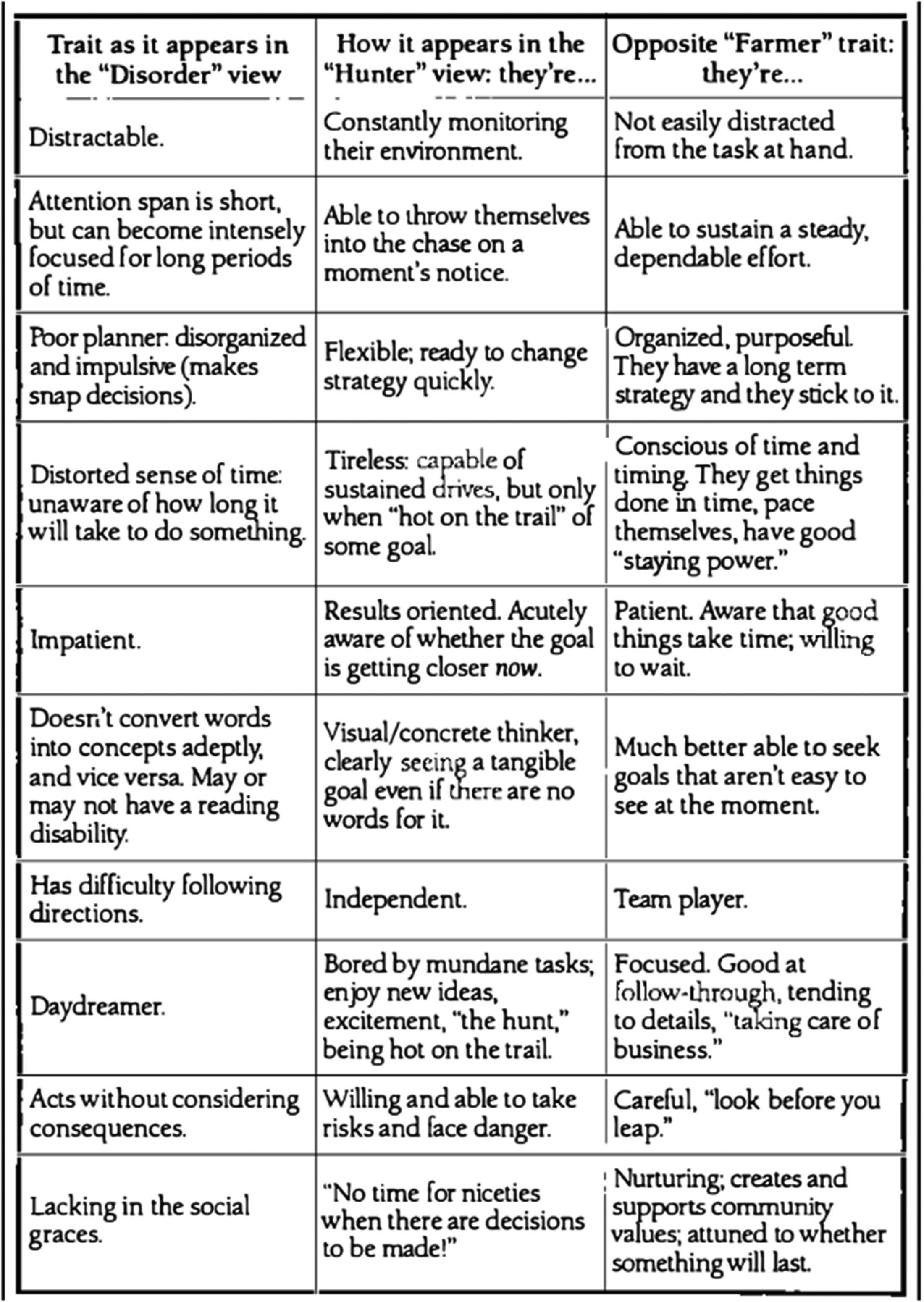
Comparative Table on ADHD Traits, from “Disorder” and “Hunter” View, to Opposing “Farmer (Non-ADHD) Traits” (Hartmann 1999, 70).
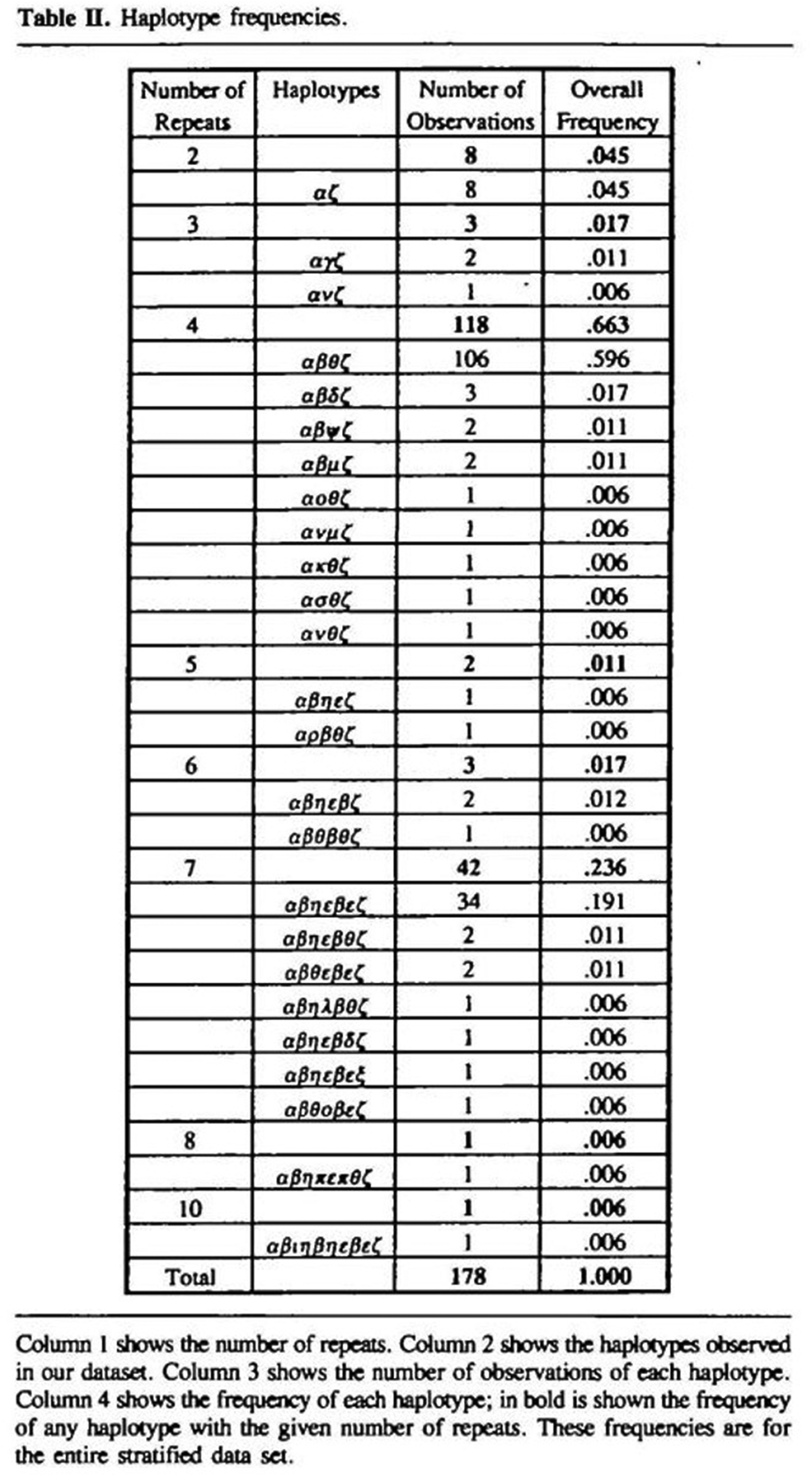
Haplotypes Frequencies Presented in Lichter et al. (1993).
The 1999 article titled Population Migration and the Variation of Dopamine D4 Receptor (DRD4) Allele Frequencies Around the Globe (Chen et al. 1999) is central to Chilean speculation about the ancestral origins of ADHD. The authors extend findings on DRD4's association with novelty-seeking and ADHD (endo)phenotypes, aiming to explain “[DRD4's] great variation among populations” (Chen et al. 1999, 310). Unlike Lichter et al. (1993), Chen et al. (1999, 310) affirm that “East Asians have a low proportion of long alleles (e.g., 1 percent or fewer 7-repeats), whereas South American Indians show a high proportion (up to 78 percent with 7-repeats).” This assertion draws on a 1996 study, which argues that the “universality of the polymorphism with only three common repeat-number alleles (4, 7, and 2) suggests it arose before the global dispersion of modern humans” (Chang et al. 1996, 91). However, this study also suggests that “different alleles provide at most a small functional difference for natural selection,” positing that population differences may result from random genetic drift and a high mutation rate (Chang et al. 1996, 99).
Chen et al. (1999), however, insist on seeking a different explanation. “As with other polymorphic genes … natural selection may significantly influence global DRD4 variation. Yet, researchers have largely overlooked potential factors involved in DRD4 selection” (Chen et al. 1999, 310). Using Chang et al. (1996) sample, along with 11 additional sources and genetic data from “well-established migration paths” spanning 1,000 to 30,000 years ago, Chen et al. (1999) found “a very strong association between the proportion of long alleles of the DRD4 gene in a population and its prehistorical macro-migration histories” (Chen et al. 1999, 317). Nevertheless, association is not causation, so speculation begins.
They compared two hypotheses: the “founders’ hypothesis,” suggesting that a higher inherent prevalence of D4-7R drives migratory behavior, and the “natural de/selection hypothesis,” which attributes increases or decreases in this variant to migration and settlement patterns. Their findings indicate that the “natural de/selection” hypothesis better explains both micro- and macro-migration, as well as sedentary patterns. We speculate that the long alleles of the DRD4 gene were selected by migration because they had adaptive value in migratory societies. As previous research has shown, long alleles (e.g., 7-repeats) of the DRD4 gene have been linked to novelty-seeking personality, hyperactivity, and risk-taking behaviors … .The commonality among these behaviors appears to be the exploratory aspect of human nature. It can be argued reasonably that exploratory behaviors are adaptive in migratory societies because they allowed for more successful exploitation of resources in the particular environment migration entails—usually harsh, frequently changing, and always providing a multitude of novel stimuli and ongoing challenges to survival. (Chen et al. 1999, 320)
To “reasonably” support the natural de/selection hypothesis, a clear depiction of ancestral human environments appears crucial. Central to the scientific speculation connecting the 7-repeat variant and ADHD is an understanding of the demands of major migratory periods (“macro-migrations”) and the characteristics of nomadic environments—such as hunter-gatherer, foraging, and pastoral “micro-migrations,” as outlined in the 1999 article. Yet the sources underlying these depictions remain opaque.
Scientific Speculation and Ancestral Imaginaries
Chen et al.'s influential 1999 article makes limited use of anthropological and archaeological sources, a limitation that is likely even more pronounced in Chilean research. To classify micro-migration groups, Chen et al. relied on Murdock's 1960s Ethnographic Atlas, Levinson's Encyclopedia of World Cultures, and in “a few cases,” original ethnographies published over the past forty years—though most observations date back to the early-to-mid twentieth century. For the macro-migration patterns, the study primarily drew on the works of Cavalli-Sforza. Like the Chilean researchers, this study posits that “some contemporary disorders, such as ADHD, which has been linked to long alleles of the DRD4 gene, may have been a by-product of human adaptation to the migration process,” drawing on Jensen et al. (1997) speculation regarding the “adaptability of ADHD in particular environments” (Chen et al. 1999, 321).
The 1997 article by Jensen et al. titled “Evolution and Revolution in Child Psychiatry: ADHD as a Disorder of Adaptation,” proposes an evolutionary explanation for the origins of ADHD, though not genetically rooted. The authors do not reference Hartmann's prior speculation but recognize the high prevalence of ADHD as justification for legitimate evolutionary inquiry, a point also acknowledged by Hartmann. “[G]iven the current estimated frequency of ADHD (3 to 5 percent),” Jensen et al. (1997, 1673) argue, “it is unlikely that such a ‘disorder’ could be as prevalent in the human species if not maintained within the species by selection forces that conveyed certain advantages to some ADHD characteristics or other associated traits.” To speculate on the “Nature of Ancestral Environments,” they refer to “[c]onverging evidence from anthropology and archeology” (Jensen et al. 1997, 1674). Although the sources for this “converging evidence” also remain opaque, the authors consistently suggest throughout the article that evolutionary explanations may clarify the presence of ADHD in certain contexts, emphasizing that ancestral human environments were likely varied. While the authors propose a somewhat more nuanced classification of ancestral human environments, it nonetheless remains dichotomous: Relevant to the traits characteristic of persons with ADHD we suggest that ancestral environments ranged along several continua, including safe versus not safe, resource-rich versus impoverished, and time-optional versus time-critical. At one end of these three continua [“response-ready” as opposed to “problem-solving”], humans’ survival depended on being (1) hypervigilant, including the ability to retrieve and integrate information through all senses at once, somewhat akin to parallel processing; (2) rapid-scanning; (3) quick to pounce (or flee); and (4) motorically “hyperactive” (foraging for food, moving toward warmer climes as seasons and ice ages come and go, etc.). Jensen et al. (1997, 1674)
This vectorized partitioning of human ancestral environments still adheres to the linear progression that often accompanies dichotomous portrayals of human ancestral history. “As society has become increasingly industrialized and organized,” Jensen et al. (1997, 1675) affirm, “response-ready” characteristics may have become less adaptive, to the extent that current-day environments are more resource-rich and safe and a “‘hair trigger’ time-action response to environmental cues is less critical (even counter-productive).”
Speculative Unsettlements
Evolutionary psychology and psychiatry face a broadly accepted and deep-seated issue: “the fact that evolutionists, like historiographers, do not have direct epistemic access to the past” (Hubálek 2021, 462. Italics in the original). This limitation makes speculation unavoidable and opens inferential strategies to significant critique. At the core of these critiques is the disputed validity of adaptationist explanations. Known as “adaptive thinking” (Matsumoto 2021; Rellihan 2012) this reasoning type posits that, given prespecified selection pressures, certain underlying cognitive structures likely evolved as adaptive responses. Unlike “reverse engineering,” which infers adaptation from a trait's current utility, adaptive thinking proceeds from hypothesized selection pressures to deduce the evolutionary functions of a trait (Rellihan 2012).
Typically, both strategies are used together in evolutionary speculation about human mental functions, introducing a significant risk of circularity. This occurs when mechanisms, structures, and functions observed in the present are projected backward into the ancestral past and then inferred to have arisen from specific selection pressures. Then, as Matsumoto (2021, 20–21) observes, this process “project[s] forward into the present that which was once obtained by projecting back into the past.” Here, a core issue in evolutionary approaches is the limited empirical evidence linking specific current cognitive mechanisms and observable phenotypes to ancestral selective pressures, or to the ancient functions, structures, and mechanisms shaping psychological traits. This is often referred to as the “matching problem,” namely, the challenge of demonstrating that current psychological mechanisms or traits are directly descended from ancestral ones (Smith 2019).
In a recent critique of evolutionary psychiatry, Maung (2024), building on Smith's (2019) influential article on the “matching problem” in Evolutionary Psychology, outlines three conditions for a successful adaptationist explanation: concordance, strong vertical homogeneity, and ultimate explanation. The dominant evolutionary framework conceives of the human mind as “an ensemble of domain-specific, innately specified cognitive mechanisms that are adaptations to specific ecological and social problems of Pleistocene foraging” (Sterelny 2003, 206). Within this framework, concordance requires that “psychological mechanisms involved in mental disorders concord with and produce the same sorts of effects as the psychological mechanisms of our ancestors” (Maung 2024, 9). Strong vertical homogeneity requires that “the contemporary module has the same function as the ancestral one by virtue of descending from it,” while ultimate explanation requires demonstrating that “the function of a contemporary module is one that an ancestral module was selected to perform” (Smith 2019, 42).
The ADHD hunter hypothesis adopts an adaptationist stance, attributing its etiology to selective forces rather than purely random genetic drift. However, as ADHD is no longer considered adaptive, an additional layer of complexity arises: it must also account for the persistence of maladaptive underlying mechanisms. Indeed, already for current adaptive traits, Rellihan (2012) highlights a significant challenge. Without resorting to a strong form of adaptationism—often associated with the much-criticized field of sociobiology—one must assume that any evolutionary path could plausibly lead to the current state of an underlying mechanism or behavior. This assumption is difficult to demonstrate empirically for adaptive traits, and it is probably impossible when addressing the persistence of “maladaptive” traits. This is a crucial critique, but the author, in a way that is not entirely explicable, relativizes the importance of the speculative nature of ancestral environments. He argues that “adaptive thinking will not yield accurate predictions even if we can identify these initial conditions” (Rellihan 2012, 247. Italics in the original).
Similarly, to illustrate how evolutionary psychology “fails to address the matching problem,” Smith (2019) appears to overlook the need to critically examine the ancestral assumptions underlying speculative hypotheses. This is surprising, given that the example she selects is evidently controversial. She critiques an article titled “Sex Differences in Perceptions of Infidelity: Men Often Assume the Worst” (Goetz and Causey 2009). As cited by Smith (2019, 44), the speculation begins as follows: Ancestral men … were susceptible to an additional and profound cost if they failed to detect a partner's infidelity: cuckoldry—the unwitting investment of resources into genetically unrelated offspring. … Some of the costs associated with cuckoldry include misdirection of the male's time, effort, and resources to rearing a rival's offspring, loss of time, effort, and resources the man spent attracting his partner, and reputational damage if such information becomes known to others. (Goetz and Causey 2009, 255)
As Smith (2019, 45) explains, “the claims about the behavior of prehistoric humans go beyond paleoanthropological evidence, but setting this aside, even if these claims were well-founded, the inference made from them would still be unwarranted.” Nevertheless, it is this specific image projected onto those tormented ancestral men that ignites evolutionary speculation.
Reductive Scientific Imagery
Emily Martin's (1991) eminent article “The Egg and the Sperm: How Science Has Constructed a Romance Based on Stereotypical Male-Female Roles” illustrates how narratives about egg and sperm function to reinforce or justify social hierarchies. Much like past social Darwinist thinking, Martin (1991, 500) observes the “importation of cultural ideas about passive females and heroic males into the ‘personalities’ of gametes.” Classics like Latour and Woolgar's Laboratory Life (1986 [1979]) and Haraway's (1989) Primate Visions highlight the closeness between constructing scientific facts and crafting fiction. Haraway (1989, 4) argues that fiction and fact are not opposites but rather both “rooted in an epistemology that appeals to experience.” Fiction, she notes, has an “active form,” while a fact appears as a settled, unchangeable entity, “fit only to be recorded” (Haraway 1989, 4). Latour and Woolgar (1986, 291) also describe their account of scientific fact-making as no more than fiction, akin to the work of laboratory members, who were “constructing accounts to be launched in the agonistic field, and loaded with various sources of credibility.” Thus, they argue, fiction holds a noncommittal or “agnostic” meaning that applies “to the whole process of fact production but to none of its stages in particular” (Latour and Woolgar 1986, 294).
Therefore, the production of a scientific fact would always entail some degree of fictionalization, crafting a narrative compelling enough to be tested, published, and defended (McNeil et al. 2017). Thus, I suggest that examining and intervening in the ancestral imaginaries shaping scientific speculation offers a generative pathway for fostering interdisciplinary and collaborative research. Building on sustained work on imagination and imaginaries in STS, I address the importance of socially and culturally rooted imagery in scientific and biomedical truth production (Camp 2020; Levy and Godfrey-Smith 2020; McNeil et al. 2017). Crucially, in the everyday work of scientific teams, certain images remain undeveloped, undertheorized, or unnoticed, subtly influencing what is ultimately tested as true—such as the models used in human reproduction studies from Martin's research, or the images projected onto ancient human history in the ADHD ancestral etiology.
Thus, what is at stake is not solely the formal hypothetical statement: ADHD is rooted in a mutation from 40,000 years ago, during the major migration and hunter-gatherer period of Homo sapiens, becoming maladaptive with the onset of agriculture, civilization, and literacy. Equally important is a second layer of speculation: the undeveloped images that contribute to forming a credible explanation. What did humanity's ancient past look like? How did hunter-gatherer communities live, and what practices did they develop? What adaptations were required during periods of mass migration?
Unlike Smith and other inferential critics, I argue that it is both crucial and productive to examine and intervene in “claims about the behavior of prehistoric humans [that] go beyond paleoanthropological evidence” (Smith 2019, 45). These speculative images shape the narratives that circulate publicly, as well as the images selected for scientific testing. Almeling (2023) revisits Martin's questions with members of the general public to identify not one but two predominant metaphors: sperm as dominant, and sperm and egg as equal partners. Yet she also points to what remains missing: the metaphor of the egg as dominant. “Rather than asking which metaphor is correct,” Almeling (2023, 15) emphasizes how “cultural beliefs about sex, gender, and sexuality influence which biological stories people do and do not tell.” In a parallel move, Roberts (2011) highlights how racial bias constrains scientific research. She notes that “some people draw a blank when asked to imagine the scientific study of human beings without classifying them by race.” But, she argues, scientists could instead ask: “How do genes work in human beings?” rather than “How do genes work differently in different racial groups?” (Roberts 2011, 323). In her view, focusing on both human genetic diversity and commonality—freed from false and antiquated notions of biological race—would not limit but liberate scientific inquiry.
Speculating Otherwise: Pluralizing Ancestral Imaginaries
Opportunities to pluralize the images that inform the production of a fact are therefore crucial. Doing so could open up the epistemic space for alternative forms of evidence, explanation, and legitimacy, which are often constrained by the cultural and social biases embedded in scientific speculation. For the Chilean team, the “hunter hypothesis” underpins their cognitive framing of ADHD as a legitimate modality of attention, directly challenging the conventional dopamine dysfunction hypothesis. However, this perspective is also constrained by traditional evolutionary narratives and moral concerns, which shape how ADHD is understood in both scientific and public discourses.
The dominant view links attentional and behavioral differences in ADHD to a neurochemical imbalance, suggesting that reduced dopamine levels in the neurosynaptic space render individuals with ADHD less likely to be “normally” motivated. By contrast, the Chilean team argues that ADHD reflects not a dysfunction, but a distinct mode of functioning within attention networks. This view partially aligns with claims made by ADHD and neurodiverse individuals, communities, and researchers fostering strengths-based narratives (Jackson-Perry, Rosqvist and Brown 2025; Stenning and Rosqvist 2021). As noted earlier, the Chilean team suggests that individuals with ADHD often struggle with tasks requiring sustained attention, yet sustained attention is not the only attentional function. In cognitive psychology, a variety of attentional functions have been described … .These include capacities such as covert attention, selective attention, divided attention, attentional focus shifting … and peripheral attention—each of which seems to follow a different pattern compared to the mechanisms of sustained attention … .Individuals with ADHD tend to respond faster and make fewer errors than controls on divided attention tasks, which involve maintaining attention on two separate items. (López 2006, 28)
Unlike traditional perspectives, the Chilean team, informed by the evolutionary approach, did not regard this type of attention modality as something solely to be corrected or cured. They suggested that ADHD might not be viewed as “a strictly pathological condition, but rather as part of the natural diversity in behavioral strategies within our species” (Aboitiz et al. 2006, 15).
The recognition of ADHD as a normal—yet marginal—aspect of human diversity within psychiatric and public discourses is highly interesting. Discussions surrounding ADHD are often dominated by moral concerns about normal and socially expected behaviors. Not surprisingly, children and schools are the first to be targeted (Caliman 2010; 2008; Comstock 2011; Lakoff 2000). For instance, since 2010, the high prevalence of ADHD in Chilean schools and the rise in methylphenidate imports 4 raised questions about what Chilean society should do with “problematic children,” as they were publicly labeled in the 1990s (Rojas, Rojas and Peña 2018), and also increasingly questioned the role of schools in socialization across the country (Cottet et al. 2023; Haye et al. 2018; Reyes et al. 2019). 5
The hunter hypothesis seems to engage with traditional moral concerns, and to some extent, the Chilean team likely follows the typical linearity found in evolutionary thinking. However, as I have shown, their work on ADHD's ancestral etiology opens an avenue for moving from a “mismatch” to a “persistence” hypothesis in Maung's (2024) classification, pointing to traits that could still be “functional.” In doing so, they unsettle their own linear and dichotomous thinking. Publicly, this led part of the Chilean team to argue that ADHD is overdiagnosed in schools, attributing this to difficulties in managing contemporary cognitive, behavioral, and social challenges (Aboitiz 2017). But if ADHD traits could still be considered “functional,” the question then becomes: Functional for what? In this context, the potential for different but legitimate attention modalities opened by the evolutionary etiology, is constrained by the undertheorized ancestral imaginaries underpinning the scientific speculation in at least two ways: (i) the dichotomous and linear opposition between simplicity and complexity; (ii) the conflation of morality with productivity.
Not Simpler but Different
A common “spontaneous” image is that ancient hunter-gatherer populations are simpler, less developed, making only “rough stone axes.” However, this is an undertheorized image that stems from “a long tradition of regarding wandering as an unmediated response to landscape and environmental constraints, rather than as a rational system of land utilization” (Noyes 2000, 48). Thus, anything outside of the “modern,” “civilized,” “Western” way of living is considered simpler, wilder, more primitive, and ultimately doomed to disappear. This assumption led the Chilean team to make some delicate associations, constraining the potential to picture ADHD otherwise.
Echoing Chen et al. (1999), who found a high presence of the long allele in “South American Indians,” the Chilean team designed a comparative study to understand what was happening among the young Chilean population. Similar to Roberts’s (2011) critique of the racial genomic reconstruction of race, the scientists established comparisons within previously defined ethnic groups. The Chilean research group (Vieyra et al. 2003) presented a table showing the frequency of the DRD4 dopamine receptor among European, South American indigenous, and Santiago de Chile populations (see Figure 3). The scientists had expected the Santiago distribution to be closer to South American indigenous populations, yet the Santiago sample exhibits a distribution more like Europe's.
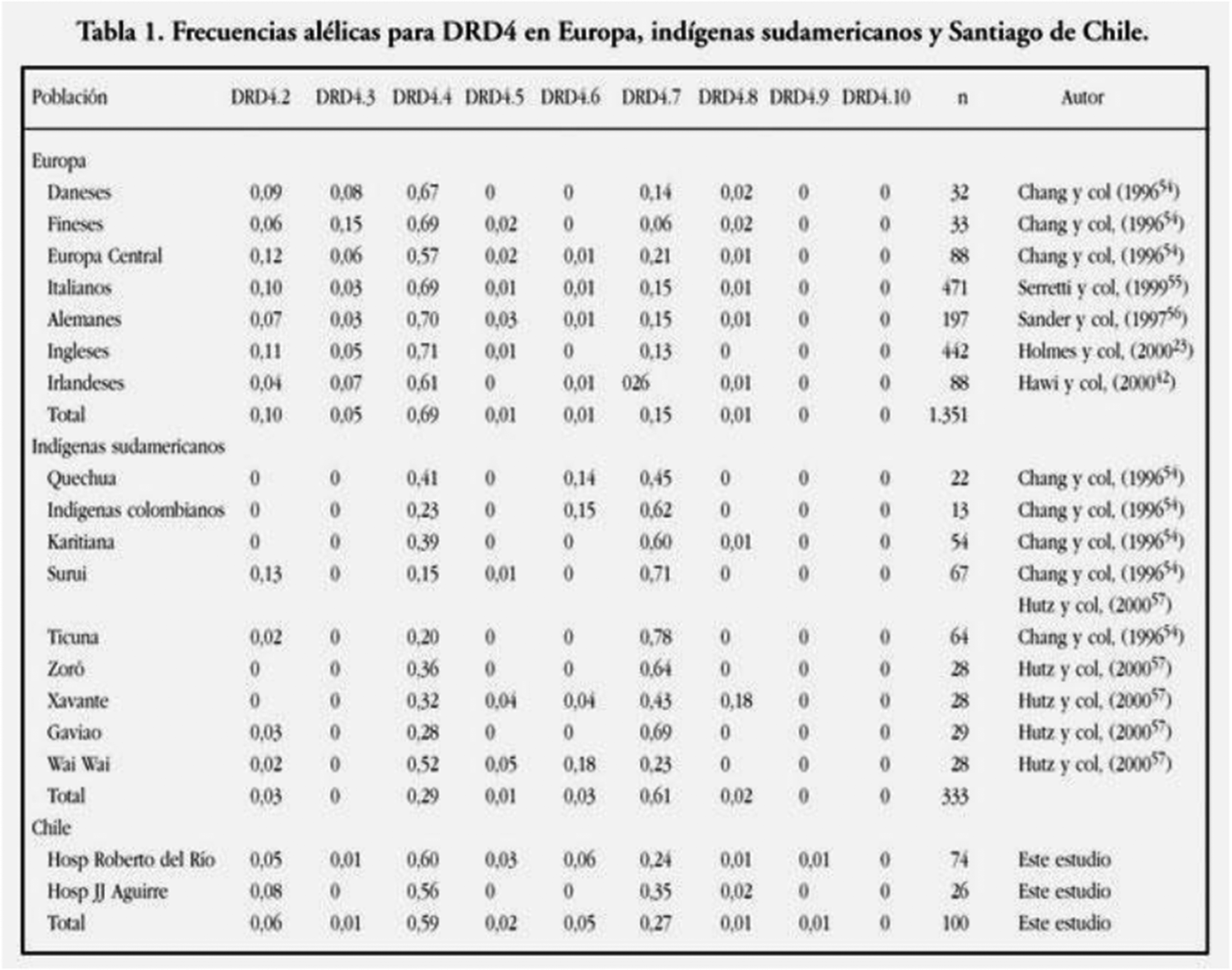
Allelic Frequencies for the DRD4 Dopamine Receptor in European Populations, South American Indigenous Groups, and Santiago de Chile (Vieyra et al. 2003).
These findings prompt a reconsideration of the sample's class composition, as the researchers had anticipated a higher prevalence of “indigenous genes” in the public health population of Santiago de Chile, traditionally associated with low-income users (PNUD Chile 2017). The researchers support this expectation based on a racial delineation overlapping with socioeconomic status. However, this assertion is solely based on a book from 1983, aimed at health students and the general population, authored by one of the researchers (Vieyra et al. 2003). In fact, this is a complementary underdeveloped image within the simplicity/complexity dichotomy.
This image of less refined, less executive-driven ancient human populations, which are then linked to present-day ethnic and socioeconomic groups, aligns with long-standing Chilean psychiatric anxieties about perceived moral deficiencies, particularly alcoholism, for low-income populations (Fuster 2023), thus limiting the Chilean team's own assertions on plural attention modalities. In a subsequent article (Henríquez B. et al. 2008), the authors work with an original ADHD sample collected from various Chilean hospitals. Unexpectedly for the team, they found (again) a distribution closer to European than indigenous populations. However, this finding did not dissuade them from linking those indigenous, hunter-gatherer novelty-seeking genes with ADHD, or “indigenous genes” with low-income groups. Instead, they posit that the diagnosis goes “unnoticed in low-income populations” (Henríquez B. et al. 2008, 723).
The insistence on this dichotomy extends to other testable hypotheses regarding Aymara indigenous communities (Carrasco et al. 2012; Lagos et al. 2011). Once again, the generated evidence contradicts the speculations, with no confirmation of a greater prevalence or severity of ADHD symptoms in these populations. Conversely, a better general state of mental health and fewer comorbidities are found in Aymara children. In the face of the hypothesis's failure, Aymaran culture is mobilized as a “protective factor” against ADHD expression. These indigenous communities, depicted as distant from the challenges of modern societies, are said to exhibit numerous conditions that prevent their genetic predisposition from becoming problematic, including a “pre-colonial type of thinking” (Carrasco et al. 2012, 1415).
However, if we move beyond simplicity/complexity linear opposition, other legitimate speculations and testable scientific fictions become possible. Neither ancient hunter-gatherer populations (Graeber and Wengrow 2021; Scott 2017) nor current ones (Descola 2024; Ingold 2011) are simpler or frozen in earlier developmental states (Antic et al. 2023; Dein 2022). One could equally speculate that all those cultural protective factors, celebrated from a primitivist stance, are precisely what the D4-7R allele allows for. A “sense of community and intra-family reciprocity,” affection, austerity, a “lack of individualism, respect for authority, the valuation of honesty, a deep magical-religious feeling, and the connection with the land” (Carrasco et al. 2012, 1415)—could these not also be adaptive in a massive migration period and within nomadic ways of inhabiting the land? What do family, community, authority or land mean in different ways of living and inhabiting? Is extreme individual competition for scarce resources the only way for survival?
I’m not attempting to “correctly” describe ancient or current hunter-gatherer societies, and in practice the politics embedded in alternative accounts of what might have been demanded in ancient environments are quite ambiguous. Instead, I am proposing the existence of missing legitimate possibilities that could align with the Chilean scientists’ findings but which are excluded by the ancestral imaginaries fueling scientific speculation. In fact, some (paleo)anthropological research mobilized by Graeber and Wengrow (2021), as well as Ingold's (2011, 123) reflections on hunter-gatherer anthropological research, support the view of hunter-gatherers as a specific, different—but neither simpler nor stagnant—way of inhabiting or “dwelling in the land.” A modality that, surprisingly for some ethnographers of hunter-gatherers, allows them to feel “thoroughly ‘at home’ in the world” (Ingold 2011, 57). Similarly, Graeber and Wengrow (2021) posit that 40,000 years ago “the striking material uniformities observed by archaeologists across very long distances” suggest that “society, insofar as we can comprehend it at that time, spanned continents.” Furthermore, when “forager bands gather into larger residential groups, these are not … made up of a tight-knit unit of closely related kin … primarily biological relations constitute … [around] 10 percent of total membership. Most members … may not even speak the same first languages” (Graeber and Wengrow 2021, 122).
Could not the D4-7R allele facilitate certain attentional capacities required to craft territories with strangers? Could not collaboration, fostered by the “lack of individualism,” have facilitated the spread of humans across the world at least as much as competition? Even if one can never be logically or empirically certain that what we describe as hyperactivity, impulsivity, inattention, or risk behavior served cooperation rather than solely predatory functions, it would still be valuable to explore what kinds of new scientific and intimate questions these ideas might allow to emerge. Interestingly, from the individual perspective, spontaneity, movement, and creativity are the most commonly mentioned traits. These capacities are linked to what they describe as an “inner strangeness” (the “bicho raro” feeling), which also fuels their ability to propose “strange” images or solutions—a feature sometimes framed as innovation, but at other times experienced as an inclination toward art, dance, sports, and personal creativity through diverse forms of expression.
Hunters but Not Productive: Materials for a Different Collective Critique of Mental Health Categories
In this article, I have sought to highlight the relevance and importance of pluralizing the ancestral imaginaries that fuel scientific speculation on ADHD. As evolutionary etiologies continue to gain traction in discussions related to neurodiversity (Hunt and Procyshyn 2024), it seems vital to develop tools that not only critique but also pluralize these images—images that are often morally framed and subtly limit what is tested as scientific truth. Since my concern is primarily with diversifying such images, it is not necessary to adhere to a single version of ancient or current hunter-gatherer societies. Yet these images shape what is known as the looping effect surrounding ADHD, influencing how ADHD is understood and experienced. This underscores the need for interdisciplinary, intersectional, and collaborative research, fostering careful and attentive depathologization and the creation of ADHD-affirmative world-making (Brown, Rosqvist and Jackson-Perry 2024).
Hacking (1998) introduced the concept of the looping effect as part of a dynamic nominalism approach, noting that people categorized in a particular way often begin to align with that description. At the same time, the practices, discourses, and collective appropriation by those labeled individuals, in turn reshape the category's definition, traits, and scope. As Navon and Eyal (2016) demonstrate, this dynamic is also highly relevant for the genetic shaping of categories such as autism. In fact, looping-genome effects play a central role in defining and developing neurodiversity categories (Doyle 2020; Goldberg 2023; Hunt and Procyshyn 2024)—though not without ambivalence.
For
Therefore, it is urgent to democratize access to scientific speculation, making it permeable to inclusive, situated, and intersectional forms of diversity and complexity. This is a call for critical collaboration among social scientists, evolutionary and genomic psychiatrists, neurodivergent individuals, activists, and neurodiverse scholars to systematically engage with ancestral speculations. I hope this article contributes to opening an avenue for such collaboration. Only by creating spaces that embrace complexity and foster diverse modes of knowledge production will social studies of mental health be equipped to address contemporary challenges.
Footnotes
Acknowledgment
This work is associated to the Chilean Funds for Academic Installation (SIA, Spanish initials) from the National Agency for Research and Development (ANID, Chile). It is also part of my postdoctoral research hosted at Concordia University, supported by Québec's Merit Scholarship Program for Foreign Students (PBEEE). I thank Yanina Gutiérrez (Universidad de Playa Ancha) and Erin Manning (Concordia University) for their support in developing the projects in Valparaíso and Montréal. I am also grateful to Esteban Radiszcz and the entire LaPSoS team. Finally, I am deeply thankful to Gabriel Abarca-Brown for his insightful comments and guidance, as well as to the anonymous reviewers and journal editors, whose suggestions significantly improved this piece.

Funding
The author disclosed receipt of the following financial support for the research, authorship, and/or publication of this article: This work was supported by the Fonds de Recherche du Québec-Société et Culture and National Research and Development Agency (ANID - Chile) (grant number 353083, SIA-85240098).