







Abstract
This article examines the political economy of technoscientific promises in peripheral contexts, focusing on the often-overlooked question of promise fulfilment. Drawing on Argentina's COVID-19 vaccine shortage, it explores how futures imagined through science and technology are shaped by scarcity and power asymmetries—constraining both promises and delivery. Amid a health emergency, national limitations, and a global vaccine race that sidelined developing countries, we show Argentina's response unfolding through three interrelated technoscientific promises—timely health access, industrial self-sufficiency, and sovereign science—interweaving expectations on science, technology, and the state. We trace how peripheral promise-making and delivery took shape, grounded in material foundations—coalitions, capacities, and technologies that conferred credibility—and symbolic ones—national imaginaries and development aspirations, framed as visions of the “public good,” which lent legitimacy to the chosen paths. We highlight the distinct dynamics of peripheral promising, where limited agency and structural asymmetries constrain both ambition and fulfilment. Under crisis-fueled public scrutiny, symbolic and material resources were mobilized to meet expectations around science, technology, and the state—ultimately narrowing broad aspirations into pragmatic, demonstrable outcomes. Fulfilment required constant adaptation, revealing the fragility, contingencies, and bounded possibilities of what peripheral nations can credibly envision, pursue, and achieve.
Keywords
Introduction
“If time is money, then speed is power” (Armitage 2000, 5). From the start of the pandemic, COVID-19 vaccines became the holy grail of global health, amid heightened expectations in a high-stakes race for innovation, market share, and geopolitical leverage (Balawejder, Sampson, and Stratton 2021; Zhang 2021). 1 Vaccine nationalism (i.e., a “my country first” distributional approach) enabled high-income countries to hoard doses and control supply chains, while low- and middle-income countries (LMICs) faced weak negotiating power and limited manufacturing capacity (Bown and Bollyky 2022; Gereffi 2020; Vanderslott et al. 2021). COVAX, a World Health Organization (WHO) initiative for equitable vaccine distribution, offered only partial relief, often failing to ensure timely access (Gemünden and Thiel 2021; Usher 2021). If time is money, speed was influence and access—and in the race to wield COVID-19 vaccines as power (Vanderslott et al. 2021), the fastest secured the most.
In this scenario, Latin America and the Caribbean faced a catastrophic toll. Though home to just 8.2 percent of the global population, by March 2022 the region accounted for 15 percent of COVID-19 cases and 28 percent of deaths—over 1.7 million lives lost (Schwalb et al. 2022). Fragile health systems, deep inequalities, weak state support, and delayed vaccine rollouts only worsened the virus spread and the health crisis. In Argentina, one of the hardest-hit countries, COVID-19 caused 130,000 deaths and 10 million cases—peaking globally in May 2021—while poverty rose to 42 percent (Jueguen 2021; La Nación, 6 November 2022).
In a context where health access is deemed a constitutional right, 2 the pandemic challenged states’ ability to protect lives, and state-led technoscientific capacities to respond to emergencies. Faced with vaccine scarcity, some developing countries turned to local production through technology transfer or domestic research and development (R&D) (Fonseca, Shadlen, and Achcar 2023; Sharma 2021). In Latin America, Argentina and Brazil spearheaded these efforts, despite decades of pro-market reforms that coevolved with a concentrated biopharmaceutical sector. As in the past (Holmberg et al. 2017), vaccines became powerful political technologies (Joerges 1999; Winner 1980), symbolizing what states could achieve through science and technology, and embodying national aspirations (Blume and Baylac-Paouly 2021).
By 2020, through decades of chronic socioeconomic deficits and an unstable macroeconomic landscape, Argentina's science and technology sector remained largely publicly funded (65 percent, MINCyT 2023) through taxes and external debt. Built on the promise of “science at the people's service,” Argentinean technoscientific institutions accumulated over 70 years of knowledge 3 —much of it underused locally or appropriated abroad (Codner and Perrotta 2018; Kreimer and Thomas 2001). Latin American Science, Technology and Society studies have long highlighted the disconnect between research agendas, industry, and national needs (Herrera 1973; Kreimer and Zabala 2007; Kreimer and Vessuri 2018), fueling cycles of hype, hope and unfulfilled promises, where knowledge rarely translated into visible societal benefits or long-awaited development (Dagnino, Thomas, and Davyt 1996; Rodriguez-Medina et al. 2019). Once confined to internal scientific concerns over legitimacy and funding, this gap became public during COVID-19, as science and the state faced renewed pressure to meet long-standing promises (Demonte et al. 2024). The perceived failure of technoscientific promises—collective, future-oriented solutions through science and technology (Joly 2010)—was especially stark in a country proud of its science and technology capacities, particularly in biosciences (Kreimer 2010) and a 40-year national biotechnology tradition (Gutman and Lavarello 2014; Stubrin 2022).
The pandemic state of exception set in motion a realignment of fragmented capacities into unprecedented mission-oriented efforts (Bortz and Gázquez 2020). Alongside innovations like nanotechnology facemasks and diagnostic tests, Argentina became a key site for major vaccine trials, seeking leverage for early access (Bortz and Sanmartin 2025). It also secured public–private partnerships for local production through technology transfer, and invested in a fully domestic, state-funded COVID-19 vaccine. By late 2023, despite 150 percent inflation and depleted currency reserves, Argentina stood proud as the only Latin American country to fully develop an approved COVID-19 vaccine meeting international standards 4 —politically interpreted as a symbol of sovereignty and enacting the fulfillment of the long-held promise of “national science.” This marked a rupture from decades of unsuccessful efforts to align national with local needs, prompting a critical assessment of the conditions under which the promise of science serving society might be fulfilled in peripheral knowledge and innovation settings.
In this context we ask: how are collective futures shaped through science and technology in contexts of scarcity and urgency, where options are limited? How does this shape—and is shaped by—what a nation can realistically aspire to?
Building on Joly (2010) and Kreimer (2023), this article examines the political economy of technoscientific promises in peripheral contexts, focusing on the often-overlooked issue of promise fulfillment through the case of COVID-19 vaccine shortages in Argentina.
We analyze how COVID-19 vaccine promises were constructed and mobilized in Argentina, tracing the expectations and strategies that attempted to secure vaccine access amid national constraints, a health emergency, and a global race that left developing countries behind. We explore both the material and symbolic foundations of these promises: the artifacts they embed, coalitions of actors, resources, technologies and capacities that sustain their credibility despite past failures; and the imaginaries and collective expectations that mobilize national identity and aspirations, legitimizing technological choices (Jasanoff and Kim 2015). After years of rising skepticism and science funding cuts in the Global South (De Ambrosio and Koop 2024; Oliveira Andrade 2024), now also in the Global North (Tollefson et al. 2025), understanding how such promises are fulfilled or fail is vital to preserving capacities and advancing innovation that serves the public good.
We show how Argentina's COVID-19 vaccine saga unfolded through nested technoscientific promises: (a) access to vaccines via procurement; (b) industrial self-sufficiency, achieving access through local production; and (c) sovereign science, reflecting a pledge by the state-funded scientific community to serve society (Kreimer 2023). Each promise was embedded in specific vaccine technologies and backed by coalitions of material and symbolic forces led by key power players. We examine how, within tight constraints, these efforts sought to make “science for society”—and the broader historical pledge of national sovereignty—tangible, bringing imagined futures of the State and science and technology governance into the present (Cantoni et al. 2018). The discussion unpacks how these promises emerged from Argentina's perception of peripheral positioning and knowledge-making, shaping the futures a nation can envision, pursue, and claim.
The Co-Production of Peripheral Promises
Future Promising
The study of health technologies unveils the intricate relation between technologies and social structures, raising questions about whose lives are deemed significant, and exposing tensions between universal health rights, market structures, and global inequalities (Blume and Baylac-Paouly 2021; Rajan 2017). Our approach, rooted in co-productionist Science, Technology and Society studies (STS), highlights the mutual shaping of social, material and epistemic realms, examining how science and technology intersect with state practices, governance, and culturally embedded worldviews (Jasanoff 2004, 2005).
Specifically, we draw on: (a) the rich STS literature on sociology of expectations (Borup et al. 2006; Van Lente 2012) and “technoscientific promises” (Joly 2010; Joly and Le Renard 2021), to analyze both symbolic and material dimensions of future promising; (b) the concept of “sociotechnical imaginaries” (Jasanoff and Kim 2015) to link these promises to national aspirations achievable through science and technology; and (c) extensive Latin American scholarship on knowledge production and development expectations (Dagnino, Thomas, and Davyt 1996; Herrera 1973; Kreimer and Vessuri 2018; Varsavsky 1969).
Over the past two decades, STS has increasingly examined the emergence of promising scientific fields. The sociology of expectations has made future envisioning its analytical focus, highlighting how collective expectations orient commitments to shared agendas, mobilize resources, legitimize efforts, and shape uncertain futures (Brown and Michael 2003; Borup et al. 2006; Van Lente 2012). These expectations link present realities to future scenarios, intertwining symbolic and material elements (Borup et al. 2006). The notion of “promises” extends beyond “expectations” by emphasizing their normative and performative nature as binding commitments made to an audience (Mülberger and Navarro 2018). While discursive promises rely on material supports—actors, technologies, and capacities (Borup et al. 2006)—they also require coalitions to uphold them, aligning interests and resources to make futures irreversible, shaping power dynamics (Latour 2007). Anticipated technologies thus become political symbols, reconfiguring coalitions, power and authority (Joerges 1999).
The concept of “technoscientific promises” (Joly 2010) provides insight into shaping the future orientation of technologies. They can be defined as the apparatus by which actors interest and enrol different audiences in order to mobilize resources to achieve techno-scientific transformations (Joly and Le Renard 2021). These promises involve key elements: (a) problematization, framing an issue that demands a solution and positioning the promise-maker as a necessary passage point (Latour 1987); (b) legitimacy, referring to both the promise-maker—established through authority and networks—and the problem itself, whose urgency, uncertainty and recognition enhance the promise's appeal (Joly 2010); (c) credibility, demonstrated through reputation and expertise (Shapin 1995); (d) directionality, guiding future coordination, excluding alternatives and building irreversibility (De Graaff, Wanzenböck, and Frenken 2025; Rip and Kemp 1998); and (e) audience targeting by crafting discourses to gain credibility and mobilize resources (Kreimer 2023; Mülberger and Navarro 2018).
Embedded in Western notions of progress and perceived techno-economic benefits (Adler 1987), technological promising and advancement are seen not only as drivers of positive change but also as tools to avert undesirable futures (Levidow and Papaioannou 2013). As instruments to sustain or reshape the socio-epistemic order, they are exercises of power (Joly 2010; Joly and Le Renard 2021), shaped by local visions of what is good and possible through science and technology. These promises are co-constituted with sociotechnical imaginaries (Jasanoff and Kim 2015), which mobilize collective expectations and imagination to address future challenges, guiding policy, innovation and governance, intertwining past narratives, present values, and future aspirations (Van Lente 2012). In doing so, technoscientific promises embed, reinforce, and allow addressing these imaginaries, guiding knowledge, technologies, and state visions.
Peripheral Promising
Scholarship on future expectations and promises, largely centered in high-income countries, has often overlooked how these dynamics unfold in “peripheral” contexts (Kreimer 2023). This neglects how future aspirations in regions like Latin America are shaped by interdependence on global “centers,” amid unequal access to resources and networks.
In the mid-twentieth century, Western-centric development models framed progress as a linear path led by Euro-American nations, casting Latin America in a subordinate role (Rostow 1960). Dominant modernization theories suggested that technology and innovation would allow poorer countries to follow suit. 5 In the 1950s, Latin American structuralist intellectuals, gathered around the Economic Commission for Latin America and the Caribbean (ECLAC), challenged this narrative. They posited the unequal structure of the world's economy in interdependent “center”—“peripheries” relations (Prebisch 1949). By the 1960s to 1970s, dependency theorists deepened this critique, rejecting linear models and highlighting that industrialization in the periphery reinforced dependence. They introduced concepts like center/periphery, dependency/autonomy, and development/underdevelopment to explain global inequality 6 (Cardoso and Faletto 1996; Furtado 1961), gaining traction within national developmentalist agendas.
These perspectives shifted from descriptive to normative, shaping policy preferences and collective imaginaries of peripheral identities and aspirations for autonomous futures (Adler 1987). The notion of “periphery” became central to Latin America's self-understanding, reflecting its economic, political, and cultural disadvantages. Economically, it emphasized dependency on central economies for raw material exports and manufactured imports (Adler 1987; Prebisch 1949), and the persistence of colonial legacies and cultures (Quijano 2007). Internationally, it highlighted subordination to more powerful nations, limiting the region's ability to influence trade, investment, and global policy (Wallerstein 2020).
As policy advisors, structuralists promoted technological self-sufficiency by adapting foreign technologies to local needs, without questioning their origins, under the promise of reaching future technological autonomy. From the 1970s, Latin American STS intellectuals began critically examining the role of science and technology in development (Dagnino, Thomas, and Davyt 1996). They argued that reliance on foreign knowledge and technologies—often controlled by multinationals—limited local innovation and deepened economic dependence (Herrera 1973). Misalignment between local science and technology and societal needs (Herrera, 1973; Varsavsky 1969), coupled with weak funding, infrastructure, and global research access, hindered knowledge production and self-determined scientific decision-making. These issues were compounded by political instability and chronic underinvestment, contributing to vicious cycles of underdevelopment.
The aspiration to self-determination in science and technology emerged as a path to break structural dependency. This formed the core of a regional technoscientific promise: that autonomous knowledge foundations would lead to sovereign development 7 (Herrera 1973; Sábato 2011). Pursuing technological sovereignty became a rallying cry, advocating for state-led socially oriented science and technology to overcome inequality and shape self-determined futures as a “national project” (Herrera 1973). Although only recently prominent in global debates (Edler et al. 2023; Kameda 2021; March and Schieferdecker 2023), the idea of “technology sovereignty” has deep roots in Latin America, explicitly invoked since the 1970s and grounded in a long history of dependency critique and calls for autonomous development paths (Galeano 1973; Sábato and Mackenzie 1982). Often more a political banner than analytical tool, it emphasized the pursuit of a self-determined national project, reducing foreign technological and industrial dependence through state-led efforts and local governance (Herrera 1973; Varsavsky 1969). While these aspirations became part of a developmentalist common sense, they did not materialize as a sustained political project, undermined by sharp shifts in economic and political cycles 8 (Adler 1987; Arza and Brau 2021).
In Latin America, the misalignment between local science and technology and national needs underscored the importance of directing national R&D to social and economic welfare aims. The social utility of science and technology remained central in research and policy debates (Kreimer and Thomas 2001; Kreimer and Vessuri 2018), emphasizing the need for autonomous capacity to generate knowledge, develop locally appropriate technologies, and produce essential goods aligned with national goals (Kameda 2021). In this scenario, the twenty-first century global shift toward science and technology “for society” (Frahm, Doezema, and Pfotenhauer 2022) was regionally mirrored as science and technology “for inclusive development” agendas (Cozzens and Sutz 2014; Fressoli, Dias, and Thomas 2014).
While growing citizen demands for accountability have pushed public science and technology sectors to demonstrate the social value of their work worldwide (Knobel and Leal 2019; Ferreyra and Céspedes 2021), repeated failures to deliver on promises have eroded credibility (Audétat 2015), originally in regions facing persistent social challenges—now extended to a broader global scenario (Tollefson et al. 2025). In a context of strained budgets, and competing priorities between urgent needs and future promises, this erosion fuels skepticism about the value of sustaining scientific systems (Ferreyra and Céspedes 2021; Wessel 2019). The COVID-19 pandemic intensified these tensions, particularly in countries like Argentina, prompting a reassessment of the role of the state and science and technology in crisis response (Anderson 2021).
While much attention has been given to how promises are legitimized through cycles of hype, hope, funding, and reconversion to succeeding hypes in emerging technologies (Joly 2010; Kreimer 2023; Van Lente 2012), less focus has been placed on their actual fulfillment—what is promised and how it is delivered—making this a growing theoretical and political concern.
The following sections trace Argentina's COVID-19 vaccine efforts, showing how collective promises and aspirations are shaped through science and technology in a peripheral context. The case reveals how imagined futures, material constraints, and feasible options interact, highlighting the iterative pursuit—and setbacks—of fulfilling these promises while legitimizing science as a tool of sovereignty and the state's capacity to manage the pandemic amid an uneven playing field.
Methods
This study employs a qualitative methodology, utilizing in-depth interviews and documentary analysis. Between 2022 and 2024, 40 interviews were conducted with key actors in COVID-19 vaccine acquisition and development: 14 from the domestic biopharma sector, 10 public R&D scientists and university officials, 12 science, technology, innovation and health policy makers (national and international), 3 government health advisors, 1 clinical research expert (see Appendix 1 for the full list; in-text references are coded accordingly). Participants were selected through purposive sampling (24), snowballing (12), and follow-up interviews (4). Interviews were conducted both online and in person at interviewees’ offices in the Buenos Aires Metropolitan Area. All were carried out by the authors, recorded with verbal informed consent, transcribed, and coded for thematic analysis. Confidentiality was maintained in accordance with ethical standards.
Documentary analysis focused on press coverage of COVID-19 vaccines in Argentina, acknowledging the media's role shaping public perception (Demonte et al. 2024). Using keywords such as “COVID-19,” “vacunas [vaccines]” and “Argentina,” we retrieved articles from three major online newspapers (Infobae, La Nación, and Página/12) from March 2020 to October 2023, ensuring diverse political perspectives (Boczkowski and Mitchelstein 2023). A corpus of 150 articles was selected based on empirical saturation. Additionally, over 50 articles were sourced from the official government site (Argentina.gob.ar).
We employed an inductive, constructivist grounded theory approach (Charmaz 2006), allowing critical questions to emerge from the data. Analysis iteratively linked empirical findings and theory to identify key themes, with a focus on meaning, action, and their entanglement with power, (in)equality, and (in)justice (Charmaz 2016). The concept of “technoscientific promises” (Joly 2010) was not preselected as a guiding framework but emerged inductively, as the empirical trajectory shifted from our original focus on artifacts to the expectations embedded in them—combining material and symbolic dimensions. This iterative process led to identifying dimensions for operationalizing these promises, supporting intra-case (and future cross-case) comparisons. This included mapping key actors, technologies (Joerges 1999; Winner 1980), capabilities (Jensen et al. 2016), supporting coalitions 9 (Jasanoff 2015 Pont and Thomas 2012; Rudek 2022) and their outcomes.
Through stakeholder discourses (Cantoni et al. 2018), we traced the symbolic components in which technoscientific promises and imaginaries become co-constituted: problematization (Callon 1980; Latour 1987), legitimacy (Joly 2010), credibility (Shapin 1995), directionality (de Graaff et al. 2025; Rip and Kemp 1998), and audience targeting (Kreimer 2023; Mülberger and Navarro 2018). Here, “sovereignty” is not treated as an analytical category but an actor's category—an imaginary of a self-determined future discursively used to express aspirations for autonomous decision-making. While not a formal discourse analysis, illustrative excerpts are included.
Initially conceived as a case study, the analysis of Argentina's COVID-19 vaccine efforts revealed three distinct dynamics tied to specific interrelated pledges, enabling intra-case comparison. As an exceptional case in Latin American knowledge-making, it serves as a quasi-experiment to examine both the pursuit and limits of fulfilling technoscientific promises in the peripheries, and the extent of achievable aspirations.
Three Promises
This section reconstructs three interrelated dynamics in Argentina's response to COVID-19 vaccine scarcity, animated by distinct expectations: (a) securing doses to immunize the population; (b) achieving self-sufficiency through local manufacturing to secure supply; and (c) developing a national vaccine for future self-reliance. As they unfolded concurrently, we present them in the order most consequential for pandemic management.
The Promise of Access to Vaccines
Amid political division and a deep recession worsened by lockdowns (BBC, 21 August 2020; 13 October 2020), securing COVID-19 vaccines became a top priority in Argentina. Although nationalist hopes emphasized self-sufficiency, urgency drove the government to prioritize imports. In August 2020, it announced with much fanfare a high-profile deal between the local biopharmaceutical mAbxience and AstraZeneca to produce vaccine ingredients locally, while also opening negotiations with multiple suppliers.
While high-income countries secured early vaccine access, Argentina sought to leverage its clinical research capacities, becoming a key trial site for Pfizer/BioNTech (Infobae, 7 August 2022) hoping for preferential access: “We expected some priority to buy the vaccines…but that wasn’t a priority—nor included in any contract” (AR-I028). However, negotiations stalled over tiered pricing and demands for sovereign asset guarantees (Thomas et al. 2021; Blanco 2020). Meanwhile, the National Ministry of Health (2020), guided by national expert committees, drafted a Strategic Plan for COVID-19 Vaccination. Issued in November 2020, the plan set vaccination priorities around the constitutional right to health—“the three driving axes [for Ministry of Health's action] are access, equity, and quality” (AR-I028)—while noting the foreseeable lack of vaccine supply. To expedite procurement, Congress passed Law 27.573 (Argentina 2020), declaring vaccine R&D, manufacturing and acquisition in the public interest, authorizing advance payments and bypassing tenders, and expanding the Ministry of Health's authority over emergency decisions (Cravacuore 2021).
Facing negotiation delays with major suppliers, Argentina diversified the conversation, turning to the Russian Direct Investment Fund (RDIF) for 25 million doses of Sputnik V. Cast in an epic narrative, the first 3,000 arrived on 24 December 2020 aboard Aerolíneas Argentinas, the national carrier, fostering national pride (Infobae, 24 December 2020). This marked the start of the vaccination campaign on 29 December 2020, showcasing the state's promise of timely access (Infobae, 29 December 2020). Driven by the Ministry of Health, the arrival of the Russian vaccines affirmed the state's role in protecting the population's right to health, while countering peripheral feelings of being left behind: “Without more state, your right [to health ]is not guaranteed.” (Health Minister of the Buenos Aires Province, 2020) “We, as state officials, are responsible for…protecting the state….It…means securing vaccines…that are effective and safe to protect the population.” (AR-I016) “We wanted…vaccines as quickly as possible because it was…a cornerstone of pandemic change….In every agreement, we stressed the need for the largest possible supply, as soon as possible.” (AR-I016) “It is of utmost importance…to have the first [vaccine] out into the world.” (Argentine President, Infobae, 5 November 2020) “We are one of the countries that are going to start vaccinating first….We are starting on a new path, a path of hope.” (Health Minister, Ministry of Health, 24 December 2020)
However, several factors undermined the promise's credibility. The absence of WHO and Food and Drug Administration (FDA) approval, along with unpublished safety data at the campaign's start, fueled public skepticism about Sputnik V. As the virus spread, urgent vaccination needs clashed with safety concerns (Infobae, 5 November 2020). With Russia outside international regulatory frameworks, Argentina relied on the Ministry of Health's approval based on national health surveillance agency (ANMAT) onsite audit, being the third country to authorize Sputnik V 10 (Shadlen 2024). The lack of global validation made Sputnik's emergency use politically contentious, with trust often aligning with support or opposition to the government. While 90 percent of Argentines held positive views on vaccination (Fundación Bunge y Born 2021), the main debate was not anti-vaccine sentiment, but which vaccine was preferable despite severe supply constraints, and amplified by a deep political divide (Cravacuore 2021; Demonte et al. 2024).
The slow arrival of Sputnik doses raised doubts among a divided audience about the supplier's credibility, the promise of access, and the state's capacity to protect its citizens (Demonte et al. 2024; Infobae, 5 November 2020). Delays—shaped by Argentina's peripheral position and vaccine geopolitics—reinforced internal perceptions of dependence. By late April 2021, only 5 of the 56 million doses the Ministry of Health pre-ordered had arrived, leaving just 7 percent partially and 0.9 percent fully vaccinated, worsening the impact of the Delta variant. A scandal involving “VIP vaccinations” circumventing the immunization plan's priorities further eroded legitimacy for the equitable access promise, while opposition groups echoed international skepticism to question Sputnik's credibility (Infobae, 27 February 2021; Struminger 2021; Visacovsky and Noel 2026).
The Ministry of Health led the coalition supporting the promise of vaccine access, enacted in Law 27,573, which streamlined emergency decision-making and procurement. This enabled deals with multiple suppliers, starting with RDIF. By early 2021, Argentina had secured six additional agreements—with AstraZeneca, Serum Institute of India (ChAdOx1 nCoV-19), COVAX (ChAdOx1), and China's Sinopharm, and CanSino. mRNA vaccines (Pfizer and Moderna), seen as more effective and evoking a sense of global elite belonging, were only secured later that year.
Logistical support included new Aerolíneas Argentinas routes, expedited customs processing, and massive vaccination logistics country-wide, including 7,700 vaccination sites, cold-chain transport, and tracking systems—all these efforts framed as a demonstration of state-led capacity and national pride. “We said: we’ll handle logistics—don’t include it in the vaccine price, we’ll pick it up….People ask why we have a flag carrier—this is why.” (AR-I016) “Never before has vaccination been so massive and widespread—it posed an unprecedented logistical, operational, and planning challenge.” (Health Minister, Cancillería.gob.ar, 12 December 2020)
Delays in vaccine supply, especially Sputnik V, stalled the access promise. As the Delta wave hit, health officials and scientific advisors accelerated clinical trials on heterologous schedules to complete regimens with available doses 11 (Pascuale et al. 2022). While heightened as a protective state's commitment to ensure access despite scarcity, the experimental “mix-and-match” strategy sparked public safety concerns, reinforcing perceptions of state neglect and peripheral fragility.
While debates arose over vaccine suppliers and technologies, dependence on external providers limited real choice and policy flexibility. Feasibility consistently constrained expectations, shaping what could actually be delivered (AR-016). While critics framed it as settling for “second-rate” vaccines and “falling behind,” government supporters backed an access-focused pragmatic approach—securing vaccines from any willing supplier and reducing dependence on the US and multinational corporations. Affirming the state's prowess, public science and technology and regulatory capabilities supported evidence-based crisis response, including heterologous vaccination, to manage scarcity. “It wasn’t about any vaccine—it was about one that would be as good as possible.” (AR-016) “Argentina has strong capabilities—high-level human resources, top clinical research centers, and one of the world's best regulatory agencies.” (AR-028)
The Promise of Industrial Self-Reliance
At the time the COVID-19 pandemic unfolded, Argentina's vaccine production had significantly eroded, in line with global trends from the 1980s and 1990s that saw public manufacturing infrastructure dismantled, and increased dependency on imports (Blume and Baylac-Paouly 2021; Corvalán 2017). Nevertheless, Argentina has seen the emergence of a robust national biotech sector, comprising 340 firms—102 of which specialize in human health—making it the regional leader in Latin America (Stubrin et al. 2024). This growth stems from early biosimilar development in the 1980s, supported by low regulatory thresholds, tech transfer agreements, and continued innovation (Gutman and Lavarello 2014). Domestic firms dominate the pharmaceutical market, with only two MNCs among the top ten by market share, and twenty domestic labs accounting for 70 percent of total sales (CILFA 2022).
In August 2020, amid procurement negotiations, Argentina's President announced with much fanfare that local biopharma mAbxience 12 (part of Insud holding 13 ) had signed a technology transfer deal to produce 150–250 million doses of the Oxford/AstraZeneca vaccine's drug substance. With facilities in Argentina and Spain, the company's quality track record met AstraZeneca's standards. The local manufacturing promise aimed to ensure access “at the same time as Europe or the US” (Insud CEO, Página/12, 13 August 2020), taking the risk of starting production ahead of regulatory approval. The agreement also included Liomont—one of Mexico's largest pharmaceuticals—for fill-and-finish, with AstraZeneca handling Latin American vaccine distribution.
Although publicly praised as a domestic industry achievement with state backing, the initiative emerged as a private deal prompted by AstraZeneca's global push to triple vaccine production capacity. Seeking regional partners to maximize speed and scale, it approached the Mexican-based philanthropical Carlos Slim Foundation, which provided funding and brought in Liomont. Unable to meet demand alone, but with previous links to Insud, Liomont and Slim enlisted mAbxience. Despite Argentina's capacity for full-cycle production, AstraZeneca favored a geographically distributed supply chain 14 (Shadlen 2024). mAbxience's technical and human resources, as well as its regulatory readiness, enabled rapid learning and infrastructure readjustment for drug substance production, with the first 6 million-dose batch shipped to Mexico by January 2021.
Meanwhile, the promise of access via Sputnik V was strained by batch delays and second component shortages, showing “a real picture of the need for local manufacturing” (AR-I010). In January 2021, the local pharmaceutical Richmond Laboratory 15 —new to vaccine production—secured a deal with RDIF to formulate doses using Russian-supplied drug substance. Brokered by Hetero Labs, 16 a supplier to Richmond based in India, it was also framed as a private initiative, though Richmond emphasized strong government support (AR_I010).
The promise of local vaccine manufacturing aimed at self-sufficiency, fueling hopes for faster, broader access: “a future of supply” (Télam, 26 February 2021). National biopharma mobilized technical and regulatory capacities to legitimize this goal, while the government reinforced the narrative by spotlighting local capabilities and framing tech transfer as a pragmatic step (Adler 1987) toward “health sovereignty” during the crisis and beyond.
17
Framed as contributions to public health through an alliance with highly praised national science, these efforts sought to counter persistent skepticism toward the private sector in Argentina (López 2006). “The region's need for self-sufficiency during the pandemic woke us all up.” (Minister of Health, Ministry of Health, 8 February 2023) “Local production—public or private, but local—is the flag we raise.” (AR-I028)
The companies also built ties with government actors to speed up inputs and strengthen feedback loops that enhanced state capacity. Richmond shared expertise with ANMAT and began building a new biotech plant—funded by a USD85 million trust with over 60 partners—to produce vaccines for the National Immunization Calendar, including drug substance (Blanco, 13 July 2023; Gutman et al. 2021), approved by ANMAT in 2025. Although COVID-19 vaccine production ended in 2021, the upgraded capabilities remain, reinforcing local supply chains and future preparedness.
While these agreements strengthened local capacities, they also highlighted concerns about dependence on foreign firms for knowledge, inputs, and decisions—stressing the need for greater autonomy in vaccine manufacturing and distribution: “depending on foreign inputs, when we know some things we can do, and some others we cannot” (AR-I028).
In Richmond's case, delays in Gamaleya's drug substance supply—especially for the second dose—, international authorization, and scale-up obstacles slowed local manufacturing.
In mAbxience's case, although the first drug substance batches were shipped to Mexico in January 2021, strained global supply chains—compounded by the US Defense Production Act prioritizing orders by domestic vaccine manufacturers—made securing essential production inputs like vials increasingly difficult. By May 2021, as vaccination accelerated in the US and Europe, Argentina faced peak excess deaths during the Delta wave—with scarce vaccines when they were most needed to advance the immunization campaign (Shadlen 2024).
Criticism grew as the promised local manufacturing, showcased by the government and supporting media, had not delivered doses (Demonte et al. 2024). Amid widespread economic hardship, the slow vaccine rollout deepened public frustration—amplified by opposition voices and partisan media—over a persistent sense of being left behind. Discontent stemmed not only from Argentina's structural limitations but also from the difficulty of sustaining hopeful futures in a landscape marked by recurring crises and failures, political fragmentation, and narratives of decline (Visacovsky and Noel 2026; Levita 2018).
The first Latin American-made doses, expected by early 2021, only reached Argentina on 29 May. To bypass Liomont delays, AstraZeneca had redirected mAbxience's active ingredient to a US-based firm for fill and finish. 18 Although mAbxience managed to produce 75 percent of AstraZeneca's agreed supply—covering 24.4 percent of national vaccine demand—distribution followed supplier times and terms, leaving little room for local control or enforcement.
Simultaneously, in April 2021, WHO/PAHO, the Medicines Patent Pool, and COVAX launched a program to establish mRNA vaccine tech transfer hubs in emerging economies:
19
“a health self-sufficiency project…tied to stock shortages and value chain breaks due to depending on foreign inputs” (AR-I028). By September, Brazil's public laboratory Bio-Manguinhos and Argentina's national firm Sinergium Biotech
20
—also, within Insud, neighboring mAbxience—were selected to expand their mRNA capacity. With experience in tech adoption from multinationals and fill-and-finish, and already a WHO/PAHO supplier, Sinergium took the lead in advancing mRNA capabilities amid growing global technology hype (Brown and Michael 2003; Extance 2021). Partnering with ANMAT and a public laboratory, it started to scale lipid production for mRNA vaccines to internalize capacities, building self-reliance for future pandemics (Ministry of Health, 8 February 2023). As of June 2025, Insud's Sinergium is developing an mRNA vaccine for influenza H5N1 and constructing a new manufacturing plant set to open in 2026: “It's not just about solving the moment, but building lasting capacities for long-term self-sufficiency.” (AR-I027)
The Promise of Sovereign Science
“There's no greater health sovereignty than…the science to generate our own answers—and share them with the region.” (AR-I016) “The evaluators said no—how are we going to support vaccine projects if we’re not going to get anywhere?…Making a vaccine is very difficult.” (AR-I017) “We…were told a vaccine was not important.” (AR-I023)
One awardee, Dr. Juliana Cassataro (CONICET–Universidad Nacional de San Martín, UNSAM), used the grant (6 million pesos, approximately USD90,000 21 ) to develop two COVID-19 vaccine prototypes (oral and subcutaneous) by December 2020. After promising results, in April 2021 the Agencia I+D+i launched a grant for in vivo preclinical trials, funding four projects—including Cassataro's—with 60 million pesos each (about USD600,000). Using adenovirus, recombinant proteins, and nanotech, the initiatives showcased Argentina's R&D strength. Cassataro's team advanced a recombinant protein vaccine, a proven, safe platform used in hepatitis B and HPV. Named ARVAC “Cecilia Grierson,” after the first woman to earn a medical degree in Argentina, the vaccine aimed to honor the scientific legacy of women in national science (Pasquevich et al. 2023).
In December 2020, after several attempts to find a suitable partner, Agencia I+D+i paired UNSAM with Cassará Laboratory, a national biopharma firm experienced in recombinant protein and vaccine development and manufacturing.
22
Although they had no prior collaboration history, the partnership was synergistic, focusing on formulation and adjuvant adjustment for industrial scale-up. By late 2021, ARVAC became Argentina's most advanced homegrown candidate, securing an unprecedented USD8 million grant from the Argentinian government for clinical trials (Blanco, 13 December 2021). Promoted as a “safe and traditional” booster, ARVAC contrasted with more novel candidates (including the group's oral vaccine), acknowledging it would arrive only after the pandemic had eased. The technology was chosen for its maturity, regulatory track record, adaptability to new variants, local production feasibility, and compatibility with 2–8 °C cold chain (Pasquevich et al. 2023). However, some scientists and biotech entrepreneurs criticized the decision, arguing that favoring mature platforms over mRNA reflected a cautious, achievable path but risked technological lag. “There are more innovative vaccines. We aimed for effectiveness over originality—it was an approach of convenient technology.” (Peirano 2023) “It is neither a technological balance nor a contribution…[to] a new knowledge economy that shuffles the capacities of the scientific sector and translates them into value for society.” (AR-I023) “There should have been…specific subsidies for…mRNA….To remain outside is to be behind….If I were the State, I would go forward….It does not make sense to develop technology that is already developed.” (AR-I006) The project is ambitious, but this homeland [patria] was made ambitiously, when it was decided to stop depending on Spain, when the Andes were crossed. (Página/12, 1 April 2021) “The state's presence and the government's political decision to coordinate across ministries.” (Health Minister, Agencia I+D+i, 18 October 2023) “The virtuous circle between research, development, and societal impact is confirmed…research with development and health impact for Argentines.” (Health Minister, cited by Esteban, 31 March 2022). “[While] science and the state's role are under debate…this shows that sustained investment in research and technology yields results. It reflects a state and government decision to invest in science and achieve health sovereignty.” (STI Minister cited in Agencia I+D+i, 18 October 2023) “The pride in…this path…we can’t assume everything comes from outside, where the focus is on other, not regional, problems.” (Laboratorio Cassará CEO, cited in Blanco, 18 October 2023) “This is a historic day for Argentine science—it enables vaccine export and reduces imports. Argentina spends $500 million a year on vaccines, this is a big step toward import substitution.” (Science and Technology Minister cited in Telam, 18 October 2023) “Our own capacity brings peace of mind, sovereignty, and future export income to Latin America.” (President of Agencia I+D+i, Infobae, 21 October 2023) “We’ve demonstrated our scientists can deliver high-quality developments….I hope this also helps science be more valued in society.” (Luna 2021) “The pandemic demonstrated our latent capacities and the power of coordinated policy.” (Villarroel 2021)
This last dynamic relied on three interconnected claims. First, reframing the promise of access to vaccines by positioning the state as health guardian through self-governed technology (health sovereignty aspiration). Second, positioning the project as a milestone in technological autonomy—a decolonial quest showcasing state readiness and industrial self-reliance, free from foreign influence (Adler 1987). Third, proving science's societal problem-solving power, restoring credibility after decades of unmet promises and legitimizing public investment in science and technology.
By 2024, just after ARVAC's approval and a government change in December 2023, the state—despite championing and co-funding its development—had not purchased the vaccine for public immunization, relying instead on the surplus of mRNA doses acquired through foreign debt. Created to foster access through self-sufficiency, ARVAC was sidelined by structural peripherality: early shortages, weak bargaining power, and oversupply of late-arriving imports. In 2025, it remains available only in private clinics—highlighting once more the fragility of peripheral technoscientific promises.
Discussion
Table 1 summarizes the three technoscientific promises. Through the analytical dimensions proposed in the Methods section, it outlines core expectations, associated problems, supporting coalitions, material and symbolic elements, enabling cross-dynamic comparison within the case.
Summary of Material and Symbolic Elements Mobilized by Coalitions Supporting the Three Technoscientific Promises.
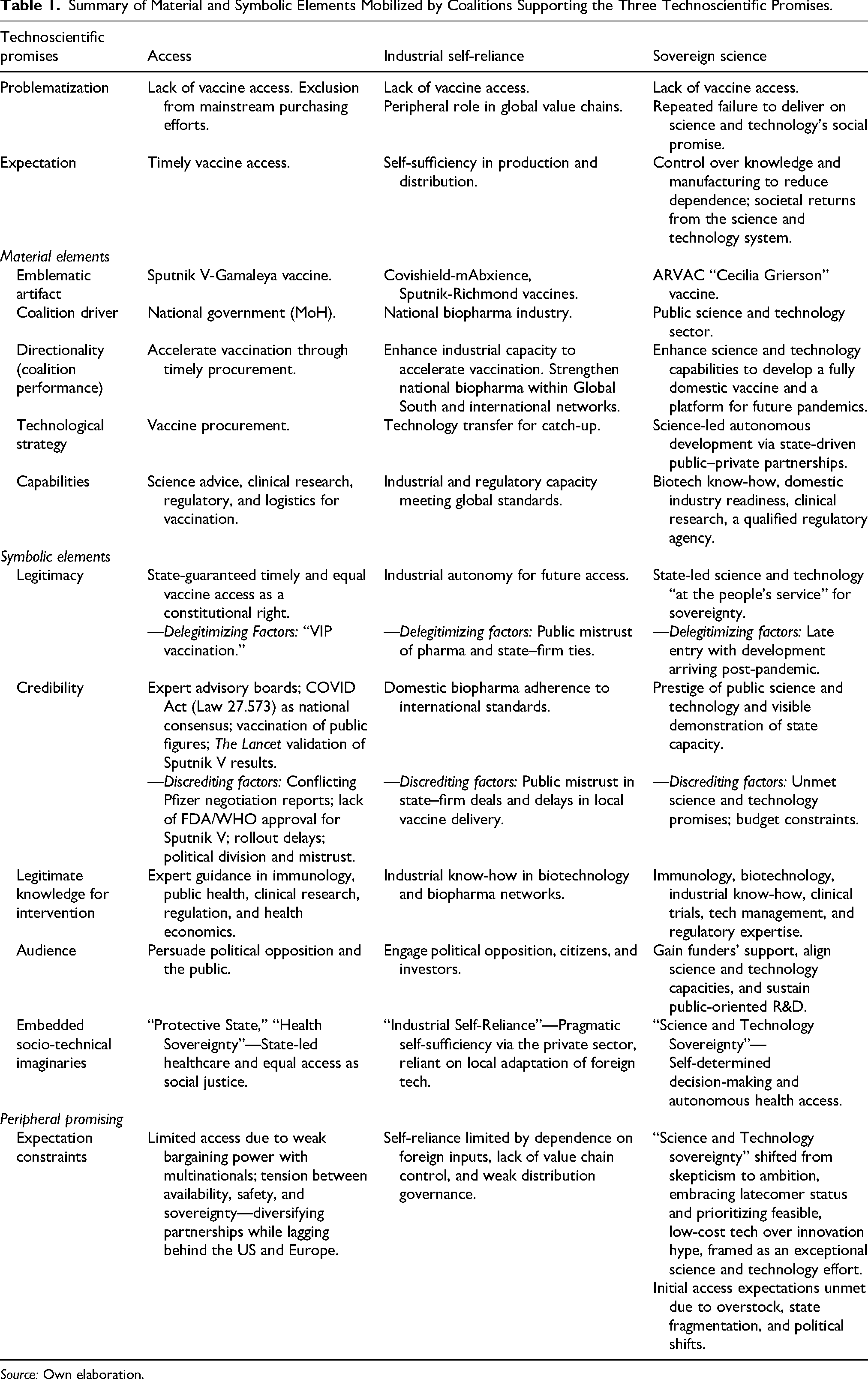
Source: Own elaboration.
The three dynamics emerged from a shared challenge: pandemic progression and exclusion from primary vaccine access, reflecting a peripheral role in global value chains. This aligned with growing skepticism about national science's social value after repeated failures to deliver tangible solutions for societal needs (Ferreyra and Céspedes 2021; Kreimer 2023).
This gave rise to three layers of expectation: timely and equitable access to quality vaccines, mobilized by the Ministry of Health; achieving self-sufficiency to govern distribution, mobilized by domestic pharmaceutical industry with state support; and ultimately, control over knowledge and vaccine production by orienting local technoscientific capacities to reduce foreign dependence, mobilized by science and technology political authorities and researchers. Like nested Russian dolls, these formed three technoscientific promises, mobilizing science for collective solutions to present and future challenges. Rooted in shared “sociotechnical imaginaries” (Jasanoff and Kim 2015), each promise reflected increasing complexity in sovereignty aspirations, championed by overlapping coalitions—from “health sovereignty” focused on equal access, to “industrial self-reliance” leveraging local capabilities, and finally “science, technology and industrial sovereignty” for self-determined decision-making. Showcased capabilities—clinical research, regulation, logistics, production, biotechnology development—lent credible evidence to each promise's achievability, fueling aspirations for the next.
The COVID-19 crisis amplified the visibility of these promises in mass and social media, reaching a citizenship desperate for vaccine solutions amid disinformation and political polarization (Demonte et al. 2024). National scientific and industrial efforts gained unprecedented exposure, held accountable by the public eye (Visacovsky and Noel 2026). Even after the emergency eased, the “Argentine vaccine” development remained symbolically powerful, carrying the weight of 70 years of scientific efforts, and chronically unfulfilled expectations (Kreimer 2023; Kreimer and Zabala 2007). Amid economic turmoil, ARVAC, followed closely by the press, came to embody public science at the nation's service (Joerges 1999), despite persistent skepticism about its social utility (Ferreyra and Céspedes 2021). The vaccine's approval in 2023 marked a milestone: transforming a narrative from exclusion and dependence to joining—even if late—the global “small club” of pandemic-ready nations. This shift temporarily challenged the image of a chronically failed “impossible Argentina” (Levita 2018), to a more hopeful “possible Argentina” capable of overcoming adversity—and even an “imagined Argentina” grounded in sovereign sociotechnical futures (Herrero 2011; Villavicencio 2003). These imaginaries, embedded into the quest for ARVAC, confronted old monsters (Dennis 2015) of stalled aspirations: colonial legacies, extractivism, weak bargaining power, chronic financial constraints, and a history of unfulfilled scientific promises.
Throughout this journey, the peripherality of promises shaped both future expectations and fulfillment strategies, as each apparent success carried its own caveat. The promise of access was constrained by foreign dependence and weak bargaining power with multinational firms. Despite hosting clinical trials for top-tier vaccines, access remained elusive, prompting reliance on alternative suppliers and unorthodox strategies that strained the balance between availability and safety—such as early adoption of unapproved vaccines and heterologous regimens. While sovereignty claims legitimized diversifying partnerships to curb US influence—moves criticized by the opposition as signs of “falling behind”—accessing US-produced mRNA vaccines was ultimately tied to foreign debt and subordinated decision-making.
Concurrently, the promise of industrial self-reliance—the envisioned “future of supply” (Télam, 26 February 2021)—was constrained by dependence on foreign inputs and weak control over the value chain, which remained in external hands, delaying distribution and access.
Finally, the promise of sovereign science evolved from initial skepticism to committed engagement in the vaccine race—an aspiration seen as feasible despite Argentina's latecomer status. Under public scrutiny and tight constraints, ambitions shifted from disruptive innovation to delivering achievable outcomes. Mature technologies were favored over hype, guided by the logic that “we live in scarcity and therefore cannot afford any waste” (AR-I040). This rare alignment of typically fragmented actors and resources was driven by the project's potential to fulfill sociotechnical imaginaries of sovereignty—enacting autonomous decision-making, delivering public goods, and steering science and technology toward aspired national futures (March and Schieferdecker 2023). Though knowingly late—and largely isolated—the production of the ARVAC vaccine ultimately embodied the realization of long-standing developmental aspirations (Herrera 1973).
The late-2023 radical political shift—openly dismissive of science's social role and the need for state support—revealed the fragility of this fulfillment and peripheral technoscientific promises. Even when national governance over science and technology was achieved, institutional fragmentation and weak policy commitments obstructed the expected realization of equitable access through self-reliant capacities. As the state infrastructure behind ARVAC is dismantled, its legacy survives precariously in the scientific teams and private sector capabilities that brought it into being.
Conclusion
This article examined technoscientific promises and future imaginaries in peripheral contexts—often overlooked in research. While most analyses show how built expectations legitimize some solutions over others or fuel new hypes and hopes, they often overlook whether promises are fulfilled or how power asymmetries shape their delivery (Kreimer 2023). Focusing on peripheral promises, we explored how they are co-produced within the global political economy of knowledge and innovation. Amid eroding trust in national science and technology to meet societal needs we aimes to go beyond normalizing disillusionment over unmet promises, and traced instead what was promised, how these promises were embedded in sociotechnical imaginaries, how they shaped aspirations for attainable futures, and how coalitions mobilized science under constraint to make those futures actionable in the present.
The COVID-19 vaccine rollout in Argentina offered a rich empirical base, marked by a state of exception that drove realignments and unconventional practices. Mobilizing imaginaries around the state and science and technology, actors sought to fulfill and publicly enact promises under close public scrutiny. Amid overlapping health and economic crises, hopes for success clashed with representations of dependence and subordination, intensifying debates on science, state, and industry roles in securing a future less bound by external and internal constraints. The peripheral condition of these promises—marked by scarcity—narrowed options and constrained visions of what was possible (Bortz 2025). Their fulfillment required constant experimentation and adaptation, where each apparent success came with caveats.
ARVAC became a symbol of achieving technological governance and industrial capacity, enacting a path of sovereign futures through creative problem-solving and strong state support under tight budget constraints. Positioned between the state's need to demonstrate competence and science's search for legitimacy and continued state support, it marked a shift from skepticism to active pursuit. Reconciling hopes for disruptive innovation with pragmatic choices, it embraced mature technologies to prioritize feasibility and capacity-building. Ultimately, ARVAC built belief in its viability, mobilizing actors and resources to see it through. Though an exceptional case that did not fundamentally alter the structural dynamics of peripheral science and technology, it illuminated pathways for potential transformation.
Reflexively, this research mirrors its own cycles of hype, hope, and disillusionment. It began with the excitement of exploring vaccine feasibility in a developing country and hopes of sparking change in the science and technology system. Yet, it was written amid mass layoffs, the dismantling of national science, technology and innovation policy institutions, and deep budget cuts (De Ambrosio and Koop 2024), eroding the very capacities that enabled ARVAC's fulfillment. Once again, Argentina stands at a crossroads, with the “impossible Argentina” reemerging and the future of national science and technology in question. Whether these capacities that were built will endure—and provide a foundation for resilient science, technology, innovation and health systems—remains uncertain. For those committed to science as a tool for development, understanding how promises are fulfilled seems vital, before hard-won gains fade, along with the very possibility of imagining a still possible Argentina.
Supplemental Material
sj-docx-1-sth-10.1177_01622439251413218 - Supplemental material for From Access to Sovereign Science: COVID-19 Vaccines and Peripheral Technoscientific Promises in Argentina
Supplemental material, sj-docx-1-sth-10.1177_01622439251413218 for From Access to Sovereign Science: COVID-19 Vaccines and Peripheral Technoscientific Promises in Argentina by Gabriela Bortz and María Cecilia Sanmartín in Science, Technology, & Human Values
Footnotes
Acknowledgments
This study is part of two institutional projects titled COVID-19 Vaccines in Latin America: Capacities, Imaginaries, and State Building (UNSAM, PRI2422, 2025–2027) and From Biotechnology to Bioeconomy: Policy Visions, Policies, and Capacities in Argentina (UNSAM, PRI2420, 2025–2027). Fieldwork was partially supported by Innovation and Complementary Capabilities for Vaccines (ESRC-JSPS, 2021–2024) and New Political Agendas in Health, Environment, and Food in Argentina (PICT-2020-SERIEA-00432, Agencia I+D+i). We thank Sebastian Pfotenhauer and the organizers of the 2nd Novation Forum for offering valuable spaces to share and discuss findings (April and September 2024, respectively), Gustavo Seijo for his challenging insights, Valeria Arza for her thoughtful reading, and the anonymous reviewers for their engaged and constructive feedback.
Conceived in conditions far removed from the austerity now shaping science in Argentina, the first version of this article took form during a month-long residency at the Brocher Foundation (Switzerland) in April 2024—an oasis of inspiration, reflection, and care. In sharp contrast to the precarity explored in this article and currently pervading research practice in Argentina, this setting highlights the situated nature of this work. Gabriela Bortz is deeply grateful to the Brocher Foundation for offering the unique conditions that made this possible.

Funding
The authors disclosed receipt of the following financial support for the research, authorship, and/or publication of this article: This work was supported by the Fondo para la Investigación Científica y Tecnológica (Agencia I+D+i) and the Economic and Social Research Council (grant number PICT 2020-SERIEA-00432, Innovation and Complementary Capabilities for Vaccines).
Declaration of Conflicting Interests
The authors declared no potential conflicts of interest with respect to the research, authorship, and/or publication of this article.
Supplemental Material
Supplemental material for this article is available online.
Notes
Author Biographies
References
Supplementary Material
Please find the following supplemental material available below.
For Open Access articles published under a Creative Commons License, all supplemental material carries the same license as the article it is associated with.
For non-Open Access articles published, all supplemental material carries a non-exclusive license, and permission requests for re-use of supplemental material or any part of supplemental material shall be sent directly to the copyright owner as specified in the copyright notice associated with the article.
