







Abstract
Since COP21 in 2015, carbon neutrality targets have emphasized the enhancement of various carbon sinks, including soils, to help sequester carbon away from the atmosphere. What does it take to make soils into carbon sinks? This article focuses on a French digital model of soil carbon cycling named AMG, which quantifies soil carbon stocks and their evolution under various agricultural practices. We examine how AMG circulates and transforms within a loosely connected network of actors and organizations involved in agricultural development, climate research, land-use planning public administrations, and carbon commodification. We show how the model evolves into three distinct yet interconnected regimes of carbon quantification—in climate academic research, local public action, and carbon markets—that contribute to building and expanding a sociotechnical infrastructure for quantifying soil carbon sequestration potential. Our findings contribute to the literature on environmental quantification and knowledge infrastructures by calling for a shift from viewing knowledge infrastructures as stable and fixed, toward an approach that emphasizes open-ended, flexible, and ongoing processes of infrastructuring. We also contribute to the literature on soil–human relations by emphasizing how this model fosters a new focus on the active role of soils in the global carbon cycle and climate change mitigation.
Introduction
While soil carbon has been studied by scientists and experts for several decades, this topic has taken center stage in climate policies since the COP21 in December 2015. In line with the climate objective of limiting global warming to below 2 °C compared with preindustrial average temperatures (with an aspirational target of 1.5 °C), the Paris Agreement led many countries, companies, and organizations to adopt carbon neutrality commitments, aiming to achieve “net-zero emissions” by the end of the 21st century. This means not only drastically reducing greenhouse gas emissions but also balancing unavoidable emissions (such as those from agriculture and certain industries) with the removal of CO2 from the atmosphere and its sequestration. Carbon neutrality, therefore, requires the enhancement of various carbon sinks, including soils.
Holding twice as much carbon as the atmosphere, soil plays a major role in the global carbon cycle and climate regulation. Even small variations in soil carbon stocks, related to the complex carbon turnover between plants, atmosphere, and soil biota, can have a very big impact on the atmospheric levels of CO2 (Smith 2012; Moinet et al. 2023). 1 At the end of 2015, just before COP21 in Paris, the French Ministry of Agriculture launched the “4 per 1,000: Soils for Food Security and Climate” Initiative to promote soil carbon sequestration projects and practices across countries and organizations. 2 The Initiative is based on a simple idea: increasing soil carbon stocks by 0.4 percent annually could, in theory, offset anthropogenic emissions (Balesdent and Arrouays 1999). Scientists quickly clarified, however, that carbon sequestration is both limited and reversible over time (Arrouays et al. 2002). For example, Pellerin et al. (2020) reassessed the sequestration potential of French agricultural soils and concluded that it corresponds to 40 percent of emissions from the French agricultural sector alone (i.e., far from offsetting all emissions across all sectors).
Nonetheless, this calculation has given rise to a wave of hope and promises about the potential of soils to sequester carbon and remove it from the atmosphere. Enhancing carbon in the soil is good not only for soil fertility and plant growth but also for soil biodiversity and soil structure, thus reducing soil erosion and degradation. Because agriculture is a major source of greenhouse gases—mainly nitrous oxide (from fertilizers) and methane (from livestock and rice paddies), and to a lesser extent carbon dioxide 3 —soil carbon sequestration has been widely promoted for its multiple cobenefits. Since the early 2000s, such promises have sustained efforts to determine how much carbon soils can sequester, and how their sequestration potential might be optimized (Bispo et al. 2017). As governments began urging scientists to produce estimates that would reinforce the inclusion of soil sinks in climate mitigation policies and targets, a variety of programs and initiatives at various scales emerged to quantify soil carbon stocks and forecast their potential evolution. These efforts involve a diverse community of actors, including soil science researchers, local agricultural stakeholders, land-use planners, and carbon credit entrepreneurs.
So, what does it take to make soils into carbon sinks? What sorts of methods, tools, and sociotechnical infrastructures were developed to try and assess soil carbon potential? And how do they contribute to reconfiguring the way in which we come to know and manage soil? This article answers these questions by examining the initiatives and tools devised to quantify how much carbon different soils can sequester under varying conditions, thereby contributing to efforts to make soils “count” as carbon sinks.
Drawing on a grounded, qualitative investigation in France into soil science research, farming organizations, land-use planning public administrations, and carbon credit markets, this article traces the trajectory of a single carbon model originally conceived within the agronomic and soil sciences community. It highlights the model's multiple circulations and appropriations by various groups of actors and organizations pursuing divergent goals. We analyze the recontextualizations and transformations of this instrument, which was initially designed to help French farmers manage the organic matter of their soils but was repurposed to serve distinct goals in academic research, local public administration, and carbon markets. This led to the emergence of three regimes of soil carbon quantification: a regime of climate modeling, a regime of local public action, and a regime of carbon commodification. We show how these three regimes contribute to building and expanding a sociotechnical infrastructure for quantifying soil carbon sequestration potential, thus contributing to new understandings of soil and soil carbon agentivity and complexities.
Theoretical and Empirical Framework
Literature Review and Theoretical Framework
Our reflection is situated at the crossing point of three strands of literature that respectively address soil–human relations, environmental quantification and knowledge infrastructures, and carbon commodification.
Paralleling an ecological turn in soil sciences research that has reaffirmed the “living” nature of soil in the 1990s and 2000s (e.g., Gobat, Aragno, and Matthey 2004), a dynamic body of literature in anthropology, human geography, and environmental humanities has addressed soil–human relations (see Granjou and Meulemans 2023). Inspired by Puig de la Bellacasa's (2015) pioneering insights into the active and dynamic nature of organic matter and its particular brand of materiality as a heterogeneous mix of living organisms and dead or dying things, authors share a key concern for unsettling common visions of soil as a surface, a background or a taken-for-granted stock of resources for human enhancement and cultivation, and provide instead distinct understandings of soils as multispecies assemblages and active, dynamic and vulnerable ecosystems. Strongly committed to developing more attentive and ethical relations with soil as a living and lively ecosystem, with which human life is deeply entangled, this literature addresses the development of embodied and aesthetic relationships with soils in various practical contexts (Krzywoszynska 2019; Meulemans 2019; Salazar et al. 2020). Our reflection on soil carbon quantification contributes to this literature by focusing on a different type of soil–human relationship anchored in expert knowledge and technical tools. We argue that producing quantified scenarios of soil carbon evolution depending on farming strategies and decisions tends to foster new sensitivities to soil agency and complexities, thus contributing to a reappraisal of soils beyond their traditional understanding as the basis of agricultural productivity, toward carbon cycle and climate change mitigation instead.
Kearnes and Rickards (2017) observed that soils have long been viewed as underground repositories for burying unwanted materials, including dead bodies and domestic and nuclear waste. However, turning soils into carbon sinks does not simply mean using them as storage sites to lock carbon away from the atmosphere. Soil scientists have long emphasized the continuous turnover and fluxes of carbon between soils, plants, and the atmosphere (e.g., Manlay, Feller, and Swift 2007). Accordingly, the rising research and development efforts aiming to quantify soils’ potential for carbon sequestration also convey complex visions of soils as heterogenous and dynamic milieus composed of organic matter that closely interact with the biosphere and atmosphere.
Our analysis is also inspired by a second body of work that examines the rise of informational and quantification instruments and their role in environmental and climate governance, at the intersection of sociology, science and technology studies, and infrastructure studies. This literature follows Espeland and Steven’s (2008, 401) inventive proposal to consider quantification as “the production and communication of numbers,” and to study the spread of “new regimes of measurement.” A key insight from this research is that quantification is a performative act that relies on enduring sociotechnical infrastructures in order to exist and to “count.” In line with formative works on the role of numbers and quantification (Porter 1995; Desrosières 1998; Foucault 2004), this literature highlights that, far from merely depicting, measuring, or representing the social and material world, technologies of environmental quantification contribute to shaping the environment and its governance in historically specific and negotiated ways (Kovacic 2018). Addressing the rise of metrics seeking to assess and govern environmental issues, scholars in Science and Technology Studies (STS) have emphasized the role of quantification techniques both in constructing environmental entities and problems, such as climate change (Edwards 2013) or the underground (Kama 2020), as intelligible and manageable issues, and in valuing some realities over others (Loconto et al. 2024). “In a world saturated with numbers,” as Espeland and Stevens (2008, 411) remind us, “we often forget how much infrastructure lies behind the numbers that are the end product of counting regimes.” In a similar vein, Edwards (2013, 17) builds on Leigh and Star's pioneering work on infrastructures to theorize the notion of knowledge infrastructure, defined as “networks of people, artifacts, and institutions that generate, share and maintain specific knowledge about the human and natural worlds.”
We contribute to this critical research on the production of environmental quantification by charting the trajectory of a model of soil carbon called AMG, and showing that it contributes to foster new visions of soils as carbon sinks, thus valuing the role of soils in the global carbon cycle and climate change mitigation, alongside their role in agricultural productivity. We examine the development of an “infrastructure” of soil carbon quantification based on the various adaptations and circulations of this model, understood as a sociotechnical assemblage of data, models, practices, organizational arrangements, communities, and institutions that work to produce reliable quantifications of soil carbon. We show that, as the AMG model has circulated across various social arenas and been adopted by groups who imbue the technique with diverse objectives and meanings, the infrastructure has evolved into three distinct regimes of carbon quantification: a regime of climate change modeling, a regime of local public action, and a regime of carbon commodification. Here, we define a regime of soil carbon quantification as a set of relationships linking a technology of soil carbon quantification with specific organizations or collectives, and associated socioeconomic goals. This notion of regime is inspired by Pestre's (2003) approach to regimes of knowledge production. 4
We engage with several authors in political ecology and STS who have criticized the rise of decarbonization incentives (Boehmer-Christiansen 2003) and analyzed the role of carbon quantification initiatives and schemes in stabilizing carbon credit markets (MacKenzie 2009; Bumpus 2011; Boisvert 2015; Chiapello and Engels 2021). This literature has largely focused on carbon markets in general, often using forests as case studies (though see Kearnes and Rickards 2020; Whitington 2020), to criticize the dominance of a logic of commodification. By contrast, our analysis focuses specifically on soil carbon. We argue that the infrastructure built to make soils count as carbon sinks cannot be reduced to an expanding commodification logic: rather, as we show below, this infrastructure also serves a range of logics, including soil conservation, climate modeling, and the advancement of local public climate mitigation efforts.
Context
The idea of soil carbon sequestration is part of the long history of carbon sinks in climate governance. Sinks have been considered officially since the creation of the United Nations Framework Convention on Climate Change (UNFCC) in 1992 (Carton et al. 2020). Based on emerging knowledge that forests in the Northern Hemisphere constitute important carbon sinks, countries in the Global North proposed establishing a “net accounting system” to fulfill their new obligations of inventorying national emissions. This system allowed them to subtract the amount of carbon absorbed by terrestrial sinks from the amount released into the atmosphere by fossil fuel combustion. While countries such as the United States, Canada, Japan, Switzerland, Norway, Australia, and New Zealand viewed forest sinks as a cost-effective way to mitigate climate change, others argued that sinks merely offered a loophole to the main contributors—namely, fossil fuels (Lövbrand 2009).
The 1997 Kyoto Agreement marked an important step in the progressive normalization of the perspective of enhancing carbon sinks (Berta and Roux 2024). The Kyoto Protocol implemented market-based reduction quotas for industrialized countries and adopted the principle of “net accounting”—initially only for forests, though the protocol later made it possible to add additional sectors and activities, such as soils. Yet natural sinks are temporary and reversible, making them much more difficult to account for than emissions. In the years following the Kyoto Protocol, the Intergovernmental Panel on Climate Change (IPCC) released a special report entitled Land Use, Land-Use Change, and Forestry (IPCC 2000), which emphasized the scientific and technical challenges involved in assessing the carbon sequestration potential of terrestrial sinks. Naturally, the report did not resolve all the uncertainties and controversies surrounding carbon measurement and accounting.
The Paris Agreement, adopted at COP21 in 2015, relaunched the issue of terrestrial sinks in a new way, in relation to the aspirational 1.5 °C target. 5 The recognition of the urgent need to halt greenhouse gas emissions in order to stabilize global temperatures (Lahn 2020) spurred the development of decarbonization pathways capable of meeting such ambitious goals (Guillemot 2017). Nearly all climate scenarios that meet the 2 °C target involve not only drastic reductions in emissions but also the use of “negative emissions technologies,” also known as carbon dioxide removal (CDR) techniques: methods of removing CO2 from the atmosphere (Anderson 2015; Cointe and Guillemot 2023). Technological CDRs, such as bioenergy with carbon capture and storage and direct air capture, are often distinguished from nature-based techniques like afforestation and soil carbon sequestration. The latter are generally viewed as the least controversial options and the only ones likely to be implemented in the short term (Smith et al. 2024). Our research suggests that nature-based techniques nonetheless rely on sophisticated scientific expertise and also sociotechnical work that deserves social sciences scrutiny.
Our fieldwork is based in France, the country that launched the “4 per 1,000: Soils for Food Security and Climate” Initiative in 2015. A decade on, France continues to play a prominent role in several international organizations focused on soil and soil-related issues (e.g., the European research program EJP Soil). The “4 per 1,000” Initiative was promoted by French scientists and researchers from influential public institutions dedicated to agricultural research, development, and extension, particularly the French National Research Institute for Agriculture (INRA, now INRAE), who have long studied soil organic matter, initially to enhance soil fertility and agricultural productivity.
In this article, we focus on the trajectory of a specific model of soil carbon cycling called AMG, for the initials of the three scientists who invented the model: Adrian Andriulo, Bruno Mary, and Jérôme Guerif (Andriulo et al. 1999). While AMG is not the most cited carbon cycling model in international soil science research, we selected it because it is widely used in French academic and policy spheres. Compared with other international models of carbon cycling, 6 AMG is robust in producing avowedly reliable predictions of carbon evolution and also accessible to users outside academic circles. Its broad circulation among local stakeholders, including agricultural extension agents, land-use planning administrations, and other intermediary organizations, made it well-suited to our objective of describing various regimes of carbon quantification and how they are embedded in specific socioeconomic organizations and goals. AMG depicts and predicts inputs and outputs of carbon in soils based on the mechanical representation of some of the processes of carbon cycling (which remain difficult to validate). This type of “simple” model, as opposed to “complex” models that aim to represent biogeochemical processes at the microscopic scale (see Manach et al. 2023), is more efficient for predicting carbon stocks and their evolution at larger scales. Far from remaining confined to academic research, the model has given rise to a simpler version, SimeosAMG, which is used by agricultural advisers and farmers to conduct agronomic assessments of soil conditions. It has also been adopted by economic and administrative stakeholders in various configurations.
Methods
We conducted a long-term investigation into soil science and soil management at the national level in France, in connection with international soil science communities and bolstered by local case studies. This research included more than 200 interviews with soil and climate scientists, council employees, agricultural advisers, farmers, consultancy firms, and other stakeholders involved in emerging soil carbon markets in France. 7 Most interviews were conducted between 2022 and 2024 by a team of seven French researchers who were part of a collective research project funded by the French National Agency for Research (ANR) entitled POSCA (The Promises of Soil Carbon Sequestration: Innovations, Organizations, Knowledge). 8 The data was analyzed using thematic coding and analysis software (NVivo), and backed up with gray literature, websites, scientific articles, and webinars. Interviews were in French, and relevant quotations were then translated into English for the purpose of this article.
Drawing on this investigation, and using fifteen in-depth interviews focused on AMG and SimeosAMG, we examine how AMG has circulated and transformed within a loosely connected network of actors and organizations involved in agricultural development, climate research, land-use planning public administration, and carbon commodification. We show how the model evolved into three distinct yet interconnected regimes of carbon quantification—climate academic research, local public action, and carbon markets—that have contributed to building and expanding a sociotechnical infrastructure for knowing and quantifying soil carbon sequestration potential (see Figure 1). Our findings advance the literature on the production of environmental quantification and the role of knowledge infrastructures by identifying the sociotechnical work required to quantify carbon, and highlighting how carbon quantification contributes to making soils “count” as carbon sinks.
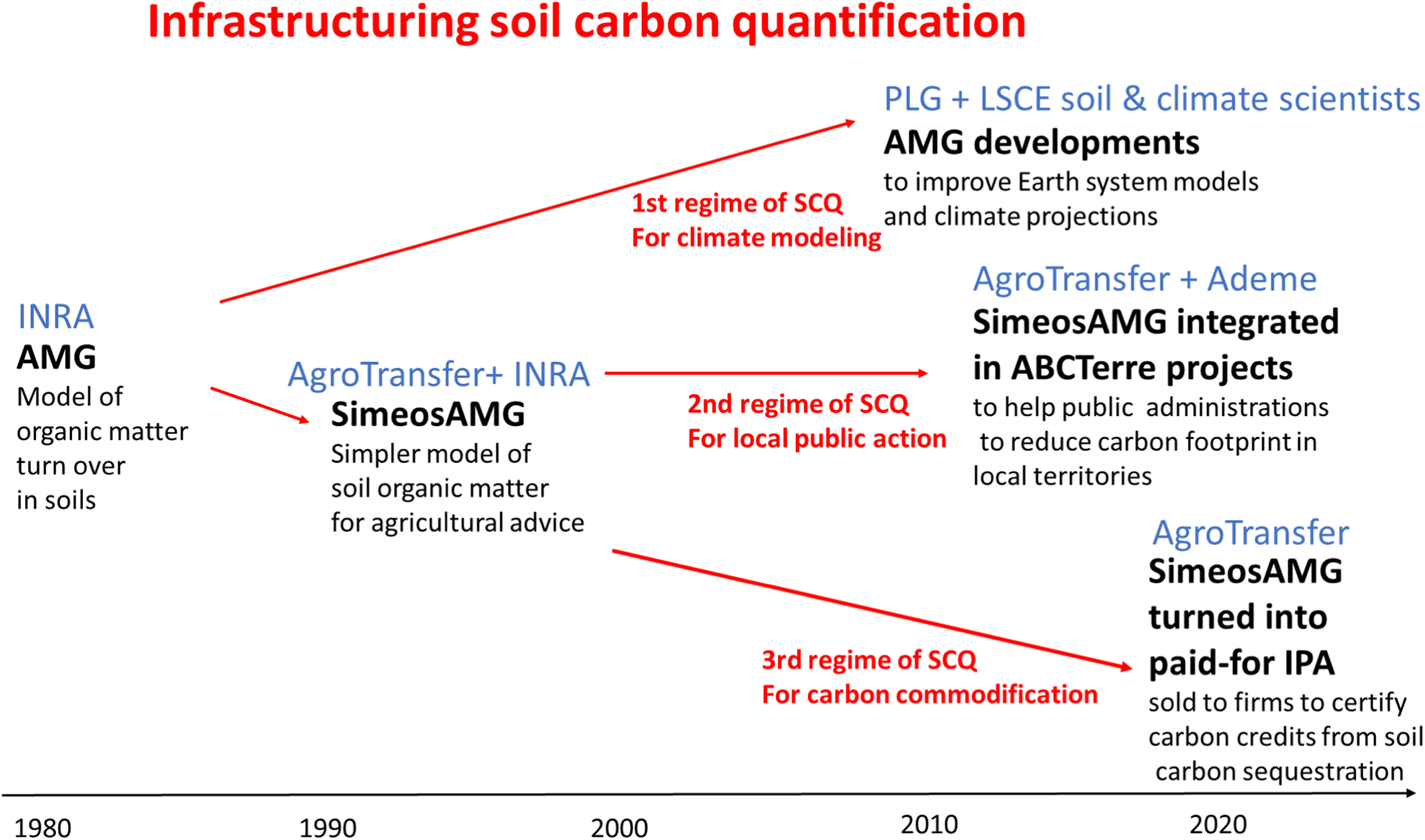
Infrastructuring soil carbon quantification.
Three Regimes of Soil Carbon Quantification
A Regime of Soil Carbon Quantification for Climate Modeling
Soil organic matter (also known as humus) is a key factor in soil fertility and agricultural productivity. Soils rich in organic matter tend to retain water for longer periods, are less prone to erosion, and have better structure (Manlay, Feller, and Swift 2007). The first models of organic matter were developed in the 1940s in response to the observed depletion of soil organic matter caused by the rise of intensive farming practices. From the 1980s, agronomic researchers concerned with agricultural productivity and soil fertility developed several major numerical models of organic matter cycling, including the British model Roth-C and the US model CENTURY. These models aim to improve the understanding of organic matter decomposition in agricultural and forestry soils.
In France, one of the most prominent soil carbon models is AMG. It was first developed in 1999 by a small team of agronomy and soil science researchers 9 at INRA in a context of rising fears over soil carbon depletion due to the industrialization of agriculture, notably in the Global South. The model aimed to “predict the consequences of different strategies for managing the organic matter in a region of relatively recent agriculture, where intensification [was] expected to alter the organic status of soils” (Andriulo et al. 1999, 366). Like many simple models, AMG represents carbon dynamics through three interacting compartments: a compartment of fresh organic matter just added to the soil; an active compartment, where soil organic matter is quickly decomposed; and a stable compartment, where soil organic matter is protected from decomposition for long periods of time, typically a hundred years (Clivot et al. 2019). Scientists refer to these as different “residence times” for soil carbon. Notably, these three compartments do not correspond easily to directly observable features in the field or laboratory; rather, they are considered an efficient means of reliably predicting carbon inputs and outputs. Yet, the reasons why some carbon remains stable while some other carbon cycles back quickly to the atmosphere remain somewhat “enigmatic,” as one interviewed soil scientist described it. 10 Although AMG is not widely used internationally, French scientists consider it a “very robust” model, well-calibrated for agricultural use in France. It has been tested and validated using long-term field observations and measurements from a diversity of experimental farming sites, along with national soil data monitoring programs. 11
Beyond agricultural concerns, new questions and stakes have emerged around soil carbon in relation to climate change, particularly since the mid-1990s, which has created new conditions for soil carbon modeling. Climate scientists demonstrated that the terrestrial biosphere acts as a net global sink that absorbs about one-quarter of the CO2 emitted by human activities. Since then, efforts have been made to integrate carbon cycling into climate models. Renamed “Earth system models,” these climate models started to integrate representations of soils based on existing soil carbon models, as the post-Kyoto context brought increased political and scientific interest in enhancing carbon sinks, including agricultural soils. But in the late 2000s, the representation of soil carbon in Earth system models became a subject of debate. In the IPCC's third, fourth, and fifth assessment reports (2001-14), soil carbon modeling was identified as one of the factors contributing to the high variability in terrestrial carbon sink projections across different Earth system models (Luo et al. 2016).
In response to this evolving context and mounting pressure to reduce uncertainty in Earth system models, a cluster of soil and climate scientists at the Paris Laboratory of Geology (PLG) and the Laboratory for Climate and Environmental Sciences (LSCE) near Paris, began working to mobilize and enhance AMG to improve the representation of carbon cycling in global climate models and scenarios. Their strategy was to refine a simple, robust model like AMG before attempting to further complicate Earth system models. Jeanne,
12
a postdoctoral researcher at the PLG working on AMG, explained the objective of enhancing the model's robustness and reliability for quantifying soil carbon stocks to improve climate change modeling: My role here is to make soil organic carbon models predictive, because they are not at present…The goal is to develop models that are not only predictive but also reliable and precise, which is not yet the case.
While simple models like AMG are generally reliable in predicting carbon inputs and outputs at the scale of farm plots for agricultural purposes, they require more precise empirical data to calibrate their functioning and validate their results in the context of the global carbon cycle (Le Noë et al. 2023). Jeanne and other researchers working at the intersection of soil and climate sciences use a range of data and observations—from field experiments and long-term soil monitoring systems—to make the model more precise and predictive at broader scales. This team produced for instance new data on stable soil carbon using laboratory tools coming from geology in order to better validate this soil compartment of AMG (Kanari et al. 2022). This work takes place in a context where accurately quantifying soil carbon fluxes under a changing climate is becoming essential to Earth system scientists.
This regime of soil carbon quantification brings together a Paris-based cluster of soil scientists working closely with climate modelers to advance AMG with the goal of improving our understanding and representation of soil carbon fluxes in Earth system models and climate projections (Table 1). It enacts a vision of soils as a critical part of Earth system models, with a major role in sequestering and emitting carbon within a complex turnover involving soil microorganisms, plants, and the atmosphere.
Three Regimes of Soil Carbon Quantification (SCQ).
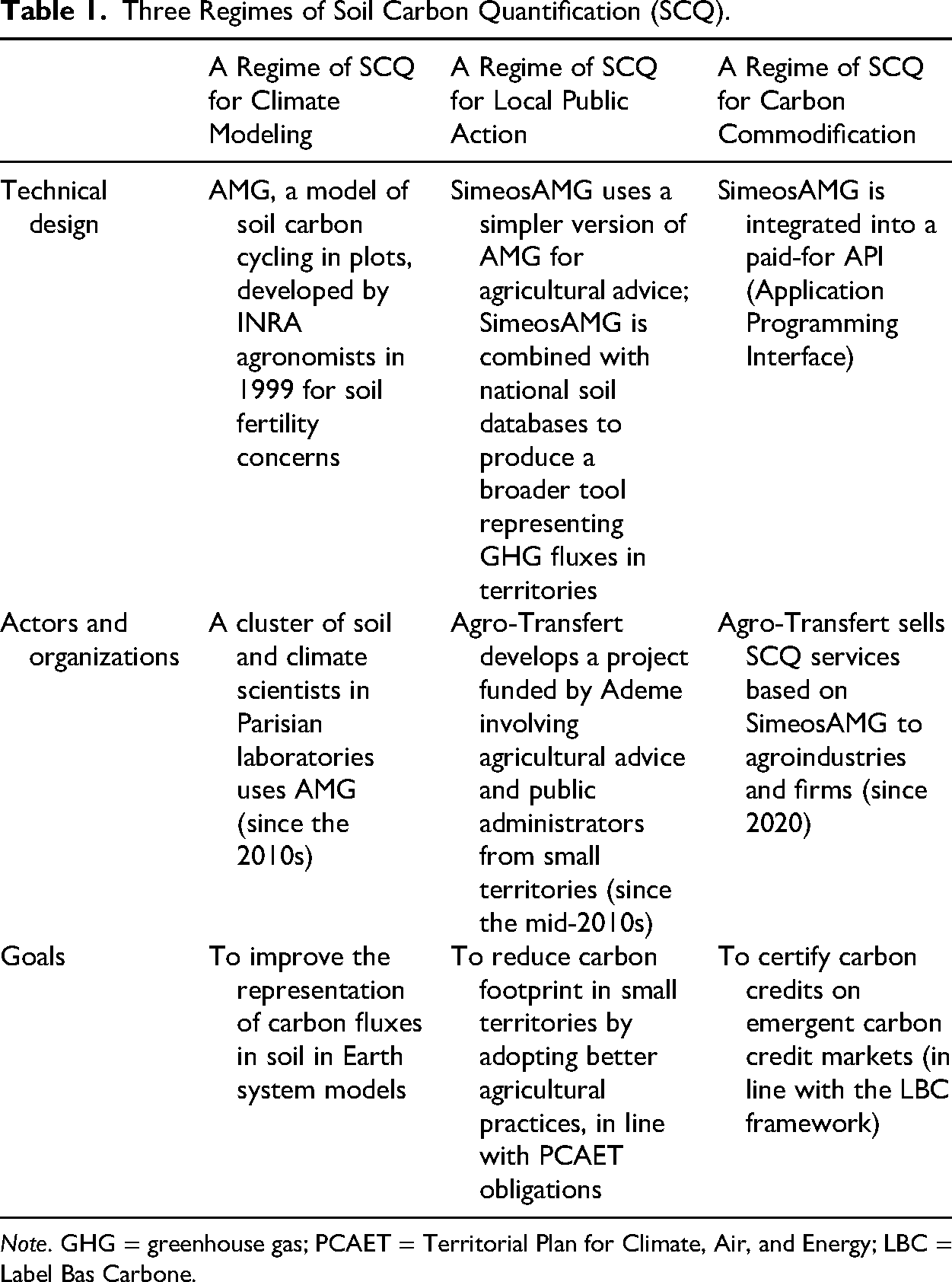
Note. GHG = greenhouse gas; PCAET = Territorial Plan for Climate, Air, and Energy; LBC = Label Bas Carbone.
A Regime of Soil Carbon Quantification for Local Public Action
Meanwhile, around the beginning of the 2010s, a simpler version of AMG, called SimeosAMG, was created by INRA researchers in collaboration with Agro-Transfert, a public organization responsible for agricultural extension. 13 Agro-Transfert is a nonprofit organization created in 1990 by the director of the INRA research unit where AMG was originally designed. His goal with SimeosAMG was to build on the collaboration initiated in 1990 between INRA, local agricultural advisers, and several regional councils to produce agricultural expertise tailored to local contexts. SimeosAMG was designed “to simulate the evolution of organic matter in agricultural soils based on cultivation practices,” and to “help farmers and advisers identify long-term organic matter management practices,” as Agro-Transfert employee Rachel explained in an interview. Rachel had been responsible for refining SimeosAMG since 2004, as well as for training agricultural advisers and farmers to use the tool. This version was designed to make it accessible to a wide range of actors, including farmers and agricultural advisers, not just scientists.
SimeosAMG users are required to input a variety of agricultural data, such as crop succession, type of tillage, organic amendments, irrigation methods, and more. 14 The model outputs are graphs representing different scenarios of organic matter evolution under varying farming practices and land-use changes over a thirty-year or fifty-year horizon. 15 For instance, SimeosAMG predicted that a system growing grain and sugar beet in loamy soils would lead to a loss of about 2 tons of carbon per hectare over the next fifty years if the current farming practices remain unchanged, with soil carbon stocks decreasing from 42 tons of carbon per hectare to slightly less than 40 tons per hectare (in the first 30 centimeters of soil). By comparison, the model showed that replacing grain with potatoes would lead to a bigger loss of carbon than in the current system, that is, more than 4 tons per hectare over fifty years. On the other hand, introducing alfalfa in the cropping system would make it possible to conserve the same carbon stocks over time. 16 These quantified scenarios provide a tool for farmers to make decisions regarding which crops and crop rotations to favor in trying to conserve soil fertility and contribute to carbon sequestration. Other scenarios produced by SimeosAMG show the difference in soil carbon stocks resulting from various fertilizing strategies, different plant residues (i.e., straw) and management practices, or from the adoption of no-tillage practices.
Since the mid-2010s, SimeosAMG has been appropriated by another group of stakeholders, in a context where drafting local climate change policies prompted new uses for soil carbon models. Administrative officers and political stakeholders in local territories (from municipalities of 20,000 inhabitants to larger urban areas) began using SimeosAMG to estimate soil carbon stocks and potential changes, with the aim of designing local climate mitigation policies involving agricultural practices and land-use planning. In this second regime, local administrators sought to understand how much their soils could sequester in order to formulate public action plans that would help balance local greenhouse gas emissions with the carbon sink capacity of soils, thereby reducing the territory's overall carbon footprint.
The development of this second regime was backed by Ademe, a public, government-funded agency dedicated to funding technological innovation and transfer for ecological transition. In 2010, Ademe created a new department for agriculture and forestry, where Timothée, an agronomist with specialized training in soil carbon science, was recruited. 17 Timothée and his colleagues recognized the potential of a tool like SimeosAMG for quantifying local soil carbon stocks and changes in support of public policies for climate change mitigation through the adoption of better agricultural practices in local territories. Timothée and his colleagues encouraged Rachel and her team at Agro-Transfert to launch a research and development project called ABCTerre (2010-15) funded by Ademe. This project made it possible to integrate SimeosAMG into a broader greenhouse gas assessment tool for local territories that accounted for both carbon sequestration and emissions. Within the ABCTerre project, Agro-Transfert created new links between SimeosAMG, which models carbon cycling at the scale of farm plots, and national soil carbon databases, in order to account for the carbon emitted and sequestered by all the cropping systems within a given territory. 18 SimeosAMG could now be used not only at the level of farm plots but also to produce quantifications of carbon stocks and fluxes at the broader level of small territories. For instance, in the Tardenois territory in the northern part of France, the model predicted that soil carbon stocks would increase by 168 kg per hectare per year over the next twenty years for the whole area if the current farming practices remained unchanged. The model made it possible to distinguish between five categories of cropping systems depending on their predicted increase of carbon stocks in soils, and showed that the dynamics of carbon sequestration were noticeably due to the presence of cropping systems in which big amounts of plant residues, that is, straw, are returned to soils. Thus, SimeosAMG was adapted into a new framework that generated a representation of potential options and levers to sequester more carbon and/or reduce emissions. These outputs were then discussed in small groups of farmers, advisers, and administrative officers within a given territory.
At the beginning of the 2010s, the tool met with a certain level of success, as several agricultural advisers and farmers were increasingly concerned about what they perceived as a stigmatization of agriculture's role in climate change. The 2006 FAO report Livestock's Long Shadow was influential in publicizing the contribution of animal breeding to greenhouse gas emissions. Agro-Transfert's website dedicated to the ABCTerre project begins by stating that “the agricultural sector contributes 20 percent of greenhouse gas emissions, but it is also able to store carbon in soils and thus partly compensates for these emissions.”
19
Agricultural actors involved in the ABCTerre project were eager to present farming not as a problem but rather as a solution to climate change, and they saw carbon sequestration as a valuable opportunity to do so, as Rachel and her colleagues noted: Farmers reflected, without even knowing yet whether they would earn any money from it [soil carbon sequestration]: we’ll be able to give a better image of farming. That matters to them.
A second ABCTerre project followed in 2017, driven by a shifting regulatory context around climate and carbon accounting. New legislation required municipalities with more than 20,000 inhabitants to draft a Territorial Plan for Climate, Air, and Energy (PCAET). PCAET is a planning tool designed to advance climate change mitigation efforts at the local level. Municipalities were expected to assess greenhouse gas emissions and the net sequestration of CO2, as well as its development potential in local sinks such as forests and soils. Once again, Ademe (particularly the Agriculture and Forestry Department, where Timothée was responsible for soil issues) funded the second ABCTerre project. It aimed to upscale the use of SimeosAMG and integrate soil carbon quantification into the climate-related obligations of local authorities.
In parallel to the continuing mobilization of AMG for agricultural purposes of soil enhancement, both ABCTerre projects contributed to establishing a new regime of carbon quantification in which agricultural and local land-use planning administrations collaborated around shared objectives of reducing carbon footprints in farms and local territories (Table 1). Several of the farmers involved in the second ABCTerre project were also local political officials, and were thus interested in the experiment both as practitioners and local politicians. In particular, the development of SimeosAMG through the two ABCTerre projects helped make agricultural soils “thinkable” and manageable as carbon sinks for advisers and farmers concerned about agriculture's role and image. Isabelle, the Agro-Transfert employee responsible for the second ABCTerre project, felt that the initiative fostered new sensitivities and awareness among participants, especially farmers, regarding the role of agricultural soils in reducing the sector's carbon footprint. Farmers have become familiar with the carbon vocabulary and carbon numbers, as the quantifications of soil carbon stocks evolution attached to various farming methods and strategies tended to provide them with a new way of valuing and comparing their practices and decisions in the light of their capacity to emit or to sequester carbon: They [farmers] were delighted, I remember in those workshops, to find out which activities emit the most [greenhouse gases]: tillage, stubble plowing, various machineries. To learn that, in the end, mineral nitrogen has much more impact on climate change than tractors.
Yet four local authorities participated in the second ABCTerre project as “pilot territories”; they were meant to be the first to test SimeosAMG before the tool was expanded to others. Yet the project ultimately had limited impact, as not many local authorities chose to use SimeosAMG to design their PCAET, mainly because they found it too costly and complex, and preferred more ready-to-use tools for quantifying carbon stocks. 20
For similar reasons, some consulting firms offering carbon footprint assessments were not particularly interested in using the ABCTerre framework, as an employee at one such firm described: I tried to train myself to use the ABCTerre framework to see what it would produce and whether I could use it to work on PCAETs…And I saw that thing, you have to go and collect data from I don’t know where, connect everything each time, and…in the end…well, it was super complicated, super long…and it didn’t meet the expectations I had.
A Regime of Soil Carbon Quantification for Carbon Commodification
At the beginning of the 2020s, SimeosAMG was mobilized in a third regime of soil carbon quantification. This one aimed to quantify the potential carbon gains from adopting new agricultural practices to certify carbon credits on emerging carbon markets. This regime still involved the agricultural extension organization Agro-Transfert, which transformed SimeosAMG into an Application Programming Interface (API)—a digital interface open to various users who wish to connect their own programs and applications to SimeosAMG. This regime relies on extending and standardizing access to SimeosAMG for new types of users, particularly private firms in agroindustry and consulting (Magnin and Doré 2024). Access to SimeosAMG online is available, as Isabelle stated, to any user “who would be interested in paying for the service and the benefits it provides.” While it is still possible to run the API and obtain a few results for free, especially for farmers who are not interested in purchasing the full service, it is also bought and used by agroindustries and firms seeking to offset the carbon footprint of their activities by buying certified tons of carbon sequestered in agricultural soils.
This third regime of soil carbon quantification was encouraged by new carbon accounting regulations and by the French government's release of the Label Bas Carbone (LBC) at the end of 2018. The label allows farmers to certify the expected amount of carbon sequestered in their soils or the reduction of their emissions and to sell the resulting credits. The LBC is a voluntary certification framework designed to facilitate the creation of methods for assessing carbon credits generated by projects aimed at carbon sequestration or emissions reduction across various sectors, including agriculture. Its goal is to establish shared, sector-specific methodologies that enable stakeholders to certify carbon credits. 21 So far, the LBC has mostly supported voluntary carbon credit transactions between firms seeking to offset their emissions and a small number of farmers. The development of soil carbon markets has remained limited, partly because the market price of credits is often too low to cover the cost of adopting new practices for farmers. 22 In addition, many uncertainties remain regarding the amount of carbon that is ultimately sequestered in soils. Soils can only sequester carbon up to a certain point, beyond which carbon stocks stabilize—or may even decline, as carbon is released back into the atmosphere if the sequestering practices are discontinued (Derrien et al. 2023). In addition, from 2023 onward it has become mandatory for agroindustrial firms to integrate the carbon impact of upstream agricultural activities in their own carbon accounting scheme. 23 This fostered firms’ interest in collecting carbon information from farmers and expanding carbon accounting at the level of the whole agroindustrial chain.
While carbon gains are uncertain or unstable, the main benefit of the LBC framework has been to spur better agricultural practices related to soil conservation and explore new forms of remuneration for farmers. Although ABCTerre was previously considered too complex and detailed to meet the needs of local administrators working on carbon reduction, the launch of the LBC and the new agroindustrial regulation reframed the model's precision and rigor as an asset for ensuring detailed carbon information and fair market transactions. As an Ademe employee noted: Precise quantifications allow for precise certifications, which make it possible to claim [carbon gains] and support the development of a market. The territorial planning framework [PCAET] didn’t require that level of precision. There weren’t the same risks of overestimation, bias, imprecision, or false claims.
In the context of LBC projects, the scenarios produced by AMG now serve a new purpose—known as additionality—which is to provide a sound basis for selling carbon credits by attesting that the farming practices adopted by a farmer are indeed likely to sequester one more ton of carbon compared with the baseline situation of unchanged practices. 24 Thus, the model finds a new potential user base as a paid service sold by Agro-Transfert, providing reliable and detailed predictions of soil carbon sequestration and building carbon credit markets. AMG is now being used by new economic actors, such as private firms buying carbon credits or intermediary consulting firms offering carbon accounting services to various public and private actors (Magnin and Doré 2024). The API can also be licensed by agroindustries seeking to improve the carbon budget of their supply chains—that is, to reduce their own indirect emissions—by paying their agricultural suppliers to reduce emissions or sequester more carbon in soils.
As AMG has been mobilized as a paid carbon accounting service, some actors emphasized that it has also lost part of its original purpose and meaning, which was to help farmers and other actors learn and experiment with new forms of attention to how farming practices affect the complex carbon fluxes and cycles between soils, plants, and the atmosphere. Instead, sequestering carbon now tends to be viewed as a potentially lucrative practice, even if not well remunerated for the time being. As Isabelle explained: Farmers joined the ABCTerre projects to really learn something new, to understand the impact [in terms of carbon fluxes] their farming system could have…Now that there's the Label Bas Carbone, it's… the stakes are very different….Because now there's money involved…Why act now on carbon sequestration? If I make improvements now and start an LBC project in five years, I’ll get less money [because my soil will already have more carbon and, thus, less potential for additional sequestration].
In this third regime, soil carbon quantification serves carbon accounting goals in emerging carbon credit markets and in agroindustrial initiatives aimed at reducing emissions in supply chains (Table 1). While the scope of these markets remains limited, partly due to the low price of carbon per ton and uncertainties regarding carbon gains over the long term, this third regime contributes, with the first two regimes, to building and expanding a sociotechnical infrastructure for quantifying soil carbon sequestration potential. In other words, it makes soils “count” as carbon sinks for a range of actors and organizations.
Discussion: Infrastructuring Soil Carbon Quantification
Our findings contribute to the literature on environmental quantification by unpacking the type of work needed to make quantification both possible and meaningful. They show how AMG has been appropriated and reconfigured into an emerging infrastructure of soil carbon quantification that has evolved into three distinct regimes: climate modeling, local public action, and carbon commodification (see Figure 1). The second and third regimes remain experimental and emergent, while the first regime has shown greater durability, in part due to the sustained research efforts of a small but dynamic cluster of soil and climate scientists.
Espeland and Stevens (2008, 411) emphasize that “quantification usually is embedded within larger social projects. It is work that makes other work possible.” They suggest that examining the production and use of quantification helps reveal how they contribute to maintaining or enabling specific social and political orders. In our case study, quantifications are embedded within three different regimes, each tied to a distinct “larger social project,” pursuing different objectives with different temporalities: the gradual improvement of Earth system modeling since the 1980s, the development and implementation of PCAETs since 2016, and the expansion of carbon markets since the early 2000s. Yet all three regimes show common threads and connections that shape them.
First, all three regimes mobilize AMG—a “simple” model developed by INRA agronomists and soil scientists in the late 1990s that is flexible enough to be combined with empirical datasets, which enabled improvements to its predictive capacity for climate modeling. It can also be used with data from national soil monitoring initiatives, which allows AMG to be scaled up from the level of the farm plot to the territorial level. However, the development of three regimes is not only due to the plasticity of a numerical model. The common connections among them also stem from the circulation of the same actors and organizations. Agro-Transfert, in particular, which is positioned at the intersection of academic research, agricultural advisory and development services, local municipalities, and agroindustries, has played a pivotal role in the emergence of the second and third regimes. Soil scientists also move between the first and second regimes, as they contributed to adapting AMG into SimeosAMG. Ademe has eventually acted as a key intermediary between the first and second regimes by recognizing and supporting the potential of an academic research tool to equip local public policy efforts in climate action. It is important to note that the three regimes should not be seen as independent or competing approaches to soil carbon quantification. Taken together, they contribute to building and expanding a unified infrastructure of soil carbon quantification. This process is instrumental in advancing a new vision and governance of soils in terms of carbon sequestration potential, in relation to both the sustainability of agricultural yields and climate action. 25
Starting with Edward'’s (2013, 17) definition of knowledge infrastructures as “networks of people, artifacts, and institutions that generate, share and maintain specific knowledge about the human and natural worlds,” our findings lead us to adopt a slightly different approach to the notion of quantification infrastructure. While Edwards emphasizes the stability and durability of the knowledge infrastructure gradually constructed and maintained in climate research, we align more closely with Niewöhner (2015), who argues that infrastructures are never fully completed or fixed (see also Hanseth et al. 1996 for a discussion of change and stability in information infrastructures). Niewöhner's (2015, 120) concept of “infrastructuring” describes a process of “continuous, coordinated networking of social organization, moral order and interweaving layers of technical integration.” Our fieldwork shows that the various circulations, adaptations, and transformations of AMG across the three regimes contribute to the infrastructuring of soil carbon quantification. They support a continuous process of creating a single yet flexible and open-ended quantification infrastructure that embeds soil carbon measurement into distinct “social organizations” and “moral orders”: scientific research pursuing improved climate models; local public administrations pursuing climate mitigation goals; and agroindustries pursuing commodification and profit. Three research and development organizations (INRAE, Agro-Transfert, and Ademe) have played a key role in extending the infrastructuring process by actively promoting the circulation and adaptation of AMG and SimeosAMG in climate research, local public action, and agroindustry. Instrumental to the infrastructuring of soil carbon quantification have been a small number of individuals within these organizations, who are trained as agronomists and/or soil scientists with a focus on agricultural soils, and are committed to producing reliable and precise knowledge to enable implementation of carbon sequestering practices in local farming contexts.
This article also contributes to the literature on soil–human relations by highlighting the performativity of the infrastructure of soil carbon quantification. This infrastructure shapes new ways of seeing soils not only within climate modeling and soil science communities but also for a number of agricultural and land planning organizations and private firms. Interviews with Agro-Transfert employees suggested, for instance, that the farmers and agricultural advisers who took part in the ABCTerre projects developed new knowledge and interest regarding the impact of various farming practices (e.g., tillage or use of cover crops) on greenhouse gas emissions and sequestration. This is not to say that the ABCTerre projects created a new way of seeing soils as carbon sinks, as international climate policy has been promoting this vision since at least the 1990s. Rather, quantification tools like SimeosAMG, along with the ABCTerre projects, made it possible for agricultural actors to move from an abstract understanding to a more embedded and situated knowledge of how soils can store carbon in specific farming contexts and in relation to their own farming decisions.
As farmers and other actors are confronted with soil carbon volatility and instability in soils depending on the various cultivation systems and techniques they implement, the infrastructure of carbon quantification contributes to a sense of soil agency and complexities that echo environmental humanities literature on soil agency, in less technical contexts of soil practice and care. Interestingly, it is less the rediscovery of the living character of soil that is at stake here than a new connection made between the agronomic notion of organic matter and more recent bio-geo-chemical approaches to carbon. However, it should be noted that this shift in understanding soil and soil carbon remained limited in scope, partly because soil-based carbon credit markets remain emergent and because the ABCTerre projects did not meet the expectations for simplicity and usability demanded by administrators and private consulting firms. In this infrastructuring process, the distinction between the performativity of quantifications (i.e., their capacity to shape new understandings of soil) and the work needed to make soil carbon quantifiable (i.e., the infrastructure) tends to blur. As AMG circulates and is transformed across different regimes of soil carbon quantification, the very possibility of quantifying soil carbon is coproduced alongside new ways of understanding and managing it. The model sustains a sense of carbon dynamics and volatility depending on the actual, situated choices made by farmers, also connecting global and local scales of carbon dynamics. As a consequence, the infrastructuring of soil carbon quantification paradoxically contributes to a greater sense of the precariousness of storing carbon into soils by making actors aware of the complexities and reversibility of carbon turnover, even as it contributes to making soils into carbon sinks.
Conclusion
What does it take to make soils count as carbon sinks? And how does the rising promotion of soil as a carbon sink reconfigure how we come to know and manage soil? We chose to focus on a single French numerical model of soil carbon designed to quantify and anticipate the potential of various agricultural practices to enhance soil carbon stocks—a tool that may, at first glance, appear to be a narrowly technical and specialized instrument. However, this focus on AMG allowed us to reveal much broader mechanisms and transformations in how different organizations and groups have made sense of soil and soil carbon since the early 2000s. First, our research sheds light on the kinds of technical, organizational, and relational work required to develop, circulate, adapt, and interpret AMG and SimeosAMG within a loosely connected community of actors animated by diverse perspectives and goals, including agricultural development, climate change research, local public policies, and carbon commodification. We show that this work has been shaped by the efforts of three key public organizations (INRAE, Agro-Transfert, and Ademe) that played a central role in moving the model across social arenas. Our fieldwork highlighted the circulation and multiple reappropriations of AMG, which gave rise to three distinct regimes of quantification. Together, these three regimes have contributed to building and expanding an infrastructure for quantifying soil carbon stocks and their evolution. The research presented in this article highlights the value of shifting attention away from stable and fixed infrastructures toward more open-ended, flexible, and continuous processes of infrastructuring. As we have shown, the sociotechnical work needed to quantify soil carbon is coproduced alongside new ways of understanding soils and soil carbon. While these findings may be partly specific to soils, to the extent that carbon has long been a key issue for agricultural soils management, we think that the notion of carbon quantification infrastructuring is likely to help explore what it takes to make other ecosystems—such as oceans, forests, or mangroves—count as carbon sinks in climate policies.
Our results suggest that, contrary to arguments from some political ecologists regarding carbon markets and commodification, the development of soil carbon quantification infrastructures is not solely in service of commodification. 26 Rather, quantification infrastructures serve a range of goals, including soil conservation, climate modeling, and the advancement of local public action in support of climate mitigation. Our study also contributes to the literature on soil–human relations by shifting focus from the direct, aesthetic, and embodied relationships to soils often emphasized in this literature, and exploring the role of expert knowledge and quantification in relating to soils instead. Attention to the infrastructure of carbon quantification foregrounds the active role of soils in the global carbon cycle by connecting it to mundane, local choices of cultivation systems. In so doing, the circulations of AMG foster a sense of soil agency and complexities in the conventional agricultural and agroindustrial circles that mobilize and develop it. The infrastructuring of soil carbon quantification thus contributes to richer understandings of soils, beyond their traditional conception as the basis of agricultural productivity, in terms of carbon sinks and climate change mitigation. Soil carbon comes to matter not only in terms of organic matter enhancement for agriculture, but also through interconnected perspectives on agricultural fertility and climate change action.
Footnotes
Acknowledgments
We are most grateful to all the actors who accepted being interviewed for this study, and especially to Agro-Transfert employees who read a first draft of this article and sent us detailed comments and suggestions to improve it. Their feedback was precious. We also thank the French National Agency for Research that funded our research work within the POSCA project (ANR-20-CE26-0016).

Funding
The authors disclosed receipt of the following financial support for the research, authorship, and/or publication of this article: This work was supported by the Agence Nationale de la Recherche (grant number ANR-20-CE26-0016).