







Abstract
This qualitative study used critical ethnography as a theoretical framework to investigate the social coping strategies of gifted and lesbian, gay, bisexual, transgender, and queer (LGBTQ) students in middle and high school. Twelve LGBTQ college students from a selective Southeastern university were interviewed and asked to retrospectively describe their experiences, feelings, and behaviors from middle to high school. Their most common coping strategies included finding supportive groups of friends; hiding or downplaying their LGBTQ identity; participating in extracurricular activities; confiding in supportive teachers; developing their writing, musical, and leadership talents; and conducting research to understand and develop their identity. The implications of this study can help educators guide students in the use of positive coping strategies that facilitate both talent and identity development for this socially and politically marginalized group of gifted students.
Keywords
Lesbian, gay, bisexual, transgender, and queer (LGBTQ) middle and high school students often struggle to come to terms with their sexual and gender identities in toxic school environments. They are teased, alienated, or worse. In fact, 81.9% of students in a nationwide sample of LGBTQ students were verbally harassed at school due to their sexual orientation (Gay, Lesbian, and Straight Education Network [GLSEN], 2012b). These students must find ways to cope with being socially different.
Students who are both gifted and LGBTQ are different from their peers in multiple ways. Past research has examined the social coping strategies used by gifted students, but little or no research has investigated the way that doubly different—gifted and LGBTQ—students have coped with their social differences. This study investigated the extent to which gifted and LGBTQ students use social coping strategies analogous to previously researched strategies used by other gifted populations.
By interviewing students who identify as LGBTQ and who are gifted, this study also explored potential interactions between giftedness and LGBTQ identity. When Blackburn and McCready (2009) studied poor, urban, LGBTQ students of color, they found that their multiple social identities intersected to produce specific and unique academic and social school experiences. Gifted and LGBTQ students’ multiple identities also interact in unique ways. However, researching these students can have potential political and social repercussions (Cohn, 2002; Kerr & Cohn, 2001), so few empirical studies have addressed this specific population. Of those, most are position papers (National Association for Gifted Children [NAGC], n.d.), opinion pieces (Eriksson & Stewart, 2005; Friedrichs, 1997; Tolan, 1997), broad literature reviews (Cohn, 2002; Friedrichs, 2011, 2014; Stewart, 2006), or case studies (Friedman-Nimz et al., 2006; Treat, 2010). Only two studies thus far (Peterson & Rischar, 2000; Treat, 2006) have made unique and generalizable research contributions to the literature on gifted and LGBTQ students. Therefore, this area is a fertile ground for further research.
This study revealed important implications for educators who work with these doubly marginalized students. Educators of the gifted have committed to nurturing the affective and social needs of their students (NAGC, 2010) in addition to developing their academic potential. Specifically, NAGC (n.d.) “supports practices of equitable and sensitive treatment of GLBT youth” (p. 1) and urges educators to develop all students’ self-understanding and respect for others’ similarities and differences (NAGC, 2010). Supporting Emotional Needs of the Gifted (SENG) also believes that supportive schools can ensure safety and help gifted and LGBTQ students thrive (Keener, 2013). Teachers and counselors need to be aware of “the secrets and stigmas involved both in being gifted and GLBT” (Friedrichs, 2011, p. 170) to effectively support these students in developing coping strategies as they transition from adolescence to adulthood. A survey by the Center for Work-Policy found that LGBTQ adults who are open about their sexuality are ambitious, committed, and well educated, but LGBTQ employees who try to hide their identities feel stalled, isolated, and dissatisfied with their achievement (Hewlett & Sumberg, 2011). Gifted students cannot reach their full potential as self-actualized (Hébert, 2012), innovative, and productive adults (Subotnik & Rickoff, 2010) without learning to cope in a hostile social environment. This study explored ways that educators can support such development.
This critical qualitative study examined the personal and social intersections of giftedness and LGBTQ identities by answering the following questions: What social coping strategies are used by gifted and LGBTQ adolescents? How do intersections between giftedness and LGBTQ identity affect social coping? How can teachers and schools support and facilitate gifted and LGBTQ students’ identity and talent development in a sometimes hostile and discriminatory environment?
Background of the Study
What actually characterizes school experiences for LGBTQ adolescents, and what measures do students take to cope? This examination of extant literature will explore current research about LGBTQ students’ educational experiences and compare it with research on the coping strategies that gifted students use to manage social situations in school.
LGBTQ Students in Hostile School Environments
For discussion purposes, LGBTQ refers to all students who self-identify as lesbian or gay (sexually or romantically attracted to the same gender), bisexual (attracted to both men and women), transgender (identifying, presenting, or behaving as a different gender than the one assigned at birth), queer, or any other significantly nonheterosexual orientation or nonnormative gender identity (Human Rights Campaign, 2012; National Center for Transgender Equality, 2009). This inclusive term is comprehensive enough to refer to most populations that have been studied in an educational context.
Much information about the current school environment for LGBTQ students came from the GLSEN (2012b) National School Climate Survey, a biennial survey of more than 8,000 LGBTQ secondary school students from all 50 states. Discrimination, harassment, and negative stereotyping are a part of everyday life for most LGBTQ adolescents. Almost two thirds (63.5%) of LGBTQ students “felt unsafe at school because of their sexual orientation and 43.9% [felt unsafe] because of their gender expression” (GLSEN, 2012b, p. 3). Most students (81.9%) have been verbally harassed for their sexual orientation, whereas 38.3% have been physically harassed and 18.3% have been physically assaulted (e.g., punched, kicked, or injured with a weapon; GLSEN, 2012b). More than half (55.2%) of LGBTQ students also reported some form of cyberbullying (GLSEN, 2012b).
Perhaps more importantly, most students (60.4%) did not feel comfortable enough to report instances of harassment or assault to school staff (GLSEN, 2012b). Indeed, 36.7% of those students who did report incidents felt that staff members did not respond appropriately or administer sufficient repercussions (GLSEN, 2012b). When LGBTQ students see teachers responding to racist and sexist remarks but not to homophobic and transphobic ones, their feelings of isolation are magnified (Stewart, 2006).
This discrimination and harassment can affect students whether they are out (open and public about their sexual orientation or gender identity) or closeted (not open), have not yet realized that they are LGBTQ, or even are heterosexual. Many stereotypes about lesbian, gay, and bisexual people are based in gender expression and behavior rather than actual sexual orientation. Because sexual orientation is not outwardly visible, would-be harassers have only a person’s gender presentation on which to judge him or her (Wilkinson & Pearson, 2009). Even before young children know what such words imply, children taunt any boys who act unmasculine with insults such as “gay” and “sissy” (Kerr & Cohn, 2001), which serves to “marginalize and stigmatize same-sex sexual desire” later on (Wilkinson & Pearson, 2009, p. 544). The supremacy of heterosexuality in schools and in society is strictly maintained by the derogation of all nonnormative gender expressions (Schilt & Westbrook, 2009).
In our society, heterosexuality is clearly privileged above homosexuality, just as men have more power than women. School institutions such as football and prom legitimize and promote masculinity and heterosexuality. Such practices stigmatize LGBTQ students, who are left without role models for embodying their own nonnormative identities (Wilkinson & Pearson, 2009). Therefore, school can be uncomfortable for many LGBTQ students, especially boys who must police their clothing, behaviors, and mannerisms to conform to others’ expectations (Kerr & Cohn, 2001).
Giftedness and Social Coping
A significant body of research (e.g., Berlin, 2009; Coleman, 1985; Gross, 1998; Jung, Barnett, Gross, & McCormick, 2011; Plucker & Levy, 2001) suggests that gifted students feel socially different than their peers, which can have negative social, emotional, psychological, and academic effects. It is important to recognize that the stigmas and stereotypes that gifted students face are mixed and far less overwhelmingly hostile than those that LGBTQ students encounter. However, the parallels are worth considering. To any degree, “being different is problematic in that differentness prevents, or, at least, interferes with, full social acceptance and personal development” (Coleman, 1985, p. 163).
Because gifted children and adolescents believe themselves to be stereotyped and stigmatized (Berlin, 2009), they behave in certain ways to cope with their perceived or actual social differentness. Cross (1997) explored strategies that gifted students use to cope with stigmatizing social situations. Some potentially harmful coping strategies include blending in with their nongifted peers, underachieving, or even attempting suicide. More positive social coping strategies include getting involved in hobbies, extracurricular activities, and physical activities.
Cross (1997) proposed that gifted students mediate the information available to their peers in potentially stigmatizing social or academic situations. For example, gifted students may choose to hide their giftedness by refusing to answer questions or appearing unprepared (invisibility), or they may attempt to stand out by dressing or acting distinctly different from their typical peers (visibility). Because both giftedness and sexual orientation/gender identity are not outwardly discernible (Cross, 1997; Stewart, 2006), both groups of students have the ability to deny or hide their giftedness, while most other minority groups cannot mask their differentness. Therefore, the coping strategies used by gifted students and LGBTQ students may be especially similar. These similarities are explored in the next section.
Gifted and LGBTQ Interactions
Giftedness has been associated with androgyny and nonstereotypical gender behavior (Tolan, 1997). Therefore, even heterosexual gifted students may be perceived as LGBTQ and experience similar bullying, harassment, and discrimination. It is important to study the interactions between gifted and LGBTQ identities to guide all students toward positive coping strategies to help them succeed in hostile school environments.
Researchers (e.g., Kerr & Cohn, 2001; Peterson & Rischar, 2000) who have studied gifted and LGBTQ students found negative patterns of isolation, depression, and underachievement as well as positive themes such as high achievement and involvement in activities. Because gifted and LGBTQ students are a very small percentage of the population (Cohn, 2002), these students face unique challenges. However, their giftedness can be used to compensate for and overcome such challenges.
Just as gifted students fall along a continuum of visibility (Cross, 1997), LGBTQ students can control the extent to which their sexual orientation/gender identity is publicly perceived. Because their giftedness makes them acutely aware of stereotypes, some gifted and LGBTQ students try to exaggerate their gender nonconformity or flamboyance to live up to how they believe LGBTQ people are “supposed” to act (Peterson & Rischar, 2000). Others take the opposite approach, trying to suppress stereotypical behavior or hide their identities by forming opposite-sex relationships (Kerr & Cohn, 2001; Peterson & Rischar, 2000). Either extreme of the continuum can be developmentally harmful because they can prevent students from developing their own authentic understanding of their identity.
One of the most positive ways gifted and LGBTQ students can cope with their social differences is by using their intelligence. Students can use their talents, including writing, political action, creativity, and humor (Peterson & Rischar, 2000), as expressive outlets and as a means for social change. Their advanced intellectual abilities allow these students to “shift perspectives and . . . to spar, debate, and argue with the most adroit gay basher” (Peterson & Rischar, 2000, p. 239).
Finally, research suggests that gifted and LGBTQ students, such as all LGBTQ students, use Gay–Straight Alliances (GSAs) to provide safe spaces and supportive peers. However, gifted students are more likely to see such organizations as opportunities to express their talents and develop their capacity for leadership. “Bright, creative teens are often at the core of instigating a GSA or particular GSA-sponsored projects” (Friedman-Nimz et al., 2006, p. 261). Hébert (2012) asserted that social action, volunteering, and being able to help others allows gifted students to look beyond their own social problems.
Method
This qualitative study used critical ethnography as a theoretical framework to investigate the social coping strategies of LGBTQ college students as they retrospectively discussed their middle and high school experiences. Marshall and Rossman (2006) suggested that critical ethnography with respect to education is concerned with the “issues and dilemmas of policy, power, and dominance” (p. 6). Furthermore, Madison (2005) offered that researchers begin with an “ethical responsibility to address processes of unfairness or injustice within a lived domain” (p. 5). Due to social and political marginalization, LGBTQ students may be subject to harassment, prejudice, and discrimination that affect their cognitive and affective well-being in schools. Through in-depth, semistructured interviews, the researchers gained insight into the strategies that students use to cope with feeling different from their peers in two distinct areas of identity, gifted and LGBTQ, and explored potential interactions between the two identities.
Participants
We invited a purposive convenience sample of undergraduate students who met specific identity, ability, and age variables (Patton, 2001) to participate in this study. Participants were recruited through the university’s LGBTQ undergraduate student organization. The primary researcher garnered interest for participation by attending two meetings of the organization. She described the study and gave examples of possible interview questions. Interested members spoke to the researcher after the meeting and provided their e-mail addresses. Members of the organization were also given the researcher’s e-mail in person and by a listserv e-mail so that they had the option to express interest and/or participate confidentially, but no members took advantage of this. Sixteen members expressed initial interest and 13 agreed to participate in an interview. One participant’s interview was discounted because of a technical problem when recording the interview. Therefore, a total of 12 interviews were included in the study. For the purposes of this study, giftedness was operationalized by enrollment at a highly selective university. However, all 12 participants were identified as gifted in elementary and middle school or later enrolled in honors, Advanced Placement (AP), International Baccalaureate (IB), or dual enrollment courses in high school; many were identified as gifted in elementary school and continued their advanced coursework in high school.
Participants may not sufficiently represent all gifted and LGBTQ students because all defined themselves as “out of the closet” or semi-public about their LGBTQ identities at the time of this research. Eleven participants were out during high school, and one participant was out during middle school as well. These participants first realized they were LGBTQ between the ages of 10 and 17, with a mean age of 13. They came out of the closet to parents, friends, or both between the ages of 13 and 19, with a mean age of 15.4 (see Table 1). Pseudonyms are used to describe all participants.
Participant Demographics.
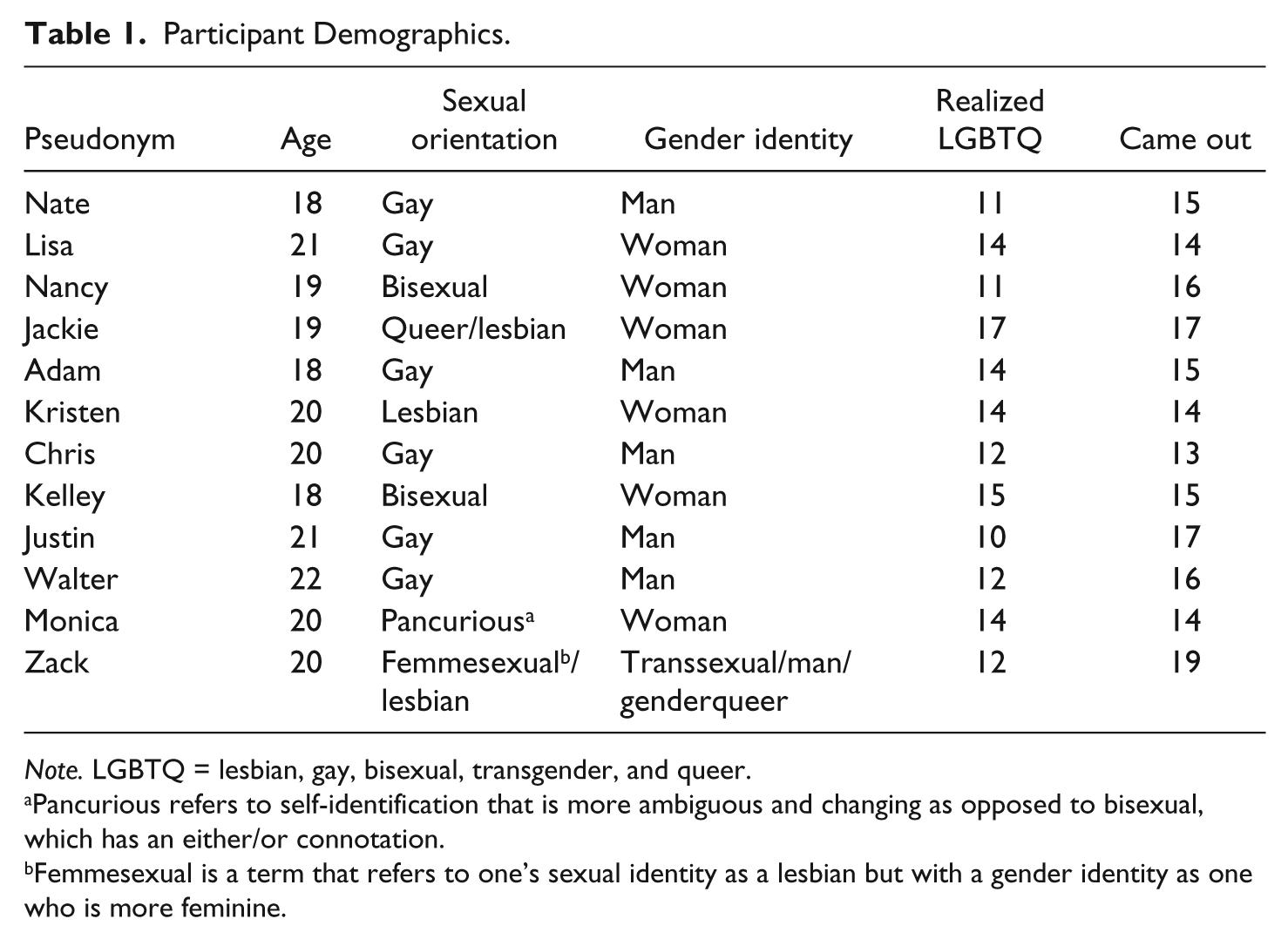
Note. LGBTQ = lesbian, gay, bisexual, transgender, and queer.
Pancurious refers to self-identification that is more ambiguous and changing as opposed to bisexual, which has an either/or connotation.
Femmesexual is a term that refers to one’s sexual identity as a lesbian but with a gender identity as one who is more feminine.
Procedures
Interviews, which took place at the beginning of the spring semester, lasted 14–85 min, depending on the length and depth of participants’ responses. Eleven interviews took place in an empty classroom on campus at the university, and one interview was conducted online via Skype. In each case, the primary researcher and the interviewee were the only people present to ensure confidentiality. The researcher introduced herself to the interviewee, described the purpose of the study, and offered to answer any questions. Each participant signed an informed consent document and gave additional verbal permission for the researcher to record the interview and take notes. At the end of each interview, participants were given the opportunity to ask questions, were debriefed again about the nature of the study, and were told that they would receive the results of the study if interested.
A review of the literature on social coping strategies used by gifted and LGBTQ students guided the development of interview questions. The interview protocol contained 13 baseline questions and 4 potential questions designed to encourage elaboration (see the appendix). For example, participants were asked, “How did you cope with feelings of differentness?” and then were prompted with follow-up questions about previously identified social coping strategies such as talking to friends, teachers, or family; joining a GSA; participating in extracurricular activities; and/or staying in the closet.
Data Analysis Process
The researchers interpreted and analyzed data from transcribed interviews descriptively. Demographic information was reported using descriptive statistics. We used open coding, “the process of breaking down, examining, comparing, conceptualizing, and categorizing data” (Strauss & Corbin, 1990, p. 61), to identify and highlight common themes and unique experiences among participants. After 12 interviews, we concluded that no further themes or patterns would emerge and data saturation had been achieved (Rubin & Rubin, 1995).
We coded the data iteratively to allow themes to emerge naturally (Strauss & Corbin, 1990). Following the procedures outlined by Bogdan and Biklen (2003), we ordered the transcribed interviews chronologically and read them twice in their entirety. In addition, we identified possible coding categories from frequently emerging themes and the social coping strategies previously identified in the literature. These preliminary codes were manually assigned to the data, modified to more comprehensively capture the scope of respondents’ answers, and then reassigned. Overarching codes were assigned to categorize the information into broad themes, including social environment, feelings, coping strategies, gifted and LGBTQ interactions, and suggestions for teachers and schools. Finally, the data were interpreted and recontextualized in light of the unique dual identities (gifted and LGBTQ) of the participants (Creswell, 1994).
Authenticity of the Data
Authenticity is the attempt to synchronize the goals of the researcher with the needs of the people studied (Spradley, 1979). To balance the needs of the participants with the needs of the researchers, openness and honesty are crucial. We informed participants that the main reason for the study was to find out more about their perceptions, attitudes, and coping strategies for dealing with differentness and told them that the information they provided would help improve the educational environment for gifted and LGBTQ students. The participants agreed with our perception of the importance of the study.
Researchers’ perspectives
The major researcher was a gifted and lesbian-identified graduate student who attended the university from which the sample was drawn. As an undergraduate student, she actively participated in the LGBTQ student organization from which she recruited participants. Therefore, the researcher knew and had developed rapport with many, but not all, of the participants outside the research context. Although this position introduced bias into the research, Bogdan and Biklen (2003) noted that neutrality is both impossible and undesirable in qualitative research. Researchers who are similar in age and share some characteristics find it easier to build rapport with students. In this situation, because sexual orientation and gender identity are sensitive subjects, participants may have been more willing to open up to the researcher and to consider her trustworthy and empathetic because of her lesbian identity. Furthermore, her position as a gifted and LGBTQ student meant that she understood and shared her participants’ cultural contexts and definitions (Rubin & Rubin, 1995), which facilitated communication and mutual understanding. The second researcher was a member of the graduate faculty in gifted education and curriculum and instruction at the same university.
Results
Several major themes emerged from the interview data. When participants recalled their middle and high school experiences as gifted and LGBTQ students, they reported that they often felt isolated and stigmatized, just as other LGBTQ students do (GLSEN, 2012b). To deal with these feelings of differentness, their most common coping strategies included finding supportive groups of friends; hiding or downplaying their LGBTQ identity; participating in extracurricular activities; confiding in supportive teachers; developing their writing, musical, and leadership talents to compensate for and express their feelings of difference; and conducting research to understand and develop their identity. Participants reported that their giftedness interacted with their LGBTQ identities because they were motivated and able to seek and create safe spaces to cope. Finally, participants suggested ways for educators to support gifted and LGBTQ students by creating welcoming and inclusive school cultures and policies.
School Environment
Seven of the 12 participants reported negative social interactions in school as a result of their being gifted, LGBTQ, or both. Nationally, school environments are even less welcoming to these minority students, with 84.6% of LGBTQ adolescents reporting verbal harassment due to their sexual orientation (GLSEN, 2012b).
Discrimination and harassment
Many of the negative social interactions that participants experienced were indirect. For example, other students pried into the participants’ private lives and gossiped about them behind their backs. Justin explained that when his peers found out he was gay, “news spread like wildfire.” Like 91.4% of LGBTQ teenagers nationally (GLSEN, 2012b), participants reported noticing and being negatively affected by homophobic comments, even if they were not directed at anyone. When Nate heard comments like “that’s so gay” and homophobic slurs such as “faggot,” he explained, “those things were very disturbing and distressing . . . especially in the moment when you’re pursuing your sexuality or trying to figure out who you are.”
Although it was less common, some participants reported harassment because of their gifted identity instead of or in addition to their LGBTQ identity. For example, students were teased for always being the student who answered the teacher in class. Kristen reported, “I feel like a lot of people didn’t talk to me because we were in the gifted and talented programs.”
Heteronormativity
Several participants described their classes and extracurricular activities as uncomfortably heteronormative because they unconsciously reinforced heterosexuality and erased the existence or mention of other identities (Schilt & Westbrook, 2009). For example, Jackie recalled an experience during a poetry unit in English class where her teacher asked the students to pretend to write love poems—the boys to their girlfriends and the girls to their boyfriends. Other participants noticed heteronormativity in extracurricular activities. Walter felt alienated when his peers in his Boy Scout troop looked at and commented on girls in a magazine, recalling, “They were able to freely . . . be part of the group, but if I had said anything I would have been ostracized.” The privileging of straightness over LGBTQ identities in these situations made these students feel different and isolated from their peers.
Broader social context
Students were also cognizant of homophobia within society at large. Unprompted, participants expressed frequent concerns about the culture of their hometowns, often describing them as conservative and rural pockets where “gay was just a thing that didn’t happen” (Jackie). Participants were upset by the political climate, including anti-gay political candidates and legislation, as well.
Two thirds of participants mentioned religion as a strong force that affected their social acceptance as LGBTQ individuals. Two participants attended Catholic schools, where they felt a particularly strong stigma against homosexuality. Other participants worried about their parents’ or friends’ religious convictions. Most students felt that their religion was at odds with their sexuality.
Finally, three participants mentioned their race or ethnicity as a factor in their social acceptance. Monica, an African American participant, said that there was a strong stigma against homosexuality outside of the GSA at her predominantly Black high school, which increased her feelings of isolation. Two White participants were also aware of the sometimes negative interaction between different cultural groups and acceptance of their LGBTQ identities.
Emotional effects
When participants were asked whether they felt different from their peers, Nancy replied, “I knew I was sort of different [for being bisexual], but I also felt different from a lot of people because of being smart.” This was a common sentiment. Ten participants reported feeling different for being LGBTQ, and nine reported feeling different for being gifted. These feelings of difference started as early as elementary school for some participants. The participants felt “alone all the time” (Nate), like they were “one person against everyone else” (Jackie).
Fear
Half of the participants expressed feeling scared or anxious about the social repercussions of their LGBTQ identities. For instance, when Justin, who heard the word “faggot” used frequently and even used it himself, realized “that the word could be used or inflicted upon me, [it] was just really scary in a lot of ways.” Participants were worried about how classmates, parents, and friends would react to their coming out; were scared to stick up for themselves in heteronormative spaces; and were afraid to seek out safe spaces such as GSAs because others might then discover their identity. Aware of negative media representations of LGBTQ individuals, the participants were “worried that the worst might happen” (Walter).
Depression
Two participants reported experiencing clinical depression during high school, and others expressed feelings of extreme unhappiness because of their social situations. Justin recalled, “I kept getting really sad or angry or having this range of emotions that were always at extremes.” The students felt that their social differentness was unfair, and they “didn’t understand why people didn’t like her for being smart” (Jackie) or for being LGBTQ.
Anger
Other participants were angry about their situation. Their anger was sparked by their unfriendly social environment but compounded by their perceived isolation. For example, when Jackie heard homophobic comments, she explained, “I just wanted to always speak up, but I fell silent because I knew that I was maybe the only out person.” Zack, the only transsexual participant, expressed that “feeling wrong [in his body] translated into hating myself a lot.” Adam, who was teased for not being masculine enough as early as middle school, “didn’t really know how to deal with teasing” at such a young age and reacted with anger as well.
Boredom
Several participants expressed negative feelings about school because it was not challenging enough for them. Lisa never paid attention in class because “because it was so boring,” whereas Chris began to sleep during classes because he realized that he could pass them without trying.
Coping Strategies
Students used a variety of strategies to cope with their feelings of isolation and social rejection. Some students coped by coming out, denying, or hiding their identities, just as Cross (1997) found that gifted students tried to maximize or minimize their visible differences from their peers. Some students found social strength from supportive school groups, teachers, family, friends, or online social networks. Finally, students used their giftedness to cope by expressing themselves through areas of talent or focusing on academics.
Continuum of visibility
At one end of Cross’s (1997) continuum of visibility for stigmatizing social situations, gifted students are visible and open about their giftedness. For LGBTQ students, this is analogous to telling the truth about their identities and coming out of the closet. The other end of the continuum is denying or hiding one’s giftedness to blend in. Similarly, some LGBTQ students choose to deny their identity to themselves or to keep it hidden from others.
Coming out
Being able to speak openly about and be accepted for their identities was very important to most participants. All but one participant was out to some extent in high school, and three participants regretted not coming out sooner. Justin, who did not come out until his senior year of high school, reflected,
Happiness was the best part about coming out . . . Even if I got picked on in middle school, even if I got slammed into the lockers and sh– like that, at least part of the time I would have been happy.
Chris “was just tired of hiding and lying and having friends who I knew weren’t really friends.”
Choosing to come out was a conscious and strategic decision for the participants in this study. Some participants chose to come out first to friends who were almost certainly “home runs” (Justin) or who were LGBTQ themselves because these individuals “wouldn’t judge” (Zack). Several students waited to get to know a peer before coming out “so there was no reason they couldn’t be friends with me” (Chris). Others used the Internet as a testing ground to come out to people without the risk of losing “real” friendships.
There were downsides to coming out, such as garnering “negative attention” from peers (Chris) and having doubts about how friends and family would react (Kelley). Nate, who only came out to a few peers, decided that he’d “rather not be judged and looked down upon than be out and proud.” However, he noted, “I don’t think that it’s a good thing . . . [that] it was more important to me to have the social tools than my own medium of expression.” Jackie, however, downplayed the importance of peer acceptance of her identity as a lesbian, primarily because she had already been rejected by peers for her giftedness. “People didn’t like me already,” she recalled. “What harm could it do” to be extremely opinionated and outspoken about her LGBTQ identity?
Denial of gifted and LGBTQ identities
Many students faced an internal struggle about their LGBTQ identity. Students who were particularly young when they realized their LGBTQ identities were more likely to deny their feelings for a time. Nancy explained, “I fought it for a really long time, especially in seventh grade, trying to push back those feelings.” Justin named his ongoing struggle to deny these emotions and thoughts “being on ‘gaywatch’”—whenever he had a thought or feeling about being gay, he tried to suppress it. He recalled forcefully denying his thoughts:
When I started to realize that I was gay, I just went into a tailspin . . . I sure as hell wasn’t going to be thinking about guys, so I just told everyone I was going to become a priest.
Walter simply thought that “if I waited long enough it would go away” and, to facilitate the erasure of his same-sex attraction, he tried to date girls. Zack took a pragmatic approach: “I feel like being repressed, in general, is a bad thing . . . but I’m so glad I’m dealing with this [transsexual identity] now, my sophomore year in college, rather than in high school.”
However, participants generally viewed the strategy of denying their identity as negative. Kristen felt she had to be true to her experiences. Chris agreed, explaining,
I knew I could not live any way that wasn’t the way I am . . . It was worth it to me to put up with all that bull—t than it was for me to never have been romantically involved or never figure out things about my identity, or been in a relationship with a girl and just have a miserable life.
Hiding gifted and LGBTQ identities
Although participants were largely out of the closet and most refused to deny their identities to themselves, many participants nonetheless tried to hide or minimize their gifted and LGBTQ identities to some extent. Strategies ranged from minor, like “focusing on superficial [conversations] with friends to be accepted” (Nate) to extreme, such as trying drugs to fit in with nongifted peers (Kristen).
Several participants also tried to minimize gender nonnormative behaviors. Justin consciously chose to hide his more feminine “mannerisms, and the thoughts that I had, and the music that I was interested in, and the shows that I wanted to watch.” Before he was out as transsexual, Zack was particularly girly, “partly because I do like feminine things,” but partly as a means of “overcompensating . . . I wanted to fill that role . . . I wanted to perform my gender correctly and be attractive.”
The extent to which each participant hid his or her sexual orientation and gender identity was a conscious choice. Students intellectualized the problem and used data to decide when and how to be open. Nate explained, “I had to understand how to interpret [my sexuality] and how it would be viewed in the setting of my high school.” Chris was very open about his sexual orientation at first, but as he began to notice “a direct correlation between me visibly dating someone at school and people calling me names and making fun of me or saying hateful things,” he stopped drawing attention to his LGBTQ identity. Justin chose to completely hide his sexual orientation because “keeping this secret solely to myself meant that I had control over it and meant that no one else could control it and manipulate it.” Adam, aware of how others perceived him, noted that “there was some interaction between how I acted and stereotypes,” which aligns with previous findings (Peterson & Rischar, 2000).
The extent to which participants hid their LGBTQ identity also varied by gender. Men were more likely to take extreme measures, but women were far more open. Lisa “told anyone who asked” about her sexual orientation, whereas Jackie and Kelley did not advertise their sexual orientations but also “didn’t hide.” Nancy and Jackie both noticed that sexual orientation was more easily noticed for boys than girls, and the social repercussions for boys who were perceived as gay were far greater. In addition, three of the six women in this study were bisexual or pansexual and, at times, had boyfriends. Pansexuality is considered a more loosely defined term than bisexuality and allows for more ambiguity and questioning with respect to sexual identity (Rust, 2001). This unintentionally served to “hide” their sexual orientations, making more conscious social coping mechanisms unnecessary.
Social interaction and support
All participants discussed ways that they found and built social support systems to cope as gifted and LGBTQ adolescents. Some students participated in extracurricular activities, including GSAs. They also found support in teachers, family members, and friends. Finally, they turned to the Internet to build affirming social networks when their existing support systems were unwelcoming.
GSAs and extracurricular activities
Swiatek and Dorr (1998) found that extracurricular activities allowed gifted students to cope with their differences by providing opportunities for social interaction. Helping behaviors, such as assisting others with homework, also allowed gifted students to channel their social difference into a positive force. In this study, GSAs emerged as a coping strategy particular to gifted and LGBTQ students. These clubs are extracurricular activities that provide social support for LGBTQ youth while also allowing gifted youth to help others by becoming activists for the LGBTQ community. Monica described feeling an impetus to “support the cause, to teach people that, hey, we’re just like you.” However, although most participants expressed a desire to participate in such a club, only four participants actually had GSAs at their high schools.
All but one participant engaged in extracurricular activities in their high schools. Many students were involved in sports, which “were always fun and a good way of just destressing in general” (Nancy). Several also participated in drama, a traditionally LGBTQ-friendly space. Chris and Zack agreed that drama “just attracts queer people . . . that’s why I was so involved with it, because it was just a place where I could be myself” (Chris).
Some participants chose extracurricular activities that allowed them to express their gifted identity, such as chess club and anime club. Many also used extracurricular activities to develop and express their talents, such as playing musical instruments in band, or their leadership capacities, such as through participation in a teen advisory board. Kristen, who was president of her high school sorority for 2 years, felt that membership in the organization gave her social credibility. However, some extracurricular activities were instead socially harmful for participants. Organizations that emphasized and reified gender roles, such as Boy Scouts and an all-male sailing team, were negative experiences for participants.
Teachers
Two thirds of the participants in this study formed close academic and personal relationships with certain teachers, which is also a coping strategy gifted students use (Rimm, 2002). “I felt like I held my own talking to adults, a lot better than I did with students,” Chris declared. Often, teachers served as participants’ mentors and coaches, guiding them in their talent development. For example, one teacher encouraged Nate to express himself through art, and another wrote poetry collaboratively with Kristen. Teachers helped to guide their gifted and LGBTQ students socially and emotionally as well.
Teachers acted as support systems and havens for students who were sometimes harassed for being LGBTQ. Adam remarked of a Latin teacher, “He’s kind of a mentor, just because he is just such a friendly person. It was always comfortable and fun going to his class and . . . knowing I won’t get teased here.” Justin’s Spanish teacher supported him during class and extended her support outside class as well, giving him a safe space to escape bullying and even encouraging him with a gift about homosexual history. Walter had a teacher at his Catholic school who was so compassionate that he felt safe talking to her about his sexual orientation even though he knew her religious views were against it. Some students came out to their teachers to hear “a different perspective” from someone who “isn’t going to judge you” (Nancy). Teachers helped students cope with their social differences by encouraging them to see their own potential and look beyond the confines of high school to the broader world.
Family and friends
The participants in this study were fortunate to have largely accepting family and friends. All but one participant reported having at least one close friend or friend group who accepted them for being LGBTQ. However, they were cautious and anxious about their peers, choosing friends carefully and only coming out to people they could trust.
Many participants had a whole group of supportive friends, often in their gifted classes. Several students expressed that they made most of their friends in their advanced-level classes “so [they] didn’t feel different from them” (Nancy). Kelley expressed that she “connected with those people better than I probably would have [with] people who weren’t as motivated,” and Walter simply stated that he “liked people in gifted [classes] better.” When Lisa realized she was gay, “I didn’t feel any different than I already was, because all my friends were the outcasts . . . the gay kids, the drug kids, and the hippies. It was a good mix.”
Not all participants readily found positive social connections, however. Justin found that several groups of friends, particularly his church friends and sailing teammates, were not supportive of his gay identity. As a result, he stopped associating with them when possible and developed closer relationships with his more supportive female friends. Because of his dual differences, Nate was also unable to find a peer group where he felt that he belonged. He explained that his peers in his IB classes were too heteronormative, but he did not share similar interests with the group of LGBTQ students he found. Because he was doubly different from his classmates, he reported spending most of his free time outside of school with family instead of friends.
Nine participants felt fully supported by their families. This high rate of familial acceptance is most likely an artifact of the unrepresentative sample studied. Many LGBTQ students, homeless at disproportionally high rates because of familial conflict (Ray, 2006), do not have the resources to attend universities or to participate in studies such as this one.
Social media and the Internet
Studies (e.g., GLSEN, 2012b) report that more than half of LGBTQ adolescents have experienced some form of cyberbullying online. However, little research has investigated LGBTQ students’ positive use of the Internet to cope with their feelings of difference. Ten of the twelve participants in this study reported using the Internet to form social connections to LGBTQ communities. Through forums, blogs, and chat rooms, participants saw other people experiencing the same problems, expressed feelings they were previously unable to verbalize, and met significant others. Social media sites served as test sites where participants were able to try on new identities and practice coming out to friends. Participants also used media “to see that it’s possible to have a community” (Justin), which helped them feel less isolated. They immersed themselves in popular LGBTQ movies, books, and shows to feel connected to the larger LGBTQ community despite being physically isolated from others.
In a manifestation of their giftedness, nine participants also reported using the Internet to research terms, identities, same-sex relationships, and the history of the LGBTQ community because of their self-described “insatiable hunger to know stuff about everything” (Adam). Participants wanted to “be well informed” and be able to “talk about [sexuality and gender] intelligently” (Jackie). The Internet served as a place for their gifted and LGBTQ identities to interact.
Gifts and talents as coping mechanisms
More than half of the participants reported some area of talent that helped them cope with their dual differences. Four participants used writing to express their feelings. Nate, who wrote a novel about coming to terms with himself, recalled, “I found a lot of safety in my writing.” Several other participants found comfort in music. Adam explained, “If I’m stressed out or freaking out about something, I’ll go play piano and I’ll calm down and I can go back and do whatever it was I was doing before.”
Four participants developed their talents as leaders in student and community organizations. For example, Adam participated as a youth leader with the GLSEN to facilitate the development of GSAs beyond his own school. Working to make school environments safer for LGBTQ students helped him cope. Justin, who was president and founder of a food bank club, also used leadership to cope with his feelings of difference. He recalled, “I just liked to be out front, like leading something made me feel good about myself . . . it gives you that satisfaction that you can move on and do better things; it really helps your confidence.”
Participants who faced the most difficult social environments as gifted and LGBTQ individuals also placed the strongest emphasis on academics. In the absence of social interactions, Nate focused on academics and his love of learning. Kristen appreciated her good grades, despite their negative social repercussions, because they “kind of kept me level sometimes” when her efforts were acknowledged by her school and her mother. Chris, too, treated school as a ticket to better things: “I really focused on my studies . . . it was like my studies were the only way out of that hellhole, so that’s what I did.” These participants relied on their giftedness to help them cope with being LGBTQ.
Gifted and LGBTQ Interactions
Students who are different from their peers in more than one way often face compounded feelings of difference (Blackburn & McCready, 2009). When discussing her choice to be out at school, Jackie recalled, “I didn’t want teachers and other students to react badly toward me, because I was already sort of disliked at my school because I was the smart kid.” Even more negatively, Walter attributed his extreme isolation and unhappiness to his dual identities: “The gifted identity started the severe self-hate and issues that I had with myself, and the gay identity just added on to it.”
Despite such negative feelings, most participants felt that their dual identities interacted positively. Previous research on the resiliency of gifted students may support this finding (Reis, Colbert, & Hébert, 2004). Participants felt more accepted for their sexual orientations and gender identities in their advanced classes than in their general education classes, because “smarter spaces tend for me to be more welcoming spaces” (Chris). Kristen reflected, “In IB classes, we all looked at each other as equals. My sexuality wasn’t even a factor . . . Everyone had an open mind and no one really judged anyone. Outside of the class, it was just different.”
Participants also attributed their motivation, inquisitiveness, and opportunities to their giftedness. Kelley expressed that her giftedness was “probably one of the reasons why I’m motivated to learn more about myself, so that may have helped me to come to terms with [my bisexual identity].” Similarly, Kristen felt that “the gifted part of me caused me to be inquisitive and ask questions, and helped me define who I was, and then it helped me decide whether I wanted a label or not.” Chris connected his experiences in gifted programming at a summer talent development program with his awareness of the “bigger, more interesting, accepting world out there that [he] just needed to find,” which encouraged him to persevere through the teasing and harassment during school. Finally, Zack believed that his giftedness gave him
a privilege that has helped me cope with being queer, because I’m here in college and I feel like I know I’m going to make a meaningful contribution to the world, and I’m smart and I’ve been praised for that my whole life . . . I’ve already been promised that I’m worth something . . . I feel like with being gifted, I have the tools to make my life what I want it to be.
Recommendations for Educators
Teachers
State and local legislation pertaining to LGBTQ students can vary widely (Friedrichs, 2014). Some regulations protect LGBTQ students and the educators that support them, but others condemn even the mention of LGBTQ identities in schools. Educators may hesitate to openly support their gifted and LGBTQ students because they fear personal and professional repercussions. However, according to the students in this study, educators can best support gifted and LGBTQ students by simply listening to students and recognizing their identities. Participants appreciated being able to go to teachers for comfort and support, but they were most moved by teachers who came to them. Small gestures, such as giving a student a book about gay people or recognizing and positively acknowledging LGBTQ themes in homework assignments, made a huge difference to these students.
Teachers can also make their classrooms and schools more welcoming to all by assuming that they have LGBTQ students in every class, even if students have not come out to them (NAGC, n.d.). Educators who are able should be visible about supporting LGBTQ students, who need signals (e.g., “safe space” stickers, open invitations) to make informed judgments about which teachers are safe and welcoming. They should make it clear to all students that homophobic and transphobic comments are unacceptable, both in and out of class. For some participants, certain teachers’ classroom became the only space in which they could feel safe from teasing. Finally, teachers should educate themselves about LGBTQ identities so that they are able to support students appropriately. GLSEN (2012a) has provided professional development resources, curriculum materials, and a professional network at http://glsen.org/educate/resources.
Schools and Policies
Schools can also support these students through inclusive curricula, policies, and resources. LGBTQ students want curricula that reflect their lives. LGBTQ individuals should be included in developmentally appropriate ways in all subject areas, including history, sex education, and even English, just as other multicultural groups have been integrated into the curriculum (Talburt, 2004). School policies must affirm LGBTQ students’ rights. Students should be able to act out their gender expressions without fear of dress code repercussions. For example, one participant appreciated being able to attend his senior prom while wearing a dress. Policies should also allow students to take same-sex dates to school dances. Schools should permit and encourage the formation of GSAs, and they should not permit homophobic speech or bullying. The Human Rights Campaign Foundation’s (2012) Welcoming Schools Project (see http://www.welcomingschools.org) provides a “Welcoming Schools Starter Kit,” which is a helpful resource for schools that are striving to become more inclusive to LGBTQ students.
Implications for Gifted Education
The results of this study have implications for both researchers and practitioners in the field of gifted education. This study contributes to the existing body of literature in gifted education in the areas of dual exceptionality and social coping. A focus on dual exceptionality has been a recent trend in gifted education. Twice-exceptional students are those who are gifted and who also have some form of disability (Baum & Owen, 2004). Research on the social aspects of dual exceptionality has focused on the ways that these students do not fit entirely in either group because they are different from their peers with gifts and their peers with disabilities. Although being LGBTQ is not a disability, it is another type of difference that can affect students similarly. Therefore, this study adds a new perspective to the literature on dual exceptionality.
Existing research on social coping is international in scope, but it is limited in that it almost exclusively explores the coping strategies of gifted students who attend prestigious extracurricular programs or academies for the gifted. Most students in this study attended public middle and high schools, and none attended schools specifically designed for the gifted, which more accurately represents the realities of most gifted students.
Furthermore, most literature on social coping assumes that all gifted students experience their giftedness in similar ways. Some research (e.g., Foust, Rudasill, & Callahan, 2006) explores differences in social coping strategies by age and gender, but largely, research and practices in gifted education emphasize the similarities among gifted students over their intragroup differences. This study acknowledges the different experiences and multifaceted identities of gifted students who belong to more than one minority group. By exploring the social coping of adolescents who are both gifted and LGBTQ, this study adds a new perspective to the existing literature on social coping.
The results of this study can help practitioners in gifted education by giving them insight into the lives of their gifted and LGBTQ students. Although students who are both gifted and LGBTQ are a small minority, teachers, administrators, gifted coordinators, and counselors have a responsibility to support diversity and to attend to the social and emotional needs of all of their students (NAGC, 2010). Because of their dual differences, gifted students who are also LGBTQ are at risk for social alienation and isolation. The firsthand accounts presented in this research can help educators better understand and empathize with the experiences and feelings of gifted and LGBTQ students.
Furthermore, because gifted students are often more androgynous and less gender normative than their average-ability peers (Kerr & Cohn, 2001; Tolan, 1997), they may face some of the same issues as gifted and LGBTQ students even if they are heterosexual. Therefore, it is even more important for teachers of the gifted to create safe and welcoming learning environments for their students.
The participants’ suggestions for the improvement of teachers and schools are practical and implementable. This research impels educators to create safer school climates by establishing policies and classroom cultures that promote compassion and respect for all. As McCready (2004) asserted, if doubly different LGBTQ youth “are willing to risk harassment and abuse by openly identifying as gay, lesbian, bisexual, or transgender,” then educators must “be willing to risk stepping out of our comfort zones to unravel the complexities of their lives” (p. 142).
The group of successful college students interviewed in this study used largely positive, goal-oriented strategies such as focusing on academics and extracurricular activities. These strategies support gifted students’ talent development and help adolescents reach their potential. Other social coping strategies, including hiding or denying aspects of their identities, are emotionally stressful and painful for students. Educators and counselors need to be aware of both positive and negative strategies so that they can be proactive about guiding students toward positive coping mechanisms. Future research should endeavor to determine specific strategies that educators can use to inform and guide students in their identity development. Teachers must also resist ascribing to destructive stereotypes about LGBTQ students, and further research should determine the most effective pedagogies to reduce stereotypes and prejudice. Only then will all gifted and LGBTQ students reach their potential as happy, productive, and well-educated members of society.
Footnotes
Appendix
Declaration of Conflicting Interests
The authors declared no potential conflicts of interest with respect to the research, authorship, and/or publication of this article.
Funding
The authors received no financial support for the research, authorship, and/or publication of this article.