







Abstract
This study investigated the educational provision for mathematically gifted students offered in primary (elementary) schools in England (United Kingdom) just before the abandonment of the government’s Gifted and Talented (G&T) program. Through a questionnaire within five Educational Authorities and four in-depth case studies in different primary schools that were implementing provision for their most able mathematicians, the study, despite some positive results, found a number of problems relating to the effectiveness and defensibility of the offered provision. This article presents those problems and the identified links between them, the lack of support from gifted theory and research, the lack of support from specialists, and the abandonment of the G&T initiative and makes recommendations that could have sustained and increased the effectiveness of both the schools’ provision and the government’s initiative.
Today, the need for taking educational measures for gifted students is recognized worldwide (Eurydice, 2006; Freeman, Raffan, & Warwick, 2010; Plucker, 2015; Steenbergen-Hu & Moon, 2011). Therefore, providing gifted programs in schools is critical, as it responds in pragmatic terms to a recognized need to offer enhanced education for gifted students. But problems appear when gifted education practices are not informed by theory and empirical evidence. Research consistently highlights the gap between the practice in schools and the developments in gifted theory and research (Boyes, 2004; Cox, Daniel, & Boston, 1985; Freeman et al., 2010; Westberg, Archambault, Dobyns, & Salvin, 1993; Westberg & Daoust, 2004). Overcoming this gap is critical for the effectiveness, defensibility, and sustainability of any program that aims to meet the needs of gifted students in everyday classroom practice. Gifted literature (e.g., Freeman et al., 2010; Gagné, 2011; Hertberg-Davis & Callahan, 2013; Renzulli, 2012) suggests that without support from theory and research, a program for the gifted cannot achieve internal consistency, from goal setting to services to evaluation. It cannot provide proper evaluation, as it lacks a sound scientific base and reliable criteria; it cannot be transferable as a good practice example; and it cannot be defensible against common criticism, which often links gifted programs with “inequality” and “elitism.” Moreover, when there are no clear examples of success, then the sustainability of the program is at risk.
This article, which focuses on mathematically gifted children, discusses these problems by drawing upon empirical evidence derived from classroom practice in primary (elementary) schools in England (United Kingdom).
Issues of Effectiveness, Defensibility, Sustainability, and the Gifted and Talented Initiative in England
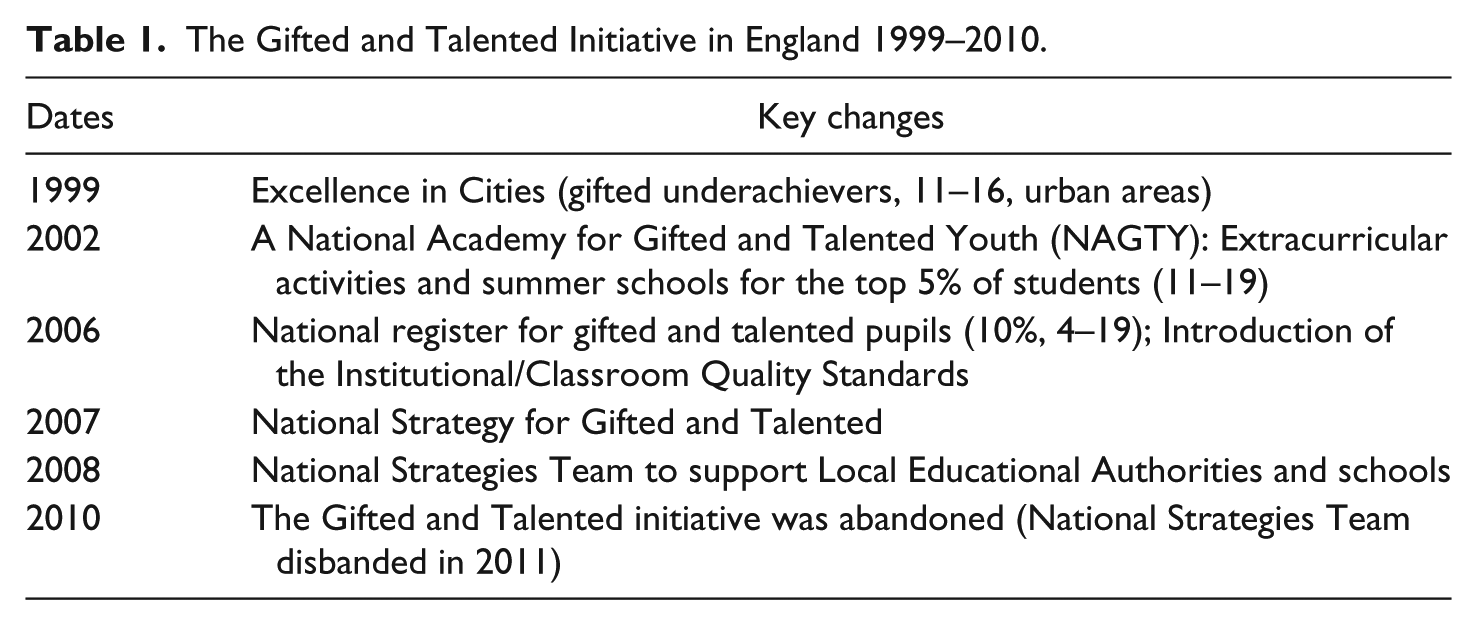
Table 1 presents a glimpse of the recent history of gifted education in England. The period between 1999 and 2010 was the only period in which terms and ideas around giftedness and talent were used officially and the issue of gifted education was a priority. The initiative to create a national gifted program began in 1999 with the launch of Excellence in Cities (Department for Education and Employment [DfEE], 1999), a local initiative for a limited age range and with a focus on gifted underachievers within inner-city, deprived areas that expanded afterwards to a national level. The most significant changes that affected schooling education happened after 2006, when specific standards for classroom practice were introduced, and in the following years, when a Gifted and Talented (G&T) National Strategy and a designated team were formed to provide exemplary materials and training for the practicing teachers. The training mainly involved short insets delivered by the Local Educational Authorities (LEAs). The initiative was abandoned at the end of 2010, and the National Strategies Team disbanded 1 year later; along with these efforts, terms linked with the words gifted and talent were also abandoned. Now schools are still required to provide for their “most” or “highly” able students, but they are on their own.
The Gifted and Talented Initiative in England 1999–2010.
It is interesting to see the words of criticism that were heard in a government select committee that reviewed the G&T initiative before its abandonment in February 2010 (House of Commons, 2010). The initiative was described as “elitist,” “inconsistent and incoherent,” and “patchy” in relation to classroom provision, and as a very weak program that lacked a proper evaluation and plan: “It is a worry that it all looks a bit wishy-washy. You do not know what has worked in the past, and you are not sure how you will measure it in the future” (Chairman of the Government Select Committee 2010, in House of Commons, 2010, p. 26). It is clear that there is a correlation between the problems of effectiveness, the lack of defensibility, and the abandonment of the G&T initiative. The study presented in this article took place in England just before the abandonment of the G&T initiative. It found interesting evidence that linked the aforementioned problems with the lack of support from theory and research, and of specialists in the field (people with expertise in both subject and gifted education). These findings are presented in this article.
Theoretical Basis of the Study
Who Are Mathematically Gifted Students?
Krutetskii (1976) defined mathematical giftedness as a unique ability, a “mathematical cast of mind,” that renders the phenomena of the environment mathematical. Children who have this ability are able to utilize mathematical facts and complete mathematical tasks effectively in school and beyond. They have a tendency to discover number bonds and mathematical relationships everywhere, to follow their own personal pathways to find a solution, and to produce novel ideas of some value. Krutetskii called the latter “creative” mathematical ability to distinguish it from “school” mathematical ability, which is the ability to effectively complete mathematical tests or problems in school. A similar distinction has been suggested by Renzulli’s (1999) Three Ring Conception of Giftedness, in which giftedness in different domains (such as mathematics) is viewed as schoolhouse giftedness or creative productive giftedness. Krutetskii’s idea of the existence of a unique and special mathematical mind can be linked with Gardner’s studies on brain functioning and human behavior and his theory of multiple intelligences (MI; Gardner, 1999). According to the MI theory, mathematical giftedness is associated with a particular type of intelligence that is called logical-mathematical intelligence. This is a bio-psychological (associated with both brain and mind) potential to process information to solve problems or create things in the area of mathematics and science that have some value in a culture or community. It is one of the eight intelligences (linguistic, logical-mathematical, spatial, bodily-kinesthetic, musical, interpersonal, intrapersonal, and naturalist) identified as having a distinctive basis within the human brain and nervous system. Each one can be dissociated from the others or work in concert within a domain (e.g., logical-mathematical and linguistic intelligences can work together to solve a complex word problem). The latter (working in concert), along with other aspects, such as the potential to solve and create unique mathematical problems, makes the identification and assessment of mathematical giftedness a very complicated issue. Others (e.g., Gagné, 2008; Sheffield, 1999; Tannenbaum, 1983) have added to this complexity another aspect, which is the role of affect and motivation. In mathematics, for instance, Sheffield (1999), the chairperson of the U.S. Task Force on Mathematically Promising Students, defined mathematical giftedness as a function of ability, motivation, belief, and experience or opportunity and recommended the term mathematical promise to describe this function better. The Study of Mathematically Precocious Youth (SMPY), an ongoing longitudinal study commenced since 1971, highlights the continuum of ability in mathematics and science (e.g., from being able to being exceptionally able). It recommends the use of psychological knowledge of individual differences, to recognize able individuals of different characteristics and levels of ability, and the use of “above-level assessments” for the identification of “extraordinary human potential” (Lubinski & Benbow, 2006, p. 338). Gardner (1992) has also suggested a combination of sources and methods, including the use of neuropsychological data, for the identification of specific types of intelligence, including the one that is related to mathematical giftedness.
It is widely recognized now that an accurate identification and assessment of mathematical giftedness in early years and within primary schools is needed and that this should include a range of methods and sources, including tests (e.g., IQ, cognitive, achievement, nonverbal) and other forms of assessment, such as on-task observations and student portfolios (Gardner, 1999, 2006; Karolyi, Ramos-Ford, & Gardner, 2003; Renzulli, 1999; Sternberg, 2003; VanTassel-Baska, Feng, & Evans, 2007). Assessment through observation can be very effective in primary classrooms when it is reliable and valid. However, accurate assessment is not easy, as it requires well-trained teachers who know what they are seeking and where to find it (Eyre, 2001; Sheffield, 1999), and standardization. A way to help teachers standardize their observations can be the use of rating scales for the identification of gifted students (e.g., Pfeiffer & Jarosewich, 2007; Renzulli et al., 2010; Ryser & McConnell, 2004) or the use of specific characteristics lists of mathematically gifted students (e.g., Krutetskii, 1976; Sheffield, 2003). This study used the latter to analyze the performance and behavior of the case-study students.
The Development of Mathematical Giftedness in Schools
Krutetskii (1976), upon concluding his 12-year systematic studies on young gifted mathematicians, contended that mathematical ability develops through experiences, instruction, training, and continuous challenge. Similar views have been suggested over the last four decades by contributors to modern theories of giftedness (e.g., Gagné, 1985, 2008, 2011; Gardner, 1983, 1999; Renzulli, 1978, 1999, 2012; Sternberg, 1985, 2003; Tannenbaum, 1983, 2003), who also highlight the role of environment and motivation and consequently the roles of education and teachers. These conceptions of giftedness, drawing upon the continuous advancements in brain functioning, cognitive psychology, and educational psychology, have provided useful insights into understanding the multifaceted nature of giftedness, including mathematical giftedness, and have contributed to the development of programming educational models for the whole school to apply across domains (e.g., Gagné, 2008; Gardner, 2006; Renzulli & Reis, 1985; Sternberg, 2010; Sternberg, Ferrari, Clinkenbeard, & Grigorenko, 1996), or influenced the development of other programming models (e.g., Gentry & Owen, 1999; Treffinger, 1998), curriculum differentiation models (e.g., Tomlinson et al., 2009; VanTassel-Baska & Wood, 2010), service delivery options (e.g., pull-out programs, acceleration, cluster grouping, mentoring, special clubs, enrichment projects, resource rooms), or subject-specific models/frameworks, such as those developed for teaching mathematically promising students (e.g., R. Casey, 1999; Koshy, 2001; Sheffield, 1999). Subject-specific models or frameworks are a response to the need for having a “content-specific” (VanTassel-Baska, 1992) provision for the gifted in schools and require well-trained teachers to be successful and effective. They mainly emphasize teaching mathematics in depth, challenges for all children, and the role of the teacher in recognizing mathematical promise and changing the pace according to the needs of the most promising students. These elements were found to be crucial for the development of mathematical talent by the 10- and 20-year follow-ups of the Study of Mathematically Precocious Youth. The findings showed that individuals identified as exceptionally able required different opportunities to reach their fullest potential than those identified as able (Lubinski, Webb, Morelock, & Benbow, 2001; Muratori et al., 2006), and that the former needed a more abstract, deeper, and accelerated curriculum to avoid boredom (Lubinski & Benbow, 2006).
Method
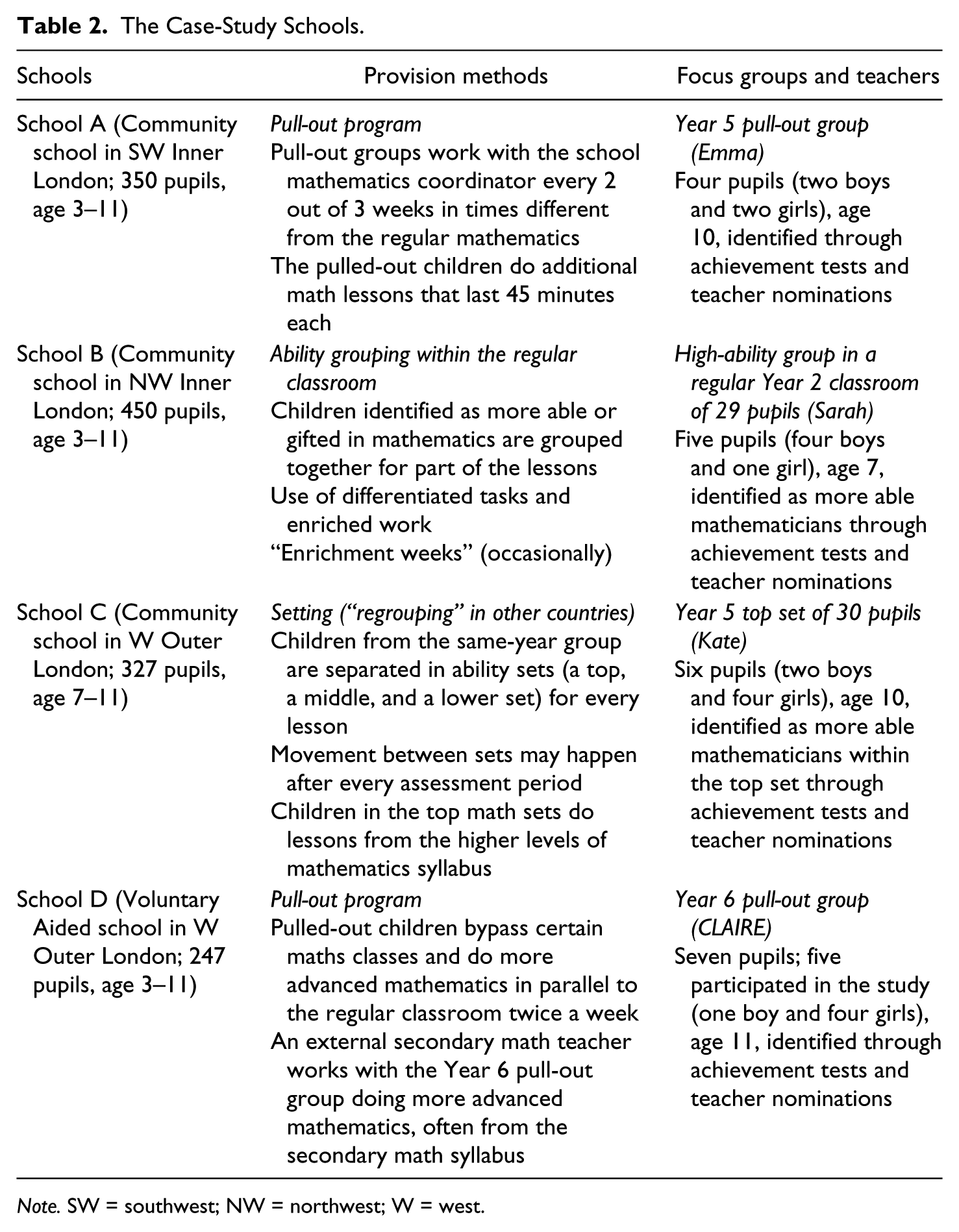
This small-case research study was conducted within five LEAs in Greater London and investigated the provision for gifted students in mathematics in primary schools. The study was conducted in two phases. The first was the preliminary study and involved a questionnaire. Two hundred and twenty-four questionnaires were distributed (one questionnaire for each school) with a request to be completed by a person involved in making provision for and/or teaching mathematically gifted children, or by the school mathematics coordinator. The five LEAs, two from inner and three from outer London, although representative of the diverse areas in Greater London, did not constitute a probability sampling to represent education in England but rather a convenient sampling to serve the purpose of the preliminary phase of a research that was mainly qualitative in nature. The questionnaire, as part of this phase, did not aim to determine incidence or causes, but rather to gain a first picture about how schools were responding to the government’s G&T initiative in general and mathematics in particular, and find the participants and schools for the second phase, the main study. The main study involved four in-depth case studies. Each case study was conducted in a different school in areas with a different socioeconomic background within both inner and outer London (see Table 2). All schools were mixed in gender and ethnicity. Two of the schools (School A and School C) had a wider range of ethnicity, including White (British and European), Black, and Arab, and one (School C) also had a large number of bilingual students. Each school was implementing a different method of provision. Table 2 presents the methods and the case-study classes. The data within the case studies were collected through interviews with the selected teachers and their identified gifted pupils, observations of their lessons, and documentary evidence (e.g., school policy, teachers’ planning and assessment records, and students’ written work). The collected data, mainly qualitative in nature, were thematically analyzed using Creswell’s (2009) guidelines for analyzing qualitative data and Bassey’s (1999) checklist for trustworthiness of qualitative research.
The Case-Study Schools.
Note. SW = southwest; NW = northwest; W = west.
Findings and Discussion
Issues That Have Arisen From the Preliminary Study
Forty-four schools responded to the questionnaire (response rate 20%). Although that is a low response rate, the questionnaire does serve the purpose of the preliminary phase. It sets the ground for the main study (the in-depth case studies) and illuminated interesting findings regarding the way the participating schools were responding to the government’s G&T initiative. The findings presented below show a pragmatic response with elements of randomness, uncertainty and insecurity, and a lack of specialized knowledge.
A pragmatic response to a government’s requirement
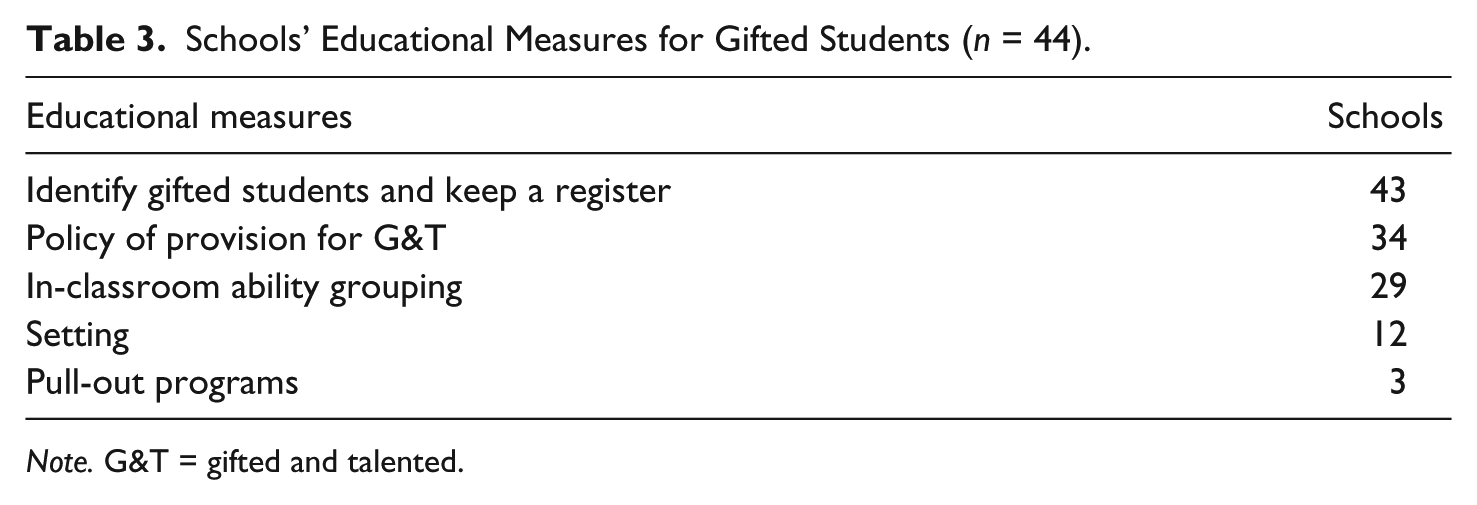
The preliminary study showed that all 44 schools that responded to the questionnaire were taking some measures for their gifted students. These measures were mainly a response, in pragmatic terms, to the government’s requirement for identifying a percentage of pupils as gifted (43), keeping a register for the identified gifted students (43), and assigning them to ability groupings (44, mostly within the regular classroom; see Table 3). Another study (Koshy, Pinheiro-Torres, & Portman-Smith, 2012) that involved a questionnaire and took place around the same time confirmed that primary schools in England were taking measures in pragmatic terms to respond to the G&T initiative. These measures showed an active involvement of practicing teachers in organizing some kind of provision for gifted students. This involvement although it could not itself ensure success of the offered provision, it could maintain a positive climate and attitude toward the education of the gifted, as previous research found (Brighton, Hertberg, Moon, Tomlinson, & Callahan, 2005; Reis & Renzulli, 1982; Renzulli & Reis, 1994).
Schools’ Educational Measures for Gifted Students (n = 44).
Note. G&T = gifted and talented.
Randomness, uncertainty, insecurity, and a need for specialized knowledge
Schools did respond to the government’s requirement, but not all teachers were convinced that they were doing the right thing and that the students on their G&T register were truly gifted, as the following sample shows: “The LEA has asked us to have a specific quota for G&T pupils. I worry this is artificial and would doubt that all those on the register are truly gifted” (Mathematics Coordinator, School 42).
These words indicate the randomness of G&T quotas and a lack of knowledge on the part of teachers. Teachers were doing something because they were required to do it, but they did not know why and how to do it properly. When we do not know what to do and what happens as a result of a certain actions based on evidence from practice, then our actions and decisions are characterized by randomness, uncertainty, and insecurity. These problems are highlighted by the gifted literature, which argue that a common problem in schools can be solved only if there is a theoretical underpinning from a credible research-based conception of giftedness (Renzulli, 2012). An international survey carried out by Freeman et al. (2010) also found that although all the countries that took part in the review were taking educational measures for gifted students, these measures did lack a scientific underpinning and evidence-based support, which are needed to provide evidence of whether and where specific practice happens and how it might be transferred somewhere else.
This study’s survey found evidence to suggest that practicing teachers were aware of the need to inform their practices with empirical evidence: “I would like to have some exemplars of good practice in other schools. Maybe you [the researcher] can help” (Mathematics Co-Ordinator & Senior Manager, School 04).
This request for examples also shows that teachers would be open to accepting support from experts and opportunities to inform their practice from gifted research. The problem is that most of the research on gifted education is now outdated or descriptive (e.g., it shows the manifestation and frequency of certain concepts within gifted populations), and does not demonstrate the effects of specific school interventions (Plucker & Callahan, 2014). Teachers’ lack of knowledge of contemporary theory and practice calls for more and systematic research of classroom practice on what works well and how.
Issues That Have Arisen From the Main Study
The case studies in the selected schools confirmed a pragmatic response to the G&T program, but also randomness and lack of knowledge, despite teachers’ hard work. The most positive results were found from the use of pull-out groups and whenever a teacher with a training background and self-confidence was involved. The problems that were identified were related to a lack of knowledge and lack of support from theory and research. The following sections present these findings in more detail.
Teachers’ training background and readiness to teach gifted mathematicians
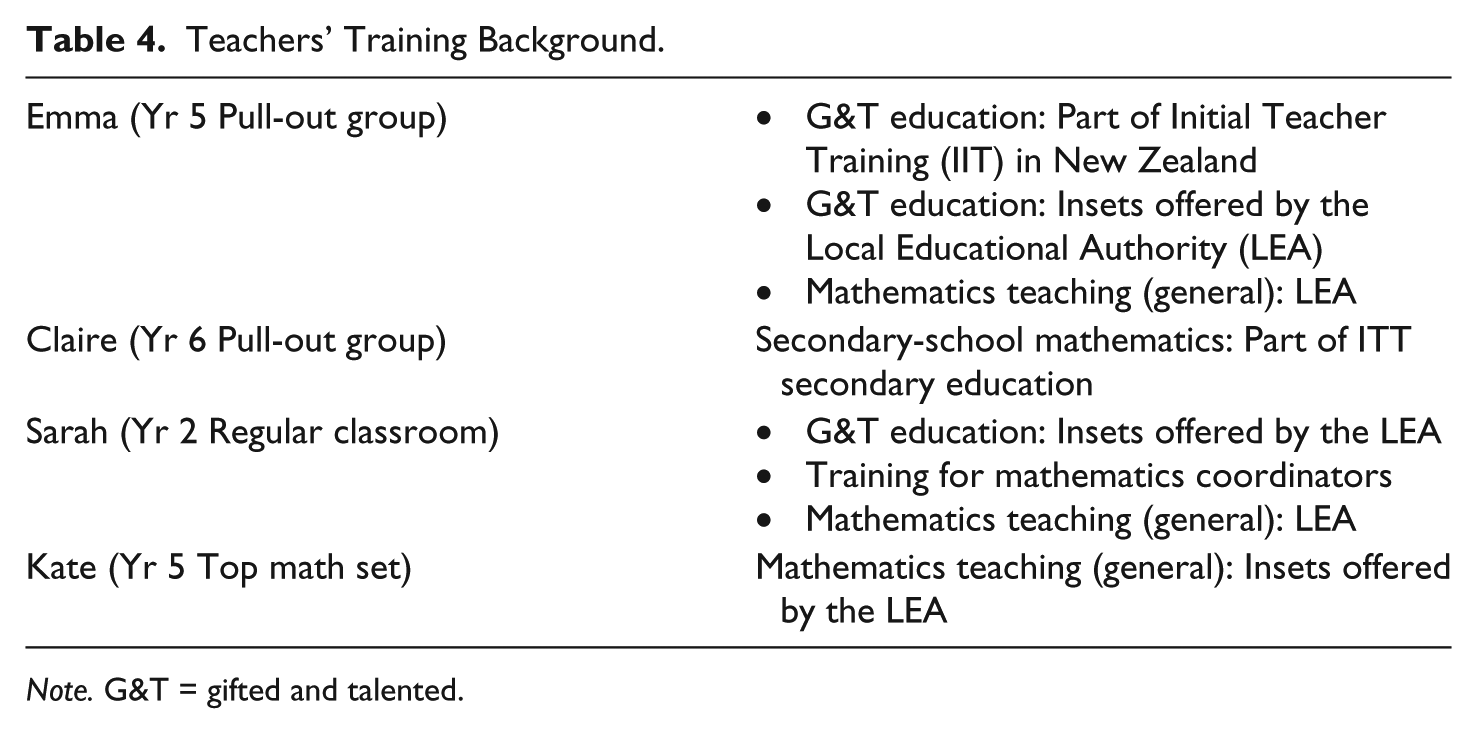
The case-study teachers were found to have enthusiasm about making provision for gifted mathematicians. All four teachers were doing their best, working beyond the usual syllabus to assign extra work to their gifted students through online sources and national curriculum publications. However, not all of them were appropriately prepared to undertake the responsibility to organize provision and teach gifted mathematicians. Table 4 presents the training background of the case-study teachers.
Teachers’ Training Background.
Note. G&T = gifted and talented.
Two of the case-study teachers, Emma and Sarah, had some training in gifted education, which mainly consisted of one or two short insets offered by the LEA. Emma underwent this training as part of her initial teacher training, but it was in another country. Claire had gained this subject expertise as a secondary mathematics teacher, which was found to be beneficial (see Pupil 17’s response, presented in this section). Kate did not have any special training. This was a problem, because it had an impact on her readiness to teach gifted mathematicians and on her attitude toward the education of the gifted in general, as can be seen in her own words during her interview: “I’m not very confident, so I think I need to set some time aside to work on that” and “I think that you have not to worry more about them [gifted students] but about the other ones, not so much about them because they’ll probably be high flyers anyway.”
Kate’s belief about gifted students—that they do not need attention and support, because they will be “high flyers anyway”—does not help much with her role in a special program for gifted mathematicians. Moreover, this belief, along with the displayed insecurities to teach gifted mathematicians, does not match with the model of the teacher of the gifted as described by Sheffield (1999). According to Sheffield, that teacher needs to be an expert in both the subject and in recognizing mathematical giftedness, and should possess an ability to inspire the gifted student of mathematics. This finding raised concerns about the effectiveness of the gifted program offered in that school, which requires attention. For instance, how is it possible for a teacher with the insecurities and beliefs described above to effectively support, extend, and, especially, inspire a student who is gifted in mathematics? These concerns were confirmed by the observations of the lessons and the children’s interviews. In the lessons observed, Kate was mainly working with the children in middle- and lower-ability groups, leaving the higher-ability ones to work by themselves, and, actually, to remain unchallenged. The interview with Pupil 10 (Numbers 1–20 were given based on the order each child was interviewed), a child on the school’s G&T register and the highest achiever in the class, also showed that the level of the teacher’s readiness and her approach had a negative impact on him and his attitude toward the lessons and the teacher:
I could have a better teacher. Do you know Mrs. [he says another teacher’s name]? Because she is quite good at maths. I was hoping to have her, because this teacher Miss [Kate] is not. I am working quite alone because the teacher is choosing other people that need help . . . [pause] but they are looking for answers, they need help with the answers so I feel like shutting it out. (Pupil 10, boy, age 10; interview)
Negative attitude and negative affect may be big obstacles in mathematics learning, and may apply to any student, including gifted mathematicians (Koshy, Ernest, & Casey, 2009).
The opposite result was found in Claire’s case-study class, where her subject expertise brought forth enthusiasm and increased motivation for taking part in the special math class, as can be seen in the following words of Pupil 17: “We are just going above the level. I like it . . . I look forward to Fridays and Mondays” (Pupil 17, girl, age 11; interview).
This enthusiasm and acceptance of the external teacher as a role model and inspirational instructor usually exists between a mentor and protégés, where a good mentor is a person with widely recognized expertise and the ability to challenge and inspire the mentee (Freeman, 2001; Sheffield, 1999). The words of this girl, therefore, add a little more evidence to those who suggest mentoring as an appropriate educational strategy for the education of the gifted (e.g., K. M. A. Casey & Shore, 2000; Freeman, 2001; Grassinger, Porath, & Ziegler, 2010; Pleiss & Feldhusen, 1995).
Positive results from pull-out groups
The most positive results were found in the pull-out groups. In those groups, there were teachers with some training background, like Emma and Claire, and all the pulled-out children were assigned work that was enriched and different from the usual and given individual support. As a result, each child experienced increased achievement. However, achievement may have been increased simply because of the increased attention and support that those children received, and not because of the program itself. There was also a positive impact on students’ motivation, especially in the group with the external mentor, as presented earlier.
Problems relating to the lack of knowledge and support from theory and research
Most of the problems that were found had to do with teachers’ lack of knowledge and lack of support from gifted theory and research. This had an impact on the identification and development of the real talent and on the work set selected by the teachers for use in the special classes.
Identification and development of real talent
Identification in all the cases was based on standardized test results and teacher nomination. As a result, almost all the students in the special classes were only students of higher attainment with the standard knowledge and skills required for their year group, but not necessarily gifted. Those students had difficulties coping with the work when it was a little more advanced. There was only one student in the two pull-out groups who displayed clear attributes of a promising mathematician. That means the schools’ methods of identification failed to create special classes of gifted students. There were gifted programs but not gifted students. Situations like this generate skepticism about the relative merits of gifted programs (Borland, 1996, 2013; Ziegler & Phillipson, 2012). Supporters of gifted programs (e.g., Gagné, 2011; Renzulli, 2012), however, suggest that such problematic situations can be avoided if teachers follow a particular conception of giftedness. If they use a modern conception of giftedness (e.g., Gagné, 2008; Gardner, 1999; Renzulli, 1999; Sternberg, 2003; Tannenbaum, 2003), teachers will know about the complexities in assessing the multifaceted aspects of giftedness and about the need to use multiple sources and methods of assessment.
The nature of work in the special classes
There were problems relating to the selection of the work set for the special classes. More specifically, in the top mathematics set, the teacher followed a full set from a commercial source. The activities were selected from higher levels of mathematics syllabi intended for older children, but not according to the real needs of the students. Most of the students were unable to cope well with them, while some students found parts of the work too easy and boring, as the following sample shows: “Sometimes it’s easy. Then it gets boring . . . ” (Pupil 15, boy, age 10; interview).
The work in the pull-out group with the internal teacher was enriched and interesting but not challenging enough (Dimitriadis, 2011). It was work that could be easily used for all pupils in regular classrooms. In the other group, with the external teacher, there was more advanced work (selected from secondary mathematics), but there was no plan to challenge the one student who displayed a clear mathematical promise and looked able to do more than what was given. There was no plan to extend and accelerate that child’s progress.
Questions regarding the “defensibility” of the case-study programs
The results raised some critical questions about the defensibility of the case-study programs, including
Why were students who did not display any special ability in special programs for gifted mathematicians?
Why did those students have more attention and more knowledgeable teachers than others in regular classrooms?
Why were enriched activities, which could benefit all students, given to a few of them only?
These are often questions that generate concerns and criticism that link gifted education with inequality and elitism and raise the defensibility problem for the program. Answering these questions, we may simply conclude that the programs observed were not actually needed. This negative assessment was what actually happened in England when the G&T program was reviewed (House of Commons, 2010). However, it is not always good to abandon something because it does not work well, not before trying the most reliable solutions that are available; in this case, reliable solutions could only come from gifted theory and research.
The problems described here are well-known problems in the gifted literature. For instance, Hertberg-Davis and Callahan (2013), drawing upon Passow’s (1982) views, suggested that a gifted program, to be effective and defensible, must be designated for the gifted, designed to benefit to the maximum those students only and not all the students; otherwise, it needs to be available to everyone, and it is not a gifted program. Gifted students need to be taught “only what they don’t already know” (Stanley, 2000, p. 216). The literature also suggests that a gifted program must have a clear and challenging excellence goal, and selective access criteria (Gagné, 2011). The aim must be to make the talent and the program recognizable; then, organizing something special to offer advanced learning opportunities for the gifted student will make sense to everyone and no objections will be raised because it will be about “equity” and “meritocracy,” which are the answers to the inequality and elitism concerns (Gagné, 2011). There need to be strong relationships between the program that is offered for the gifted and gifted theory (Renzulli, 2012), and, of course, teachers with subject expertise and knowledge of the gifted (Sheffield, 1999).
Conclusion
Despite the triangulation that occurred through the use of a range of sources and methods of data collection, generalizations can only be tentative. However, the in-depth case studies do provide a trustworthy insight into the real practice, which should be useful for both practicing teachers and policy makers. The findings showed that having a provision program for the gifted, although good as an idea, when it is not supported by gifted theory and research does not ensure success but rather problems. The certain good of having a provision is that it keeps teachers’ interest and engagement in the education of the gifted high, providing a good basis for a supportive environment for the gifted student to be built. Furthermore, a provision program, when delivered through well-trained teachers, may have positive results in students’ achievement, attitude, and motivation. However, positive results do not necessarily mean success of a gifted program. This is because small class size, teachers’ focused attention, and individualized support can benefit any student—which should be a common educational requirement.
Simply giving extra attention and enriched opportunities to a group of pupils with no clear identification criteria, excellence goal, and plan for extension and acceleration does not support real talent development or constitute a recognizable gifted program, and instead creates reasonable concerns and criticism about the idea of gifted education and negatively influences the defensibility and sustainability of the specific program and gifted education in general.
This study, therefore, recommends that teachers should be highly trained in both recognizing mathematical promise and making subject-specific provision. This training should not only be a couple of short insets, but a systematic initial training, followed by ongoing, in-service training. Experts should organize and oversee a theory- and research-based provision program or service for the whole school. A mentor with the expertise and ability to recognize and inspire the truly gifted students is needed to work with those exceptional students in small groups or one-on-one, within or outside the regular classroom. Conditions for individualized learning and opportunities for extension for the gifted should be created even within a pull-out group, as it is possible to have a gifted student who is not sufficiently challenged. More and continuous research of classroom practice is needed to see, for example, what is happening now in English schools, which are still required to provide for their most able children, but without any specific policy and training in place at a national level.
Footnotes
Acknowledgements
The research reported in this article would not be possible without the participation of the teachers and pupils. I would like to acknowledge their help and thank them for this. I would also like to thank the Head teachers of the schools for their interest in this study and their willingness to provide any necessary help.
Declaration of Conflicting Interests
The author declared no potential conflicts of interest with respect to the research, authorship, and/or publication of this article.
Funding
The author received no financial support for the research and/or authorship of this article.