






Abstract
This update of the legislation/regulations and case law specific to pre-K–12 gifted students since a cluster of publications in 2004–2005 primarily focuses on the “gifted alone” category, with only secondary attention to twice-exceptional and other students in the “gifted plus” category. For the gifted-alone category, the legislation and regulations during the most recent 11 years continue to be at the state level, rather than federal level, with a net change amounting to moderate strengthening, primarily in terms of the group, rather than Individuals With Disabilities Education Act (IDEA)–type, model. The corresponding case law remains very limited in both frequency and pro-plaintiff outcomes, with most of the cases arising in Pennsylvania. The gifted-plus category accounts for far more litigation, fueled by the intersecting federal civil rights laws that are pivotal in these cases. Yet, their outcomes, for a variety of issues that extend well beyond eligibility and free appropriate public education, have also reflected a pro-district skew.
The law, primarily being federal and state legislation and court decisions, plays a key, although not at all controlling, role in pre-K–12 education in the United States. For specialized groups of students, such as those with disabilities and/or giftedness, this role can be of particular significance. Yet, the coverage of legal issues in the literature concerning gifted education is limited and not current. The purpose of this article is to synthesize the legislation and case law specific to gifted education during the past 11 years, with primary attention on the issues of eligibility and services.
The successive parts of this article consist of (a) a framework section that maps the meaning of law in this context; (b) a springboard section that summarizes previous syntheses of the legislation and litigation specific to gifted education in 2004–2005; (c) a transitional section that illustrates the professional literature since 2004–2005; (d) a culminating, central section that synthesizes the applicable legislation/regulations and case law for the 11 years since 2004–2005; and (e) a final, summary set of conclusions and recommendations. The central section focuses on the legal developments purely specific to gifted education, referred to as the “gifted alone” category. On a limited, supplemental basis, it extends to the intersections with laws specific to a different status, such as disability, race, or gender, referred to collectively as the “gifted plus” category. However, the coverage does not extend to more incidental intersections with other legal issues, such as First Amendment expression (e.g., Brandt v. Board of Education of City of Chicago, 2007) and Fourth Amendment search/seizure (e.g., K.J. v. Greater Egg Harbor Regional High School District Board of Education, 2015). Moreover, the scope does not extend to employment issues for gifted education personnel (e.g., Kelly v. Huntington Union Free School District, 2012).
Background in Law and Literature
Legal Framework
Overall
As a threshold matter, an overall map of the sources and levels of American law provides the definitional scope and sequence of law in this context. The framework consists of a pyramid-like hierarchy consisting of (a) the constitution, (b) legislation or statutes, and (c) regulations. Each of these successive levels provides more details but, being dependent on the lower levels for its basis and boundary, less authority. Moreover, splitting it vertically, the pyramid has both a federal and a state face. For example, providing variety to complement the foundational uniformity, each state has a constitution, statutes, and regulations that parallel those of the federal government. Finally, built on this framework, a second pyramid consists of the case law that not only interprets and applies these three sources but also fills the gaps with the common law.
Special education
In the overall special education context, the primary pieces of each level of the framework pyramid are on its federal face: (a) the Fourteenth Amendment’s equal protection and due process clauses; (b) the Individuals With Disabilities Education Act (IDEA, 2013) and, to a lesser extent, Section 504 of the Rehabilitation Act (2013); and (c) the IDEA and the Section 504 regulations. As a secondary matter, the state face provides supplemental statutes or regulations that add to the federal foundation. The second, adjudicative pyramid, or “iceberg” (Zirkel & Machin, 2012, p. 486), consists of successively higher, rather than lower, levels of authority according to the doctrine of stare decisis, or vertical precedent: (a) hearing (and, in the relatively few states with a second tier under IDEA, review) officer decisions and (b) two or, in the federal judiciary and in some states, three successive court levels. Finally, two other marginal sources play a role in special education law. Just outside the boundary, because they are not binding but often are persuasive for hearing officers and courts (e.g., Zirkel, 2003), are the policy interpretations of the federal administrative agencies that, respectively, administer IDEA and Section 504—the U.S. Department of Education’s Office of Special Education Programs (OSEP) and Office for Civil Rights (OCR). Inside the boundary, but providing an alternative avenue for enforcement for IDEA and Section 504, are the complaint investigation processes of state education agencies (SEAs) and OCR.
Gifted education
In the specific gifted education context, the primary pieces to date have been state statutes or regulations specific to gifted students and court decisions interpreting them. In addition, the Fourteenth Amendment of the federal constitution, the education clauses in at least some state constitutions, and hearing officer decisions in the relatively few state laws that provide for this administrative adjudicative mechanism have played a secondary role to date. Finally, but not centrally, case law concerning gifted education has arisen relatively often at its intersection with (a) IDEA and/or Section 504 for students who may be twice-exceptional, (b) Fourteenth Amendment equal protection and/or pertinent civil rights laws for racial or ethnic minority students, and (c) Title IX for gender discrimination.
Professional Literature
The 2004–2005 publications
In a monograph available at no cost on The National Research Center on the Gifted and Talented’s website, Zirkel (2005a) provided a comprehensive synthesis of the state legislation and regulations specific to gifted education, including an appendix chart, the case law similarly specific to students categorized as gifted alone, and, on a secondary basis, the case law concerning students categorized therein as gifted plus, representing the aforementioned intersections for twice-exceptional and minority students.
Legislation/regulations
As summarized in a separate article in the gifted education literature, Zirkel (2005b) categorized the state legislation and regulations into three broad categories. The first category, labeled the “IDEA-type model,” was distinguishable by providing individual rights that included individualized education programming, or what the IDEA terms individualized education programs (IEPs), and procedural safeguards extending to due process hearings. The other two categories were the group-oriented model, which were limited to state and local responsibilities concerning funding and/or standards, and the miscellaneous remaining states that provided no or negligible requirements for gifted education. As of the August 2005 data collection, which was via direct review of these laws rather than a survey of SEA representatives, Zirkel (2005b) approximated the following number of states in each category: IDEA model = 12 (e.g., Florida, Louisiana, Pennsylvania, Tennessee), (b) group-oriented only = 35 (e.g., Colorado, Connecticut, Indiana, Maryland, Massachusetts, Michigan, Missouri, Rhode Island, Texas, Wisconsin), and (c) none or negligible = 3 (i.e., Minnesota, New Hampshire, South Dakota). More specifically, his table provided his estimated entries for each state in terms of state responsibilities (funding, standards, and technical assistance), school district responsibilities (identification, programming, teacher training, data collection, and program evaluation), and (c) individual rights (individualized programming, procedural safeguards notices, due process hearing, and complaint investigations).
Case law
Concluding that federal legislation and regulations lack an entitlement to gifted education, Zirkel’s (2005a) monograph summarized the case law in the gifted-alone category as not supportive of such an entitlement in the federal constitution and its state counterparts or as a matter of common law. Instead, as Zirkel (2004) separately summarized in an article in the gifted education literature, the case law predominated in relation to the three aforementioned categories of state statutes or regulations as follows: (a) the issue of gifted students’ early entrance to public school arose under other state statutes, and the outcomes were generally deferential to the defendant school districts; (b) in the states in a third, null category or before the passage of mandatory legislation in the first two categories, courts were similarly deferential to the discretionary decision making of defendant districts, thus, not receptive to an inferable entitlement to gifted education; and (c) in the third, IDEA–type category, the case law was limited concerning the issue of eligibility and more extensive concerning the issue of appropriate services, but predominantly from Pennsylvania courts and not particularly plaintiff-favorable outcomes.
Conversely, Zirkel (2004, 2005a) found the case law in the gifted-plus category to be relatively abundant, with the following perceived trends: (a) judicial disinclination to recognize dual exceptionality; (b) adjudicative complexity in determining appropriateness for students recognized as dually exceptional; (c) the addition of OCR complaint investigation rulings for the less frequently addressed intersection of giftedness with Section 504 eligibility or services; and (d) relatively limited judicial and OCR rulings concerning the underrepresentation of minority students in gifted education, with the supportive authority often within the larger context of the court’s desegregation orders.
More recent literature
The professional literature since 2005 regarding legislation and litigation concerning gifted education has been almost entirely limited to law journals, which most professors and practitioners in gifted education do not regularly access. Moreover, these articles have not provided comprehensive or current coverage of the applicable legislative and case law.
Advocacy articles
One cluster of these articles in the legal literature is limited to advocacy proposals. In a brief article, Duchamre (2011) criticized federal and state policies, including the No Child Left Behind (NCLB) Act, for neglecting the effective education of gifted students in terms of both funding and standards. Serving as one counterpart at the state level, Ferrick (2015) advocated for gifted education legislation in Massachusetts that would provide “a definition, earmarked funding, statutory entitlements to specialized education, and procedural safeguards” (p. 501). Serving as a second, alternate counterpart at the state level, Haney (2013) advanced the argument for judicial rulings requiring identification, services, and funding of gifted education based on the “thorough and efficient” education clauses of some state constitutions.
Limited intersections
A couple of other articles in the legal literature have focused on the intersection of gifted education with another educational issue. First, focusing on charter schools, Eckes and Plucker’s (2005) legal coverage did not extend beyond state laws and court decisions as of 1995. More recently, focusing on the intersection of gifted education and students of color, Ford and Russo (2013–2014) analyzed McFadden v. Board of Education of Illinois School District U-46 (2013), a federal trial court decision that was in response to a long-standing class action suit on behalf of minority students. In relevant part, the McFadden court ruled that the district’s separate, and thus segregated, gifted education program for most Hispanic students identified as gifted violated their constitutional and statutory rights to equal educational opportunity. Yet, Ford and Russo’s conclusions and recommendations went well beyond the specific scope of the McFadden ruling to address the problems of underidentification of African American and Latino students in gifted education programs.
Limited on point
In the only pertinent article in the education literature, which was in a general education rather than gifted education journal, Zirkel (2009) provided a brief overview of the various lines of case law during 2006–2008. The format was question-and-answer discussion largely focused on a Pennsylvania state court decision concerning eligibility for gifted education.
Finally, in their most recent biennial report in 2015, the National Association for Gifted Children (NAGC) and The Council of State Directors of Programs for the Gifted (CSDPG) reported that 32 of 40 responding states had “some form of legal mandate relating to gifted and talented education,” but the report’s interpretation of “legal mandate” was vaguely expansive, including, for example, SEA “guidelines” (p. 23). Moreover, the report’s table summarizing the SEA survey responses did not systematically and objectively differentiate the specific scope and enforceability of the mandate beyond broad rubrics such as “identification services” and “dispute resolution” (NAGC + CSDPG, 2015, pp. 140–148).
Legislative and Adjudicative Update
The central section of this article is organized within the two aforementioned rubrics—gifted alone and gifted plus—with primary attention to the first category due to customary meaning of gifted education. Moreover, based on this customary usage, the treatment of state statutes and regulations will be within the gifted-alone category.
Gifted Alone
Federal legislation
Unlike the federal laws for students with disabilities, especially but not exclusively IDEA (e.g., Zirkel, 2012), Congress has never passed a law requiring identification or services for gifted students. As recounted elsewhere (e.g., Russo, 2001), the limited authorizations for funding consisted of the Jacob K. Javits Gifted and Talented Students Education Act and the much more generic NCLB. The recently enacted successor to the NCLB, the Every Student Succeeds Act (ESSA, 2015), incorporates the Javits Act and includes various incidental references to gifted students and programs within its broad-based funding and relatively discretionary structure.
State legislation and regulations
The updating of the previous tabulation of state laws specific to gifted education was based on a two-stage process. First, to identify the changes since 2005, the primary source was the Education Commission of the States (2015) state legislation database, which provides an ongoing update of state laws, including regulations, for various designated topics, including “gifted and talented students.” For this stage, the “Changes in States Rules and Regulations” table for the NAGC and CSDPG (Note 1, 2009, 2011, 2013, 2015) biennial reports 1 served as a supplemental source. The second stage was to examine in the Westlaw database the current provisions in the statutes and regulations for each of the identified states. The focus was to identify significant changes that fit within the template of the Zirkel’s (2005a) table for the purpose of highlighting the recent trend, not to capture every legislative and regulatory revision concerning gifted education. Thus, the various exclusions included revisions for (a) advisory groups and report studies; (b) higher education programs; (c) advanced placement (AP), international baccalaureate (IB), and curricular or graduation adjustments; (d) temporary funding provisions; and (e) teacher summer programs.
Table 1 summarizes the results of these noted changes in two directions and broad gradations: limited strengthening (->) and substantial strengthening (→) and limited weakening (<-) and substantial weakening (←). A review of Table 1 reveals a variety of changes, with a net moderate trend in the direction of strengthening state laws for gifted education. Although subject to further research, the variety appears to fit in four approximate groupings within a continuum from substantial strengthening to substantial weakening:
substantially strengthened laws: CO, DE, IN, MD, MN, and OH;
moderately strengthened laws: OR, SC, TX, and WA;
slightly strengthened laws: IL, KS, MO, and NV; and
notably weakened laws: CA, HI, MS, and UT.
Changes in State Laws for Gifted Education: Strengthening (-> or →) and Weakening (<- or ←).
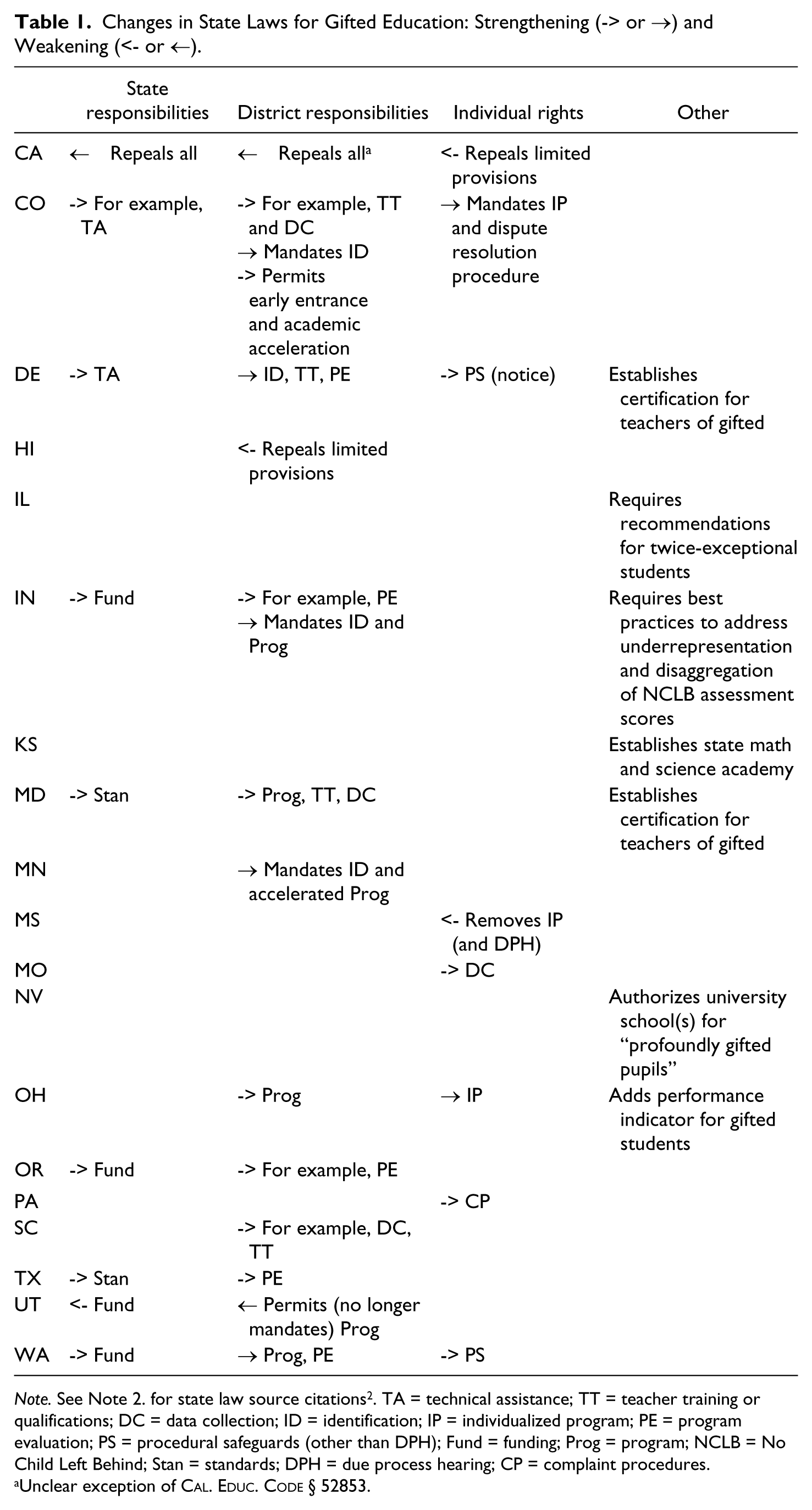
Note. See Note 2. for state law source citations 2 . TA = technical assistance; TT = teacher training or qualifications; DC = data collection; ID = identification; IP = individualized program; PE = program evaluation; PS = procedural safeguards (other than DPH); Fund = funding; Prog = program; NCLB = No Child Left Behind; Stan = standards; DPH = due process hearing; CP = complaint procedures.
Unclear exception of Cal. Educ. Code § 52853.
The majority of the changes concern school district obligations for the group-oriented, rather than the IDEA–type individual rights, model. Nevertheless, substantial diversity, rather than a particular thrust, predominates among and within the overall categories.
Case law
The case law consists of two levels of published adjudication. The lower level consists of impartial hearing or review officer decisions under state laws that provide this individual right under the IDEA–type model. A few of the states with this model provide these decisions amid those for students with disabilities, with the time period for this accessibility further contributing to the lack of uniformity. For this reason, and the subordinate level of authority of these administrative adjudications in comparison with court decisions and the national database source for court decisions, the choice was to follow the approach as the 2005–2006 publications for this update using LRP’s national database, Special Ed Connection®, as their source. Their resulting citations are to “LRP” or the “Individuals With Disabilities Education Law Report” (IDELR). For court decisions, the two source databases were Westlaw and, on a supplemental basis, IDELR. Following the organization of the predecessor publications, the focus is on the central gifted-alone issues of eligibility, or identification, and free appropriate public education (FAPE), or services.
Table 2 provides an overview of the case law in the gifted-alone category in chronological order of the decisions. The time period extends from mid-2005 to mid-2016. As Table 2 shows, the case law specific to gifted-alone students remains, as it was in the predecessor publications, very limited. First, the overall frequency amounts to 17 decisions within the 11-year period, thus averaging approximately 1.5 decisions per year, which is a negligible level compared with the case law under IDEA. Second, almost all the case law for this updated period is from Pennsylvania, with the California, Louisiana, New York, and South Carolina exceptions largely being only marginally relevant cases. Finally, with the limited exception of the narrow final decision, all these rulings have been in favor of the defendant districts. However, in the two district-favorable rulings concerning the remedy, the parents had prevailed at the hearing officer level with regard to FAPE and at least some compensatory education, with the issue for the court upon appeal being limited to the amount of compensatory education. A closer examination of the decisions within each issue cluster, with eligibility and FAPE serving as the centerpieces, provides more guidance as to the contours of the respective rulings.
Case Law for Gifted-Alone Students.
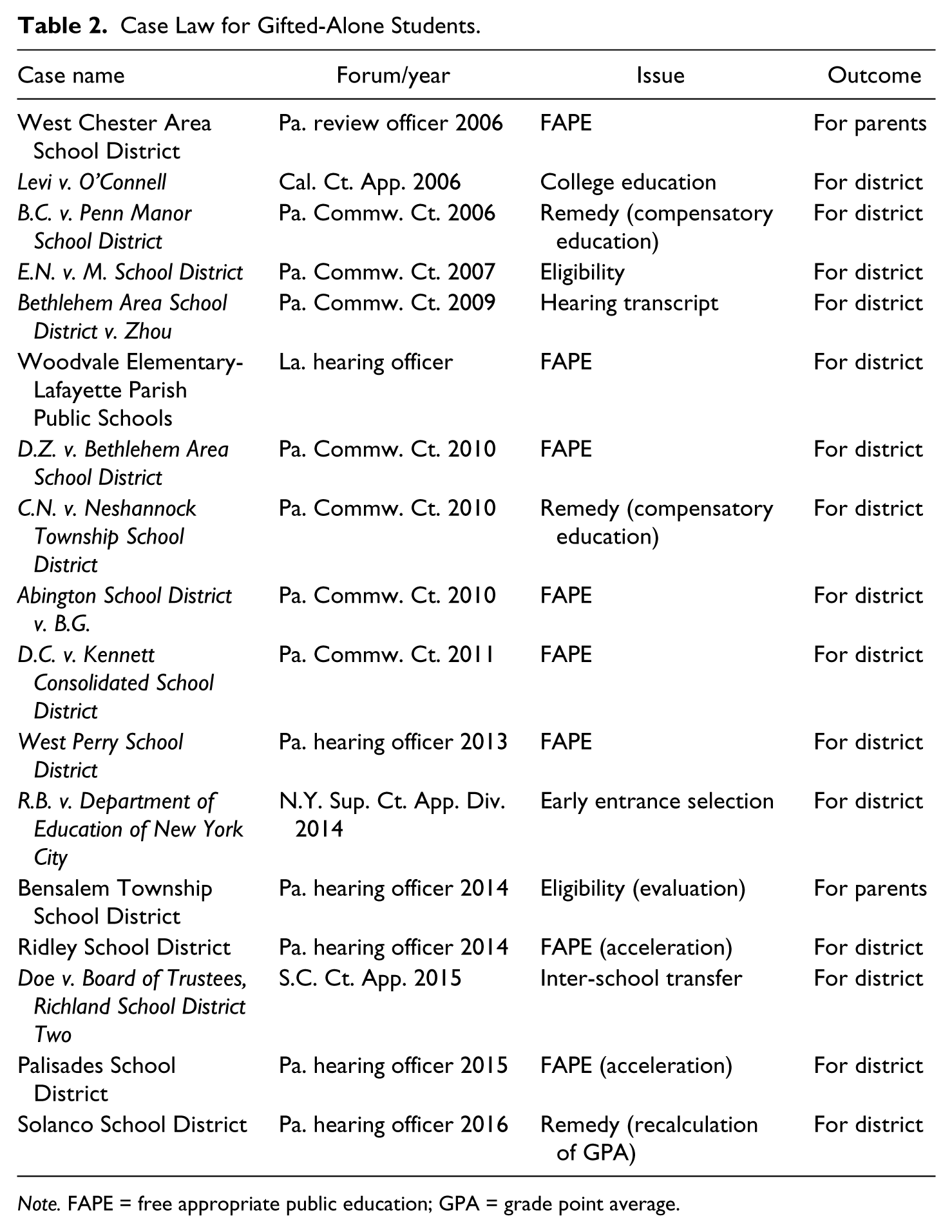
Note. FAPE = free appropriate public education; GPA = grade point average.
First, serving only as a transition, the case from California is a marginal outlier for two reasons. First, the student was within the age range of pre-K–12 schooling and the issue was whether the SEA was required to pay for his college education. Second, the state law for gifted education, which was not mandatory at the time (and which more recently has been repealed), was not at issue. In this case, the California Court of Appeals affirmed the dismissal of the parents’ suit, summarily concluding that none of their cited sources—the state constitution, NCLB, IDEA, and the state’s special education law—provides an entitlement to gifted education, much less at the postsecondary level (Levi v. O’Connell, 2006).
Eligibility
Only two decisions during the updating period concerned the issue of eligibility as a gifted student. In the first decision, Pennsylvania’s intermediate, appellate court ruled in favor of the district, which had determined via the requisite multidisciplinary evaluation that the child did not meet the eligibility standards in the state’s gifted education regulations (E.N. v. M. School District, 2007). The regulations require both an IQ of 130 or above and specified multiple criteria of gifted ability, such as a year or more above grade-level achievement in one or more subjects. The child was a first grader who the year before had attended a private preschool/kindergarten and had been recommended by the Johns Hopkins Center for Talented Youth for gifted programming. Declining to address the parents’ arguments about the IQ testing as part of the district’s evaluation, which had resulted in overall scores of 131 on the Kaufman Brief Intelligence Test–Second Edition (KBIT-2) and 124 on the Wechsler Intelligence Scale for Children–Fourth Edition (WISC-IV), the court relied on the second essential element for eligibility, for which the regulations accord districts’ discretion. More specifically, the court reasoned, While [the child] has displayed some characteristics of giftedness, [the child] has also displayed some characteristics that suggest against a finding of giftedness. Thus, it is far from clear whether [the child] displays sufficient multiple criteria to be able to be classified as gifted. On that basis alone, whether [the child’s] IQ score is above or below the 130 threshold, the District’s decision is consistent with the regulations. (E.N. v. M. School District, 2007, p. 466)
The second decision was notably limited in two ways: (a) it was at the hearing officer level and, even more importantly, in this context, (b) it was an unusual factual situation that was notably narrow, and (c) it did not directly address eligibility. Specifically, in Bensalem Township School District (2014), the basic facts were as follows: (a) approximately 1 month after their child entered the district’s kindergarten program, the parents requested an evaluation for gifted eligibility under Pennsylvania’s IDEA–type gifted education regulations; (b) the district responded by requesting consent for administering the KBIT-2 for its screening process; (c) the parents refused to provide not only consent but also the parental information form, because they sought evaluation, not screening; and (d) the district conducted the screening based on the only available information, which was the child’s kindergarten readiness testing and the kindergarten teacher’s opinion, and concluded that it did not have reason to suspect that the child qualified under the state standards for gifted eligibility. Rejecting the SEA guidelines because “they have no force or effect of law” (Bensalem Township School District, 2014, p. 6) and the analogous special education regulations because they are distinctly separate in Pennsylvania, the hearing officer assiduously adhered to the wording of the relevant regulation regarding the criteria for an evaluation and concluded that “the stipulated facts of this matter tie my hands” (Bensalem Township School District, 2014, p. 8) to find that the situation narrowly met these criteria. Thus, the hearing officer ordered the requested evaluation, but “strongly decline[d] the Parents’ request to issue an Order going beyond the Student’s case” (p. 8).
FAPE
The case law during the relevant period concerning the core issue of individual appropriateness of services amounted to eight decisions that almost all were in Pennsylvania, with the principal ones by Pennsylvania’s intermediate, appellate court. The first decision was at a lower, administrative level of adjudication, and the case was a hybrid with the gifted-plus category, with FAPE under Pennsylvania’s gifted education law only one of multiple issues (West Chester Area School District, 2006). In this case, the review officer panel upheld the hearing officer’s ruling that the gifted IEP was not individually tailored to fit the individual child’s needs, thus not meeting the substantive standard for FAPE. However, the review panel reduced the hearing officer’s compensatory education relief from of 160 to 75 hr based on the then-applicable quantitative approach (which, as explained below, soon thereafter changed).
Pennsylvania’s intermediate, appellate court decided most of the remaining FAPE cases, which were all in favor of the defendant districts. In D.Z. v. Bethlehem Area School District (2010), the court upheld a cluster of hearing officer decisions that had ruled in favor of the appropriateness of successive gifted IEPs of an elementary school child, although the focus on appeal was on adjudicatory issues, such as the fairness of the hearings.
The remaining Pennsylvania Commonwealth Court decisions addressed FAPE more directly. In Abington School District v. B.G. (2010), the hearing officer ruled that the district had denied FAPE to the child, who was a third grader gifted in mathematics, by not providing measurable goals and individualized services in math. However, the court reversed the hearing officer’s decision, concluding that the goals were sufficiently measurable and that the services reasonably, although not optimally, tailored to the child’s needs. The following statement in the court’s decision is potentially problematic to the unclear extent that it was partly essential, rather than merely incidental, to the ruling: The parents, who attended the meetings and signed the [gifted IEPs], cannot now argue that the goals, objectives and measuring tools set forth in those [gifted IEPs] were insufficient because their son was not learning enough when they agreed to those goals, objectives and measuring tools. (Abington School District v. B.G., 2010, p. 632)
In the next decision, D.C. v. Kennett Consolidated School District (2011), the hearing officer had ruled that the parents failed to meet their burden to prove that the child’s gifted IEP violated the substantive standard for FAPE, thereby denying their requested remedy for compensatory education. However, the hearing officer ordered the IEP team to revise the present educational levels and goals. Upon the parents’ appeal, the court deferred to the hearing officer’s decision. As to their arguments based on the procedural flaws that the hearing officer identified in the IEP, the court reasoned, The Hearing Officer’s conclusion that the District provided an appropriate gifted education … renders the Parents’ arguments unpersuasive; the Hearing Officer’s order provides a supplemental remedy to their arguments on this issue where none was required given the disposition. (D.C. v. Kennett Consolidated School District, 2011, p. 4)
The remaining FAPE decisions were at the hearing officer level and concerned the amount or approach of gifted education. In the first of these four decisions, a Louisiana hearing officer rejected the parents’ request for 1 year more advanced than the district’s proposed placement of her gifted child in the second grade with third-grade-level instruction in math and language arts. His conclusion was that the parents failed to meet their burden to prove that the district violated the applicable regulations in refusing the requested acceleration (Woodvale Elementary-Lafayette Parish Public Schools, 2009). In the second decision in this cluster, a Pennsylvania hearing officer upheld the appropriateness of a gifted IEP that had reduced the level of resource room services by 50%. Although the reason for the reduction was the school schedule and without the requisite written notice to the parents, the hearing officer primarily relied on the relatively relaxed substantive standard for FAPE under the state law and the harmless effect of the procedural error (West Perry School District, 2013). In the third decision, the same Pennsylvania hearing officer upheld the placement of the child in kindergarten, rather than the parent’s skipping request for first-grade placement. The key reasons that the hearing officer identified were the school personnel’s credible testimony that the child was not socially and emotionally ready for first grade and the gifted IEP provided for enrichment and pull-out services geared to the child’s academic strengths (Ridley School District, 2014). In the fourth decision, another Pennsylvania hearing officer ruled that the parent had the burden of proof and had not sustained this burden to show that her gifted child needed acceleration for the gifted IEP to provide FAPE. Nevertheless, as a matter of dicta (i.e., side comments that were not part of the formal ruling), the hearing officer made various observations critical of the district, including its overly narrow view of the forms of acceleration (Palisades School District, 2015).
Remedy
The same Pennsylvania court issued a pair of decisions specific to the issue of the remedy for denial of FAPE, which in Pennsylvania typically is compensatory education. In B.C. v. Penn Manor School District (2006), the court ruled that the appropriate way to calculate compensatory education under Pennsylvania’s gifted education law is the qualitative, not the quantitative, approach. More specifically, looking at approaches under IDEA as instructive but not at all binding, the court found the flexible approach from other federal circuits “more persuasive and workable” (B.C. v. Penn Manor School District, 2006, p. 650) than the hour-for-hour approach of the Third Circuit, which includes Pennsylvania. Thus, the court ruled that “the student is entitled to an amount of compensatory education reasonably calculated to bring him to the position that he would have occupied but for the school district’s failure to prove a FAPE” (B.C. v. Penn Manor School District, 2006, p. 651). In C.N. v. Neshannock Township School District (2010), after the hearing officer had awarded 108 hr of compensatory education within the range of the district’s offerings, the parents appealed, claiming that the hearing officer erred by (a) limiting the award to the district’s offerings and (b) not using the quantitative (i.e., hour-for-hour) approach. The court rejected both claims based on the rather clear and directly applicable standards of prior Pennsylvania court decisions, including B.C. v. Penn Manor.
Most recently, a Pennsylvania hearing officer ruled that the parent’s requested remedy to recalculate the grade point average of a gifted eighth grader is beyond the authority of the due process system. More specifically, he concluded that the jurisdictional boundaries for due process hearings under Pennsylvania’s gifted education regulations on the one side and, even more significantly, school districts’ vested authority under the state’s academic requirement regulations precluded the requested remedy (Solanco School District, 2016).
Other issues
Another Pennsylvania Commonwealth Court decision was limited to the relatively unusual issue of whether the parents are entitled to a transcript of the impartial hearing proceedings in their native language, which in this case was Mandarin Chinese (Bethlehem Area School District v. Zhou, 2009). Moreover, in this case, the parent had received interpreter services during the hearing, thus narrowly framing the issue to the resulting transcript. Answering this narrow issue contrary to the parent’s contention, the court concluded, “there is no Federal or Pennsylvania Constitutional, statutory, or regulatory authority for the provision of a free transcript—translated or otherwise—of an administrative proceeding to a non-indigent party” (Bethlehem Area School District v. Zhou, 2009, p. 1287). The larger significance is the rather strict judicial view with regard to law. The parent pointed to the state’s manual for hearing officers, which supported her view. However, the court rejected its applicability, reasoning that the manual is “at best, a statement of [state agency] policy” (Bethlehem Area School District v. Zhou, 2009, p. 1289) that, in any event, “does not rise to the level of a properly promulgated Pennsylvania regulation, and does not have the force of law” (p. 1287).
In another Pennsylvania case, the same intermediate, appellate court ruled that a hearing officer erred by dismissing a parent’s due process complaint on behalf of her gifted daughter. The hearing officer concluded that the parent did not have standing to file a hearing due to the temporary transfer of legal and physical custody of her daughter. The court remanded the case to the hearing officer for a hearing because (a) judicial precedents in Pennsylvania have held that a temporary transfer of custody does not terminate parents’ rights to litigate the education rights of their child, and (b) Pennsylvania’s gifted education regulations establish a parent’s rights in her child’s gifted IEP (J.C. v. Slippery Rock School District, 2010).
The other two case in this miscellaneous category were in other states and more recent. First, in a dispute concerning the transfer of a gifted student in South Carolina, the state appeals court upheld dismissal disposed of the suit primarily due to the limited, group-oriented nature of the state’s gifted education statute (Doe v. Board of Trustees, Richland School District Two, 2015). More specifically, the court ruled that the state’s gifted education law does not provide an individual right to sue and that the alternative claims based on the U.S. Constitution were factually unfounded.
Finally, the New York state court decision was of only marginal relevance because the issue was limited to a school district’s particular selection process for early entrance to gifted education and the ruling was arguably inconclusive regarding the merits of the parents’ claim (R.B. v. Department of Education of New York City, 2014). More specifically, in a short opinion, the court upheld the dismissal of the parents’ constitutional challenge based on their failure to exhaust available administrative remedies before filing suit. On an alternative basis, which was arguably dicta, the court concluded that the district’s methodology, which was a lottery according to percentile ranking with a preference to those 4 year olds with siblings already in the program, met the relatively relaxed applicable standard under the Fourteenth Amendment equal protection clause. In contrast to the compelling justification required for race and fundamental rights, the applicable standard was to show a rational relationship between the methodology and its purpose.
Complaint investigations
An alternative and less traveled avenue for complaint decisions is via the investigative, rather than adjudicative, process. More specifically, some states with IDEA–type gifted education laws include the state complaint investigation process as an alternative to due process hearings. Due to the relative infrequency and marginality in comparison with adjudicative case law, the coverage here is limited to a brief example. In a Florida case, the parent filed a complaint with the SEA, claiming that the district violated procedures in determining that her child was not eligible for gifted education. After conducting an investigation, the Florida’s SEA found no violation of the applicable regulations (Santa Rosa School District, 2014).
Gifted Plus
The update concerning this gifted-plus category is much more succinct and only illustrative because—unlike the gifted-alone category—eligibility, services, or other legal issues specific to gifted education are not the fulcrum, or legal basis, of the decision. Instead, such issues are only secondary to the intersecting and pivotal legal rights specific to students with disabilities (under IDEA or Section 504, respectively), minority students (under the Fourteenth Amendment’s equal protection clause or Title VI of the Civil Rights Act), or female students (under Title IX of the Education Amendments). Thus, the canvassing of the case law in this category, which is much more extensive, is only cursory. In additional contrast with the gifted-alone category, the sample citations, in light of the relevant federal civil rights laws, include an ample representation of federal circuit courts of appeals’ decisions.
Disability: IDEA
The IDEA cases where the child appears to be gifted are the most frequent subcategory of litigation, arising across the entire range of IDEA issues, starting with eligibility and its interrelated issues of child find and evaluation. This wide and multifaceted range centers on FAPE but extends to various other issues, such as the remedy of tuition reimbursement.
IDEA eligibility
The three-pronged standard for eligibility under IDEA consists of one or more classifications that adversely affect educational performance so as to necessitate special education. Giftedness may affect the application of this eligibility standard in at least three respective ways. First, for identification under the most frequent IDEA classification, which is specific learning disability (SLD), the movement in the approximately 15 to 20 states to prohibit severe discrepancy in favor of a Response to Intervention or some alternate research-based approach may make the first prong more difficult. For the second prong, the child’s superior academic ability may mask the adverse effect on educational performance. Third, overlapping with the second prong, the child’s need calls into question the meaning of “educational performance” and/or “special education.”
The case law during the updating period has focused on the interrelated second and third prongs, with mixed outcomes attributable to not only the child’s giftedness but also various other factors, including differences in the particular facts and the specific issue. In the rulings in favor of the district, the child’s successful performance in regular education relative to peers generally was often a decisive factor with regard to the second and/or third prong. In some of these decisions, including the aforementioned review officer decision in West Chester Area School District (2006), the relevant ruling was specific to child find (P.P. v. West Chester Area School District, 2009) or the evaluation (Blake B. v. Council Rock School District, 2008). In other cases, the focus was on the ultimate issue of eligibility (Anchorage School District, 2010; City of Chicago School District 299, 2013; Marion County School District, 2008; Mowery v. Board of Education of School District of Springfield R-12, 2011; Q.W. v. Board of Education of Fayette County, 2015; School District of Springfield, 2007). Conversely, and less frequently, the rulings were in favor of the parents, with the more penetrating analysis being attributable to cogent private expert testimony (District of Columbia Public Schools, 2007; Williamson County Board of Education v. C.K., 2009) or a wider interpretation of Prong 2 (Mr. I v. Maine School Administrative Unit No. 55, 2007). For the pro-parent rulings concerning the appropriateness of the evaluation under IDEA, the remedy may be payment for an independent education evaluation (e.g., M.Z. v. Bethlehem Area School District, 2013). For the pro-parent rulings specific to the narrower issue of eligibility, the remedy extended to compensatory education (Williamson County Board of Education v. C.K., 2009) or tuition reimbursement (District of Columbia Public Schools, 2007) as a result of a denial of FAPE.
IDEA FAPE
For the overlapping and central issue of FAPE, the case law has abounded. Based on the applicable standards for procedural and substantive appropriateness, the pronounced majority of the decisions were in favor of the defendant district, with the child’s giftedness either playing no overt role in the outcome or contributing to the pro-district ruling in light of the child’s academic progress (e.g., A.D. v. New York City Department of Education, 2008; District of Columbia Public Schools, 2016; Hjortness v. Neenah Joint School District, 2007; Klein Independent School District v. Hovem, 2012; Lewellyn v. Sarasota County School Board, 2011; P.P. v. West Chester Area School District, 2009; Sneitzer v. Iowa Department of Education, 2015). Indeed, in one case, a California hearing officer concluded that in states that do not mandate gifted education, dual exceptionality does not directly affect FAPE under IDEA (Hermosa Beach City Elementary School District, 2014). The other side of the ledger is largely limited to a decision upholding tuition reimbursement where the district failed to make a written offer of its proposed placement (J.P. v. Los Angeles Unified School District, 2011). The other cases on the parent side of the ledger were effectively partial or pyrrhic FAPE victories: A case where the hearing officer ruled that neither the district’s proposed therapeutic placement nor the child’s previous gifted placement, which the parent sought to reinstate, was appropriate (Boston Public Schools, 2008) and a case where the Ninth Circuit Court of Appeals rejected reimbursement for the parents’ unilateral residential placement based on its medical nature and the parents’ late notice (Ashland School District v. E.H., 2009).
IDEA other
A few other IDEA cases amount to a final, miscellaneous subcategory. First, both a federal court and a state court dismissed a parent’s claims under IDEA and state law for failure to adhere to the exhaustion provision of IDEA (Hance v. Fountain Hills Unified School District, 2008/2010). Second, a federal court dismissed, similarly based on IDEA’s exhaustion provision, her challenge to the expulsion of her son from a residential gifted education placement (Alison K. v. Board of Trustees for the Illinois Mathematics and Science Academy, 2013). Inasmuch as the expulsion was for his sale to other students of the medication prescribed for his attention-deficit/hyperactivity disorder (ADHD), the parent premised her challenge alternatively on IDEA, Section 504, and the Americans With Disabilities Act (ADA, 2013). However, IDEA requires such disability-based claims to exhaust the available impartial hearing mechanism.
Finally, in a case only marginally related to gifted status, a federal court upheld a hearing officer’s order for IQ testing as part of the reevaluation of a child with an IEP; the parent sought a preliminary injunction based on her assertion that such testing might hurt her child’s chances of being admitted to the district’s gifted education program (Haowen v. Poway Unified School District, 2013).
IDEA agency policy interpretations
Although agency policy interpretations are not legally binding in terms of adjudication, those from the U.S. Department of Education’s OSEP, which administers IDEA, are included herein based on the scope of the original monograph (Zirkel, 2005a) and their general persuasive value in IDEA hearing/officer and court decisions. Specifically, during this 11-year updating period, OSEP has issued successive policy interpretations specific to twice-exceptional students. First, in Letter to Anonymous (2010), OSEP provided reminders of (a) the commentary accompanying the 2006 IDEA regulations that interpreted them as “clearly allow[ing] discrepancies in achievement domains, typical of children with SLD who are gifted, to be used to identify children with SLD” and (b) although IDEA is silent regarding twice-exceptional children, it covers gifted students who meet its eligibility criteria, offering as specific examples gifted children with ADHD or Asperger’s syndrome who need special education as a result of this added diagnosis. Second, in Letter to Delisle (2013), OSEP added, with regard to SLD eligibility, that it would be inconsistent with the IDEA for a child, regardless of whether the child is gifted, to be found ineligible for special education … [as SLD] solely because the child scored above a particular cut score established by state policy. (p. 1)
Finally, in Memorandum to State Directors of Special Education No. 15-08 (2015), OSEP repeated its overall message based on the reported failure of districts to comply with their IDEA child find obligation for gifted students and others students suspected of needing special education. This Memorandum extended this message beyond SLD to alternative IDEA classifications, such as emotional disturbance.
Disability: Section 504
As revealed in a systematic comparison (Zirkel, 2012), Section 504 of the Rehabilitation Act and its sister statute, the ADA, provide additional coverage for students with disabilities, with differences from IDEA that include a broader definition of disability and agency enforcement via the U.S. Department of Education’s OCR.
OCR policies and rulings
During the updating period, OCR issued a Dear Colleague Letter (2007) warning against disability-based discrimination in “accelerated classes or programs.” In addition, the OCR letters of findings, after investigations in response to parent complaints, during this period concerned alleged disability discrimination in various aspects of eligibility (e.g., Albuquerque [NM] Public School District, 2007; Lake Oswego [OR] School District, 2014) and FAPE (e.g., Palm Beach County School District, 2005) and, to a lesser extent, specialized supports (e.g., West Windsor-Plainsboro Regional School District, 2012).
Case law
The court decisions under Section 504 since 2005 also addressed various FAPE issues. For example, federal courts ruled against a student with a hearing impairment who requested reduced homework assignments in gifted classes (G.B.L. v. Bellevue School District No. 405, 2013) and against a gifted student with gastroparesis and, subsequently, anxiety disorder who alleged that his high school’s accommodations, including homebound instruction, amounted to denial of FAPE (K.K. v. Pittsburgh Public Schools, 2014). Other issues included (a) a claim of retaliation (M.T.V. v. DeKalb County School District, 2006), which the court dismissed on the same failure-to-exhaust basis as the aforementioned expulsion challenge in Alison K. v. Board of Trustees for the Illinois Mathematics and Science Academy (2013); (b) a liability claim of a middle school child in gifted education, which the court preserved for further proceedings to determine whether the change in placement to a private psychiatric school rather than provide additional accommodations and services at the middle school amounted to disability discrimination (A.G. v. Paradise Valley Unified School District, 2016); and (c) a successful denial of FAPE claim that led to a court award of not only US$118,572 in attorneys’ fees but also US$9,394 in expert witness fees (M.M. v. School District of Philadelphia, 2015).
Minority students
The principal issue in the case law at the intersection between gifted students and the constitutional and statutory protections against discrimination based on race or national origin is the underrepresentation of minority students in gifted education programs. The case law in the most recent 11 years has not only addressed this issue in three lines of litigation: (a) within the larger context in the long but disappearing line of desegregation cases (e.g., Anderson v. School Board of Madison County, 2008; Fisher v. United States, 2015; Holton v. City of Thomasville School District, 2005; Lee v. Lee County Board of Education, 2007; United States v. Georgia, 2015); (b) class actions under Title VI, which prohibits discrimination based on race or national origin, specifically directed at intersecting gifted education practices (e.g., McFadden v. Board of Education of Illinois School District U-46, 2013; T.V. v. Sacramento City Unified School District, 2016); and (c) individual suits under Title VI in which allegedly discriminatory admission to gifted education was one of several issues (e.g., Barnett v. Johnson City School District, 2006). On balance, the rulings have largely been in favor of the defendant district, with the limited success largely on behalf of English language learners rather than African American students.
Gender
In a couple of cases, giftedness has intersected with Title IX, the civil rights act that prohibits discrimination based on gender. However, in one case, the relationship between the alleged discrimination and the student’s giftedness was negligible or nonexistent (Long v. Fulton County School District, 2011). The other case was specific to admission to gifted education, but the claim failed at the pretrial stage due to the lack of a factual foundation for the requisite element of discriminatory intent against female students (Pungitore v. Barbera, 2012).
Conclusion
In the 11 years since the referenced 2004–2005 publications on the law of gifted education, this corresponding current snapshot reveals that the pattern has largely continued with relatively minor changes. For the gifted-alone category, which is the central focus here, the pertinent legislation and regulations is still at the state, rather than federal, level. As Table 1 shows, the net direction across the various states amounts to moderate strengthening, largely in terms of the district group, rather than IDEA–type, model. Canvassed in Table 2, the case law remains at a very low level compared with IDEA litigation; in contrast to the rate of 1.5 cases per year, a search of the Westlaw database yielded an estimated average of close to 100 court—without extending to hearing officer—decisions under IDEA during this same 11-year period. The contributing factors include the relatively few states with the IDEA–type model and, in those few states, the failure to adopt the feature of IDEA that provides for attorneys’ fees for prevailing parents. The dominant role of Pennsylvania in this case law is attributable in part to its regulations’ otherwise strong alignment with IDEA and its high rate of related litigation; it is the only state in the top five jurisdictions for IDEA hearing officer decisions (Zirkel, 2014) and court decisions (Rose Bailey & Zirkel, 2015) that has the IDEA model for gifted education. The outcomes of the decisions reflect a strong pro-district skew, which is not surprising in light of the same floor-, rather than ceiling-, based substantive standard for FAPE and the strong trend of judicial deference to school authorities.
It may be as a policy matter that the IDEA model, which encourages but does not assure litigation, much less winning litigation, is not the most effective way to facilitate effective pre-K–12 programs for gifted students in comparison with a less legalized model that emphasizes state guidance and technical assistance, specialized certification/preparation and professional development, strong funding, and/or trusting parent–district partnership and commitment. Conversely, as a matter of law, in the sense of legislations/regulations and case law, gifted education remains far behind the other side of the exceptionality spectrum.
Finally, the gifted-plus category is much more pronounced in the frequency of litigation, largely fueled by federal civil rights legislation and regulations. However, these cases generally have yielded limited success for advocates on behalf of twice-exceptional and minority students, including the issue of alleged underrepresentation.
Although far more comprehensive than the few other legal analyses during the past decade, this systematic examination is less than complete at the administrative level, including hearing officer and complaint investigation cases, and it does not extend to unpublished decisions, settlements, and state guidance. More research, including in-depth qualitative analyses, is needed. Nevertheless, the broad outlines remain much the same as the previous state of the law.
In sum, the law for gifted students generally remains less than gifted. Yet, litigation is not necessarily the way to improve education. This systematic, succinct, and impartial synthesis extends the basis for prudent policy choices and for further research. Recommendations for follow-up studies include more nuanced examination of state laws and more in-depth analysis of the case law, especially concerning specific issues such as racial, ethnic, and gender disproportionality.
Footnotes
Declaration of Conflicting Interests
The author declared no potential conflicts of interest with respect to the research, authorship, and/or publication of this article.
Funding
The author received no financial support for the research and/or authorship of this article.