







Abstract
This meta-analysis of five studies examined the effect of school-based intervention programs on psychosocial well-being of gifted racial/ethnic minority students in K–12 school settings. Analyses determined the overall effect sizes for various intervention programs and compared the effect sizes for subgroups by grade (i.e., elementary vs. secondary) and program developer (i.e., local district vs. national institution). Results indicated a significant impact of school-based intervention programs on students’ psychosocial well-being overall. The impact did not significantly differ by grade or program developer. The significance of these results is discussed.
There has been a call for educational institutions across the United States to work toward meeting the needs and challenges of racially/ethnically diverse gifted student populations (Lockwood, 2007; U.S. Department of Education, 1993). To better understand the needs of these specific student populations and ways to address their needs, more information is needed. Although attention to identification and education of gifted racial/ethnic minority students has increased since the early 1990s (Passow & Frasier, 1996; U.S. Department of Education, 1993), scholars (Mueller, 2009; Neihart, 2007) have reported that the literature related to gifted minority students is small and uneven. That is, although a relatively larger number of empirical studies exists in relation to the area of academic achievement, the literature is bereft of information detailing psychological and social needs specific to this population and educational programming tailored to these needs influencing academic success (Baker, 1995). The present study was designed to help address this void by conducting a meta-analysis on existing school-based intervention programs targeting psychosocial factors for gifted racial/ethnic minority students in the United States.
Misperceptions of Racial/Ethnic Minority Students
Due to issues like high attrition rates and underachievement reported among racial/ethnic minority students, educators often misperceive the academic standard for minority students as being one of survival rather than excellence. However, minority students have to deal with unique challenges that influence their performance in school, such as stereotype threat, racism, racial identity development, and related peer pressure. Stereotypes about racial/ethnic minority students’ ability and intelligence demonstrate that respondents are more likely to associate minority groups (e.g., African Americans) with low intelligence and low levels of academic ambition (Graham & Bryant, 2010). Research on stereotype threat, or an awareness of negative stereotypes associated with their racial group, demonstrates that minority students have lower academic success when they experience negative stereotypes associated with the intellectual ability of their race (Graham & Bryant, 2010). For example, African American elementary school children performed worse on academic tasks when they were aware of racial stereotypes, and these negative effects were more pronounced when children placed high value on achievement (Wasserberg, 2014).
Minority students also experience racial/ethnic prejudice from teachers and school personnel (Kitano, 2003). Researchers have argued that discriminatory practices exist in educational settings and have contributed to educational disparities between Whites and minority students, such as placement in remedial classes, standardized test scores, and school disciplinary actions (Farkas, 2003; Mickelson, 2003). For example, high school students who identified as African American, Hispanic, and East or South Asian reported experiencing more discriminatory distress in educational contexts than their White peers, such as being discouraged from joining advanced-level classes, given a lower grade than they felt they deserved, or being wrongly disciplined at school (Fisher, Wallace, & Fenton, 2000). This is concerning, given that minority students who perceived more discrimination from teachers reported lower grades than those who perceived less discrimination (Thomas, Caldwell, Faison, & Jackson, 2009).
Researchers also have proposed that racial identity and related negative peer influences have a significant impact on minority students’ achievement, attitudes toward school, and motivation for learning (Ford & Moore, 2006). For example, the characteristics required for academic achievement are in conflict with African American culture (Graham & Bryant, 2010), and academic achievement is often associated with “acting White” (Olszewski-Kubilius & Thomson, 2010). To stop negative peer pressure stemming from “acting White,” many high-achieving African American students choose to unenroll in advanced programs and underperform academically (Ford & Moore, 2006; Ford, Moore, & Scott, 2011). The implications of negative peer pressures for “acting White” can be detrimental to minority students, as they have a strong need for affiliation and peer acceptance (Ford & Moore, 2006). Thus, high achievers identifying as racial minorities may feel as though they need to choose between high academic achievement and the ethos of their racial community (Burney & Beilke, 2008; Fordham, 1988). As noted, these unique challenges place minority students at a disadvantage academically and within the school system when compared with their White counterparts.
Misperceptions of Gifted Students
Terman (1925; Terman & Oden, 1959) conducted longitudinal studies with students who received high scores on intelligence assessments and determined that gifted students were more advanced than their nongifted peers on a number of psychological, social, and physical factors. However, several studies (Culross, 1982; Gallagher, 1980; Leaverton & Herzog, 1979; Strang, 1960; Thompson & Rudolph, 1983) have found contrasting results, suggesting that gifted students not only experience a variety of emotional and social problems but may also need support in a way that significantly varies from that required my other students. Specifically, Leaverton and Herzog (1979) noted that gifted students are not necessarily better adjusted than their nongifted peers, and building upon this, Strang (1960) suggested that gifted students may experience greater conflict because of their intense interaction with the environment. Given these discrepant findings, this idea was later labeled the Terman myth (Blackburn & Erickson, 1986) and, as a result, many educators have assumed that gifted students have superior abilities and therefore do not require the same assistance and support as nongifted students, which resulted in disregarding unique individual experiences and needs, mainly focusing on assessment and identification of gifted students (Plucker, 1994; Webb, Meckstroth, & Tolan, 1994). However, this false stereotype may hinder gifted students from personal, emotional, and social growth, as well as maximizing their talent, because school personnel are more likely to provide guidance and support to nongifted students while the mental health needs of gifted students remain unmet (Kitano, 2011; Plucker, 1994).
Contrary to Terman’s findings, many gifted students, indeed, encounter psychosocial risk factors to their development and success. Blackburn and Erickson (1986) referred to this as the “predictable crisis.” Gifted students often have characteristics, including sensitivity, overexcitabilities, low tolerance for frustration, pressure to meet internal as well as external expectations, and intensity, that could make them vulnerable to psychological and social problems and put them in conflict with their environment, especially when school conditions are not optimal (Sowa, McIntire, May, & Bland, 1994). Researchers identified several psychosocial problems experienced by gifted students, such as perfectionism, social isolation/loneliness, depression, anxiety, stress, and loss of self-confidence and internal motivation (Ford & Moore, 2006; Peterson, 2009) that can greatly influence gifted students’ academic performance. In fact, many underachieving gifted students were found to have psychosocial adjustment problems (Dowdall & Colangelo, 1982). In addition, loneliness and social isolation can influence gifted students to withdraw from advanced classes to avoid stigma from peers (Blaas, 2014). These findings point to the need for continued research on the psychological well-being of gifted students and on what educators can do to support these students.
Double-Tier Difficulties Facing Gifted Racial/Ethnic Minority Students
Considering the aforementioned misperceptions, gifted racial/ethnic minority students are at risk for both internal and external pressures. They have to deal with double-tier difficulties: (a) fighting against unique challenges as a minority, such as images of underachievers, conflict with their culture’s ethos and being academically excellent, and related negative peer pressures (Ford et al., 2011; Olszewski-Kubilius & Thomson, 2010); and (b) dealing with psychosocial problems as a gifted student (i.e., “Terman myth”; Blackburn & Erickson, 1986; Peterson, 2009). In fact, psychological problems can become intensified when combined with the challenges related to being a minority (Moore, Ford, & Milner, 2005).
Researchers believe that gifted minority students who experience these unique challenges are more likely to have difficulties in school (Moore et al., 2005). For example, when educators perceive minority students as less motivated and lower achievers, these students are less likely to be referred to gifted programs and if they are, they have lower retention rates (Ford et al., 2011). Also, researchers have noted that experiencing racial identity issues (e.g., being accused of “acting White”) is associated with underachievement in gifted African American students despite their beliefs that school is important for future success (Ford, Grantham, & Milner, 2004; Olszewski-Kubilius & Thomson, 2010). These findings are concerning given that gifted minority students may experience more psychological and emotional problems than nongifted minority students (Colangelo & Exum, 1979; Ford, 1996).
Although gifted minority students experience unique difficulties and psychosocial issues that negatively influence their development and achievement, the education literature has paid little attention to this student population. Only a handful of studies have investigated the rates and effects of psychosocial problems on gifted minority students, and most of these studies focus on racial identity issues and stereotype threat experienced by African American gifted students (e.g., Ford et al., 2004; Ford & Moore, 2006). More studies are warranted to include a variety of other psychosocial problems and diverse racial/ethnic groups in gifted education research.
Educational Programming for Psychosocial Problems
It often is assumed that gifted education programs provide the best learning opportunities for all gifted students regardless of their backgrounds (Reis & Renzulli, 2009). Although this may be true, the literature on educational programming reveals that students from racial/ethnic minority groups may have different experiences in gifted education programs (Olszewski-Kubilius & Thomson, 2010). For example, Olszewski-Kubilius and Thomson (2010) discussed components of two successful intervention programs (Project EXCITE and Project LIVE) designed for talented minority students. These projects included services such as enrichment classes, parent support and education, tutoring, exposure to wider groups of gifted peers, peer support, cultural enrichment, and psychological services. These programs have demonstrated significant improvement in gifted minority students’ academic achievement and further met the psychological needs of the students by facilitating motivation for learning, providing out-of-school support for students of color to reduce stigma among their peers, including a cultural enrichment component, and creating several support systems for students (Olszewski-Kubilius, 2006; Olszewski-Kubilius & Thomson, 2010). However, myths that it is fair to teach all students the same way, students learn in the same ways, and that gifted students are a homogeneous group still exist (Cooper, 2009; Kaplan, 2009).
These myths are concerning given the mounting literature on the benefits of creating programs that are culturally appropriate and meet the needs of all students (Cooper, 2009; Kaplan, 2009; Olszewski-Kubilius, 2006; Olszewski-Kubilius & Thomson, 2010). This supports the need to reexamine the effects of gifted education programs on gifted racial/ethnic minority students. Until strong, consistent evidence confirms that particular benefits are related to specific aspects of gifted education programming and outcomes for minority students, it could be argued that educational policies do not fully support gifted racial/ethnic minority students.
In fact, a lack of culturally appropriate educational programming can be a risk factor for achievement and social and psychological adjustment. In a study of underperforming gifted minority students, Ford (1996) found that these students reported a lack of interest and boredom in school because they could not relate to content being taught in class. In response to this, Ford and Harris (1999; see Ford & Harris, 1999, for application of this model) developed a multicultural gifted education framework in an attempt to assist educators in developing culturally appropriate gifted education programs. In fact, a majority of research on intervention programs for gifted students has focused on academic outcomes, resulting in significantly fewer studies that target gifted students’ psychosocial needs (Neihart, 2007). Researchers emphasize the importance of culturally diverse and appropriate gifted education programs that use a culturally relevant framework, focus on students’ strengths, and take a holistic approach to meeting not only educational demands but also the psychological and cultural needs of students of color (Moore et al., 2005).
Relevant Meta Analyses
In a review of meta-analytic findings on gifted education, it appeared as though a majority of studies took a colorblind approach; that is, most studies did not investigate outcomes for gifted racial/ethnic minority students or even include race/ethnicity as an inclusion criterion. For example, Steenbergen-Hu and Moon (2011) examined the effects of acceleration on gifted students’ academic outcomes and social-emotional development. The researchers analyzed 38 studies and found that the overall effect sizes for both academic achievement and social-emotional development were positive but not statistically significant. Yet Steenbergen-Hu and Moon did not include information on students’ racial/ethnic identity, while information was provided for students’ grade level and age. In addition, Litster and Roberts (2011) sought to compare gifted and nongifted students’ self-concepts and perceived competencies. Researchers found gifted students had higher perceived abilities in areas involving intelligence, reasoning, and academic abilities, but lower perceptions in areas such as physical appearance and athleticism. Litster and Roberts included student variables such as age and gender but did not report students’ race. Furthermore, M. Kim (2016) found that enrichment programs had a positive impact on gifted students’ academic achievement and socioemotional development, but again, researchers did not include students’ race. Finally, K. H. Kim (2005) examined the relationship between intelligence scores and creativity among gifted students, and while age and gender were highlighted, again, students’ race was not included in the study. Given the call for education systems to work toward meeting the needs and challenges of racially/ethnically diverse gifted student (Lockwood, 2007; U.S. Department of Education, 1993), it is vital that researchers include race as a variable of interest and provide results specific to gifted racial/ethnic minority students’ outcomes.
A recent meta-analysis by Henfield, Woo, and Bang (2017) did, however, aim to address the need to investigate specific outcomes for ethnic minority students. The researchers analyzed 13 studies to examine the overall effect of gifted programs on gifted ethnic minority students’ academic achievement. Results indicated that gifted education programs have a positive effect on gifted ethnic minority students’ achievement. Specific study characteristics that resulted in larger effect sizes included programs serving high school students and those measuring overall achievement as opposed to a specific area. This recently published meta-analysis is a great contribution to increasing an understanding of program effectiveness for gifted ethnic minority students; however, Henfield et al. only examined academic outcomes in their meta-analysis. Given unique psychosocial problems gifted minority students experience, meta-analyses pertaining to gifted education programs to meet the students’ psychosocial outcomes are warranted.
Purpose of Current Study
Given the substantial, unique psychosocial problems facing gifted minority students (Graham & Bryant, 2010; Olszewski-Kubilius & Thomson, 2010), it is essential to investigate the influence gifted education intervention programs have on gifted minority students’ psychosocial outcomes. The purpose of the present study was to conduct a meta-analysis exploring racial/ethnic minority students enrolled in gifted or advanced programs, with particular attention given to program characteristics as a means of determining specific programmatic factors shown to improve students’ psychosocial well-being. This study sought to answer the following research questions:
In this study, gifted is defined by the National Association for Gifted Children (2010) as follows:
Gifted individuals are those who demonstrate outstanding levels of aptitude (defined as an exceptional ability to reason and learn) or competence (documented performance or achievement in top 10% or rarer) in one or more domains. Domains include any structured area of activity with its own symbol system (e.g., mathematics, music, language) and/or set of sensorimotor skills (e.g., painting, dance, sports). (para. 10)
Psychosocial is defined as a short term for the combination of psychological (individual level processes influencing mental states) and social (pertaining to social structure and processes impinging on an individual) factors (Stansfeld & Rasul, 2007).
Method
Search Strategy
In accordance with the Preferred Reporting Items for Systematic Reviews and Meta-Analyses (PRISMA) checklist (Moher, Liberati, Tetzlaff, Altman, & The PRISMA Group, 2009), we conducted a comprehensive search for empirical articles from a 30-year period (1983–2014). The search included books, conference papers, dissertations, government reports, journal articles, and unpublished papers. The majority of the records were identified through online databases, including ERIC ProQuest, ERIC EBSCO, Academic Search Elite, PsycINFO (via EBSCOhost), Science Direct, and the ProQuest Digital Dissertation database.
We initially searched for the following key words: “gifted program,” “education,” “interventions,” “acceleration,” “enrichment,” “advanced placement,” “underserved,” “underrepresented,” “African American” (and other specific ethnic minority groups), “ethnic and/or racial minority,” “gifted,” “talent,” “high-achieving,” “high-potential,” “achievement,” “(academic) performance,” “(academic) success,” “development,” “students,” “self-concept,” “depression,” “perfectionism,” “peer pressure,” “isolation,” “loneliness,” “anxiety,” “sensitivity,” “intensity,” “overexcitability,” “internal asynchronies,” “identity,” “crisis,” “risk,” “issues/needs/problems/factors,” and “personal/social/emotional/psychological/psychosocial.” As we narrowed our search to articles that are appropriate for this meta-analysis, we recorded the article search history and input key information from each identified article into an Excel spreadsheet (i.e., online databases, specific keywords, number of articles, titles, author(s), publication years, and abstracts of each article that resulted in from each search).
To arrive at a comprehensive search of the literature, the first author contacted two experts in the field of gifted education research and asked them to review the bibliography and offer suggestions. Based on the experts’ feedback, we expanded our search to include professional organizations such as the Center for Gifted Education Policy under the American Psychology Association and the Department of Education. We also visited private gifted-education-related websites and further conducted general web searches using Google and Google Scholar. Finally, the third author reviewed the tables of contents of gifted-specific journals (e.g., Gifted Child Quarterly, Parenting for High Potential, Teaching for High Potential, Gifted Child Today, and Journal for the Education of the Gifted) within the target period. She added titles, author(s), years, and abstracts (when available) from these articles to the Excel spreadsheet. After completing our search, we discussed findings and combined our data, which included a collection of 4,682 articles.
Criteria for Inclusion in the Study
To select articles, we used rigorous criteria and focused on empirical research that clearly reported the impact gifted programs/interventions had on gifted minority students’ psychosocial issues. Specifically, we examined studies that (a) were published in the English language between January 1, 1983, and December 31, 2014; (b) were concerned with K–12 student populations; (c) included psychosocial variable(s) as the dependent variable; (d) focused on gifted education, intervention(s), and/or program(s) as independent variables; (e) were experimental or quasi-experimental with/without a comparison group; (f) reported effect size and/or included statistics necessary to calculate effect size (e.g., means and standard deviations, sample sizes), particularly matched with minority student populations; and (g) recruited racial/ethnic minority students as major study participants or as subgroups.
The detailed article selection process is as follows (see Figure 1). In a collection of 4,682 articles, we identified duplicated reports (the same study that each of us collected and the same study reported in a journal article and a conference paper). We exported the data to EndNote and deleted 2,358 duplicated articles. This screening process resulted in 2,324 reports. Then we skimmed the titles and keywords of each article and deleted 1,322 articles that did not have programmatic interventions. That is, we excluded conceptual articles that were not empirically oriented, such as literature reviews, introductions to theories or models, or case studies. We also excluded studies using qualitative data collection methods such as interviews and focus groups.
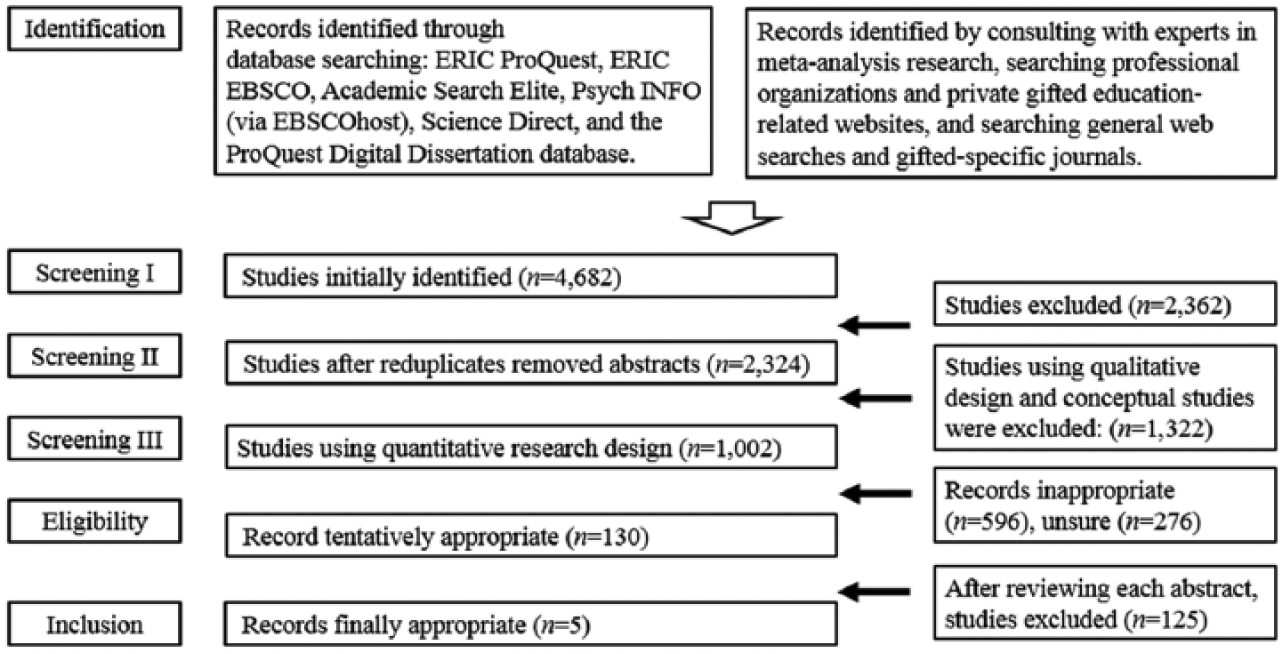
Selection process.
Then, we exported the remaining articles from EndNote to an Excel file, and it resulted in a total of 1,002 reports. We categorized the 1,002 articles into three categories: appropriate (n = 130), inappropriate (n = 596), and unsure (n = 276). When there was any disagreement about whether to keep or remove an article into our meta-analysis, we reviewed the full text. Next, we reviewed the full PDF file of each of 130 articles; 125 articles that did not meet the selection criteria were deleted. This process resulted in our collection of five studies: three journal articles and two dissertations.
To decide whether to conduct a meta-analysis or not with five articles, we considered whether the evaluation of a substantial body of literature would present statistical foundations and meaningful insights (Valentine, Pigott, & Rothstein, 2010). According to Valentine et al. (2010), “two studies” answered the question, “How many studies do you need to do a meta-analysis?” As such, the number of studies included in our meta-analysis was considered reasonable as they provided significant statistical information and could offer valuable insights into gifted programs for minority students.
Coding
Based on the literature (Asher, 2003; Rosenblad, 2009; Schroeder, Scott, Tolson, Huang, & Lee, 2007), we developed an Excel codebook for data extraction. In this codebook, we included study characteristics and format of the data. Study characteristics included (a) study number and citation information, (b) author(s), (c) publication year, (d) type of article (i.e., journal article or dissertation), (e) research design (i.e., experimental, quasi-experimental), (f) data collection methods, (g) characteristics of the gifted education programs (e.g., length of time, program details), (h) program location/setting, (i) sample size and characteristics of participants, (j) outcome variables (e.g., type of measure, measure name, and areas to be measured), and (k) brief study findings. Format of the data included (a) mean, standard deviation, and sample size; (b) statistics and associated degrees of freedom; and (c) effect size. To increase the stability of findings, the first and second authors independently coded the whole data, exchanged the codes, cross-checked, and discussed discrepancies. We discussed how to deal with any ambiguous and/or missing data. Then we independently coded the data of the remaining studies. When we cross-checked, there was no major discrepancy among us.
Data Analysis
RevMan 5.2 (Cochrane Centre), commonly used in the social science and medical fields, was used for data analysis in the current study (Bailey et al., 2009; Jiménez-Barbero, Ruiz-Hernández, Llor-Zaragoza, Pérez-García, & Llor-Esteban, 2016; Park-Higgerson, Perumean-Chaney, Bartolucci, Grimley, & Singh, 2008; Van Daele, Hermans, Van Audenhove, & Van den Bergh, 2012; Walsh, Zwi, Woolfenden, & Shlonsky, 2015). We used a random effects model to account for the variability in the individual program’s effect sizes. A random effects model is preferred over a fixed effects model in meta-analysis when interventions and outcome measures across different studies are not exactly the same (Higgins & Green, 2011), which was the case for the present study.
Both the overall effects of different intervention programs and the effects in subgroups (by grade level and program developer) were examined. Meta-analyses for outcome measures were conducted to estimate the mean effect size and 95% confidence interval. In meta-analysis, the pooled estimate was obtained using standardized mean differences (SMD), often referred to as Hedge’s g, because SMD accounts for variations in units by converting to standard deviations (Deeks, Higgins, & Altman, 2008; Lipsey & Wilson, 2001). The SMD provides size of the treatment effect relative to the variability observed in different studies (Katz, O’Connell, Njike, Yeh, & Nawaz, 2008). Effect size comparisons for different subgroups were also performed using the 95% confidence intervals (CIs) around the pooled SMD. A positive SMD indicated superiority/effectiveness of interventions in experiment groups as compared with control groups.
As meta-analyses summarize the results across different studies that include different analysis methods, topics of interest, and findings, researchers should consider the issues related to heterogeneity to determine whether the variation observed in results across different studies is greater than that expected by chance (Deeks et al., 2008; Lipsey & Wilson, 2001). To analyze heterogeneity, we estimated the values of the I2 index in pooled data. I2 index is a statistical tool commonly used in reporting heterogeneity by estimating the percentage of total variation across trials (Higgins & Green, 2011; Higgins & Thompson, 2002). This index provides the degree of inconsistency of the intervention results, and this value is expressed as a percentage of the total variation across trials that are attributed to heterogeneity occurring rather than by chance (Huedo-Medina, Sánchez-Meca, Marín-Martínez, & Botella, 2006; Katz et al., 2008). Interpretation of the values of I2 was based on Higgins and Thompson’s (2002) criteria indicating that percentages roughly around 25%, 50%, and 75% are considered “low,” “medium,” and “high” heterogeneity, respectively. Forest plots were also examined to identify if there were any significant outliers and significant outliers were not identified.
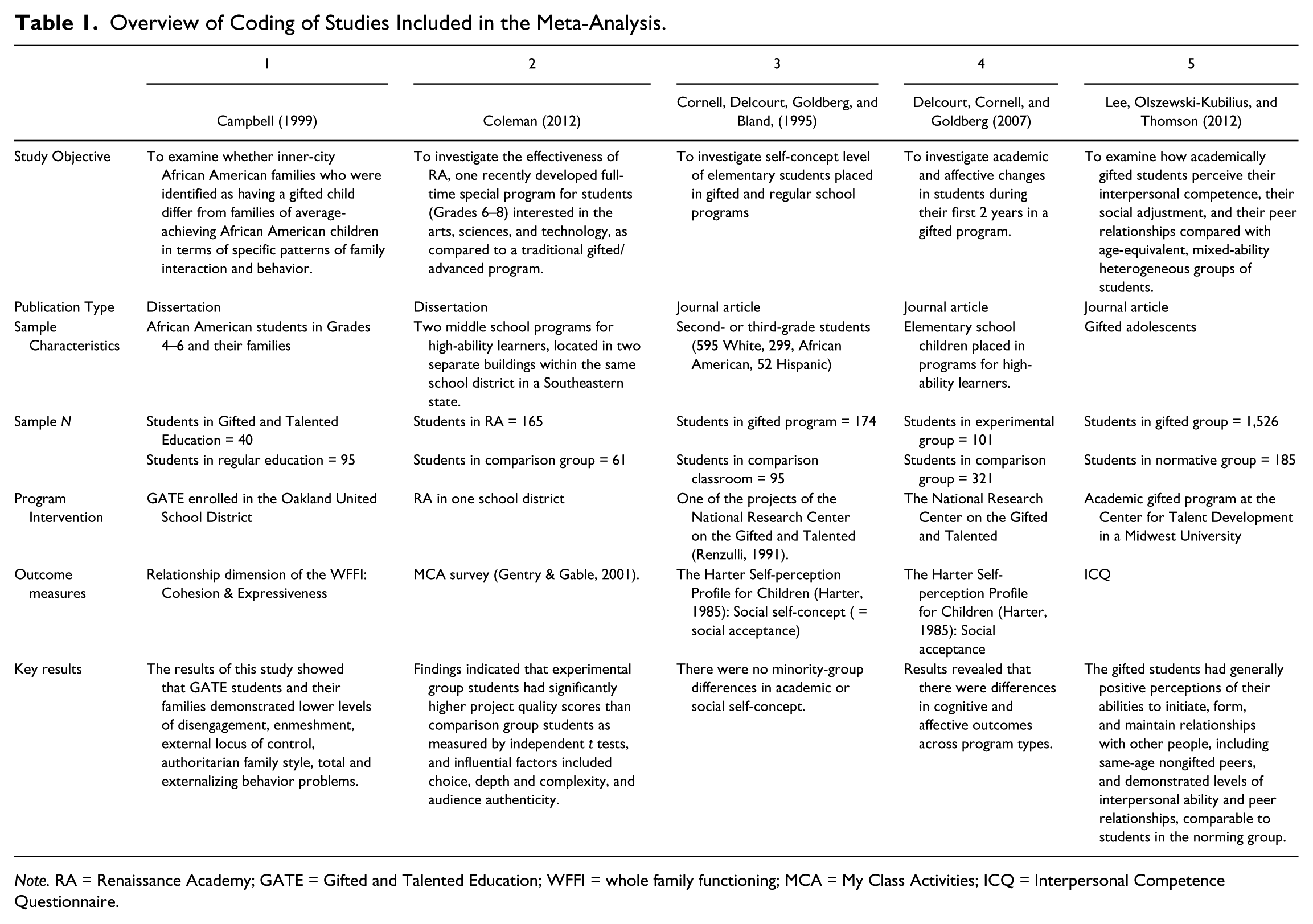
To evaluate publication bias, such as the impact of studies missing from the meta-analysis (Sutton, Duval, Tweedie, Abrams, & Jones, 2000), we conducted a sensitivity analysis using funnel-plot, which represents the magnitude of the effect of each trial compared with a measure of its size, including the standard error (Sutton et al., 2000). In this study, the distribution was symmetrical; thus, there was no major publication bias that would compromise the interpretation of effect sizes found. Finally, we explored study variables and characteristics of the gifted education program in each study (see Table 1).
Overview of Coding of Studies Included in the Meta-Analysis.
Note. RA = Renaissance Academy; GATE = Gifted and Talented Education; WFFI = whole family functioning; MCA = My Class Activities; ICQ = Interpersonal Competence Questionnaire.
Results
This section provides (a) the descriptive information about each of the five gifted program examined in the current meta-analysis, (b) the overall intervention effects of the five gifted programs, and (c) the intervention effects by subgroups. The five studies in the meta-analysis included samples of elementary and high school students and implemented different types of gifted programs. The results showed that gifted education programs had positive influence on the psychological well-being of gifted racial/ethnic minority students. However, when analyzing intervention effect sizes for the first subgroups (i.e., elementary-school-level programs vs. secondary-school-level programs), there were no statistically significant group differences. Similar results were found when comparing intervention effect sizes for the second subgroups (i.e., types of programs; locally developed vs. nationally developed).
An overview of the included studies is presented in Table 1. The descriptive information for the five studies is provided, including contributors, publication year, study objective, publication type, sample size, intervention used, outcome measures, and key results of each study. As can be seen, few studies focusing on gifted racial/ethnic minority students were published prior to the late 1990s. Intervention studies (that met selection criteria of the present study) related to gifted racial/ethnic minority students began appearing in notable qualities in the late 1990s. Regarding the study sample, three studies included students at the elementary level, while two studies included secondary-level students. In regard to intervention programs, diverse gifted education programs were provided to gifted minority students, such as Gifted and Talented Education (Campbell, 1999), Renaissance Academy (Coleman, 2012), gifted programs developed by The National Research Center on the Gifted and Talented (Cornell, Delcourt, Goldberg, & Bland, 1995; Delcourt, Cornell, & Goldberg, 2007), and gifted programs at the Center for Talent Development (Lee, Olszewski-Kubilius, & Thomson, 2012). Outcome variables and measures were also diverse across the studies; some studies explored self-concepts/self-perceptions, while others examined other psychosocial variables such as interpersonal competence.
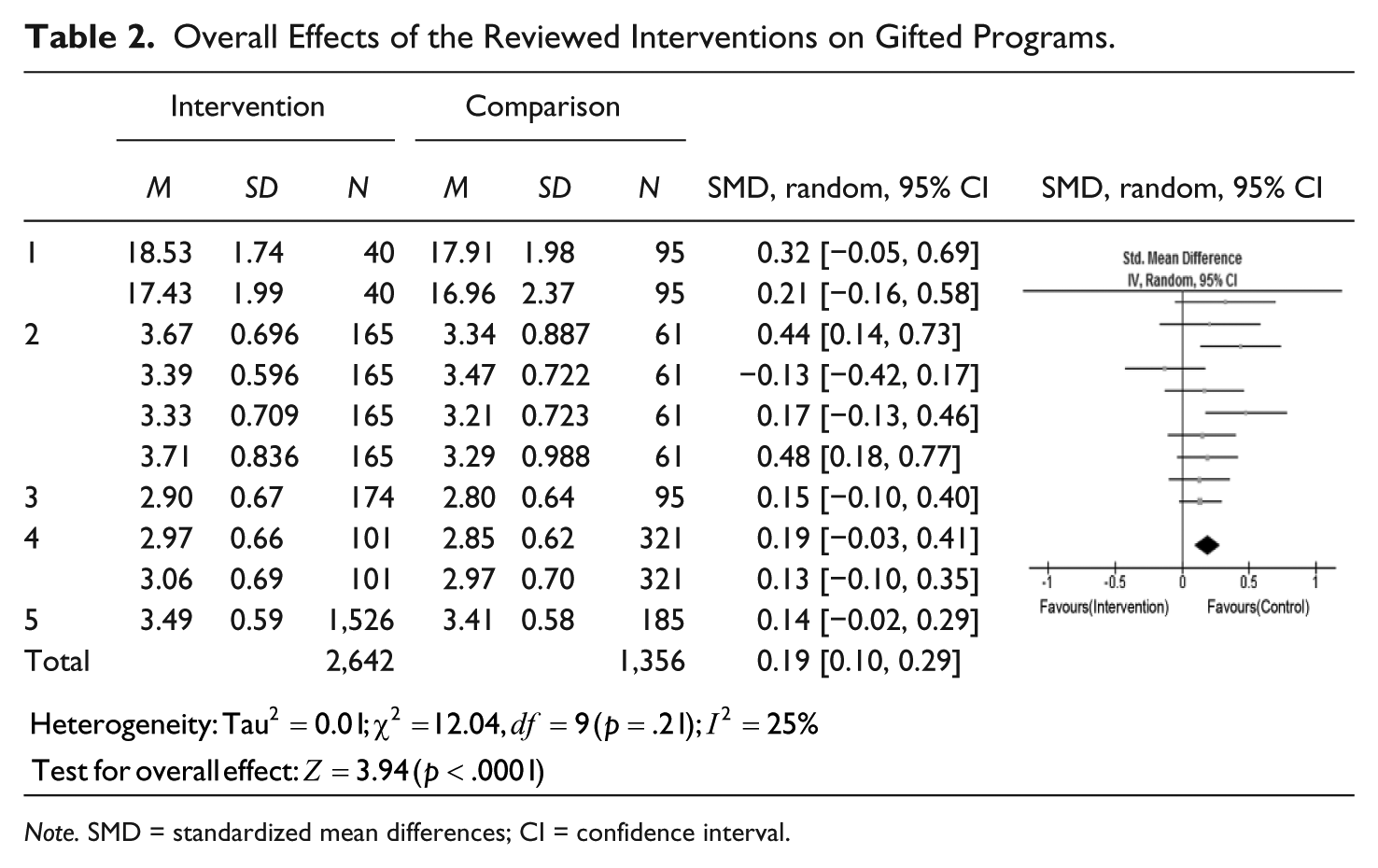
Effect sizes for the five included studies are presented in Table 2. The values of Standard Mean Differences (SMD), Risk Ratio, Chi2, df, I2, and Z are presented in Table 2. Hedges’ adjusted g, which is similar to Cohen’s d, has been implemented when calculating the SMD. As reported, the effect sizes for the studies varied from .13 to .48. This may be due to the fact that the studies were very different from each other in terms of sample size, participants’ grade level, gifted education programs used, and so forth. In meta-analysis, it is essential to measure of heterogeneity (Jiménez-Barbero et al., 2016); we used a chi square test with a significance level of .05 and calculated the I2 index to assess heterogeneity (Chi2 = 12.04, I2 = 25%). Also, we used Z scores to test overall effect and to compare mean effects (Z = 3.94). According to the rule-of-thumb interpretations of the I2 values (Higgins & Thompson, 2002), 25% equals low heterogeneity, 50% equals medium heterogeneity, and 75% equals high heterogeneity. The results in this study suggest that the percentage of total variation across studies due to heterogeneity is low (I2 = 25%).
Overall Effects of the Reviewed Interventions on Gifted Programs.
Note. SMD = standardized mean differences; CI = confidence interval.
Regarding the first research question, “What is the overall intervention effect, across the current literature, of gifted education programs on psychosocial well-being of gifted racial/ethnic minority students?” we found a statistically significant positive effect of gifted education programs on the psychosocial well-being of gifted racial/ethnic minority students (SMD = 0.19).
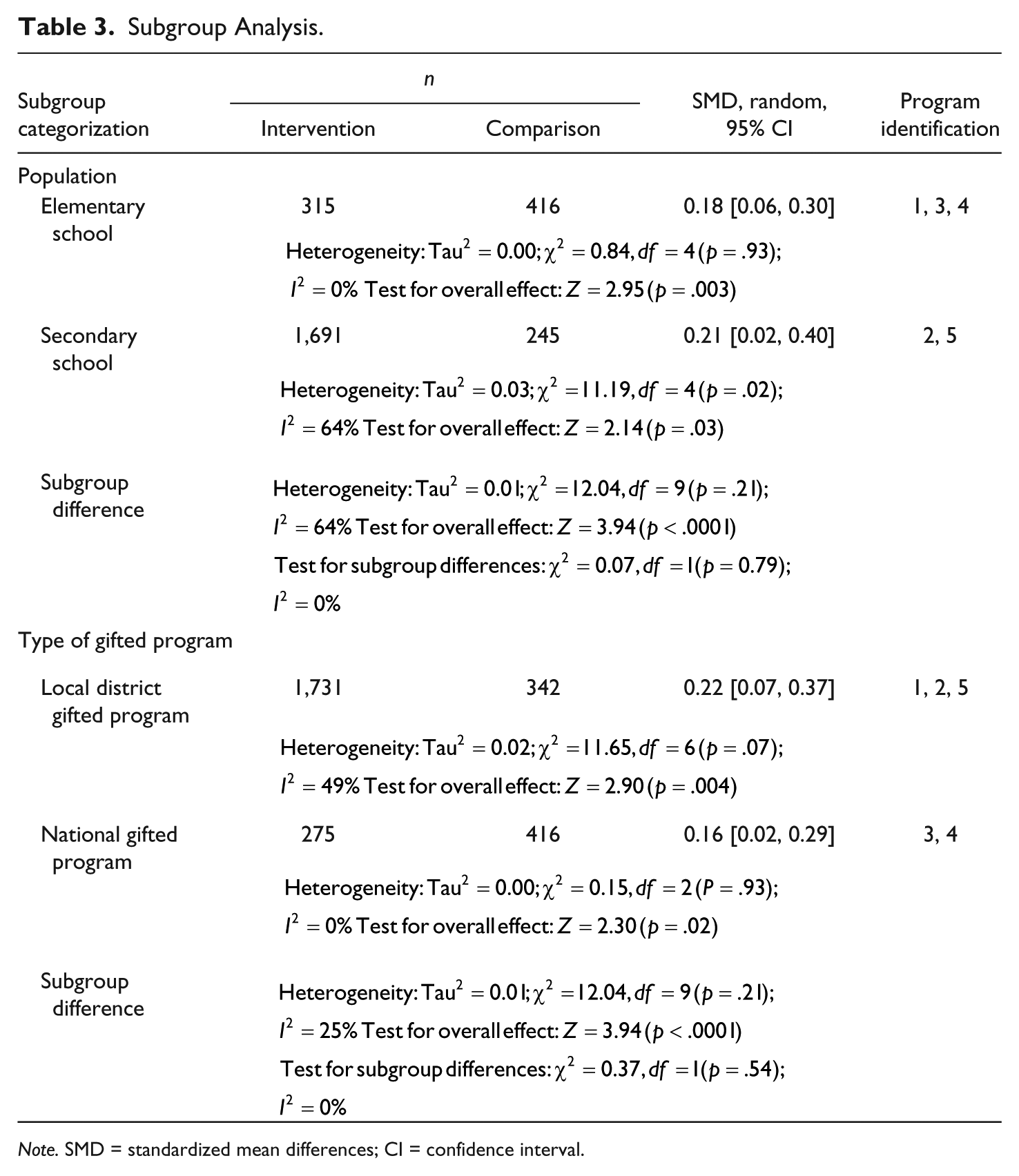
Regarding the second research question, “Are intervention effects significantly different by grade level (i.e., elementary vs. secondary) and program developer (i.e., local district vs. national institution)?” we compared intervention effect sizes for the two sets of subgroups (i.e., elementary vs. secondary; local school district programs vs. national programs). As presented in Table 3, results indicated that the difference in the effect sizes for the first subgroups comparison (elementary school students vs. secondary school students) was not statistically significant (p < .05). Likewise, there was no statistically significant difference in the effect sizes for the second subgroups comparison, local school district programs vs. national programs (p < .05).
Subgroup Analysis.
Note. SMD = standardized mean differences; CI = confidence interval.
Discussion
The present meta-analysis aimed to answer two research questions. The first question was related to the overall effect of gifted education programs in the current literature on gifted racial/ethnic minority students’ psychosocial well-being. Our findings on the overall effect size of this study support the notion that school-based gifted education programs have a positive impact on minority students’ psychosocial well-being. Although the overall effect size of .19 is technically considered small according to Cohen’s criteria, this level of effect size has been found to be typical in gifted and talented education research (Asher, 2003) and also commonly found in other meta-analyses in the education field (e.g., Van Daele et al., 2012). As such, the results can be meaningful suggesting the strength of the results, not merely the statistical significance (Asher, 2003). If the programs continue to meet the criteria set for quality, they can be viable and valuable platforms for gifted students from racial/ethnic minority groups in meeting some of their psychosocial needs. However, considering the criticisms voiced by researchers (Ford, 1996; Olszewski-Kubilius, 2006; Olszewski-Kubilius & Thomson, 2010), future programs need to pay more attention to how they could be more culturally appropriate programs.
The second research question that focused on whether the effect sizes significantly differ by grade level and program developer has the potential to contribute to the current literature by shedding light on different variables associated with intervention conditions for gifted minority students’ psychosocial well-being. According to the subgroup analyses, first, the program effect was statistically significant both at the elementary school level (p = .003) and the secondary school level (p = .03). In addition, the program effect was statistically significant for both types of programs (locally developed or nationally developed) at p = .004 and at p = .02, respectively. However, the differences in the effect sizes for the subgroup comparisons were not statistically significant at the .05 level.
Specifically, gifted programs implemented at the elementary level did not differ significantly from those implemented at the secondary level, and vice versa. The result of nonsignificant difference in the effect sizes for different grade levels (elementary vs. secondary) is the first available indicating that there is no reason to expect differences based on strictly grade- or age-relevant placement. This may be due to the possibility that inconsistency in instruments used to measure program outcomes as well as diversity in psychosocial domains being targeted and program approaches (e.g., task type, task difficulty, length) used across the studies may have influenced the result of nonsignificant subgroup difference (Callahan, 2001). The number of studies used for the group comparison might be too small to provide reliable insight as well. To have a better understanding of and insights into how different grouping methods (e.g., interclass or cross-grade grouping by needs or abilities) impact effectiveness of gifted programs for students’ psychological areas, more studies on program effectiveness involving different placement methods are warranted.
Similarly, a nonsignificant difference in the effect sizes was found for different program developers. This finding is the first to suggest that there is no reason to expect differences in program effectiveness based on at what level the programs were developed. A possible reason for this finding is that specific program features (e.g., enrichment, parent involvement) and participants’ characteristics (e.g., group membership) across the studies examined may have contributed to program effectiveness rather than simply where the programs were developed. As noted by VanTassel-Baska (2006), who conducted a content analysis of gifted program evaluation studies, it is also possible that there was inconsistency in program implementation across schools. Existing meta-analyses with gifted students in general have highlighted the importance of intervention conditions and settings in designing and implementing gifted education programs for students’ socialization and psychological adjustment (Rogers, 1991). More research is necessary to identify the impact of different program characteristics on gifted minority students’ psychosocial well-being.
This study adds to the current literature by evaluating the program characteristics and effect sizes of gifted programs designed to meet psychosocial needs of gifted minority students. One thing made clear by findings of the study is the need for more empirical research with racially/ethnically gifted minority students. Particularly, the small number of intervention studies on gifted minority students’ psychosocial development included in this meta-analysis supports the need for developing and implementing school-based programs aimed at promoting gifted minority students’ psychosocial well-being and competence. To do this, future researchers are encouraged to first gather qualitative information about the various forms, different practices, and specific components of gifted education programs. This information could then be analyzed and used in designing programs for gifted minority students. Without such information, it would be impossible to know how gifted minority students’ unique psychosocial needs are best met in gifted learning environments.
As indicated by the search of articles for this meta-analysis, many studies did not meet the selection criteria and were thus excluded from this study because of methodological weaknesses in data collection and analysis procedures. We encourage researchers first and foremost to establish standards for designing, implementing, and evaluating intervention programs to support and/or enhance psychosocial well-being of gifted minority students (Park-Higgerson et al., 2008). Also, the studies included in our analysis only reported the pre and post scores of interventions and did not provide specific information about the definition of giftedness, research methods, features of the program, and how each session of the program was implemented. We suggest that researchers report more detailed information in these areas so that differences in individual students as well as in programs could be identified, which will provide insights into gifted education programming.
Studies analyzed in the present study were less attentive in specifying study variables (i.e., different psychosocial aspects of racial/ethnic minority gifted students). Although gifted students of ethnic minority groups often struggle with diverse psychosocial problems as being minority and being talented (Ford et al., 2011; Olszewski-Kubilius & Thomson, 2010; Peterson, 2009), most studies examined in the current study focused on students’ self-concepts or interpersonal competence. Future studies need to identify and specify psychosocial issues of racial/ethnic minority students and examine how each issue could be resolved through the participation of gifted education programs.
Finally, when studying intervention programs, researchers may want to focus on programs’ long-term outcomes, obstacles and challenges, and other factors that would be helpful in better understanding the psychosocial development of gifted minority students (Van Daele et al., 2012; Walsh et al., 2015). To this end, follow-up studies to observe and identify how gifted minority students’ psychosocial development change over time after their participation in the programs are warranted. It would be also needed to hear directly from participants about their experiences and development in the programs, which will provide insight into future program development and implementation.
Limitations of the Study
This study includes some limitations that should be taken into account when interpreting its results and relating to future research. First, although the authors of the studies analyzed found promising results in gifted education programs, these findings may not generalize to other settings than those in which targeted programs were implemented. In addition, the number of studies (n = 5) analyzed was appropriate for a meta-analysis; however, the number is small. Thus, it would be difficult to generalize the results of this meta-analysis to all studies examining gifted education programs for talented racial/ethnic minority students because some studies having incomplete statistical data or inappropriate outcome reports were not included in our analysis. Moreover, the heterogeneity, predictable by the very nature of the design of the studies, in this study was reduced to some extent through the use of statistical random effects models to estimate the effect sizes and analyze the subgroups. A larger number of study samples in meta-analysis would contribute to better explain the effect sizes. Future studies need to provide strong evidence regarding the effects of program-based interventions in supporting ethnic minority gifted students’ psychosocial development.
Footnotes
Declaration of Conflicting Interests
The authors declared no potential conflicts of interest with respect to the research, authorship, and/or publication of this article.
Funding
The authors received no financial support for the research, authorship, and/or publication of this article.