







Abstract
Accessibility to gifted programs is related to processes by which students are screened for eligibility and have knowledge of options for participation. Accessibility via websites is related to usability for all users, including those with limited technology or connectivity. The purpose of the present study was to evaluate accessibility and availability of information regarding gifted education for parents of gifted students from historically marginalized student populations. We conducted a content analysis of Florida’s 74 district websites to determine accessibility and availability of gifted information. We found a disparity between accessibility based on number of clicks and availability based on embeddedness of information, although quantity of clicks was not necessarily correlated with the availability of information. Our findings led to practical implications and actionable items for educational institutions to address the potential impact of accessibility to gifted identification/program participation for students from underrepresented populations.
Disparities exist across all facets of educational programs, including gifted programming (Grissom & Redding, 2016; Hamilton et al., 2018; McBee, 2006; Peters & Engerrand, 2016). According to Peters and Engerrand (2016), inequities in gifted education are a symptom of prolonged societal dilemmas leading to lack of gifted identification and limited access to appropriate programming for students who are gifted and from underrepresented populations. Inequity refers to the disproportionate representation (i.e., underrepresentation) of students from culturally, linguistically, and/or economically diverse (CLED) backgrounds including students with low socioeconomic status (SES), English language learners, and students from racially and ethnically minority populations in gifted programs (Peters, 2022; Worrell & Dixson, 2022). Scholars in gifted education have firmly established that inequitable identification practices or unwillingness to use alternative identification practices lead to disparities in representation in gifted education programming (Bernal, 2001; Borland, 2004; Goings & Ford, 2018; Hodges et al., 2018; McBee, 2006; McBee et al., 2012; Peters & Engerrand, 2016). In addition to identification, lack of access to or even awareness of gifted education programs is likely an underlying cause to disparities in representation that plague gifted education (Assouline et al., 2017; Goings & Ford, 2018; Lu et al., 2020; Peters & Engerrand, 2016). Borland (2004) posited that the underrepresentation of CLED students has permeated gifted education by catering to the needs of more affluent, well-resourced school districts while failing to provide access to gifted programs and services for economically disadvantaged students. In essence, awareness and access are the first steps toward equity in gifted education. A child may not be identified for gifted education services if parents do not have access to information regarding those gifted education services.
An essential component to successful identification of students from marginalized populations is information and access to information about gifted education services in the local education agency (Ford, 2014a; Ford et al., 2008; Grantham, 2003; Lu et al., 2020; Olszewski-Kubilius et al., 2004; Peters et al., 2016). In other words, a first step in closing gaps in equity is for those who are marginalized to know that gifted services exist within the district and what those services entail. As such, it is paramount that information about gifted education services be made available and accessible for all parents. The lack of availability and accessibility of information can exacerbate gaps in representation (Ford, 2015; Lu et al., 2020; Peters, 2019). If parents of students from historically underrepresented populations have access to information about gifted identification, programs, and services, this can increase students’ opportunities to participate in gifted programs and services (Borland, 2004; Ecker-Lyster & Niileksela, 2017; Ford et al., 2008; Koshy et al., 2013). Olszewski-Kubilius et al. (2004) found that when parents had access to information regarding gifted programs, this prompted parents to independently seek out additional information suggesting that access to information increases opportunities for participation in gifted programs. Additionally, Mun, Ezzani, and Yeung (2021) posited that district-level efforts to engage in equitable practices can increase gifted identification and program participation among students from diverse backgrounds. Empowering students who are gifted and from marginalized populations may be partly accomplished by making information pertaining to gifted education accessible and available to students and families via district websites.
Lack of accessible and available information may influence the capacity of students who are gifted and from underrepresented populations to enter and/or succeed in appropriately matched gifted programs. Although previous research has examined systemic issues at state, local, and/or national levels and the role of parent advocacy in meeting students’ academic needs to increase the representation of students from marginalized populations in gifted programs (Mun, Ezzani, et al., 2021), the present study aims to demonstrate that in a digital age, school districts can address excellence gaps by making information regarding gifted identification/programs more readily available, transparent, and user-friendly for parents via district websites. Making information both accessible and available likely requires no additional cost in terms of money and only minimal cost in terms of effort yet potentially yields great returns in terms of academic opportunities for students who are gifted and from marginalized student populations (Kaur & Singh, 2015). Additionally, Olszewski-Kubilius et al. (2015) noted the importance of “provision of opportunities,” “early access,” and “opportunities to engage early” (p. 196).
Purpose
The purpose of this paper is to examine the accessibility and availability of information pertaining to gifted programs in Florida. Florida is a state where gifted programming is mandated (Rinn et al., 2020). As such, all districts are required to identify students for gifted education and offer gifted services. One concern amongst scholars is that a barrier to equity is access to information. According to Peters and Engerrand (2016), inequities in gifted education are a symptom of prolonged societal dilemmas leading to lack of gifted identification and limited access to appropriate programming for students who are gifted and from underrepresented populations. Current issues in gifted education reflect this sentiment resulting in the elimination of gifted education programs altogether. Alternatively, our paper is offering a viable step toward equity and eliminating barriers to gifted identification and participation. In our study, we examine the accessibility and availability of information on district websites. Research has shown that when parents are made aware of gifted education programming within school districts, gaps in equity close (Lu et al., 2020; Olszewski-Kubilius et al., 2004). Understanding the accessibility and availability of information can help frame a possible cause for gaps in equity.
To this end, we focused this study on two aspects of information: its accessibility and its availability. Accessibility is defined as the number of clicks needed to find information from the district’s homepage (Porter & Miller, 2016). Specifically, in website design, a three-click rule has been described as the optimal number of clicks when seeking information on websites (Zeldman, 2001). Availability is defined as whether the information is present within a district’s website. Examination of this relationship will consider the accessibility of information via district websites to determine how difficult or how easy it is for parents to locate pertinent information to facilitate the placement of their students who are gifted into appropriately matched curricula and programs. The following two research questions guided this study: • •
Literature Review
According to Koshy et al. (2013), parents may benefit from increased access to information regarding gifted identification, available program options, and information pertaining to the overall student population in reference to the overall gifted program population. Siegle et al. (2016) discussed the data from a school district that showed a discrepancy between “students of poverty in the district and in the middle school gifted program” (p. 10). Additionally, in a meta-analysis of 26 studies, Kim (2016) found consistent support that gifted students’ participation in enrichment programs positively influenced academic and social-emotional areas aligning with other meta-analysis findings regarding gifted pull-out and acceleration. Considering this, parents of students from marginalized populations, including English language learners, students with low SES, and students from underachieving rural or urban schools, may benefit from increased knowledge about alternative identification methods and what their schools’ policies are regarding these methods to keep school accountable in best practices for identifying culturally diverse gifted students (Ford, 2011).
Additionally, Stambaugh and Ford (2015) outlined several areas that should be addressed when working with gifted students who are from marginalized populations, such as students who are Black, Hispanic, and/or have low SES. These areas include the need for school–family collaboration and parental awareness of academic opportunities. Parents should be made aware of opportunities that may have both present and future academic consequences (Ambrose, 2013; Stambaugh & Ford, 2015). These include educational opportunities such as online resources on district websites, which is a viable venue for gaining access to information regarding academic opportunities for gifted students.
Underrepresentation in Gifted Education
Losinski et al. (2019) examined the effects of discriminatory practices and school-based behaviors on children and youth and found that schools can positively affect change in behaviors and decrease biases that negatively impact students in school settings. Indeed, schools can play a role in minimizing institutional racism and discrimination by addressing more overt behaviors at the student level including harassment and bullying and more subversive behaviors at the school level including selection bias in teacher recommendations for students of color to gifted programs and disproportionate recommendations to special education programs compared to gifted programs.
In a content analysis of five prominent gifted journals, Goings and Ford (2018) examined 22 articles to determine ways in which scholars discuss gifted education in the context of race and poverty. Their findings included overuse of deficit language when discussing the needs of historically marginalized student populations and the need to incorporate strategies to increase access to and retention in gifted programs for the target population. Additionally, in an analysis of self-assessments of the 1024 school districts in Texas, Hodges et al. (2018) found that among the factors that contributed to disproportionate representation in gifted programs of students from underrepresented populations was limited access to academic resources. The authors noted that educational policies and practices regarding gifted education may serve as potential barriers to access to gifted programming for students from historically marginalized populations. Peters et al. (2016) examined the rate of disproportionality among underrepresented populations in gifted programming in the United States in the context of state mandates regarding gifted programming and found that as recently as 2016, almost half of all U.S. schools (42.4%) indicated having no students identified as gifted. Schools with specific mandates related to gifted education had higher rates of students identified than schools without mandates. Peters et al. noted, “With regard to identification, there seems to be little relationship between a state mandate and proportionality” (p. 278). The study compared their findings to previous research by Yoon and Gentry (2009), illustrating negligible rates of increase among specific student populations between the years 2006 and 2016. In the context of increased mandates regarding gifted education policies, they found that mandates did not mitigate the underrepresentation of marginalized student populations in gifted programs. These findings suggest that more than policy mandates are needed to increase gifted identification and program participation of underrepresented students. Access and availability to information regarding gifted education may influence the rate of disproportionality among marginalized student populations in gifted programs.
Lack of access to gifted information for parents of students from underrepresented populations predates the use of websites yet persists in the information/technology age. For example, Calabrese (1990) examined the relationship between schools and parents of students from marginalized populations to determine feelings of alienation or separation from schools experienced by participants. The study found a higher mean score among minority parents regarding care and concern for their children’s education, indicating that parents of students from marginalized populations would benefit from access to information in parent-friendly and culturally responsive formats, beginning with district websites providing insight and visibility into policies, procedures, and programs, such as gifted education. Ultimately, “most minority parents felt that they lacked the personal knowledge or confidence to confront a bureaucratic institution” (Calabrese, 1990, p. 151). Presently, district websites can serve as the first line of information to equip parents with the knowledge and the confidence to approach their student’s school.
Olszewski-Kubilius et al. (2004) examined the effects of access to programming in addressing achievement gaps between minority and nonminority students. Among the factors impeding participation regarding access, the study found that providing technology alone was not enough to improve access but teaching parents and students how to effectively use technology, including offering specific classes/training, was needed to help parents and students take advantage of programs. Olszewski-Kubilius et al. also found that once information was accessible through initial participation in Project EXCITE, parents were better equipped to seek out other educational opportunities and better able to discern goodness-of-fit of program options specific to eligibility, resources, and family dynamic (e.g., Saturday and evening options). Addressing these needs includes understanding how poverty and giftedness may influence opportunities for students (Bolland et al., 2018; Stambaugh & Ford, 2015).
Access to Information and Gifted Education
Disparity in the diversity in student achievement factors into the prolonged achievement gap (Olszewski-Kubilius & Thomson, 2010). Access to information via district websites may increase gifted identification of culturally diverse students. Specifically, “when schools include parents of culturally diverse students in gifted program identification and decision-making processes, they stand a greater chance of not being overlooked” (Grantham et al., 2010, p. 146). Achievement gaps can be decreased by parental involvement and parents’ ability to address their child’s needs holistically by attending to both present educational needs and future career goals (Kerr & Sodano, 2003; Subotnik et al., 2012). Making information both accessible and available via district websites can facilitate this.
Considering the potential impact of access to information, it seems necessary to empower parents of students who are both gifted and from underrepresented populations with information that will lead to effective advocacy (see Mun, Ezzani, & Yeung, 2021). Fostering a welcoming environment via district website content invites minority parents to be involved in authentic decision-making around their student’s educational experience and future goals may lead to better opportunities for students who are gifted and from marginalized populations (Grantham et al., 2005; Tan, 2019). Informed parents may help to facilitate excellence and equity in gifted education for students who are historically underrepresented (Grantham et al., 2005). If parents have access to information, they will be better equipped to facilitate their students’ educational needs.
In a review of the literature, Fischer et al. (2019) posited that although parents of all SES (low, mid, and high) want to help their children attain the best educational opportunities available to them, parents in middle and upper strata of SES “can confidently access information they need about possible education pathways within and beyond school” (p. 199). This includes knowing how to access information regarding needed support such as financial resources. Following a review of program evaluations, Fischer et al. recommended using several strategies based on four successful programs to increase parent engagement among parents with low SES, including providing early access, presenting information in culturally sensitive formats, presenting information in multiple languages, and being culturally responsive to specific informational needs, empowering parents to be aware of and take action on inequitable education practices. Additionally, several areas to increase parent engagement were recommended including the use of internet/media (Emerson et al., 2012, as cited in Fischer et al., 2019). These strategies and suggestions can be applied to the effective use of district websites to enable parents of students from marginalized populations to have agency to advocate for their gifted students and to seek out and take advantage of appropriate academic opportunities within the district.
Accessing Information Via Websites
In a qualitative study of the usability of a school website, Kokil and Scott (2017) found that the 10 female parent participants benefited most from the school website if their student attended the school suggesting that an existing familiarity with the school made navigation on the website easier. The study also found that the likability of the visual appearance of the website did not translate into usability of the website. Additional findings included that headings and labels on websites did not always lead to the information participants were seeking, and content was not well organized making it difficult for participants to access relevant information. For example, gifted information was noted as being listed under the parent resources tab, whereas participants searched under the academics tab when looking for information on gifted programs. Specifically, “nine out of ten participants thought the gifted program was misplaced under Parent Resources in the sidebar instead of under Academics (which was their first click)” (Kokil & Scott, 2017, p. 59). Participants in the study expressed frustration about the navigation paths and the need for clearer labeling to access relevant information. Additionally, Zillien and Hargittai (2009) examined the influence of SES on online activities. Although the use of websites and tools was prevalent across all socioeconomic strata, the study found that skills and quality of equipment along with access to information varied across socioeconomic strata and was higher among participants with high SES than those with low SES.
In a web-based newsletter, Lakin (2021) described the changes in access to gifted programming at Thomas Jefferson High School for Science and Technology, a nationally ranked elite school in Fairfax, VA. Prior to the recent changes, access to gifted programming was disproportionate based on school versus community demographics (e.g., 70% Asian population and 20% Asian population, respectively). Intentional efforts to address achievement gaps and to create more academic opportunity for students from diverse backgrounds included changes to program admission, such as increasing the number of incoming freshman; increasing outreach efforts by making information known and accessible to a greater, more diverse audience; minimizing barriers, such as application fee, testing requirements, and teacher recommendations; and recognizing local norms by saving seats specifically for top ranking students in middle schools across the community. The results of these efforts indicate that research-based practices, including access to information, work to improve the participation of diverse student populations in gifted programming.
Lu et al. (2020) used New York City’s Department of Education data to examine the relationship between test-taking gaps for participation in gifted and talented (GT) programs and access to information regarding GT programs among public school and nonpublic school kindergarteners from 2008 to 2011. The authors found that the public school cohort had greater access to information and higher rates of GT test-taking than the nonpublic school cohort. Specifically, the authors found that “greater dosage levels of information were associated with greater rates of G & T test-taking” (p. 270). These findings suggest that access to information is directly linked to closing achievement gaps and facilitating participation in GT programs. This highlights the importance of increasing accessibility of information for families via district websites as a basic mechanism to decrease achievement gaps for diverse student populations in GT programming. Lu et al. posited that the lack of access to information for parents of students from CLED backgrounds regarding GT education diminishes the likelihood of policy changes that could potentially reduce the current demographic disparities in GT identification and programming. Recommendations for future research included the need to qualitatively assess the perceived accessibility of information among parents from diverse populations.
Key Online Information Pertaining to Gifted Education Services
Website users primarily seek information that is easy to access, can be accessed in a timely manner, and provides the information pertaining to a particular topic of interest (Kaur & Singh, 2015). When seeking information about gifted services, three specific pieces of information are needed to initiate the accommodating needs of gifted students, including contact information, eligibility/identification information, and program information. These items represent the minimum amount of information required to pursue academic options for gifted students. Additional information could include grade-level information, acceleration policies, type programs, deadlines for scholarships or program applications, and the like.
Hartshorne et al. (2008) examined the goals and functions of 50 randomly selected elementary school websites and rated the websites based on a specific checklist. The checklist included the following: design, structural, content, and general elements. Each of the elements encompassed aspects of the website’s usability such as user-friendliness, navigation, and organization of content. Using a devised scale of 1–100 based on the checklist, the authors rated websites as poor, below average, average, good, and exemplary and found a wide disparity between the efficacy of websites with 0% of websites acquiring an exemplary rating and 34% acquiring a poor rating. The areas with the lowest ratings among all the websites included content, structure, and general elements. The findings suggest that websites did not provide sufficient access to various stakeholders or serve as an informational resource in the educational process. Additionally, the authors discussed the lack of equity and inclusion via internet-related standards of accessibility to information on websites outlined by the Web Access Initiative (WAI), a resource available to check accessibility of information for all websites. The authors suggest the need for further research on ways in which various stakeholders (e.g., teachers, parents, and students) use websites and the kind of information they value to improve accessibility to relevant information and resources. The following statement is telling regarding the need for improvement due to the ineffective utility of some school websites, “As opposed to creating a site that promotes the involvement of stakeholder interaction, the majority of schools used their Web site as a vehicle to post general information about their school” (p. 299).
Florida Education Websites
The Florida Department of Education’s (FLDOE) website contains information regarding school districts, cities, and superintendents. The website also contains district- and state-level report card information including graduation rates, school status, and the like. Navigating the website provides the user with in-depth information about the enrollment status, free and reduced lunch (FRL) data, and academic condition of Florida’s school districts. This includes the enrollment in gifted programs/services by race/ethnicity, which includes the following information for the 2020–2021 school year: total enrollment (N = 166,312); White (n = 80,762); Black or African American (n = 15,589); Hispanic/Latino (n = 51,646); Asian (n = 11,000); Native Hawaiian or Other Pacific Islander (n = 234); Native American or Alaska Native (n = 297); and two or more races (n = 6,784; FLDOE, 2021). Although this information is good to know, the navigational path to access it included using the search bar, choosing among four links leading to a page with 10 sections with multiple links per section. Navigating the website is not only a matter of sifting through multiple layers, but it is also a matter of knowing in advance which layers to pursue or ignore. Barriers to parental involvement result in a general lack of access to information about educational programs and tools for gifted students from historically underrepresented and underserved populations (Olszewski-Kubilius et al., 2004). Regarding nuanced information about gifted programs and services, the FLDOE website recommends parents and users visit the individual district’s website. Each district website varies to some degree its display of content, design, and navigational path to find gifted information. There is no designated uniformity required regarding district websites’ structure, design, and/or content to present information in a parent-friendly format when seeking specific programs and services related to gifted education.
Contact Information
Contact information includes information for gifted teachers and/or gifted program coordinators. This information is useful to parents seeking information about gifted programs and services. Contact information is the minimal information needed to find answers to any questions parents may have.
Information on Eligibility
Information regarding eligibility should include requirements, test options, gifted characteristic checklists, teacher/parent recommendations, alternative identification practices, or other information relevant to the process and procedures of gifted identification. Providing clear and accessible information can help parents be equipped with pertinent knowledge to move forward with program options that match their students’ ability. Parents would also be made aware of what if any steps they need to take prior to requesting programs and services to meet their students’ academic and/or social-emotional needs. Eligibility information for parents should include Florida’s statewide criteria for gifted.
Information on Programming
Gifted programs and services can range from pull-out, push-in, enrichment, acceleration, advanced coursework, and dual-enrollment. Information regarding districts’ programs can help determine goodness-of-fit for gifted students. Because the FLDOE recommends visiting district websites to find specific information regarding programs and services, it seems incumbent upon each school district to provide clear and accessible information regarding gifted programs and services.
Florida Gifted Education
Due to Florida’s gifted education mandates, scholars have studied it extensively. Florida’s definition of giftedness is as follows: “students who have superior intellectual development and are capable of high performance” (FLDOE, 2021). The FLDOE has made efforts to increase the gifted identification of underrepresented populations by maintaining a Plan A and a Plan B.
As of 2017, FLDOE’s Florida Plan for K–12 Gifted Education document outlined the following identification goal: The state will identify methods for district-wide screening intended to increase appropriate identification of students from all populations beginning at an early age. The state will provide support to districts as they increase access to students of diverse backgrounds across the state. Indicator 1.1: The number of students identified as eligible for gifted services will match the student population for each subgroup within twenty percent. (p. 9)
In the 2015–2016 school year, the percentage of identified gifted students was 5.92%, that is, 165,445 gifted students within a student population of 2,792,234. Florida’s gifted identification rule, Rule 6A-6.03019, has two parts, part a and part b. Part a describes the “need for the program, a majority of characteristics of gifted students as evidenced on a scale or checklist, and measured intelligence of two or more standard deviations above the mean” and part b, also known as Plan B, was “written for students who are members of an underrepresented group” and described as “a plan for increasing the participation of underrepresented groups in programs for gifted students” (FLDOE, 2021).
Hodges and Gentry (2021) examined the ratio of students from underrepresented populations compared to Asian and White students across Florida’s 74 school districts and found that when combined students from underrepresented populations represent half of all gifted students in Florida’s gifted programs compared to students who are from Asian and White populations. McBee et al. (2012) examined the impact of state-level policies on the gifted identification of underrepresented populations in the state of Florida. Specifically, the authors wished to examine Florida’s alternative “Plan B” for identification. Under this plan, districts could develop alternative identification plans for students who were English language learners or qualified for federal meal subsidies (FLDOE, 2017; Matthews, 2007). Matthews and Shaunessy (2010) developed a checklist to evaluate the implementation and efficacy of NAGC Pre-K–Grade 12 Gifted Programming Standards among 43 district gifted plans in Florida. The authors examined the impact of Florida’s Plan B for gifted identification regarding equity in representation in gifted programs. Their findings included disparities in practice that did not align, or inconsistently aligned, with NAGC Programming Standards. Extending upon the work of Matthews and Shaunessy (2010), McBee et al. (2012) found that in districts that implemented Plan B, representation increased for gifted identification among students with low SES as determined by FRL data and among students identified as Black. As such, this research provides evidence of limited success of Florida’s Plan B.
Methods
Data
Utilizing existing information from Florida school district websites from FLDOE, data were collected using Florida district websites to determine accessibility to parents of information on gifted programming, eligibility, and identification criteria. Florida has 67 counties and 74 school districts including research schools, schools for the deaf, and youth centers. The data collected examined the 74 district websites.
To analyze the ease of access and availability of gifted information, we analyzed all school public district websites in the state of Florida. We collected the number of clicks needed to access gifted education information and noted what information was available. To determine the availability of data, we looked for the three categories of information based on the criteria of Olszewski-Kubilius et al. (2004): • • •
The data collection process was as follows: 1. Team members first located the URL of gifted education sites using a search engine (e.g., Google). 2. A team member visited each district’s main page and explored the link on the home page using the district URL as a guide. 3. The team member wrote the number of clicks needed to access to get the GT landing page. 4. The team member noted the information available and to which categories that information pertains. 5. A second team member repeated the above steps. 6. When two team members disagreed, they discussed with the team member who obtained the fewest clicks demonstrating the path they took to navigate through the district website to access the gifted information.
Data Analysis Plan
A descriptive analysis was used to analyze our data. In our analysis, we include descriptive statistics in addition to data visualizations. We descriptively analyzed the number of clicks needed to access information pertaining to gifted education services and what information was available.
Click was defined as the point at which website users make navigation decisions on a website in search of specific or general information. Using a mouse or mouse pad to hover over a particular text, image, or link related to a topic of information, users then selected the appropriate item by “clicking” on it. Kaur and Singh (2015) examined click analytics of an educational website and found that users clicked on texts at a rate of 24.23% and users clicked on links at a rate of 55.59%. From their findings, the authors posited that website developers did not adequately anticipate how users would navigate the website or what was important to users when seeking information. Additionally, the results of click analytics showed that website design misled users with images, vague descriptions, and size of hyperlinks.
Results
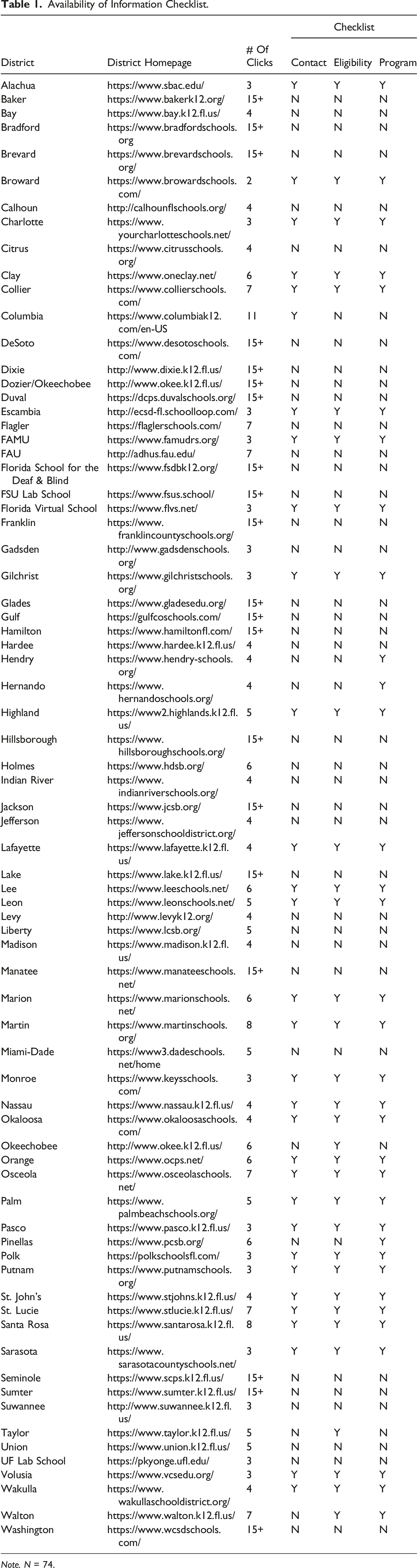
Five district websites had optimal number of clicks (three) but led to no gifted information, broken links, or to external links (e.g., FLDOE website, and blogs). Sixteen sites had greater than optimal number of clicks (more than three). Number of clicks did not necessarily equate to good or bad information. This finding was similar to Hartshorne et al.’s (2008) findings that indicated that “good design did not necessarily lead to a high overall score” of websites (p. 299). Ideally, the optimal number of clicks is three, and the number of clicks at which people give up searching for information on websites is fifteen (Jiménez Iglesias et al., 2018; Porter & Miller, 2016). Sites with the optimal number of clicks (three) and containing all three components of the information checklist (contact information, eligibility/identification information, and program information) are examples of high accessibility and availability of information for parents looking to learn about giftedness or facilitate their gifted child’s learning options.
In addition to counting the number of clicks to determine the embeddedness of information, we devised a checklist of criteria to determine the availability of relevant information regarding GT on district websites. Our checklist criteria included the following three items: contact information, identification process, and programming options. We used Y/N responses to each of these checklist items to assess the availability of relevant GT information on the 74 district websites.
Based on the checklist criteria, we found that 56% of the websites contained no contact information, 53% contained no eligibility/identification information, and 51% contained no programming options information. Figure 1 contains information from websites with discoverable content regarding accessibility based on number of clicks and availability of information based on checklist criteria. Accessibility and quality of gifted information.Note. District websites containing discoverable content with gifted information are listed. District websites containing no content with gifted information are not listed.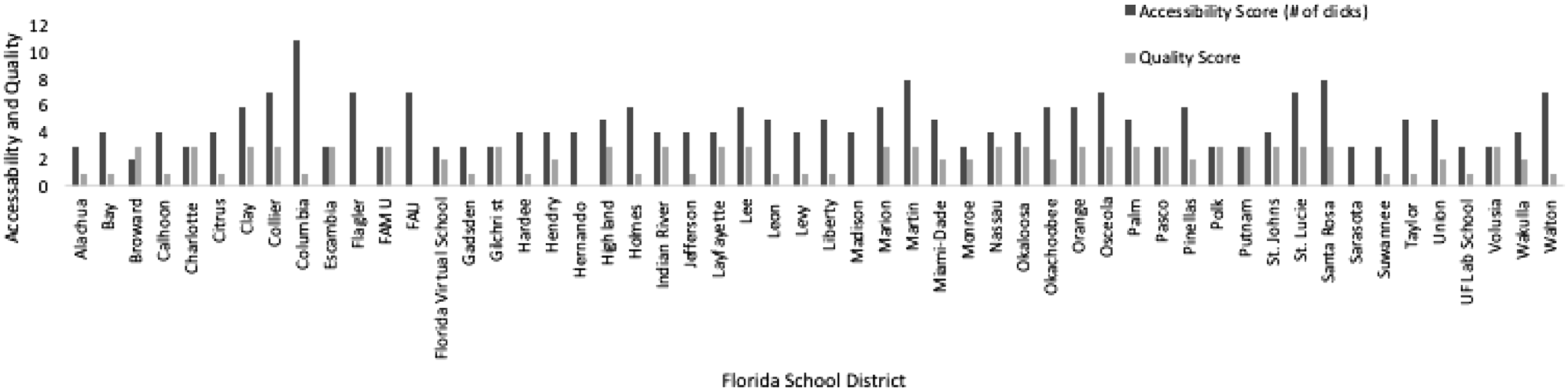
Availability of Information Checklist.
Note. N = 74.
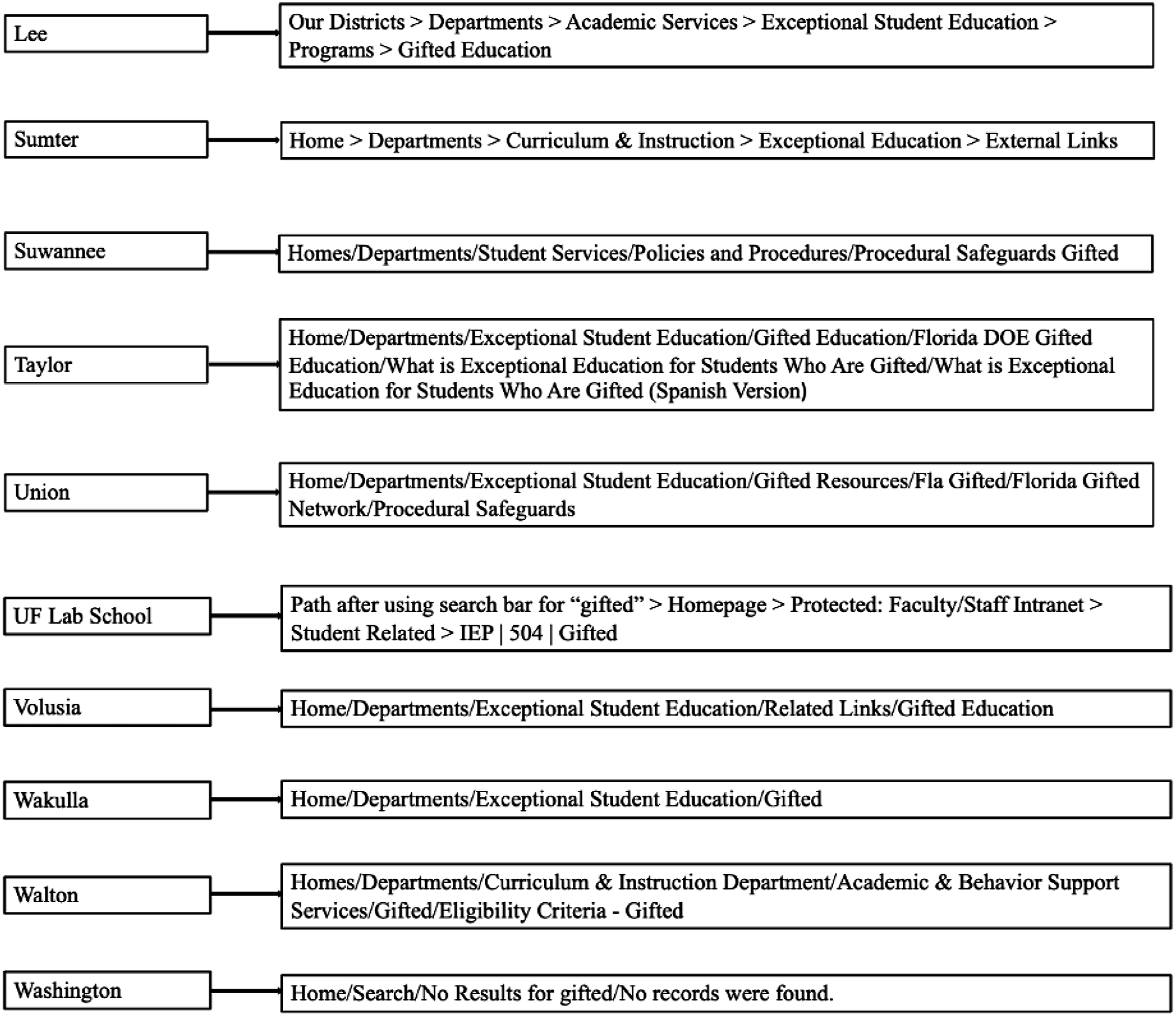
Examples of web paths to gifted information on Florida district websites. Note. Web paths varied across district websites. Both/ and > represent the next step in a website’s path
The use of mobile devices is prevalent across all levels of SES. Considering this, we checked the responsiveness versus nonresponsiveness of each district’s website and found that only two districts had nonresponsive mobile websites. Responsiveness was defined as the adaptability of the website layout in the context of the device used and ability to rapidly address issues related to screen resolution (Tubin & Klein, 2007; Zhou, 2011). This suggests that accessibility and availability of information is impeded by its existence or nonexistence on district websites rather than by device used.
Discussion
In our analysis of accessibility and availability of gifted information on Florida district websites, the findings indicate that Florida websites can be improved. Improvements include ensuring that pertinent gifted information such as contact information, eligibility requirements, identification criteria, and program options are displayed in a user-friendly format on district websites (Hartshorne et al., 2008). Furthermore, our findings confirmed what previous literature has stated regarding aesthetics alone. That is, although the visual aspects of websites are helpful, they are not enough to enable user-friendliness of websites. Both placement of information (accessibility) and presence of useful content (availability) are needed for the websites to be useful to parents of gifted students.
Although limited access to information may be unintentional, once it is found that discrimination exists as indicated by insufficient access to pertinent information related to GT programming and identification for parents of students from marginalized populations, corrections and/or reversals of such practices should be made to better equip parents to with information regarding academic resources for their gifted students (Olszewski-Kubilius et al., 2004). Ford (2014b) posited that “once it is found that such students are negatively impacted by attitudes, instruments, policies, and procedures, if changes are not made discrimination may be in operation” (p. 147). This may very well include information about gifted programming that is readily available on district websites. Parents of gifted students need help navigating the educational system beginning with access to basic information regarding identification, processes, procedures, and program options (Matthews, 2007; Morawska & Sanders, 2009).
Lack of access and availability of information may impede parents’ ability to appropriately address the needs of their gifted students (Grantham et al., 2010) Additionally, potential difficulty in accessing can lead to inequities (Lu et al., 2020). Parents should be empowered to have an active role and should be considered a viable resource in identifying their students’ giftedness (Gross, 1999; Jolly & Matthews, 2012; McBee et al., 2012; Peters & Engerrand, 2016). For parents to fulfill this role, barriers such as poorly designed websites, information deficits via websites, and unresponsive websites should be addressed by Florida’s school districts (Fischer et al., 2019; Lakin, 2021).
Providing access and availability regarding gifted information to parents is a good starting point in valuing parents as significant stakeholders in their students’ education and will help to minimize achievement gaps in gifted education (Lu et al., 2020: Subotnik et al., 2012; Tan, 2019). Such access should begin with the least restrictive delivery format of information that is both accessible and available to parents, that is, district websites. After all, technology is meant to be a tool to alleviate challenges to accessible and available information. If limitations to information are impeded due to faulty website design, lack of usefulness, or user-friendliness of information, then technology via district websites is not functioning effectively (Fischer et al., 2019; Hartshorne et al., 2008).
Implications for Practice
In a digital era and information age where technology is readily available in settings such as public libraries (e.g., free computers and internet access) or retail spaces (e.g., coffee shops with free internet access), it seems imperative to ensure information is available and integral once such barriers are removed. This study aims to bring awareness to the need of making online information regarding GT identification and programs accessible to parents of students from diverse backgrounds with the understanding that knowledge is power, that is power to have options, understanding, and pertinent details regarding eligibility for and participation in gifted programs (Subotnik et al., 2012). Providing easy access and usability to information regarding available policies, procedures, and services will potentially increase the representation of students from CLED backgrounds in gifted programs.
In a report aimed at demonstrating the disproportionality of students from diverse backgrounds represented in gifted programs, Payne (2011) made several suggestions to school administrators to address demographic disparities in gifted programs compared to overall school demographics. One suggestion was to expand the referral process to include parents, peers, and self rather than limiting referrals to those made by teachers. Ensuring availability and access to information on district websites can be a path to facilitating the acquisition of knowledge needed for parents to effectively refer and/or advocate for gifted students from diverse backgrounds.
In a case study of a school district, Mun, Ezzani, Lee, and Ottwein (2021) examined the effects of building local and district systemic capacity to improve gifted services and programs for CLED students and found a relationship between systemic capacity and conceptions of giftedness with equitable practices of identifying and serving diverse gifted populations. This relationship indicates that those working with gifted students from diverse populations both at school and district levels should have shared understandings and goals in efforts to best identify and serve CLED students who are gifted (Matthews & Shaunessy, 2010). The role of building systemic capacity shapes the actions of those working with gifted students to address inequities that exist including engaging in professional development, collaboration, and adapting understandings of giftedness across diverse populations. Collaborative efforts can extend to including parents of CLED students who are gifted to increase the identification of and participation in gifted programs. Collaboration can begin with ensuring information is disseminated on district websites ultimately leading to the voice and agency of minority parents to advocate on the behalf of their students.
School Level: Administration
Administrators should provide information regarding gifted eligibility and programs in multiple languages (e.g., procedural safeguards are often available in English and Spanish). Administration should also disclose state- and district-level data on number of students served in gifted programs including student demographics, information for transferring students, description of process and timeline, scholarship information for selective programs that involve resources beyond the regular school day, transportation if off site from school, and transparency of information including credentials of those working with gifted populations from diverse backgrounds. Overall descriptions of program goals and objectives should be outlined to better align with program outcomes (Rothenbusch et al., 2016).
Program Level: Gifted Teachers, Specialists, and Coordinators
Gifted teachers, specialists, and coordinators should include information such as links to gifted websites; activities; specific school and program offerings; grade-level services and delivery models; contact information; qualifications of teachers, specialist, and coordinators; schedule of services; and programming standards (e.g., Florida Framework for Gifted Learners and NAGC Programming Standards). Additionally, information regarding meetings to establish eligibility, assessment procedures, and the development of educational plan (EP) should be provided.
Family Level: Parents and Caregivers
Parents should have access to and be made aware of what information to look for regarding gifted education on district websites. Accessible information should include the following: eligibility criteria; program options; program types (e.g., pull-out, resource, push-in, acceleration, enrichment, advanced academics, on-campus or off-campus programs, and transportation); teachers, specialist, and coordinators contact information; gifted credentials of those working with gifted students; deadlines to apply or sign-up; grade-level information; transportation; and delivery model (e.g., service driven vs. enrichment). Additionally, parents should know about procedural safeguards, options to accept/decline services, consent to eligibility process, option to bring a person of choice to EP meeting, and review and renewal timelines.
Limitations and Future Research
One limitation of the current study includes not addressing limited internet access, which may be a barrier to the accessibility of information. Addressing connectivity issues may reveal more inequity among vulnerable populations. Further research may provide insights into how internet access limits the flow of information for parents who cannot afford steady access due to time or financial constraints. Additionally, future research is needed to provide insights into the potential relationship between accessibility of gifted information via district websites and accessibility to GT programs for students from diverse backgrounds. Another limitation of the study includes not evaluating the accessibility of information for parents whose first language is not English. As the websites were evaluated based on assuming reading proficiency in English only, future research is needed to address any potential language barriers that may impede access to information via district websites. Another limitation of the current study is not examining the current context of education given the recent lived experience of a global pandemic where school districts had to quickly shift to virtual environments. Future research is needed to understand how this increased or decreased gifted program participation among students from diverse backgrounds.
Conclusion
Creating access on district websites may be the first step in equipping parents with the knowledge and power needed to advocate for students from diverse backgrounds. Accessibility should include the least embedded path to find information and the most up-to-date, useful information available for parents. In addition to improving accessibility via district websites, more outreach, education, and support may be needed for parents to be included in the process of addressing achievement gaps by having access to quality information to facilitate the academic opportunities for their gifted students (Ambrose, 2002). Access to information and resources leads to more knowledge, thus more agency of parents to seek out more opportunities to address their gifted students’ academic needs (Olszewski-Kubilius et al., 2004).
Once parents have knowledge of programs and accessibility to technology, parents are more likely to seek out academic opportunities for their students rather than needing to wait for opportunities to find their students (Olszewski-Kubilius et al., 2004; Olszewski-Kubilius & Thomson, 2010). Plucker and Peters (2018) outlined three components of realistic opportunities including “a realistic chance of accessing the opportunity” (p. 62). Equipping parents with the tools to seek out information and ensuring access to quality information is the foundation of empowering parents of students from diverse backgrounds to advocate on their students’ behalf and to seek out opportunities to facilitate the needs of their gifted children. A call to change to eliminate inequity in gifted education has long been acknowledged (Peters, 2022). We hope our findings aid in making practical changes to improve accessibility to information regarding gifted identification, programs, and services via district websites.
Footnotes
Declaration of Conflicting Interests
The author(s) declared no potential conflicts of interest with respect to the research, authorship, and/or publication of this article.
Funding
The author(s) received no financial support for the research, authorship, and/or publication of this article.
