







Abstract
This review was conducted to evaluate the current body of scholarly research regarding the use of computer-assisted instruction (CAI) to teach mathematics to students with specific learning disability (SLD). For many years, computers are utilized for educational purposes. However, the effectiveness of CAI for teaching mathematics to this specific group of students is unclear. First, a brief review of the diagnosis of SLD, the importance of mathematics instruction for these students, and the use of computers in the classroom is provided. Next, a review of the current body of research is presented. Finally, suggestions for future research are discussed. Since 1981, a total of 25 research studies have been published, focusing exclusively on using CAI for teaching mathematics to students with SLD. This review examines the current body of research for this area. In addition, the author provides recommendations for future research on this important subject for this category of students.
Using computers to teach students is not a new idea. Computers have been utilized for educational purposes since 1924 (Pressey, 1926). However, the effectiveness of these programs for teaching mathematics to students with specific learning disability (SLD) is unclear. Students with SLD have unique learning characteristics and educational needs (Hallahan, Lloyd, Kauffman, Weiss, & Martinez, 2005). In addition, the need to identify and utilize best practices for use in the classroom has been well-documented (Klingner, Boardman, & McMaster, 2013; Tzivinikou & Papoutsaki, 2016). A review of the current body of recently published research on teaching mathematics to students with SLD will assist classroom teachers as well as educational researchers to determine whether a clear best practice has emerged and what still needs to be examined.
This review of literature was conducted to evaluate the current body of scholarly research regarding the use of computer-assisted instruction (CAI) to teach mathematics to students with SLD and to answer the associated research questions of the study. Initially, 238 articles were identified on the topic of using CAI to teach mathematics to students with SLD. The author then narrowed the number of studies included in the review by examining each of the articles. Only articles that provided discussion of original research on the topic of using CAI for teaching mathematics to students with SLD were included in the analysis. Articles that provided secondary analysis or discussion of the application of research conducted by others were excluded from the review. Also, studies that combined students with SLD with their nondisabled peers or students with other types of disabilities were excluded from the analysis. This filter was utilized so that only students with SLD would be at the center of the analysis.
A brief overview of students with SLD and mathematics instruction for those students will first be provided. Next, a review of the types of CAI methods and their uses will be presented. Finally, the review of the literature will be discussed, and recommendations for educators and researchers will be listed.
Students With SLD
Students with SLD are the single largest group of individuals with special needs in the classroom today (Mercer & Pullen, 2009; Pierangelo & Giuliani, 2002). Those students represent nearly half of all students in special education programs in the United States (Mercer & Pullen, 2009; National Center for Learning Disabilities, 2013). The Individuals with Disabilities Act of 2004 provides the following definition for a student with an SLD: a disorder in one or more of the basic psychological processes involved in understanding or in using language, spoken or written, which disorder may manifest itself in the imperfect ability to listen, think, speak, read, write, spell, or do mathematical calculations. Such term includes such conditions as perceptual disabilities, brain injury, minimal brain dysfunction, dyslexia, and developmental aphasia. Such term does not include a learning problem that is primarily the result of visual, hearing, or motor disabilities, of mental retardation, of emotional disturbance, or of environmental, cultural, or economic disadvantage.
Students with SLD are increasingly taught alongside their nondisabled peers in either a mainstreamed classroom or one that follows the inclusion model of service (McLeskey, 2007; Mercer & Pullen, 2009), so evaluating effective teaching strategies specifically tailored for those students can be difficult. However, the difficulty of the task should not dissuade educators and researchers from looking for best practices for teaching students with SLD.
Importance of Mathematics Instruction for Students With SLD
The importance of understanding basic mathematical concepts is unquestionable. Without mathematical skills, individuals will not be able to hold gainful employment or manage their personal finances (Abraham, Slate, Saxon, & Barnes, 2014). Individuals with disabilities, such as SLD, are especially at risk unless they can afford to pay someone to assist them with managing their finances (Rowe & Test, 2012).
Various researchers have demonstrated that students with SLD tend to fall behind their nondisabled peers as they advance to the middle school and high school levels (Kortering, deBettencourt, & Braziel, 2005; Montague & Jitendra, 2006). In addition, individuals with SLD may not be able to compete in the labor market if they do not possess basic mathematical skills once they leave high school. This, in turn, could lead those individuals into a cycle of failure, resulting in low-paying jobs and lower socioeconomic statuses (Raskind, Goldberg, Higgins, & Herman, 2002; Stultz, 2013).
Computers in Education
One of the methods suggested for assisting individuals with SLD to develop mathematics skills is using computers. Computers are becoming a common fixture in the modern American classroom. They can be in the form of desktop computers, notebook computers, or tablet devices. The declining costs of these devices coupled with recent changes in federal education policies have helped to speed the usage of computers in the K–12 environment (Janisse et al., 2014). Nearly every American student now has access to one or more types of computer devices and the Internet each day (Ditzler, Hong, & Strudler, 2016; Saine, 2012). In addition, the ratio of computers to students has increased from 26 to 1 in 1993 (J. Wilson & Notar, 2003) to around 1 to 1 today (Bean, O’Brian, & Fang, 2012; Ditzler et al., 2016).
As computers are more prevalent in the classroom, one would expect their increased usage for student education. CAI was defined as “the process by which written and visual information is presented in a logical sequence to a student by a computer” (Frenzel, 1980, p. 86). Although this definition is nearly 40 years old, it is still appropriate when discussing the CAI programs currently in use in the classroom. Modern CAI programs have varying degrees of complexity in their design and operation and can be used to teach a variety of subjects. Most CAI programs can be classified as either drill-and-practice design or game-type design.
Drill and Practice
The earliest CAI programs utilized the drill-and-practice design (Molnar, 1997). Those programs focused on repeatedly reviewing information with students to allow the students to work on a specific area of weakness (Christensen & Gerber, 1990; Stultz, 2013). One of the possible limitations of drill-and-practice CAI programs is that those programs might not be able to hold the attention of younger students or those with attention deficits (Bahr & Rieth, 1989; Okolo, 1992a). Updates to the basic drill-and-practice designs have attempted to address these shortcomings and to provide individualized feedback and instruction to students (Bragg, 2012; Burks, 2011). However, many of those changes are still in their early stages of development.
Game Type
Game-type CAI programs offer an alternative to the traditional drill-and-practice techniques. Those programs utilize technologies often associated with video games, such as high-resolution graphics, sound effects, differentiated backgrounds, and so on, to keep student attention (Okolo, 1992b). Examples of game-type CAI programs that the author has observed being used successfully with younger students include (a) Feed Me Fractions by ABCYa, (b) Fraction Fighters by Room Recess, and (c) Make One with Fractions by Math Playground. Because of their design and focus on keeping the student’s attention, game-type CAI programs may be well suited for younger students or those with attention deficits (Okolo, 1992b; Stultz, 2013). However, students at the middle and high school levels may respond better to the drill-and-practice technique (Stultz, 2013).
The Present Literature Review
Many of the studies in the current body of research have supported the use of CAI programs for students in general education classes (Christmann, Badgett, & Lucking, 1997; Li, 2002). However, most of those studies failed to focus on the effectiveness of these programs for students with SLD. This is especially true for the area of mathematics instruction.
Research Questions
This review was developed to address the following research questions:
Method
The author conducted a review of the literature to address the research questions of the study. Computerized databases were searched for journal articles that discussed research studies examining the efficacy of CAI for teaching mathematics to elementary, middle, and high school students with SLD. The databases used by the author were Education Research Complete, Emerald, ERIC, and ProQuest Education Journals. In addition, the author utilized popular search engines such as Google and Bing to search for additional research articles.
The search terms utilized were computer-assisted instruction, CAI, computerized instruction, mathematics, learning disability, learning disabilities, SLD, and LD. Those search terms were used in tandem to locate articles that qualified for inclusion in the review. For example, the terms computer-assisted instruction, mathematics, and learning disability were used together in one of the database searches. In addition, only peer-reviewed articles were selected.
Finally, the time frame for the search was from 1981 to 2016. The 36-year window was selected because 1981 was the year that the first personal computer (PC) was introduced by International Business Machines Corporation (n.d.). Previous uses of computers in education were limited to grading student work and automating complex engineering calculations (Frenzel, 1980; Molnar, 1997). The introduction of the PC, as well as the related operating systems and programs, provided broader access to the technology in the classroom setting.
The initial database searches using the term computer-assisted instruction yielded 34,131 research studies, reviews, and other scholarly articles examining the use of computers in various educational settings. Adding the term mathematics to the search parameters reduced the number of scholarly sources to 5,515. However, the breadth of the studies identified was still too large. The focus of the studies using those two search parameters ranged from using computers to prove theorems for geometry (Hay, 1981) to improving student mathematical fluency using multiple graphical representations (Rau, Aleven, & Rummel, 2017). The addition of the term specific learning disability helped to narrow the field to 172 scholarly articles published from 1981 until 2017.
The other filters previously mentioned were later used with the same search engines to determine whether any other research studies could be located. Each of the studies located using the alternate searches were compared to the initial list to determine whether any studies needed to be added to the 172 previously identified studies. Two additional studies were located using the other search parameters. The researcher then examined each of the 174 scholarly articles identified to determine whether they were research studies that could be included in the review.
Using this process, the reviewer narrowed the body of research to 25 research studies. Table 1 lists each of the 25 research studies identified by the author for inclusion in the review. The name(s) or the author(s), year of publication, number of participants (N), study design, grade level of study participants, length of the study, and a brief discussion of the study results are shown in Table 1.
Studies of CAI for Teaching Mathematics to Students With Specific Learning Disability.
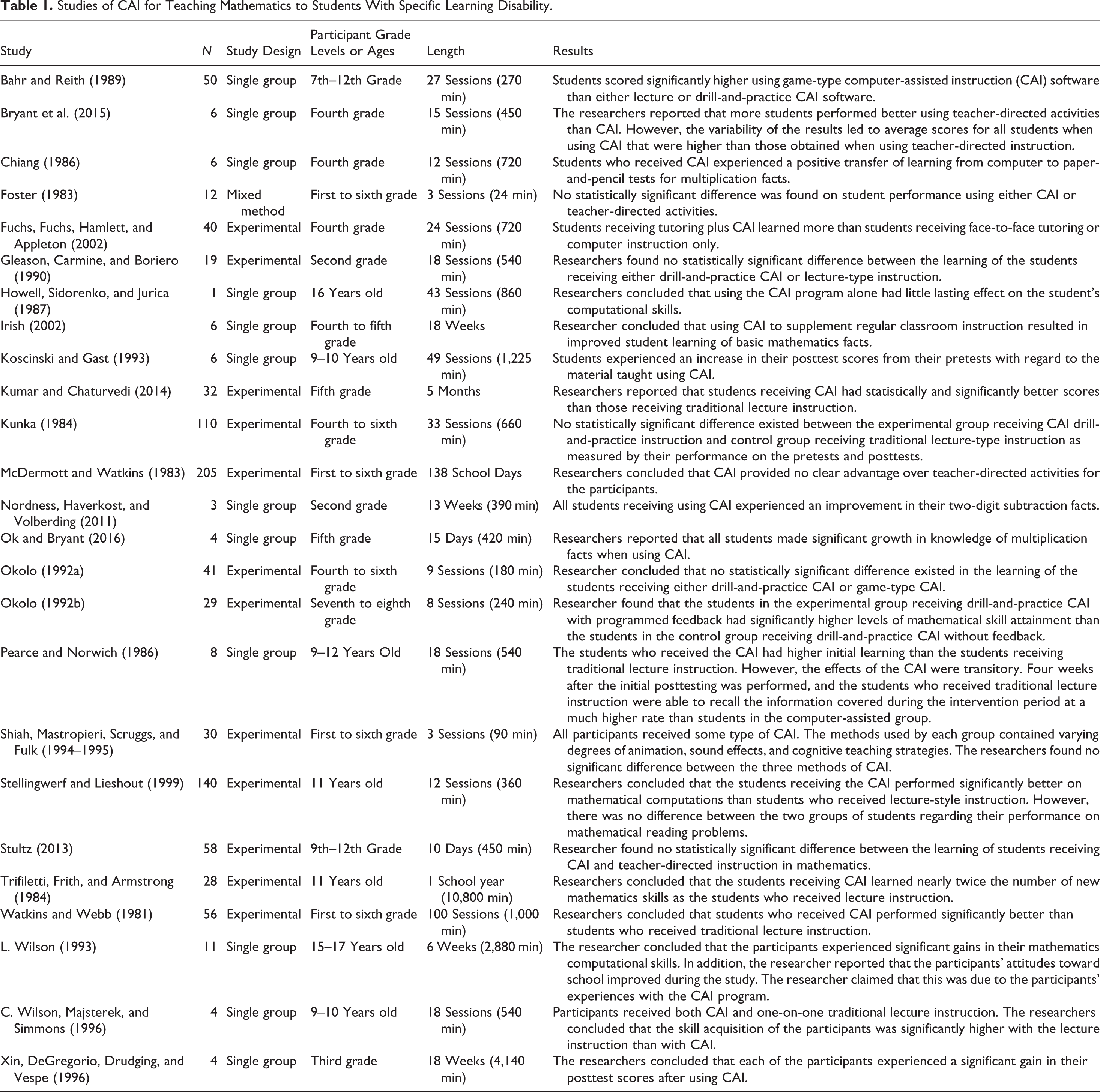
Each of the studies in Table 1 examined the efficacy of CAI for teaching mathematics to students with SLD, and the findings of the studies were relevant to addressing the research questions for this review. The author relied on the peer-review process of each of the educational journals to filter unreliable studies. It was assumed that publication in journals that undergo exhaustive peer review was sufficient for this review. The goal of the review was not to evaluate the relative quality of the individual studies. It was also not designed to identify or suggest a single best practice for all students with SLD. Instead, the author sought to survey the current body of research to determine the answers to the two research questions regarding the effectiveness of CAI for teaching mathematics to students with SLD. Part of that process was to determine whether any gaps, such as underrepresentations of certain groups of students, or other general weaknesses existed. The answers to these research questions will help guide classroom teachers and future researchers on this topic by identifying potentially effective methods of teaching as well as pointing to where additional research is needed. The current study was not designed to provide a critical analysis of past research on using CAI for teaching mathematics to students with SLD.
Results
The results of the review are divided into six areas: (a) overall research findings, (b) sample size, (c) research designs, (d) participant characteristics, (e) study length, and (f) age of studies. Each of these factors was examined individually to provide a detailed analysis of the 25 research studies in a way that combining them into a single analysis might obfuscate. Separate discussion and summary tables are provided for each area of analysis. The goal was to provide a series of cross-sectional analyses of the current body of research. This type of analysis provided a more detailed review of the studies. It also helped to point out areas where future research may be needed.
Overall Research Findings
Table 1 discusses the overall findings of each of the 25 research studies regarding the efficacy of using CAI to teach mathematics to students with SLD. The discussion in Table 1 is based on the reported findings by the authors of each study. Slightly more than half (56%) of the studies yielded results that, in general, supported the use of CAI for teaching mathematics to students with SLD.
Sample Size
The number of participants (N) in a study can be an important consideration. Larger sample sizes tend to improve the generalizability of the study results (Creswell, 2002). The median sample size for the 25 studies identified in this review was 19 participants. The range for the sample size was between 1 and 205 participants. The sample size for each study is listed in Table 1.
Research Designs
Forty-eight percent of the studies identified by the researcher utilized experimental methods of analysis with a control group and an experimental group. The other studies used other research designs such as a single-group or a mixed-method approach. Forty-eight percent of the studies used a single group design, while 4% of the studies used a mixed-method approach.
Many of the studies that utilized the experimental (i.e., control group and experimental group) design failed to isolate the effectiveness of CAI programs. Twenty-five percent (i.e., 3 of 12) of the research studies utilizing the experimental design compared different types of CAI programs, such as game type or drill and practice, instead of examining the effectiveness of CAI as compared to non-CAI forms of instruction such as instruction using teacher-directed activity. Although these studies are useful for comparing different types of CAI programs, they are not appropriate for answering the question of whether CAI was as effective as other methods of instruction that did not utilize computers. Nine of the experimental design studies compared a CAI method of instruction.
Participant Characteristics
The characteristics of the participants in the studies presented a challenge. Eighty percent of the studies were conducted using students at the elementary school level. The participant grade levels or ages, as described by the original researchers, are listed in Table 1. This underrepresentation of middle school and high school students made generalization of the findings to students beyond the elementary school level difficult. In addition, recent changes to educational policies have emphasized students with disabilities performing at proficient levels on high-stakes state and national achievement tests (Marita & Hord, 2017). This has placed a greater emphasis on identifying effective teaching methods such as CAI for this population of students.
Study Length
Another factor to consider when examining the studies is the length of interventions utilized by the researchers. Table 1 lists the length of each study. Some of the studies listed a specific number of sessions and minutes per session, while others listed a time period such as 1 month or one semester. Where determinable, the total number of minutes of the intervention is listed in Table 1.
The length of the intervention might have had an impact on the results of the study. For example, the longest study was conducted by Trifiletti, Frith, and Armstrong (1984). That intervention was conducted in 180 sixty-minute sessions (i.e., a total of 10,800 min of instructional time). The researchers in that study concluded that the CAI group learned nearly twice as many new math facts as those receiving teacher-directed instruction. The shortest intervention was by Foster (1983). That study consisted of three 8-min sessions (i.e., a total of 24 min). Foster (1983) concluded that there was no difference between the different instructional methods. It is possible that a longer study might have yielded different results.
Age of Studies
Finally, the ages of the studies in the current body of research should be addressed. The median age of the published research studies located was 24 years old. The year of publication of each study is found in Table 1. Two thirds of the studies were published before 1999. In addition, only 20% of the studies were published in the past 9 years. Changes in computer technologies since the earlier studies on CAI for teaching mathematics to students with SLD may modify the conclusions of the earlier studies. Students with SLD should be taught using the best practices available, so additional research may be needed on the efficacy of CAI as a method for teaching mathematics to this group of students.
Discussion
The author designed this review to address the following research questions:
The review also provided a summary of the current body of research regarding the use of CAI for teaching mathematics to students with SLD.
The current body of educational research on this topic is sparse. Since the introduction of the first PC in 1981, only 25 research studies isolating the efficacy of using CAI to teach mathematics to students with SLD have been published. In addition, many of the current studies exclusively examined the effectiveness of CAI for students at the elementary school level. Only five studies included students who were in either middle school or high school, and only one of those studies was published in the past 20 years. Finally, less than one third of the research studies included in this review were published since 1999. This distribution demonstrates a need for additional research, especially at the middle and high school levels.
The research findings support the idea of using CAI to augment traditional classroom instruction. Each of the three studies (Fuchs, Fuchs, Hamlett, & Appleton, 2002; Irish, 2002; Okolo, 1992b) that examined the effectiveness of adding CAI to traditional teacher-directed instruction found that students experienced significant improvement in their mathematical performance when augmenting traditional classroom instruction with computerized resources.
The research results were not as conclusive for using CAI in place of traditional teacher-directed activities. Some researchers (Stellingwerf & Lieshout, 1999; Trifiletti, Frith, & Armstrong, 1984; Watkins & Webb, 1981) concluded that CAI was more effective than traditional classroom instruction. However, others (Pearce & Norwich, 1986; C. Wilson, Majsterek, & Simmons, 1996) found that CAI was less effective than teacher-directed activities. A final group of researchers (Bryant et al., 2015; Foster, 1983; Ok & Bryant, 2016) found no statistically significant difference between the learning of students using CAI and those receiving traditional face-to-face instruction. Using CAI to replace classroom instruction can be appealing, given shrinking school budgets across the nation. However, the lack of clarity in the current body of research demonstrates the need for additional study regarding the efficacy of the use of CAI as a substitute for classroom teaching.
Regarding the first research question, it appears that the current body of research generally supports the use of CAI for teaching mathematics to students with SLD. However, the extent to which CAI should be utilized (i.e., as a primary means of instruction or as an augmentation to classroom instruction) is not yet clear. These results also help to address the second research question. Additional research is needed to test the efficacy of CAI for students beyond the elementary level and for using CAI to either supplement or supplant traditional classroom instruction.
Finally, research regarding higher level mathematics skills should also be considered as a topic for future research. None of the 25 research studies in this review examined the use of CAI for teaching higher level mathematics topics such as algebra or geometry. A basic understanding of algebra or geometry is useful to students with SLD as they transition from school to the workplace (Patton, Cronin, Bassett, & Koppel, 1997; Watt, Watkins, & Abbitt, 2016). Therefore, research regarding the efficacy of CAI for teaching those subjects to students with SLD would be informative.
Implications and Recommendations
The results of the current review have implications for those teaching students with SLD as well as educational researchers looking for best practices in the area. Some of the implications for classroom teachers and recommendations for researchers will be provided in this section. Clearly, the specific environment in which the teacher and researcher work will affect the implementation of these items.
Recommendations for Classroom Teachers
For classroom teachers, the overall findings of the current body of research regarding the efficacy of using CAI to teach mathematics to students with SLD were promising. In 60% (i.e., 12 of 20) of the studies with participants at the elementary level, the use of CAI to teach mathematics to students with SLD was supported by the research findings. In addition, 60% (i.e., 3 of 5) of the studies with participants at the middle school and high school levels supported the use of CAI for mathematics instruction. Classroom teachers may want to consider using CAI as a viable alternative, either as a primary source of teaching or to augment classroom instruction, when planning educational programs for students with SLD. However, teachers should be aware that there is a limited number of recent studies regarding the efficacy of CAI for teaching mathematics to students and that the results of future research may modify this recommendation.
Recommendations for Researchers
For educational researchers, additional examination of this topic for students with SLD is needed. Recent advancements in computer technologies may modify the effectiveness of CAI for teaching mathematics to students with SLD. In addition, the sparse amount of research including students at the middle school and high school level demonstrates that a clear gap in the literature exists. The author makes the following recommendations for future research on the efficacy of CAI for teaching mathematics to students with SLD:
Conduct research on CAI for teaching mathematics to students with SLD who are in middle school or high school. Only 20% of the studies in the current body of research examined the effectiveness of using CAI for teaching mathematics to this group of students. Mathematical fluency is essential for academic and life success, so it is important that older students also receive instruction using the best methods possible to help prepare them for their post school lives (National Mathematics Advisory Panel, 2008; National Research Council, 2001). Additional research is needed for determining the efficacy of CAI for middle and high school students with SLD.
Replicate earlier studies on CAI using modern CAI programs to determine whether different results are obtained. Modern CAI programs have more advanced graphics, sound, and other enhancements compared to those from the 1980s and 1990s. Replicating earlier studies using modern CAI programs may help to determine whether the results of the earlier studies should be reconsidered.
Utilize an experimental research design with a control group and an experimental group that examines the effectiveness of one or more CAI methods against a traditional lecture-type classroom. Only 8% of the studies published within the past 10 years employed this type of design. The average age for all studies employing the experimental group and control group design was 24 years. Older studies may not be as applicable to today’s students because of the advances in computer technology over the past 20 years. This type of design can help to provide a direct comparison of the efficacy of CAI versus non-CAI methods of instruction using modern CAI programs.
Examine the efficacy of CAI for teaching students with SLD more advanced mathematical concepts. All the studies in the current body of literature examined the use of CAI for teaching basic mathematical skills such as computational skills and reading problems. None of the studies examined teaching advanced mathematical concepts, such as algebra or geometry, to this group of students. Effective training in those areas to students with SLD can help them as they transition into the workplace (Patton et al., 1997; Watt et al., 2016). This type of research would generally require using high school level students in the study, so it would help to expand the research for that group of students as well as for a different area of mathematics.
These recommendations are not intended to be an exhaustive list of research studies, designs, and participants. All types of research regarding the efficacy of using CAI to teach mathematics to students with SLD would help to provide direction to practitioners and other researchers.
Limitations
The author attempted to avoid any issues with the review. However, no review is without limitations. The author recognized four limitations of this review. Each of the limitations is discussed here.
First, only published research studies were included in the review. It would not have been practicable to locate unpublished studies for inclusion in the analysis. Including the results of unpublished studies might have yielded different results.
Next, it is possible that some studies were not discovered by the author during the review. The author used a variety of scholarly databases (e.g., Education Research Complete and ERIC) and major search engines (e.g., Bing and Google) to identify research studies on the effectiveness of CAI for teaching mathematics to students with SLD. Any studies not listed with one of the major databases may not have been located by the author for inclusion in this review.
Also, the design of a study might have an influence on its findings and conclusions. For example, the findings of the studies without non-CAI control groups might not be comparable to those with non-CAI control groups in all instances. In addition, differences in group sizes and participant ages might make a study’s results less generalizable. The author chose to examine those factors separately in the review to allow the reader to see that differences in the study designs existed.
Finally, not all studies located by the author provided sufficient information to perform statistical power or effect analysis. Therefore, this was not included in the review. The lack of the power or effect size analysis does not limit the relevance of the review. However, if the information had been available from each of the studies, it would have helped to add to the discussion provided by the author.
Conclusion
The current body of research regarding the effectiveness of using CAI to teach mathematics to students with SLD is lacking. Additional research is needed in this area, especially for students beyond the elementary school level. The author who conducted this review has extensive experience in the K–12 special education environment and with teaching mathematics to students with and without disabilities. The author’s firsthand experience with these areas led to this focused type of review. Limited school budgets and constraints on the time of classroom teachers necessitate the need to identify best practices to be used in the classroom. The current body of research does not provide this level of clarity about using CAI to teach mathematics to students with the SLD. Future research will assist classroom teachers, students with SLD, preservice special education teachers, and college faculty.
Footnotes
Declaration of Conflicting Interests
The author(s) declared no potential conflicts of interest with respect to the research, authorship, and/or publication of this article.
Funding
The author(s) received no financial support for the research, authorship, and/or publication of this article.